Best AI Model for Business 2026: Muse Spark 1.1 vs GPT-5.6 vs Claude vs Gemini


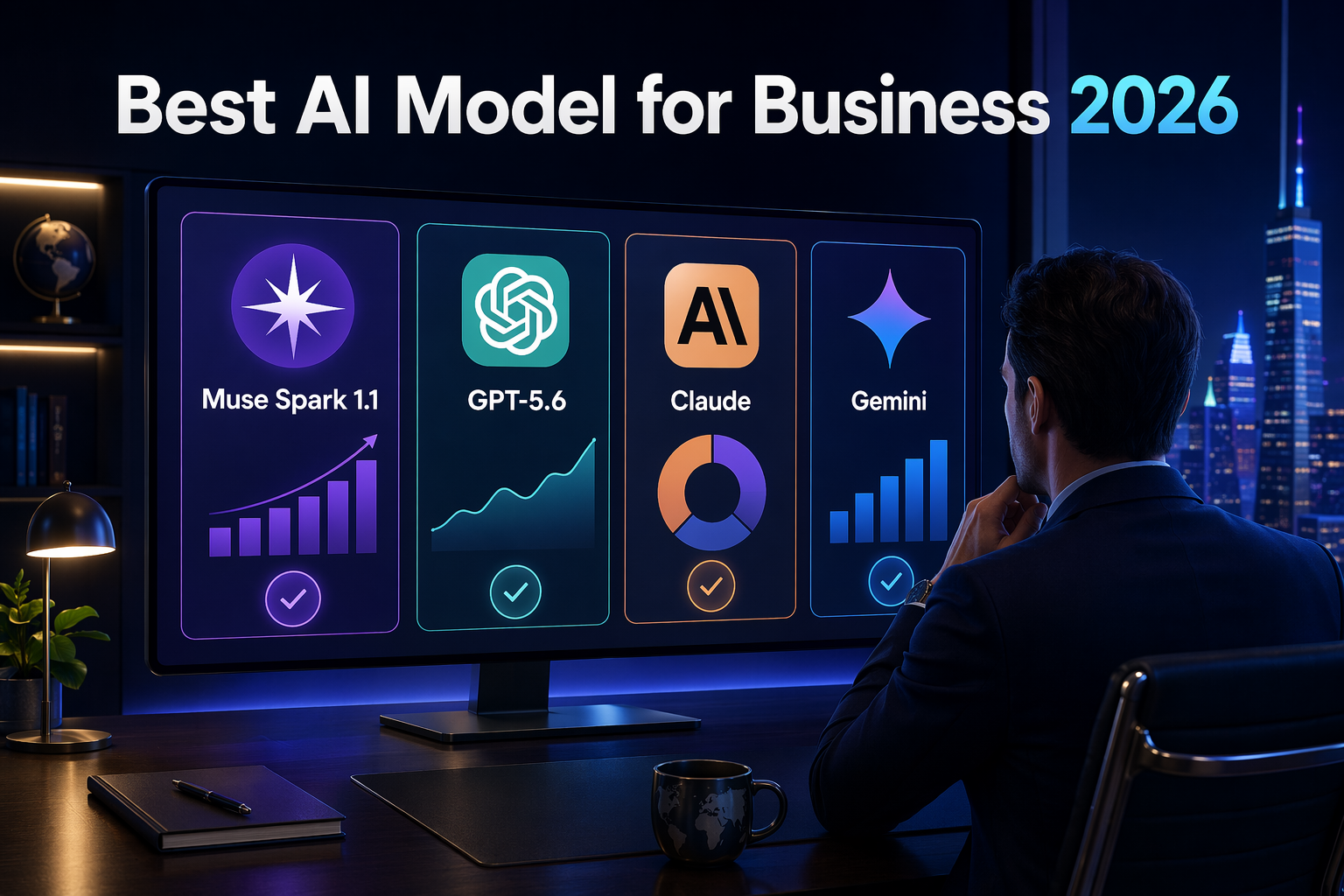
Compare Muse Spark 1.1, GPT-5.6, Claude, and Gemini by capabilities, API access, pricing, privacy, and the best business use cases.
Best AI Model for Business 2026: Muse Spark 1.1 vs GPT-5.6 vs Claude vs Gemini
What if the best AI model for business 2026 is not the one with the highest benchmark score—but the one that fits your workflows, budget, data policies, and region? The question became more urgent on July 9, 2026, when Meta released Muse Spark 1.1 in public developer preview, claiming strong agentic, tool-use, computer-use, and coding performance with a 1-million-token context window, according to Meta and Reuters.
This comparison examines Muse Spark 1.1 vs GPT-5.6, Claude, and Gemini across multimodal reasoning, coding, API access, agentic workflows, deployment, latency, pricing, privacy, and customer-support or voice-agent use cases. Because capabilities, regional availability, pricing, and benchmarks can change quickly, treat every figure as time-sensitive and verify it before deployment. Platforms such as CallMissed reflect this shift by connecting businesses to multiple AI models through one integration.
Which AI model is best for business in 2026? At a Glance: Verdict
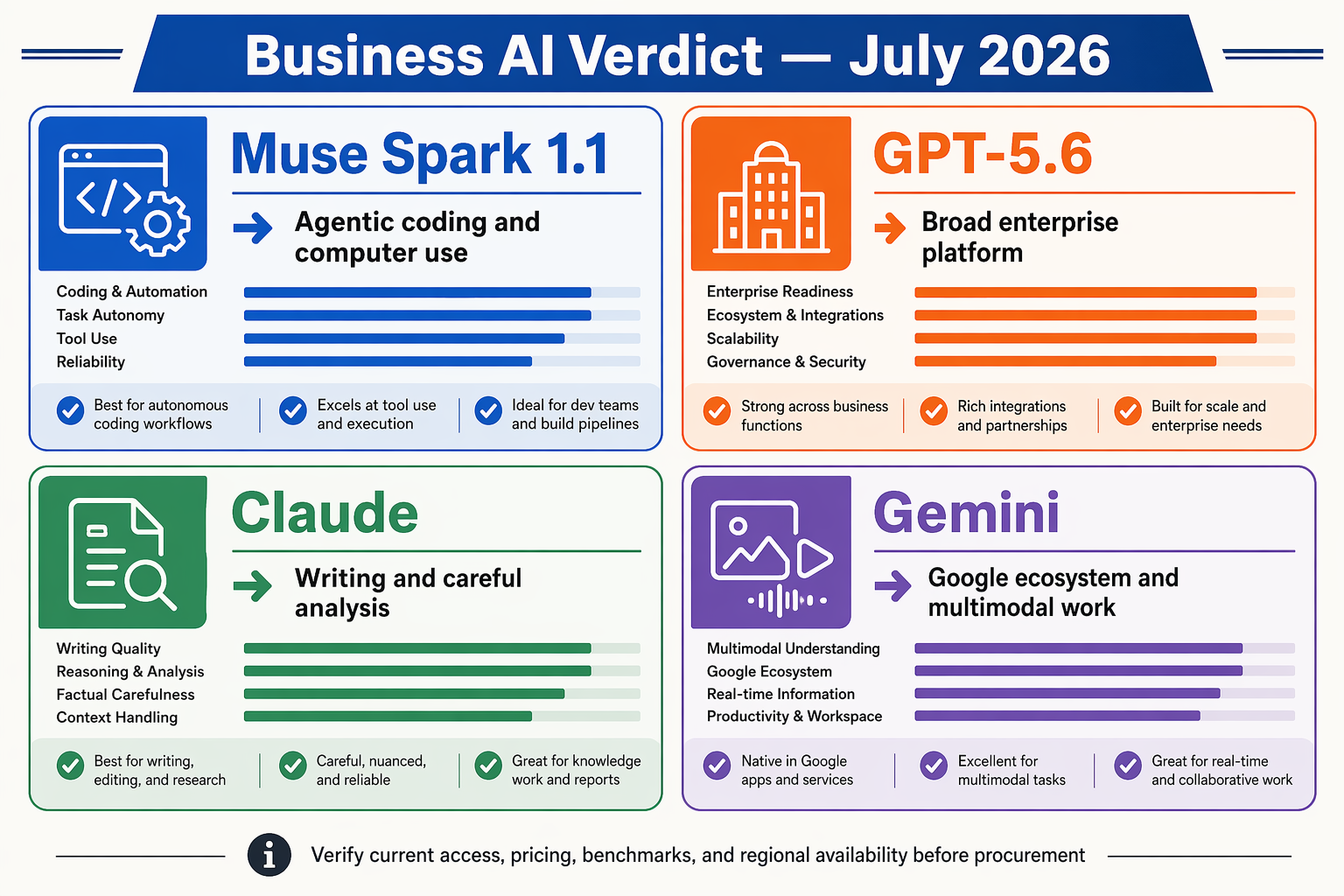
The best AI model for business 2026 is the model that performs best on your real workflow, budget, data policy, and regional requirements—not a universal benchmark winner. As of July 10, 2026, Muse Spark 1.1 is a promising new option, but it remains a public developer preview, and cross-vendor benchmarks are not fully apples-to-apples.
At-a-Glance Verdict
- Agentic and computer-use workflows — Muse Spark 1.1: A leading candidate to test for long-running agents, tool use, computer use, and coding. Meta states that it supports a 1-million-token context window and opened API access in public preview on July 9, 2026. Treat it as an evaluation candidate rather than a proven production default.
- Coding and production integrations — GPT-5.6: Consider it when you value OpenAI’s developer ecosystem, tooling, function calling, and existing integrations. Before deployment, confirm the exact GPT-5.6 model ID, coding performance on your repository, rate limits, pricing, and regional availability.
- Document analysis and writing — Claude: A strong choice for document-heavy research, summarization, writing, coding, and enterprise governance. Because Claude includes multiple model tiers, compare the specific model and configuration—not only the Claude brand.
- Multimodal and Google workflows — Gemini: Shortlist Gemini for image, audio, video, and document understanding, particularly when your business already uses Google Workspace or Google Cloud. Verify API access, context limits, data residency, and billing for the selected model.
- Customer support — test several models: The best AI model for business 2026 support workflows should be selected using real tickets and tools. Measure response accuracy, function calling, retrieval quality, latency, escalation reliability, multilingual performance, and cost per resolved conversation.
- Voice agents — prioritize real-time behavior: Evaluate streaming latency, interruption handling, speech recognition, text-to-speech quality, accent coverage, tool execution, and human handoff. Platforms such as CallMissed can help route multiple models through one integration rather than locking every workflow to one provider.
Decision rule: Choose the model that meets your quality and compliance threshold at the lowest reliable total cost; use a second model when another workflow has materially different needs. In practice, finding the best AI model for business 2026 means piloting two or three candidates on your own data before committing.
Reuters reported Muse Spark 1.1 as a public developer preview, not a final stable release. Verify all pricing, model IDs, context limits, quotas, availability, and regional restrictions as of deployment, since vendor specifications can change quickly.
What are the real capabilities of Muse Spark 1.1, GPT-5.6, Claude, and Gemini? Feature Comparison
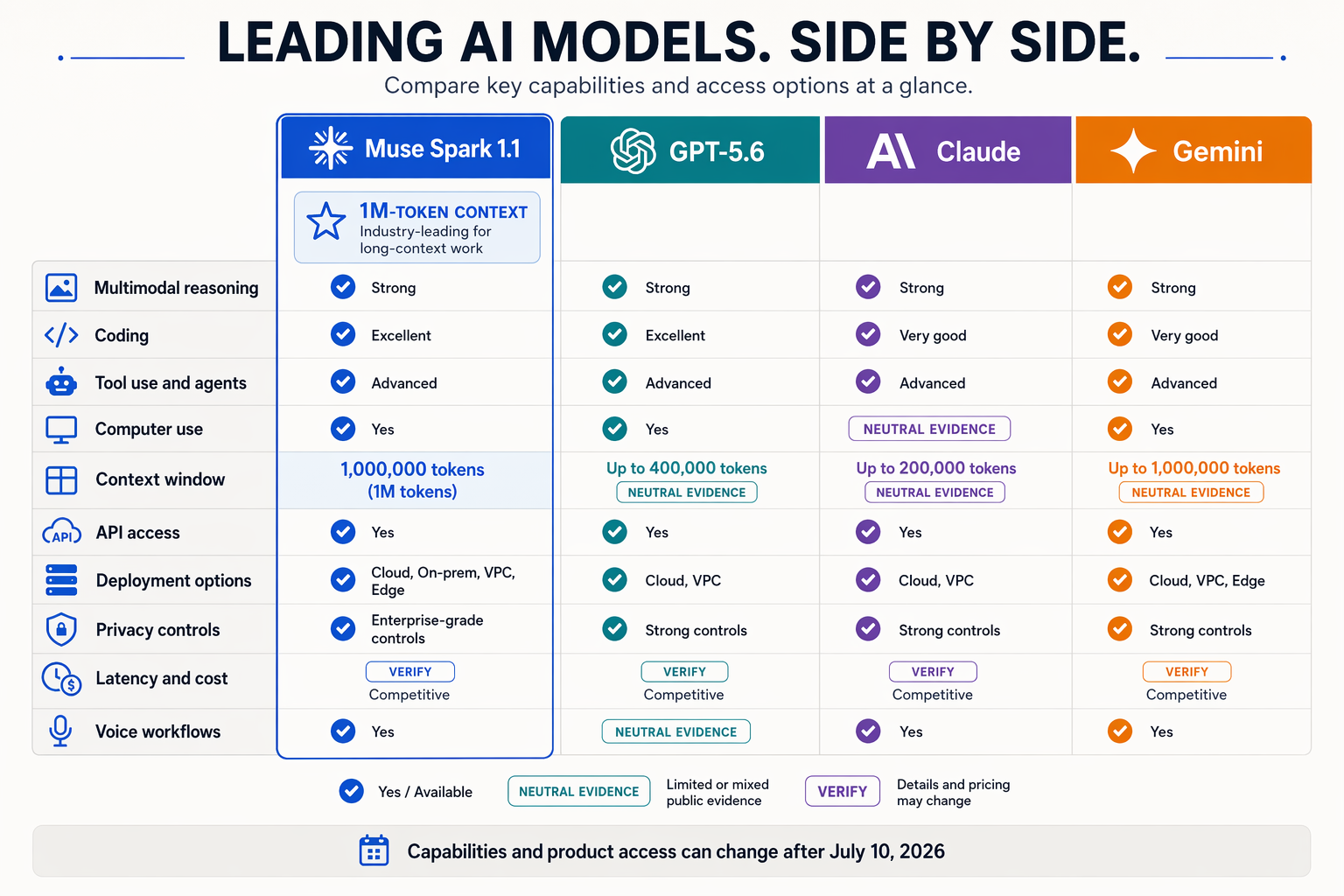
The real difference is workflow fit, not a universal winner: Muse Spark 1.1 has the clearest published agentic claim, while GPT-5.6, Claude, and Gemini require model-specific verification of capabilities, limits, and access as of July 10, 2026.
- Muse Spark 1.1: Meta describes it as “strong” for agentic performance, tool use, and computer use, with a 1-million-token context window; Reuters reported its public developer preview began July 9, 2026.
- GPT-5.6: Evaluate the exact model ID, reasoning mode, tool and vision support, rate limits, pricing, and regional API availability; “GPT-5.6” alone is not enough for a production decision.
- Claude: Compare the specific Claude tier for document analysis, coding, tool use, context limits, enterprise controls, and data-retention terms; Claude is a model family, not one fixed specification.
- Gemini: Validate the selected Gemini model’s multimodal inputs, Google Workspace or Google Cloud integration, context capacity, latency, residency, and country-level billing.
- Customer support and voice agents: Test streaming, function calling, interruption handling, multilingual speech, escalation, and response latency—not only text reasoning or coding scores.
Feature comparison
| Model | Published capability signal | Context / modality | Access status | Business evaluation priority |
|---|---|---|---|---|
| Muse Spark 1.1 | Agentic, tool-use, computer-use, coding | 1M tokens; verify multimodal details | Public developer preview from July 9, 2026 | Long-running agents and computer-use pilots |
| GPT-5.6 | Exact claims require current provider documentation | Verify selected model’s limits and modalities | Verify API, geography, and tier | Mature tooling, reliability, and integration fit |
| Claude | Strong candidate for writing, coding, and document workflows | Varies by Claude model | Verify API, console, and enterprise availability | Governance, analysis, and high-quality written output |
| Gemini | Strong candidate for multimodal and Google-connected workflows | Varies by Gemini model | Verify Google AI or Cloud access by region | Workspace, Cloud, media, and multimodal use cases |
- Important limitation: No comparable benchmark scores for all four models are provided in the July 2026 source material; do not invent a leaderboard.
- Practical test: Run identical business tickets, tools, documents, languages, and escalation rules through two or three shortlisted models before selecting one.
How much do these AI models cost for businesses? Pricing & Value
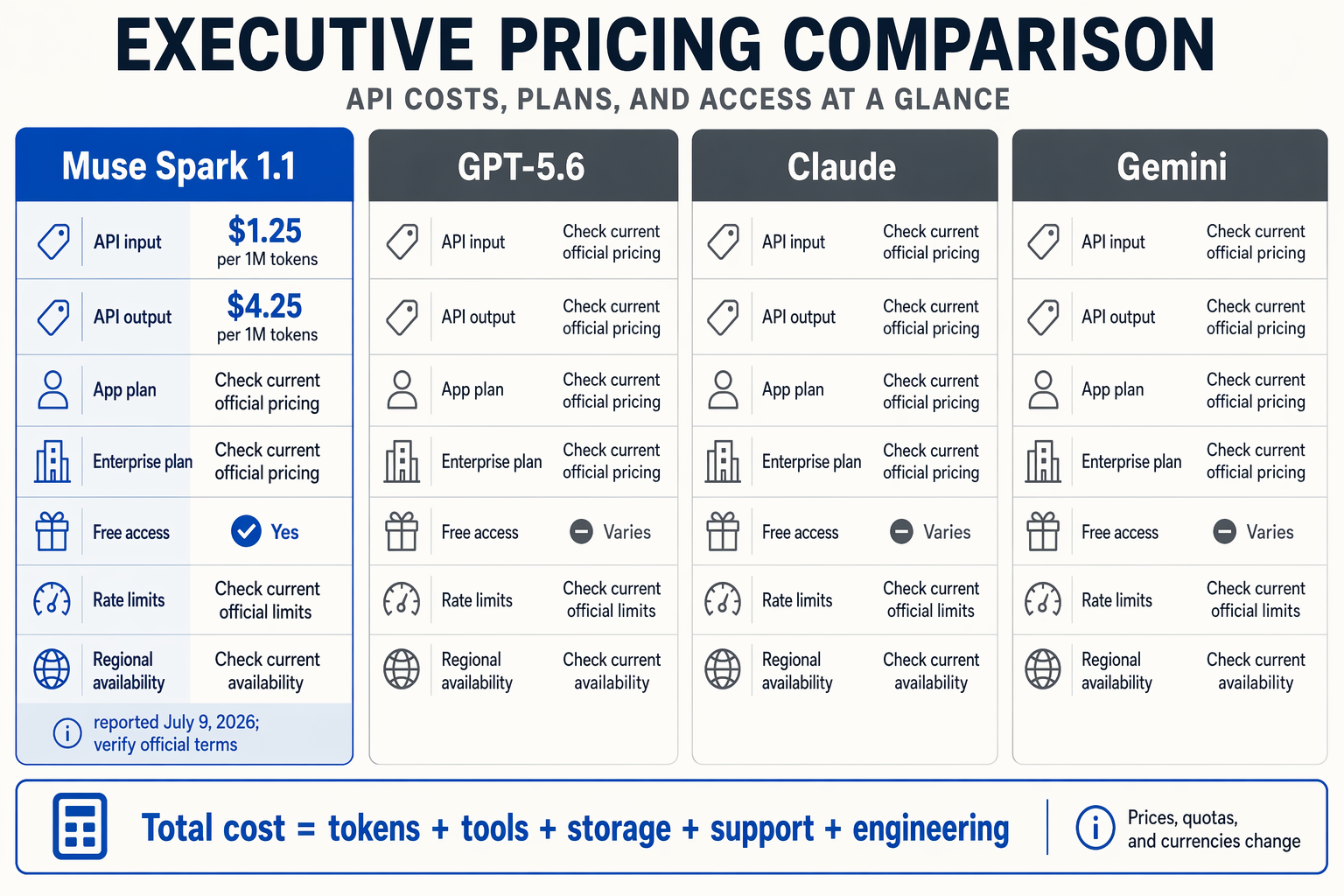
The lowest advertised price is not enough to determine business value. As of July 10, 2026, exact pricing, access conditions, usage limits, and regional billing for Muse Spark 1.1, GPT-5.6, Claude, and Gemini must be verified against the selected model and official rate card.
Pricing snapshot
| Model or route | July 2026 pricing evidence | Access status | Business cost check |
|---|---|---|---|
| Muse Spark 1.1 | Meta described Muse Spark 1.1 as available at a “very low price,” but the supplied sources do not state exact input or output rates | Reuters reported a public developer preview on July 9, 2026 | Confirm preview limits, production terms, rate limits, overage pricing, and support before deployment |
| GPT-5.6 | No exact GPT-5.6 price is established in the supplied July 2026 sources | Verify the official model identifier, API availability, and regional access | Price input, output, cached context, batch processing, tool calls, and any enterprise commitments |
| Claude | “Claude” includes multiple models and service tiers; no single brand-level price applies | Confirm the selected Claude model, API route, and deployment region | Compare context usage, caching, latency, quality per task, and contract terms |
| Gemini | “Gemini” covers different API and Google Cloud offerings; exact model pricing is required | Check Google AI or Google Cloud availability for the target region | Include multimodal input, grounding, storage, platform, and network charges |
| CallMissed gateway | Gateway pricing and underlying model charges must be checked in the current CallMissed billing documentation | A single OpenAI-compatible integration can consolidate access to multiple model categories | Evaluate consolidated billing, supported models, token charges, limits, and fallback terms |
Meta’s July 9, 2026 announcement described Muse Spark 1.1 as strong in “agentic performance, tool use, and computer use,” with a 1-million-token context window, according to Meta’s release post on Threads. Those capabilities may improve workflow completion, but a large context window can also increase spend when applications repeatedly send long prompts, documents, or conversation histories.
How businesses should calculate value
Do not compare only headline cost per million tokens. Estimate the cost of the business outcome:
- Customer support: cost per resolved ticket, deflected escalation, or successful handoff.
- Agentic workflows: cost per completed workflow, including tool calls, retries, browser actions, and human review.
- Voice agents: include speech-to-text, model inference, text-to-speech, telephony, and session duration.
- Enterprise deployments: account for logging, monitoring, security controls, data retention, support, and integration engineering.
For India-based teams, verify INR billing, GST treatment, foreign-exchange exposure, payment methods, data residency, and regional service availability before signing a production contract. Pricing can also differ between direct vendor APIs, cloud marketplaces, and third-party gateways.
Solutions such as CallMissed’s OpenAI-compatible gateway can consolidate access and billing through one integration, potentially reducing integration overhead. However, teams should independently verify gateway fees, the underlying model’s token charges, quotas, and whether any fallback behavior is included or billed separately. The most defensible July 2026 decision is therefore a short pilot using representative workloads, measured latency, completion rates, and total cost per successful business outcome.
What are the strengths and weaknesses of each model? Pros and Cons
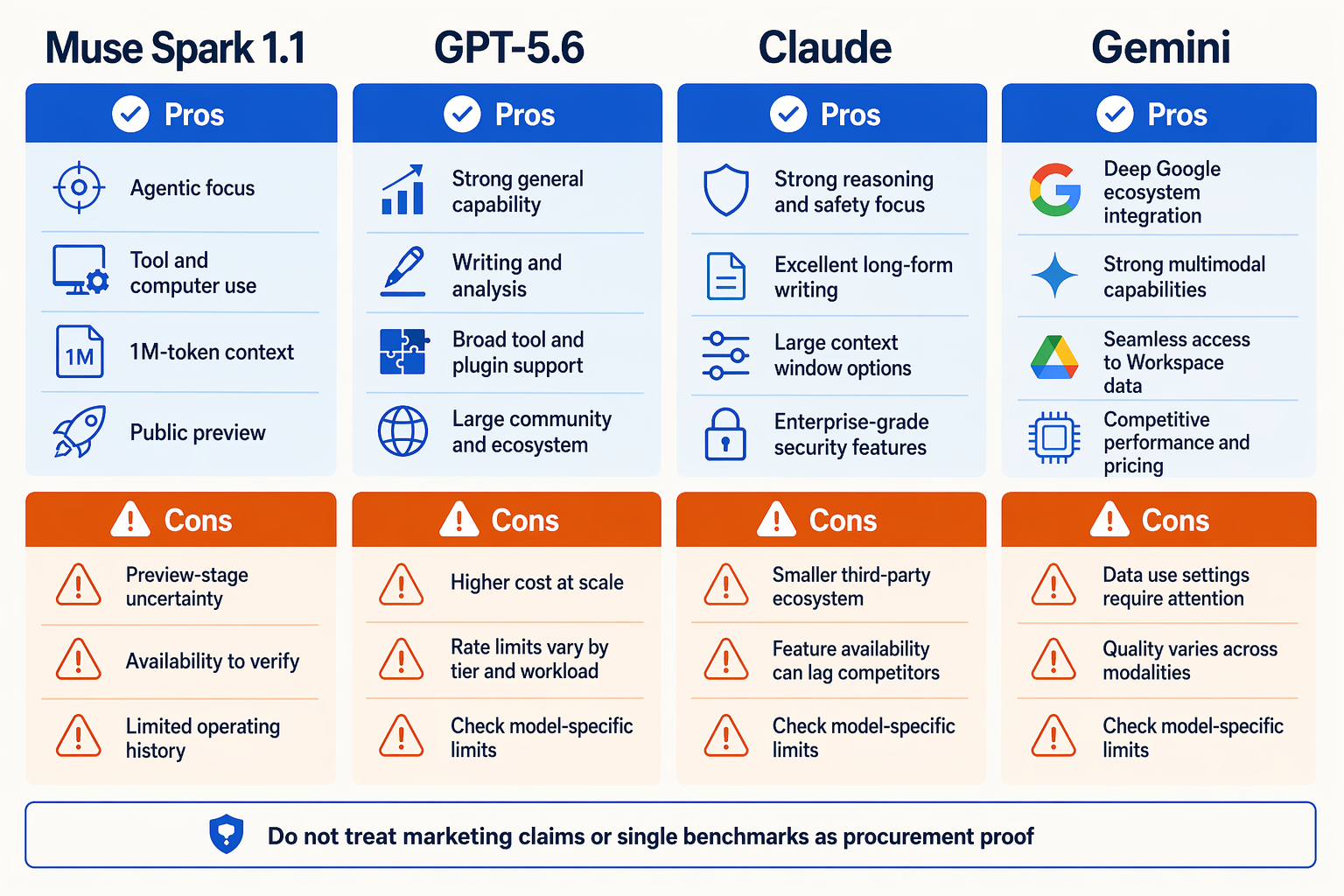
The practical choice depends on the workflow, not on a single headline benchmark. Muse Spark 1.1 is positioned for strong agentic, tool-use, computer-use, and coding performance, while GPT-5.6, Claude, and Gemini require model- and region-specific verification before production deployment.
Pros and Cons
| Model | Strengths | Limitations / risks | Best business fit | Verify before buying |
|---|---|---|---|---|
| Meta Muse Spark 1.1 | Meta described Muse Spark 1.1 as strongest in agentic performance, tool use, and computer use; the model is also reported to support a 1-million-token context window for long-running tasks. | Released as a public developer preview on July 9, 2026. Production stability, latency, pricing, rate limits, and support commitments may change. | Coding agents, browser and computer-use workflows, research tasks, and long-running tool orchestration. | Exact API model ID, preview SLA, API limits, data policies, multimodal support, India and other regional access, and production-readiness timeline. |
| GPT-5.6 | OpenAI’s established developer ecosystem and broad tooling can simplify existing integrations, structured outputs, and business automation. | The available July 2026 sources do not establish GPT-5.6’s exact context limit, benchmark profile, price, model ID, or regional access. | Existing OpenAI applications, customer-support automation, structured tool calling, and general-purpose workflows. | Official documentation, pricing, rate limits, retention controls, data residency, streaming latency, and the exact GPT-5.6 variant. |
| Claude | Claude models are a credible shortlist for document analysis, writing, software development, policy review, and long-context knowledge work. | Claude refers to several models and access channels; capability, context, pricing, tool support, and availability differ by selected tier and region. | Enterprise review, compliance-oriented content, long documents, coding, and research assistance. | Exact Claude model, API terms, supported tools and modalities, context window, regional billing, privacy controls, and throughput. |
| Gemini | Gemini is a logical option for multimodal analysis and organizations using Google Workspace, Google Cloud, or Vertex AI infrastructure. | Commercial terms and capabilities vary across Gemini model families and between direct API access and Vertex AI deployment. | Google-centric businesses, multimodal applications, cloud-native development, and enterprise data workflows. | Vertex AI versus direct API access, quotas, supported modalities, pricing, residency, logging, and the exact model version. |
Evaluate the Workflow, Not Just the Model
- Customer support: Run representative tickets through each model and measure tool-call accuracy, escalation decisions, response latency, multilingual quality, refusal behavior, and human handoffs. Text-only benchmarks do not capture the operational cost of an unreliable action.
- Voice agents: Test speech-to-text accuracy, text-to-speech naturalness, interruption handling, turn-taking, call transfer, and regional-language performance. A communication platform such as CallMissed can be relevant when businesses want to connect AI engagement across voice, WhatsApp, and other channels, but production quality still depends on the selected models and telephony setup.
- Agentic and coding workloads: Measure task-completion rate, recovery after tool errors, browser or computer-use reliability, repository-scale coding performance, and the number of retries required. Meta’s July 9 announcement and Reuters’ July 9, 2026 report establish Muse Spark 1.1’s preview status—not a universal production guarantee.
- Cost and deployment: Compare identical workloads using current prices, input and output tokens, caching, retries, tool calls, concurrency, latency, privacy terms, and regional availability. Solutions such as CallMissed’s OpenAI-compatible gateway can reduce integration work when teams need to test multiple model providers, but buyers should still verify the underlying provider’s terms and exact model IDs before launch.
Which model should your business choose for coding, support, research, and voice agents?
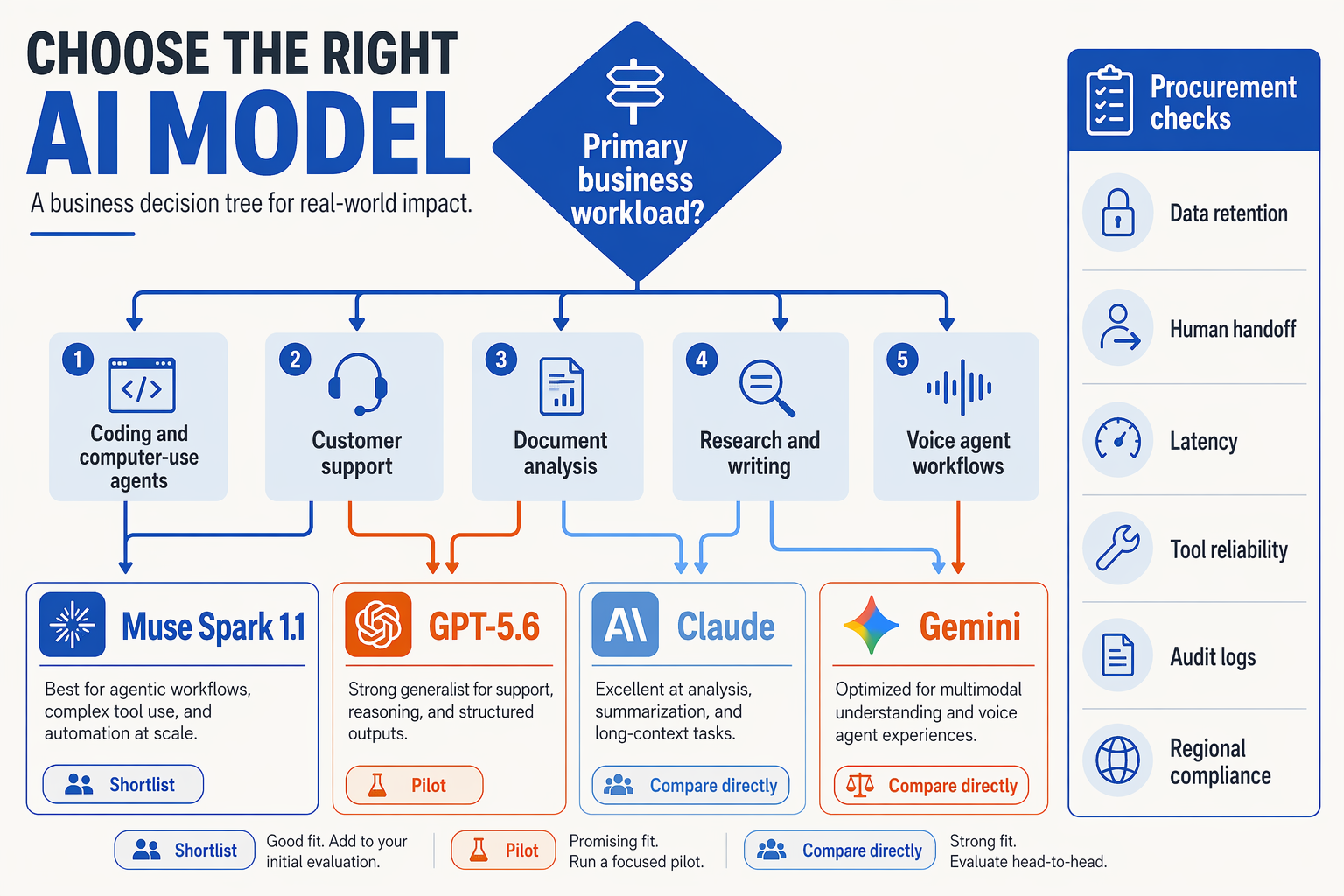
The right choice depends on the workflow, existing infrastructure, and deployment constraints—not on a single overall ranking. Muse Spark 1.1 is a logical candidate to test for agentic coding and long-running tool-use tasks, while GPT-5.6, Claude, and Gemini may be more practical where established APIs, enterprise controls, multimodal features, or cloud integrations are priorities. Verify current access, pricing, limits, benchmarks, and regional availability before making a production decision.
Choose by business workflow
- Coding and software agents: Include Muse Spark 1.1 in evaluations for autonomous coding, tool use, and computer-use workflows. On July 9, 2026, Meta positioned Muse Spark 1.1 as strongest at agentic performance, tool use, and computer use; Reuters separately reported Meta’s focus on real-world coding and agentic tasks. Treat that as vendor positioning, then test repository navigation, code edits, debugging, test execution, and recovery from failed tool calls using your own codebase.
- Long documents and research: Muse Spark 1.1 is worth testing alongside Claude and Gemini for large-document analysis. Meta’s July 9 announcement described a 1-million-token context window, but context capacity does not by itself guarantee strong retrieval, citation accuracy, or consistent reasoning across very long inputs. Measure answer quality on your own reports, contracts, and research sources.
- Enterprise applications: GPT-5.6, Claude, or Gemini may be a better operational fit when a business already uses OpenAI, Anthropic, or Google Cloud tooling. Compare the exact model, API tier, SDK support, identity controls, logging, and service commitments rather than treating each provider’s brand as a uniform product.
- Customer support: Choose the model that performs reliably on real tickets, not the one with the highest general benchmark score. Evaluate function calling, structured outputs, policy adherence, refusal behavior, escalation logic, multilingual handling, latency, and consistency across repeated conversations.
Choose by deployment constraints
- API access: Meta announced Muse Spark 1.1 as its first Spark model available through an API, with public developer preview access beginning July 9, 2026. Confirm model IDs, quotas, rate limits, uptime commitments, commercial terms, and whether preview access is suitable for production.
- Cost and latency: Run a representative pilot that records input and output tokens, tool-call counts, time to first token, end-to-end response time, retries, and fallback costs. No verified July 2026 price comparison is provided here, so use current provider pricing rather than estimates.
- Privacy and region: Before sending customer or regulated data, verify retention, training-use policies, encryption, data residency, compliance documentation, and availability in every operating country.
- Voice agents: Evaluate streaming speech-to-text (STT), text-to-speech (TTS) quality, interruption handling, turn-taking, multilingual accuracy, call-transfer reliability, and failure recovery separately from text reasoning. Platforms such as CallMissed can be assessed as an orchestration layer for AI voice-agent workflows, but the underlying model and telephony configuration still require independent testing.
How should teams validate an AI model before deployment?
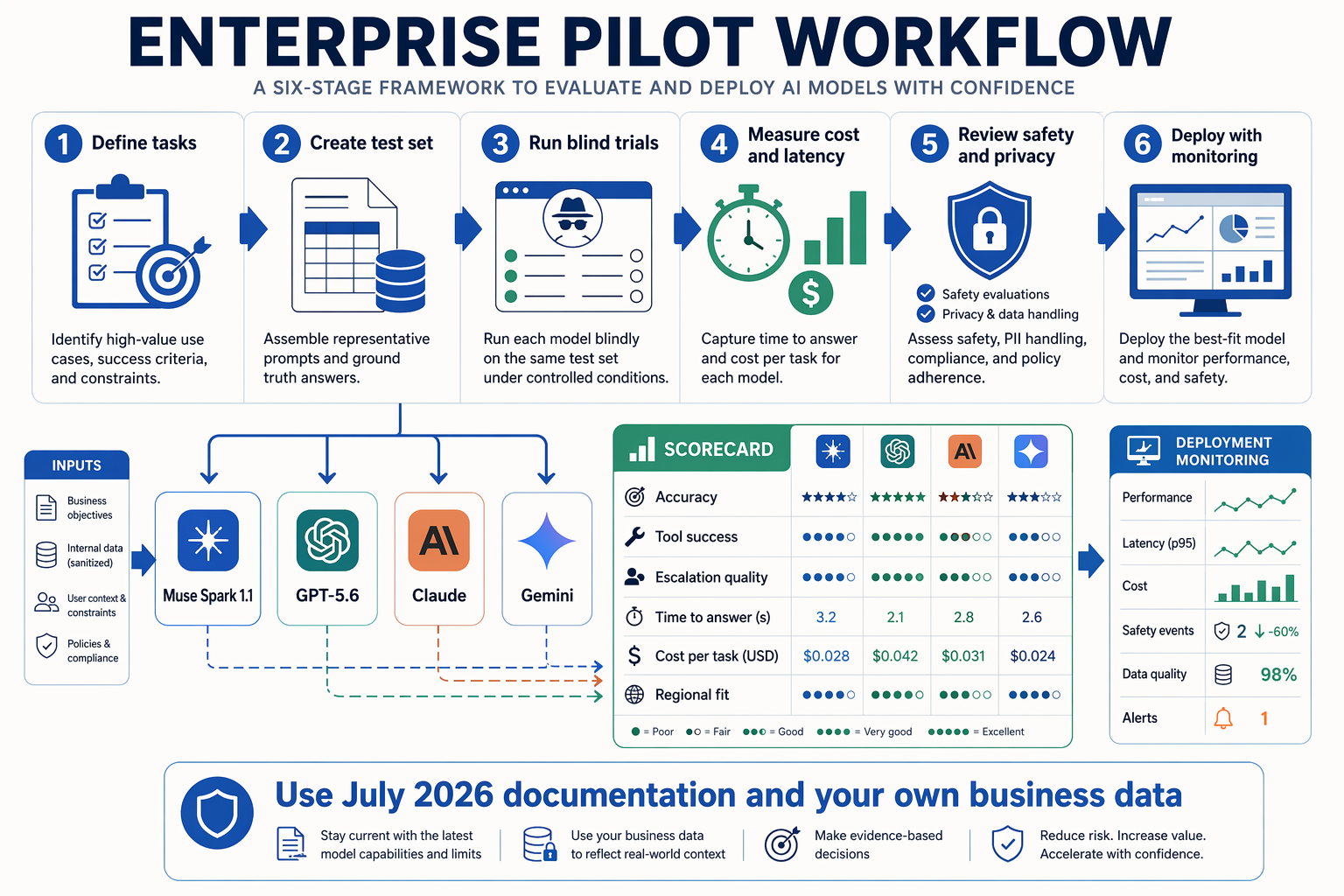
Validate the model on your own production tasks before choosing a winner. Muse Spark 1.1 remains a public developer preview as of July 10, 2026, so preview claims require especially careful testing.
Validation checklist
- Build a representative test set: Use at least 50–100 anonymized tickets, documents, code tasks, tool calls, and multilingual queries that reflect actual volume and failure modes.
- Measure task quality: Score factual accuracy, structured-output compliance, citation quality, tool-selection accuracy, refusal behavior, and human-review acceptance—not just published benchmarks.
- Test long-context claims: For Muse Spark 1.1, include retrieval tasks approaching its claimed 1-million-token context window; Meta described the model as strongest in agentic performance, tool use, and computer use on July 9, 2026.
- Run reliability tests: Repeat identical prompts, simulate API errors, and measure successful task completion, timeout rates, retry behavior, and recovery after a wrong tool call.
- Benchmark production economics: Record input and output tokens, image or audio charges, average and p95 latency, throughput, and fallback costs for the exact GPT-5.6, Claude, and Gemini model IDs under consideration.
- Verify regional access: Confirm API availability, data residency, retention controls, encryption, abuse-monitoring terms, and contractual commitments for the countries where customers and operators are located.
- Test voice and multilingual workflows: Measure interruption handling, streaming latency, transcription accuracy, pronunciation, escalation, and language coverage; platforms such as CallMissed can help teams evaluate multiple models behind one integration, including Indian-language voice workflows.
- Set a release gate: Require a documented quality threshold, maximum cost per resolved interaction, latency target, human-escalation rate, and rollback plan before moving from pilot to production; Reuters reported that Meta had not announced a full-release date for Muse Spark 1.1.
Frequently Asked Questions about Muse Spark 1.1 vs GPT-5.6 vs Claude vs Gemini
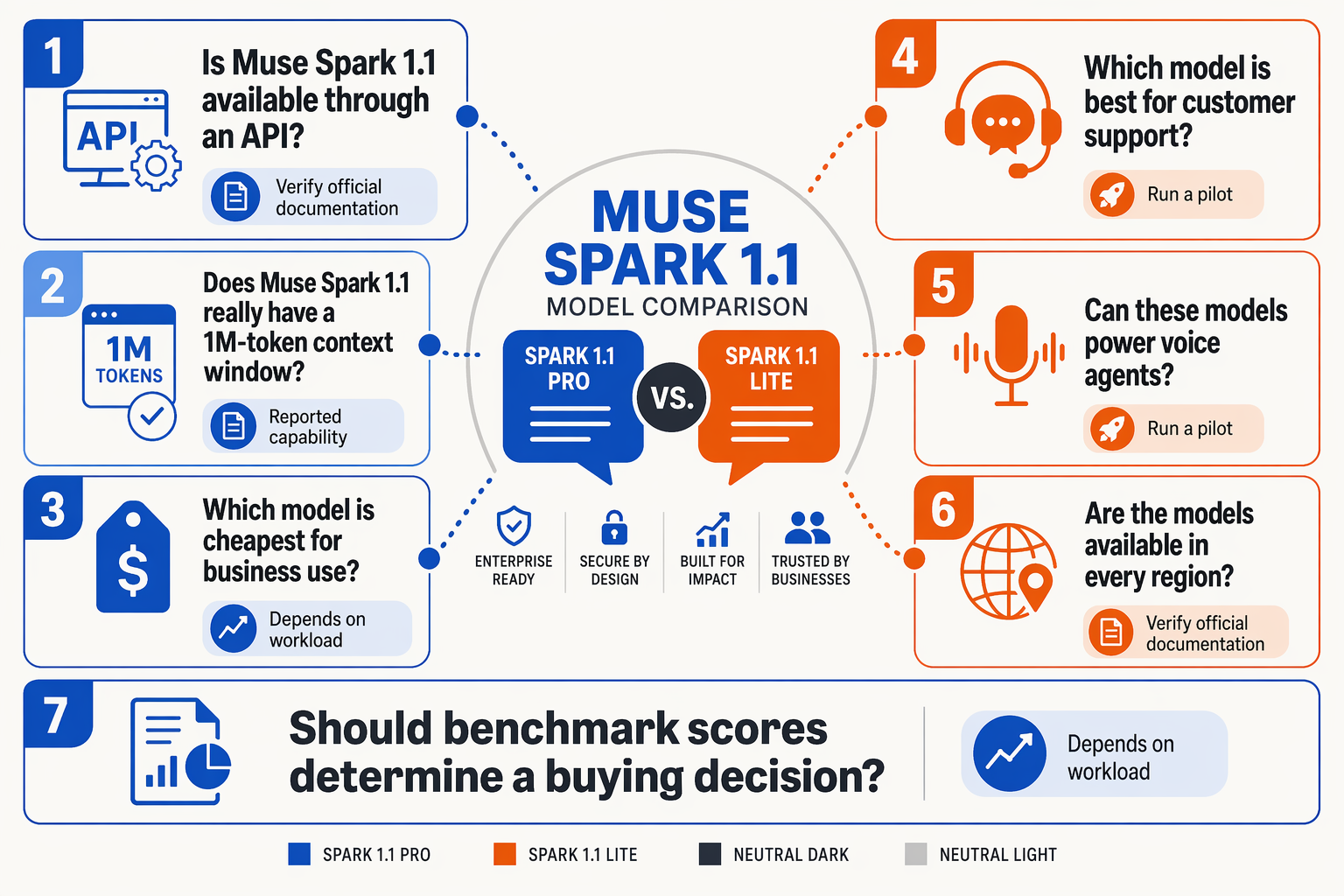
The best AI model for business 2026 depends on verified access, cost, compliance, latency, and workflow performance—not a single benchmark. As of July 10, 2026, Muse Spark 1.1 is still a public developer preview, so businesses should validate production readiness before switching.
- Q: What is the main difference in Muse Spark 1.1 vs GPT-5.6 for businesses?
A: Meta describes Muse Spark 1.1 as strongest for agentic performance, tool use, computer use, and long-running tasks, with a 1-million-token context window. GPT-5.6 may suit teams prioritising an established OpenAI ecosystem, but its exact model limits, pricing, and access should be verified from current documentation.
- Q: Is Muse Spark 1.1 better than Claude or Gemini for coding?
A: Meta and Reuters reported on July 9, 2026 that Muse Spark 1.1 targets real-world coding and agentic tasks, but no universal winner can be established without independent, task-specific testing. Compare the exact Claude and Gemini model versions on your repositories, tool calls, latency, error recovery, and security requirements.
- Q: Which is the best AI model for business 2026 customer support?
A: Select the model that delivers reliable retrieval, structured outputs, function calling, escalation, and low streaming latency on real customer conversations. For Indian deployments, platforms such as CallMissed add practical infrastructure around AI engagement, including WhatsApp Business calling, voice agents, and support for speech-to-text and text-to-speech across 22 Indian languages.
- Q: How much does Muse Spark 1.1 cost compared with GPT-5.6, Claude, and Gemini?
A: The provided July 2026 announcements do not establish a complete, directly comparable price sheet for all four model families. Confirm current input and output token rates, cached-token pricing, tool or search charges, minimum commitments, free quotas, and taxes before calculating total cost.
- Q: Can businesses access Muse Spark 1.1 through an API?
A: Yes, Meta opened Muse Spark 1.1 API access in public developer preview on July 9, 2026, according to Reuters and Meta’s announcement. Preview availability, rate limits, supported regions, service-level commitments, and production terms may differ from GPT-5.6, Claude, and Gemini, so verify each provider’s documentation.
- Q: Should a company choose Muse Spark 1.1 vs Claude vs Gemini immediately?
A: Not without a controlled pilot covering representative tickets, documents, code, tools, languages, latency, cost, privacy, and failure recovery. Run two or three candidates against the same evaluation set, and treat Muse Spark 1.1’s 1-million-token context claim as a capability to test rather than proof of production superiority.
Conclusion
The best AI model for business in 2026 is workflow-dependent, not a universal benchmark winner. Key takeaways:
- Muse Spark 1.1, released in public developer preview on July 9, 2026, is worth testing for agentic, computer-use, coding, and long-context workflows, including its claimed 1-million-token context window.
- GPT-5.6, Claude, and Gemini remain candidates for mature ecosystems, document analysis, governance, and multimodal or Google workflows—but verify model-specific pricing, limits, access, and regional availability.
- Customer-support and voice agents require testing latency, streaming, tool calls, multilingual speech, and escalation reliability.
Watch how preview access and production benchmarks evolve. Explore CallMissed to see how multi-model AI infrastructure supports voice agents and multilingual chatbots—and which model will best fit your next workflow?