
Property Management AI Receptionist: Safe Voice and WhatsApp Workflow Guide for 2026


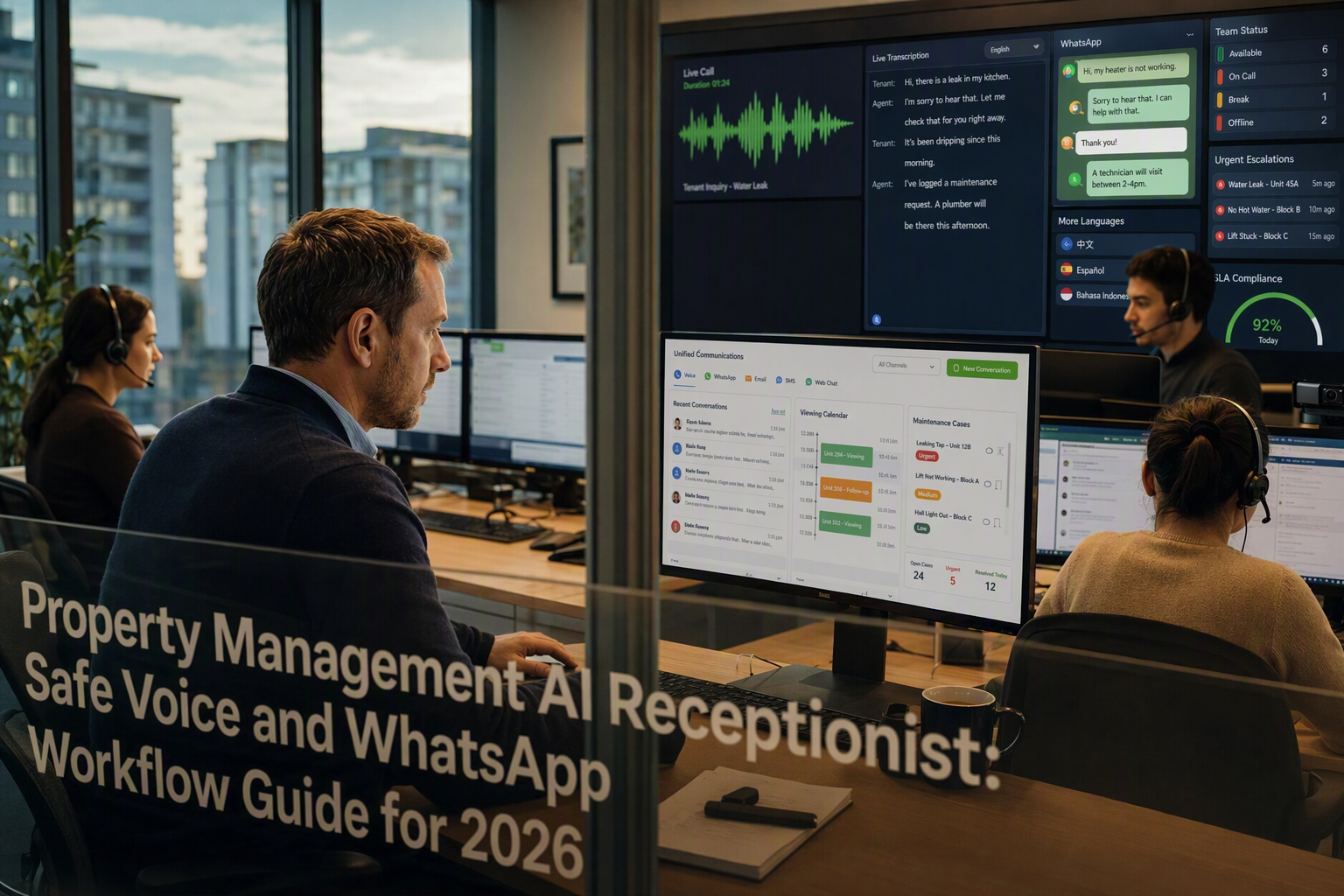
Learn how a property management AI receptionist handles calls, WhatsApp, maintenance triage, emergencies, integrations and KPIs safely.
Property Management AI Receptionist: Safe Voice and WhatsApp Workflow Guide for 2026
What happens when a tenant reports “a burning smell near the fuse box” at 2:00 a.m.—and the first responder is an AI agent? A property management AI receptionist can capture the address, verify the caller, identify emergency indicators and alert the right human within seconds, but it must never diagnose the electrical problem or offer risky repair instructions.
This distinction matters in 2026 because customer expectations and communication habits have shifted. Meta reported in April 2025 that WhatsApp had surpassed 3 billion monthly active users, making messaging a practical service channel for tenants, landlords, vendors and on-site teams. Meanwhile, phone support remains indispensable for urgent, emotional or accessibility-sensitive situations. Property managers therefore need coordinated voice and WhatsApp workflows—not disconnected bots that lose context when a tenant changes channels.
Effective tenant call automation is not about removing people from property operations. It is about automating repetitive intake while preserving human authority over emergencies, disputes, legal notices, rent exceptions and safety decisions. Similarly, property management WhatsApp automation should provide confirmations, appointment choices and status updates without exposing personal information or treating a messaging profile as proof of identity.
This guide presents a safe, practical workflow covering:
- Tenant and landlord intake, including role, property, unit and contact verification
- Maintenance request AI classification based on reported symptoms and urgency signals—not technical diagnosis
- Emergency escalation for fire, gas, flooding, electrical danger, security threats and medical risk
- Viewing, inspection and contractor scheduling with consent-based reminders
- Clear boundaries for rent balances, payment promises, lease terms and policy FAQs
- Missed-call recovery through approved WhatsApp follow-ups
- CRM and property-management system integration, structured records and human handoffs
- Multilingual service, phased rollout and measurable performance indicators
The objective is a channel-safe operating model: voice for immediate dialogue, WhatsApp for persistent updates, and the property-management system as the authoritative record. Indian platforms such as CallMissed reflect this direction by connecting AI voice agents with inbound and business-initiated WhatsApp Business calls, while supporting speech workflows across 22 Indian languages.
By the end, property management teams will have a blueprint for deciding what AI may answer, what it must verify, when it must escalate and how to measure results through missed-call recovery, containment rate, emergency handoff time, scheduling completion, classification accuracy and tenant satisfaction.
How should a property management AI receptionist work in 2026? Use a verified, human-supervised workflow that captures requests, completes approved tasks and escalates risk
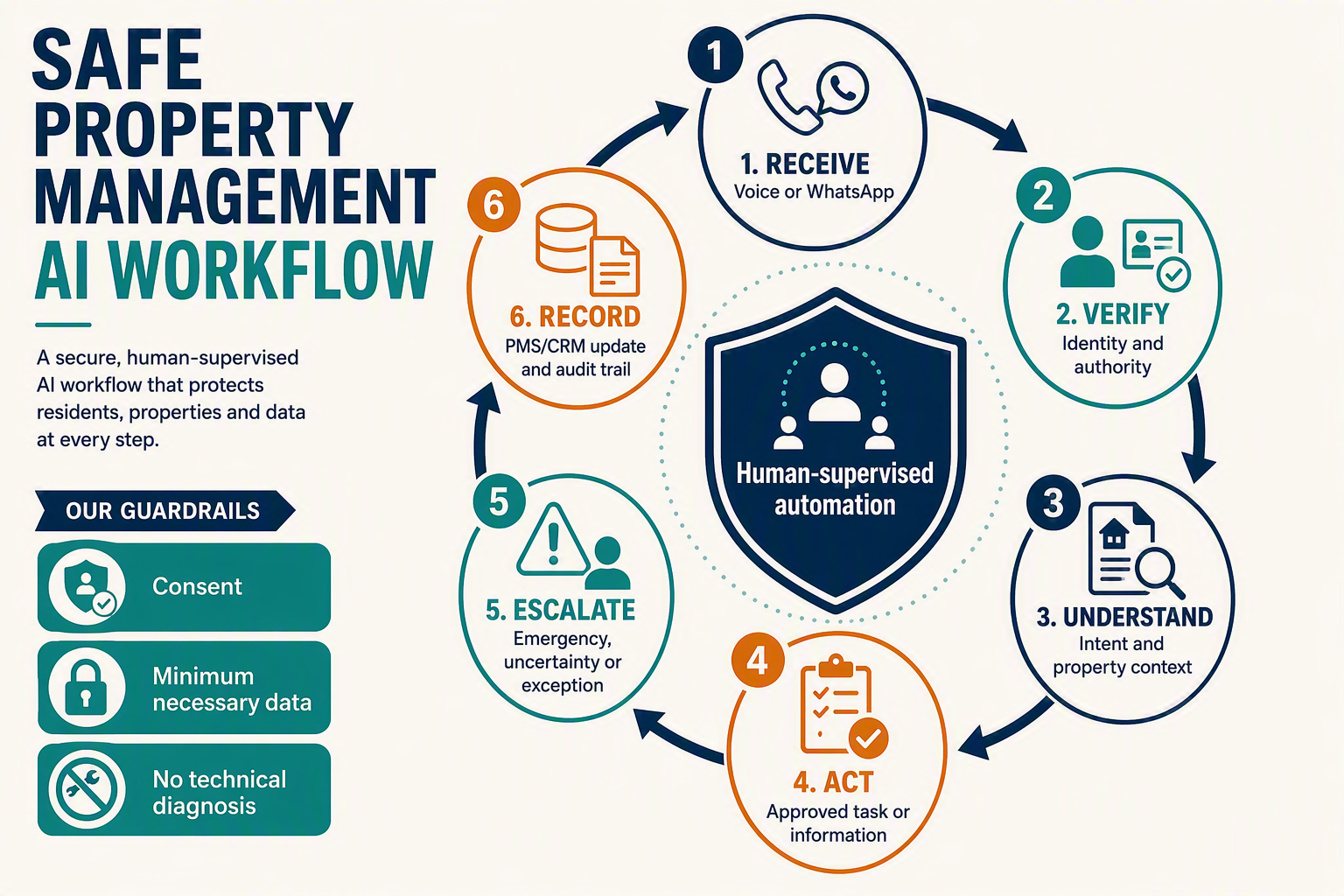
A property management AI receptionist should operate as a controlled workflow engine, not an autonomous property manager. In 2026, the safe model is: capture the request, verify identity to the level required, complete only pre-approved actions, write every interaction to the system of record and escalate uncertainty or risk to a human.
The verified workflow: capture, confirm, act and escalate
Every voice or WhatsApp interaction should follow six auditable stages:
- Identify the person and intent. Ask whether the contact is a tenant, landlord, applicant, contractor or other party, then classify the request as maintenance, scheduling, payment, policy, complaint or emergency.
- Locate the relevant record. Collect the property address and unit number, but avoid reading back resident or tenancy details until verification succeeds.
- Apply proportionate verification. Low-risk questions may require a one-time code or confirmation from a registered channel. Requests involving balances, access arrangements, personal data or lease information require stronger checks.
- Capture facts in the caller’s own words. Record symptoms, location, timing, affected areas, photographs and accessibility needs. The AI should confirm its summary before submission.
- Execute an approved task. Permitted actions can include opening a ticket, offering available appointment slots, sending a reference number or sharing a published policy.
- Escalate when rules require judgment. Safety indicators, failed verification, threats, disputes, exceptions and low-confidence classifications must go to an authorised employee.
This structure keeps tenant call automation useful without allowing a language model to make legal, financial, safety or technical decisions.
Classify maintenance reports without diagnosing faults
A maintenance request AI should classify reported evidence—not infer the underlying defect. For example, “water is spreading across the kitchen floor” can be tagged as active water escape, but the system should not declare that a pipe has burst.
The intake should capture:
- Exact location and time first noticed
- Whether the issue is active, worsening or contained
- Reported smells, sounds, smoke, sparks, heat or visible water
- Loss of essential services, blocked exits or vulnerable occupants
- Permission to contact the tenant and access preferences
- Photos or videos voluntarily supplied through WhatsApp
Emergency phrases such as “smoke,” “gas smell,” “sparking socket,” “ceiling collapsing,” “intruder” or “person trapped” should trigger a fixed safety script and immediate human escalation. The AI may advise the caller to contact local emergency services or leave immediate danger where the property manager’s approved procedure says so; it must not provide repair instructions, assess whether an area is safe or tell someone to handle electrical or gas equipment.
Coordinate voice, WhatsApp and the property system
Meta reported in April 2025 that WhatsApp had exceeded 3 billion monthly active users, supporting its role as a persistent channel for confirmations, evidence collection and status updates. However, property management WhatsApp automation must not assume that possession of a WhatsApp account proves tenancy or ownership.
Each interaction should create one structured case containing:
- Contact role, verification status and consent
- Original transcript plus a confirmed summary
- Category, urgency, confidence score and escalation reason
- Property, unit, ticket number and responsible team
- Actions taken, messages sent and human approvals
Voice is appropriate for urgent clarification; WhatsApp is useful for durable updates; the property-management or CRM platform remains the authoritative record. If integration fails, the receptionist should disclose that the request is pending, preserve the captured information and alert a human rather than falsely claiming that a ticket or appointment was completed.
Why are voice, WhatsApp and human handoffs becoming one property-management service model?
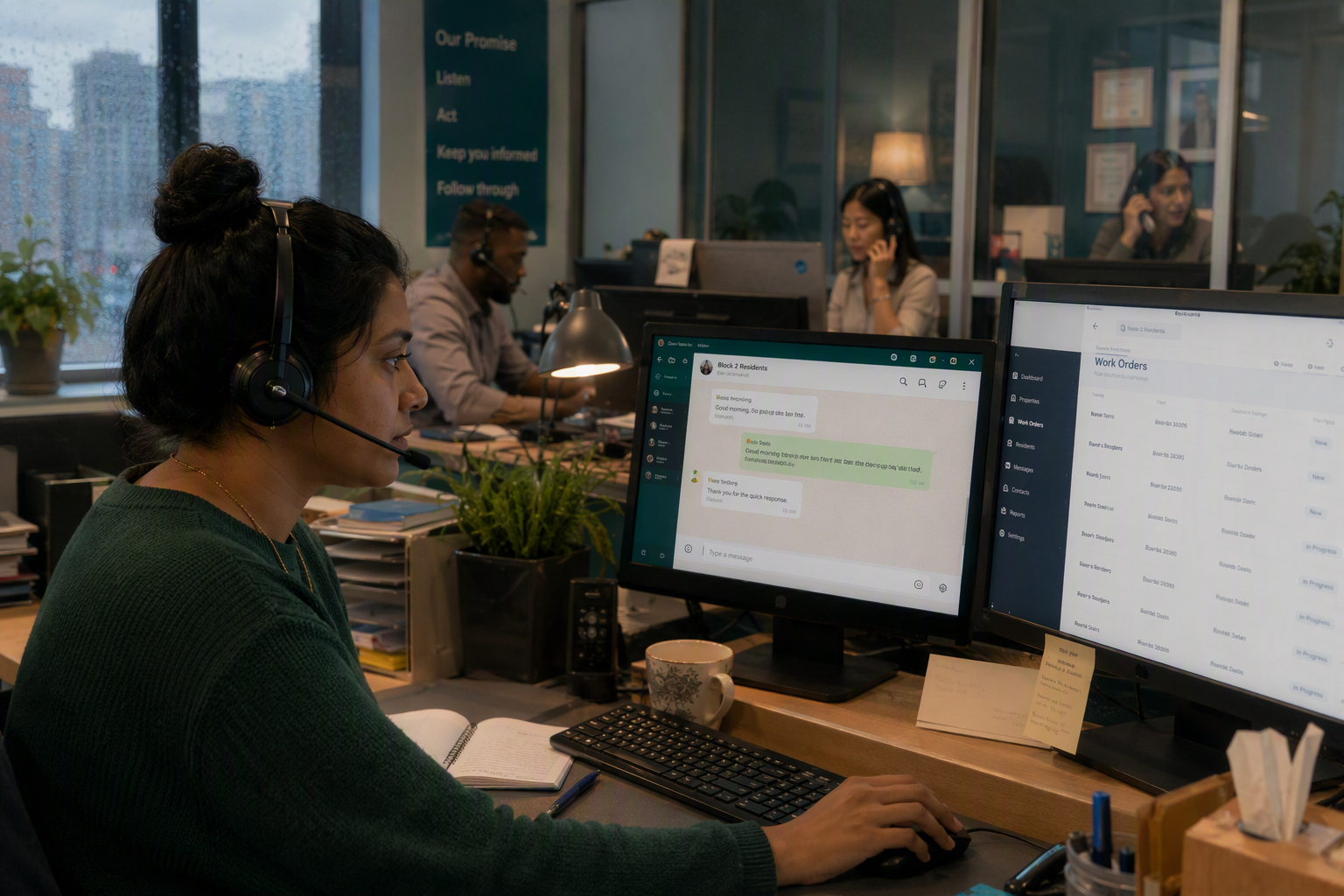
Voice, WhatsApp and human support are becoming one property-management service model because each channel solves a different part of the same request. Voice handles urgency and nuance, WhatsApp preserves confirmations and updates, and humans retain authority over safety, legal, financial and relationship-sensitive decisions.
One request should not become three separate conversations
A tenant may call about a leak, receive an appointment window on WhatsApp and later speak with a property manager about access permission. If those interactions sit in disconnected systems, the tenant must repeat the problem and staff may act on incomplete information.
A unified property management AI receptionist should create one case with:
- Verified role, contact details, property and unit
- The tenant’s own description of the issue
- Reported urgency indicators and relevant timestamps
- Photos or documents subsequently shared through WhatsApp
- Scheduling choices, access consent and vendor updates
- A complete record of automated and human interactions
The property-management system or CRM remains the authoritative record. Voice transcripts, WhatsApp messages and call outcomes should attach to the same case rather than create competing versions of events.
Voice provides immediacy; WhatsApp provides continuity
Phone calls remain suited to situations involving distress, ambiguity or limited ability to type. An AI voice agent can ask short, structured questions such as whether smoke, flames, flooding or immediate danger is present. Maintenance request AI must classify reported symptoms, not diagnose causes: “water entering through the ceiling” is a valid observation; “the upstairs pipe has ruptured” is an unverified technical conclusion.
WhatsApp is better suited to persistent, asynchronous tasks:
- Sending a case reference and summarising the reported issue
- Collecting photographs after warning tenants not to approach danger
- Offering approved viewing, inspection or contractor time slots
- Recording consent for property access
- Providing status updates without forcing another call
- Recovering missed calls with an approved, privacy-conscious message
Meta reported in April 2025 that WhatsApp had exceeded 3 billion monthly active users, demonstrating why messaging can serve as a mainstream operational channel rather than an optional add-on. However, property management WhatsApp automation must not assume that control of a WhatsApp account proves tenancy, ownership or authority to discuss a property.
Human handoff is a workflow state, not a failure
Successful tenant call automation does not maximise containment at any cost. It routes cases according to risk, authority and confidence. A handoff should preserve the transcript, classification, verification status and actions already completed.
Immediate or priority human escalation is appropriate when:
- Safety indicators include fire, gas odour, electrical danger, uncontrolled flooding, medical risk or threats.
- Identity cannot be verified but the caller requests balances, lease details, keys or access changes.
- Financial discretion is required, including payment promises, fee waivers or rent disputes.
- Legal or policy interpretation is disputed, particularly around notices, tenancy rights or enforcement.
- The AI has low confidence, conflicting information or repeated misunderstanding.
The operating principle is straightforward: automate intake and coordination, not accountability. A well-designed model lets tenants move between voice, WhatsApp and a person without losing context, while giving property managers a traceable record of what the AI collected, what it communicated and why it escalated.
Which 2026 developments shape safe property-management automation?
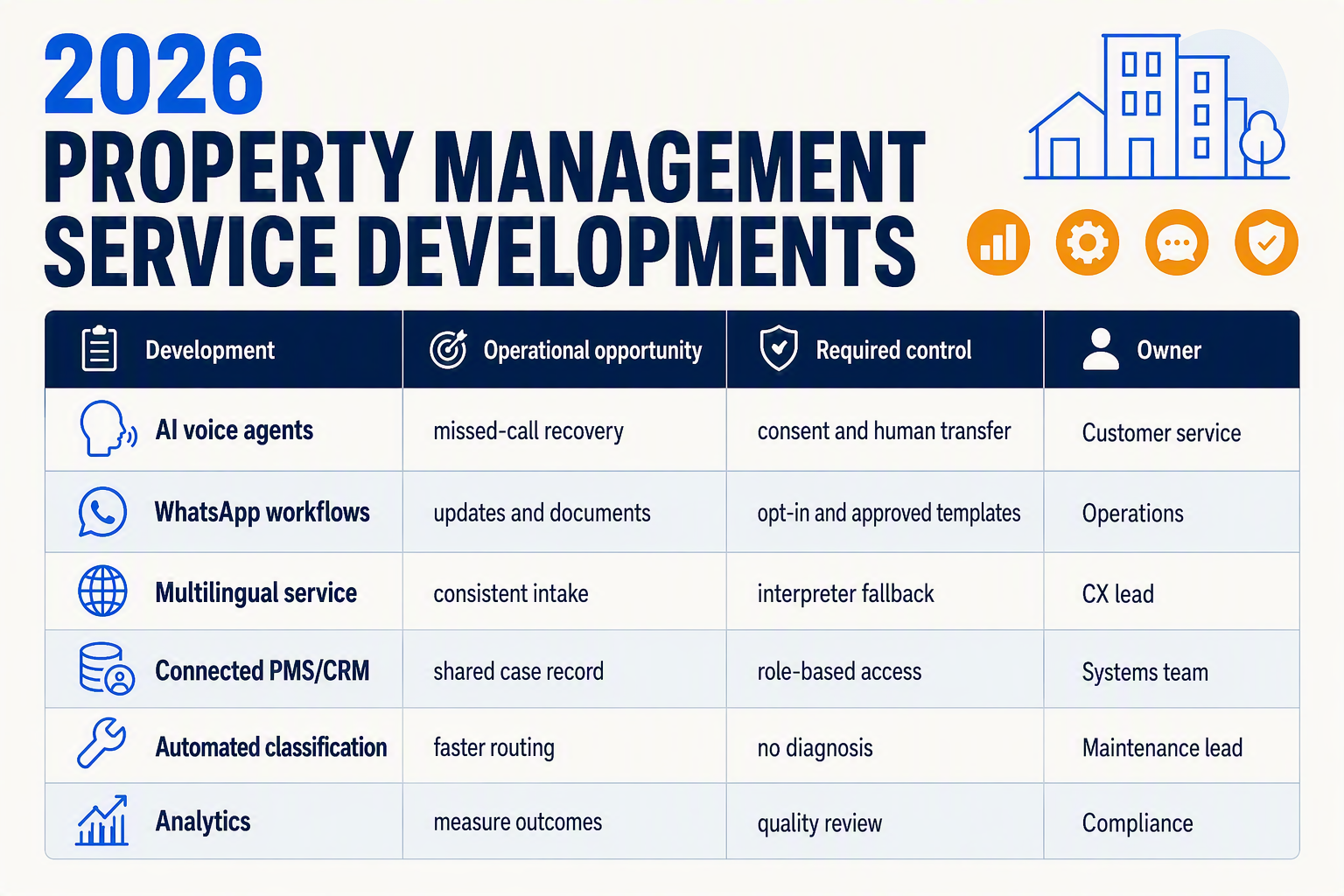
Safe property-management automation in 2026 is being shaped by real-time voice AI, WhatsApp calling, stricter privacy governance, multilingual models and tool-using agents. These developments make automation more capable, but they also require explicit limits: AI may collect reported symptoms and execute approved tasks, while humans retain authority over diagnosis, emergencies, legal decisions and financial exceptions.
Developments and operational controls
| 2026 development | Property-management use | Principal risk | Required control |
|---|---|---|---|
| Real-time conversational voice AI | Answer calls, capture unit details and recover interrupted intake | Confident but unsafe advice during fire, gas, flooding or electrical incidents | Use emergency phrase detection, approved safety scripts and immediate human or emergency-service escalation |
| WhatsApp Business chat and calling | Continue a voice conversation through messages, confirmations or an AI-assisted WhatsApp call | Assuming possession of a WhatsApp account proves identity | Verify residents using separate property records and disclose when the user is interacting with AI |
| Tool-using AI agents | Create tickets, retrieve approved policies and offer available appointment slots | Unauthorized changes, duplicate work orders or fabricated availability | Restrict tools by role, require confirmation before writes and attach an audit trail to every action |
| Multilingual speech models | Support tenants, landlords and contractors in regional languages | Translation errors affecting urgency or access instructions | Preserve the original transcript, confirm critical facts and route low-confidence cases to a qualified person |
| Retrieval-augmented generation (RAG) | Answer building-specific questions from leases, policies and operating procedures | Outdated documents being presented as current policy | Apply document owners, effective dates, version control and citation-backed responses |
| Stronger AI and privacy governance | Standardize consent, retention, testing and human oversight | Excessive collection of identity, payment or household information | Minimize data, define retention periods and run documented safety evaluations before release |
Regulation is becoming an engineering requirement
The European Commission states that most provisions of the EU AI Act become applicable on August 2, 2026, although some obligations follow different dates. Property managers operating in or serving people in the European Union should therefore document system purpose, oversight, vendor responsibilities and incident procedures rather than treating governance as a policy document added after deployment.
The ISO/IEC 42001 artificial-intelligence management-system standard was published in December 2023, giving organizations a structured framework for AI risk ownership, monitoring and continual improvement. The NIST AI Risk Management Framework Generative AI Profile, released in July 2024, likewise emphasizes governance, content provenance, pre-deployment testing and incident disclosure. These frameworks are especially relevant when a maintenance request AI can write to operational systems.
Automation is moving from answers to controlled actions
A property management AI receptionist can now do more than transcribe a call. With permissioned integrations, it can:
- Match the caller to a property record after verification.
- Classify “water entering through the ceiling” as a reported symptom and urgency signal, not diagnose a failed pipe.
- Create a maintenance ticket with transcript evidence.
- Offer approved inspection windows without overriding contractor constraints.
- Send a WhatsApp confirmation containing a reference number and escalation route.
This shift makes least-privilege design essential. Tenant call automation should not change lease terms, promise compensation, accept a payment arrangement or close a safety-related ticket without authorized review.
Platforms such as CallMissed illustrate the convergence behind property management WhatsApp automation by connecting AI voice agents, WhatsApp chat and WhatsApp Business calling with multilingual speech workflows. Regardless of platform, the safe 2026 architecture is consistent: constrained actions, verified identity, authoritative source systems, confidence thresholds and rapid human handoff.
How should tenant call automation and property management WhatsApp automation handle tenant and landlord intake, missed calls and multiple languages?
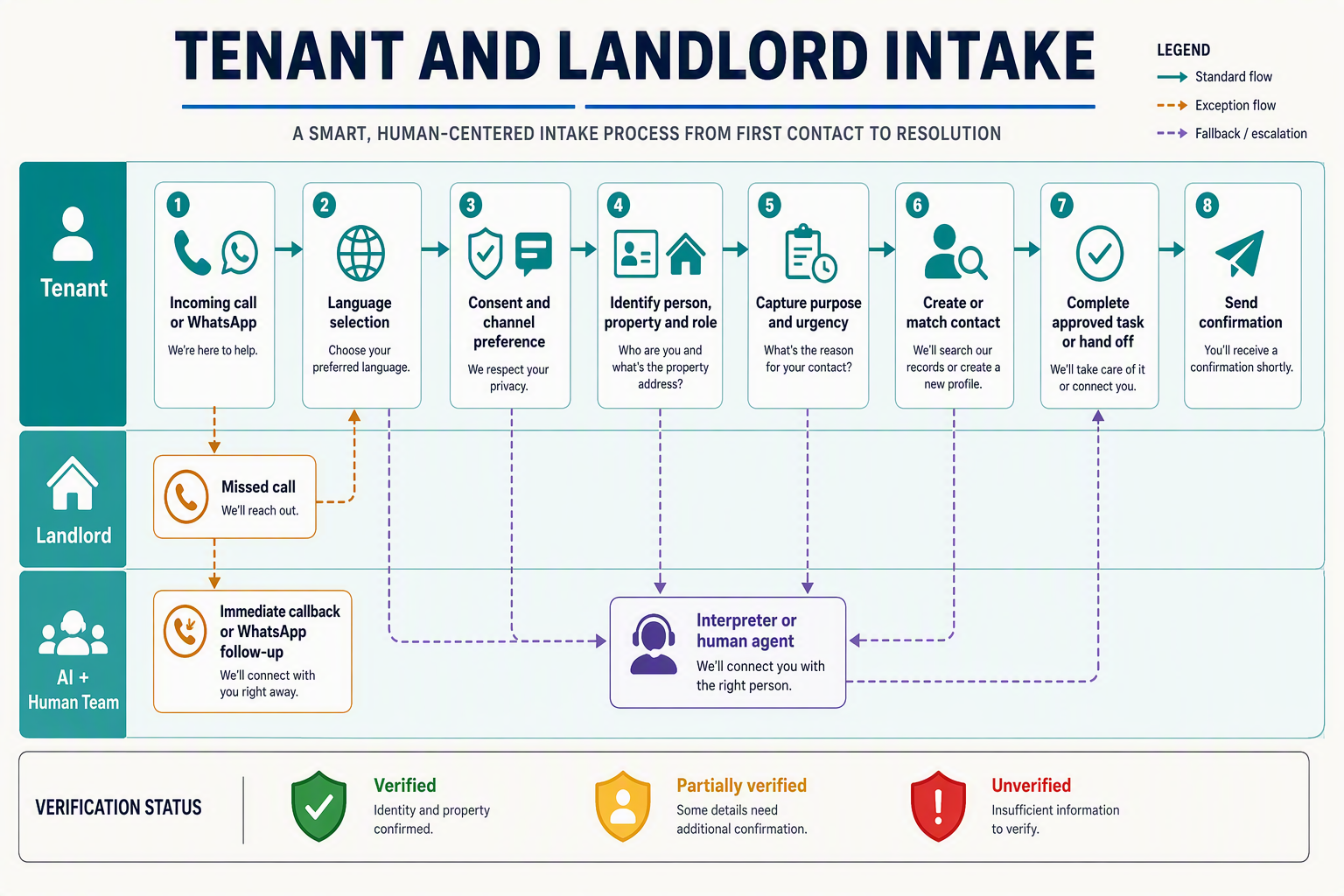
Tenant and landlord intake should use one structured workflow across phone and WhatsApp, while applying verification and permissions according to the caller’s role. Missed calls should trigger a consent-aware follow-up, and multilingual automation should confirm the preferred language rather than relying solely on automatic detection.
Separate identification from identity verification
A property management AI receptionist should first establish who is contacting the business and why. It can collect basic routing information without treating a phone number or WhatsApp profile as verified identity.
- Ask whether the person is a tenant, landlord, prospective tenant, contractor or other contact.
- Capture the property address, building and unit number where relevant.
- Record the request category and the caller’s preferred contact channel.
- Match the details against the property-management system.
- Apply stronger verification before disclosing protected information or changing records.
For existing tenants, verification might combine the registered phone number with a one-time code or a non-sensitive account attribute. Landlords may need additional checks before receiving tenant-specific information, financial statements or access details. Failed verification should lead to a human queue—not repeated questions that expose account data.
The agent can still accept an unverified maintenance report, especially when safety may be involved. However, it should mark the requester as unverified, capture reported symptoms without diagnosis and avoid revealing occupancy or tenancy information.
Design role-specific intake paths
Tenant call automation should collect:
- Property and unit
- Callback number and language preference
- Reason for contact
- Access permission and availability, where appropriate
- Any reported emergency indicators
- Preferred update channel
Landlord intake should capture the property, ownership or management relationship, request type and required deadline. Questions involving rent adjustments, tenancy disputes, legal notices, deposits or lease interpretation should be assigned to an authorised property manager.
Channel choice should reflect the task. Phone works well for urgent, complex or emotionally sensitive conversations; WhatsApp provides a persistent record for confirmations, photographs, appointment options and progress updates. Meta reported in April 2025 that WhatsApp had exceeded 3 billion monthly active users, underscoring its relevance as an intake and follow-up channel.
Recover missed calls without creating spam
Property management WhatsApp automation can turn a missed call into a recoverable service request, but the message should be brief, contextual and compliant with the business’s consent and approved-template rules.
A practical missed-call workflow is:
- Check whether the number can receive an authorised WhatsApp follow-up.
- Send a message identifying the property-management company and acknowledging the missed call.
- Offer clear options such as maintenance, rent or policy question, viewing, landlord support or speak to a person.
- Ask whether the matter involves immediate danger.
- Write the interaction back to the same CRM record and suppress duplicate callbacks.
The message should never include an address, balance, tenant name or maintenance details until identity has been appropriately verified.
Make multilingual service explicit and reversible
Language detection should accelerate service, not trap people in the wrong conversation. The agent should say, “I can continue in Hindi or English—which do you prefer?” and preserve that selection across voice, WhatsApp and human handoff.
For Indian portfolios, support must extend beyond translated text to speech recognition, text-to-speech, local names, addresses and code-switching. Indic-focused platforms can support voice workflows across 22 Indian languages, but managers should still test accents, mixed-language speech and noisy calls using real operational scenarios.
Every multilingual workflow needs a visible change language option, a human-transfer route and a transcript that records both the original utterance and any translation used for routing.
How should maintenance request AI classify issues without unsafe diagnosis, and when must it trigger emergency escalation?
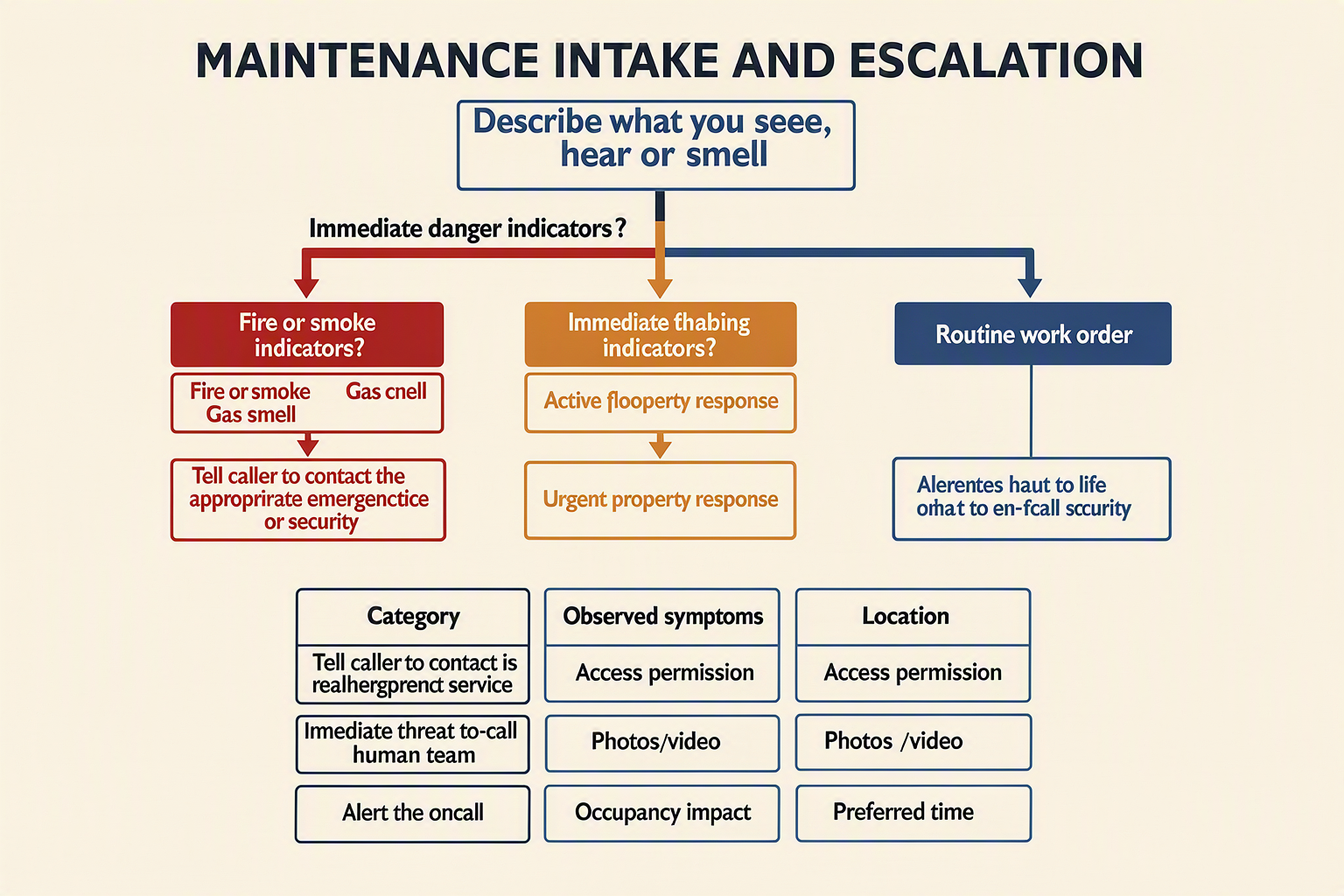
A maintenance request AI should classify the tenant’s reported symptoms, affected location, severity and occupancy risk—not identify the underlying fault. It must immediately escalate whenever reported conditions suggest danger to life, security, habitability or the building, even if identity verification or technical classification remains incomplete.
Classify observations, not causes
The property management AI receptionist should preserve the tenant’s own words and assign an operational category such as plumbing, electrical, heating, appliance, access or structural. It may ask neutral questions that help route the request:
- “What can you see, hear or smell?”
- “Is water actively flowing, dripping or already stopped?”
- “Are there sparks, smoke, flames or unusually hot surfaces?”
- “Is anyone injured, trapped or unable to leave?”
- “Which rooms or units appear affected?”
- “When did this begin, and is it getting worse?”
The AI may record “burning smell reported near fuse box” but must not convert that statement into “faulty wiring” or “electrical fire.” Likewise, “water coming through the ceiling” must not become a diagnosis of a burst pipe.
The resulting record should contain the original transcript, structured symptoms, location, media supplied through WhatsApp, urgency level, confidence score and escalation history. Images and videos can support human assessment, but they should never overrule explicit danger words from the tenant.
Use a conservative urgency model
A practical 2026 workflow uses four routing levels:
- Emergency: Immediate threat to people, property or building security; alert the designated human on-call team without waiting for routine verification.
- Urgent: Serious loss of an essential service or rapidly worsening damage; route for priority human review under the company’s service-level policy.
- Routine: Contained problems without present danger, such as a dripping tap or non-critical appliance fault; create a standard work order.
- Information needed: The description is ambiguous or incomplete; ask limited clarifying questions, then default upward if risk cannot be excluded.
Confidence must affect routing. A low-confidence report containing words such as “gas,” “smoke,” “sparks” or “collapse” should be escalated—not downgraded.
Trigger emergency escalation on explicit danger signals
Emergency rules should cover both keywords and meaning across voice, WhatsApp and supported languages. Typical triggers include:
- Fire or smoke: flames, smoke, alarms sounding or a strong burning smell
- Gas or fumes: suspected gas leak, hissing near gas equipment, dizziness or breathing difficulty
- Electrical danger: sparks, exposed live wiring, electric shock, smoking outlets or water contacting electrical equipment
- Uncontrolled water: major flooding, rapidly rising water or water entering electrical areas
- Structural risk: ceiling collapse, falling masonry, major cracking or trapped occupants
- Security threats: forced entry, an intruder, violence or inability to secure an external door
- Medical danger: injury, unconsciousness, breathing difficulty or immediate risk to a vulnerable resident
Escalate first, then complete the record
When a trigger appears, tenant call automation should:
- State that the report may be an emergency without diagnosing it.
- Advise the person to move away from immediate danger and contact the locally configured emergency number; in India, the integrated emergency number is 112.
- Notify the human duty manager and approved emergency contractor simultaneously.
- Send a concise WhatsApp confirmation where consent and channel rules permit.
- Continue collecting only safety-critical details, such as address, unit and callback number.
The AI must never instruct tenants to open electrical panels, test gas equipment, enter flooded areas or perform repairs. If the human handoff fails, the system should retry across approved channels, alert the next escalation tier and maintain a timestamped audit trail until a person acknowledges the incident.
How can the workflow verify identity, schedule viewings and inspections, answer rent or policy FAQs, and update the PMS or CRM?
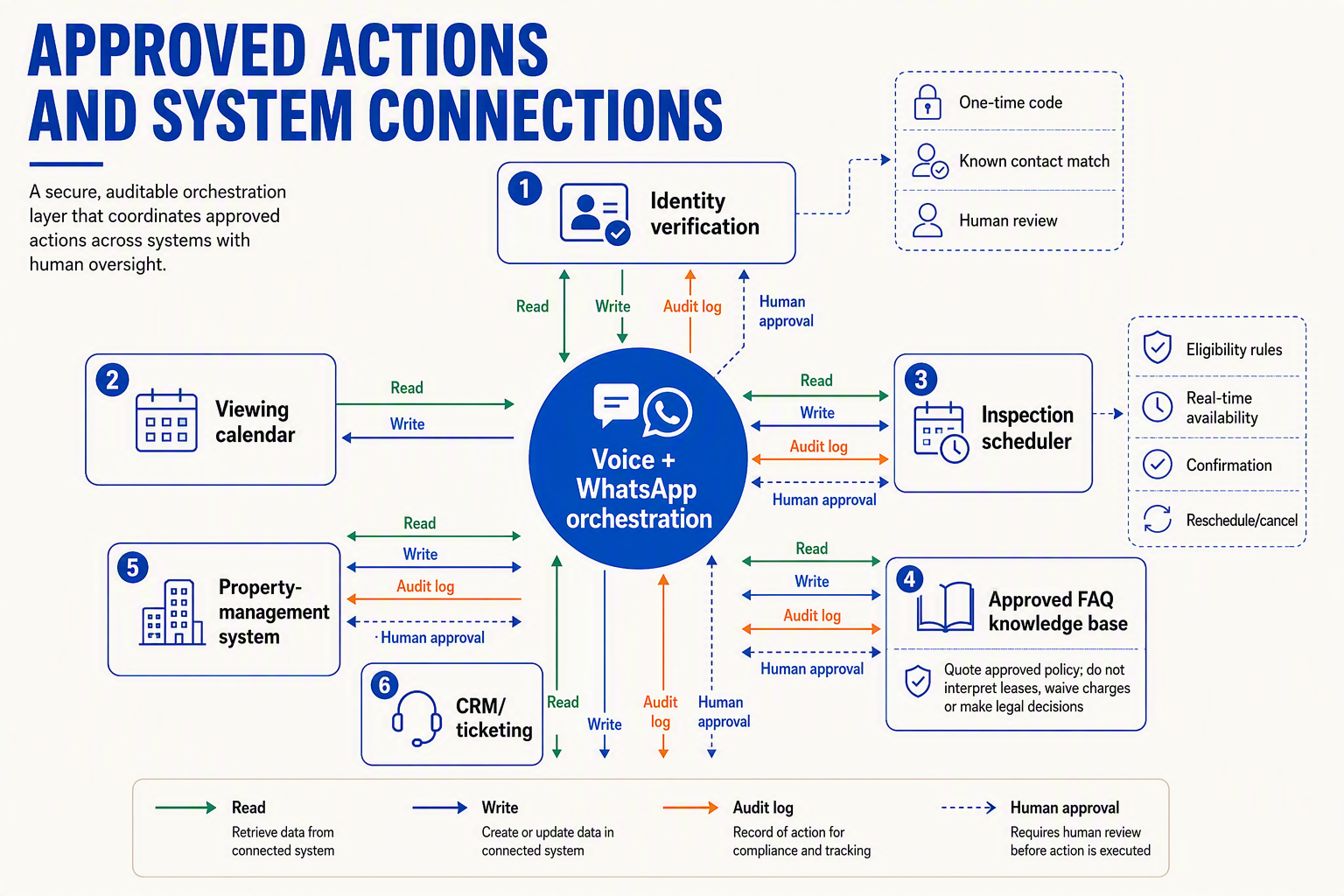
The workflow should apply risk-based identity verification, expose only approved information, book against live calendars and write every confirmed action to the property-management system (PMS) or CRM. The governing rule is simple: the AI may collect and coordinate, but the PMS remains the authoritative record.
1. Verify identity according to the action’s risk
A WhatsApp number or caller ID is a useful matching signal, not proof of identity. This distinction is increasingly important because Meta reported in April 2025 that WhatsApp had surpassed 3 billion monthly active users.
A property management AI receptionist should use progressive verification:
- Low risk: Answer public questions about office hours, amenities, application procedures or general policies without authentication.
- Moderate risk: Before discussing an appointment or existing request, match the phone number and request a second attribute such as postcode, unit number or service-request reference.
- High risk: Before revealing rent balances, changing bank details, issuing access instructions or updating contact information, use a one-time passcode or transfer to an authorised employee.
- Restricted: Never ask callers to speak or message full payment-card numbers, account passwords or unnecessary identity documents.
Failed verification should produce a neutral response—“I couldn’t verify the account”—rather than confirming whether a named person occupies a property.
2. Schedule viewings and inspections from live availability
Tenant call automation should query the approved calendar rather than inventing or verbally “holding” an unavailable slot. A reliable booking sequence is:
- Capture the property, appointment type, attendee count and accessibility requirements.
- Retrieve valid slots using property, staff, key-access and notice-period rules.
- Offer two or three options in the caller’s local time zone.
- Restate the address, date, time and attendance conditions.
- Obtain confirmation before creating the booking.
- Send a WhatsApp or email confirmation and consent-based reminders.
Inspections require additional controls. The workflow should check required notice, occupancy status and staff permissions; it must not interpret lease law or assume that a tenant’s silence constitutes consent. Cancellations and rescheduling should update the same appointment record rather than create duplicates.
3. Separate general FAQs from account-specific answers
The agent can answer approved, version-controlled FAQs about rent due dates, accepted payment channels, pet procedures, visitor rules and maintenance responsibilities. Every answer should carry the policy version or source document used by the retrieval system.
Clear boundaries are essential:
- Provide an exact rent balance only after strong verification and a live PMS lookup.
- Do not promise waivers, extensions, refunds or payment plans.
- Do not reinterpret ambiguous lease clauses.
- Escalate disputes, arrears, legal notices and accommodation requests to trained staff.
- Label quoted balances with an “as of” timestamp because payments may still be processing.
4. Write structured outcomes to the PMS or CRM
Property management WhatsApp automation and voice workflows should create consistent records containing:
- Verified party, role, property and unit
- Channel, consent status and verification level
- Appointment or FAQ category
- Confirmation timestamp and assigned employee
- Transcript reference, escalation status and next action
Integrations should validate required fields, use idempotency keys to prevent duplicate bookings and record failed writes for retry. A maintenance request AI may similarly add reported symptoms and urgency indicators, but it should never convert those observations into an unverified technical diagnosis. If the PMS update fails, the AI must not claim success; it should explain that confirmation is pending and route the task for human review.
What operational, tenant-experience and compliance impacts should property managers expect?
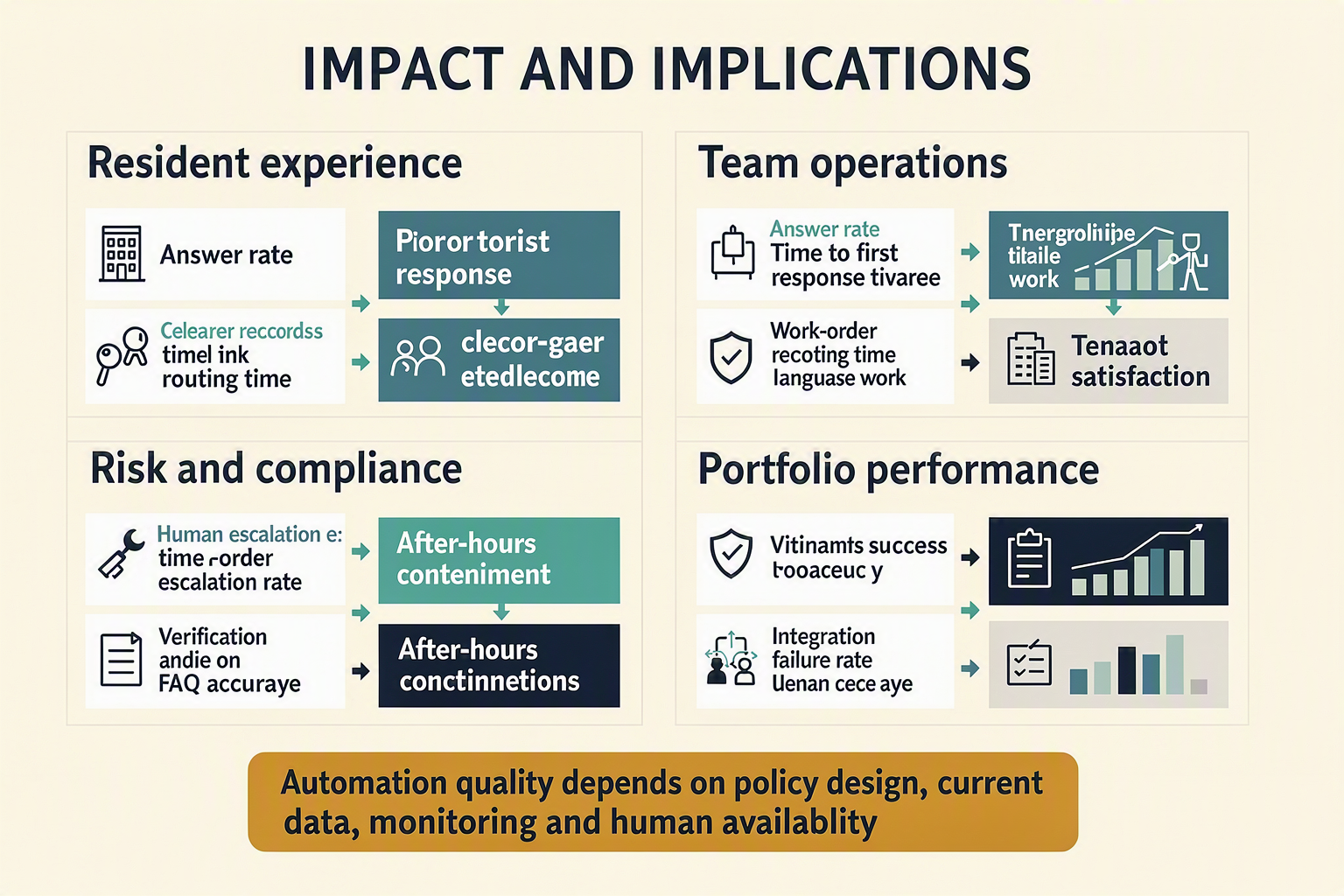
Property managers should expect faster intake, more consistent records and broader service availability, alongside new responsibilities for supervision, privacy and auditability. The strongest results come when AI handles structured communication while employees retain control over safety, tenancy, financial and legal decisions.
Operational impact: less queue pressure, better data discipline
A property management AI receptionist can reduce repetitive work by collecting required fields, creating tickets and sending updates before an employee reviews the case. However, automation also exposes weaknesses in property records, escalation rosters and vendor processes.
Likely operational changes include:
- Lower call abandonment and faster missed-call recovery, especially outside office hours.
- More complete maintenance tickets containing the property, unit, reported symptoms, access constraints and preferred contact channel.
- Fewer duplicate conversations when voice, WhatsApp and the property-management system share a common case identifier.
- Higher workload predictability because routine FAQs and scheduling requests are separated from exceptions.
- New monitoring duties covering failed integrations, misunderstood speech, stalled conversations and overdue human handoffs.
Teams should not treat containment as the sole measure of success. A low containment rate may be appropriate for emergency reports, payment disputes or tenancy-sensitive requests. Measure handoff speed, record completeness, repeat-contact rate and resolution time alongside automation.
Tenant experience: convenience must not become a barrier
Well-designed tenant call automation gives residents immediate acknowledgement and consistent next steps. Persistent WhatsApp updates can also reduce the need to call repeatedly for contractor arrival times or ticket status.
Poorly designed automation creates the opposite result: residents repeat information, struggle to reach a person or receive confident answers unsupported by the lease. Protect the experience by providing:
- A clearly stated option to reach a human.
- Equivalent service for tenants who cannot or do not wish to use WhatsApp.
- Confirmation of what the system recorded, with an easy correction route.
- Language choices without assuming language from a telephone number or name.
- Accessible alternatives for residents with hearing, speech or digital-access needs.
For multilingual portfolios, platforms such as CallMissed can support speech workflows across 22 Indian languages. Property managers should still test local accents, code-switching, names and addresses against real call scenarios before deployment.
Compliance impact: create evidence, not just conversations
Property management WhatsApp automation and voice AI process personal data, potentially including addresses, occupancy details, payment information and recordings. Compliance therefore requires purpose limitation, controlled retention and role-based access—not merely a privacy-policy link.
In India, deployments should be reviewed against the Digital Personal Data Protection Act, 2023 and applicable rules and commencement schedules. European operations must also consider the EU AI Act: Article 50 transparency obligations became applicable on 2 August 2026, including requirements relevant to informing people when they interact directly with an AI system. Call-recording and consent laws vary by jurisdiction, so legal review must cover every operating region.
Maintain an audit trail showing:
- Whether the tenant interacted with AI and received appropriate notice.
- What identity checks occurred before account-specific information was disclosed.
- The original transcript or recording, structured maintenance request AI classification and subsequent edits.
- Which rule triggered escalation and when a human accepted it.
- Consent, opt-out and message-template status for WhatsApp communications.
- Retention, deletion and access history.
The practical impact is a shift from informal inbox management to governed, reviewable service operations. AI can increase capacity, but accountability remains with the property manager.
What do property operations, maintenance, safety and compliance experts recommend before automation goes live?
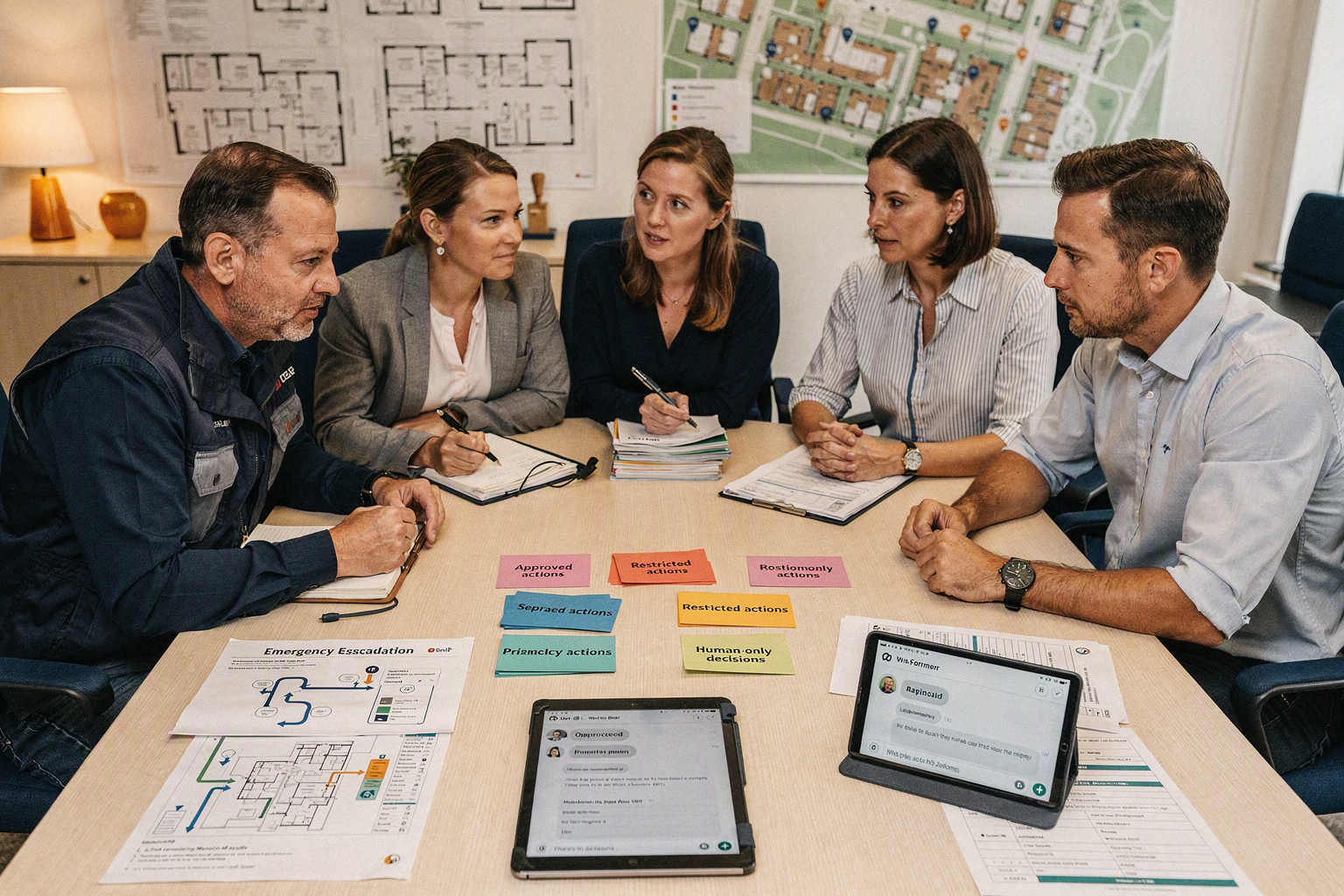
Before launch, experts should require a documented risk assessment, emergency escalation plan, privacy review and human-supervised acceptance test. A property management AI receptionist may collect and route information, but qualified people must retain authority over diagnosis, emergency response, legal interpretation, access decisions and financial exceptions.
Establish operational ownership and non-negotiable boundaries
Property operations, maintenance, safety, legal and data-protection stakeholders should jointly approve an automation responsibility matrix. It should state what the AI may complete, what requires confirmation and what must immediately transfer to a human.
Recommended boundaries include:
- Maintenance request AI records reported symptoms—such as “water entering through the ceiling”—without declaring a pipe burst or recommending repairs.
- Fire, smoke, gas odour, sparking, electric shock, flooding near electricity, structural movement, trapped occupants and threats trigger the emergency workflow.
- The agent should direct people to the applicable local emergency service when immediate danger is reported; it must not imply that notifying property management replaces emergency services.
- Rent disputes, eviction matters, lease interpretation, compensation demands and reasonable-accommodation requests go to authorised staff.
- No contractor receives keys, access codes or occupant details until identity, work order and access authority are verified.
Each automated decision should have a named business owner. “The AI decided” is not an acceptable accountability model.
Run safety testing with realistic failure scenarios
Maintenance and safety leaders should create a test library from historical requests, near misses and building-specific hazards. Testing must cover ambiguous language, background noise, distressed callers, code-switching, interrupted WhatsApp conversations and incomplete addresses.
Before enabling tenant call automation, run these scenarios:
- A caller says “I smell something odd” but cannot identify the source.
- A child reports smoke while the named tenant is unavailable.
- A tenant requests instructions for opening an electrical panel.
- WhatsApp messages arrive from an unrecognised number claiming to represent a landlord.
- The property-management system or on-call notification service is unavailable.
The correct outcome is conservative escalation, not confident diagnosis. Teams should verify that urgent handoffs include the property, unit, callback number, reported symptoms, timestamp and transcript while clearly labelling all details as caller-reported.
Complete privacy, communications and compliance reviews
Legal obligations vary by country, state, building type and tenancy regime. In India, counsel should review processing against the Digital Personal Data Protection Act, 2023, while communications teams should assess consent and messaging practices under applicable telecom rules and Meta’s WhatsApp Business policies.
The pre-launch checklist should confirm:
- A lawful purpose and retention period for recordings, transcripts and identity data
- Clear notice when calls are recorded or handled by AI
- Role-based access, encryption and audit logs
- Redaction of payment credentials, government identifiers and access codes
- Consent records for business-initiated WhatsApp messages
- A process for access, correction, deletion and incident response
- Accessible human alternatives for people who cannot use voice or messaging
Require operational sign-off and rollback controls
Go-live approval should be evidence-based. Property teams should conduct a limited pilot, manually review emergency classifications and compare AI-created records with the source conversations.
Set launch thresholds for emergency handoff time, classification accuracy, failed verification, abandoned transfers and duplicate work orders. Property management WhatsApp automation should also be tested for message delivery failures, expired conversation windows and cross-channel identity mismatches.
Finally, require a visible kill switch, fallback phone routing and manual work-order intake. Automation is ready only when staff can detect failures, take control and reconstruct every consequential action from the audit trail.
What does this mean for your rollout plan, governance and KPI dashboard?
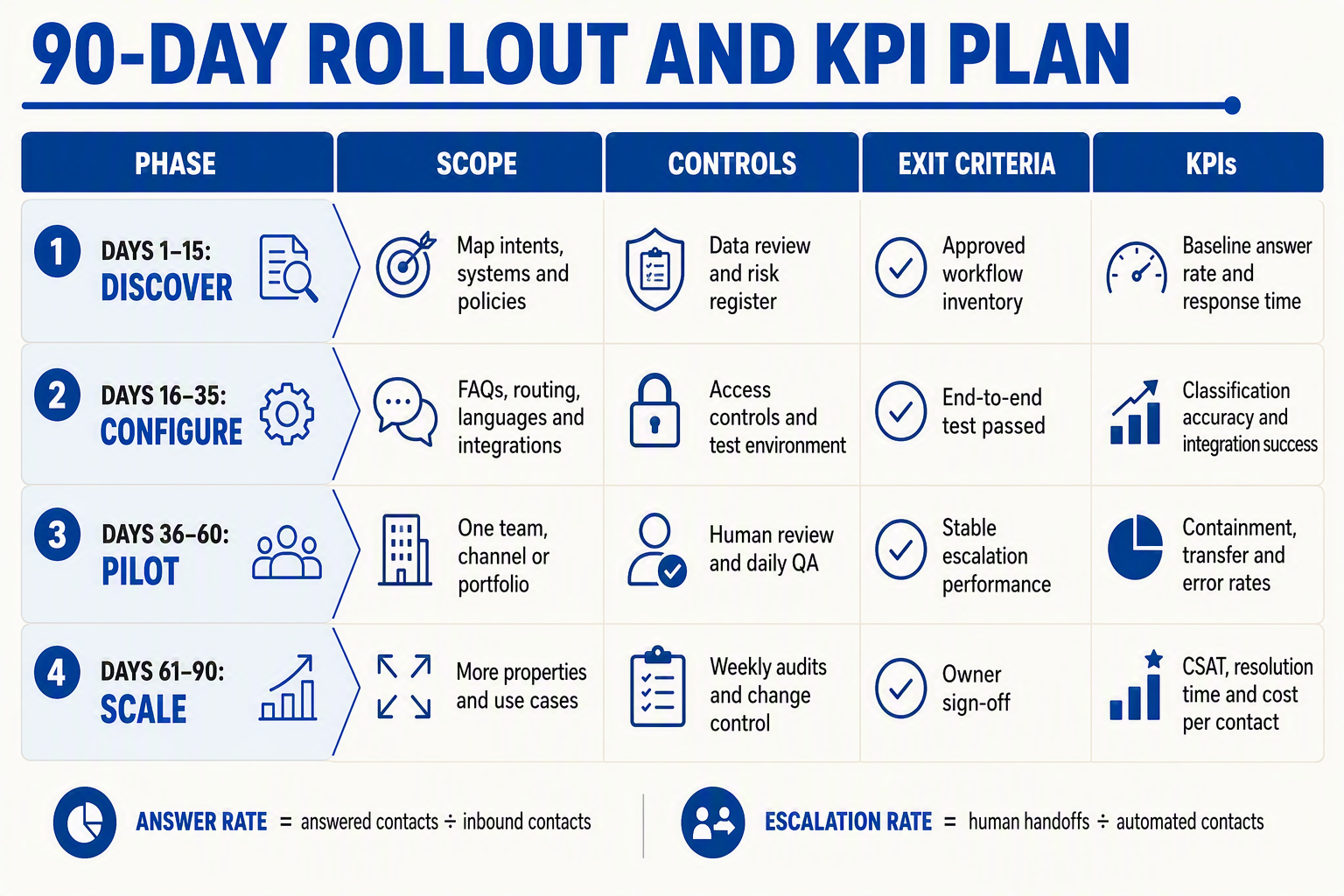
Roll out the property management AI receptionist in controlled stages: begin with low-risk intake and status updates, prove data quality and escalation reliability, then expand automation only when predefined safety and service thresholds are met. Governance should assign a human owner to every automated decision path, while the KPI dashboard separates efficiency gains from safety, accuracy and customer outcomes.
Phased rollout and decision gates
| Phase | Workflows enabled | Governance control | KPI and suggested release gate |
|---|---|---|---|
| 1. Shadow mode | Transcription, intent tagging and draft case creation | Humans review every output; AI sends no tenant-facing response | ≥95% required-field capture and no unreported emergency indicators in the test set |
| 2. Assisted intake | Tenant/landlord intake, missed-call recovery and basic FAQs | Verified templates, consent logging and mandatory human handoff paths | ≥90% correct routing; 100% of sampled conversations retain an audit trail |
| 3. Scheduling | Viewings, inspections and contractor appointment choices | Calendar conflict checks, cancellation rules and identity verification | ≥80% scheduling completion with booking-error rate below 2% |
| 4. Maintenance triage | Symptom-based classification and priority recommendation | No diagnosis or repair instructions; deterministic emergency trigger list | ≥95% emergency recall in controlled testing; median emergency handoff below 60 seconds |
| 5. Multichannel operations | Voice-to-WhatsApp continuity, multilingual service and status updates | Channel consent, language-quality review and CRM record matching | ≥90% successful case matching across channels; track results separately by language |
| 6. Scaled automation | Approved end-to-end routine workflows across properties | Monthly risk review, prompt/version register and rollback procedure | Stable satisfaction, complaint and escalation metrics for at least four consecutive weeks |
These figures are recommended internal gates, not universal industry benchmarks. Each company should tighten them according to portfolio size, staffing, local tenancy law, building risk and contractual response obligations.
Build one dashboard with four KPI layers
Meta reported in April 2025 that WhatsApp had surpassed 3 billion monthly active users, reinforcing the need to govern messaging as a core service channel rather than an experimental add-on. However, dashboard volume must never be mistaken for successful service.
Track four layers:
- Safety: emergency recall, emergency handoff time, missed escalation count, false reassurance incidents and prohibited diagnostic responses.
- Service: first-response time, missed-call recovery rate, scheduling completion, tenant satisfaction and repeat-contact rate.
- Automation quality: intent accuracy, required-field capture, containment rate, human override rate and classification accuracy by request category.
- Operational integrity: CRM sync success, duplicate-case rate, consent capture, authentication failures and unresolved handoff backlog.
For maintenance request AI, measure classification against human-reviewed labels such as emergency, urgent, routine and information-only. Never reward the model for confidently naming a fault; the correct output is a safe priority, structured symptoms and an accountable destination.
Establish governance before expanding scope
The rollout committee should include property operations, maintenance, customer service, legal/privacy, IT security and a named executive owner. Its minimum operating cadence should be:
- Review high-risk conversations weekly, including fire, gas, electrical, flooding, medical and security reports.
- Audit random routine cases monthly across voice, WhatsApp, properties and supported languages.
- Approve every material workflow change, recording prompts, policies, integrations, test results and rollback versions.
- Pause automation automatically when emergency recall, CRM reliability or authentication performance falls below its release gate.
Finally, segment results by property, request type, channel, language and time of day. This prevents a strong overall containment rate from hiding poor overnight escalation or weak regional-language performance. For Indian portfolios, platforms such as CallMissed can support tenant call automation and property management WhatsApp automation across 22 Indian languages, but each deployed language still requires its own testing, monitoring and human escalation coverage.
Frequently asked questions about AI voice and WhatsApp workflows for property management
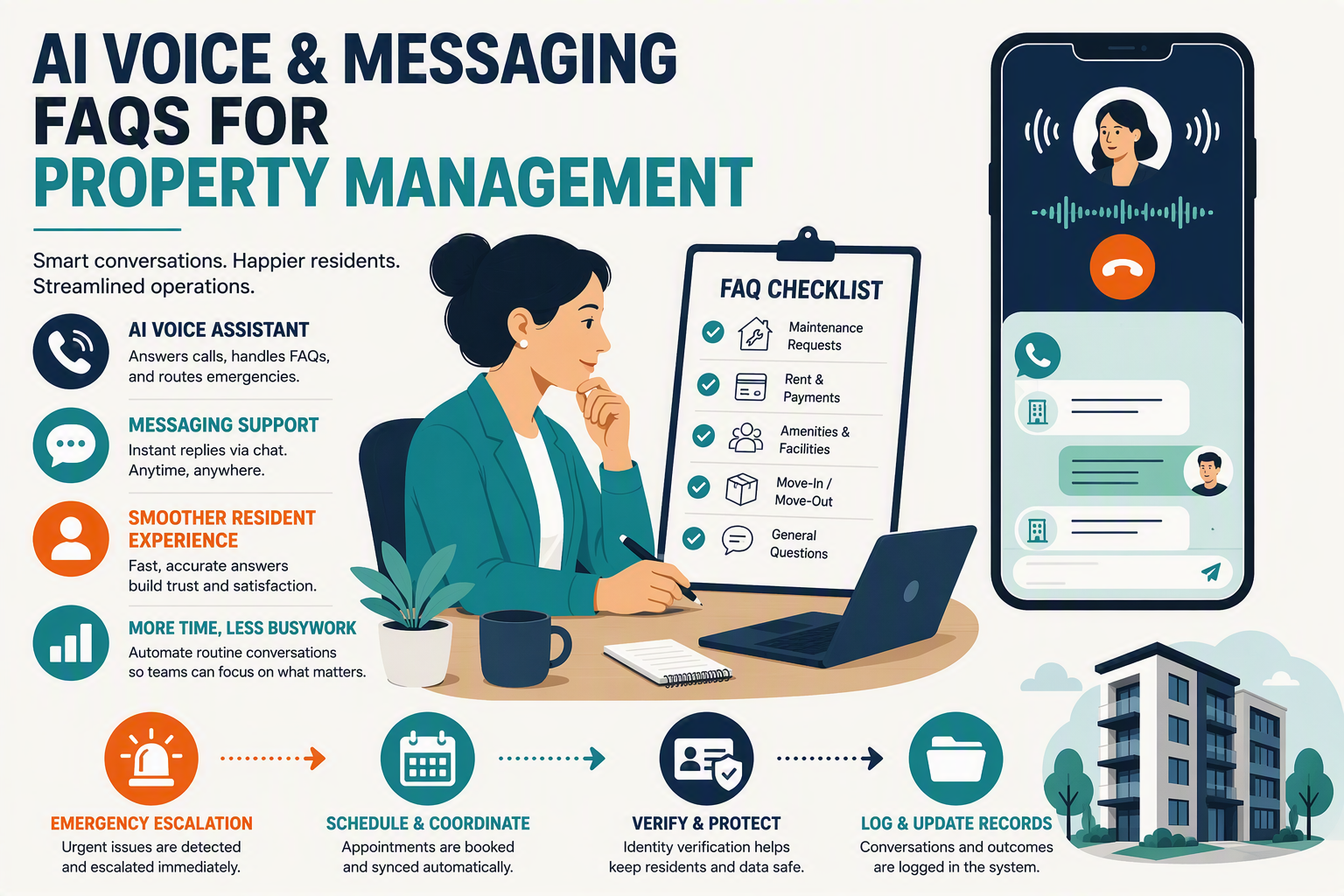
What can a property management AI receptionist safely handle without human approval?
How should a property management AI receptionist verify tenants and landlords?
Can maintenance request AI diagnose plumbing, electrical or gas problems?
How does property management WhatsApp automation work after a missed tenant call?
What integrations are required for reliable tenant call automation?
Which KPIs should property managers track when launching AI voice and WhatsApp workflows?
Conclusion
The 2026 operating model
A property management AI receptionist should automate structured intake, coordination and updates while leaving emergency judgment, legal decisions, disputes and financial exceptions to authorised people. The safest model combines immediate voice conversations, persistent WhatsApp communication and an integrated property-management system as the authoritative record.
Meta reported in April 2025 that WhatsApp had surpassed 3 billion monthly active users, reinforcing why property managers need coordinated voice and messaging workflows rather than isolated bots. However, a WhatsApp profile or incoming phone number must not be treated as sufficient proof of identity; access to rent balances, lease information and personal records should follow role-appropriate verification.
The practical takeaways are clear:
- Capture facts without diagnosing. A maintenance request AI can record the property, unit, reported symptoms, affected areas and urgency indicators. It should classify “burning smell near the fuse box” as a potential electrical emergency, escalate immediately and avoid repair instructions or claims about the underlying fault.
- Design escalation before automation. Fire, gas, flooding, electrical danger, medical risk and security threats require explicit human handoff rules. Teams should measure emergency handoff time, classification accuracy and whether the correct person received enough structured context to act.
- Keep channels connected. Tenant call automation should preserve context when a caller moves to WhatsApp for confirmations, appointment options or status updates. Missed-call recovery can use approved WhatsApp follow-ups, but consent, identity verification and privacy controls remain essential.
- Automate within defined boundaries. Property management WhatsApp automation can support viewing, inspection and contractor scheduling, reminders and approved policy FAQs. Humans should retain authority over payment promises, rent exceptions, lease interpretation, disputes and legal notices.
What to watch next
The next stage of property communication will be defined less by how human an AI sounds and more by how reliably it verifies, records, escalates and hands off. Property managers should roll out workflows in phases, test multilingual performance and monitor missed-call recovery, containment rate, scheduling completion, tenant satisfaction and emergency escalation outcomes.
Platforms such as CallMissed show how this model is evolving by combining AI voice agents, WhatsApp Business calls and chat workflows with support for 22 Indian languages. As capabilities expand, the decisive question will remain: Does your automation merely answer faster, or does it help the right human act safely with the right context?
Related Reading
Discussion
Related Posts



Ready to automate customer conversations?
Launch AI voice agents and WhatsApp bots with CallMissed — one API, 22+ Indian languages.