
Multilingual Customer Engagement India: 2026 AI Voice, WhatsApp and Email Guide


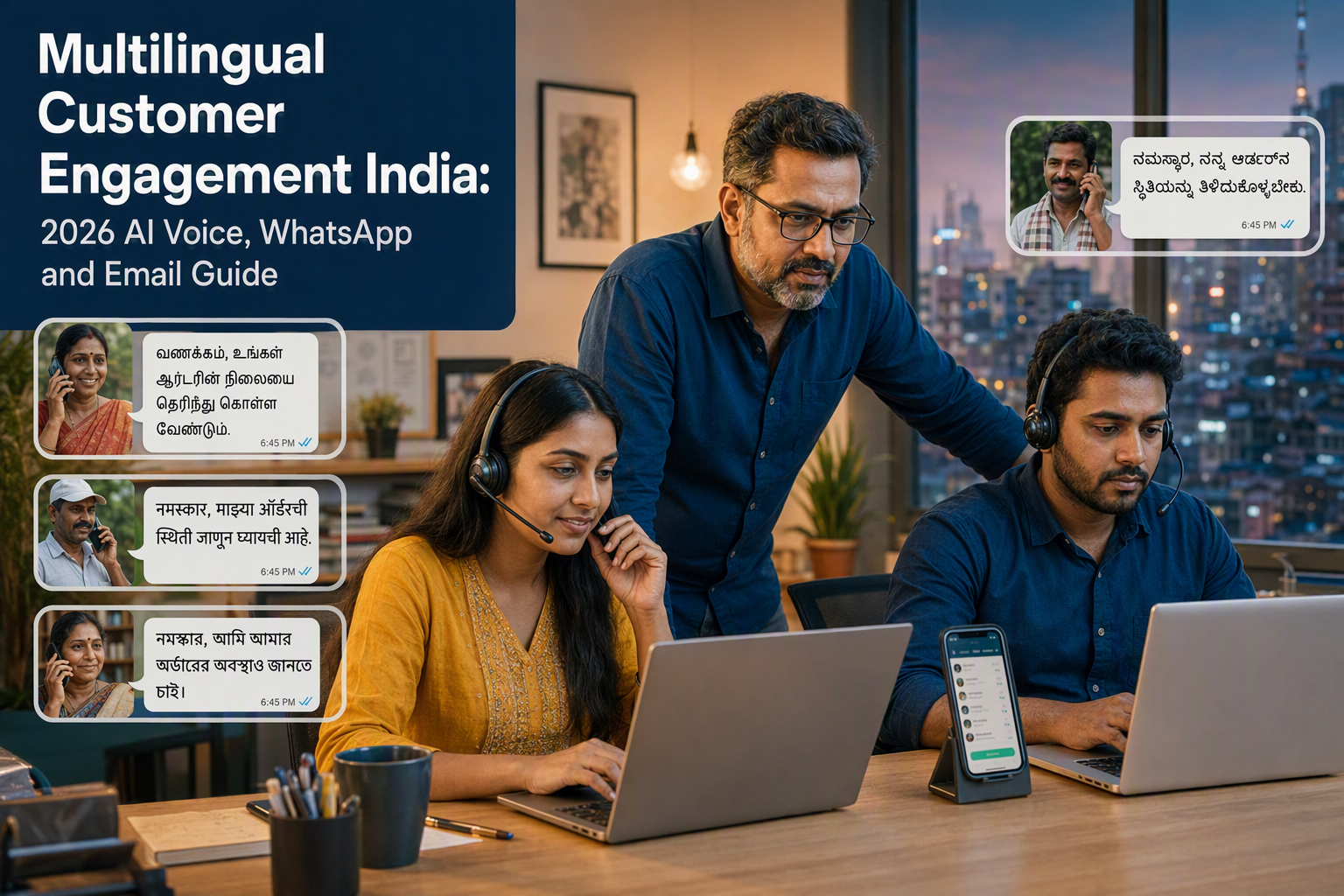
Build multilingual customer engagement India workflows with AI voice, WhatsApp, email, consent controls, testing, metrics and rollout steps.
Multilingual Customer Engagement India: 2026 AI Voice, WhatsApp and Email Guide
What if the next customer who calls your business speaks Hindi, replies on WhatsApp in Hinglish and expects the booking confirmation by email in English? For teams exploring multilingual customer engagement India, that journey is no longer unusual—it is the operating reality of serving a linguistically diverse, mobile-first market.
The scale makes language support commercially important. The Internet and Mobile Association of India and Kantar reported that India had 886 million active internet users in 2024, with 870 million—98%—accessing Indic-language content. Meanwhile, the Census of India 2011 identified 121 languages spoken by at least 10,000 people and recognised 22 Scheduled Languages. Although the census data predates today’s AI boom, it remains the latest completed national linguistic census and illustrates why English-only automation cannot represent the whole Indian market.
For a small clinic, retailer, coaching centre or home-services company, however, multilingual engagement does not mean launching every language at once. It means identifying the languages customers actually use, handling code-switching such as Hinglish or Tanglish, and preserving context when a conversation moves from a phone call to WhatsApp or email. The objective of AI voice WhatsApp automation India should be reliable task completion—not merely producing a fluent-sounding reply.
Platforms such as CallMissed reflect this shift by combining AI voice agents, WhatsApp chat and Business calling, email, knowledge-grounded assistance and an omnichannel inbox, with speech capabilities spanning 22 Indian languages.
What this 2026 guide will help you build
You will learn how to design and evaluate practical workflows for:
- Inbound answering and missed-call recovery, including consent-aware WhatsApp or email follow-up.
- Lead qualification and appointment booking using an Indian language AI receptionist, with clear rules for human escalation.
- Knowledge-grounded customer support that answers from approved business information instead of improvising.
- Cross-channel continuity, so customers do not need to repeat details when moving among voice, WhatsApp and email.
- Accent and code-switching tests measured by task completion, correction frequency, latency and handoff quality.
- Privacy-conscious deployment aligned with India’s Digital Personal Data Protection Act, 2023, including purpose limitation, access controls and appropriate retention.
Rather than promising universal accuracy or instant returns, this guide treats small business customer service automation India as a staged operational change. You will get sector examples, a channel-selection table, a testing scorecard, a rollout checklist and practical questions to ask before allowing AI to communicate with real customers.
How can Indian small businesses build multilingual customer engagement in 2026? Start with one high-value journey, use verified language and channel capabilities, preserve context, obtain consent and route uncertain cases to people
Indian small businesses can build multilingual customer engagement India workflows by starting with one high-value customer journey, verifying language and channel capabilities, preserving context across voice, WhatsApp and email, obtaining purpose-specific consent, and routing uncertain or sensitive cases to people. The goal is not to automate every conversation; it is to complete a defined business task safely and consistently.
1. Select one journey with a clear outcome
Begin a multilingual customer engagement India rollout with a frequent, measurable journey rather than a general-purpose assistant for every department. Suitable starting points include:
- Clinic: answer an inbound call, identify the preferred language, collect the appointment request and confirm the slot.
- Coaching centre: qualify an enquiry by course, location and start date before routing it to admissions.
- Home-services company: recover a missed call, obtain permission for follow-up and arrange a technician visit.
- Retailer: answer a product or delivery question from an approved knowledge base, escalating exceptions to staff.
Define success as a completed business task—not merely a fluent conversation. Useful outcomes include appointment booked, lead qualified, question resolved or handoff accepted.
2. Choose languages using customer evidence
Prioritise languages using call recordings, inbox messages, customer locations and staff feedback rather than India-wide popularity alone. The Internet and Mobile Association of India and Kantar reported in 2024 that 870 million Indian internet users accessed Indic-language content. This demonstrates substantial regional-language demand, but it does not mean every business needs to support every language.
For each language in a multilingual customer engagement India workflow, verify:
- Speech recognition for relevant accents, code-switching and noisy phone audio.
- Text-to-speech pronunciation of names, addresses, prices and local terms.
- Written WhatsApp responses in the scripts and language styles customers use.
- Code-switching, such as Hindi speech containing English product terminology.
- Human support availability for escalated conversations.
CallMissed supports speech capabilities across 22 Indian languages, but businesses should test every intended language, voice, model and channel in their own operating environment before deployment. Support on one channel should not be assumed to guarantee equivalent performance on another.
3. Preserve context across voice, WhatsApp and email
A customer moving from a call to WhatsApp or email should not have to repeat the conversation. Store a compact, structured interaction record containing:
- Customer identifier and preferred language
- Original request and confirmed details
- Channel-specific consent status and timestamp
- Actions already completed
- Unanswered questions and confidence flags
- Assigned employee, queue or next step
For example, an Indian language AI receptionist might capture a Hindi appointment request by voice, send a consent-aware WhatsApp confirmation and generate an English email summary for the clinic’s back office.
This continuity is central to effective multilingual customer engagement India operations. Platforms such as CallMissed can bring AI voice, WhatsApp, email and an omnichannel inbox into one workflow, but businesses should verify WhatsApp Business Calling eligibility, messaging templates, account configuration and other channel-specific requirements before launch.
4. Make consent, privacy and human escalation explicit
Obtain consent that is specific to the purpose and channel, record when and how it was provided, and make withdrawal straightforward. Do not treat a phone number collected for service delivery as automatic permission for unrelated promotional campaigns.
Configure data minimisation, retention periods, role-based access and deletion procedures with regard to the Digital Personal Data Protection Act, 2023 and applicable rules or implementation requirements. Staff should be able to see what the customer agreed to without exposing unnecessary personal information.
Route the interaction to a person when:
- Speech recognition repeatedly requests correction.
- The customer changes language unexpectedly.
- Confidence falls below the business’s tested threshold.
- The approved knowledge base lacks an answer.
- Payment, medical, legal or emotionally sensitive issues arise.
- The customer asks to speak with an employee.
- Identity, consent, pricing or booking details remain ambiguous.
5. Pilot, measure and expand carefully
Test the workflow with a limited set of customers, hours or locations before scaling. Review completion rates, correction requests, handoff rates, consent records and customer complaints separately for each language and channel.
Expand a multilingual customer engagement India programme only after the initial journey performs reliably. Add one language, channel or use case at a time, then repeat the same capability, privacy and escalation checks.
Before launch, use this checklist:
- [ ] One high-value journey has a measurable outcome.
- [ ] Each language has been tested on the intended voice and messaging channels.
- [ ] Names, addresses, prices, accents and code-switching have been evaluated.
- [ ] Customer context can move between voice, WhatsApp and email.
- [ ] Consent is purpose-specific, channel-specific, recorded and withdrawable.
- [ ] Retention, access and deletion controls are documented.
- [ ] WhatsApp eligibility, templates and account settings are verified.
- [ ] Low-confidence, sensitive and customer-requested cases reach a person.
- [ ] Employees receive the conversation history and unresolved details at handoff.
- [ ] Multilingual customer engagement India performance is measured by language, channel and completed business outcome.
This staged approach makes AI voice WhatsApp automation India safer and more useful: automate predictable steps, preserve an auditable context trail and let employees resolve uncertainty.
Which languages, regions and customer journeys should an Indian language AI receptionist handle first? Background, demand discovery and code-switching priorities
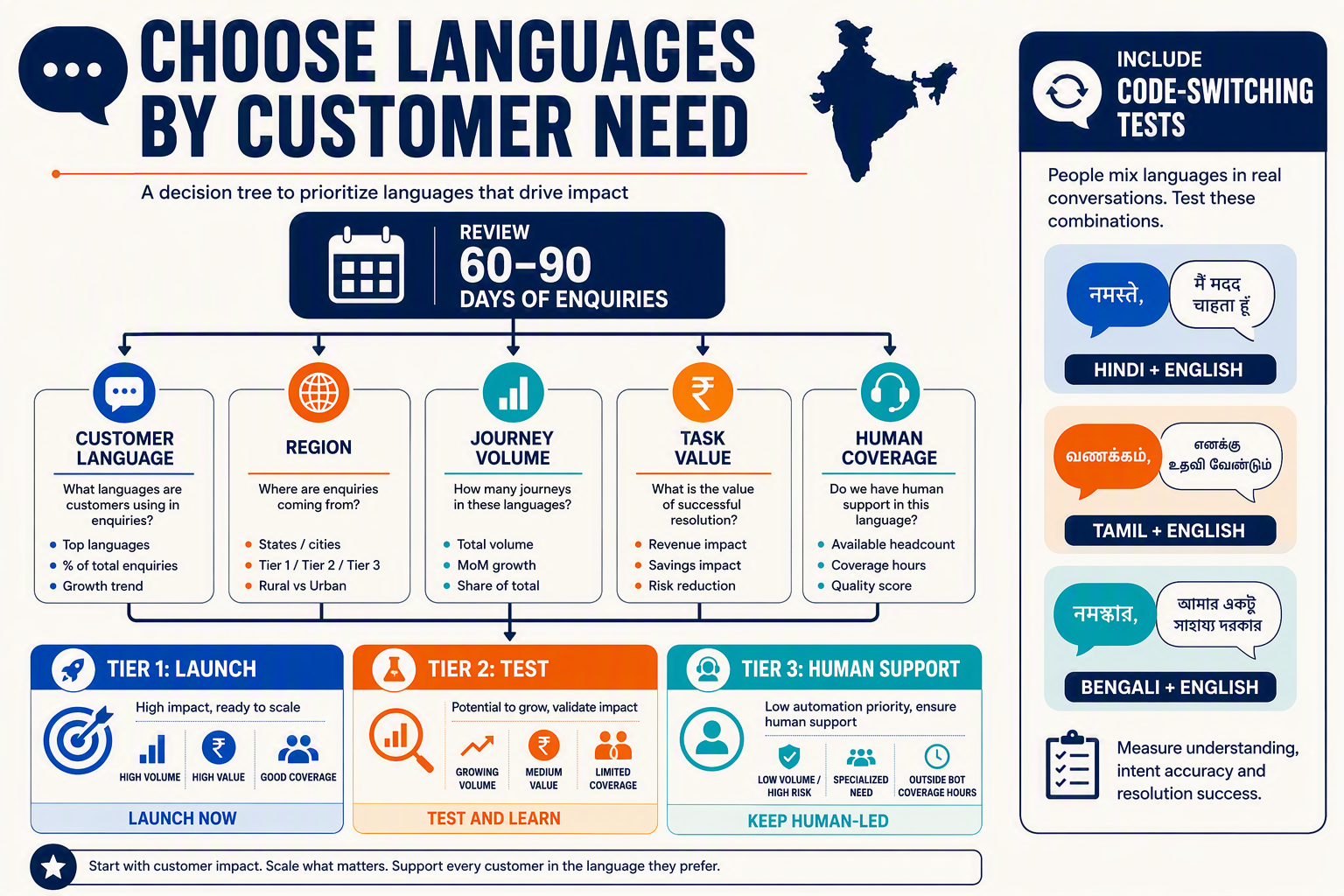
Start with the two or three language patterns already visible in customer conversations, not a national list. An Indian language AI receptionist should first handle high-frequency, low-risk journeys—such as enquiry capture, appointment requests and missed-call recovery—before complex complaints or regulated advice.
Map demand by service area, not state boundaries
Language demand rarely follows neat administrative borders. A Bengaluru business may receive Kannada, English, Hindi and Tanglish conversations, while a Surat merchant may encounter Gujarati, Hindi and mixed-language messages.
The Census of India 2011 identified 121 languages spoken by at least 10,000 people, making transaction-level demand analysis more useful than assuming one language per region. Build a 30- to 60-day baseline from:
- Call recordings or agent-selected language tags.
- WhatsApp messages, including Roman-script Indic language.
- Website search terms and enquiry forms.
- Delivery PIN codes, branch locations and campaign geography.
- Human-agent notes about translation requests or misunderstood calls.
Do not infer a customer’s preferred language solely from their name, location or phone number. Ask directly: “Would you prefer Hindi, English or another language?” Store that choice with consent and allow customers to change it.
Rank languages with a practical demand score
Score each candidate language against four factors:
- Conversation share: How many calls or messages use it?
- Commercial value: How often do those conversations lead to bookings, orders or qualified leads?
- Service gap: How frequently are calls abandoned, transferred or misunderstood?
- Operational readiness: Can the business review scripts, knowledge-base content and escalations in that language?
For example, a Jaipur clinic might prioritise Hindi and English for appointment booking, then add Rajasthani-influenced Hindi testing based on recordings. A Chennai home-services company could begin with Tamil, English and Tanglish for availability checks, while routing technical disputes to trained staff.
This staged approach makes multilingual customer engagement India measurable without attempting simultaneous deployment across every supported language.
Automate journeys by risk and repeatability
The first workflows should have clear inputs, approved answers and an obvious completion state:
- Inbound enquiry: identify language, capture intent and answer opening-hours or service-area questions.
- Missed-call recovery: send a consent-aware WhatsApp message asking when the customer wants a callback.
- Lead qualification: collect location, requirement, budget range and preferred appointment time.
- Booking: confirm an available slot and provide a written summary.
- Knowledge-grounded support: retrieve answers from approved policies, catalogues or FAQs.
- Human escalation: transfer context, transcript and language preference rather than making the customer start again.
Platforms such as CallMissed can support these patterns across AI voice, WhatsApp, email and an omnichannel inbox, with speech capabilities spanning 22 Indian languages. Businesses should still validate the selected language, accent, telephony route and workflow in their own operating environment before launch.
Treat code-switching as a core requirement
The Internet and Mobile Association of India and Kantar reported in 2024 that 98% of India’s 886 million active internet users accessed Indic-language content. Yet customers may speak Hindi, insert English product terminology, type the response in Roman script and request an English invoice.
Testing for AI voice WhatsApp automation India should therefore include:
- Hinglish, Tanglish and other common mixed-language patterns.
- Local pronunciations of names, landmarks and brands.
- Numbers, dates, addresses and spelling corrections.
- Mid-conversation language changes.
- Low-confidence recognition followed by clarification or human handoff.
The priority is not linguistic elegance. It is whether the customer can complete the intended task accurately, with minimal repetition and a safe route to human assistance.
What changed in AI voice WhatsApp automation India in 2026? Current developments, official evidence and CallMissed capability-verification matrix
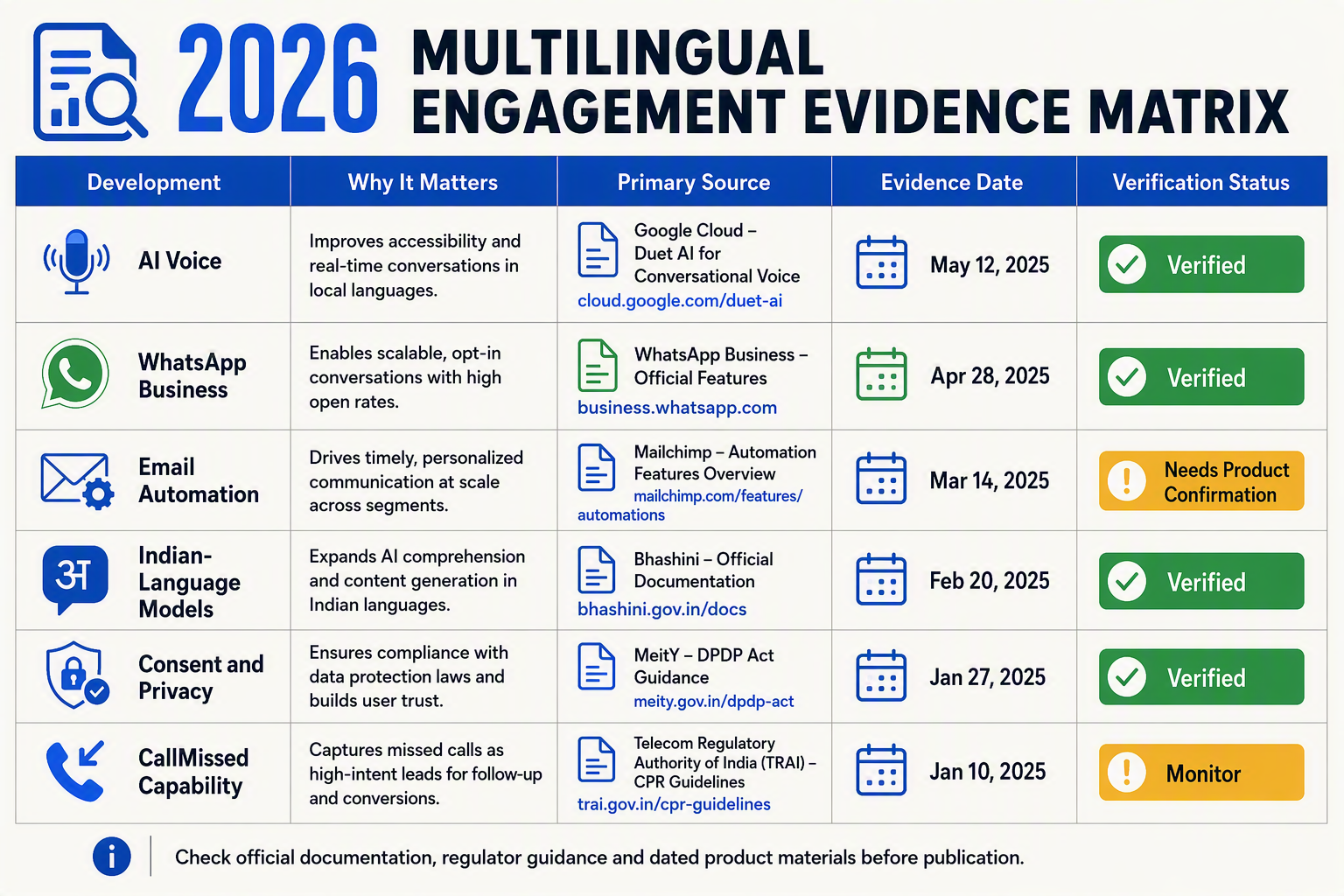
AI voice and WhatsApp automation in India has moved from isolated chatbots toward multilingual, cross-channel workflows that can answer calls, retrieve approved information and continue conversations through WhatsApp or email. In 2026, the practical breakthrough is orchestration—but every advertised capability still requires language, consent and integration testing before deployment.
Four developments shaping 2026 deployments
- WhatsApp now supports real business calling workflows. Meta’s WhatsApp Business Platform documentation distinguishes customer-initiated calls from business-initiated calls; outbound calling requires the customer’s permission and is subject to Meta’s eligibility and messaging rules. This makes voice escalation inside WhatsApp possible without treating every interaction as a text chat.
- Indian-language infrastructure has become a national priority. The Union Cabinet approved the IndiaAI Mission on 7 March 2024 with an outlay of ₹10,371.92 crore, according to India’s Press Information Bureau. Digital India BHASHINI also targets access across India’s 22 Scheduled Languages, strengthening the ecosystem around speech recognition, translation and speech synthesis.
- Retrieval-augmented generation has replaced unrestricted answering. A production Indian language AI receptionist should retrieve prices, policies and availability from an approved knowledge base, then transfer uncertain or sensitive cases to a person. Fluency alone does not establish factual reliability.
- Privacy and consent have become workflow requirements. India’s Digital Personal Data Protection Act, 2023 establishes principles including lawful processing, notice, consent where applicable and safeguards for personal data. Businesses must also check current commencement notifications, implementing rules and sector-specific obligations rather than assuming that installing compliant software makes the entire operation compliant.
CallMissed capability-verification matrix
The following matrix separates published platform capabilities from items that depend on configuration, external systems or account eligibility.
| Workflow | Published CallMissed capability | Verify before launch | Practical 2026 test |
|---|---|---|---|
| Inbound phone answering | AI voice agents with speech support across 22 Indian languages | Number routing, supported accents, latency and fallback behaviour | Complete 30 calls across selected languages and code-switched speech |
| WhatsApp voice calls | Inbound and business-initiated WhatsApp Business calling bridged to an AI agent | Meta account eligibility, customer permission and country restrictions | Capture permission, place a test call and confirm refusal handling |
| WhatsApp chat follow-up | WhatsApp chatbots, campaigns and omnichannel inbox | Approved templates, opt-in records and 24-hour conversation-window rules | Recover a missed call without sending an unapproved promotional message |
| Knowledge-grounded support | Knowledge-base retrieval-augmented generation, or RAG | Source freshness, citation visibility and “I don’t know” behaviour | Ask outdated, ambiguous and deliberately unanswerable questions |
| Booking and qualification | Voice and chat agents can collect structured lead or appointment details | Calendar, CRM or booking-system integration; duplicate prevention | Create, modify and cancel a booking across two channels |
| Email and human escalation | Email tooling plus an omnichannel inbox/CRM | Context transfer, assignment rules, permissions and retention settings | Escalate a WhatsApp conversation and check what the employee receives |
What this means for a small business
For small business customer service automation India, “supported” should never mean “safe to activate without testing.” A clinic might support Hindi and Marathi voice first, use WhatsApp for appointment confirmation and reserve email for formal instructions.
That staged approach turns AI voice WhatsApp automation India into measurable operations. CallMissed’s combination of Indic speech, WhatsApp Business calling, knowledge-grounded assistance and an omnichannel inbox is relevant to multilingual customer engagement India, but exact integrations, permissions and language performance should be verified against the business’s own customers before production rollout.
Which channel should handle each customer task? Voice, WhatsApp and email workflows for inbound answering, missed-call recovery, qualification, booking, support and escalation
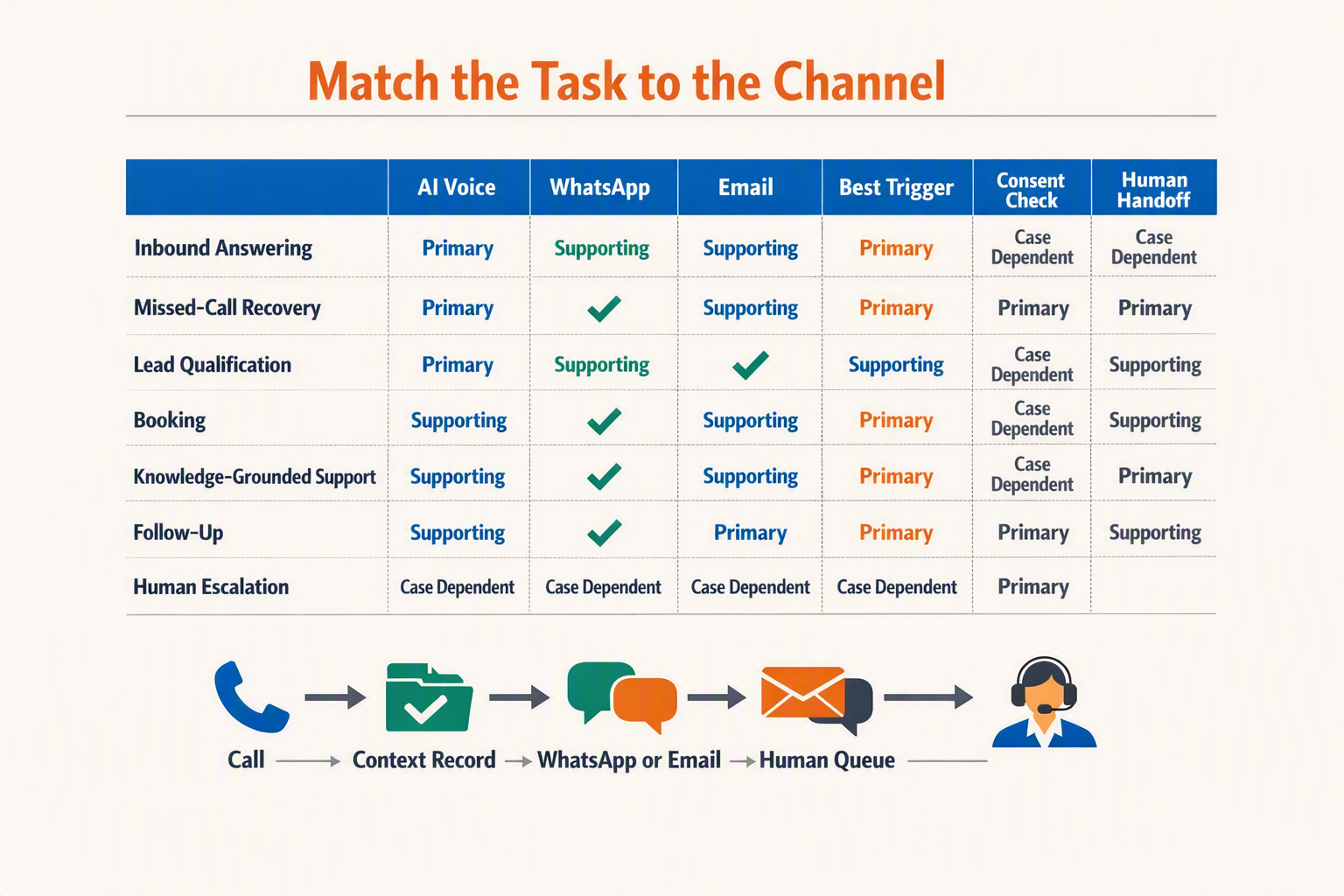
Use voice for urgent, nuanced or low-literacy interactions; WhatsApp for structured, asynchronous actions; and email for formal, detailed records. The most effective workflow assigns each task a primary channel while preserving context and offering a clear human fallback.
Channel-to-task workflow map
| Customer task | Primary channel | Recommended automated workflow | Escalation or fallback |
|---|---|---|---|
| Inbound answering | Voice | Detect language, state the AI’s role, identify intent, answer approved questions and capture the caller’s name and need | Transfer urgent, sensitive or repeatedly misunderstood calls to a person |
| Missed-call recovery | Send a consent-aware message identifying the business, reference the missed call and offer reply buttons such as Book, Get support or Call me | Retry by voice only when permitted; otherwise queue the lead for manual review | |
| Lead qualification | Voice or WhatsApp | Ask a short sequence covering location, requirement, timeline, budget range and preferred language | Route high-value, unusual or low-confidence enquiries to a sales representative |
| Appointment booking | Show available slots, confirm the selection and issue reminders; use voice when the customer needs conversational assistance | Send an email confirmation or create a human follow-up task if calendar validation fails | |
| Knowledge-grounded support | Retrieve answers from approved policies, catalogues, FAQs or service documents and retain citations internally | Escalate when the knowledge base has no reliable answer or the customer disputes the response | |
| Complaints and complex cases | Human-assisted voice | Pass the conversation summary, language, customer details and previous messages to an authorised employee | Continue through email for documents, investigation findings and formal resolution records |
Match the channel to customer effort
An Indian language AI receptionist can answer routine inbound calls when customers want immediate acknowledgement or find typing inconvenient. Voice is especially useful for pronunciation-sensitive details, but addresses, registration numbers and payment references should be repeated or confirmed through text.
WhatsApp works better for actions customers may need time to complete, including sharing a location, selecting a slot or reviewing a quotation. For businesses implementing AI voice WhatsApp automation India, platforms such as CallMissed can combine WhatsApp chat with inbound and business-initiated WhatsApp Business calling, including calls bridged to an AI voice agent. Availability, Meta approval, templates, consent requirements and account eligibility should be verified before deployment.
Email should not imitate instant chat. Use it when the customer needs:
- Invoices, estimates or policy documents
- A detailed complaint trail
- Attachments or long instructions
- A formal booking, cancellation or resolution record
Preserve context without automating every decision
A channel switch should transfer a compact conversation state, not simply dump a transcript. Store the customer’s chosen language, verified contact details, intent, completed steps, unresolved question and consent status. CallMissed supports an omnichannel inbox and knowledge-grounded workflows, alongside speech capabilities spanning 22 Indian languages, although each business should verify its required language, accent and channel configuration.
For dependable small business customer service automation India, set three routing rules:
- Escalate on uncertainty: repeated corrections, low-confidence recognition or missing knowledge should trigger human review.
- Confirm consequential actions: bookings, cancellations and payment-related instructions need an explicit customer confirmation.
- Minimise repeated questions: a human agent should receive the summary and collected fields before joining.
The operating principle is simple: automate the predictable step, preserve the customer’s context and make human help easy to reach.
How should accents, dialects and code-switching be tested before launch? A task-completion and handoff-quality scorecard
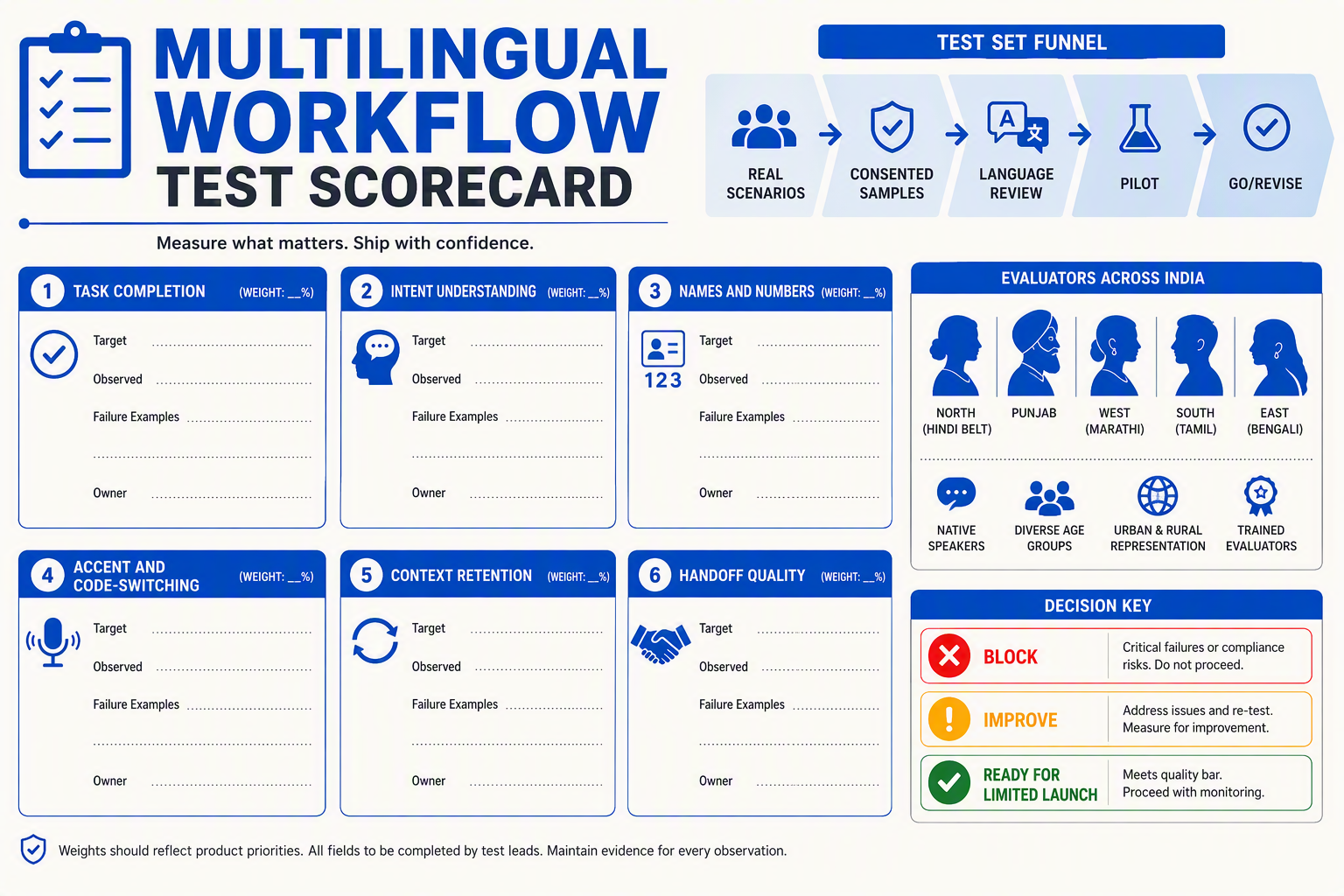
Test accents, dialects and code-switching with realistic end-to-end tasks, not isolated pronunciation samples. Launch only when customers can complete the intended action and, when automation fails, reach a human with their language choice, intent and conversation context intact.
Build a representative test set
Start with the languages customers actually use rather than treating “Hindi,” “Tamil” or “English” as uniform speech categories. The Census of India 2011 identified 121 languages spoken by at least 10,000 people, demonstrating why a single-language or single-accent test set is inadequate.
Recruit employees, customers or paid testers across relevant cohorts:
- Accents and dialects: Test regional, urban, rural and second-language speakers.
- Code-switching: Include natural Hinglish, Tanglish and mixed-language sentences, such as “Kal ka appointment reschedule karna hai.”
- Speaking conditions: Test fast speech, pauses, corrections, background traffic, speakerphone audio and weak mobile connections.
- Business vocabulary: Include local place names, personal names, product codes, medical terms and prices expressed in Indian numbering conventions.
- Channel changes: Begin on voice, continue on WhatsApp and confirm by email without making the tester repeat information.
CallMissed supports speech capabilities across 22 Indian languages, but language availability should not be treated as proof that every accent, dialect or noisy environment will perform equally. Each deployed workflow still requires business-specific testing.
Use a task-completion and handoff-quality scorecard
Score at least 30–50 varied conversations per priority language before a pilot. These are recommended operational sample sizes and launch gates—not universal industry benchmarks—and teams should tighten them for regulated or high-risk workflows.
| Measure | How to calculate it | Suggested pilot gate | Failure example |
|---|---|---|---|
| Task completion | Completed tasks ÷ valid attempts | ≥85% | Booking discussed but not saved |
| Critical-field accuracy | Correct names, dates, numbers and locations ÷ fields tested | ≥95% | “15 August” recorded as “50 August” |
| Correction rate | Conversations requiring customer repetition ÷ conversations | ≤15% | Customer repeats a phone number three times |
| Appropriate escalation | Correctly escalated failure cases ÷ cases requiring humans | ≥95% | Agent guesses instead of transferring |
| Handoff completeness | Transfers containing intent, language, summary and captured fields ÷ transfers | ≥90% | Human receives a call without context |
Task completion should carry the greatest weight. A fluent Indian language AI receptionist that transcribes every word correctly but fails to create the appointment has not succeeded. Conversely, a minor transcription variation may be acceptable if the correct service, location, date and consent status are captured.
Test the handoff as rigorously as the AI
For every failed or ambiguous interaction, verify that the human agent receives:
- Customer language and preferred channel
- Detected intent and urgency
- Confirmed details, clearly separated from uncertain fields
- Conversation summary or transcript
- Reason for escalation
- Consent status for WhatsApp or email follow-up
Run adversarial cases too: unsupported languages, repeated silence, abusive speech, contradictory dates and requests outside the approved knowledge base. The system should acknowledge uncertainty rather than invent an answer.
Finally, segment results by language, accent, device and noise level. An overall 90% completion rate can conceal a poorly served dialect cohort. For reliable multilingual customer engagement India, publish an internal go/no-go decision for each cohort, launch narrowly, review failed conversations weekly and expand only after the weakest group clears the agreed threshold.
How can small business customer service automation India remain consent-aware and protect customer data across follow-ups?
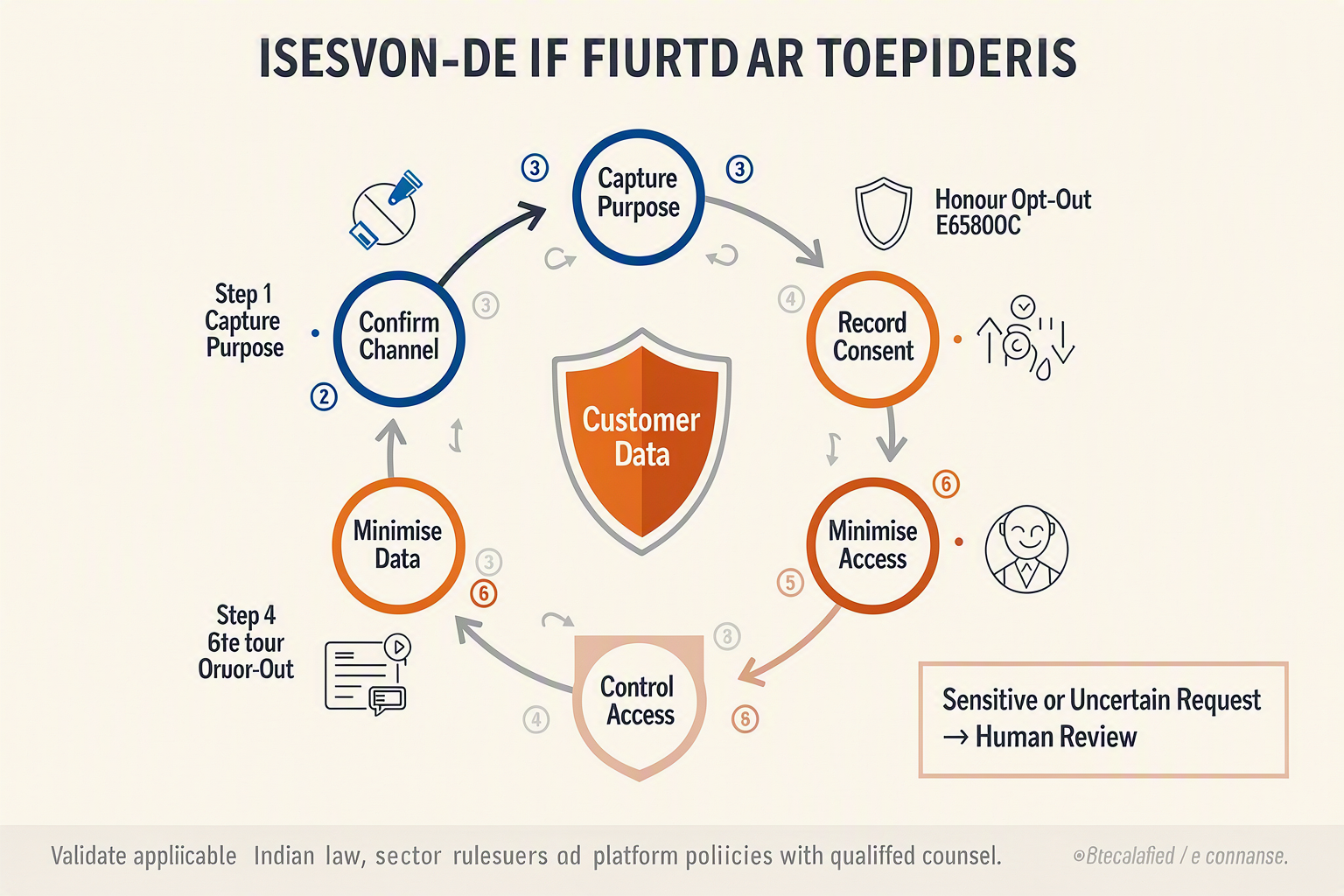
Small businesses should treat every follow-up as a specific, recorded permission—not as an automatic extension of an inbound call. Consent-aware automation requires a clear purpose, channel-level preferences, limited data collection, secure access and an easy route to opt out or reach a person.
Capture consent by purpose and channel
A customer calling about an appointment has not necessarily agreed to receive future promotions. Separate transactional communication—such as a requested booking confirmation—from marketing campaigns.
A practical consent record should capture:
- Customer identifier and chosen language.
- Approved channel: voice, WhatsApp or email.
- Purpose, such as appointment updates or promotional offers.
- Consent wording, source, date and time.
- Withdrawal status and suppression-list entry.
Section 5 of India’s Digital Personal Data Protection Act, 2023 requires notice describing the personal data and processing purpose, while Section 6 requires consent to be free, specific, informed, unconditional and unambiguous. The Act also allows notices and consent requests in English or any language listed in the Constitution’s Eighth Schedule—an important requirement for multilingual customer engagement India.
Make withdrawal as easy as agreement. For example, accept “STOP,” “बंद करें” or an equivalent regional-language instruction on WhatsApp, include an unsubscribe mechanism in email and let callers request no further contact.
Apply channel-specific follow-up rules
- Voice: At the beginning of a recorded or AI-handled call, identify the business, explain that an AI system is assisting and disclose recording or transcription before collecting sensitive details. Provide a human-transfer option.
- WhatsApp: Obtain opt-in before business-initiated messages and follow the applicable Meta WhatsApp Business rules, including approved templates where required. Do not interpret a missed call as indefinite permission for promotional messaging.
- Email: State why the recipient is receiving the message, identify the sender and provide a functioning unsubscribe route. Keep transactional and promotional mailing lists separate.
- Commercial communication: The Telecom Regulatory Authority of India’s Telecom Commercial Communications Customer Preference Regulations, 2018 govern unsolicited commercial communication through India’s telecom ecosystem, including customer preferences, registered senders, headers and templates.
An Indian language AI receptionist can ask, “May I send your appointment details on WhatsApp?” in the caller’s selected language, record the answer and send only the agreed confirmation. Marketing requires a separate permission.
Minimise and secure customer data
For small business customer service automation India, collect only what the workflow needs. A salon booking may require a name, phone number, service and time; it usually does not require identity documents or complete call recordings.
Use these controls:
- Encrypt data in transit and at rest.
- Restrict inbox, transcript and knowledge-base access by employee role.
- Mask payment, health and identification data in transcripts.
- Set separate retention periods for recordings, transcripts and contact records.
- Maintain audit logs for exports, edits and agent access.
- Delete or anonymise information when its stated purpose ends, subject to legal retention duties.
- Create a tested process for security incidents and customer requests.
Section 8 of the Digital Personal Data Protection Act, 2023 requires reasonable security safeguards and breach notification obligations for Data Fiduciaries. Businesses should obtain legal advice on the Act’s provisions and rules applicable to their deployment.
Platforms such as CallMissed can connect voice, WhatsApp and email context, but businesses must verify current consent, retention, access-control and deletion settings before deployment. The safest AI voice WhatsApp automation India workflow shares the minimum necessary context across channels while keeping marketing permissions, service messages and opt-outs clearly separated.
What do practical multilingual workflows look like in retail, clinics, professional services, education and field-service businesses?
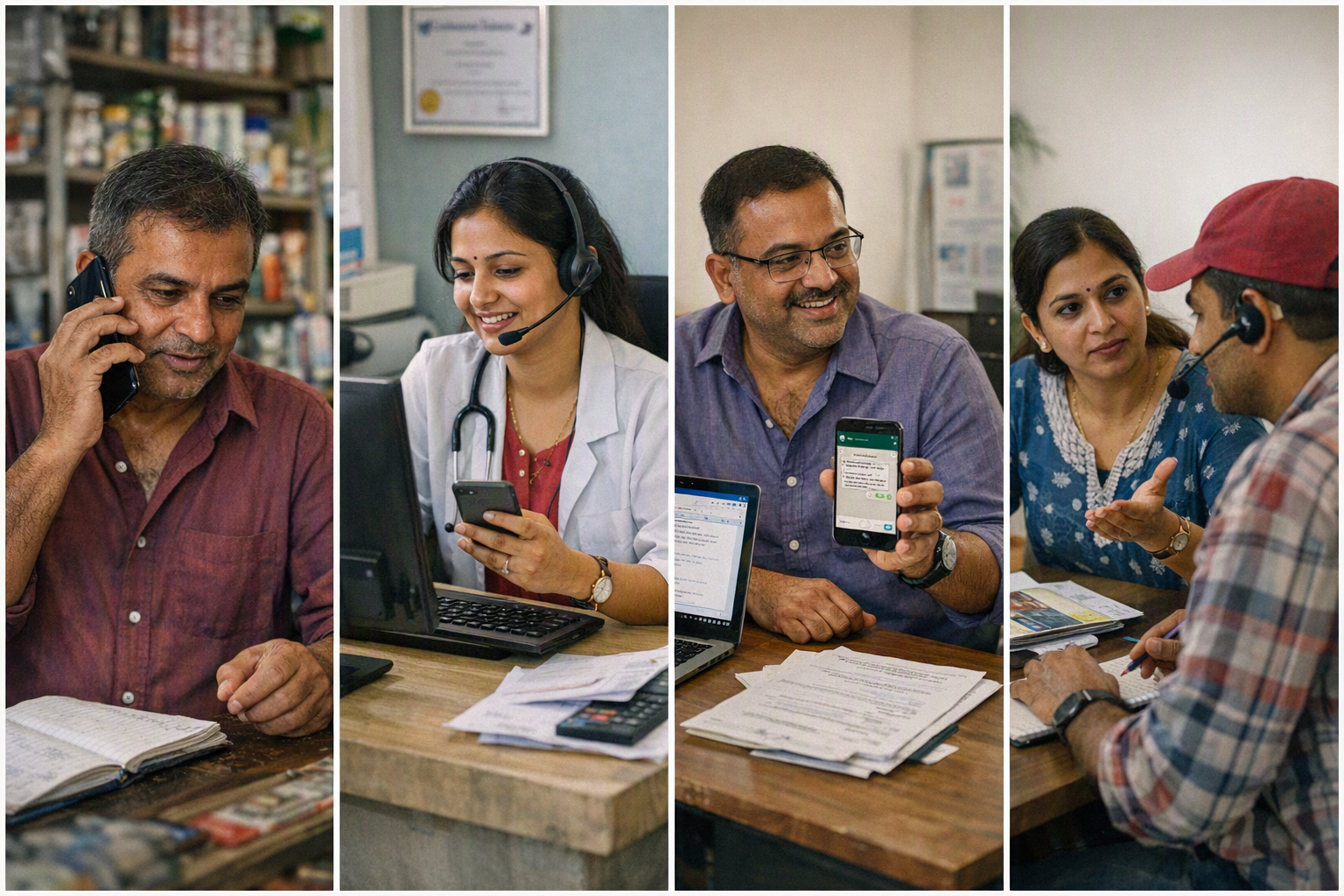
Practical multilingual workflows combine voice for immediate intent capture, WhatsApp for interactive follow-up and email for formal records. In every sector, AI should complete a narrowly defined task, preserve language and context across channels, and transfer exceptions to a named employee.
Retail: availability, orders and missed-call recovery
A customer calls in Marathi to ask whether a product is available. An AI voice agent identifies the product, branch and preferred variant, then checks a verified catalogue or routes the request to store staff if live inventory is unavailable.
- With permission, send the product details, price and shop location on WhatsApp.
- Let the customer respond in Marathi, English or mixed-language text.
- Escalate complaints, refund disputes and unusual discount requests.
- Email a receipt or order summary only after confirming the address and purpose.
The important safeguard is to distinguish knowledge-base information from real-time inventory; the agent must not claim an item is in stock without a reliable system response.
Clinics: appointments without automated diagnosis
An Indian language AI receptionist can answer routine calls, identify the requested speciality, offer available slots and send a WhatsApp confirmation. It should collect only the minimum information required for booking.
A safe clinic workflow follows this order:
- Disclose that the caller is interacting with an automated assistant.
- Ask for language preference, appointment type and suitable time.
- Confirm the patient’s name and contact details.
- Send booking instructions through the consented channel.
- Transfer emergencies, clinical questions and uncertain requests to trained staff.
The Digital Personal Data Protection Act, 2023 makes purpose-specific data handling especially relevant: appointment details should not automatically become marketing data. AI must not diagnose symptoms or interpret test results unless the clinic has a separately governed, clinically validated process.
Professional services: qualify enquiries, not outcomes
Accountants, lawyers, agencies and consultants can use AI to capture the caller’s location, service category, deadline and preferred consultation language. A knowledge-grounded assistant may explain office hours, document checklists and published fee structures, but it should not promise legal, financial or commercial outcomes.
After qualification, WhatsApp can collect approved documents or schedule a consultation, while email provides the formal engagement summary. High-value prospects, conflicts of interest and requests involving confidential advice should trigger human escalation.
Education: admissions journeys across family members
A coaching centre or school may receive a Hindi call from a parent, a Hinglish WhatsApp reply from the student and need to send an English fee schedule by email. The workflow should retain the course, campus, class level and callback history across that journey.
Useful automation includes:
- Answering from an approved admissions knowledge base.
- Capturing programme and location preferences.
- Booking counselling sessions or campus visits.
- Sending verified brochures, fee tables and document lists.
- Routing scholarship, refund and safeguarding questions to staff.
Field services: dispatch with language-aware handoffs
For electricians, appliance repair firms and home-service teams, voice AI can capture the appliance, fault description, postcode and preferred visit window. WhatsApp can then request a location pin or image, subject to explicit customer action.
Platforms such as CallMissed can support this pattern through AI voice agents, WhatsApp chat and Business calling, email, knowledge-grounded assistance and an omnichannel inbox. Before deployment, each business should verify telephony, calendar, CRM and dispatch integrations.
Across all five sectors, measure task completion, correction frequency, escalation accuracy and whether the employee receives a usable summary. Fluency matters, but operational success means the customer gets the correct product, appointment, consultation, admission response or technician visit without repeating the story.
Which metrics reveal genuine impact, and what do customer-service, language, privacy and operations experts recommend?
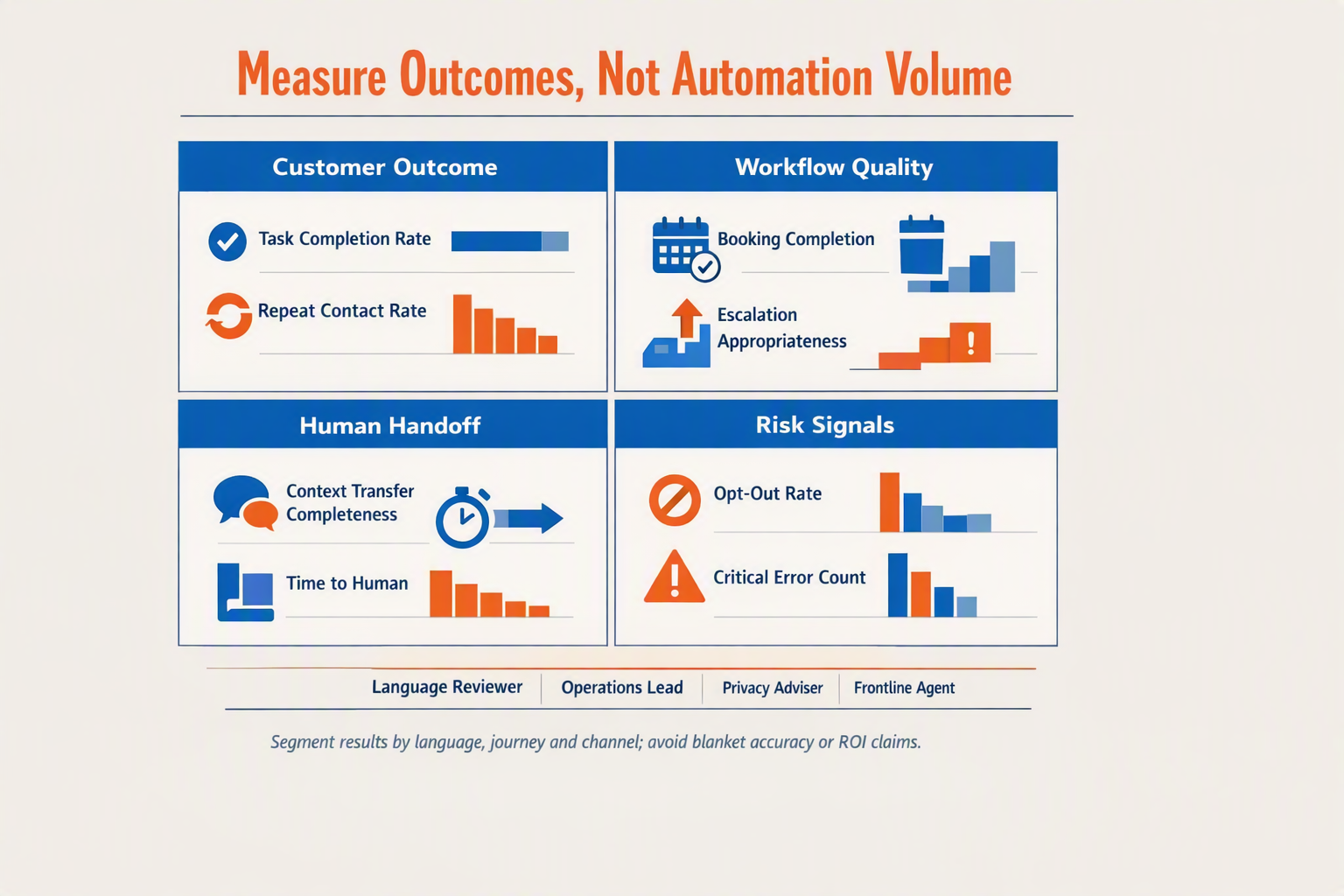
Genuine impact appears in completed customer tasks, low-effort handoffs and consistent outcomes across languages—not in call volume or fluent-sounding conversations alone. Experts should evaluate an AI workflow through four lenses: customer service, language quality, privacy and day-to-day operational reliability.
Measure outcomes rather than activity
For small business customer service automation India, establish a manual baseline and compare AI-assisted results by channel, language, intent and time of day. Track:
- Task-completion rate: The percentage of conversations that achieve the stated objective, such as booking an appointment, confirming an order or answering an approved support question.
- First-contact resolution: Whether the customer’s issue is resolved without another call, message or email.
- Correction rate: How often customers repeat, rephrase or correct names, dates, addresses and quantities.
- Handoff success: The percentage of escalations that reach the correct employee with the transcript, detected language, intent and collected details intact.
- Customer effort: The number of turns, channel switches and repeated questions required to complete a task.
- Latency and abandonment: Response delay, premature hang-ups and conversations abandoned before completion.
- Business outcome: Qualified leads, attended appointments, recovered missed calls or resolved cases—not merely messages sent.
Do not report one blended accuracy number. Compare Hindi, Tamil, Marathi, Bengali, English and code-switched conversations separately, including performance by intent and accent. The Internet and Mobile Association of India and Kantar reported in 2024 that 870 million of India’s 886 million active internet users—98%—accessed Indic-language content. Language-level reporting is therefore a core business requirement rather than a specialist research exercise.
What customer-service and language specialists recommend
Customer-service specialists generally prioritise resolution quality over containment. A call transferred safely to a trained employee may be a better result than an automated but incorrect resolution.
For an Indian language AI receptionist, reviewers should:
- Build test sets from genuine customer phrases, with personal data removed or appropriately protected.
- Include accents, background noise, interruptions, number formats and Hinglish or Tanglish code-switching.
- Score the complete task, not just speech transcription.
- Test whether customers can request a person at any stage.
- Review failures weekly and update prompts, routing rules and approved knowledge.
The Census of India 2011 identified 121 languages spoken by at least 10,000 people and recognised 22 Scheduled Languages. Language experts would therefore recommend selecting languages from actual customer demand rather than assuming that “Hindi plus English” covers every market.
What privacy and operations specialists recommend
Privacy reviewers should map every data field collected through AI voice WhatsApp automation India, document its purpose and restrict employee and vendor access. They should also define retention periods, deletion procedures and consent-aware follow-up rules consistent with India’s Digital Personal Data Protection Act, 2023.
Operations specialists should use a controlled rollout:
- Start with one location, language and low-risk intent.
- Keep human escalation available during operating hours.
- Audit transcripts and summaries for unsupported claims.
- Maintain an incident log covering wrong bookings, failed transfers and unwanted follow-ups.
- Pause automation when error or abandonment thresholds are exceeded.
- Expand only after the workflow performs reliably across representative language tests.
A practical executive dashboard should combine completion rate, correction rate, successful handoffs, abandonment, repeat contact and privacy incidents. Together, these metrics reveal whether multilingual customer engagement in India is genuinely reducing effort while preserving customer trust.
What should your 30-day rollout plan include? CallMissed verification gates, pilot checklist, owners, stop conditions and internal links to implementation resources
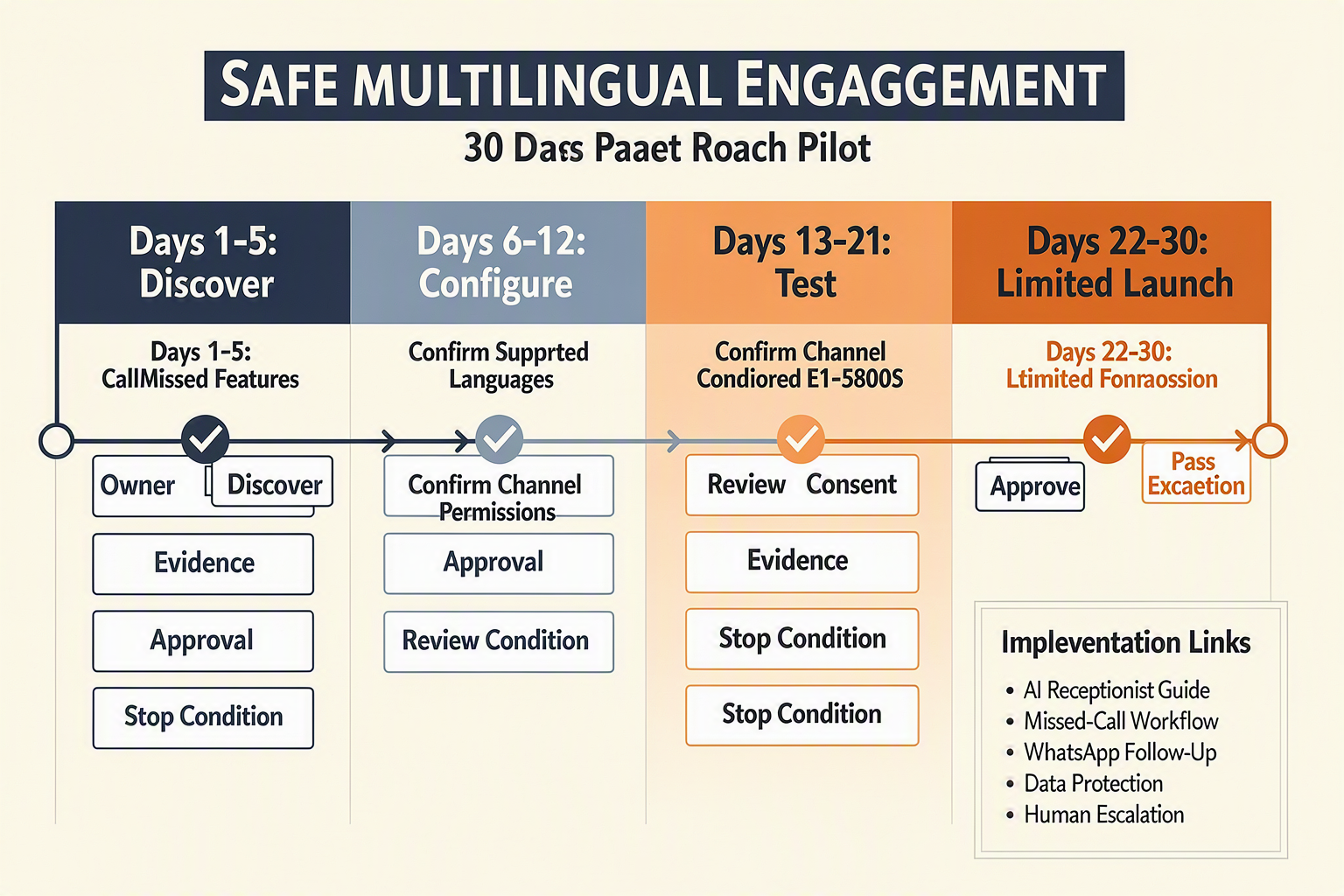
A safe multilingual customer engagement India rollout should progress through four stages: capability verification, internal testing, a limited live pilot and an evidence-based go/no-go decision. Start with one use case and one or two languages, assign an accountable owner to every gate and define stop conditions before customer traffic begins.
For multilingual customer engagement India programmes, reach alone is not proof of readiness. The Internet and Mobile Association of India and Kantar reported in 2024 that 870 million of India’s 886 million active internet users—98%—accessed Indic-language content. That scale supports careful experimentation, but each language, accent, model, channel and workflow still requires testing in the business’s actual CallMissed configuration.
30-day rollout table
| Period | Owner | Verification gate and action | Evidence required | Stop or rollback condition |
|---|---|---|---|---|
| Days 1–3 | Business owner | Approve the multilingual customer engagement India pilot charter. Select one use case, such as missed-call recovery or appointment booking, and one or two customer languages using the workflow-selection framework. Define consent, escalation, context-continuity and success requirements. | Baseline contact volume and completion rate, approved purpose, target segment, named human fallback and measurable acceptance thresholds. | No lawful purpose, unclear consent route, undefined success measure or no employee available for escalations. |
| Days 4–7 | Technical owner | Verify in the actual CallMissed account or sandbox that the required voice, WhatsApp chat, WhatsApp Business calling, email, knowledge-base and language combination is available. Check provider approvals, sender status, account limits and pricing instead of relying on general marketing descriptions. | Successful test for every intended channel, verified sender or calling configuration and a signed multilingual customer engagement India capability matrix. | Any critical channel, model, language, sender or business-initiated calling capability is unavailable, unapproved or unreliable. |
| Days 8–12 | Operations lead | Build the narrow workflow, approved knowledge source and human handoff. Test missing information, interruptions, silence, regional accents, code-switching, incorrect customer details and context transfer between voice, WhatsApp and email using the accent and code-switching scorecard. | Test transcripts, task-completion results, correction counts, latency observations, context-continuity checks and handoff records. | Fabricated policy answers, failed urgent escalation, repeated loops, lost context, incorrect bookings or material language-understanding failures. |
| Days 13–17 | Privacy or compliance owner | Review notices, consent capture, access permissions, retention, transcript handling and deletion procedures against the customer-data checklist. Minimise the customer information shared across channels and with human agents. | Approved data map, consent record, role-based access list, retention period, deletion test and incident owner. | Sensitive data is collected unnecessarily, consent cannot be demonstrated, access cannot be restricted or deletion does not work as documented. |
| Days 18–24 | Pilot manager | Release the multilingual customer engagement India workflow to a small, defined segment—for example, after-hours appointment enquiries in Hindi and English. Review interactions daily and compare automation performance with the pre-pilot baseline. | Daily conversation samples, opt-out log, completion and escalation rates, customer corrections, unresolved cases, complaints and channel-transfer results. | Material complaint spike, consent failure, routing error, harmful response, privacy incident or sustained deterioration from baseline. |
| Days 25–30 | Business owner and pilot team | Conduct a documented go/no-go review. Expand only the tested workflow, and treat every additional language, location, model or channel as a new verification gate. | Signed decision record, results against acceptance thresholds, issue backlog, updated scripts and an assigned monitoring owner. | Critical defects remain open, staff cannot manage handoffs, acceptance thresholds are missed or evidence is insufficient to justify expansion. |
Acceptance gates before live traffic
A multilingual customer engagement India pilot should not receive customer traffic until all of these checks pass:
- Use test phone numbers, sandbox accounts and internal email addresses before external exposure.
- Confirm the AI identifies itself where appropriate and provides a clear route to a person.
- Verify that human agents receive the relevant conversation context, customer language, consent state and unresolved task without requiring the customer to start again.
- Validate names, dates, prices, addresses, policies and booking availability against authoritative systems.
- Test several speakers per target language, including regional accents, different speaking speeds and natural code-switching.
- Test silence, interruptions, background noise, unsupported requests, repeated corrections and channel changes.
- Confirm WhatsApp templates, calling permissions, sender status and opt-out handling meet applicable provider and Meta requirements.
- Record consent where required and verify access controls, retention limits, transcript handling and deletion.
- Assign one named owner for operations, technical issues, privacy review and live-pilot decisions.
- Set measurable acceptance thresholds for task completion, correction frequency, handoff success, latency, complaints and unresolved cases.
- Maintain an emergency kill switch that can pause automation and route interactions to staff or conventional voicemail.
- Document stop conditions in advance; a serious consent, privacy, safety or routing failure should trigger an immediate pause rather than waiting for the end-of-month review.
CallMissed supports a broad multilingual engagement stack, including speech capabilities across 22 Indian languages, but suitability and availability must be verified for the selected model, channel, account and workflow. The goal of a 30-day multilingual customer engagement India rollout is not maximum automation: it is evidence that customers can complete the intended task, retain context across channels, reach a capable person when necessary and rely on a tested rollback path.
Frequently asked questions: How many languages should a small business launch first, can AI understand Indian accents and mixed-language speech, when is WhatsApp follow-up permitted, can context move between channels, when should a person take over, how should CallMissed claims be verified, and what does a safe pilot cost?
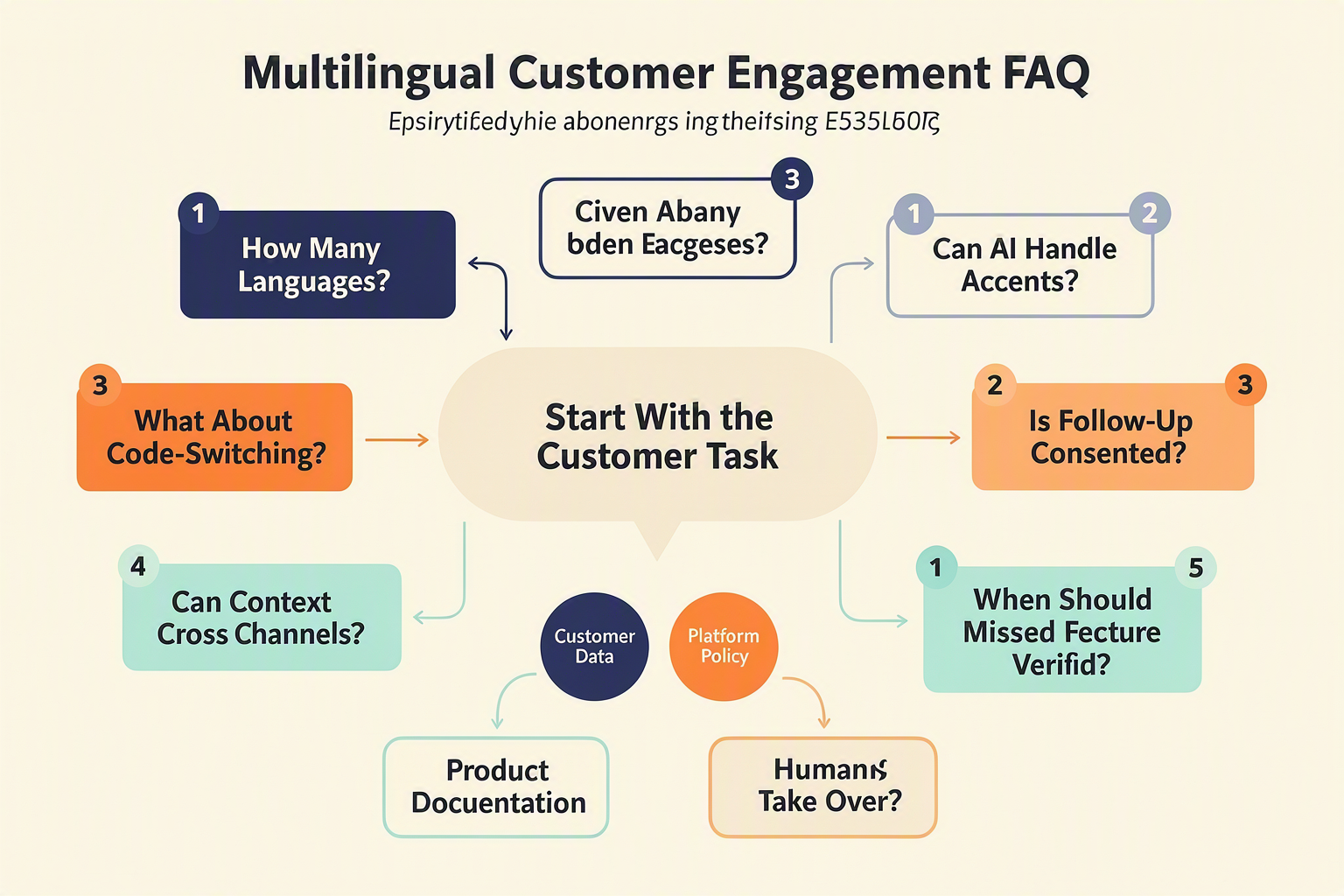
How many languages should a small business launch first for multilingual customer engagement India?
Can an Indian language AI receptionist understand regional accents and mixed-language speech?
When is WhatsApp follow-up permitted after a missed call or AI voice conversation?
Can customer context move securely between voice, WhatsApp and email?
When should an AI customer-service agent transfer the conversation to a person?
How should businesses verify CallMissed capabilities, and what does a safe AI pilot cost?
Conclusion
Success in multilingual customer engagement India will come from dependable workflows, not from automating every language and channel at once. Indian small businesses should begin with one high-value customer journey, test it with real speech patterns and expand only when the system completes tasks reliably.
Key takeaways for 2026
- Prioritise customer behaviour over language counts. The Internet and Mobile Association of India and Kantar reported that India had 886 million active internet users in 2024, with 870 million—98%—accessing Indic-language content. Businesses should identify the languages, accents and code-switching patterns their customers actually use rather than launching all available languages simultaneously.
- Design one connected journey across voice, WhatsApp and email. Effective AI voice WhatsApp automation India can answer an inbound call, qualify a lead, confirm consent for follow-up and continue the interaction on WhatsApp or email without forcing the customer to repeat information.
- Measure operational outcomes, not conversational fluency alone. Evaluate an Indian language AI receptionist through booking completion, correction frequency, response latency, escalation accuracy and handoff quality. Knowledge-grounded answers, clear escalation rules and human review remain essential when confidence is low or a request is sensitive.
- Treat privacy and rollout controls as product requirements. Practical small business customer service automation India should use purpose-limited data collection, appropriate retention, access controls and consent-aware outreach aligned with India’s Digital Personal Data Protection Act, 2023.
The Census of India 2011 identified 121 languages spoken by at least 10,000 people and recognised 22 Scheduled Languages, underscoring why multilingual engagement will remain an operational priority. What businesses should watch next is whether advances in accent handling, code-switching, cross-channel context and knowledge grounding translate into higher task completion under real customer conditions—not merely better demonstrations.
Platforms such as CallMissed provide a practical way to explore this direction through AI voice agents, WhatsApp chat and Business calling, email, knowledge-grounded assistance and speech capabilities spanning 22 Indian languages. Which single customer journey could your business test safely, measure clearly and improve first?
Related Reading
Discussion
Related Posts


Ready to automate customer conversations?
Launch AI voice agents and WhatsApp bots with CallMissed — one API, 22+ Indian languages.