Meta Muse Personal AI Agent: Privacy, Features and U.S. Availability


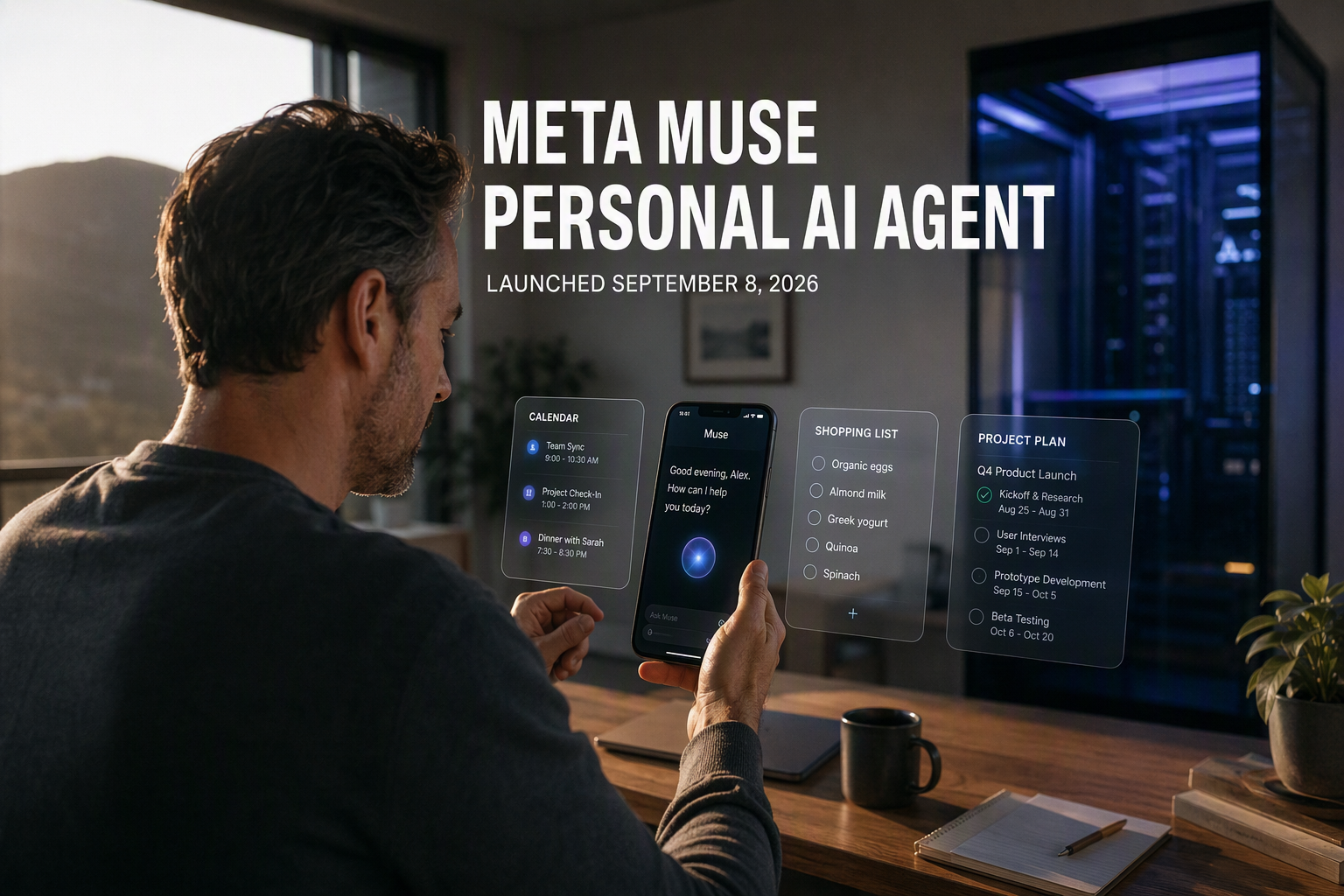
Learn what the Meta Muse personal AI agent does, where it is available, how its secure virtual machine works and what remains unverified.
Meta Muse Personal AI Agent: Privacy, Features and U.S. Availability
What if an AI assistant could manage your calendar, help with shopping and turn a distant ambition into an actionable plan—while remembering enough about you to become genuinely personal? Meta launched the Meta Muse personal AI agent in the United States on September 8, 2026, bringing that promise—and its unavoidable privacy questions—to adults aged 18 and over.
Muse is a consumer-facing agent designed to perform and coordinate everyday tasks rather than merely answer prompts. The Associated Press reported on September 8, 2026, that Muse can assist with schedules, shopping and “long-term” goals, while Bloomberg described the product as an agent capable of carrying out tasks on a user’s behalf. That shift from generating information to taking action matters: an assistant that organizes appointments or purchases may need access to more sensitive personal context than a conventional chatbot.
The launch also has unusual potential scale. NogenTech reported in September 2026 that Meta AI operates across apps used by more than three billion people, giving Meta Platforms a distribution advantage across Facebook, Instagram, WhatsApp and Messenger. Muse is initially a U.S.-focused, 18-plus product, however, and readers should not assume that a global release—or integration into every Meta app—is already confirmed. Availability, account requirements and feature access can also change during a staged rollout.
The naming requires particular care. Muse is the new personal AI agent, meaning it is the user-facing product people interact with. It should not be confused with Meta’s existing Mu, a separately named AI technology, or with Muse Spark, the model series described as coming from Meta Superintelligence Labs. “Agent,” “model” and “underlying infrastructure” are not interchangeable terms: a model generates or interprets information, while an agent adds memory, tools, permissions and task execution around one or more models.
This explainer separates Meta’s confirmed statements from early reporting and unresolved questions. It examines what Muse can do, which U.S. users can access it, what Meta has said about safety and privacy, and what users should verify before granting calendar, shopping or other personal-data permissions. Muse also reflects a broader move toward action-oriented AI: business platforms such as CallMissed already connect AI agents with voice, WhatsApp and customer-engagement workflows. The central issue is no longer whether AI can converse—it is what an AI agent may remember, access and do in your name.
What did Meta launch on September 8, 2026? Muse is an 18+ U.S. personal AI agent for schedules, shopping and longer-term goals

Meta Platforms launched Muse, a consumer-facing personal AI agent for U.S. adults aged 18 and older, on September 8, 2026. Meta positioned Muse as an assistant that can help organize schedules, support shopping and translate longer-term ambitions into manageable tasks.
What Meta has confirmed about Muse
The Associated Press reported on September 8, 2026, that Meta Muse is intended for people aged 18 and over who want help with schedules, shopping and turning “long-term” goals into action. The quoted phrase is Meta’s description; detailed evidence about how effectively Muse completes complex, multi-month goals is not yet available.
Bloomberg reported on September 8, 2026, that Muse is designed to carry out tasks on a user’s behalf, a description that places the product in the emerging category of agentic AI rather than conventional question-and-answer chatbots.
The launch establishes three core points:
- Muse is a personal assistant: It is aimed at individual consumers rather than being presented primarily as an enterprise automation product.
- Muse is action-oriented: Meta’s framing goes beyond generating text to helping coordinate or execute everyday activities.
- Muse is restricted at launch: The announced audience is U.S. users aged 18 and older, not children, teenagers or a confirmed worldwide user base.
The early reports identify broad use cases, but they do not fully document every supported action. For example, “shopping” could range from comparing products and preparing lists to interacting with retailers. Users should not assume Muse can independently complete purchases, move money or approve transactions unless Meta explicitly documents those permissions.
Why the word “agent” matters
A chatbot typically responds when a user submits a prompt. A personal AI agent can potentially combine several steps, retain relevant preferences and use connected tools to pursue an outcome.
For a scheduling request, those steps could theoretically include:
- interpreting a natural-language instruction;
- checking calendar availability;
- identifying conflicts;
- suggesting a time; and
- making a change after receiving authorization.
That sequence illustrates what agentic software can do; it is not confirmation that every step is available in Muse at launch. Verification requires Meta’s product documentation, permission screens and hands-on testing.
The same distinction applies to longer-term goals. Muse may help break an ambition into milestones, reminders and follow-up actions, but Meta’s launch framing does not by itself establish autonomous execution, guaranteed outcomes or professional expertise.
Muse, Mu and Muse Spark are not interchangeable
The product announced on September 8 is Muse, the user-facing personal AI agent. It should be separated from two similarly named technical entities:
- Mu refers to existing Meta AI technology, not the newly launched consumer agent.
- Muse Spark refers to a model series associated with Meta Superintelligence Labs, rather than the complete personal-agent product.
A model can provide reasoning or language-generation capabilities, while an agent adds the surrounding product layer: memory, tool access, permissions, interfaces and task orchestration. Consequently, reports about Muse Spark’s technical capabilities should not automatically be treated as evidence that the Muse agent exposes those capabilities to every user.
Finally, “launched” does not necessarily mean immediate access for every eligible account. Meta had confirmed the product, intended audience and headline uses, but users still need to verify rollout status, supported devices, account requirements and available integrations inside Meta’s official interfaces.
What is the difference between the Muse agent, Muse Spark, Muse Code and Muse Glimmer?
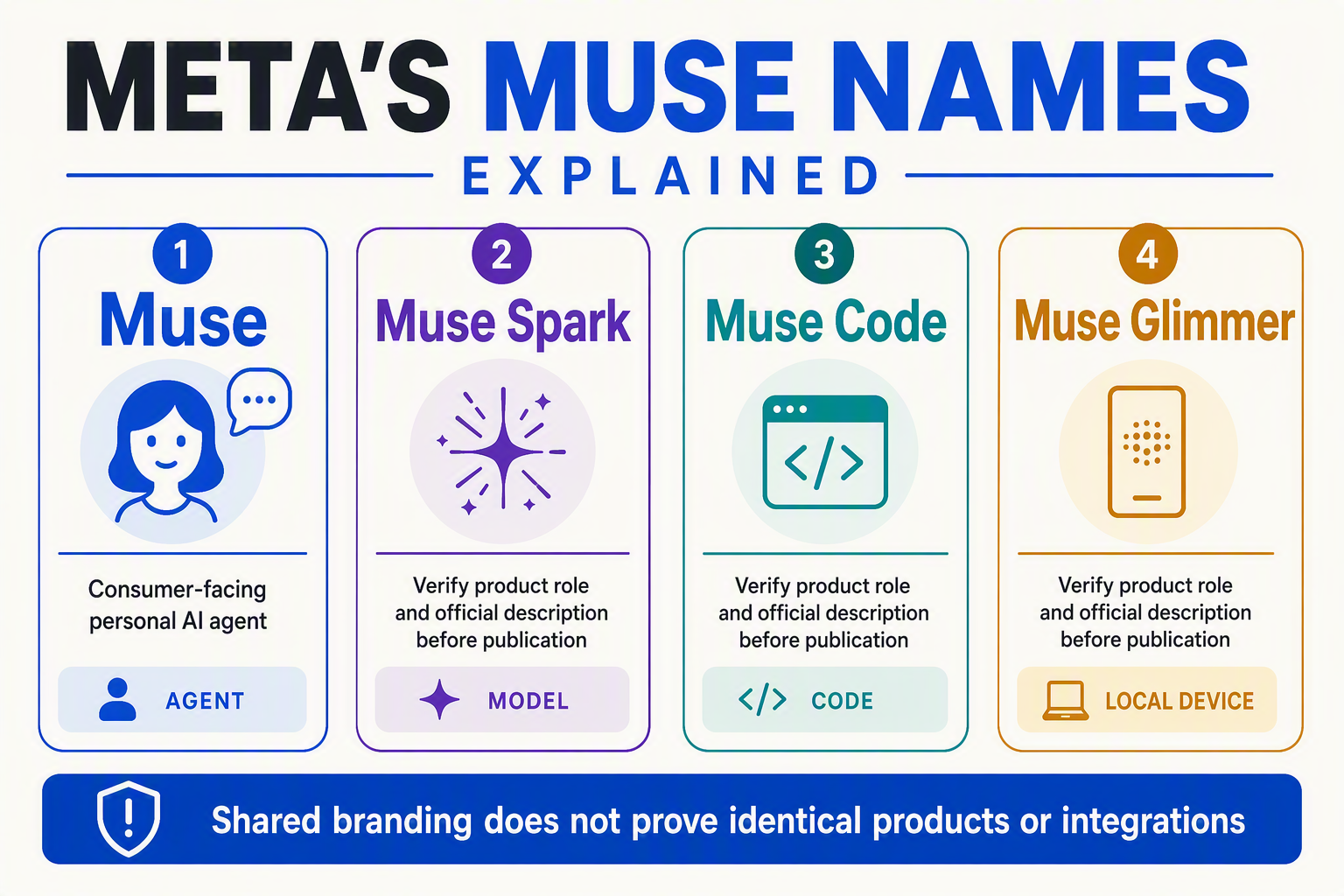
Muse is the consumer product, while Muse Spark is the reported model series intended to power AI assistants. “Muse Code” and “Muse Glimmer” are not adequately documented in the currently available launch reporting, so their functions should not be stated as fact without a Meta technical announcement or model card.
The names refer to different layers—or different evidence levels
| Name | What it appears to be | Confirmed role | Verification status |
|---|---|---|---|
| Muse | Consumer-facing AI agent | Coordinates personal tasks using context, tools and permissions | Confirmed by Meta launch reporting |
| Muse Spark | Large-language-model series | Provides underlying AI capabilities for assistants | Reported as a Meta Superintelligence Labs model |
| Muse Code | Possibly a model or specialized component | No reliable role established in the supplied launch material | Unverified |
| Muse Glimmer | Possibly a model or specialized component | No reliable role established in the supplied launch material | Unverified |
The Associated Press reported on September 8, 2026, that Muse is available to people aged 18 and over and is intended to help with schedules, shopping and turning “long-term” goals into plans. Bloomberg reported on September 8, 2026, that Muse is designed to carry out tasks on a user’s behalf. Those descriptions establish Muse as an agent-level product, not merely the name of a language model.
An agent typically combines several technical layers:
- One or more foundation models for reasoning and language generation
- Memory or personalization systems that retain relevant user context
- Tools and integrations for calendars, shopping or other services
- Permission controls governing what the agent may access or change
- Safety policies and execution checks before consequential actions occur
Muse Spark is infrastructure, not the assistant experience
TechBuild Africa described Muse Spark as the first in a new series of large language models from Meta Superintelligence Labs. NogenTech similarly reported in September 2026 that Muse Spark was built on a rebuilt Meta AI stack under Chief AI Officer Alexandr Wang and powers Meta AI across applications used by more than three billion people.
That reporting supports a clear distinction: Muse Spark generates or interprets information, whereas Muse packages model capabilities into a personal assistant that can plan and act. A single agent may also use multiple models, retrieval systems and conventional software services; its product name does not necessarily identify every model operating underneath it.
Muse Code and Muse Glimmer require primary-source confirmation
The currently supplied Associated Press, Bloomberg, TechBuild Africa and NogenTech material does not provide a dependable definition, specification or release status for Muse Code or Muse Glimmer. They could refer to specialist models, internal components, development codenames or incorrectly repeated labels, but assigning capabilities such as coding, lightweight inference or on-device operation would be speculation.
Before treating either name as a released Meta product, readers should look for:
- A post on Meta’s official AI or engineering channels
- A model card naming the developer, architecture and intended use
- Documented availability through an app, API or downloadable release
- Independent reporting that quotes identifiable Meta representatives
This distinction is especially important during a breaking launch: a confirmed agent, a reported model family and two unexplained names should not be presented as four equivalent products.
Which Meta Muse launch claims are confirmed, attributed or still unverified?
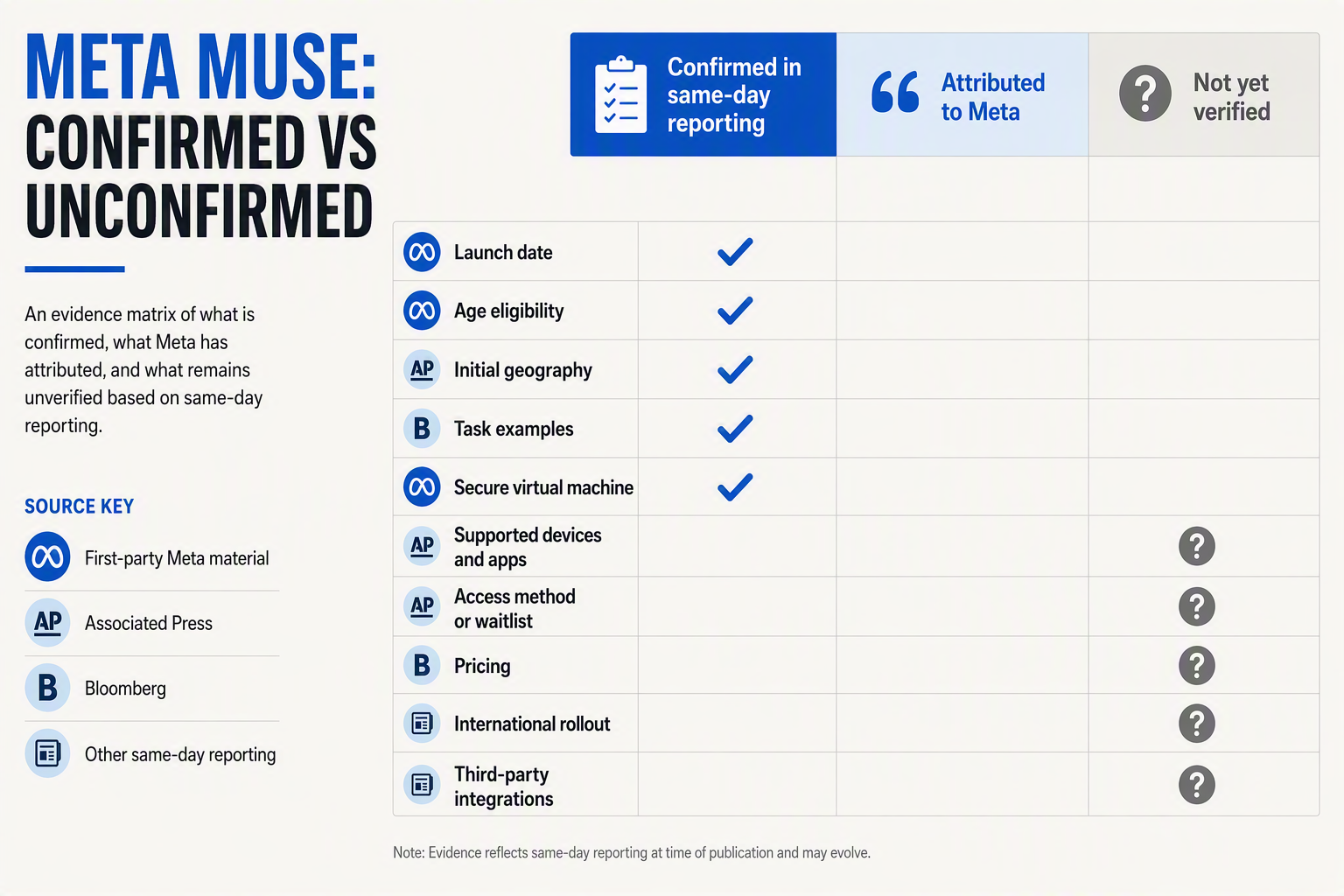
The September 8, 2026 launch, U.S. availability and 18-plus eligibility are supported by contemporaneous reporting from the Associated Press and Bloomberg. Muse’s promised capabilities are largely Meta-attributed claims, while its technical architecture, privacy controls, app-by-app rollout and relationship to similarly named Meta technologies remain unverified.
Claim-by-claim verification table
| Launch claim | Status | Evidence available on September 8, 2026 | Verification-first takeaway |
|---|---|---|---|
| Meta launched Muse on September 8, 2026 | Confirmed | The Associated Press reported the launch on September 8, 2026; Bloomberg separately reported that Meta Platforms unveiled Muse at 7:00 p.m. UTC that day. | Multiple contemporaneous reports establish the launch, although access may still arrive through a staged rollout. |
| Muse is intended for people aged 18 and older | Confirmed in launch reporting | The Associated Press described Muse as a personal AI agent “for people 18 and over.” | The stated minimum age is 18; reporting does not establish how Meta verifies age or handles existing accounts with uncertain birth dates. |
| Muse can help with schedules and shopping | Attributed to Meta | The Associated Press reported these use cases as part of Meta’s product description. Bloomberg characterized Muse more broadly as an agent designed to carry out tasks on a user’s behalf. | These are announced capabilities, not independently benchmarked measures of reliability, completion rate or transaction accuracy. |
| Muse can turn “long-term” goals into plans | Attributed to Meta | The Associated Press explicitly presented “long-term” as the company’s wording. | The phrase describes Meta’s intended experience; no public test cited here defines the planning horizon, memory duration or measurable success criteria. |
| Muse has specific privacy and safety protections | Partially attributed; details unverified | Associated Press coverage emphasized Meta’s safety and privacy positioning, but the available reports do not provide a complete technical audit of data retention, human review, permission scopes or deletion behavior. | Users should verify the product’s current privacy notice and permission screens rather than treating broad safety language as proof of a particular safeguard. |
| Muse is powered by Mu or Muse Spark and is available throughout Meta’s apps | Unverified | Techbuild Africa describes Muse Spark as a Meta Superintelligence Labs model series, while NogenTech says Muse Spark powers Meta AI across apps reaching more than three billion people. Neither statement, as presented, proves Muse’s exact model stack or universal availability. | Do not equate Muse, Mu, Muse Spark and Meta AI without explicit technical documentation from Meta. |
How to read the evidence labels
These labels distinguish whether an event occurred from whether the product performs exactly as advertised:
- Confirmed means multiple credible reports support a concrete fact such as the launch date.
- Attributed to Meta means journalists accurately reported Meta’s statement, but the capability has not necessarily been independently tested.
- Partially verified means the broad claim is documented while implementation details remain missing.
- Unverified means the available evidence does not support a definitive conclusion—not that the claim is necessarily false.
The most important unresolved questions
The early reports do not yet establish which accounts receive Muse first, whether it appears in a standalone interface or particular Meta apps, or which actions require explicit confirmation. They also leave open how long Muse retains personal context, whether users can inspect and delete that memory, and what happens when an agent misinterprets a purchase or calendar instruction.
Readers should therefore separate availability from capability and capability from reliability. The launch is documented; the limits, safeguards and underlying model architecture require further primary documentation and independent testing.
How does Muse carry out tasks, and what does a dedicated secure virtual machine actually protect?
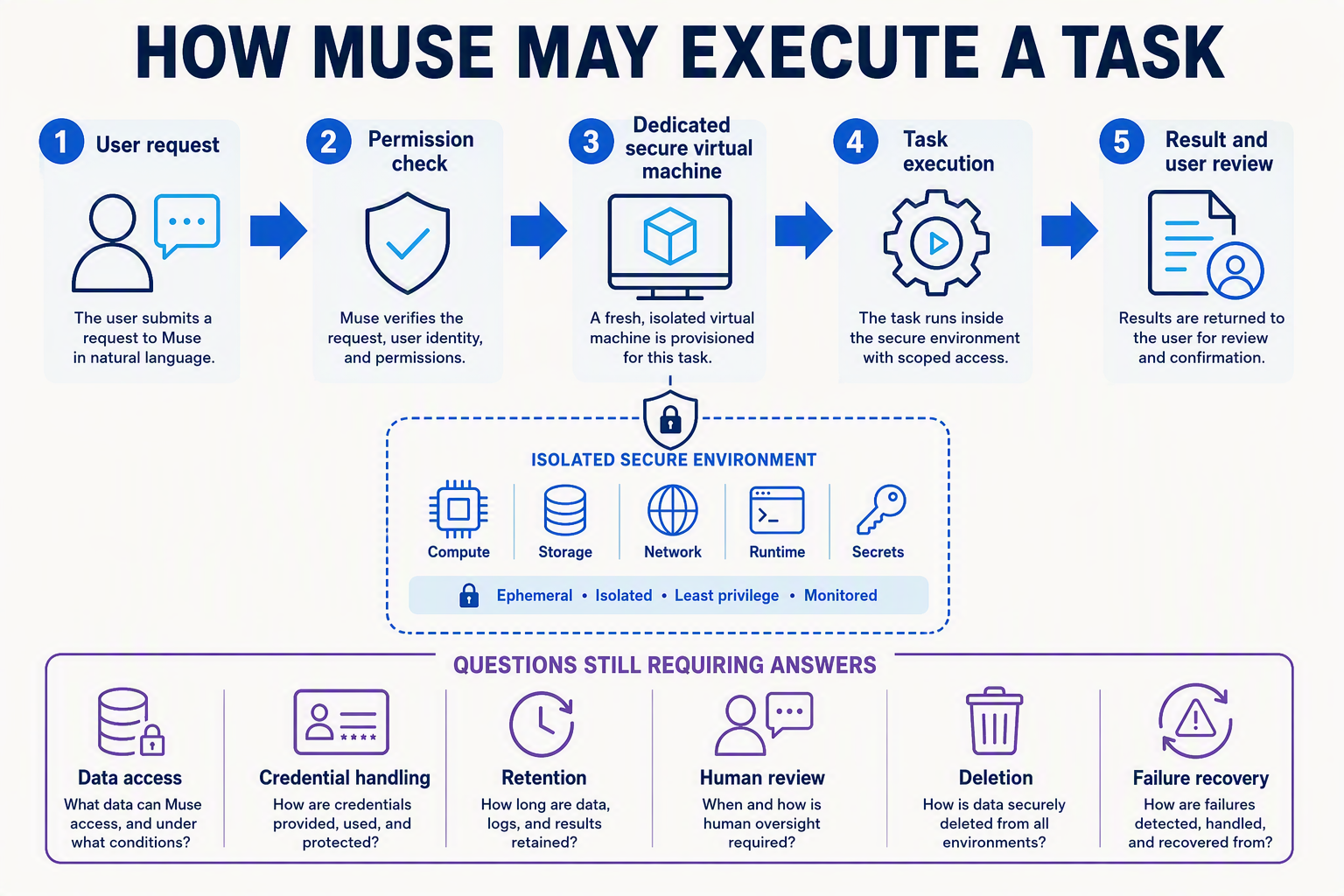
Muse carries out tasks by combining an AI model with planning, memory, authorized tools and an isolated execution environment. Meta’s reported dedicated secure virtual machine can reduce the risk that Muse’s task code affects other users or underlying systems, but it does not automatically prevent Meta, connected services or authorized recipients from receiving personal data.
From a request to an action
Bloomberg reported on September 8, 2026, that Meta Muse is designed to “carry out tasks on a user’s behalf.” Although Meta has not publicly documented every orchestration step, an agentic workflow generally involves:
- Interpreting intent: Muse converts a request—such as reorganizing a week—into a defined objective.
- Building a plan: The agent divides that objective into steps, identifies dependencies and determines which connected tools it needs.
- Requesting access: Calendar, shopping or communications services may require explicit account permissions or authentication.
- Executing tool calls: Muse can read permitted information, calculate options and initiate supported actions.
- Seeking confirmation: High-impact actions, especially purchases, cancellations or messages, should require clear user approval.
- Reporting results: The agent explains what it completed, what failed and what still needs attention.
This process is materially different from a chatbot producing text. An incorrect chatbot answer can misinform; an incorrect agent action could alter an appointment, disclose information or create a financial commitment.
What a dedicated secure virtual machine protects
A virtual machine (VM) is a software-isolated computer with its own operating environment, memory and processes. Running agent tasks inside a dedicated secure VM can create a boundary between Muse’s execution and Meta’s broader production infrastructure.
Depending on Meta’s implementation, VM isolation can help contain:
- Untrusted content or code encountered while processing a task.
- Cross-user interference, preventing one workload from directly accessing another workload’s memory or files.
- System damage, limiting what a malfunctioning tool or generated command can modify.
- Persistent compromise, particularly if the VM is temporary and destroyed after execution.
- Credential exposure, provided tokens are narrowly scoped, stored outside the guest environment and injected only when required.
A dedicated VM is therefore primarily an execution-security control. Its effectiveness depends on details such as network restrictions, encryption, patching, credential handling, audit logs and whether environments are genuinely single-user or single-task.
What VM isolation does not guarantee
A secure VM should not be interpreted as a complete privacy promise. It does not, by itself, determine:
- Whether Muse conversations or task histories are retained.
- Whether personal data is used for model training or product improvement.
- Which Meta companies, employees or contractors can access logs.
- What information connected retailers, calendar providers or other third parties receive.
- Whether a malicious webpage can manipulate the agent through prompt injection.
- Whether Muse’s memory can be viewed, corrected, exported or deleted.
The Associated Press reported on September 8, 2026, that Meta emphasized safety and privacy at launch, but users still need product-specific answers about retention, training, permissions and deletion. “Secure execution” and “private data handling” are related but separate claims.
Before granting access, users should inspect each permission, enable confirmations for consequential actions and avoid sharing passwords or payment credentials directly in prompts. The most important unresolved question is not simply whether Muse runs inside a protected machine, but what data enters that machine, where the resulting records go and who controls them afterward.
Where is Meta Muse available, who can use it and how can people get access?
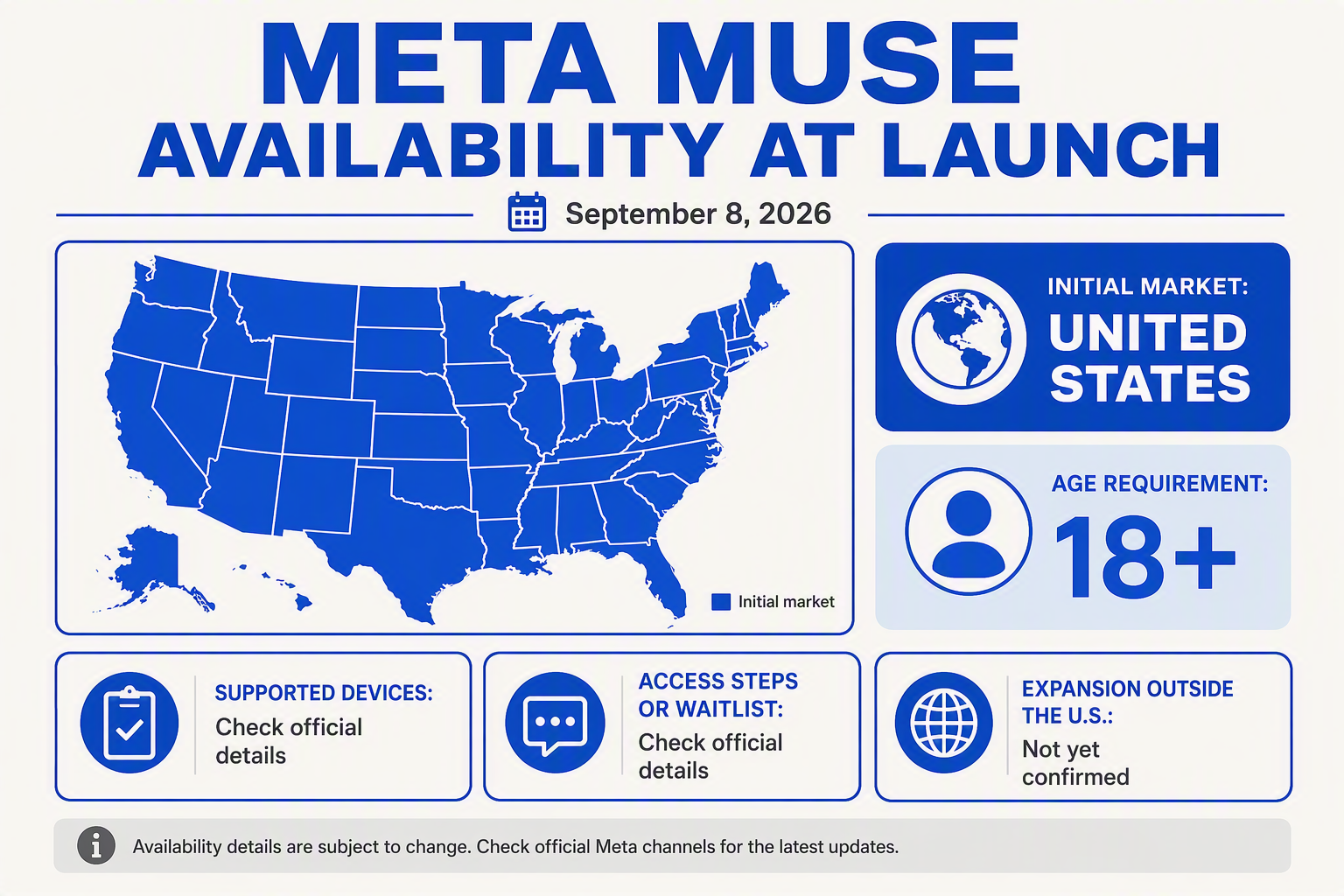
Meta Muse is initially available in the United States to people aged 18 or older, but the available reporting does not establish that every eligible user received access immediately on September 8, 2026. Meta has not yet confirmed a global timetable, a complete app-by-app rollout schedule or whether all access routes require the same type of Meta account.
Confirmed eligibility at launch
The Associated Press reported on September 8, 2026, that Meta launched Muse for people aged 18 and over who want assistance with schedules, shopping and longer-term goals. Bloomberg separately reported on September 8, 2026, that Meta Platforms unveiled Muse as an agent designed to carry out tasks on a user’s behalf.
The clearest launch requirements are therefore:
- Location: The initial launch is focused on the United States.
- Age: Users must be 18 or older.
- Rollout status: Availability may be staged rather than simultaneous for every eligible account.
- Product identity: Users should look specifically for Muse, Meta’s personal AI agent, not Meta’s existing Mu technology or the Muse Spark model family.
An adult U.S. user who cannot see Muse should not necessarily interpret that as an account problem. Large consumer AI launches commonly appear progressively across accounts, platforms and software versions, although Meta’s precise Muse rollout sequence was not detailed in the launch reporting.
How to check for legitimate Muse access
Because the confirmed reports do not provide one universal activation path, users should verify availability through Meta-controlled interfaces rather than third-party downloads or unsolicited links.
- Update Meta applications through the official Apple App Store or Google Play Store.
- Check the Meta AI interface and account menus for a clearly labelled Muse option, invitation or onboarding flow.
- Confirm the publisher and domain before signing in, particularly if a search result claims to offer “early access.”
- Review every requested permission before connecting calendars, shopping information, contacts or other personal data.
- Check Meta’s official announcements and help documentation if Muse does not appear or if an invitation’s authenticity is uncertain.
Muse may eventually benefit from Meta’s enormous distribution network, but reach should not be confused with present availability. NogenTech reported in September 2026 that Meta AI operates across apps used by more than three billion people; that figure does not mean three billion people can already use Muse.
What remains unconfirmed
As of the September 8 launch, the cited reporting does not clearly settle several practical access questions:
- Whether Muse is available through Facebook, Instagram, WhatsApp, Messenger, a standalone app or the web from day one
- Whether users need a particular Meta account, invitation or waitlist approval
- Whether access differs by device, operating system or U.S. state
- Whether Muse is free, subscription-based or subject to usage limits
- When people outside the United States—or users under 18—might become eligible
Until Meta publishes definitive support documentation, users should treat screenshots, app-store listings and social-media claims as provisional. The verification-first rule is simple: being an adult in the United States establishes eligibility, not guaranteed immediate access.
What privacy and safety questions should users ask before giving Muse permission to act?
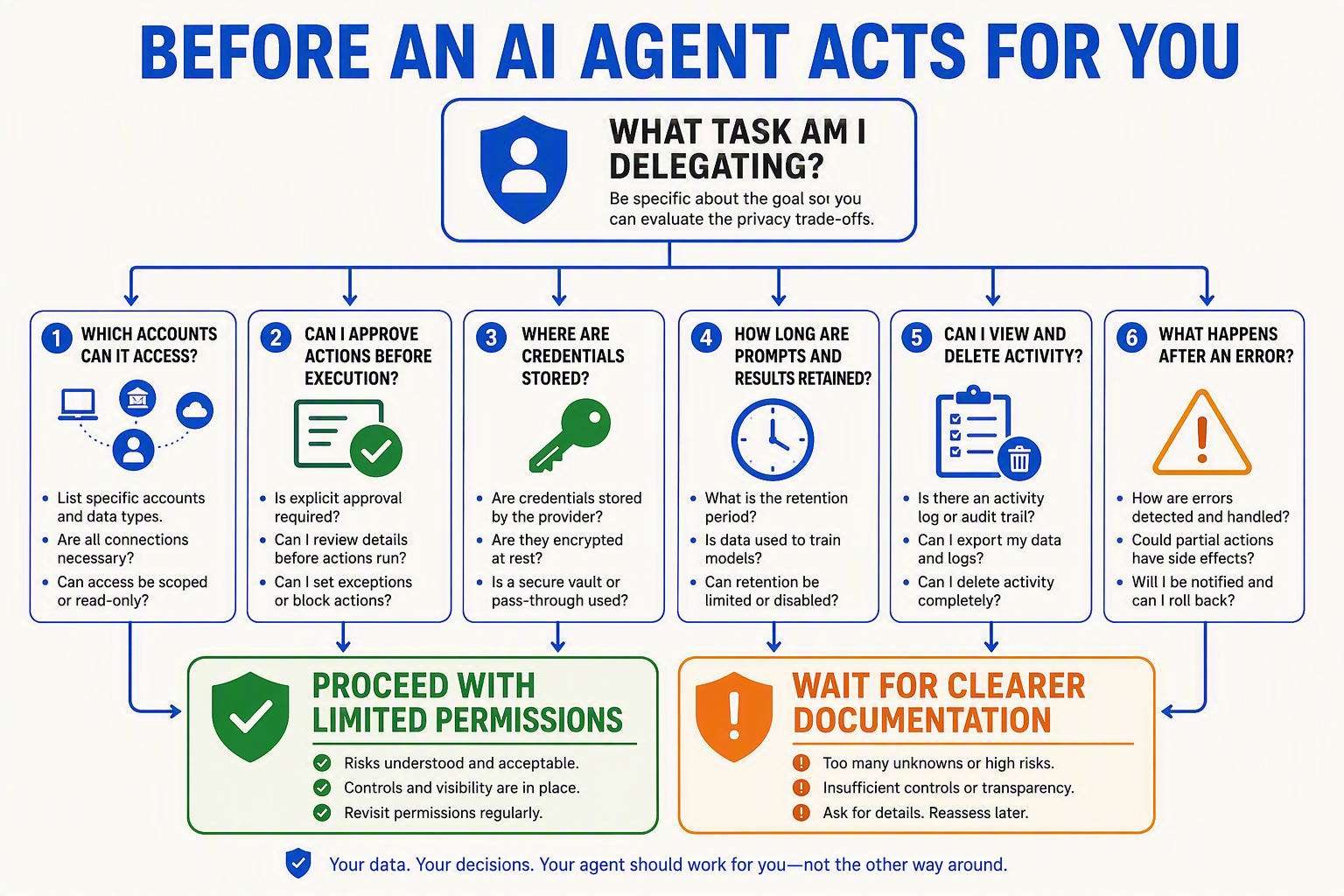
Before granting Muse access, users should verify what data it can read, what actions it can take, how long it retains information and whether every consequential action requires confirmation. Because Meta has emphasized safety and privacy without the available launch reporting fully documenting every control, users should treat unverified protections as open questions—not assumptions.
Start with the scope of each permission
The Associated Press reported on September 8, 2026, that Muse is intended for adults aged 18 and over and can help with schedules, shopping and “long-term” goals. Each use case could expose a different category of sensitive information:
- Calendar access: Can Muse read event titles, locations, attendees and notes, or only availability?
- Shopping access: Can Muse merely recommend products, or can it add items, enter addresses and complete purchases?
- Personal memory: What preferences, relationships, routines or goals does Muse retain between conversations?
- Cross-service access: Can information from one connected service influence actions in another?
- Communications: Can Muse draft messages only, or send them without a separate approval?
Users should choose least-privilege access wherever possible. “View free/busy status” is safer than unrestricted calendar access; “prepare an order for review” carries less risk than permission to purchase automatically.
Ask how memory and data use work
A personalized agent becomes useful by accumulating context, but that same memory can create a detailed behavioral profile. Before adding sensitive information, users should look for clear answers to these questions:
- Is Muse’s memory on by default or opt-in?
- Can individual memories be viewed, corrected and deleted?
- Does deleting a conversation also delete extracted memories?
- Are prompts, files or agent actions used to train or improve Meta’s models?
- How long are interaction records, tool outputs and transaction logs retained?
- Can information be shared across Facebook, Instagram, WhatsApp, Messenger or advertising systems?
- What happens to stored data after Muse is disabled or the account is deleted?
An 18-plus eligibility rule is not a privacy guarantee. It limits the intended audience but does not, by itself, explain retention, model training, advertising use or data-sharing practices.
Require confirmation for consequential actions
Bloomberg reported on September 8, 2026, that Muse is designed to carry out tasks on a user’s behalf. That makes action controls as important as answer accuracy.
Users should verify whether Muse provides:
- A preview before sending, booking, buying, cancelling or sharing
- Spending limits and transaction notifications
- An accessible history showing what Muse did and why
- A way to revoke permissions immediately
- Undo, cancellation or dispute mechanisms
- Extra authentication for payments or account changes
Muse should also distinguish recommendations from completed actions in unmistakable language. A user should never have to guess whether an agent merely found a flight or actually booked it.
Test defenses against manipulation and mistakes
Connected agents can encounter malicious instructions hidden in webpages, emails, documents or product listings—a risk known as prompt injection. Users should ask whether Muse treats third-party content as untrusted, isolates credentials and refuses instructions that conflict with the user’s authorization.
Before relying on Muse, conduct a low-risk test: grant narrow access, request a harmless task, inspect the action log and then revoke permission. Until Meta publishes sufficiently detailed documentation, independent testing or audit results, users should avoid giving Muse irreversible authority over payments, private communications, identity records or high-stakes decisions.
How does Muse fit Meta's broader AI strategy without proving integration across WhatsApp, Instagram, Facebook or Messenger?
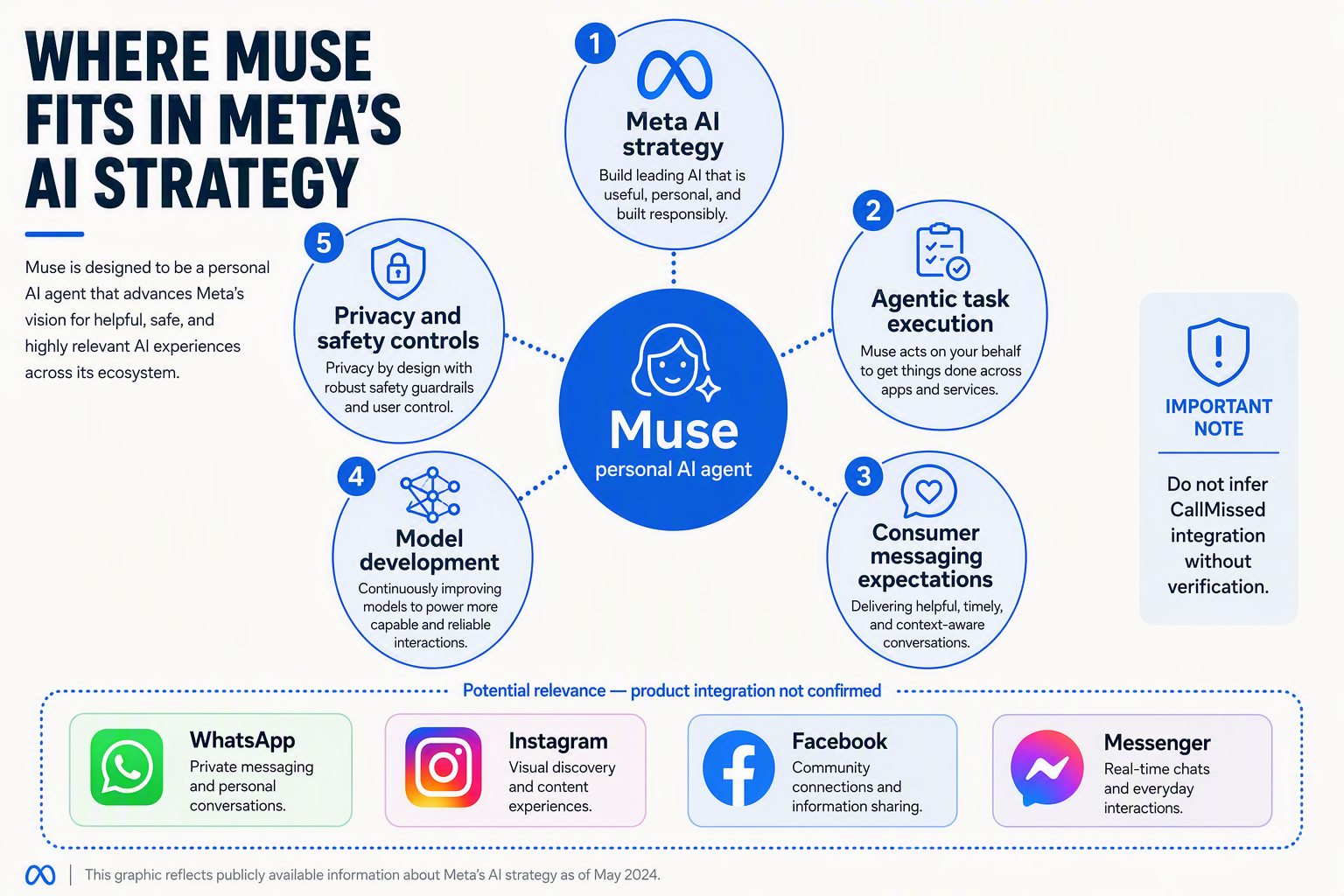
Muse fits Meta Platforms’ strategy as the consumer-agent layer in a broader push toward personalized AI that can act for users. However, Meta’s enormous reach through WhatsApp, Instagram, Facebook and Messenger does not by itself prove that Muse is available—or technically integrated—across any of those services.
Strategic fit: from assistant to personal agent
Bloomberg reported on September 8, 2026, that Muse advances Meta CEO Mark Zuckerberg’s vision of a future in which each person has a personalized AI assistant. The strategic progression is significant: Meta is moving beyond an AI that generates text or answers questions toward an agent that can coordinate tasks on a user’s behalf.
Muse potentially adds three layers to Meta’s existing AI ambitions:
- Personal context: An agent can adapt its responses around a user’s preferences, routines and goals.
- Task execution: Muse is described as carrying out tasks, not simply suggesting what a user should do.
- Long-term assistance: Persistent plans require continuity across sessions, although Meta’s exact memory controls and retention practices still need close examination.
This direction aligns with the industry-wide shift from chatbots to agents. The difference is operational: a chatbot supplies information, while an agent may use tools, request permissions and initiate actions.
Distribution potential is not deployment evidence
Meta already owns some of the world’s largest communication and social platforms, creating a clear path for distributing a personal agent if the company chooses to do so. NogenTech reported in September 2026 that Meta AI operates across apps used by more than three billion people.
That figure establishes Meta’s potential audience, but it does not answer several product-specific questions:
- Is Muse embedded directly inside WhatsApp, Instagram, Facebook or Messenger?
- Can Muse read messages, access contacts or act across those services?
- Is it a separate app, website or account-level experience?
- Will Muse-generated actions synchronize between Meta products?
- Are integrations available to every eligible U.S. adult or only to a staged test group?
Unless Meta’s documentation, app interfaces or release notes explicitly confirm those capabilities, the accurate formulation is that Muse could benefit from Meta’s ecosystem, not that it already works across the entire ecosystem.
Muse, Muse Spark and Meta AI are separate layers
Product naming can obscure the distinction between an interface and its underlying technology. Muse is the personal agent users interact with, while Muse Spark has been described as a model series developed by Meta Superintelligence Labs. NogenTech characterized Muse Spark as the first model from that laboratory and linked it to a rebuilt AI stack under Meta Chief AI Officer Alexandr Wang.
Those reports may explain Meta’s technical direction, but they do not establish which exact models power every Muse feature. Likewise, Meta’s existing Mu technology should not be treated as another name for Muse.
A verification-first reading therefore separates:
- Confirmed product: Muse, launched for U.S. adults aged 18 and over.
- Reported corporate strategy: personalized AI that performs tasks for individuals.
- Potential advantage: distribution through Meta’s multibillion-user ecosystem.
- Unproven implementation: full Muse integration across WhatsApp, Instagram, Facebook or Messenger.
Muse strengthens the strategic link between Meta’s models, consumer products and agent ambitions. The launch announcement alone, however, is not evidence of universal cross-app access.
What do credible same-day reports say, and which claims still need first-party confirmation?

The strongest same-day evidence comes from The Associated Press and Bloomberg, which agree that Meta launched Muse on September 8, 2026, as a personal agent that can help U.S. adults with everyday tasks. However, detailed claims about Muse’s technical architecture, app integrations, data retention, model training and global rollout still require direct confirmation from Meta’s documentation.
What credible reporting establishes
Two independently branded news reports support the core launch facts:
- The Associated Press reported on September 8, 2026, that Meta launched Muse for people aged 18 and older seeking help with schedules, shopping and turning “long-term” goals into practical steps.
- Bloomberg reported at 7:00 p.m. UTC on September 8, 2026, that Muse is designed to carry out tasks on a user’s behalf and advances Mark Zuckerberg’s vision of personalized AI.
These descriptions support calling Muse an agent, not merely a chatbot. The central distinction is task execution: Muse is presented as software that can organize or perform actions for users, although the available reports do not yet define the limits of that autonomy.
The AP account appeared on multiple local-news websites, including ClickOrlando, WTOP and the Record-Bee. Those copies strengthen confidence that the AP report was distributed widely, but they are not three independent confirmations. WTOP attributes its September 8 article to The Associated Press, while the Record-Bee identifies AP technology writer Barbara Ortutay.
What remains dependent on Meta’s claims
Some wording should be attributed rather than treated as independently verified. AP explicitly described “long-term” goals as being “in the company’s words,” indicating that this characterization originated with Meta.
Similarly, headlines saying Meta “emphasizes safety and privacy” establish that the company highlighted those themes—not that outside experts have audited Muse’s safeguards. Verification would require primary policies, technical documentation and, eventually, independent testing.
Key unresolved questions include:
- Where Muse is available: Same-day reports establish a U.S., 18-plus launch, but do not conclusively document whether every eligible user receives immediate access or whether deployment is staged.
- Which services it can control: Calendar and shopping assistance do not automatically mean Muse can independently book appointments, place orders or authorize payments.
- What Muse remembers: Public reporting does not yet establish default memory duration, deletion controls, retention periods or whether users can inspect stored personal context.
- How data is used: First-party terms are needed to determine whether Muse conversations, tool outputs or connected-account data may be used for model improvement, personalization or advertising.
- Which model powers it: Secondary reports about Muse Spark should not be treated as proof of Muse’s complete model stack. Muse, Muse Spark and Meta’s separately named Mu technology are distinct entities unless Meta explicitly documents a relationship.
- What expansion is planned: No same-day report cited here confirms launch dates outside the United States, pricing, enterprise availability or support across every Meta application.
A verification-first reading
As of September 8, 2026, readers can reasonably treat Muse’s launch, adult eligibility and broad task categories as well-supported by AP and Bloomberg. More granular claims should remain labeled reported, company-stated or unconfirmed until Meta publishes accessible product pages, privacy terms, safety documentation and rollout details. That distinction is especially important for an agent entrusted with calendars, purchases and long-term personal plans.
What does the Meta Muse launch mean for consumers, businesses and AI-agent expectations?
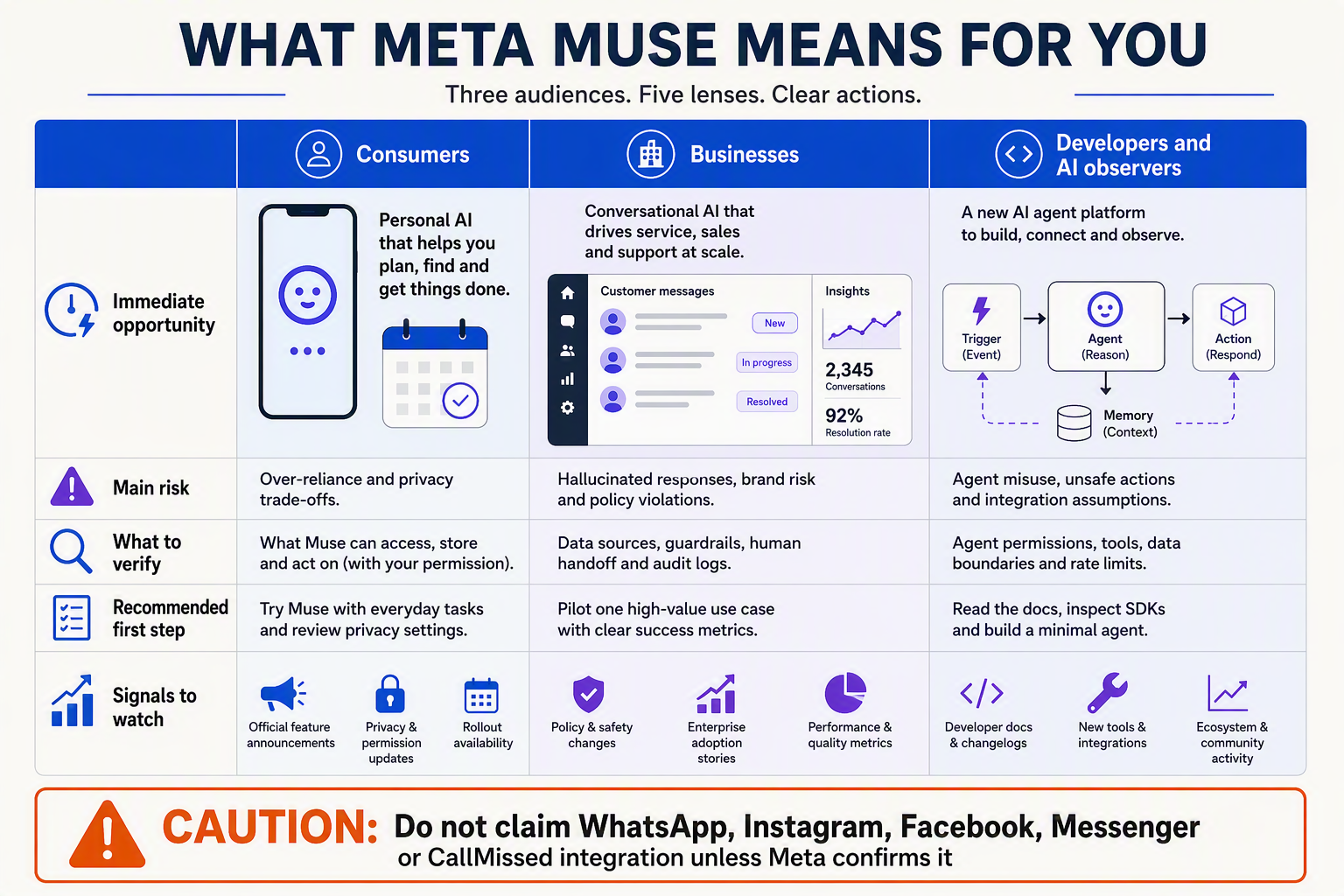
Muse raises the baseline for consumer AI from answering questions to coordinating actions, but its real significance will depend on reliability, permission controls and transparent accountability. For businesses, the launch signals that customers may increasingly expect AI agents to remember context and complete multistep workflows—not simply provide conversational support.
The practical impact at a glance
| Stakeholder or issue | Immediate implication | What remains unverified | Sensible next step |
|---|---|---|---|
| Consumers | Muse may help coordinate schedules, shopping and longer-term plans | Reliability across complex, real-world tasks | Begin with reversible, low-risk requests |
| Privacy-conscious users | Personalization may require persistent context and connected data | Exact retention, deletion and training policies | Review every permission and privacy setting |
| Businesses | Customers may expect service agents to take action, not just answer questions | Which Muse integrations and commercial workflows will emerge | Design workflows with confirmation and escalation |
| Developers | Agent design shifts toward tools, memory and permission management | Public API access, pricing and integration terms | Keep systems modular and auditable |
| AI industry | Distribution could accelerate mainstream agent adoption | Adoption, retention and task-completion rates | Measure successful outcomes, not conversation volume |
| Regulators and safety teams | Agentic systems create consequences beyond inaccurate text | Liability when an agent makes an unwanted decision | Require logs, consent and human override |
What changes for consumers?
The Associated Press reported on September 8, 2026, that Meta Muse is intended to help adults with schedules, shopping and turning “long-term” goals into practical plans. That promise creates a higher standard than chatbot fluency: a useful personal agent must understand intent, preserve relevant context and avoid taking an incorrect or premature action.
Consumers should distinguish between three levels of behavior:
- Advice: Muse suggests products or proposes a schedule.
- Preparation: Muse builds a shopping list or drafts a plan for approval.
- Execution: Muse submits, books, buys or changes something on the user’s behalf.
Bloomberg reported on September 8, 2026, that Muse was designed to carry out tasks for users, but early coverage does not by itself establish which actions are autonomous, which require confirmation or which third-party services are supported. Users should therefore verify confirmation screens, cancellation options and transaction limits before relying on Muse for consequential tasks.
What businesses should take from the launch
Muse reinforces a broader shift from conversational AI to operational AI. A customer may soon expect an agent to reschedule a delivery, update an account or arrange a callback within the same interaction. Businesses adopting this model need more than a capable language model; they need authenticated tools, explicit permissions, auditable logs and seamless human escalation.
That shift is already visible in customer communications. Platforms such as CallMissed connect AI agents with voice, WhatsApp and customer-engagement workflows, including bridging WhatsApp Business calls to an AI voice agent. The strategic lesson is channel-independent: agents create value when they can complete a governed workflow safely.
Expectations should remain evidence-based
NogenTech reported in September 2026 that Meta AI operates across apps serving more than three billion people, giving Meta Platforms exceptional potential distribution. Potential reach, however, is not proof that Muse is available across Facebook, Instagram, WhatsApp and Messenger—or that every Meta AI user has access.
The benchmarks that matter now are verified task-completion rate, correction frequency, unauthorized-action rate, escalation success and user-controlled data deletion. Until Meta publishes comparable evidence, Muse should be viewed as an important product launch—not proof that fully autonomous personal AI has been solved.
Frequently Asked Questions about Meta Muse availability, privacy, pricing, apps and its relationship to Muse Spark
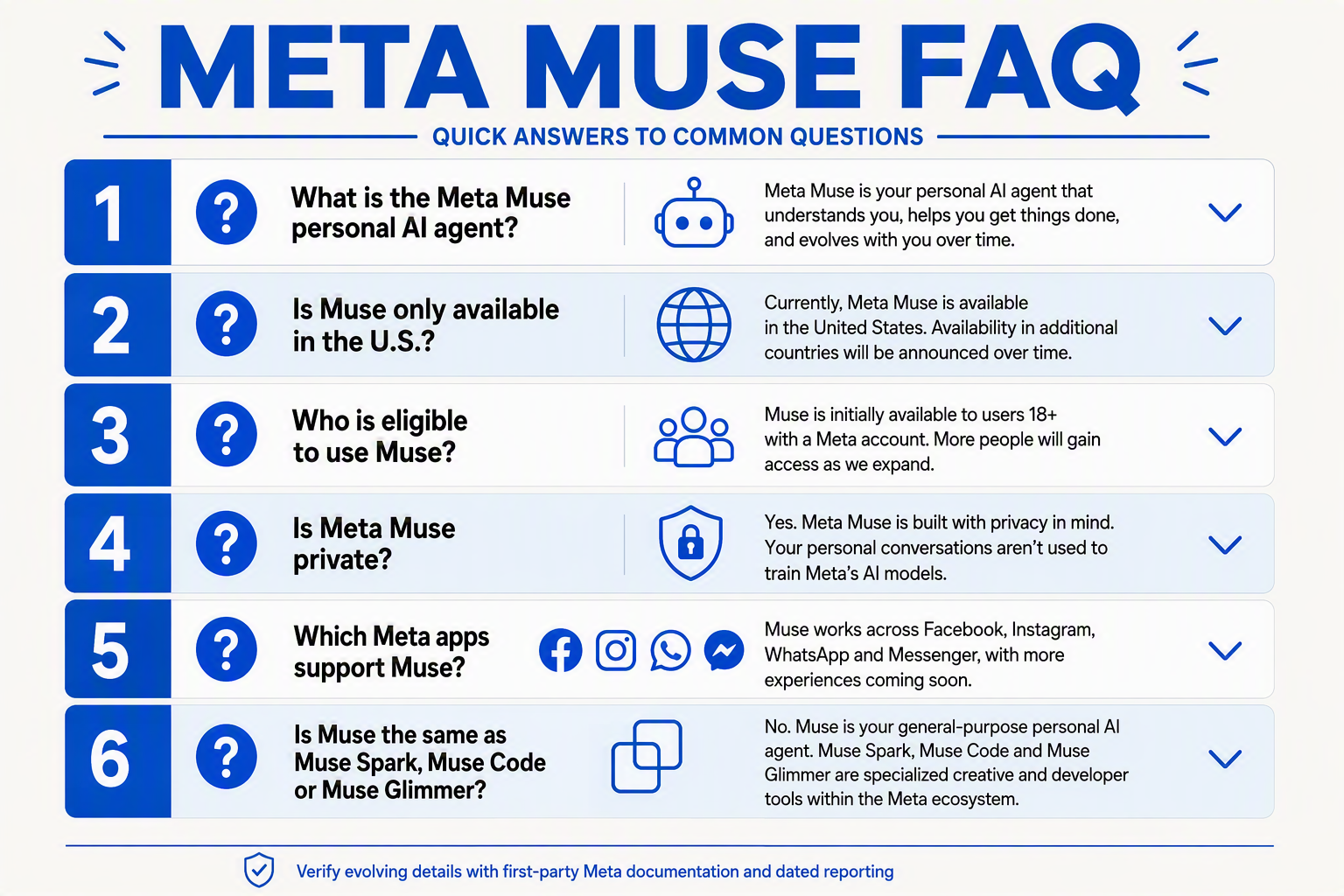
Is Meta Muse available now, and which countries can use it?
Which apps support Muse—Facebook, Instagram, WhatsApp, Messenger or a standalone app?
Pricing, eligibility and permissions
Is the Meta Muse personal AI agent free?
Can teenagers use Muse, and what account requirements apply?
What can Muse access when connected to calendars, email, contacts or shopping services?
Privacy, security and trust
How does Meta say Muse protects personal data?
What should users check before trusting Muse with sensitive tasks?
Muse, Muse Spark, Muse Code and Muse Glimmer
What is the difference between Muse and Meta’s similarly named AI systems?
Is Muse Spark the same product as the Meta Muse personal AI agent?
Conclusion
Meta Muse marks a shift from AI that answers questions to AI that can coordinate schedules, assist with shopping and act on longer-term goals. The opportunity is more useful automation; the trade-off is that meaningful personalization may require memory, permissions and access to sensitive context.
Key takeaways
- Muse is a consumer-facing agent, not simply an AI model. Meta Platforms launched Muse in the United States on September 8, 2026, for adults aged 18 and older. Bloomberg reported on September 8, 2026, that Muse is designed to carry out tasks on a user’s behalf.
- Its initial scope is practical but potentially data-intensive. The Associated Press reported on September 8, 2026, that Muse can help with schedules, shopping and “long-term” goals. Users should therefore examine what data Muse remembers, which services it can access and whether individual actions require confirmation.
- Availability should not be overstated. Muse begins as a U.S.-focused, 18-plus product; a worldwide release or deployment across every Meta application has not been confirmed. Although NogenTech reported in September 2026 that Meta AI reaches apps used by more than three billion people, that figure does not mean every user has immediate access to Muse.
- The product names are not interchangeable. Muse is the personal agent people use, while Mu refers to separate existing Meta technology and Muse Spark is a model series associated with Meta Superintelligence Labs. An agent can combine models with memory, tools, permissions and task-execution systems.
What to watch next
The next phase will reveal how Meta communicates consent, memory controls and task confirmations during the staged rollout. Watch for clearer documentation on account requirements, app integration, data retention and the boundaries between recommendations and actions performed for users.
Muse also reflects a wider transition toward action-oriented communication AI. To explore how that trend is developing in business workflows, visit CallMissed, an AI communication-infrastructure platform supporting voice agents, WhatsApp automation and multilingual engagement across 22 Indian languages.
As personal agents gain the ability to remember and act, the decisive question is: what permissions are you willing to grant in exchange for convenience?
Related Reading
- Best WhatsApp AI Agent Platform in 2026: Pricing, Features, and Fit Compared
- How to Use Meta Muse Code: A Launch-Readiness and Official Documentation Verification Guide
- Meta Muse Code: What Meta Has—and Has Not—Officially Verified