
GPT Live 1 API Tutorial: Build a Full-Duplex Agent


Learn how the GPT Live 1 API handles full-duplex voice, interruptions, function calls, WebSocket setup, limits, and per-minute billing.
GPT Live 1 API Tutorial: Build a Full-Duplex Agent
What if a voice agent could hear a customer interrupt while the agent was still speaking—then change course without waiting for silence? This GPT-Live-1 API tutorial shows how OpenAI’s new full-duplex voice model enables that experience and how to build an interruptible agent with it.
GPT-Live-1, introduced by OpenAI in 2026, is a real-time speech-to-speech model that can listen and speak simultaneously. OpenAI explains that GPT-Live advances beyond the conventional voice pipeline, where separate systems transcribe speech, generate text and synthesize the response. Microsoft Foundry describes gpt-live-1 as OpenAI’s flagship full-duplex voice model.
That architectural shift matters because human conversation rarely follows clean, alternating turns. People pause, correct themselves and interrupt. GPT-Live-1 accepts audio and text input, produces spoken responses, supports natural interruptions and can invoke application functions during a session.
For example, a caller might interrupt a booking agent with, “Actually, make that Friday.” The model can stop its current response, interpret the correction and trigger a scheduling function without restarting the conversation.
As of September 2026, gpt-live-1 is available through CallMissed’s managed voice-agent WebSocket. CallMissed provides one API key and balance for 138 models overall, including 25 real-time voice-agent models.
There are several boundaries developers need to understand:
- WebSocket only: GPT-Live-1 is a voice-agent model, not a
/v1/chat/completionsmodel. - No image or video input: Sessions support audio and text input.
- Limited capacity: Applications must opt in separately for each session.
- Time-based billing: GPT-Live-1 API pricing is based on session minutes with per-second granularity, rather than token consumption.
Time-based charging changes cost engineering. Prompt length is less important than controlling idle time, closing abandoned connections and monitoring total session duration.
This guide will explain how to:
- Connect to the GPT Live 1 API using the model ID
gpt-live-1 - Send and receive real-time audio events
- Handle interruptions without losing conversational context
- Configure function calling for bookings, order updates and CRM lookups
- Understand GPT-Live versus GPT-Realtime
- Estimate session costs and close WebSocket connections safely
By the end, you will have the core architecture for a full-duplex agent suited to customer support, appointment scheduling, commerce assistance and other use cases where conversational timing matters as much as accuracy.
What is GPT-Live-1, and what has launched on CallMissed?
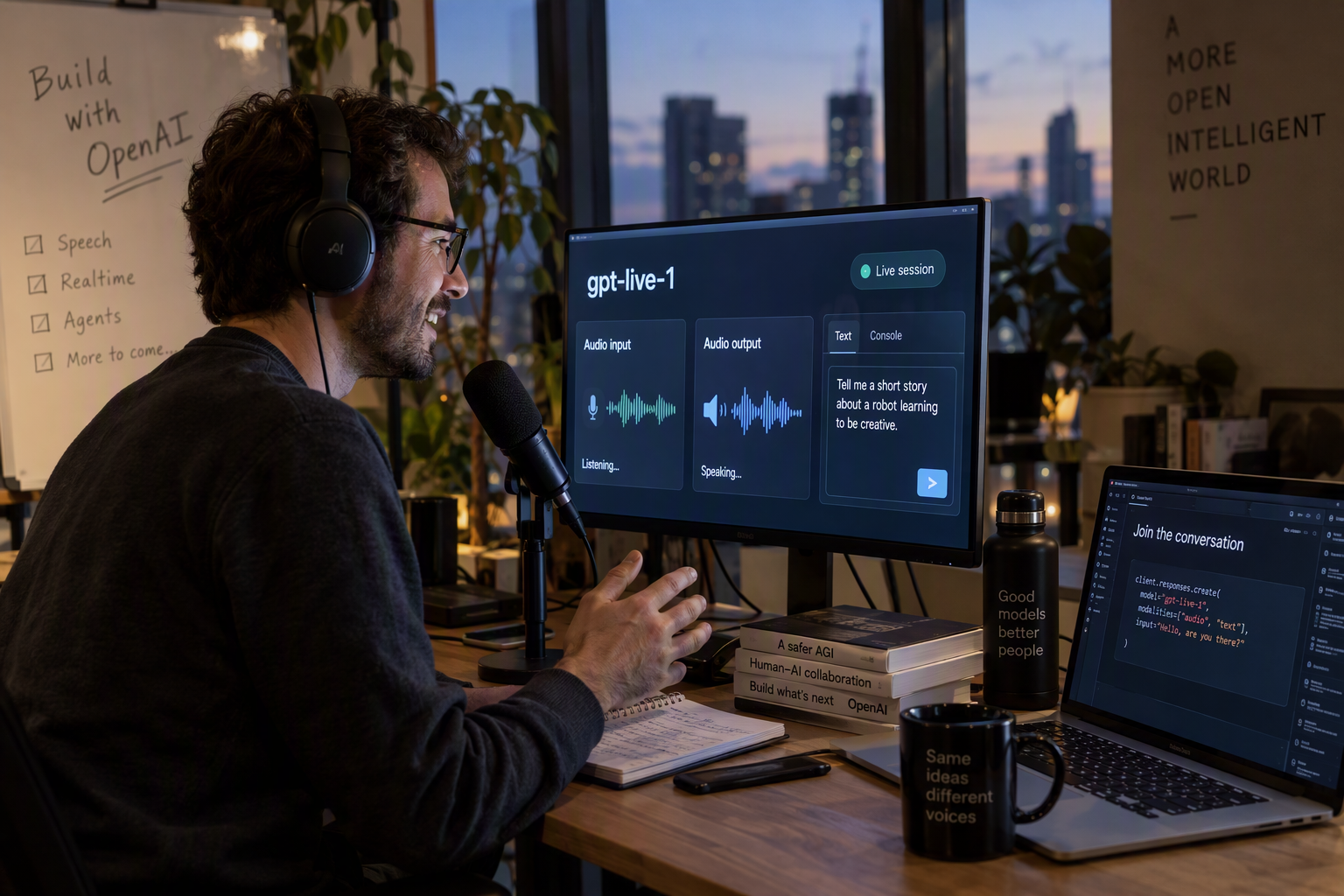
GPT-Live-1 is OpenAI’s full-duplex, real-time speech-to-speech model, designed to listen while speaking, accept audio and text, handle natural interruptions and call application functions. As of September 2026, gpt-live-1 is available through CallMissed’s managed voice-agent WebSocket for session-based voice applications.
What makes GPT-Live-1 different from earlier voice architectures?
Traditional voice agents often combine three separate components: speech-to-text, a text-based language model and text-to-speech. Every transition can add latency, lose vocal nuance or make mid-response corrections harder to process.
OpenAI describes GPT-Live-1 as a native full-duplex voice model. Microsoft Foundry similarly calls gpt-live-1 OpenAI’s “flagship full-duplex voice model” and documents multilingual speech and translation support as of September 2026.
Its core capabilities include:
- Concurrent listening and speaking: Users can interrupt the model before it finishes responding.
- Audio and text input: Applications can stream speech while supplying written instructions, context or tool results.
- Native spoken output: The model produces conversational audio without requiring developers to assemble a separate three-stage voice pipeline.
- Function calling: GPT-Live-1 can request actions such as retrieving an order, checking inventory or rescheduling an appointment.
- Live conversational context: Corrections and function results remain available within the active session.
“Full duplex” means more than quick turn-taking. Both directions of the audio connection remain active, enabling GPT-Live-1 to react when someone says “wait,” “that’s incorrect” or “change that to two tickets” during its response.
What exactly has launched on CallMissed?
CallMissed, the OpenAI-compatible AI gateway, now exposes gpt-live-1 through its managed voice-agent WebSocket. As of September 2026, the CallMissed developer catalogue contains 138 models overall, including 25 real-time voice-agent models.
A typical integration follows this session-oriented flow:
- Open a supported real-time WebSocket connection.
- Opt into
gpt-live-1for the individual session. - Configure instructions, audio behavior and callable functions.
- Stream audio or text events to the model.
- Process audio responses, interruption events and function calls.
- Close the WebSocket immediately when the conversation ends.
GPT-Live-1 is voice-agent-only and is not available through /v1/chat/completions. The model also does not support image or video input. Because launch capacity is limited as of September 2026, developers must opt in per session and should implement graceful fallback or retry behavior when capacity is unavailable.
How is GPT-Live-1 API usage billed?
GPT-Live-1 API pricing is based on session time, billed per minute with per-second granularity, rather than on input and output tokens, as of September 2026. Connection duration therefore becomes an important part of both application architecture and cost control.
Recommended safeguards include:
- Open the session only when the user is ready to speak.
- Detect silence, abandoned conversations and disconnected clients.
- Set explicit idle and maximum-duration limits.
- Close sockets after completion, errors or network loss.
- Track session duration separately from function-call and telephony charges.
GPT-Live-1 is particularly relevant for appointment changes, customer-support triage, commerce assistance and interactive tutoring—use cases where interruption handling and conversational timing matter as much as the model’s final answer.
What are the key facts developers should know?
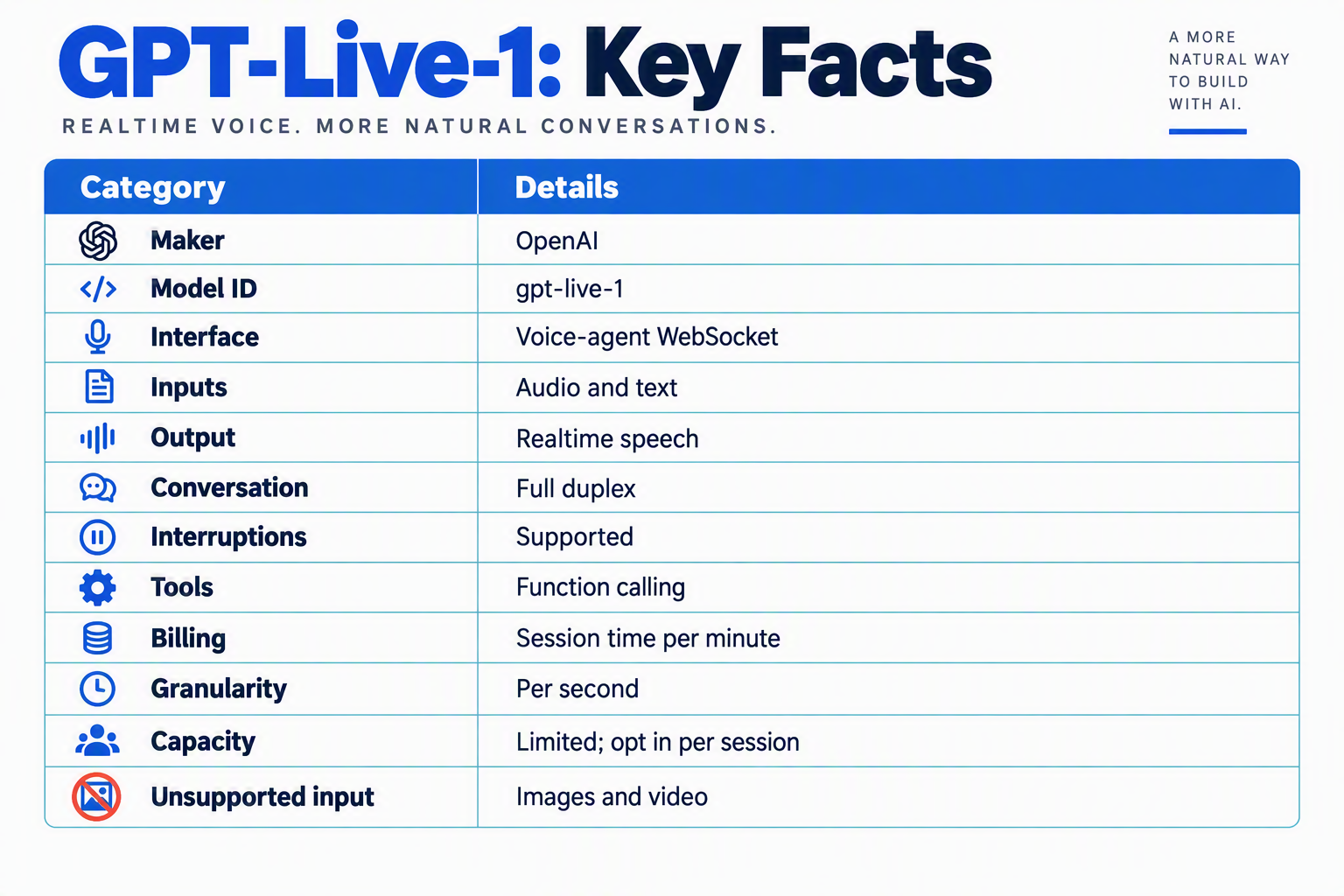
Developers should treat GPT-Live-1 as a stateful, voice-agent model—not a drop-in text LLM. As of September 2026, gpt-live-1 uses a persistent WebSocket, accepts audio and text, supports function calling and natural interruptions, and charges for connected session time with per-second granularity.
What are the GPT-Live-1 specifications?
| Key fact | GPT-Live-1 specification | Developer implication |
|---|---|---|
| Model and developer | gpt-live-1, developed by OpenAI | Select the exact model ID when creating a session |
| Interaction model | Native, full-duplex speech-to-speech | GPT-Live-1 can listen while speaking and respond to interruptions |
| Supported input | Audio and text | Combine live speech with text instructions, context or application data |
| Unsupported input | Images and video | Route visual tasks to a separate vision-capable model |
| Transport | Persistent voice-agent WebSocket; not /v1/chat/completions | Build an event-driven client rather than sending independent HTTP prompts |
| Tool use | Function calling | Connect the model to booking, CRM, search or order-management functions |
| Capacity | Limited; opt-in is required for each session | Handle unavailable capacity and failed session creation gracefully |
| Billing | Per minute of session time, calculated with per-second granularity | Enforce idle timeouts and close abandoned connections promptly |
OpenAI describes GPT-Live as an alternative to the conventional speech-to-text → LLM → text-to-speech pipeline. Microsoft Foundry called gpt-live-1 OpenAI’s “flagship full-duplex voice model” in 2026 and documented multilingual speech and translation support.
What does full-duplex mean for application design?
Full-duplex means incoming and outgoing audio can overlap instead of forcing the user and model into rigid, alternating turns. Pipecat’s 2026 GPT-Live documentation says the model listens and speaks simultaneously, while DataCamp’s 2026 GPT-Live-1 API tutorial highlights its handling of spoken turns, interruptions and the pauses between them.
That architecture changes several implementation requirements:
- Do not interpret every short pause as the end of a user’s turn.
- Stop, attenuate or replace playing audio when the user interrupts.
- Preserve state when a caller corrects information mid-response.
- Separate meaningful speech from background noise and acknowledgements such as “yes.”
- Make side-effecting tools idempotent, preventing duplicate bookings or payments after interruptions.
For example, if GPT-Live-1 says, “Your delivery is scheduled for Tuesday at—” and the customer interrupts with “Make it Wednesday,” the application should revise the pending operation rather than complete the obsolete Tuesday request.
How is GPT-Live-1 accessed through CallMissed?
As of September 2026, CallMissed, the OpenAI-compatible AI gateway, provides gpt-live-1 through its API and playground. CallMissed’s catalogue contains 138 models overall, including 25 real-time voice-agent models, as of September 2026.
A typical OpenAI Realtime API GPT-Live-1 setup follows four stages:
- Request capacity by opting in for the individual session.
- Open an authenticated CallMissed managed voice-agent WebSocket and select
gpt-live-1. - Send instructions, audio or text events, and function definitions.
- Process audio, interruption and function-call events, then close the socket when the session ends.
What should developers verify before production?
Prioritize capacity handling, cost controls and tool safety. Because billing tracks connected session time rather than tokens, applications should implement idle detection, maximum session durations and reliable WebSocket cleanup.
Teams should also test noisy rooms, overlapping speakers, rapid corrections, network reconnections and failed function calls. GPT-Live-1 reduces the rigidity of sequential voice pipelines, but production reliability still depends on robust event handling and carefully controlled tool execution.
Why does full-duplex speech change real-time voice agents?
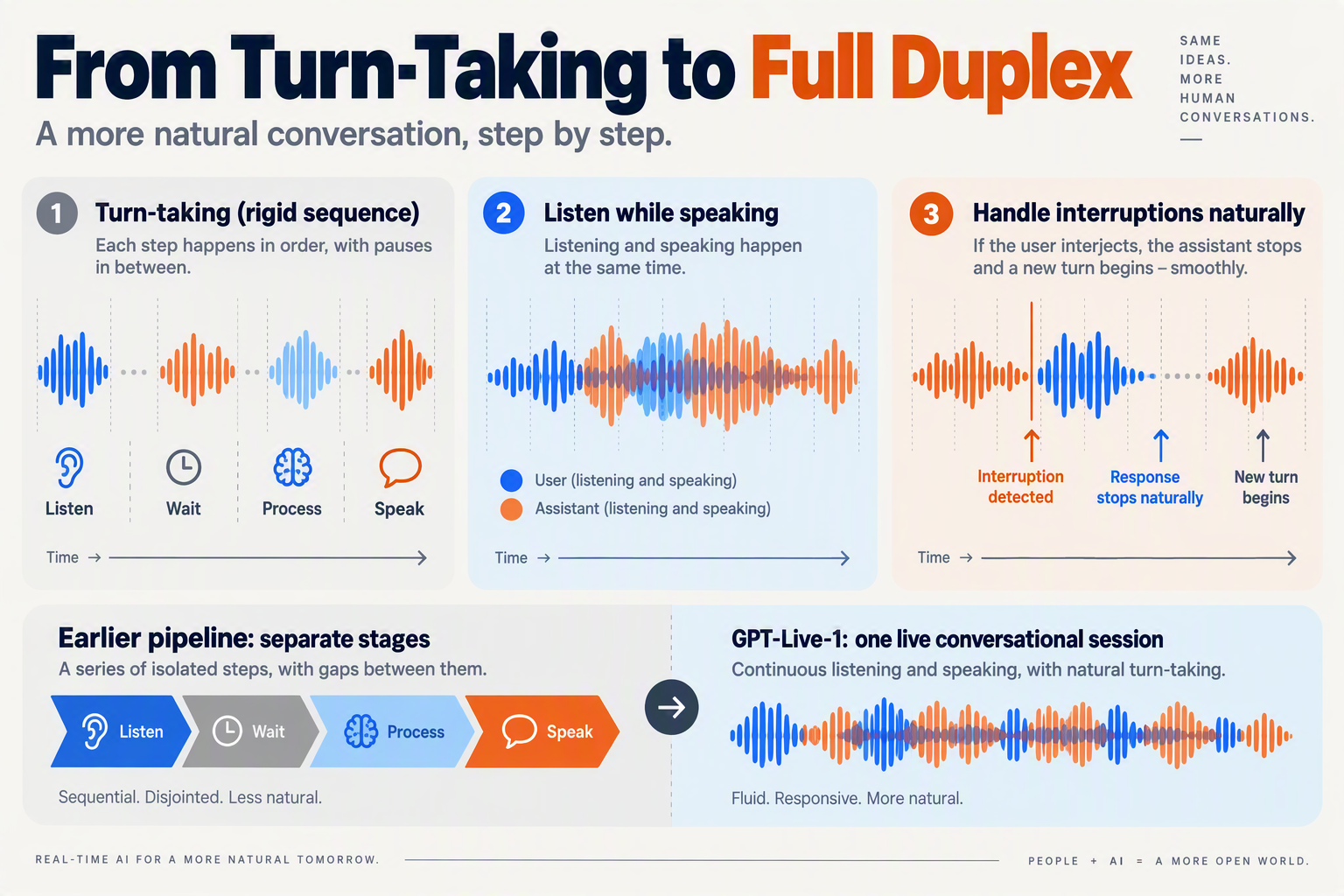
Full-duplex speech changes real-time voice agents because listening no longer stops when speaking begins. Instead of alternating rigidly between input and output, a GPT-Live-1 agent can detect an interruption, revise its response and continue the conversation using the caller’s latest intent.
What does full-duplex mean for an AI voice agent?
In telecommunications, full duplex means both sides can transmit simultaneously. Applied to the GPT Live 1 full-duplex voice model, the agent continues processing incoming audio while generating spoken output.
Microsoft Foundry described gpt-live-1 as OpenAI’s “flagship full-duplex voice model” with multilingual speech and translation support as of September 2026. Pipecat’s September 2026 documentation likewise characterizes GPT-Live as a speech-to-speech service that listens and speaks at the same time.
That changes the interaction from a sequence of isolated turns into a continuous stream:
- The customer begins asking about an order.
- The agent starts explaining the delivery status.
- The customer interrupts: “No, I mean the replacement order.”
- The application stops or redirects the current audio.
- GPT-Live-1 incorporates the correction and can invoke an order-lookup function.
A half-duplex system may wait for playback to finish—or depend on basic “barge-in” logic that cancels the response without fully understanding the correction. Full-duplex processing gives the model access to the interruption as part of the live conversational context.
Why do interruptions matter in customer conversations?
Interruptions are not merely edge cases. People use them to correct assumptions, reject irrelevant detail, supply missing information and signal urgency. A voice agent that ignores those signals can complete a technically accurate response while frustrating the caller.
Full duplex improves several practical interaction patterns:
- Mid-sentence corrections: “Tuesday—sorry, make that Thursday.”
- Clarifications: “I meant my business account, not my personal account.”
- Urgent redirection: “Wait, don’t cancel it.”
- Backchannels: Short responses such as “yes,” “right” or “go on.”
- Tool-result updates: New speech can alter the parameters of a booking, CRM or commerce function before execution.
The important architectural shift is that turn-taking becomes a model and application policy, not simply a silence timeout. Developers must decide whether a short sound should pause playback, cancel it or be treated as background noise.
Does full duplex eliminate latency and audio problems?
No. Full duplex improves conversational timing, but it does not eliminate network delay, microphone noise, echo or slow external tools. The complete experience still depends on audio capture, WebSocket transport, playback buffering and the response time of functions such as inventory or calendar APIs.
Implementation should therefore include:
- Echo cancellation so the agent does not interpret its own voice as caller speech
- Interruption thresholds that avoid reacting to keyboard noise or brief acknowledgements
- Cancellation handling for speech and in-progress function calls
- State checks before consequential actions such as payments or cancellations
- Clear recovery prompts when two speakers overlap heavily
As of September 2026, CallMissed’s managed voice-agent WebSocket exposes gpt-live-1 for live audio and text sessions. Because GPT-Live-1 is voice-agent-only, the integration belongs in a persistent WebSocket control loop—not a conventional /v1/chat/completions request—where applications can manage incoming audio, output playback, interruptions and function events continuously.
How does GPT-Live compare with earlier GPT-Realtime approaches?
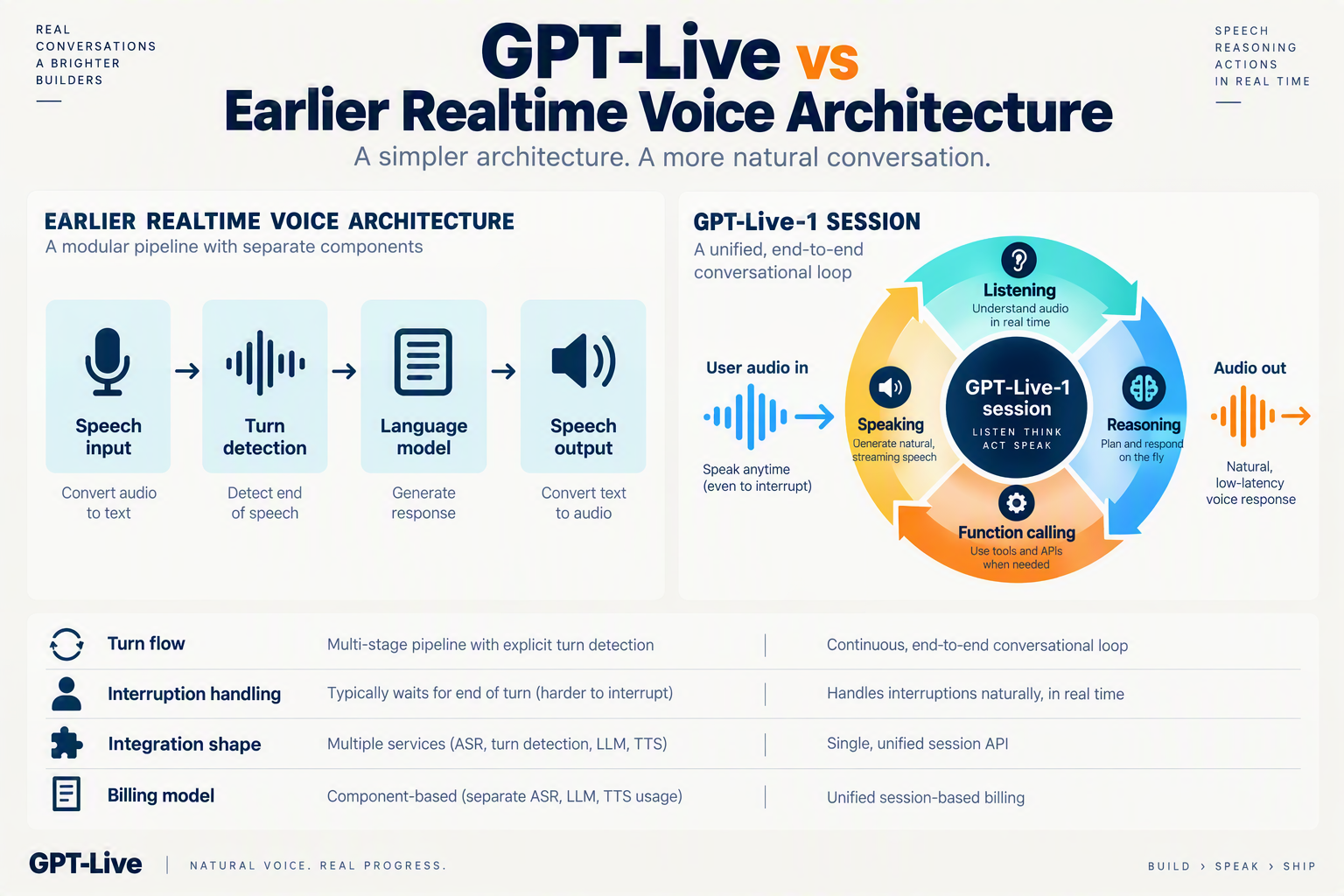
GPT-Live-1 advances GPT-Realtime voice interactions from streamed turn-taking toward full-duplex conversation. The model can listen while speaking, allowing an interruption to become conversational context rather than merely a command to cancel playback.
What changed from the traditional voice-agent pipeline?
A conventional voice agent usually connects three independent stages:
- Speech-to-text (STT) transcribes the caller.
- A large language model (LLM) generates a text response.
- Text-to-speech (TTS) converts that response into audio.
OpenAI describes GPT-Live-1 as a native speech model that avoids depending on this serial STT–LLM–TTS path. Direct audio processing can retain cues such as pauses, timing and overlapping speech that may be reduced when every utterance must first become text.
Cascaded systems remain useful when developers need to choose each component separately, inspect exact transcripts or tune recognition and synthesis independently. GPT-Live-1 instead packages more of the conversational loop into one speech-to-speech model.
Is GPT-Live-1 different from the OpenAI Realtime API?
GPT-Live-1 is the model; the OpenAI Realtime API is the session interface used to exchange live audio, text and events with compatible models. “GPT-Live” and “GPT-Realtime” therefore describe related but distinct parts of the stack.
Earlier realtime implementations could already stream audio, detect voice activity and cancel a response when a user began speaking. Applications commonly handled interruptions by detecting new speech, stopping the assistant’s audio and starting another turn.
GPT-Live-1 introduces model-level full duplex:
- Audio input can continue while the model produces spoken output.
- An interruption can change the meaning or direction of the active response.
- Audio and text can coexist within a live session.
- The model can request function calls during the conversation.
- The application remains responsible for tool permissions and external actions.
Microsoft Foundry described gpt-live-1 as OpenAI’s “flagship full-duplex voice model” with multilingual speech and translation support as of September 2026.
How do GPT-Live and GPT-Realtime approaches compare?
| Approach | Conversation structure | Interruption handling | Primary trade-off |
|---|---|---|---|
| Cascaded STT–LLM–TTS | Three sequential components | New speech is transcribed before processing | Greater component control, but more hand-offs |
| Earlier realtime turn-taking | Fast, streamed spoken turns | Detect speech, cancel output and begin another turn | Responsive, but generally turn-boundary-oriented |
| GPT-Live-1 full duplex | Listening and speaking can overlap | Interruption becomes live model context | More unified interaction, but requires a live session integration |
| Text chat model | Discrete request and response | No native spoken interruption | Simple HTTP workflow, but unsuitable for overlapping voice |
No published benchmark in the supplied launch material establishes a universal latency, accuracy or quality advantage. The defensible difference is architectural: GPT-Live-1 treats overlapping speech as part of the conversation instead of only as a stop signal.
When should developers choose GPT-Live-1?
GPT-Live-1 is most relevant when timing and interruptions affect task completion, such as:
- Correcting a date while a booking is being confirmed
- Interrupting a lengthy support explanation
- Receiving immediate feedback during language practice
- Checking inventory through function calls during a commerce conversation
- Clarifying details rapidly in multilingual calls
It is not designed for image or video input, asynchronous batch jobs or standard /v1/chat/completions requests. The model is voice-agent-only, runs through WebSocket sessions, bills session time per minute with per-second granularity and requires per-session opt-in because capacity is limited.
As of September 2026, the CallMissed developer catalogue contains 138 models overall, according to CallMissed’s product catalogue. Developers can access gpt-live-1 through CallMissed’s managed voice-agent WebSocket alongside its broader OpenAI-compatible API infrastructure.
How does GPT Live 1 API pricing work per session minute?
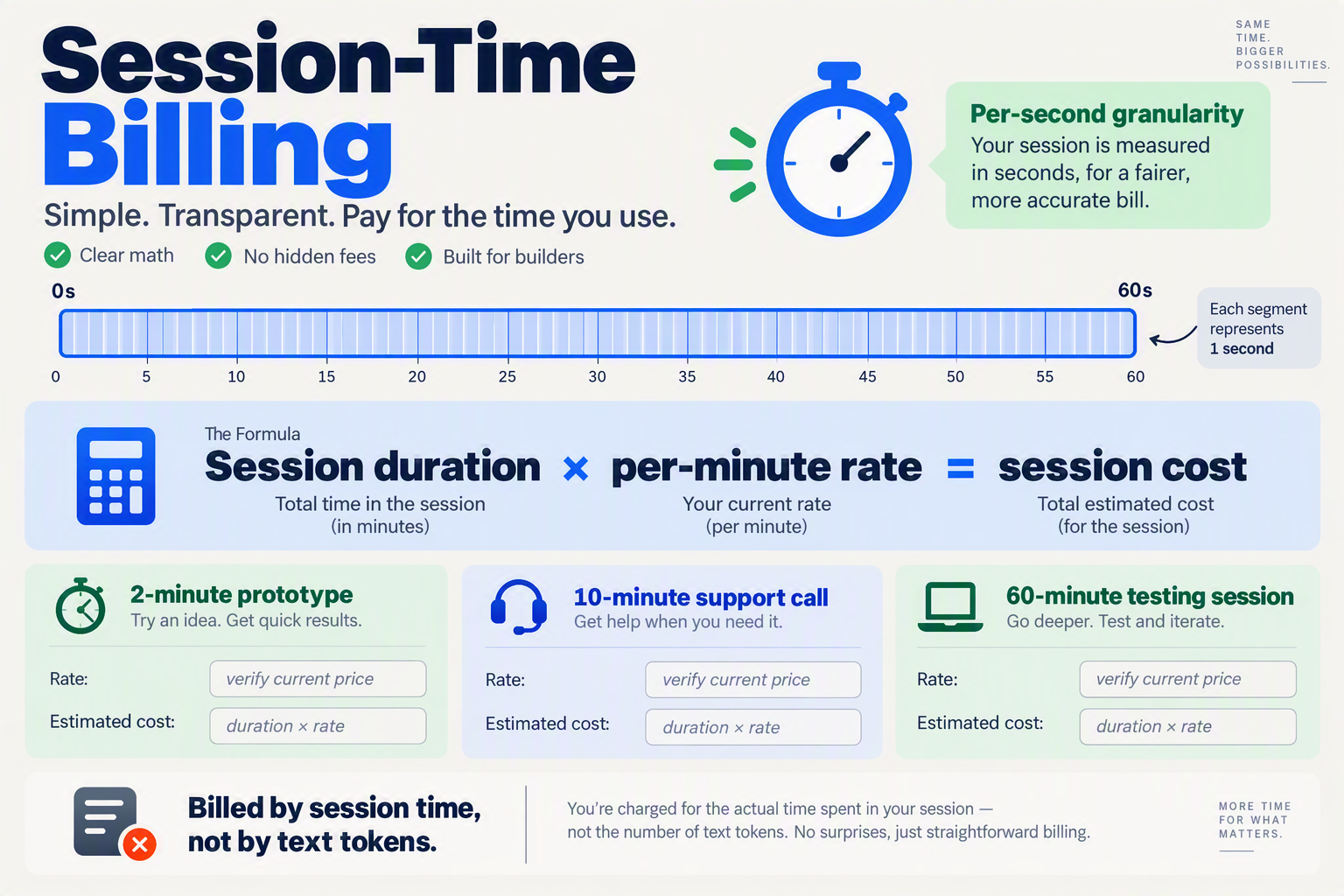
GPT-Live-1 API pricing is based on session time, measured with per-second granularity, rather than the number of audio or text tokens processed. As of September 2026, no specific per-minute rate is stated in the supplied launch brief, so teams should verify the current model rate in the CallMissed API playground or pricing interface before production deployment.
What does per-session billing mean for GPT-Live-1?
A GPT-Live-1 session is a live WebSocket interaction between an application and the realtime speech-to-speech model. Billing follows the duration of that session, with usage calculated to the second instead of rounding every connection to a full minute.
This structure differs from conventional large language model pricing:
- Token-priced APIs charge according to text or multimodal input and output volume.
- Session-priced GPT-Live-1 charges according to elapsed session time.
- Silence, user pauses and time spent waiting for the next turn can therefore affect costs if the session remains active.
- Natural interruptions and function calls occur within the live session rather than as separately priced chat-completion requests.
Because GPT-Live-1 accepts both audio and text input, token counts are not the appropriate primary unit for forecasting its cost. A better forecast starts with expected session duration, concurrent sessions and the number of conversations handled each day.
How can developers control GPT-Live-1 API costs?
The most effective cost controls focus on session lifecycle management rather than prompt compression. Production applications should:
- Set an idle timeout. Close a session after a defined period without meaningful audio, text or tool activity.
- Clean up disconnected clients. Mobile-network drops, closed browser tabs and abandoned calls should trigger server-side WebSocket termination.
- End sessions explicitly. Do not leave connections open after a caller says goodbye, completes a workflow or requests transfer.
- Use shorter reconnection windows. Preserve only the context needed to resume an interrupted conversation instead of maintaining inactive sessions indefinitely.
- Monitor duration by use case. Compare support, appointment-booking and qualification flows because each may produce a different average session length.
- Cap maximum session duration. Add a warning, handoff or controlled shutdown when a conversation exceeds the expected operational limit.
CallMissed provides usage and request logs for its developer AI API, which teams can use to inspect consumption and identify unexpectedly long-running interactions. Credits on CallMissed never expire, and one credit equals ₹1 or $0.01 as of September 2026, but the applicable GPT-Live-1 consumption rate should still be confirmed before estimating a deployment budget.
Does limited capacity change the billing model?
GPT-Live-1 currently has limited capacity and must be opted into for each session. That requirement does not change the session-time billing basis, but applications should handle unavailable capacity cleanly and avoid repeatedly opening unused connections.
For reliable budgeting, track successful session starts, active seconds, idle seconds, disconnect causes and average duration. These measurements provide a more useful GPT-Live-1 API pricing forecast than token estimates designed for /v1/chat/completions, which GPT-Live-1 does not use.
How do you set up gpt-live-1 through CallMissed's WebSocket API?
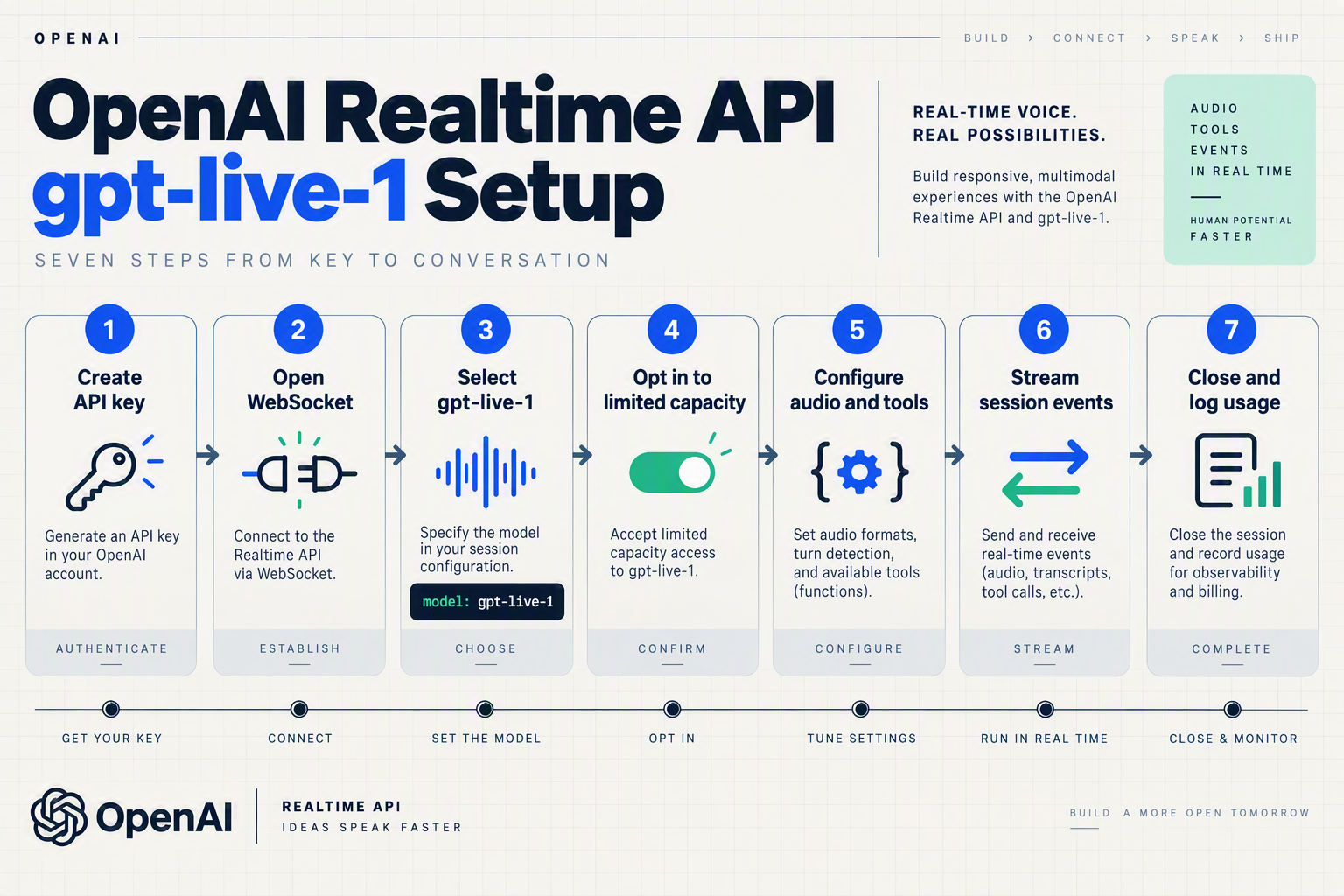
Set up gpt-live-1 by opening an authenticated, persistent connection to CallMissed’s managed voice-agent WebSocket, configuring the session for model ID gpt-live-1, and then exchanging audio, text, function-call, and lifecycle events over that socket. The model is voice-agent-only and does not run through /v1/chat/completions.
What should you prepare before connecting?
As of September 2026, CallMissed provides one API key and balance across 25 realtime voice-agent models, including gpt-live-1. Keep the API key on a trusted backend rather than exposing it in browser or mobile application code.
Before creating the session, define:
- The model ID:
gpt-live-1 - System or agent instructions
- The supported input modes your application will use: audio, text, or both
- Any callable functions and their argument definitions
- Your handling logic for streamed output, interruptions, errors, and disconnects
Use the audio encoding, framing, and authentication method specified in the current CallMissed documentation or demonstrated by the playground. Do not infer those values from a chat-completions integration because realtime WebSocket sessions have a different lifecycle.
How do you start a GPT-Live-1 session?
Follow this sequence:
- Open the authenticated WebSocket connection. Keep it open for the duration of the conversation rather than creating a new connection for every spoken turn.
- Opt in to GPT-Live-1 for that session. Capacity is limited, so access must be requested per session; do not assume that enabling it once applies to later connections.
- Send the session configuration. Select
gpt-live-1, provide the agent instructions, and include any function definitions the model may call. - Stream user input. Send microphone audio incrementally for natural conversation, or send text when the interface requires typed input.
- Process server events continuously. Route incoming audio to playback, collect text where needed, and update the user interface from session and response events.
Because GPT-Live-1 supports natural interruptions, the client should continue monitoring microphone input while output is playing. When the user interrupts, stop or suppress obsolete playback and follow the server’s event state rather than waiting for the previous response to finish locally.
How should function calling and events work?
Treat the WebSocket as an event-driven state machine, not a request-response REST call. Your handler should distinguish among:
- Session readiness and configuration updates
- Incremental audio or text output
- User-turn and interruption signals
- Function-call requests and arguments
- Function results, completion notices, and errors
When GPT-Live-1 requests a function, validate the supplied arguments, execute the approved operation on your server, and return the result through the active session using the documented event format. Apply authorization and timeouts independently; a model-generated function request should never bypass application permissions.
How do you end the session safely?
On hang-up or application exit, stop microphone capture, cancel unfinished tool operations, process any required final events, and close the WebSocket cleanly. Release playback buffers and session-specific state, and retain only the logs or transcripts permitted by your privacy policy.
Billing is based on session time with per-second granularity, not token usage, so prompt cleanup also prevents an abandoned connection from remaining active unnecessarily. Test the full lifecycle—including capacity rejection, reconnects, interruptions, tool failures, and cleanup—in CallMissed’s playground before deploying it to production.
How should interruptions, function calls, and backend reasoning work together?
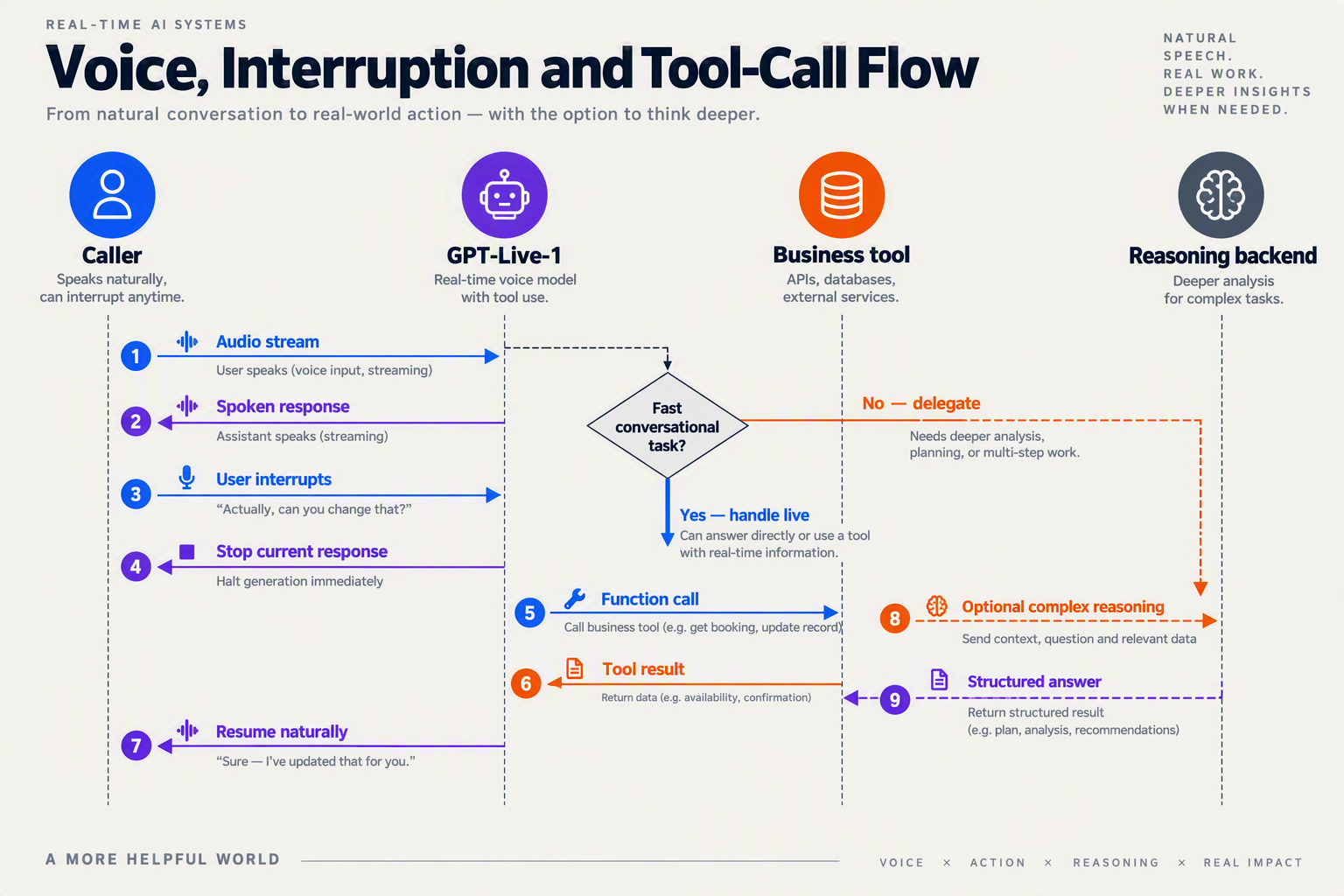
Interruptions, function calls, and backend reasoning should operate as separate but coordinated layers: the realtime model manages conversation, an orchestration layer controls playback and state, and trusted backend services execute actions. This separation prevents a user’s interruption from corrupting context or accidentally triggering the same action twice.
How should GPT-Live-1 handle user interruptions?
Treat every interruption as an explicit barge-in event, not as a brand-new conversation. GPT-Live-1 is designed for full-duplex speech, meaning it can listen while speaking; DataCamp’s 2026 GPT-Live-1 API tutorial specifically describes support for spoken turns, interruptions, and the pauses between them.
When new user speech arrives during playback, the application should conditionally:
- Stop or fade the current audio output so stale speech does not continue over the user.
- Cancel or supersede the active response if the transport supports cancellation.
- Preserve committed conversation state, including completed tool results and confirmed user choices.
- Discard only unplayed or superseded output, rather than deleting the entire turn.
- Start the replacement response using the new speech plus the relevant retained context.
Assigning each response a turn ID helps clients reject late audio packets from a cancelled turn. The interface should also show a clear listening or processing state, especially when playback has stopped but backend work continues.
How can function calls remain safe during interruptions?
A spoken interruption should stop unnecessary narration, but it should not automatically cancel a backend operation that may already be executing. Keep audio lifecycle, model response lifecycle, and tool execution lifecycle as distinct state machines.
Tool integrations should follow several safeguards:
- Give every tool request a unique operation ID or idempotency key.
- Make retryable operations idempotent wherever possible.
- Validate arguments server-side instead of trusting model-generated parameters.
- Use narrow permissions and an allowlist of callable tools.
- Require explicit confirmation before payments, bookings, deletions, account changes, or messages are finalized.
- Return structured success, pending, declined, and failure states.
For example, if a caller interrupts “Book the 4 p.m. appointment” with “Actually, make that 5 p.m.,” the system should not create both bookings. It should determine whether the first request was merely proposed, already submitted, or completed before replacing or compensating for it.
When should complex reasoning move to a separate backend?
GPT-Live-1 can remain the conversational front end while a separate model or deterministic service handles tasks requiring deeper analysis, large document retrieval, policy checks, or multi-step planning. This routing is optional: simple questions and lightweight tool calls may not justify another backend hop.
A practical pattern is:
- GPT-Live-1 acknowledges the request without claiming completion.
- A backend service performs the analysis or transaction.
- The orchestrator stores the result against the current session and operation ID.
- GPT-Live-1 explains the result when it becomes available.
As of September 2026, CallMissed’s managed voice-agent WebSocket provides the realtime transport layer, while its API supports function calling, structured outputs, caller-selected fallback models, and request logs. Regardless of transport, applications should define timeouts, bounded retries, fallback responses, and human escalation for failures rather than leaving callers in silence or implying that an unfinished action succeeded.
Which practical use cases benefit most from GPT-Live-1?
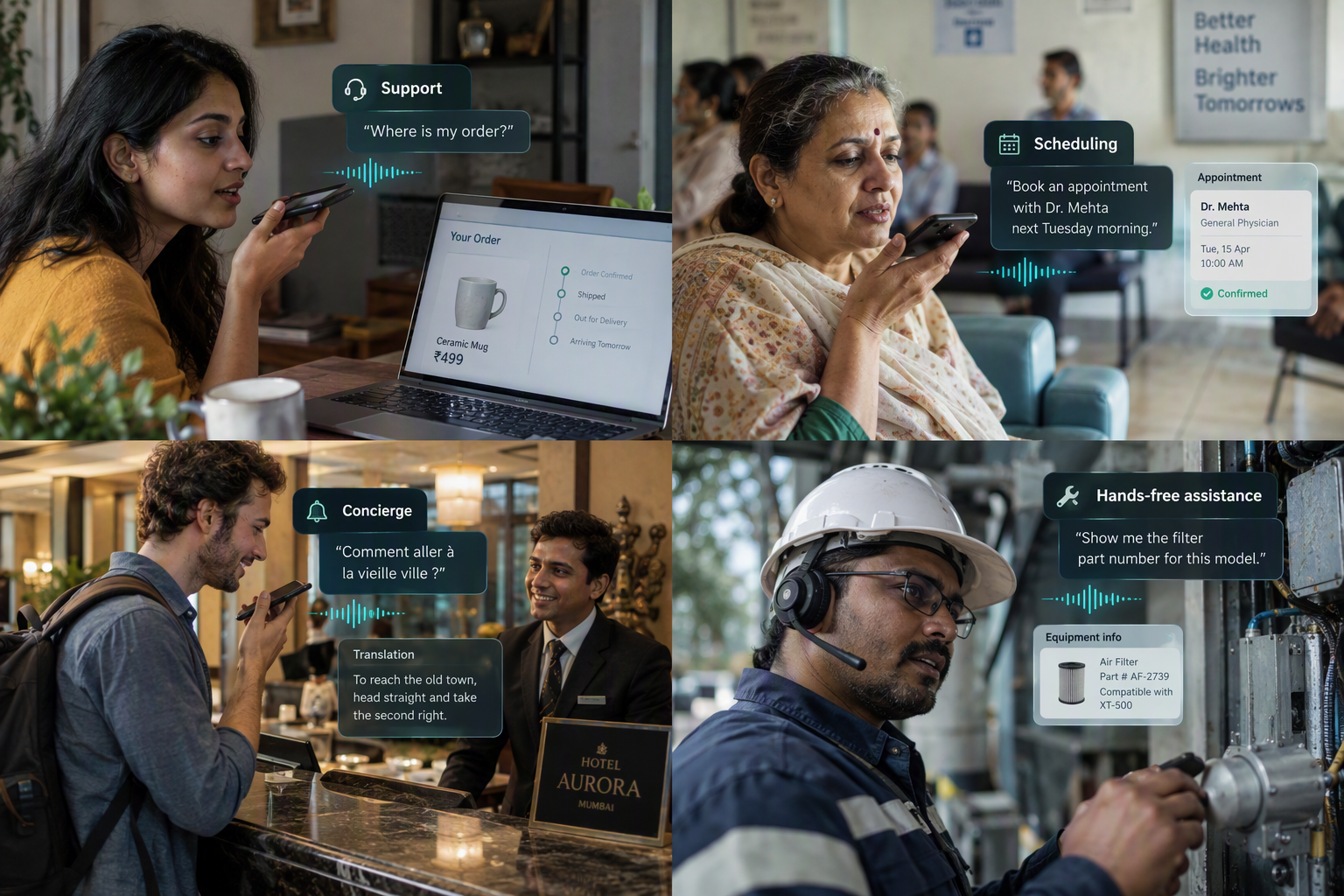
GPT-Live-1 is most useful where people need to speak naturally, interrupt without restarting the conversation, and trigger real business actions through function calls. The strongest initial use cases are customer support, appointment management, commerce assistance, and interactive language practice.
How can GPT-Live-1 improve customer-support calls?
A customer-support agent can listen and speak simultaneously rather than treating each utterance as a rigid turn. DataCamp describes GPT-Live-1 as an OpenAI full-duplex voice model that handles spoken turns, pauses, and interruptions.
Consider a caller reporting a delayed delivery. While GPT-Live-1 explains the shipping status, the caller might interrupt with, “Wait—I’m travelling tomorrow. Can you change the address?” The model can stop naturally, acknowledge the correction, and invoke approved functions to:
- Look up the order using an order ID
- Check whether an address change is still permitted
- Create or update a support ticket
- Transfer the conversation to a human when authorization is required
Function calls should remain constrained by authentication, permissions, and confirmation rules. The model can conduct the conversation, but the connected business system remains the source of truth.
Can GPT-Live-1 schedule or change appointments?
Appointment scheduling and rescheduling combine conversation with structured actions, making them a practical fit for the GPT Live 1 API. A caller could say, “Book Friday afternoon,” then interrupt the response with, “Actually, not this Friday—the one after.”
GPT-Live-1 can interpret the correction and call calendar functions to retrieve available slots. After the user selects a time, another function can create the appointment and return a confirmation number. For changes or cancellations, the workflow should verify the caller and request explicit confirmation before modifying the booking.
This pattern can support clinics, salons, repair services, and professional consultations without assuming that every request should be completed automatically.
How does GPT-Live-1 support conversational commerce?
Commerce assistants can use audio or text input to answer product questions while querying live inventory, order, and catalog systems. For example, a shopper might ask for running shoes, then interrupt with, “Only show waterproof options under ₹8,000.”
The assistant could call functions to:
- Search a product catalog with the revised filters
- Check size and inventory availability
- Retrieve an existing order’s status
- Prepare a cart for the shopper to review
Payment, refunds, substitutions, and final order placement should require clear confirmation and appropriate business controls. The benefit is not unchecked automation; it is the ability to move fluidly from spoken intent to a verified system action.
Why is GPT-Live-1 useful for language practice?
Microsoft Foundry identifies multilingual speech as a supported GPT-Live-1 capability. That makes the model relevant to role-play exercises, pronunciation practice, interview rehearsal, and conversational tutoring.
A learner could interrupt a restaurant role-play with, “Why did you use that tense?” GPT-Live-1 can pause the scenario, explain the phrase, and then resume. Function calls could save vocabulary, retrieve the next exercise, or record progress in a learning application.
As of September 2026, CallMissed makes gpt-live-1 available through its API and playground. Because GPT-Live-1 is a voice-agent model, production integrations use a real-time WebSocket session—not /v1/chat/completions—and must opt into its currently limited capacity per session.
How has the voice-AI industry reacted, and what remains to be tested?
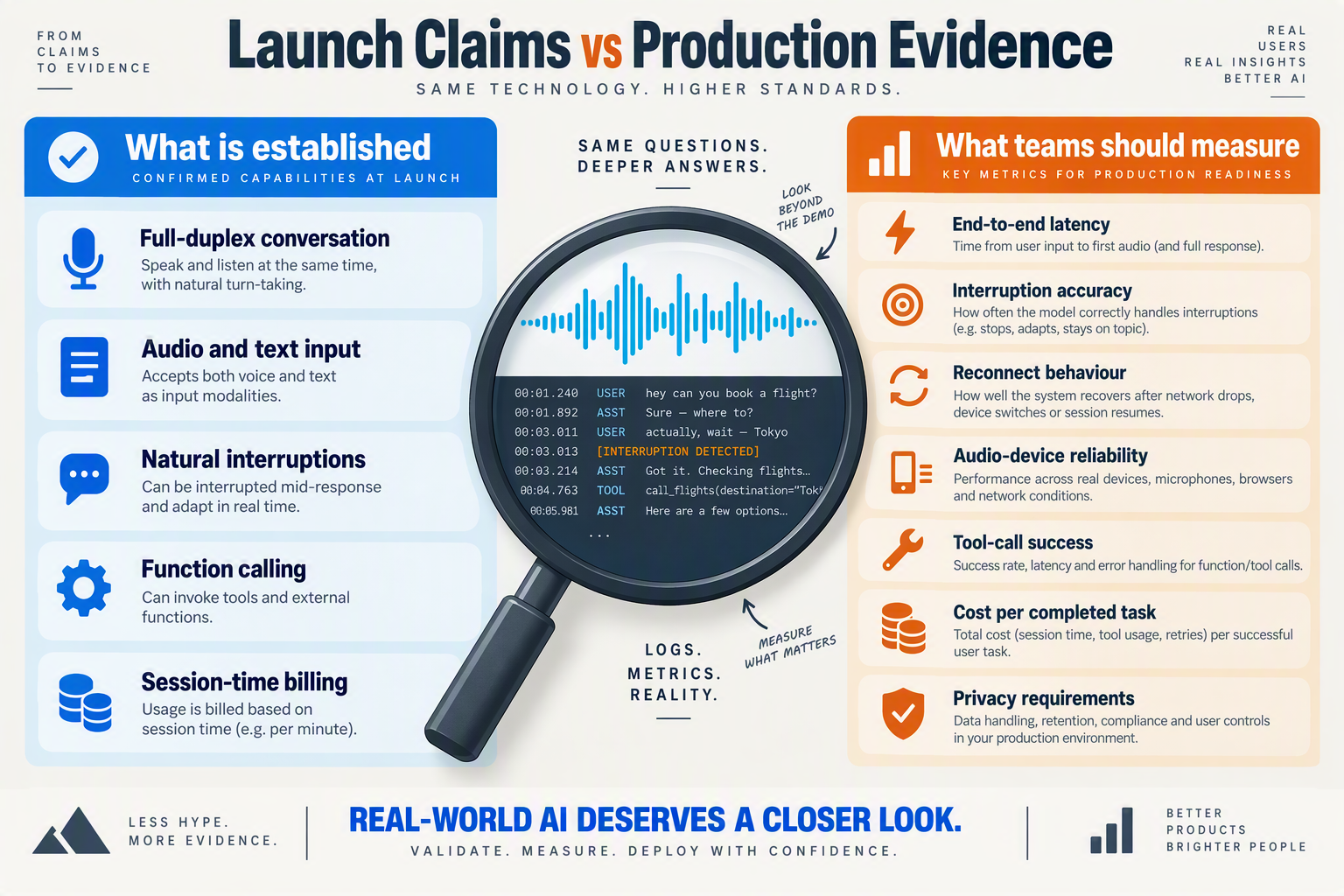
The early response to GPT-Live-1 is best described as implementation-focused rather than an industry-wide verdict. As of September 2026, OpenAI’s launch materials, Microsoft Foundry documentation, and developer coverage from Pipecat and DataCamp consistently emphasize full-duplex speech and interruption handling, but they do not establish universal superiority or real-world performance across every environment.
What are developers and platform providers highlighting?
OpenAI presents GPT-Live-1 as a model designed for direct, real-time voice interaction rather than a conventional speech-to-text, language-model, and text-to-speech pipeline. The central promise is a more natural conversational loop in which audio does not have to be reduced to isolated text turns before the system responds.
Microsoft Foundry describes GPT-Live-1 as a “flagship full-duplex voice model” and documents support for multilingual speech and speech translation as of September 2026. That framing is significant because multilingual operation could make one model useful across customer service, travel, education, and international business workflows.
Developer resources have concentrated on the interaction model:
- DataCamp describes GPT-Live-1 as a full-duplex voice model that handles spoken turns, interruptions, and the pauses between them.
- Pipecat documents
gpt-live-1through its OpenAI live speech-to-speech service, presenting it as a model that can participate in a full-duplex conversation. - OpenAI positions GPT-Live-1 around direct speech interaction, reducing dependence on a multi-model voice pipeline.
These sources show clear technical interest, but documentation and tutorials should not be mistaken for broad market validation. Published coverage does not yet demonstrate how the model performs across all accents, devices, networks, industries, or conversation types.
What still needs to be tested with GPT-Live-1?
Teams evaluating the GPT Live 1 full-duplex voice model should run controlled tests using their own callers, tools, and operating conditions. Important questions include:
- Interruption reliability: Does the model stop at the right moment when a caller speaks, and can it distinguish a genuine interruption from background conversation or noise?
- Turn-taking quality: How naturally does it handle hesitation, silence, self-correction, overlapping speech, and callers who change direction mid-sentence?
- Multilingual behavior: How consistently does multilingual speech and translation support work across language pairs, regional accents, and code-switching?
- Function execution: Does function calling remain dependable when users revise a request, interrupt a confirmation, or provide required details out of order?
- Production responsiveness: How does the complete experience behave across mobile networks, Bluetooth devices, congested connections, and geographically distributed users?
- Conversation safety: Can the application reliably enforce confirmations, escalation rules, and human handoff for sensitive or high-impact actions?
The practical conclusion is cautious: full-duplex speech and natural interruptions represent a meaningful architectural step, and OpenAI, Microsoft Foundry, Pipecat, and DataCamp all foreground those capabilities. However, production suitability still depends on scenario-specific evaluation rather than launch descriptions alone.
What is the GPT-Live-1 launch timeline?
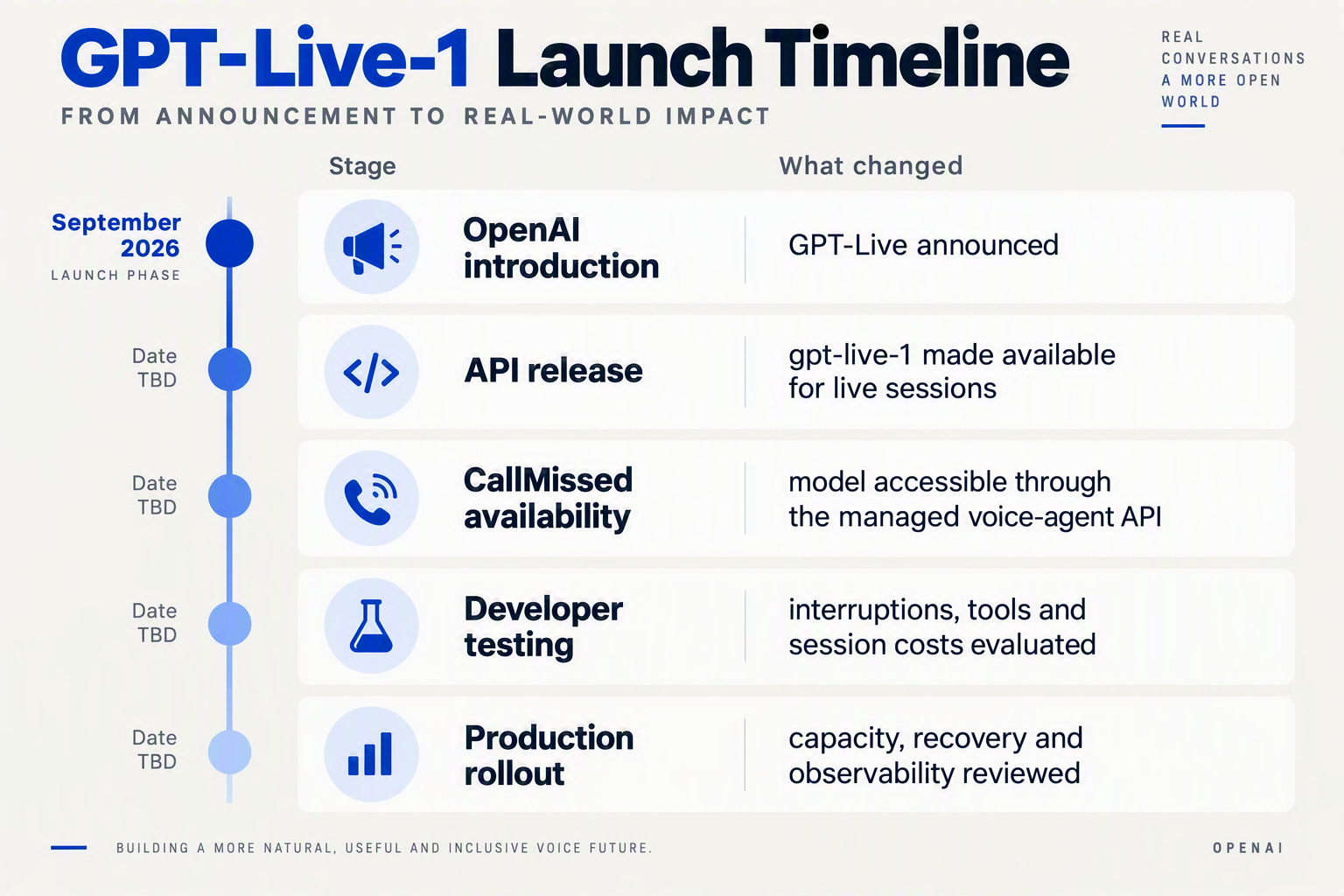
As of September 2026, the confirmed GPT-Live-1 timeline has two central milestones: OpenAI introduced the full-duplex voice model during 2026, and CallMissed subsequently made gpt-live-1 available through its API and playground in September 2026. The current release remains a voice-session product with specific transport, capacity, modality and billing constraints.
| Period | Milestone | What developers need to know | Status as of September 2026 |
|---|---|---|---|
| 2026 launch context | OpenAI introduces GPT-Live-1 as a realtime, full-duplex speech model. | GPT-Live-1 can process audio and text input, generate spoken responses and respond to natural interruptions. Microsoft Foundry also describes gpt-live-1 as a flagship full-duplex voice model. | Launched |
| 2026 developer rollout | GPT-Live-1 becomes accessible for building conversational voice applications. | DataCamp and Pipecat describe the model as speech-to-speech technology that can listen and speak within a live conversation rather than relying only on isolated, sequential turns. | Available with capacity controls |
| September 2026 | gpt-live-1 becomes available through the CallMissed API and playground. | Developers can evaluate the model interactively or connect through CallMissed’s managed voice-agent WebSocket infrastructure. The release supports function calling for integrating external tools and application workflows. | Available |
| September 2026 integration requirements | The launch uses a voice-session interface rather than a standard text-completion endpoint. | GPT-Live-1 must be accessed over WebSocket; it is not available through /v1/chat/completions. Applications should maintain session state and handle realtime audio events, interruptions and tool calls. | Required for every integration |
| September 2026 capacity and billing | Limited capacity and session-based charging apply. | Developers must opt in for each session. Usage is billed by session time with per-second granularity, not by input and output tokens, so idle connection time can affect cost. | Current launch policy |
| September 2026 modality scope | GPT-Live-1 supports audio and text input but excludes visual media. | Image and video inputs are not supported. Workflows requiring visual analysis should route that content to a compatible vision model instead of sending it to the live voice session. | Current limitation |
What changed when GPT-Live-1 reached CallMissed?
The September 2026 availability means developers can select the model ID gpt-live-1 while using CallMissed’s realtime voice-agent infrastructure. Unlike a conventional LLM request that sends a prompt and waits for a complete response, a live session keeps a bidirectional connection open so audio, text, model output and function-call events can move continuously.
The key implementation differences are:
- Use WebSocket events, not chat-completion requests.
- Request access per session because launch capacity is limited.
- Measure session duration, since billing is time-based and calculated per second.
- Design for interruptions, including stopping or redirecting speech naturally.
- Keep visual inputs separate, because the model does not accept images or video.
Are additional GPT-Live-1 milestones confirmed?
No later roadmap dates, capacity-expansion dates or visual-input milestones are confirmed in the supplied launch material as of September 2026. Teams should therefore build around the currently documented WebSocket transport, per-session opt-in, session-time billing and audio-or-text input boundaries rather than assuming unsupported features will arrive on a particular date.
Frequently Asked Questions
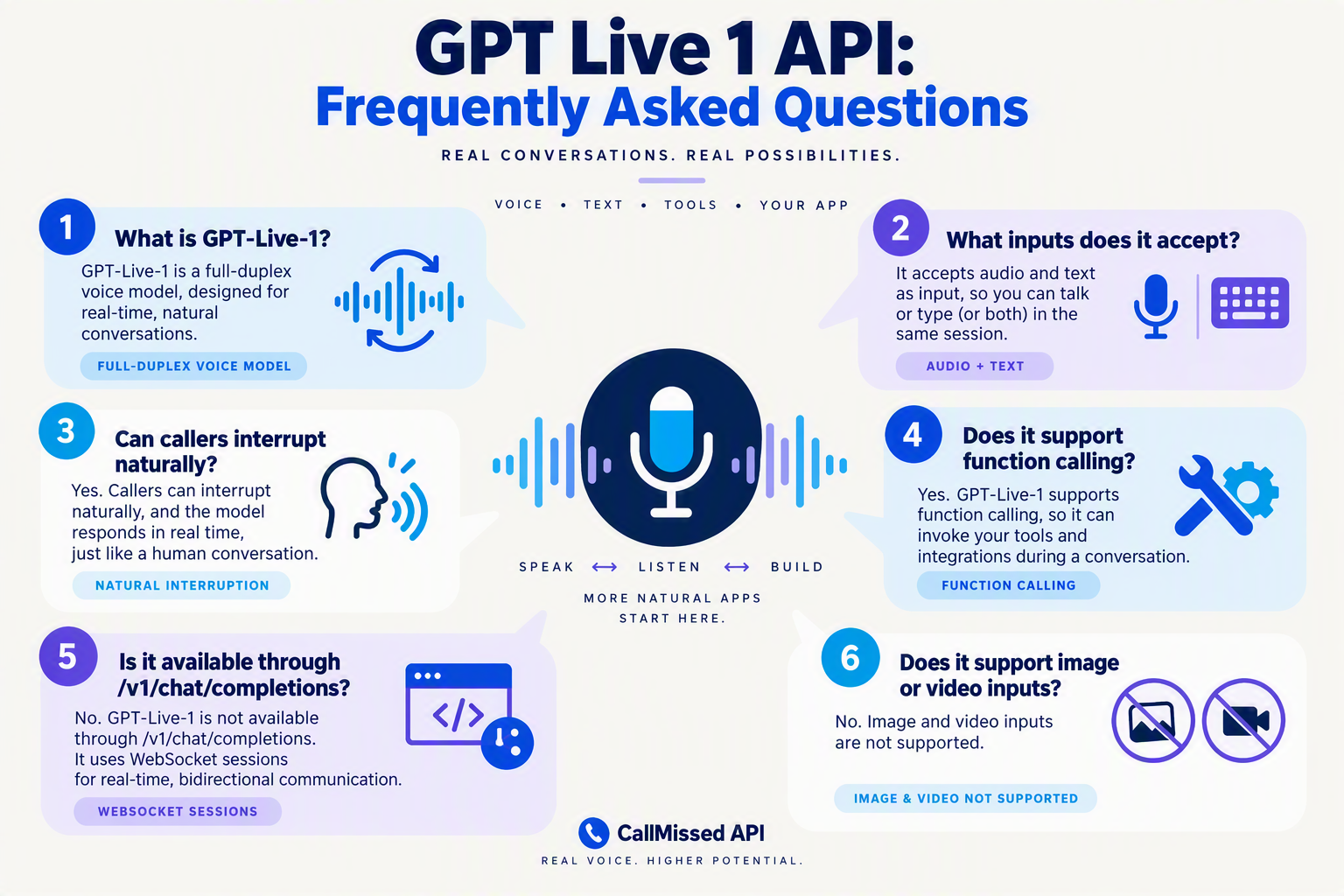
What is GPT-Live-1?
gpt-live-1, with support for fluid spoken exchanges and natural interruptions.Does GPT-Live-1 use the Chat Completions API?
/v1/chat/completions endpoint. Developers should therefore treat an OpenAI Realtime API gpt-live-1 setup as a persistent, bidirectional session rather than a conventional request-and-response chat completion.Which input types does the GPT Live 1 API support?
gpt-live-1.Can GPT-Live-1 handle interruptions during a conversation?
Does GPT-Live-1 support function calling?
How do capacity limits and per-session opt-in work for GPT-Live-1?
How does GPT Live 1 API pricing and billing work on CallMissed?
gpt-live-1 in CallMissed’s API or playground and check the current published rate before deployment, because an open but idle session can still affect time-based usage.Conclusion
GPT-Live-1 marks a shift from chained speech pipelines toward native, full-duplex conversation. OpenAI’s model can listen while speaking, respond to natural interruptions and maintain live context—capabilities that make voice agents feel less like turn-based interfaces.
- GPT-Live-1 accepts audio and text input, produces spoken responses and supports function calling for actions such as checking orders or changing appointments.
- CallMissed provides
gpt-live-1through its managed voice-agent WebSocket, enabling developers to configure and run session-based voice applications. - The model is WebSocket-only: it is unavailable through
/v1/chat/completionsand does not accept image or video input. - Billing follows session time with per-second granularity, rather than input and output tokens; limited launch capacity also requires developers to opt in for each session and prepare fallback or retry logic.
The next developments to watch are capacity expansion, production behavior under frequent interruptions and how effectively applications coordinate function calls without disrupting conversational flow. Those factors will determine where full-duplex agents deliver the clearest practical gains.
Developers can explore GPT-Live-1 through CallMissed’s API and playground—but the key design question remains: what could your voice application do differently if users never had to wait for the agent to stop speaking?
Related Reading
- GPT-6 Sol vs Claude Opus 5.5: 2026 API Reality Check
- GPT-5.6 Luna API Pricing, Context Window & Benchmarks
- GPT-6 API Guide: Sol, Luna and Astra Facts for 2026
Sources
Discussion
Related Posts


Ready to automate customer conversations?
Launch AI voice agents and WhatsApp bots with CallMissed — one API, 22+ Indian languages.