Deploy a multilingual voice bot in Marathi and Gujarati


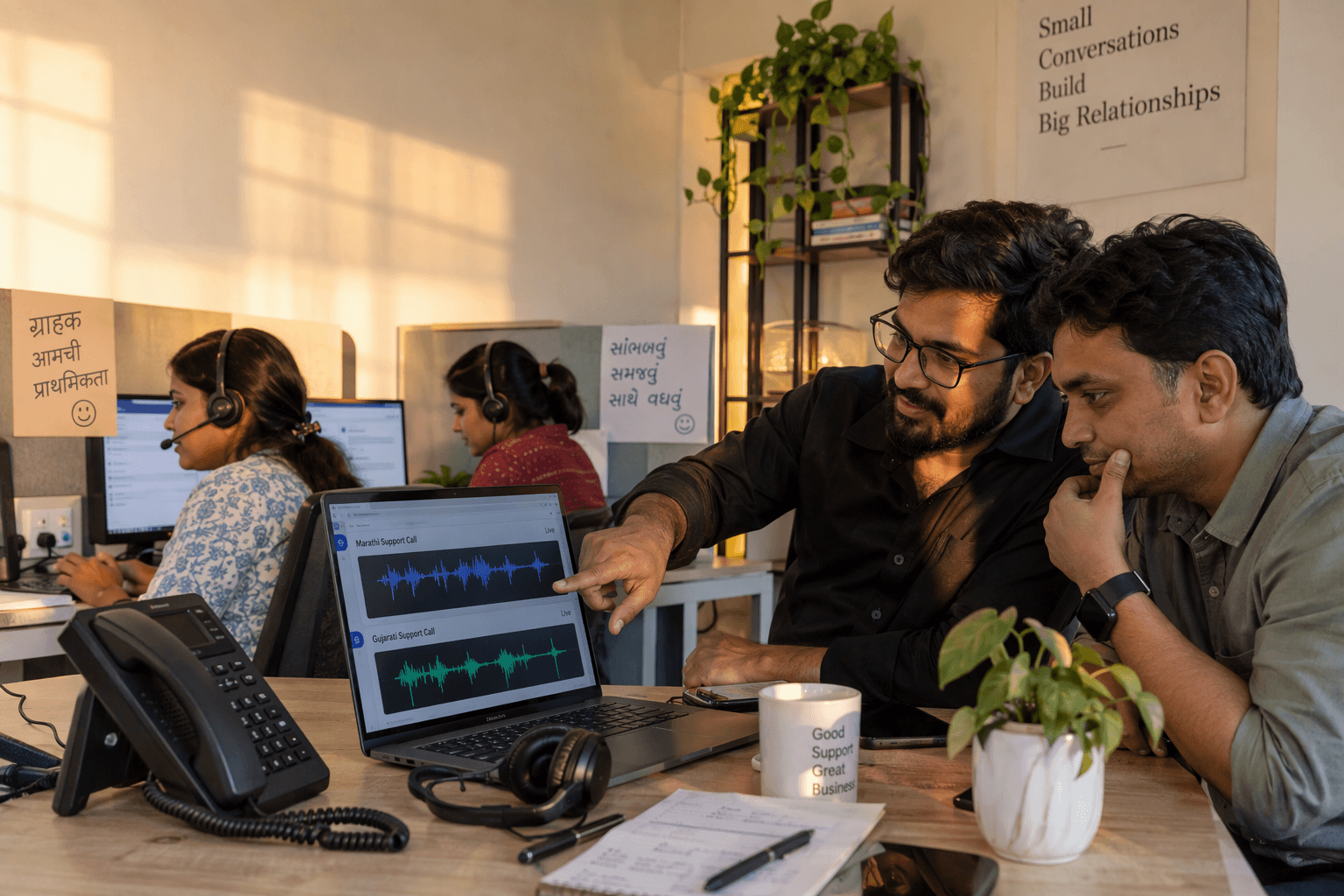
Deploy a multilingual voice bot with Marathi and Gujarati support using setup checks, language-switching tests, cost tables, and a launch checklist.

Deploy a multilingual voice bot in Marathi and Gujarati
What if your voice bot understands Marathi perfectly—but answers in a voice your customers struggle to follow? To Deploy a multilingual voice bot that handles Marathi and Gujarati, you need to verify speech recognition, conversational responses, and speech generation separately, then connect the tested agent to your calling channel.
That distinction matters because “multilingual support” is not a complete deployment specification. A caller might begin in Gujarati, switch to English for an order number, and interrupt before the bot finishes speaking. Your deployment needs to handle that journey—not simply read a translated greeting.
What does a Marathi and Gujarati voice bot need to work reliably?
The building blocks are available, but language coverage is only the starting point. As of November 2026, Sarvam AI’s voice-agent text-to-speech documentation lists both Marathi and Gujarati and specifies 8 kHz telephony-optimized audio. These are useful selection criteria: the voice must support your target language and work with the audio format your phone connection requires.
Language configuration also varies across platforms. As of November 2026, Bolna’s Marathi documentation specifies the language code mr and lists Marathi among languages supported for automatic detection mid-call. That does not establish identical behavior for Gujarati; each language and provider combination needs its own verification.
For buyers, the practical question is therefore not “How many languages does this platform advertise?” It is “Can this configuration complete our customers’ tasks accurately in Marathi and Gujarati?”
Consider an appointment-booking bot serving Pune and Ahmedabad. Success means understanding the requested date, confirming the correct location, checking availability, and repeating the booking details clearly. A fluent-sounding answer that books the wrong branch is still a failed interaction.
As of November 2026, CallMissed offers a no-code voice-agent builder with language settings, knowledge bases, custom REST tools, and inbound calling through rented numbers or a connected carrier—bringing several deployment components into one platform.
This guide will show you how to:
- Validate language support across recognition, reasoning, and voice output.
- Configure Marathi and Gujarati prompts, greetings, and business terminology.
- Connect a knowledge base and tools for tasks such as appointment booking.
- Test mixed-language speech, interruptions, names, numbers, and unclear audio.
- Launch on your chosen calling channel and review transcripts for recurring failures.
You will also learn where to draw the line between automation and escalation. Before launch, define what happens when the bot cannot understand a caller, retrieve an answer, or safely complete a requested action.
How do I deploy a voice bot that handles Marathi and Gujarati? Verify speech recognition and spoken output for both languages, configure language selection and fallback, and connect a supported phone number. Test real calls with native speakers before publishing, then monitor errors and keep a rollback path.
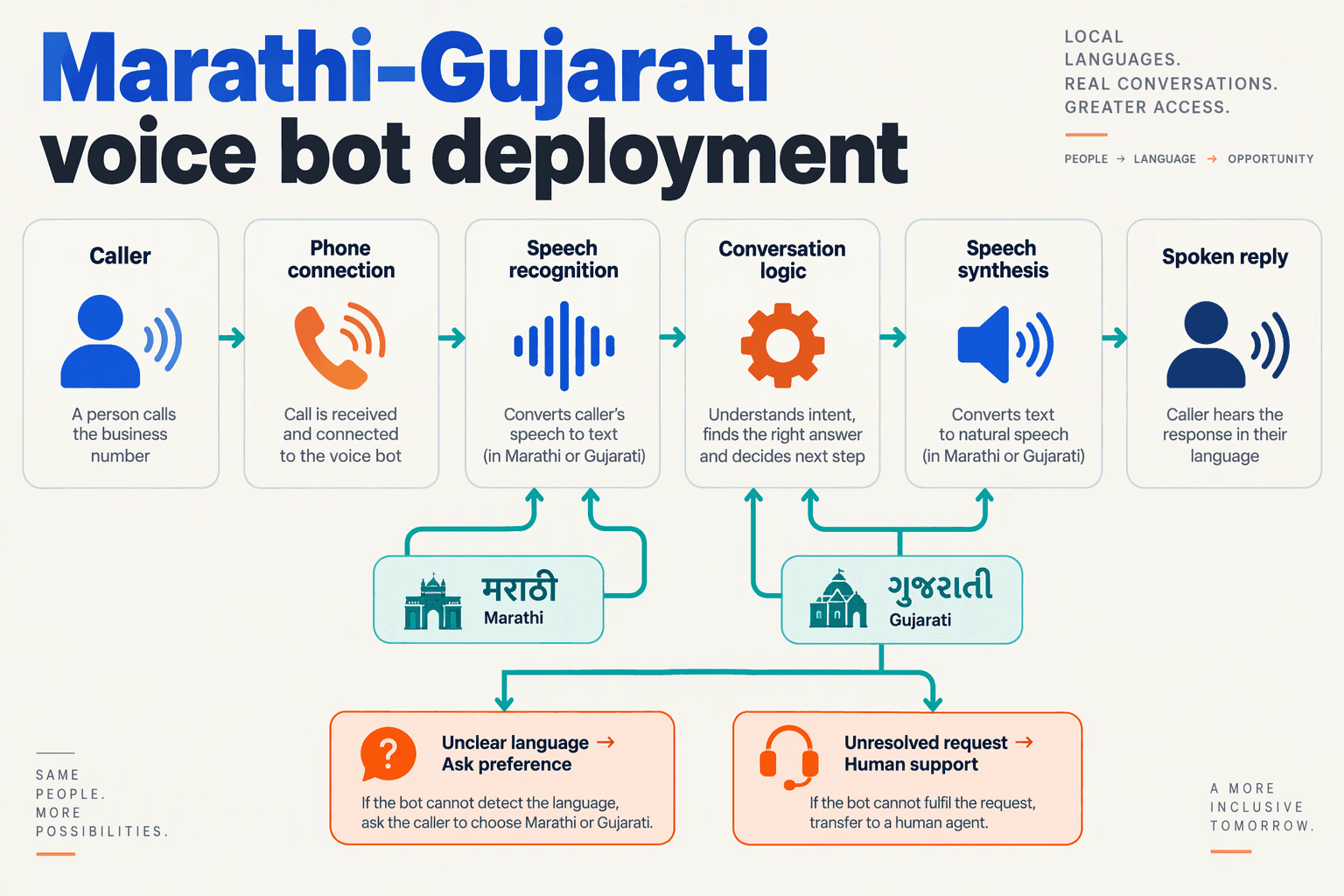
Deploy a Marathi–Gujarati voice bot by validating speech recognition and spoken output independently, configuring language selection and recovery rules, and connecting a supported calling channel. Publish only after native speakers complete realistic phone calls successfully, with monitoring and a tested rollback procedure ready.
How do I verify Marathi and Gujarati support before configuring the bot?
Create a deployment checklist for each language, not a single “multilingual supported” checkbox. Record the selected recognition model, conversational model, voice, required language identifier, and telephone audio format.
For both Marathi and Gujarati, verify that:
- Speech recognition captures names, locations, dates, and English words embedded in regional speech.
- Conversational responses follow your business rules in the caller’s chosen language.
- Spoken output pronounces amounts, appointment times, and business terminology intelligibly.
- Telephone audio remains understandable after passing through your actual carrier connection.
According to Sarvam AI’s voice-agent TTS page, as of November 2026, the service advertises streaming at “sub-250ms.” Treat that as a provider claim about voice generation—not a guarantee of your bot’s end-to-end response time, which also includes recognition, reasoning, tool execution, and network delays.
How should callers select Marathi or Gujarati?
Start with an explicit language choice unless automatic detection has passed your own tests for both languages. A short bilingual greeting or keypad menu gives callers a predictable starting point.
Configure these rules before connecting production traffic:
- Initial selection: Offer Marathi and Gujarati without requiring callers to navigate a long introduction.
- Language persistence: Keep the selected language for responses unless the caller requests a switch.
- Code-switching: Accept English product names or reference numbers without automatically changing the response language.
- Recovery: Ask a targeted clarification when recognition is uncertain; offer a human route after repeated failures.
As of November 2026, Bolna’s Marathi documentation directs developers building English–Marathi agents to its multilingual setup guide. That distinction reinforces an important implementation rule: language availability and multilingual conversation configuration are separate checks.
How do I connect the agent to a phone number?
Connect a supported number, configure inbound routing, and test the complete call path—not just the browser preview. Confirm that greetings play correctly, keypad input reaches the intended branch, and the call ends cleanly.
As of November 2026, CallMissed supports rented numbers or bring-your-own-carrier connections through Twilio, Plivo, or any SIP trunk; its no-code builder includes language settings, versioning, publish, and rollback. Those capabilities support a staged rollout, but the selected recognition and voice configuration still needs language-specific validation.
Keep your first deployment narrow: one number, one business task, and a clearly defined escalation route.
What should I test before publishing?
Run native-speaker tests separately for Marathi and Gujarati, then add mixed-language calls. For the Pune–Ahmedabad appointment example, score whether the bot confirms the correct branch, date, time, and caller details, not merely whether the conversation sounds fluent.
Include:
- Background noise, interruptions, and quiet speech.
- Similar-sounding names and spoken digit sequences.
- Mid-call language changes and corrections.
- Unavailable appointments, failed tools, and unanswered questions.
Set acceptance criteria before testing. After launch, review transcripts alongside recordings, classify failures by recognition, reasoning, pronunciation, or integration, and change one component at a time. Retain the last tested configuration so a regression has a clear rollback path.
Who is this setup for, and what must be ready before you start?
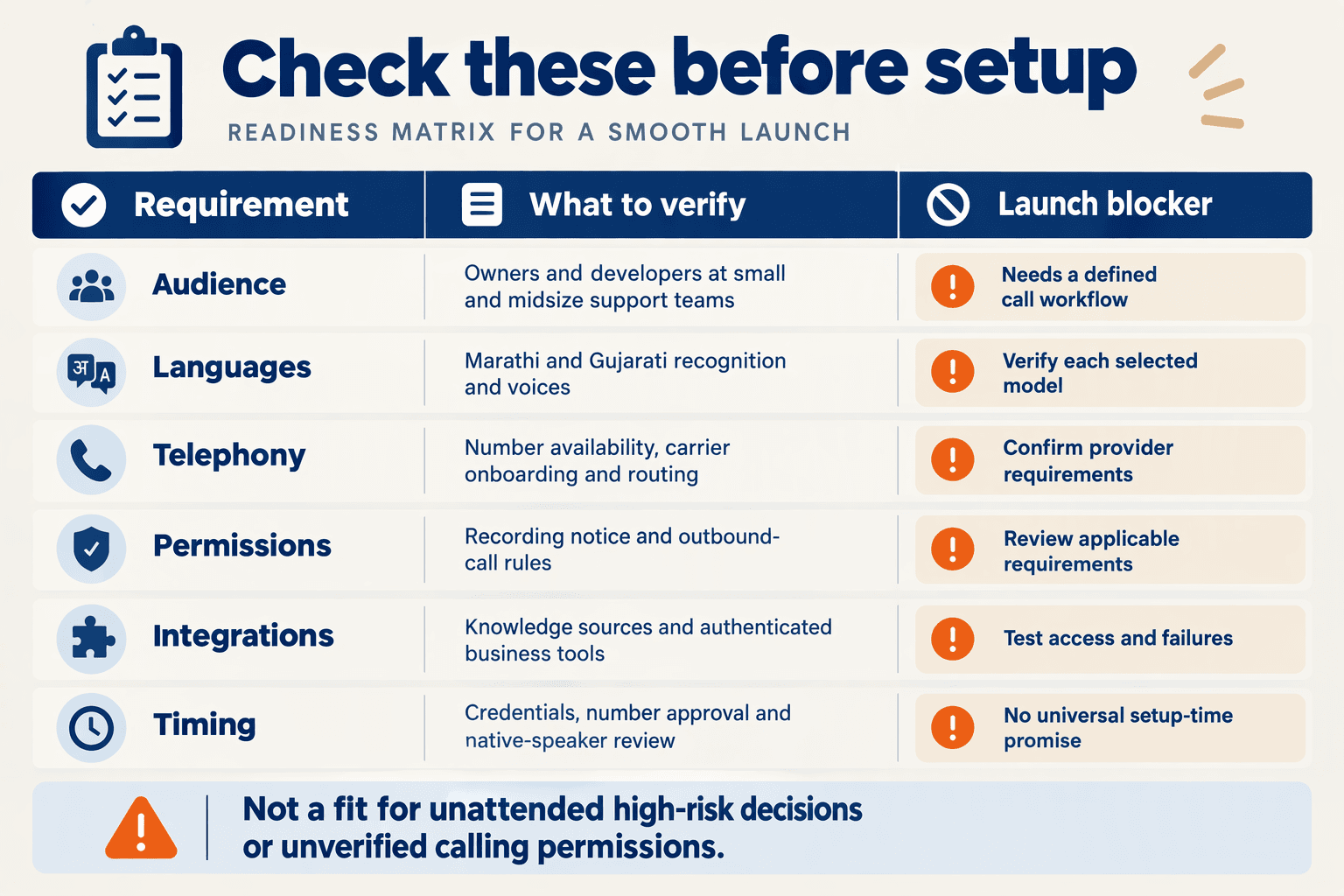
This setup is for businesses with repeatable customer calls in Marathi and Gujarati, such as appointment booking, order-status enquiries, and routine support. Before starting, have a defined call scope, approved business information, a calling channel, and native-language reviewers—not just a platform account.
Which businesses are ready for a Marathi and Gujarati voice bot?
The strongest first deployment handles a narrow task with a verifiable outcome. Use the table below to identify what your team must prepare; these are recommended readiness criteria, not platform guarantees.
| Use case | Suitable first task | Prepare before building | Pilot acceptance check |
|---|---|---|---|
| Clinics and service centres | Book an appointment | Branches, opening hours, available slots, cancellation rules | Correct branch, date, and time confirmed |
| Retail and ecommerce | Answer order-status enquiries | Order lookup tool, identity checks, approved status wording | Correct order retrieved without exposing another customer’s details |
| Local service businesses | Capture a service request | Service areas, required fields, escalation contact | Address and requested service recorded accurately |
| Customer-support teams | Answer routine policy questions | Approved FAQs, policy versions, unresolved-question workflow | Answers match the current policy |
| Sales enquiry teams | Qualify an inbound enquiry | Qualification questions, routing rules, CRM fields | Required details captured without invented promises |
| Developer teams | Add voice to an existing workflow | API credentials, tool schemas, test environment, calling connection | Tool failures trigger a safe recovery response |
Avoid making diagnosis, disputed payments, or complex account changes the initial pilot. These tasks require more safeguards than a simple information or booking workflow.
What technical access and business information must be ready?
Prepare a deployment pack that someone outside your team could use without guessing:
- Call scope: List permitted actions, prohibited actions, and when the bot should stop attempting automation.
- Approved knowledge: Supply current prices, policies, locations, and opening hours, with an owner responsible for updates.
- Tool access: Provide test credentials and documented inputs for booking, order lookup, or CRM updates.
- Calling connection: Confirm number ownership, carrier access, and the audio format required by your chosen connection.
- Recovery route: Specify what happens when a tool fails or a caller requests a person.
As of November 2026, Sarvam AI’s voice-agent documentation specifies 8 kHz telephony-optimized audio; use that specification as a compatibility check when evaluating a Sarvam-based voice stack, not as proof that every carrier configuration will work.
As of November 2026, CallMissed supports rented numbers or a connected carrier through Twilio, Plivo, or any SIP trunk, alongside custom REST tools and knowledge bases built from text, web pages, and PDFs. For a deployment using those capabilities, prepare both the business content and the credentials for the systems the agent will access.
Who should approve the pilot before launch?
Assign a business owner, an integration owner, and reviewers who regularly speak Marathi and Gujarati. One person can cover multiple roles, but both languages need independent review.
Before spending on live traffic, agree on:
- Task completion: What constitutes a successful call?
- Error handling: Which mistakes require escalation?
- Data handling: What caller information may be collected, recorded, and retained?
- Launch authority: Who can pause the bot or approve changes?
If nobody owns these decisions, keep the deployment in testing. A well-defined pilot is easier to improve than an unrestricted bot whose mistakes have no clear owner.
Should I choose CallMissed, Bolna, or a Sarvam-based stack?
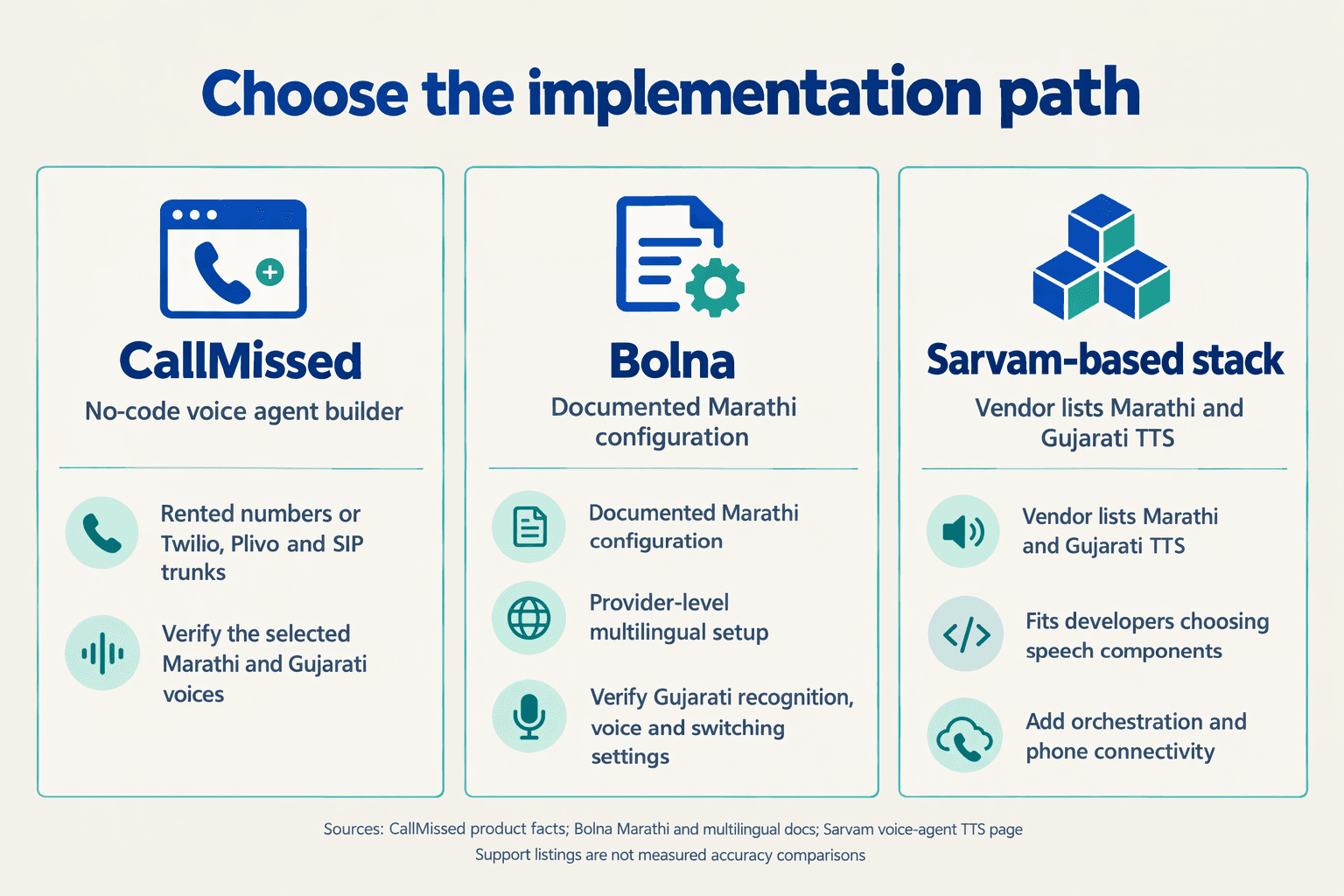
Choose CallMissed if you want a no-code deployment with integrated operational controls; evaluate Bolna if its documented provider configurations suit your requirements; choose a Sarvam-based custom stack if you want to assemble and maintain the components yourself. For a Marathi and Gujarati voice bot, the deciding factors should be deployment ownership, verified configurations, and total operating cost—not a generic multilingual label.
How do CallMissed, Bolna, and a Sarvam-based stack compare?
The comparison below reflects the supplied product facts and named documentation as of November 24, 2026. “Verify” identifies information the available sources do not establish; it does not mean a capability is absent.
| Decision factor | CallMissed | Bolna | Sarvam-based custom stack |
|---|---|---|---|
| Deployment approach | No-code agent builder with publishing and rollback | Marathi documentation provides provider choices and an API example | Assemble speech services, orchestration, tools, and calling |
| Language evidence | Speech recognition in 22 Indian languages; natural TTS in 10 Indian languages, plus English | Bolna documents Marathi code mr and mid-call automatic detection; verify the Gujarati configuration separately | Sarvam lists Marathi and Gujarati for voice-agent TTS; verify the selected recognition service separately |
| Calling connection | Rented numbers or your carrier through Twilio, Plivo, or any SIP trunk | Verify carrier compatibility for your deployment | Connect and validate your chosen telephony integration |
| Business actions | Knowledge base, custom REST tools, and calendar integrations | Verify tool execution and integration requirements | Implement tool execution, validation, and error handling |
| Production oversight | Recordings, transcripts, QA scoring, eval suites, and supervisor intervention | Verify available monitoring and review controls | Build or integrate monitoring, evaluation, and escalation |
| Cost evidence | Flat voice plans at ₹4–₹6/min on November 24, 2026; phone carriage separate | Obtain a quote for the exact provider configuration | Price speech services, model usage, telephony, hosting, and maintenance separately |
CallMissed’s Best latency plan increases from ₹6/min to ₹8/min for calls starting on or after November 30, 2026, according to its verified pricing facts. Flat plans have a 30-second minimum per call, so compare expected call-duration distributions rather than headline rates alone.
When should I choose a managed platform rather than a custom stack?
Choose a managed platform when your team’s priority is operating the service rather than maintaining its infrastructure. Publishing changes, reviewing failed calls, and giving supervisors intervention controls become important once the bot handles real appointments or customer requests.
Bolna’s Marathi documentation offers a concrete configuration starting point, but that evidence should not substitute for a Gujarati demonstration. Ask for both languages using the same proposed production configuration, including the actual voices and calling connection.
A Sarvam-based stack makes sense when engineers need control over component selection and can own integration testing. Sarvam’s voice-agent TTS page advertises “sub-250ms” streaming over 8 kHz audio, as of November 2026; that is a vendor claim about speech generation, not an end-to-end response-time benchmark for your assembled bot.
What should I request before choosing a vendor?
Give each shortlisted option the same acceptance brief:
- Run a matched demonstration: use identical Marathi and Gujarati booking scenarios, including corrections and English identifiers.
- Show operational recovery: demonstrate a failed tool request, human escalation, and how staff inspect the call afterward.
- Provide an itemized estimate: include telephony, minimum billing, model charges, and engineering responsibilities.
The useful comparison is cost per correctly completed task. A lower per-minute price is not necessarily cheaper if callers need repeat calls or staff must repair incorrect bookings.
Steps 1–3: How do I configure both languages and a reliable call flow?
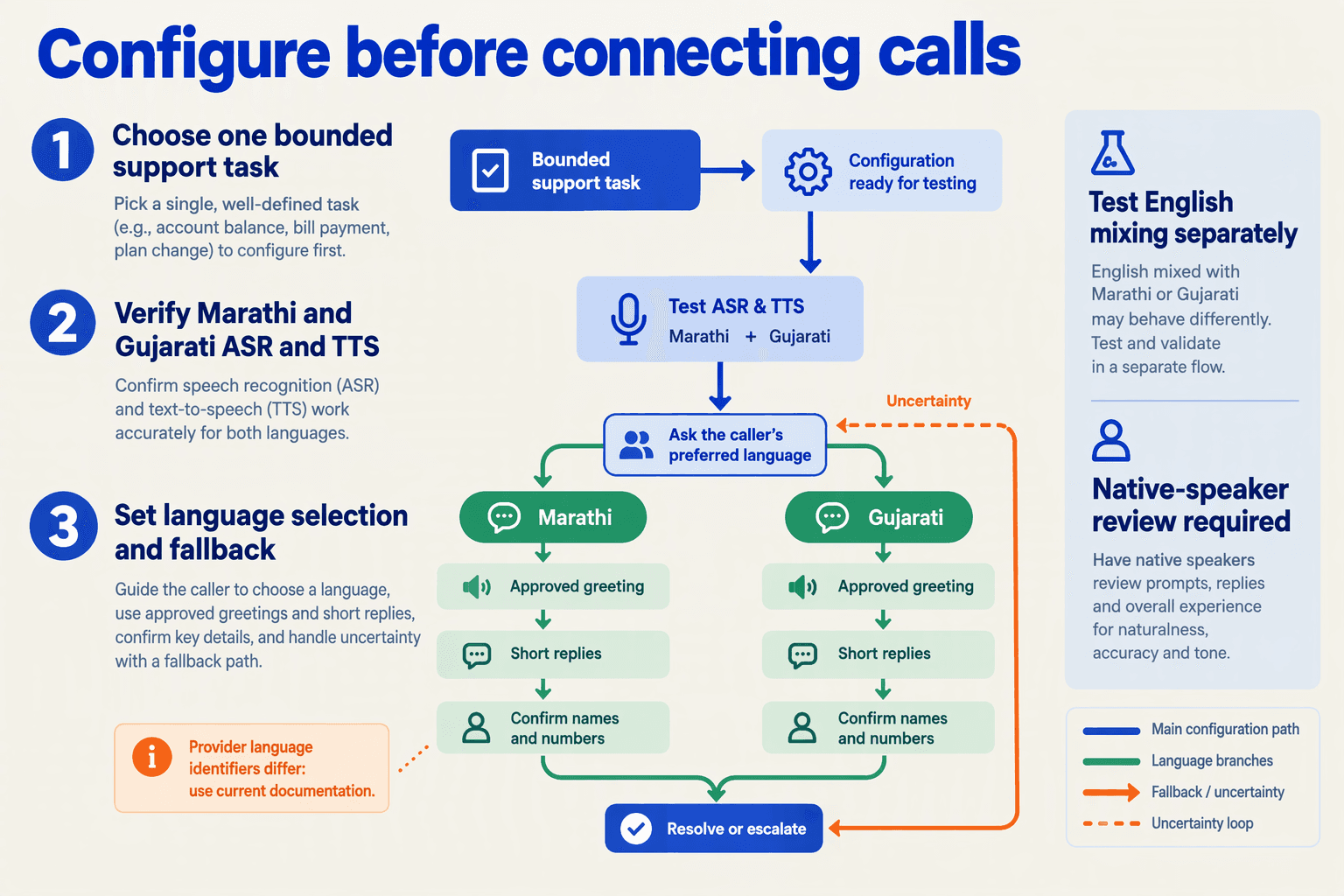
Configure Marathi and Gujarati as separate, tested language paths, then connect both to the same task-driven call flow. Use an explicit language choice when detection is uncertain, maintain the caller’s selected language, and define recovery steps before enabling actions such as booking appointments.
Step 1: How do I configure Marathi and Gujarati language selection?
Create a configuration record for each language containing the recognition provider, provider-specific language identifier, selected voice, greeting, and fallback behavior. Do not assume one language code works across every component. As of November 2026, Bolna’s Marathi documentation specifies mr; that identifier should not be copied into another provider’s configuration without checking its documentation.
Choose one of two entry patterns:
- Explicit selection: Offer a short bilingual greeting and ask callers to choose Marathi or Gujarati, with keypad selection if your calling stack supports it.
- Automatic detection with confirmation: Detect the opening utterance, then confirm the language when the result is ambiguous.
For the Pune–Ahmedabad appointment bot, store preferred_language separately from branch. A Gujarati-speaking caller may want the Pune location; language must not silently determine geography.
Once selected, preserve the language across follow-up questions. Treat English words such as “appointment” or an English-spoken booking reference as possible code-mixing, not an automatic request to switch languages.
Step 2: How do I write prompts and greetings for both languages?
Use one shared policy prompt for business rules and separate Marathi and Gujarati instructions for conversational delivery. Have fluent speakers review greetings, branch names, service terminology, and confirmation messages before launch.
A practical prompt structure is:
- Role: Identify the business and explain that the caller is speaking with an automated assistant.
- Language policy: Reply in
preferred_language; change it when the caller explicitly requests another supported language. - Task policy: Collect service, branch, preferred date, and contact details before checking availability.
- Accuracy policy: Never invent availability, prices, or booking confirmations.
- Confirmation policy: Repeat consequential details and obtain approval before submitting an action.
Keep greetings short enough to invite a response. Instead of listing every service, identify the business, offer language selection if needed, and ask what the caller wants to do.
Maintain a pronunciation checklist for clinician names, Ahmedabad and Pune locations, dates, and alphanumeric references. As of November 2026, Sarvam AI’s voice-agent documentation lists Marathi and Gujarati alongside 8 kHz telephony-optimized output; use the actual telephone connection—not only a browser preview—to evaluate spoken confirmations.
Step 3: How do I build a reliable bilingual call flow?
Build the workflow around explicit states: greet → select language → identify intent → collect details → check availability → confirm → submit → close. Attach a recovery route to every state rather than relying on the model to improvise.
For example:
- Unclear date: Ask a narrower question and repeat the interpreted date.
- Unavailable slot: Offer alternatives returned by the scheduling tool.
- Tool timeout: Explain that availability could not be checked; do not claim a booking succeeded.
- Repeated misunderstanding: Offer human assistance where configured.
- Submission failure: Preserve collected details for follow-up without presenting them as a confirmed appointment.
As of November 2026, CallMissed’s no-code builder includes language settings, custom REST tools, keypad menus, and a visual call-flow designer. These capabilities let teams connect language-specific conversations to explicit business workflows.
Before proceeding, run one complete booking journey in each language and verify that the spoken confirmation matches the tool’s actual result.
Steps 4–6: How do I connect a number, test calls, and publish safely?
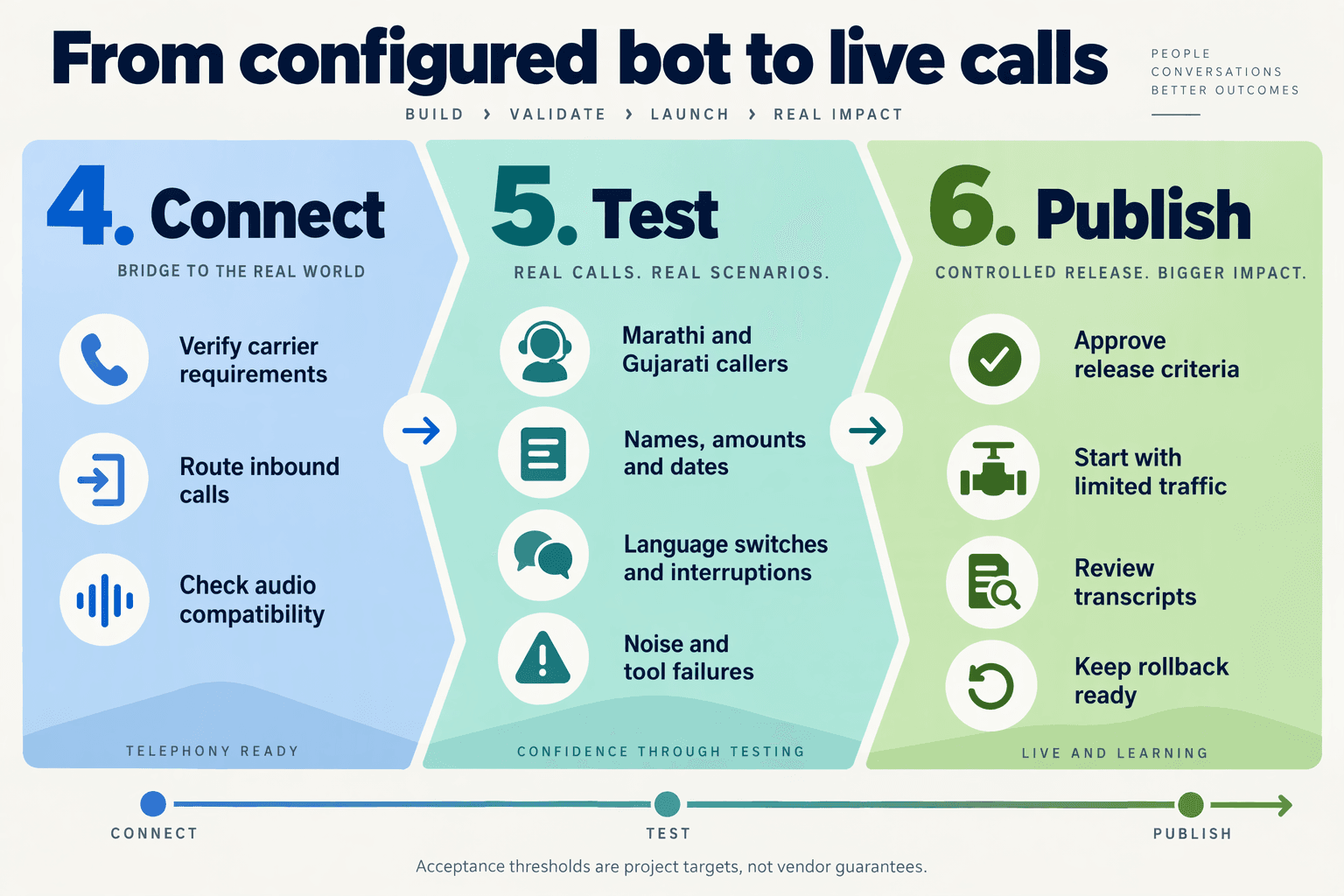
Connect your configured Marathi–Gujarati agent to a test phone number, validate complete calls over the actual telephone connection, and publish only after it passes predefined checks. A successful browser demo is not a launch approval: callers must be able to finish tasks accurately, recover from misunderstandings, and reach an escalation path.
Step 4: How do I connect a phone number to my voice bot?
Choose between a rented number and your existing carrier connection. Before routing customer traffic, confirm number availability, inbound routing, audio requirements, and carrier charges with your providers.
As of November 2026, CallMissed supports inbound calls on rented numbers or through a connected carrier, including Twilio, Plivo, or any SIP trunk, according to its verified product fact sheet; phone carriage is billed separately.
Use this connection checklist:
- Create a test route: direct a test number to the configured agent without replacing your production support line.
- Verify the greeting: call from an ordinary mobile phone and check that the intended language and business identity are audible.
- Check audio end to end: listen for clipped opening words, distortion, silence, and speech that becomes unclear over the phone.
- Exercise the fallback: confirm what happens when the agent cannot understand or complete a request.
As of November 2026, Sarvam AI’s voice-agent text-to-speech documentation specifies 8 kHz telephony-optimized audio and lists Marathi and Gujarati. Check your chosen model’s output against the carrier’s required sample rate and codec; language support alone does not establish connection compatibility.
Step 5: How do I test Marathi and Gujarati calls before launch?
Test task outcomes, not just fluent conversation. Use native-speaking reviewers for each language and record whether the bot understood the request, used the correct tool, and confirmed the result accurately.
For the Pune–Ahmedabad appointment example, build a repeatable test set covering:
- Marathi and Gujarati separately: book, reschedule, and cancel an appointment in each language.
- Mixed-language details: speak a regional-language request containing an English branch name or order identifier.
- Corrections and interruptions: change the requested date while the bot is speaking.
- Telephone conditions: repeat scenarios with background noise and a weak connection.
- Failure handling: simulate unavailable appointment slots, tool errors, and an unclear caller response.
An illustrative starter set is 24 calls: 12 per language, comprising two runs of six scenarios. This is a proposed testing plan, not an industry benchmark or proof of production reliability.
Track task completion, incorrect bookings, language mismatches, and successful escalation separately. A bot that confirms the wrong Ahmedabad branch should fail that test even if its Gujarati sounds natural.
Step 6: How do I publish the voice bot safely?
Publish a reviewed version, expose it to limited traffic first, and keep a tested rollback path. Define stop conditions before launch—for example, an incorrect booking, repeated tool failures, or an escalation route that does not work.
As of November 2026, CallMissed’s verified product fact sheet lists versioning with publish and rollback, call recordings, transcripts, call scoring against custom QA rubrics, and eval suites.
Use those capabilities to:
- Preserve the last working configuration before making changes.
- Review early calls separately for Marathi and Gujarati.
- Compare transcripts with actual booking records, not summaries alone.
- Fix recurring failures and rerun the same tests before expanding traffic.
Launch readiness means verified outcomes on real calls—not merely a published agent.
How much does a Marathi–Gujarati voice bot cost?
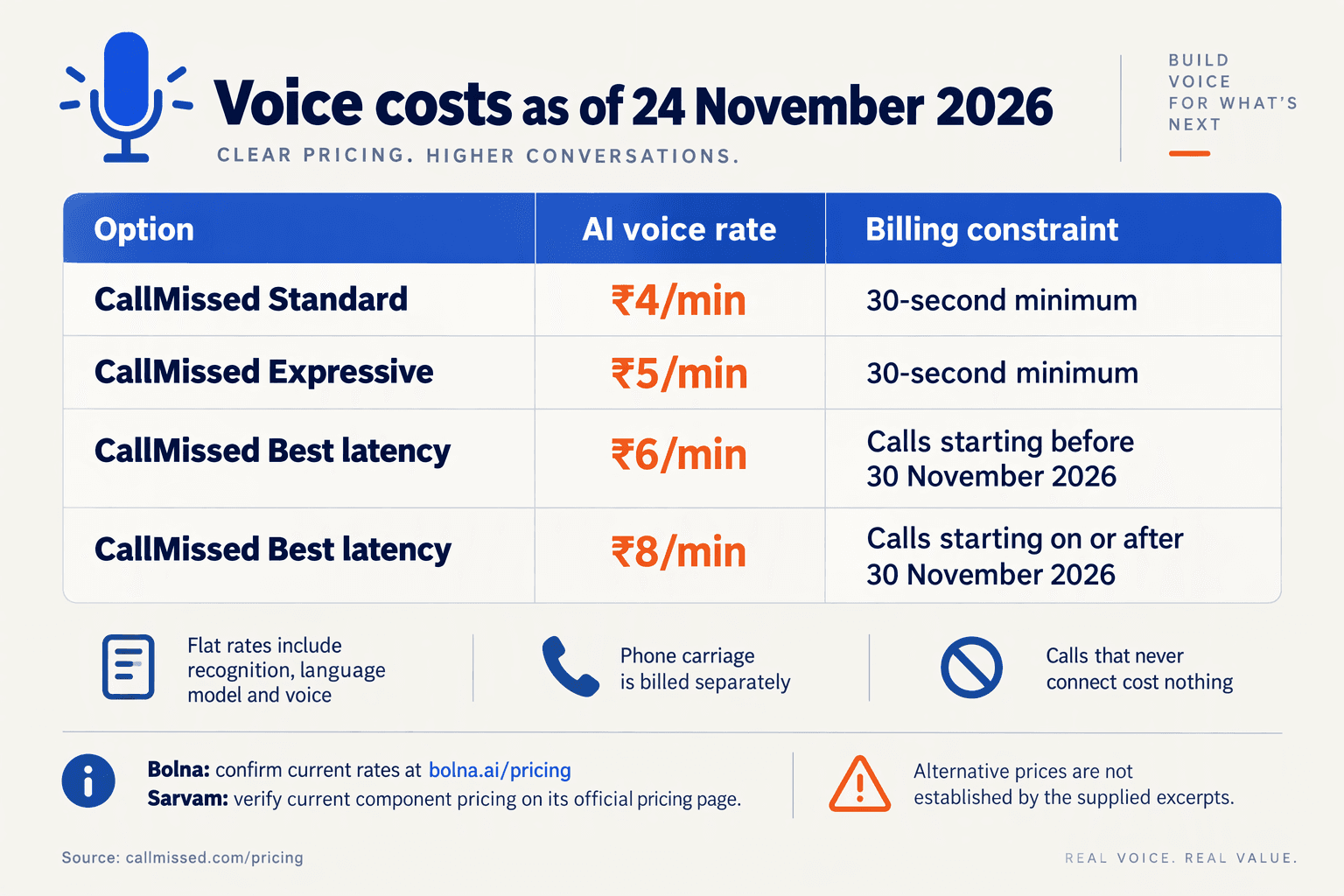
A Marathi–Gujarati voice bot’s cost depends on connected call duration, voice configuration, and telephone carriage, rather than language coverage alone. According to CallMissed’s verified pricing facts, as of November 24, 2026, flat voice-agent rates start at ₹4 per minute, including speech recognition, the language model, and voice generation; phone carriage is billed separately.
What should you include in a voice-bot cost comparison?
Compare the complete operating cost—not just a speech-to-text or text-to-speech API price. The following rates are current as of November 24, 2026, with the announced November 30 change shown separately.
| Configuration or cost | Rate | What it covers | Budgeting caveat |
|---|---|---|---|
| Standard voice plan | ₹4/min | Recognition, language model, natural Indian-language voices | 30-second minimum per call |
| Expressive voice plan | ₹5/min | Recognition, language model, richer expressive voices | 30-second minimum per call |
| Best latency, before November 30 | ₹6/min | Recognition, language model, fastest-reply voice option | Applies to calls starting before November 30, 2026 |
| Best latency, from November 30 | ₹8/min | Same plan, revised rate | Applies to calls starting on or after November 30, 2026 |
| Custom voice stack | Component charges + ₹1/min platform fee | Separately selected recognition, model, and voice | Components billed per second; platform fee has a 30-second minimum |
| Telephone carriage | Separately billed | Phone connection through rented numbers or your carrier | Obtain the applicable carrier charges |
Flat plans do not incur the additional ₹1-per-minute custom-stack platform fee. A call that never connects costs nothing under the flat voice plans. For a custom stack, component billing has no minimum, but the separately itemized platform fee does.
What would 1,000 Marathi and Gujarati calls cost?
For an illustrative November 2026 budget, assume 1,000 connected calls averaging three minutes each: that produces 3,000 connected minutes. This is a planning scenario, not a measured customer benchmark.
The voice-agent usage calculation is:
- Standard: 3,000 × ₹4 = ₹12,000.
- Expressive: 3,000 × ₹5 = ₹15,000.
- Best latency at the pre-November 30 rate: 3,000 × ₹6 = ₹18,000.
- Best latency for calls starting from November 30: 3,000 × ₹8 = ₹24,000.
These totals exclude telephone carriage and any other separately applicable charges. If your deployment spans November 30, split Best latency usage by call start date rather than applying one rate to the entire month.
Short calls also need attention: under the November 2026 Standard rate, a connected ten-second call costs ₹2 because the 30-second minimum applies. An average-duration forecast can therefore understate spending when many connected calls end quickly.
How do you choose the most economical configuration?
Use cost per successfully completed task, not cost per minute alone. A cheaper conversation that repeatedly fails to confirm an appointment may consume more minutes and create more manual follow-up.
Before committing to a monthly budget:
- Run a representative pilot covering Marathi and Gujarati calls, including short and unsuccessful conversations.
- Measure connected minutes and task completion separately for each language and configuration.
- Add carrier charges and model a realistic mix of short calls, longer conversations, and escalation.
Choose the least expensive configuration that passes your language and task-quality checks—not simply the lowest advertised rate.
How do I test accents, code-switching, and pronunciation before launch?
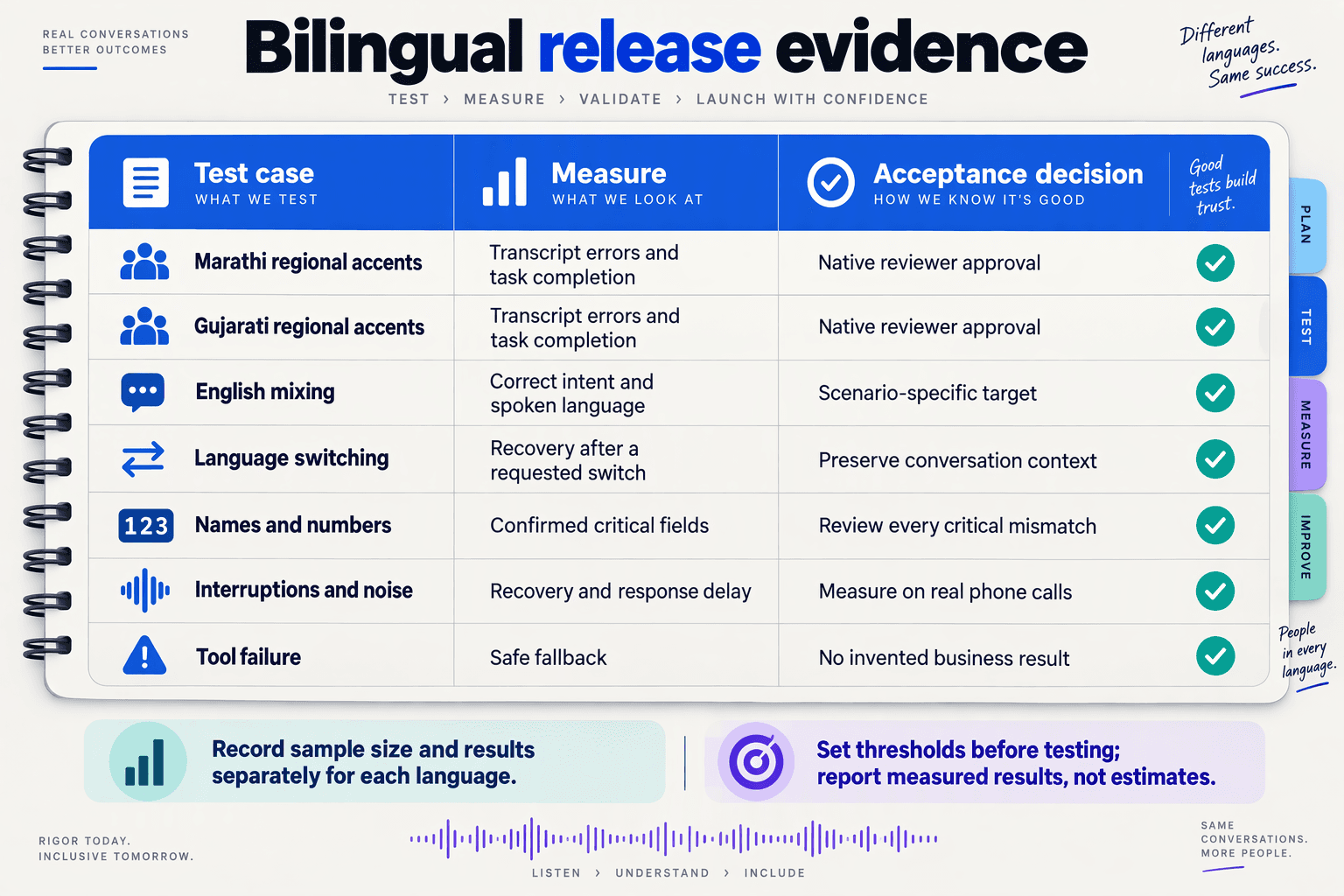
Test your Marathi and Gujarati voice bot with native-speaker recordings, mixed-language conversations, and real calls through your deployment channel. Score recognition, spoken pronunciation, and completed tasks separately: a convincing voice can still repeat the wrong date or submit an incorrect booking.
What should a Marathi and Gujarati voice-bot test set include?
Build a consented test set that reflects your actual callers—not just employees reading a translated script. Include speakers from the regions you serve, different speaking speeds, and both quiet and noisy environments.
Use the following recommended pre-launch test matrix, not a vendor benchmark:
| Test area | Example input | What to inspect | Suggested launch gate |
|---|---|---|---|
| Regional accents | Same booking request from different Marathi and Gujarati speakers | Intent, branch, date, and time extraction | No unresolved accent-related critical errors |
| Code-switching | Marathi or Gujarati request containing “appointment,” “reschedule,” or an English order ID | Language continuity and preserved identifiers | Correct task without unnecessary language resets |
| Names and places | Customer names, Pune branches, Ahmedabad addresses | Transcript accuracy and spoken confirmation | Native reviewer understands each critical name |
| Numbers and dates | Phone numbers, amounts, “tomorrow,” and corrected appointment times | Digit order, date interpretation, tool payload | Every critical value confirmed before submission |
| Interruptions and corrections | Caller changes the branch while the bot speaks | Whether the new value replaces the old one | No action using superseded details |
| Noise and unclear speech | Traffic noise, weak audio, or an ambiguous surname | Clarification rather than guessing | Safe retry or escalation; no invented details |
For an initial pilot, 30 scenarios per language with three speaker recordings each creates 180 test conversations. This is a suggested starting workload, not evidence of production readiness; expand it whenever testing reveals a new failure pattern.
How should native speakers score pronunciation and code-switching?
Ask Marathi and Gujarati reviewers to judge intelligibility and meaning, not whether the voice sounds impressive. Give reviewers the intended answer and identify words that must remain unambiguous: branch names, medication names where relevant, prices, dates, and reference numbers.
As of November 2026, Sarvam AI’s voice-agent text-to-speech page claims support for Hinglish and correct pronunciation of Indian names. Those claims are useful test prompts, but they do not establish that your particular Marathi-English or Gujarati-English conversations will work correctly.
Record three separate outcomes:
- Recognition: Did the transcript preserve what the caller meant?
- Pronunciation: Could a native listener understand the spoken response without seeing its text?
- Task correctness: Did the booking or lookup use the right values?
Calculate critical-field accuracy as correctly captured required fields divided by all required fields tested. Report results separately for Marathi, Gujarati, and code-switched calls; a combined average can hide a weak language configuration.
How do I turn test failures into a launch decision?
For each failure, save the audio, transcript, expected response, actual response, and tool result. Determine whether the problem belongs to speech recognition, prompting, knowledge retrieval, tool execution, or voice generation before changing the configuration.
As of November 2026, CallMissed’s verified feature set includes call recordings, transcripts, scoring against custom QA rubrics, eval suites, and A/B experiments. These capabilities can support a repeatable review process rather than subjective spot-checking.
Rerun the same failing cases after each change, alongside previously passing cases. Block launch for unresolved errors that trigger incorrect actions; accept minor pronunciation imperfections only when native reviewers confirm that meaning remains clear.
Which deployment mistakes cause Marathi and Gujarati calls to fail?
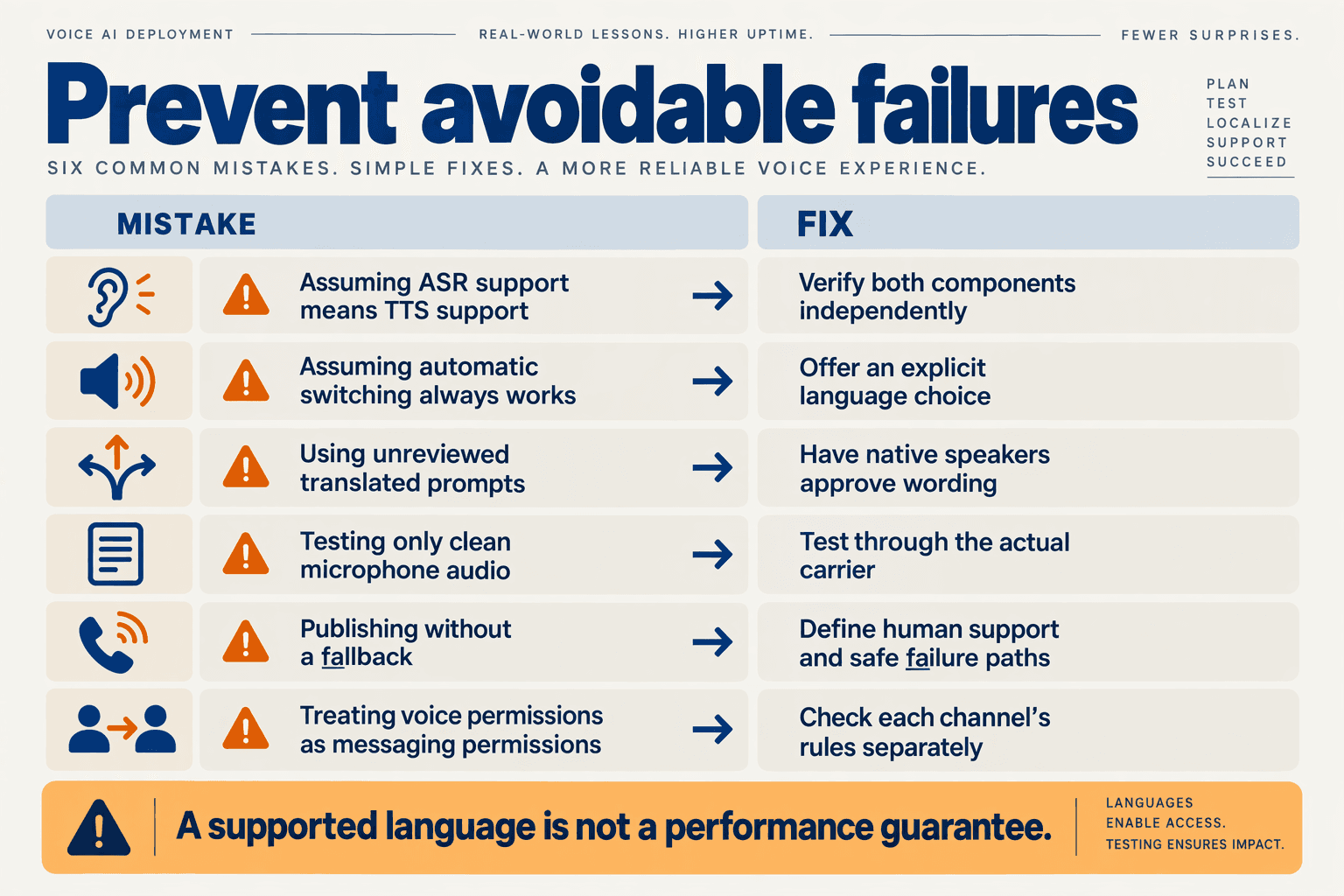
Marathi and Gujarati voice-bot calls fail when deployment settings break the path from caller speech to a confirmed business action. The highest-risk mistakes include incompatible audio, incorrect provider parameters, unchecked names and numbers, unsafe tool retries, and configuration changes released without regression testing.
Use the following checklist before exposing your agent to customer calls. A successful browser demo is not proof that the same configuration works over your production phone connection.
Which configuration mistakes should you check before launch?
| Deployment mistake | What fails on the call | Prevention | Release check |
|---|---|---|---|
| Reusing language identifiers across providers | A component rejects the setting or uses an unintended language. | Map language parameters separately for recognition and voice generation. | Inspect the actual request sent to each provider. |
| Assuming audio compatibility | Speech becomes distorted, silent, or difficult to recognize. | Match sample rate, encoding, and channel requirements across the carrier and voice pipeline. | Test both directions through the production number. |
| Treating names and numbers as ordinary prose | A fluent response repeats the wrong branch, date, amount, or reference number. | Require explicit read-back of action-critical fields. | Use locally relevant names and digit sequences in both languages. |
| Letting interruptions leave stale state | The bot acts on an earlier instruction after the caller corrects it. | Replace superseded fields and reconfirm changed details. | Interrupt a booking confirmation with a different date or branch. |
| Retrying business actions blindly | A timeout can trigger duplicate bookings or other repeated actions. | Use idempotency where supported; check action status before retrying. | Simulate a timeout after the backend accepts the request. |
| Changing prompts or voices without regression tests | A previously working journey fails after an apparently minor edit. | Version configurations and rerun the same Marathi and Gujarati scenarios. | Compare task outcomes and retain a rollback path. |
As of November 2026, Bolna’s Marathi documentation specifies mr as its Marathi language code, while Sarvam AI’s supplied text-to-speech example uses hi-IN for Hindi. These examples illustrate why identifiers must come from each provider’s documentation, not from a universal language-code assumption.
As of November 2026, Sarvam AI describes its voice-agent audio as “8kHz Telephony-optimized.” That specification is a compatibility checkpoint—not permission to skip checking the rest of your audio pipeline.
How can fluent Marathi or Gujarati still produce a failed call?
Language quality and transaction accuracy are separate acceptance criteria. An appointment bot can sound natural while saving the wrong date.
For example, a caller initially requests Ahmedabad, then interrupts to change the appointment to Pune. The deployment should:
- Replace the stored branch rather than merely acknowledge the correction.
- Check availability for the revised branch.
- Read back the branch and date before submitting the booking.
If the booking request times out, the bot should not announce success without evidence or automatically submit a second booking. This is a backend reliability problem that better pronunciation cannot solve.
What should block a production release?
Define release blockers around incorrect actions, not just awkward phrasing:
- An unconfirmed change to a critical field.
- A duplicate action after a timeout.
- A correction that never reaches the backend.
- An unresolved failure with no usable escalation route.
As of November 2026, CallMissed provides agent versioning with publish and rollback, eval suites, and call scoring against custom QA rubrics. These capabilities support a disciplined release process: retain representative Marathi and Gujarati calls, test each configuration change, and roll back when task accuracy deteriorates.
Which official resources should I check before going live?
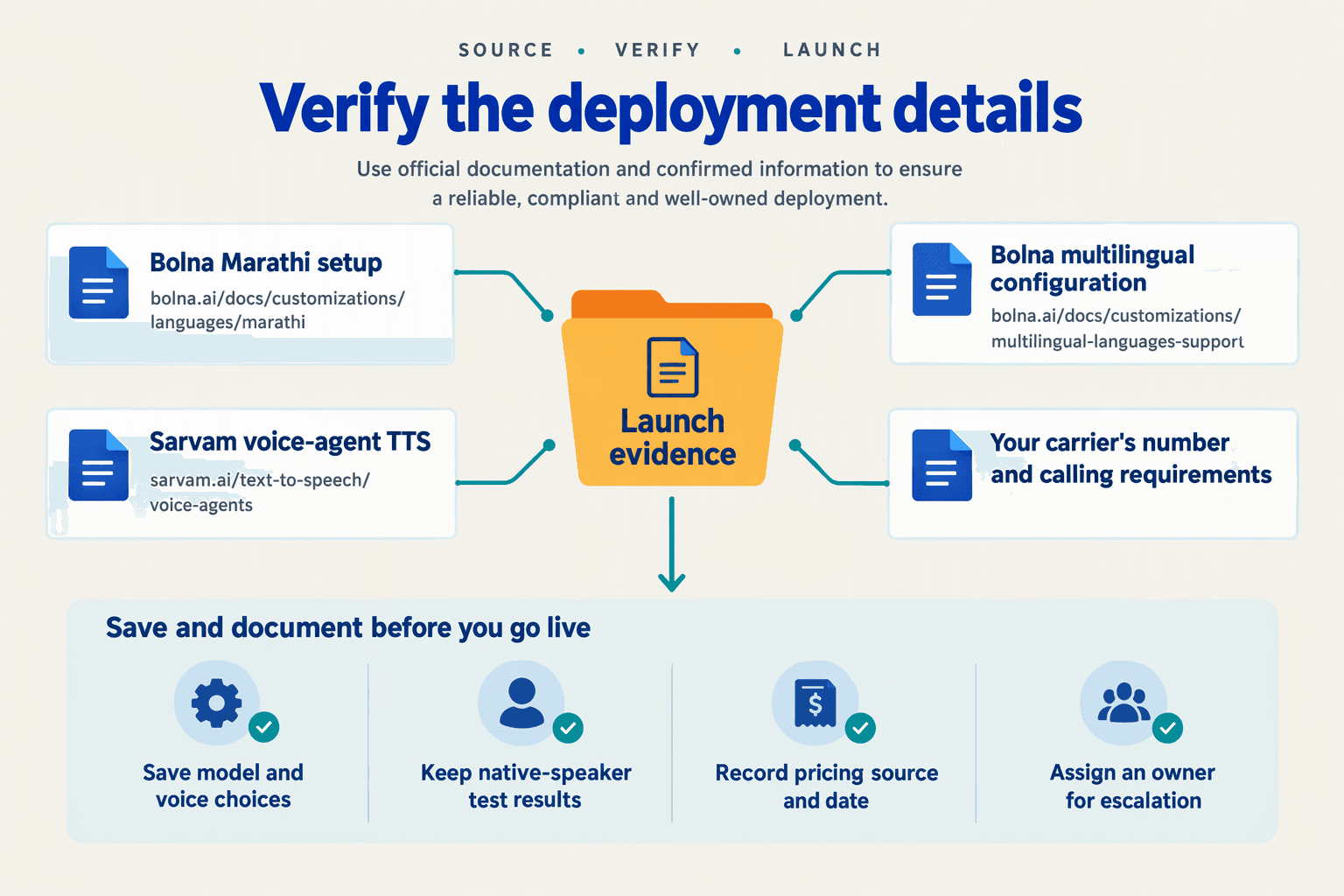
Before going live, check official language documentation, speech-provider specifications, your calling provider’s integration requirements, and the rules governing your chosen channel. For a Marathi and Gujarati voice bot, save the exact configuration references—not just a vendor’s claim that its platform is multilingual.
Which official language resources should I trust?
Start with the documentation for the platform and speech models you will actually deploy. Third-party comparisons can help you discover providers, but they should not determine production settings.
Two resources from the supplied research are particularly useful:
- Bolna’s “Build a Marathi voice agent” documentation: As of November 2026, Bolna specifies
mras its Marathi language code and identifies Marathi as supported for automatic detection mid-call. Use that page alongside Bolna’s multilingual configuration documentation; do not assume the Marathi instructions establish Gujarati behavior. - Sarvam AI’s “Text to Speech for Voice Agents & IVR” page: As of November 2026, Sarvam AI lists Marathi and Gujarati and advertises 8 kHz telephony-optimized audio. Treat this as a product specification to cross-check against the API reference for your selected model, voice, and output format.
Language codes are implementation-specific. Copy the value required by the particular API field rather than translating a code from another provider’s example.
For Gujarati, obtain an explicit official reference covering the component you are configuring. If a page confirms spoken output but says nothing about recognition or language switching, record those as separate verification tasks.
Which API and telephony documents should I review?
Review the documentation that connects your tested conversation to a real call. A successful browser demo does not establish that your carrier and speech stack exchange compatible audio.
Use this numbered pre-launch checklist:
- Model API reference: Confirm authentication, required parameters, supported languages, streaming behavior, and error responses.
- Audio specification: Match sample rate, encoding, and channel requirements across the speech service and calling connection. An advertised sample rate alone is not a complete compatibility specification.
- Carrier or SIP documentation: Check number provisioning, inbound routing, credentials, and the settings required by your selected integration.
- Webhook and tool documentation: Confirm how your application receives events, authenticates requests, and handles failed booking or CRM operations.
- Release notes and pricing: Check for model changes, deprecated parameters, and charges that your test environment might not expose.
As of November 2026, CallMissed offers voice-agent versioning with publish and rollback, custom REST tools, and carrier connections through Twilio, Plivo, or any SIP trunk. For a deployment using those capabilities, consult CallMissed’s official documentation together with the connected carrier’s documentation, and record which published agent version passed acceptance testing.
Which policy resources belong in the launch checklist?
Consult official channel policies and applicable government or regulator guidance before enabling customer traffic. For phone calls, verify the requirements relevant to your use case, including outbound contact, recordings, and personal-data handling; for WhatsApp, consult Meta’s official WhatsApp Business documentation.
Keep a compact launch evidence register containing:
- The official resource title and date checked.
- The model, voice, language setting, and agent version tested.
- The requirement the resource confirms.
- Any unresolved question and the person responsible for resolving it.
For the Pune-and-Ahmedabad booking example, this register should connect documented settings to the actual tested deployment. Documentation establishes supported configuration; acceptance tests establish whether that configuration completes your customers’ tasks. Both are needed before launch.
Frequently Asked Questions
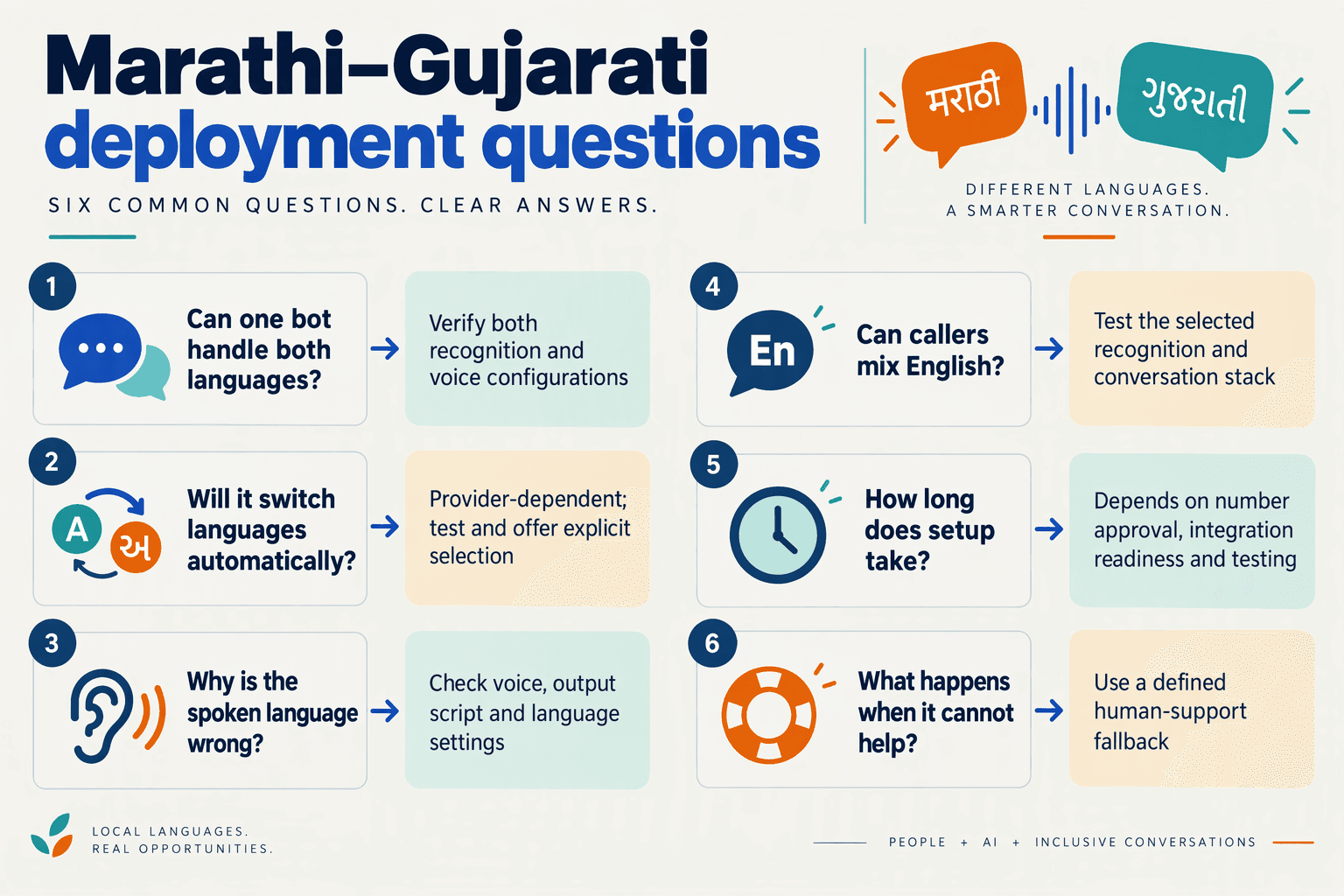
How do I deploy a voice bot that handles Marathi and Gujarati in one agent?
Can a Marathi and Gujarati voice bot switch languages mid-call automatically?
Can a voice bot understand Marathi or Gujarati mixed with English in the same sentence?
How should a Marathi and Gujarati voice bot recover when it misunderstands a caller?
How do I prevent a multilingual voice bot from booking the wrong appointment or changing incorrect customer details?
How do I deploy a voice bot that handles Marathi and Gujarati with predictable calling costs?
Conclusion
To deploy a multilingual voice bot that handles Marathi and Gujarati, verify speech recognition, conversational accuracy, and spoken output separately, then connect the tested configuration to your calling channel. The real deployment milestone is not a fluent greeting—it is a caller completing the right task, in the right language, with clear confirmation and a safe escalation path.
Four takeaways should guide your launch:
- Validate both languages across the full stack. Test Marathi and Gujarati independently rather than assuming that one provider’s multilingual label guarantees identical coverage. As of November 2026, Sarvam AI’s voice-agent text-to-speech documentation lists Marathi and Gujarati alongside 8 kHz telephony-optimized audio; those specifications help establish voice-output compatibility, but they do not replace end-to-end testing.
- Configure conversations around actual business tasks. Prepare language-specific prompts, greetings, terminology, and confirmation steps. Connect the knowledge base and required tools so an appointment-booking agent can check availability, select the correct branch, and repeat the final booking details—not merely produce a plausible answer.
- Test how customers really speak. Include English order numbers inside Gujarati sentences, Marathi names, unclear audio, interruptions, and changes of language. As of November 2026, Bolna’s Marathi documentation specifies
mrand supports automatic Marathi detection mid-call; verify Gujarati behavior separately rather than extending that documented capability by assumption.
- Launch with review and escalation built in. Define what happens when recognition fails, information is unavailable, or a requested action cannot be completed safely. Review transcripts for recurring errors, adjust the configuration, and repeat the same task-based tests before expanding the deployment.
What should you watch for as multilingual voice AI evolves?
Watch for improvements that make mixed-language conversations more dependable: clearer pronunciation of local names, better handling of interruptions, and more consistent recognition of dates and numbers. Evaluate those improvements against your own Marathi and Gujarati test calls, not just demonstrations or advertised language counts.
For the Pune-and-Ahmedabad booking example, the useful comparison remains concrete: did the agent understand the date, choose the correct location, check availability, and confirm the booking clearly? Keep those acceptance criteria consistent as you update prompts, voices, or providers.
As of November 2026, CallMissed offers a no-code voice-agent builder with language settings, knowledge bases, custom REST tools, call transcripts, and evaluation suites. Readers can explore CallMissed as a platform for bringing these deployment components together while continuing to validate the chosen Marathi and Gujarati configuration.
Start with a focused pilot, review the failures, and expand only when callers can reliably complete their tasks. Can your bot correctly confirm a real customer’s booking in both languages—not just sound convincing?
Related Reading
- WhatsApp Appointment Reminders: Multilingual Voice Guide
- Multilingual customer support bot: India build guide
- COD confirmation voice bot script: WhatsApp and ROI