Claude Fable 5.1 Features: What’s New, Pricing and Upgrade Guide



Compare Claude Fable 5.1 features, benchmarks, pricing, safeguards, platforms and upgrade fit using verified Anthropic launch details.
Claude Fable 5.1 Features: What’s New, Pricing and Upgrade Guide
What if Anthropic’s newest “general use” model were built from the same underlying model as its highest-capability research release—but with additional safeguards for cybersecurity and biology? Claude Fable 5.1, announced on September 1, 2026, is Anthropic’s new model for demanding coding, deep knowledge work, incident investigation and long-running AI agents.
Why Claude Fable 5.1 matters now
Anthropic describes Claude Fable 5.1 as a “Mythos-level model” designed for ambitious, long-horizon projects. According to Anthropic’s September 2026 announcement, Claude Fable 5.1 is the same underlying model as Claude Mythos 5.1, differentiated by safeguards that restrict certain high-risk biological and cybersecurity tasks. That makes the release particularly relevant to enterprises that want advanced reasoning while retaining controls appropriate for broader production use.
The launch also arrives only two months after Claude Opus 5 in July 2026 and three months after Claude Sonnet 5 in June 2026, according to Anthropic’s model-system-card timeline. This rapid cadence means developers and AI buyers must evaluate more than headline benchmark scores: model selection now depends on sustained task performance, security controls, workload economics and compatibility with existing infrastructure.
Anthropic’s Claude Platform documentation recommends Claude Fable 5.1 for “demanding reasoning and long-horizon agentic work,” particularly when evaluations using Claude Opus 5 at higher effort still fall short. Anthropic also says Claude Fable 5.1 is a leading model in its internal incident-investigation evaluations, which use real production incidents to test the effectiveness of its agent, Bits. These claims are promising, but buyers should distinguish Anthropic’s first-party evaluations from independently reproduced Claude Fable 5.1 benchmarks.
What this launch guide covers
This guide examines what’s new in Claude Fable 5.1 without treating every model-launch claim as proof of universal superiority. You will learn:
- The official release date, API model identifier—
claude-fable-5-1—and documented availability - The most important Claude Fable 5.1 features and behavioral changes from Fable 5
- Where Claude Fable 5.1 coding capabilities may benefit multi-step, codebase-wide work
- Pricing, cache economics and the practical cost of upgrading production workloads
- Supported access routes, ideal use cases, safeguards and operational limitations
- A decision framework for developers and enterprise AI teams considering migration
For teams using multi-model infrastructure, OpenAI-compatible gateways such as CallMissed reflect the broader shift toward testing advanced models behind one integration rather than hard-wiring applications to a single provider.
The central question is not whether Claude Fable 5.1 is newer. It is whether its long-horizon reasoning, root-cause focus and guarded high-capability architecture produce measurable improvements on your own workloads—at a price, latency profile and risk level your production environment can support.
What’s new in Claude Fable 5.1?
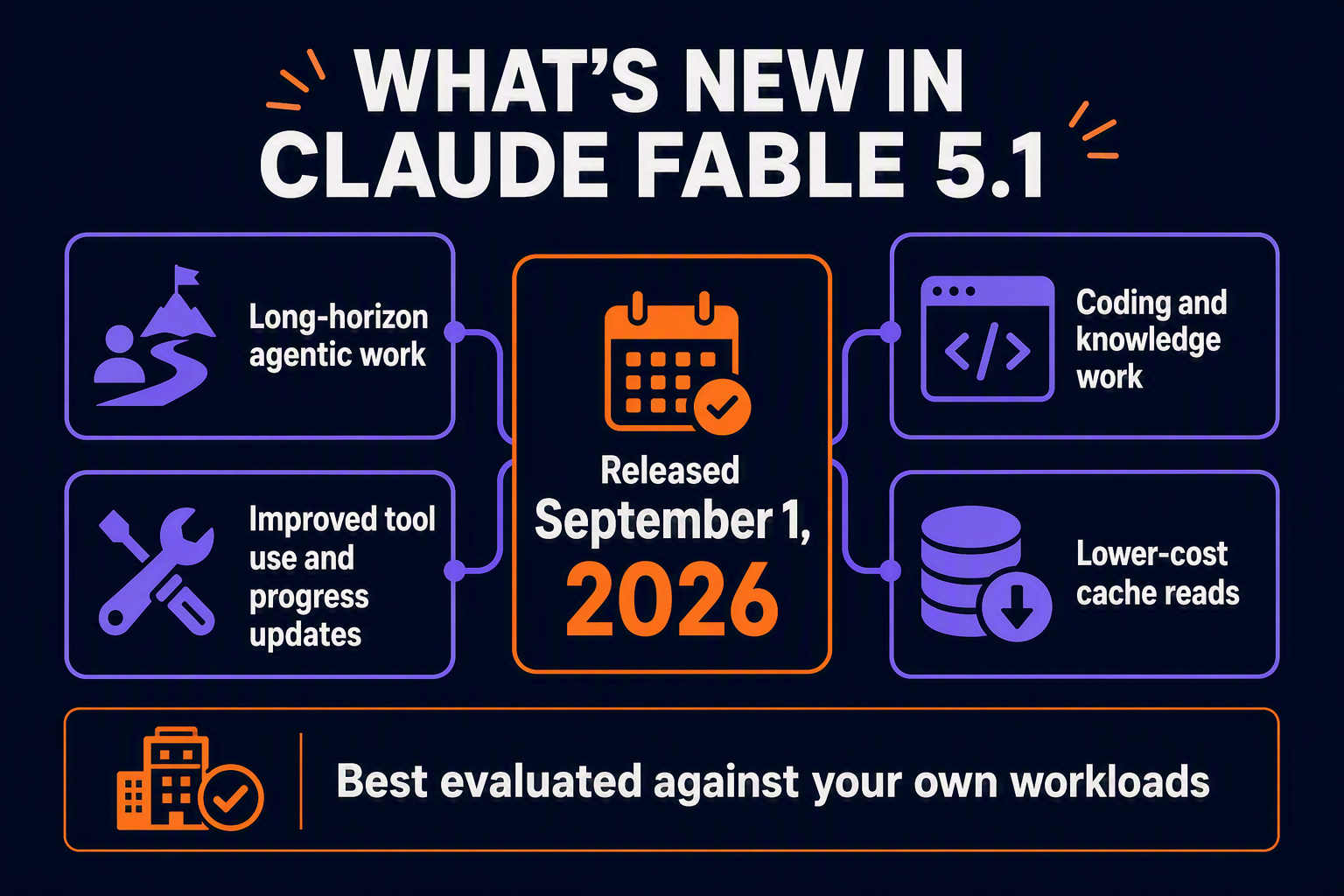
Anthropic released Claude Fable 5.1 on September 1, 2026, with general availability rather than the invite-only access used for Claude Mythos 5.1. The two releases use the same underlying model, but Fable 5.1 has different access policies and additional safeguards intended for broader deployment.
The headline Claude Fable 5.1 features are stronger long-horizon agentic performance, improved coding and knowledge work, a documented context window of up to 1 million tokens in supported configurations, and usage-based API pricing starting at $10 per million input tokens.
From quick fixes to sustained agentic work
Anthropic positions Fable 5.1 for complex projects that require a model to preserve goals, constraints and evidence across many steps. Its release materials say the model “avoids easy-seeming shortcuts, fixes the root causes of problems, and delivers solutions that hold up over time.”
Potential applications include:
- Investigating production failures across logs, services and deployment histories
- Refactoring or migrating code across large, multi-file repositories
- Diagnosing performance regressions instead of suppressing symptoms
- Operating coding agents through extended planning, tool-use and verification loops
- Synthesizing large volumes of technical, legal or operational material
- Maintaining project requirements during long-running knowledge-work tasks
These Claude Fable 5.1 features matter most when incomplete work or a superficial answer would create substantial review costs. Anthropic recommends the model for demanding reasoning and long-horizon agentic tasks, particularly when lower-cost models—or Claude Opus 5 at higher reasoning effort—do not complete representative evaluations reliably.
A practical adoption sequence is:
- Test real tasks on the model already in production.
- Increase reasoning effort where the selected model supports it.
- Escalate difficult failures to Fable 5.1.
- Compare completion quality, tool-use accuracy, human review time and total token cost.
- Require approval before an agent makes consequential production changes.
One-million-token context for large workloads
Anthropic documents a context window of up to 1 million tokens for supported Fable 5.1 use. This can help agents work with large repositories, extensive documentation, incident records or lengthy research collections without splitting every source into isolated requests.
A large context window does not guarantee accurate retrieval or reasoning across every included token. Teams should test whether the model identifies relevant evidence, respects instructions placed throughout the context and avoids relying on outdated or contradictory material.
Fable access and safeguards versus Mythos 5.1
Fable 5.1 shares its underlying model with the research-oriented, invite-only Claude Mythos 5.1. The distinction is therefore not a separate base capability tier. It is primarily the deployment package: Fable provides general availability with different access conditions and additional safeguards, including controls for certain high-risk cybersecurity and biological tasks.
Organizations should still restrict tool permissions, isolate sensitive environments, log agent actions and use human approval for security-sensitive or irreversible operations.
Pricing and prompt-cache reads
Anthropic lists Claude Fable 5.1 API pricing at:
- $10 per million input tokens
- $50 per million output tokens
- $0.25 per million prompt-cache read tokens
The discounted cache-read rate can materially reduce repeated-context costs when an application reuses stable instructions, repository context or reference documents. Actual spending will depend on cache eligibility and hits, context size, generated output and the number of steps in each agent workflow.
Anthropic claims versus independent evidence
Anthropic describes stronger performance in agentic coding, knowledge work and incident investigation, including results from its internal evaluations using real production incidents and Bits, Anthropic’s investigation agent. Those results are first-party evidence and should not be treated as independent validation.
As of September 5, 2026, the launch information supplied here does not establish broadly reproduced third-party results for all Claude Fable 5.1 features. Buyers should validate the model against private repositories, historical incidents, hidden tests and organization-specific review rubrics before upgrading critical workflows.
What did Anthropic officially announce, and where is Fable 5.1 available?
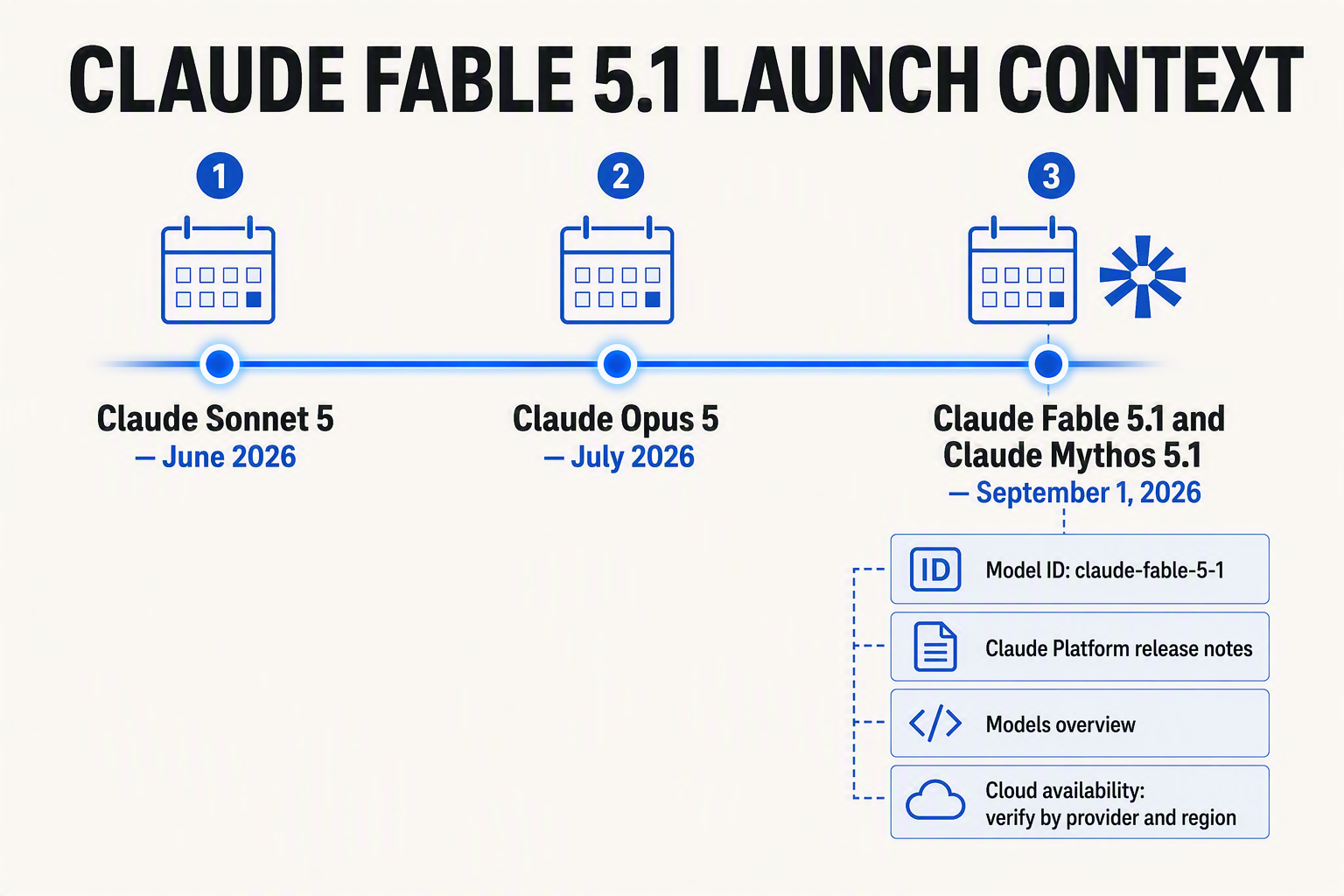
Anthropic officially launched Claude Fable 5.1 and the related Claude Mythos 5.1 on September 1, 2026, describing them as its “most advanced models for coding and knowledge work.” Anthropic confirms that Fable 5.1 is available for general use through the Claude Platform API under the model identifier claude-fable-5-1.
What Anthropic announced
Anthropic positions Claude Fable 5.1 as the successor to Claude Fable 5 for ambitious, long-running coding and knowledge-work projects. The official Claude Fable product page calls Fable 5.1 a “Mythos-level model” that avoids “easy-seeming shortcuts” and focuses on fixing root causes.
Anthropic’s launch materials highlight four capabilities:
- Long-horizon execution: Claude Platform documentation recommends Fable 5.1 for “demanding reasoning and long-horizon agentic work.”
- Complex coding: Anthropic designed the model for projects that require sustained work across codebases rather than isolated code generation.
- Root-cause problem-solving: The product page says Fable 5.1 is intended to address underlying issues instead of producing superficial fixes.
- Incident investigation: Anthropic reports that Claude Fable 5.1 is a leading model in its internal incident-investigation evaluations, which use real production incidents to assess the company’s Bits investigation agent.
These statements are Anthropic’s official product claims, not independent benchmark replications. Developers and enterprise AI buyers should test Fable 5.1 against representative repositories, incident histories, tool-use sequences and acceptance criteria before migrating production workloads.
Confirmed release date, API identifier and status
Anthropic’s Claude Platform release notes document September 1, 2026 as the release date for Claude Fable 5.1 and identify it as the successor to Claude Fable 5. Anthropic’s September 2026 system card separately confirms that Claude Fable 5.1 is available for general use.
The verified implementation details are:
- Model identifier:
claude-fable-5-1 - Documented access route: Anthropic’s Claude Platform
- Release date: September 1, 2026
- Availability status: General use, subject to Anthropic’s policies and safeguards
- Recommended use: Demanding reasoning, long-horizon agentic work and cases where evaluations of Claude Opus 5 at higher effort remain insufficient
Anthropic describes Claude Mythos 5.1 as the same underlying model with a different safeguard posture. Anthropic’s product documentation says Fable 5.1 applies additional safeguards to certain cybersecurity and biological tasks; however, the cited materials do not establish Mythos 5.1’s availability conditions, so teams should not infer access status from the safeguard distinction.
What “generally available” means for buyers
General-use status does not guarantee identical access through every cloud marketplace, Claude interface, geographic region or enterprise agreement. The first-party documentation directly confirms Fable 5.1 through the Claude Platform, while procurement and architecture teams should separately verify:
- Partner-cloud and marketplace listings
- Regional availability and data-processing locations
- Account eligibility, quotas and rate limits
- Data-retention and training policies
- Enterprise contractual and compliance controls
Developers should pin claude-fable-5-1 rather than rely on an ambiguous “latest” alias. A fixed model identifier makes evaluations reproducible and reduces the risk that an unnoticed model change alters coding-agent behavior, compliance results or production outputs. Teams using a multi-model gateway, including an OpenAI-compatible platform such as CallMissed, should also confirm that the exact identifier is listed before routing production traffic.
Which Claude Fable 5.1 features improve on Fable 5?
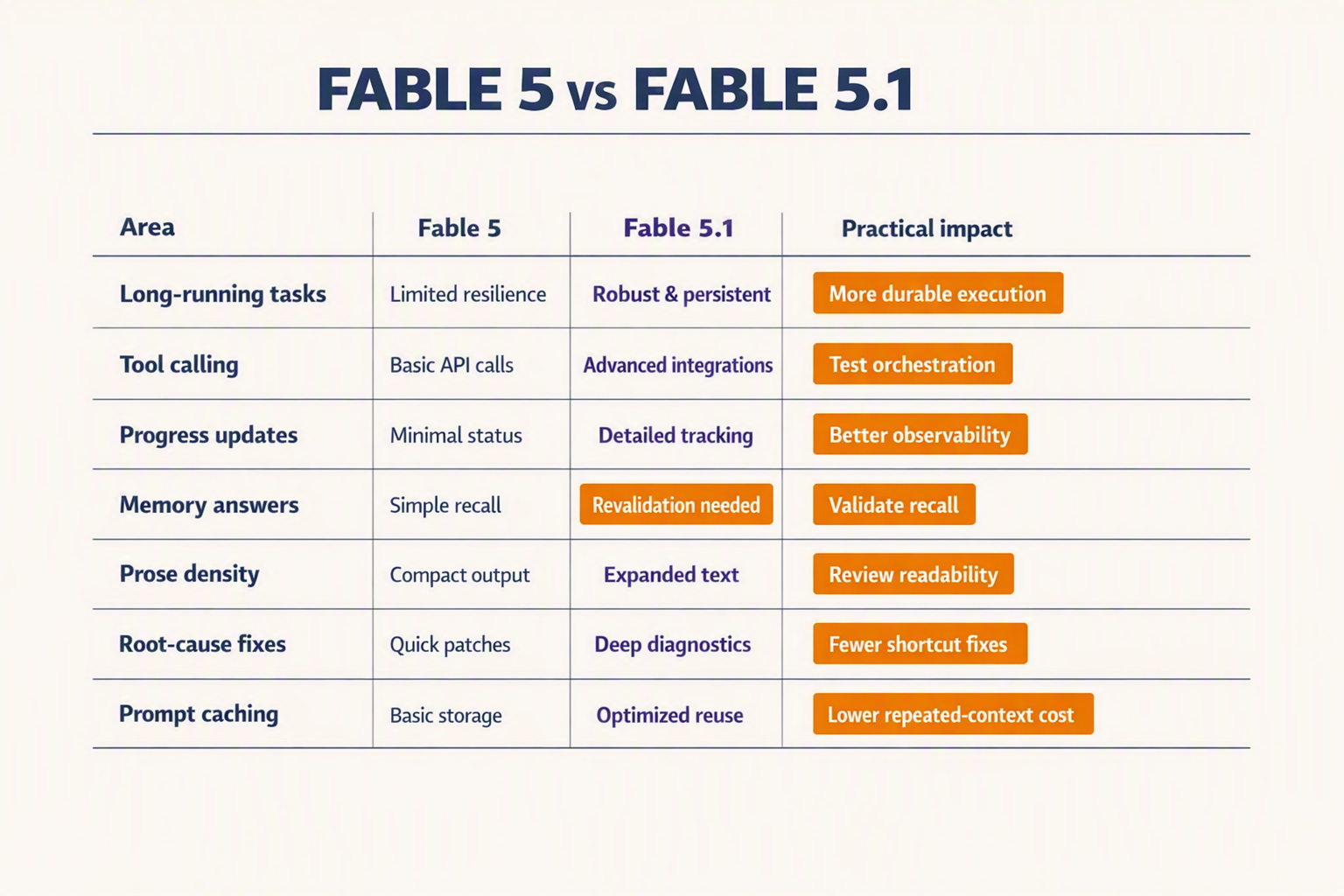
Claude Fable 5.1 improves on Fable 5 primarily through more persistent agentic execution, deeper root-cause reasoning and stronger performance on complex coding and incident-investigation workflows. Anthropic has not published a complete, independently verified set of Fable 5-versus-5.1 percentage gains, so the most defensible comparison focuses on documented behavioral changes rather than unsupported score claims.
Fable 5 versus Fable 5.1 at a glance
| Area | Fable 5.1 improvement | Practical developer impact | Anthropic evidence |
|---|---|---|---|
| Long-running agents | Designed to sustain ambitious, multi-stage projects | Fewer manual interventions during extended coding or research workflows | Claude Platform documentation recommends Fable 5.1 for “long-horizon agentic work” |
| Problem-solving behavior | Avoids solutions that appear easy but do not address the underlying issue | Better fit for debugging architectural defects and correcting systemic failures | Anthropic’s Fable product page says the model “avoids easy-seeming shortcuts” |
| Root-cause analysis | Prioritizes fixing causes rather than symptoms | Can improve incident remediation, code repair and infrastructure analysis | Anthropic says Fable 5.1 “fixes the root causes” of problems |
| Incident investigation | Stronger performance in Anthropic’s internal production-incident evaluations | Useful for investigating logs, repositories, deployments and operational context together | Anthropic calls Fable 5.1 a “leading model” in evaluations involving its Bits agent |
| High-difficulty reasoning | Positioned above Opus 5 for workloads where higher-effort evaluations remain insufficient | Offers an escalation path for exceptionally demanding tasks | Claude Platform documentation recommends it when Claude Opus 5 at higher effort still falls short |
| Safety controls | Uses the Mythos 5.1 underlying model with restrictions for specified high-risk tasks | Gives general enterprise users advanced capabilities with additional cybersecurity and biology safeguards | Anthropic’s September 2026 system card documents Fable 5.1 as available for general use |
The biggest change is sustained problem solving
The central Claude Fable 5.1 feature is not a single tool or larger headline specification. It is the model’s reported ability to remain focused across interconnected steps, examine why a system failed and implement a durable correction.
Anthropic’s September 1, 2026 release notes describe claude-fable-5-1 as the successor to Fable 5 for long-running agentic coding, knowledge work and related complex workloads. That positioning matters for tasks such as:
- Tracing a production incident across source code, logs and deployment configuration
- Refactoring multiple packages while preserving interfaces and tests
- Investigating performance regressions instead of applying local patches
- Maintaining a plan across lengthy research or document-analysis sessions
- Coordinating tool calls where later actions depend on earlier findings
What the available evidence does—and does not—prove
Anthropic’s incident-investigation results are especially relevant because the evaluations use real production incidents and the company’s Bits agent, rather than isolated question-answer tests. However, Anthropic reported these findings in its own September 2026 launch materials; they should be treated as first-party evidence, not independent confirmation of universal performance.
Enterprise buyers should therefore run Fable 5 and Fable 5.1 against the same repositories, tool permissions, prompts and completion criteria. Measure task success, human corrections, regression rates, elapsed workflow time and total token cost. The documented improvements make Fable 5.1 a strong candidate for difficult, long-horizon evaluations, but workload-specific testing remains more informative than a launch claim or aggregate benchmark alone.
How strong are Claude Fable 5.1 benchmarks and coding capabilities?
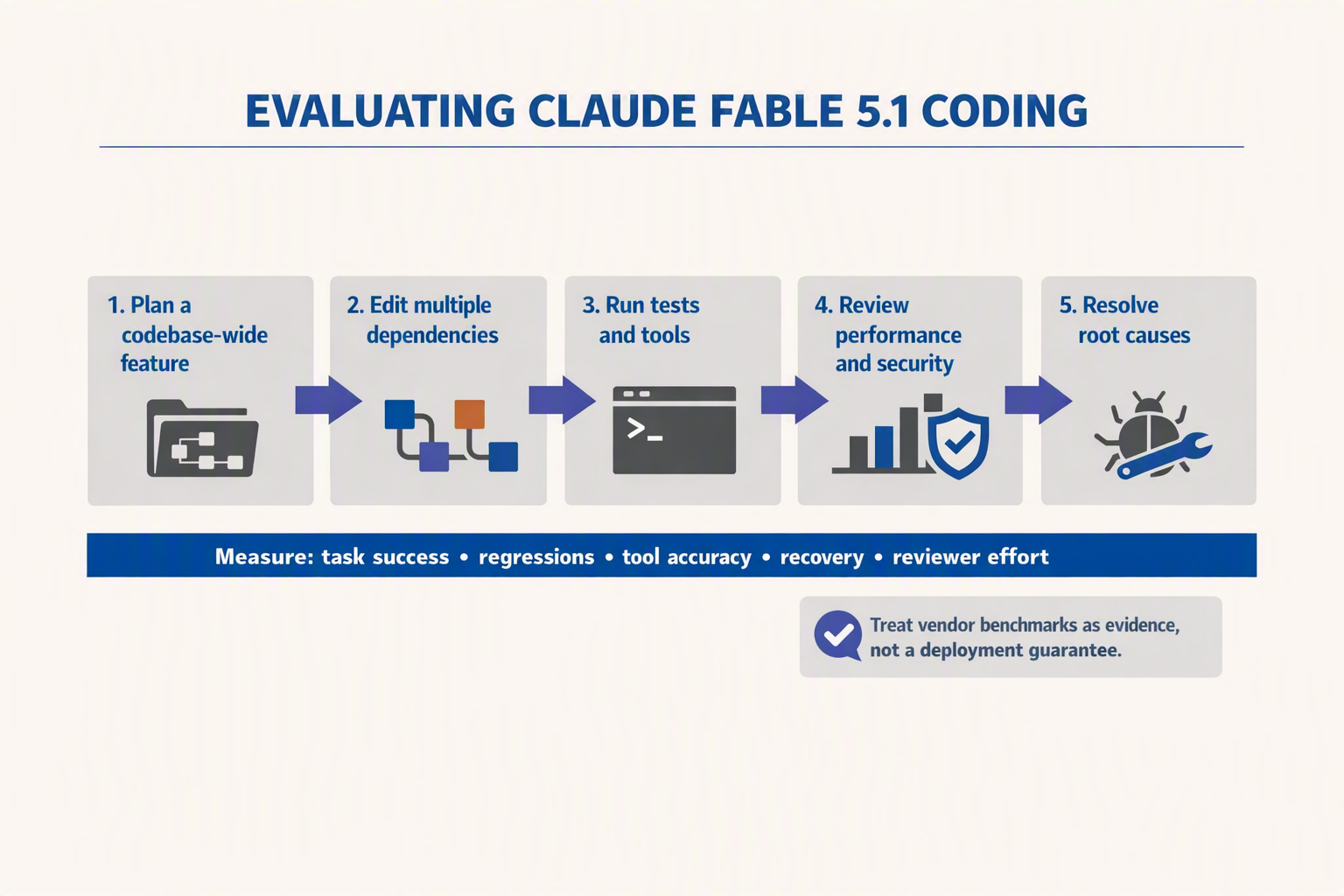
Claude Fable 5.1 appears strongest on long-horizon coding, root-cause analysis and incident investigation, but Anthropic has not published enough numerical results in the supplied launch materials to support a universal benchmark ranking. Developers should treat the release as a high-capability candidate requiring workload-specific evaluation—not as an automatic winner based on launch claims alone.
What the official benchmark evidence shows
Anthropic’s September 1, 2026 announcement calls Claude Fable 5.1 “a leading model” on the company’s incident-investigation evaluations. These evaluations use real production incidents to measure how effectively Anthropic’s Bits agent investigates failures, making them more operationally relevant than isolated question-answer tests.
However, the announcement excerpt does not provide a numerical score, sample size, baseline comparison or percentage improvement over Claude Fable 5. Anthropic’s claim is therefore useful directional evidence, but it is not yet an independently reproducible benchmark.
The strongest documented signals are:
- Production-oriented evaluation: Anthropic evaluates incident investigation using real production incidents rather than only synthetic prompts.
- Long-horizon emphasis: Claude Platform documentation recommends Claude Fable 5.1 for “demanding reasoning and long-horizon agentic work.”
- Higher-capability positioning: Anthropic specifically suggests trying Claude Fable 5.1 when evaluations with Claude Opus 5 at higher effort still fall short.
- Shared underlying model: Anthropic states that Claude Fable 5.1 uses the same underlying model as Claude Mythos 5.1, while adding restrictions for certain high-risk cybersecurity and biological tasks.
These points indicate where the model is intended to excel, but they do not establish that Claude Fable 5.1 leads every coding benchmark or programming language.
Where Claude Fable 5.1 coding may improve real work
Anthropic describes Claude Fable 5.1 as avoiding “easy-seeming shortcuts” and fixing root causes. That behavior is particularly relevant to codebase-wide assignments where a superficially correct patch can create regressions elsewhere.
Likely high-value workloads include:
- Repository-scale refactoring that requires tracing interfaces, dependencies and tests across many files.
- Complex debugging where symptoms appear far from the underlying defect.
- Incident response involving logs, source code, infrastructure configuration and deployment history.
- Long-running coding agents that must preserve objectives across repeated tool calls.
- Performance engineering where the model must profile a system, test hypotheses and verify the resulting change.
The key distinction is sustained task completion, not merely code generation. A model can score well on short programming exercises while struggling to inspect a repository, select tools, recover from errors and deliver a tested patch.
How developers should benchmark it
A credible Claude Fable 5.1 coding evaluation should compare the model with Fable 5 and existing production models under identical conditions. Measure:
- Percentage of tasks completed without human correction
- Unit, integration and regression test pass rates
- Number of tool calls and failed recovery attempts
- End-to-end completion time and token consumption
- Security-policy refusals on legitimate defensive tasks
- Reviewer-rated correctness, maintainability and scope discipline
Use at least several dozen representative tasks and preserve prompts, tool permissions and effort settings. Because Fable 5.1 includes cybersecurity safeguards, enterprises should also test whether authorized security workflows complete successfully. Until independent results become available, internal repository and incident evaluations remain more decision-useful than unsupported leaderboard claims.
How much does Claude Fable 5.1 cost, and how should buyers calculate spend?
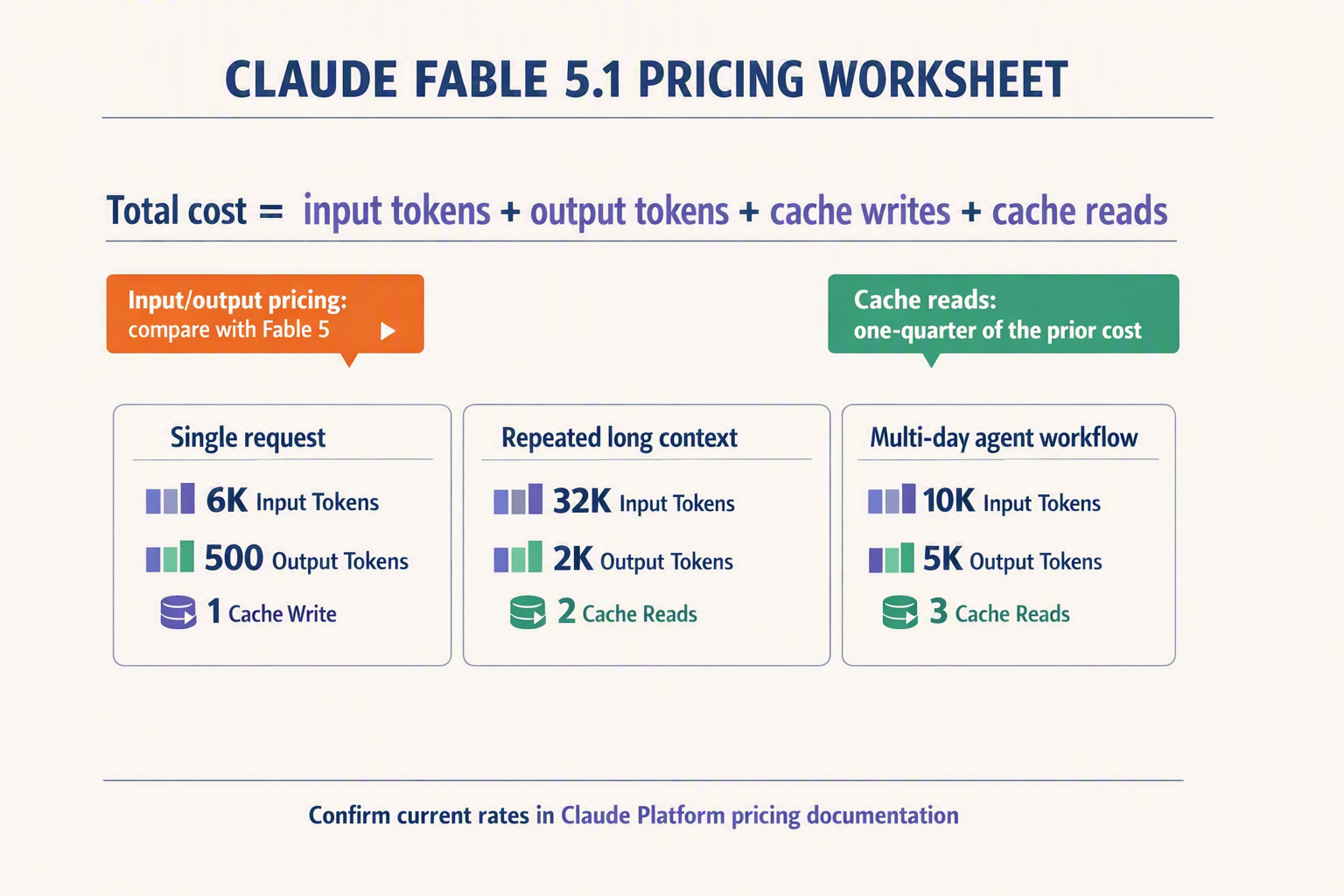
Claude Fable 5.1 pricing is unchanged from Claude Fable 5 for standard input and output tokens, while prompt-cache reads are cheaper, according to Anthropic’s September 1, 2026 launch information. Buyers should calculate total spend from uncached input, cache creation and reads, generated output, tool-loop volume, and the number of retries—not from the headline token rate alone.
Verify the applicable rate before forecasting
Anthropic released the API model identifier claude-fable-5-1 on September 1, 2026, according to the Claude Platform release notes. However, the launch materials supplied for this guide do not state the currency-denominated per-million-token rates, so buyers should verify the current pricing table in the Claude Platform documentation or console rather than relying on copied third-party figures.
“Unchanged pricing” does not necessarily mean an unchanged bill. Claude Fable 5.1 targets long-running coding, investigation and knowledge-work agents, and those applications may consume more tokens through:
- Large repository or document context
- Repeated tool calls and observation messages
- Longer reasoning trajectories
- Automated verification and correction passes
- Parallel agents or candidate solutions
- Persistent instructions that are repeatedly re-sent
Anthropic’s September 2026 documentation recommends Claude Fable 5.1 for demanding reasoning and long-horizon agentic work, so unit economics should be measured per completed task rather than per individual request.
Use a workload-level cost formula
For an API workload, estimate monthly cost as:
Total cost = uncached-input cost + cache-write cost + cache-read cost + output cost + external tool and infrastructure costs.
A practical calculation is:
- Measure average uncached input tokens, cached tokens read, cache entries written, and output tokens per successful task.
- Multiply each token category by its applicable Claude Fable 5.1 rate.
- Multiply the result by expected monthly task volume.
- Add retry, evaluation, observability, retrieval, web-search and code-execution costs.
- Apply a contingency allowance for unusually long agent runs and traffic peaks.
For example, suppose an engineering agent completes 20,000 tasks per month, with each successful task using 30,000 uncached input tokens, 120,000 cache-read tokens and 12,000 output tokens. Monthly billable volume would be 600 million uncached input tokens, 2.4 billion cache-read tokens and 240 million output tokens, before retries. Applying Anthropic’s current published rates to those three categories produces a much more reliable forecast than multiplying requests by an assumed average price.
Evaluate cost per successful outcome
Enterprises should compare Claude Fable 5.1 with Fable 5 using identical production-like tasks and track:
- Cost per resolved incident
- Cost per accepted code change
- Tokens and tool calls per completed task
- First-pass success rate
- Human-review minutes required
- Retry and timeout frequency
Cheaper cache reads can materially benefit workloads that repeatedly reuse system prompts, repository maps, policies or stable knowledge. The saving is workload-dependent: caching offers limited value when prompts change almost entirely between requests.
The central purchasing metric should therefore be cost per verified successful outcome. A model that uses more tokens but completes substantially more tasks without intervention may be economical; one that generates longer outputs without improving completion rates may not be.
What limitations and safeguards does the Claude Fable 5.1 System Card identify?
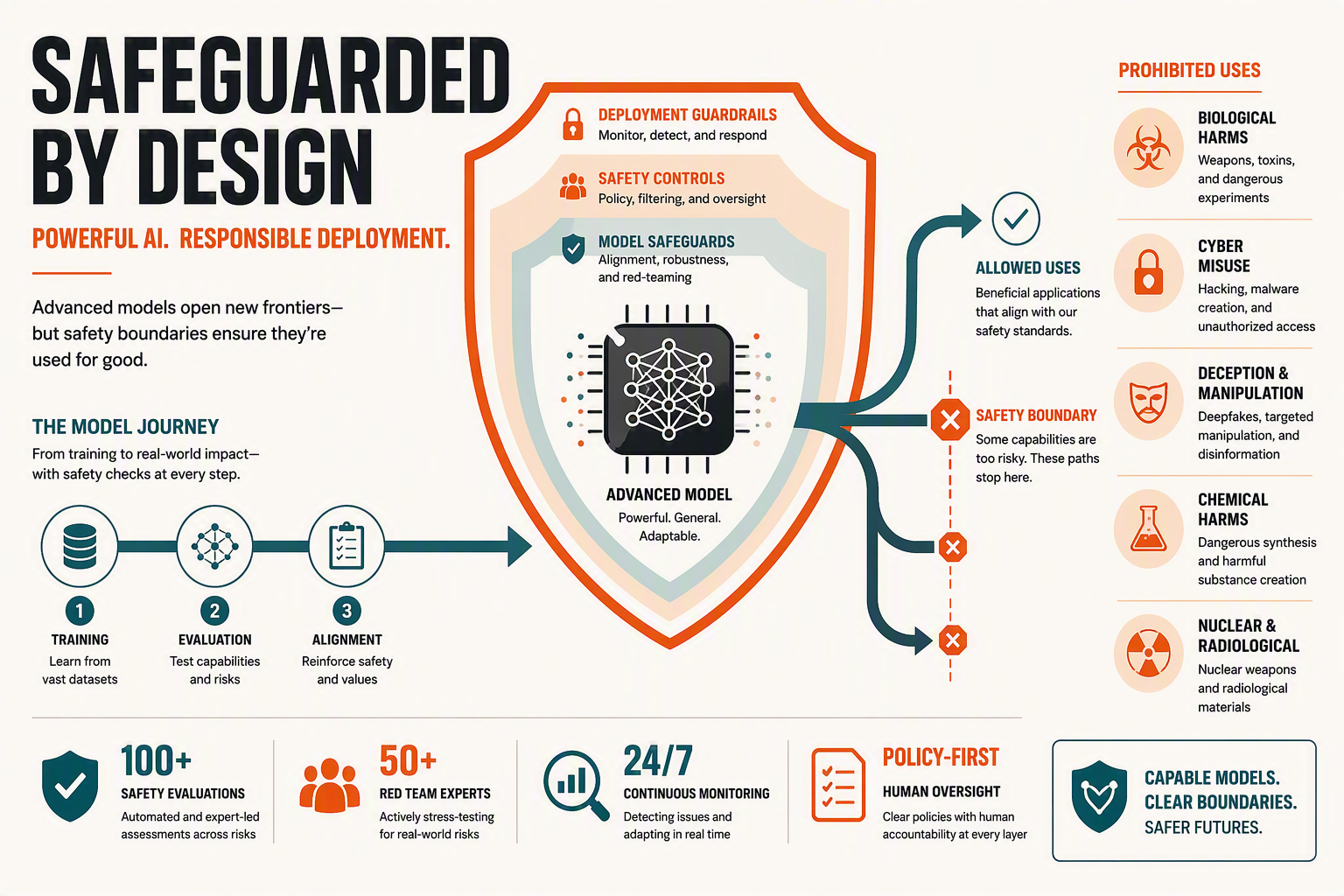
Anthropic’s Claude Fable 5.1 and Claude Mythos 5.1 System Card identifies a central deployment trade-off: Fable 5.1 uses the same underlying model as Mythos 5.1, but adds safeguards that prevent certain high-risk biological and cybersecurity tasks. Consequently, general availability does not mean unrestricted capability, guaranteed accuracy or automatic suitability for every enterprise workflow.
The main safeguard boundary
Anthropic states that Claude Fable 5.1 is available for general use and includes additional protections for biological and cybersecurity risk. The distinction is deliberate:
- Claude Fable 5.1 is the broadly deployable version, with controls that can block or constrain sensitive requests.
- Claude Mythos 5.1 exposes the underlying model in a research-oriented context with different access conditions.
- The safeguards are a product-level distinction, not evidence that Fable 5.1 uses a less capable base model.
Anthropic’s September 2026 product materials explicitly describe Claude Fable 5.1 as “the same underlying model as Claude Mythos 5.1 with safeguards for cybersecurity and biology.” Developers should therefore expect some technically sophisticated prompts to be refused or answered at a safer level of abstraction when they cross Anthropic’s risk boundaries.
Practical limitations for developers
The System Card’s safety framing has several operational consequences:
- Legitimate dual-use work may encounter restrictions. Defensive security analysis, vulnerability research and biological research can overlap with capabilities that have harmful applications. A refusal does not necessarily indicate that the model lacks the relevant reasoning ability.
- Safeguards can affect agent completion rates. Long-running agents may begin with a benign objective but later generate a restricted subtask—for example, while investigating an exploit chain. Applications need explicit handling for refusals, partial responses and escalation to authorized human reviewers.
- Model capability does not eliminate hallucination risk. Anthropic recommends Claude Fable 5.1 for demanding reasoning and long-horizon agentic work, but that recommendation is not a guarantee that generated code, incident diagnoses or factual conclusions are correct.
- First-party evaluations require independent validation. Anthropic calls Claude Fable 5.1 a leading model in its incident-investigation evaluations using real production incidents and its Bits agent. Enterprise buyers should reproduce those results against their own repositories, tool permissions and incident classes.
What the safeguards do—and do not—prove
The September 2026 System Card should be treated as a risk-assessment input, not a complete deployment certification. It does not replace:
- Human approval for destructive commands, production changes or consequential decisions
- Least-privilege tool access and sandboxed code execution
- Logging, audit trails and prompt-injection testing
- Domain-specific legal, privacy and regulatory review
- Continuous evaluation after model or policy updates
Anthropic launched claude-fable-5-1 on September 1, 2026, according to the Claude Platform release notes. Because model behavior and enforcement policies can evolve, regulated organizations should pin model identifiers where supported, monitor release notes and rerun acceptance tests after material changes.
The appropriate conclusion is not that Claude Fable 5.1 is risk-free. It is that Anthropic has intentionally separated broad production access from certain high-risk capabilities—and developers must design systems that remain reliable when those safety boundaries activate.
How should experts and enterprise teams interpret Anthropic’s launch claims?
Anthropic’s launch claims should be treated as strong evidence for where Claude Fable 5.1 is designed to excel—not as proof that it will outperform every alternative in production. Enterprise teams should validate the model on representative workflows, especially because the release was only two days old as of September 3, 2026.
Separate positioning from measurable evidence
Anthropic uses terms such as “Mythos-level model,” “leading model,” and “most ambitious, long-running projects.” These phrases indicate intended positioning, but they do not define measurable service-level outcomes.
According to Anthropic’s September 1, 2026 announcement, Claude Fable 5.1 leads its internal incident-investigation evaluations, which use real production incidents to assess the company’s Bits agent. This is more relevant than a generic multiple-choice benchmark for operations teams, but buyers still need details such as:
- Incident categories, complexity and time limits
- Tool access and prompting configuration
- Success criteria and human-review procedures
- Comparative results against Fable 5 and other models
- Failure rates, token consumption and task-completion latency
Until those results are independently reproduced, the accurate interpretation is that Anthropic observed strong performance under its own evaluation methodology.
Translate behavioral claims into testable hypotheses
Anthropic says Claude Fable 5.1 avoids “easy-seeming shortcuts” and addresses root causes instead of merely treating symptoms. Engineering teams can convert that claim into concrete acceptance tests:
- Seed a repository with a defect whose visible error originates several layers away from its cause.
- Measure whether the model patches the symptom or identifies the causal dependency.
- Run the generated change against regression, security and performance test suites.
- Score unnecessary file changes, introduced defects and human-review time.
- Repeat the test across multiple runs to assess consistency rather than showcasing one successful output.
For long-horizon agents, buyers should measure end-to-end task completion, not only answer quality. Relevant metrics include tool-call errors, recovery after failed actions, context retention, escalation accuracy, cost per completed task and the percentage of work accepted without substantial correction.
Evaluate safeguards as product behavior
The additional cybersecurity and biology controls should be assessed as part of the product, not treated as a footnote. Anthropic’s September 2026 system card says Claude Fable 5.1 is available for general use while safeguards prevent certain high-risk tasks.
That can create two distinct enterprise outcomes:
- Risk reduction: The model may better align with security, compliance and responsible-use requirements.
- Workflow friction: Legitimate defensive-security, pharmaceutical or biological research prompts may trigger refusals or require revised processes.
Regulated teams should therefore run both prohibited-use tests and authorized-use tests, documenting refusal rates, escalation paths and audit requirements.
Apply a launch-evidence hierarchy
A defensible procurement decision should prioritize evidence in this order:
- Your production evaluation: Real prompts, tools, data and approval criteria
- System-card evidence: Safety methods, limitations and evaluation scope
- Reproducible external testing: Transparent datasets and configurations
- Vendor benchmarks: Useful directional evidence with disclosed methodology
- Launch language: A hypothesis about product fit, not a purchasing conclusion
Anthropic’s Claude Platform documentation recommends Fable 5.1 when Claude Opus 5 at higher effort still falls short. Enterprises should interpret that narrowly: upgrade where difficult workloads demonstrate a measurable gain, while retaining cheaper or faster models for routine classification, extraction and conversational tasks. A staged rollout with shadow traffic, human review and rollback controls is more credible than fleet-wide migration based on launch claims alone.
Is Claude Fable 5.1 suitable for CallMissed and other real-time voice agents?
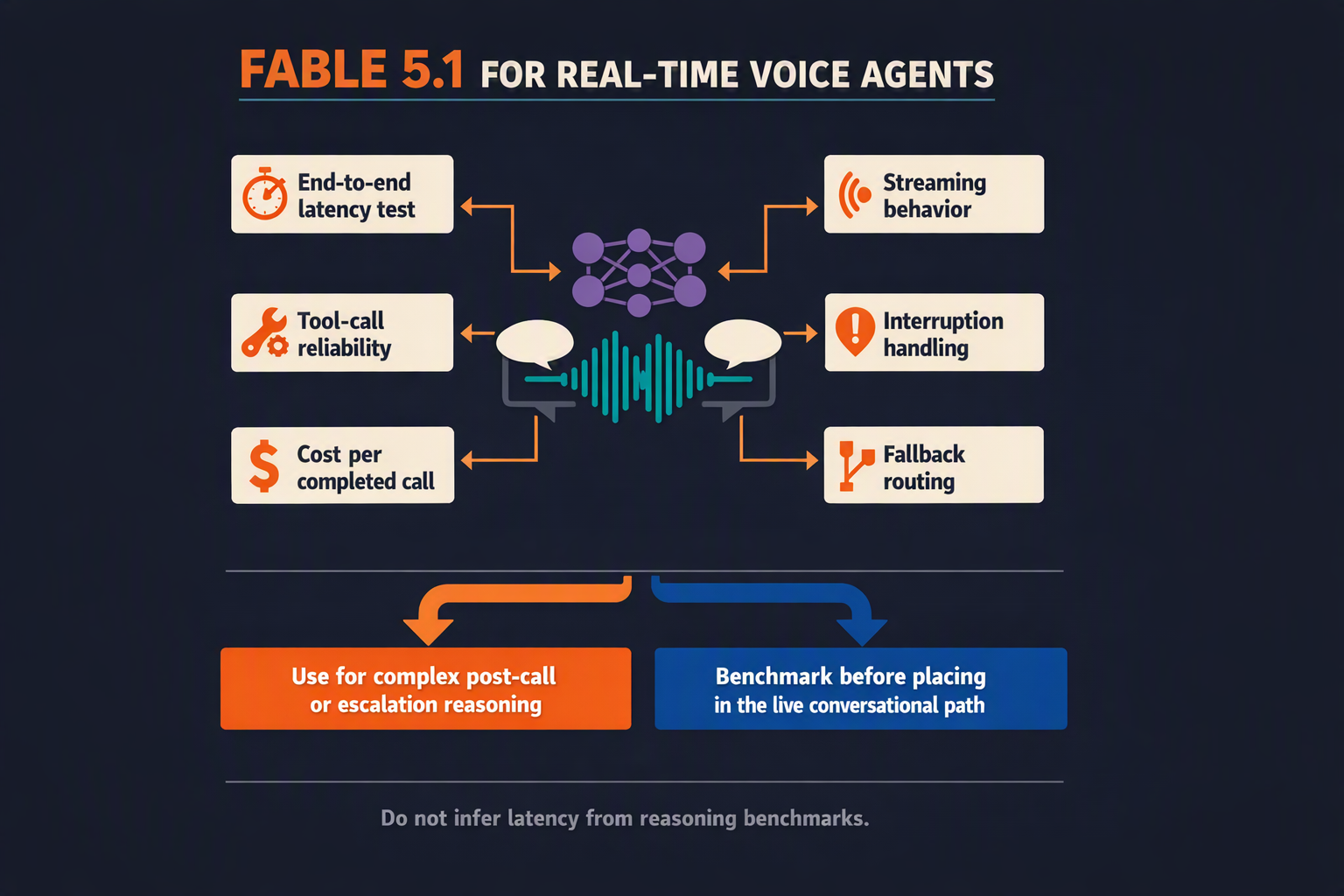
Claude Fable 5.1 could serve as the reasoning layer for selected real-time voice-agent tasks, but Anthropic has not published voice-specific latency metrics that support making it the default for every conversational turn. A voice-agent team such as CallMissed should test workload-based routing and measure end-to-end conversational performance before production deployment.
Separate reasoning capability from voice responsiveness
Anthropic released claude-fable-5-1 on September 1, 2026, describing it as the successor to Claude Fable 5 for long-running agentic coding, knowledge work and demanding reasoning. Anthropic’s Claude Platform documentation recommends Fable 5.1 for long-horizon agentic work or when evaluations using Claude Opus 5 at higher effort still fall short.
However, Anthropic’s September 2026 launch materials provide no voice-specific results for:
- Time to first token
- Streaming generation speed
- Caller-perceived response delay
- Interruption or barge-in handling
- End-to-end speech-to-speech latency
This distinction is critical because a live voice response passes through several stages: speech recognition, model inference, tool execution, speech synthesis and network or telephony transport. Strong reasoning benchmarks cannot establish whether the complete pipeline will feel responsive in conversation.
Anthropic reports that Claude Fable 5.1 is a leading model in its internal Bits incident-investigation evaluations, which use real production incidents. That first-party evaluation supports its potential for complex diagnosis, but it does not measure spoken-dialogue latency or turn-taking quality.
Where Fable 5.1 may add value
Claude Fable 5.1 is most relevant when the reasoning quality of a difficult interaction matters more than producing the fastest possible reply. Candidate workloads include:
- Complex escalations: Analysing policies, customer history and operational records before recommending a resolution.
- Multi-step tool use: Coordinating actions across ticketing, scheduling, billing or inventory systems.
- Root-cause investigation: Examining transcripts and related data to identify recurring service failures.
- Human-agent assistance: Generating structured recommendations, evidence summaries or next-best actions.
- Post-call processing: Producing summaries, follow-up tasks, dispositions and quality-review findings.
Routine greetings, identity confirmations and simple status requests may not require a model designed for ambitious, long-running tasks. Model selection should therefore follow measured workload requirements rather than release recency alone.
What a real-time pilot should measure
A team such as CallMissed should compare Fable 5.1 with alternative routing options using representative calls, tools and production-like traffic. The evaluation should report:
- Time to first token at p50, p95 and p99
- Time from the caller finishing a sentence to hearing the reply
- Tool-call accuracy, failure rate and completion time
- Interruption detection and recovery performance
- Task-completion, escalation and transfer rates
- Hallucination and policy-compliance rates
- Cost per completed or successfully resolved interaction
- Performance across accents, languages, code-switching and domain terminology
Recommended deployment decision
Use Claude Fable 5.1 selectively when its complex reasoning or long-horizon orchestration produces a measurable improvement in task completion, accuracy or escalation handling. Until production testing demonstrates acceptable voice latency, retain faster validated routes for routine turns and avoid treating Anthropic’s coding or incident-investigation results as substitutes for real-time voice benchmarks.
Who should upgrade from Fable 5 to Claude Fable 5.1?
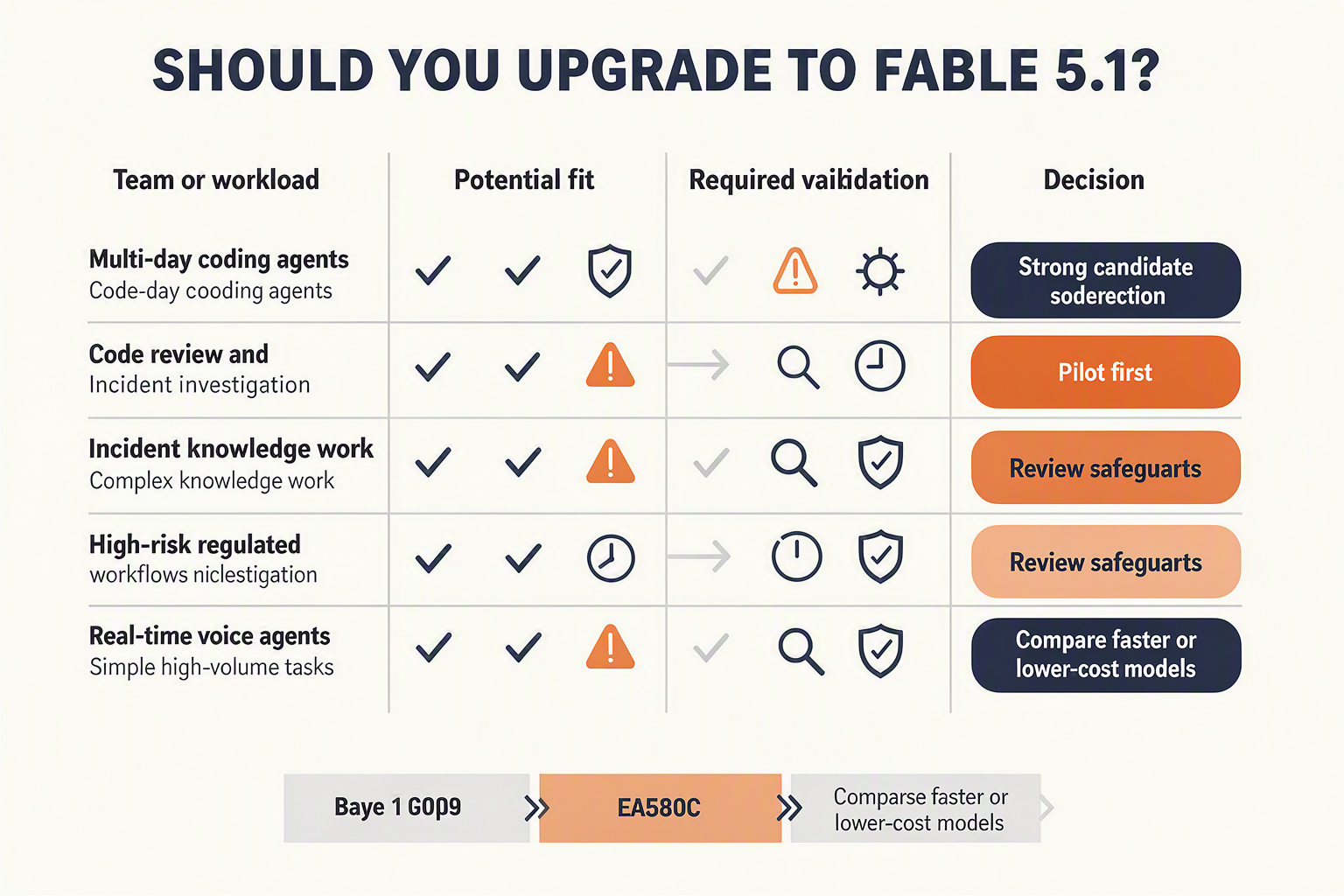
Teams running long-horizon coding, complex knowledge work or production incident investigations should evaluate an upgrade from Fable 5 to Claude Fable 5.1. Teams with short, predictable tasks should migrate only if their own evaluations demonstrate a meaningful gain in accuracy, completion rate or total cost per successful task.
Upgrade decision by workload
| Team or workload | Upgrade signal | Evaluation to run | Recommendation |
|---|---|---|---|
| Agentic software engineering | Tasks span repositories, tools or extended execution loops | Measure task completion, regressions and human corrections | Strong upgrade candidate |
| Production incident response | Agents investigate logs, traces, deployments and code changes | Compare root-cause accuracy, time to diagnosis and false leads | Strong upgrade candidate |
| Complex research and knowledge work | Outputs require synthesis across many sources or documents | Score factual support, reasoning quality and completeness | Evaluate promptly |
| Existing Fable 5 deployments | Errors arise from shortcuts or superficial fixes | Replay failed and borderline production cases | Upgrade if failure rate falls |
| High-risk cyber or biological workflows | Requests may trigger Fable 5.1 safeguards | Test representative permitted tasks and refusal behavior | Review carefully before migration |
| Short summarization or simple extraction | Current model already meets quality and latency targets | Compare cost, response time and structured-output reliability | No automatic need to upgrade |
Where Fable 5.1 has the clearest case
Anthropic’s September 1, 2026 Claude Platform release notes identify claude-fable-5-1 as the successor to Fable 5 for long-running agentic coding, knowledge work and related demanding tasks. The strongest migration case therefore exists where Fable 5’s limitations appear only after many reasoning steps, tool calls or code changes—not in a single-turn demonstration.
Incident-response teams have another concrete reason to test. Anthropic reported in September 2026 that Claude Fable 5.1 is a leading model in its internal incident-investigation evaluations, which use real production incidents to assess the Bits agent. That is relevant evidence, but it remains a first-party result rather than an independently reproduced benchmark. Buyers should replay their own anonymized incidents before approving a production switch.
Anthropic also says Fable 5.1 avoids “easy-seeming shortcuts” and focuses on fixing root causes. A practical evaluation should therefore inspect whether the model:
- Identifies the underlying defect rather than patching symptoms
- Preserves existing behavior across a codebase-wide change
- Recovers effectively after failed tools or incorrect intermediate assumptions
- Completes extended tasks without drifting from acceptance criteria
- Produces evidence that reviewers can verify
When staying on Fable 5 may be rational
A newer model does not automatically improve every workload. Retaining Fable 5 can be reasonable when it already satisfies service-level objectives, migration introduces behavioral risk, or Fable 5.1’s additional cybersecurity and biology safeguards interfere with legitimate specialist workflows.
Use a gated migration, not an immediate replacement:
- Build a representative test set from real Fable 5 traffic.
- Run both models with identical prompts, tools and context.
- Blind-score correctness, policy compliance and reviewer effort.
- Compare end-to-end economics, including retries and human remediation.
- Route a small production share to
claude-fable-5-1, monitor failures and expand only after thresholds are met.
The upgrade decision should rest on successful task economics and operational reliability, not launch positioning or a single benchmark score.
Frequently asked questions about Claude Fable 5.1
When was Claude Fable 5.1 released, and how can developers access it?
claude-fable-5-1. Anthropic’s September 2026 system card classifies the model as available for general use, but developers should verify current account, regional and platform availability in Anthropic’s documentation before planning production deployments.What’s new in Claude Fable 5.1 compared with Fable 5?
What do Claude Fable 5.1 benchmarks show about coding and reasoning performance?
Is Fable 5.1 the same model as Claude Mythos 5.1?
How much does Fable 5.1 cost to use through the API?
Who should upgrade to Fable 5.1, and is it suitable for real-time voice agents?
Conclusion
Claude Fable 5.1 is a targeted upgrade for teams whose hardest workloads involve long-running agents, codebase-wide changes, deep knowledge work and production incident investigation. Announced by Anthropic on September 1, 2026, the model offers Mythos-level capability with additional safeguards restricting certain high-risk cybersecurity and biological tasks.
The practical takeaways are clear:
- Fable 5.1 prioritizes sustained problem-solving. Anthropic positions
claude-fable-5-1for demanding reasoning and long-horizon agentic work, especially when evaluations using Claude Opus 5 at higher effort remain insufficient. Its emphasis on avoiding easy shortcuts and addressing root causes could be valuable for complex engineering and investigation workflows.
- The model shares its foundation with Claude Mythos 5.1. According to Anthropic’s September 2026 announcement, Claude Fable 5.1 uses the same underlying model as Claude Mythos 5.1 but adds safeguards for broader production access. Enterprise buyers should evaluate whether those controls align with their security, governance and acceptable-use requirements.
- First-party results are encouraging, but production evidence matters more. Anthropic reports that Claude Fable 5.1 leads its internal incident-investigation evaluations based on real production incidents handled by its Bits agent. Buyers should still run representative tests covering task completion, coding accuracy, tool use, latency, failure recovery and total workload cost rather than relying on launch claims alone.
- Upgrade decisions should be workload-specific. Compare Fable 5.1 with Fable 5 and Opus 5 using complete workflows—not isolated prompts—and account for input, output and cache economics before migrating production traffic. A newer model does not automatically justify replacing a stable, less expensive deployment.
Anthropic’s release cadence—Claude Sonnet 5 in June 2026, Claude Opus 5 in July 2026 and Claude Fable 5.1 in September 2026, according to Anthropic’s system-card timeline—shows how quickly enterprise model portfolios are evolving. What matters next is whether independent benchmarks and real deployments confirm stronger reliability across multi-day coding, incident analysis and other long-horizon tasks.
To explore how AI communication infrastructure is adapting to this multi-model future, visit CallMissed, an AI infrastructure platform supporting voice agents, multilingual chatbots and OpenAI-compatible model access. Will Claude Fable 5.1 produce enough measurable improvement on your hardest production workflows to justify the upgrade?
Related Reading
- Claude Fable 5.1 Pricing: API Costs, Calculator and Examples
- Claude Fable 5.1 vs GPT-6: Enterprise Agent Tests
- Best WhatsApp AI Agent Platform in 2026: Pricing, Features, and Fit Compared