
Chewy AI Customer Assistant Kai: What 30% and $50M Signal


See what Chewy AI customer assistant Kai’s reported 30% chat resolution means, what the fiscal 2027 $50M target covers, and which service metrics remain unknown.
Chewy AI Customer Assistant Kai: What 30% and $50M Signal
What if one in every three customer-service chats could be resolved without a human—and the company still saw that as only the beginning? Chewy’s AI customer assistant Kai reportedly resolves about 30% of chats through self-service, while the pet retailer is targeting roughly $50 million in AI-related cost savings in fiscal 2027. Together, those figures show why businesses are moving past AI demos to a tougher question: can automation improve service and produce measurable operating gains at scale?
Chewy introduced Kai to a select group of customers, where it handles common requests involving orders, returns, Autoship and account management, according to September 2026 reporting by PetRetailNews. The 30% figure is meaningful, but it needs context: it describes chats resolved through self-service, not all customer inquiries or a company-wide reduction in support costs. The distinction matters because the value of an AI assistant depends not just on how many conversations it closes, but on whether customers get accurate answers and can reach a person when they need one.
The financial target raises a second question. PYMNTS reported on September 18, 2026, that Chewy expects AI to take about $50 million out of costs in fiscal 2027, compared with “the low tens of millions” in the current fiscal year. That is a forward-looking savings goal—not a claim that $50 million has already been saved. It also reflects a broader deployment strategy: Chewy is applying AI across customer care, pharmacy services and its Vet Care network, rather than treating Kai as an isolated chatbot experiment.
This article unpacks what Kai’s reported 30% resolution rate does—and does not—tell us, how a customer-service automation metric connects to a company-level savings target, and what businesses should measure before declaring an AI rollout successful. We’ll look at the practical trade-offs behind self-service, including which tasks are suited to automation, how human handoff affects customer experience, and why savings depend on adoption and operating changes as well as model capability. The lesson extends beyond retail: AI agents are becoming part of a wider shift toward communication systems that can handle routine interactions while routing complex ones to people.
What do Kai’s 30% and Chewy’s $50M target actually tell us?
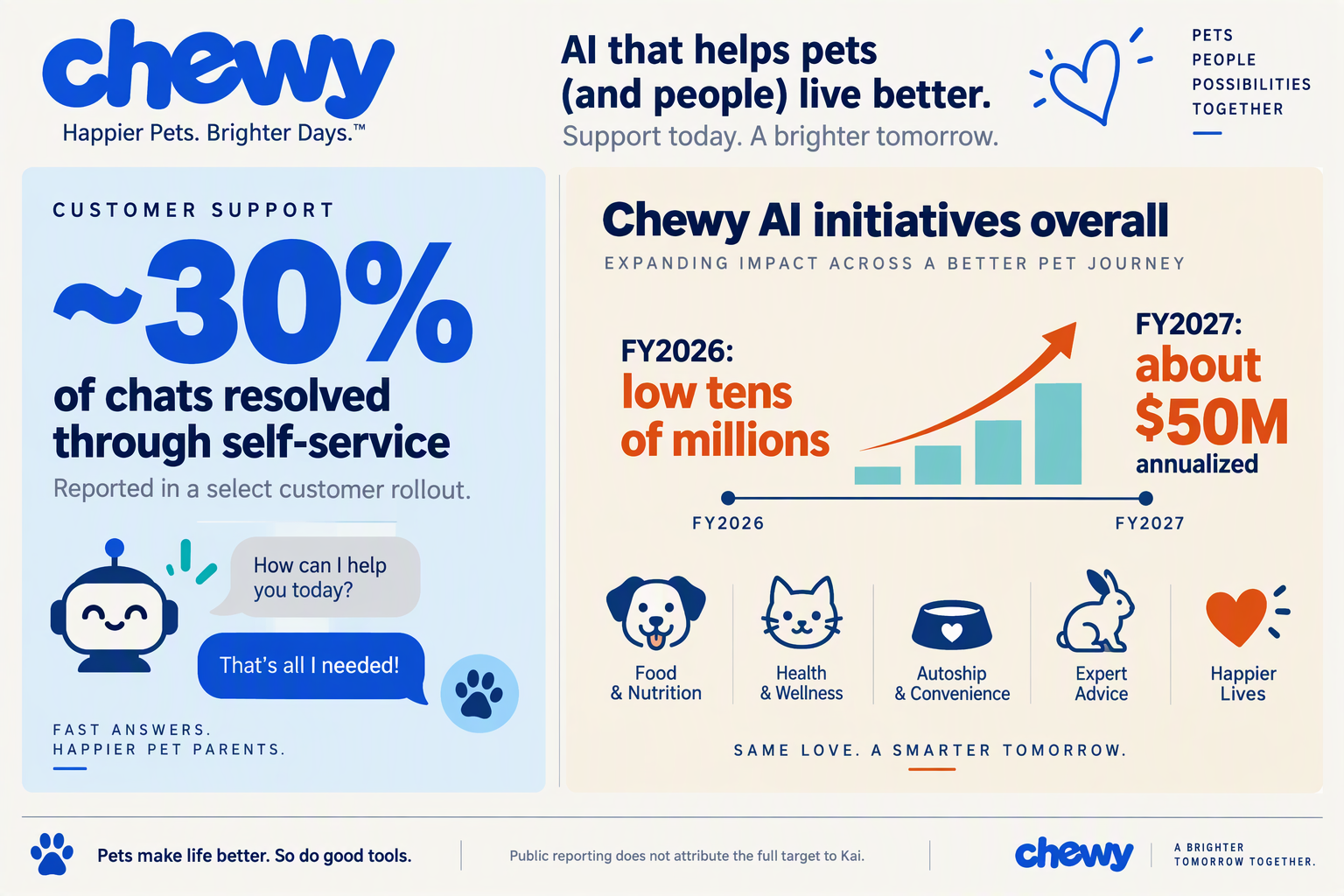
Kai’s reported 30% resolution rate and Chewy’s $50 million fiscal 2027 savings target are best read as two different signals: one indicates that self-service is working for a portion of chats, while the other sets a company-wide ambition for AI-driven productivity. Neither number, on its own, proves that Kai caused the projected savings.
What does a 30% chat-resolution rate measure?
The 30% figure suggests that Kai can handle a meaningful share of the conversations in the group using it—but it does not show how much effort or cost each resolved chat avoids. PetRetailNews reported in September 2026 that Kai resolved approximately 30% of chats through self-service for a select group of customers, covering common needs such as orders, returns, Autoship and account management.
That leaves several operational questions unanswered. A business assessing the result would want to know:
- What counts as “resolved”? Was the customer’s issue fully settled, or did they stop chatting before confirming?
- How often do customers return? A chat that appears closed but triggers a repeat contact may not reduce total workload.
- Which requests are included? Routine order questions may be easier to automate than exceptions involving refunds, prescription concerns or unusual delivery problems.
- How much human effort remains? An agent may still need to review, correct or complete an AI-handled interaction.
These questions do not diminish the reported rate; they define what it can support. The figure is evidence of self-service activity in a limited rollout, not a universal benchmark for other retailers or a direct measure of customer satisfaction.
How does that connect to a $50 million target?
The savings target is broader than chat deflection. PYMNTS reported on September 18, 2026, that Chewy expects AI to reduce costs by about $50 million in fiscal 2027, compared with “the low tens of millions” in the current fiscal year. Chewy is applying AI across customer care, pharmacy services and its Vet Care network, so the target reflects a wider productivity program.
To turn that ambition into realized savings, a company needs more than a capable assistant. It must account for adoption, the mix of work automated, the cost of running and maintaining AI systems, and whether operating processes change as automation scales. A self-service resolution can create capacity; savings follow only if that capacity is used productively or costs are actually reduced.
The useful interpretation is therefore not “30% of chats equals $50 million.” It is that Chewy is pairing a service-level indicator with a financial goal—and will need to demonstrate how results across multiple operations contribute to that goal.
What should companies measure alongside resolution?
A practical scorecard should connect customer outcomes to operating results. Track resolution alongside repeat contacts, escalation and transfer rates, time to resolution, customer satisfaction, and the cost of AI and human support. Segment results by issue type and rollout group so that a strong average does not conceal poor performance on sensitive or complex cases.
Human handoff is part of that measurement, not a failure of automation. For example, CallMissed’s omnichannel inbox includes AI agents for Instagram and Facebook direct messages and a queue that hands a conversation to a person when AI is switched off. The broader lesson is that useful automation is not just about closing more chats; it is about resolving appropriate requests reliably and routing the rest cleanly.
How did Chewy introduce Kai, and which requests can it handle?

Chewy introduced Kai to a select group of customers, where it handled about 30% of chats through self-service across common requests such as orders, returns, Autoship and account management. PetRetailNews reported in September 2026 that CEO Sumit Singh shared the rollout and resolution figure with investors; the reporting does not specify the exact launch date or the size of the test group.
How did Chewy introduce Kai?
Chewy’s reported approach was a limited customer rollout rather than an announced, company-wide launch. That matters: a test with selected customers can help a business learn how an assistant performs on real support requests before expanding access, but the available reporting does not explain how Chewy selected participants or whether the rollout has since broadened.
The reported 30% is a self-service resolution rate for chats in the group using Kai. It should not be read as evidence that Kai resolves 30% of every Chewy support interaction, or that the company reduced customer-service costs by 30%. As the broader savings target discussed earlier suggests, chat automation is one part of a larger AI effort.
For businesses assessing a similar rollout, the useful questions are practical:
- Which customer needs are in scope? Begin with repeatable requests where the answer or next step is clear.
- What happens when the assistant cannot finish? The available Kai reporting does not describe its escalation process, so it does not establish how customers reach a human when needed.
- How is resolution verified? A conversation ending is not necessarily the same as a customer’s issue being resolved; businesses should track repeat contacts and customer feedback alongside automation rates.
Which requests can Kai handle?
According to PetRetailNews, Kai handles common customer needs involving orders, returns, Autoship and account management. These are recognizable support categories, but the reporting does not detail the exact actions Kai can complete—for example, whether it can change an order, initiate a return or update an Autoship schedule—or identify restrictions within each category.
That distinction is important when interpreting an AI assistant’s capabilities. A tool might answer a policy question, retrieve account information or complete a transaction; those are different levels of automation. The public description identifies Kai’s request areas, not the precise permissions or workflows behind them.
A useful way to frame the reported scope is:
- Orders: questions connected to customers’ purchases.
- Returns: requests related to returning items.
- Autoship: recurring-order questions or account needs.
- Account management: common tasks involving a customer’s account.
These labels describe the reported categories, not a confirmed list of supported actions.
What does the rollout signal for customer-service design?
Kai’s initial scope points to a familiar pattern in customer-service automation: start with frequent, bounded requests, then evaluate whether the assistant can resolve them reliably. The next step is not simply adding more topics; it is confirming that customers get accurate outcomes and have a clear route to human help when a request falls outside the assistant’s capabilities.
That principle applies across communication platforms. As of September 2026, CallMissed offers AI agents with a knowledge base and a shared inbox where switching off AI hands a thread to a person. That is one example of designing automation alongside human support—not evidence about Kai’s own handoff process, which the reporting does not describe.
Chewy’s disclosed categories therefore tell us where Kai is being applied, while leaving important operational details open. Those details—task permissions, escalation, customer satisfaction and repeat-contact rates—will help determine whether self-service is both efficient and genuinely useful.
What are the key reported facts about Kai and Chewy’s AI plans?
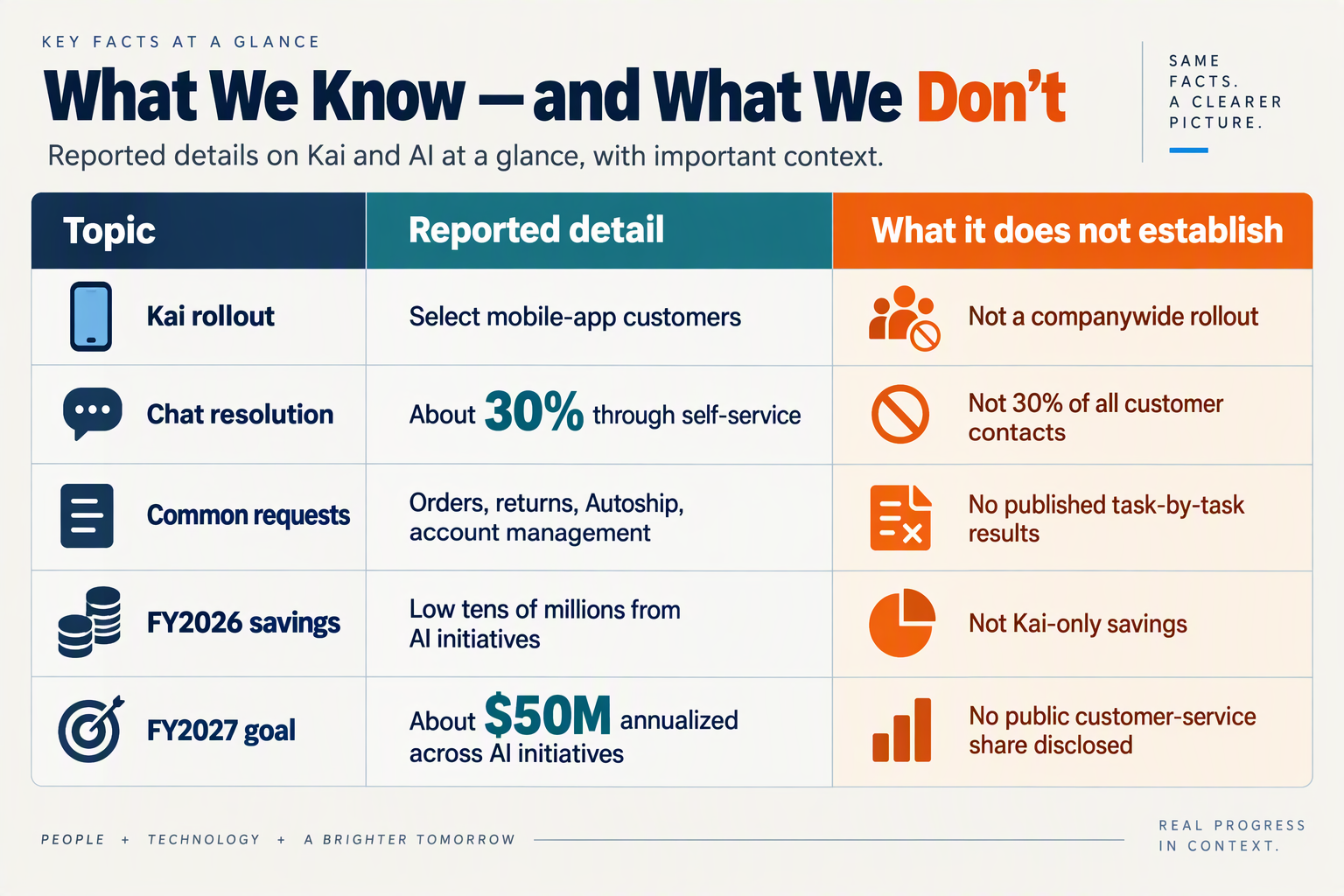
What has Chewy reported about Kai’s rollout and performance?
Chewy’s reported figures point to an early customer-service deployment alongside a broader, forward-looking productivity target. The central distinction is scope: Kai’s approximately 30% figure concerns self-service chat resolution in a select customer group, while the $50 million goal covers AI-driven cost savings across multiple parts of Chewy’s business.
| Reported fact | Figure or status | Scope and interpretation | Source and date |
|---|---|---|---|
| Kai rollout | Introduced to a select group of customers during the quarter | The reported deployment is not described as a full rollout to every Chewy customer. | PetRetailNews, September 2026 |
| Chat resolution | Approximately 30% of chats resolved through self-service | Applies to common customer needs; it is not a reported company-wide reduction in support costs. | PetRetailNews, September 2026 |
| Common Kai tasks | Orders, returns, Autoship and account management | These are routine service topics that Kai was reported to handle. | PetRetailNews, September 2026 |
| AI cost savings | “Low tens of millions” in the current fiscal year; about $50 million targeted for fiscal 2027 | The $50 million is a forward-looking target, not savings already achieved. | PYMNTS, September 18, 2026 |
| Other areas for AI deployment | Customer care, pharmacy services and Vet Care | Chewy’s stated AI productivity effort extends beyond Kai and customer-service chat. | PYMNTS, September 18, 2026 |
| Q2 business context | 208,000 customers added; net sales rose 7.3% year over year to $3.3 billion | These figures describe company performance, not outcomes attributed specifically to Kai. | PetRetailNews and GlobalPETS, September 2026 |
The figures should be read together, but not treated as proof of cause and effect. A 30% self-service resolution rate can indicate that some routine conversations are being handled without a person; it does not, by itself, reveal customer satisfaction, repeat-contact rates, or the cost avoided per chat. Likewise, the $50 million target is an enterprise-level ambition across several operations, not a savings estimate tied solely to Kai.
For readers assessing the claims, keep three distinctions in view:
- Observed versus planned: Kai’s chat-resolution figure is reported performance; fiscal 2027 savings are a target.
- Pilot scope versus company scope: Kai was introduced to a select group, while the savings goal spans broader AI initiatives.
- Correlation versus attribution: Chewy’s Q2 customer and sales figures provide business context, but the reporting does not attribute those results to Kai.
Those distinctions are useful when evaluating any AI-service rollout. Businesses should pair resolution rates with measures such as successful completion, repeat contact and human escalation to understand whether automation is helping customers as well as reducing workload. As of September 2026, platforms such as CallMissed combine AI messaging agents with a human-handoff queue and agent analytics—capabilities that can help teams monitor both automation and escalation without assuming that a resolution percentage tells the whole story.
Why is a 30% resolution rate not enough to judge automated chat support?
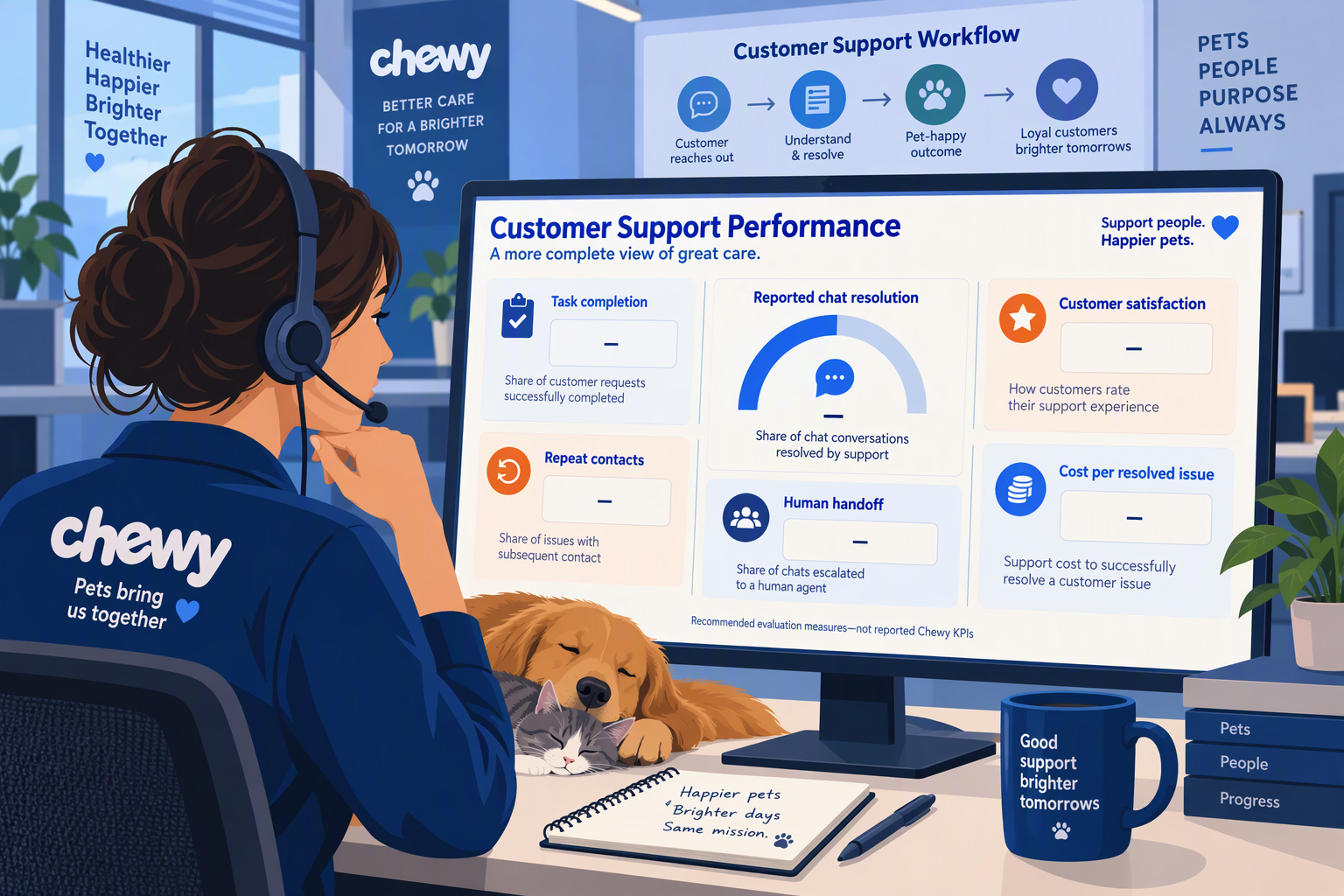
A 30% chat-resolution rate is a useful sign of self-service adoption, but it cannot show whether the automation is accurate, customer-friendly, or reducing total support costs. To judge automated chat support, companies need to pair resolution with measures of quality, customer effort, escalation, and the work that remains for human agents.
What does “resolved” mean in an automated chat?
The definition matters. A chat may end because the customer got the right answer, because the issue was deferred to another channel, or because the customer gave up. Those outcomes should not be counted as equivalent.
PetRetailNews reported in September 2026 that Chewy’s Kai handled common requests involving orders, returns, Autoship, and account management. That task mix is important: a self-service answer about an order status may be easier to verify than a conversation involving a disputed charge or a complex account problem. A headline rate does not reveal which tasks Kai resolves, or how successful it is on each one.
A useful evaluation starts by separating outcomes such as:
- Confirmed resolution: the customer’s need was met, with no repeat contact about the same issue.
- Assisted resolution: AI gathered information or took an initial step, but a person completed the work.
- Escalation: the customer was handed to a human agent, with context preserved.
- Abandonment or deflection: the chat ended without evidence that the customer’s issue was solved.
These categories make it harder for a single percentage to conceal a frustrating experience. They also help teams spot where automation is suitable and where a faster human handoff may be the better outcome.
Which metrics should companies track alongside resolution?
A balanced scorecard should show both customer outcomes and operational effects. For example, teams can track repeat contacts for the same issue, customer satisfaction after AI-handled chats, time to resolution, escalation rates, and whether agents must redo work after a handoff. Results should also be segmented by request type, since an aggregate rate can hide strong performance on routine questions and weak performance on more complicated ones.
Companies should check whether a rise in self-service resolution corresponds with a measurable change in cost or agent workload. If the AI closes more chats but creates repeat contacts, lengthy escalations, or extra verification work, the apparent efficiency may not translate into net savings. PYMNTS reported on September 18, 2026, that Chewy expects AI to reduce costs by about $50 million in fiscal 2027; assessing that goal requires operational evidence beyond a chat-resolution percentage.
How should teams interpret the number?
Treat the 30% as a starting indicator, then ask what the remaining 70% represents and whether the automated conversations were genuinely successful. Compare outcomes over time and across task categories, while keeping the customer experience visible alongside labor and cost measures.
The system design matters, too: automation should make it possible to pass a conversation to a person when needed, rather than treating every escalation as failure. As of September 2026, CallMissed’s omnichannel inbox includes AI chat agents and a human-handoff queue, where switching the AI off hands the thread to a person. That reflects a broader principle for support automation: measure not only what AI can resolve alone, but also how well it supports the full service journey.
What does the $50M savings goal include—and what remains unknown?
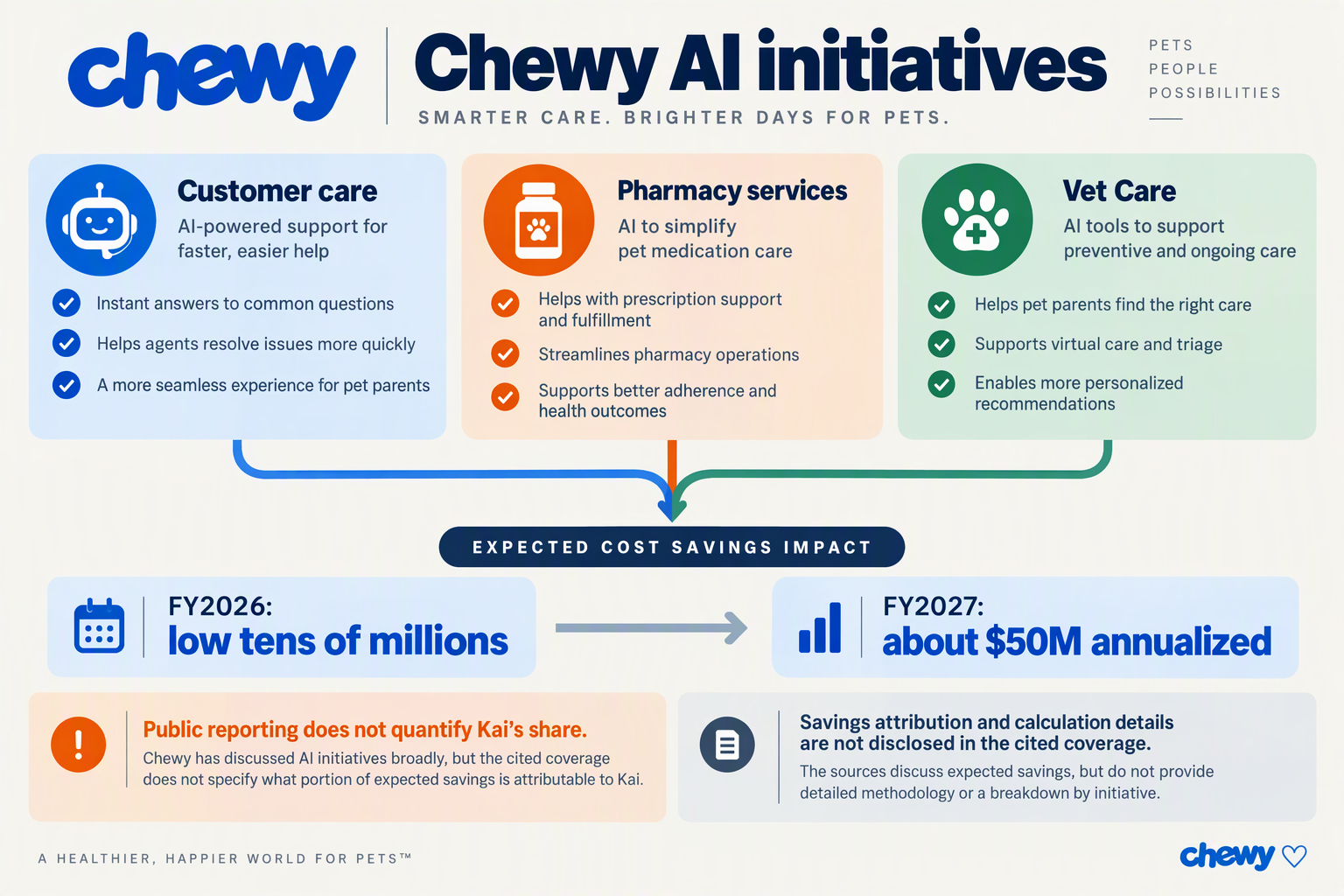
The $50 million target is a company-level AI cost-savings goal for fiscal 2027, not a disclosed savings figure for Kai alone. Chewy and the reporting available as of September 2026 have not provided a detailed breakdown of which projects, cost categories or measurement rules make up the target.
What costs could the $50 million target cover?
PYMNTS reported on September 18, 2026, that Chewy executives expect AI to take about $50 million out of costs in fiscal 2027, compared with “the low tens of millions” in the current fiscal year. That signals an effort to connect AI deployment to operating results—not just to report that a chatbot has been launched.
The target appears broader than Kai’s customer-service work. Reporting describes Chewy’s AI activity across customer care, pharmacy services and its Vet Care network. But the public information does not assign a dollar amount to any one area, or say how much of the fiscal 2027 goal depends on resolving chats.
Nor does “take out of costs” specify the accounting mechanism. Potential measures might include reduced labor hours, avoided hiring or faster handling of work, but those are examples of ways a company could realize savings—not disclosed components of Chewy’s target. The distinction matters: automating a conversation does not automatically lower costs if the business still needs the same staffing, adds new review work or incurs significant technology and implementation expenses.
What remains unknown about the $50 million figure?
The reported target does not answer several questions investors and operators would need to assess the result:
- Scope: Which AI projects count toward the goal, and how much is attributed to customer care versus pharmacy or Vet Care?
- Baseline: Compared with what cost level or operating plan will savings be measured?
- Calculation: Are the figures gross savings, net savings after AI-related costs, or a mix of direct savings and avoided costs?
- Timing: How will Chewy recognize savings during fiscal 2027, and will they be recurring?
- Quality and workload: Will savings be evaluated alongside customer satisfaction, repeat contacts, escalation rates and the work transferred to human agents?
Without those details, the $50 million is best understood as a forward-looking ambition, not a verified outcome or a unit-economics benchmark for Kai.
What should businesses learn from Chewy’s target?
A useful AI business case connects automation to both service outcomes and total operating cost. For customer support, that means tracking more than the share of chats marked resolved: teams should also examine whether customers had to contact the business again, whether complex cases reached a person, and how much human effort remained after automation.
This is why the design around an AI agent matters as much as the model. Platforms such as CallMissed, an AI customer-communication platform, provide no-code voice and chat agents alongside knowledge bases and human handoff in its omnichannel inbox; those capabilities reflect the broader shift toward combining automation with escalation paths. They do not, by themselves, guarantee savings—the operating process and measurement do that work.
Chewy’s target therefore signals a higher bar for AI adoption: companies will increasingly be asked to show not only that an agent can handle routine interactions, but also where the resulting economic value appears, how it is calculated, and whether service quality holds up.
What do management statements and public reporting actually confirm?
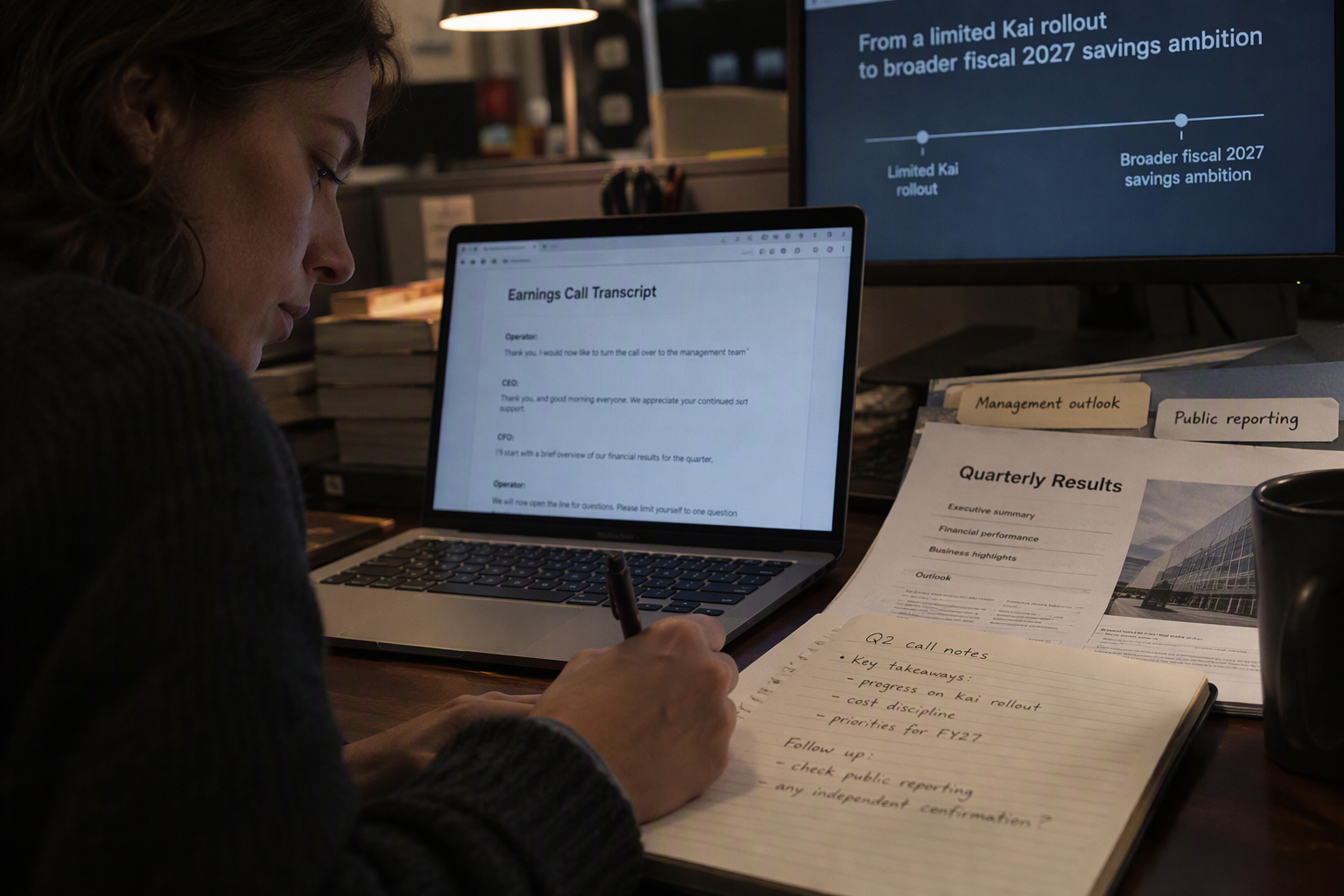
Management statements and public reporting confirm that Chewy has begun deploying Kai and set a company-wide AI savings target; they do not establish that Kai alone will deliver $50 million in savings. The reported 30% chat-resolution rate describes self-service results for a select customer group, while the fiscal 2027 target spans AI initiatives across multiple operations.
What has Chewy’s management said about AI savings?
Chewy expects AI to reduce costs by about $50 million in fiscal 2027, up from “the low tens of millions” in the current fiscal year, according to PYMNTS reporting on September 18, 2026. The figures are forward-looking expectations, not audited results showing that the savings have already been achieved.
The distinction matters: a target signals management’s planned scale of impact, but does not reveal the calculation behind it. The reporting does not break the expected savings into specific amounts for customer care, pharmacy services, or Vet Care, nor does it identify how much is attributed to Kai.
PYMNTS reports that CEO Sumit Singh discussed the goal with analysts. CIO Dive likewise described the $50 million figure as a projection from Chewy’s fiscal 2027 planning. Read together, the reports support the existence of a broad productivity target—not a claim that one assistant has already produced those savings.
What does public reporting confirm about Kai?
PetRetailNews reported in September 2026 that Chewy introduced Kai to a select group of customers during the quarter. CEO Sumit Singh told investors that the assistant resolved approximately 30% of chats through self-service, handling common requests involving orders, returns, Autoship, and account management.
That is useful evidence of deployment and reported performance, but the available reporting leaves important measurement details unspecified. It does not provide the number of chats included, the measurement period, a definition of “resolved,” or a comparison with customers who did not use Kai. It also does not say how many conversations were escalated to a human or whether those customers later contacted support again.
Those gaps do not invalidate the figure; they limit what can safely be inferred from it. In particular, 30% of chats resolved through self-service is not the same as a 30% reduction in support costs. Cost impact depends on what happens to the other conversations, how much staff time each successful resolution avoids, and the ongoing cost of operating and improving the system.
What remains unconfirmed—and why does it matter?
Public reporting supports three conclusions: Kai is live for a select customer group, Chewy reports roughly 30% self-service resolution in that deployment, and management expects AI-related savings to grow to about $50 million in fiscal 2027. It does not establish a causal link between Kai’s resolution rate and that company-wide savings target.
To evaluate the business result, readers would need measures such as repeat-contact rates, escalation rates, customer satisfaction, cost per resolved issue, and savings by business function. Those indicators show whether automation is reducing effort without simply shifting work to another channel or creating extra contacts.
This is also why human handoff belongs in the measurement plan, not just the product design. Communication platforms such as CallMissed combine AI agents with an omnichannel inbox and a human-handoff queue, reflecting a practical model in which automation handles suitable interactions while people take over when needed. The key signal in Chewy’s disclosures is not that AI has eliminated customer-service work; it is that the company is setting measurable productivity expectations while expanding AI across several operations.
What should support leaders measure before scaling AI chat?
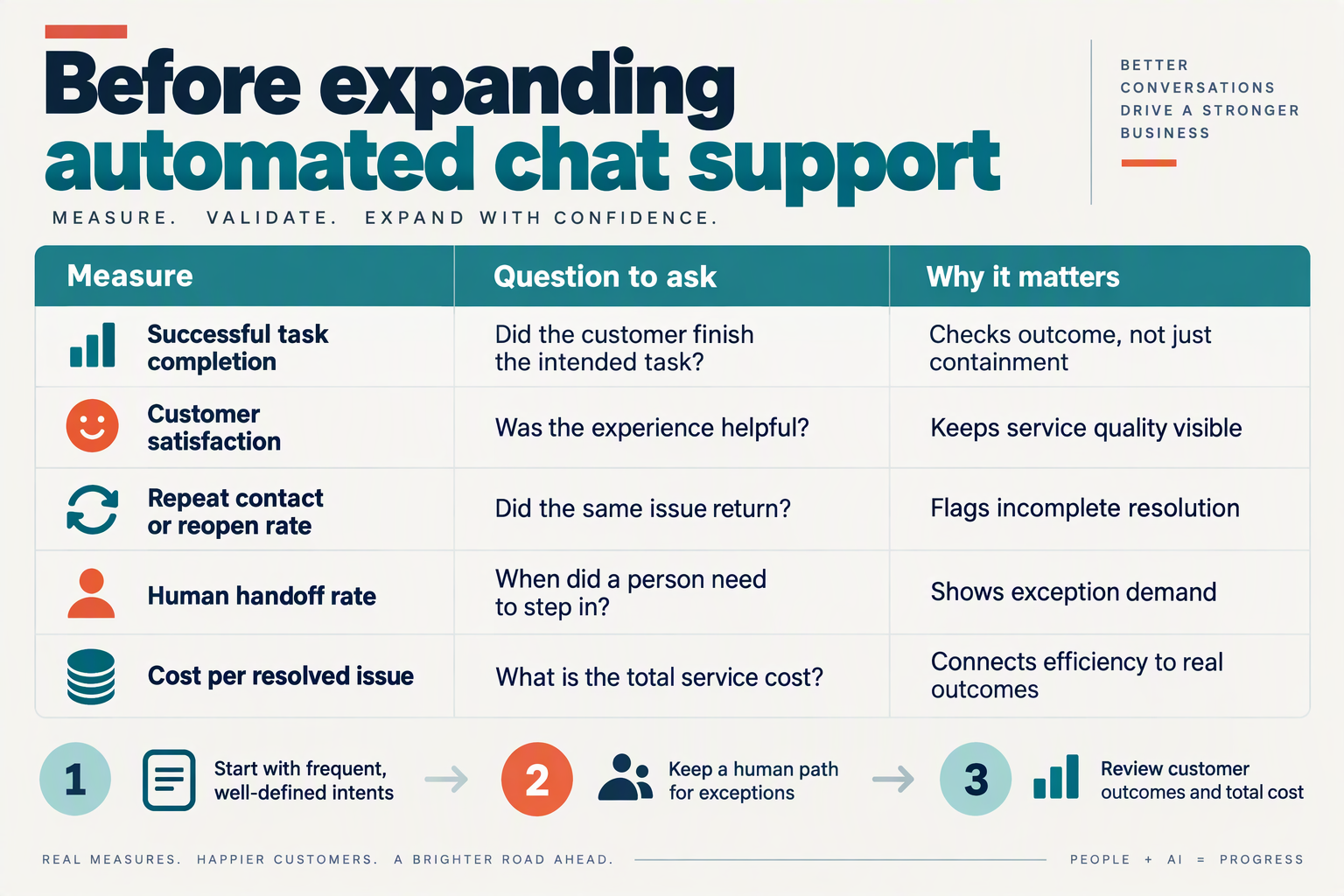
Before scaling AI chat, support leaders should verify who is included in the resolution rate, whether answers are correct, what happens after handoff, and whether the automation reduces total service cost. A single containment percentage is not enough to establish customer value or financial return.
Which metrics show whether AI chat is ready to scale?
Chewy’s reported result is a useful starting point, not a complete scorecard. PetRetailNews reported in September 2026 that Kai resolved approximately 30% of chats through self-service for a select group of customers, handling common needs such as orders, returns, Autoship and account management. Before comparing that result with another rollout—or expanding it—leaders should document the denominator, customer cohort, eligible inquiry types and measurement period.
| Metric | What to measure | Why it matters before scaling |
|---|---|---|
| Resolution rate | Chats resolved without human help ÷ eligible chats started; define exclusions and the time window | Makes the percentage interpretable and prevents a narrow pilot cohort from being mistaken for all customer inquiries |
| Answer quality | Accuracy and policy compliance, reviewed against a representative sample or QA rubric | A conversation can end without a transfer while still giving an incorrect or incomplete answer |
| Repeat contact | Whether customers return about the same issue within a defined follow-up period | Helps distinguish durable resolution from a conversation that simply stopped |
| Human handoff | Handoff rate, reason, wait time and whether the person receives the chat context | Shows whether complex or sensitive requests reach a human smoothly instead of getting trapped in automation |
| Customer outcome | CSAT or another customer-feedback measure, segmented by AI-only and handed-off chats | Checks whether efficiency gains coincide with an acceptable service experience |
| Net operating impact | Human effort avoided, minus AI, review, integration and escalation costs | Connects chat performance to savings without treating every automated conversation as a dollar saved |
How should leaders connect chat results to financial goals?
The business case should follow the full path from conversation to cost: identify which issue types the AI handles, estimate the human work actually avoided, then include the expense of running and supervising the system. Track results by use case and channel, and compare them with a consistent baseline; order-status automation, for example, may have a different value and risk profile from a refund dispute.
Chewy’s financial target is broader than Kai’s chat result. PYMNTS reported on September 18, 2026, that Chewy expects AI to reduce costs by about $50 million in fiscal 2027, up from “the low tens of millions” in the current fiscal year. That is a forward-looking company goal, not evidence that Kai alone has produced those savings. Leaders should therefore avoid multiplying a chat-resolution rate by average support cost and presenting the estimate as realized savings.
What operating checks should come before expansion?
A practical scale-up review can ask:
- Are the results comparable? Keep cohort, eligibility rules and reporting period consistent.
- Are failures visible? Review incorrect answers, repeat contacts, abandoned chats and escalations—not just completed conversations.
- Can customers reach a person? Test handoff paths for speed and continuity, especially for unusual or high-impact requests.
- Does the workflow support measurement? As of September 2026, platforms such as CallMissed combine AI chat agents with a shared inbox and a human-handoff queue, illustrating how automation and human support can be designed as one service flow.
Scaling is justified when resolution, quality, customer outcomes and net cost move in the right direction together—not when one headline percentage rises on its own.
Frequently Asked Questions
Frequently asked questions
What is Chewy’s Kai AI assistant and what can it do?
How many customer chats does the Chewy Kai assistant resolve?
Has Chewy already saved $50 million with AI?
How could Chewy’s Kai assistant contribute to the $50 million savings goal?
Will Chewy’s Kai AI assistant replace human customer-service agents?
What metrics should businesses track to assess AI customer-service savings?
Conclusion
Chewy’s Kai and its $50 million savings target show two different measures of AI progress: whether customers can resolve routine needs through self-service, and whether AI can contribute to company-wide productivity. Neither figure alone proves that Kai caused the projected savings.
- The 30% rate has a defined scope. PetRetailNews reported in September 2026 that Kai resolved about 30% of chats through self-service among a select customer group, covering requests such as orders, returns and Autoship.
- The $50 million is a goal, not a result. PYMNTS reported on September 18, 2026, that Chewy expects AI to reduce costs by roughly $50 million in fiscal 2027, up from “the low tens of millions” in the current fiscal year.
- Resolution is only part of the test. Accuracy, customer experience and access to human help matter alongside the number of chats automated.
- Company-wide gains depend on deployment. Chewy is applying AI across customer care, pharmacy services and its Vet Care network—not relying on Kai alone.
What to watch next is whether Chewy reports sustained service quality alongside measurable savings as these tools expand. For a closer look at this broader shift, explore CallMissed, an AI communication platform offering voice and chat agents, including speech recognition in 22 Indian languages. As AI moves from pilot metrics to operating results, what evidence would convince you it is improving service—not just reducing cost?
Related Reading
- Weather and News AI Agent: Build a Voice Assistant
- AI Agent Human Oversight Rules for Customer Support
- Offline AI Voice Assistant Mac: What Laya Actually Proves
Sources
Discussion
Related Posts



Ready to automate customer conversations?
Launch AI voice agents and WhatsApp bots with CallMissed — one API, 22+ Indian languages.