
Paper2Agent for Operations Teams: Turning Papers into Agents


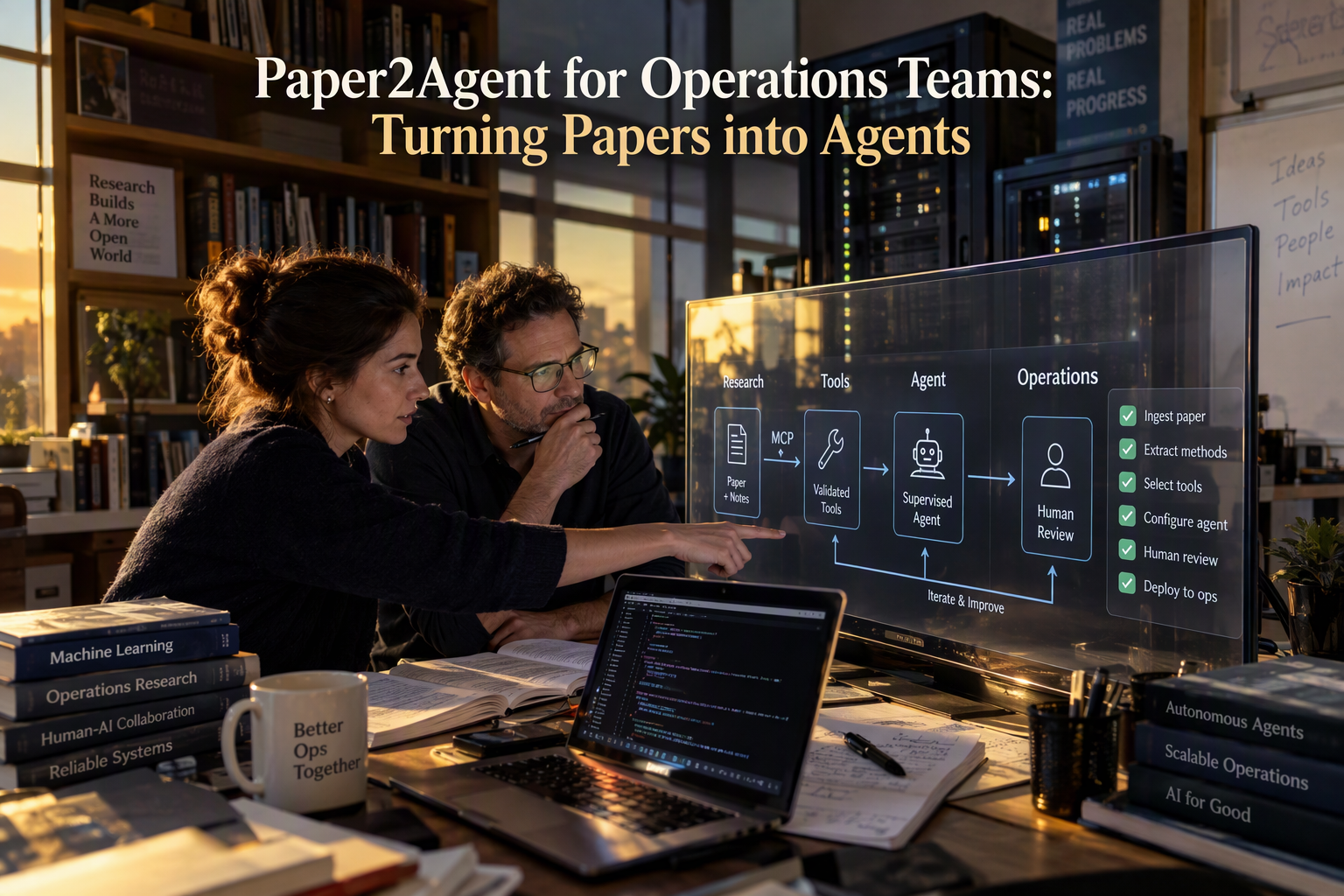
See how Paper2Agent turns reproducible research into callable workflows, what its study results do—and don’t—show, and how operations teams can pilot safely.
Paper2Agent for Operations Teams: Turning Papers into Agents
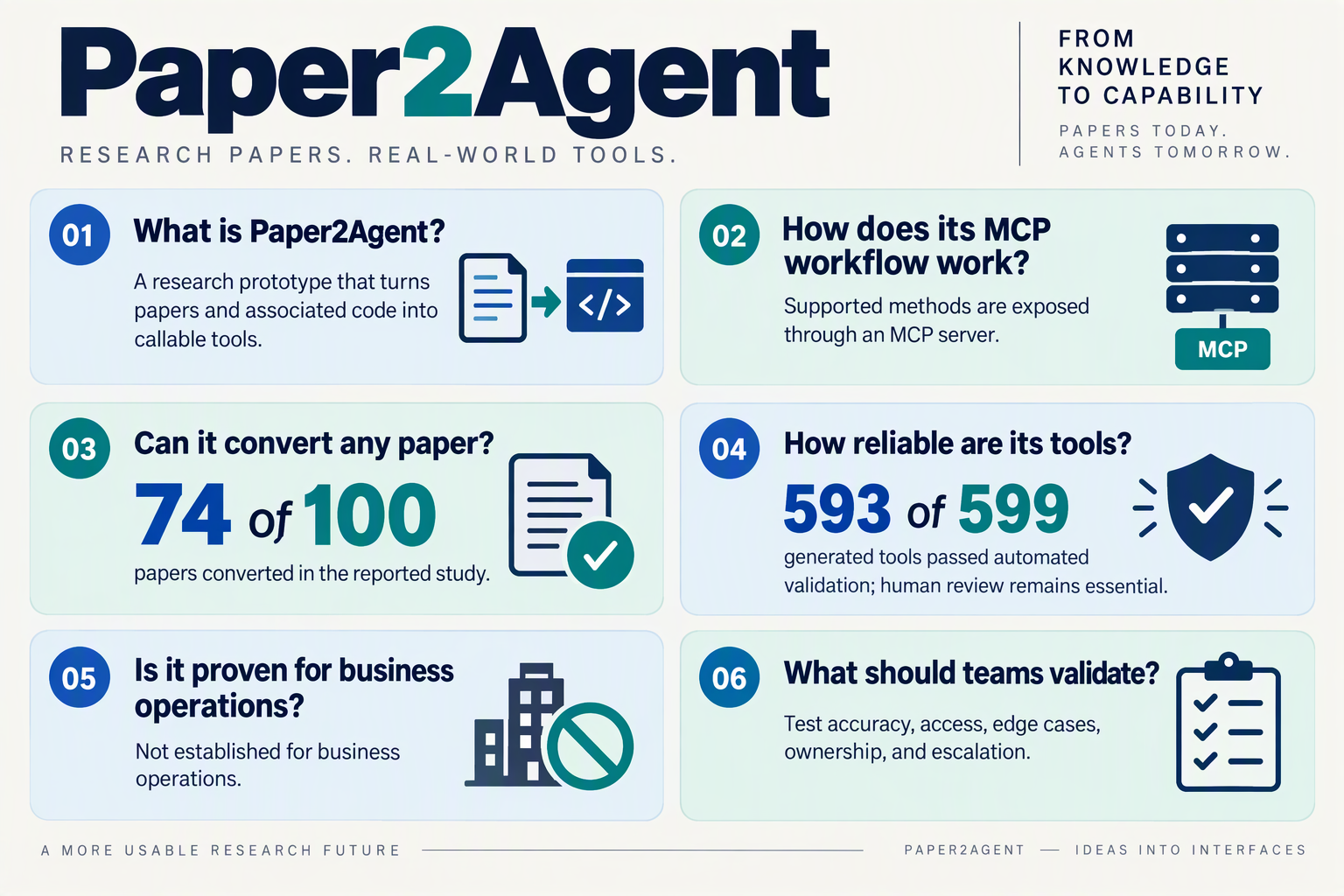
What if a research paper could answer operational questions, rerun its own analysis, and help a team apply its methods to new data? That’s the idea behind Paper2Agent for operations teams: turning papers and their public code into interactive AI agents that make research workflows easier to explore and use.
The shift matters because valuable methods can be difficult to operationalize. A paper may describe an analysis clearly, yet applying it can still mean locating code, installing dependencies, interpreting parameters, and checking whether a result can be reproduced. Paper2Agent proposes packaging a paper’s methods, code, and validation materials as an agent that can answer questions and run workflows. A Nature article on the framework was published on September 16, 2026, bringing fresh attention to the idea of research outputs as usable systems rather than read-only documents, according to Library Journal infoDOCKET.
For operations teams, the opportunity is practical—not just academic. Imagine a team evaluating a forecasting method, applying a published quality-control workflow to incoming data, or letting staff ask an agent how an analysis works before escalating to a specialist. These are potential applications, not guaranteed outcomes: an agent’s usefulness depends on the quality of the source paper and code, the validation behind its outputs, and the safeguards around the data and decisions it touches.
This article will unpack how Paper2Agent works, including its use of the Model Context Protocol (MCP) to expose research workflows as tools that AI assistants can interact with. We’ll look at where agents could reduce friction in research-heavy operations, what teams should verify before trusting results, and the trade-offs involving reproducibility, maintenance, permissions, and human review. The goal is to distinguish a compelling demo from a dependable operational capability.
The broader ecosystem is moving toward MCP-connected AI tools, too. For example, CallMissed provides a hosted MCP server with OAuth sign-in, allowing AI assistants such as Claude to work with its agents, calls, CRM, messaging, and campaigns. That’s one illustration of a larger pattern: specialized capabilities becoming accessible through standardized interfaces. Paper2Agent applies that pattern to research—potentially making methods easier to question, test, and carry into day-to-day work.
How does Paper2Agent turn research papers into interactive AI agents?
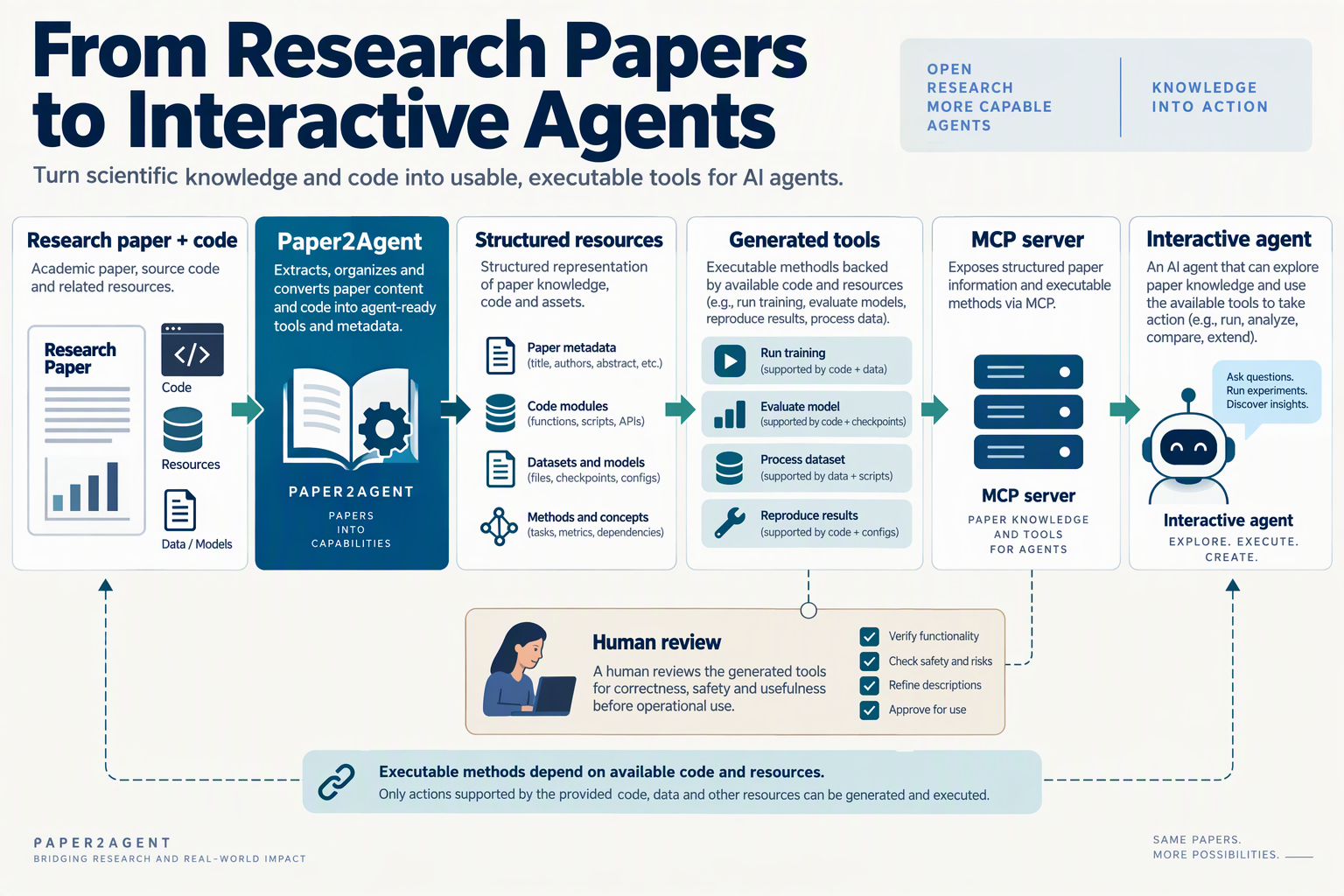
Paper2Agent turns a research paper and its public code into an interactive AI agent by packaging the paper’s methods, executable workflows, resources, and validation materials behind a Model Context Protocol (MCP) server. An AI assistant can then use that server to answer questions about the research, run supported analyses, reproduce outputs, or apply workflows to new data—within the limits of the code and its validation.
What does Paper2Agent package from a research paper?
The key distinction is that Paper2Agent aims to make research methods usable, not merely searchable. A paper describes its approach, while its code and supporting materials can provide the procedures an agent needs to carry out parts of that approach. Paper2Agent brings these pieces together so an assistant can interact with them through tools.
The framework is described as a multi-agent system that converts scholarly work into standardized, interactive agents. Emergent Mind’s overview says the resulting MCP server packages “workflows, code, resources, and validation artifacts.” In practice, the source paper and repository define what an agent can do: if a method is absent from the code, depends on unavailable resources, or is not represented in a runnable workflow, the agent cannot reliably supply it just by being conversational.
How does a paper become an MCP-connected agent?
At a high level, the process moves from research materials to callable tools:
- Identify the source materials. The paper supplies the research question, methods, and intended interpretation; the public code repository supplies implementations and related resources.
- Map methods to workflows. The system identifies which procedures can be exposed as executable tasks, such as running an analysis or generating a figure. The available repository and its setup determine how much of the paper can be operationalized.
- Package tools and supporting information. Workflows, resources, and validation artifacts are organized so an AI assistant can access them through an MCP server.
- Interact and check results. A user can ask a question or request a supported workflow. The agent can call the relevant tool, then return a result or explanation; teams still need to verify that the input, execution, and interpretation are appropriate.
A 2026 overview from Joshua Berkowitz describes Paper2Agent as a way to answer questions, rerun methods, reproduce figures, and apply workflows to new data. These are capabilities the framework proposes—not a guarantee that every paper can be converted into a complete, reliable operational system.
What could this mean for operations teams?
For an operations team evaluating a published quality-control method, an agent could make it easier to ask what inputs the method expects, run an available analysis on a permitted dataset, and inspect its output before deciding whether to use it. That may reduce the friction of locating and interpreting a workflow, but it does not eliminate the need for domain review, data controls, or reproducibility checks.
The Nature article “Reimagining Research Papers as Interactive and Reliable AI Agents” was published on September 16, 2026, according to Library Journal infoDOCKET. Its framing points to a broader shift: research outputs may become systems people can query and test, rather than documents they can only read. For operational use, the practical question is not simply whether an agent can run code; it is whether its tools, assumptions, and validation are clear enough for the team’s decision.
What does the Paper2Agent MCP workflow actually convert?

Paper2Agent does not make a paper executable as a whole: it can expose selected, code-supported methods through MCP tools while keeping the paper’s explanation, required resources, and validation evidence distinct. In practical terms, the paper tells an operations team what a method claims to do; the code determines what can actually run.
What is the difference between a paper’s narrative and executable code?
A paper’s narrative describes a question, method, assumptions, and findings in human-readable form. That helps an assistant explain the work, but prose alone does not define a reliable operation: teams still need to know what inputs the method expects and what steps the implementation performs.
Executable code is the part that can perform a procedure, subject to what the available implementation supports. Paper2Agent is described as connecting research papers and code so an agent can answer questions and run methods; Joshua Berkowitz’s overview also describes reproducing figures and applying workflows to new data as possible uses. Those capabilities depend on the specific paper and code—not every paper supports every use.
What does an MCP tool expose to an operations user?
An MCP tool is a callable interface to a supported action. It gives an AI assistant a structured way to request that action, rather than treating a chat response as if it had performed an analysis. The actual tool names, parameters, and return formats depend on the implementation; they should be inspected rather than assumed.
For example, an operations team might want to run a paper’s documented quality-control procedure on a sample dataset. The following is illustrative pseudocode, not a verified Paper2Agent tool name or schema:
{
  "tool": "run_qc_pipeline",
  "input": {
    "dataset": "sample_batch.csv",
    "threshold": 0.85
  }
}
The request’s boundary is important: it supplies a dataset and a threshold only if the implemented workflow accepts those inputs. A possible response might contain a status, summary metrics, and a generated artifact reference—but those fields are examples, not guaranteed outputs. The tool cannot be presumed to accept other file types, invent missing measurements, or apply the method to a different process just because the user asks in natural language.
What resources and validation artifacts should teams inspect?
Resources are supporting materials needed to understand or use a workflow, such as documentation, tutorials, or project files. They provide context, but their presence does not prove that the implementation is complete or suitable for an organization’s data.
Validation artifacts help teams check what the workflow produces. Depending on the available materials, these might include reference figures or reproducible outputs. The Paper2Agent framework overview from EmergentMind describes packaging workflows, code, resources, and validation artifacts in an MCP server; it does not mean every converted project has the same artifacts or passes every operational test.
Before relying on a workflow, operations teams should check:
- Whether its code implements the method the paper describes.
- Which input formats, parameters, and assumptions are supported.
- Whether available reference outputs can be reproduced.
- Whether a qualified person must review results before they affect decisions.
The alphaXiv description frames Paper2Agent as a way to make research outputs more interactive and usable. That is a useful distinction: MCP can make supported actions callable, while evidence and human review determine whether those actions are appropriate for a particular operation.
What did the Paper2Agent study measure—and what did it not prove?
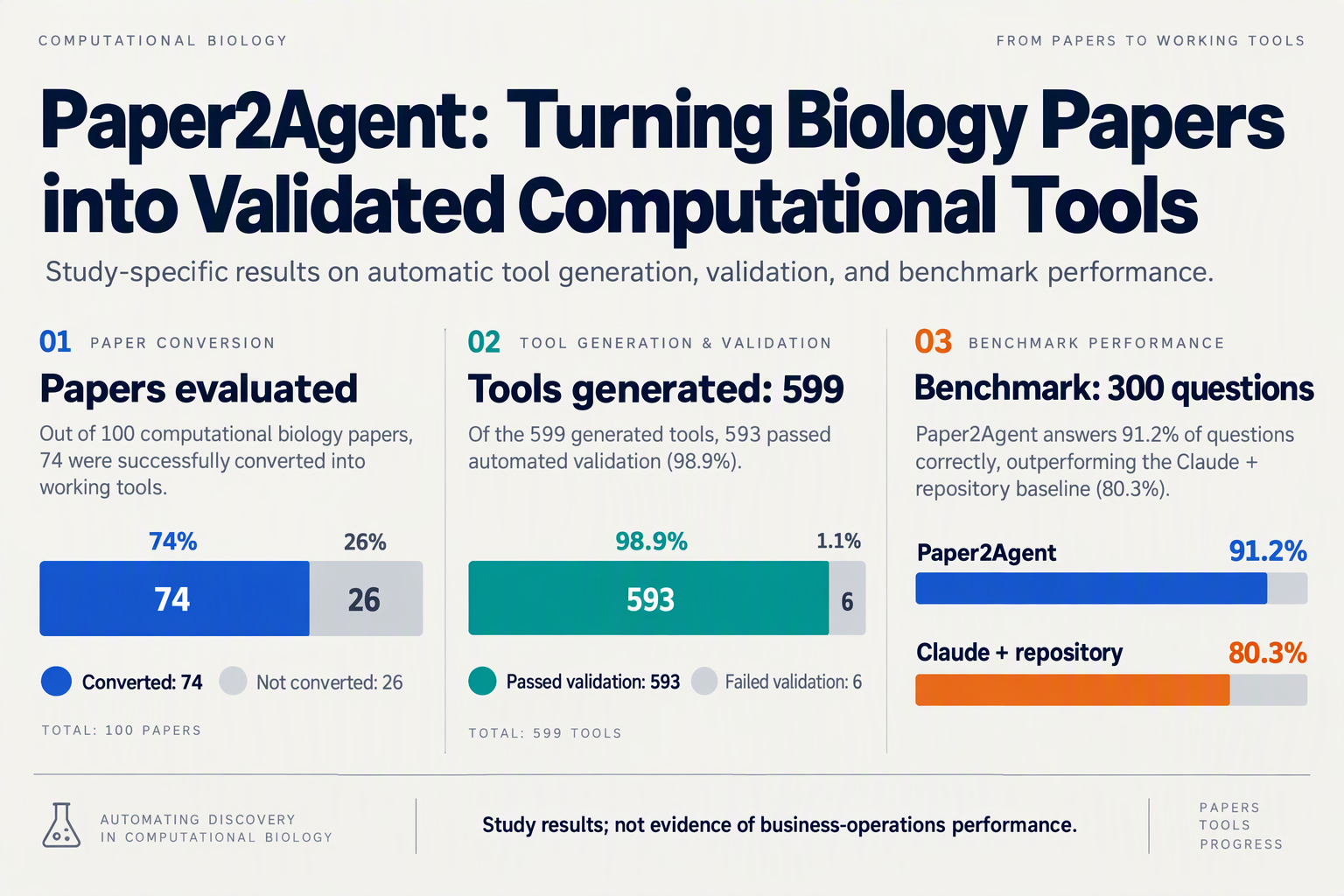
The Paper2Agent study reports measurable conversion, tool-validation, and question-answering results—but those results do not establish reliable performance in business operations or production. The denominators matter: the paper reports outcomes across 100 computational-biology papers, 599 generated tools, and a separate 300-question benchmark.
What did the Paper2Agent study measure?
The Nature article “Reimagining Research Papers as Interactive and Reliable AI Agents,” published September 16, 2026, reports the following results:
| Measure | Reported result | Denominator and interpretation | What it does not establish |
|---|---|---|---|
| Paper conversion | 74 papers converted; 26 failed | 100 computational-biology papers attempted | A 74% success rate for papers in other disciplines, or for every paper with usable code |
| Generated tools | 599 tools generated | Total tools reported by the study | That every generated tool works correctly in every setting |
| Automated validation | 593 of 599 tools passed | About 99% of the generated tools passed the study’s automated checks | Independent scientific correctness, safety, or production reliability |
| Question answering | 91.2% accuracy, versus 80.3% for a Claude-plus-repository baseline | A 300-question benchmark; the reported comparison is specific to that benchmark | Better performance on all research questions, business tasks, or operational decisions |
These measures answer different questions. The 74-of-100 figure describes whether the conversion process succeeded on the papers attempted; the 593-of-599 figure concerns generated tools passing automated validation. Neither should be read as proof that 99% of papers converted successfully: the paper-level denominator is 100, and 26 attempts failed.
Likewise, the 91.2% result is benchmark accuracy on 300 questions, not a general accuracy guarantee. The Nature study reports a 10.9 percentage-point advantage over the Claude-plus-repository baseline on that benchmark. Applying that difference to another domain would require new testing.
What do these results not prove for operations teams?
Automated validation and benchmark performance are useful evidence, but they do not by themselves demonstrate that an agent will handle a company’s data, permissions, dependencies, exceptions, or consequences correctly. The study’s computational-biology paper set and question benchmark are not substitutes for tests on an operations team’s actual workflows.
Before using a paper-derived agent in a consequential process, teams should:
- Reproduce a known result and compare the output with the paper or an independently verified reference.
- Test on representative local data, including edge cases and inputs that differ from the original examples.
- Inspect failure behavior, dependencies, access controls, and data handling.
- Keep qualified human review for outputs that could affect customers, compliance, or business decisions.
For teams exploring how agents connect to operational systems, CallMissed offers a hosted MCP server with OAuth sign-in for assistants such as Claude to use CallMissed agents, calls, CRM, messaging, and campaigns, as of September 2026. That integration capability is separate from Paper2Agent’s study results; each workflow still needs independent testing and human oversight before deployment.
How should Paper2Agent operations teams assess a candidate workflow?

Assess a Paper2Agent candidate workflow by checking whether its code is usable, its outputs can be independently validated, and its intended operational use has acceptable risks. A promising demonstration is not enough: teams should confirm that the agent can reproduce the method under their conditions and define where human review remains mandatory.
Is the paper’s code complete enough to run?
Start with the workflow’s prerequisites, not the appeal of its research question. Review the repository, dependencies, input formats, documentation, licenses, and required compute or external services. Then test whether a technically capable team member can run the core analysis from a clean environment using the paper’s documented inputs.
Look for gaps that could block routine use:
- Unclear inputs: Are required fields, units, and data-quality rules specified?
- Hidden dependencies: Does execution rely on unavailable data, credentials, or services?
- Narrow examples: Does the code work only for the paper’s sample dataset?
- Maintenance risk: Is there a realistic owner for dependency updates and failures?
Paper2Agent can package a paper’s workflows, code, resources, and validation artifacts behind an MCP server, but packaging does not repair incomplete code or undocumented assumptions. Treat those as candidate-workflow issues to resolve before a pilot.
Can the workflow reproduce results and handle your data?
Choose one published result as a test case. Run it with the paper’s stated data and parameters, then compare the agent’s output with the paper’s reported result. Record tolerances in advance: exact figure matching may be inappropriate for a stochastic method, while a material difference in a deterministic calculation needs explanation.
Next, use representative operational data that has been approved for testing. Check how the method behaves with missing values, unfamiliar categories, outliers, and changes in data format. Keep the test narrow: a workflow that performs well on the research dataset has not automatically been validated for a new population, process, or decision.
Oddbrief reports that an AlphaGenome agent was spun up in about 45 minutes. That example illustrates how quickly an agent may be assembled; it does not establish that the workflow is accurate, safe, or ready for operational decisions.
What level of risk can the workflow touch?
Map the agent’s potential outputs to the consequences of error. A workflow used to explore trends or draft an analyst’s first-pass summary may be suitable for a supervised pilot. A workflow that could affect safety, customer eligibility, regulatory reporting, or financial decisions needs stronger evidence, traceable inputs, and explicit human approval.
Before launch, define:
- Permitted use: Which questions and data types are in scope?
- Review points: Who checks outputs, exceptions, and consequential recommendations?
- Escalation: What happens when the agent cannot run a method or returns an unexpected result?
- Audit trail: Can the team retain inputs, parameters, code version, and outputs needed to investigate a result?
These controls make the boundary between assistance and decision-making explicit.
Is there an owner after the pilot?
Assign responsibility for monitoring reproducibility, reviewing code or data changes, and deciding when results require revalidation. The Nature article introducing Paper2Agent was published on September 16, 2026, according to Library Journal infoDOCKET; operational adoption still depends on each team’s own evidence and governance.
A useful go/no-go decision is therefore not “Can we make an agent?” but “Can we run this workflow repeatedly, explain its limits, and respond when it fails?” If the answer is yes for a bounded task, proceed with a documented pilot—not an assumption of general reliability.
Where could interactive and reliable AI agents from research papers help operations?
Interactive agents built from research papers could help operations teams apply validated methods to recurring analysis tasks—such as forecasting, quality checks, and anomaly investigation—without requiring every user to reconstruct the research workflow from scratch. They are most useful when a paper includes accessible code, clear inputs and outputs, and tests that let teams check whether the agent behaves as intended.
Which operational workflows are good candidates for research-paper agents?
Good candidates are repeatable, bounded workflows where a published method can be run on defined data and a human can review the result. For example, a quality team might use an agent to explain a paper’s inspection method, run the supported analysis on a new batch of measurements, and show which parameters or assumptions shaped the result.
Other potential uses include:
- Forecasting: compare a published forecasting approach with a team’s current method on historical demand data.
- Anomaly detection: apply a documented method to flag unusual readings for investigation, rather than automatically making operational decisions.
- Process analysis: help analysts explore a research-backed technique and understand its required inputs before adopting it.
- Staff enablement: let employees ask how a workflow works and get answers grounded in the paper and its associated code.
These are possible applications, not proven savings or guaranteed improvements. A paper agent can only run workflows supported by its packaged code and resources; a conversational interface does not make a method more applicable to a team’s data.
How could an agent make research easier to use day to day?
A Paper2Agent-style system can expose research workflows through a Model Context Protocol (MCP) server, so an AI assistant can ask questions and call supported tools. That can turn a multi-step handoff—find the paper, locate the code, install dependencies, interpret parameters—into a more guided interaction. The underlying analysis still needs appropriate data, software, and review.
The opportunity is timely: Library Journal infoDOCKET reported that the Nature article “Reimagining Research Papers as Interactive and Reliable AI Agents” was published on September 16, 2026. Its focus reflects a shift from treating research as a document to making methods easier to interact with and test. For operations leaders, the practical question is not simply whether an agent can answer questions, but whether it can produce traceable, repeatable results on relevant inputs.
What should operations teams verify before relying on one?
Treat an agent as an interface to a method—not as proof that the method is valid for your business. Before a pilot, teams should establish:
- Fit: Do the paper’s assumptions, data types, and operating conditions match the use case?
- Reproducibility: Can the packaged workflow reproduce the paper’s stated outputs using the documented inputs?
- Validation: Are there test cases and expected results, including cases where the method should fail or abstain?
- Governance: Are data access, retention, permissions, and human approval defined?
- Maintenance: Who updates dependencies and checks whether later changes alter results?
Where should human review remain essential?
Human review should remain in place when an output could affect safety, compliance, customer treatment, or costly operational choices. Start with a limited pilot: compare the agent’s results with an established process, log disagreements, and require an accountable person to approve consequential actions. Paper2Agent can lower the effort of exploring research methods, but operational reliability depends on the source method, implementation, validation, and controls around its use.
What do the researchers’ findings mean for operational ownership and trust?

The researchers’ findings suggest that Paper2Agent can make research methods more accessible and executable, but they do not transfer operational accountability to the agent. Teams still need to own validation, permissions, maintenance, and decisions made using its outputs.
Who owns an operational Paper2Agent?
Ownership stays with the organization deploying the agent—not with the paper’s authors or the AI assistant. Paper2Agent’s reported approach packages a paper, public code, workflows, resources, and validation artifacts behind a Model Context Protocol (MCP) server. That can make a method callable, but it does not assign responsibility for data quality, access, maintenance, or decisions. Emergent Mind describes Paper2Agent as a multi-agent system for creating standardized, interactive research agents.
For operations teams, treat an agent as a maintained software service, with named owners for:
- Method stewardship: a subject-matter expert who can explain the study’s assumptions and when its method is appropriate.
- Technical stewardship: an engineer or platform owner who manages dependencies, permissions, deployment, and failure handling.
- Decision accountability: an operational leader who decides whether an output may inform a workflow and who reviews consequential decisions.
This distinction matters because reproducibility is not the same as operational suitability. A workflow may reproduce a published figure using the authors’ data yet behave differently on company data with other formats, missing values, or a different population. Teams should document where the agent has been tested, which inputs it accepts, and which cases require escalation.
How should teams decide whether to trust its answers?
Trust should be earned in stages: verify the source and implementation, test the workflow on representative data, then limit how outputs can influence operations. The Nature article “Reimagining Research Papers as Interactive and Reliable AI Agents” was published on September 16, 2026, according to Library Journal infoDOCKET. Its framing signals a move toward research methods as interactive systems; it does not mean every generated agent is validated for every organization or use case.
A pre-deployment review should ask:
- Can the result be traced? Keep the paper, code version, input data, parameters, and output together so reviewers can reconstruct how a result was produced.
- Does the workflow reproduce known results? Compare agent-run outputs with examples or figures reported in the paper. Investigate discrepancies instead of assuming they are harmless.
- Does it generalize to local conditions? Test representative operational data, including edge cases and incomplete records. Distinguish “matches the paper” from “works reliably here.”
- What can the agent do? Start with read-only or sandboxed access. Require approval before it changes records, triggers downstream actions, or informs high-impact decisions.
- Who responds when it fails? Set an escalation path, a rollback or disable procedure, and a review schedule for code, dependencies, and the underlying research.
What is the right role for human review?
Human review should be strongest where errors are costly, hard to reverse, or difficult to detect. Paper2Agent can make a method easier to interrogate and execute, but a fluent explanation is not proof that the computation is correct. Ask the agent to show the inputs, parameters, and intermediate outputs behind an answer, then have a qualified reviewer check them before operational use.
The practical takeaway for operations leaders is not “delegate the work to an agent.” It is that research methods can be exposed through a consistent interface while trust remains a governance and validation task. Clear ownership lets teams explore potential efficiency gains without confusing accessibility with assurance.
What should your team do before piloting Paper2Agent?
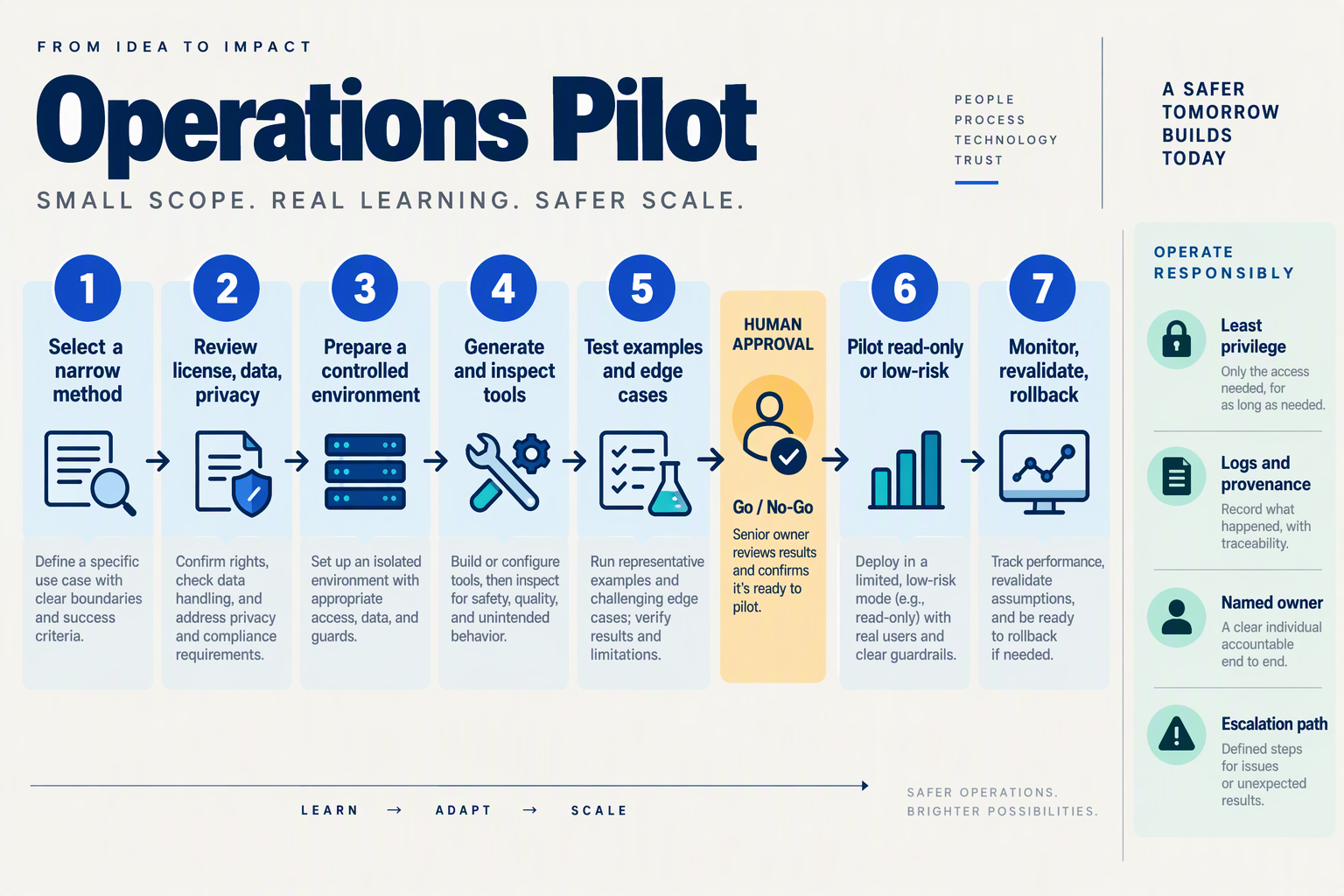
Before piloting Paper2Agent, choose one bounded workflow and verify its source materials, outputs, data permissions, and human-review path. Treat the agent as a research workflow to evaluate—not as an authority—because its operational reliability depends on the paper, code, and validation evidence available for that workflow.
Pilot-readiness checklist
Paper2Agent is described as packaging a research paper’s methods, public code, workflows, and validation materials behind an MCP server. The Nature article on the framework was published on September 16, 2026, according to Library Journal infoDOCKET. Before adopting that approach for operations, use the checks below to decide whether a particular method is ready for a controlled trial.
| Pilot gate | What to verify | Evidence to collect | Decision |
|---|---|---|---|
| Operational fit | The paper addresses a specific, recurring team question or task. | A short use case naming the user, input, expected output, and current process. | Proceed only if the workflow has a clear operational purpose. |
| Source readiness | The relevant paper, code, dependencies, and instructions are accessible and sufficiently documented. | A source inventory and notes on missing files, setup steps, or unclear parameters. | Pause if the method cannot be run or its requirements cannot be understood. |
| Reproducibility | The agent can reproduce a documented example before it is asked to handle new data. | A comparison of the agent’s run with a paper, code, or tutorial reference result. | Investigate discrepancies before testing operational cases. |
| Output boundaries | Users can tell what the agent did, what inputs it used, and where the method’s limits apply. | Sample outputs that identify assumptions, parameters, and any unsupported cases. | Keep outputs advisory if limitations are unclear. |
| Data and access | Pilot data is approved for the tools and environment involved; access is limited to the people and records needed. | Data-owner approval, access rules, and a documented test-data plan. | Do not use sensitive production data without authorization. |
| Human oversight | A named subject-matter reviewer can check results and handle failures or ambiguous cases. | Review steps, escalation contact, and a log of issues and corrections. | Expand only after the review process works in practice. |
How should a team run the first pilot?
Start with one workflow, one owner, and a small set of test cases. Compare the agent’s behavior with the existing method; don’t judge success by how fluent its explanations sound. Emergent Mind describes Paper2Agent as packaging workflows, code, resources, and validation artifacts, but teams still need to inspect whether those materials support their own use case.
A practical sequence is:
- Select a low-risk task where mistakes can be reviewed before they affect customers, compliance, or operational decisions.
- Run known examples first, recording inputs, parameters, outputs, and differences from reference results.
- Test realistic edge cases such as missing fields, unusual values, or questions outside the paper’s scope.
- Ask reviewers to classify failures—for example, reproducibility, unclear instructions, unsupported inputs, or incorrect interpretation.
- Set a go/no-go review with the workflow owner and subject-matter reviewer before expanding access or using live data.
The pilot should produce a decision, not just a demonstration: continue, revise the workflow, or stop. Record the reasons, unresolved risks, and conditions for any next phase so that an interactive research agent earns trust through evidence rather than novelty.
Frequently Asked Questions
What is Paper2Agent for operations teams?
How does Paper2Agent turn a research paper into an AI agent?
Can Paper2Agent rerun a paper’s analysis on my operations data?
What research papers are suitable for Paper2Agent?
How can operations teams validate a Paper2Agent before relying on it?
Does Paper2Agent replace analysts or operations specialists?
Conclusion
Paper2Agent points toward a more practical relationship between research and operations: papers and public code could become interactive systems that explain methods, run supported analyses, and help teams test workflows on new data. The promise is real, but usefulness depends on whether the underlying code works and the results are carefully validated.
Key takeaways:
- Paper2Agent packages a paper’s methods, executable workflows, resources, and validation materials behind a Model Context Protocol (MCP) server.
- Operations teams could use agents to explore research methods, reproduce analyses, or assess how a workflow applies to their data.
- Reproducibility is not automatic: teams still need to check outputs, manage permissions, maintain the underlying tools, and keep human review in the loop.
- The framework reflects a broader shift toward making specialized capabilities accessible through standardized interfaces.
Looking ahead, watch for evidence that these agents remain reliable beyond demonstrations: whether results can be reproduced, workflows stay maintained, and teams can apply appropriate safeguards. CallMissed offers another example of the MCP trend, with a hosted server that lets AI assistants such as Claude work with its agents, calls, CRM, messaging, and campaigns. To explore how AI communication infrastructure is evolving, visit CallMissed. What would your team need to verify before trusting a research agent with a real operational workflow?
Related Reading
- July 2026 AI Agent Updates: Gemini for Support Teams
- AI Agents from Pilot to Production: Support Playbook
- How to Write Prompts for AI Agents: Support Guide 2026
Sources
Discussion
Related Posts


Ready to automate customer conversations?
Launch AI voice agents and WhatsApp bots with CallMissed — one API, 22+ Indian languages.