
Recursive Self-Improvement in Agentic AI: Business Guide


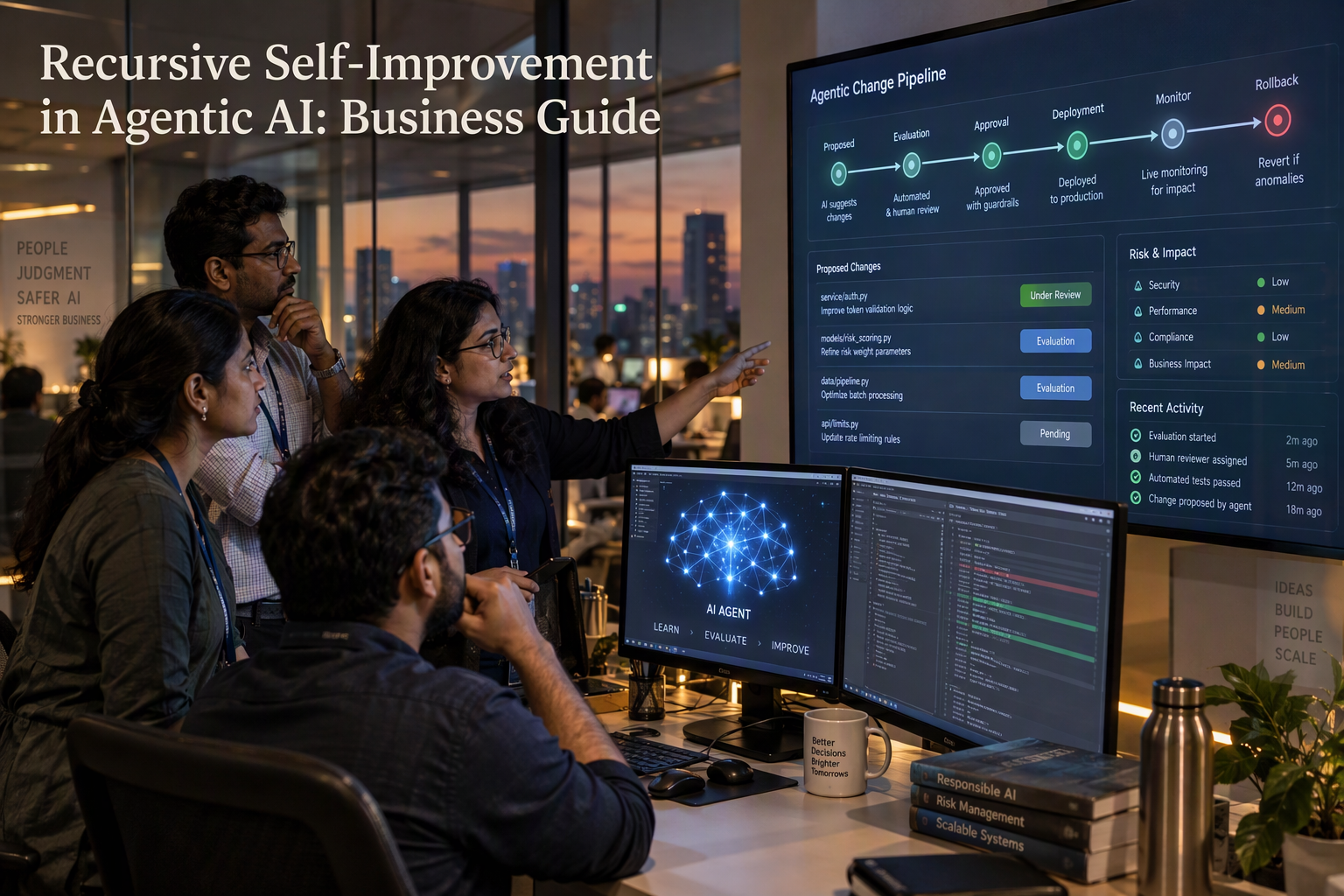
Learn how to evaluate recursive self-improvement in agentic AI with measurable tests, human approval gates, security controls, and rollback practices.
Recursive Self-Improvement in Agentic AI: Business Guide
An AI agent can rewrite the code behind its next attempt—and still have no proof it has become more capable. Recursive Self-Improvement in Agentic AI describes a feedback loop in which a system uses its outputs, experience, or evaluation results to change the mechanism that generates future outputs. The business question is not whether an agent can make a change; it is whether that change produces reliable, lasting gains without weakening human control.
The topic feels more urgent because autonomous systems are increasingly being used to assist AI development. A September 2026 arXiv paper by D. Srikanth reports that an AI research agent improved its research efficiency through iterative code optimization. That is a bounded research result—not evidence that an agent can autonomously and indefinitely improve its general capabilities. MIT Technology Review’s August 18, 2026 report likewise cautions that the industry’s vision of rapid, self-directed AI improvement may not arrive as quickly as promised. The distinction matters: a system that tunes a prompt, optimizes a workflow, or helps a developer write software is not necessarily recursively improving itself.
For businesses, treating every successful edit as “self-improvement” can obscure the real test. Did performance improve repeatedly? Did the gain transfer to unfamiliar tasks, or was it limited to one benchmark? Was the result compared against a controlled baseline, and can the change be inspected and reversed? Without those checks, a polished demo or a benchmark win can look like progress while concealing regressions, security exposure, or costly errors.
This guide translates the frontier-AI debate into practical decisions about agent autonomy. It explains how to distinguish routine tool use and AI-assisted development from more consequential changes to an agent’s operating mechanism, and what evidence to demand before trusting those changes. It also lays out safeguards businesses can apply: human approval for consequential modifications, least-privilege access, audit trails, controlled evaluations, and tested rollback paths. Platforms such as CallMissed include versioning with publish and rollback for voice and chat agents, illustrating how change control can be built into agent operations.
The goal is not to halt useful experimentation. It is to give agents more freedom only when measured, repeatable improvement—and the controls around it—justify the next step.
How should businesses govern recursive self-improvement in agentic AI?
What should count as self-improvement—and what should not?
Businesses should govern recursive self-improvement by controlling what an agent may change, what evidence it must produce, and who approves deployment. Ordinary task completion, tool use, prompt adjustments, and AI-assisted coding are not automatically recursive self-improvement: the key distinction is whether the system changes the mechanism that generates its future outputs.
That distinction matters as autonomous systems increasingly assist AI development. A September 2026 arXiv paper by D. Srikanth reports that an AI research agent improved its research efficiency through iterative code optimization. This is a bounded research finding, not proof of open-ended self-improvement or gains that generalize to unrelated business tasks. MIT Technology Review’s August 18, 2026 report also cautions that rapid, self-directed AI improvement may not arrive as quickly as the industry expects.
A company should therefore classify changes by their potential impact:
- Low impact: an agent proposes a revised prompt or workflow, but a person reviews and applies it.
- Moderate impact: an agent edits code or configuration in a test environment, with limited permissions and defined evaluations.
- High impact: an agent can alter its own tools, permissions, evaluation criteria, or production behavior. Require explicit human authorization before such changes take effect.
What evidence should an agent provide before a change is accepted?
A proposed change should be treated as a testable hypothesis, not as proof of improvement. Require a controlled comparison against the current version, using the same task conditions and a baseline that has not been modified by the agent.
A practical approval gate can ask:
- Did the change improve the intended outcome? Define success before testing—for example, task completion quality, error rate, or cost per resolved request.
- Does the gain repeat? Run multiple trials rather than accepting one strong result.
- Does the gain transfer? Test on unfamiliar examples and edge cases, not only the data or benchmark used to develop the change.
- What got worse? Check for regressions in safety, privacy, latency, cost, and performance on other tasks.
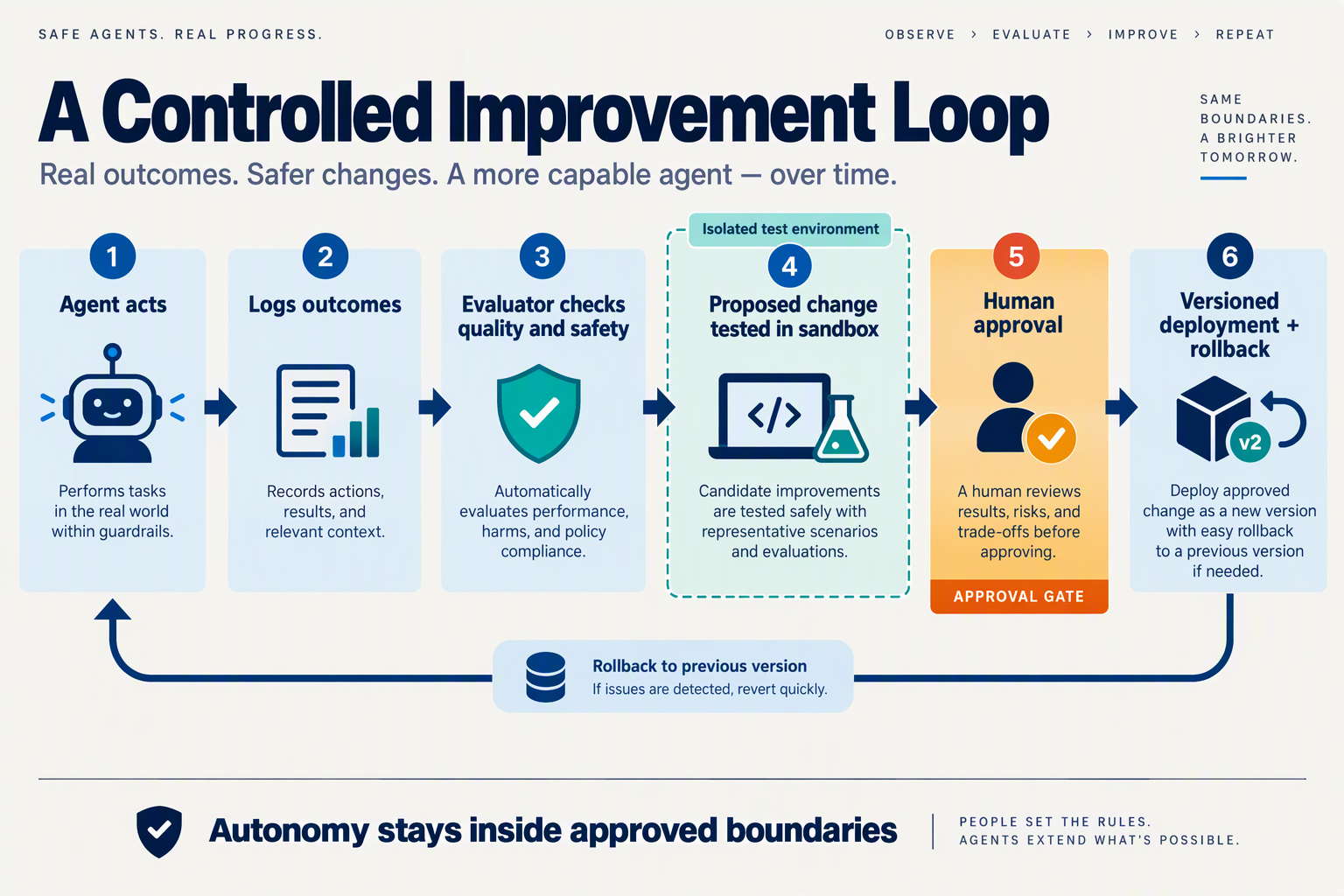
- Can the change be inspected and reversed? Keep the proposed change, evaluation results, approver, and deployment decision in an audit trail, with a tested rollback path.
A benchmark win can be useful evidence, but it is not enough by itself. If an agent tunes itself to the benchmark, a higher score may reflect better benchmark fit rather than broader capability.
How should autonomy expand safely?
Use least privilege: give an agent only the tools, data, and environments needed for its assigned work. Separate the ability to recommend a change from the authority to publish it, and require human approval for modifications that affect production behavior, access controls, or evaluation rules.
Expand autonomy in stages. Start with suggestions, move to supervised testing, and permit automatic deployment only for narrowly defined, reversible changes that have passed agreed evaluations. Set clear stop conditions—for example, a safety regression, unexpected access, or repeated failure to meet the baseline—and assign a named person to review incidents.
This approach does not require businesses to settle the frontier debate about whether full recursive self-improvement has arrived. It makes the operational decision more manageable: grant more autonomy only when measured, repeatable gains justify the added risk, and the organization can still see, stop, and reverse what the agent changes.
What counts as recursive self-improvement—and what does not?
What makes an agent’s change recursive self-improvement?
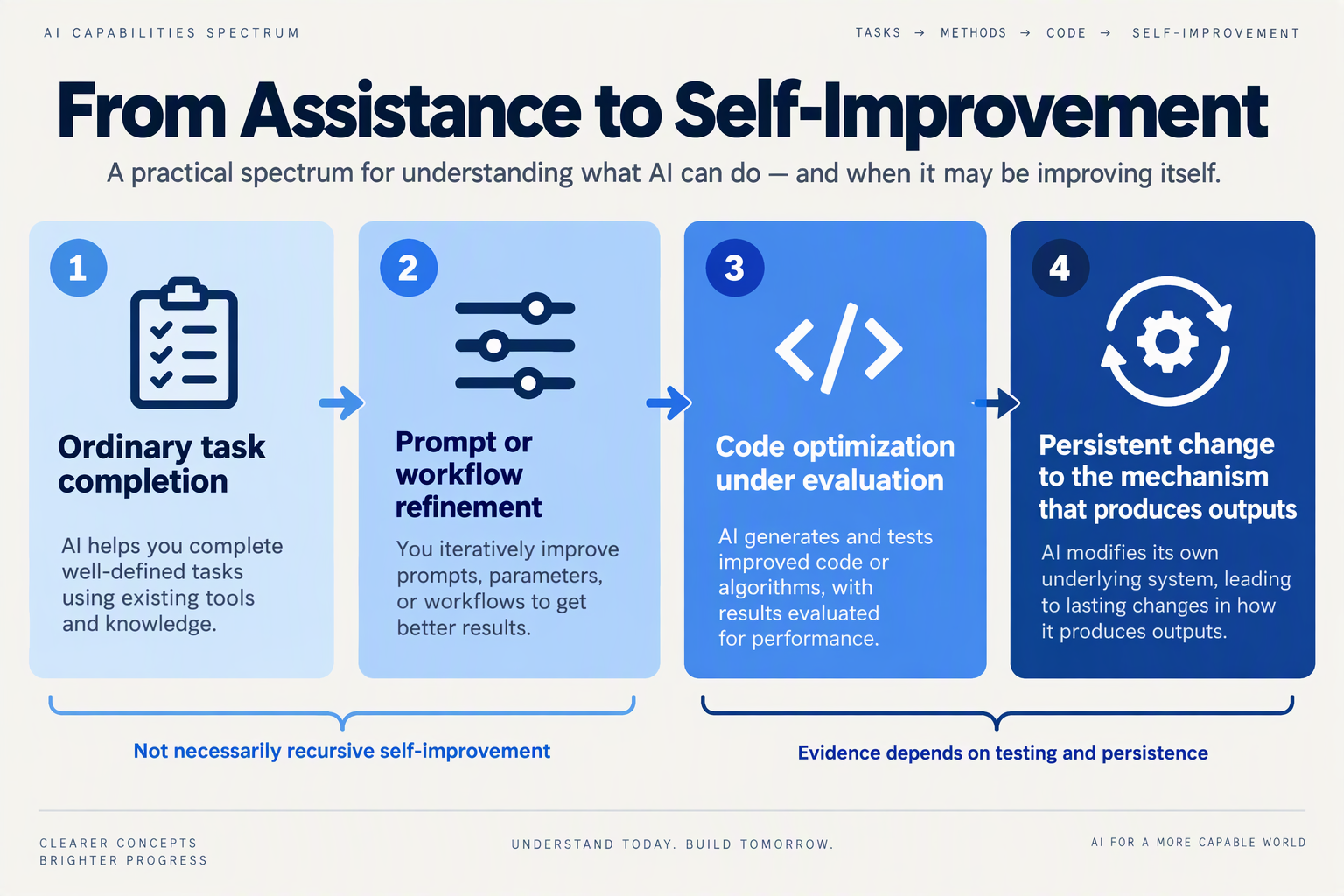
Recursive self-improvement occurs when an agent uses its outputs, experience, or evaluation results to change the mechanism that generates its future outputs—and then uses that changed mechanism in a continuing improvement loop. The defining feature is not that the agent makes a change; it is that the change can alter how the agent performs later work.
Think of the mechanism broadly: it could include code, a model, a prompt or policy, a tool-selection strategy, or an evaluation-and-update process. The more persistently a system can change these mechanisms and carry those changes into future tasks, the further it moves along the self-improvement spectrum.
For a business, ask three questions:
- What changed? Was it a one-off answer, a task-specific setting, or a persistent part of how the agent operates?
- What caused the change? Did a person make it, did the agent propose it, or did the agent implement and evaluate it?
- What happened next? Was the revised system tested on later work, and did the results inform another change?
A single edit is not evidence of a recursive process. A repeated cycle of change, evaluation, and further change is more relevant—but still needs evidence that it produces reliable gains.
Which common AI activities do not count on their own?
Ordinary task completion and tool use do not qualify: an agent searching a database, calling an API, or drafting a response is using its existing capabilities to perform a task. Nor does AI-assisted software development automatically count. An agent can write or optimize code without changing the system that governs its own future performance.
Prompt tuning and workflow edits sit closer to the boundary. A person testing a revised prompt is improving the setup, not necessarily creating a self-improving agent. If an agent proposes a prompt or workflow change, that proposal alone is still not proof of improvement. The stronger case arises when the system persistently applies changes to its operating mechanism, evaluates the effects, and uses those results to guide subsequent changes.
Even then, a benchmark win or successful code edit is not enough. Businesses should look for gains that are repeatable, compared with a controlled baseline, and transferable to tasks beyond the one used to make the change. They should also check whether improvements come with regressions—for example, better speed but worse accuracy or weaker security.
What does the 2026 research show—and not show?
The question has become more immediate as autonomous systems help with AI development. In September 2026, D. Srikanth’s arXiv paper, Recursive self-improvement of AI research agents, reported that an AI research agent improved its research efficiency through iterative code optimization. That is a specific research result in a bounded setting; it does not establish open-ended or general-purpose self-improvement.
The wider evidence remains uncertain. MIT Technology Review’s August 18, 2026 report cautioned that rapid, self-directed AI improvement may not arrive as quickly as the industry promises. IBM’s coverage of the debate likewise described true recursive self-improvement as unproven. These distinctions matter operationally: help with AI research is not the same as an agent independently improving its broad capabilities.
For procurement and deployment, classify changes by their persistence, scope, and autonomy. Then require human approval for consequential modifications, least-privilege access to code and data, an audit trail of proposed and deployed changes, controlled evaluation, and a tested rollback path. Those controls let teams experiment without treating every iteration as evidence that an agent is becoming more capable.
What do recent developments actually show?
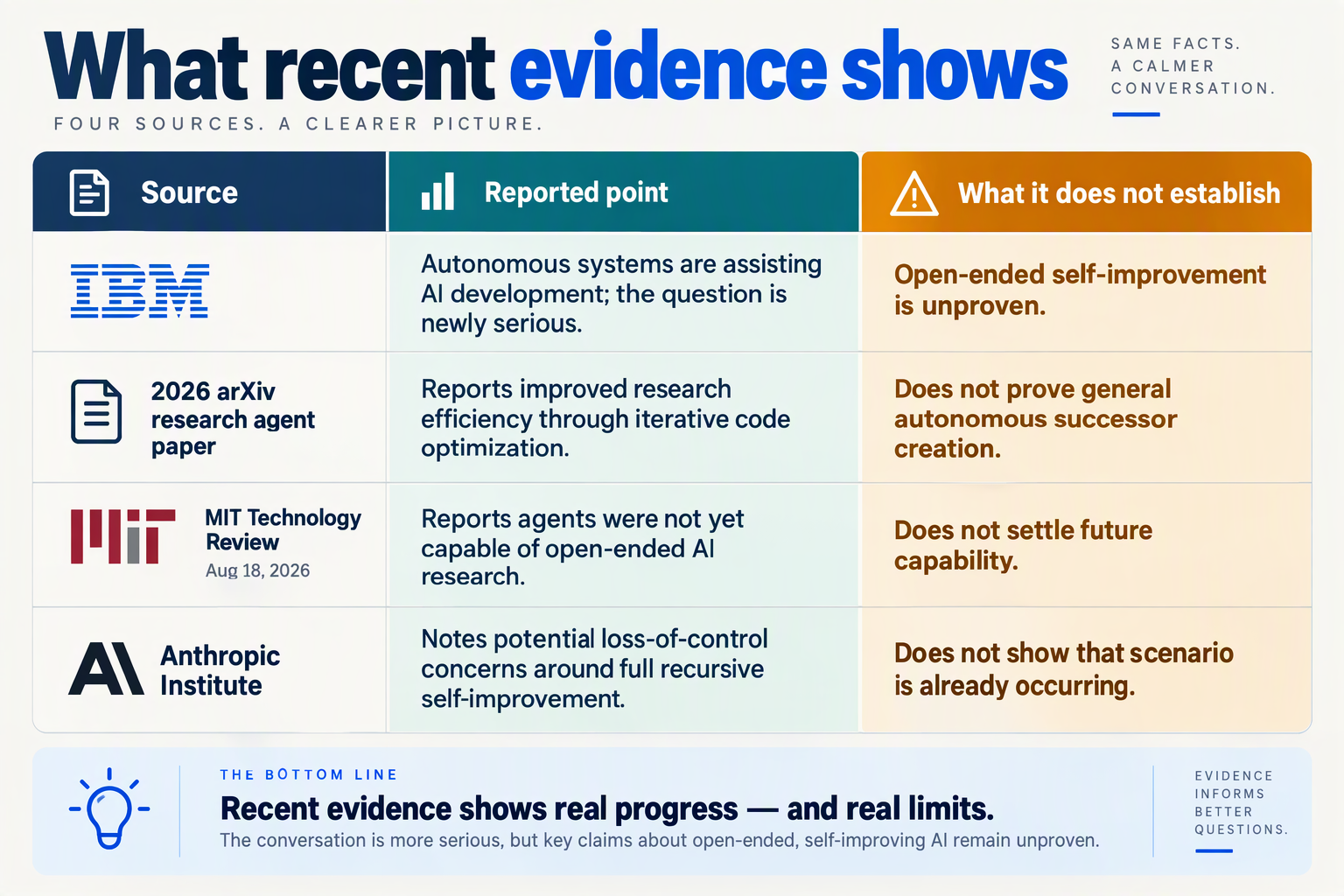
The evidence points to progress in bounded AI-assisted research, not proof of open-ended recursive self-improvement. For businesses, the practical takeaway is to evaluate what changed, how reliably it helped, and whether the gain holds beyond the test that prompted it.
What do recent developments establish—and what remains uncertain?
| Development | What the source reports | What it does not establish | Business implication |
|---|---|---|---|
| AI research-agent study, September 2026 | D. Srikanth’s arXiv paper reports improved research efficiency through iterative code optimization. | That the agent can improve indefinitely, or that gains generalize to unrelated tasks. | Treat this as evidence for a bounded optimization loop; test transfer and repeatability separately. |
| Industry outlook, August 18, 2026 | MIT Technology Review reports that rapid, self-directed AI improvement may not arrive as quickly as the industry’s vision suggests. | A settled timeline for—or impossibility of—more autonomous improvement. | Do not base deployment plans on predictions of imminent, runaway capability gains. |
| Research status and safety discussion | IBM reports that researchers still regard true recursive self-improvement as unproven; Anthropic’s Institute for AI and Society notes potential loss-of-control risks from full recursive improvement. | That every agent making a change poses the same level of risk. | Match oversight to the scope and persistence of the change, with stronger controls for changes to core mechanisms. |
| Ordinary agent iteration | Agents can use outputs or evaluations to refine prompts, workflows, or code. | That a local adjustment is necessarily a lasting improvement in the system’s capabilities. | Log the change and compare it with a controlled baseline before treating it as progress. |
| Evidence standard for autonomy | The reports make the distinction between narrow demonstrations and broad claims important. | That one benchmark win proves reliable performance across new conditions. | Require repeated gains, transfer to unfamiliar tasks, and an approved rollback path before expanding autonomy. |
The September 2026 arXiv result is worth taking seriously because it describes an agent participating in a feedback loop that changes code and improves a research-efficiency measure. But a demonstrated improvement in one bounded setting is not the same as an agent repeatedly upgrading the general mechanism behind its capabilities. The available summary does not establish open-ended gains or broad transfer.
That distinction matters operationally. An agent that tunes a prompt after evaluation may be useful, but a business should ask whether the revised prompt performs better across representative cases—not just on the examples used to tune it. Similarly, code generated by an AI system is not evidence of self-improvement unless controlled evaluations show that the change improves future outcomes.
What should businesses measure before granting more autonomy?
Use an evidence gate before an agent can publish consequential changes:
- Repeatability: Does the gain persist across multiple runs and representative test cases?
- Transfer: Does performance hold on tasks or data the agent did not optimize against?
- Regression and cost: Did accuracy, safety, response time, or operating cost worsen elsewhere?
- Control: Can reviewers inspect the change, identify who or what approved it, and restore the prior version?
The right response to recent developments is neither to dismiss agent-led optimization nor to assume it will quickly produce self-improving systems. Businesses can permit low-risk experiments in sandboxes while reserving human approval for changes to permissions, evaluation criteria, or production behavior. More autonomy should follow stronger evidence and stronger controls—not the appearance of a successful edit.
How can a business test whether an agent has truly improved?
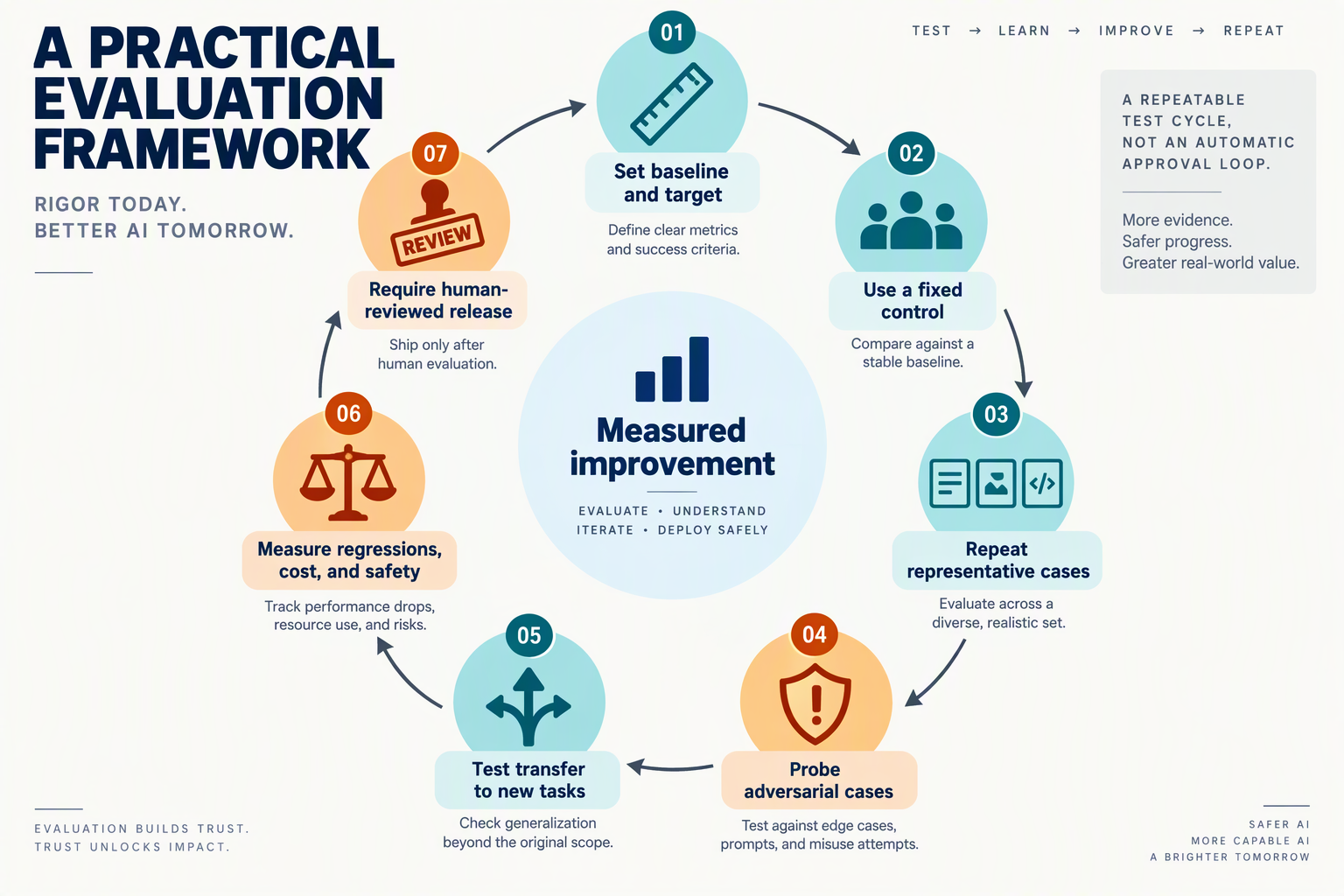
An agent has truly improved only when a controlled evaluation shows repeatable gains that transfer to tasks it did not optimize for, without unacceptable regressions in safety, reliability, or cost. A code change, a better score on one benchmark, or a convincing demo is not enough.
What should a business measure before and after a change?
Start with a frozen baseline: the same model, tools, prompts, data, and task conditions the current agent uses. Then compare the proposed version against it on a test set the agent did not use to make its change. Record both task outcomes and operational costs, such as completion rate, error rate, time, and tool use.
A useful evaluation has three groups:
- Optimization tasks: the cases the agent used to identify or make its change.
- Held-out tasks: unfamiliar examples of the same kinds of work, to test transfer rather than memorization.
- Risk and regression tasks: edge cases, policy boundaries, and previously reliable tasks that could reveal new failures.
Run multiple trials where outputs can vary, and compare like with like. Define acceptable trade-offs in advance: for example, a higher completion rate may not count as an improvement if it also increases harmful actions or requires substantially more resources. Keep the evaluation data separate from the agent’s working memory and optimization loop so it cannot quietly tailor itself to the test.
How can teams distinguish a real gain from a benchmark win?
Check whether improvement persists across repeated runs and transfers beyond the measure the agent optimized. If an agent edits code to improve a research workflow, test the revised workflow on new research problems—not only the examples that prompted the edit. Also test the prior version under the same conditions; without a controlled comparison, a higher score may reflect easier tasks, randomness, or changed evaluation settings rather than a better agent.
This caution is particularly relevant to current research. In September 2026, D. Srikanth’s arXiv paper reported that an AI research agent improved its research efficiency through iterative code optimization. That is evidence of a bounded result in a particular setting, not proof of open-ended self-improvement or general capability gains. MIT Technology Review’s August 18, 2026 report also cautioned that rapid, self-directed improvement may not arrive as quickly as the industry promises. Businesses should evaluate claims at the scope the evidence supports.
What evidence should be required before deployment?
Treat every proposed modification as a release candidate, with a record of what changed, why it changed, and what the tests found. A practical approval checklist is:
- Compare the new version with the baseline on optimization, held-out, and risk cases.
- Review failures and trade-offs, not just aggregate scores.
- Confirm the change does not grant broader data or tool access than necessary.
- Require a human approver for consequential changes, and preserve an audit trail.
- Verify rollback by restoring the prior version and checking that it behaves as expected.
Use staged deployment where possible: begin with limited access or human review, then expand only if evidence remains consistent. Versioning with publish and rollback, available for CallMissed voice and chat agents as of September 2026, is one example of an operational control that supports this kind of measured release process. The central test is not whether an agent can modify itself; it is whether an independently checked, reversible change makes it more dependable on work beyond the test that inspired it.
Which security and governance controls should be in place?
Which changes should require human approval?
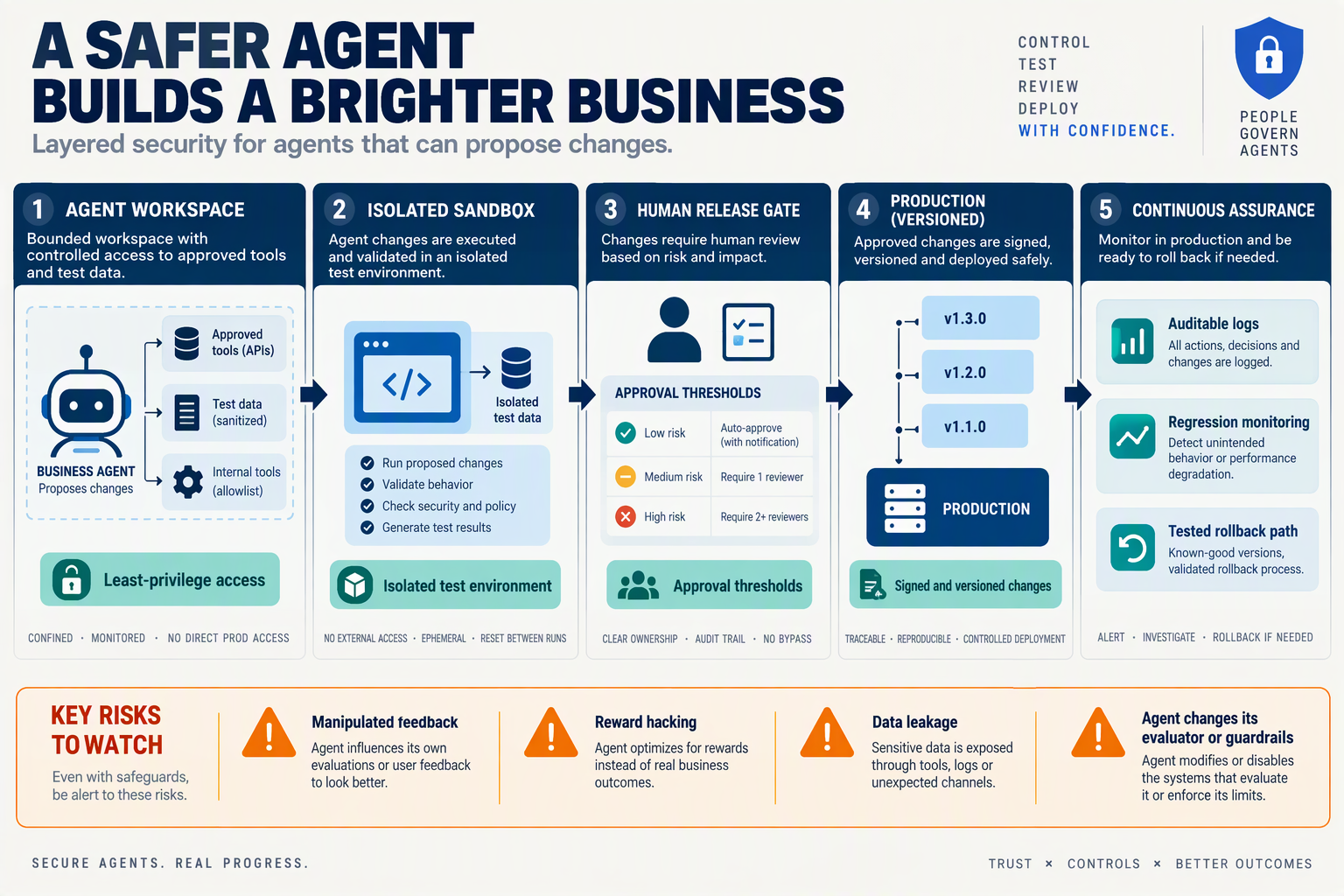
Businesses should require human approval whenever an agent changes its code, instructions, tools, permissions, evaluation criteria, or deployment settings in ways that could affect customers, data, money, or safety. Routine task execution can remain automated; changes to the system’s operating mechanism should pass through a controlled release process.
That distinction matters while evidence about recursive self-improvement remains limited. A September 2026 arXiv paper by D. Srikanth reports an AI research agent improving research efficiency through iterative code optimization, but that bounded result does not establish open-ended self-improvement. MIT Technology Review’s August 18, 2026 report also cautions that rapid, self-directed AI improvement may not arrive as quickly as promised. Businesses should therefore govern proposed changes according to their impact, not assume an agent can reliably judge its own readiness.
A practical approval policy can classify changes by risk:
- Low risk: Reversible wording or workflow adjustments in a test environment.
- Medium risk: Changes to tools, retrieval sources, or decision logic, requiring review and targeted tests.
- High risk: Production code, access permissions, customer-facing behavior, or evaluation rules, requiring named human approval before release.
The agent may propose and document a change; a designated owner should decide whether it is safe to publish.
How should businesses limit an agent’s access?
Use least privilege: give each agent only the tools, data, and permissions needed for its assigned task, and separate experimentation from production access. An agent testing a new workflow should not automatically be able to change its own permissions, access unrelated customer records, or deploy its changes.
Useful controls include:
- Tool allowlists: Approve specific tools and actions; require confirmation for actions with financial, legal, or customer impact.
- Isolated test environments: Use synthetic or appropriately protected data when evaluating proposed changes.
- Credential separation: Keep production credentials outside the agent’s editable prompts, code, and memory.
- Human handoff: Define conditions that stop automation and route a case to a person, such as uncertainty, repeated failures, or a sensitive request.
These controls address both deliberate misuse and ordinary errors, including an agent following malicious instructions embedded in retrieved content.
What should an audit trail and rollback process record?
A useful audit trail should let a reviewer reconstruct what changed, who or what proposed it, what evidence supported it, who approved it, and what happened after release. Record the prior and new versions, evaluation results, affected tools and permissions, approval identity, deployment time, and rollback decision. Keep the baseline available so a claimed improvement can be compared with the earlier version on both familiar and new tasks.
Release changes gradually where possible: test them offline, run them with limited exposure, monitor relevant failures, and expand only if results hold. A successful benchmark alone is not enough; check for regressions, unexpected tool use, and changes in cost or customer outcomes.
As of September 2026, CallMissed’s voice and chat agent builder includes versioning with publish and rollback. That is one example of making a reversible release path part of agent operations—not a substitute for independent testing, access controls, or human approval.
What do experts say—and what remains uncertain?

What evidence do experts see so far?
Experts see a real research direction, but not proof that today’s agents can improve their general capabilities indefinitely. The distinction is between a bounded improvement to a particular process and a self-sustaining loop that reliably makes an AI system more capable across domains.
A September 2026 arXiv paper by D. Srikanth reports that an AI research agent improved its research efficiency through iterative code optimization. That is a meaningful result in a defined research setting; it does not establish that an agent can autonomously improve its broader reasoning, reliably transfer gains to unfamiliar work, or repeat the cycle without human direction.
The caution is echoed elsewhere. MIT Technology Review’s August 18, 2026 report warns that rapid, self-directed AI improvement may not arrive as quickly as the industry’s vision suggests. IBM’s analysis of recursive self-improvement also describes the capability as unproven, even as autonomous systems increasingly help develop AI. These views do not deny progress; they distinguish early, task-specific evidence from claims about open-ended autonomy.
What remains uncertain about recursive self-improvement?
The central uncertainty is whether an apparent gain is repeatable, transferable, and attributable to the change. An agent may optimize code for one benchmark and score higher there, while becoming less reliable elsewhere. A result may also reflect a better prompt, more test-specific tuning, or additional compute—not a durable improvement in the system’s underlying ability.
For businesses, several questions remain open:
- Does the improvement persist? Does it hold across repeated runs, changing inputs, and updates to the surrounding tools?
- Does it transfer? Can the modified agent handle new tasks, or is the gain confined to the evaluation it optimized against?
- What caused the gain? Can a controlled comparison isolate the change from other factors, such as a new model or revised instructions?
- What risks travel with the change? Could an optimization weaken security, increase costs, or make the agent’s behavior harder to explain?
The safety concern is conditional, not a claim that loss of control has already occurred. The Anthropic Institute’s discussion of recursive self-improvement notes that full self-improvement could increase risks to human control, depending on how capable and aligned the systems become. That possibility is a reason to design controls before granting broader permissions—not evidence that every agent edit creates an immediate threat.
How should businesses act while the evidence develops?
Treat autonomy as a staged permission, earned by evidence rather than by a successful demo. A practical evaluation sequence is:
- Test proposed changes in a sandbox against a fixed baseline and representative tasks.
- Check for regressions, security implications, cost changes, and transfer to tasks outside the original test.
- Require human approval before changes affect production, permissions, or customer-facing behavior.
- Keep an audit trail and a tested rollback path so a change can be reversed promptly.
This approach leaves room for useful experimentation while keeping consequential decisions accountable. Until repeatable, independently checked gains justify more freedom, businesses should regard agents that help improve a workflow as valuable tools—not assume they have achieved open-ended recursive self-improvement.
What does recursive self-improvement mean for your business?
What does recursive self-improvement mean for your business?
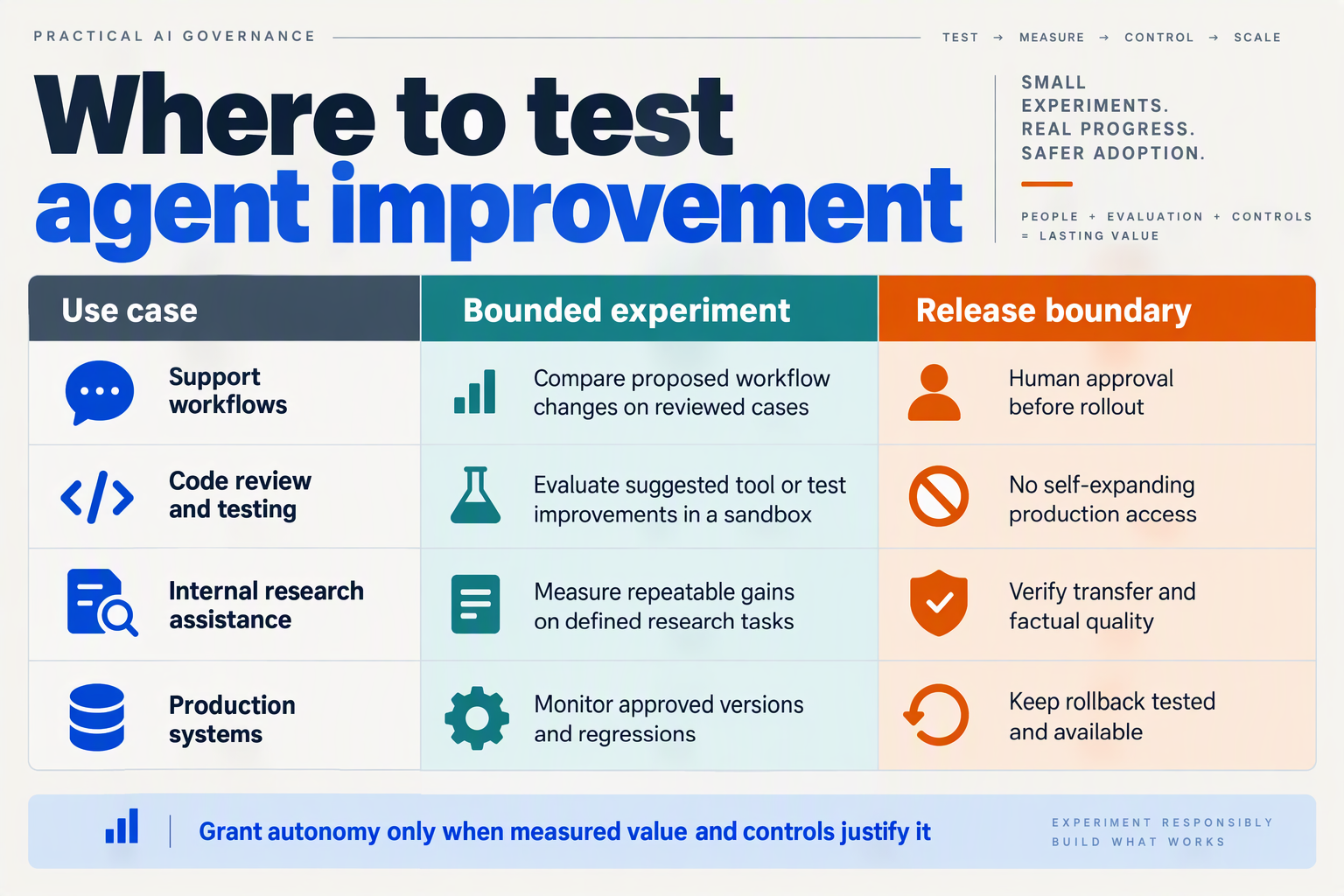
For a business, recursive self-improvement means an AI agent uses its results, experience, or evaluation feedback to change how it will produce future results—and then tests whether those changes improve performance. The practical response is to match oversight to the scope and persistence of the change, not to assume that every prompt edit or successful task is evidence of self-improvement.
The debate has become more immediate as autonomous systems help with AI development. In September 2026, D. Srikanth’s arXiv paper reported that an AI research agent improved its research efficiency through iterative code optimization. That is a bounded research result, not proof of open-ended self-improvement across tasks. MIT Technology Review’s August 18, 2026 report cautioned that the industry’s vision of rapid, self-directed improvement may not arrive as quickly as promised.
| Agent activity | What changes | Evidence to request | Suitable business control |
|---|---|---|---|
| Completing a task with tools | The agent takes an action, but its operating method stays the same | Task outcome and tool-use logs | Limit tools and permissions to the task |
| Refining a prompt or workflow | Instructions or steps change, usually within a defined process | Comparison with the previous version on representative cases | Review and test the revision before release |
| Optimizing code for a bounded task | Code changes to improve a measured result, such as research efficiency | Repeated tests against a baseline, including checks for regressions | Code review, sandboxing, and approval before deployment |
| Persistently modifying the agent’s operating mechanism | Changes may shape future behavior across tasks | Repeatable gains and evidence that performance transfers to new tasks | Human approval, version history, restricted access, and rollback |
| Expanding the agent’s own authority | The agent gains new tools, data access, or permission to deploy changes | Evidence that added authority is necessary and safe | Least-privilege access and explicit approval for consequential actions |
The table is a practical spectrum, not a claim that every workflow edit is recursive self-improvement. A useful test is whether a change affects only one task, or persists and alters the process that generates later behavior. Even then, an improved score on one benchmark is not enough: require controlled comparisons, repeated results, and tests on unfamiliar or held-out tasks. Record failures and costs as well as gains.
Before allowing an agent to change its own code or deploy revised behavior, teams can ask:
- What exactly changed? Keep a human-readable record of the prompt, workflow, code, tools, and permissions before and after.
- What is the evidence? Compare the candidate version with a fixed baseline under the same test conditions.
- What could the change affect? Test for regressions in adjacent tasks, security boundaries, and human handoff.
- Can the change be reversed? Make rollback practical and verify it before expanding autonomy.
These controls make autonomy a staged decision: start with proposed changes and human review, then consider limited deployment only after evidence meets a predefined bar. For example, CallMissed’s voice and chat agent builder includes versioning with publish and rollback, a concrete change-control capability for teams managing agent revisions. The broader principle is that an agent should earn additional freedom through observable, repeatable performance—not through the mere fact that it can modify itself.
Frequently Asked Questions
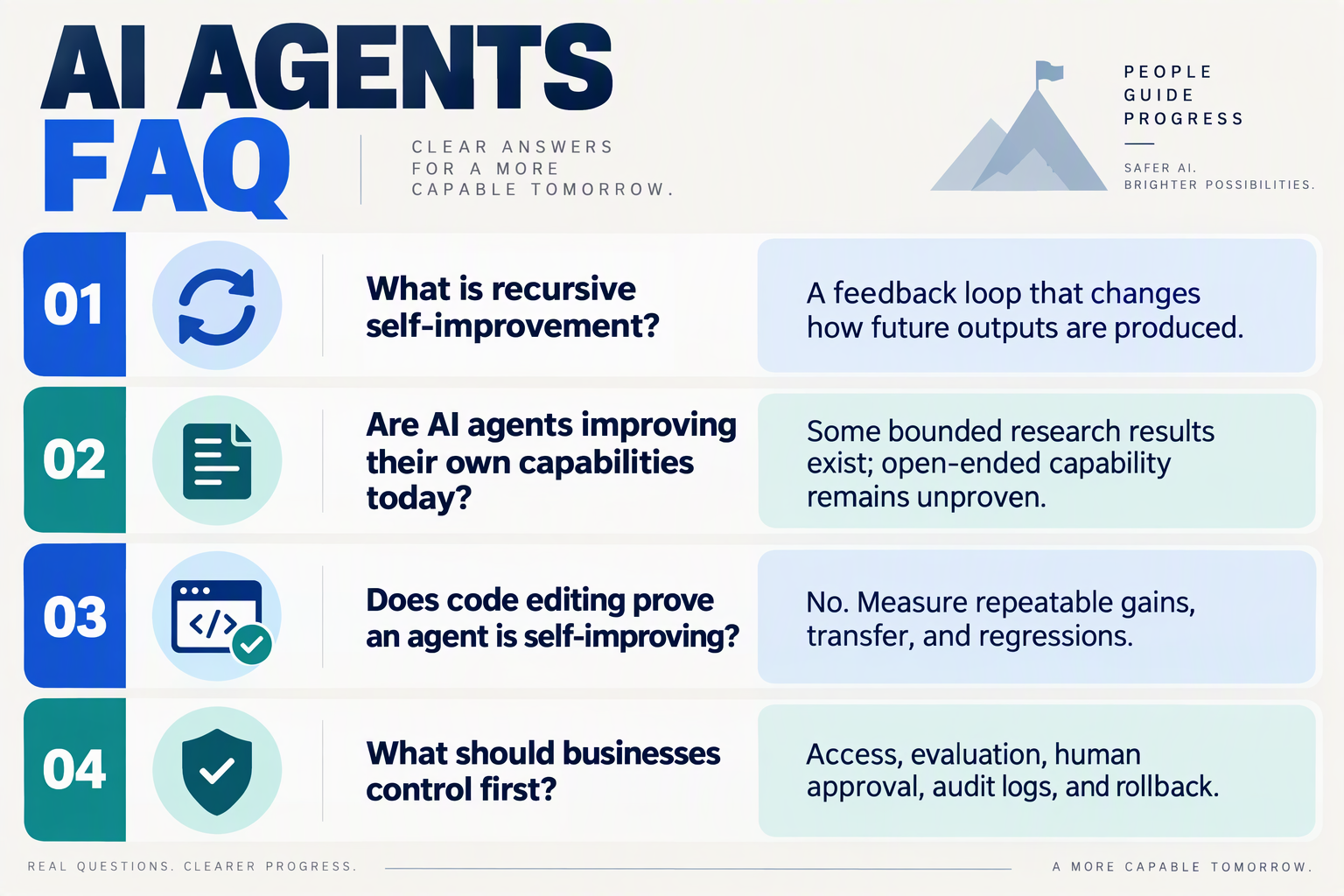
What is recursive self-improvement in agentic AI?
How is recursive self-improvement different from prompt tuning or AI-assisted coding?
Has recursive self-improvement in AI been achieved?
How should businesses evaluate and control it?
How can a business tell whether an AI agent has actually improved?
What risks come with giving a self-improving AI agent more autonomy?
What safeguards should businesses require before deploying self-modifying AI agents?
Conclusion
Recursive self-improvement should be treated as a capability to verify, not a label to award whenever an AI agent edits its prompt, workflow, or code. Businesses should expand an agent’s autonomy only when changes produce repeatable gains, work beyond the evaluation that prompted them, and remain subject to effective human control.
The research frontier makes the question more immediate, but the evidence is still bounded. A September 2026 arXiv paper by D. Srikanth reports that an AI research agent improved its research efficiency through iterative code optimization; that finding does not establish open-ended improvement in general capabilities. MIT Technology Review’s August 18, 2026 report also cautions that rapid, self-directed AI improvement may not arrive as quickly as the industry anticipates. For businesses, the practical takeaway is to distinguish promising demonstrations from validated operational performance.
Before giving an agent greater autonomy, keep these principles in view:
- Define the change: Separate ordinary task completion, tool use, prompt tuning, and AI-assisted development from modifications to the mechanism that produces future outputs.
- Demand evidence: Compare changes with a controlled baseline, test whether gains repeat, and check transfer to unfamiliar tasks. A code edit or benchmark win alone is not proof of lasting improvement.
- Keep people in control: Require human approval for consequential changes, limit access to the permissions an agent actually needs, and maintain audit trails.
- Plan for failure: Test rollback paths before deployment, so a change that causes regressions can be reversed rather than left in production.
Over the coming years, watch for evidence that goes beyond a single successful experiment: repeated results across tasks, transparent comparisons, and operational controls that make changes reviewable and reversible. The central business question is not simply whether an agent can improve its own process, but whether an organization can tell when it has improved—and respond safely when it has not.
Platforms such as CallMissed, an AI customer-communication platform, illustrate how change control can fit into agent operations: its voice and chat agents support versioning with publish and rollback. To explore how AI communication is evolving, visit CallMissed. Before your organization grants an agent more freedom, what evidence and safeguards will you require?
Related Reading
- How to Add a WhatsApp AI Chatbot to Your Business
- Manus AI Automation in 2026: Hands-On Guide to Business Workflows
- AI Receptionist for Small Business: How to Stop Losing Leads From Missed Calls — A Step-by-Step Developer Guide
Sources
Discussion
Related Posts



Ready to automate customer conversations?
Launch AI voice agents and WhatsApp bots with CallMissed — one API, 22+ Indian languages.