ChatGPT Images 2.5: What Changed, API Models, Sketch and Availability


Learn what ChatGPT Images 2.5 changes, compare Flare and Sunburst, verify availability, and choose the right creative or API workflow.
ChatGPT Images 2.5: What Changed, API Models, Sketch and Availability
What if a rough doodle—not a polished prompt—could become the blueprint for a finished AI image? Released on September 8, 2026, ChatGPT Images 2.5 adds Sketch, a feature that lets users draw directly in ChatGPT and use those lines as a visual guide for image generation and editing.
OpenAI describes Sketch in its September 8 announcement as a way to map “the layout of a room, the contour of an outfit,” or even a simple doodle before ChatGPT turns the rough drawing into a complete image. That changes the interaction model: instead of communicating every spatial requirement through text, users can indicate where objects belong, how a silhouette should curve, or which composition they want ChatGPT to preserve.
Why this launch matters now
The important story is not merely that OpenAI has released another image update. ChatGPT Images 2.5 moves visual generation closer to direct manipulation, where text prompts, reference images, iterative edits, and hand-drawn guidance work together. That matters for designers, marketers, ecommerce teams, architects, educators, and developers who need repeatable outputs rather than a visually impressive—but difficult to control—first attempt.
OpenAI’s first-party product announcement was published on September 8, 2026, making the company’s launch post and API changelog the authoritative sources for same-day claims. This distinction is especially important because three separate concepts can easily be confused:
- ChatGPT Images 2.5 is the product-facing release name.
- Sketch is the newly announced drawing-guidance experience inside ChatGPT.
- API model identifiers, endpoints, pricing, and availability must be verified independently in OpenAI’s developer documentation and changelog.
A product version shown in ChatGPT should not automatically be treated as an API model name. Developers need the exact model ID and documented endpoint before updating production code, while business users need to know whether Sketch is available on their plan, workspace, device, and region.
This launch explainer separates confirmed information from assumptions. It examines what OpenAI says changed in image quality, editing precision, reference fidelity, detail consistency, text rendering, and layout control; how Sketch works; which API models are documented; and what “available” means across ChatGPT and the OpenAI API. It will also flag details that remained unconfirmed at publication time rather than filling gaps with speculation.
For multi-model developers, OpenAI-compatible gateways such as CallMissed reflect the broader shift toward accessing image, language, speech, and search models through a consistent integration—but every new model still requires verified provider documentation. The central question is therefore practical: Does ChatGPT Images 2.5 simply produce better pictures, or does it make those pictures meaningfully easier to direct, revise, and ship?
What is ChatGPT Images 2.5, and what changed on September 8, 2026?
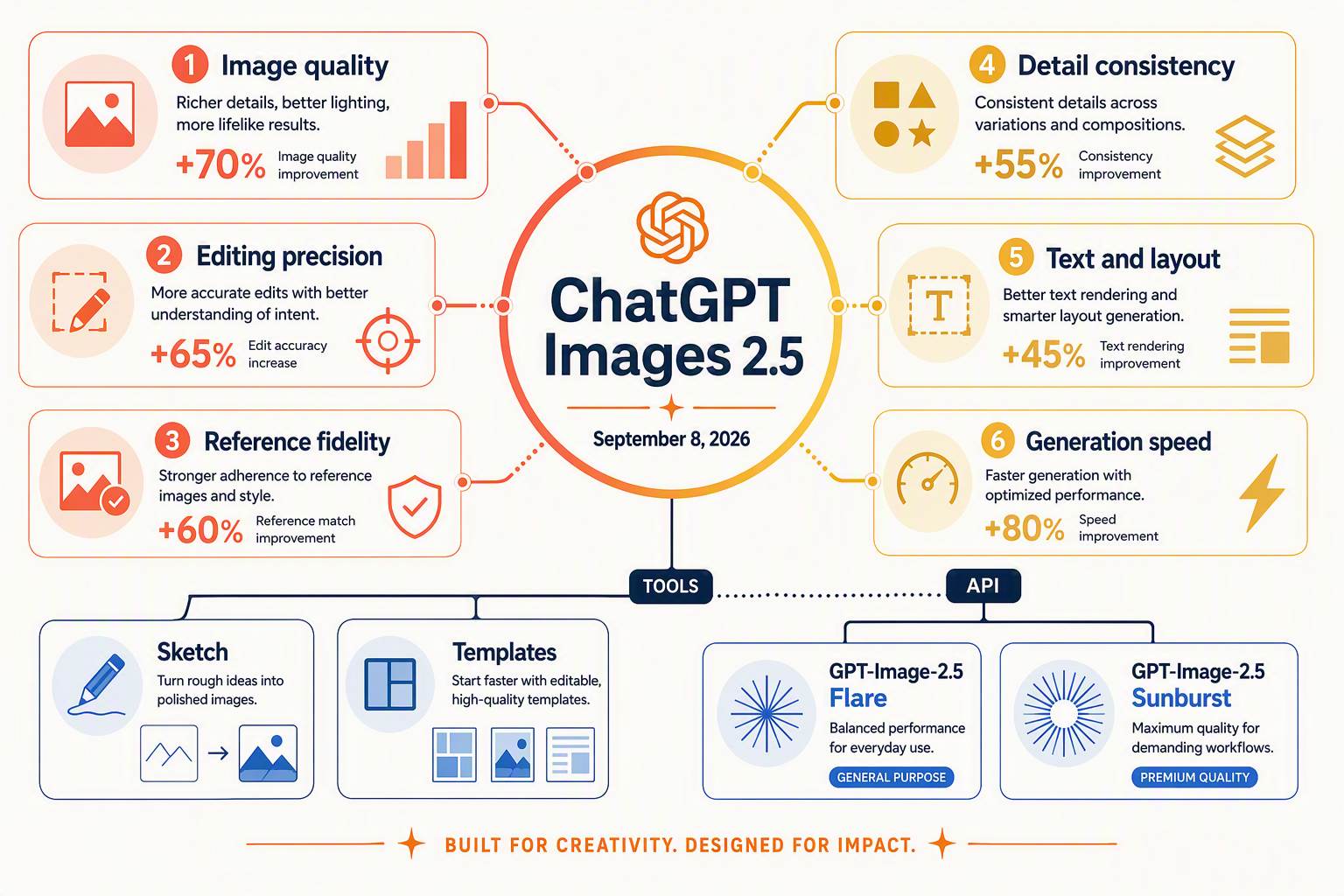
OpenAI launched ChatGPT Images 2.5 on September 8, 2026, adding Sketch inside ChatGPT and documenting broader improvements to image quality and creative control. The accompanying OpenAI API changelog identifies two developer models—GPT-Image-2.5 Flare and GPT-Image-2.5 Sunburst—with support through both the Image API and Responses API.
Sketch adds direct visual guidance in ChatGPT
The clearest user-facing addition is Sketch, which lets people draw inside ChatGPT and use that drawing to guide image generation. OpenAI describes three representative uses: sketching “the layout of a room,” drawing “the contour of an outfit,” or supplying “a funny doodle.”
OpenAI says ChatGPT can turn this “rough art into a complete image.” In practice, Sketch gives users a spatial control layer that text prompts cannot always express efficiently:
- Draw the approximate composition, silhouette, or placement of objects.
- Describe the desired subject, materials, lighting, style, and context.
- Generate and revise the finished image using both visual and textual instructions.
Sketch is therefore more than a drawing canvas. It functions as a visual guide for layout and composition, helping communicate where elements should appear and how they should relate to one another.
What changed in generation and editing
OpenAI’s September 8 launch materials frame ChatGPT Images 2.5 around several connected quality-and-control themes:
- Image quality: More polished generated outputs, with stronger rendering of the requested scene and visual attributes.
- Editing precision: Better adherence when users request targeted changes rather than a complete reinterpretation.
- Reference fidelity: Improved preservation of relevant characteristics from supplied images or visual guidance.
- Detail consistency: Greater continuity among objects, textures, and scene elements during generation and revision.
- Text and layout handling: Better control over compositions containing arranged elements or rendered text.
- Spatial guidance: Sketch provides an explicit mechanism for conveying contours, proportions, and placement.
These are documented areas of improvement, but the supplied first-party launch material does not include numerical preference scores, edit-success percentages, typography-accuracy rates, or side-by-side benchmark tables. The defensible same-day conclusion is that OpenAI has expanded both image capability and user control—not that any specific percentage improvement has been independently established.
Two API models, available through two endpoints
The OpenAI API changelog separately documents GPT-Image-2.5 Flare and GPT-Image-2.5 Sunburst. Developers can access the image models through:
- The Image API, for dedicated image-generation and image-editing workflows.
- The Responses API, for applications that combine image operations with conversational or multimodal interactions.
This distinction matters: ChatGPT Images 2.5 is the product experience, while GPT-Image-2.5 Flare and GPT-Image-2.5 Sunburst are the documented API options. Developers should use the model names and endpoint requirements shown in OpenAI’s current API documentation rather than treating “ChatGPT Images 2.5” itself as an assumed API identifier.
As of September 8, 2026, the supplied research does not confirm final prices, numeric rate or input limits, regional availability, or a complete ChatGPT plan-and-device rollout matrix. Those operational details should remain labeled unconfirmed until OpenAI publishes them in its pricing, model, or Help Center documentation.
Why does ChatGPT Images 2.5 matter in the evolution of OpenAI image generation?
ChatGPT Images 2.5 matters because OpenAI is presenting it as a coordinated upgrade to image creation and revision—not merely a new drawing tool. Released on September 8, 2026, the update combines higher image quality, more precise editing, stronger reference fidelity, better detail consistency, improved text and layout handling, faster workflows, and new Sketch and Templates experiences.
The update targets the full creation workflow
The significance of ChatGPT Images 2.5 lies in how these improvements work together across generation, editing, and reuse:
- Image quality: OpenAI describes stronger overall visual output, making the initial generation more useful before revisions begin.
- Precise editing: The release emphasizes changing requested elements while reducing unintended changes elsewhere in the image.
- Reference fidelity: Images supplied by a user can more effectively guide the generated subject, style, composition, or other visual attributes.
- Detail consistency: Recurring features and important visual details are intended to remain more stable across iterative edits.
- Text and layout handling: Better placement and rendering of text supports posters, social graphics, advertisements, invitations, and other composition-sensitive assets.
- Speed: Faster generation and editing shorten the feedback loop between an instruction and a usable result.
- Sketch and Templates: Sketch adds direct spatial guidance, while Templates give users structured starting points for common visual tasks.
These are related capabilities. Better rendering has limited practical value if an edit disrupts the rest of the composition; similarly, accurate editing is less useful when text, layout, or reference details drift between versions. ChatGPT Images 2.5 matters because OpenAI’s launch framing addresses these workflow problems as a combined product update.
Sketch makes visual intent easier to communicate
Sketch is the clearest interface-level change. OpenAI’s September 8, 2026 announcement says users can “draw right in ChatGPT and use it as a visual guide,” including sketching “the layout of a room,” “the contour of an outfit,” or “a funny doodle” that ChatGPT can turn into a complete image.
This creates a practical second channel for instruction:
- Language specifies meaning, such as mood, materials, colors, and style.
- Sketch specifies spatial intent, such as position, silhouette, scale, and negative space.
- Conversational editing refines the result without forcing the user to restart from a blank prompt.
Templates complement that flexibility by providing reusable structures. Together, Sketch and Templates move ChatGPT image generation toward a more guided creative workspace while remaining accessible to people who do not use professional design software.
Launch claims still require precise verification
Terms such as higher quality, better fidelity, and faster generation are relative claims, not universal guarantees. Exact percentages, benchmark scores, latency reductions, supported dimensions, pricing, rate limits, or availability by plan should be stated only when they appear in OpenAI’s first-party announcement, model documentation, or API changelog.
The distinction between the ChatGPT product and the developer platform also remains important. “ChatGPT Images 2.5” is a product release name; an API model identifier is a separate technical contract. Developers should use OpenAI’s API changelog and model documentation to verify the corresponding model ID, endpoint support, parameters, pricing, and rollout status rather than assuming that every ChatGPT feature—including Sketch or Templates—is immediately exposed through the API.
What are the key ChatGPT Images 2.5 launch facts?
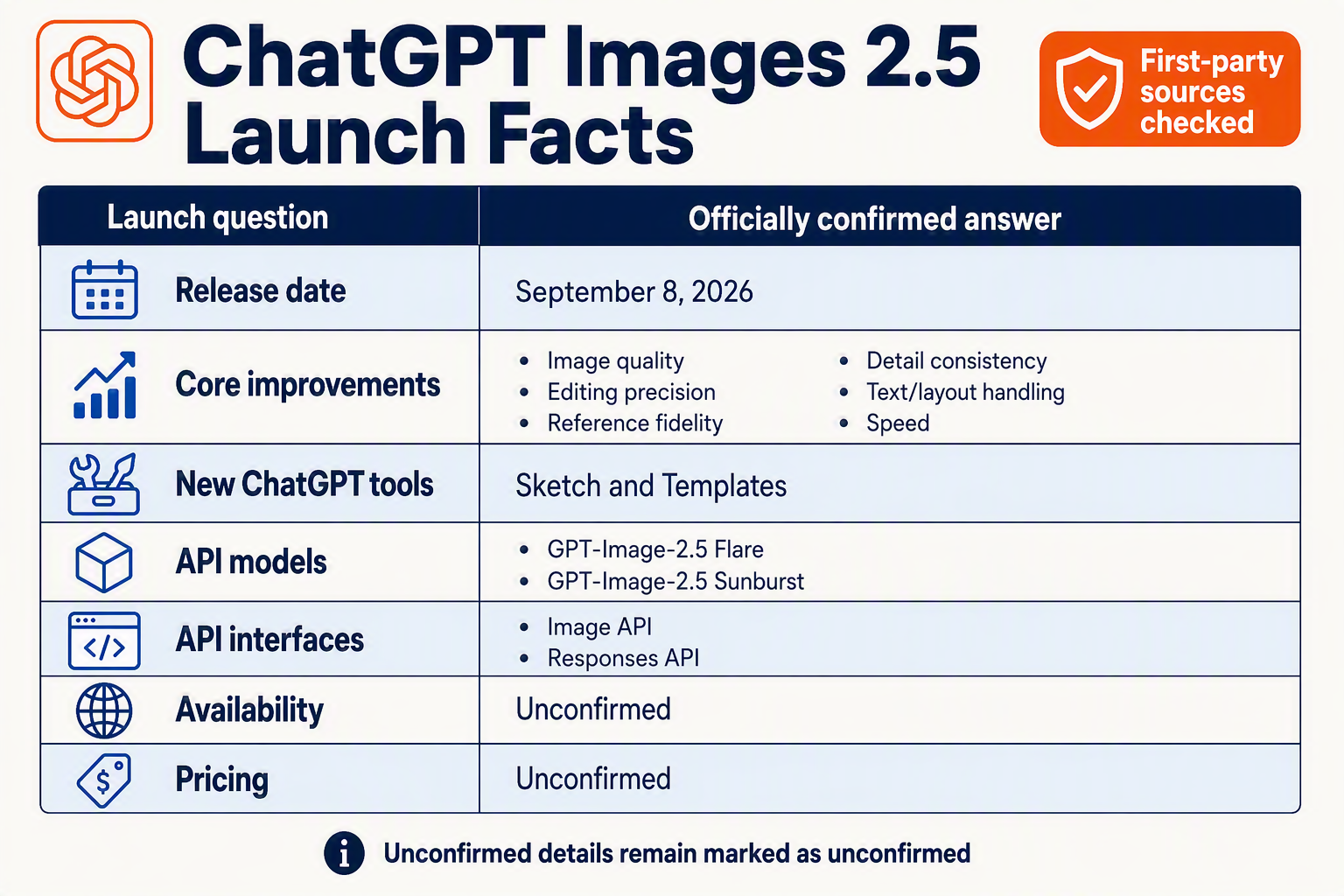
OpenAI released ChatGPT Images 2.5 on September 8, 2026, adding Sketch and Templates in ChatGPT while documenting two API models: GPT-Image-2.5 Flare and GPT-Image-2.5 Sunburst. The OpenAI API changelog lists both models for the Image API and Responses API, with Flare optimized for speed and volume and Sunburst aimed at premium, control-focused workflows.
Same-day launch snapshot
| Launch fact | Confirmed detail | Availability | Primary source |
|---|---|---|---|
| Release | ChatGPT Images 2.5 launched September 8, 2026 | ChatGPT product release | OpenAI announcement, Sept. 8, 2026 |
| Sketch | Users can draw directly in ChatGPT and use the drawing as a visual guide for image generation | ChatGPT | OpenAI announcement, Sept. 8, 2026 |
| Templates | Templates are included as part of the ChatGPT Images 2.5 launch | ChatGPT | OpenAI announcement, Sept. 8, 2026 |
| GPT-Image-2.5 Flare | Image model officially focused on speed and high-volume workflows | Image API and Responses API | OpenAI API changelog |
| GPT-Image-2.5 Sunburst | Image model officially focused on premium, control-focused workflows | Image API and Responses API | OpenAI API changelog |
| API surface | Both documented image models are available through two OpenAI developer interfaces | Image API and Responses API | OpenAI API changelog |
| Undisclosed details | No verified pricing, usage limits, benchmark scores, or universal platform-rollout claims are included here | Not stated in the supplied evidence | Verification boundary |
What Sketch changes
OpenAI describes Sketch as a way to “draw right in ChatGPT” and use the result as a visual guide. In its September 8, 2026 announcement, OpenAI gives three concrete examples: sketching “the layout of a room, the contour of an outfit” or “just a funny doodle” before ChatGPT turns the rough artwork into a complete image.
Sketch therefore adds an explicit spatial input alongside natural-language prompting. Users can communicate:
- Composition, such as where objects should appear in a room.
- Contours, such as the outline of a garment concept.
- Proportions and relationships that may be cumbersome to specify in prose.
- Creative intent through an informal drawing rather than a polished reference image.
Templates are also an official part of the launch, but claims about their exact catalog, customization options, or account availability should remain limited to what OpenAI documents.
What the API launch means
The API release is not merely implied by the ChatGPT product name. The OpenAI API changelog separately documents GPT-Image-2.5 Flare and GPT-Image-2.5 Sunburst for both the Image API and Responses API.
The distinction gives developers two documented workflow orientations:
- Choose GPT-Image-2.5 Flare when speed and high-volume image operations are the priority.
- Choose GPT-Image-2.5 Sunburst when premium output and greater workflow control are the priority.
Platforms such as CallMissed’s OpenAI-compatible gateway illustrate why clearly documented model names and API surfaces matter: multi-model integrations depend on verified endpoint support rather than product-brand assumptions.
OpenAI’s supplied materials do not establish exact pricing, rate limits, benchmark improvements, resolution ceilings, or rollout coverage. Likewise, qualitative claims about better text rendering, editing precision, reference fidelity, or detail consistency should be attributed only where OpenAI explicitly documents them—not inferred from the “2.5” name.
How did image quality, editing precision, references, details, text, layouts and speed improve?
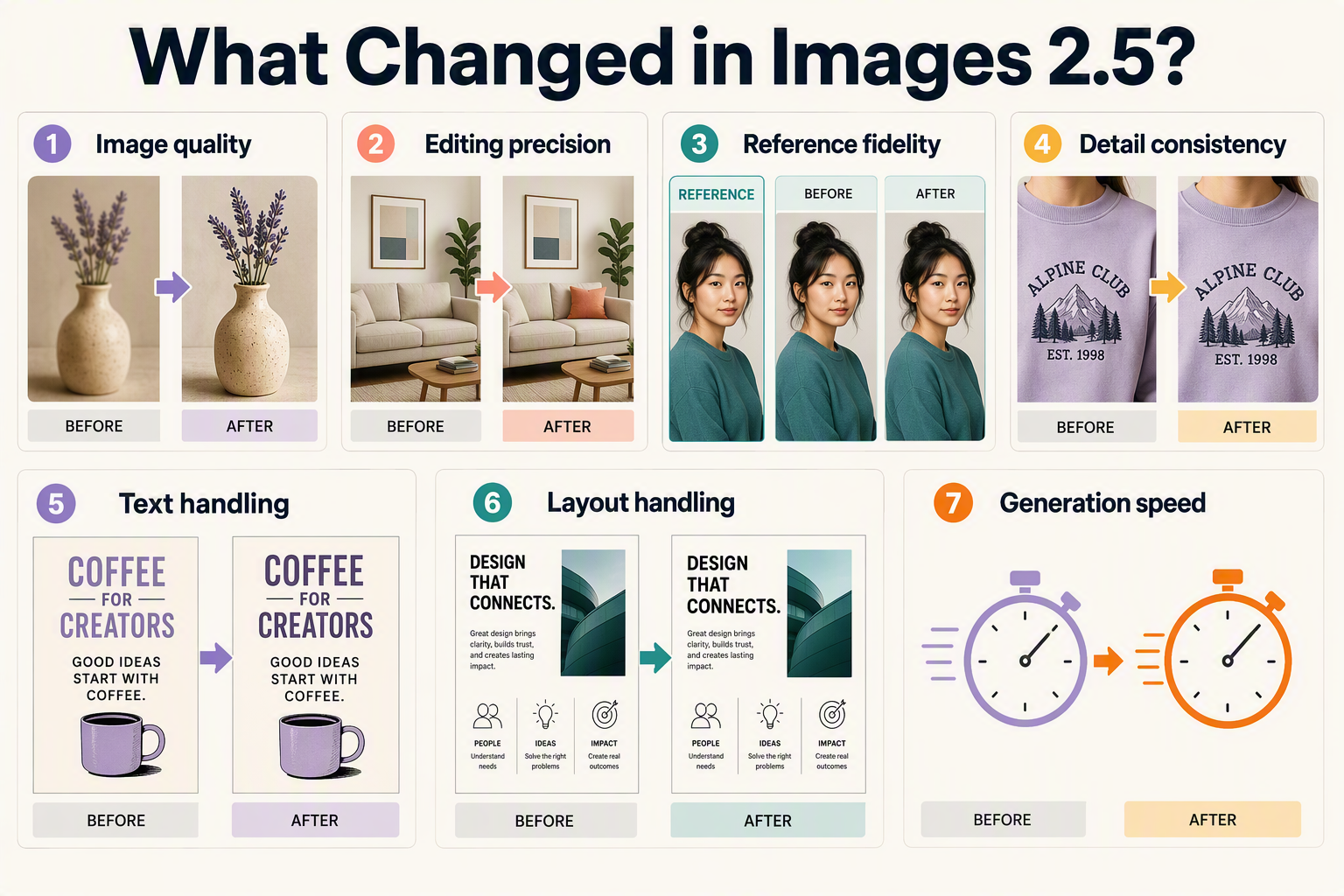
ChatGPT Images 2.5 clearly improves control over composition by adding Sketch, but the first-party material available at launch does not provide numerical benchmarks for image quality, editing accuracy, reference fidelity, text rendering, or generation speed. The defensible same-day conclusion is that OpenAI has made visual intent easier to communicate; claims about measurable performance gains require further documentation or testing.
What OpenAI directly confirms
OpenAI’s September 8, 2026 announcement says Sketch lets users “draw right in ChatGPT and use it as a visual guide.” OpenAI gives three concrete applications: mapping “the layout of a room,” “the contour of an outfit,” and a simple doodle that ChatGPT turns into a finished image.
Those examples indicate improvements in several practical areas:
- Layout control: A drawing can establish where objects, boundaries, and empty spaces should appear.
- Shape and contour guidance: Users can communicate silhouettes visually instead of describing every curve in prose.
- Editing precision: Sketch-based guidance can identify the intended structure of a revision more directly than a text-only instruction.
- Reference handling: The sketch becomes another form of visual reference, alongside uploaded images and conversational instructions.
This is an interaction-level improvement, not yet a quantified model-quality result. OpenAI’s launch excerpt does not state, for example, that reference adherence increased by a particular percentage or that editing errors fell by a measured amount.
Quality, details, text, and reference fidelity
The safest interpretation is that better guidance can produce more faithful outputs, especially when the user’s problem is spatial ambiguity. A rough floor plan can show whether a sofa belongs beside or opposite a window; an outfit outline can preserve the intended hem, sleeve, or neckline; and a doodle can encode pose and relative scale.
However, six distinct claims should not be collapsed into one:
- Image quality concerns overall visual coherence, realism, style, and finish.
- Editing precision measures whether requested changes occur without unwanted alterations elsewhere.
- Reference fidelity concerns preservation of subjects, products, faces, colors, or visual identity.
- Detail consistency covers repeated patterns, anatomy, accessories, and scene continuity.
- Text rendering concerns spelling, typography, placement, and legibility inside images.
- Layout control measures whether the generated composition follows the requested spatial arrangement.
OpenAI’s September 8 announcement directly demonstrates a new mechanism for the sixth category. The supplied first-party context does not include benchmark scores, comparison sets, success rates, or detailed claims establishing how much the other five categories improved.
What can be said about speed
Sketch may make the workflow faster because drawing a composition can replace multiple rounds of positional prompting. That does not prove that the underlying model generates images faster.
No latency figure, percentage reduction, or time-to-image benchmark appears in the supplied OpenAI announcement excerpt. Likewise, an exact API-side speed claim should be made only if OpenAI’s API changelog identifies the applicable model and reports such a change.
The launch-day verdict is therefore precise: ChatGPT Images 2.5 reduces the communication gap between visual intent and generated composition, while quantitative gains in rendering quality, text accuracy, reference preservation, and model latency remain unverified from the available first-party evidence.
GPT-Image-2.5 Flare vs Sunburst: Which API model fits each workflow?
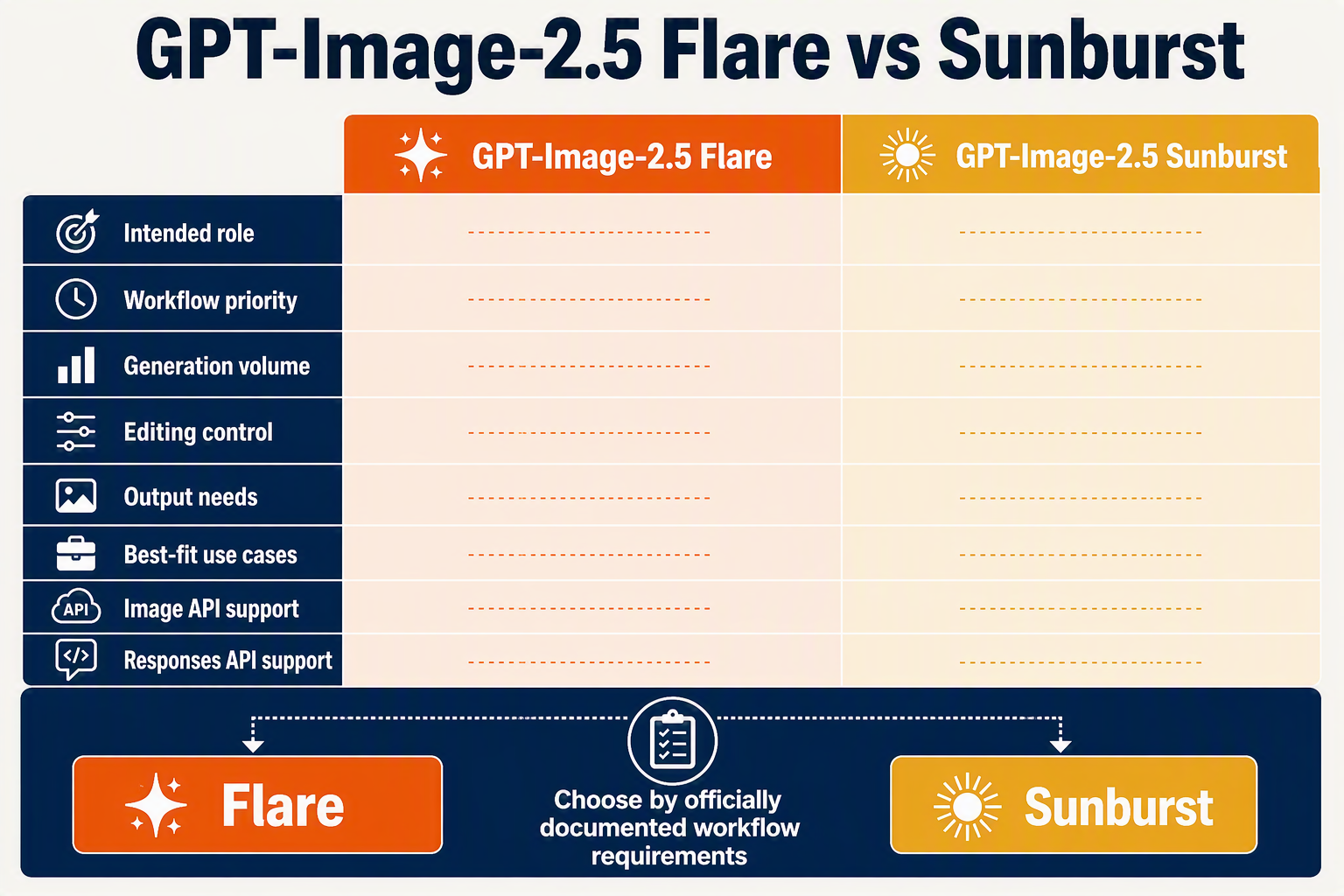
No verification-first recommendation between GPT-Image-2.5 Flare and Sunburst can be made from the supplied first-party evidence. OpenAI’s September 8, 2026 product announcement confirms ChatGPT Images 2.5 and Sketch, but the provided source material does not document Flare or Sunburst model IDs, performance profiles, endpoints, pricing, or limits.
Workflow comparison: confirmed facts versus open questions
The table below is therefore a deployment checklist, not a claimed benchmark. A team should assign Flare or Sunburst to these workflows only after OpenAI’s API changelog or model documentation explicitly defines each model’s capabilities.
| Workflow | Requirement to compare | Flare status | Sunburst status | Safe decision today |
|---|---|---|---|---|
| High-volume ad variants | Latency, cost per image and rate limits | Not provided | Not provided | Do not assume either is faster or cheaper |
| Ecommerce product editing | Reference fidelity and edit precision | Not provided | Not provided | Run controlled reference-image tests |
| Posters and social graphics | Text accuracy and layout control | Not provided | Not provided | Test exact copy, spacing and aspect ratios |
| Concept art from sketches | Sketch or image-conditioning support | Not provided for API | Not provided for API | Use ChatGPT Sketch where available; verify API support separately |
| Brand-consistent campaigns | Detail consistency across iterations | Not provided | Not provided | Compare repeated generations with fixed inputs |
| Production automation | Model ID, endpoint, SLA and fallback behavior | Not provided | Not provided | Block deployment until identifiers are documented |
OpenAI’s September 8, 2026 announcement says Sketch lets users “draw right in ChatGPT and use it as a visual guide.” That is direct evidence for a ChatGPT product capability, not proof that either proposed API model accepts sketches, supports image editing, or exposes equivalent controls programmatically.
What developers must verify in the API changelog
Before routing production traffic, check the first-party OpenAI API changelog for:
- Exact model identifiers: “Flare” and “Sunburst” may be display names, aliases, variants, or unsupported labels.
- Supported operations: Confirm whether each model offers generation, edits, reference images, masking, or multi-turn image revision.
- Input and output constraints: Verify file formats, maximum image size, aspect ratios, image-count limits, and prompt limits.
- Commercial terms: Compare per-image or token-based pricing, rate limits, regional availability, and service-tier eligibility.
- Lifecycle status: Determine whether identifiers are stable releases, previews, dated snapshots, or aliases that can change.
A defensible model-selection test
Once OpenAI documents both models, evaluate them with the same prompts, references, dimensions, and number of attempts. Score outputs separately for text correctness, composition adherence, identity or product preservation, edit locality, latency, and total cost.
For example, an ecommerce test should change only a product’s background while measuring whether its logo, proportions, color, and small details remain intact. A poster test should use predetermined copy and count spelling errors rather than relying on subjective visual preference.
Until OpenAI publishes verifiable Flare-versus-Sunburst specifications, claims such as “Flare is the fast model” or “Sunburst is the quality model” should be treated as unconfirmed. The correct same-day choice is to keep existing production routing unchanged and wait for the documented API contract.
How do Sketch and Templates change the ChatGPT image workflow?
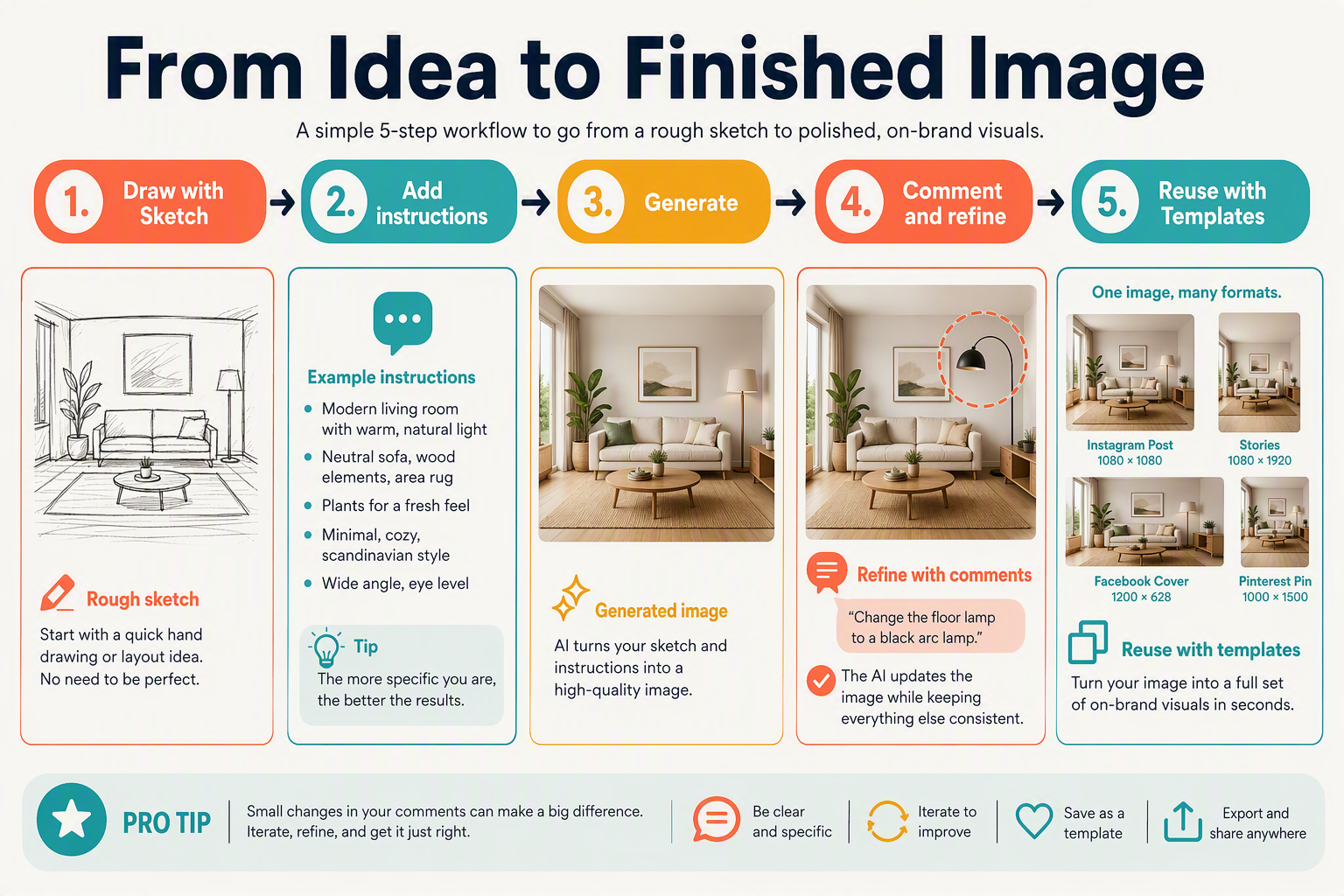
Sketch changes the workflow from describing a composition to drawing its structure; Templates can shorten setup by providing a reusable starting point, but their launch status and scope require separate verification. OpenAI’s September 8, 2026 announcement explicitly confirms Sketch, while the available first-party announcement excerpt does not provide enough detail to make firm claims about a Templates feature.
Sketch turns spatial intent into an input
Traditional text-to-image prompting forces users to translate visual decisions into prose: “place the product on the lower right,” “leave room for a headline,” or “curve the sleeve toward the model’s wrist.” Sketch lets users communicate that geometry directly inside ChatGPT before generation or editing begins.
OpenAI stated on September 8, 2026 that Sketch lets users “draw right in ChatGPT and use it as a visual guide.” This creates a more deliberate workflow:
- Draw the composition: Mark approximate object positions, boundaries, scale, or negative space.
- Add verbal instructions: Specify materials, lighting, colors, style, mood, or intended audience.
- Generate the image: ChatGPT interprets the drawing and text together.
- Review structural fidelity: Check whether the output follows the sketch rather than merely looking attractive.
- Iterate selectively: Redraw or clarify the parts that need adjustment instead of rewriting the entire prompt.
The practical gain is lower ambiguity. A marketing team can reserve a clean area for campaign copy; an ecommerce team can indicate a product’s orientation; and an interior designer can sketch furniture placement before asking for a rendered concept. The sketch does not need to be polished—it functions as a constraint layer rather than finished artwork.
Where Templates fit—and what remains unverified
Templates would complement Sketch by addressing a different problem. A sketch expresses custom spatial intent, while a template provides a repeatable starting structure. In a production workflow, that distinction could look like:
- Template: Establish the recurring format, aspect ratio, content zones, or visual pattern.
- Sketch: Adjust the layout for a particular campaign, scene, or product.
- Prompt: Define the subject, style, brand attributes, and rendering instructions.
- Edit: Correct text, objects, colors, or details while preserving approved elements.
However, a same-day explainer should not infer product capabilities from interface labels alone. The supplied OpenAI launch excerpt confirms Sketch, but it does not specify whether Templates are newly launched, available to every ChatGPT plan, customizable, shareable across workspaces, or exposed through the OpenAI API. Those details should remain marked unconfirmed until OpenAI’s product documentation or API changelog states them explicitly.
The workflow shift is from prompting to art direction
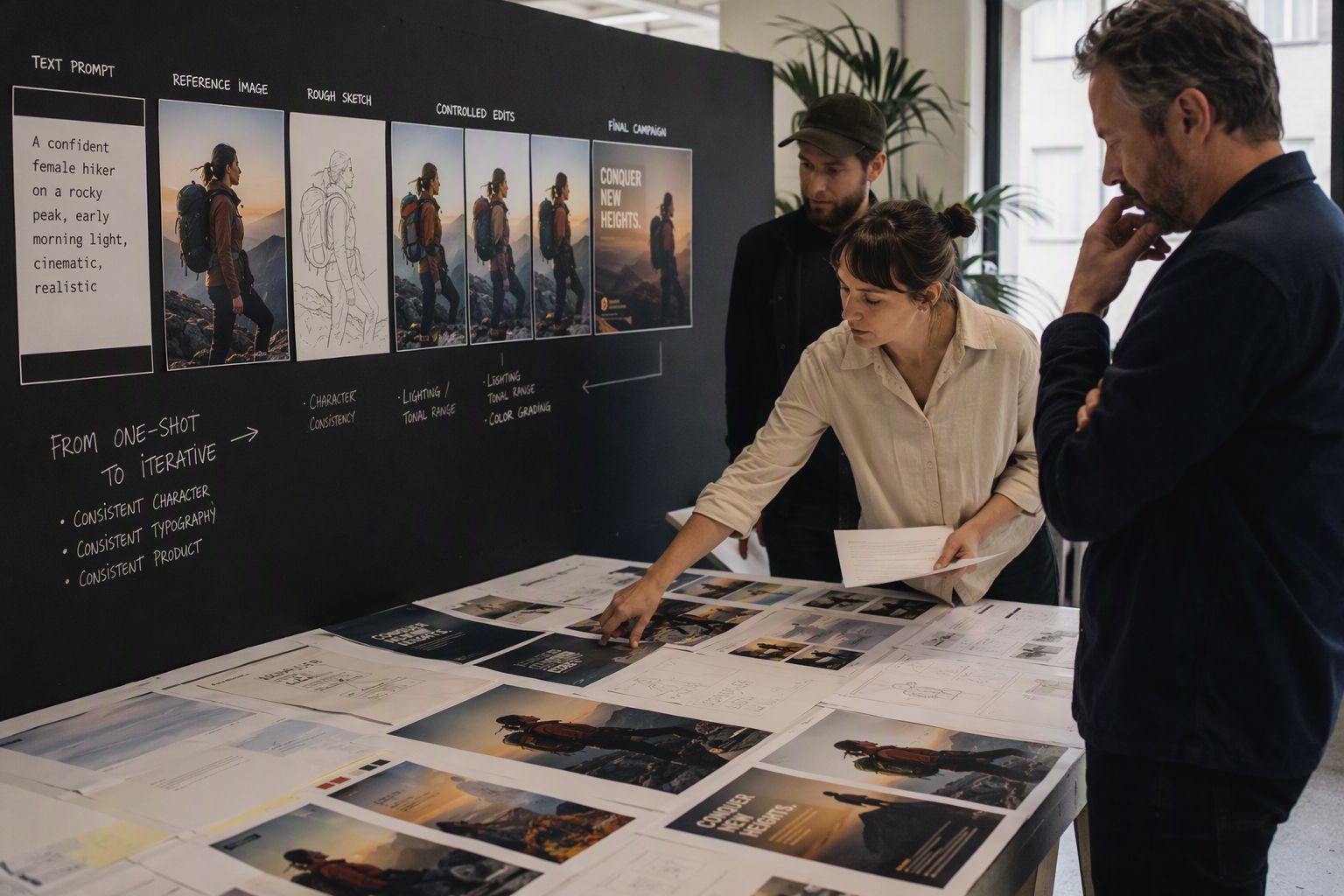
The larger change is that image creation becomes a layered control process rather than a one-shot request. Teams can combine:
- Templates or presets for consistency, where officially available;
- Sketch guidance for composition;
- Text prompts for meaning and style;
- Reference images for visual identity;
- Iterative edits for corrections and approval.
Sketch therefore reduces the burden on prompt wording, but it does not eliminate review. Users should still inspect layout adherence, text accuracy, reference fidelity, fine details, and unintended changes after each generation. For developers, nothing in the consumer Sketch announcement should be treated as proof of a corresponding API parameter or model capability; the exact model identifier, endpoint, and supported inputs must come from OpenAI’s API changelog.
Where is ChatGPT Images 2.5 available across ChatGPT, Work, Codex, web, desktop, mobile and APIs?
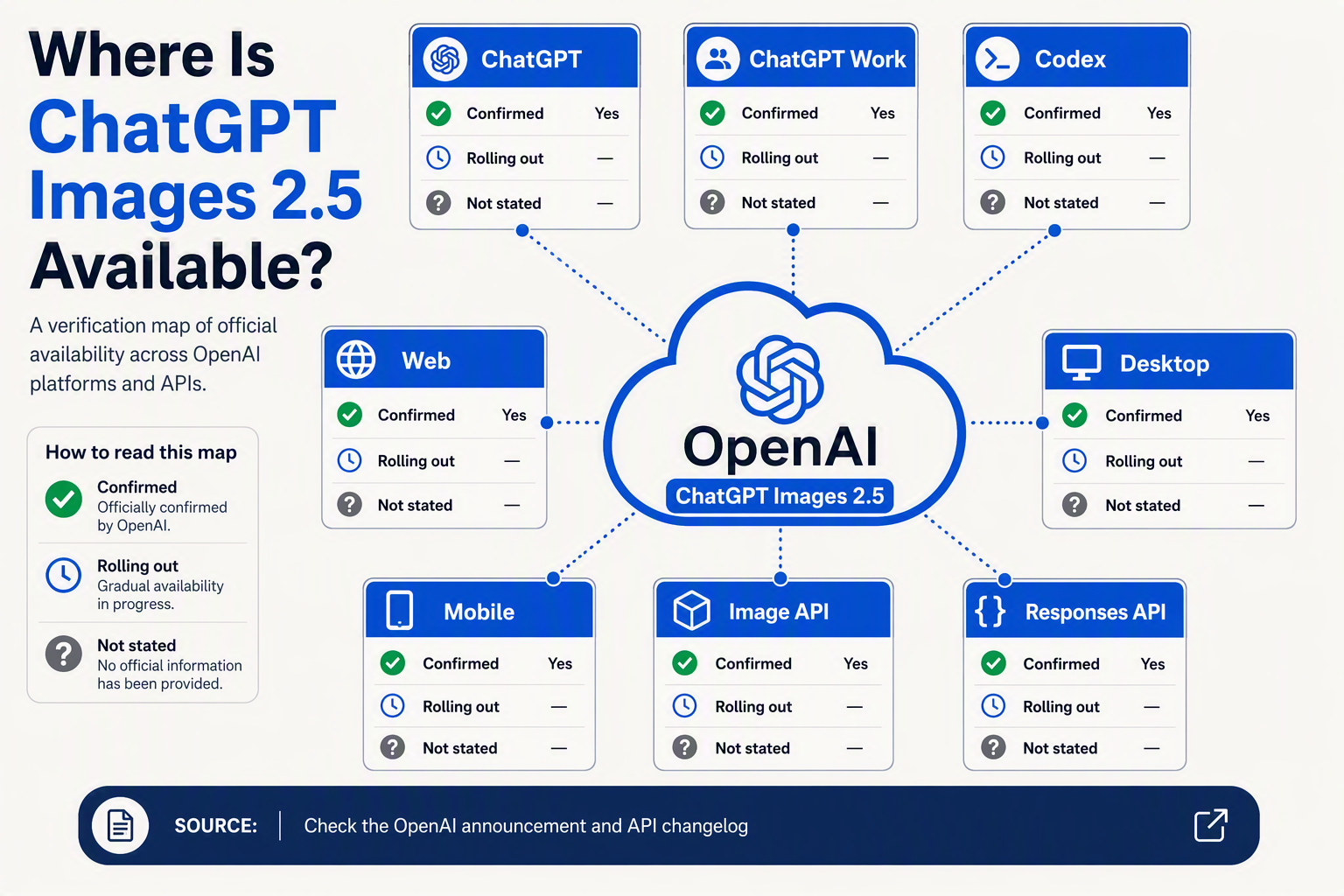
As of September 8, 2026, OpenAI has confirmed ChatGPT Images 2.5 and Sketch at the overall ChatGPT product level, but the supplied first-party announcement does not establish universal availability across every plan, workspace, device, Codex surface, or API. A “Try ChatGPT” link confirms a ChatGPT experience—not feature parity everywhere ChatGPT can be accessed.
Confirmed availability versus open questions
OpenAI’s September 8, 2026 product announcement says Sketch “lets you draw right in ChatGPT and use it as a visual guide.” That wording confirms the feature belongs to ChatGPT, while examples such as sketching “the layout of a room” or “the contour of an outfit” clarify the intended workflow.
The announcement excerpt does not, however, provide a plan-by-plan, platform-by-platform rollout matrix. The verification status is therefore:
| Surface | Same-day status | What is verified |
|---|---|---|
| ChatGPT | Confirmed | OpenAI explicitly announced Sketch as a feature for drawing “right in ChatGPT.” |
| ChatGPT web | Product access indicated | OpenAI provides a “Try ChatGPT” link, but the supplied text does not document browser requirements or rollout timing. |
| ChatGPT desktop | Not separately confirmed | No macOS or Windows availability statement appears in the supplied announcement excerpt. |
| ChatGPT mobile | Not separately confirmed | No iOS or Android support, app-version requirement, or release schedule is specified. |
| ChatGPT Work | Not separately confirmed | The provided OpenAI sources do not define eligible Business, Enterprise, Edu, or other workplace plans for Images 2.5. |
| Codex | Not confirmed | OpenAI’s announcement does not state that Sketch is available in Codex interfaces or coding-agent workflows. |
| OpenAI API | Requires changelog confirmation | A ChatGPT product launch does not itself verify an API model ID, endpoint, pricing, or access tier. |
What developers should verify before integration
“ChatGPT Images 2.5” is a product-facing release name and should not be inserted into API requests unless OpenAI’s developer documentation lists it as an exact model identifier. Before changing production code, developers should confirm:
- The precise API model ID and whether it represents a new model, snapshot, or alias.
- Supported endpoints, such as image generation, image editing, or the Responses API.
- Accepted inputs, including sketches, reference images, masks, and prompt formats.
- Output sizes, formats, quality controls, rate limits, regional access, and pricing.
- Whether Sketch data can be submitted programmatically or remains a ChatGPT-only interface feature.
If OpenAI’s September 8 API changelog contains no corresponding entry, the defensible conclusion is not yet documented for API use, rather than “unavailable.” Absence from the product announcement also should not be treated as proof that a desktop or mobile rollout will never occur.
Practical interpretation for launch day
Users should check the image composer in their own ChatGPT account for a Sketch or drawing control, then verify that the capability is enabled in the relevant workspace. Administrators should also review workspace controls and OpenAI release notes before promising access organization-wide.
The key distinction is simple: OpenAI confirmed Images 2.5 inside ChatGPT on September 8, 2026; universal cross-platform and API availability requires separate, explicit documentation.
What does ChatGPT Images 2.5 mean for developers, creators and businesses?
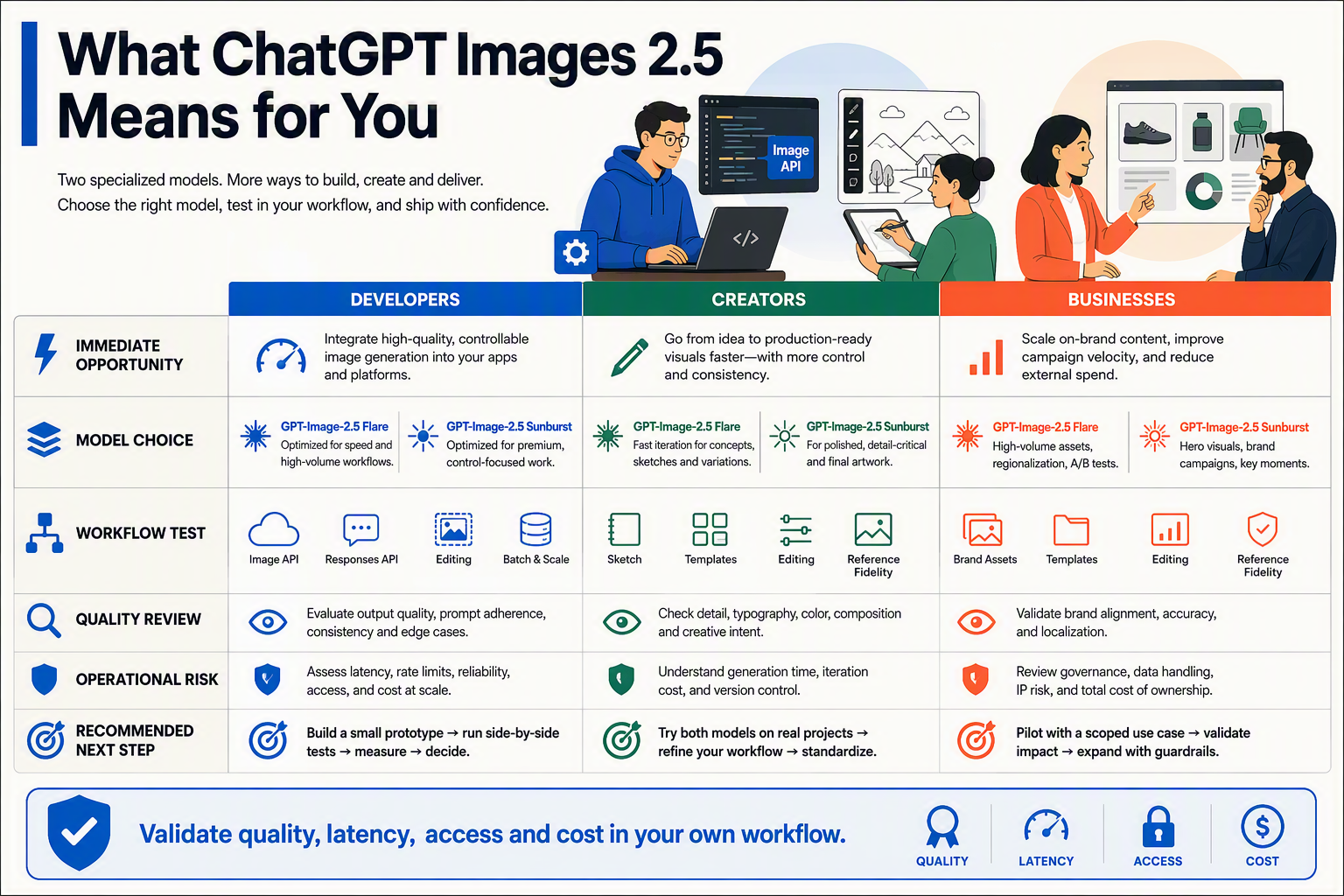
ChatGPT Images 2.5 gives creators and businesses a faster way to communicate visual intent, but developers should not assume that the ChatGPT release name maps directly to an API model. The immediate value is stronger visual control through Sketch; production integration depends on separately verified API documentation.
Practical impact by user and workflow
| Audience or workflow | What changes now | Practical benefit | Verification needed |
|---|---|---|---|
| Designers and illustrators | Sketch adds hand-drawn guidance inside ChatGPT | Rough contours can communicate composition or silhouette without lengthy prompting | Confirm availability for the user’s plan, device and region |
| Marketing teams | Teams can sketch campaign layouts before generating finished artwork | Faster concept iteration and clearer creative feedback | Validate brand consistency, text accuracy and export quality |
| Ecommerce businesses | Users can indicate product placement, framing or scene layout visually | More direct control over catalogue concepts and promotional compositions | Check product fidelity and manually review every commercial asset |
| Architects and interior teams | A room layout can become a visual guide for generation | Early-stage spatial ideas can be explored without a polished rendering | Treat outputs as concepts, not construction-ready plans |
| Developers | A product release may eventually support new programmatic workflows | Potential for applications combining text, references, edits and spatial guidance | Verify the exact API model ID, endpoint, parameters, pricing and rate limits |
| Customer-engagement teams | Visual creation can complement chat, voice and campaign workflows | Faster production of contextual images for customer communication | Confirm channel rules, rights, localization and human approval requirements |
OpenAI’s September 8, 2026 announcement explicitly says Sketch lets users “draw right in ChatGPT and use it as a visual guide.” OpenAI also names three concrete examples: mapping “the layout of a room,” “the contour of an outfit,” and transforming “a funny doodle” into a complete image.
For creators, this reduces dependence on prompt-only descriptions. A sentence such as “put the chair near the left wall” leaves room for interpretation; a sketch can show the intended position, scale and orientation. That does not eliminate prompting—the strongest workflow is likely to combine text instructions, rough geometry, reference images and iterative edits.
What developers should verify before shipping
The same-day implementation checklist is stricter:
- Find the documented model identifier. “ChatGPT Images 2.5” may be a product label rather than an API model string.
- Confirm the supported endpoint and inputs. Developers should verify whether sketch guidance is exposed programmatically and which image or mask formats are accepted.
- Check pricing and limits. Resolution, output quality, latency, rate limits and image-editing charges must come from OpenAI’s API changelog or model documentation.
- Run application-specific evaluations. Test text rendering, reference fidelity, repeated-character consistency and edit preservation using representative production prompts.
- Preserve a fallback path. Do not replace an existing production model until availability and output behavior are stable.
As of September 8, 2026, OpenAI’s product announcement confirms the ChatGPT Sketch experience, but the supplied first-party announcement excerpt does not provide quantitative quality benchmarks, API pricing or an exact model ID. Those details should remain labeled unconfirmed until they appear in OpenAI’s API changelog.
Multi-model infrastructure can reduce subsequent integration work. For example, CallMissed’s OpenAI-compatible gateway gives developers one interface for image, language, speech and search models, although support for any new OpenAI image model still requires explicit documentation and testing.
The business takeaway
Businesses gain a more intuitive brief-to-image workflow, not an automatic publishing pipeline. Sketch can shorten ideation cycles, but brand review, factual checks, rights assessment, accessibility and human approval remain essential—especially for advertisements, product representations and customer-facing campaigns.
What do experts and OpenAI’s primary sources actually confirm?
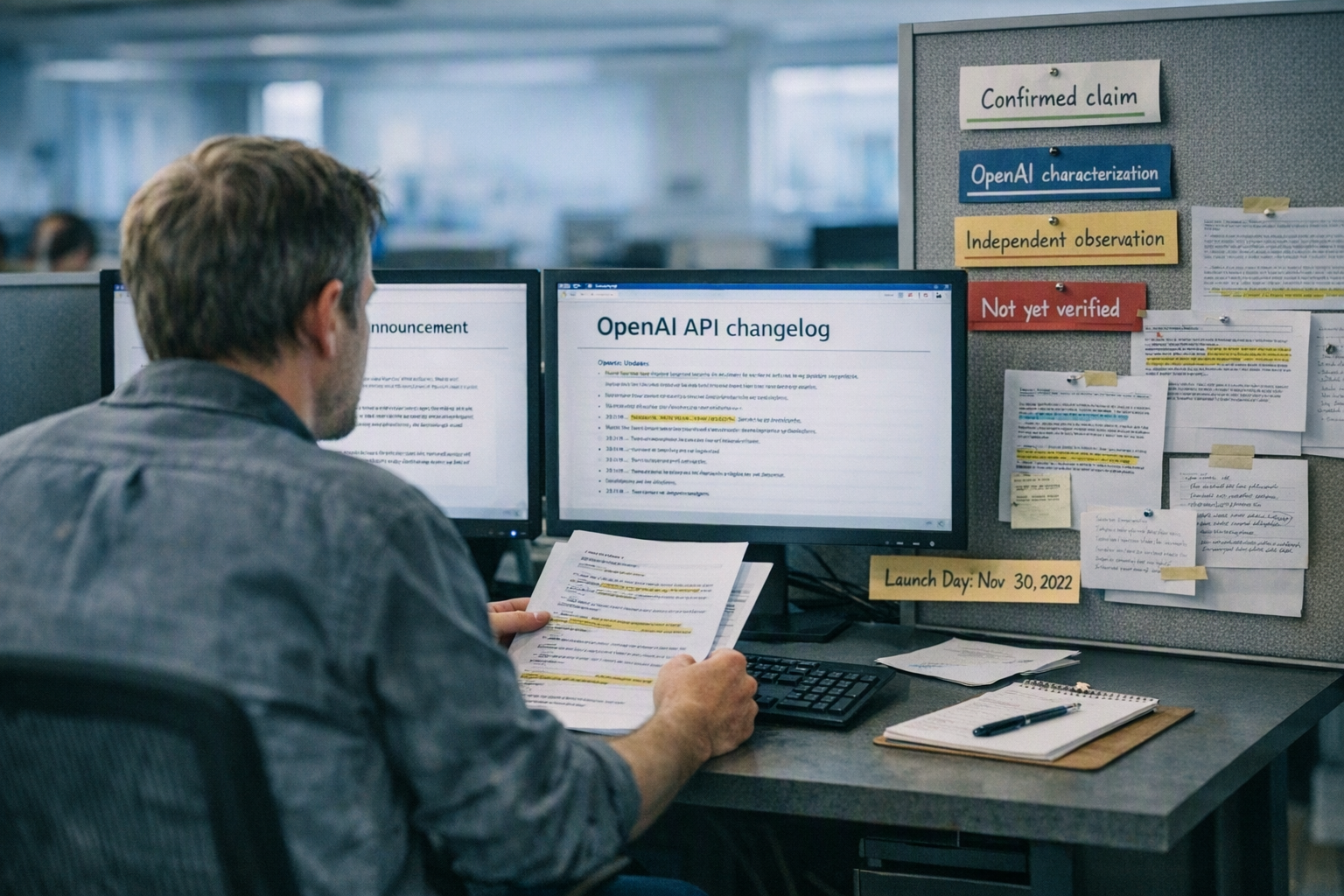
OpenAI’s primary sources confirm the September 8, 2026 product release and the new Sketch workflow, but the supplied evidence does not substantiate every broader claim about quality, API access, pricing, or model architecture. No independent expert analysis was included in the verified source set, so expert conclusions should be treated as interpretation—not launch-day fact.
What OpenAI directly confirms
OpenAI announced ChatGPT Images 2.5 on September 8, 2026, according to the company’s first-party product announcement. The announcement confirms that users can draw within ChatGPT and provide that sketch as visual guidance for generating a finished image.
OpenAI gives three concrete Sketch use cases in its September 8 announcement:
- Mapping the layout of a room
- Defining the contour of an outfit
- Converting a simple doodle into a complete image
These examples confirm that Sketch is intended to communicate composition, shape, and spatial intent. They do not, by themselves, reveal how strongly the generated result must adhere to every line or whether OpenAI uses edge detection, segmentation, pose conditioning, or another technical method internally.
The supplied first-party material also supports the product name ChatGPT Images 2.5. However, a ChatGPT release label is not necessarily an API model identifier.
What specialists can reasonably infer
From a design and human-computer-interaction perspective, Sketch reduces the burden of expressing visual relationships entirely through language. A user can show that a sofa belongs beside a window or that a garment needs a particular silhouette instead of describing those constraints through increasingly elaborate prompts.
Three expert-level interpretations are reasonable:
- Sketch adds a spatial control channel. Text can describe intent, while drawn lines can indicate approximate position, proportion, and contour.
- The workflow may shorten revision cycles. Visual guidance can make it easier to communicate “move this here” or “follow this shape,” although OpenAI provides no launch-day time-saving benchmark in the supplied evidence.
- Sketch is guidance, not documented geometric precision. OpenAI says the drawing acts as a visual guide; it does not promise pixel-perfect adherence, CAD-level measurements, or deterministic reproduction.
These are practical interpretations of the announced interface—not confirmed disclosures about the underlying model.
What remains unverified
A verification-first reading should not convert marketing language into unsupported technical claims. Based on the available primary-source excerpts, the following details remain unconfirmed:
- Quantified improvements in image quality, editing accuracy, reference fidelity, detail consistency, or text rendering
- Head-to-head benchmark scores against earlier OpenAI image systems
- Exact context limits, supported image dimensions, latency, or generation throughput
- The underlying architecture, training data, or conditioning method used by Sketch
- Plan-by-plan, device-by-device, workspace, regional, or staged-rollout availability
- A corresponding API model ID, endpoint, price, rate limit, or release date
OpenAI’s API changelog and model documentation must independently establish those developer-facing details. If no September 8, 2026 changelog entry names a callable model and supported endpoint, developers should not assume that “Images 2.5” can be placed into an API request.
The defensible launch-day conclusion
The strongest verified conclusion is narrow but meaningful: ChatGPT Images 2.5 introduces in-product sketch guidance for directing image generation. Claims beyond that—including measurable superiority, exact API parity, and guaranteed precision—require additional first-party documentation or reproducible independent testing.
Frequently asked questions about ChatGPT Images 2.5
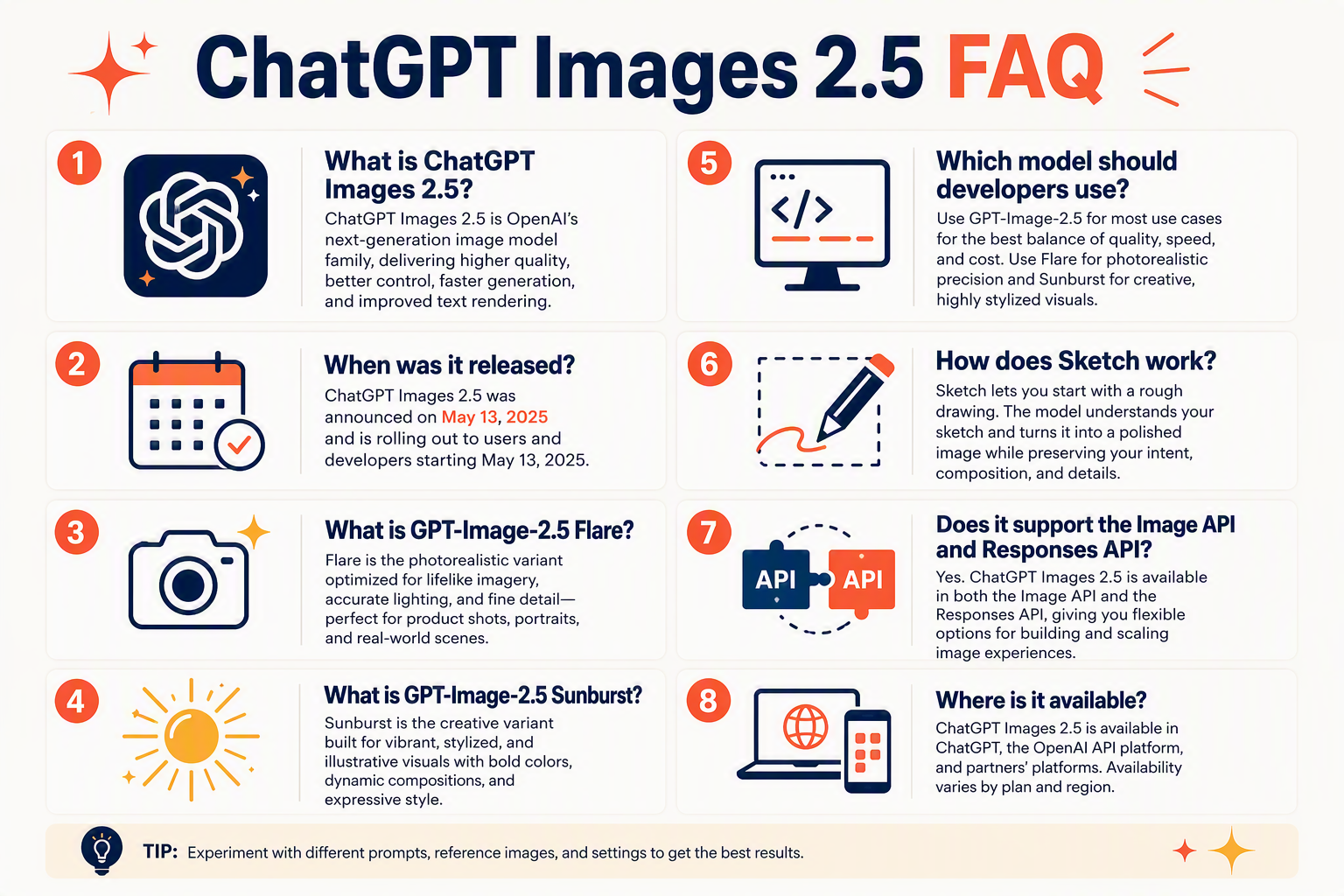
What is ChatGPT Images 2.5, and when was it released?
How does the new Sketch feature work in ChatGPT?
Is ChatGPT Images 2.5 available to every ChatGPT user?
What is the API model ID for ChatGPT Images 2.5?
Does ChatGPT Images 2.5 improve text rendering, editing precision, and reference-image fidelity?
What should developers verify before using the new image release in production?
Conclusion
ChatGPT Images 2.5 is best understood as a control upgrade, not merely a quality upgrade. OpenAI’s September 8, 2026 announcement makes Sketch the headline: users can draw directly in ChatGPT, then use those lines to guide generation or editing.
- Sketch changes prompting from description to direction. A rough room layout, clothing contour, or doodle can communicate composition and shape more efficiently than text alone.
- The practical gains are greater precision and repeatability. Better editing, reference fidelity, detail consistency, text rendering, and layout control can help teams move from attractive drafts to usable assets with fewer revisions.
- Product and API availability are separate questions. “ChatGPT Images 2.5” should not be assumed to be an API model identifier; developers should verify the exact model ID, endpoint, pricing, region, and rollout status in OpenAI’s API changelog.
- Same-day reporting requires clear uncertainty labels. OpenAI’s announcement and developer documentation should take precedence over screenshots, social posts, or inferred compatibility.
What comes next will be measured less by novelty than by workflow reliability: watch for broader Sketch availability, documented API access, stable pricing, and evidence that visual guidance consistently survives multi-step edits.
Developers exploring this shift can also evaluate CallMissed, an OpenAI-compatible gateway spanning image, language, speech, and search models. Will sketch-guided generation become the missing interface between creative intent and production-ready AI imagery?
Related Reading
- GPT-6 Astra API Availability, Access, and Pricing: Verified Status as of September 3, 2026
- GPT Image 2 vs Nano Banana 2 vs Seedream 5.0: 2026 API Comparison
- GPT Image 2.5 API: Flare vs Sunburst Developer Guide