
AI Receptionist for Travel Agencies: Practical 2026 Guide to Voice, WhatsApp and Email


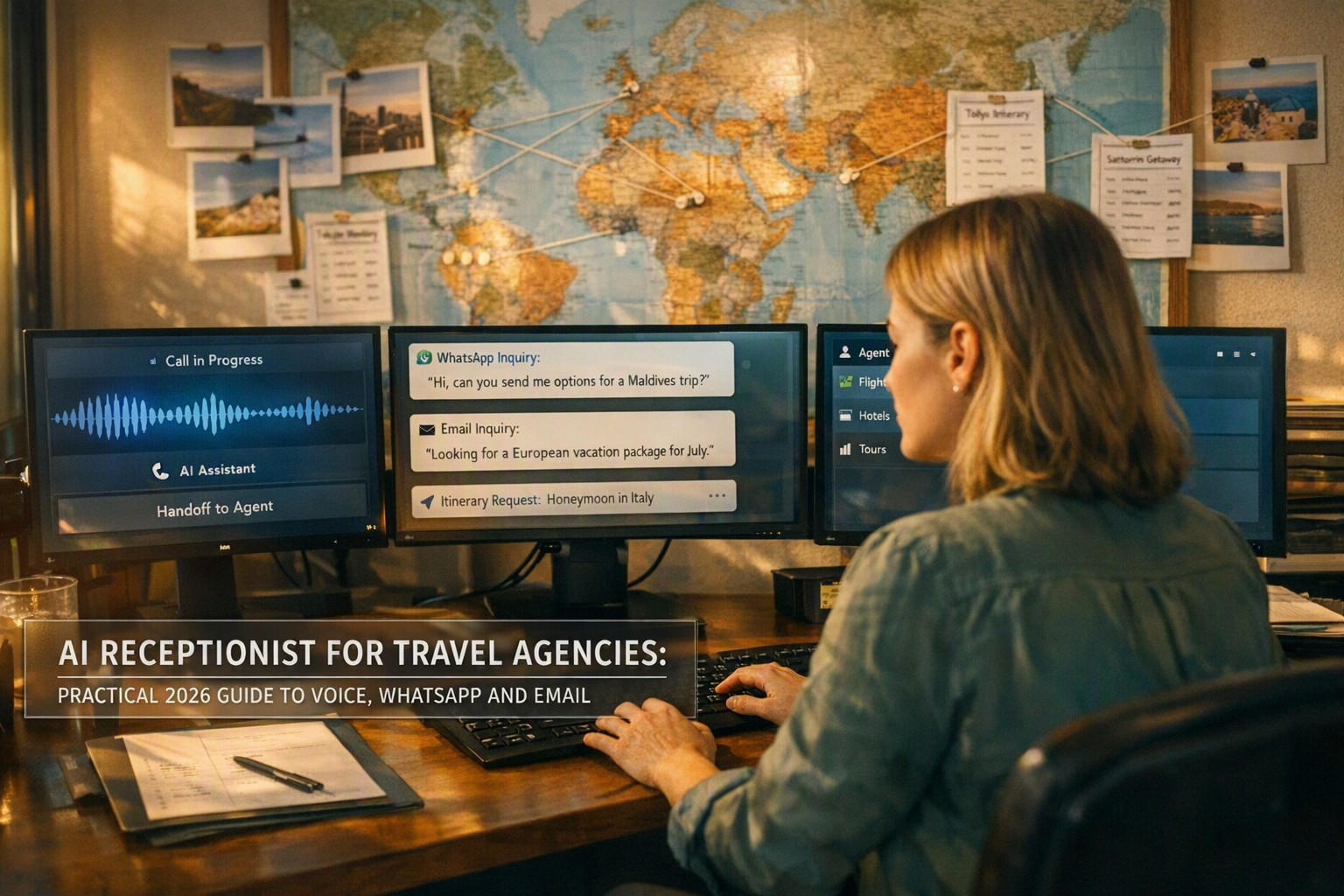
Learn how an AI receptionist for travel agencies captures leads, verifies availability, books consultations and escalates safely in 2026.
AI Receptionist for Travel Agencies: Practical 2026 Guide to Voice, WhatsApp and Email
What happens when a high-intent traveller calls after hours, sends a WhatsApp message and emails an itinerary request—yet nobody responds until the next morning? An AI receptionist for travel agencies can capture that enquiry immediately, answer approved package questions, qualify the lead and schedule a consultation across voice, WhatsApp and email without pretending that uncertain prices or availability are confirmed.
The commercial stakes are substantial. The World Travel & Tourism Council projected in 2025 that travel and tourism would contribute a record US$11.7 trillion to the global economy, equivalent to 10.3% of global GDP. Demand is also increasingly conversational: Meta CEO Mark Zuckerberg said in April 2025 that WhatsApp had surpassed 3 billion monthly active users. For agencies and tour operators, every missed call or delayed message can therefore represent a family holiday, group departure, visa-assistance request or corporate booking moving to a faster respondent.
Effective travel enquiry automation is not simply a chatbot repeating generic destination content. A production-ready receptionist should use agency-approved package data, collect travel dates and passenger details, distinguish fixed departures from customised tours, and verify live fares, inventory and cancellation terms through connected systems. It must also recognise clear boundaries: an AI agent should not invent visa rules, guarantee unverified availability, accept sensitive card details in conversation or improvise during flight cancellations and other disruptions.
This practical travel enquiry automation 2026 guide explains how to design workflows that are useful to travellers and controllable by operations teams. You will learn how to:
- Capture enquiries and recover missed calls across voice, WhatsApp and email.
- Build travel agency WhatsApp automation for destination FAQs, package discovery and follow-ups.
- Configure a tour booking AI agent to qualify budgets, dates, origin cities, group sizes and preferences.
- Collect structured itinerary requests and book consultations with human travel advisers.
- Support multilingual travellers while grounding answers in approved knowledge.
- Check live pricing and availability before making commitments.
- Escalate payment questions, visa uncertainty, complaints and travel disruptions safely.
- Connect CRM, calendars, booking platforms, email systems and analytics.
- Roll out in stages and track response time, qualified-lead rate, booking conversion, containment and escalation accuracy.
Platforms such as CallMissed reflect this shift by combining AI voice agents, WhatsApp chat and Business calling, email workflows, knowledge-base retrieval and support for 22 Indian languages. The goal, however, is not to remove travel expertise—it is to ensure that every enquiry reaches the right next step quickly, with human advisers taking over when judgement, verification or empathy matters most.
How does an AI receptionist for travel agencies work? It captures enquiries, answers approved FAQs, qualifies leads and routes complex requests to people
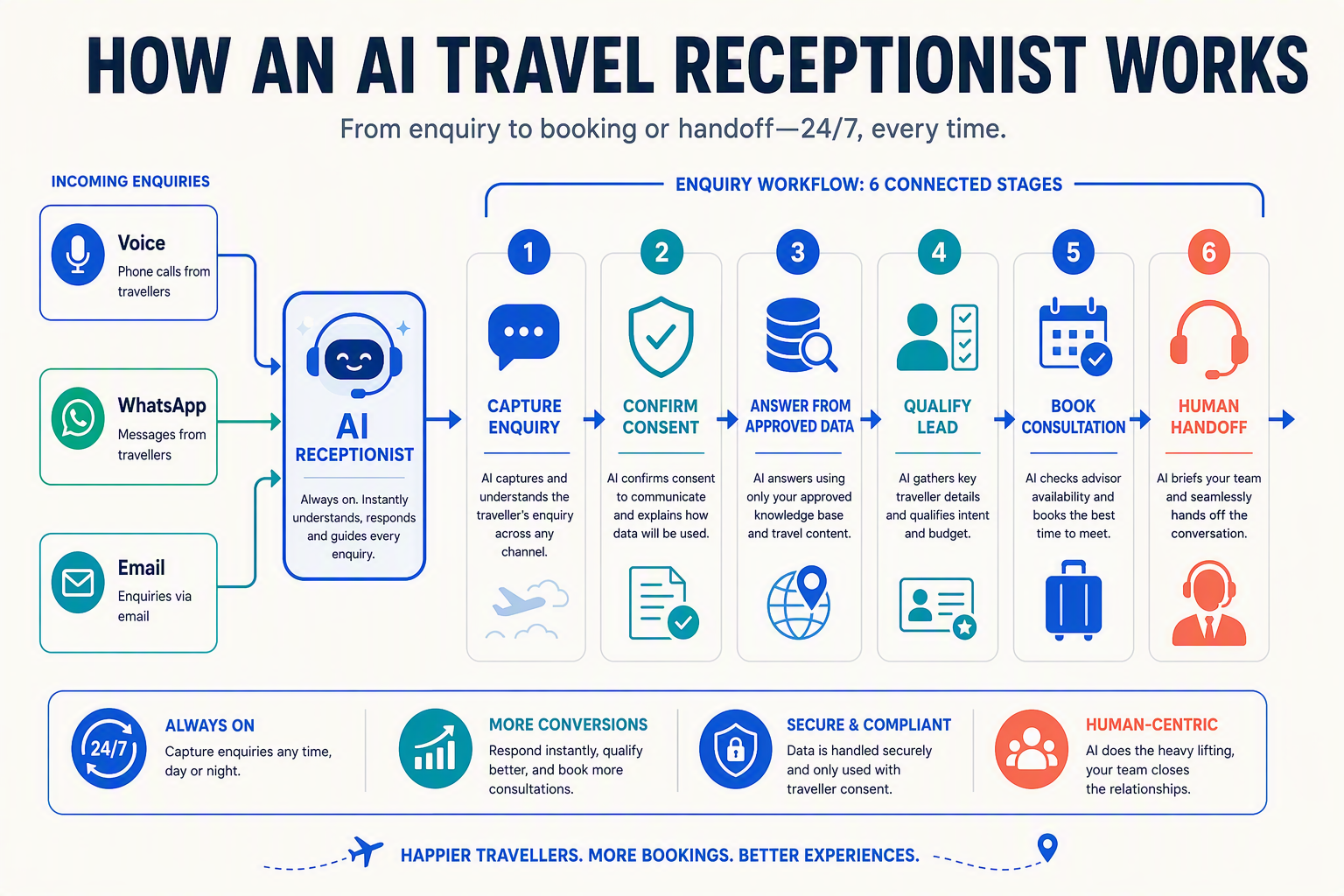
An AI receptionist for travel agencies acts as a controlled orchestration layer: it receives enquiries, identifies the traveller’s intent, retrieves answers from approved agency data, records lead details and either completes a permitted action or transfers the conversation to a human adviser. It should operate consistently across phone calls, WhatsApp messages and email while preserving the conversation history.
From first contact to structured enquiry
The workflow begins when a traveller calls, messages or emails the agency. The AI identifies common intents such as package discovery, itinerary customisation, group travel, visa assistance, booking changes or payment support.
A typical sequence is:
- Acknowledge immediately: Confirm that the enquiry has been received and state that prices or availability require verification where applicable.
- Capture contact details: Record the traveller’s name, phone number, email address and preferred communication channel.
- Collect trip requirements: Ask for destination, origin city, travel dates, flexibility, passenger count, children’s ages, budget and preferences.
- Classify the opportunity: Distinguish a fixed-departure package from a customised holiday, corporate trip, honeymoon or group tour.
- Create or update the CRM lead: Store structured fields alongside the transcript, call recording or email thread.
- Choose the next action: Answer an approved FAQ, check a connected system, book a consultation or escalate.
This turns fragmented conversations into records that advisers can review without asking travellers to repeat everything.
Approved answers rather than improvised travel advice
A tour booking AI agent should retrieve information from a governed knowledge base containing package inclusions, hotel categories, destination summaries, departure points, standard policies and agency-approved FAQs. Retrieval-augmented generation can locate the relevant content, but business rules determine what the agent may actually say.
For example, the receptionist can explain that a package includes airport transfers and breakfast when those details appear in the approved itinerary. It should not claim that a room, flight seat or visa appointment is available unless a connected source verifies that information live.
Useful answer controls include:
- Showing the source package and its last-updated date.
- Separating static facts from dynamic fares and inventory.
- Refusing to guess when approved material is missing or contradictory.
- Escalating legal, medical, immigration and disruption-related questions.
- Logging the retrieved source for later quality review.
One workflow across voice, WhatsApp and email
Channel behaviour should reflect how travellers communicate. Voice works well for rapid discovery and callers who prefer conversation. Travel agency WhatsApp automation can present package summaries, gather documents through approved processes and continue missed-call follow-ups. Email is better suited to detailed itinerary requests, quotations and attachments.
Cross-channel identity resolution matters because the same traveller may use all three channels. Meta CEO Mark Zuckerberg reported in April 2025 that WhatsApp had exceeded 3 billion monthly active users, reinforcing why WhatsApp should be treated as a primary service channel rather than a secondary chatbot surface.
Qualification and human routing
Effective travel enquiry automation does not attempt to contain every interaction. It routes high-value, uncertain or sensitive requests with a concise handoff summary containing:
- Traveller profile and contact preference.
- Dates, destination, passenger mix and budget.
- Packages discussed and questions answered.
- Unverified details requiring adviser action.
- Consultation slot or requested callback time.
Urgent disruptions, complaints, payment disputes, accessibility needs and complex multi-city itineraries should move to designated teams. The result is not human replacement, but faster triage and better-prepared travel advisers.
Why is travel enquiry automation becoming essential for agencies and tour operators in 2026?
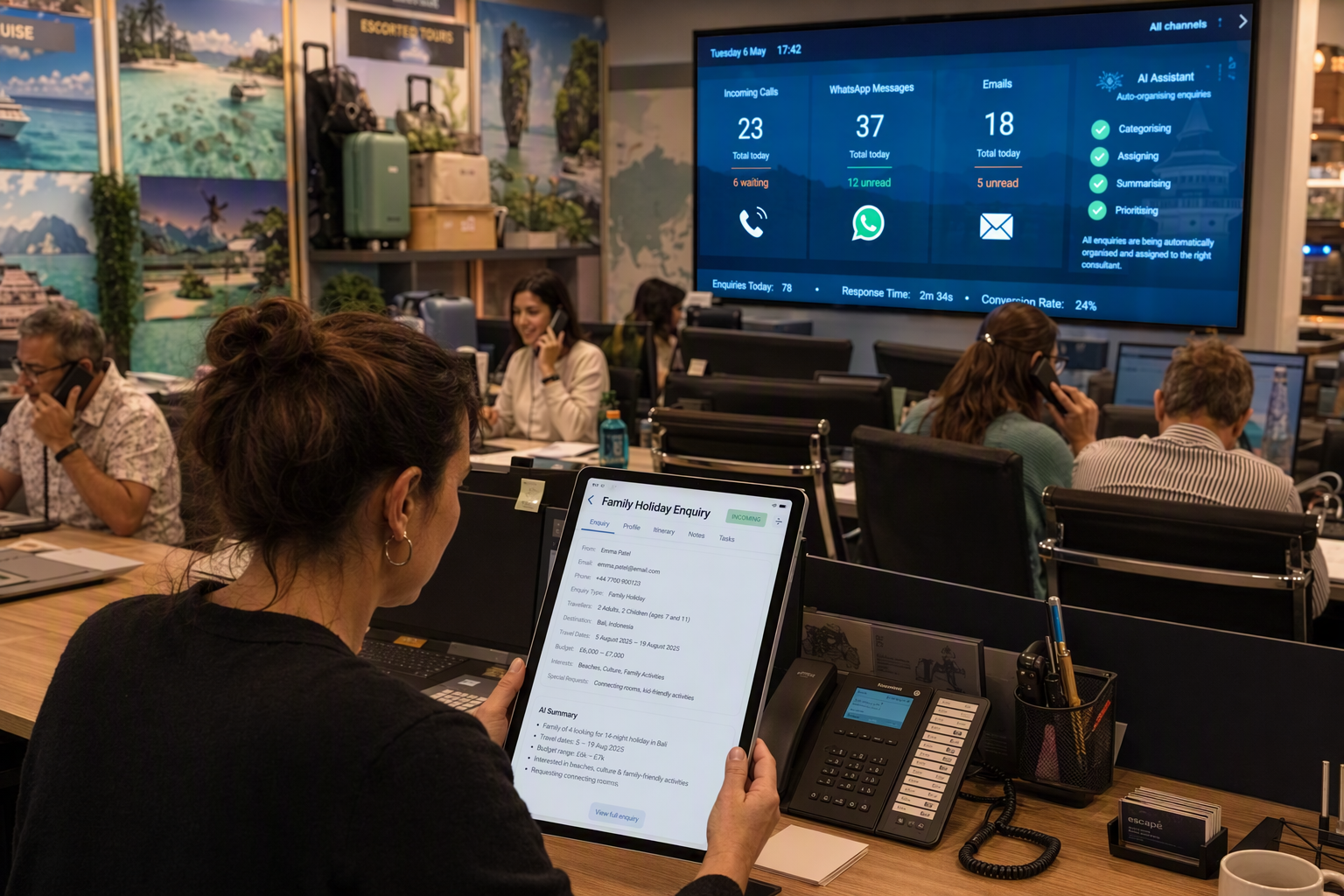
Travel enquiry automation is becoming essential in 2026 because demand arrives continuously across multiple channels, while travellers expect quick, consistent and useful answers. Agencies need a coordinated system that can recognise one customer across voice, WhatsApp and email, complete routine intake immediately, and route high-value or high-risk cases to a qualified adviser.
Enquiry volume no longer follows office hours
Travel decisions often happen during evenings, weekends or lunch breaks, particularly when families and groups must coordinate. Campaigns, social media posts and fare alerts can also create sudden enquiry spikes that a fixed-size reservations team cannot absorb efficiently.
The market opportunity makes slow handling increasingly costly. The World Travel & Tourism Council projected in 2025 that travel and tourism would contribute US$11.7 trillion, or 10.3% of global GDP, to the global economy. An AI receptionist for travel agencies helps operators participate in that demand without requiring every initial interaction to wait in a telephone queue or shared inbox.
Useful automation can immediately record:
- Destination, departure city and preferred travel dates.
- Number and age profile of travellers.
- Budget range and accommodation preferences.
- Fixed-departure versus customised-tour requirements.
- Passport, visa-assistance or accessibility needs.
- The traveller’s preferred language, channel and callback time.
This structured capture gives human consultants a workable brief rather than an unclassified message such as “Please send details.”
Travellers move between channels
A customer may discover a package on Instagram, ask for the itinerary on WhatsApp, call about child pricing and later email passport-name details. Treating these as separate conversations produces duplicate work, inconsistent answers and fragmented customer records.
WhatsApp deserves particular attention because Meta CEO Mark Zuckerberg announced in April 2025 that WhatsApp had exceeded 3 billion monthly active users. Effective travel agency WhatsApp automation should therefore do more than send promotional broadcasts: it should identify intent, retrieve approved package information, collect missing fields and preserve context for a human handoff.
A channel-aware workflow can assign different roles:
- Voice handles urgent questions, conversational qualification and missed-call recovery.
- WhatsApp supports package discovery, document prompts and asynchronous follow-ups.
- Email accommodates detailed itineraries, corporate requirements and longer attachments.
- CRM and inbox systems consolidate the resulting timeline for advisers.
Speed must be balanced with accuracy
Travel products contain volatile elements, including airfares, hotel inventory, taxes, transfer capacity and foreign-exchange effects. A tour booking AI agent should answer stable questions from approved content—such as inclusions, destination highlights and standard pickup policies—but query connected booking systems before quoting live prices or confirming availability.
This distinction makes travel enquiry automation operationally valuable rather than merely conversational. The agent can automate repeatable work while escalating situations that require judgement, including:
- Unverified visa or entry requirements.
- Payment links, refunds and charge disputes.
- Flight cancellations, missed connections and stranded travellers.
- Complaints, medical needs or accessibility exceptions.
- Complex groups and negotiated corporate travel.
In 2026, automation is therefore becoming infrastructure for responsiveness and control. The objective is not maximum containment; it is faster progression from first contact to an accurate answer, qualified opportunity, booked consultation or safe human escalation.
Which 2026 developments are changing voice, email and travel agency WhatsApp automation?
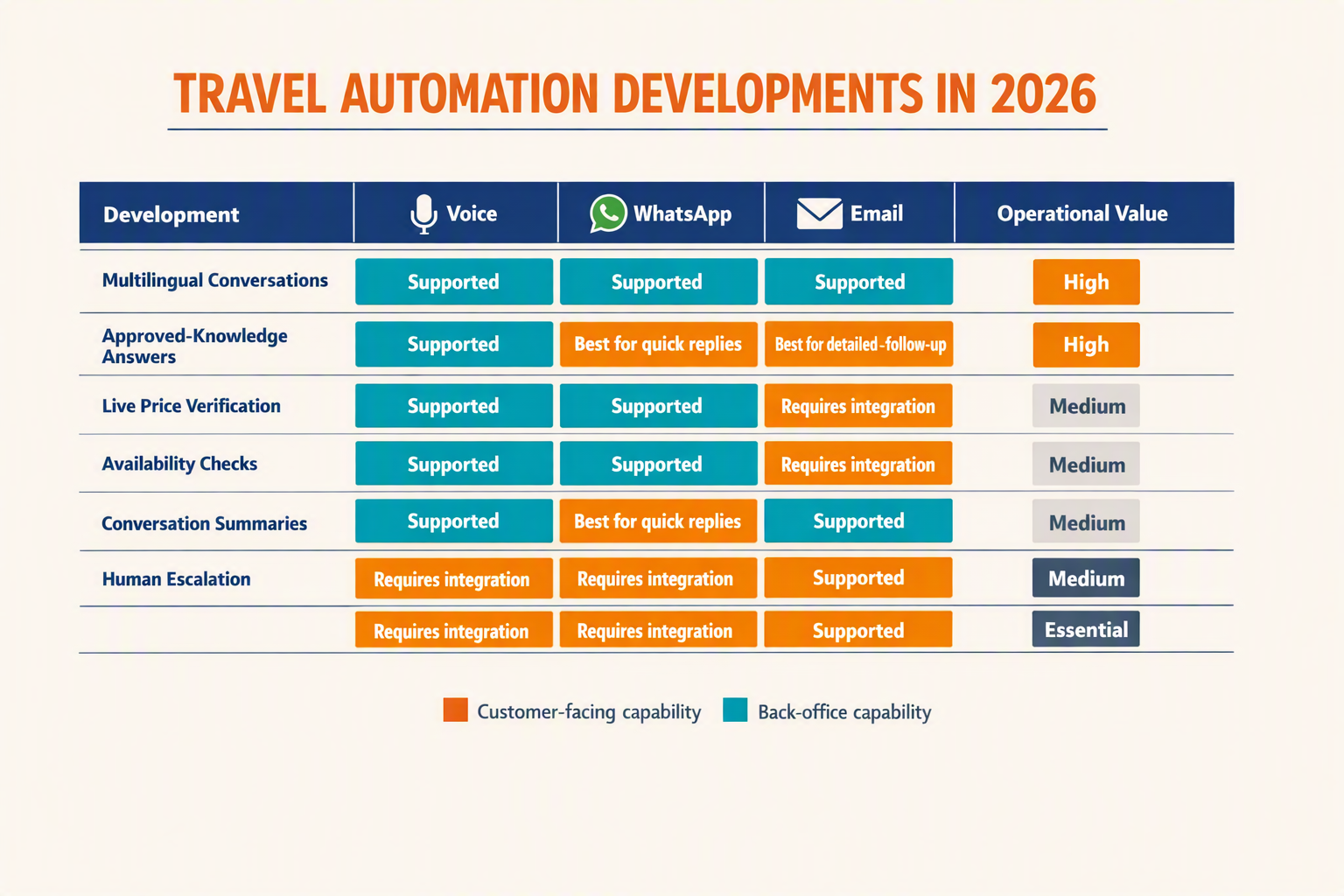
AI receptionists in 2026 are shifting from isolated chatbots to multichannel, tool-using agents that preserve context across phone calls, WhatsApp and email. For travel agencies, the practical breakthrough is not more human-sounding conversation; it is the ability to ground answers in approved data, verify changing details through connected systems and transfer exceptions to an adviser.
Six developments reshaping travel automation
| 2026 development | Voice impact | WhatsApp or email impact | Practical agency use |
|---|---|---|---|
| Unified conversation memory | Recognises details collected during an earlier call | Continues the same enquiry on WhatsApp or email | Prevents travellers from repeating dates, budgets and group sizes |
| WhatsApp Business calling | AI agents can handle inbound or approved business-initiated WhatsApp calls | Calls and chats remain within a WhatsApp-centred journey | Recover an abandoned chat through a scheduled voice conversation |
| Grounded retrieval, or RAG | Answers from approved package and destination material | Cites controlled itineraries, inclusions and policies in replies | Explain meal plans or sightseeing inclusions without inventing details |
| Tool calling and live verification | Checks connected inventory before responding | Sends verified prices, availability or consultation slots | Distinguishes indicative package prices from bookable inventory |
| Multilingual speech and messaging | Detects and responds in a traveller’s preferred language | Maintains language consistency across chat and follow-up email | Serve regional Indian and international audiences more effectively |
| Structured email and document intake | Summarises email context for an adviser callback | Extracts itinerary requirements from messages and attachments | Converts long requests into CRM fields and actionable tasks |
WhatsApp is becoming a voice channel
Meta CEO Mark Zuckerberg said in April 2025 that WhatsApp had surpassed 3 billion monthly active users. That scale makes travel agency WhatsApp automation relevant beyond simple text FAQs: travellers can move between messages, approved templates and WhatsApp Business calls without starting an unrelated support journey.
Platforms such as CallMissed can bridge inbound and business-initiated WhatsApp Business calls to an AI voice agent. This creates practical workflows such as asking permission in chat, arranging a callback and passing the complete transcript to a human holiday consultant.
Grounding and verification now matter more than fluency
A modern tour booking AI agent can retrieve information from approved brochures, fixed-departure sheets and cancellation policies. Retrieval alone is insufficient, however, because package documents may not contain current airfares, hotel inventory or blackout dates.
Agencies should separate information into three classes:
- Stable knowledge: destination descriptions, standard inclusions and office hours.
- Version-controlled content: package itineraries, eligibility rules and cancellation terms.
- Live transactional data: fares, rooms, departure capacity and payment status.
Only the third category should trigger booking, supplier or payment-system tools. If verification fails, the agent should label the amount as indicative or escalate rather than imply confirmation.
Multilingual and email automation are becoming operational
An AI receptionist for travel agencies can now capture spoken names, origin cities and travel dates, then continue qualification in writing. Indic-first support is especially important in India, where regional-language speech cannot be treated as a translated English workflow; CallMissed supports speech-to-text and text-to-speech across 22 Indian languages.
Email automation is also moving beyond canned acknowledgements. In a controlled travel enquiry automation 2026 guide workflow, the agent can classify an email, extract passenger count and preferences, request missing fields, create a CRM record and offer verified calendar slots—while routing passports, payment disputes, visa uncertainty and disruption cases to authorised staff.
Which enquiries should a tour booking AI agent capture, qualify and book automatically?
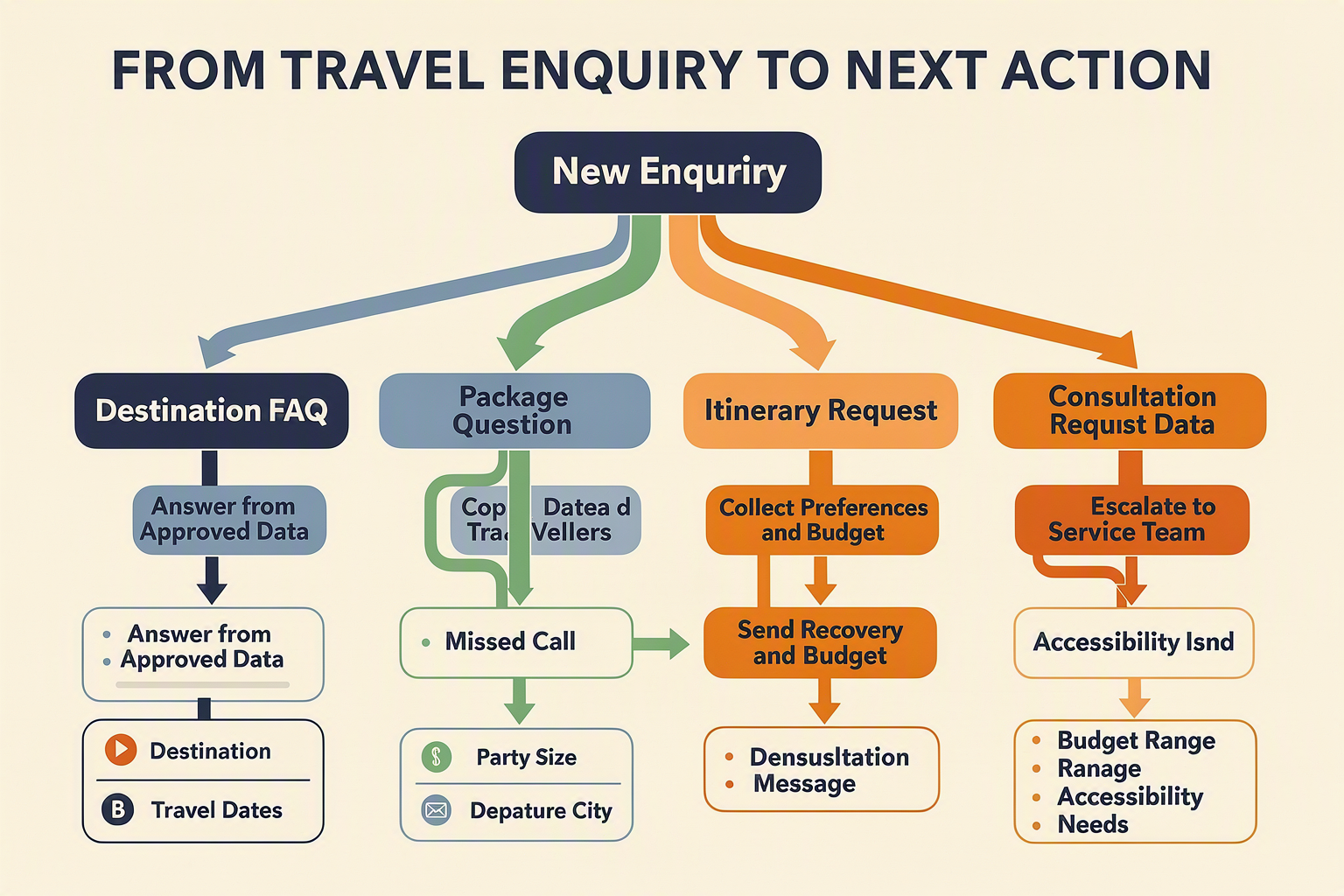
A tour booking AI agent should automatically handle high-volume, rules-based enquiries where package data, calendar slots, prices and inventory can be verified. It should capture and qualify more complex requests, but transfer them to a travel adviser before confirming bespoke itineraries, uncertain availability, payments or exception-heavy bookings.
Capture every enquiry in a structured record
An AI receptionist for travel agencies should create one lead record regardless of whether the traveller calls, messages on WhatsApp or sends an email. When the same person uses multiple channels, phone number and email matching can help avoid duplicate conversations.
Capture these minimum fields:
- Traveller’s name, mobile number, email and preferred contact channel.
- Destination or shortlisted destinations.
- Origin city and preferred departure point.
- Travel dates, flexibility and trip duration.
- Number of adults, children and infants, including children’s ages.
- Approximate total or per-person budget and preferred currency.
- Holiday type, such as honeymoon, family, group, pilgrimage or corporate travel.
- Hotel category, meal, transport and activity preferences.
- Passport status and nationality when relevant—without claiming visa eligibility.
- Accessibility, dietary or other special-service requests.
- Marketing consent and a concise conversation summary.
For missed calls, the workflow can immediately send an approved WhatsApp message such as: “We missed your call. Which destination, dates and number of travellers are you considering?” This turns missed-call recovery into structured intake rather than an untracked callback task.
Qualify intent before routing the lead
Effective travel enquiry automation should identify both booking fit and purchase readiness. The agent can classify an enquiry as package discovery, fixed-departure booking, customised itinerary, visa assistance, existing-booking support or disruption support.
A useful qualification sequence is:
- Confirm intent: research, quotation, consultation or immediate booking.
- Check fit: destination, departure city, dates, group size and budget against approved packages.
- Identify constraints: fixed dates, elderly travellers, infants, accessibility needs or passport concerns.
- Measure urgency: travel month, quotation deadline and readiness to pay after human or system verification.
- Assign ownership: sales adviser, group desk, visa team or customer-support queue.
Travel agency WhatsApp automation should preserve this information when a conversation moves to a phone adviser. Travellers should not have to repeat dates, budgets and passenger counts after completing qualification.
Book automatically only when the commitment is verifiable
The agent can safely book consultations, branch appointments and adviser callbacks when it has real-time access to staff calendars. It may also confirm a tour product automatically when all required conditions are deterministic:
- The package is active and available for the requested dates.
- Live inventory and the final payable price have been verified through connected systems.
- Inclusions, exclusions, taxes and cancellation terms match approved records.
- Passenger details satisfy the operator’s predefined booking rules.
- The traveller has explicitly reviewed and accepted the applicable terms.
- Payment occurs through a secure hosted checkout—not by collecting card details in voice, WhatsApp or email.
By contrast, customised multi-city tours, large groups, conflicting fare results and special requests should produce a qualified itinerary brief, not an invented confirmation. The AI can schedule the consultation, attach the transcript and provide the adviser with a structured summary.
Platforms such as CallMissed can connect AI voice agents with WhatsApp chat and WhatsApp Business calling, helping agencies maintain one intake workflow across spoken and written enquiries. The operational rule remains simple: capture broadly, qualify consistently and book automatically only when price, availability and policy are machine-verifiable.
How should approved destination data, live prices and availability checks be handled safely?
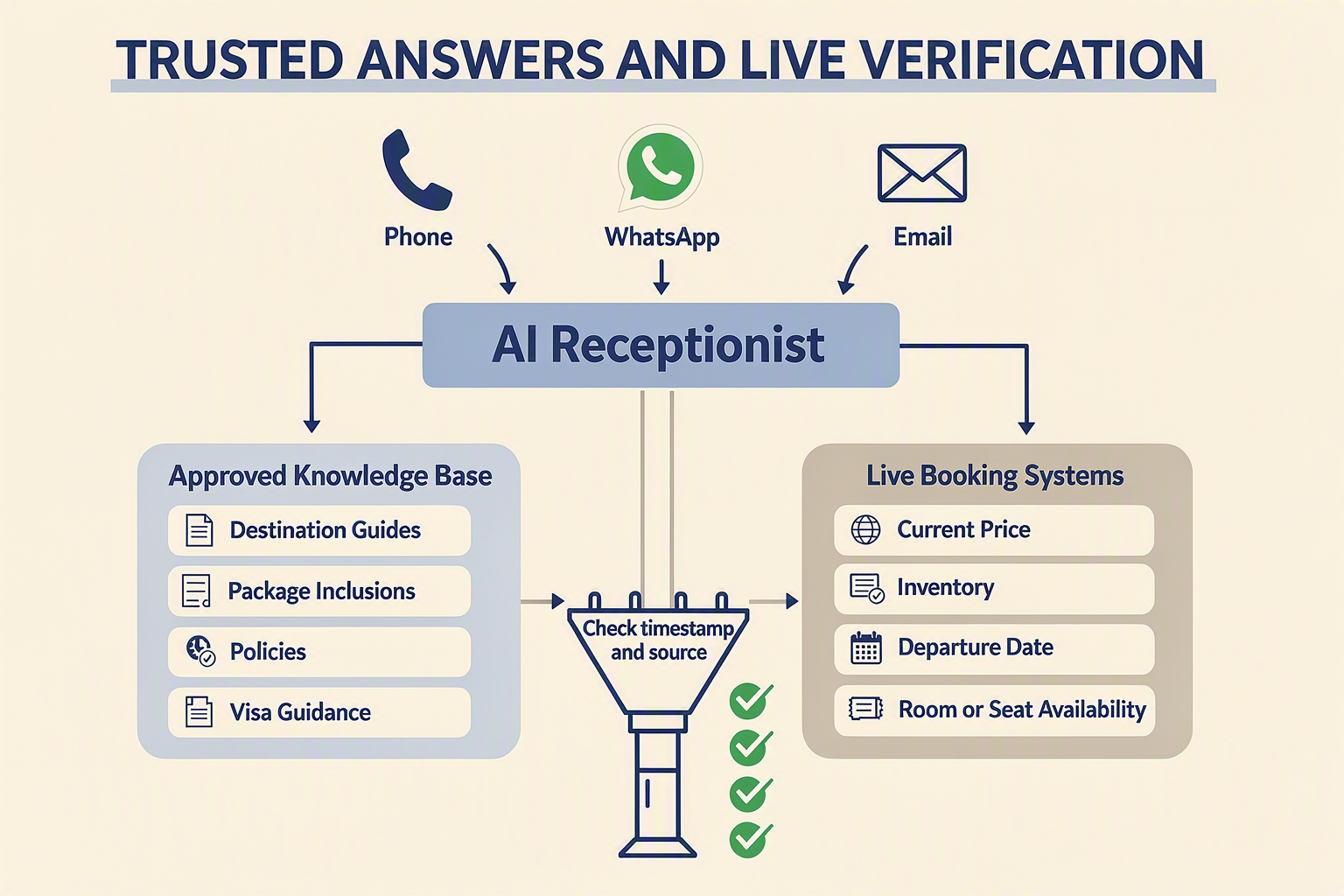
Approved destination information should come from a version-controlled knowledge base, while prices and availability must be retrieved from authorised booking systems at the moment of enquiry. An AI receptionist for travel agencies should clearly label estimates, report when each live check was performed and avoid presenting inventory as reserved until the supplier confirms the booking.
Separate approved knowledge from live transaction data
A safe architecture distinguishes relatively stable content from information that can change within minutes.
Approved knowledge-base content can include:
- Destination descriptions, climate guidance and recommended travel periods.
- Published package inclusions, exclusions and standard itinerary sequences.
- Hotel categories, transfer arrangements and optional activities.
- Agency-authored documentation checklists and general cancellation guidance.
- Supplier-approved terms, with an owner, effective date and review date.
Retrieval-augmented generation, or RAG, should restrict answers to these approved records. Every document needs metadata such as destination, package ID, departure market, language, version and expiry date. Draft itineraries, old brochures and unverified web pages should not enter the production knowledge base.
Visa, health and entry requirements require tighter controls because they may change rapidly. The agent should identify the traveller’s nationality, destination and travel date, cite the approved official-source record where available, and recommend verification with the relevant embassy, consulate or government portal rather than guaranteeing eligibility.
Check dynamic information through authorised APIs
Airfares, hotel rooms, transfer capacity, taxes and fixed-departure seats should not be generated from brochure text or previous conversations. A tour booking AI agent should query the agency’s global distribution system, booking engine, supplier API or inventory database using structured inputs.
A reliable workflow is:
- Collect the origin, destination, dates, passenger count, child ages, room configuration and fare preferences.
- Validate ambiguous details—for example, whether “next Friday” refers to departure or return.
- Request current inventory and a priced offer from the connected system.
- Return the currency, inclusions, taxes, conditions and verification timestamp.
- Explain that the result remains subject to change until held, paid for or supplier-confirmed.
If an API times out or returns incomplete data, the response should be explicit: “I could not verify live availability, so I have sent this request to a travel adviser.” The model must never fill missing fields with plausible-looking prices.
Apply channel-specific safeguards
The same data policy should govern voice, email and travel agency WhatsApp automation, even though presentation differs:
- Voice: Read back dates, passenger numbers and the total price; send detailed fare rules through an approved written channel.
- WhatsApp: Use structured summaries and confirmation buttons, but refresh live results before the traveller proceeds.
- Email: Include the package reference, pricing timestamp, assumptions and validity conditions in a consistent template.
- All channels: Mask personal identifiers in logs and never request full card numbers, CVVs or banking passwords conversationally.
Dynamic results should also have short, supplier-appropriate cache periods. A cached destination description may remain valid for months, whereas airfare or room inventory may require an immediate recheck.
Preserve evidence and human control
Safe travel enquiry automation needs an audit trail recording the customer request, knowledge source, API response, timestamp, model output and any human edits. Operations teams should receive alerts for expired documents, supplier-data conflicts, unusually large price changes and repeated API failures.
Most importantly, distinguish three states in every workflow: informational quote, inventory hold and confirmed booking. Only the connected supplier or booking platform—not the language model—should move a traveller between those states.
Where must automation stop for payments, disruptions and high-risk customer situations?
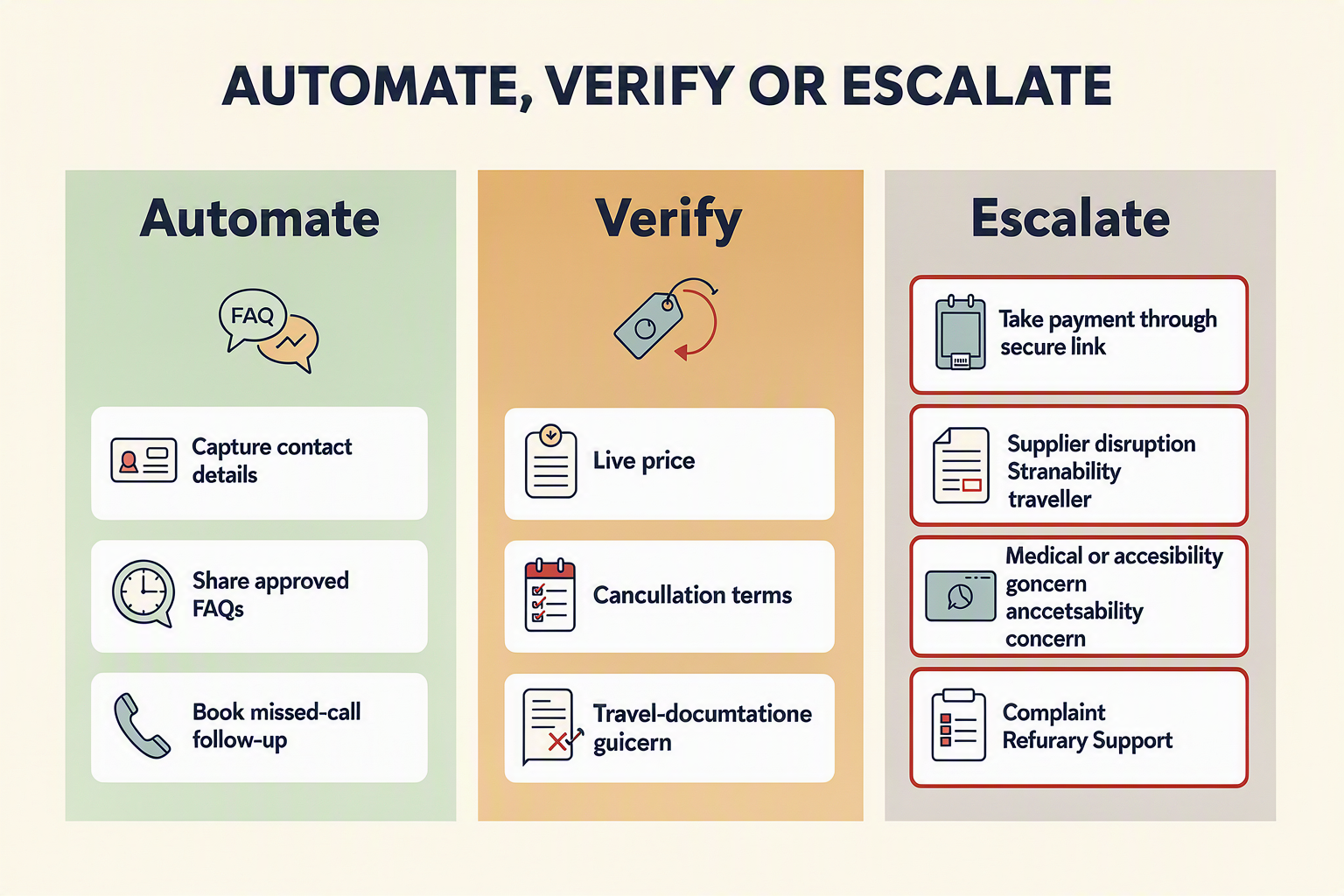
Automation must stop whenever a request involves payment credentials, unverified financial commitments, disrupted travel, legal or visa uncertainty, safety, vulnerability or emotionally charged disputes. In these cases, an AI receptionist for travel agencies should collect only the minimum context, disclose its automated role and transfer the traveller to an authorised human or secure system.
Keep conversational AI outside the payment boundary
A tour booking AI agent may explain an approved deposit amount, identify an outstanding balance and send a secure payment link. It should never ask a traveller to dictate or message a full card number, CVV, PIN, one-time password or internet-banking credentials through voice, WhatsApp or email.
The PCI Security Standards Council states that sensitive authentication data, including card verification codes, cannot be stored after authorisation—even when encrypted. Agencies should therefore:
- Redirect customers to a PCI DSS-compliant hosted checkout or payment-provider page.
- Tokenise payment references rather than retaining card details in the CRM or transcript.
- Require human review before changing bank details, issuing large refunds or accepting unusual payment arrangements.
- Mask accidental payment data in recordings, transcripts and support logs.
- Escalate suspected fraud, duplicate charges and chargeback threats immediately.
Travel agency WhatsApp automation can send payment reminders and confirmed receipts, but it must not interpret a screenshot as definitive proof of settlement. Booking status should change only after the payment gateway or finance system returns a verified success event.
Treat disruptions as assisted workflows, not routine FAQs
Flight cancellations, missed connections, hotel overbooking, natural disasters and civil unrest can change by the minute. The AI may acknowledge the problem, retrieve a verified status and collect the booking reference, traveller location and immediate needs—but should not invent alternatives or promise reimbursement.
Human escalation should be mandatory when:
- A traveller is stranded, travelling with children or requires accessibility assistance.
- A replacement creates extra cost, an overnight stay or a material itinerary change.
- Supplier information conflicts with the agency’s booking system.
- The customer requests a cancellation, refund, compensation or insurance claim.
- A destination is affected by severe weather, conflict, epidemic controls or an official advisory.
For example, European Union Regulation EC 261/2004 establishes passenger rights for qualifying cancellations, long delays and denied boarding, while eligibility depends on the route, operating carrier and circumstances. An AI can surface approved policy language, but a trained adviser should determine how the rule applies to a specific booking.
Define high-risk triggers across every channel
The same escalation policy must govern voice, email and WhatsApp. Travel enquiry automation should immediately create a priority case when it detects:
- Medical emergencies, threats, self-harm language or personal-safety concerns.
- Passport loss, detention, trafficking indicators or an unaccompanied vulnerable traveller.
- Visa uncertainty or requests to guarantee entry at a border.
- Discrimination allegations, legal threats or serious privacy complaints.
- Aggressive disputes that require empathy, negotiation or management authority.
The handoff should include a concise summary, booking ID, verified conversation history, traveller location, preferred callback channel and urgency level. If transfer fails, the system must provide an emergency contact path and continue retrying according to a documented service level.
Apply a simple control rule
Use three outcomes: automate, verify, or escalate. Automate low-risk information from approved sources; verify live prices, inventory and payment status through connected systems; escalate decisions carrying financial, legal, safety or reputational consequences. The safest AI receptionist does not maximise containment—it recognises when human judgement is the product the traveller needs.
Which integrations, rollout stages and controls make travel automation reliable?
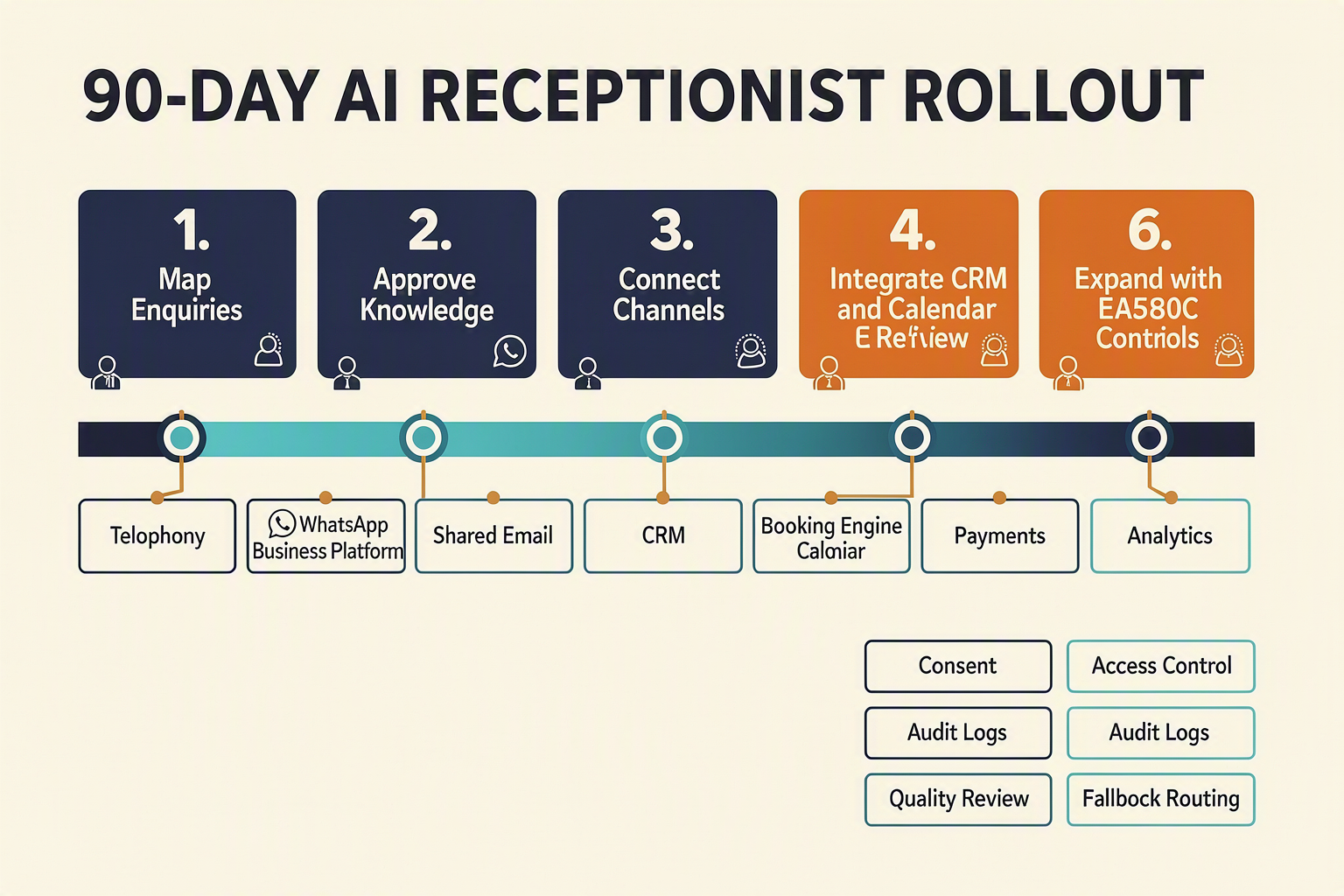
Reliable travel automation requires verified system integrations, a staged rollout and explicit controls over what the AI can read, write and promise. An AI receptionist should begin with low-risk enquiry capture, then gain transactional capabilities only after accuracy, escalation and audit checks meet agreed thresholds.
Connect systems by function, not convenience
An AI receptionist for travel agencies needs separate sources of truth for customer context, product information and live transactions. Typical integrations include:
- CRM: Create or update leads in Salesforce, HubSpot, Zoho CRM or the agency’s own system, preserving source channel, consent, destination, dates, budget and passenger count.
- Knowledge base: Retrieve destination FAQs, inclusions, exclusions, hotel categories, fixed-departure dates and approved policies from version-controlled documents.
- Reservation and supplier systems: Query global distribution systems, tour inventory platforms, hotel suppliers or internal booking databases for current availability and prices.
- Calendars: Offer consultation slots from Microsoft 365, Google Calendar or adviser scheduling software while respecting time zones and assignment rules.
- Communications: Maintain one conversation history across telephony, WhatsApp Business Platform and shared email inboxes.
- Payments: Generate an approved payment link through the agency’s payment provider; never collect complete card numbers, CVVs, banking passwords or one-time passwords conversationally.
Every integration should declare whether access is read-only or write-enabled. A tour booking AI agent may read inventory and create a provisional CRM opportunity, for example, without receiving permission to issue a ticket, confirm a hotel or process a refund.
Roll out capability in controlled stages
A practical deployment sequence reduces both operational risk and staff resistance:
- Observe: Analyse missed calls, email categories and WhatsApp enquiries without allowing the AI to respond.
- Capture: Record contact details, destination, origin city, travel dates, group composition and preferred callback time.
- Answer: Enable replies only from approved package and policy content, with citations or document identifiers available to supervisors.
- Schedule: Allow consultation booking and missed-call recovery after testing calendar conflicts, office hours and adviser routing.
- Verify: Connect live inventory and pricing APIs, clearly labelling results with supplier and retrieval time.
- Transact selectively: Permit deposits or reservation requests only through authenticated workflows, approval gates and secure payment links.
For omnichannel operations, travel agency WhatsApp automation should share CRM state with voice and email. A traveller who calls after sending an itinerary should not have to repeat dates, passenger counts and destination preferences.
Establish non-negotiable operational controls
The control layer should include:
- Confidence thresholds: Escalate when retrieval produces conflicting, missing or low-confidence information.
- Freshness rules: Expire cached fares, room availability, departure capacity and visa-related content after defined intervals.
- Commitment boundaries: Use “available when checked” or “subject to supplier confirmation” until the booking system returns a verified reference.
- Human approval: Require staff intervention for refunds, complaints, special assistance, disputed charges, cancellations and travel disruptions.
- Access governance: Apply role-based permissions, encrypted credentials, retention schedules and complete audit logs.
- Channel continuity: Pass transcripts, collected fields, verification results and the escalation reason to the human adviser.
Platforms such as CallMissed can support this architecture through AI voice agents, WhatsApp chat and Business calling, email workflows, knowledge-base retrieval and communication across 22 Indian languages. Regardless of platform, the central lesson of this travel enquiry automation 2026 guide is simple: expand autonomy only when approved data, live verification and a dependable human fallback are all present.
What impact should agencies measure, and which KPIs prove the system is helping?
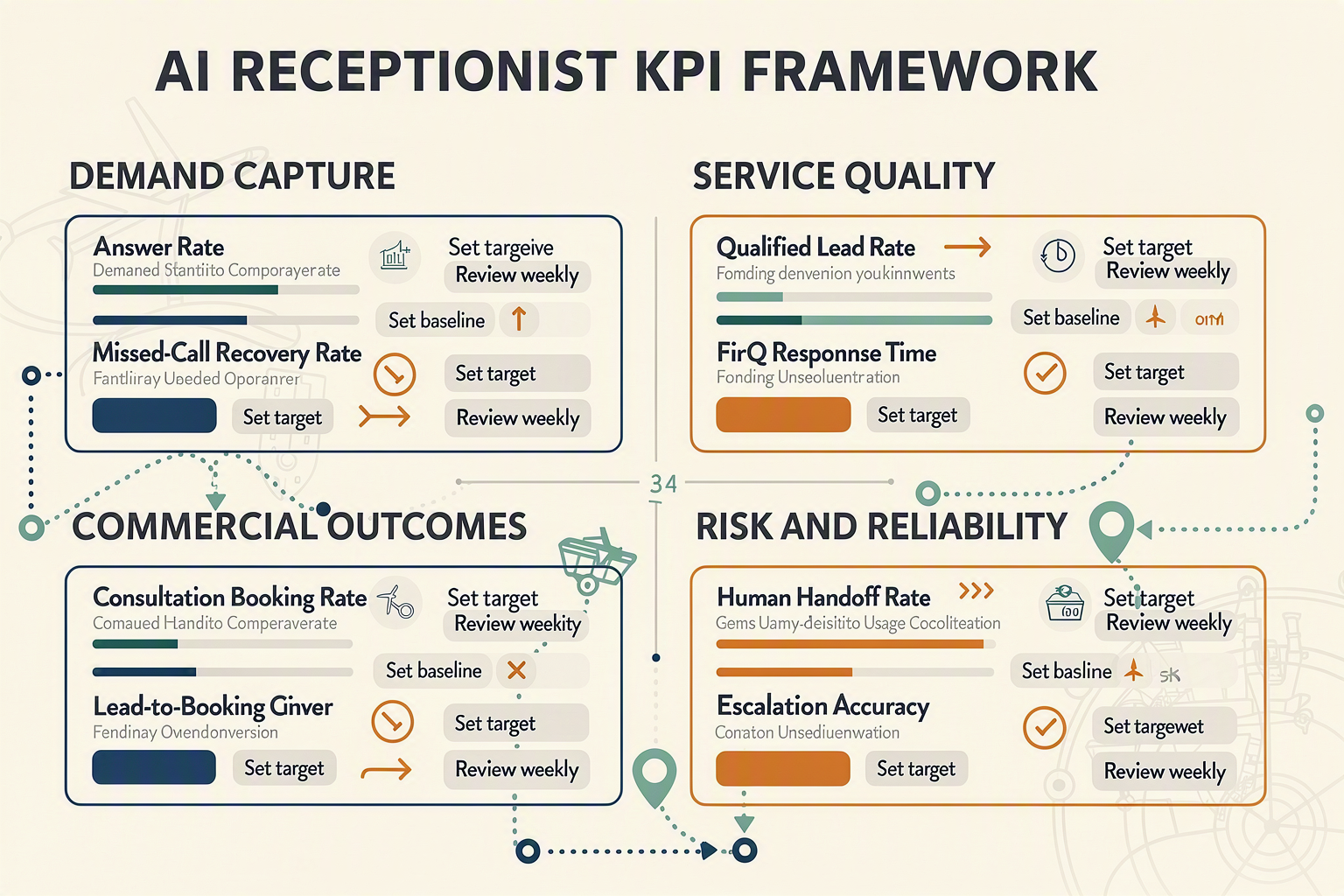
The system is helping only if it produces faster responses, more qualified consultations and higher booking conversion without increasing incorrect answers or unsafe automation. Agencies should compare each KPI with a pre-launch baseline and segment results by channel, destination, language and enquiry type.
Measure the complete enquiry funnel
Do not treat message volume or automated conversations as proof of value. Track each traveller from first contact to confirmed booking:
- Enquiry capture rate: Percentage of calls, WhatsApp messages and emails converted into identifiable CRM records.
- First-response time: Median and 90th-percentile time from enquiry arrival to a useful response—not merely an automated greeting.
- Qualification completion rate: Percentage of leads for which the system captures required fields such as dates, origin city, passenger count, budget and destination preference.
- Consultation-booking rate: Qualified enquiries that schedule an adviser appointment.
- Quote-to-booking conversion: Verified quotations that become paid bookings within a defined attribution window.
- Revenue and gross margin influenced: Booking value is useful, but gross margin prevents teams from optimising for high-value, low-margin packages.
Channel-level measurement is especially important for travel agency WhatsApp automation. Meta CEO Mark Zuckerberg stated in April 2025 that WhatsApp had exceeded 3 billion monthly active users, but an agency still needs its own evidence that WhatsApp enquiries progress into consultations and bookings.
Track speed and recovery separately
An AI receptionist for travel agencies should improve availability beyond office hours, but speed must be measured precisely.
- Missed-call recovery rate = missed calls receiving a callback or WhatsApp follow-up within the agency’s target ÷ total eligible missed calls.
- Time to first useful answer should exclude greetings that provide no information or next step.
- After-hours capture rate shows how many enquiries received outside staffed hours become complete leads.
- Human handoff time measures the delay between an escalation trigger and adviser acceptance.
- Abandonment rate reveals where callers disconnect or messaging users stop responding.
Report the median alongside the 90th percentile. An attractive average can conceal travellers who wait substantially longer.
Balance automation with accuracy and safety
A high containment rate is harmful if the tour booking AI agent gives outdated prices or mishandles disruption cases. Pair every automation KPI with a quality control:
- Approved-answer accuracy: Sampled responses fully supported by the current knowledge base.
- Live-verification rate: Price or availability questions successfully checked against an authorised booking or inventory system.
- Unsupported-claim rate: Responses containing unverified fares, inventory, visa guidance or cancellation terms.
- Correct-escalation rate: Cases requiring human judgement that were routed correctly.
- False-containment rate: Conversations marked resolved even though the traveller still needed assistance.
- Payment-boundary compliance: Percentage of sampled conversations in which card data and sensitive payment issues followed the approved secure process.
Review these metrics by language. A strong overall score can hide poor outcomes for a lower-volume regional language.
Prove incremental business impact
For a credible travel enquiry automation 2026 guide rollout, compare a four-to-eight-week baseline with a controlled pilot. Keep marketing source, destination mix and seasonality visible so automation does not receive credit for a holiday-demand spike.
Create one weekly scorecard covering conversion, response speed, safety, customer experience and cost per qualified lead. Expansion should require improvement in commercial outcomes while unsupported claims, failed handoffs and payment-boundary breaches remain within the agency’s documented risk thresholds.
What do travel operations, customer-experience and security experts recommend?

Travel operations, customer-experience and security specialists recommend treating an AI receptionist as a controlled front door, not an autonomous travel adviser. Give the system authority to capture, retrieve and route information, while reserving price commitments, payment handling, disruption decisions and regulatory advice for verified systems or trained employees.
Travel operations: automate repeatable steps, not judgement
Operations leaders should define a clear authority matrix for every intent handled by an AI receptionist for travel agencies. The agent may explain an approved itinerary or collect passenger requirements, but it should never turn cached information into a booking promise.
A practical authority matrix should specify:
- Answer directly: published package inclusions, hotel categories, departure points and standard documentation checklists.
- Verify through an integration: current fares, room inventory, departure availability, taxes and cancellation conditions.
- Escalate to an adviser: complex visas, accessibility requirements, unaccompanied minors, refunds, complaints and customised group travel.
- Trigger an incident workflow: cancellations, missed connections, medical emergencies and travellers already stranded in destination.
Operations teams should also assign an owner to each knowledge source and record its approval date, expiry date and market applicability. A tour booking AI agent should say that information requires verification when no current source is available, rather than relying on general model knowledge.
Customer experience: preserve context across channels
CX specialists recommend designing one continuous conversation across phone, WhatsApp and email. This matters at WhatsApp’s scale: Meta CEO Mark Zuckerberg reported in April 2025 that WhatsApp had exceeded 3 billion monthly active users.
Effective travel agency WhatsApp automation should therefore carry forward the traveller’s consented context instead of asking the same questions repeatedly. A useful handoff summary includes:
- Origin city, destination and proposed dates.
- Adult, child and infant counts.
- Budget range and accommodation preference.
- Visa status, mobility needs and dietary requirements.
- Packages discussed, checks still pending and promised follow-up time.
CX teams also recommend disclosing that the traveller is interacting with AI, making human assistance easy to request and measuring whether multilingual conversations preserve meaning—not merely whether speech was transcribed. Accent coverage, code-switching and correct pronunciation of place names should be tested with real regional scenarios.
Security: minimise collection and isolate high-risk actions
Security specialists advise collecting only the information necessary for the stated workflow. Article 5 of the European Union General Data Protection Regulation establishes data minimisation as a core personal-data principle, while India’s Digital Personal Data Protection Act, 2023 requires lawful processing and appropriate safeguards for digital personal data.
Key controls include:
- Never requesting full card numbers, CVVs, passwords or one-time passwords in conversational channels.
- Redirecting payments to a PCI-compliant hosted checkout.
- Restricting CRM, calendar and booking-system permissions by role.
- Encrypting transcripts and defining retention and deletion schedules.
- Testing retrieved documents and traveller uploads for prompt injection.
- Logging every availability check, quote source, escalation and human override.
The OWASP Top 10 for Large Language Model Applications 2025 identifies prompt injection and sensitive-information disclosure among major application risks. Agencies should consequently separate traveller-provided content from trusted instructions and prevent uploaded itineraries or emails from changing system rules.
The expert consensus for any travel enquiry automation 2026 guide is straightforward: constrain the agent, verify dynamic facts, preserve channel context and provide an immediate human path when risk or uncertainty increases.
What does this mean for your agency, and what should you automate first?
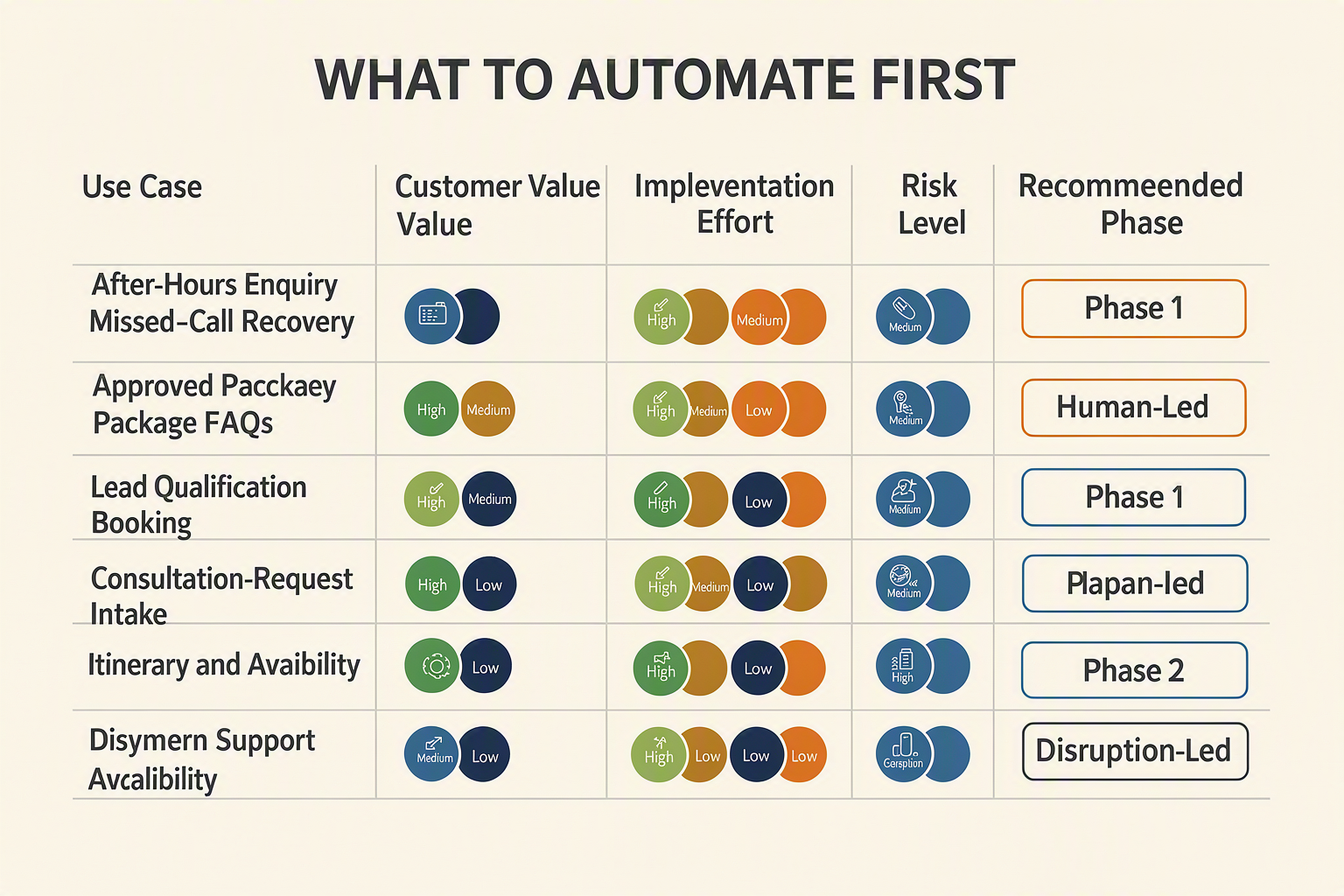
Automate speed, capture and routing first—not judgement-heavy booking decisions. The safest 2026 sequence is to recover every enquiry, answer only from approved content, qualify intent and arrange human consultations before adding live inventory, pricing or transaction workflows.
A risk-adjusted automation roadmap
The World Travel & Tourism Council projected in 2025 that travel and tourism would contribute US$11.7 trillion, or 10.3% of global GDP. That scale makes responsiveness commercially important, but it does not justify automating every interaction at once.
Meta CEO Mark Zuckerberg said in April 2025 that WhatsApp had exceeded 3 billion monthly active users. Agencies should therefore treat travel agency WhatsApp automation as a core intake channel alongside phone and email, rather than as a separate chatbot experiment.
| Priority | Workflow to automate | Primary channels | Essential guardrail | KPI to monitor |
|---|---|---|---|---|
| 1 | Enquiry capture and missed-call recovery | Voice, WhatsApp | Record consent, source, callback preference and contact details | First-response time; capture rate |
| 2 | Destination and package FAQs | Voice, WhatsApp, email | Retrieve answers only from approved, dated agency content | Answer accuracy; escalation rate |
| 3 | Lead qualification and itinerary intake | Voice, WhatsApp, email | Collect structured fields without pressuring travellers to book | Qualification completion rate |
| 4 | Adviser consultation booking | Voice, WhatsApp | Read connected-calendar availability and confirm time zones | Consultation-booking rate; no-show rate |
| 5 | Live price and inventory checks | Voice, WhatsApp, email | Verify through booking systems; label quotes with timestamps and validity | Verification success; quote-to-booking conversion |
| 6 | Payments, exceptions and disruptions | Human-led handoff | Never collect card data in free-form chat or promise unverified remedies | Escalation accuracy; handoff time |
The first four rows are generally suitable for an initial AI receptionist for travel agencies because they reduce response delays without allowing the system to make irreversible commitments. Rows five and six require stronger integrations, audit logs, role-based access and tested escalation procedures.
Roll out in controlled stages
A practical implementation should progress through three gates:
- Observe: Run the AI alongside staff, classify enquiry types and establish baseline response, qualification and conversion rates.
- Assist: Let the tour booking AI agent draft answers, populate CRM fields and suggest available consultation slots while advisers approve actions.
- Automate: Enable low-risk interactions only after knowledge retrieval, multilingual accuracy, routing and fallback behaviour pass realistic test cases.
For Indian agencies, platforms such as CallMissed can support this staged model across AI voice, WhatsApp Business chat and calling, email, knowledge-base retrieval and 22 Indian languages. A unified conversation record is especially useful when a traveller starts on WhatsApp, explains preferences by phone and later emails passport-name details or an itinerary document.
Measure business outcomes, not conversation volume
Treat this travel enquiry automation 2026 guide as an operating plan rather than a mandate to maximise containment. Establish a pre-launch baseline, then track:
- Median first-response time by voice, WhatsApp and email.
- Qualified-lead rate: enquiries with all mandatory trip fields divided by eligible enquiries.
- Consultation conversion: booked adviser calls divided by qualified leads.
- Verified quote rate: quotations confirmed against live systems before delivery.
- Escalation accuracy: cases correctly routed to a human divided by cases requiring judgement.
- Booking conversion and revenue attribution by original enquiry channel.
The right first milestone is simple: no serious traveller should disappear because the agency failed to acknowledge, structure or route an enquiry. Pricing commitments, payments and disruption management should advance only when verification and human ownership are demonstrably reliable.
Frequently asked questions about AI travel receptionists, WhatsApp automation and tour booking agents
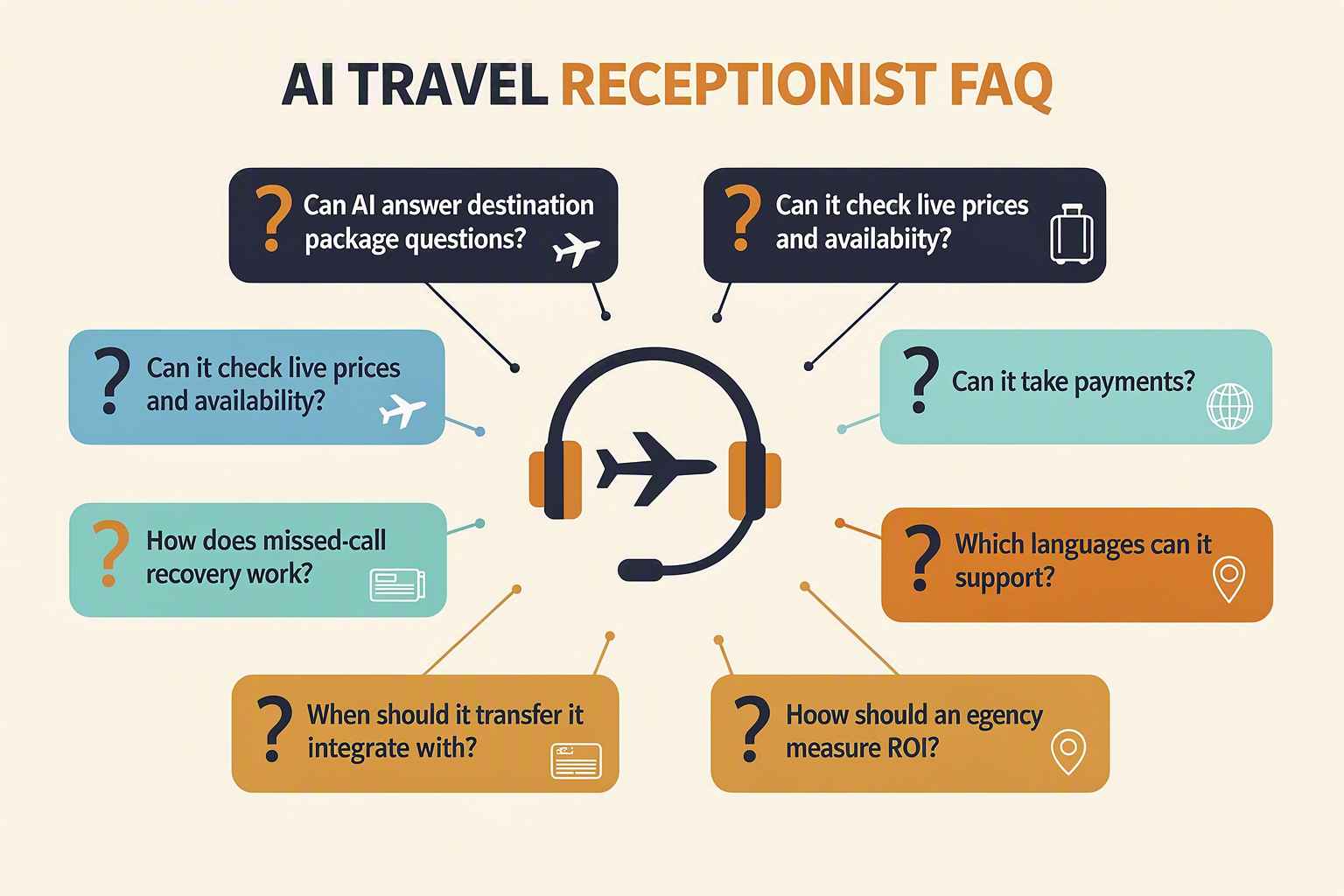
What can an AI receptionist for travel agencies automate in 2026?
How does travel agency WhatsApp automation work for customer enquiries?
Can an AI receptionist for travel agencies provide accurate prices and availability?
Can a tour booking AI agent accept payments and confirm reservations?
How should travel enquiry automation handle multiple languages and regional customers?
How do I choose and measure an AI receptionist for travel agencies?
Conclusion
An AI receptionist for travel agencies should make every enquiry actionable without turning unverified information into a promise. In 2026, the strongest systems will coordinate voice, WhatsApp and email while keeping agency-approved knowledge, live booking systems and human judgement at the centre.
- Capture and qualify every enquiry: Recover missed calls, respond after hours and collect structured details such as travel dates, origin city, passenger count, budget, destination preferences and whether the traveller needs a fixed departure or customised itinerary.
- Answer from approved data: Effective travel agency WhatsApp automation can explain destinations and packages, but live fares, room inventory, availability and cancellation conditions must be verified through connected systems before confirmation.
- Automate the next step, not every decision: A tour booking AI agent can schedule consultations, send follow-ups and record itinerary requests. Human advisers should handle payment questions, uncertain visa requirements, complaints, disruptions and situations requiring empathy or commercial judgement.
- Measure operational value: Track first-response time, qualified-lead rate, consultation bookings, conversion, containment and escalation accuracy across channels. Roll out gradually, review conversations and improve the knowledge base before expanding automation.
The opportunity is significant: The World Travel & Tourism Council projected in 2025 that travel and tourism would contribute US$11.7 trillion, or 10.3% of global GDP. Meanwhile, Meta CEO Mark Zuckerberg said in April 2025 that WhatsApp had exceeded 3 billion monthly active users. Agencies should therefore watch for tighter real-time booking integrations, more reliable multilingual conversations and smoother transfers between AI agents and human consultants.
To explore how travel enquiry automation is evolving, consider CallMissed, an AI communication platform combining voice agents, WhatsApp Business calling and chat, email workflows, knowledge-base retrieval and support for 22 Indian languages. The practical question is no longer whether automation can answer travellers—it is whether your agency can design it to respond quickly, verify carefully and escalate at exactly the right moment.
Related Reading
Discussion
Related Posts



Ready to automate customer conversations?
Launch AI voice agents and WhatsApp bots with CallMissed — one API, 22+ Indian languages.