
AI Receptionist for Real Estate: 2026 Lead Qualification Guide


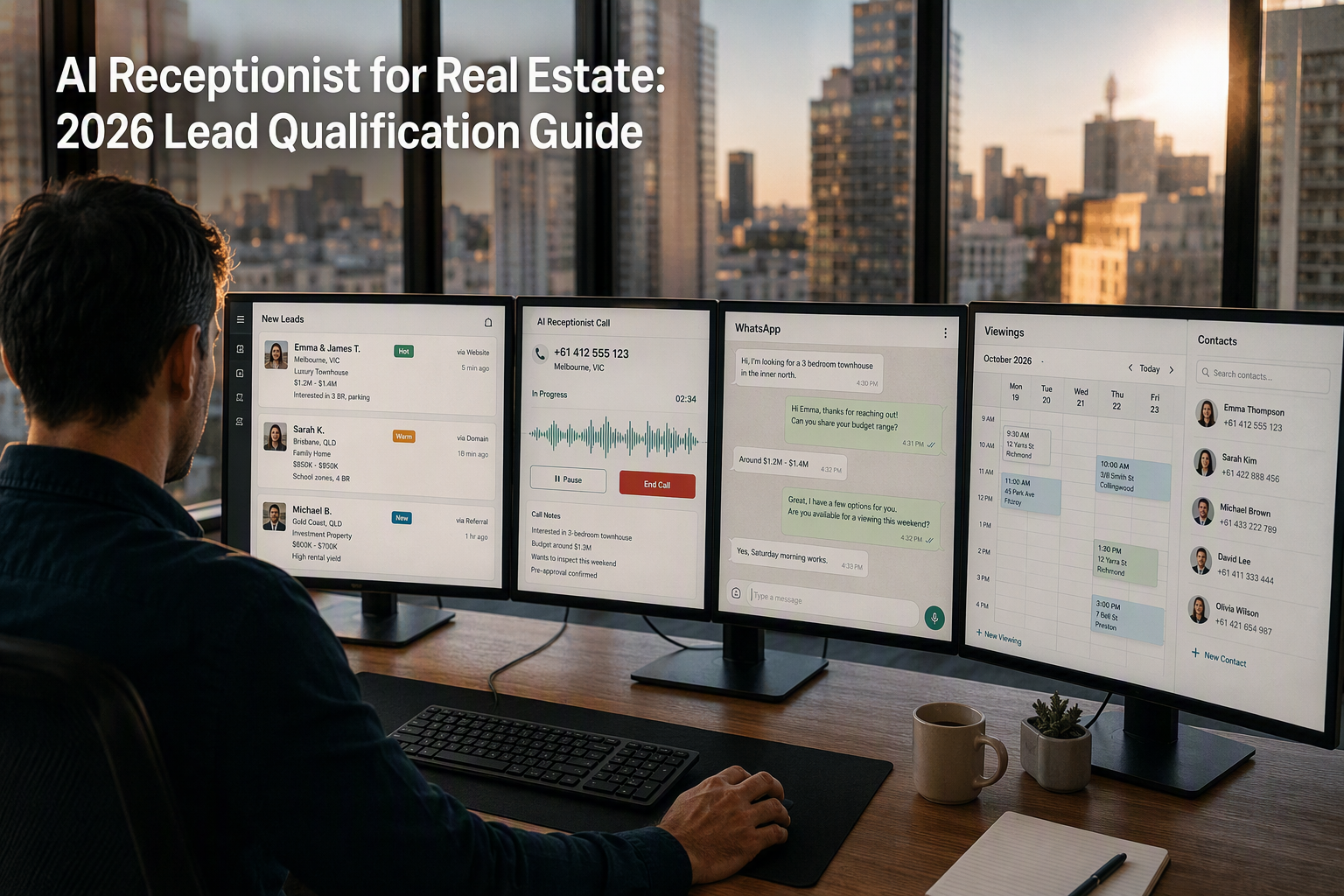
Learn how an AI receptionist for real estate captures, qualifies, routes and follows up on enquiries across voice, WhatsApp and CRM.
AI Receptionist for Real Estate: 2026 Lead Qualification Guide
Forty-three percent of homebuyers begin their search by looking for properties online, according to the National Association of Realtors’ 2024 Profile of Home Buyers and Sellers—but many enquiries still disappear when nobody answers the next call or message. An AI receptionist for real estate addresses that gap by responding immediately, capturing structured requirements and routing each prospect to the appropriate person without pretending that every conversation can—or should—be automated.
From unanswered calls to qualified opportunities
Real estate enquiries arrive outside office hours, during property viewings and across fragmented channels. Buyers ask about price and financing; tenants need availability and move-in dates; sellers want valuations; and landlords may need leasing or property-management support. Traditional voicemail records a message, but property inquiry automation can turn the interaction into usable workflow data.
A well-designed voice agent or real estate WhatsApp chatbot can collect details such as:
- Enquiry type: buyer, seller, tenant or landlord
- Preferred location, property category, budget and timeline
- Bedroom count, furnishing, amenities and viewing availability
- Property address or listing reference for seller and landlord enquiries
- Language preference and permission for subsequent calls or messages
The system can then route the enquiry by geography, listing, transaction type or team availability; propose viewing slots; recover missed calls; and create or update CRM records through a configured, tested integration. High-value opportunities, complaints, negotiation requests and sensitive conversations should transfer to a human rather than being forced through an automated script.
Speed matters, but reach matters too. Meta CEO Mark Zuckerberg said in April 2025 that WhatsApp had more than 3 billion monthly active users, making messaging and calling workflows increasingly relevant to property businesses, particularly in mobile-first markets. Platforms such as CallMissed reflect this shift by supporting AI voice and chat across 22 Indian languages and bridging WhatsApp Business calls to AI agents.
What this 2026 guide covers
This guide explains how to build a practical real estate lead qualification AI workflow without relying on opaque scores or guaranteed conversion claims. You will learn how to:
- Map voice and WhatsApp journeys for each enquiry category
- Design a transparent qualification scorecard based on intent, fit and urgency
- Handle silence, transcription errors, duplicate records and unavailable agents
- Apply consent-aware follow-up, privacy controls and retention limits
- Prevent qualification logic from using protected characteristics or acting as a substitute for fair-housing review
- Measure answer rate, qualification completion, viewing bookings, human handoffs and CRM data quality
The goal of AI property inquiry automation is not to remove agents from relationship-driven transactions. It is to ensure that every legitimate prospect receives a prompt, consistent response—and that people enter the conversation precisely when judgment, empathy or accountability matters most.
Introduction: How can an AI receptionist for real estate qualify leads in 2026? It answers voice and WhatsApp enquiries, captures consented requirements, routes or books routine requests, updates the CRM, and escalates valuable or sensitive conversations to people
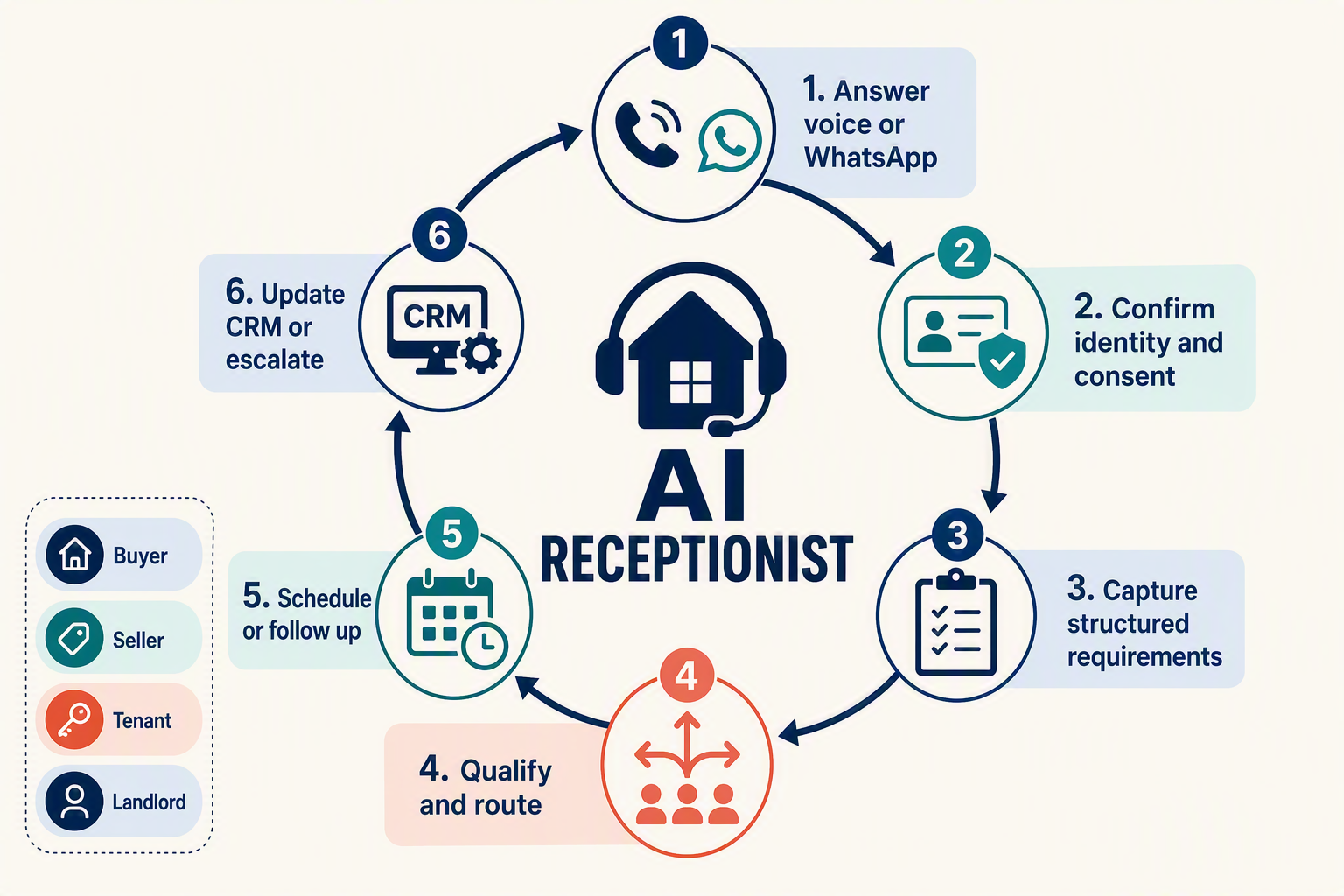
The goal is a controlled intake and orchestration layer—not an autonomous estate agent. In 2026, an AI receptionist for real estate should turn each consented conversation into a complete, traceable record while clearly disclosing automation, respecting customer choices and involving a person whenever judgement is required.
Qualification should produce evidence, not a black-box label
A prospect should not be marked “hot” merely because a model predicts that outcome. Effective real estate lead qualification AI records the information behind a status so agents can review and act on it.
A structured record might contain:
- Intent: purchase, sale, rental, letting or property management
- Fit: location, budget, property type and required features
- Readiness: exploratory, financing in progress, ready to view or ready to instruct
- Timing: immediate, within three months, later or unknown
- Next action: send listings, arrange valuation, schedule viewing or request human callback
- Consent and provenance: permitted channel, timestamp and whether information came from voice, WhatsApp or an agent
The system should distinguish facts supplied by the customer from model-generated summaries. If a caller says, “around ₹80 lakh, but I could stretch,” the CRM should preserve that nuance instead of silently converting it into an exact maximum budget.
Automation needs confidence gates
Speech recognition can mishear names, addresses, prices and listing references—especially when callers switch languages or speak in noisy environments. Before committing consequential data, the agent should confirm it explicitly: “I heard your maximum budget as ₹80 lakh. Is that correct?”
Useful operating rules include:
- Ask the customer to repeat or spell critical details after low-confidence transcription.
- Avoid booking against a listing when the property reference is ambiguous.
- Offer keypad entry or a secure form for information unsuitable for speech.
- Preserve the transcript or recording only where appropriate consent and retention controls exist.
- Transfer immediately when a person requests a human, alleges discrimination, reports an emergency or discusses a dispute.
These safeguards matter because 43% of homebuyers started their search online in the National Association of Realtors’ 2024 Profile of Home Buyers and Sellers. Digital discovery can therefore create substantial enquiry volume, but automated handling must not sacrifice accuracy or fairness to process it faster.
A receptionist is not a housing decision-maker
Property inquiry automation can gather requirements and coordinate follow-up, but it should not make eligibility decisions, steer people toward or away from neighbourhoods, or infer suitability from protected characteristics. Qualification fields and routing rules require human review for fair-housing risk, local privacy obligations and unintended proxy variables.
A real estate WhatsApp chatbot also needs channel-aware consent. A customer messaging about one listing has not necessarily agreed to recurring promotions, cross-channel calls or indefinite data retention. Agencies should record the stated purpose, honour opt-outs and separate service updates from marketing permissions.
The practical benchmark is simple: automation should leave the human team with faster response, cleaner records and clearer next actions, while customers retain an obvious route to a person. Subsequent sections translate that principle into channel workflows, qualification logic, CRM controls, rollout stages and measurable service KPIs.
Background & Context: Why are agencies combining voice agents, a real estate WhatsApp chatbot and human teams instead of treating each channel separately?

Agencies combine voice agents, a real estate WhatsApp chatbot and human teams because each channel solves a different part of the enquiry journey. Voice handles urgent, conversational intent; WhatsApp provides a persistent written thread; and people manage judgment-heavy work such as negotiation, complaints, fair-housing concerns and unusual financing situations.
One customer journey spans several channels
Property discovery may begin online, but qualification rarely remains in one interface. The National Association of Realtors reported in its 2024 Profile of Home Buyers and Sellers that 43% of homebuyers started by searching for properties online. A prospect might subsequently call from a listing portal, share a floor plan over WhatsApp and ask an agent to confirm a viewing.
Treating those interactions separately creates duplicated questions and incomplete records. A joined-up property inquiry automation workflow gives each channel a defined role:
- Voice: Captures callers who want immediate answers, including people driving past a property or responding to an advertisement.
- WhatsApp: Supports asynchronous questions, listing links, location pins, documents and written appointment confirmation.
- Human agents: Resolve ambiguity, advise clients, handle negotiation and take responsibility for sensitive decisions.
- CRM: Maintains the structured record that connects conversations, consent status, ownership and next actions.
WhatsApp’s scale makes that continuity commercially relevant. Meta CEO Mark Zuckerberg said in April 2025 that WhatsApp had exceeded 3 billion monthly active users. However, messaging reach does not eliminate voice: prospects may call when a decision feels urgent or explaining requirements by typing becomes cumbersome.
Shared context matters more than channel count
An AI receptionist for real estate should not operate as an isolated telephone script. It should contribute to the same enquiry record used by WhatsApp and the human team, subject to validated CRM integrations and access controls.
For example, a tenant may state a ₹40,000 monthly budget on a call and later send a preferred neighbourhood on WhatsApp. The workflow should reconcile those details against the same contact where identity matching is sufficiently reliable—not create two unrelated leads or silently overwrite conflicting data.
A shared context layer can preserve:
- Enquiry category and listing reference
- Budget, location, property type and timeline
- Questions already answered
- Viewing requests and scheduling status
- Language and channel preference
- Consent, opt-out and escalation history
- Assigned office, broker or property team
This structure allows real estate lead qualification AI to evaluate completeness and urgency consistently while leaving consequential decisions to authorised staff.
Automation and people need explicit boundaries
Channel orchestration is not permission to automate every interaction. Speech recognition can mishear an address, two family members may use one phone number, and a buyer’s requirements can change between conversations. Qualification logic can also produce unfair outcomes if it uses protected characteristics or proxies for them.
A safer operating model applies three rules:
- Automate repetitive intake: Ask standard questions, confirm captured details and offer approved viewing slots.
- Escalate based on risk and intent: Transfer negotiations, disputes, accessibility requests, legal questions and distressed callers to people.
- Preserve continuity during failure: If transcription confidence is low, CRM access fails or no human is available, acknowledge the limitation, retain only permitted data and create a traceable follow-up task.
The objective is therefore not channel replacement. It is coordinated coverage: automation provides availability and structure, while human teams supply accountability, expertise and empathy.
Key Developments: Which 2026 capabilities matter for voice answering, WhatsApp messaging, CRM updates, multilingual service and human handoff?
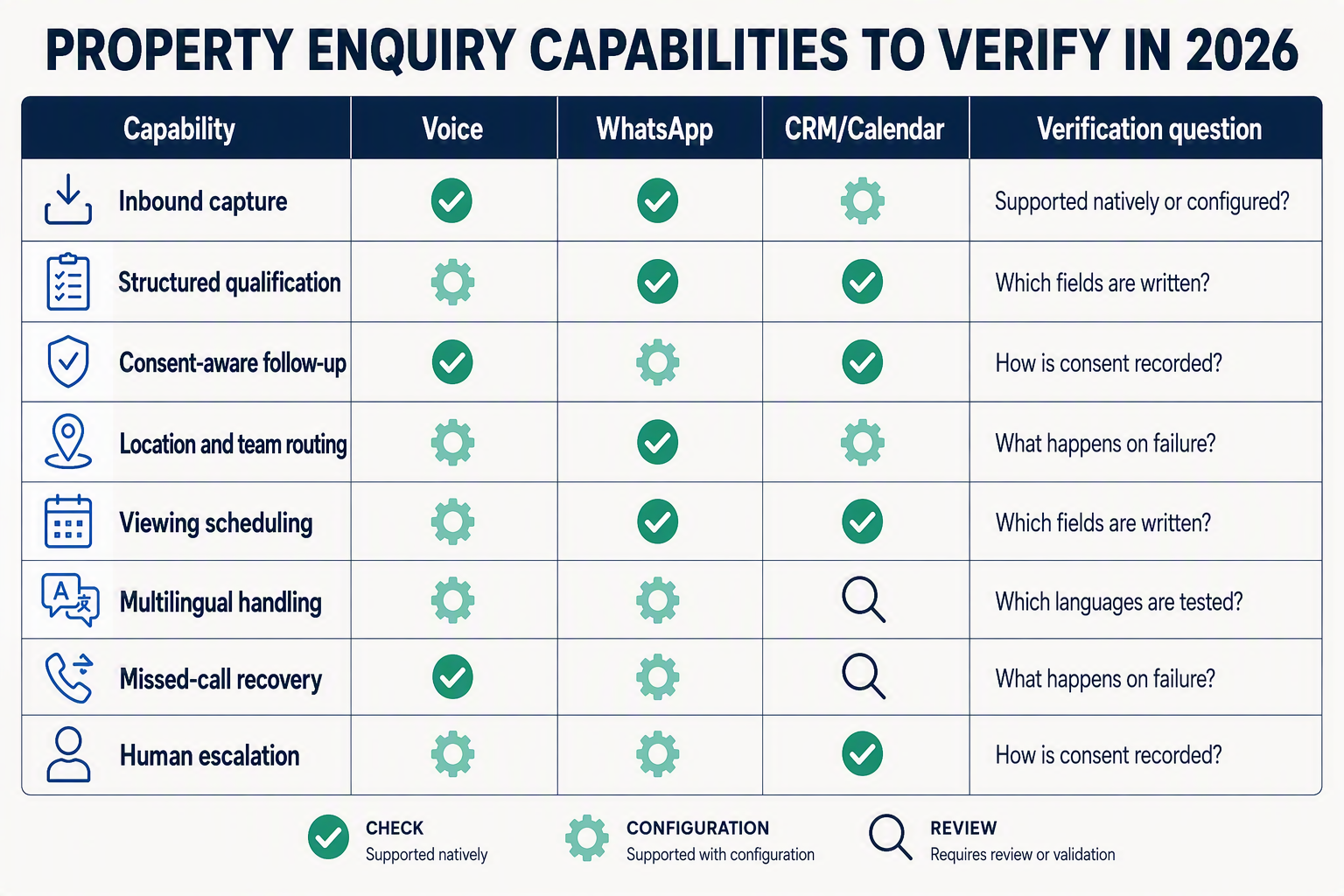
The most important 2026 capability is not simply answering more calls; it is maintaining one structured, auditable workflow across voice, WhatsApp and the CRM. An effective AI receptionist for real estate should understand intent, capture requirements, survive channel failures and transfer sensitive or commercially important conversations to a person with full context.
2026 capability matrix
| Capability | What the agent should do | Structured output | Essential safeguard |
|---|---|---|---|
| Voice answering | Answer inbound or recovered missed calls; identify buyer, seller, tenant or landlord intent; ask adaptive follow-up questions | Name, contact details, enquiry type, location, budget, timeline and listing reference | Confirm uncertain names, numbers and addresses instead of silently saving low-confidence transcripts |
| WhatsApp messaging and calling | Continue enquiries through chat, media and, where supported, WhatsApp Business calling; share listing or appointment information | Conversation history, property preferences, language and follow-up permission | Apply Meta’s messaging rules, approved templates where required and channel-specific consent controls |
| CRM synchronisation | Search for an existing contact, create or update the correct record, assign ownership and log outcomes | Lead source, qualification fields, owner, task, appointment and transcript or summary | Use idempotency and duplicate-matching rules so retries do not create multiple leads |
| Multilingual service | Detect or ask for language preference, maintain terminology across turns and switch languages when requested | Preferred language, translated summary and original-language transcript | Escalate when recognition confidence is low; do not infer eligibility or intent from accent or language |
| Human handoff | Transfer urgent, sensitive or high-value conversations with a concise summary and collected fields | Handoff reason, priority, available agent and unresolved question | Announce the transfer, preserve context and provide a callback path if no employee is available |
| Scheduling and recovery | Offer valid viewing slots, send confirmations and resume abandoned or missed-call journeys | Property, date, time, attendee, assigned agent and follow-up status | Recheck availability before confirming and prevent double bookings through transactional calendar logic |
What has changed from basic chatbot automation
A 2026 real estate WhatsApp chatbot should operate as part of an event-driven workflow rather than as a standalone question-and-answer widget. For example, a tenant may begin with a voice call, send a listing screenshot through WhatsApp and then request a viewing. The CRM should receive one consolidated record—not three disconnected leads.
Modern property inquiry automation therefore needs:
- Cross-channel identity resolution: Match phone numbers, WhatsApp identities and existing CRM contacts using explicit, reviewable rules.
- Tool-aware conversations: Query approved inventory or calendars rather than inventing availability, prices or property features.
- Confidence-based recovery: Ask the prospect to repeat critical information, offer keypad input or move to WhatsApp when speech recognition struggles.
- Observable actions: Record whether a CRM write, notification, transfer or booking succeeded, failed or remains pending.
- Policy-based escalation: Route complaints, negotiation, legal questions, discrimination concerns and distressed callers to trained employees.
Multilingual deployment is particularly consequential in India. CallMissed supports Speech-to-Text and Text-to-Speech across 22 Indian languages, allowing regional-language service to be designed into the workflow instead of added only after an English pilot. CallMissed can also bridge WhatsApp Business calls to an AI voice agent, subject to the business’s WhatsApp eligibility and configuration.
The practical standard for qualification
A real estate lead qualification AI should recommend the next action from disclosed business criteria—not issue an unexplained judgment about a person. Qualification can use stated budget, preferred location, property type, timeline and readiness for a viewing, while avoiding protected characteristics or proxies that could introduce unfair-housing risk.
Before deployment, require three pass conditions:
- Critical fields are confirmed by the prospect.
- CRM and scheduling actions are tested for success, retries and duplicates.
- Human handoff remains available when automation is uncertain, inappropriate or explicitly declined.
In-Depth Analysis: How does AI property inquiry automation move an enquiry from first contact to qualification, booking, CRM synchronisation or human escalation?
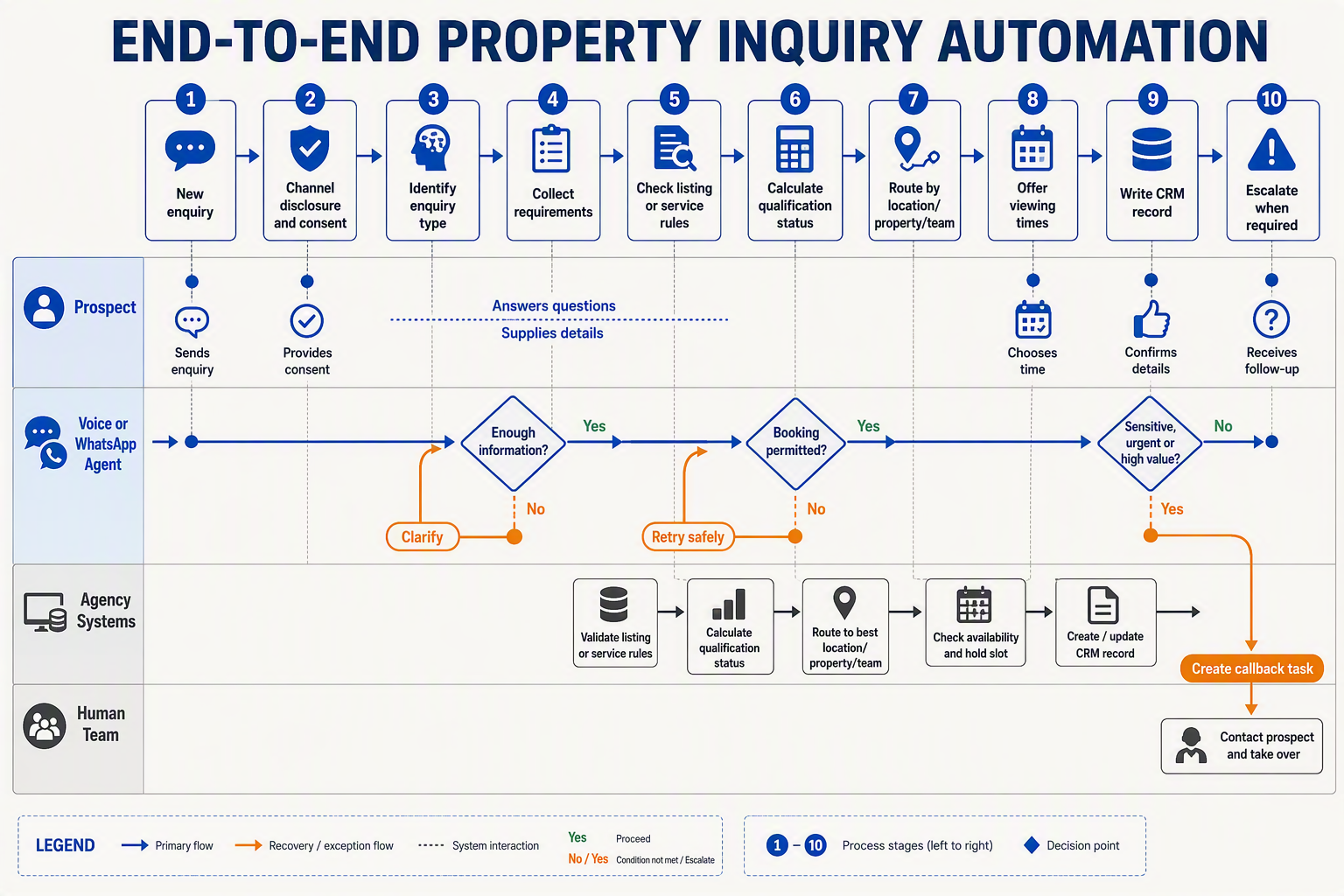
An enquiry should move through a controlled workflow: identify intent, capture structured requirements, validate fit, offer the next action, synchronise the CRM and escalate when automation is unsafe or insufficient. The AI should record why each action occurred, rather than relying on an unexplained “hot lead” label.
1. Identify the person’s objective and conversation state
An AI receptionist for real estate should first determine whether the contact is a buyer, seller, tenant, landlord or existing customer. It should also recognise whether the person is starting a new search, following up on a listing, changing a booking or reporting an urgent issue.
Voice and WhatsApp interactions can share one workflow while using channel-specific controls:
- Voice: confirm uncertain names, numbers and listing references by reading them back.
- WhatsApp: use buttons or short lists for property type, locality and bedroom count.
- Channel switching: send an explicitly permitted WhatsApp summary after a call or arrange a callback when typing becomes inconvenient.
Meta reported in April 2025 that WhatsApp had more than 3 billion monthly active users, making cross-channel identity matching important: a WhatsApp message and subsequent call should not automatically become two separate leads.
2. Build a structured enquiry record
The agent converts natural conversation into validated fields rather than storing only a transcript. A buyer record might contain location, budget range, property type, bedrooms, purchase timeline, financing status and viewing availability. Seller and landlord journeys should capture the property address, ownership relationship, occupancy status and requested service without asking for unnecessary sensitive information.
Each extracted value should carry:
- The original customer statement
- A normalised CRM value, such as “₹80 lakh–₹1 crore”
- Extraction confidence
- Confirmation status
- Timestamp, channel and consent state
If speech recognition produces two plausible localities or an incomplete phone number, the workflow should ask a focused clarification question instead of guessing.
3. Apply transparent qualification and routing rules
Real estate lead qualification AI should use auditable business criteria such as intent, budget-to-inventory fit, geographic coverage, timeline and readiness for a viewing. It must not infer eligibility or priority from protected characteristics, accents, names or neighbourhood demographic proxies.
Routing can then follow explicit rules:
- Match a listing reference to its responsible agent.
- Route unassigned searches by locality and transaction type.
- Check team availability and language capability.
- Escalate high-value, urgent or sensitive enquiries to an authorised person.
- Place unmatched requirements into a follow-up queue rather than rejecting them.
4. Book, synchronise and verify
Before proposing a viewing, property inquiry automation should confirm listing availability, calendar capacity, time zone, meeting format and any access constraints. A booking is complete only after the calendar or scheduling system returns a success response; otherwise, the agent should offer alternatives or request human assistance.
CRM updates require similar safeguards. The integration should search for existing records, use a stable contact or conversation identifier, prevent duplicate writes and retry temporary failures. The resulting record should include the qualification fields, concise summary, next action, assigned owner and relevant consent status—not merely the full transcript.
5. Escalate with context, not friction
A real estate WhatsApp chatbot or voice agent should hand off immediately for negotiations, legal questions, complaints, distressed callers, discrimination concerns or repeated recognition failures. The human agent should receive the conversation summary, verified requirements, unresolved question and recommended next step so the customer does not have to restart the enquiry.
Workflow Matrix: What should voice and WhatsApp agents collect from buyers, sellers, tenants and landlords before routing or scheduling?
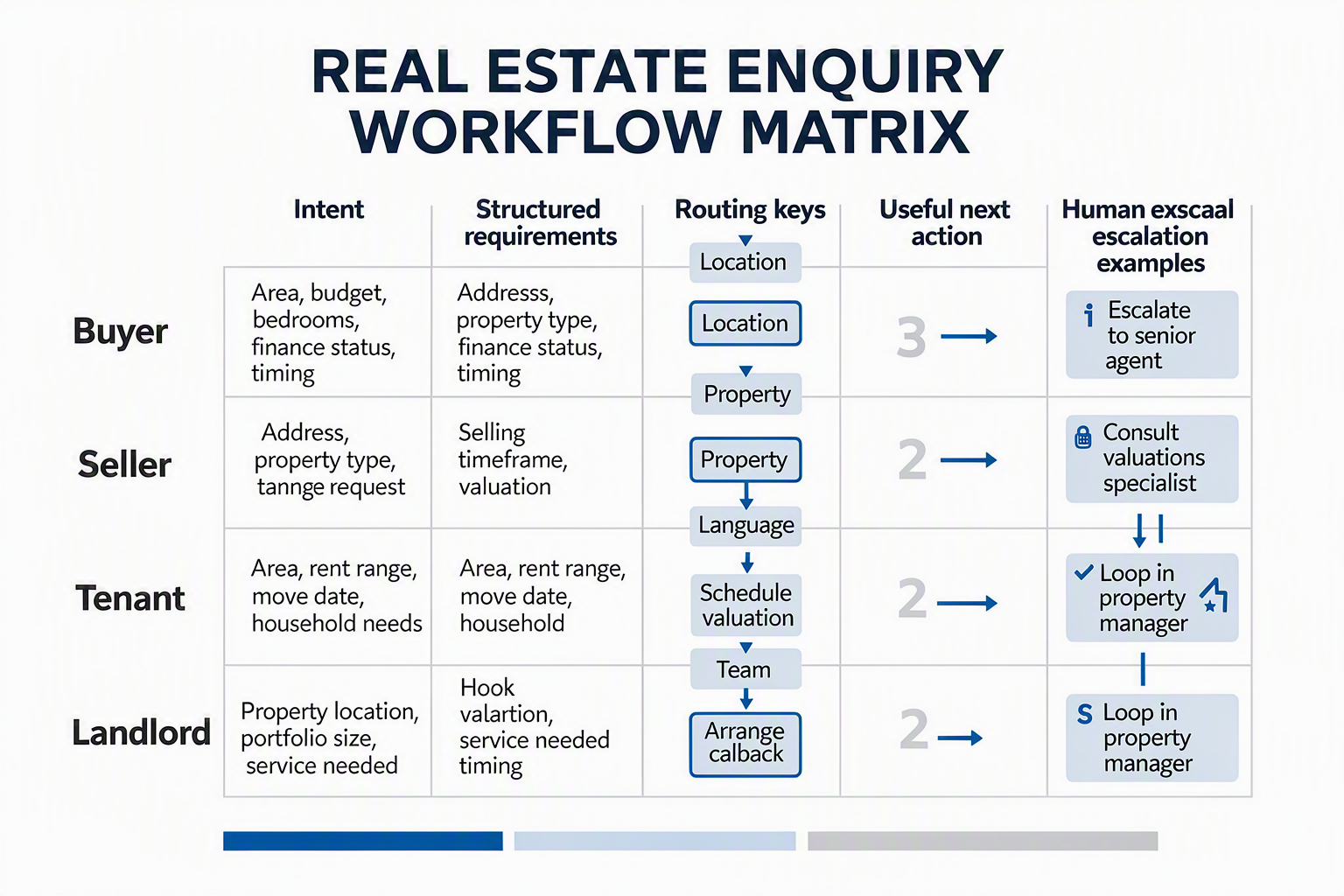
An AI receptionist for real estate should collect only the information needed to identify the enquiry, assess property fit, choose the correct team and agree on a next step. The required fields differ for buyers, sellers, tenants and landlords; scheduling should begin only after essential details are confirmed.
Enquiry-to-action matrix
| Enquiry type | Required structured fields | Qualification signals | Routing or scheduling action | Human-escalation triggers |
|---|---|---|---|---|
| Buyer | Name, verified contact channel, preferred locations, property type, budget range, bedroom count, purchase timeline and financing status | Defined budget; location and property fit; ready funds or financing progress; near-term purchase intent | Match relevant listings; route by location or property team; offer viewing slots only for confirmed availability | Offer or negotiation request; complex financing; high-value purchase; legal, title or discrimination concern |
| Seller | Name, contact permission, property address, property type, occupancy, reason for selling, expected timeline and valuation request | Identifiable property; realistic selling window; decision-maker status; valuation or listing intent | Route by territory and property category; schedule an appraisal or agent consultation | Distressed sale; ownership dispute; urgent financial circumstances; contractual or pricing advice |
| Tenant | Name, contact channel, target area, monthly budget, property type, bedroom count, furnishing preference, move-in date and viewing availability | Budget fit; active availability; defined move-in window; complete rental requirements | Match available rentals; route to the relevant leasing team; propose confirmed viewing times | Accessibility accommodation; complaint; deposit dispute; unclear eligibility rule; sensitive personal circumstances |
| Landlord | Name, contact permission, property address, unit count, occupancy status, expected rent, availability date and required service | Property is available or becoming available; clear leasing timeline; need for tenant sourcing or management | Route by location, portfolio size or service team; schedule a property assessment or consultation | Existing tenant dispute; eviction issue; regulatory question; urgent maintenance or safety problem |
The role-specific approach matters because 43% of homebuyers started their search by looking for properties online, according to the National Association of Realtors’ 2024 Profile of Home Buyers and Sellers. Digital discovery can generate the initial enquiry, but structured property inquiry automation must turn that enquiry into an operationally useful record.
Shared fields and validation rules
Regardless of enquiry type, a real estate WhatsApp chatbot or voice agent should apply several common controls:
- Capture the source channel, timestamp, language preference, campaign or listing reference and assigned branch.
- Read back critical voice inputs such as phone numbers, budgets, dates and property references; WhatsApp agents can present them for written confirmation.
- Record whether the person permits follow-up on the selected channel, including any preferred contact window.
- Check the CRM for an existing contact before creating a new record, then append the conversation rather than producing duplicates.
- Store “unknown” or “not provided” instead of guessing when speech recognition or user intent is unclear.
- Avoid collecting religion, caste, ethnicity, disability, family status or other protected characteristics for qualification or property matching.
Routing logic before calendar access
A real estate lead qualification AI workflow should evaluate fit transparently rather than hide decisions inside an unexplained score. A practical routing sequence is:
- Classify the enquiry type and confirm the person’s requested outcome.
- Validate mandatory fields, especially location, budget or expected price, timeline and listing reference.
- Check live operational data such as listing availability, service territory and agent calendar status.
- Route by property, geography and team responsibility, with overflow rules for unavailable agents.
- Schedule only against confirmed inventory and calendar slots, then send a written summary.
- Escalate ambiguity, negotiation, complaints and sensitive cases to a person with the collected context attached.
If availability or CRM access fails, the agent should capture a callback window and label the record for review—not promise a viewing or claim that an update succeeded.
What This Means For You: How should agencies build a real estate lead qualification AI scorecard while protecting consent, privacy and fair-housing obligations?
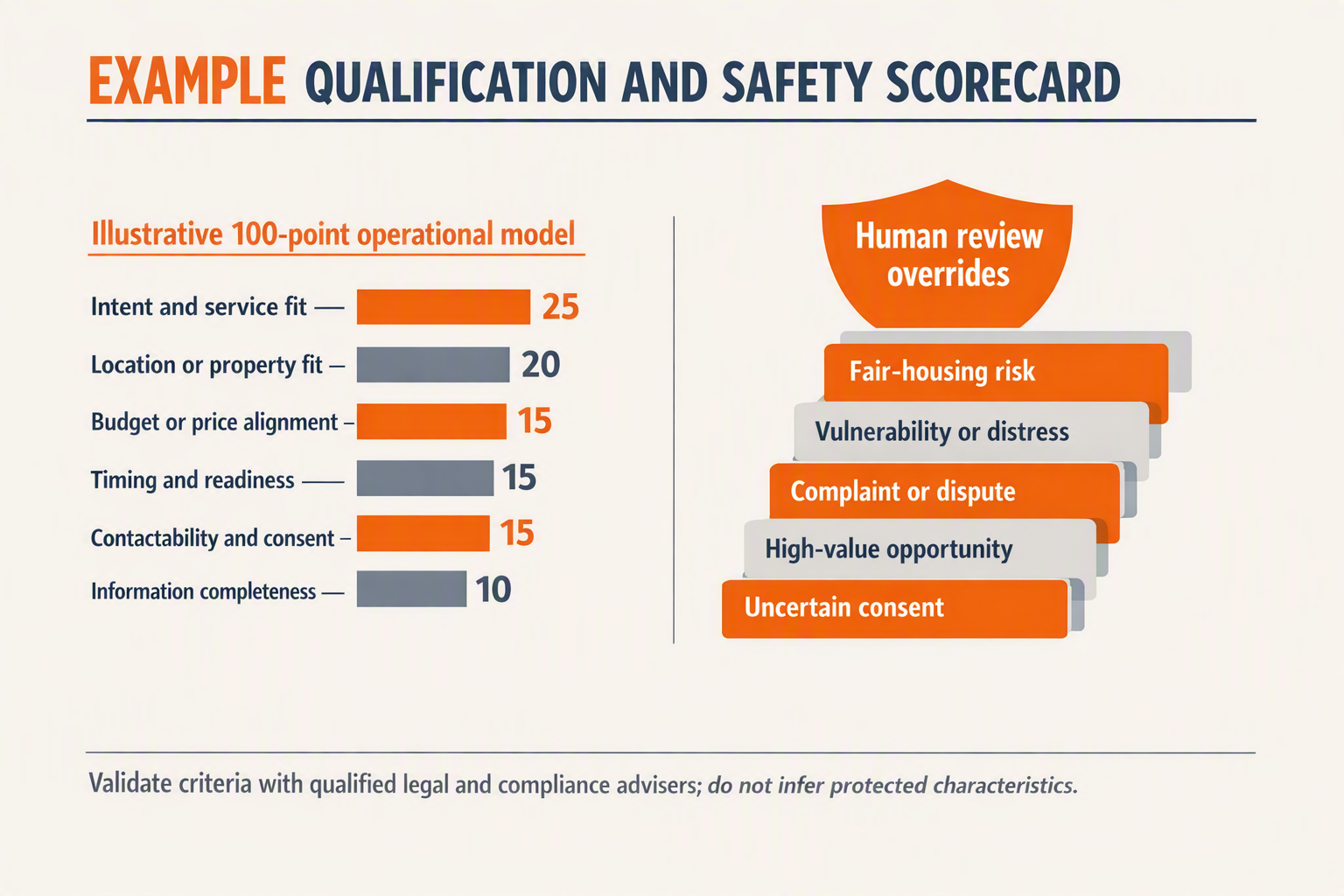
A real estate lead qualification AI scorecard should rank enquiries by operational readiness—such as stated intent, property fit, timeline and consent—not by personal identity or inferred suitability. Keep the scoring rules visible, collect only necessary data and require human review for eligibility, negotiation, rejection or other consequential decisions.
A transparent qualification scorecard
Use separate fields for lead facts, workflow priority and human decisions. A high score should mean “respond promptly,” not “this person deserves housing.”
| Scorecard factor | Example points | Permitted use | Privacy and fairness control | Human handoff trigger |
|---|---|---|---|---|
| Enquiry completeness | 0–15 | Identify missing budget, location, property type or listing reference | Do not penalise accents, language choice, silence or transcription failure | Repeated misunderstanding or low-confidence transcription |
| Stated timeline | 0–20 | Prioritise an explicitly urgent move, purchase, sale or letting | Ask directly; do not infer urgency from employment, family or demographic data | Immediate relocation, eviction or other sensitive circumstances |
| Property fit | 0–25 | Match stated budget, location, bedrooms and availability against inventory | Use requirements for matching, not to infer protected traits from postcode or neighbourhood | No suitable inventory, exception request or affordability discussion |
| Intent and next step | 0–20 | Distinguish browsing from a requested viewing, valuation or callback | Record the prospect’s own stated action; avoid emotion or “quality” predictions | Offer, negotiation, complaint or valuation advice |
| Contact permission | 0–10 | Confirm whether calls, WhatsApp messages or email follow-up are allowed | Store channel, purpose, timestamp and withdrawal status; consent is not a quality signal | Consent is unclear, disputed or withdrawn |
| Routing confidence | 0–10 | Send the enquiry to the correct location, listing, language or team | Display uncertainty and retain an auditable reason for routing | Low confidence, duplicate CRM record or unavailable team |
A practical interpretation could be 70–100: prompt human follow-up, 40–69: request missing information, and 0–39: do not discard; place in a consent-compliant review queue. Agencies should test thresholds against outcomes and error patterns rather than assume that a score predicts conversion.
Keep protected characteristics out of the model
In the United States, the Fair Housing Act prohibits housing discrimination based on race, colour, national origin, religion, sex, familial status and disability, according to the U.S. Department of Housing and Urban Development. Other jurisdictions define different protected categories, so agencies should obtain local legal review before deployment.
An AI receptionist for real estate or real estate WhatsApp chatbot should therefore avoid collecting or scoring:
- Religion, ethnicity, caste, disability, pregnancy or family composition
- Names, voices, accents or languages as proxies for identity
- Neighbourhood demographics or inferred socioeconomic status
- “Desirability,” “trustworthiness” or unsupported ability-to-pay predictions
Accessibility requests may still need to be captured to provide service, but they should be isolated from lead ranking and disclosed only to authorised personnel.
Make consent and accountability testable
For consent-aware property inquiry automation, agencies should:
- State that the customer is interacting with AI and explain the interaction’s purpose.
- Record channel-specific permission rather than treating one phone call as blanket permission for WhatsApp, email and marketing campaigns.
- Minimise retention, restrict role-based access and define deletion procedures for recordings, transcripts and CRM fields.
- Offer a human route and make opt-out requests effective across connected systems.
- Audit by language and enquiry type, checking completion, handoff and error rates for buyers, sellers, tenants and landlords.
Where the European Union’s General Data Protection Regulation applies, Article 22 provides protections concerning decisions based solely on automated processing that produce legal or similarly significant effects. Accordingly, qualification scores should guide queues and workflows—not autonomously approve, reject or disadvantage a housing prospect.
Impact & Implications: Which KPIs reveal whether property inquiry automation improves service without hiding failures or overstating conversion impact?
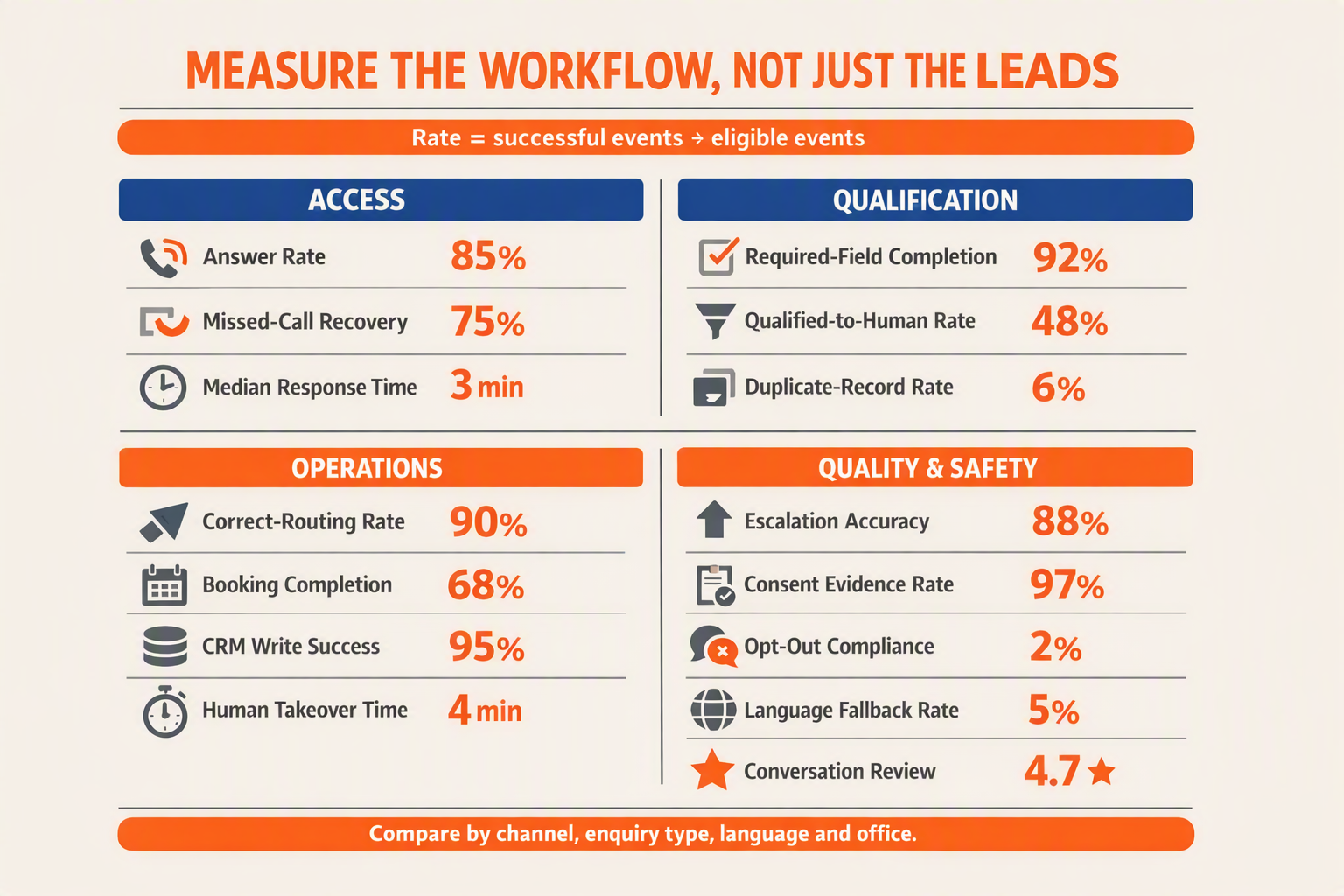
The most reliable KPI framework pairs service speed, qualification quality, workflow reliability and downstream outcomes. An AI receptionist for real estate should not be judged by “leads handled” or conversion rate alone; every metric needs a clear denominator, channel breakdown and visible failure count.
Measure service before claiming business impact
Start with operational metrics that the automation directly controls:
- Answer rate: answered inbound enquiries ÷ total eligible enquiries.
- First-response latency: report median and 95th-percentile response times separately for voice and WhatsApp.
- Abandonment rate: callers who disconnect before meaningful interaction ÷ answered calls.
- Missed-call recovery rate: missed callers successfully contacted within the agency’s target window ÷ missed callers eligible for follow-up.
- Human handoff success: enquiries connected to or accepted by a person ÷ handoffs requested.
Channel-level reporting matters because Meta CEO Mark Zuckerberg said in April 2025 that WhatsApp had more than 3 billion monthly active users. A blended dashboard could otherwise conceal strong WhatsApp performance alongside repeated voice-call failures—or the reverse.
Do not label every completed automated conversation as “contained.” A conversation that ends because of silence, a timeout or a failed transfer is an unresolved interaction, not successful automation.
Audit qualification and CRM data quality
A real estate lead qualification AI workflow should be evaluated on whether it collects accurate, actionable information—not on how many prospects receive a high score.
Track:
- Qualification completion: enquiries completing all required questions ÷ eligible enquiries that started qualification.
- Required-field completeness: populated mandatory CRM fields ÷ mandatory fields expected.
- Validation failure rate: invalid budgets, dates, phone numbers, listing references or unsupported locations ÷ captured values.
- CRM write success: records confirmed as created or updated ÷ attempted CRM writes.
- Duplicate-record rate: duplicate contacts or opportunities ÷ records created.
- Correction rate: records subsequently corrected by agents ÷ records reviewed.
Measure completion by buyer, seller, tenant and landlord, as well as by language, channel, location and time of day. A high overall completion rate can hide a broken regional-language flow or an unsuitable script for landlord enquiries.
Separate workflow outcomes from conversion claims
Property inquiry automation can influence viewing bookings, but it does not control pricing, inventory, financing, agent performance or customer intent. Use a KPI chain rather than attributing every transaction to automation:
- Qualified-enquiry rate
- Routing acceptance rate
- Viewing-booking rate
- Viewing attendance rate
- Agent follow-up completion
- Opportunity and transaction rate
Publish both the numerator and denominator. For example, “120 viewings booked from 800 eligible enquiries” is more informative than “120 bookings generated.” Compare performance with a pre-launch baseline or a carefully designed holdout cohort, while controlling for channel, campaign, property type and seasonality.
Make failures impossible to hide
A trustworthy real estate WhatsApp chatbot or voice workflow needs a visible failure budget covering:
- Transcription or language-detection errors
- Repeated-question loops and customer-requested exits
- Failed transfers, calendar writes and CRM updates
- Consent-related follow-up suppression
- Complaints and sensitive conversations requiring human review
Review these metrics weekly during rollout and establish alerts from observed baselines rather than arbitrary “industry” targets. The objective is not maximum automation: it is faster, measurable service with reliable escalation and auditable attribution.
Expert Opinions: What should operational, compliance and frontline experts verify during rollout, and which internal links should support CRM, consent, routing, privacy and missed-call playbooks?

Rollout should proceed only after operations, compliance and frontline teams independently verify that the automation captures accurate data, respects channel-specific consent, avoids discriminatory qualification and reaches a person when required. Treat the launch as a controlled operational change—not merely a software installation.
Require three separate sign-offs
Operations owners should test the complete journey from first contact to CRM disposition:
- Confirm buyer, seller, tenant and landlord records use distinct required fields.
- Test routing by location, property reference, transaction type, language and agent availability.
- Verify that viewing slots reflect real calendars, time zones, travel buffers and cancellation rules.
- Check deduplication when one prospect contacts the agency by phone and WhatsApp.
- Reconcile call recordings, transcripts, CRM fields and failed-write queues.
- Define recovery actions for silence, low-confidence transcription, unavailable staff and integration outages.
An AI receptionist for real estate should never report a CRM update or confirmed viewing until the underlying system returns a successful response.
Compliance and privacy reviewers should map each data field to a defined purpose, retention period and access policy. The Government of India’s Digital Personal Data Protection Act, 2023 defines valid consent as free, specific, informed, unconditional and unambiguous, with clear affirmative action; agencies should obtain jurisdiction-specific legal review rather than treating a generic chatbot disclosure as universal compliance.
Reviewers should also verify that:
- Call recording and automated-agent disclosures match applicable local requirements.
- WhatsApp consent is recorded separately from permission for voice, email or other marketing.
- Opt-outs suppress future campaigns without blocking necessary service communications.
- Qualification rules exclude protected characteristics and inappropriate proxies.
- Sensitive requests involving discrimination, accessibility, disputes or financial hardship trigger human escalation.
Put frontline staff in the pilot
Agents and branch managers often identify failures that technical testing misses. Ask frontline reviewers to conduct scripted and unscripted enquiries, including accented speech, code-switching, incomplete addresses, repeated callers and callers who refuse to answer optional questions.
For multilingual deployments, test intent recognition, names, locality pronunciations, numbers and currency in every activated language—not simply whether a model nominally supports that language. Platforms such as CallMissed can support voice and chat across 22 Indian languages, but each agency must still validate its own property names, regional vocabulary and escalation experience.
A controlled pilot should have explicit release gates:
- No unresolved high-severity privacy or routing defects.
- CRM writes are auditable and failed updates enter a visible retry queue.
- Human transfers work during and outside normal staffing hours.
- The real estate lead qualification AI explains its disposition through captured fields rather than an opaque score alone.
- Frontline staff can correct records and override automation.
Build an internal-link safety net
Every property inquiry automation playbook should link to maintained internal resources. CMS editors should map these descriptive anchors to verified live pages rather than guessing URLs:
- CRM field mapping and duplicate-management guide
- Consent, recording and WhatsApp opt-out policy
- Lead-routing and after-hours escalation matrix
- Privacy, retention and data-access standard
- Missed-call recovery and callback playbook
- Fair-housing and anti-discrimination review checklist
- Incident reporting and human-override procedure
These links should appear inside the operator console, training material and launch checklist—not only in a policy library. For a real estate WhatsApp chatbot, the consent and escalation resources should also be available directly to staff handling transferred conversations.
Frequently Asked Questions: Can AI recover missed calls, book viewings, update a CRM, support multiple languages, obtain follow-up consent, handle WhatsApp handoff and respond safely when integrations fail?
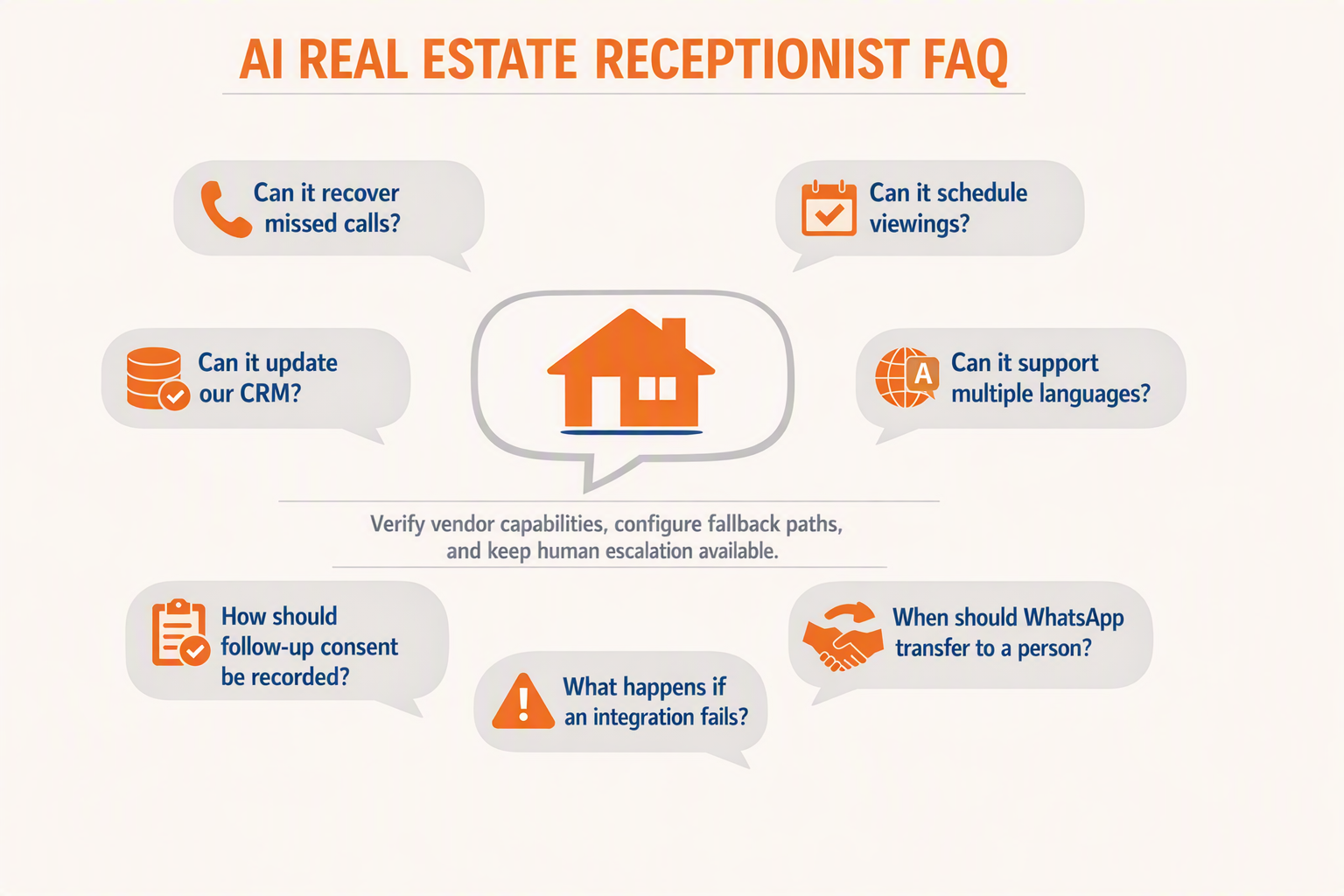
Can an AI receptionist for real estate recover missed calls and book property viewings?
Can real estate lead qualification AI create and update CRM records safely?
Does property inquiry automation support multiple languages and regional accents?
How should an AI property agent obtain consent for calls, WhatsApp messages and follow-ups?
Can a real estate WhatsApp chatbot transfer an enquiry to a human agent?
How should property inquiry automation respond when calendars, CRMs or routing integrations fail?
Conclusion
An AI receptionist for real estate should complement—not replace—the people responsible for viewings, negotiations and sensitive decisions. In 2026, the most effective deployments will turn calls and WhatsApp conversations into structured, consent-aware workflows while giving prospects a clear path to a human.
- Capture every enquiry consistently. Voice agents and a real estate WhatsApp chatbot can distinguish buyers, sellers, tenants and landlords, then collect location, budget, property type, timeline, listing reference and viewing preferences.
- Route and schedule intelligently. Agencies can assign enquiries by geography, property, transaction type or team availability, recover missed calls, propose viewing slots and update CRM records through tested integrations.
- Qualify transparently. A real estate lead qualification AI workflow should use explainable criteria such as intent, fit and urgency—not protected characteristics, opaque assumptions or promises of conversion.
- Design for human intervention. High-value opportunities, complaints, negotiations, transcription failures and privacy-sensitive conversations require reliable escalation rather than rigid automation.
Demand for connected voice and messaging experiences is likely to grow. Meta CEO Mark Zuckerberg said in April 2025 that WhatsApp had more than 3 billion monthly active users, reinforcing the importance of WhatsApp-based property engagement in mobile-first markets. Meanwhile, 43% of homebuyers began their search online, according to the National Association of Realtors’ 2024 Profile of Home Buyers and Sellers, making fast cross-channel follow-up increasingly important.
What to watch next
The next phase of property inquiry automation will be defined by multilingual accuracy, dependable CRM data, effective failure handling and measurable outcomes—not merely the novelty of an AI conversation. Agencies should monitor answer rates, qualification completion, viewing bookings, handoffs and record quality while refining consent, retention and fair-housing safeguards.
To explore this direction, consider CallMissed, an AI-native communication platform supporting voice and chat across 22 Indian languages, including WhatsApp Business calls bridged to AI agents. The practical question for every agency is: which missed enquiry workflow can you test, measure and improve first?
Related Reading
Discussion
Related Posts


Ready to automate customer conversations?
Launch AI voice agents and WhatsApp bots with CallMissed — one API, 22+ Indian languages.