
AI Receptionist for Medical Clinics: Practical 2026 Implementation Guide


Implement an AI receptionist for medical clinics with safe booking, missed-call recovery, privacy controls, escalation, testing, and KPIs.
AI Receptionist for Medical Clinics: Practical 2026 Implementation Guide
What happens when a patient calls with an urgent concern, reaches voicemail, and never calls back? An AI receptionist for medical clinics can reduce that risk by answering routine enquiries across phone, WhatsApp, and email—but only when the system is designed with strict clinical boundaries, privacy controls, and reliable human escalation.
Why clinics are adopting AI receptionists in 2026
Front-desk teams face a difficult combination of staff shortages, rising enquiry volumes, multilingual patients, and expectations of immediate service. The World Health Organization projected in 2023 that the global health workforce shortfall could reach 10 million workers by 2030, with the greatest shortages concentrated in low- and lower-middle-income countries. Automation cannot replace medical professionals, but it can remove repetitive administrative work from already stretched teams.
A properly configured healthcare appointment booking AI can:
- Answer calls outside clinic hours and check available appointment slots.
- Book, reschedule, or cancel visits using approved scheduling rules.
- Trigger clinic missed call automation, such as a callback or WhatsApp follow-up.
- Respond to approved FAQs about opening hours, locations, fees, preparation instructions, and accepted insurance.
- Collect limited intake information in the patient’s preferred language.
- Route sensitive, unusual, or urgent conversations to trained staff.
In India, multilingual access is especially important because the Eighth Schedule of the Constitution recognizes 22 scheduled languages. Platforms such as CallMissed support voice and chat across 22 Indian languages and can bridge WhatsApp Business calls to an AI voice agent, reflecting the shift toward unified, regional-language patient communication.
What safe implementation actually requires
This guide goes beyond switching on a chatbot. It explains how to map phone, medical practice WhatsApp automation, and email workflows; connect scheduling, CRM, or electronic health record systems; define minimum-data collection policies; and test every path before launch. It also covers practical KPIs, including answer rate, booking completion, missed-call recovery, escalation accuracy, abandonment, and staff time saved.
Most importantly, an AI receptionist must remain an administrative communication system. It must not diagnose conditions, interpret symptoms, recommend treatment, give medical advice, or present itself as a clinician. When a patient reports urgent symptoms, the system should stop the routine workflow, display or speak a clinic-approved safety message, direct the patient to local emergency services, and escalate to a human where the clinic’s protocol allows.
The goal for 2026 is therefore not maximum automation. It is controlled automation: faster access for patients, less repetitive work for staff, auditable workflows, and a clear human safety net whenever a conversation moves beyond approved administrative tasks.
How should clinics implement an AI receptionist in 2026? Start with bounded administrative workflows, privacy controls, urgent-symptom routing, human escalation, integrations, tests, and KPI reviews
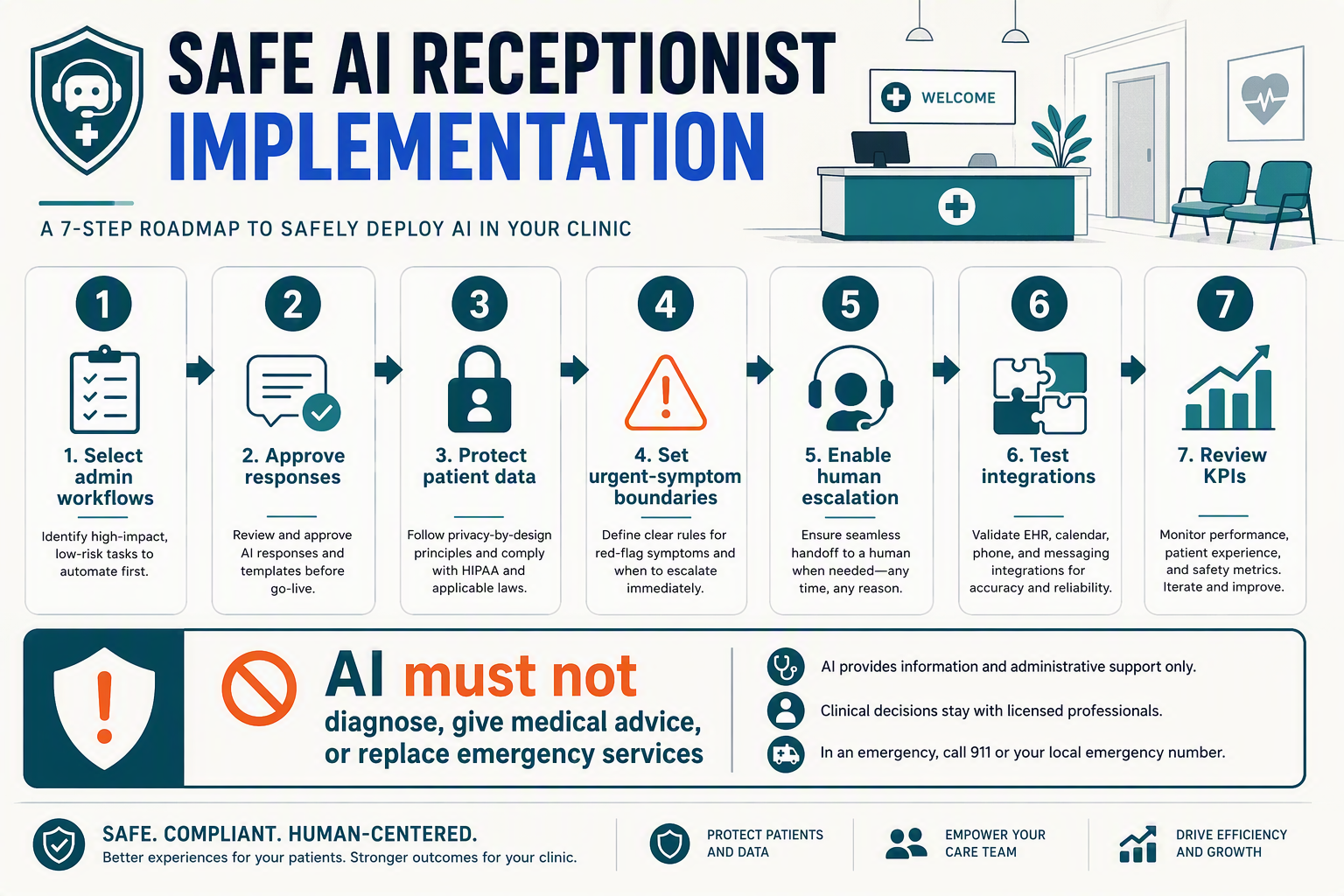
Clinics should implement an AI receptionist for medical clinics as a controlled administrative layer—not as a clinical decision-maker. Begin with low-risk workflows, restrict access to patient data, define urgent-symptom and human-handoff rules, connect only necessary systems, and expand automation after monitored tests meet agreed safety and performance thresholds.
1. Define a narrow administrative scope
Document what the AI may and may not do before selecting technology. Suitable first-release workflows include:
- Checking clinic hours, locations, accessibility, fees, and accepted insurance.
- Booking, rescheduling, and cancelling appointments under approved rules.
- Sending preparation instructions copied from clinician-approved material.
- Collecting minimum contact details and appointment preferences.
- Running clinic missed call automation through a callback, SMS, or consent-based WhatsApp message.
The prohibited list should be explicit: the AI must not diagnose, interpret test results, recommend medication, provide medical advice, or replace emergency services. Any request outside the approved scope must trigger a safe refusal and escalation.
2. Apply privacy controls by design
Map every data field collected across phone, WhatsApp, and email. Use data minimisation: an appointment request may require a name, contact method, preferred slot, and visit category—not a detailed medical history.
Clinics should also configure:
- Role-based access for receptionists, clinicians, managers, and vendors.
- Encryption in transit and at rest where supported.
- Retention and deletion periods aligned with applicable local law.
- Patient consent notices for recording, transcription, and messaging.
- Audit logs covering bookings, record changes, escalations, and staff access.
- Redaction rules preventing sensitive information from entering analytics or model-training pipelines.
Legal requirements differ by jurisdiction, so privacy and compliance teams should review the complete data flow rather than assuming that a vendor feature automatically makes the deployment compliant.
3. Build urgent-symptom and escalation paths
Create a clinic-approved list of phrases and situations that immediately interrupt routine automation. When urgent symptoms are detected, the system should provide the approved emergency instruction, direct the patient to appropriate local emergency services, and initiate human escalation where protocol permits.
Human handoff should also occur when:
- The patient requests a person.
- Identity verification fails.
- The scheduling request requires clinical judgement.
- The AI has low confidence or repeatedly misunderstands the patient.
- A complaint, safeguarding issue, or emotionally distressed caller is detected.
4. Integrate systems conservatively
Connect the healthcare appointment booking AI to a scheduling system through restricted permissions and validated APIs. Prevent double-booking with real-time availability checks, idempotency controls, confirmation states, and clear recovery procedures when an integration fails.
For omnichannel operations, platforms such as CallMissed can coordinate phone, WhatsApp, email, and shared-inbox workflows. A single patient conversation should retain its context without exposing more medical information than staff need to complete the task.
5. Test before expanding
Run a staged rollout:
- Test approved FAQs and synthetic appointment scenarios.
- Simulate emergencies, ambiguous symptoms, abusive messages, and system outages.
- Verify language accuracy with qualified native speakers; India’s Constitution recognizes 22 scheduled languages, making language-by-language testing essential rather than optional.
- Pilot with staff supervision and a limited appointment type.
- Review failures weekly before adding workflows or channels.
Track answer rate, booking completion, missed-call recovery, escalation accuracy, abandonment, integration errors, and staff time saved. Safety metrics should act as release gates: if urgent routing or human escalation is unreliable, the clinic should pause expansion regardless of booking gains.
Why are phone, WhatsApp, and email becoming one patient-access workflow for medical practices?
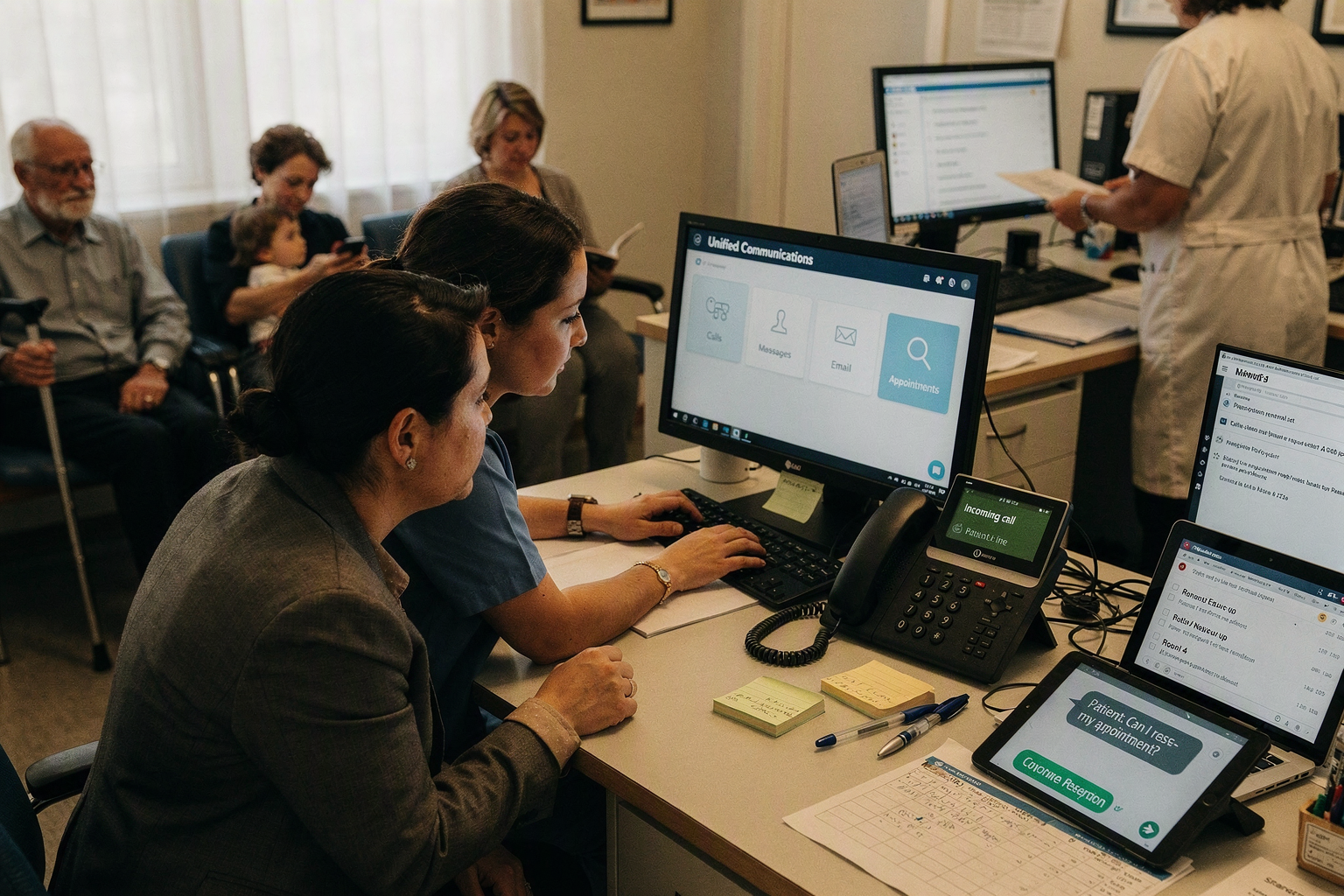
Patients no longer treat phone, WhatsApp, and email as separate service desks; they expect to begin an enquiry on one channel and complete it on another without repeating information. Medical practices therefore need one governed patient-access workflow that preserves context, applies consistent booking rules, and routes every interaction to the same operational queue.
Multichannel access is not the same as an omnichannel workflow
A multichannel clinic may have a telephone number, WhatsApp account, and email inbox, but staff still manage each separately. An omnichannel AI receptionist for medical clinics connects those entry points to shared scheduling rules, approved content, conversation history, and human escalation.
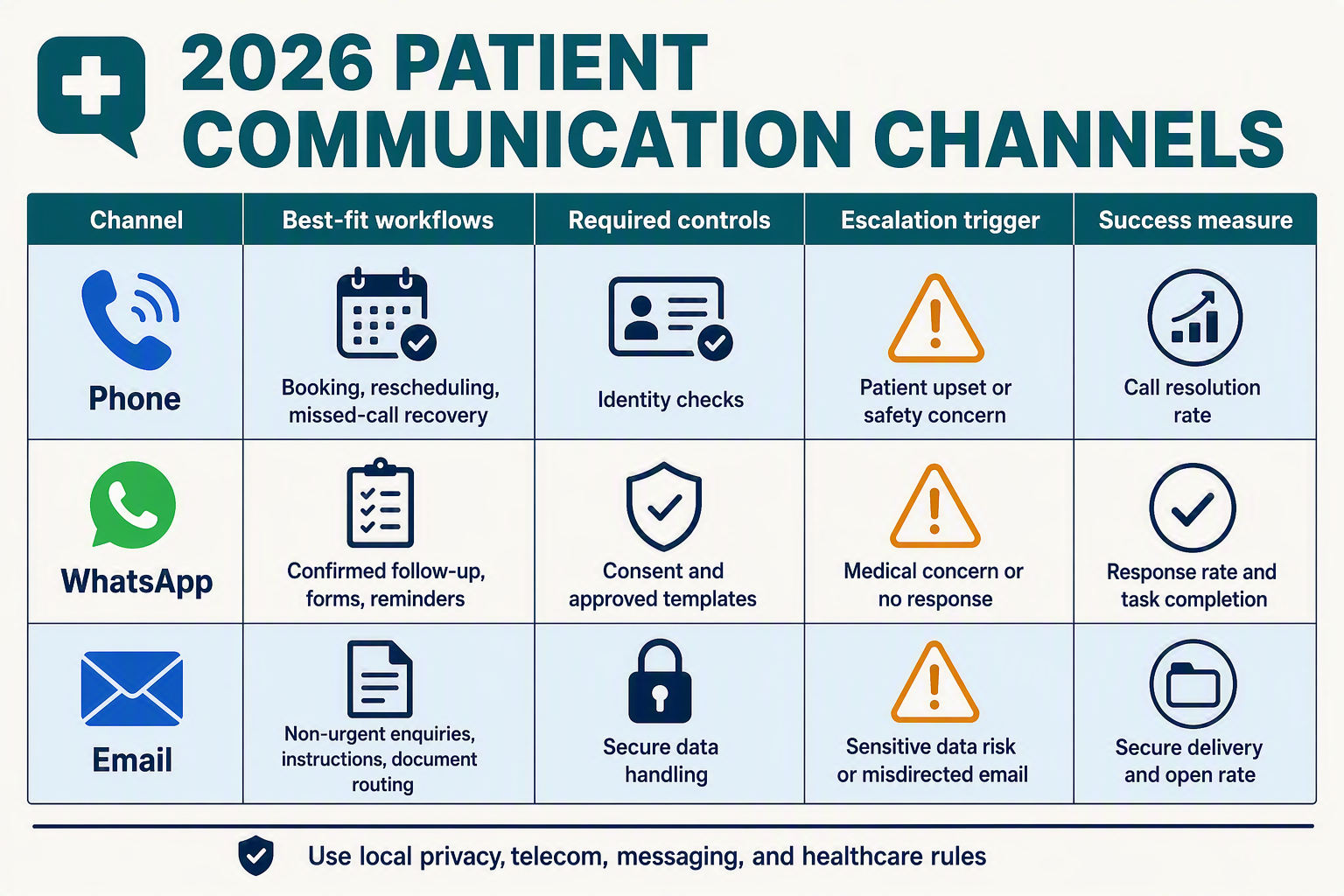
Each channel serves a different patient need:
- Phone: Best for immediate, conversational access, particularly for patients who are uncomfortable typing or navigating forms.
- WhatsApp: Useful for missed-call follow-up, appointment confirmations, approved preparation instructions, and structured replies.
- Email: Appropriate for less urgent enquiries, longer administrative messages, and documents handled under clinic policy.
- Human inbox: Gives authorised staff one place to review escalations and continue conversations with the available context.
The AI should not force every interaction to remain on its original channel. For example, a caller who disconnects while the line is busy might receive a policy-approved WhatsApp message asking whether they want to book an appointment. Any such transition should follow applicable consent, privacy, and messaging rules.
One patient journey can cross several channels
A unified workflow might proceed as follows:
- A patient calls outside normal reception hours.
- The voice agent identifies the administrative request and checks permitted appointment availability.
- The patient asks to receive the available times on WhatsApp.
- The system sends approved options after verifying the destination number and obtaining any required consent.
- The patient selects a slot, and the healthcare appointment booking AI updates the connected scheduling system.
- The clinic sends confirmation through the patient’s authorised channel while recording the interaction for staff review.
This design also improves clinic missed call automation. Instead of treating a missed call as an isolated telephone event, the system can create a follow-up task, send an approved message, or place the caller in a human callback queue. It must avoid including sensitive medical information in notifications or assuming that a shared phone number belongs exclusively to one patient.
Shared context must have strict boundaries
“One workflow” should not mean unrestricted data sharing. Clinics should define which information moves between channels, how identity is verified, how long records are retained, and which team members may view them.
A practical shared record may contain:
- Preferred name and communication language
- Verified contact details and consent status
- Appointment type, location, and requested time
- Booking, cancellation, or rescheduling status
- Approved FAQ responses already provided
- Escalation reason and responsible staff queue
Language preference should also follow the patient across channels. The Eighth Schedule of the Constitution of India recognizes 22 scheduled languages, making multilingual continuity a practical requirement for many Indian medical practices rather than an optional interface feature.
Crucially, unified context does not expand the AI’s clinical authority. Whether the patient calls, messages, or emails, the same rule applies: the system may manage approved administrative tasks, but it must not diagnose, interpret symptoms, prescribe treatment, or replace emergency services.
What key 2026 developments shape healthcare appointment booking AI across phone, WhatsApp, and email?
In 2026, healthcare booking AI is shifting from isolated chatbots to policy-controlled, omnichannel reception systems that share scheduling context across phone, WhatsApp, and email. The most important developments are real-time booking integrations, WhatsApp voice calling, multilingual speech, grounded FAQ retrieval, privacy-aware data collection, and auditable human escalation.
Developments clinics should plan for
| 2026 development | Phone impact | WhatsApp and email impact | Practical clinic requirement |
|---|---|---|---|
| Real-time scheduling integration | Agents can check availability while speaking and confirm a slot immediately. | Patients can book, reschedule, or cancel through structured messages and email links. | Connect through an approved API; prevent double-booking with slot locks and final availability checks. |
| Unified conversation context | A returned call can continue a missed-call workflow without restarting intake. | WhatsApp or email can carry forward the booking reference and administrative history. | Use one patient-safe interaction record, channel identifiers, and explicit identity verification before disclosure. |
| WhatsApp Business calling | Voice conversations can occur through WhatsApp rather than the conventional telephone network. | Chat can transition into a WhatsApp Business call when speaking is easier than typing. | Obtain appropriate consent, define calling windows, and apply the same recording and escalation policies used for phone calls. |
| Multilingual speech and messaging | Speech-to-Text and Text-to-Speech support regional-language booking conversations. | Patients can receive instructions and confirmations in their preferred supported language. | Clinically review every translated template; escalate unclear language rather than guessing intent. |
| Knowledge-grounded FAQ answers | The agent answers only from clinic-approved information about fees, hours, locations, and visit preparation. | The same controlled knowledge base supports consistent chat and email replies. | Add document ownership, approval dates, version history, and an “answer not found” handoff path. |
| Safety and audit controls | Urgent terms can interrupt booking and trigger a predefined safety message. | High-risk messages can be flagged for immediate staff review instead of receiving a generated clinical answer. | Log detection, response, escalation status, timestamps, and staff acknowledgement without collecting unnecessary health data. |
Why channel convergence matters
Patients frequently move between channels: someone may call after hours, receive a WhatsApp follow-up, and request confirmation by email. Clinic missed call automation should therefore be treated as one continuous administrative workflow rather than three disconnected conversations.
A practical sequence is:
- Record the missed call with timestamp and routing number.
- Send a clinic-approved acknowledgement through an authorised channel.
- Offer booking options without exposing sensitive information.
- verify identity before retrieving or changing an existing appointment.
- Escalate failed verification, unusual requests, or urgent language to staff.
Platforms such as CallMissed reflect this convergence by combining AI voice agents, WhatsApp chat and Business calling, email tooling, and a shared inbox. Its support for Speech-to-Text and Text-to-Speech across 22 Indian languages is particularly relevant when regional-language access must remain consistent across voice and messaging.
The non-negotiable 2026 boundary
More capable models do not expand the receptionist’s clinical authority. An AI receptionist for medical clinics must not diagnose, interpret symptoms, recommend medicines, provide medical advice, or claim to replace emergency services.
Clinics should configure deterministic rules so that urgent-symptom language stops ordinary booking. The system should deliver the clinic’s approved emergency instruction, direct the patient to appropriate local emergency services, and initiate human escalation where protocol permits. Every automated action should be traceable to a workflow version, approved content source, and accountable staff owner.
Which workflows should clinic missed call automation, booking, approved FAQs, and multilingual intake handle?
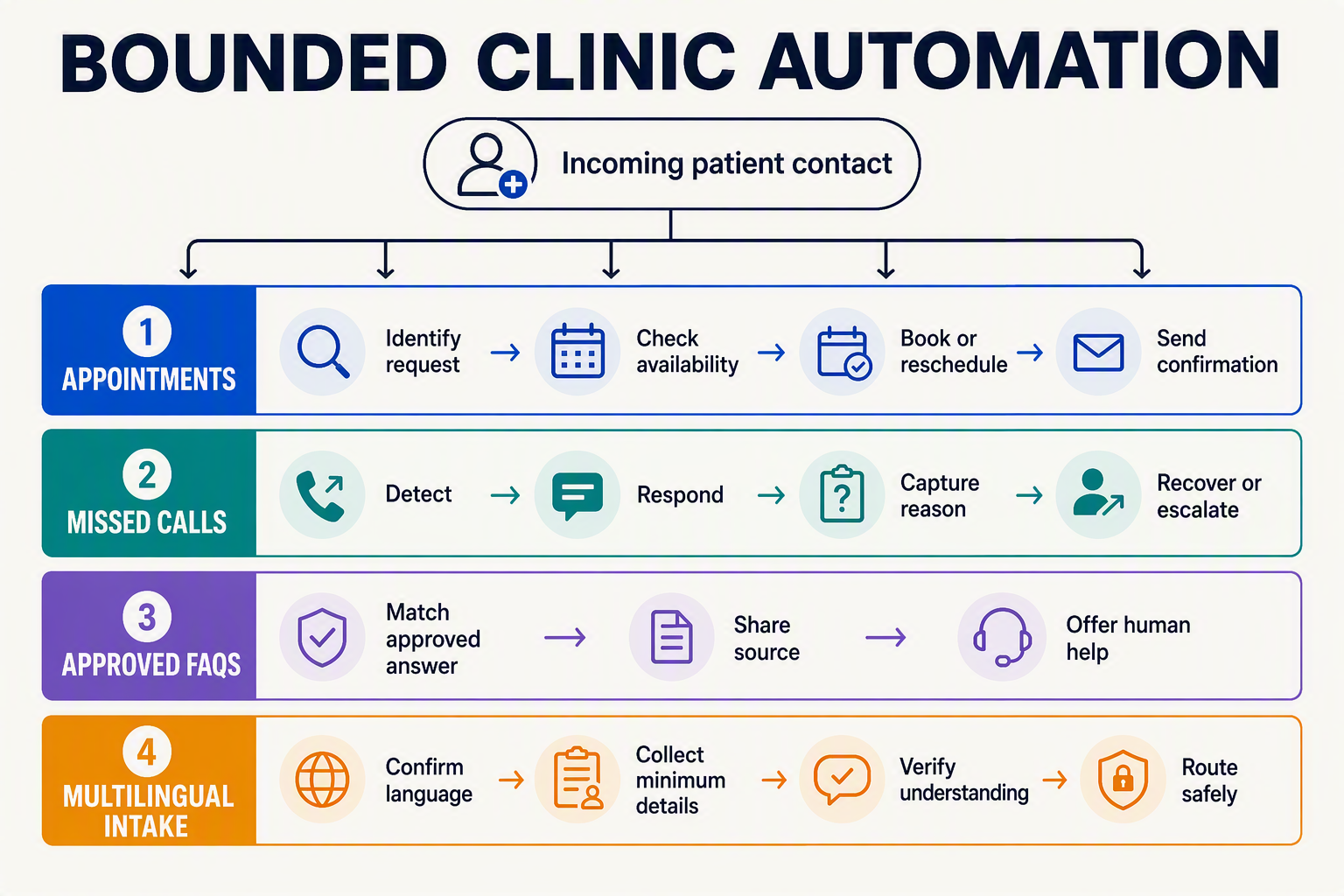
The safest workflow scope is narrow: automate administrative tasks with deterministic rules, while sending clinical, urgent, ambiguous, or privacy-sensitive cases to trained staff. Clinic missed call automation, booking, approved FAQs, and multilingual intake should operate consistently across phone, WhatsApp, and email without diagnosing or recommending treatment.
1. Recover missed calls without creating communication loops
A missed-call workflow should identify the caller, check business hours, and initiate one clinic-approved follow-up path:
- Send a consent-aware WhatsApp message or SMS acknowledging the missed call.
- Offer options such as book an appointment, request a callback, view opening hours, or speak to reception.
- Create a staff task when automated contact fails or the patient requests a person.
- Record the original call, follow-up attempts, outcome, and opt-out status.
Messages should remain discreet—for example, “We received your call to ABC Clinic”—rather than revealing a specialty, condition, or appointment purpose on a shared device. Clinics should also define maximum retry counts and quiet hours so recovery does not become persistent outreach.
2. Complete rule-based appointment transactions
A healthcare appointment booking AI should read real-time availability from the clinic’s scheduling system rather than promise unverified slots. It can handle:
- New bookings based on location, service, practitioner, and appointment type.
- Rescheduling or cancellation after suitable identity verification.
- Waitlist offers and clinic-approved reminder sequences.
- Preparation instructions linked to the confirmed appointment type.
- Human handoff for referral requirements, complex procedures, or unavailable slots.
The workflow must confirm the date, time, location, practitioner, and cancellation policy before committing the booking. If an integration times out or returns conflicting information, the AI should create a callback task—not guess.
3. Answer only approved, version-controlled FAQs
The AI should retrieve answers from a clinic-controlled knowledge base containing non-clinical information, including:
- Opening hours, directions, parking, accessibility, and contact details.
- Published fees, accepted payment methods, and insurance processes.
- Documents patients should bring.
- Clinic-approved preparation and post-visit administrative instructions.
- Prescription-renewal procedures without approving or interpreting medication requests.
Each answer should have an owner, approval date, review date, and channel-appropriate wording. Questions such as “What does this symptom mean?” or “Should I change my dose?” must trigger a boundary statement and human escalation because an AI receptionist must not diagnose or provide medical advice.
4. Collect minimum multilingual intake data
Multilingual intake should capture only what is necessary to route or schedule the enquiry: name, contact details, preferred language, appointment category, and callback preference. Free-text symptom histories should be avoided unless the clinic has explicitly approved their secure collection and review.
India’s Constitution recognizes 22 scheduled languages under the Eighth Schedule, making language selection an operational requirement rather than a cosmetic feature. Clinics should test names, dates, numbers, code-switching, accents, and transliterated WhatsApp messages with native speakers.
Across every language, urgent-symptom phrases should interrupt routine automation. The system must deliver the clinic-approved emergency message, direct the patient to the appropriate local emergency service, and escalate according to protocol; it must never present itself as a clinician or replace emergency services.
How should medical practice WhatsApp automation coordinate with phone and email without confusing patients?
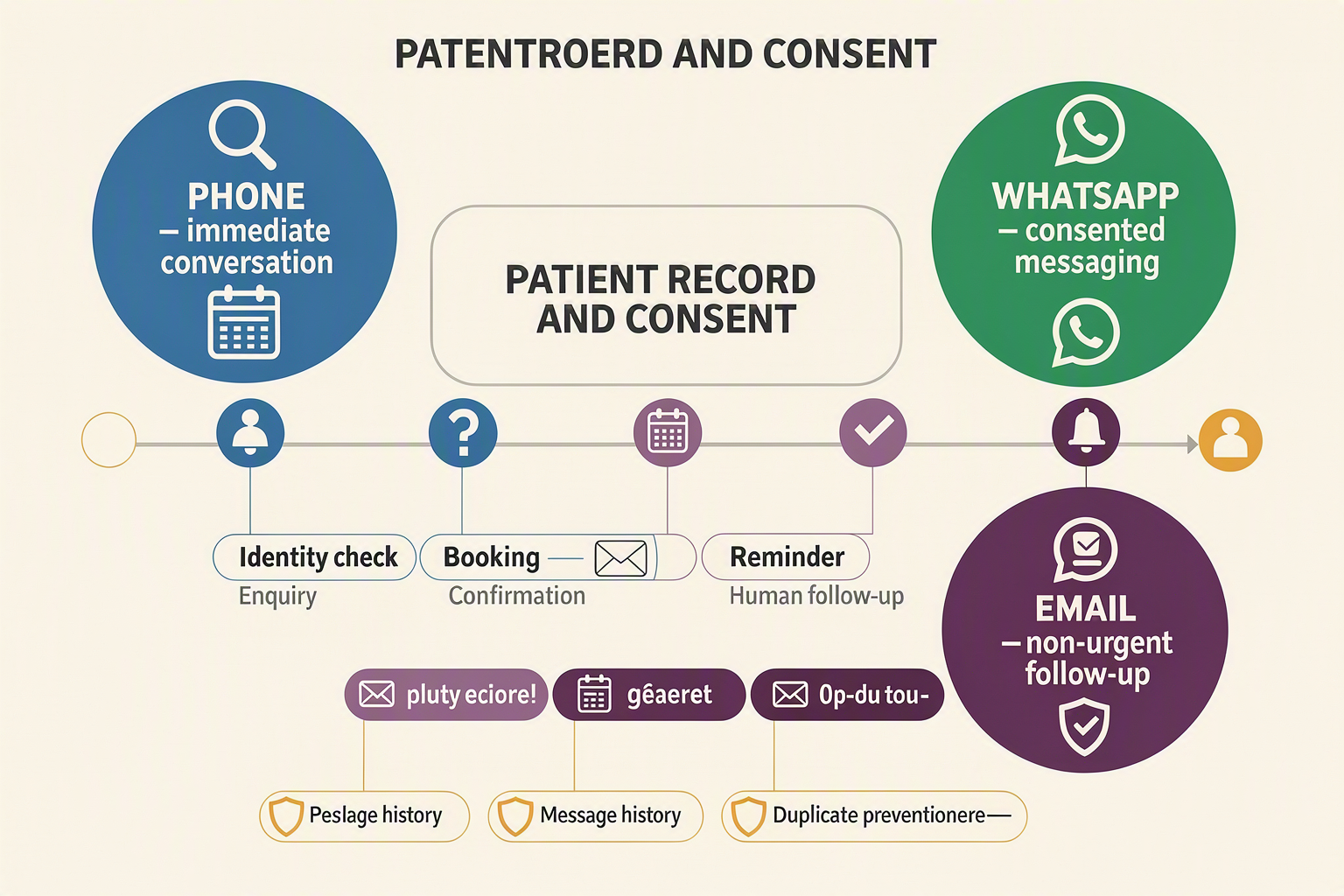
Medical practice WhatsApp automation should operate as part of one coordinated patient-conversation system, not as a separate chatbot. Phone, WhatsApp, and email must share appointment status, patient preferences, escalation history, and a single source of truth so patients do not receive duplicate or contradictory messages.
Give each channel a clear role
Clinics should explain what each channel is designed to handle:
- Phone: immediate conversations, accessibility needs, complex scheduling, and transfer to front-desk staff.
- WhatsApp: missed-call recovery, appointment confirmations, approved FAQs, rescheduling links, preparation instructions, and short intake flows.
- Email: longer documents, receipts, non-urgent administrative correspondence, and information unsuitable for a chat thread.
Patients should not have to restart when changing channels. If someone calls, misses the clinic, and replies to an automated WhatsApp message, the shared record should show the original call time, intended department, language preference, and current workflow stage.
For Indian practices, language settings should also follow the patient across channels. The Eighth Schedule of the Constitution of India recognizes 22 scheduled languages; therefore, a patient selecting Bengali on a call should not automatically receive a Hindi WhatsApp message or English email.
Use one record and one booking authority
The scheduling system—not WhatsApp, email, or the voice agent—should be the authoritative source for appointment availability. Every channel should read from and write to that same calendar, practice-management system, CRM, or electronic health record integration.
A safe cross-channel sequence is:
- A patient’s unanswered call creates a time-stamped enquiry.
- Clinic missed call automation checks communication consent and sends one approved WhatsApp message.
- The patient selects a purpose, language, or available appointment.
- The healthcare appointment booking AI temporarily holds the slot.
- The scheduling system confirms the booking and generates one reference number.
- WhatsApp or email delivers confirmation according to the patient’s preference.
- The voice agent and staff inbox immediately display the confirmed status.
Use idempotency controls so repeated clicks, webhook retries, or simultaneous staff actions cannot create duplicate bookings. Configure suppression rules so a patient who answers on WhatsApp does not also receive an unnecessary callback and email chase.
Keep messages consistent but channel-appropriate
Maintain a centrally approved content library for opening hours, fees, insurance, preparation instructions, cancellation policies, and escalation wording. Adapt length and format by channel without changing the underlying meaning.
Every message should identify the clinic, explain why the patient is being contacted, and offer a human option. For example: “You called Greenfield Clinic at 10:42 a.m. Reply 1 to book, 2 to request a callback, or STOP to opt out.”
Platforms such as CallMissed can coordinate AI voice agents, WhatsApp chat, WhatsApp Business calls, email, and an omnichannel inbox. This architecture helps staff see one conversation history rather than reconciling isolated channel logs.
Prevent privacy leaks and unsafe handoffs
Cross-channel convenience must not broaden data collection. Clinics should:
- Verify identity before displaying appointment or patient-specific information.
- Avoid placing diagnoses, test results, or detailed symptoms in routine notifications.
- Record consent, channel preference, language, delivery status, and opt-outs.
- Restrict staff access by role and define retention periods.
- Escalate repeated failures or ambiguous requests to a human queue.
If urgent symptoms appear on any channel, automation must stop the administrative flow and use the same clinic-approved safety response. The AI must not diagnose, provide medical advice, or replace emergency services, whether the conversation began by phone, WhatsApp, or email.
How do clinics protect patient privacy, set urgent-symptom boundaries, and guarantee human escalation?
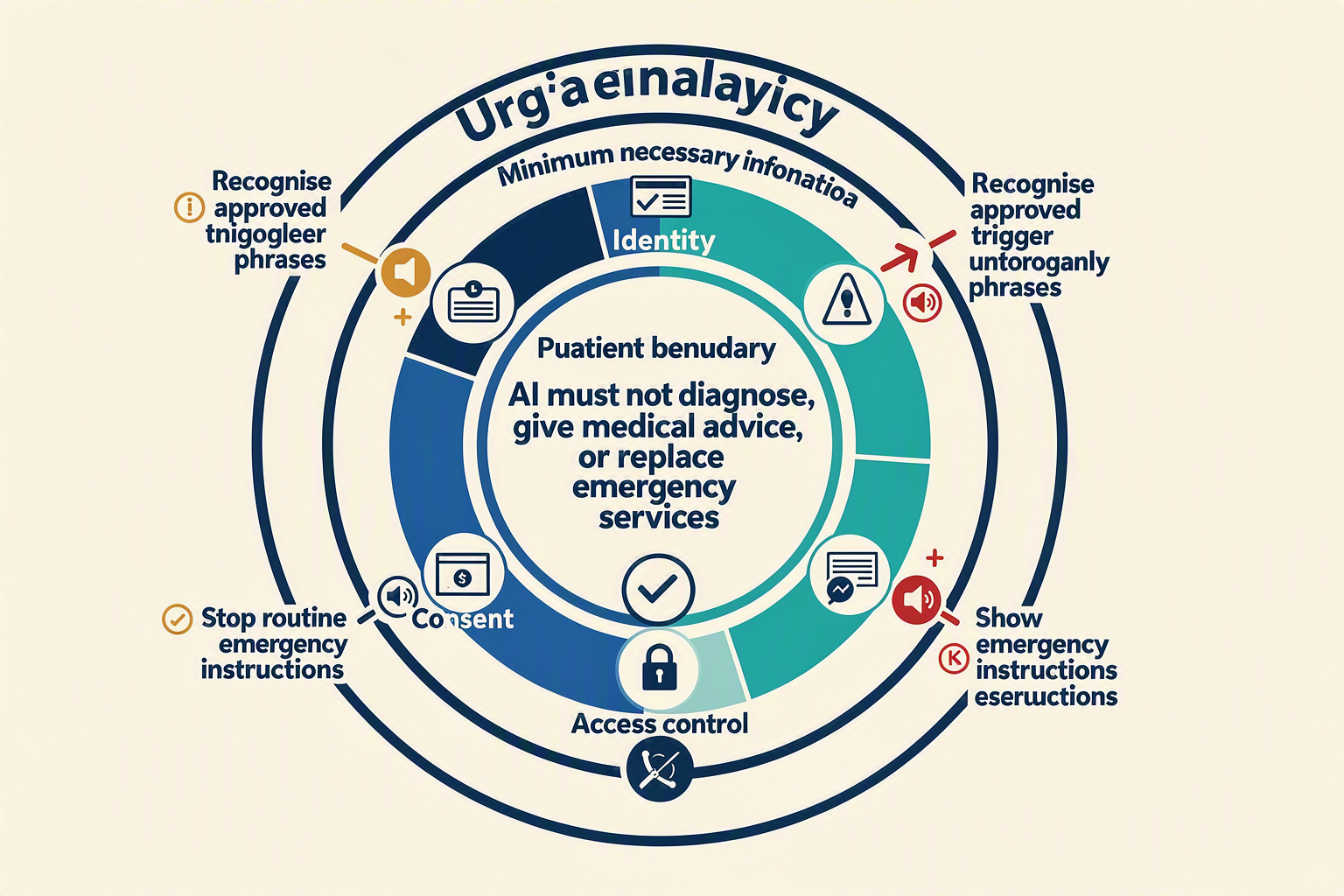
Clinics protect patients by collecting the minimum necessary information, restricting how it is stored and accessed, and preventing the AI from performing clinical tasks. Reliable escalation requires more than transferring a call: every handoff must be acknowledged, timed, logged, and backed by an alternative route if no staff member responds.
Apply privacy controls across every channel
An AI receptionist for medical clinics should treat phone transcripts, WhatsApp messages, emails, recordings, appointment details, and symptom descriptions as sensitive data. Configure the same privacy standard across all channels rather than assuming that a familiar channel is automatically compliant.
Before launch, clinics should:
- Minimise collection: Ask only for information needed to identify the patient, complete the administrative task, and arrange follow-up. Avoid collecting diagnoses, detailed histories, identity documents, or payment information unless the workflow genuinely requires them.
- Explain the purpose: Tell patients that they are interacting with an automated receptionist, what information will be collected, and whether calls are recorded or transcribed.
- Control access: Use role-based permissions, multifactor authentication, and separate access levels for receptionists, clinicians, administrators, and technology vendors.
- Protect data: Require encryption in transit and at rest, defined retention periods, deletion procedures, audit logs, and contractual restrictions on using patient conversations to train general-purpose models.
- Verify vendors: US clinics should assess whether relevant vendors can support obligations under the Health Insurance Portability and Accountability Act (HIPAA), including Business Associate Agreements where required. Indian clinics should map processing to the Digital Personal Data Protection Act, 2023 and applicable health-data policies; European operations must also consider the General Data Protection Regulation (GDPR).
A WhatsApp conversation, email inbox, or AI transcript should not become a shadow medical record. Decide which information enters the clinic’s authorised system and automatically delete unnecessary intermediate copies.
Define a hard boundary around symptoms
The AI must not diagnose, interpret symptoms, recommend medication, provide treatment advice, or replace emergency services. Approved FAQs should cover administrative information and clinician-reviewed instructions only.
Create a safety-trigger library covering explicit phrases and likely variations, including:
- Chest pain, breathing difficulty, severe bleeding, unconsciousness, seizures, or signs of stroke.
- Self-harm, suicide, overdose, abuse, or immediate danger.
- Severe allergic reactions, pregnancy emergencies, and rapidly worsening symptoms.
- Statements such as “I cannot breathe,” “this is getting worse,” or “I need help now.”
When triggered, the AI should stop booking or FAQ flows and deliver a clinic-approved message such as: “I cannot assess medical symptoms. If this may be an emergency, contact your local emergency service or go to the nearest emergency department now.” The system should not reassure the patient that a condition is harmless.
Engineer a verified human handoff
A transfer attempt is not a completed escalation. Use a closed-loop process:
- Classify and timestamp the escalation without generating a diagnosis.
- Route it to the designated clinical or reception queue.
- Require acknowledgement from a named staff member within the clinic’s defined service level.
- Retry through another route—call, secure inbox alert, or on-call workflow—if acknowledgement does not arrive.
- Give the patient a fallback, including the clinic number, expected response window, and emergency-services instruction where appropriate.
- Log the outcome for audit and quality review.
Test escalation after hours, during network failures, when queues are full, and when integrations are unavailable. Clinics should review false negatives, unacknowledged alerts, transfer failures, and emergency-trigger wording regularly; safety depends on monitored operations, not merely an AI prompt.
How should clinics evaluate integrations, CallMissed, security controls, and rollout tests before launch?
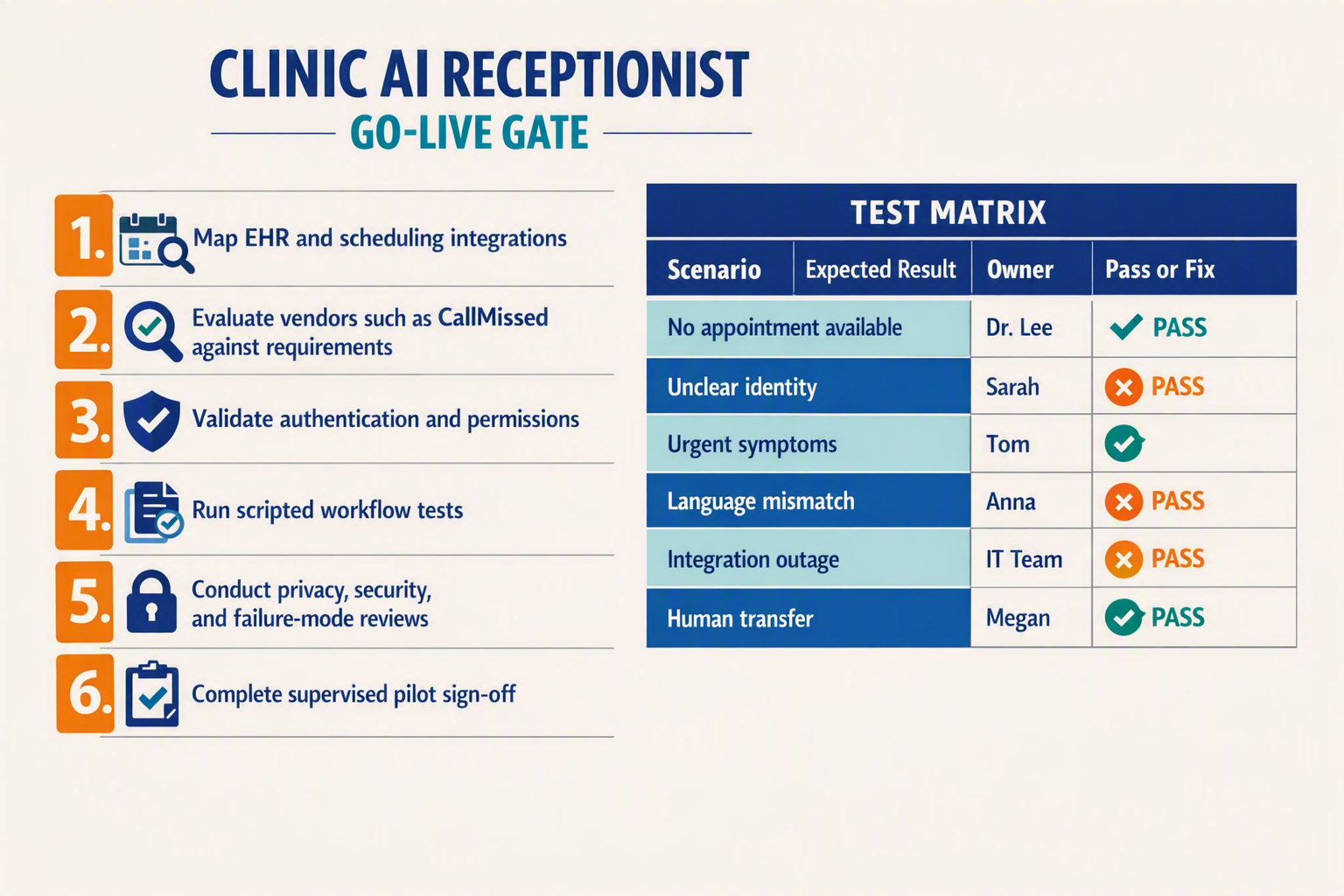
Clinics should approve an AI receptionist only after verifying system integrations, minimum-access security, channel-specific safeguards, and end-to-end failure tests. A successful demo is not enough: the clinic must prove that bookings, escalations, consent records, and audit trails behave correctly under normal, urgent, ambiguous, and unavailable-system conditions.
Evaluate integrations using real workflows
Test integrations in a sandbox using representative—but synthetic—patient records. The healthcare appointment booking AI should connect only to systems required for its administrative role, such as scheduling, CRM, telephony, WhatsApp Business, and approved email services.
Confirm that each integration can:
- Read current availability without exposing unrelated clinical records.
- Create, reschedule, and cancel appointments without duplicate entries.
- Respect practitioner, location, visit-type, buffer-time, and eligibility rules.
- Pass the conversation summary and channel history to authorised staff.
- Queue requests safely when the scheduler, CRM, or network is unavailable.
- Prevent repeated callbacks or messages after a patient has already responded.
CallMissed can support this architecture through AI voice agents, WhatsApp chat and Business calling, email workflows, an omnichannel inbox, and knowledge-base retrieval. Its support for 22 Indian languages can also be evaluated with the clinic’s actual terminology, accents, names, and regional-language scripts rather than generic translation tests.
Require security and governance controls
Do not assume that a product is automatically compliant because it uses encryption or advertises healthcare use. The clinic remains responsible for determining which obligations apply, including India’s Digital Personal Data Protection Act, 2023, the US Health Insurance Portability and Accountability Act, or local health-record and telecommunications rules.
The procurement checklist should require:
- Role-based access control: Receptionists, clinicians, administrators, and vendors receive only necessary permissions.
- Encryption: Protect data in transit and at rest, including recordings, transcripts, exports, and backups.
- Data minimisation: Avoid collecting diagnosis details, full medical histories, or identification documents for routine booking.
- Retention controls: Define when call recordings, messages, emails, and generated summaries are deleted.
- Auditability: Log access, edits, appointment actions, consent status, escalations, and knowledge-base changes.
- Vendor governance: Document subprocessors, hosting locations, breach-notification procedures, model-training policies, and contract termination processes.
- Prompt-injection protection: Prevent patients or external content from overriding approved instructions or extracting internal knowledge.
The US National Institute of Standards and Technology published AI Risk Management Framework 1.0 in January 2023, organising AI risk work around four functions: Govern, Map, Measure, and Manage. Clinics can use this structure even where it is not legally mandatory.
Run controlled rollout tests before launch
Use a written acceptance matrix with expected outcomes and named owners:
- Booking tests: Check valid, unavailable, duplicate, cancelled, and waitlisted appointments.
- Channel tests: Begin on phone, continue on WhatsApp, and verify that staff receive one coherent history.
- Safety tests: Enter urgent symptoms, requests for diagnosis, medication questions, and attempts to bypass restrictions. The AI must refuse clinical guidance and follow the approved emergency-escalation script.
- Language tests: Have fluent reviewers assess pronunciation, dates, consent wording, and transliterated names.
- Failure tests: Disconnect the calendar, delay an API response, interrupt a call, and simulate an unavailable human queue.
- Privacy tests: Request record deletion, challenge caller identity, and verify that sensitive information is not disclosed through previews or shared devices.
Launch first with limited hours, locations, or appointment types. Set explicit stop conditions—such as incorrect bookings, missed urgent escalations, or unauthorised disclosure—and retain a manual fallback until the clinic has reviewed enough real interactions to approve wider deployment.
Which KPIs show whether automation improves access without weakening safety or patient experience?
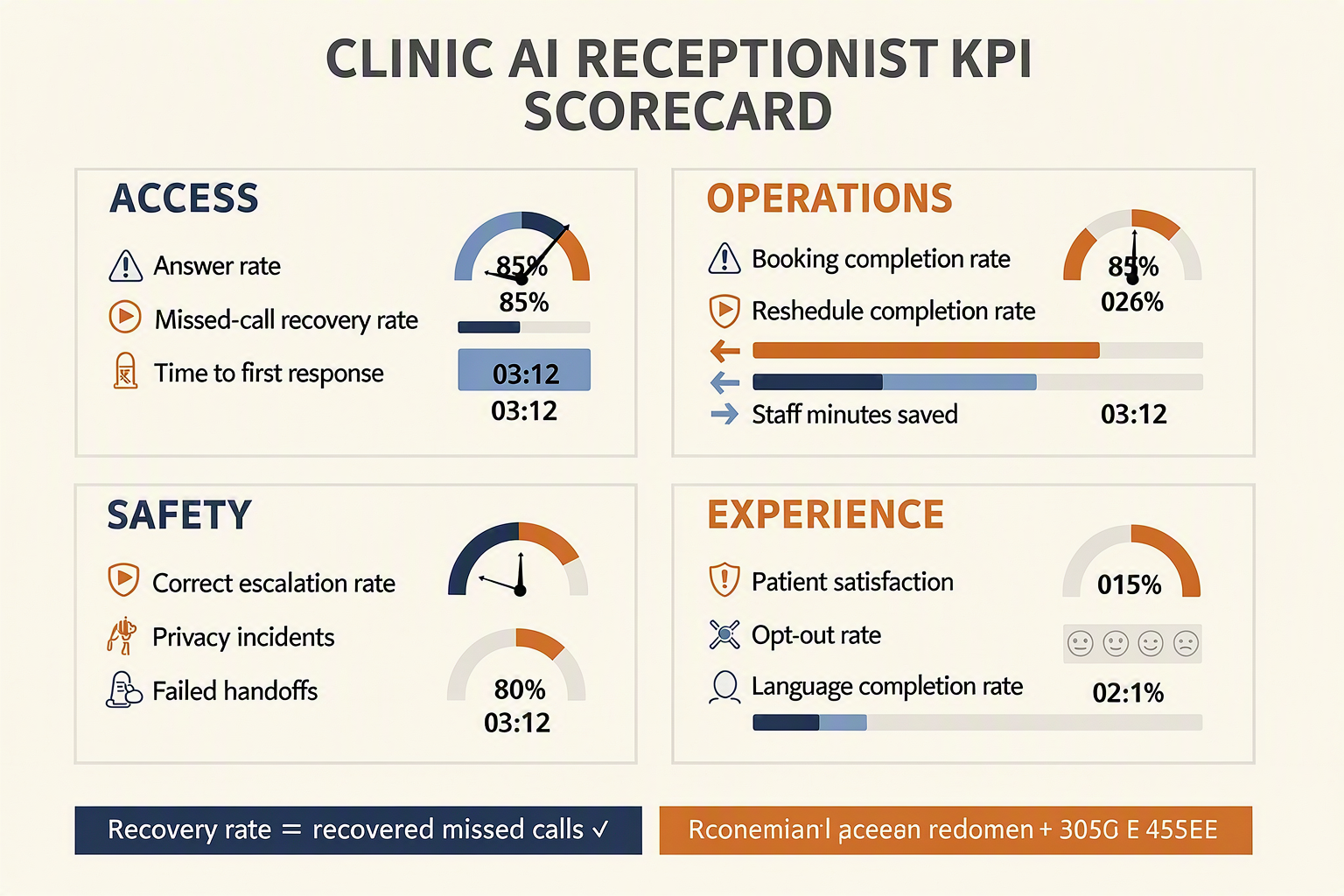
Measure automation with a balanced scorecard covering access, safety, patient experience, and operational impact. A higher booking rate is not success if urgent messages are mishandled, patients repeatedly request humans, or the system exposes unnecessary health information.
Track access by channel and patient segment
Compare each KPI with a four-to-eight-week pre-launch baseline, then report phone, WhatsApp, and email separately. Overall averages can conceal poor performance in a particular language, clinic location, or after-hours period.
Core access KPIs include:
- Answer rate: answered inbound contacts ÷ total eligible contacts.
- Abandonment rate: callers who disconnect before service ÷ inbound calls.
- Median first-response time: time until the first useful response, not merely an automated greeting.
- Booking completion rate: confirmed appointments ÷ appointment requests started.
- Missed-call recovery rate: missed callers who are successfully contacted ÷ missed callers eligible for follow-up.
- Recovery-to-booking rate: appointments booked through follow-up ÷ recovered missed calls.
- Self-service resolution rate: eligible administrative enquiries completed without staff intervention.
- Time to human response: median and 90th-percentile wait after escalation.
For clinic missed call automation, count a call as recovered only when the patient receives and engages with the approved callback or WhatsApp workflow. Sending an unanswered message does not demonstrate restored access.
Treat safety metrics as release gates
An AI receptionist for medical clinics must not diagnose, interpret symptoms, recommend treatment, give medical advice, or replace emergency services. Safety metrics should therefore be monitored as hard guardrails rather than traded against efficiency.
Use these measures:
- Urgent-escalation recall: known urgent test cases correctly identified and routed ÷ all urgent test cases. Clinics should require 100% success on their approved pre-launch emergency test suite.
- False reassurance incidents: conversations in which the AI minimizes risk or implies that waiting is safe. The acceptable target is zero.
- Clinical-boundary violations: responses containing diagnosis, treatment recommendations, medication guidance, or symptom interpretation. The target is zero.
- Escalation delivery rate: escalations successfully delivered to the designated team ÷ escalations triggered.
- Escalation acknowledgement time: elapsed time until an authorized staff member accepts the handoff.
- Privacy exceptions: unauthorized disclosures, incorrect-recipient messages, excessive data collection, or retention-policy breaches.
Automated scoring is insufficient for safety assurance. A trained reviewer should audit a risk-based sample of routine conversations plus every reported safety, privacy, and failed-escalation incident.
Measure patient experience, not just containment
A high self-service rate can indicate convenience—or that patients could not reach a person. Pair containment with:
- Post-interaction satisfaction, using the same short survey before and after launch.
- Human-request rate and the percentage of those requests successfully transferred.
- Repeat-contact rate within 24 or 48 hours, which can reveal unresolved enquiries.
- Correction rate, covering names, dates, contact details, languages, and appointment types.
- Complaint rate per 1,000 conversations.
- Language-specific completion and escalation rates for multilingual intake.
- Channel switching rate, such as patients abandoning WhatsApp and calling to finish the task.
Review outcomes through a weekly scorecard
Assign an owner, target, warning threshold, and data source to every KPI. Review safety incidents immediately, operational metrics weekly during rollout, and broader trends monthly.
A practical success rule is: access improves, experience remains stable or improves, and no safety or privacy guardrail deteriorates. If booking completion rises while urgent-escalation recall falls, pause or narrow the workflow rather than declaring the implementation successful.
What should clinical, privacy, security, operations, and patient-access experts approve before expansion?

Expansion should proceed only after clinical safety, privacy, security, operations, and patient-access owners independently approve the production workflow. Approval must be evidence-based: each expert should review test results, failure handling, audit records, and named accountability—not merely attend a demonstration.
1. Clinical safety approval
The clinical lead should approve exactly what the AI receptionist for medical clinics may say, collect, and escalate. The approved scope should cover appointment administration and clinic-authored information while explicitly prohibiting diagnosis, symptom interpretation, treatment recommendations, medication advice, or replacement of emergency services.
Clinical sign-off should confirm:
- Every FAQ answer has an owner, approval date, source document, and review date.
- Urgent or ambiguous language exits the automated workflow immediately.
- Emergency messaging is appropriate for each country and clinic location.
- Escalations reach a monitored queue during stated operating hours.
- Transcripts cannot be silently converted into clinical conclusions.
- Changes to safety prompts require clinical review before publication.
Approval should include adversarial tests involving vague symptoms, distressed callers, children, medication questions, self-harm language, and patients who repeatedly reject escalation.
2. Privacy and legal approval
The privacy owner must map what data is collected, why it is needed, where it travels, who can access it, and when it is deleted. India’s Digital Personal Data Protection Act, 2023 establishes obligations for processing digital personal data, while the European Union’s General Data Protection Regulation treats health information as special-category data under Article 9. US deployments may also fall within the Health Insurance Portability and Accountability Act, depending on the clinic’s role and vendor arrangements.
The privacy review should approve:
- Channel-specific notices and consent or lawful-basis language.
- Minimum-data fields for phone, WhatsApp, and email.
- Transcript, recording, and failed-booking retention periods.
- Patient access, correction, deletion, and complaint procedures.
- Processor contracts, cross-border transfers, and subprocessors.
- Rules preventing sensitive information from appearing in notifications or staff previews.
3. Security approval
Security teams should validate the complete system rather than reviewing only the conversational model. Approval should cover encryption in transit and at rest, role-based access, multifactor authentication, audit logging, secret management, backups, vulnerability handling, and incident response.
Teams should also test for prompt injection, impersonation, account enumeration, unauthorised appointment changes, malicious attachments, and attempts to retrieve another patient’s information. Integration permissions should follow least privilege: a booking workflow should not receive broad electronic health record access when calendar availability is sufficient.
4. Operations approval
Operations owners should confirm that automation remains manageable during real-world failures. Required evidence includes:
- Successful booking, rescheduling, cancellation, and duplicate-prevention tests.
- Recovery procedures for scheduling, telephony, WhatsApp, email, or integration outages.
- Named owners for escalations and unresolved conversations.
- Reconciliation between AI-created appointments and the authoritative schedule.
- Rollback controls for faulty prompts, FAQ updates, or integration releases.
- Staffing plans for peaks created by clinic missed call automation.
No workflow should launch without a manual fallback and an agreed incident severity matrix.
5. Patient-access and equity approval
Patient-access experts should test whether elderly users, people with disabilities, low-literacy patients, and regional-language speakers can complete or exit the workflow. They should verify language quality with human reviewers—not translation scores alone—and ensure patients can request a person without navigating repeated menus.
Final expansion should use a go/no-go checklist with named signatories, unresolved risks, compensating controls, and a review date. Approval is a continuing governance process: material changes to models, channels, integrations, languages, or clinical content should trigger reassessment before wider release.
What does this mean for your clinic? A phased 30-, 60-, and 90-day rollout plan
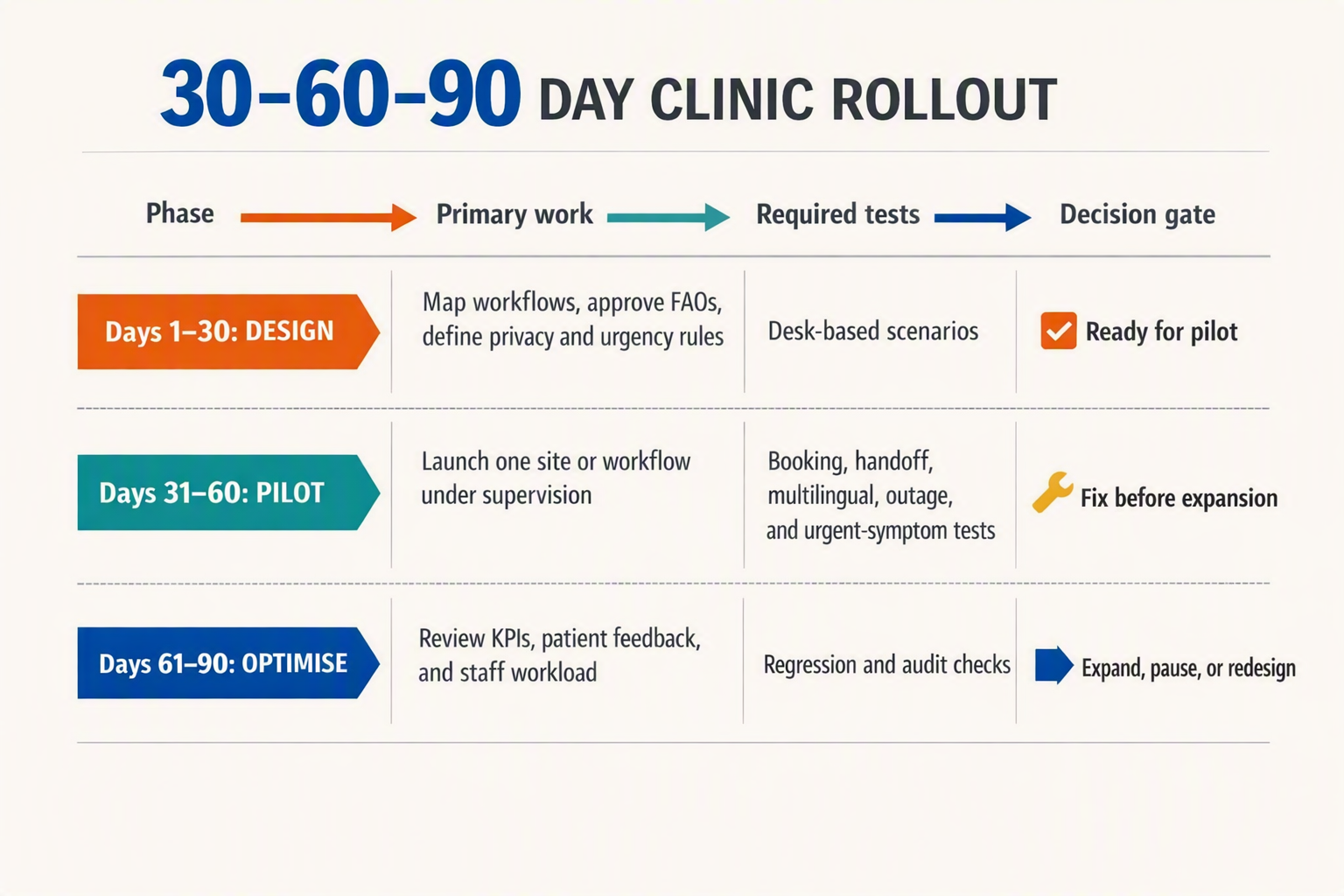
A clinic should implement an AI receptionist for medical clinics in three controlled phases: design and sandbox testing in days 1–30, a limited patient-facing pilot in days 31–60, and measured expansion in days 61–90. Progress should depend on safety, privacy, and escalation evidence—not simply whether the technology works.
| Workstream | Days 1–30: Design | Days 31–60: Pilot | Days 61–90: Expand | Exit evidence |
|---|---|---|---|---|
| Scope and governance | Approve administrative use cases, owners, consent language, retention rules, and prohibited actions | Review transcripts and incidents daily; document corrective actions | Move to weekly governance reviews and monthly policy audits | 100% of workflows have an owner and approved procedure |
| Appointment booking | Connect a test calendar; configure visit types, durations, clinicians, buffers, and eligibility rules | Offer booking for selected routine appointments or one location | Add rescheduling, cancellation, reminders, and more appointment types | At least 95% test-case accuracy with no duplicate bookings |
| Phone and missed calls | Map office-hours, after-hours, voicemail, callback, and transfer paths | Route a limited share of routine calls through the AI; send consented follow-ups | Enable broader clinic missed call automation with retry limits and suppression rules | At least 90% of test calls follow the intended route |
| WhatsApp and email | Approve templates, identity checks, response boundaries, and opt-out handling | Pilot FAQs and booking with a small patient group | Add multilingual intake and unified staff handoff across channels | Opt-outs work in 100% of test cases |
| Safety and escalation | Create urgent-symptom triggers, emergency wording, and staffed escalation destinations | Run at least 50 scripted scenarios, including ambiguity, silence, and language changes | Test weekly and after every workflow or model update | 100% of urgent test scenarios stop automation and present approved guidance |
| Measurement and training | Establish baselines for call answer rate, abandonment, bookings, and staff workload | Compare pilot results with the pre-launch baseline; coach front-desk staff | Expand only where safety and service KPIs meet clinic-set thresholds | Signed clinical, privacy, operational, and technical approval |
Days 1–30: Establish the safety envelope
Begin with a workflow inventory rather than a broad launch. The World Health Organization projected in 2023 that the global health workforce shortage could reach 10 million workers by 2030, but workforce pressure does not justify automating clinical judgement.
During this phase, clinics should:
- Create a single approved FAQ source for hours, fees, directions, insurance, and preparation instructions.
- Define the minimum patient data required for each task.
- Prevent the AI from diagnosing, interpreting symptoms, recommending treatment, or replacing emergency services.
- Test scheduling integrations with synthetic—not real—patient records.
- Assign a human destination for every exception.
Days 31–60: Run a constrained live pilot
Limit the pilot by location, appointment type, operating period, or enquiry category. Staff should review failed bookings, low-confidence responses, unexpected data collection, and delayed escalations every day.
For India-focused deployments, test the actual languages patients use rather than translating English scripts mechanically. The Constitution of India recognizes 22 scheduled languages. CallMissed supports voice and chat across 22 Indian languages and can connect WhatsApp Business calls to an AI voice agent, making it practical to test phone and medical practice WhatsApp automation within one operational plan.
Days 61–90: Expand only after measurable approval
Set clinic-specific thresholds before increasing traffic. Useful measures include:
- Answer rate and call abandonment
- Booking completion and scheduling-error rate
- Missed-call recovery within the clinic’s target window
- Urgent-scenario escalation accuracy
- Human handoff completion
- Opt-out compliance and privacy incidents
- Staff minutes saved per completed administrative task
A 90-day rollout is not an endpoint. It establishes a repeatable change-control cycle in which every new language, FAQ, appointment type, model, or integration is tested and approved before reaching patients.
Frequently asked questions: Can an AI receptionist diagnose, is it privacy-compliant, how does booking work, what happens in an emergency, and when does a human take over?
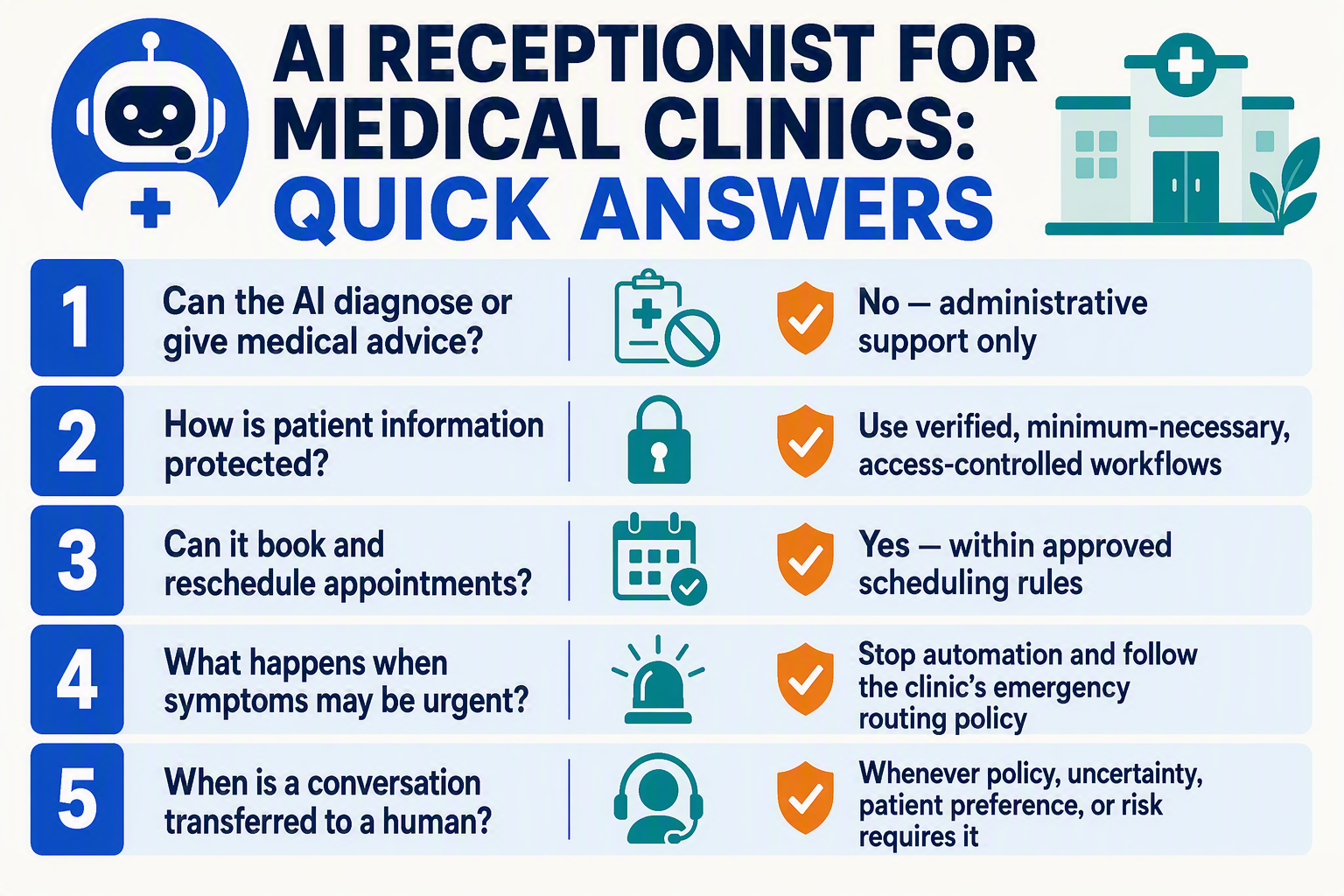
Can an AI receptionist for medical clinics diagnose patients or give medical advice?
Is an AI medical receptionist compliant with patient privacy requirements such as HIPAA?
How does healthcare appointment booking AI connect to a clinic calendar or EHR?
What should an AI receptionist do when a patient reports an emergency or urgent symptoms?
When should a human take over from an AI receptionist for medical clinics?
Can one AI receptionist manage phone calls, WhatsApp, email, missed calls, and multiple languages?
Conclusion
The practical goal for an AI receptionist for medical clinics in 2026 is controlled automation—not replacing clinicians or removing human judgment. Clinics should use AI to improve access and reduce administrative workload while maintaining strict privacy, escalation, and patient-safety boundaries.
Key takeaways include:
- Deploy healthcare appointment booking AI for routine booking, rescheduling, cancellations, and clinic-approved FAQs across phone, WhatsApp, and email.
- Configure clinic missed call automation to recover unanswered enquiries through callbacks or consent-aware WhatsApp follow-ups.
- Support multilingual intake while collecting only the minimum necessary patient information; CallMissed, for example, supports voice and chat across 22 Indian languages.
- Test integrations, urgent-symptom responses, human handoffs, and failure scenarios before launch, then monitor answer rate, booking completion, abandonment, escalation accuracy, recovered calls, and staff time saved.
An AI receptionist must never diagnose, interpret symptoms, recommend treatment, give medical advice, or replace emergency services. Any urgent or uncertain conversation should trigger a clinic-approved safety message and a reliable escalation pathway.
Looking ahead, watch for tighter integration between communication channels, scheduling systems, and auditable workflows—but evaluate every capability against patient safety and privacy requirements. To explore this shift, visit CallMissed, an AI communication infrastructure platform for voice agents, WhatsApp automation, and multilingual engagement. Which patient journey should your clinic automate—and safely test—first?
Related Reading
Discussion
Related Posts



Ready to automate customer conversations?
Launch AI voice agents and WhatsApp bots with CallMissed — one API, 22+ Indian languages.