
AI receptionist for education: 2026 admissions enquiry automation guide


Implement an AI receptionist for education to automate enquiries, bookings and follow-up while protecting minors, privacy and admissions fairness.
AI receptionist for education: 2026 admissions enquiry automation guide
India’s schools enrolled 24.8 crore students across 14.72 lakh schools, according to the Ministry of Education’s UDISE+ 2023–24 report—yet every admission season still depends on answering thousands of repetitive questions by phone, WhatsApp and email. An AI receptionist for education can handle that first-contact workload around the clock, while leaving eligibility judgments, exceptions and final admission decisions with authorised staff.
Why admissions automation matters in 2026
Prospective students and parents rarely use a single channel. They may call about fees, ask for a brochure on WhatsApp, email documents and later request a campus visit. WhatsApp alone exceeded 3 billion monthly active users worldwide, Meta CEO Mark Zuckerberg said during Meta’s April 2025 earnings call. For schools, colleges, coaching centres and training businesses, disconnected handling creates duplicate records, inconsistent answers and missed follow-ups during peak admission periods.
A properly governed admissions enquiry AI agent can provide approved course information, capture a caller’s programme interest, identify the preferred campus or location, and arrange a callback or counselling appointment. It can also transfer sensitive, unusual or high-stakes questions to a human instead of improvising an answer.
This guide explains how to design an omnichannel workflow covering:
- Phone reception and routing, including after-hours and overflow enquiries
- Course FAQs grounded in approved knowledge-base content
- Lead qualification without making autonomous eligibility decisions
- Callback, email and WhatsApp follow-up
- Campus visits and counselling bookings
- Multilingual and accessible interactions
- Human escalation, consent, privacy and safeguards for minors
The goal is not to replace admission counsellors. It is to give them complete, structured context before they speak with a family. Effective school call answering AI should never promise acceptance, interpret ambiguous admission rules as fact or collect unnecessary information from a child. Every workflow needs clear disclosure, minimum-data collection, role-based access, retention controls and an immediate path to a trained person.
For regional institutions, language coverage is equally important: CallMissed supports voice and chat across 22 Indian languages, alongside WhatsApp Business calling, email and web engagement. That makes use cases such as coaching center WhatsApp automation practical without forcing every prospect into an English-only form.
The sections ahead provide a workflow table, implementation checklist and governance model. They also connect admissions teams with deeper guidance on knowledge-base RAG, AI email agents and receptionist-to-CRM lead capture, so automation begins with accurate answers rather than merely faster replies.
What is an AI receptionist for education, and how should providers implement one in 2026?
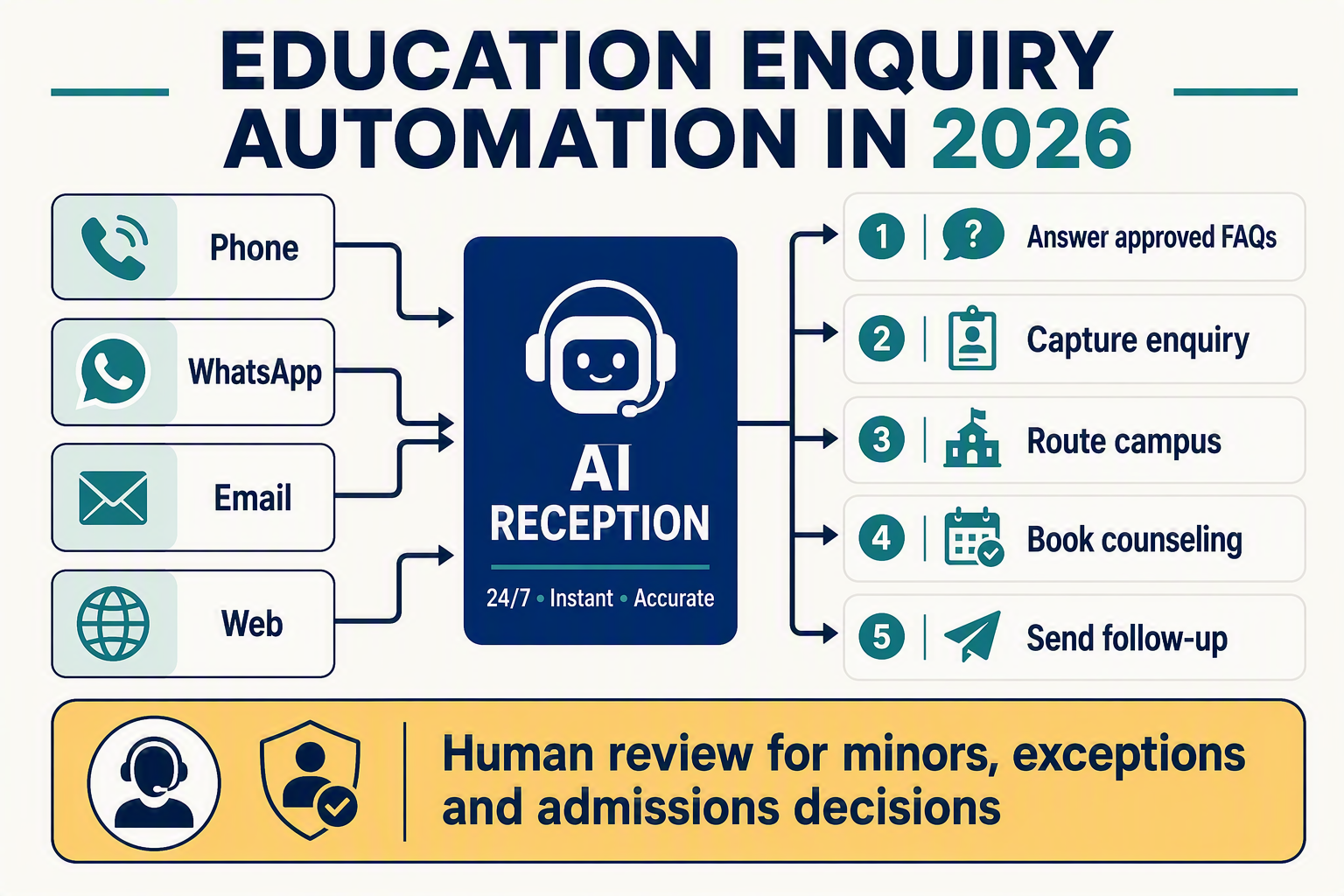
An AI receptionist for education is a voice-and-messaging agent that answers routine enquiries, retrieves approved information, captures structured lead details and coordinates the next action across phone, WhatsApp, email and web. In 2026, providers should implement an AI receptionist for education as a governed front door to admissions—not as an autonomous admissions officer or system of record.
Define a narrow, operational role
An AI receptionist for education should recognise intent, answer questions using approved sources and complete predefined workflows. A practical scope includes:
- Explaining courses, schedules, fees, facilities and application steps from approved content
- Identifying the programme, class, campus or training location of interest
- Collecting only the contact and enquiry details needed for follow-up
- Sending an approved brochure or application link through WhatsApp or email
- Booking a campus visit, counselling session or staff callback
- Routing conversations by location, language, programme and urgency
- Escalating exceptions, complaints and high-stakes questions to authorised employees
An admissions enquiry AI agent must not promise admission, determine eligibility from incomplete information or interpret ambiguous policies. Statements such as “you are definitely eligible” should be replaced with bounded language: “An admissions counsellor must verify your documents and eligibility.”
Scale matters when defining this role. India had 24.8 crore students enrolled across 14.72 lakh schools in 2023–24, according to the Ministry of Education’s UDISE+ 2023–24 report. Providers should therefore design for seasonal surges, regional languages and campus-specific policies rather than assume one generic English workflow will suit every institution.
Implement one shared enquiry workflow
Start by configuring the AI receptionist for education around one high-volume journey, such as a new-course enquiry. Expand only after the workflow has been tested:
- Map entry points: List every phone number, WhatsApp account, email inbox and web form used by prospective students and families.
- Create an approved knowledge base: Give the AI receptionist for education access only to current fee schedules, course descriptions, admission dates, campus addresses and escalation contacts. Assign an owner and expiry date to each document.
- Define required fields: Capture programme interest, preferred location, contact channel and callback time—not unnecessary identity documents or sensitive personal data.
- Configure routing and human handoff: Route campus-specific questions to the correct team. Escalate when confidence is low, information conflicts, a case is sensitive or the user asks to speak with a person.
- Connect follow-up: Pass a structured conversation summary from the AI receptionist for education into the provider’s authorised lead-management process. The AI receptionist CRM integration guide explains this handoff pattern.
- Pilot and review: Test accents, background noise, code-switching, interrupted calls, stale content, failed bookings and escalation paths before broader deployment.
- Monitor performance: Review answer accuracy, unresolved enquiries, handoff success, booking completion and user complaints. Update approved content and routing rules when courses, fees or policies change.
For school call answering AI, the same interaction should continue without forcing a parent to repeat information when it moves to WhatsApp, email or a staff callback. Coaching center WhatsApp automation should likewise preserve consent, relevant conversation context and the identity of the staff member receiving an escalation.
Build safeguards before launch
Apply privacy, accessibility and child-safety controls at the workflow level:
- Disclose clearly that the user is interacting with AI.
- Avoid soliciting information directly from minors unless the workflow is specifically authorised, age-appropriate and supervised.
- Provide keypad, text and immediate human alternatives for users who cannot use voice comfortably.
- Collect only necessary data, restrict access by role, define retention periods and redact unnecessary sensitive information.
- Require staff review for eligibility, scholarships, accommodations, disciplinary matters and acceptance decisions.
- Prevent the AI receptionist for education from making admissions decisions, promising outcomes or presenting unverified guidance as institutional policy.
- Record consent and preserve an auditable handoff when a conversation moves to an employee.
Platforms such as CallMissed can support this model through AI voice agents, WhatsApp Business calling, email and web engagement, plus voice and chat across 22 Indian languages. Providers should still validate their own content, permissions, escalation rules, privacy controls and accessibility experience before going live.
Why are schools, colleges, coaching centers and training businesses redesigning enquiry handling in 2026?
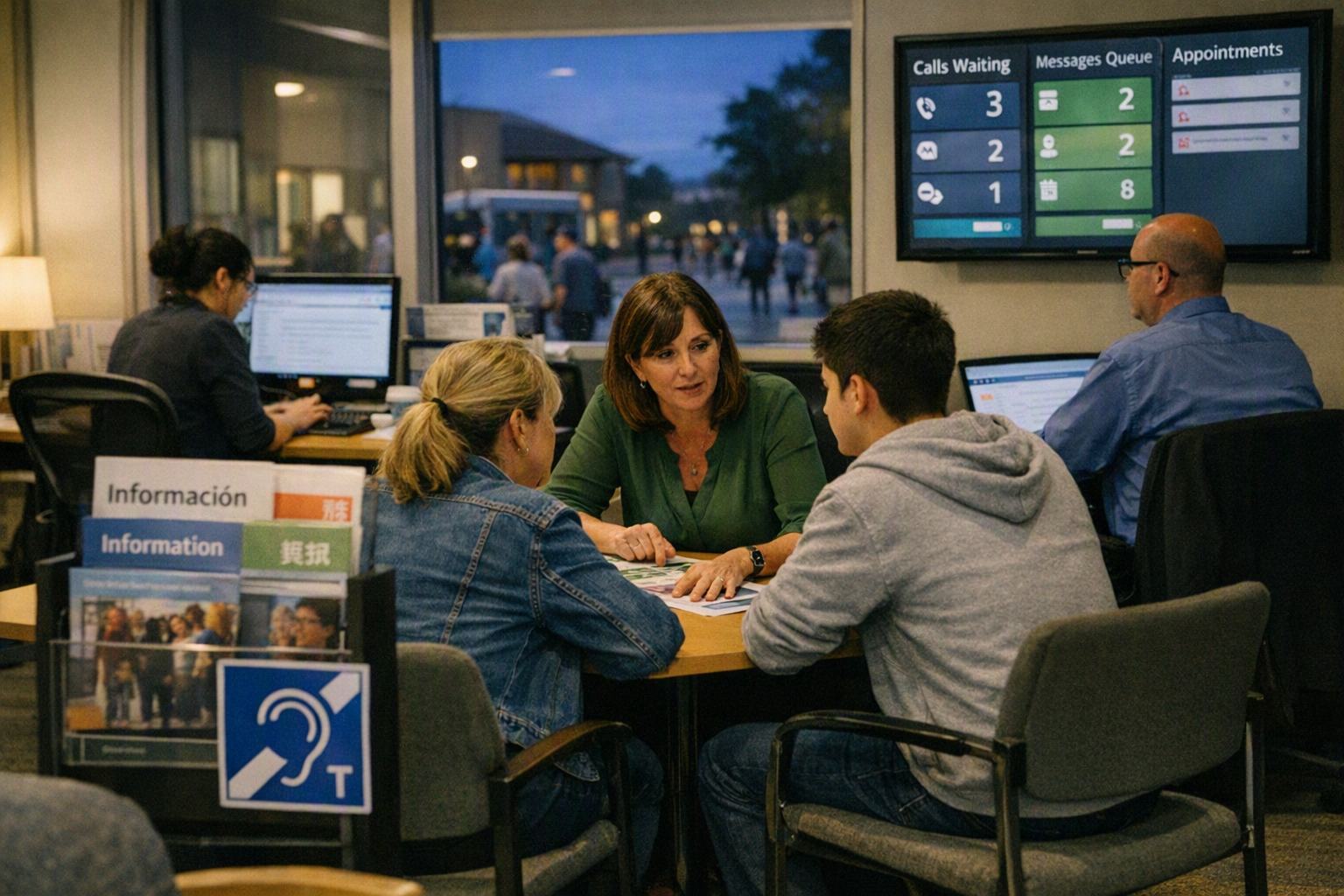
Education providers are redesigning enquiry handling in 2026 because seasonal demand, fragmented communication channels and rising expectations for immediate answers are exposing the limits of manual reception. The objective is not merely to answer more calls; it is to preserve context from first enquiry through counselling, application and human follow-up.
Peak demand overwhelms fixed reception capacity
Admissions traffic is uneven. Application deadlines, entrance results, scholarship announcements and new-batch launches can generate sudden spikes, while employing enough reception staff for peak periods is rarely practical.
The scale of the underlying market is substantial: India had 24.8 crore students enrolled across 14.72 lakh schools in the 2023–24 academic year, according to the Ministry of Education’s UDISE+ 2023–24 report. Even a small institution may repeatedly receive the same questions about:
- Programme fees, duration and schedules
- Age requirements and application dates
- Campus location, transport or hostel availability
- Required documents and entrance processes
- Counselling sessions, demo classes and campus visits
An AI receptionist for education can absorb routine, after-hours and overflow demand, but peak-load handling must include queue limits, callback capture and a human fallback—not endless automated dialogue.
Enquiries now move between channels
A parent might begin with a telephone call, request the prospectus over WhatsApp and later email academic records. If each channel creates an isolated record, counsellors cannot see what was already discussed, prospects must repeat themselves and consent preferences can be lost.
WhatsApp surpassed 3 billion monthly active users worldwide, Meta CEO Mark Zuckerberg said during Meta’s April 2025 earnings call. That reach makes coaching center WhatsApp automation operationally important, particularly for sending an explicitly requested brochure, confirming a counselling appointment or continuing a conversation after a missed call.
The redesigned model treats phone, WhatsApp, email and web enquiries as stages of one journey. Each interaction should update a shared lead record containing only necessary details, such as programme interest, preferred location, language and requested next action. Teams planning this architecture can use the AI receptionist-to-CRM lead capture guide to define field mapping and ownership.
Different institutions need different routing logic
A generic bot cannot reflect the operating structure of every education provider:
- Schools may route by grade, campus, curriculum or admission year.
- Colleges may route by department, degree level, quota category or international-admissions desk.
- Coaching centres may distinguish examination, batch timing, delivery mode and branch.
- Training businesses may route by certification, employer sponsorship or placement-support enquiry.
A school call answering AI therefore needs institution-specific rules and approved content rather than broad internet knowledge. An admissions enquiry AI agent may explain published criteria, but it must not infer eligibility, rank applicants or promise acceptance.
Governance is becoming part of workflow design
Education enquiries can involve minors, disability accommodations, financial circumstances and academic records. Redesign must therefore build safeguards into the interaction itself:
- Disclose when the user is interacting with AI.
- Collect the minimum information required for the next step.
- Avoid soliciting sensitive details directly from children.
- Offer accessible language, pacing and human assistance.
- Escalate disputed, exceptional or high-stakes questions.
- Restrict staff access and apply documented retention controls.
In 2026, effective enquiry automation is measured not only by response speed, but by whether it creates a consistent, accessible and reviewable path to an authorised human decision-maker.
Which 2026 admissions workflows should AI automate, assist or always escalate?
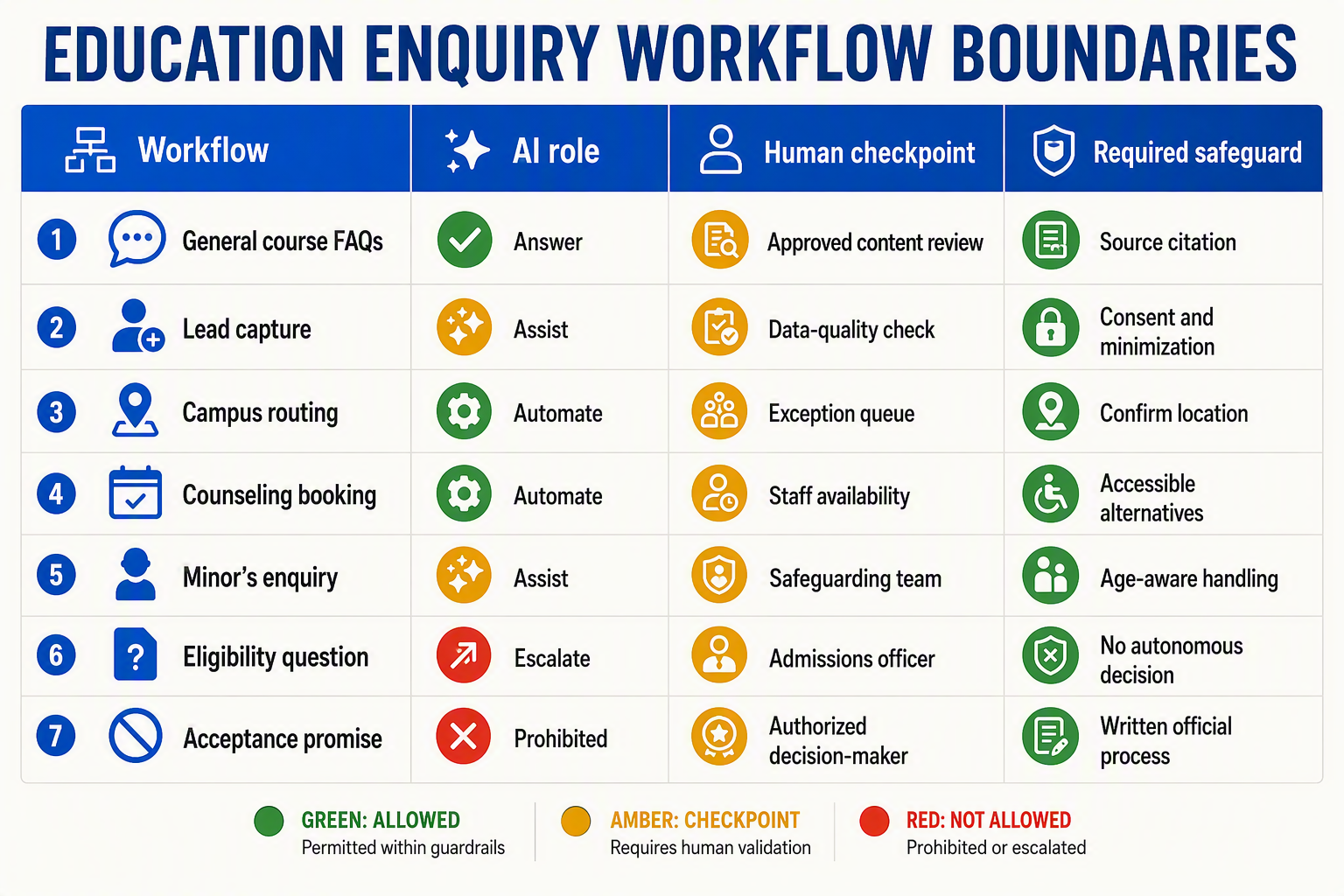
AI should automate repetitive, low-risk admissions tasks, assist staff where interpretation is required, and always escalate decisions affecting eligibility, acceptance, safeguarding or privacy. The operating rule for 2026 is simple: AI may retrieve approved facts and coordinate next steps, but authorised employees must make consequential admissions decisions.
Risk-based workflow matrix
| Admissions workflow | AI role | Permitted actions | Mandatory escalation trigger |
|---|---|---|---|
| Course, fee and deadline FAQs | Automate | Answer from an approved, version-controlled knowledge base; cite the relevant prospectus or policy; send brochures by email or WhatsApp | Missing, conflicting or expired content; requests for discounts, exceptions or guarantees |
| Initial enquiry and lead capture | Automate with limits | Record name, contact details, programme interest, preferred campus, language and callback consent | A child contacts the institution alone; sensitive or unnecessary personal data is disclosed |
| Campus and location routing | Automate | Identify the requested campus, provide approved directions and route the enquiry to the correct admissions team | Accessibility accommodation, transport-safety issue or uncertainty about the appropriate campus |
| Callback, counselling or visit booking | Automate | Offer available slots, confirm the appointment and issue reminders through the prospect’s agreed channel | No suitable slot, repeated rescheduling, urgent deadline or request for a named senior official |
| Document and application support | Assist | Explain the published checklist, acknowledge receipt and flag missing files without judging their validity | Identity mismatch, unreadable records, disputed submission time or documents containing unexpected sensitive data |
| Eligibility, scholarships and admission outcomes | Always escalate | Collect the question, summarise prior interactions and transfer the complete context to authorised staff | Any request to predict, promise, approve or reject eligibility, scholarship awards, wait-list status or acceptance |
Apply controls across every channel
An AI receptionist for education should assign one enquiry ID across phone, WhatsApp, email and web interactions. This prevents a parent who calls, messages and emails from appearing as three unrelated prospects. WhatsApp exceeded 3 billion monthly active users worldwide, according to Meta CEO Mark Zuckerberg in April 2025, making continuity between messaging and human counselling operationally important.
Configure the admissions enquiry AI agent around four controls:
- Grounding: Answers must come only from current, institution-approved material. When retrieval confidence is low or sources conflict, the agent should say it cannot verify the answer and transfer the enquiry.
- Decision boundaries: The system must never infer that marks, age, category, test performance or uploaded documents guarantee admission.
- Consent and minimisation: Capture only information needed for routing or follow-up. Record the chosen contact channel and provide a straightforward way to stop messages.
- Auditability: Preserve the source used, workflow action, consent status and escalation reason, subject to the institution’s retention policy and role-based access rules.
Protect minors and maintain accessibility
School call answering AI requires stricter handling when a caller may be a child. The agent should avoid collecting identity documents, financial details, health information or family circumstances directly from a minor and should route safeguarding disclosures immediately to trained personnel. It should not ask a child to repeat distressing information merely to complete a form.
For multilingual coaching center WhatsApp automation, preserve the original message alongside any translation and let prospects switch languages without restarting. Voice workflows should support slower speech, repetition and keypad alternatives, while appointment information should also be available in text for people who cannot use a voice channel. Human transfer must remain available at every stage—not only after the AI fails.
How should an admissions enquiry AI agent connect phone, coaching center WhatsApp automation, school call answering AI and email?
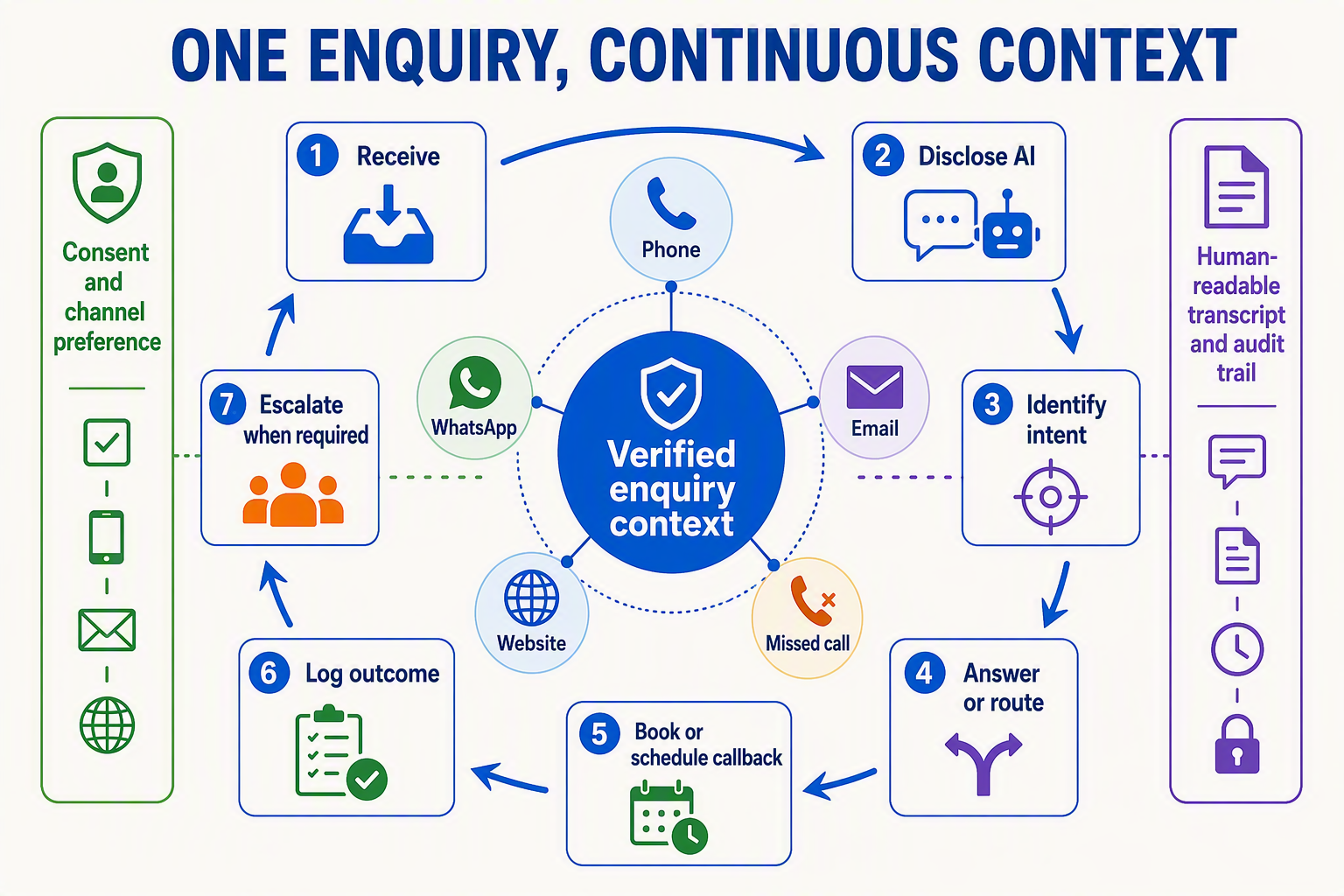
An admissions agent should connect phone, WhatsApp and email to one shared enquiry record, so every channel reads the same approved information and writes back structured context. The design should preserve channel choice, recognise returning prospects where consent and reliable identifiers permit, and escalate decisions or sensitive cases to authorised staff.
Use one workflow, not three separate bots
Configure the AI receptionist for education, WhatsApp agent and email agent as entry points into a common orchestration layer. Each interaction should capture only the information needed for the next step:
- Prospect or parent/guardian name
- Contact details and preferred communication channel
- Course, class, programme or exam of interest
- Preferred campus, branch or online option
- Enquiry category, language and requested callback time
- Consent status and assigned counsellor or queue
India had 24.8 crore students across 14.72 lakh schools in 2023–24, according to the Ministry of Education’s UDISE+ report. At that scale, institutions need deterministic routing rules rather than relying on staff to copy details manually between inboxes.
Use a stable internal enquiry ID to connect conversations. A phone number can help match a call with a WhatsApp thread, while a verified email address can connect document correspondence, but the system should avoid merging records on weak evidence such as similar names.
Define each channel’s role
- Phone: A school call answering AI should identify intent, answer approved FAQs, capture the preferred campus and route urgent or complex calls. After-hours callers can request a callback rather than reaching voicemail.
- WhatsApp: Coaching center WhatsApp automation should send requested brochures, confirm counselling slots and continue opted-in follow-up. WhatsApp exceeded 3 billion monthly active users worldwide, Meta CEO Mark Zuckerberg said during Meta’s April 2025 earnings call, making it a practical continuity channel after an initial call.
- Email: The email agent should classify enquiries, acknowledge receipt and draft answers grounded in approved content. Attachments and unusual requests should enter a staff review queue; the workflow should not infer eligibility from marksheets or identity documents. See the AI email agent guide for a deeper implementation pattern.
CallMissed can support this architecture through AI voice agents, WhatsApp chat and WhatsApp Business calling, email engagement and an omnichannel inbox. Its support for 22 Indian languages also allows a caller to begin in a regional language and receive follow-up through an appropriate supported channel.
Make hand-offs context-rich and safe
The admissions enquiry AI agent should pass a concise interaction summary—not merely a recording or transcript—to the admissions team. A useful hand-off includes:
- The prospect’s stated goal and unanswered question
- Information already supplied by the agent
- Campus, programme, language and callback preference
- Consent and communication history
- The reason for escalation and its urgency
Route campus visits to the relevant location calendar and counselling requests to an authorised team member. Never let the agent promise admission, guarantee eligibility, waive fees or interpret an exception as policy.
For minors, request a parent or guardian when personal, financial or consequential matters arise. Apply role-based access, retention limits and transcript redaction, and provide accessible alternatives such as text follow-up or human assistance. The receptionist-to-CRM integration guide explains how to preserve this context without creating disconnected duplicate leads.
How do you ground course FAQs, qualify leads, route locations and book counseling without making admissions promises?
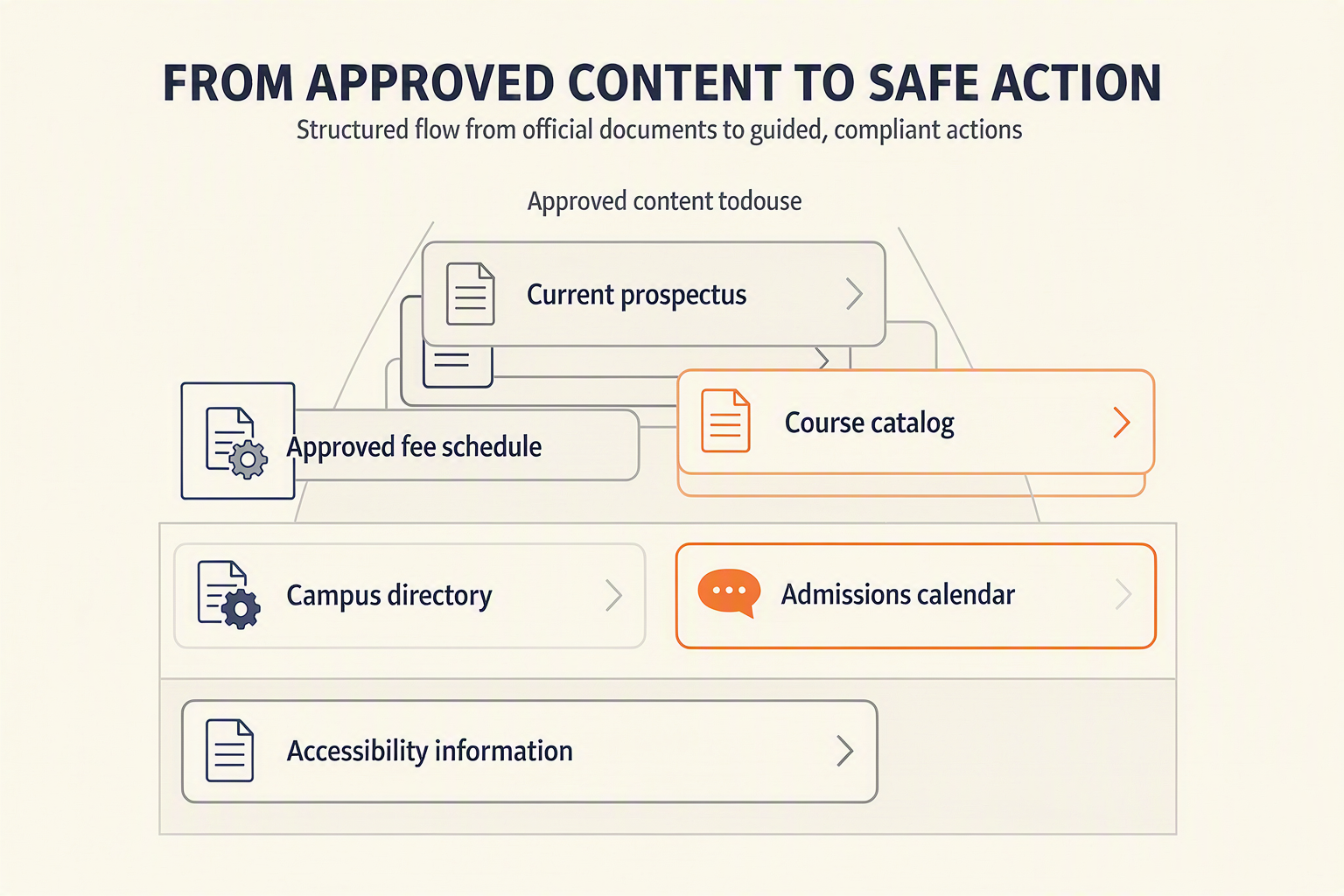
Ground the agent in a version-controlled source of truth, limit qualification to factual intake, route enquiries using explicit campus rules, and let prospects book only published counselling slots. An admissions enquiry AI agent must never predict eligibility, guarantee acceptance, reserve a seat without confirmation or reinterpret an exception to policy.
Ground every course answer in approved content
Build the knowledge base from documents owned and approved by admissions staff, not from public search results or previous conversations. Follow a knowledge-base RAG approach so the agent retrieves relevant passages before answering.
Include:
- Programme names, curriculum summaries and delivery modes
- Published fees, taxes, refund rules and payment schedules
- Application dates, required documents and official eligibility criteria
- Campus addresses, accessibility information and transport guidance
- Counselling hours, authorised contact details and escalation policies
Attach an owner, approval date, effective date and expiry date to each item. If two sources conflict, information is missing or the retrieved passage has low confidence, the AI receptionist for education should say that confirmation is required and create a human follow-up task. It should not infer that last year’s fee or deadline still applies in 2026.
Qualify interest without deciding eligibility
Qualification should help counsellors prioritise and prepare—not score whether someone deserves admission. Capture only the minimum operational fields:
- Prospect or parent/guardian name
- Preferred programme, level or subject
- Intended intake or batch
- Preferred campus, city or online mode
- Contact channel, language and callback window
- Consent for the requested follow-up
Use neutral labels such as “course enquiry,” “application support required” or “counsellor review needed.” Avoid labels based on accent, disability, surname, gender, neighbourhood or other sensitive characteristics. For minors, request a parent or guardian contact rather than conducting unnecessary profiling or collecting sensitive documents conversationally.
A school call answering AI may quote published criteria—for example, a stated minimum age—but must not conclude, “Your child will be accepted.” The correct response is: “The published requirement is X; an authorised admissions team member must confirm eligibility and acceptance.”
Route locations with deterministic rules
Maintain a routing directory that maps each programme to valid campuses, service areas, languages, operating hours and human teams. Ask for the prospect’s preferred location rather than relying solely on caller ID or device location.
Routing rules should cover:
- Exact match: Send the enquiry to the selected campus and programme team.
- Multiple matches: Present available locations and let the prospect choose.
- No local offering: Offer online or nearby published options without claiming equivalence.
- Accessibility request: Escalate to trained staff who can confirm accommodations.
- Unclear or exceptional case: Transfer or schedule a human callback with the transcript attached.
Book counselling and continue on the chosen channel
Offer only available appointment types, dates and time zones exposed by the institution’s approved booking process. Repeat the campus, counsellor format, date and time before confirmation; provide rescheduling and cancellation options; and never describe a counselling booking as an admission reservation.
For coaching center WhatsApp automation, send brochures, callback confirmations and appointment reminders only after channel-appropriate consent. Meta CEO Mark Zuckerberg reported in April 2025 that WhatsApp had surpassed 3 billion monthly active users, making continuity between calls and WhatsApp operationally important.
CallMissed can support this workflow across voice, email, web and WhatsApp—including WhatsApp Business calls bridged to an AI voice agent—with support for 22 Indian languages. Regardless of channel, preserve the same approved answers, consent status, routing context and human-escalation boundaries.
Which safeguards protect minors, privacy, accessibility and high-stakes admissions decisions?
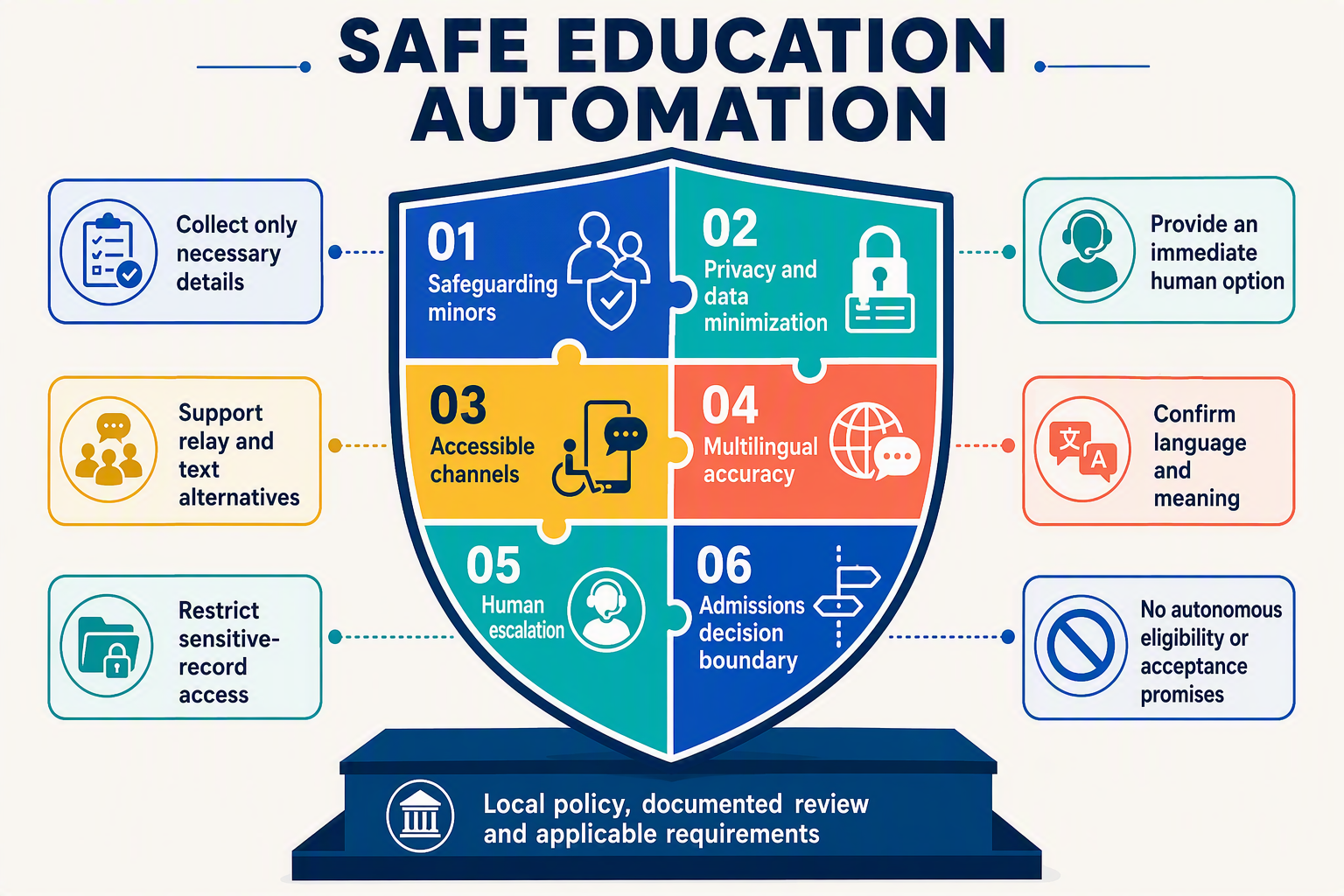
The safest model is automation for information and administration, not autonomous judgment. An AI receptionist may answer approved FAQs, collect minimum contact details and book counselling, but authorised staff must decide eligibility, accommodations, scholarships, exceptions and acceptance.
Protect children and obtain appropriate consent
India’s Digital Personal Data Protection Act, 2023 defines a child as a person under 18 and requires verifiable parental consent before processing a child’s personal data, subject to applicable rules and exemptions. Education providers should confirm their obligations with qualified privacy counsel rather than treating the AI workflow as legal advice.
Configure the AI receptionist for education to:
- Ask whether the enquirer is a student, parent, guardian or authorised representative.
- Avoid collecting identification documents, marksheets, health information or financial data during an initial call or chat.
- Direct children to involve a parent or guardian before submitting personal information.
- Never use a child’s conversation for behavioural profiling, targeted advertising or unrelated campaign enrichment.
- Escalate safeguarding disclosures, distress, harassment or threats immediately under the institution’s child-protection policy.
A child should never be pressured to continue with an automated agent. “Speak to a person” must work at every stage, without requiring the child to explain why.
Apply privacy and security by design
Data minimisation means capturing only what the next workflow step requires—typically a name, guardian contact, programme interest, campus preference and callback time. Recording or transcription should not be assumed to equal consent.
Before deployment, document:
- Purpose and lawful basis: Explain why each field, recording and transcript is needed.
- Notice and choice: Disclose that the user is interacting with AI and whether the conversation is recorded or transcribed.
- Retention: Set deletion periods for abandoned enquiries, recordings, transcripts and uploaded documents.
- Access controls: Restrict sensitive records by role and log staff access, exports and changes.
- Vendor handling: Identify where data is processed, which subprocessors are involved and whether cross-border transfers occur.
- Incident response: Provide procedures for access revocation, breach assessment and parent or student complaints.
Email, phone and coaching center WhatsApp automation should share the same consent status and suppression preferences rather than maintaining conflicting channel records.
Make every channel accessible
The World Wide Web Consortium published WCAG 2.2 on October 5, 2023, adding criteria addressing focus visibility, target size, consistent help and accessible authentication. Institutions should target WCAG 2.2 Level AA for enquiry forms, chat interfaces and booking pages.
Accessible school call answering AI should also offer:
- Keypad input and human transfer when speech recognition fails.
- Text alternatives for voice interactions and readable transcripts where appropriate.
- Plain-language responses, slower repetition and confirmation of critical details.
- Keyboard navigation, screen-reader labels and sufficient colour contrast.
- Language choice without assuming accent, literacy level or disability.
Keep admissions decisions human
The European Union’s AI Act classifies certain AI systems used to determine access or admission to educational institutions as high-risk, illustrating the global regulatory concern around automated education decisions. Regardless of jurisdiction, an admissions enquiry AI agent should not rank applicants or promise that a learner “will qualify” or “will be admitted.”
Use a mandatory escalation sequence:
- State that the information is general and based on published policy.
- Identify uncertainty, missing documents or exceptional circumstances.
- Route the complete conversation context to authorised admissions staff.
- Record the human decision, rationale and policy version used.
- Provide a correction, complaint and appeal path.
These controls should be tested before every admission cycle and after any policy, model or knowledge-base change.
What should admissions, safeguarding, accessibility, IT and compliance reviewers verify before launch?

Before launch, reviewers should require documented evidence that the system gives accurate information, protects minors, supports disabled users and escalates consequential decisions to authorised staff. An AI receptionist for education should not go live until admissions, safeguarding, accessibility, IT and compliance owners have each signed off on realistic end-to-end tests.
Admissions and academic-policy review
The admissions team should verify that every answer comes from approved, dated and version-controlled content, including fees, deadlines, prerequisites, scholarships, course availability and campus-specific rules.
Test whether the admissions enquiry AI agent:
- Distinguishes general lead qualification from formal eligibility assessment.
- Says “an admissions officer must confirm” when policies are ambiguous.
- Never promises acceptance, a scholarship, a seat, visa success or credit transfer.
- Routes applicants to the correct campus, programme or counsellor.
- Preserves context when enquiries move between phone, WhatsApp and email.
- Stops using expired brochures, fee schedules and admission dates.
The Ministry of Education’s UDISE+ 2023–24 report recorded 24.8 crore students across 14.72 lakh Indian schools, making consistent policy communication a material operational and governance issue rather than merely a convenience.
Safeguarding and minors
Safeguarding reviewers should use child-specific scenarios, not just ordinary enquiry scripts. The workflow must minimise information collected directly from minors and avoid requesting identity documents, health details, home circumstances or financial information unless an approved process genuinely requires them.
Mandatory launch checks include:
- Age-sensitive notices and a clear route to a parent, guardian or trained employee.
- Immediate human escalation for disclosures involving abuse, self-harm, threats, bullying or immediate danger.
- A prohibition on counselling, diagnosis or investigative questioning by the AI.
- Restricted transcript access, with safeguarding records visible only to authorised roles.
- Tested procedures for handling accidental disclosure of sensitive information.
A school call answering AI must never present itself as an emergency or safeguarding service. Escalation scripts should provide institution-approved emergency instructions appropriate to the operating location.
Accessibility and multilingual testing
Accessibility reviewers should test complete journeys rather than the welcome message alone. Checks should cover keyboard navigation, screen-reader labels, readable contrast, plain-language prompts, text alternatives to voice, sufficient response time and a human-assisted option. WCAG 2.2 can provide a useful technical testing benchmark, while reviewers should confirm the standards applicable to their institution and jurisdiction.
For multilingual deployments, native speakers should test names, numbers, dates, campus locations and mixed-language speech. Where CallMissed is used, its support for voice and chat across 22 Indian languages should be validated against the institution’s own vocabulary and regional accents before release. The same standard applies to coaching center WhatsApp automation, including WhatsApp Business calls bridged to an AI agent.
IT, privacy and compliance approval
IT and compliance reviewers should verify:
- Role-based access, strong administrator authentication and audit logs.
- Encryption, backup, outage handling, rate limits and safe human fallback.
- Protection against prompt injection and unauthorised knowledge-base changes.
- Clear notices covering AI use, call recording and data processing.
- Separate choices for operational replies and promotional follow-up.
- Defined retention, correction, deletion and incident-response procedures.
- Vendor responsibilities, subprocessors and approved data-storage locations.
Compliance requirements vary by institution and jurisdiction, so qualified advisers should confirm applicable obligations. Any unresolved high-severity security issue, inaccessible critical journey, safeguarding failure or autonomous admissions promise should be treated as a launch blocker, not a post-launch improvement.
Which setup checklist and internal implementation guides should your team use? — AI email agent (/en/blog/ai-email-agent-guide-2026-customer-service), CRM integration (/en/blog/ai-receptionist-crm-integration-2026-guide-lead), knowledge base AI agent (/en/blog/knowledge-base-ai-agent-2026-callmissed-rag), WhatsApp AI agent (/en/blog/whatsapp-ai-agent-business-2026-callmissed-buyer)
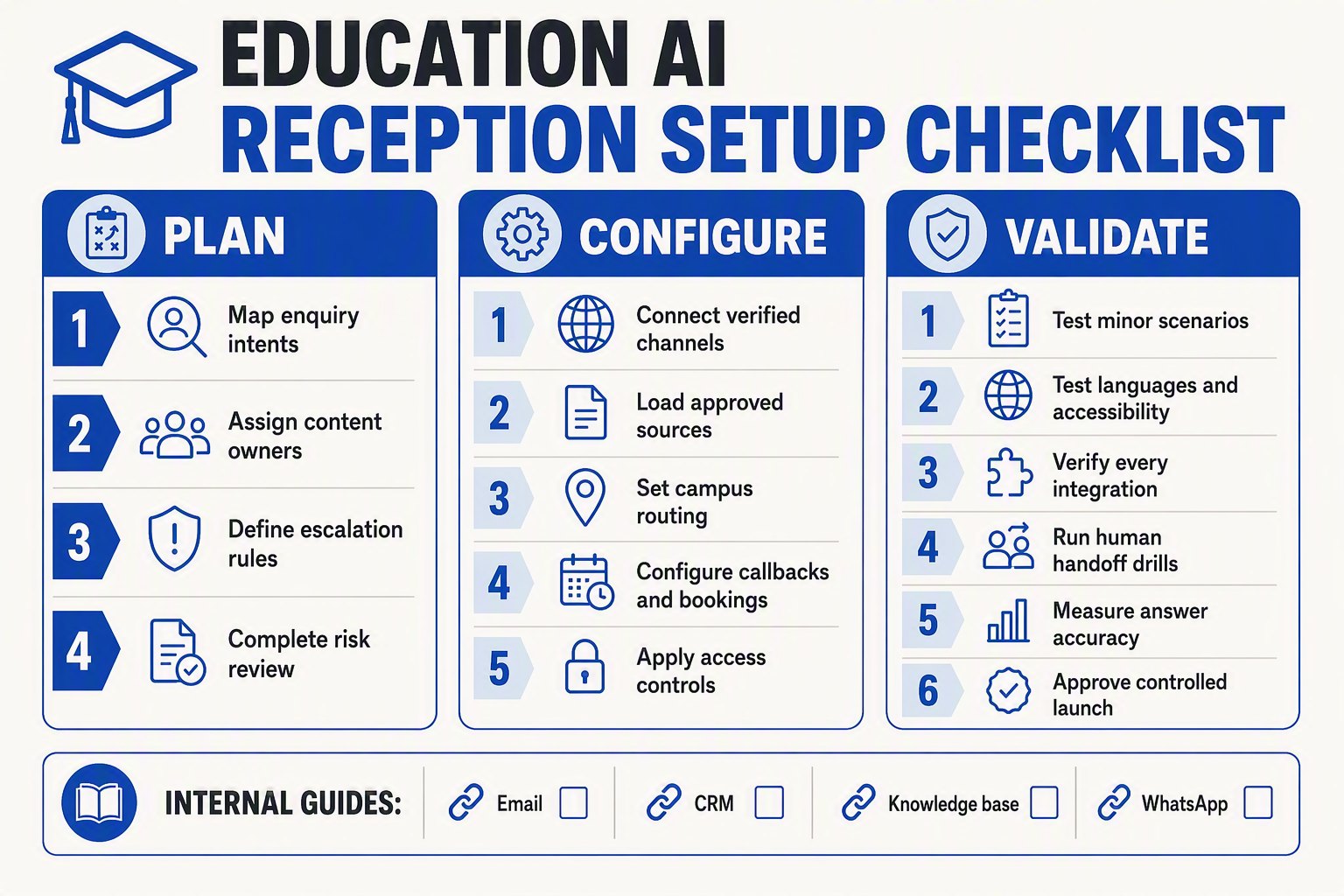
Use a stage-gated checklist that assigns an owner, creates an auditable artefact and defines a pass/fail test for every channel. An AI receptionist for education should enter production only after its knowledge, routing, consent, CRM, accessibility and human-escalation controls have been tested together.
2026 implementation checklist
| Workstream | Setup checklist | Owner and acceptance test | Internal guide |
|---|---|---|---|
| Reception and routing | Map phone numbers, opening hours, campuses, departments, overflow rules and after-hours handling. Define when the school call answering AI transfers, schedules a callback or records a message. | Admissions operations: test every campus, closed-hours scenario and failed-transfer path. Confirm that no enquiry ends without a documented next step. | CRM integration guide |
| Approved knowledge | Load current prospectuses, fee schedules, course FAQs, scholarship information, calendars and campus policies. Add document owners, effective dates and withdrawal procedures. | Academic or admissions owner: verify answers against source passages and test outdated, conflicting and unanswerable questions. | Knowledge-base AI agent guide |
| Lead and CRM workflow | Define required fields such as programme, campus, intake, preferred language and callback time. Establish duplicate matching, source attribution, counsellor assignment and status updates. | CRM administrator: submit test enquiries across phone, web, email and WhatsApp, then confirm that one consolidated record reaches the correct queue. | CRM integration guide |
| WhatsApp follow-up | Approve message templates, consent capture, brochure delivery, appointment reminders and opt-out handling. For coaching center WhatsApp automation, separate informational replies from promotional campaigns. | Channel owner: test new enquiries, returning prospects, opt-outs, unavailable counsellors and WhatsApp Business calling handoffs. | WhatsApp AI agent guide |
| Email handling | Create categories for course questions, applications, documents, payments, complaints and urgent safeguarding concerns. Restrict automated sending where identity or attachment content is uncertain. | Admissions inbox owner: test threading, attachments, ambiguous requests, escalation and approved signatures. | AI email agent guide |
| Safety and inclusion | Configure minor-aware data minimisation, AI disclosure, language selection, accessible alternatives and immediate human escalation. Prohibit promises about eligibility, scholarships, visas or acceptance. | Safeguarding and privacy leads: require a 100% pass on prohibited-action tests before launch and after every material workflow change. | Knowledge-base AI agent guide |
Required internal runbooks
Each institution should maintain version-controlled guides for:
- Content governance: who may publish, approve, retire or correct an answer.
- Incident response: how staff pause automation, preserve records and notify responsible teams.
- Human handoff: queue ownership, response targets, fallback contacts and context transferred.
- Data handling: purpose, minimum fields, access roles, retention period and deletion process.
- Accessibility: text alternatives, slower speech options, repeat requests and staff-assisted channels.
Multilingual testing must use native speakers rather than translation checks alone. CallMissed supports voice and chat across 22 Indian languages, but each institution remains responsible for validating its own terminology, course names and policy wording.
Final launch gates
- Run end-to-end tests with synthetic records across every enabled channel.
- Make the admissions enquiry AI agent explicitly say when it cannot verify an answer.
- Confirm that counsellors receive the transcript, source channel, consent state and requested next action.
- Launch to one programme or campus first, review failures weekly, and expand only after owners sign off.
These guides are operational controls, not one-time documentation; update them whenever fees, admissions criteria, campuses, models or communication policies change.
Frequently asked questions about education admissions enquiry automation
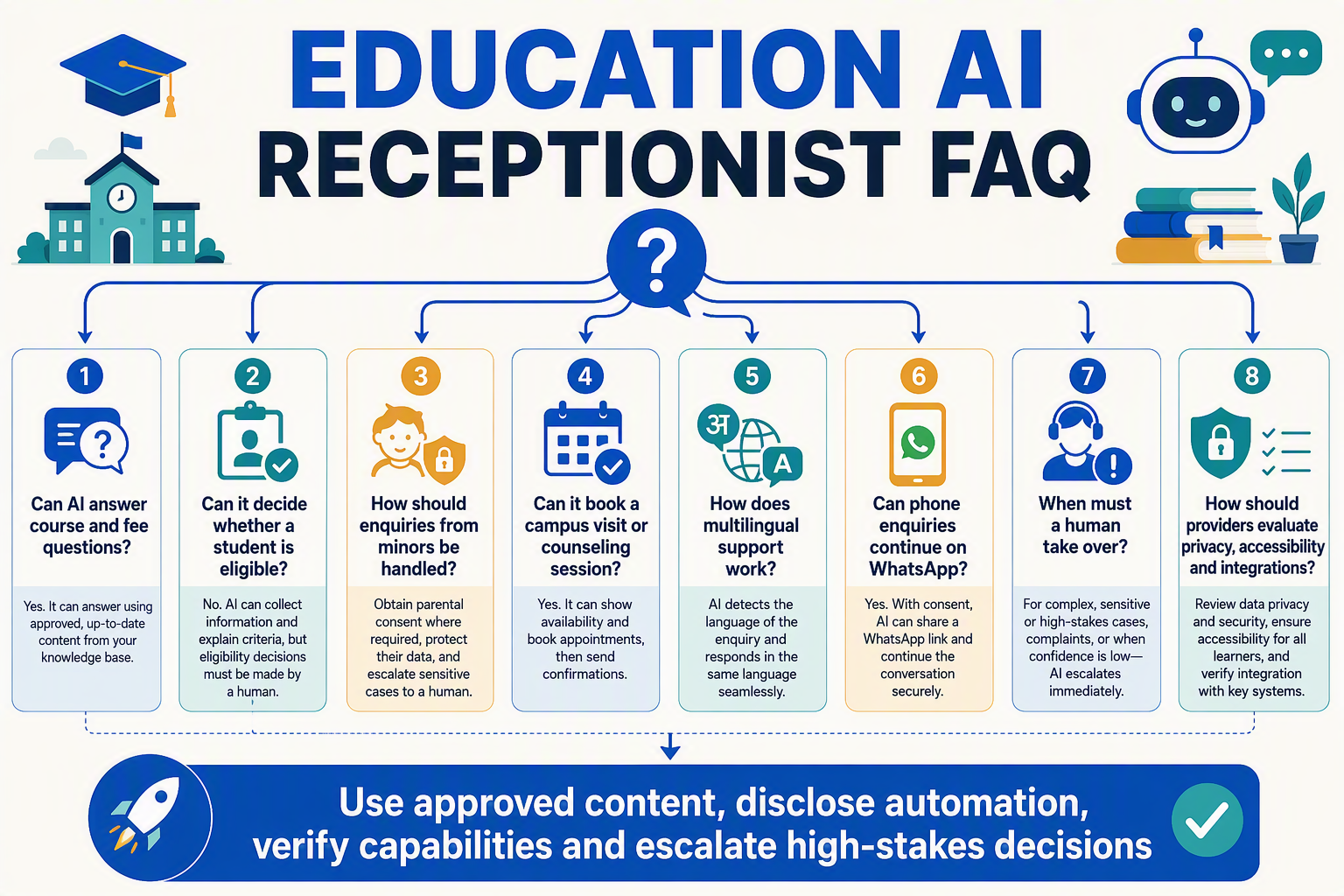
What is an AI receptionist for education, and how does it handle admissions enquiries?
How should an admissions enquiry AI agent qualify prospective students?
How does coaching center WhatsApp automation work for calls and messages?
Can an AI receptionist for education support regional Indian languages?
What privacy safeguards does school call answering AI need for children and parents?
Will admissions automation replace counsellors or make final eligibility decisions?
Conclusion
An AI receptionist for education should become the dependable first layer of admissions support in 2026—not the final decision-maker. It can answer approved questions across phone, WhatsApp, email and web, capture structured enquiry details, book counselling sessions and route exceptions to authorised staff while preserving human control over eligibility and acceptance.
Key takeaways for education providers
- Unify every enquiry journey. Parents and students often move between calls, WhatsApp messages, emails and campus visits. A shared workflow should retain programme interest, preferred campus, communication history and callback status, reducing duplicate records and inconsistent follow-ups.
- Ground responses in approved information. An admissions enquiry AI agent should retrieve current fees, course details, schedules and document requirements from a governed knowledge base. It must escalate ambiguous policies rather than guess, promise admission or interpret eligibility rules autonomously.
- Design for India’s scale and diversity. India enrolled 24.8 crore students across 14.72 lakh schools, according to the Ministry of Education’s UDISE+ 2023–24 report. Effective school call answering AI and coaching center WhatsApp automation therefore need multilingual interactions, campus-level routing and accessible alternatives—not an English-only form.
- Build safeguards into the workflow. Clearly disclose AI use, collect only necessary information, restrict access by role and provide immediate human escalation. Interactions involving minors, sensitive documents, accessibility needs or high-stakes decisions require especially careful handling.
Education teams should next watch how accurately their systems answer approved FAQs, preserve context between channels and escalate unusual cases during peak admission periods. WhatsApp will remain central: Meta CEO Mark Zuckerberg said in April 2025 that WhatsApp had surpassed 3 billion monthly active users worldwide.
To prepare for the next admissions cycle, test one controlled workflow, review outcomes with counsellors and expand only after governance is working. Explore CallMissed, which supports AI voice agents, WhatsApp Business calling and voice or chat across 22 Indian languages—then ask: which repetitive enquiry could your admissions team automate safely first?
Related Reading
Discussion
Related Posts
Ready to automate customer conversations?
Launch AI voice agents and WhatsApp bots with CallMissed — one API, 22+ Indian languages.