
AI Coding CI Bottlenecks: A Practical CI Playbook


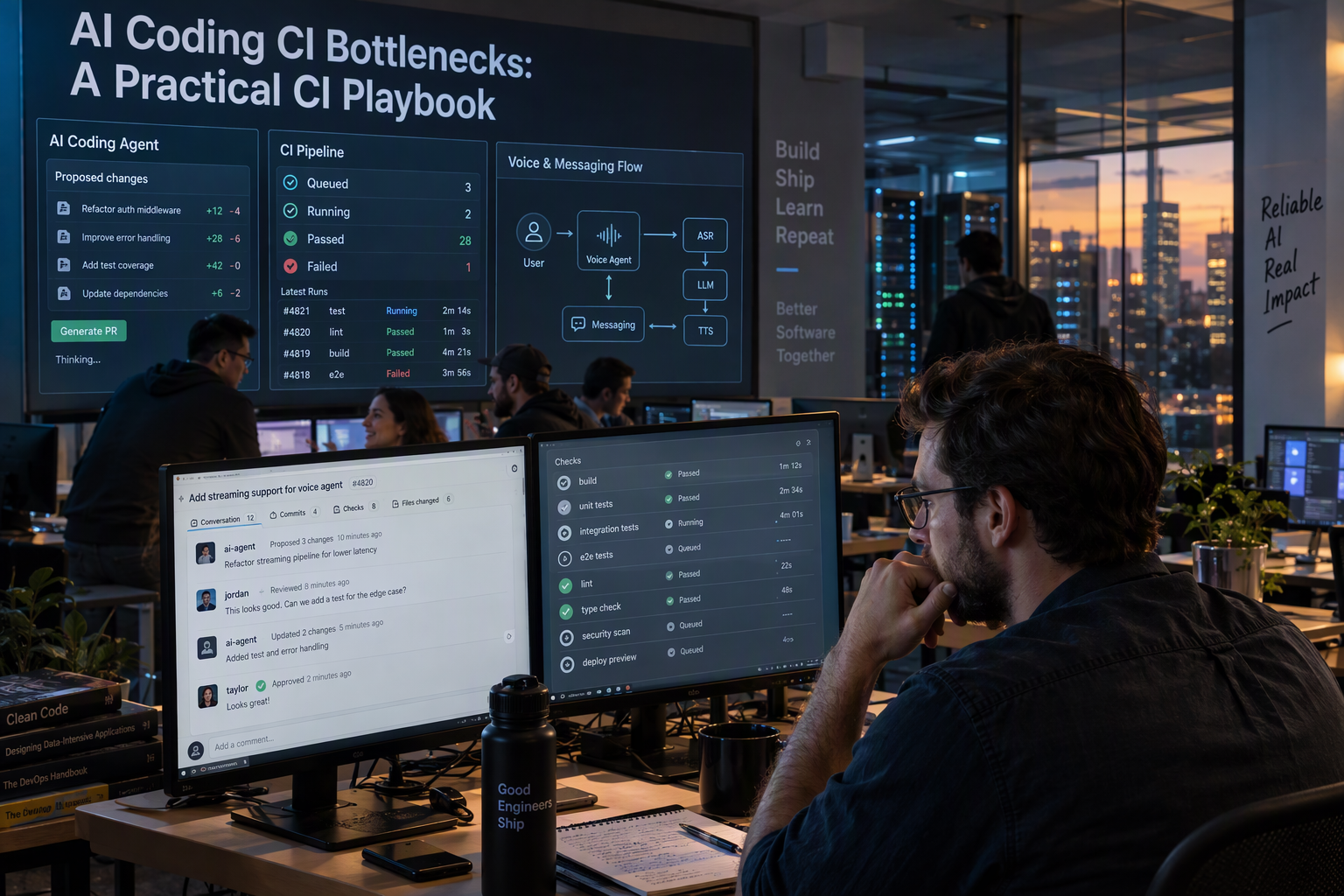
Learn how to measure AI coding CI bottlenecks, speed feedback safely, and test voice and messaging flows without relying on live providers.
AI Coding CI Bottlenecks: A Practical CI Playbook
What happens when an AI coding agent can produce a change faster than your CI pipeline can prove it is safe? That mismatch is turning AI Coding CI Bottlenecks into a practical release problem: as code generation accelerates, integration, testing, and deployment can become the limiting steps.
The shift is already showing up in industry coverage. On September 11, 2026, CODEW described CI/CD as the next bottleneck for AI-accelerated development, while Depot argues that the constraint has moved from writing code to integrating it. These sources point to a real engineering challenge, but not a reason to simply run every test on every change: longer queues and noisy checks can slow teams without improving confidence.
The stakes rise when the software handles voice and messaging. A change to an API, call flow, webhook, or AI response can affect more than a web page: it may alter whether a customer can reach support, whether a conversation is routed correctly, or whether a deployment works across languages and model providers. For these systems, “the build passed” is only one part of production readiness.
This playbook explores how to keep CI fast while testing what matters. You’ll learn how to:
- Map the slowest stages—from dependency installation and builds to integration tests and environment setup.
- Use risk-based test tiers, parallel execution, caching, and clear merge gates to reduce waiting without skipping essential validation.
- Test voice and messaging paths with realistic API contracts, model-provider fallbacks, webhook events, and failure scenarios.
- Add release safeguards such as staged rollouts, monitoring, and rollback plans for changes that pass CI but behave differently in production.
The requirements are increasingly concrete: as of September 2026, CallMissed’s platform supports speech recognition in 22 Indian languages plus English and brings 138 AI models behind one developer API—examples of the language and provider variation a modern integration test strategy may need to account for. The goal is not to make CI test everything. It is to make the right checks run quickly, give useful feedback, and protect the customer-facing paths that matter most.
How should teams respond to AI coding CI bottlenecks?

Treat CI as a risk-control system, not a contest to run the most tests: shorten feedback for routine changes, while preserving deeper checks for changes that can interrupt calls, messages, or customer data. The practical response to AI coding CI bottlenecks is to prioritize by production impact, measure where time is spent, and make every required check explain what risk it covers.
What should teams measure before changing CI?
Start with a baseline. Track queue time separately from execution time, and break execution down by dependency installation, builds, unit tests, integration tests, and environment setup. Without that split, teams may optimize the longest-looking test suite while the real delay is a saturated runner or slow dependency download.
Use a small set of indicators to guide improvements:
- Time to useful feedback: How soon does a developer learn that a change is unsafe?
- Queue time: How long does a job wait before it starts?
- Failure signal quality: How often do failed checks identify a reproducible product defect rather than flaky infrastructure?
- Change risk: Which components—call routing, webhook handling, message delivery, or authentication—could affect customer-facing paths?
On September 11, 2026, CODEW described CI/CD as the next bottleneck for AI-accelerated development. Depot’s analysis similarly frames the constraint as shifting from writing code to integrating it. These are useful signals, but they don’t imply that every repository needs the same fix: diagnose your own pipeline before adding more runners or more tests.
How can teams keep checks fast without weakening protection?
Use risk-based test tiers. Run formatting, static analysis, and focused unit tests on every change; run contract and integration tests for the services or interfaces a change touches; reserve full end-to-end suites for merge gates, scheduled runs, or higher-risk releases. A change to a UI label should not wait on the same path as a change to call routing or message delivery.
Then improve throughput without hiding failures:
- Parallelize independent jobs and remove unnecessary dependencies between them.
- Cache reproducible inputs, such as dependencies and build artifacts, with clear invalidation rules.
- Run affected tests first, but retain a broader merge or release gate where the impact warrants it.
- Quarantine flaky tests carefully: keep them visible, assign an owner, and avoid treating a skipped check as evidence of safety.
For voice and messaging platforms, integration tests should verify behavior at boundaries—not just whether a function returns successfully. Check API request and response contracts, webhook signatures and event handling, retries and duplicate events, timeout behavior, and what happens when a model provider is unavailable. Include representative language, audio, and message payloads, plus explicit tests for fallback and human handoff where those paths exist.
What should change for AI-dependent features?
Make model-dependent tests deterministic where possible. Use recorded fixtures or controlled test doubles for ordinary CI, then run a smaller set of live-provider checks separately with clear cost and failure ownership. Assert the system’s contract—such as a valid response shape, tool call, or safe fallback—not identical wording from a probabilistic model.
CallMissed’s developer AI API, as of September 2026, supports caller-chosen fallback models and usage and request logs; those capabilities illustrate why provider selection and observability belong in integration planning. CI should test the fallback path deliberately, while production monitoring checks whether real traffic behaves within expected operational limits. A passing build proves a defined set of checks passed; it does not replace staged rollout, monitoring, or a tested rollback plan.
Why are AI coding agents changing CI workloads?
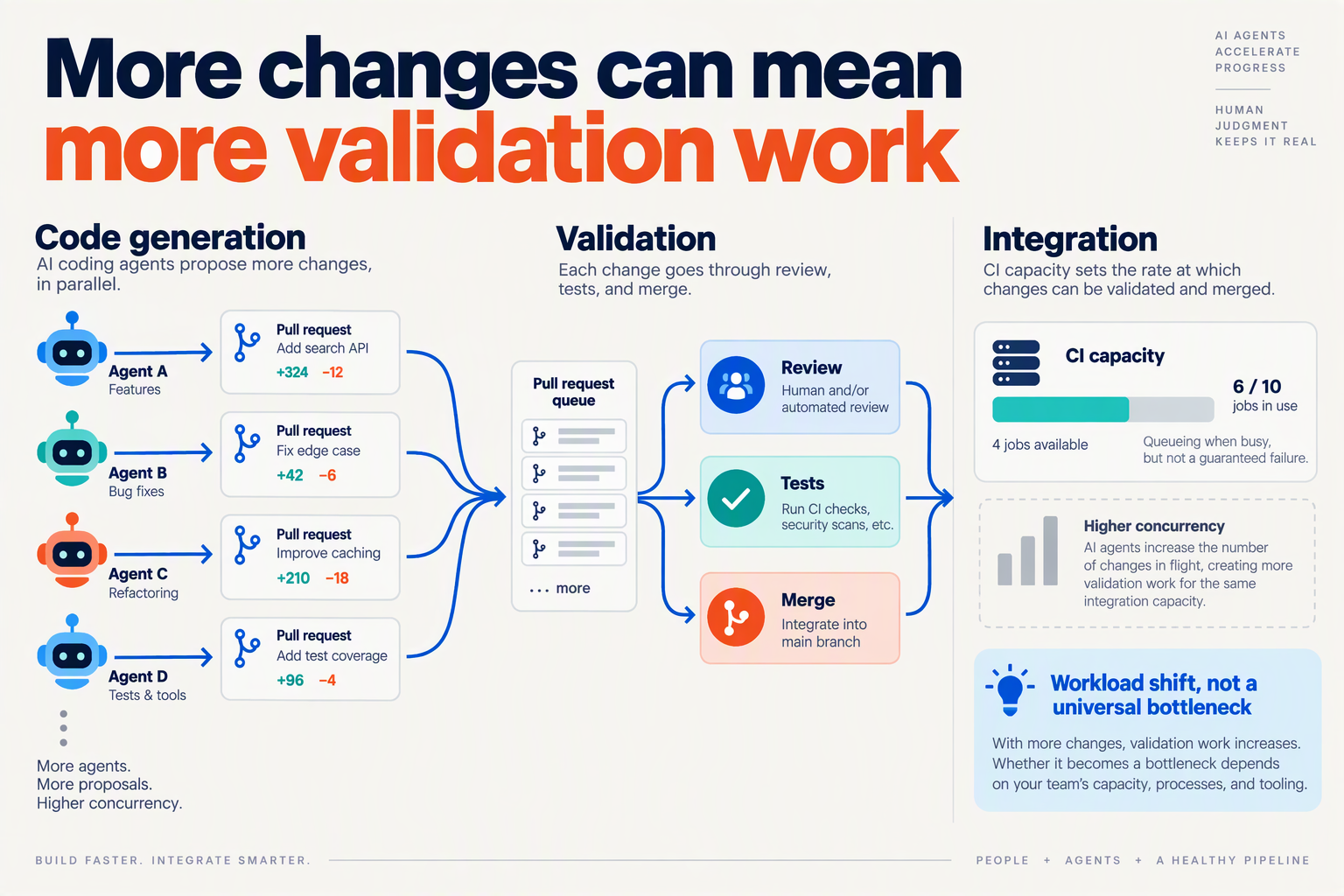
Why are AI coding agents changing CI workloads?
AI coding agents change CI workloads by increasing the volume and pace of proposed code, while also broadening the kinds of changes a single pull request can contain. The result is more integration work: pipelines must validate not just whether code compiles, but whether connected services, customer-facing flows, and failure handling still behave correctly.
On September 11, 2026, The CODEW described CI/CD as the next bottleneck in AI-accelerated development. Depot similarly argues that the constraint has shifted from writing code to integrating it. Those observations explain why simply adding more runners may not solve the problem: when more changes arrive together, the limiting factor can be coordination and confidence, not raw compute.
What makes an AI-generated change harder to validate?
An agent may touch several layers in one task—for example, an API handler, a database field, a webhook, and the interface that displays the result. Each change can look reasonable in isolation while creating a mismatch at the boundary between components. Agent-generated code can also introduce unfamiliar dependencies or assumptions that reviewers need to verify.
For voice and messaging platforms, those boundaries include live interactions and external services. A change that appears small in a diff could affect:
- Call setup and routing: Does a request still connect to the right agent, and does the system handle a failed connection?
- Conversation state: Are messages, call notes, or handoffs still associated with the correct customer and session?
- Provider and model behavior: Does the integration still handle different response formats, timeouts, or fallback paths?
- Language coverage: Does a speech-related change preserve the expected behavior for supported languages and code-mixed input?
This is why a green unit-test run cannot, by itself, establish that a customer can complete a conversation. The tests must reflect the contract between components and the consequences of breaking it.
Why do voice and messaging integrations expand the test surface?
Voice and messaging systems combine software your team controls with services, networks, and model providers that may behave differently from local test doubles. An API can return a valid response while the overall interaction still fails—for instance, if an event is duplicated, arrives late, or cannot be mapped to the right conversation.
The diversity is tangible. As of September 2026, CallMissed’s developer API lists 138 models, including 42 general-purpose LLMs, 25 realtime voice-agent models, 45 speech-to-text models, 9 text-to-speech models, 15 image models, and 2 embedding models. CallMissed also supports speech recognition in 22 Indian languages plus English, including code-mixed speech such as Hinglish. These are examples of the provider and language variation teams may need to represent in integration tests—not a reason to test every combination on every change.
A useful design principle is to validate interfaces and critical journeys, then expand coverage when a change affects them. For example, a modified webhook handler may need contract tests for event shape and duplicate delivery, plus an end-to-end check that a customer conversation reaches the intended destination.
What does this change in the role of CI?
CI increasingly acts as a fast integration signal, not merely a build gate. Teams should expect more proposed changes and make the pipeline especially good at answering three questions:
- Did this change break an agreed interface?
- Does the affected customer journey still work?
- If a dependency fails or behaves unexpectedly, does the system fail safely?
Answering those questions clearly helps teams absorb faster code generation without treating every generated line as equally risky.
What does Linear’s 2026 CI case study report?
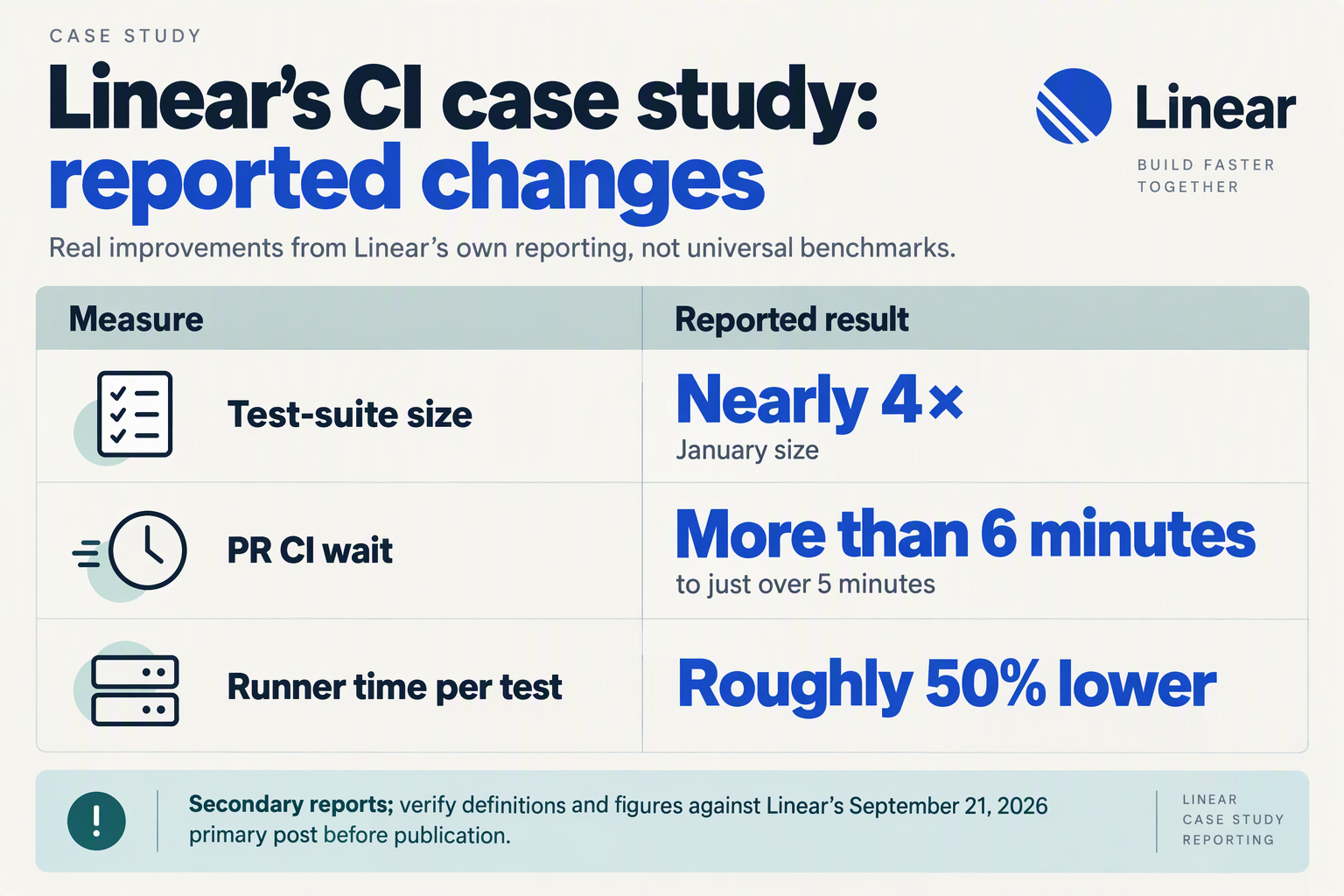
What does the available evidence say about Linear’s 2026 CI case study?
The supplied research does not document a Linear 2026 CI case study, so it does not support attributing CI performance numbers, methods, or conclusions to Linear. It does contain industry coverage of AI-related CI bottlenecks and concrete examples of the testing complexity that voice and messaging platforms can face.
| Source or subject | Verifiable detail in the supplied context | CI metrics or findings reported? | Relevance to this article |
|---|---|---|---|
| Linear 2026 case study | No case-study text, quotation, or data is included | No | Do not present results as Linear’s |
| CODEW | A September 11, 2026 article frames CI/CD as a constraint in AI-accelerated development | No quantified benchmark in the excerpt | Supports examining integration and validation bottlenecks |
| Depot | Describes a shift from writing code toward integrating it as AI adoption grows | No quantified benchmark in the excerpt | Supports measuring integration work, not just code generation |
| CallMissed language support | As of September 2026, speech recognition supports 22 Indian languages plus English, including code-mixed speech | Product specification, not a CI benchmark | Illustrates why language coverage can shape test matrices |
| CallMissed developer API | As of September 2026, one API provides access to 138 models across several categories | Product specification, not a CI benchmark | Illustrates why provider and model variation may need contract tests |
What should readers take from this evidence gap?
The distinction matters: a trend article is not the same as a case study. The supplied CODEW excerpt reports that AI coding agents are increasing code production and frames CI/CD as a new constraint; Depot similarly says the bottleneck has shifted toward integration. Neither excerpt supplies a Linear-specific experiment, before-and-after timings, test-suite design, or failure-rate data. Without those details, claims such as “Linear cut CI time by a certain percentage” would be unsupported.
For engineering teams, the useful takeaway is therefore a measurement question, not a borrowed benchmark: where does a change wait, and which checks establish that it is safe? Track queue time separately from execution time, then split execution into builds, unit tests, integration tests, and environment setup. Those measurements let a team distinguish a slow test suite from runner contention or dependency setup.
Voice and messaging make that distinction especially useful. A change may affect a shared API contract, a provider-specific response, a webhook, or a language-specific path. CallMissed’s published platform specifications—as of September 2026—include speech recognition in 22 Indian languages plus English and a developer API covering 138 models. Those figures are not CI performance claims; they show why teams integrating comparable systems may need representative language and provider coverage in their tests.
A practical response is to tier checks by risk:
- Run formatting, static analysis, and focused unit tests on every change.
- Run contract and integration tests when APIs, webhooks, call flows, or provider adapters change.
- Use a smaller representative set of language and model combinations on pull requests, with broader coverage on scheduled or release builds.
- Record test duration and failure causes so slow or flaky checks can be improved rather than blindly repeated.
Until a verifiable Linear report is available, treat the 2026 coverage as context for the bottleneck, not evidence for a specific company’s CI results. The reliable benchmark for a team is its own measured pipeline, tied to the production risks it needs to control.
How can teams shorten the AI coding CI feedback loop?
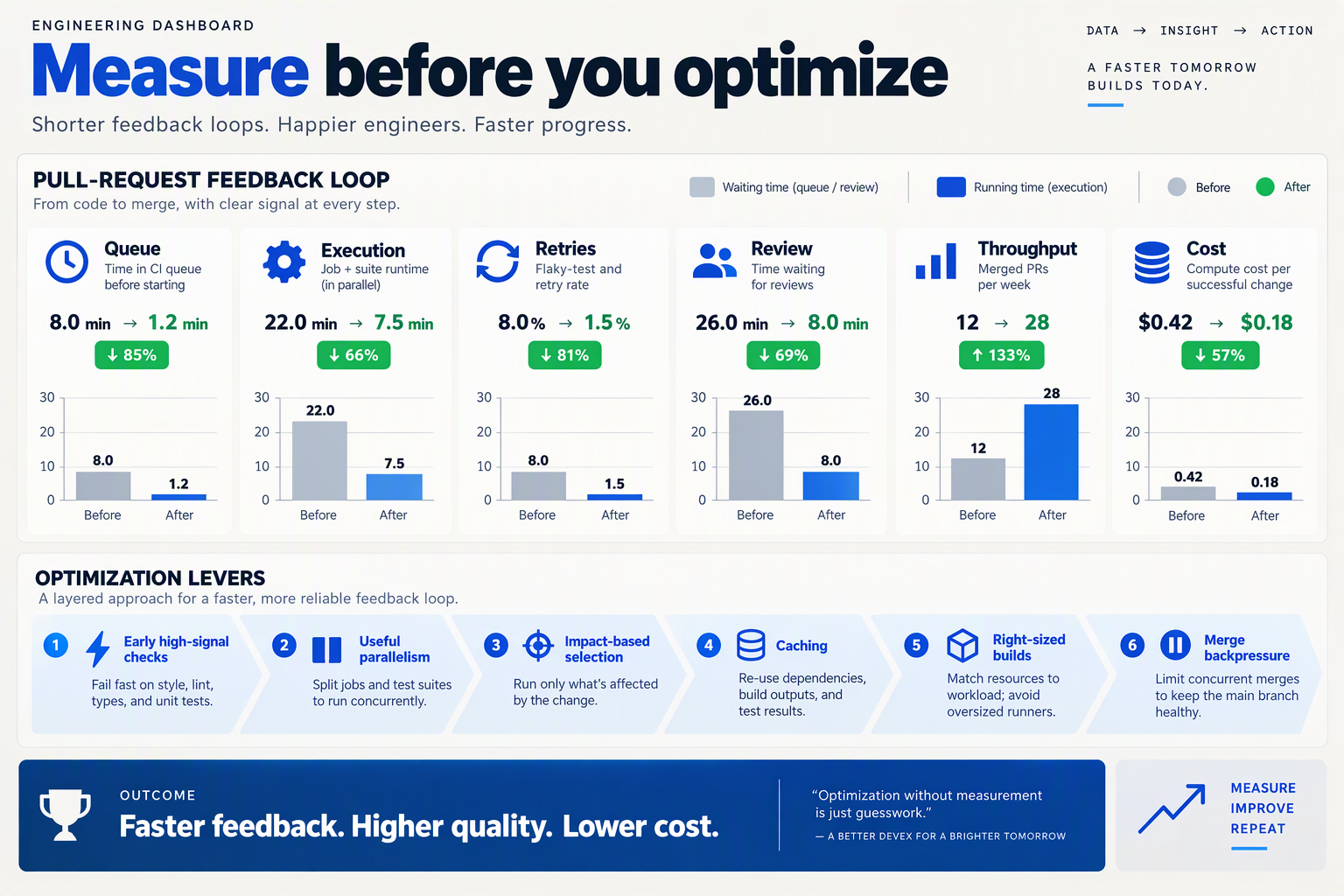
Shorten the AI coding CI feedback loop by running the fastest, most informative checks first and reserving expensive, provider-dependent tests for changes that need them. For voice and messaging platforms, that means validating code and contracts on every change, then testing realistic call and message journeys in targeted tiers.
Which CI checks should run on every change?
Run deterministic checks early so developers learn about basic failures before waiting for full integration environments. A practical first tier is:
- Formatting, linting, type checks, and dependency or security checks.
- Unit tests for changed modules and their immediate dependants.
- API schema and compatibility checks for endpoints, webhooks, and event payloads.
- Focused tests for call-state transitions, message routing, retries, and error handling.
Keep this tier small enough to provide actionable feedback. If a test needs a live model or phone carrier, it usually belongs in a later tier; using a stub at the first stage can verify that the application handles a known response or failure without adding external-service variability to every commit.
How should teams test voice and messaging integrations?
Use contract tests to check the boundary between your service and each provider, then run end-to-end scenarios for the customer journeys most likely to break. For example, a voice test can verify that an inbound call reaches the intended agent, a tool request returns the expected structure, and a failed model request follows the configured fallback path. A messaging test can validate webhook signature handling, duplicate-event protection, and the transition from an automated response to a human handoff.
Keep fixtures representative, not exhaustive. Include variations such as missing fields, timeouts, out-of-order events, and Unicode or code-mixed text. As of September 2026, CallMissed’s developer API offers access to 138 models across language, voice, speech, image, and embedding categories. That breadth illustrates why testing every provider-model combination on every pull request can become costly; test the shared contracts on every change and expand the model matrix for relevant integrations or scheduled runs.
How can teams reduce waiting without hiding failures?
Use parallel jobs for independent test groups, cache dependencies and build artifacts with keys tied to lockfiles and toolchain versions, and avoid rebuilding identical assets across jobs. Apply path-based selection carefully: changing a documentation file should not trigger the full voice stack, but edits to shared routing code should run the tests for every affected channel.
A useful tiered policy is:
- Pull request: deterministic checks, changed-area tests, and API contract validation.
- Merge or release candidate: broader integration tests, including key call and messaging flows.
- Scheduled or pre-release run: expanded provider, language, and environment combinations.
Do not make a skipped test look like a passed test. Show which checks ran, which were selected out, and why; require the deeper tier before release when a change touches high-impact paths.
What makes CI feedback useful to developers?
A failed check should identify the broken behavior, the relevant log or trace, and the next action—not just report a red build. Keep flaky tests visible and quarantine them with an owner and a plan to restore them; otherwise, teams learn to ignore signals that should protect production.
This is the practical response to the integration bottleneck highlighted by CODEW on September 11, 2026: shorten the route to trustworthy evidence, not merely the route to a green check. For voice and messaging systems, fast CI works when each stage gives developers a clear answer about a specific risk.
What should voice and messaging platform CI validate?
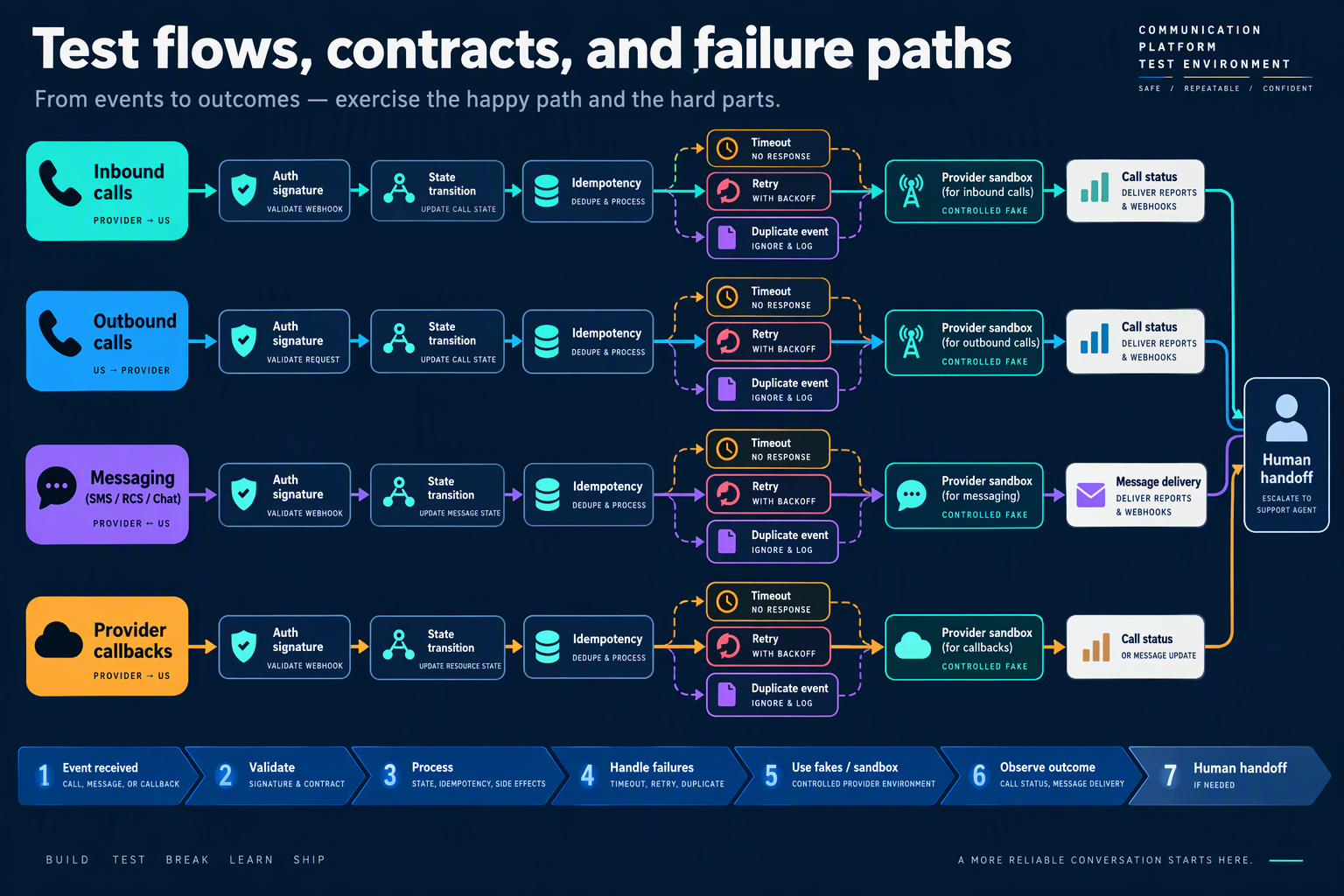
Validate the customer journey, not just whether services compile: CI should prove that calls connect, messages route, AI responses respect contracts, and failures recover safely. For voice and messaging platforms, that means testing API compatibility, conversation state, language and model variation, webhooks, and human handoff—then choosing the depth of each check according to release risk.
Which voice and messaging paths should every change test?
Keep a fast smoke suite for the critical paths customers rely on. It should verify that:
- An inbound call or message reaches the intended agent or queue.
- A response uses the expected schema and the conversation stays associated with the right contact.
- A request to hand off to a human actually transfers control.
- A failed or timed-out dependency produces a safe fallback rather than a broken conversation.
Test outbound calling and messaging flows only where the product supports them, and distinguish a single outbound call from a campaign workflow. For each path, assert observable outcomes—such as routing, status, and handoff—not a model’s exact wording, which can vary between valid responses.
How should CI test AI models and language variation?
Use contract tests to check request and response formats, tool-call arguments, streaming events, and error handling independently of a live model. Then run a smaller set of integration tests against approved providers to verify that the full path works. This split helps catch interface regressions quickly without making every pull request depend on every external service.
The scale of variation is material. As of September 2026, CallMissed’s developer API provides access to 138 models: 42 general-purpose LLMs, 25 realtime voice-agent models, 45 speech-to-text models, nine text-to-speech models, 15 image models, and two embedding models. CallMissed also supports speech recognition in 22 Indian languages plus English, including code-mixed speech such as Hinglish. These are useful examples of why test fixtures should include language and provider variation rather than only one English-language, single-model happy path.
What should webhook and integration tests cover?
Test the boundaries where platforms exchange events and data. Verify required fields, event ordering where relevant, duplicate delivery, retries, authentication, and handling of unknown event types. Include negative cases: an unavailable CRM, an invalid payload, a delayed callback, or a tool that returns an error.
A practical pattern is to use deterministic local fixtures for routine pull requests, then run sandbox or staging integration checks for changes that touch external contracts. Keep test data synthetic and ensure logs do not expose credentials or sensitive conversation content.
How can teams keep these checks useful without slowing every change?
Run checks in tiers:
- Every change: fast unit, schema, routing, and core conversation smoke tests.
- Relevant changes: targeted language, provider, webhook, and integration suites selected by affected components.
- Release candidates: broader end-to-end scenarios, including dependency failures and recovery.
This approach aligns with the September 11, 2026, CODEW report that AI coding agents are making CI/CD a new constraint: more generated changes need useful validation, not indiscriminate test volume. Keep failures attributable—show whether a test failed in product logic, a contract, or an external dependency—so engineers can act without rerunning an entire suite.
Platforms such as CallMissed illustrate the breadth a test plan may need to cover: its verified capabilities include AI voice agents, WhatsApp Business messaging, and a developer API. CI should reflect the actual channels, providers, languages, and handoff paths in a product’s own architecture.
What do engineering sources say about the new bottleneck?
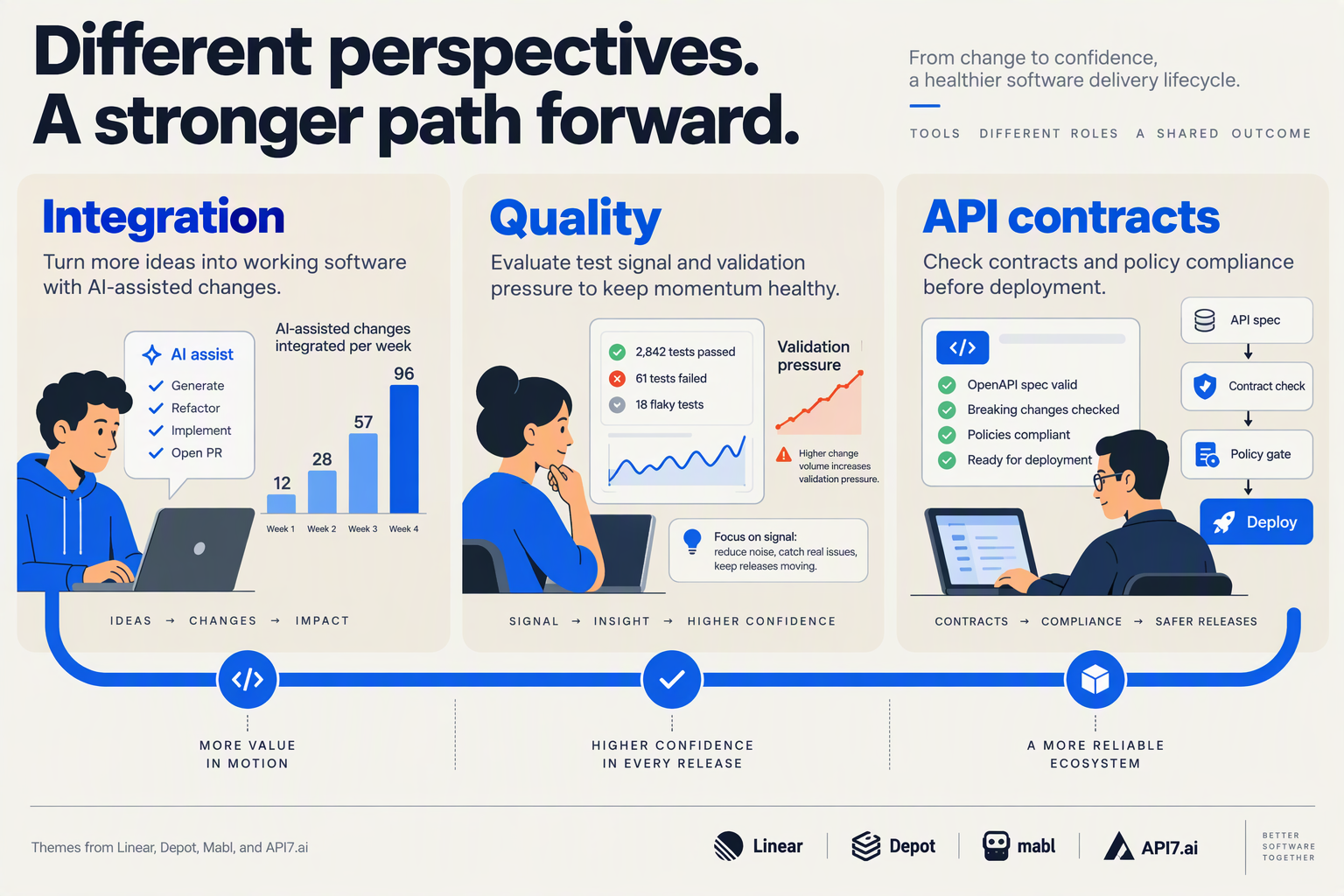
Engineering sources largely agree that AI-assisted code generation is shifting pressure from implementation toward integration and quality validation. The CODEW described CI/CD as the next bottleneck on September 11, 2026, while Depot frames the shift as “from writing code to integrating it”; Mabl likewise argues that quality assurance is becoming a constraint as release cycles accelerate.
What do these sources mean by a new bottleneck?
The sources point to a mismatch: code can arrive faster than teams can establish whether it works with the surrounding system. That does not mean every change needs a larger test suite. It means CI must identify which changes create meaningful risk, then return evidence quickly enough for engineers to act on it.
Depot’s integration-focused framing is especially relevant to platforms built from APIs, models, telephony, and messaging channels. A code change can pass unit tests yet fail at a boundary: a provider returns a different response shape, a webhook is retried, or an agent’s call flow no longer routes correctly. The practical implication is to test contracts and customer journeys, not just isolated functions.
Mabl’s discussion of quality assurance adds a second point: increasing release speed can expose weaknesses in brittle or overly manual validation. For voice and messaging products, useful CI checks should be repeatable, scoped, and diagnostic. A red build should help an engineer identify whether a failure came from a changed contract, an unavailable dependency, or a genuine customer-facing regression.
Which CI requirements follow for voice and messaging systems?
A risk-based pipeline should combine fast feedback with targeted coverage. For example:
- Run cheap checks first: formatting, static analysis, unit tests, and schema validation can catch many defects before slower environments are allocated.
- Test changed boundaries: when an API, tool, or webhook changes, validate request and response contracts, authentication behavior, retries, and error handling.
- Protect critical journeys: maintain integration checks for representative paths such as starting a call, handing a conversation to a human, and delivering a message after an event.
- Exercise failure modes: verify timeouts, provider errors, duplicate events, and fallback behavior—not only the successful path.
- Keep results actionable: report the failing journey and dependency so teams can distinguish product defects from test-environment problems.
Coverage should reflect actual product variation without exploding into every possible combination. As of September 2026, CallMissed’s developer API brings 138 models together, and its platform supports speech recognition in 22 Indian languages plus English. Those figures illustrate why teams may need representative model-provider and language test matrices, chosen by usage and risk rather than exhaustive permutations.
How should teams read the trend without overreacting?
Industry commentary identifies a direction, not a universal benchmark: the provided sources do not establish a single CI duration or test count that works for every team. The useful response is to treat CI as a release-confidence system. Keep routine checks quick, reserve deeper integration tests for higher-risk changes, and ensure production monitoring and rollback plans cover behavior that tests cannot fully predict.
For voice and messaging platforms, the new bottleneck is therefore not simply “too many tests.” It is insufficiently targeted evidence: teams need to prove that important interfaces and customer journeys still work at the pace AI-assisted development produces changes.
What should your staged CI adoption plan look like?
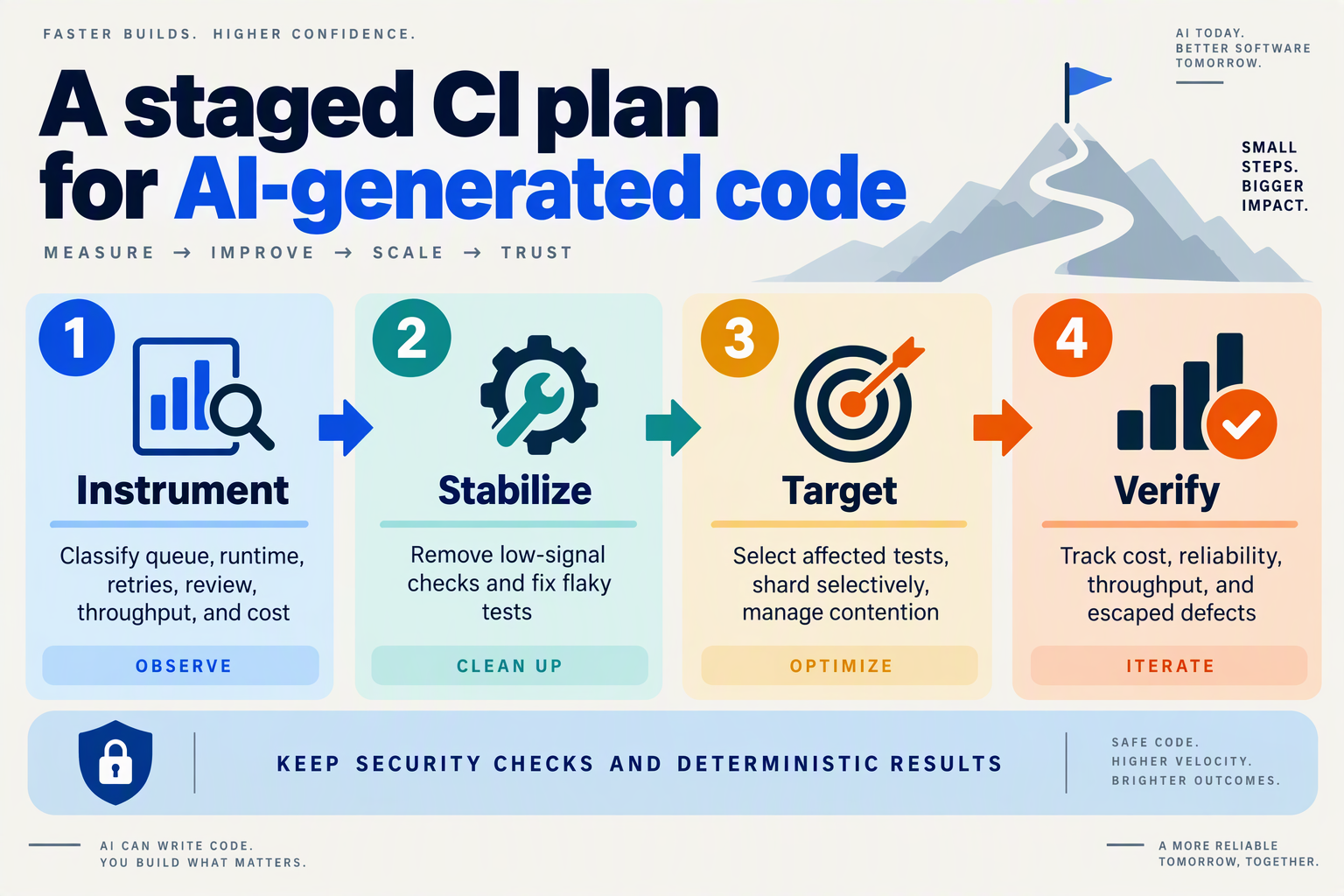
Adopt CI in stages: first establish a reliable merge gate, then add risk-based integration coverage, and finally make production rollout and rollback part of the release path. This lets teams improve confidence incrementally without making every code change wait for the slowest end-to-end test.
What should each stage of CI adoption include?
Use explicit promotion criteria at each stage. Treat the timelines below as suggested starting points, not universal benchmarks; adjust them to your team’s baseline and customer risk.
| Stage | Checks and scope | Voice and messaging focus | Promotion gate |
|---|---|---|---|
| 1. Baseline | Record queue and job duration; identify flaky checks and failed builds | Map critical paths: call start, message delivery, webhook handling, and human handoff | Agree on current performance and name an owner for each critical path |
| 2. Fast merge gate | Run formatting, static analysis, unit tests, and changed-component checks on every pull request | Validate input handling, routing rules, and error responses with deterministic fixtures | Required checks pass; failures identify the affected component and likely risk |
| 3. Contract and integration tests | Test API schemas, authentication, event payloads, database changes, and provider adapters | Verify webhook retries, call-state transitions, message templates, and provider fallback behavior | Merge only when contracts remain compatible or changes are explicitly versioned |
| 4. Risk-based end-to-end tests | Run a small set on pull requests; expand coverage on main branch or before release | Exercise representative inbound/outbound flows, timeouts, disconnects, and agent-to-human transfers | Critical customer journeys pass; unstable tests are quarantined and tracked, not silently ignored |
| 5. Staged release | Deploy to a limited environment or traffic segment; monitor errors and customer-impact signals | Check real integrations, language behavior, delivery outcomes, and rollback readiness | Expand only if agreed indicators stay within the team’s release thresholds |
How should teams test model and language variation?
Do not make every pull request run every possible model and language combination. Instead, keep a small, deterministic compatibility set in the merge gate: one primary provider, one fallback, and representative speech and messaging flows. Expand the matrix in scheduled or pre-release runs, and add combinations when a customer incident or code change makes them relevant.
This matters because an integration can pass a generic API test and still fail on a specific provider, locale, or event sequence. For example, CallMissed’s developer API provides access to 138 models, while its platform supports speech recognition in 22 Indian languages plus English, as of September 2026. Those figures illustrate the breadth a test strategy may need to account for; they are not a recommendation to run all combinations on every commit.
Use stable fixtures for exact assertions, then reserve live-provider checks for controlled integration stages. Keep secrets out of pull-request logs, use test accounts where available, and make external-service failures distinguishable from code regressions.
What should a team implement first?
A practical rollout sequence is:
- Choose a thin merge gate. Require fast checks that catch common defects, while documenting which production risks they cover.
- Add contracts for customer-facing boundaries. Version API schemas and test webhook signatures, payloads, retries, and idempotency.
- Select a few critical journeys. Include at least one successful path and meaningful failure paths, such as a timeout or handoff.
- Add release safeguards. Define who can pause rollout, what signals trigger rollback, and how to preserve logs needed for diagnosis.
On September 11, 2026, CODEW described CI/CD as a growing constraint in AI-accelerated development; Depot likewise frames integration as the bottleneck shifting beyond code creation. A staged plan addresses that pressure by making early feedback fast while reserving broader validation for the changes and release moments that carry greater customer risk.
Frequently Asked Questions
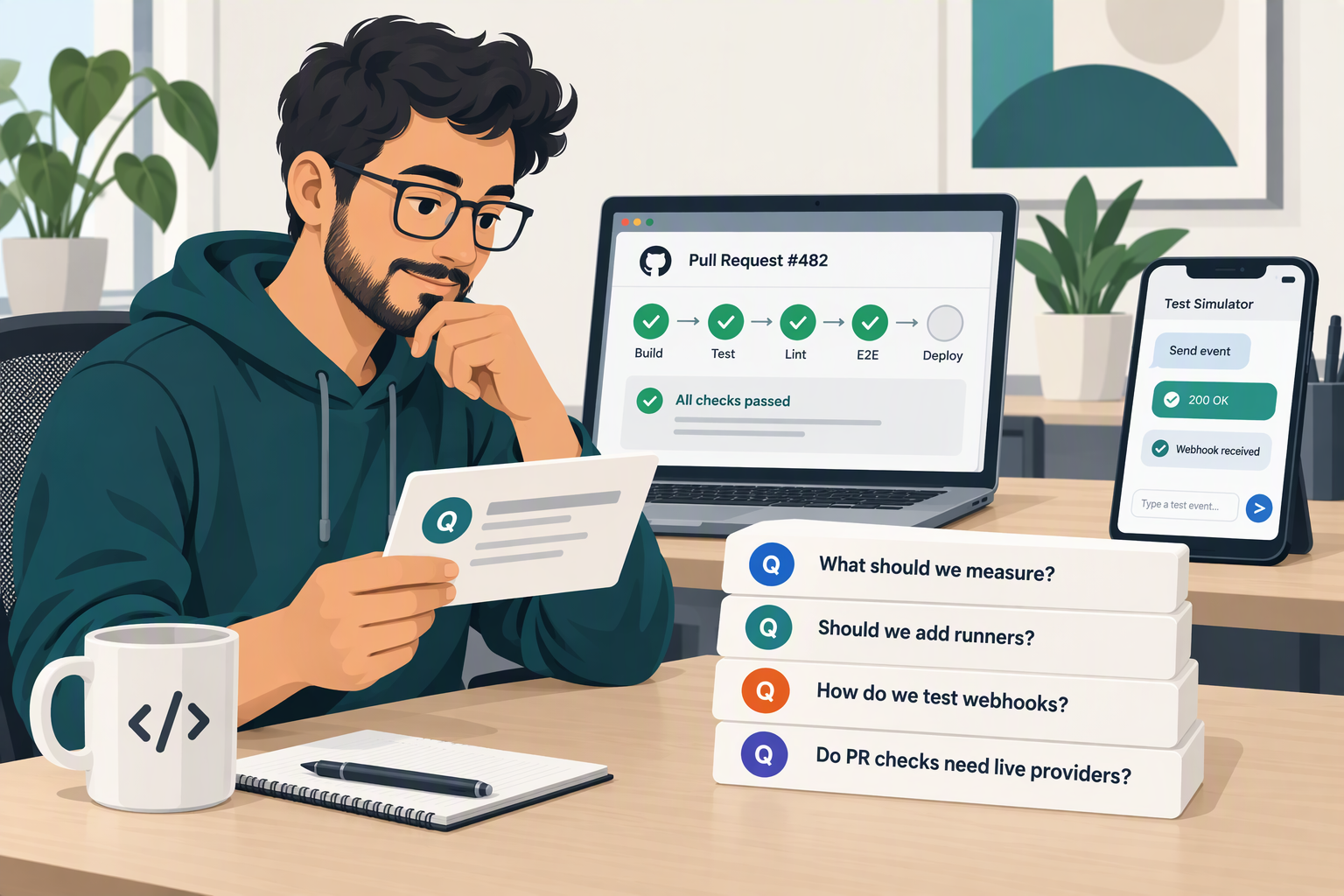
What are AI Coding CI Bottlenecks, and why do they happen?
How can a team find the biggest AI Coding CI Bottlenecks?
What should CI test for voice and messaging platforms?
How should teams test AI model integrations and fallbacks in CI?
How can developers reduce CI time without skipping important checks?
Which CI failures should block a voice or messaging release?
Conclusion
AI coding CI bottlenecks are best solved by making validation faster and more risk-focused—not by running every possible test on every change. For voice and messaging platforms, CI must protect customer-facing paths while giving developers clear, timely feedback.
- Measure before optimizing: Separate queue time from execution time, then identify delays in installs, builds, tests, and environment setup.
- Match checks to risk: Keep routine changes moving with fast feedback; apply deeper integration and failure-path checks when calls, messages, APIs, or customer data could be affected.
- Test realistic behavior: Validate API contracts, webhooks, provider fallbacks, and language-sensitive interactions—not just whether the build completes.
- Plan beyond CI: Staged rollouts, monitoring, and rollback plans help catch production differences that automated checks cannot fully predict.
The shift described by CODEW on September 11, 2026, and by Depot—from code creation toward integration—makes that discipline increasingly important. Watch how AI coding agents change the volume and shape of changes, and adapt test selection and release safeguards as those patterns emerge.
CallMissed, an AI communication platform, supports speech recognition in 22 Indian languages plus English and provides access to 138 AI models through one developer API, as of September 2026. To explore how AI communication is evolving, visit CallMissed. What would your CI need to prove before you trust an AI-generated change with a live customer conversation?
Related Reading
- AI Agents from Pilot to Production: Support Playbook
- Claude Opus 5.5 vs GPT-5.6 Sol: Coding & Cost Tests
- Claude Fable 5.1 vs Opus 5.5: Pricing & Coding
Sources
Discussion
Related Posts


Ready to automate customer conversations?
Launch AI voice agents and WhatsApp bots with CallMissed — one API, 22+ Indian languages.