
AI Agent Analytics 2026: Conversation Intelligence, QA, and ROI With CallMissed



Use AI agent analytics to connect conversation intelligence, QA, and operating metrics to AI agent ROI through CallMissed review cycles.
AI Agent Analytics 2026: Conversation Intelligence, QA, and ROI With CallMissed
What if an AI agent handles 10,000 conversations but quietly loses the highest-value leads? AI agent analytics in 2026 must answer more than “How many calls or messages were automated?” It must show whether automation resolved customer needs, generated revenue, protected service quality, and reduced the total cost of engagement.
From automation volume to business value
Traditional contact center analytics often emphasizes activity: call counts, average handling time, queue length, and agent occupancy. Those measures remain useful, but autonomous voice and messaging systems require a broader operating model. Leaders now need to connect call and message outcomes with containment, transfer rate, conversion, response time, end-to-end latency, repeat contacts, and customer sentiment—where sentiment can be measured reliably and reviewed in context.
A 70% containment rate, for example, is not automatically positive. If the AI resolves routine status requests but incorrectly “contains” cancellation complaints or qualified sales enquiries, the metric can conceal revenue loss and customer risk. Likewise, a fast first response means little when backend tool calls add several seconds of latency or the answer itself is incomplete.
Effective conversation intelligence turns transcripts, recordings, dispositions, tool events, and CRM outcomes into evidence that operators can inspect. That evidence enables teams to ask sharper questions:
- Which intents produce successful self-service outcomes?
- Where do customers request a human transfer?
- Which knowledge-base gaps trigger repeated questions?
- Does lower latency improve completion or conversion?
- Are escalations reaching the correct team with sufficient context?
- How does performance change by channel, language, campaign, or customer segment?
CallMissed brings this model to omnichannel engagement by combining AI voice agents, WhatsApp chat and Business calling, email and web workflows, transcript-driven review, and support for 22 Indian languages within one customer-engagement platform.
What this guide will help you measure
This guide explains how to build an analytics and continuous-improvement system rather than another static KPI dashboard. You will learn how AI call analytics and message data can support transcript review, automated and human scorecards, scenario testing, privacy controls, weekly optimization cycles, and executive reporting.
It also distinguishes operational customer service KPIs from financial outcomes. Containment, transfer rate, latency, answer accuracy, conversion, and cost per successful resolution become useful only when tied to an explicit baseline and business objective. The practical calculation is not simply “automation savings”; AI agent ROI should account for platform and usage costs, implementation effort, human escalation, incremental revenue, recovered leads, and avoided service workload.
Finally, the guide presents a structured approach to voice AI quality assurance: define the intended outcome, instrument every step, review failures, test changes, deploy safely, and measure again. That closed loop is how conversation data becomes better customer experience—and how AI operations become financially accountable.
How CallMissed turns AI agent analytics into ROI: connect outcomes, QA findings, and fixes in one closed loop
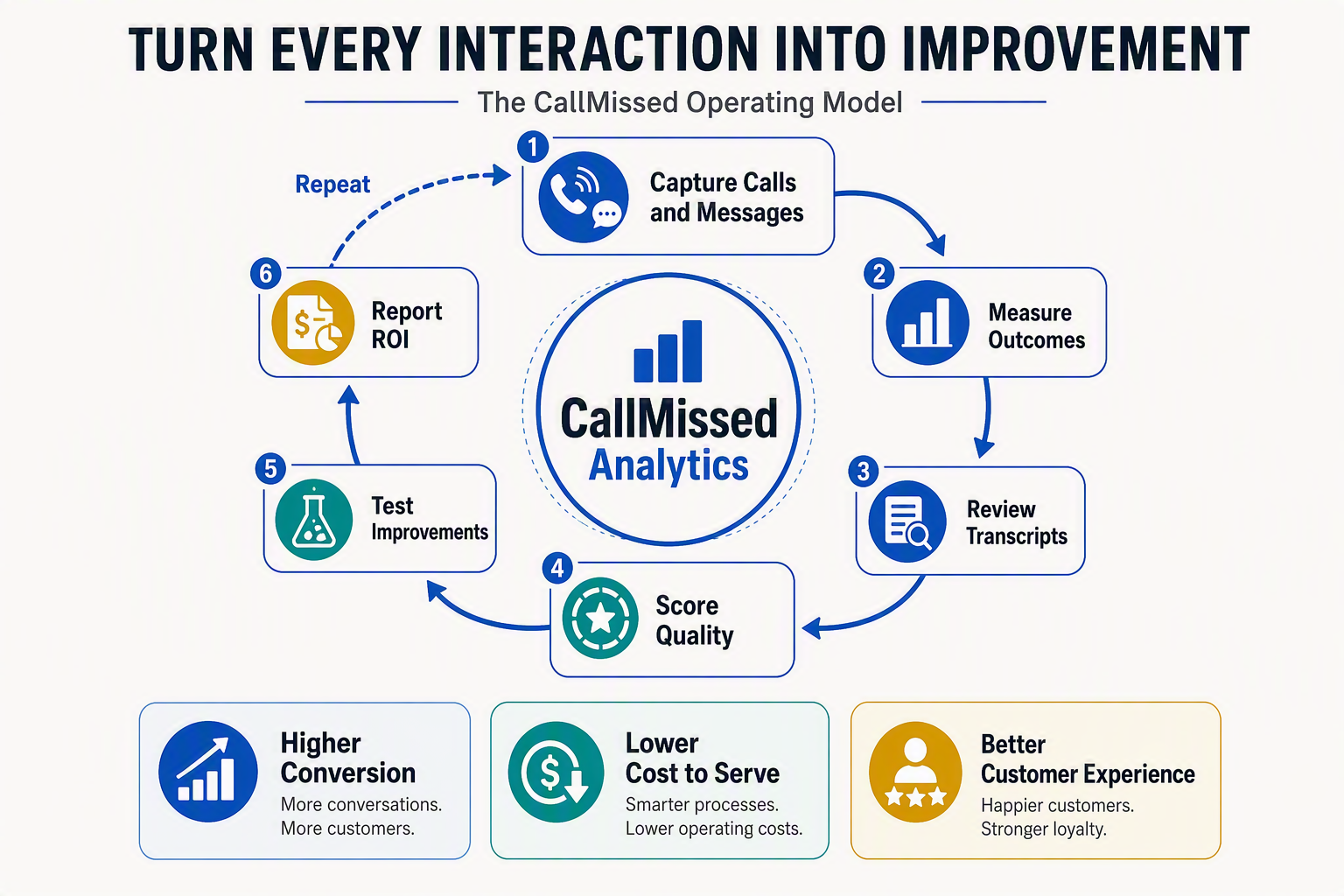
CallMissed turns AI agent analytics into ROI by connecting each interaction’s business outcome with transcript evidence, quality findings, and a prioritized corrective action. The result is a closed loop: measure what happened, diagnose why it happened, deploy a fix, and verify whether the fix improved revenue, resolution, or cost.
Build one outcome record across the customer journey
A useful analytics record should extend beyond the final call disposition. CallMissed can support journeys spanning AI voice agents, WhatsApp chat and Business calling, email, web interactions, knowledge-base retrieval, and CRM workflows—including conversations across 22 Indian languages.
For every interaction, capture four evidence layers:
- Customer context: channel, language, segment, campaign, consent status, and detected intent.
- Operational events: response time, end-to-end latency, tool calls, knowledge retrieval, transfers, retries, and failures.
- Quality evidence: transcript excerpts, recording references, policy checks, factual accuracy, tone, and reviewer notes.
- Business outcome: resolved enquiry, booked appointment, qualified lead, completed purchase, human escalation, repeat contact, or abandonment.
This structure connects AI call analytics and messaging data to downstream results. It also prevents conventional contact center analytics measures—such as handling time or interaction volume—from being mistaken for financial value.
Convert QA findings into an actionable fix queue
Conversation intelligence should produce work, not merely charts. Every failed or low-scoring conversation needs a reason code and an accountable remediation path.
A practical workflow is:
- Detect: Flag unsuccessful outcomes, repeated questions, excessive latency, unexpected transfers, negative customer language, and compliance exceptions.
- Review: Examine the transcript, recording, retrieval result, tool trace, and final CRM disposition.
- Classify: Assign the root cause—knowledge gap, prompt failure, speech-recognition error, workflow defect, integration timeout, routing mistake, or unsupported request.
- Fix: Update the knowledge base, dialogue instruction, pronunciation dictionary, tool configuration, escalation rule, or agent workflow.
- Test: Replay representative scenarios before release, including regional-language, noisy-audio, interruption, and ambiguous-intent cases.
- Verify: Compare outcome and QA results against the pre-change baseline.
For voice AI quality assurance, separate recognition quality from reasoning and execution. A correct answer cannot help if speech was transcribed incorrectly; similarly, an accurate transcript does not compensate for a failed booking API.
Calculate improvement in financial terms
Treat each fix as a measurable intervention with a baseline, target, owner, and review date. Relevant customer service KPIs may include successful resolution, repeat-contact rate, transfer accuracy, conversion, and cost per resolved interaction.
For example, suppose a booking workflow processes 5,000 monthly conversations. Raising verified conversion from 8% to 10% produces 100 additional bookings per month:
5,000 × (10% − 8%) = 100
If contribution margin is ₹600 per completed booking, the illustrative gross impact is ₹60,000 per month before subtracting additional platform usage, implementation, review, and escalation costs.
Use a complete calculation:
AI agent ROI = (incremental margin + avoided service cost − total AI operating cost) ÷ total AI operating cost × 100
Executive dashboards should therefore show not only metric movement but also the fixes responsible, confidence in attribution, operating cost, and realized value. This closed-loop approach makes analytics an improvement system rather than a retrospective report.
Why should contact center analytics move beyond isolated customer service KPIs in 2026?

Contact centers should move beyond isolated customer service KPIs because an AI agent can improve speed or containment while simultaneously reducing resolution quality, conversion, or customer trust. In 2026, contact center analytics must connect every conversation to its operational, customer, revenue, risk, and cost outcomes.
Isolated metrics can reward the wrong behaviour
Metrics such as average handling time, first-response time, containment, and transfer rate describe individual parts of a journey. They do not establish whether the journey succeeded.
Consider an illustrative AI voice deployment:
- Containment rises from 60% to 75%.
- Average handling time falls from five minutes to four minutes.
- Transfer rate drops from 40% to 25%.
- Sales conversion simultaneously falls from 12% to 8%.
A dashboard focused on efficiency would report improvement. A revenue-connected dashboard would reveal that the agent may be ending conversations prematurely, failing to identify high-intent prospects, or preventing valuable human intervention. AI agent ROI therefore cannot be inferred from automation volume alone.
The same principle applies to messaging. A WhatsApp chatbot may respond within two seconds but still create a poor outcome if a knowledge retrieval failure produces an incomplete answer, the customer repeats the question, and a later escalation lacks conversation context.
Analytics should follow the complete outcome chain
Modern AI agent analytics should connect several layers of evidence:
- Demand: Why did the customer make contact, through which channel, and in which language?
- Agent behaviour: What did the AI say, retrieve, classify, or execute?
- Conversation outcome: Was the request resolved, transferred, abandoned, deferred, or incorrectly contained?
- Business outcome: Did the interaction produce a booking, payment, qualified lead, retained customer, or support resolution?
- Economic outcome: What were the model, telephony, messaging, human-review, and escalation costs?
- Quality and risk: Did the agent follow policy, disclose limitations, protect personal data, and avoid unsupported claims?
This chain makes conversation intelligence more than transcript search. It turns recordings, messages, tool calls, CRM updates, and downstream events into a traceable explanation of performance.
Quality assurance must become outcome-aware
Traditional sampling can miss rare but costly failures. Voice AI quality assurance should combine automated checks with targeted human review, using rules that prioritize conversations involving complaints, cancellation requests, payment details, repeated questions, negative language, failed tools, or unusual latency.
Similarly, AI call analytics should distinguish between superficially similar outcomes. A transfer may be:
- Necessary, because the customer requested regulated or specialist assistance;
- Preventable, because the knowledge base lacked an answer;
- Misrouted, because intent classification failed;
- Commercially valuable, because a qualified prospect reached a salesperson.
Reducing every transfer would therefore be the wrong objective. The goal is to increase successful containment while preserving appropriate escalation.
A shared scorecard creates accountability
Operations, customer experience, sales, finance, compliance, and engineering should work from one linked scorecard rather than separate dashboards. Each metric needs a defined owner, baseline, target, review interval, and diagnostic path.
For example, rising latency should trigger analysis of speech recognition, model inference, knowledge retrieval, external tools, and text-to-speech—not merely a generic “slow call” alert. This system-level approach turns analytics into a continuous-improvement loop: measure, investigate, test, deploy, and verify.
Which 2026 developments are reshaping AI call analytics and omnichannel measurement?
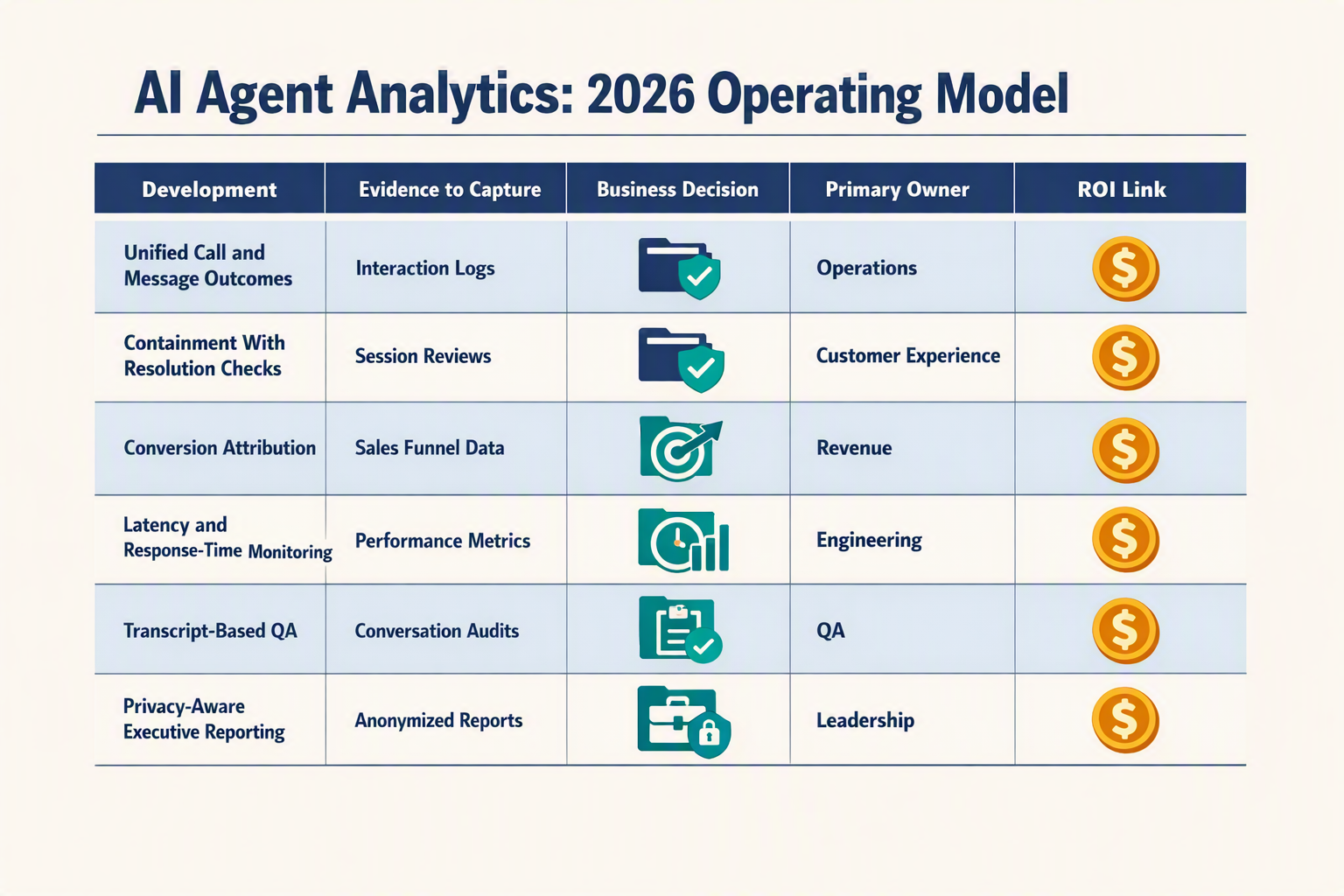
In 2026, AI call analytics is shifting from channel-level activity reporting toward journey-level measurement that connects conversations, tool actions, human transfers, CRM records, and verified business outcomes. The relevant question is not simply whether an AI agent completed an interaction, but whether the customer received an accurate, compliant, and useful result.
The metrics below are a recommended measurement framework, not a claim that every metric is generated natively by CallMissed. Availability depends on the channels, workflows, integrations, and reporting configuration enabled for an account. Business outcomes should be validated against authoritative systems such as a CRM, booking platform, payment system, or support database.
Six developments changing omnichannel measurement
| 2026 development | What is changing | Measurement response | ROI or QA implication |
|---|---|---|---|
| Outcome-based containment | An interaction is not necessarily successful merely because no human agent joined | Measure confirmed resolution, repeat contact, abandonment, unresolved intent, and downstream status | Reduces the risk of counting failed or deferred automation as savings |
| Cross-channel journey analytics | Voice, messaging, email, and web interactions may form one customer journey | Use persistent journey identifiers, where technically and legally appropriate, and compare outcomes across channel sequences | Helps determine whether channel switching is associated with better outcomes or additional friction |
| End-to-end latency tracing | Model generation is only one component of an AI voice agent’s response time | Separate speech recognition, retrieval, model, tool, speech synthesis, telephony, and network latency where telemetry is available | Helps isolate components associated with long pauses, interruptions, or abandonment |
| Automated QA with human calibration | Automated scoring can evaluate more eligible interactions than manual sampling alone | Apply machine-generated scores consistently, then review high-risk, low-confidence, and representative samples with trained humans | Expands coverage without treating automated judgments as ground truth |
| Multilingual and code-switched analysis | Aggregate reporting can conceal performance differences between languages, dialects, and mixed-language conversations | Segment transcription confidence, intent performance, latency, transfers, and outcomes by language when reliable language labels are available | Identifies quality gaps that broad customer service KPIs may hide |
| Privacy-aware observability | Recordings, transcripts, summaries, identifiers, and tool traces can contain personal or sensitive information | Apply data minimization, appropriate notice or consent, redaction, retention limits, access controls, and audit logging based on applicable requirements | Supports review and improvement while limiting unnecessary collection, access, and retention |
Why legacy dashboards are no longer enough
Traditional contact center analytics often records each call or message separately. A customer journey may instead begin in a messaging channel, continue by voice, trigger an account lookup or CRM update, and end with a confirmation message. A call disposition by itself cannot establish whether the entire journey succeeded.
A useful event model can include:
- Conversation and journey identifiers, with controls against unnecessary identity linkage
- Channel, language, intent, and permitted customer-segment fields
- Knowledge retrievals, source references, tool calls, and tool outcomes
- First-response time and available component-level latency
- Transfer reason, destination, waiting time, and whether relevant context was passed
- Containment, confirmed resolution, conversion, and repeat-contact indicators
- Sentiment or emotion signals alongside transcript evidence and reviewer decisions
- QA findings, policy exceptions, corrective actions, and remediation status
These are recommended fields rather than guaranteed CallMissed-native data points. Teams should document which fields come directly from CallMissed, which are inferred by an analytics model, and which are joined from external business systems.
This structure makes conversation intelligence more useful than transcript search alone. It can also support AI agent ROI analysis, but attribution requires care. A booking or sale that follows an AI interaction is correlated with that interaction; it is not automatically caused by it. Stronger attribution may require consistent outcome definitions, deduplication, baseline comparisons, controlled rollouts, or other methods that account for seasonality, marketing activity, staffing changes, and customer mix.
Cost savings should likewise be based on validated resolutions and actual cost changes—not raw interaction volume or nominal containment. A defensible analysis separates observed measures, such as completed bookings or avoided repeat contacts, from assumptions such as estimated handling cost.
Quality assurance is becoming risk-weighted
Voice AI quality assurance is moving beyond uniform scorecards. An incorrect opening-hours response and an incorrect statement about a payment, cancellation, or regulated obligation do not carry the same potential impact. Review queues can prioritize failed authentication, unsupported commitments, repeated tool errors, cancellations, low-confidence transcripts, possible disclosure of sensitive information, and interactions involving financial or personal data.
Multilingual evaluation should be performed by reviewers and test sets appropriate to the relevant language, dialect, domain, and code-switching pattern. Any statement about the number of languages available through CallMissed should be checked against the current product documentation and the customer’s enabled configuration rather than treated as proof of equal accuracy across languages.
Sentiment analysis should be treated as a probabilistic triage signal, not an objective measure of customer emotion or a standalone compliance decision. Its reliability can vary with language, accent, sarcasm, background noise, transcript quality, and model design. Material decisions should be supported by transcript or recording evidence and, where appropriate, human review.
The practical model for AI agent analytics is cyclical: measure eligible interactions, calibrate automated findings through human review, identify high-impact failure patterns, test corrections, and compare outcomes before and after changes. Changes in containment, transfer rate, conversion, latency, or compliance findings can indicate improvement, but causal claims should be made only when the evaluation design supports them.
Which outcomes, containment, transfer, conversion, response-time, latency, and sentiment signals should teams analyze?
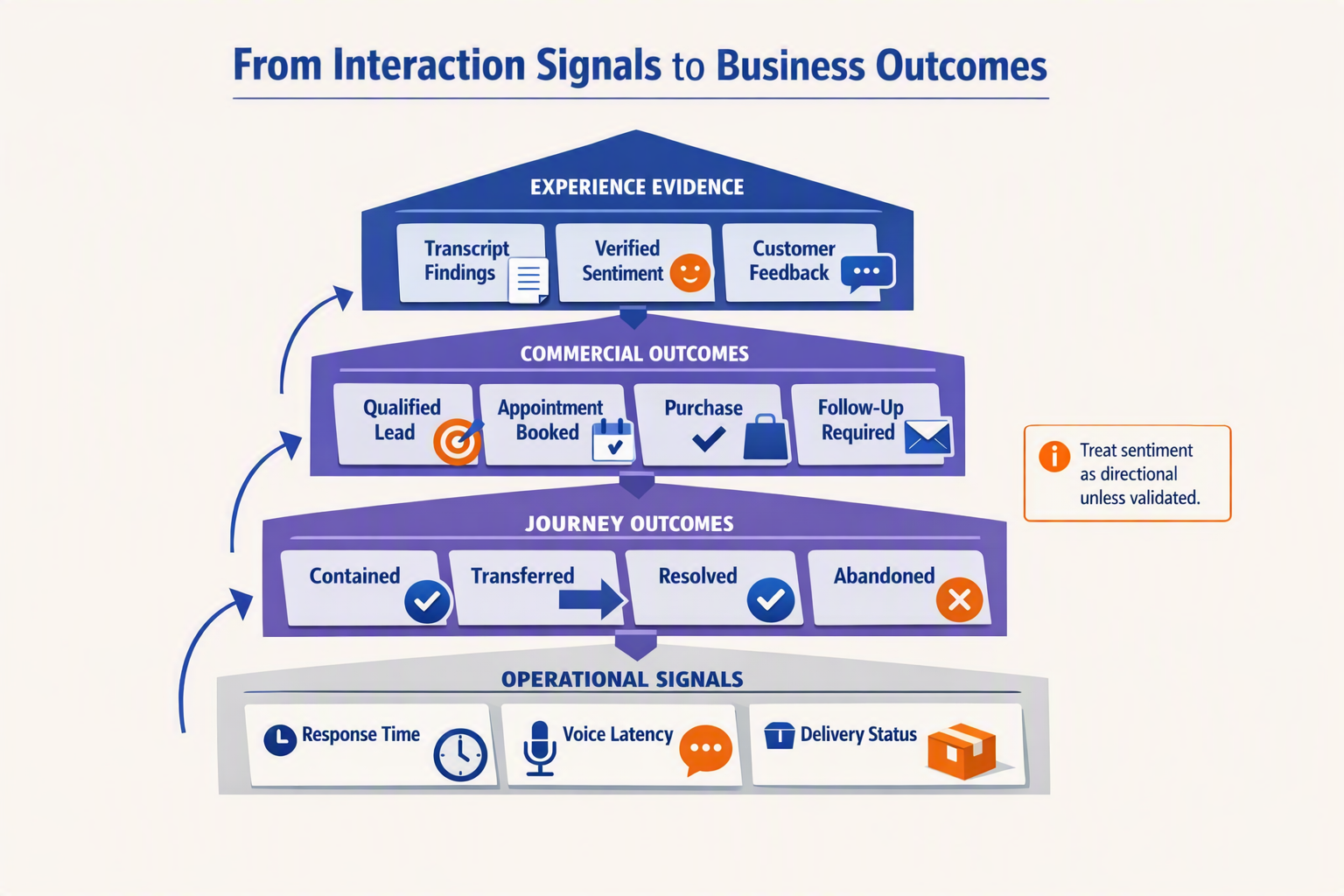
Teams should analyze outcomes, containment, transfer, conversion, response time, latency, and sentiment together, segmented by intent, channel, language, campaign, and customer value. No single metric proves success: the relevant question is whether the AI produced the intended business result efficiently and safely.
Define outcomes before calculating rates
Assign every conversation a mutually exclusive primary outcome, then preserve secondary events such as transfers or follow-ups. Useful outcome labels include:
- Resolved: The customer’s verified objective was completed.
- Converted: A purchase, qualified lead, appointment, payment, or other defined revenue event occurred.
- Transferred successfully: A human or specialist queue accepted the interaction with context.
- Abandoned: The customer disconnected or stopped responding before completion.
- Failed: The agent gave an incorrect answer, encountered a tool error, or could not complete the workflow.
- Pending: Completion depends on a later payment, document, callback, or backend event.
These labels make AI agent analytics more meaningful than raw conversation volume. For CallMissed voice, WhatsApp, email, and web workflows, teams can associate transcripts and interaction events with CRM dispositions or downstream business outcomes rather than treating the final AI message as proof of resolution.
Measure containment and transfers by intent
Calculate containment rate as:
Successfully resolved without human assistance ÷ eligible AI-handled conversations × 100
Exclude interactions that policy requires humans to handle. Report both gross containment, covering every conversation, and eligible containment, covering only approved automation scenarios.
Track transfers separately:
Transfer rate = conversations transferred to a human ÷ AI-handled conversations × 100
A transfer is not necessarily a failure. In voice AI quality assurance, a prompt, correctly routed escalation can protect revenue or reduce compliance risk. Measure:
- Customer-requested versus agent-initiated transfers
- Correct queue and specialist routing
- Time from escalation decision to human acceptance
- Context transferred with the conversation
- Post-transfer resolution and repeat-contact rate
This extends traditional contact center analytics beyond transfer volume to transfer quality.
Connect conversion to attributable value
Conversion rate should use a predeclared event and attribution window. A sales agent might count a confirmed appointment, whereas a collections workflow might count a completed payment.
Report conversions by intent, campaign, channel, language, and customer segment. Compare AI-assisted performance with a credible baseline, while separating correlation from causation. AI agent ROI should use completed outcomes and attributable incremental revenue—not promises, clicks, or positive language—as its financial numerator.
Separate response speed from system latency
Messaging and voice require different timing measures:
- First-response time: Customer message to first agent reply.
- Turn latency: End of customer input to start of the response.
- Speech latency: End of speech to audible voice output.
- Tool latency: Time consumed by CRM, search, payment, or booking calls.
- End-to-end completion time: Start of interaction to verified outcome.
For AI call analytics, inspect latency distributions and tail performance rather than averages alone. Percentiles such as P50, P90, and P95 reveal slow experiences hidden by the mean.
Treat sentiment as supporting evidence
Sentiment can identify frustration, urgency, confusion, or improvement across a conversation, but it should not become an unquestioned customer service KPI. Models can misread sarcasm, code-switching, dialects, short replies, and culturally specific phrasing.
Use conversation intelligence to combine sentiment with observable signals:
- Interruptions, repeated questions, silence, and abandonment
- Explicit complaints or praise
- Escalation requests and agent corrections
- Outcome completion and repeat contact
- Human-reviewed transcript samples
Together, these measures show not merely whether automation occurred, but whether it created a successful, timely, and economically valuable customer outcome.
How should conversation intelligence and voice AI quality assurance use transcripts, scorecards, and testing?
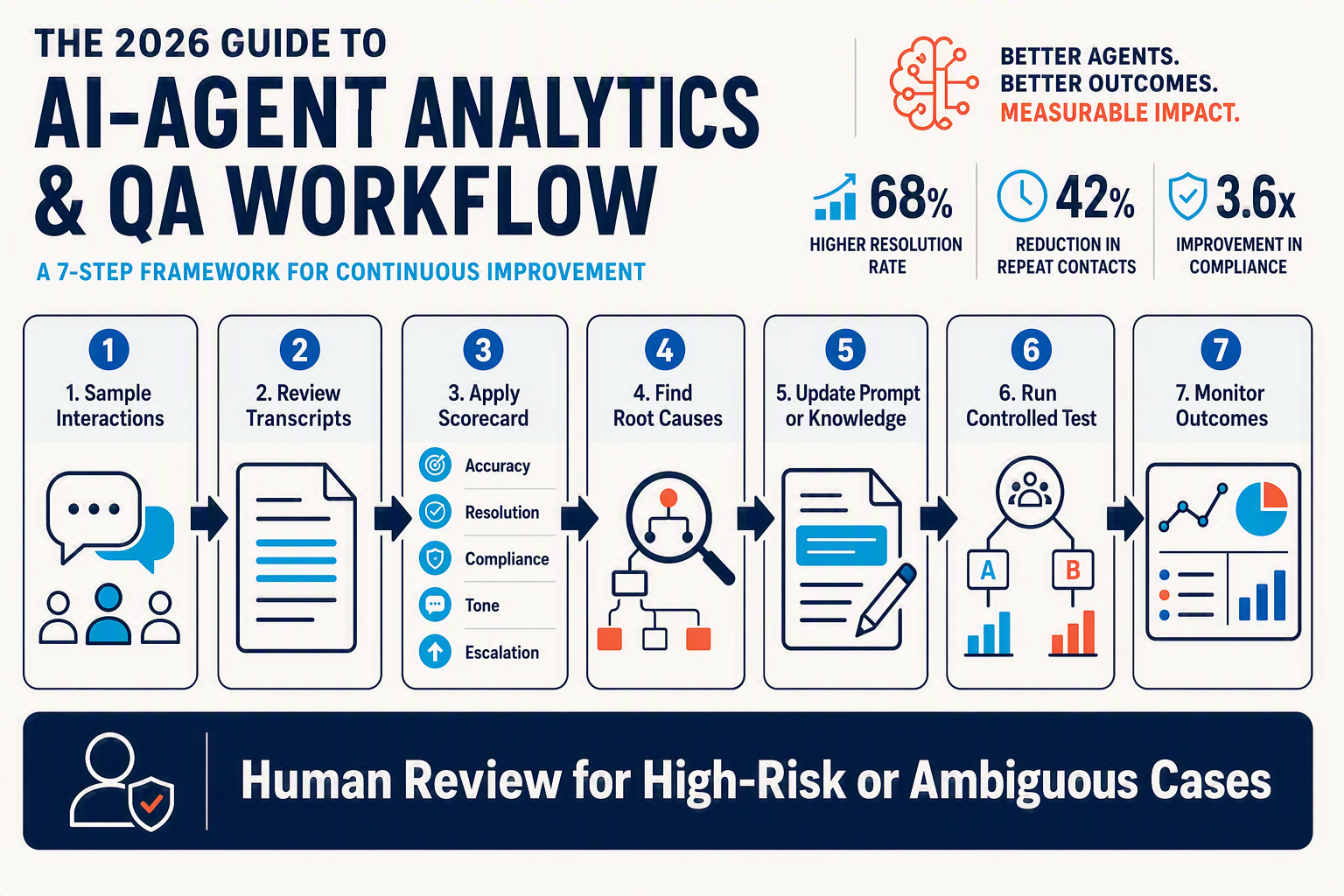
Conversation intelligence should treat transcripts as searchable evidence, scorecards as consistent decision rules, and testing as a continuous release gate. Effective voice AI quality assurance combines automated evaluation with calibrated human review because a transcript alone cannot capture pronunciation, interruptions, silence, latency, or emotional nuance.
Build a reviewable conversation record
Every interaction should produce more than a transcript. A useful AI agent analytics record connects:
- The transcript and, for voice interactions, the original recording
- Speaker turns, timestamps, interruptions, silence, and end-to-end latency
- Detected intent, disposition, transfer reason, and final outcome
- Knowledge sources retrieved and the answer ultimately delivered
- Tool calls, errors, retries, and backend response times
- CRM events such as appointments, purchases, qualified leads, or cancellations
- Customer consent and any human correction to automated labels
Transcripts are not ground truth. Speech recognition can mishear names, addresses, mixed-language phrases, or domain terminology; automated sentiment can also mistake urgency, sarcasm, or a neutral speaking style for dissatisfaction. Reviewers should therefore compare important transcript passages with audio and assess sentiment only when the signal is sufficiently reliable.
Platforms such as CallMissed can bring voice, WhatsApp, email, and web conversations into a shared review workflow. That helps teams apply comparable customer service KPIs across channels while retaining channel-specific checks, such as audio clarity for calls and response sequencing for messages.
Use outcome-linked QA scorecards
A scorecard should evaluate whether the AI accomplished the customer’s objective safely—not merely whether it followed a script. A practical weighted framework might allocate scores across:
- Outcome correctness: Was the request resolved, converted, or appropriately escalated?
- Answer accuracy: Did the response agree with approved knowledge and policy?
- Process compliance: Did the agent obtain consent and follow required disclosures?
- Conversation quality: Was the answer clear, relevant, concise, and language-appropriate?
- Operational execution: Did tools work, and did transfers include context?
- Critical failures: Did the agent invent information, expose sensitive data, or block a necessary escalation?
Critical failures should override a high average score. An agent that performs five stylistic checks correctly but gives the wrong refund policy has not delivered a successful interaction.
Automated evaluators can score every conversation, while humans review a stratified sample covering high-value leads, low-confidence outputs, transfers, complaints, minority languages, and unusual intents. Weekly calibration sessions should compare reviewers, resolve ambiguous criteria, and update scoring examples. This extends traditional contact center analytics from reporting into controlled improvement.
Test before release—and continuously afterward
AI call analytics should feed a repeatable test suite rather than a passive dashboard. Maintain scenarios for routine requests, adversarial prompts, noisy audio, interruptions, code-switching, unavailable tools, long silences, and mandatory human escalation.
For every model, prompt, workflow, or knowledge-base change:
- Run a fixed regression set and compare it with the current production version.
- Test realistic multi-turn conversations, not isolated questions.
- Measure outcome success, unsupported claims, transfers, latency, and tool failures.
- Shadow or canary-test changes on limited traffic.
- Roll back when critical-error or business-outcome thresholds deteriorate.
This closed loop makes conversation intelligence financially actionable. QA improvements should ultimately be evaluated through AI agent ROI: fewer avoidable escalations and repeat contacts, more verified conversions, lower remediation effort, and fewer costly compliance or customer-experience failures.
How do privacy controls, data quality, and attribution affect AI agent ROI?
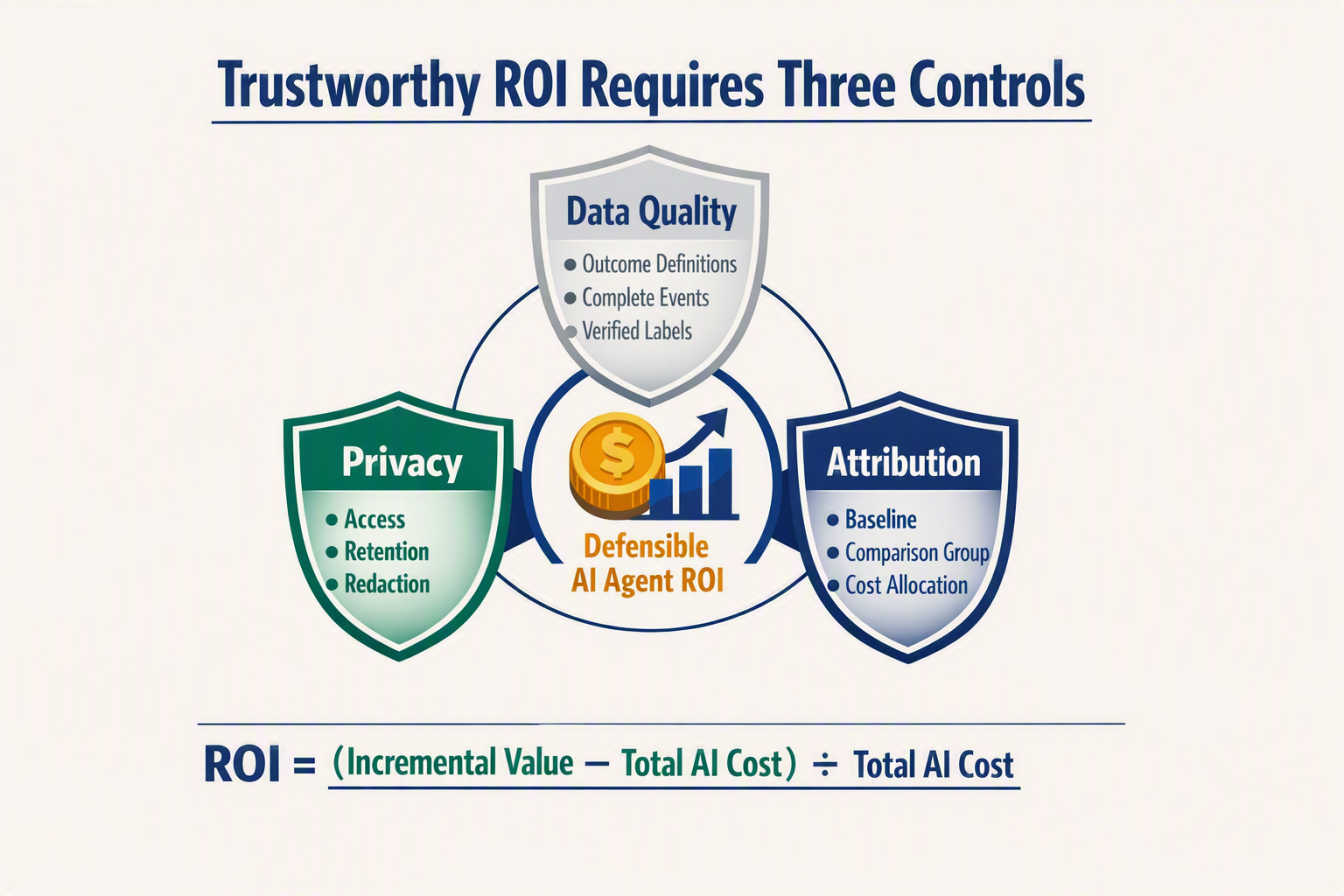
Privacy controls, reliable event data, and defensible attribution determine whether AI agent ROI reflects measurable business value or merely a dashboard estimate. Poor governance creates regulatory and security risk, while incomplete transcripts, inconsistent labels, and simplistic attribution can overstate savings and revenue.
Treat privacy as an analytics design constraint
Conversation intelligence can process recordings, transcripts, phone numbers, account details, payment references, inferred intent, and customer sentiment. Teams should define what may be collected, analyzed, exported, and retained before production conversations enter analytics systems.
Privacy requirements vary by customer location, business sector, communication channel, and data type. Organizations should obtain jurisdiction-specific legal advice and align their workflows with applicable privacy rules, recording requirements, contractual obligations, and channel policies.
Practical controls include:
- Purpose limitation: Collect only the fields required for customer service, quality assurance, fraud prevention, or another documented objective.
- Notice and permission: Inform customers when calls may be recorded or when they are interacting with AI, using language appropriate to the channel and jurisdiction.
- Sensitive-data redaction: Mask payment credentials, identity numbers, health information, passwords, and authentication codes before analytics or model evaluation.
- Role-based access: Give operators, QA reviewers, administrators, developers, and vendors only the permissions needed for their responsibilities.
- Retention schedules: Establish deletion periods for audio, transcripts, summaries, embeddings, and exported reports rather than retaining all records indefinitely.
- Audit trails: Record who accessed, modified, exported, or deleted conversation data.
Dashboards should use pseudonymous customer and interaction identifiers whenever individual identity is unnecessary. Production transcripts should also be separated from development and testing datasets unless approved controls permit reuse.
Fix data quality before trusting the scorecard
Traditional contact center analytics commonly relies on agent-entered dispositions. AI systems add classifications, retrieval traces, tool calls, transfers, CRM updates, and automated summaries, increasing the possibility of missing or contradictory records.
A dependable AI agent analytics dataset needs:
- One interaction ID spanning voice, WhatsApp, email, web, transfers, and follow-up events.
- Standard outcome definitions for resolved, abandoned, transferred, converted, failed, and pending interactions.
- Consistent timestamps for first response, model generation, tool execution, customer silence, transfer delay, and end-to-end latency.
- Deduplication rules so retries, reconnects, and channel handoffs do not create multiple conversions.
- Human validation samples that compare automated labels and summaries with transcript evidence.
Language should be captured as a first-class field rather than inferred only during reporting. CallMissed supports voice and chat across 22 Indian languages, enabling businesses to segment AI call analytics by language and identify regional differences that a national average could conceal.
Attribute value without claiming every conversion
A customer may discover an offer through email, ask questions on WhatsApp, speak with an AI voice agent, and purchase after a human callback. Giving the final interaction all the credit exaggerates automation’s contribution, while ignoring assisted journeys undervalues it.
Use several attribution views:
- Direct attribution: AI completes a verified booking, payment, or qualified-lead action.
- Assisted attribution: AI answers questions, qualifies intent, or routes the customer before a later conversion.
- Incrementality testing: Compare randomized holdouts or carefully matched cohorts, locations, and time windows.
- Full-cost attribution: Include model usage, telephony, implementation, QA review, transfers, failures, and rework.
For voice AI quality assurance, sentiment should remain supporting evidence unless validated across relevant languages and intents. The same principle applies to customer service KPIs: privacy-safe, traceable outcomes are more valuable than larger datasets that cannot be independently verified.
What should operations, finance, QA, engineering, and privacy experts validate before acting on the dashboard?

Dashboard metrics should prompt investigation before they drive staffing, budget, model, or policy changes. Operations, finance, QA, engineering, and privacy experts should jointly validate metric definitions, data completeness, attribution, statistical reliability, and governance controls before treating dashboard results as decision-grade.
Establish one version of metric truth
AI agent analytics and traditional contact center analytics can produce conflicting conclusions when teams use different denominators, exclusions, or time windows. Define every metric through a documented data contract specifying its formula, source events, owner, refresh frequency, exclusions, and acceptable error rate.
Before interpreting customer service KPIs, validate questions such as:
- Does “contained” mean no human transfer, or does it require a verified successful outcome?
- Are abandoned calls, duplicate messages, test traffic, spam, and retries excluded?
- Does response time include queueing, model inference, retrieval, tool execution, and text-to-speech?
- Are repeat contacts linked across voice, WhatsApp, email, and web?
- Can results be segmented by language, intent, channel, campaign, customer type, and model version?
- Are timestamps and reporting periods normalized to the correct time zone?
Segmentation is particularly important for CallMissed because the platform supports voice and chat across 22 Indian languages. One blended success rate can conceal meaningful differences among languages, scripts, accents, code-switching patterns, and regional workflows.
Require cross-functional sign-off
Each function should test a distinct part of the dashboard’s causal story:
- Operations: Sample conversations behind changes in containment, transfer, conversion, repeat-contact, and queue outcomes. Confirm that an apparent gain did not merely shift work to another channel or team.
- Finance: Reconcile interaction volumes with invoices, telephony records, CRM revenue, refunds, and staffing data. AI agent ROI should include usage, implementation, monitoring, human escalation, failed interactions, and incremental revenue—not only estimated handling-time savings.
- QA: Use a stable scorecard covering correctness, task completion, policy adherence, disclosure, empathy where relevant, and escalation quality. Voice AI quality assurance should examine recordings and tool traces alongside transcripts because transcription errors can misrepresent what the customer or agent said.
- Engineering: Verify event delivery, trace IDs, timestamps, prompt and model versions, retrieval sources, fallback routes, and tool-call results. AI call analytics cannot reliably explain failures or latency if observability stops at the transcript.
- Privacy and legal: Confirm an appropriate processing purpose, required notices or consent, role-based access, retention limits, redaction, deletion workflows, and export controls for recordings and transcripts.
Governance should assign accountable owners, approval thresholds, audit trails, escalation paths, and review schedules. Teams should also document which decisions may be automated, which require human approval, and how users can challenge or correct consequential outcomes.
Test evidence before changing production
Treat conversation intelligence findings as hypotheses, not automatic instructions. Use a repeatable validation sequence:
- Compare the result with a defined baseline and matched period.
- Measure sample size, missing-data rates, and uncertainty.
- Review random successes, failures, transfers, and edge cases.
- Run a controlled test with guardrails and rollback criteria.
- Monitor downstream outcomes such as repeat contacts, cancellations, refunds, and complaints.
Automated sentiment should remain a supporting signal, especially for multilingual conversations, code-switching, sarcasm, and noisy calls. Executives should therefore see both performance and evidence quality: metric coverage, unresolved anomalies, sample confidence, QA agreement, and known data limitations.
What should your CallMissed dashboard, optimization cadence, and executive report include?
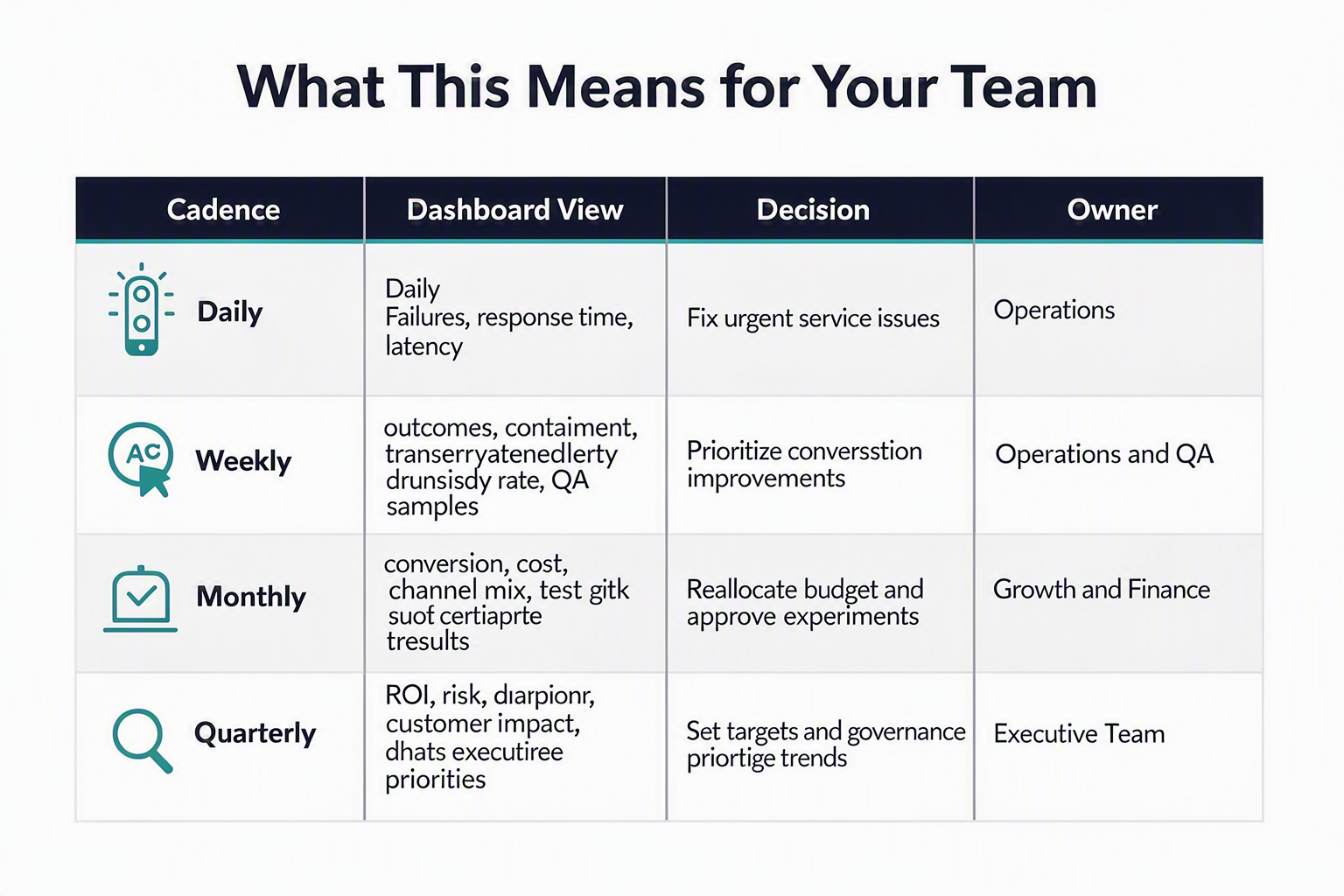
A useful CallMissed operating system should combine live operational alerts, weekly conversation reviews, monthly ROI analysis, and quarterly governance checks. The dashboard explains what happened; the optimization cadence identifies why; the executive report shows whether the AI created measurable business value.
Build one decision-oriented dashboard
Avoid presenting every available event as an equally important KPI. Organize AI agent analytics around outcomes, experience, economics, and risk, while allowing operators to filter by voice, WhatsApp chat, WhatsApp Business calling, email, web, intent, campaign, language, and customer segment.
| Dashboard view | Metrics and evidence | Recommended slice | Review cadence | Decision owner |
|---|---|---|---|---|
| Outcomes | Resolution, containment, transfer, conversion, repeat contact | Intent, channel, campaign | Daily and weekly | Operations lead |
| Experience | First-response time, end-to-end latency, interruptions, abandonment | Language, journey stage, hour | Daily | CX or support lead |
| Quality | Scorecard pass rate, transcript findings, answer accuracy, policy adherence | Agent version, prompt, knowledge source | Weekly | QA lead |
| Revenue | Qualified leads, bookings, purchases, recovered opportunities | Campaign, source, customer segment | Weekly and monthly | Sales or growth lead |
| Economics | Cost per conversation, successful resolution, lead, and conversion | Channel, model, intent | Monthly | Finance and product |
| Risk | Consent exceptions, sensitive-data exposure, complaint themes, failed escalations | Workflow, geography, reviewer | Immediate and quarterly | Compliance owner |
Each metric should retain its numerator and denominator. For example, show “420 successful self-service resolutions from 600 eligible conversations,” not merely “70% containment.” Separate eligible containment from conversations that should reach a person, such as complaints, complex sales enquiries, or regulated requests.
CallMissed supports engagement across 22 Indian languages, so language-level reporting is essential rather than optional for regional deployments. Teams should also reconcile CallMissed interaction records with CRM, order, booking, and finance data; a completed conversation is not automatically a completed business outcome.
Run a fixed optimization cadence
Use a four-level cycle to turn conversation intelligence into controlled changes:
- Daily: Investigate latency spikes, integration failures, sudden transfer increases, unanswered messages, and high-risk transcript flags.
- Weekly: Review stratified transcript samples across successful, failed, transferred, and abandoned journeys. Update prompts, routing, tools, or knowledge only after identifying a recurring cause.
- Monthly: Compare cohorts with the pre-AI baseline and calculate AI agent ROI using incremental gross profit and avoided workload minus platform, usage, implementation, review, and escalation costs.
- Quarterly: Revalidate consent, retention, access controls, language performance, scorecard criteria, and human-escalation policies.
Changes should be versioned and tested against a fixed scenario set before release. Voice AI quality assurance should additionally test silence handling, interruptions, pronunciation, transfer context, and total turn latency—not just transcript correctness. This makes AI call analytics more actionable than traditional contact center analytics based mainly on call duration and volume.
Keep the executive report commercially focused
The executive page should contain:
- Three to five customer service KPIs, each compared with its baseline and target.
- Revenue generated or influenced, avoided workload, total operating cost, and net benefit.
- Cost per successful resolution and conversion—not cost per interaction alone.
- The largest quality, compliance, or customer-experience risk.
- Changes shipped, measured impact, and the next investment decision.
CallMissed’s transparent model—one credit equals ₹1—can simplify usage-cost reconciliation. Executives should still see assumptions, attribution rules, and confidence limits so reported savings and revenue are auditable rather than promotional.
Frequently asked questions about AI agent analytics, conversation intelligence, QA, dashboards, privacy, and ROI
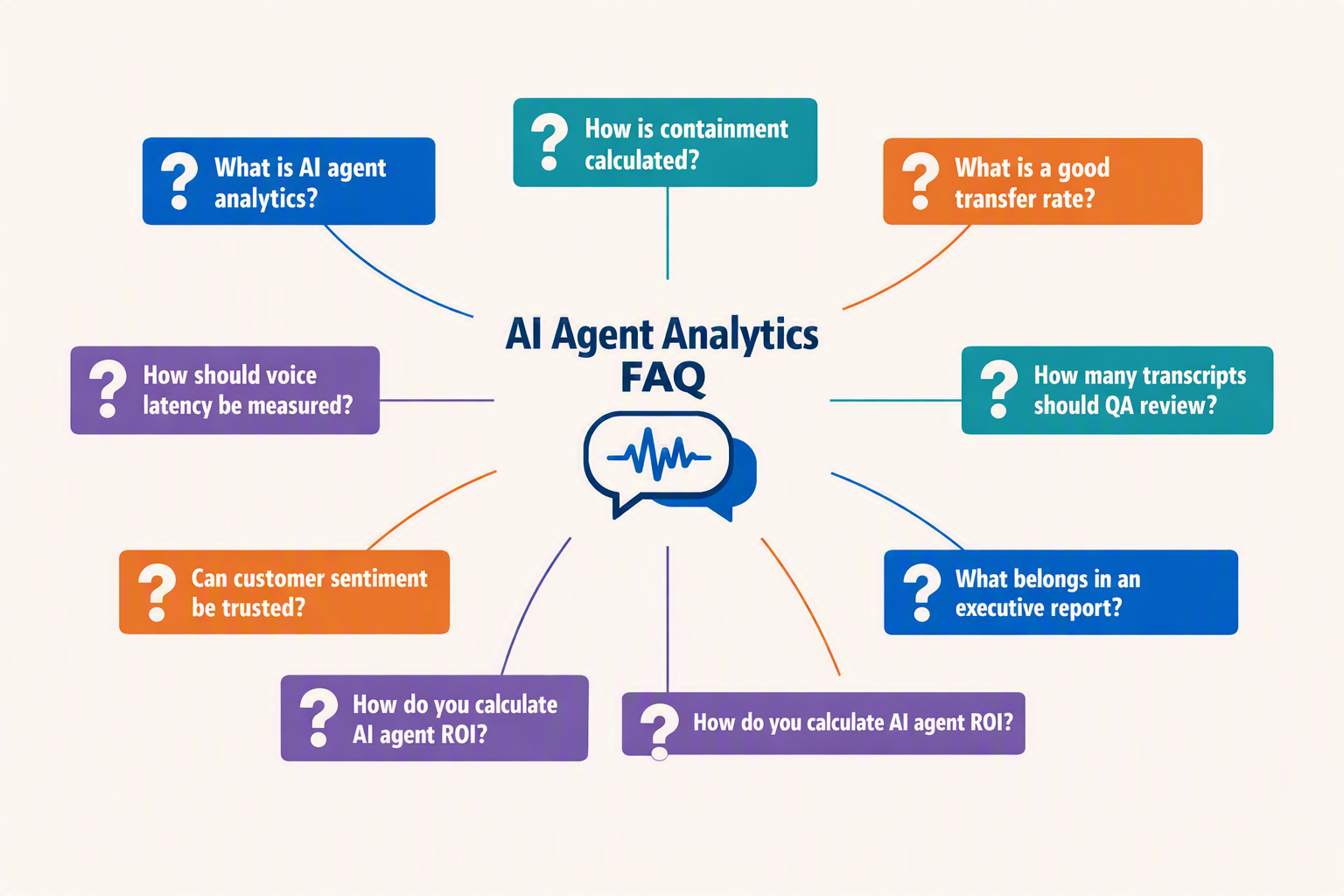
What is AI agent analytics, and how is it different from contact center analytics?
How does conversation intelligence improve an AI agent analytics dashboard?
What should a voice AI quality assurance scorecard measure?
Which customer service KPIs belong on an AI agent performance dashboard?
How should a business calculate AI agent ROI in 2026?
How can AI conversation analytics protect customer privacy and support QA governance?
Conclusion
AI agent analytics in 2026 should prove business value, not merely automation volume. The strongest measurement systems connect every call or message to resolution quality, revenue impact, customer experience, risk, and the total cost of engagement.
The practical takeaways
- Measure outcomes, not isolated activity. Traditional contact center analytics such as call volume, queue length, and handling time remain useful, but they cannot show whether an AI agent solved the customer’s problem. Track containment, transfer rate, conversion, repeat contact, response time, end-to-end latency, and verified CRM outcomes together.
- Interpret containment and speed in context. A 70% containment rate can hide lost sales or mishandled complaints if the AI keeps conversations that should reach a human. Similarly, a fast first response is not a success when slow tool calls, incomplete answers, or incorrect routing prevent completion.
- Turn conversations into an improvement system. Effective conversation intelligence, AI call analytics, and voice AI quality assurance combine transcripts, recordings, dispositions, tool events, scorecards, testing, and human review. Weekly optimization cycles should identify weak intents, knowledge-base gaps, incorrect transfers, latency bottlenecks, and performance differences across channels, languages, campaigns, and customer segments.
- Calculate financial impact against a clear baseline. Customer service KPIs become commercially meaningful only when linked to incremental revenue, recovered leads, avoided workload, implementation effort, platform usage, and the cost of human escalation. A credible AI agent ROI model measures cost per successful resolution—not simply the number of automated interactions.
What to watch next
The next phase of AI communication analytics will demand tighter links between operational dashboards and executive reporting. Leaders should watch whether reporting can distinguish successful self-service from false containment, connect conversions to specific conversations, evaluate sentiment only where it is reliable, and preserve privacy throughout transcript review and quality assurance.
CallMissed supports this outcome-focused approach across AI voice agents, WhatsApp chat and Business calling, email, and web workflows, with transcript-driven review and support for 22 Indian languages. Teams can explore CallMissed to see how omnichannel analytics and multilingual automation can fit into a continuous-improvement program.
The decisive question for 2026 is no longer “How many conversations did the AI handle?” It is: How many valuable customer outcomes did the AI create—and can your evidence prove it?
Related Reading
Discussion
Related Posts


Ready to automate customer conversations?
Launch AI voice agents and WhatsApp bots with CallMissed — one API, 22+ Indian languages.