
After Hours Answering Service AI: Practical 2026 Guide for Service Businesses


Learn how after hours answering service AI triages urgent calls, recovers missed leads, books jobs, and measures safe 2026 performance.
After Hours Answering Service AI: Practical 2026 Guide for Service Businesses
What happens when a high-intent customer calls at 10:47 p.m.—and nobody answers? Salesforce reported in its 2023 State of the Connected Customer that 77% of customers expect to interact with someone immediately when they contact a company. In 2026, after hours answering service AI gives service businesses a practical way to meet that expectation without permanently staffing a night shift.
The opportunity goes beyond keeping the phone from ringing out. A well-designed AI phone answering service can identify the caller, capture the job details, distinguish an emergency from a routine request, offer an appointment slot, and send a structured summary to the on-call employee. Zendesk’s CX Trends 2024 report found that 51% of consumers prefer interacting with bots when they need immediate service, reinforcing the value of fast automated responses when human teams are unavailable.
However, automation must be governed carefully. A burst pipe, suspected gas leak, stranded vehicle, urgent medical symptom, and next-week maintenance enquiry cannot follow the same workflow. Effective after hours call answering therefore depends on explicit triage rules, approved scripts, location checks, consent notices, and reliable emergency call routing. AI should never improvise safety advice, promise an arrival time it cannot verify, or classify a dangerous situation using vague assumptions.
This practical guide explains how to build an AI answering service for small business operations around four outcomes:
- Answer every call: Use a 24/7 virtual receptionist to greet callers consistently and collect essential information.
- Triage safely: Separate routine jobs, priority requests, and genuine emergencies using business-approved criteria.
- Recover missed demand: Trigger callbacks or WhatsApp follow-up when callers disconnect, lines fail, or escalation is unavailable.
- Create actionable records: Capture names, service locations, issue descriptions, appointment preferences, consent, and escalation history.
Platforms such as CallMissed support this model by connecting AI voice agents with WhatsApp follow-up, an omnichannel inbox, and communication across 22 Indian languages.
The sections ahead provide workflow examples, script templates, escalation logic, safety controls, implementation checklists, and performance metrics—including answer rate, qualified-lead capture, emergency-transfer success, booking conversion, abandonment, and false-escalation rate. The goal is not simply to “answer after hours,” but to turn every overnight interaction into a safe, measurable, and operationally useful next step.
What is after hours answering service AI? A system that answers, triages, captures, books, and escalates calls after closing — Introduction
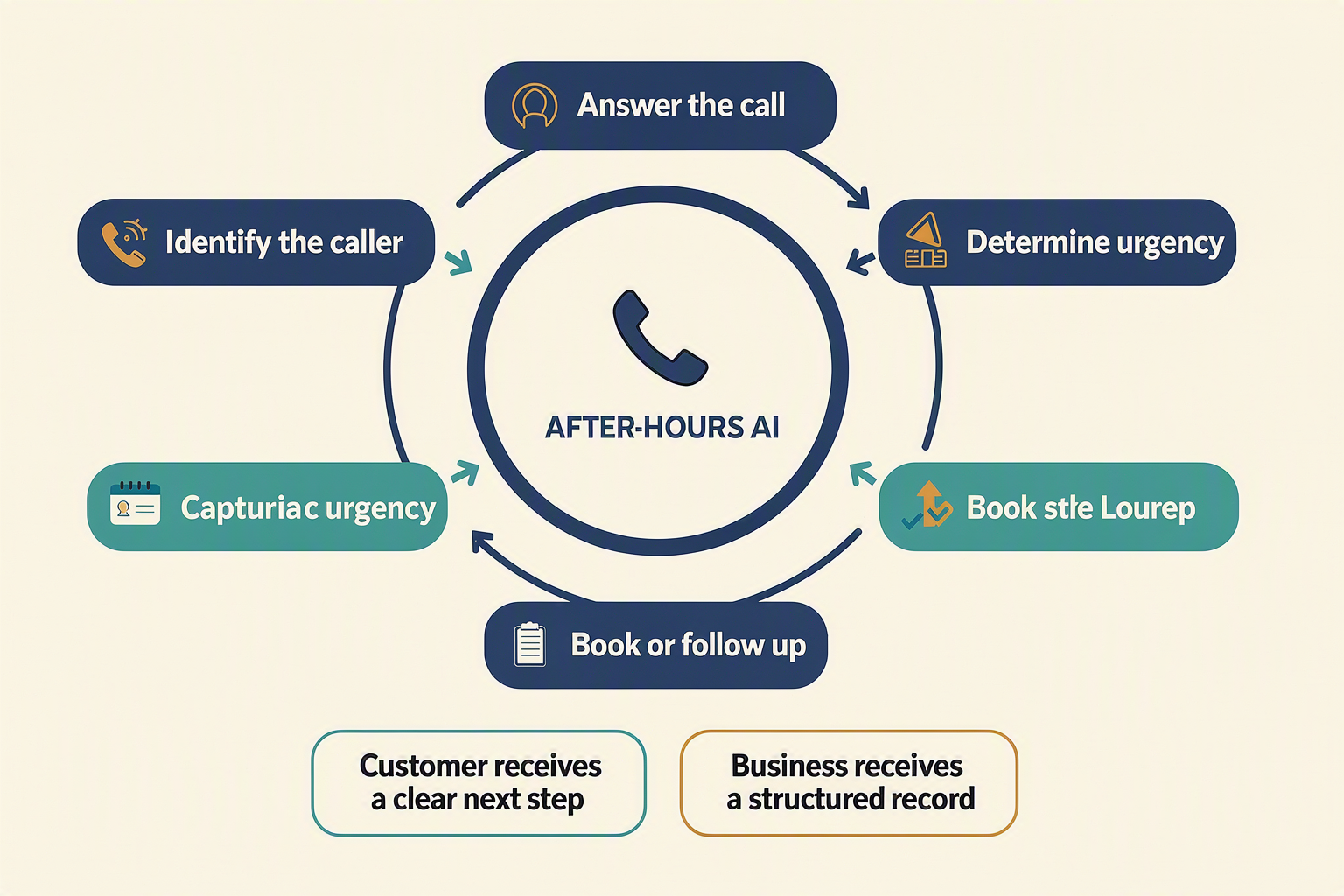
After hours answering service AI is software that handles service calls outside normal operating hours, applies predefined triage rules, records the request, offers approved appointment options, and escalates urgent cases to a human. Unlike basic voicemail, it converts an unanswered call into a structured operational workflow.
From ringing phone to actionable next step
An AI phone answering service combines telephony, speech recognition, conversational AI, business rules, scheduling tools, and customer records. The system should know when the business is closed, which locations it serves, what constitutes an emergency, and who is on call.
A typical interaction follows six steps:
- Answer: Greet the caller, identify the business, disclose automation where required, and state that the call may be recorded.
- Identify: Collect the caller’s name, callback number, service address, and customer status.
- Understand: Ask concise questions about the problem, timing, impact, and relevant safety indicators.
- Classify: Assign the request to an approved category such as routine, priority, emergency, or out of scope.
- Act: Book or request an appointment, create a lead, send WhatsApp confirmation, or initiate emergency call routing.
- Record: Store the transcript, summary, consent status, classification, and outcome for staff review.
This responsiveness matches changing customer expectations. Salesforce reported in its 2023 State of the Connected Customer that 77% of customers expect to interact with someone immediately when contacting a company. Zendesk reported in CX Trends 2024 that 51% of consumers prefer bots when they need immediate service.
More than a virtual receptionist
A 24/7 virtual receptionist answers consistently, but reliable after-hours automation also needs decision logic. For example, a plumbing company might treat an actively flooding property as urgent while scheduling a dripping tap for the next available daytime slot. A towing operator might escalate a stranded driver in an unsafe location while recording a future vehicle-transport enquiry as routine.
The AI does not independently decide what is dangerous. The business defines:
- Emergency triggers: Approved words, conditions, locations, and risk indicators.
- Mandatory questions: Details required before classification or dispatch.
- Escalation paths: Primary, secondary, and failure contacts with time limits.
- Prohibited responses: No invented safety guidance, unsupported diagnosis, or unverified arrival promises.
- Fallback actions: Instructions for disconnected calls, unavailable staff, and uncertain classifications.
Where after-hours automation fits
For an AI answering service for small business, the practical objective is controlled continuity rather than replacing every human interaction. The system handles repetitive intake and scheduling while reserving judgement-intensive, sensitive, or dangerous situations for trained people.
Effective after hours call answering also extends beyond voice. If a caller disconnects, the workflow can send a consent-aware WhatsApp message, request missing details, and place the conversation in a shared inbox. CallMissed supports this connected model through AI voice agents, WhatsApp engagement, an omnichannel inbox, and communication across 22 Indian languages, helping Indian service businesses serve regional-language callers without treating multilingual support as an add-on.
The result is measurable: each overnight call should end with a booking, qualified lead, documented callback, safe escalation, or clearly recorded out-of-scope outcome—not an unreviewed voicemail.
Why does an AI answering service for small business outperform voicemail after closing? — Background & Context
An AI answering service for small business outperforms voicemail after closing because it turns a one-way recording into a two-way, actionable workflow. Voicemail merely stores whatever message a caller chooses to leave; after hours answering service AI can ask follow-up questions, apply approved triage rules, request an appointment, and escalate urgent cases in real time.
Voicemail creates delay at the moment intent is highest
A caller contacting a plumber, towing company, clinic, repair centre, or property manager after closing usually wants a clear next step—not instructions to “leave a message after the tone.” Salesforce reported in its 2023 State of the Connected Customer that 77% of customers expect to interact with someone immediately when they contact a company.
Traditional voicemail creates several operational gaps:
- Callers may hang up without leaving their name or service location.
- Messages may omit critical details, such as whether water is actively flowing or a vehicle is blocking traffic.
- Staff must listen to recordings sequentially before prioritising them.
- The caller receives no confirmation that the request was understood.
- A high-value lead may contact another provider before the business reopens.
An AI phone answering service reduces these gaps through structured conversation. Instead of accepting an unstructured recording, it can confirm spelling, repeat addresses, collect callback consent, identify the requested service, and create a timestamped record for the morning team.
Automation produces an outcome, not just a message
The practical advantage of after hours call answering is that every response can trigger a business-approved action. A typical interaction can follow four steps:
- Identify: Collect the caller’s name, number, location, and customer status.
- Understand: Ask targeted questions about the problem, its severity, and when it began.
- Act: Offer an appointment request, send a WhatsApp confirmation, or initiate emergency call routing.
- Record: Save the transcript, summary, disposition, and escalation result in the relevant inbox or CRM.
Zendesk’s CX Trends 2024 report found that 51% of consumers prefer interacting with bots when they need immediate service. That preference supports automation for straightforward tasks, but it does not justify removing human escalation from high-risk scenarios.
The performance difference depends on workflow design
A 24/7 virtual receptionist is more useful than voicemail only when its boundaries are explicit. The system should distinguish between:
- Routine: Quotes, availability questions, maintenance requests, and future bookings.
- Priority: Service interruptions or time-sensitive issues that warrant an early callback.
- Emergency: Situations matching predefined criteria for immediate transfer or instructions to contact public emergency services.
The AI should not diagnose hazards, invent safety guidance, or guarantee response times. If information is ambiguous, the safer workflow is to escalate or present an approved fallback—not guess.
Platforms such as CallMissed can connect an AI voice agent with WhatsApp follow-up and an omnichannel inbox, allowing the conversation to continue after the call. This is particularly relevant for Indian service businesses: CallMissed supports speech and chat workflows across 22 Indian languages, helping regional callers communicate naturally while giving staff a structured record.
The core distinction is simple: voicemail captures audio for later; after-hours AI captures intent and initiates the next approved action now.
Which 2026 capabilities distinguish a 24/7 virtual receptionist from basic after hours call answering? — Key Developments
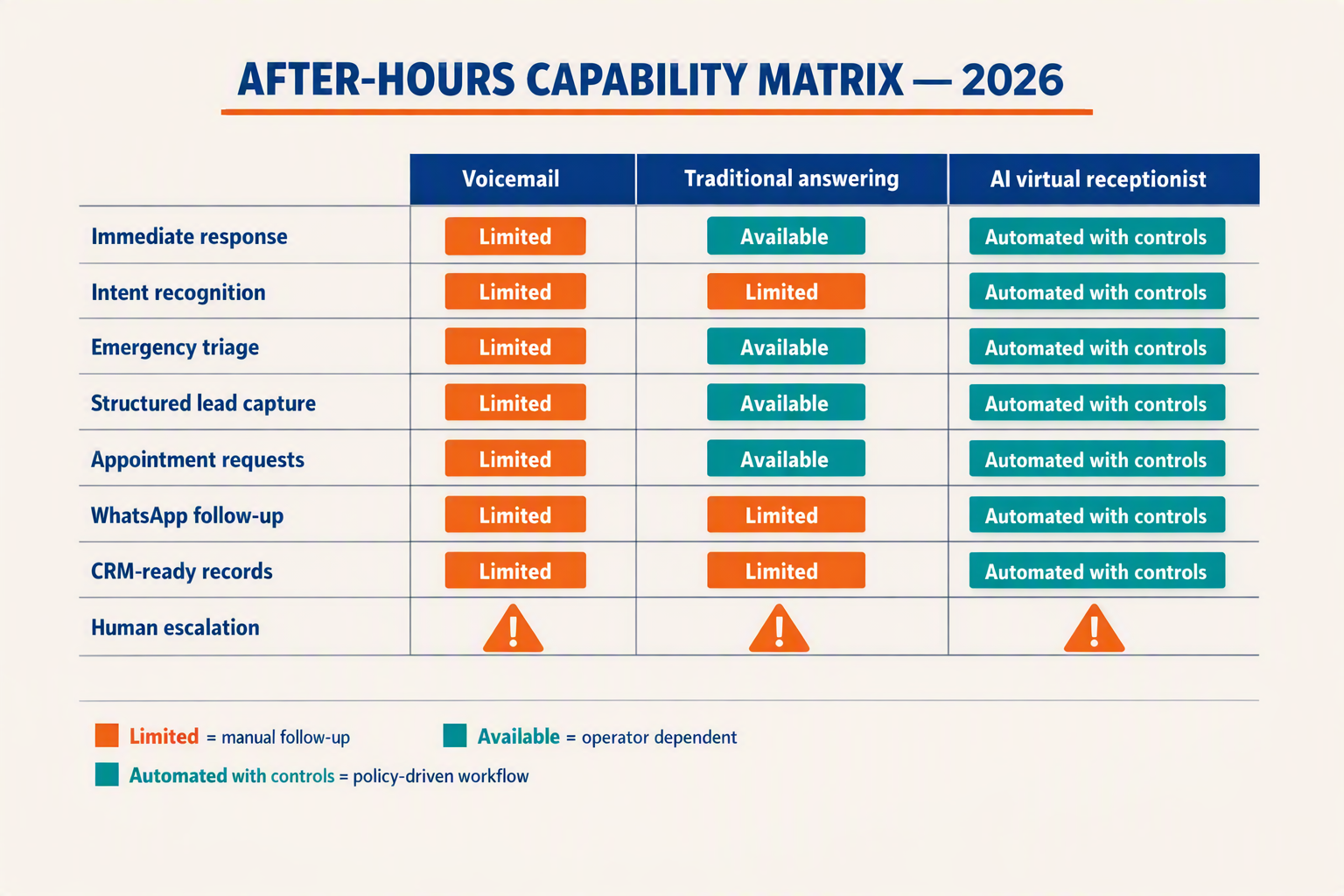
A 24/7 virtual receptionist can go beyond taking messages by identifying caller intent, collecting required details, applying business-defined triage rules, initiating approved workflows, and creating a reviewable record. In 2026, the practical distinction is controlled workflow execution with safeguards, not simply a human-sounding voice.
Capabilities vary by provider, subscription, integration, language, location, and configuration. Businesses should test each workflow before relying on it after hours.
Capability comparison for 2026
| Capability | Basic after-hours answering | 2026 virtual receptionist | Practical requirement |
|---|---|---|---|
| Caller understanding | Captures a name, number, and message | Can extract intent, location, service type, urgency, and requested next step | Confirm critical details aloud and provide a fallback when recognition confidence is low |
| Urgency handling | Flags calls as urgent based on caller wording or operator judgment | Can apply business-approved rules to distinguish emergency, priority, and routine cases | Configure explicit triggers and uncertainty escalation; never present the AI as a substitute for public emergency services |
| Action completion | Sends a voicemail or general notification | Can create tickets, qualify leads, request appointments, or update connected systems | Limit actions to approved permissions; verify live availability before confirming any appointment or arrival window |
| Escalation | Forwards calls to a designated number | Can route by issue, location, schedule, skill, or on-call availability | Configure routing rules, retry limits, fallback contacts, and failed-transfer recovery |
| Cross-channel follow-up | Leaves follow-up to daytime staff | Can continue an interaction through supported messaging channels while preserving context | Obtain any consent required by applicable law or platform policy and record delivery, replies, and handoffs |
| Governance and measurement | Stores recordings or written messages | Can produce structured summaries, outcomes, timestamps, and exception logs | Apply retention and access controls; monitor transfer success, incorrect escalations, abandonment, and completed actions |
What the upgraded workflow looks like
A capable AI phone answering service should follow a bounded, documented workflow rather than conduct an unrestricted conversation:
- Provide appropriate notice that the caller is interacting with automation and, where relevant, that the call may be recorded. Exact notice and consent requirements depend on the jurisdictions involved.
- Confirm the caller and service location when routing, account access, or dispatch depends on postcode, city, coverage area, or customer status.
- Classify the request using narrow categories approved by the business.
- Ask scripted safety or urgency questions only within the company’s defined scope.
- Take an approved action, such as capturing a message, attempting a transfer, creating a ticket, requesting an appointment, or scheduling a next-business-day callback.
- Record the outcome so authorized staff can review the summary, captured details, urgency decision, consent status where applicable, and escalation attempts.
This makes after hours answering service AI operationally different from basic after hours call answering. Depending on the provider and configuration, it may connect with calendars, customer records, ticketing tools, knowledge sources, or messaging channels. Those connections should use minimum necessary permissions and clearly defined failure handling.
Appointment booking and dispatch are not automatic capabilities of every AI receptionist. They require compatible integrations, current availability data, service-area rules, and explicit authorization. If the relevant system is unavailable or the information cannot be verified, the AI should capture a request rather than promise a confirmed appointment, technician, or arrival time.
Safety and continuity are non-negotiable
AI-based urgency handling must not replace emergency services. An AI receptionist should not diagnose conditions, improvise medical or safety advice, or imply that contacting the business is equivalent to contacting an emergency authority. For immediate threats to life, health, property, or public safety, the workflow should direct callers to the appropriate local emergency service.
Any company-specific emergency call routing must be configured in advance. The business should define which situations qualify for an on-call escalation, which questions may be asked, who receives the transfer, and what happens if no one answers. Keyword detection or sentiment analysis alone is not a reliable emergency process.
A dependable AI answering service for small business should also include recovery paths:
- If a transfer fails, follow configured retry and fallback rules, then clearly tell the caller what will happen next.
- If a caller disconnects, create a missed-call task and use an approved follow-up channel only when permitted and properly configured.
- If speech recognition confidence is low, repeat essential details, ask the caller to clarify, offer keypad input where supported, or escalate instead of guessing.
- If a calendar, CRM, dispatch platform, or ticketing system is unavailable, record the request without claiming that an action was completed.
- If the request falls outside the approved knowledge base or workflow, route it to a person or schedule follow-up rather than generating an unsupported answer.
When evaluating CallMissed or another provider, confirm the currently available voice, messaging, language, integration, recording, retention, and reporting features for the intended plan and market. WhatsApp calling or messaging, multilingual handling, CRM updates, booking, and cross-channel context should be treated as provider-, account-, region-, and configuration-dependent capabilities—not assumed defaults.
How should an AI phone answering service separate routine requests from emergency call routing? — In-Depth Analysis
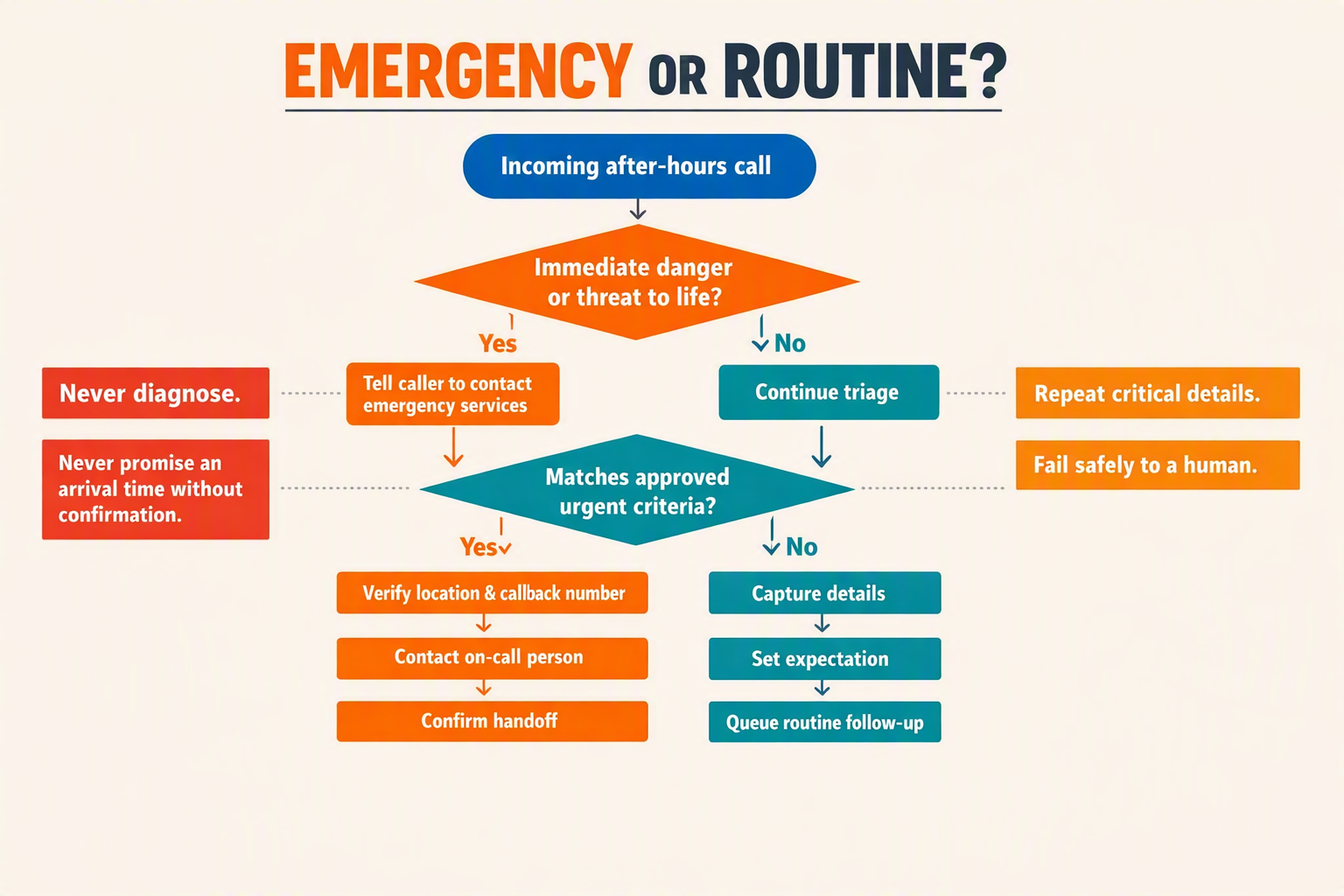
An AI phone answering service should separate routine requests from emergencies using a business-approved decision tree—not an open-ended model judgement. The safest design combines explicit trigger conditions, structured questions, location verification, and a fail-safe rule that sends ambiguous high-risk cases to a trained human or public emergency service.
Use three operational priority levels
Every call should enter one of three queues:
- Emergency: There is an immediate threat to life, safety, property, or the environment. Examples include a suspected gas leak, active flooding near electrical equipment, fire, entrapment, or a vehicle stopped in a dangerous location.
- Urgent service: The situation needs prompt attention but does not present an immediate danger. Examples include a failed commercial refrigerator, a blocked toilet in an occupied property with no alternative, or a customer locked out in safe surroundings.
- Routine request: The work can wait until normal operating hours. Typical cases include quotations, preventive maintenance, billing questions, appointment changes, and non-critical repairs.
These categories must reflect the business’s actual services, on-call coverage, geography, and insurance requirements. A plumbing company and a roadside-assistance provider should not use identical definitions.
Ask structured questions in a safe order
Effective after hours call answering should collect only the information needed to choose the next action. A practical sequence is:
- “Are you or anyone else in immediate danger?”
- “What is happening right now?”
- “Is there fire, smoke, gas, flooding, injury, or exposed electricity?”
- “What is the complete service address or current location?”
- “What is the best callback number if the call disconnects?”
- “Is the problem active, contained, or getting worse?”
The AI should confirm critical details aloud: “I heard that you smell gas at 14 Park Road. Is that correct?” It should not diagnose equipment, tell callers to touch unsafe systems, or claim that a technician is en route before dispatch confirms availability.
Build deterministic escalation rules
The underlying model can understand natural language, but emergency call routing should rely on explicit policy conditions. For example:
IF fire, injury, suspected gas, electrocution, or immediate danger:
    advise caller to contact public emergency services
    do not delay the caller with lead-capture questions
    notify the approved on-call contact
ELSE IF active property damage or essential-service failure:
    verify address and callback number
    attempt on-call transfer
    send fallback alert if unanswered
ELSE:
    capture request and offer the next available appointment
In India, the Ministry of Home Affairs’ Emergency Response Support System uses 112 as the pan-India emergency number. An AI answering service for small business should clearly distinguish calling 112 from contacting the company’s own emergency technician; the latter is not a substitute for police, fire, or medical assistance.
Design for failed transfers and uncertainty
A 24/7 virtual receptionist needs a fallback path for every escalation. If the first on-call employee does not answer within a configured interval, the system should try the next approved contact, create a timestamped incident, and send the caller an SMS or WhatsApp acknowledgement without promising an arrival time.
After hours answering service AI should escalate uncertainty rather than conceal it. Low-confidence transcripts, conflicting answers, distressed callers, unsupported languages, and incomplete locations should trigger human review. Teams should then audit false emergencies, missed emergencies, transfer success, and time-to-human-contact weekly so that triage rules improve without weakening safety controls.
How do missed-call recovery, WhatsApp follow-up, lead capture, and appointment requests work in a CallMissed workflow? — Impact & Implications
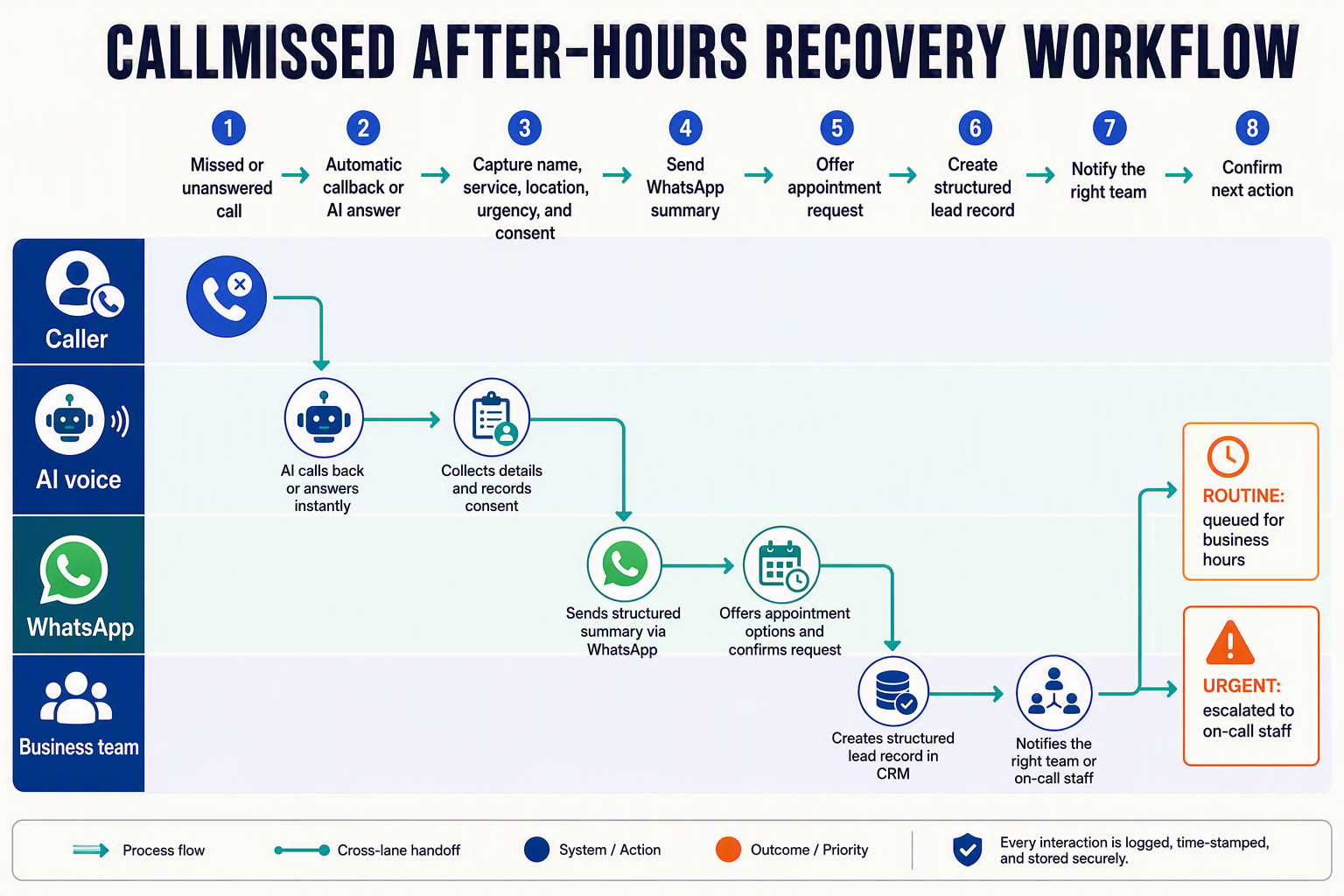
A CallMissed workflow converts an unanswered or completed after-hours call into a structured customer record, then coordinates WhatsApp follow-up, lead capture, appointment requests, and human escalation. The operational goal is a verified next step—not merely an automated message claiming that someone will respond.
The end-to-end recovery workflow
A practical workflow follows six stages:
- Detect and acknowledge the contact.
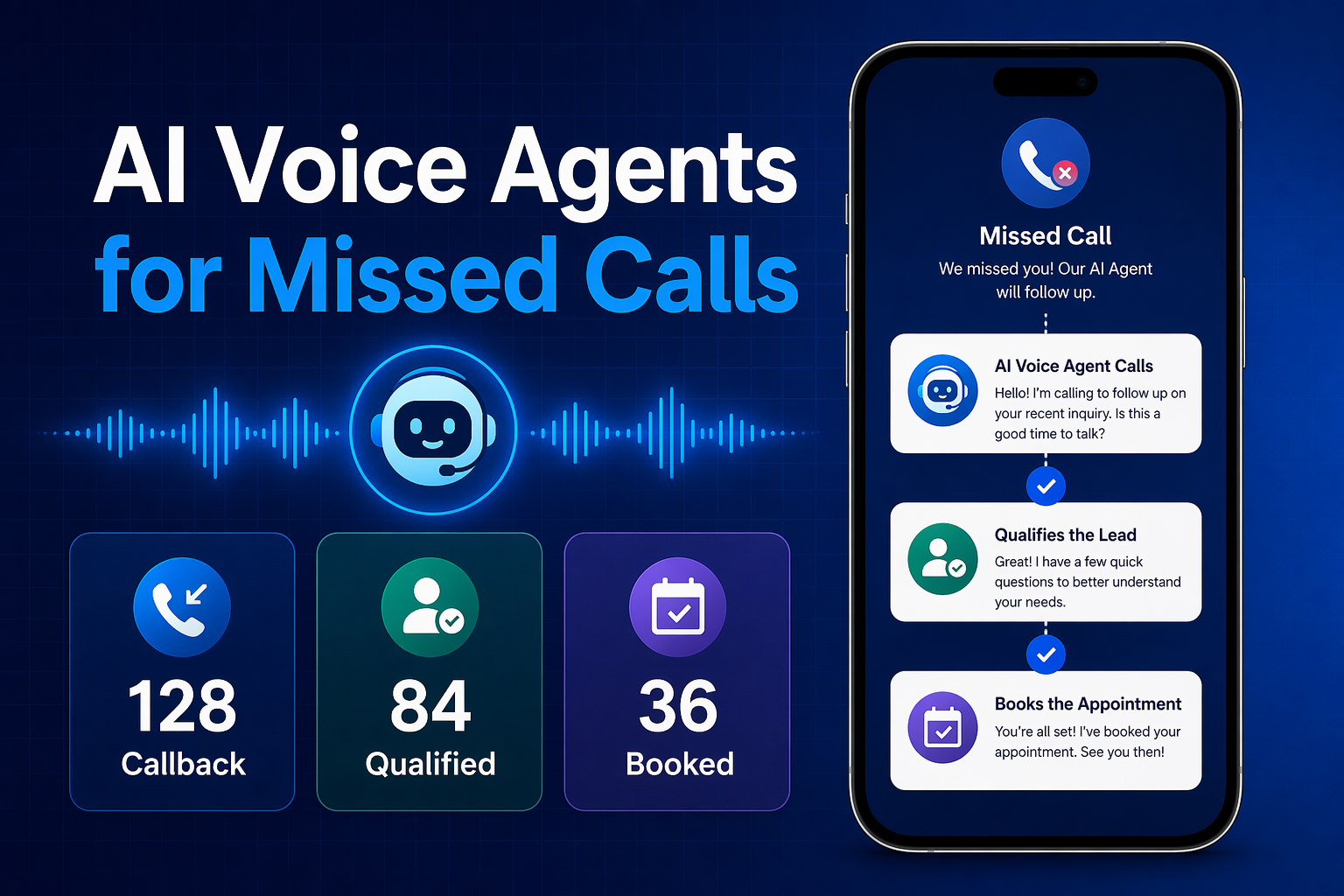
The AI phone answering service handles the incoming call. If the caller disconnects, the line fails, or no agent becomes available, the missed-call event starts a recovery workflow rather than remaining an unworked call log.
- Create or update the lead.
The system records the caller’s phone number and captures essential fields such as:
- Name and preferred language
- Service address or postcode
- Type of service required
- Problem description and time sensitivity
- Existing-customer status
- Preferred callback and appointment window
- Apply the approved triage rules.
Routine enquiries proceed to follow-up, while safety-critical answers trigger emergency call routing to the designated on-call person. If an emergency transfer fails, the workflow should log every attempt, provide the business-approved fallback instruction, and flag the case prominently for human review.
- Send a consent-aware WhatsApp follow-up.
Where the business has an appropriate basis and customer opt-in to message, WhatsApp can confirm that the request was received, restate the captured details, and ask for missing information. It must not imply that a technician has been dispatched unless dispatch is genuinely confirmed.
- Capture an appointment request.
The customer can choose a preferred date or time window through voice or WhatsApp. Without a real-time calendar and booking confirmation, the message should say “appointment requested”, not “appointment booked.”
- Place everything in one operational queue.
Call transcripts, summaries, WhatsApp replies, urgency labels, appointment preferences, and escalation history should appear in the same inbox or CRM record.
What this looks like in CallMissed
CallMissed combines an AI voice agent, WhatsApp automation, and an omnichannel inbox, allowing one conversation to continue across channels without forcing staff to reconstruct the caller’s story. Its support for 22 Indian languages is particularly relevant when an AI answering service for small business needs to serve regional-language customers after closing.
For example, a caller reporting that an air conditioner has stopped cooling could receive this sequence:
- The 24/7 virtual receptionist collects the location, equipment type, symptoms, and preferred visit time.
- Approved rules classify the request as routine rather than a safety emergency.
- WhatsApp sends a concise summary: “We recorded an AC service request for tomorrow morning. Reply 1 to confirm the details or send a photo of the unit.”
- The morning team receives a qualified lead with the transcript and requested slot.
- Staff confirm availability before communicating a final appointment.
Business impact and control implications
Salesforce reported in its 2023 State of the Connected Customer that 77% of customers expect an immediate interaction when contacting a company. Zendesk reported in CX Trends 2024 that 51% of consumers prefer bots when they need immediate service.
Those expectations make rapid recovery valuable, but after hours answering service AI should be measured by operational outcomes:
- Missed calls recovered
- Complete leads captured
- WhatsApp response rate
- Appointment requests converted
- Emergency transfers completed
- Duplicate records and unwanted messages
- Time from overnight enquiry to human action
Effective after hours call answering therefore creates continuity: the customer receives acknowledgment, while the morning team receives a complete, prioritised, and auditable record.
What do experts recommend for scripts, safety controls, escalation, and reliable customer handoffs? — Expert Opinions
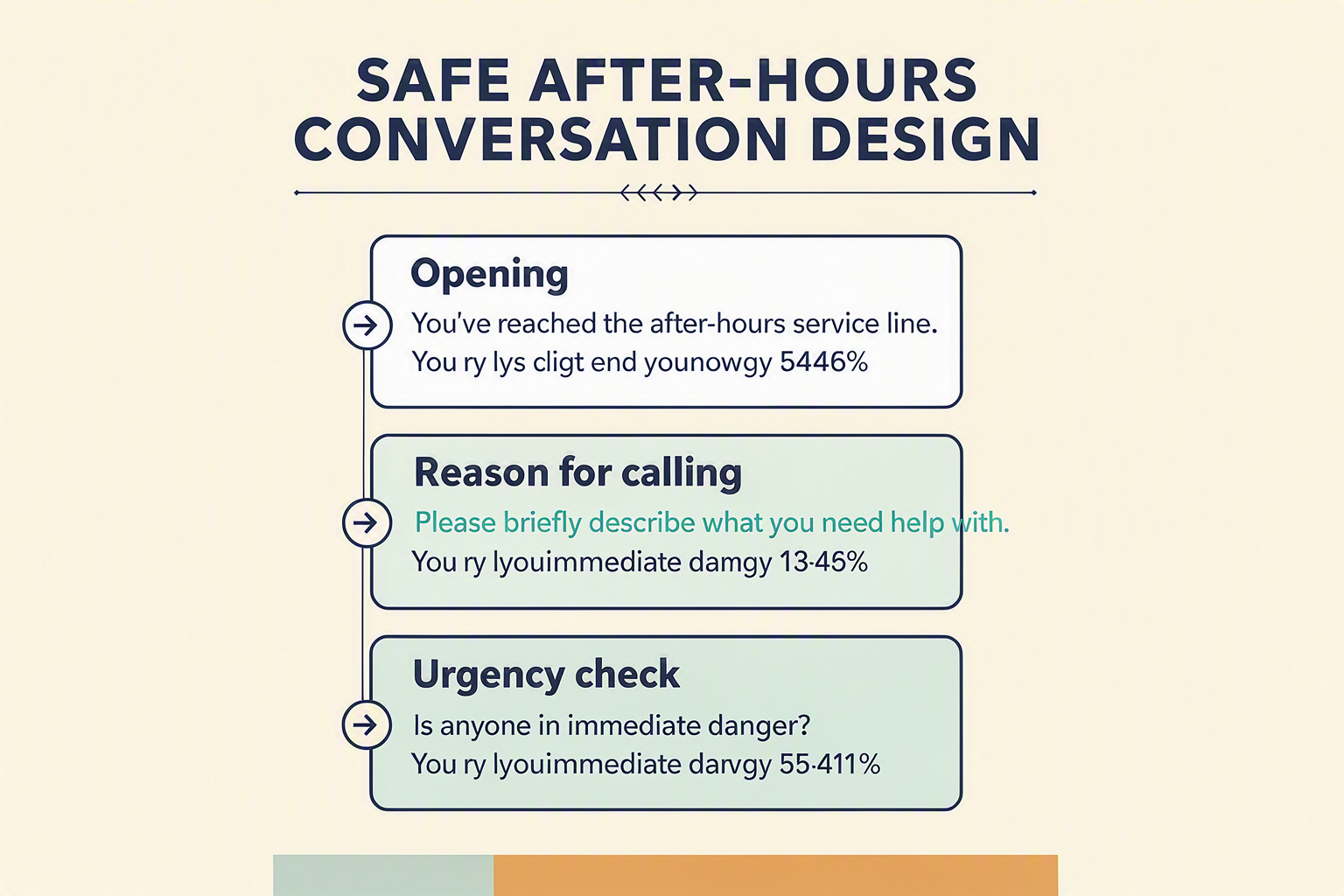
Experts recommend treating automation as a controlled intake and routing system—not an autonomous emergency decision-maker. Scripts should constrain what the AI can say, safety rules should default to human or public-emergency escalation, and every handoff should be acknowledged and logged.
Write scripts as bounded decision trees
A reliable after hours answering service AI script should use short questions, confirm critical details, and avoid open-ended promises. The NIST AI Risk Management Framework 1.0, published in January 2023, recommends governing, mapping, measuring, and managing AI risk throughout the system lifecycle.
A practical opening is:
“You’ve reached [Business Name] after hours. I can help assess your request, collect the service details, and contact the on-call team when required. If anyone is in immediate danger, contact the appropriate emergency service now.”
Experts generally recommend that an AI phone answering service collect information in this order:
- Immediate danger: Ask whether people, property, or the environment face an active threat.
- Caller and location: Confirm the caller’s name, callback number, full address, landmark, and service area.
- Observable facts: Ask what the caller can see, hear, or smell—without diagnosing the cause.
- Operational priority: Apply approved emergency, priority, or routine criteria.
- Next action: State whether the system will transfer, alert the on-call team, or record an appointment request.
The AI must read back telephone numbers and addresses rather than assuming speech recognition is correct.
Install non-negotiable safety controls
ISO/IEC 42001:2023 established requirements for an AI management system, including organizational controls for managing AI risks and responsibilities. For after hours call answering, those controls should include:
- Prohibited advice: Never provide medical, electrical, gas, fire, security, or mechanical instructions unless an authorized expert has approved the exact wording.
- Confidence thresholds: Unclear intent, incomplete addresses, repeated recognition failures, and contradictory answers should trigger human review.
- Tool restrictions: The 24/7 virtual receptionist may access approved availability and customer records but should not alter prices, waive policies, or promise dispatch times without verified system data.
- Privacy boundaries: Avoid requesting payment-card details in an ordinary recorded call. PCI DSS v4.0.1, published by the PCI Security Standards Council in June 2024, requires organizations to protect account data across storage, processing, and transmission.
- Prompt-injection resistance: Treat caller instructions and retrieved documents as untrusted input; neither should override the system’s safety policy.
Make escalation closed-loop, not “message sent”
Effective emergency call routing requires confirmation that a qualified person received responsibility. The workflow should attempt the primary on-call contact, retry after a defined interval, contact a backup, and then follow the organization’s documented fail-safe procedure.
Every handoff should contain:
- Caller identity and verified callback number
- Exact service location
- Issue summary and observable hazards
- Triage category and rule that triggered it
- Transcript or recording reference
- Actions already taken
- Time, recipient, and acknowledgement status
If nobody accepts the case, the AI answering service for small business should tell the caller truthfully that contact has not been confirmed and provide the approved alternative—not claim that “someone is on the way.”
Platforms such as CallMissed can keep the voice interaction, WhatsApp follow-up, and agent inbox in one operational workflow. Regardless of platform, experts recommend testing every escalation path monthly, including unavailable staff, failed transfers, duplicate alerts, low-confidence transcription, and caller disconnection.
What does a practical CallMissed rollout require, and which metrics prove it works? — What This Means For You
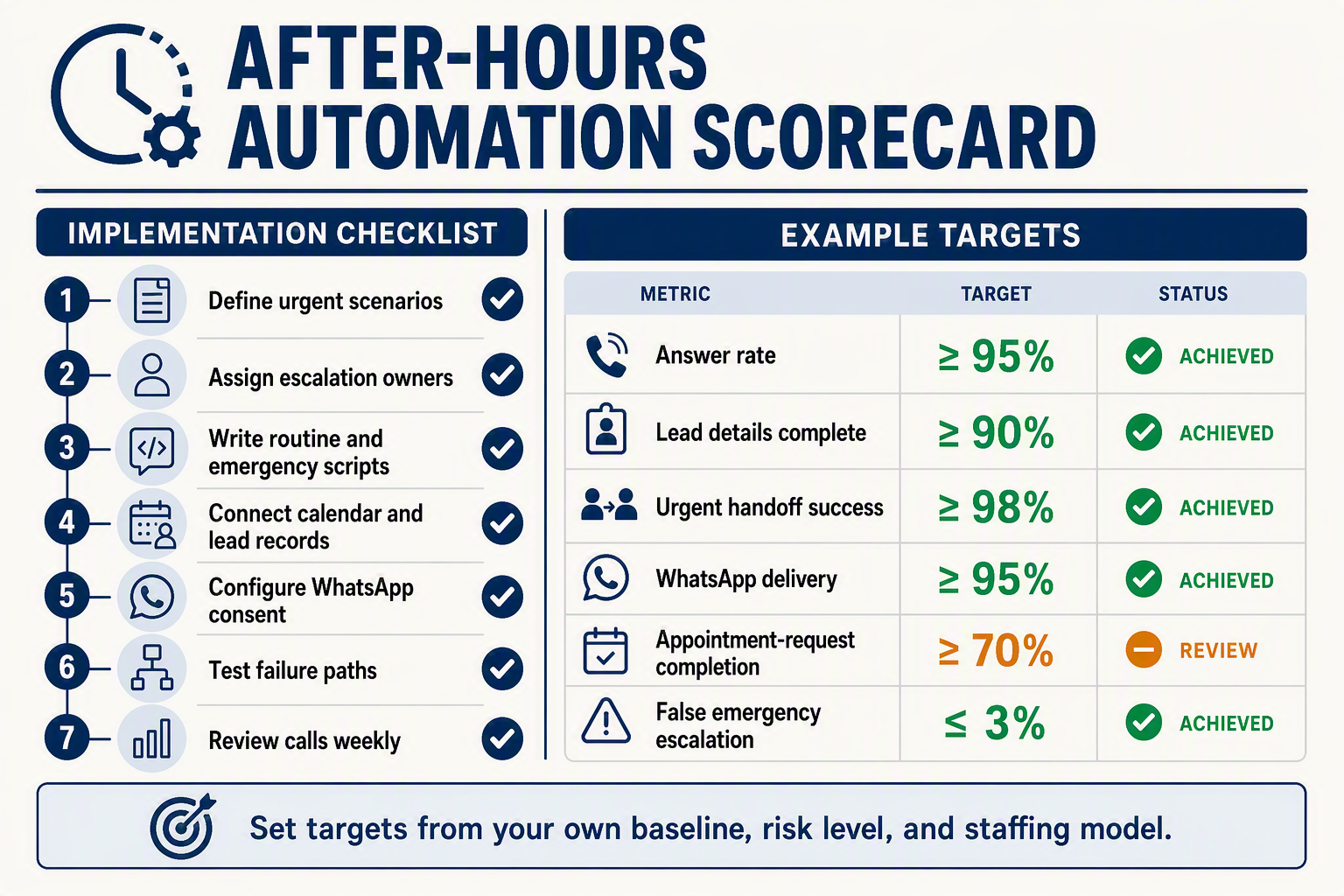
A practical CallMissed rollout requires documented routing rules, controlled testing, human escalation ownership, and baseline metrics collected before launch. Success is proven when after-hours calls produce more complete records, successful transfers, recovered conversations, and bookings—without increasing unsafe or unnecessary escalations.
Roll out in controlled stages
Do not activate a 24/7 virtual receptionist across every number and workflow at once. Use a phased implementation:
- Establish the baseline: Export at least two to four weeks of after-hours call data, including unanswered calls, callbacks, booked jobs, abandoned calls, and emergency transfers.
- Configure the workflow: Define operating hours, service areas, caller-consent language, required lead fields, appointment-request rules, and emergency criteria. Assign a named primary and backup contact for every escalation window.
- Test realistic scenarios: Run routine, ambiguous, urgent, multilingual, silent-caller, failed-transfer, and caller-disconnection tests. Verify what happens when the on-call employee does not answer.
- Launch a limited pilot: Start with one location, service category, or overnight window. Review transcripts and summaries daily before expanding.
- Add channel recovery: Connect unanswered or disconnected calls to consent-aware WhatsApp follow-up. CallMissed can place voice, WhatsApp, email, and web conversations in an omnichannel inbox so staff can continue from the captured record.
- Review and expand: Approve additional languages, booking actions, campaigns, or locations only after the pilot meets its safety and data-quality gates.
The business case is response speed: Salesforce reported in its 2023 State of the Connected Customer that 77% of customers expect to interact with someone immediately when contacting a company. Likewise, Zendesk reported in CX Trends 2024 that 51% of consumers prefer bots when they need immediate service.
Use measurable launch gates
The following are practical pilot guardrails, not universal industry benchmarks; each business should adjust them for call volume, risk, staffing, and baseline performance.
| Metric | Calculation | Suggested pilot gate | What it reveals |
|---|---|---|---|
| After-hours answer rate | AI-answered eligible calls ÷ eligible calls | ≥95%, excluding documented carrier outages | Reliability of the AI phone answering service |
| Qualified-lead capture | Records with all required fields ÷ connected calls | ≥85% | Whether callers leave actionable details |
| Emergency-transfer success | Human-answered transfers ÷ emergency transfers attempted | Objective: 100%; investigate every failure | Reliability of emergency call routing |
| Booking conversion | Confirmed bookings or valid requests ÷ qualified routine enquiries | Must improve against the pre-launch baseline | Commercial value of after hours call answering |
| Missed-call recovery | Two-way recovered conversations ÷ eligible missed calls | Track voice and WhatsApp separately | Whether follow-up restores otherwise lost demand |
| False-escalation rate | Non-emergencies sent to on-call staff ÷ total escalations | Set by risk tolerance; trend downward weekly | Triage precision and on-call workload |
Also monitor early abandonment, median response time, WhatsApp delivery and reply rates, duplicate records, caller opt-outs, and the percentage of interactions requiring manual correction.
Turn metrics into operating decisions
Review the pilot weekly with operations, customer service, and the on-call team. Sample both successful and failed conversations rather than relying only on dashboard averages.
- High answer rate but low lead capture indicates a script or speech-recognition problem.
- High capture but low booking conversion may signal unavailable slots or weak handoff procedures.
- Frequent false escalations require narrower definitions, not pressure on the AI to make riskier assumptions.
- Failed emergency transfers require immediate routing, staffing, or telecom remediation.
For an AI answering service for small business, the decisive test is not how human the agent sounds. Effective after hours answering service AI must create a safe, traceable next action for every eligible call.
What should service businesses ask about cost, setup, emergencies, WhatsApp, compliance, and human backup? — Frequently Asked Questions
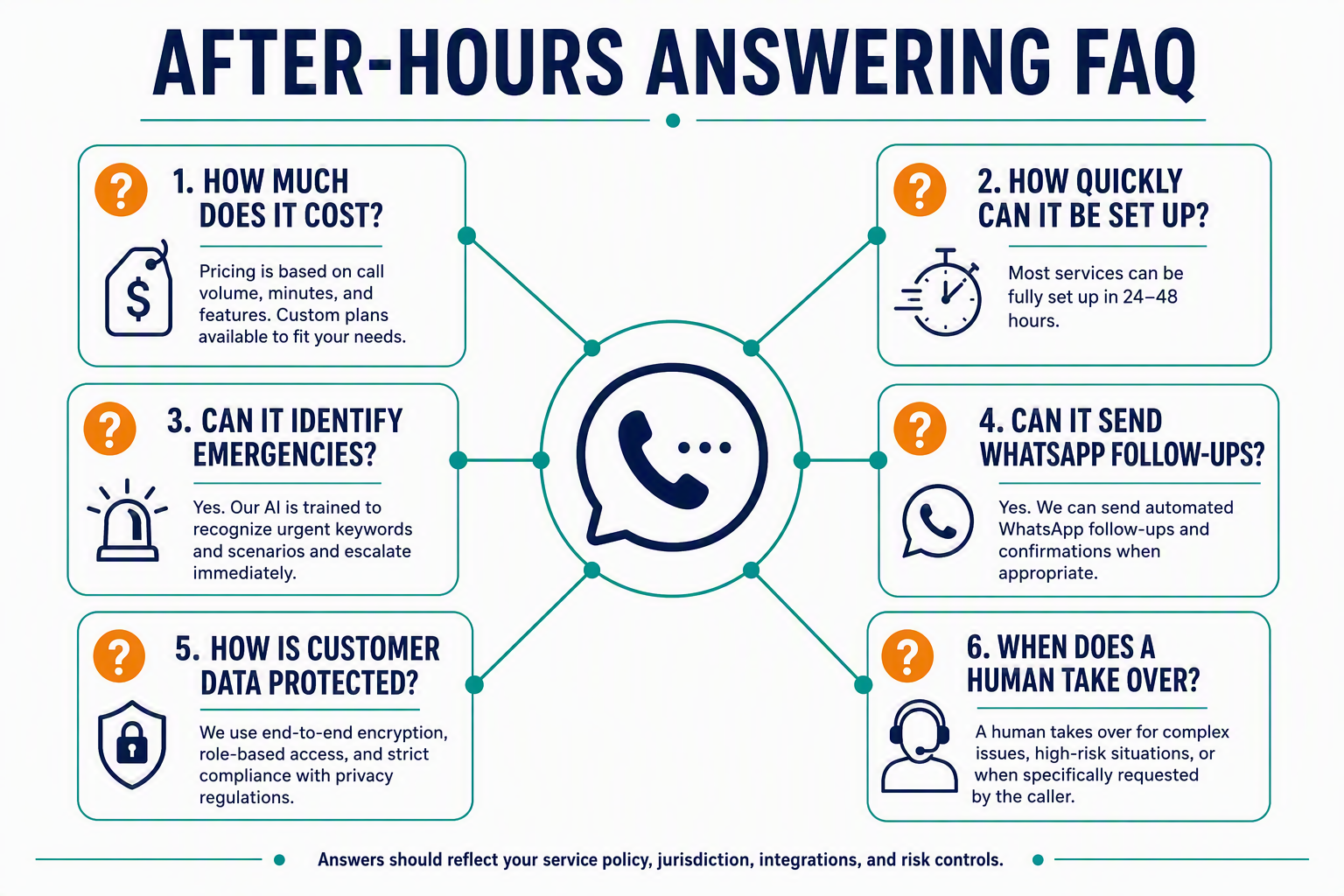
How much does after hours answering service AI cost for a service business?
How long does it take to set up after hours answering service AI?
Can an AI phone answering service safely handle emergency calls?
Can a 24/7 virtual receptionist send WhatsApp messages after an unanswered call?
What compliance questions should I ask an after hours answering service AI provider?
Does after hours call answering still need human backup?
Conclusion
After hours answering service AI should turn every overnight call into a safe, structured next step—not merely prevent voicemail. Salesforce’s 2023 State of the Connected Customer reported that 77% of customers expect to interact with someone immediately when they contact a company, while Zendesk’s CX Trends 2024 found that 51% of consumers prefer bots when they need immediate service. For service businesses in 2026, speed matters, but controlled execution matters more.
The practical takeaways are clear:
- Answer and capture consistently. A 24/7 virtual receptionist should verify the caller’s name, location, service need, appointment preference, and consent while creating an actionable record for the team.
- Separate emergencies from routine requests. Effective after hours call answering uses approved decision trees to distinguish safety-critical events from priority jobs and next-day enquiries. Emergency call routing must follow explicit escalation rules, with no improvised safety advice or unverified arrival promises.
- Recover demand across channels. If a caller disconnects, a transfer fails, or the on-call employee is unavailable, the workflow should initiate an approved callback or WhatsApp follow-up rather than silently losing the lead.
- Measure operational outcomes. Evaluate an AI phone answering service through answer rate, qualified-lead capture, booking conversion, abandonment, emergency-transfer success, and false-escalation rate—not call volume alone.
The next stage of the AI answering service for small business will be tighter continuity between voice, WhatsApp, appointment requests, escalation history, and the shared customer record. Watch whether systems can maintain that context reliably while preserving human oversight and business-approved safety boundaries.
Businesses exploring this direction can evaluate CallMissed, which connects AI voice agents, WhatsApp follow-up, an omnichannel inbox, and support across 22 Indian languages. The defining question is simple: when the next high-intent customer calls after closing, will your system produce a safe, measurable action—or another missed opportunity?
Related Reading
Discussion
Related Posts
Ready to automate customer conversations?
Launch AI voice agents and WhatsApp bots with CallMissed — one API, 22+ Indian languages.