TRAI draft guidelines: AI Governance for Telecom (2026)



Understand TRAI draft guidelines, proposed operator accountability, vendor checks and AI incident oversight, with practical governance planning steps.

TRAI draft guidelines: AI Governance for Telecom (2026)
Can a telecom operator remain accountable for an AI system it did not build? Under the TRAI draft guidelines, the proposed answer is yes: responsibility would remain with the telecom entity, even when the technology comes from a third-party vendor.
According to Khaitan & Co’s November 24, 2026 analysis published on Lexology, the Telecom Regulatory Authority of India (TRAI) released its Draft Guidelines on Responsible Use of AI in Telecommunication Networks and Provision of Telecommunication Services on October 30, 2026. As of November 28, 2026, the framework discussed here is a proposal—not a final, binding rulebook.
That distinction matters, but so does the direction of travel. AI already supports network optimisation, predictive maintenance, fraud detection and customer service, according to the same analysis. When these systems influence service availability or customer outcomes, governance cannot stop at choosing a model or signing a supplier contract. Operators need to understand what the system does, who supervises it and how failures are addressed.
The proposed framework makes that responsibility concrete. Khaitan & Co reports that covered telecom entities would need a board-approved internal AI policy, an AI Governance and Safety Committee, and a senior executive designated as the AI Governance and Safety Officer. AI systems would be classified into three risk categories: high, medium and low.
One administrative detail signals how closely governance and regulatory oversight could become connected: according to Khaitan & Co’s November 24, 2026 analysis, an operator’s internal AI policy would need to be filed with TRAI within seven working days of taking effect.
For operators, the immediate question is therefore not simply whether to adopt more AI. It is whether existing procurement, deployment and monitoring processes can demonstrate accountability by design. A customer-service voice agent, for example, raises practical questions about escalation, oversight and incident handling—not just response quality.
As of November 2026, platforms such as CallMissed support this operational trend through live call monitoring, human-handoff queues and call scoring against an organisation’s own QA rubrics, although those capabilities alone do not establish regulatory compliance.
This article examines what the proposals could mean for Indian telecom operators, including:
- Coverage and accountability: which entities fall within scope and why outsourcing would not transfer ultimate responsibility.
- Lifecycle controls: inventories covering active, inactive and decommissioned AI systems, alongside pre-deployment assessments.
- Operational readiness: how technology, network operations, legal and compliance teams can prepare together.
The central shift is clear: AI governance could become a board-level responsibility, rather than remain primarily a technical function.
What do TRAI draft guidelines propose, and are they final?
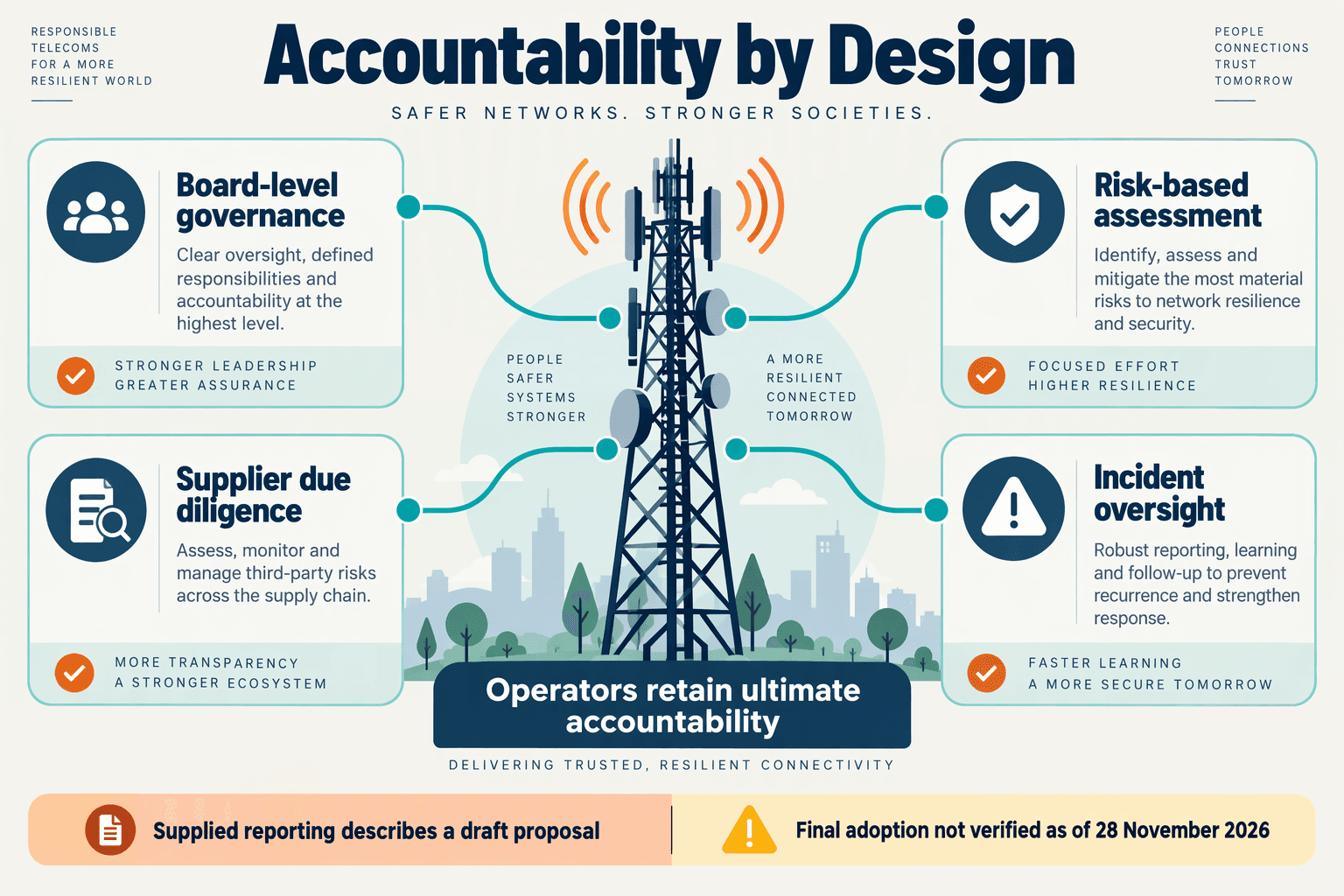
The TRAI draft guidelines propose lifecycle governance for AI used in telecom networks and services, covering procurement, deployment, monitoring and oversight. As of November 28, 2026, they remain proposals—not final, binding requirements—and operators should distinguish the draft’s stated obligations from practical preparations they can begin now.
Which telecom entities would the proposed guidelines cover?
According to Khaitan & Co’s November 24, 2026 analysis on Lexology, the proposed framework covers entities holding relevant telecom service licences under the Indian Telegraph Act, 1885, or authorisations under the Telecommunications Act, 2023, including authorisations relating to telecommunication networks.
The scope is tied to whether those entities deploy or propose to deploy AI in their networks or in providing telecommunication services. That makes intended deployment relevant: governance would not begin only after an AI system enters production.
Two distinctions matter for interpreting this scope:
- Telecom use is the trigger: the supplied analysis does not describe a general AI rulebook for every Indian business.
- Licence or authorisation status matters: an organisation would need to assess its regulatory status alongside how it uses AI.
For a telecom group with several operating companies, a sensible preparatory step would be to map AI deployments to the relevant licensed or authorised entity. This is an operational recommendation, not an additional requirement stated in the supplied analysis.
What would change before an AI system is deployed or modified?
Khaitan & Co’s November 24, 2026 analysis reports that the draft proposes an inventory covering active, inactive and decommissioned AI systems. The significance is broader than maintaining a list of production models: retired systems and paused deployments would remain visible within governance records.
The same analysis says deployment or modification would require validation, conformity and impact assessments, addressing:
- Accuracy: whether outputs are sufficiently reliable for the intended task.
- Robustness: how the system behaves under unexpected inputs or operating conditions.
- Explainability: whether relevant decisions or outputs can be understood.
- Fairness: whether outcomes create unjustified differences between affected users.
- Human oversight: how people supervise, intervene or correct failures.
These explanations translate the assessment factors into operational questions; they are not quoted regulatory definitions.
Consider an operator changing a fraud-detection model. Improved detection alone would not answer every governance question. A useful assessment would also examine false positives, consequences for legitimate customers and how staff review disputed outcomes. The draft’s reference to modification, as reported by Khaitan & Co, suggests that assurance would not be merely a one-time launch exercise.
What should operators do while the guidelines remain a draft?
The supplied context establishes the proposal’s direction but does not provide a final adoption date, implementation timetable or complete enforcement provisions. Operators should therefore avoid presenting draft expectations as settled law.
A proportionate readiness exercise would be to:
- Map systems and owners: identify AI deployments, their operating status and the teams responsible.
- Collect assessment evidence: organise testing records around the factors described in the draft.
- Review change controls: determine how model updates and other modifications receive approval.
- Track official developments: check the final text before treating proposed duties as binding.
The practical distinction is between preparing for accountability and claiming compliance. Building an auditable picture of AI use can help operators respond to the eventual framework without assuming that every proposal will be adopted unchanged.
What happened, and what are the key proposed requirements?
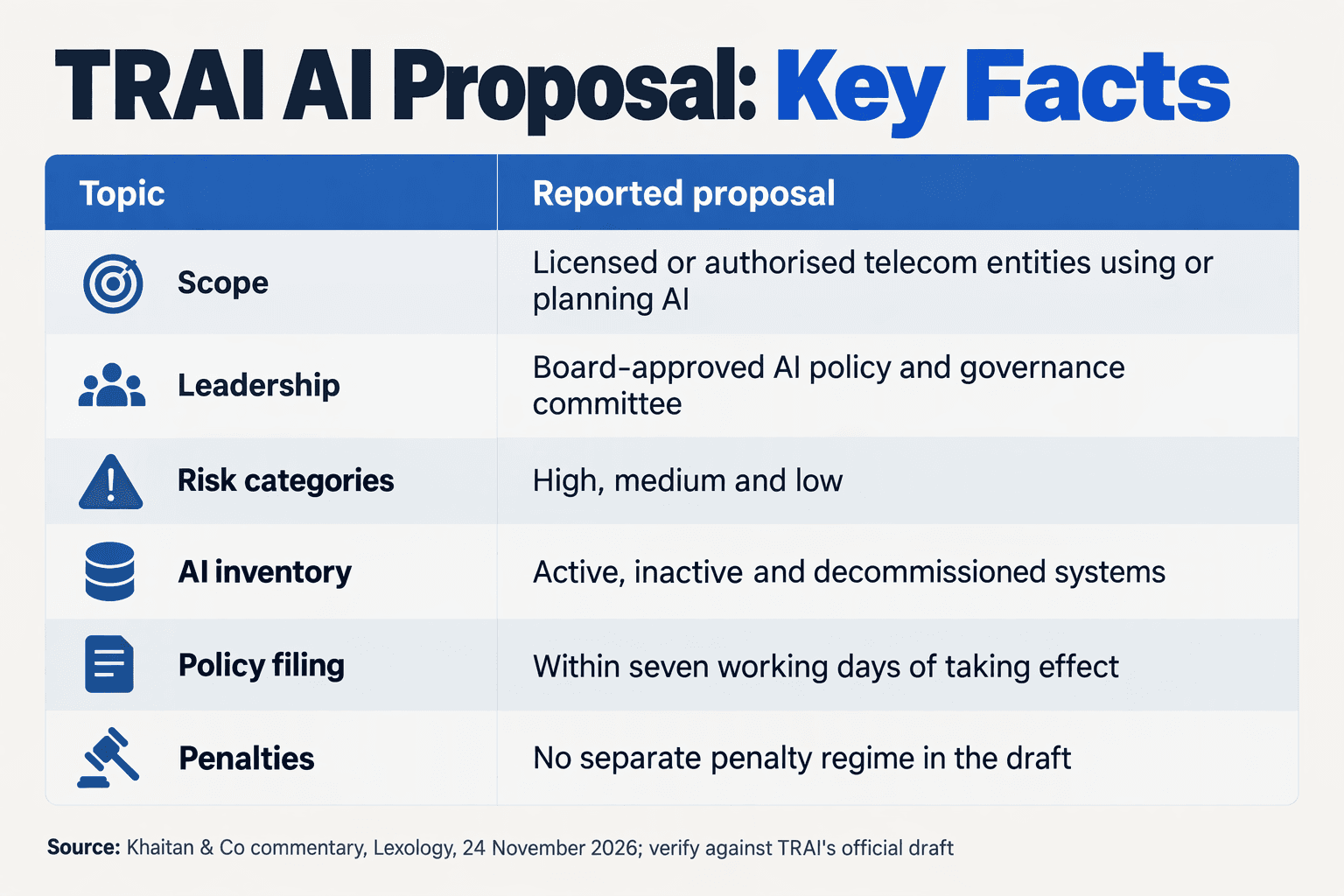
TRAI’s proposal would make AI governance a lifecycle obligation, covering procurement, deployment, monitoring and oversight—not simply approval at launch. As of November 28, 2026, the key proposed requirements combine organisational accountability with system inventories, risk classification and assessments before AI deployment or modification.
What are the key requirements in TRAI’s proposed AI framework?
According to Khaitan & Co’s November 24, 2026 analysis on Lexology, the draft would apply to relevant licensed or authorised telecom entities that deploy, or propose to deploy, AI in their networks or telecommunications services. The table separates the reported proposals from practical preparation steps; the latter are recommendations, not additional regulatory requirements.
| Area | Reported draft requirement | Practical preparation |
|---|---|---|
| Coverage | Relevant licence holders under the Indian Telegraph Act, 1885, and authorisation holders under the Telecommunications Act, 2023, including network authorisations. | Map affected legal entities and their network or service AI use cases. |
| Internal policy | A board-approved AI policy, periodically reviewed and filed with TRAI within seven working days of taking effect. | Establish policy ownership, approval records and a filing workflow. |
| Governance leadership | An AI Governance and Safety Committee headed by a senior executive designated as the AI Governance and Safety Officer. | Define escalation routes and coordination across technical and compliance teams. |
| Risk and safeguards | Classify systems as high, medium or low risk; establish human oversight, data governance, incident management and consumer grievance mechanisms. | Document classifications and connect safeguards to operational processes. |
| System inventory | Maintain an inventory covering active, inactive and decommissioned AI systems. | Reconcile deployed tools, dormant systems and retired applications. |
| Deployment assessments | Deployment or modification would require validation, conformity and impact assessments addressing accuracy, robustness, explainability, fairness and human oversight. | Build assessment checkpoints into launch and change-management processes. |
These proposals are reported in Khaitan & Co’s November 24, 2026 analysis; they should not be treated as final obligations as of November 2026.
What would change in an operator’s AI deployment process?
The most consequential operational detail is that assessments would apply to modifications, not only new deployments. A launch review alone would therefore be insufficient: operators would need a process for determining how changes to an existing AI system should be assessed.
Consider a customer-service assistant whose routing logic is changed to resolve more complaints automatically. A practical assessment could examine:
- Accuracy: Does the revised system provide correct service information?
- Fairness: Do outcomes differ across languages or customer groups?
- Human oversight: Can staff intervene when automated handling fails?
- Impact: Could an incorrect decision delay complaint resolution?
These are illustrative assessment questions, not prescribed tests or thresholds. The supplied analysis does not specify numerical acceptance criteria.
Why does the inventory include retired AI systems?
Khaitan & Co’s November 24, 2026 analysis explicitly describes an inventory of “active, inactive and decommissioned AI systems.” That scope matters because a register limited to production deployments would miss dormant applications and systems already withdrawn from service.
For operators, the useful preparation step is to connect the inventory with procurement and change records. Recording each system’s purpose, owner, supplier and lifecycle status would help teams locate assessment evidence and investigate incidents. Those suggested fields are implementation choices—not an asserted TRAI-mandated inventory template.
How would board oversight and risk-based classification work?
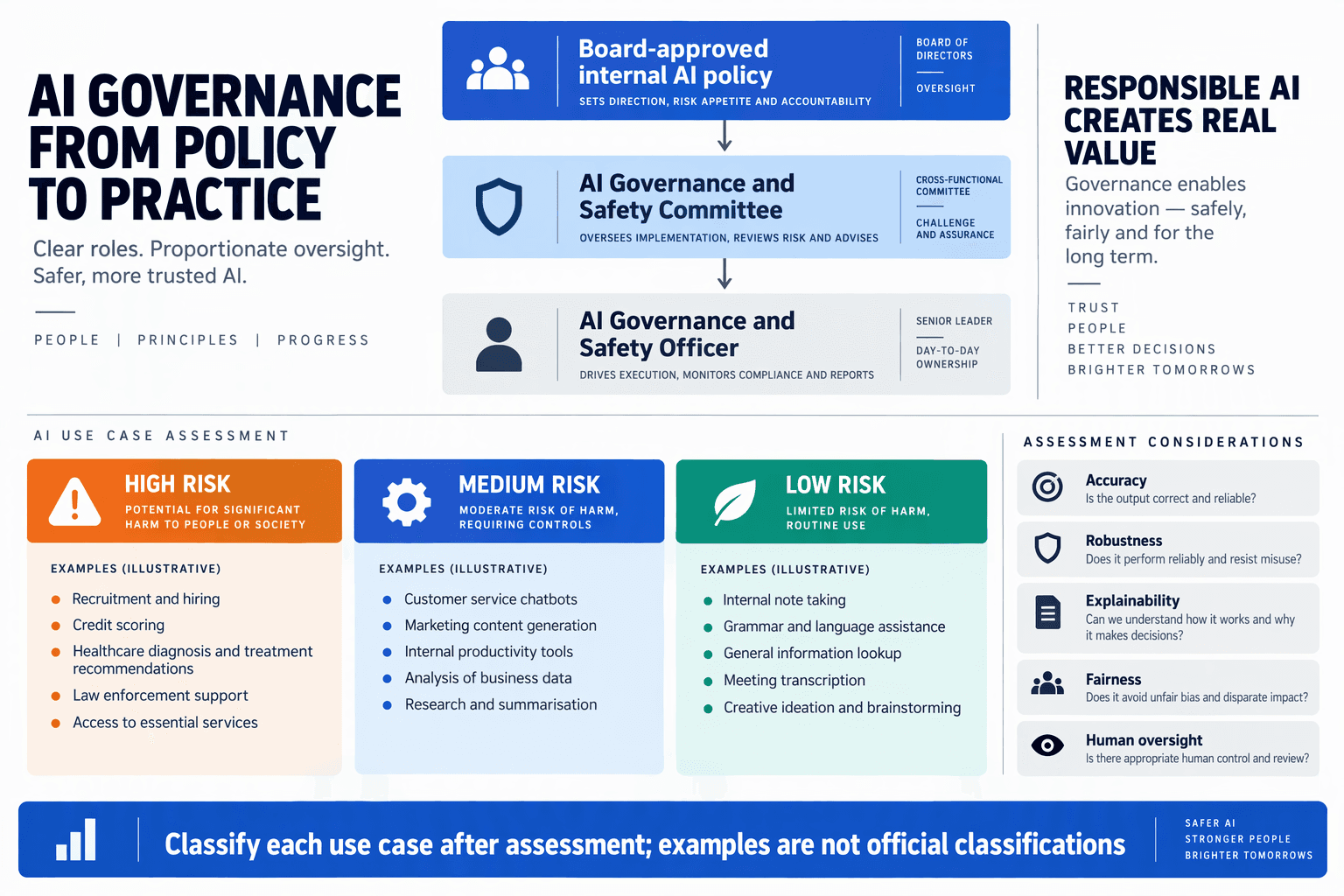
Board oversight would set the operator’s AI policy and accountability structure, while risk-based classification would help determine how individual AI systems are supervised. As of November 28, 2026, TRAI’s proposals envisage high-, medium- and low-risk categories, but the supplied analysis does not establish detailed classification thresholds or category-specific controls.
What would the board and AI governance committee oversee?
The proposed structure separates policy approval from ongoing operational oversight. According to Khaitan & Co’s November 24, 2026 analysis on Lexology, the board-approved policy would address risk classification, human oversight, data governance, incident management and consumer grievance redressal.
The AI Governance and Safety Committee, headed by a senior executive designated as the AI Governance and Safety Officer, would oversee system performance, assess emerging risks and recommend or implement corrective measures.
For operators, a practical implementation would connect these responsibilities rather than create parallel reporting silos:
- The board approves the governance approach: define accountability, escalation principles and the organisation’s approach to AI risk.
- The committee translates policy into oversight: review performance evidence, emerging risks and proposed corrective action.
- Operational teams supply evidence: technology, network operations, legal, compliance and business functions explain how systems behave and how problems are handled.
These are implementation recommendations, not additional requirements confirmed by the supplied source. The objective is to give senior decision-makers visibility into consequential AI decisions without expecting directors to inspect every model configuration.
How would high-, medium- and low-risk classification work?
Classification should distinguish systems by their potential consequences, not simply by whether they use generative AI. According to Khaitan & Co’s November 24, 2026 analysis, TRAI proposes three risk categories—high, medium and low—alongside mechanisms for human oversight and incident management.
The available context does not specify a scoring formula. Operators preparing an internal assessment could therefore ask:
- Service impact: Could an incorrect output interrupt connectivity or affect a large group of subscribers?
- Customer impact: Could the system influence access to service, fraud investigations or complaint outcomes?
- Decision authority: Does AI merely advise an employee, or can it trigger an operational action?
- Recoverability: Can staff detect, stop and reverse an erroneous action before substantial harm occurs?
Consider two illustrative deployments. An AI assistant drafting internal maintenance summaries may warrant different supervision from a system automatically changing network settings. Likewise, a customer-service assistant answering routine questions presents different consequences from one influencing service restrictions.
These examples explain a risk-based approach; they do not assign official TRAI classifications.
How can operators avoid classification becoming a paperwork exercise?
A useful classification record should explain why a risk label was chosen, who accepted that assessment and what oversight follows from it. Otherwise, “medium risk” becomes a label rather than a management decision.
Khaitan & Co’s November 24, 2026 analysis states that the internal AI policy would undergo periodic review. Operators should use that review process to test whether governance still matches actual deployments—for example, when an advisory tool gains permission to execute actions.
The practical implication is clear: board oversight needs an evidence trail linking system purpose, risk assessment, human responsibility and corrective action. That is how the proposed governance structure could become operational accountability rather than another policy document.
Who remains accountable for third-party AI? An illustrative operator responsibility map
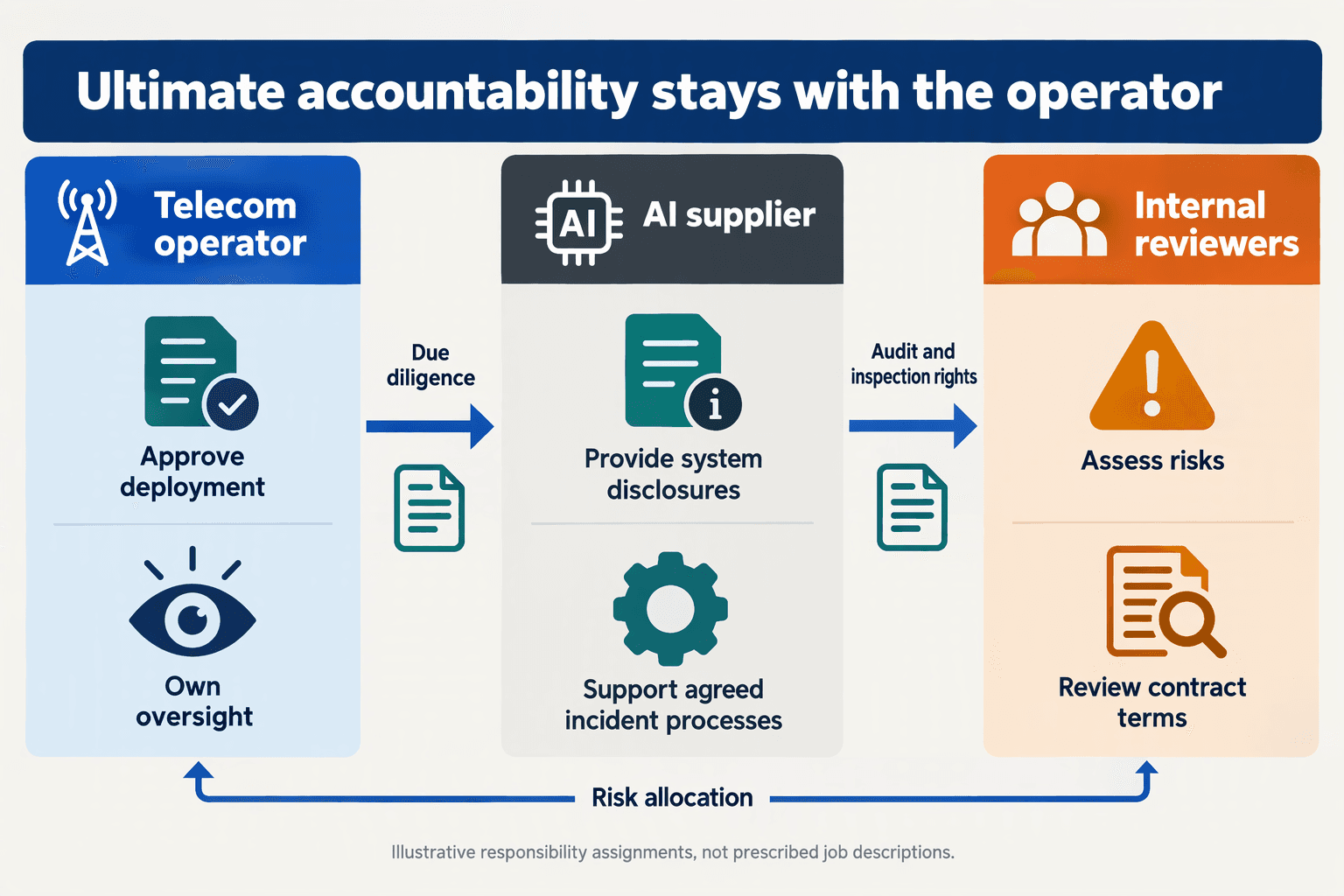
Telecom operators would retain ultimate accountability for third-party AI under TRAI’s proposed framework; procuring a system would not transfer that responsibility to its supplier. The draft also envisages supplier due diligence and enforceable contractual safeguards—not simply optional questions for procurement teams.
Khaitan & Co’s November 24, 2026 analysis on Lexology says accountability would remain with telecom entities “irrespective of whether the underlying technologies are developed in-house or procured from third-party vendors.” According to that analysis, the Telecom Regulatory Authority of India (TRAI) released the draft guidelines on October 30, 2026. As of November 28, 2026, these are proposals, not final binding requirements.
What would TRAI’s draft require for third-party AI procurement?
According to Khaitan & Co’s November 24, 2026 analysis, the proposed procurement provisions would require:
- Appropriate supplier due diligence, including assessment of the AI system’s reliability, capabilities and limitations.
- Relevant vendor disclosures to support informed procurement and oversight.
- Enforceable supplier-agreement provisions addressing regulatory compliance, audit and inspection rights, incident management, risk allocation and accountability.
The reported provisions also cover AI embedded in telecom equipment, infrastructure and technology solutions. Procurement review therefore cannot focus only on standalone models or customer-service applications; embedded AI also belongs within the proposed governance perimeter.
Commercially, these provisions would make supplier selection and contract negotiation part of AI governance. Assigning investigation or remediation tasks to a vendor would not remove the operator’s ultimate accountability.
How should operators divide responsibility with AI vendors?
The following illustrative responsibility map translates that accountability into operational tasks. It is not a prescribed TRAI organisational structure or contractual template.
| Activity | Operator responsibility | Vendor contribution | Illustrative evidence |
|---|---|---|---|
| Selecting a system | Define use and assess supplier suitability | Disclose capabilities and limitations | Due-diligence record |
| Approving deployment | Evaluate suitability and risks | Supply testing information | Assessment and approval record |
| Monitoring performance | Review service and customer outcomes | Provide diagnostics and investigate faults | Monitoring records |
| Managing changes | Determine reassessment needs | Explain relevant modifications | Change log and review decision |
| Handling incidents | Coordinate response and corrective action | Diagnose supplier-side problems | Incident and remediation record |
Khaitan & Co’s November 24, 2026 analysis also reports proposed validation, conformity and impact assessments for AI deployment or modification, covering accuracy, robustness, explainability, fairness and human oversight. Supplier evidence would support—not substitute for—the operator’s deployment-specific evaluation.
What should procurement teams ask to implement these provisions?
These are illustrative implementation questions, distinct from the reported draft requirements:
- Disclosures: What information will explain reliability, capabilities and limitations for the intended use?
- Audit and inspection: How will contractual rights work in practice, including access arrangements?
- Incident management: Who investigates, escalates and remedies problems, and within what agreed timelines?
- Risk allocation: How will supplier obligations, remedies and accountability be documented without obscuring the operator’s responsibility?
What does accountability mean for an outsourced voice agent?
If an AI voice agent incorrectly tells a subscriber that service is restored, the operator should verify service status and correct the communication. Operator engineers and the supplier can investigate the agent’s information and tools, while the operator decides whether to restrict or reassess the deployment.
As of November 2026, CallMissed supports call recordings, transcripts and call scoring against an organisation’s own QA rubrics. These capabilities can supply review evidence for outsourced interactions; they do not independently establish compliance with TRAI’s proposed framework.
What would AI incident reporting and consumer protection require?
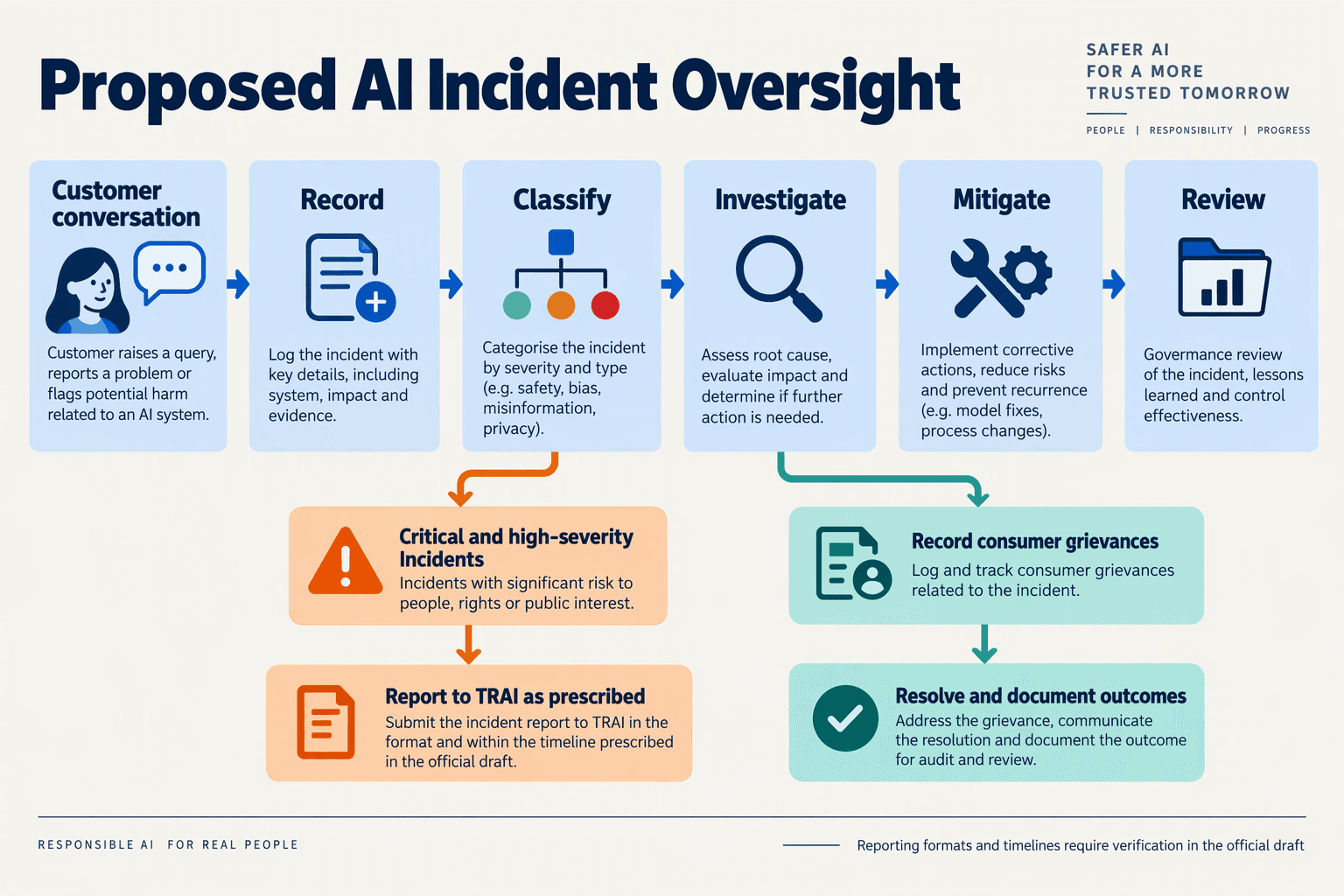
TRAI’s proposed AI governance framework would require telecom operators to centrally record, classify, investigate and mitigate AI incidents, with critical and high-severity incidents reported to TRAI. Consumer protection would also require grievance recording and resolution, alongside periodic staff training; as of November 28, 2026, these remain proposed duties, not binding final rules.
Proposed incident controls
Khaitan & Co’s November 24, 2026 analysis, published on Lexology, describes centralised incident management under TRAI’s draft framework. This would make AI failures an organisational responsibility rather than an issue handled separately by individual technical teams.
An AI incident need not involve a system going offline. An operational model could still cause harm by recommending an unjustified service restriction, giving misleading customer guidance or making a network decision that disrupts connectivity.
For preparation, operators could consider these illustrative operational examples:
- Network disruption: an AI-assisted configuration change interrupts service.
- Incorrect restriction: a fraud-detection system wrongly flags a customer and triggers a service block.
- Misleading assistance: an AI support agent provides incorrect instructions that delay complaint resolution.
- Unequal treatment: a review identifies different outcomes across customer groups that warrant investigation.
These examples are not official TRAI classifications or severity thresholds. Operators should also distinguish an AI system’s overall risk category from the severity of a particular incident: the two assessments serve different purposes.
Reporting to TRAI
According to Khaitan & Co’s November 24, 2026 analysis on Lexology, the draft proposes mandatory reporting of critical and high-severity AI incidents in prescribed formats, in the prescribed manner and within stipulated timelines.
The supplied analysis does not reproduce the actual reporting forms or numerical deadlines. Operators should therefore avoid treating any suggested internal response time as an official regulatory deadline—or assuming that the proposed reporting obligation lacks timelines.
An illustrative readiness checklist, rather than a regulatory reporting template, could include:
- Record the event: identify the AI application, version, detection time and affected service.
- Assess the consequences: document customer impact, operational disruption and unresolved uncertainties.
- Preserve evidence: retain relevant logs, outputs and records of human intervention with appropriate access controls.
- Document mitigation: record containment measures, manual reviews and customer assistance.
- Assign ownership: identify who manages regulatory reporting, corrective action and closure verification.
Centralised records would help connect these steps. An internal escalation or completed investigation would not replace reporting to TRAI when the proposed critical or high-severity reporting requirement applies.
Consumer grievances and staff training
Khaitan & Co’s November 24, 2026 analysis identifies consumer grievance recording and resolution, together with periodic training for relevant personnel, as elements of the proposed framework.
In practice, a customer disputing an AI-triggered restriction should have a traceable complaint and a route to review and resolution. Training could cover recognising AI-related harm, preserving evidence and escalating recurring complaints; these are illustrative implementation suggestions, not an official training syllabus.
As of November 2026, CallMissed, an India-hosted AI customer-communication platform, offers a human-handoff queue, support tickets and call transcripts. Such capabilities can support complaint handling and investigation, but do not by themselves establish regulatory compliance. The operator would still need defined responsibilities, documented procedures and oversight that connects customer complaints to incident investigation and corrective action.
What should an internal AI policy include? An illustrative readiness template
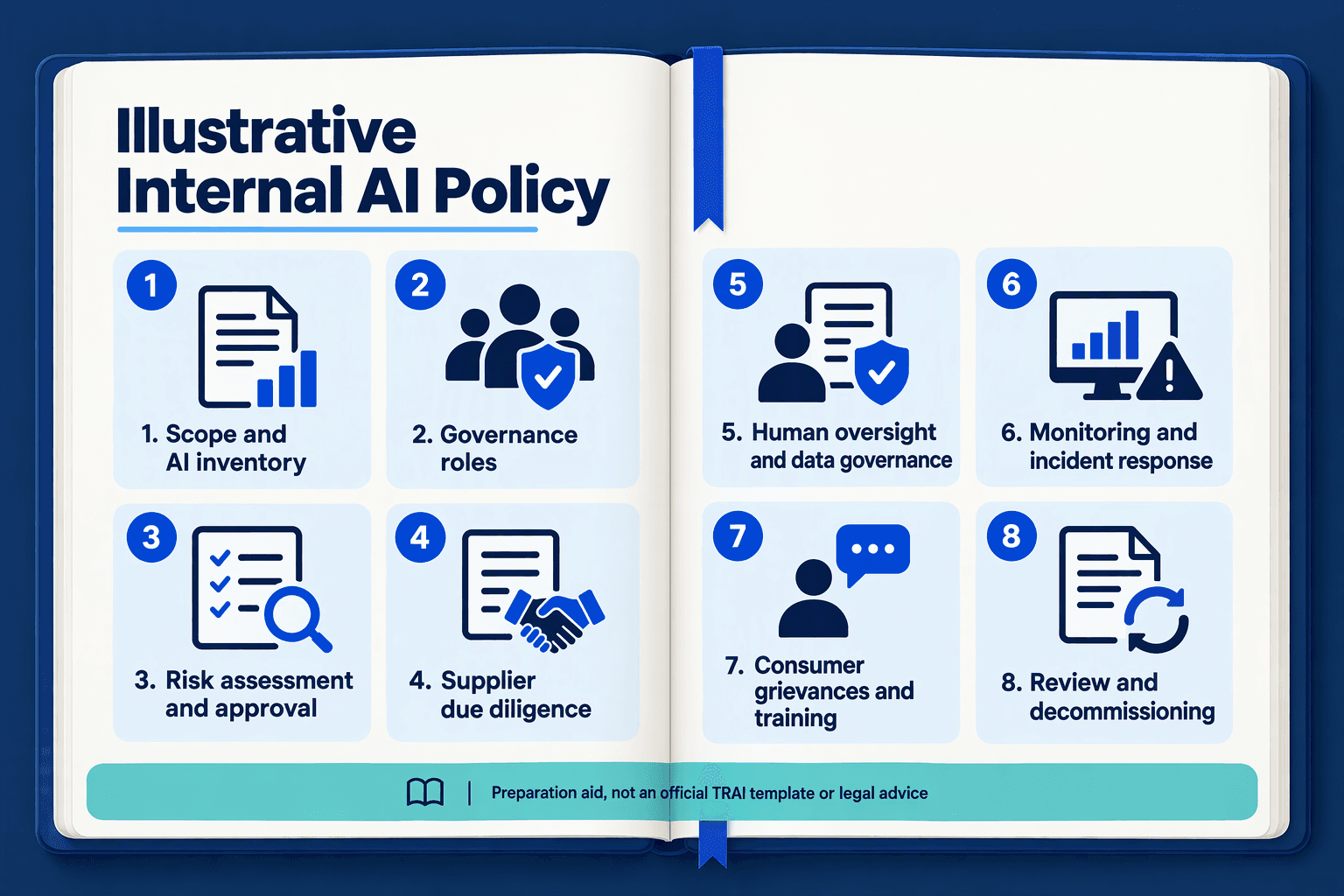
An internal AI policy should translate governance commitments into named owners, approval gates, operating controls and evidence records. The illustrative template below is a readiness tool for Indian telecom operators—not a prescribed TRAI format or a guarantee of compliance.
Khaitan & Co’s November 24, 2026 analysis on Lexology identifies human oversight, data governance, incident management and consumer grievance redressal among the proposed policy requirements. As of November 28, 2026, operators should distinguish those reported proposals from the practical implementation suggestions below.
What should the policy say about ownership and approval?
Start with a short statement defining which AI uses the policy covers, who can authorise them and who remains responsible after deployment. Avoid broad commitments such as “AI must be used responsibly” without explaining how staff should act.
- Scope and ownership: Identify covered network and customer-service uses, including vendor-supplied systems. Assign a business owner, technical owner and escalation contact to each system.
- Decision rights: Specify who approves deployment, material changes, temporary suspension and retirement. Define which decisions require escalation to the AI Governance and Safety Committee.
- Exceptions and review: Document how exceptions are requested, approved and time-limited, alongside triggers for reviewing the policy.
For implementation, distinguish approval authority from operational responsibility: a committee may approve a deployment, while a named operations manager handles service-impacting alerts.
What evidence should accompany each AI system?
Use a consistent system record so reviewers can connect policy statements to actual deployments. According to Khaitan & Co’s November 24, 2026 analysis, TRAI’s proposal envisages validation, conformity and impact assessments before AI deployment or modification, addressing accuracy, robustness, explainability, fairness and human oversight.
An illustrative record could contain:
- Purpose and boundaries: Intended users, permitted actions and decisions the system must not make.
- Risk rationale: The assigned category, supporting reasoning and circumstances that would trigger reassessment.
- Data controls: Data sources, access permissions, retention arrangements and checks on data suitability.
- Assessment evidence: Test scenarios, acceptance criteria, known limitations and unresolved issues.
- Supplier dependencies: Model or service versions, contractual responsibilities and available technical documentation.
- Change history: Approved modifications, test results and the person authorising release.
The practical test is whether a reviewer can reconstruct why deployment was considered acceptable, rather than merely find a signed approval.
How should the policy handle failures and customer complaints?
Write operational instructions that remain usable during an incident. A suggested policy annex should explain:
- Detection: What constitutes an AI incident, and where staff report suspected failures.
- Containment: Who can pause automation, restore a previous configuration or route work to people.
- Customer redress: How complaints reach a responsible team and how disputed AI-assisted outcomes are reviewed.
- Learning: How findings lead to revised tests, controls or deployment decisions.
For example, a billing-support agent that repeatedly gives incorrect explanations should trigger review of affected conversations, escalation to human support and reassessment before reuse—not just a prompt edit.
As of November 2026, CallMissed’s no-code agent builder includes versioning with publish and rollback, while its human-handoff queue supports transferring conversations to people. These capabilities can support operational controls, but the operator must still define decision rights, evidence requirements and accountability.
The strongest policy is therefore a working instruction set: every important commitment should identify an owner, an action and a record proving that action occurred.
What does published legal commentary say, and what industry reaction is verified?

Published legal commentary frames the TRAI draft AI guidelines as a shift towards formal management accountability, rather than merely technical supervision. However, the supplied source material contains no verified industry reaction from telecom operators, industry associations or AI vendors as of November 28, 2026.
What does Khaitan & Co’s legal analysis actually say?
In their November 24, 2026 commentary published on Lexology, Khaitan & Co authors Harsh Walia and Sanjuktha A. Yermal describe the proposal as a governance framework covering AI procurement, deployment, monitoring and oversight.
Their central interpretation is explicit: the framework would elevate AI governance into a “formal board-level management and regulatory compliance obligation.” That is the authors’ assessment of the proposal’s implications—not an industry endorsement or a statement that the guidelines are already binding.
The commentary also identifies operational resilience, algorithmic accountability and regulatory oversight as concerns accompanying AI adoption in telecommunications. This framing matters because it treats AI risk as a service-management issue: a system’s consequences cannot be assessed solely through model accuracy or technical performance.
According to Khaitan & Co’s November 24, 2026 Lexology analysis, the proposed framework would require coordination across technology, network operations, legal, compliance and business functions. The practical implication is organisational: legal teams would need evidence from engineering and operations, while technical teams would need clearly assigned decision-making authority.
Which industry reactions are verified as of November 2026?
None are documented in the supplied research. The available material is a law-firm analysis of TRAI’s proposal; it does not include attributable statements from telecom operators, trade bodies, equipment suppliers or AI service providers.
That evidentiary limit should shape how readers interpret this news:
- Verified published commentary: Khaitan & Co’s analysis, published by Lexology on November 24, 2026.
- Reported regulatory development: TRAI’s release of the draft guidelines on October 30, 2026, according to that analysis.
- Not established by the supplied material: operator support, industry opposition, implementation-cost estimates or requests for a longer transition period.
- Not established: whether any stakeholder has submitted a formal consultation response.
An absence of documented reactions here does not mean the industry has remained silent. It means this section cannot responsibly characterise an industry consensus—or claim that operators welcome or resist the proposal—without additional attributable evidence.
How should operators distinguish commentary from stakeholder evidence?
Operators should separate what the draft reportedly proposes, what legal commentators infer, and what affected organisations publicly say. Those categories answer different questions and carry different evidentiary weight.
A useful reading process is:
- Check the underlying document. Use TRAI’s draft text to establish proposed obligations, scope and terminology; treat the Lexology article as an interpretive source.
- Label analysis accurately. A prediction about organisational burden is commentary unless supported by implementation data.
- Require attribution for reactions. Look for a named organisation, publication date and accessible statement or submission.
- Separate proposals from final requirements. Do not describe draft provisions as obligations already in force.
The strongest conclusion supported by the available November 2026 evidence is therefore narrow but important: published legal analysis anticipates a cross-functional governance shift; verified industry acceptance, resistance and cost assessments remain unestablished in the supplied record.
When were the guidelines reported, and what remains unverified?
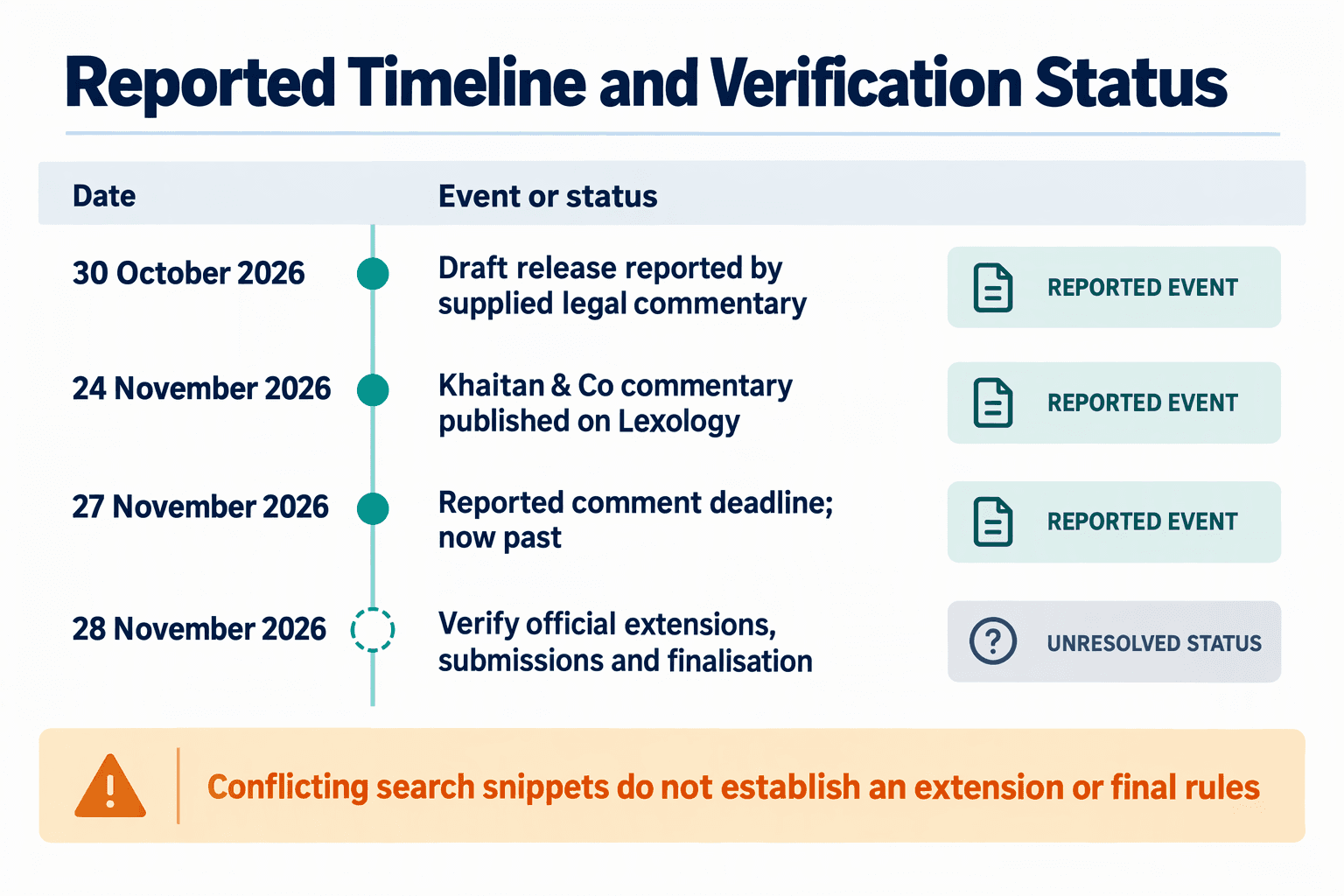
Khaitan & Co’s analysis, published on Lexology on November 24, 2026, reports that TRAI released its draft AI guidelines on October 30, 2026, and invited stakeholder comments until November 27, 2026. As of November 28, 2026, that reported deadline has passed; any extension, subsequent revision, final adoption or commencement date remains unverified in the supplied research.
What dates and regulatory status does the reporting establish?
Khaitan & Co’s November 24 analysis describes the Draft Guidelines on Responsible Use of AI in Telecommunication Networks and Provision of Telecommunication Services as being at the consultation stage. That establishes the status reported on that date—not necessarily the framework’s status after the comment deadline.
| Item | Date or timing | What Khaitan & Co reports | Status as of November 28, 2026 |
|---|---|---|---|
| Draft release | October 30, 2026 | TRAI released the Draft Guidelines | Reported release date |
| Legal analysis | November 24, 2026 | Analysis published on Lexology | Source publication date |
| Consultation status | November 24, 2026 | Guidelines were at consultation stage | Reported status at publication |
| Stakeholder comments | Until November 27, 2026 | Comments were invited until this date | Deadline passed; extension unverified |
| Final adoption | Not established | Analysis discusses a draft framework | Later adoption unverified |
| Commencement | Not established | No final commencement date established by the source | Effective date unverified |
| Separate penalty regime | Draft-stage position | Draft does not independently prescribe a separate penalty regime | Does not establish immunity under existing law |
The November 27, 2026 comment deadline reported by Khaitan & Co is a consultation milestone, not an implementation deadline. Its passing does not, by itself, establish that TRAI has adopted the proposal or that proposed duties have become enforceable.
Does the draft introduce a separate penalty regime?
According to Khaitan & Co’s November 24, 2026 analysis, the draft does not independently prescribe a separate penalty regime. This is a narrow statement about the draft’s design, not a conclusion that AI-related conduct falls outside existing-law enforcement.
Operators should therefore distinguish between:
- Draft-specific sanctions: The analysis does not identify an independently prescribed penalty regime in the draft.
- Existing legal obligations: The absence of that separate regime does not exclude enforcement under applicable laws, licence conditions or authorisation requirements.
- Final regulatory treatment: Any changes in an adopted instrument require fresh verification.
What should telecom operators verify next?
The practical priority is to establish the proposal’s current status through official TRAI documents, rather than infer adoption from a closed consultation window.
- Check for deadline extensions or later notices, including revised submission arrangements.
- Retrieve any revised or final text and compare it with the October 30 draft.
- Confirm commencement and transition provisions, keeping consultation dates separate from compliance dates.
- Record the evidence trail, including document versions, publication dates and the basis for internal decisions.
Technical records can support this preparation without proving regulatory conformity. As of November 2026, CallMissed’s developer AI API provides usage and request logs—a relevant operational capability when teams document AI deployments, but not evidence of compliance with TRAI’s proposed framework.
The reporting conclusion is precise: a draft and a now-passed comment deadline are established by the analysis; later developments and final effective dates are not verified here. “Not verified” should never be rewritten as “TRAI has taken no further action.”
How can CallMissed support human oversight and AI call review?
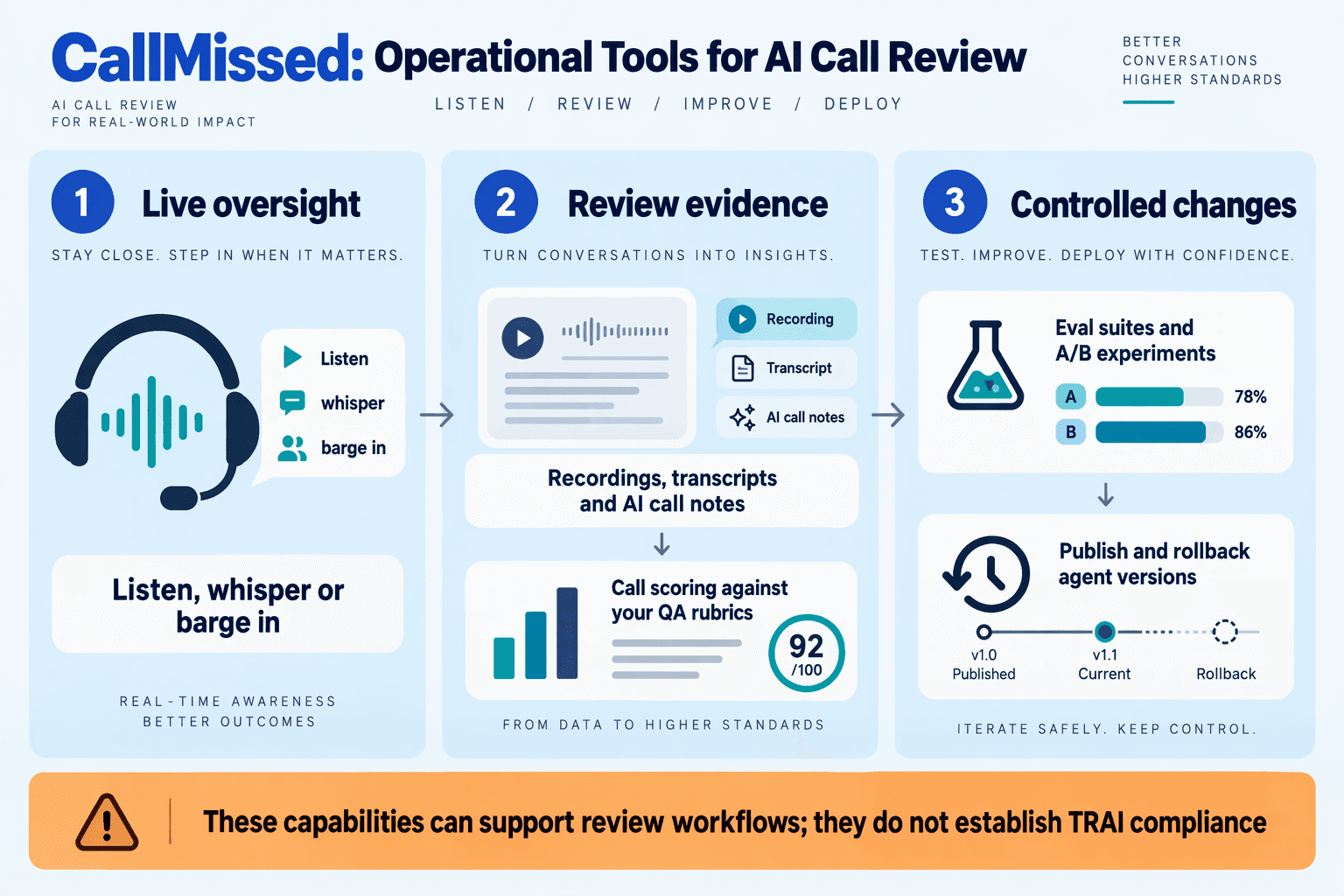
CallMissed can support human oversight and AI call review through live supervisor intervention, recordings and transcripts, configurable QA scoring, and pre-release evaluation tools, as of November 2026. These capabilities can help operators put oversight into daily workflows, but operators must define who intervenes, what reviewers assess and how corrective actions are approved.
How can supervisors intervene during an AI call?
As of November 2026, the platform’s live call monitoring lets a supervisor listen, whisper or barge in. For a telecom customer-service operation, these options support different levels of intervention: observing an interaction, providing guidance, or directly joining the conversation.
Operators should translate these capabilities into an explicit intervention policy. Consider a customer disputing a recharge deduction: the key question is not simply whether the agent sounds convincing, but whether an authorised person can intervene before an unsupported explanation becomes a customer-facing commitment.
A practical supervisor checklist could include:
- Financial disputes: intervene when the conversation requires a decision outside the agent’s authorised scope.
- Repeated misunderstanding: review interactions where the customer and agent cannot establish the issue.
- Sensitive requests: involve an authorised person when account access or identity questions require additional judgement.
- Customer distress: prioritise intervention when continuing an automated conversation could worsen the situation.
These are suggested operating rules—not claims that the platform automatically detects or escalates every scenario. Teams should document how supervisors identify calls needing attention and who provides coverage.
What should an AI call review examine?
As of November 2026, available review capabilities include call recordings, transcripts, AI call notes and call scoring against an organisation’s own QA rubrics. AI call notes cover summaries, action items, dispositions and follow-up, and can be pushed to the CRM.
A useful telecom rubric should distinguish conversational quality from substantive correctness:
- Accuracy: Did the agent use approved information rather than invent a tariff, refund rule or resolution deadline?
- Authority: Did the agent stay within its permitted actions and commitments?
- Oversight: Was human intervention sought when the operator’s policy required it?
- Resolution quality: Did the recorded outcome match what the customer actually requested?
Reviewers should compare AI-generated notes with the underlying recording or transcript rather than treat the summary as definitive evidence. Operators also need their own rules for recording notices, access permissions and retention; the listed review features alone do not establish those controls.
How can call reviews lead to safer agent updates?
As of November 2026, CallMissed supports eval suites, A/B experiments, agent analytics, metric alerts, and versioning with publish and rollback. Operators can use these capabilities within a controlled improvement process rather than editing prompts without testing.
For example, after reviewers identify an incorrect recharge explanation, a team could:
- Correct the relevant knowledge-base material or agent instructions.
- Test representative dispute scenarios before publishing the change.
- Compare outcomes through a defined experiment.
- Use rollback if the revised version introduces unacceptable behaviour.
According to Khaitan & Co’s November 24, 2026 analysis on Lexology, TRAI’s proposed framework includes mechanisms for “human oversight” and assessments addressing accuracy, robustness, explainability and fairness. Call-review workflows can contribute operational evidence toward those objectives; they do not, by themselves, prove compliance.
The practical goal is a traceable chain: observed issue → human assessment → approved correction → tested release → continued monitoring. That makes oversight a repeatable operational discipline rather than an occasional spot-check.
Frequently Asked Questions
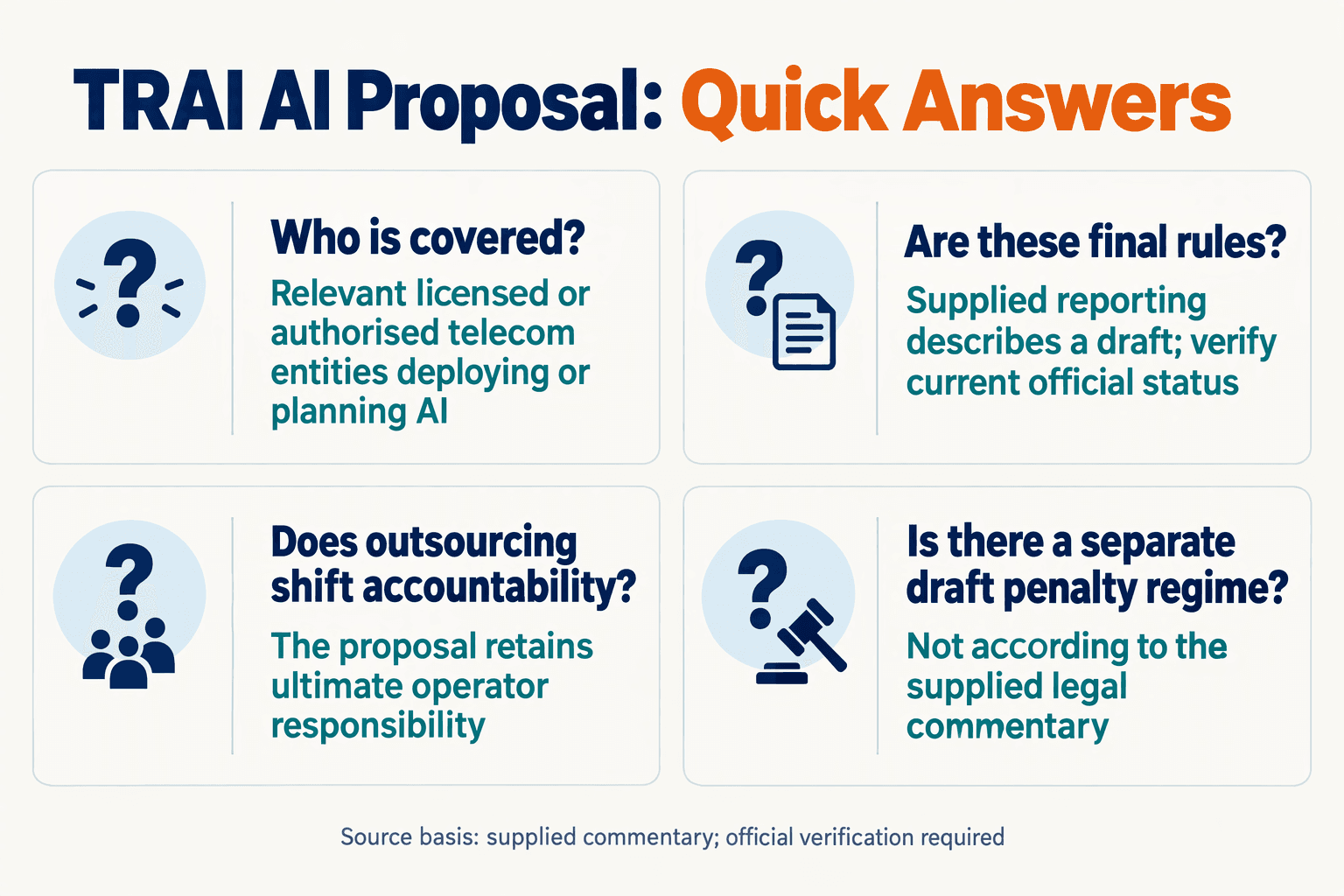
Who is covered by the proposed TRAI AI governance framework?
Are the TRAI AI governance framework rules final and legally binding?
Does outsourcing AI to a vendor shift a telecom operator’s accountability?
Does the TRAI AI governance framework apply only to high-risk AI systems?
Would changing an existing telecom AI system require a fresh assessment?
How can Indian telecom operators prepare before TRAI finalises the guidelines?
Conclusion
The TRAI draft guidelines point toward a clear shift: Indian telecom operators would remain accountable for AI systems throughout their lifecycle, including technology procured from third-party vendors. As of November 28, 2026, the framework remains a proposal—not a final, binding rulebook—but its direction makes governance readiness a practical management priority.
According to Khaitan & Co’s November 24, 2026 analysis on Lexology, TRAI released the draft on October 30, 2026. The central implication is not that operators should stop adopting AI; it is that procurement, deployment and monitoring should be supported by demonstrable oversight. For AI used in network optimisation, predictive maintenance, fraud detection or customer service, responsibility cannot end at the supplier contract.
Four takeaways should guide preparation:
- Accountability would stay with the telecom entity. Outsourcing an AI system would not transfer ultimate responsibility to its developer. Operators should therefore examine whether vendor arrangements and internal processes give responsible teams enough visibility to understand system behaviour, supervise its use and address failures.
- AI governance would become a board-level function. The proposed framework calls for a board-approved internal AI policy, an AI Governance and Safety Committee, and a senior executive serving as the AI Governance and Safety Officer. Khaitan & Co’s November 24, 2026 analysis states that the policy would need to be filed with TRAI within seven working days of taking effect.
- Risk management would cover the full lifecycle. The proposals include high-, medium- and low-risk classifications, inventories of active, inactive and decommissioned AI systems, and assessments before deployment or modification. The practical lesson is to document systems and their oversight arrangements, rather than treat approval at launch as the end of governance.
- Readiness would require cross-functional coordination. Technology, network operations, legal, compliance and business teams would need a shared understanding of ownership, human oversight and incident handling. A customer-service voice agent illustrates the challenge: response quality matters, but so do escalation procedures and the ability to intervene when outcomes fall short.
What should telecom operators watch for next?
Watch for whether the final framework retains these proposed responsibilities and how its wording clarifies implementation expectations. Until then, operators can identify gaps in their inventories, policies and monitoring processes without presenting draft provisions as current legal obligations.
As of November 2026, readers can explore CallMissed, an AI customer-communication platform offering live call monitoring, human-handoff queues and call scoring against their own QA rubrics. These capabilities support operational oversight; they do not, by themselves, establish regulatory compliance.
If an AI system failed tomorrow, could your organisation demonstrate who owned the decision, who supervised it and how the failure was addressed?
Related Reading
- Unified Image API: 2026 Developer Comparison Guide
- Voice AI Agents for Indian Startups: Buyer Guide 2026
- STT for Hinglish: Compare Code-Mixed Speech APIs in 2026