
GPT-5.6 Luna vs Claude Opus 5: Benchmarks, Cost & Verdict


Compare GPT-5.6 Luna vs Claude Opus 5 benchmarks, API cost, context, coding, agents, latency considerations, and best use cases.
GPT-5.6 Luna vs Claude Opus 5: Benchmarks, Cost & Verdict
GPT-5.6 Luna vs Claude Opus 5 is now a comparison between two released models with different priorities. As of July 25, 2026, Luna is the efficiency-oriented choice for high-volume work, while Anthropic positions Opus 5 for complex long-running agents, coding and professional tasks. Opus 5 officially costs $5 per million input tokens and $25 per million output tokens, with a 1M-token context window and 128k maximum output.
Why this comparison matters now
OpenAI introduced the GPT-5.6 family—Sol, Terra, and Luna—in July 2026, creating distinct tiers rather than presenting every model as a universal flagship. OpenAI positions GPT-5.6 Luna for high-volume efficiency, with reported API pricing of $1 per million input tokens and $6 per million output tokens. That cost profile makes Luna relevant to production workloads such as customer support, document processing, agentic automation, and code assistance at scale.
Luna is not simply a smaller label attached to OpenAI’s strongest model. OpenAI’s GPT-5.6 Preview System Card, published on June 26, 2026, explicitly describes GPT-5.6 Terra and GPT-5.6 Luna as “less capable” than the top GPT-5.6 model covered by its safety designation. OpenAI’s Help Center also confirms that GPT-5.6 Luna is not selectable in standard ChatGPT conversations, making API and product availability an important part of the purchasing decision.
Claude Opus 5 presents the opposite problem: substantial interest, but insufficient primary-source evidence. Until Anthropic publishes an official model card, API documentation, pricing page, or release announcement, claims about Opus 5’s benchmark scores, speed, token limits, multimodal features, or commercial terms should be labelled unverified. Results for Claude Opus 4.8—or earlier Opus generations—cannot automatically be attributed to Opus 5.
What this comparison will establish
This analysis separates confirmed specifications from rumours and evaluates the models without pretending they occupy the same market tier. It will examine:
- Pricing, context limits, output limits, and availability
- Reasoning, coding, tool use, speed, and multimodality
- Flagship capability expectations versus low-cost production throughput
- Which claims come from primary sources and which remain leaks
- Whether teams should deploy GPT-5.6 Luna now or wait for Claude Opus 5
This distinction matters for platforms such as CallMissed, the OpenAI-compatible multi-model gateway, where developers may route LLM, speech, image, and search workloads across providers and need verified cost and availability data—not speculative benchmark charts.
The central question is therefore not “Which model wins everything?” It is whether a documented, deployable efficiency model fits the workload today—or whether the potential advantages of an unreleased flagship justify waiting for evidence.
Which should you choose: Claude Opus 5 or GPT-5.6 Luna? The answer-first verdict
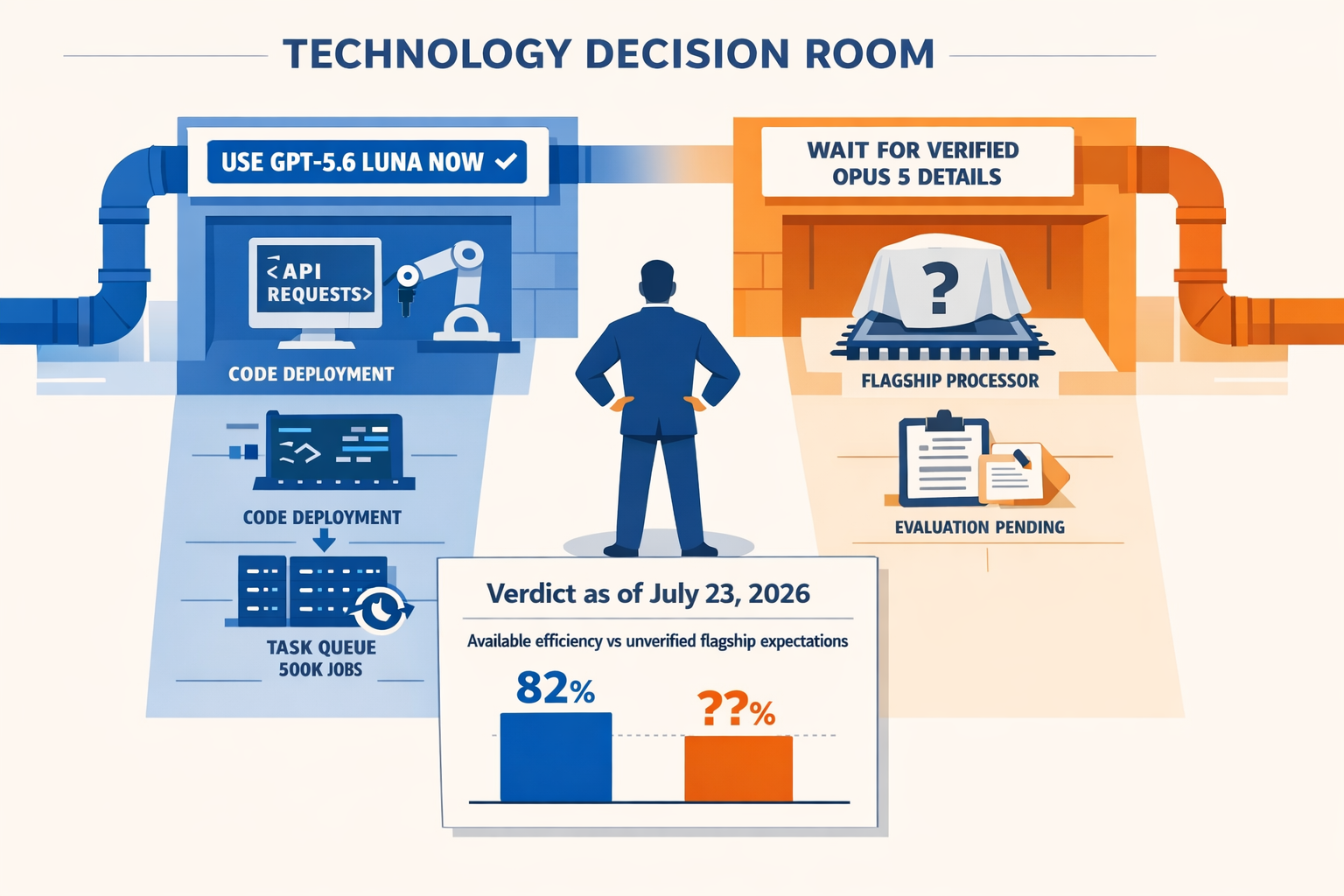
For GPT-5.6 Luna vs Claude Opus 5, choose Claude Opus 5 for complex, long-running agents, difficult coding, and high-stakes enterprise work. Choose GPT-5.6 Luna for high-volume workloads where latency, throughput, and token cost matter most. Neither is the universal winner: test both on your actual tasks and compare quality, reliability, speed, and total cost.
The short verdict
As of July 25, 2026, GPT-5.6 Luna vs Claude Opus 5 is a comparison between two officially available models with different priorities. Anthropic launched Claude Opus 5 on July 24, 2026, while OpenAI positions GPT-5.6 Luna as the high-volume efficiency model in its GPT-5.6 series.
The answer-first decision is:
- Choose Claude Opus 5 for demanding work. It is the stronger candidate for complex long-running agents, difficult software-engineering tasks, and enterprise workflows where capability and task completion matter more than the lowest token price.
- Choose GPT-5.6 Luna for efficient scale. Its documented price of $1 per million input tokens and $6 per million output tokens makes it the more economical option for repetitive, high-volume, latency-sensitive workloads.
- Run workload-specific tests before standardizing. Vendor positioning, specifications, and token prices narrow the choice, but they do not predict performance on every codebase, toolchain, dataset, or agent workflow.
Choose Claude Opus 5 for complex agents, coding, and enterprise work
Anthropic lists Claude Opus 5 with a 1 million-token context window, a 128,000-token maximum output, and the API model identifier claude-opus-5. Anthropic says the model is available across its platforms, giving teams access through supported Claude products and developer channels rather than limiting it to a preview or waitlist.
Anthropic’s published API pricing is:
- $5 per million input tokens
- $25 per million output tokens
Those rates make Opus 5 considerably more expensive than Luna on raw token usage. The trade-off can still favor Opus 5 when a harder model completes a complex task more reliably, requires fewer retries, handles a larger working context, or sustains a long-running agent workflow with less human intervention.
Opus 5 is therefore the better first model to test for:
- Long-running agents that plan, use tools, and revise their work
- Difficult coding, debugging, migration, and repository-scale tasks
- Enterprise workflows involving lengthy documents or extensive context
- High-stakes analysis where output quality outweighs minimum token cost
- Tasks that may benefit from outputs longer than conventional chat responses
Its larger context and output limits are verified specifications, not proof that it will win every evaluation. Teams should still measure correctness, tool-use reliability, completion rate, latency, and human-review time on representative workloads.
Choose GPT-5.6 Luna for high-volume, cost-sensitive workloads
GPT-5.6 Luna remains the more defensible choice when a team needs predictable token economics across large volumes. OpenAI lists Luna at:
- $1 per million input tokens
- $6 per million output tokens
At those published rates, 10 million input tokens and 2 million output tokens would cost $22 with Luna, before caching, tool charges, gateway fees, or other platform costs. The same token volumes would cost $100 with Claude Opus 5 at its listed base rates.
OpenAI describes Luna as the “high-volume efficiency” model in the GPT-5.6 Sol, Terra, and Luna series. That positioning makes it a practical candidate for:
- Customer-support classification and response drafting
- Document extraction, summarization, and routing
- Repetitive code-assistance tasks
- Background tool-calling workflows
- Batch processing with predictable token volumes
- Applications where response latency and unit economics constrain scale
Luna’s lower price does not establish that it is the better model for difficult reasoning or coding. The OpenAI GPT-5.6 Preview System Card, published June 26, 2026, characterizes GPT-5.6 Terra and GPT-5.6 Luna as “less capable” than the highest GPT-5.6 tier covered by the designation.
OpenAI’s Help Center also states that GPT-5.6 Luna is not selectable in standard ChatGPT conversations. Teams should confirm the supported API or product channel before committing to an integration.
Compare total task cost, not token price alone
The raw price difference is substantial, but procurement decisions should use total task cost rather than token rates in isolation.
A lower-priced model can become more expensive if it needs repeated prompts, additional validation, more tool calls, or frequent human correction. Conversely, using a flagship model for straightforward classification or extraction can add cost without improving the business outcome.
A useful evaluation should compare:
- Successful task-completion rate
- Coding or answer correctness
- Tool-call accuracy and recovery from errors
- End-to-end latency
- Input, output, and cached-token costs
- Number of retries and failed runs
- Human-review and correction time
- Performance on long-context and long-running tasks
Run both models with the same prompts, tools, datasets, stopping rules, and acceptance criteria. Include production-like failures and edge cases rather than relying only on short benchmark-style questions.
The procurement rule
For teams evaluating GPT-5.6 Luna vs Claude Opus 5:
- Choose Claude Opus 5 when the workload involves complex agents, difficult coding, large contexts, lengthy outputs, or enterprise tasks where better completion quality could justify higher token costs.
- Choose GPT-5.6 Luna when the workload is high-volume, repetitive, latency-sensitive, or governed by strict per-request and per-token budgets.
- Use both when the workload is mixed. Route routine requests to Luna and escalate difficult or high-value tasks to Opus 5 when the added capability produces a measurable return.
- Do not declare a universal winner from specifications alone. Standardize only after testing representative tasks and calculating end-to-end cost.
The answer-first verdict on GPT-5.6 Luna vs Claude Opus 5 is asymmetric: Claude Opus 5 is the stronger choice for demanding agentic, coding, and enterprise work, while GPT-5.6 Luna is the better fit for efficient production at high volume. The final choice should follow workload testing, not model-name hierarchy.
What are Claude Opus 5 and GPT-5.6 Luna, and are they actually in the same model class?
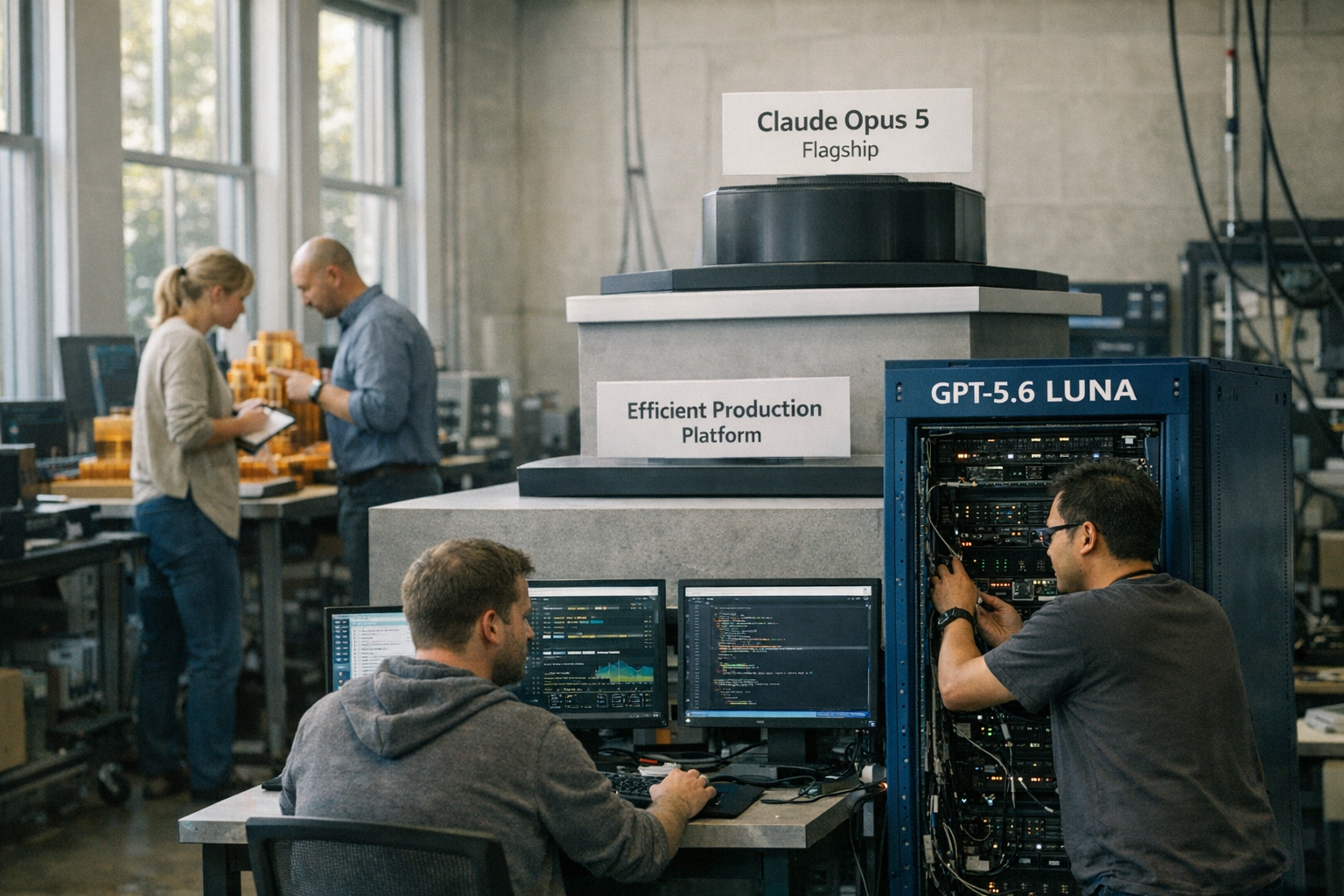
Claude Opus 5 and GPT-5.6 Luna should not be treated as direct peers as of July 24, 2026. Claude Opus 5 remains unverified, while GPT-5.6 Luna is a documented OpenAI model tier positioned for high-volume efficiency, not as the GPT-5.6 family’s flagship-capability option.
Claude Opus 5 remains an unverified model
Anthropic has not provided sufficient primary-source documentation to establish Claude Opus 5 as a publicly available product. Until Anthropic publishes an announcement, model card, API reference, or pricing page, the name should be treated as unconfirmed rather than released.
No verified Anthropic source currently establishes Claude Opus 5’s:
- API model identifier or availability date
- Input-token or output-token pricing
- Context window or maximum output length
- Latency, throughput, or benchmark results
- Tool-use, coding, reasoning, or multimodal performance
- Safety classification or knowledge cutoff
The Opus branding may encourage expectations that Opus 5 would occupy Anthropic’s flagship tier, but branding-based expectations are not product specifications. Likewise, benchmark results from earlier Claude models cannot be presented as evidence for an unreleased model.
Consequently, claims that Claude Opus 5 is faster, more accurate, more capable, or more expensive than GPT-5.6 Luna would be speculative. Even apparently precise leaked figures require confirmation from Anthropic before they can support a defensible comparison.
GPT-5.6 Luna is a verified efficiency tier
GPT-5.6 Luna has a much clearer evidence status. OpenAI identifies GPT-5.6 Luna as the GPT-5.6 tier for high-volume efficiency, making its intended commercial role materially different from that of an expected flagship model.
OpenAI’s GPT-5.6 Preview System Card, published on June 26, 2026, describes GPT-5.6 Luna and GPT-5.6 Terra as “less capable” than the top GPT-5.6 model covered by the relevant safety designation. That language supports a narrow conclusion: Luna intentionally prioritizes efficiency rather than representing the family’s maximum-capability tier.
OpenAI lists GPT-5.6 Luna at $1 per million input tokens and $6 per million output tokens as of July 2026. For example:
- Processing 10 million input tokens costs $10, excluding output.
- Generating 1 million output tokens costs $6, excluding input.
- A workload using 10 million input and 2 million output tokens costs $22 before any other applicable charges.
OpenAI’s Help Center also states that GPT-5.6 Luna is not selectable in standard ChatGPT conversations. Buyers should therefore distinguish Luna’s documented model availability from ordinary model selection inside the standard ChatGPT interface.
The comparison is asymmetric, not capability-proven
The defensible classification is straightforward:
- Claude Opus 5: an unverified model with no confirmed commercial or technical specifications.
- GPT-5.6 Luna: a verified high-volume-efficiency tier priced at $1 per million input tokens and $6 per million output tokens.
- Direct capability verdict: unavailable until Anthropic releases testable Opus 5 documentation or access.
This is therefore not yet a conventional flagship-versus-flagship comparison. It is a comparison between an unconfirmed expected flagship and a documented efficiency-oriented production model, so any stronger ranking would exceed the available evidence.
Which Claude Opus 5 claims are verified, leaked, expected, or still unknown?
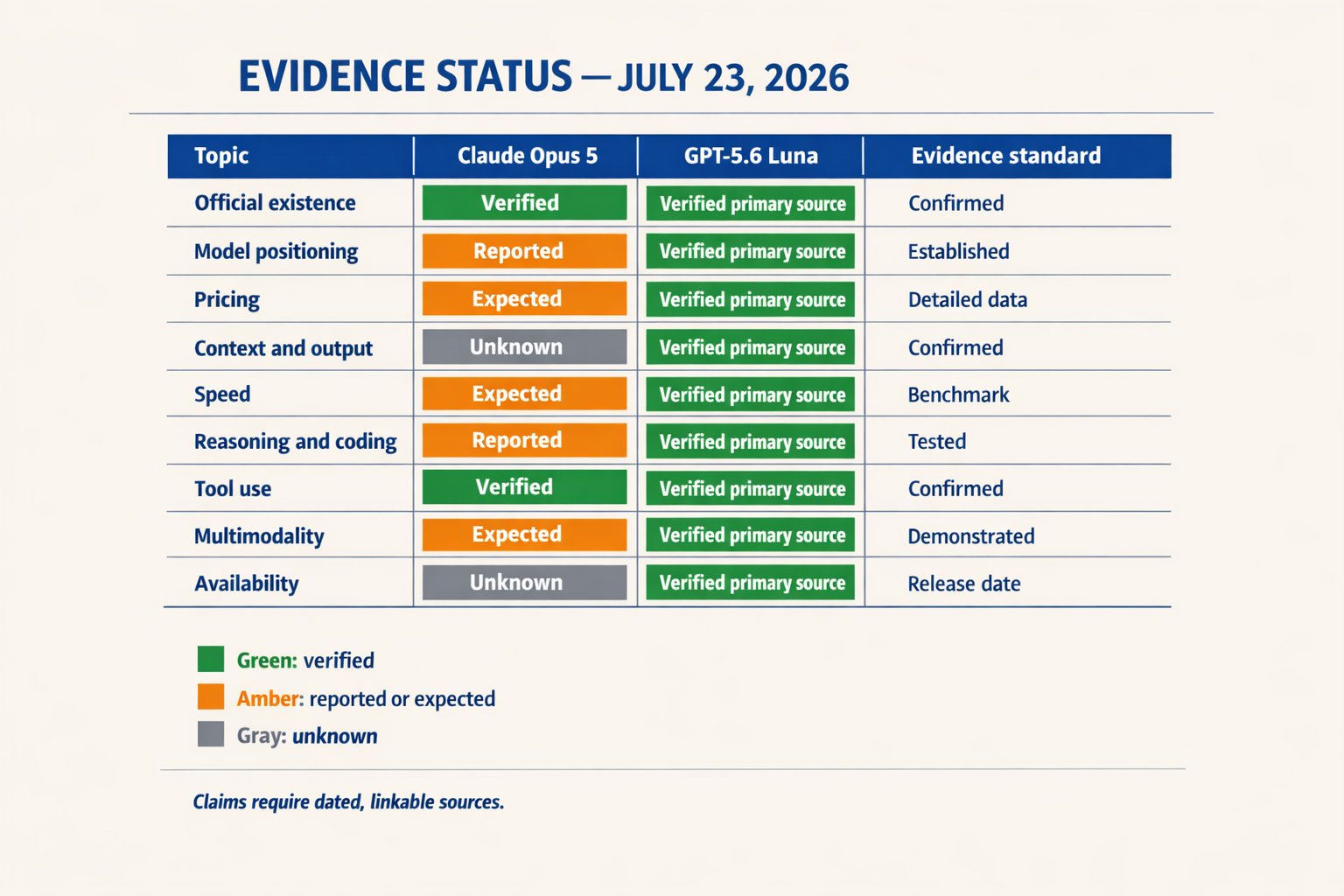
As of July 25, 2026, Claude Opus 5 is officially launched. Anthropic’s first-party documentation now confirms its model identity, API model ID, pricing, token limits, and default reasoning behaviour. Benchmark results require more careful labeling: Anthropic’s published scores are vendor-reported, while independent evaluations remain third-party evidence.
Claude Opus 5 evidence-status table
| Claim area | Current evidence | Evidence status | Safe conclusion |
|---|---|---|---|
| Launch and model identity | Anthropic has announced Claude Opus 5 as its new flagship model. | Official Anthropic fact | Claude Opus 5 is no longer a leaked or anticipated product. Its launch and flagship positioning are verified. |
| API model ID | Anthropic lists a usable Claude Opus 5 model identifier in its official API documentation and model catalogue. | Official Anthropic fact | Developers can identify and request Opus 5 through Anthropic’s documented API rather than relying on codenames or model-picker screenshots. |
| Pricing | Opus 5 costs $5 per million input tokens and $25 per million output tokens at standard published rates. | Official Anthropic fact | Opus 5 is a premium model. Workload cost should still account for caching, tool use, long prompts, and any platform-specific charges. |
| Context window | Opus 5 supports a 1 million-token context window. | Official Anthropic fact | The advertised context capacity is verified, but effective recall and accuracy across very long inputs remain workload-dependent. |
| Maximum output | Opus 5 supports outputs of up to 128,000 tokens. | Official Anthropic fact | The documented ceiling is 128k tokens; actual responses can end earlier because of configuration, stop conditions, safety controls, or platform limits. |
| Thinking behaviour | Opus 5 uses thinking by default. | Official Anthropic fact | Reasoning-oriented behaviour is part of the standard model configuration, although latency and token consumption can vary with task complexity and API settings. |
| Reasoning benchmarks | Anthropic reports gains on selected reasoning and knowledge evaluations. | Vendor-reported | These scores describe Anthropic’s own evaluation runs. They should not be presented as independent verification unless the test setup and results are reproduced externally. |
| Coding and agent benchmarks | Anthropic reports Opus 5 results on software-engineering or agentic evaluations. | Vendor-reported | The claims are attributable to Anthropic, but benchmark version, scaffolding, tools, retry policy, and scoring method must be preserved when quoting them. |
| Independent performance tests | Third parties have begun testing coding quality, reasoning, latency, reliability, and long-context behaviour. | Third-party, test-specific | Independent results should be labeled with the evaluator, date, model ID, settings, sample size, and methodology. One test should not be generalized to every workload. |
| Real-world speed and value | Cost and token limits are official, but observed latency, throughput, and task-level value vary by deployment. | Partly verified; workload-dependent | There is no universal speed or value winner. Comparisons must use equivalent prompts, reasoning settings, tools, regions, and output lengths. |
What counts as verification after launch?
The launch changes the status of Claude Opus 5’s core specifications. The following are now suitable for presentation as verified facts because Anthropic documents them directly:
- Claude Opus 5’s release and flagship positioning
- Its documented API model identifier
- $5-per-million input-token pricing
- $25-per-million output-token pricing
- A 1 million-token context window
- A 128,000-token maximum output
- Default thinking behaviour
That does not automatically make every performance claim independently verified. Anthropic benchmark charts should be described as Anthropic-reported or vendor-reported, not as neutral proof that Opus 5 wins every reasoning or coding task.
Third-party tests should remain a separate evidence category. A credible independent result should identify the exact model ID, test date, benchmark version, prompt or agent scaffold, tool permissions, reasoning configuration, number of attempts, and scoring method.
What remains workload-dependent?
Official limits establish what the product supports, but they do not guarantee identical results in every application. A 1M context window does not prove perfect retrieval across 1 million tokens, and a 128k output allowance does not mean every interface or partner platform exposes the full limit.
Likewise, default thinking can improve difficult-task performance while increasing response time or token use. Latency, throughput, long-context accuracy, coding reliability, and total cost per completed task still require controlled testing.
Claude Opus 5 versus GPT-5.6 Luna
The comparison is now between two documented products rather than a released OpenAI model and an unverified Anthropic model. Claude Opus 5 has an official premium profile at $5/M input tokens and $25/M output tokens, with 1M context, 128k maximum output, and thinking enabled by default.
GPT-5.6 Luna remains positioned for high-volume efficiency at $1 per million input tokens and $6 per million output tokens. That gives Luna a clear published-price advantage, while Opus 5 targets a higher-capability flagship role.
A winner on reasoning, coding, latency, or real-world value should still be based on matched independent tests. Vendor benchmark claims can inform the comparison, but they should not be mixed with third-party findings or presented as universally verified outcomes.
How did the models reach this point, and what are the key July 2026 developments?
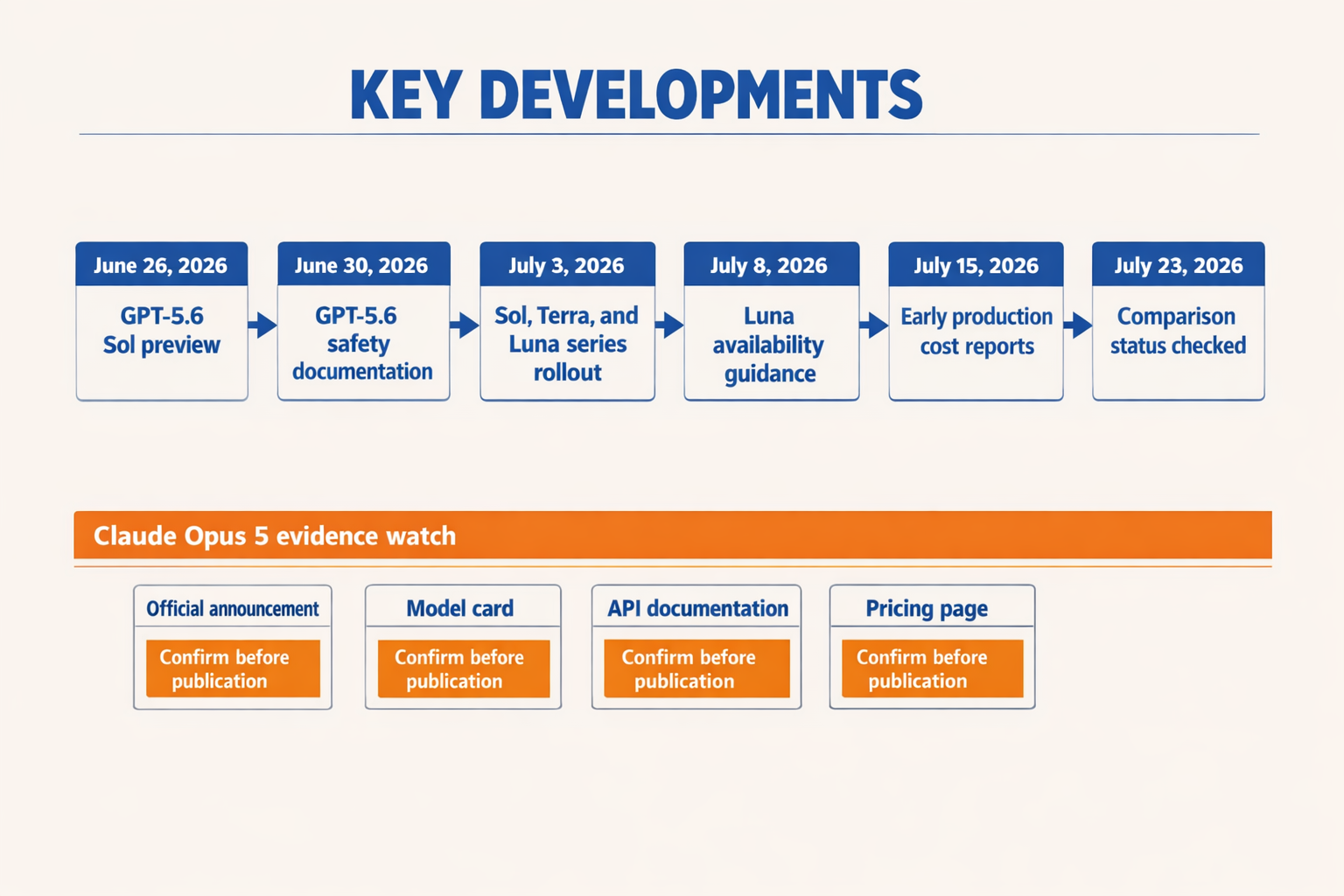
The models reached July 2026 through very different paths: GPT-5.6 Luna progressed from documented preview materials to a deployable efficiency tier, while Claude Opus 5 remained a rumoured successor without an Anthropic model card or release announcement. The central July development was therefore not a verified head-to-head benchmark, but a widening evidence gap between an available product and an anticipated flagship.
Timeline and evidence status
| Date | Development | GPT-5.6 Luna significance | Claude Opus 5 significance | Evidence status |
|---|---|---|---|---|
| Before June 26, 2026 | Claude Opus 4.8 appeared as the current Claude comparator in GPT-5.6 materials | OpenAI used an existing Anthropic model as a competitive reference | Opus 4.8 results cannot be reassigned to Opus 5 | Mixed: prior model verified; Opus 5 extrapolation unsupported |
| June 26, 2026 | OpenAI previewed GPT-5.6 Sol | Established the forthcoming GPT-5.6 family and its frontier tier | No corresponding Anthropic announcement identified | Official OpenAI product release |
| June 26, 2026 | OpenAI published the GPT-5.6 Preview System Card | OpenAI described Terra and Luna as “less capable” than the top model covered by the safety designation | No equivalent Opus 5 safety document was available | Official primary source |
| July 8, 2026 | An OpenAI Community announcement described Sol, Terra, and Luna | Luna was positioned for high-volume efficiency, distinct from Sol and Terra | Reinforced that Luna should not be treated as a direct flagship-class equivalent | Official community channel, below product documentation in evidentiary weight |
| July 2026 | OpenAI released its GPT-5.6 family materials | Luna became a documented production option with reported pricing of $1 per million input tokens and $6 per million output tokens | Anthropic still had not published verified Opus 5 pricing, limits, or availability | Luna verified/reported through OpenAI materials; Opus 5 unverified |
| July 15–23, 2026 | Early users discussed Luna’s real-world token consumption and cost | One OpenAI Community test reported Luna costing approximately 96% more than GPT-5.4 mini in a controlled multi-turn Responses API workload | No comparable Opus 5 production telemetry existed | Community observation, not a universal benchmark |
What changed during July 2026?
Three developments shaped the comparison:
- OpenAI formalised model segmentation. GPT-5.6 Sol represents the higher-capability end, while Terra and Luna target different cost-performance needs. OpenAI’s June 26 system card explicitly prevents readers from assuming that every GPT-5.6 model has identical capability.
- Luna became commercially actionable. Its $1/$6 per-million-token pricing gives developers enough information to model production costs, although caching, reasoning effort, output length, and multi-turn context can materially change the final bill.
- Opus 5 speculation outpaced documentation. As of July 24, 2026, no cited Anthropic primary source established Claude Opus 5’s context window, maximum output, benchmark scores, latency, multimodal support, tool-use performance, API identifier, or price.
The OpenAI Help Center also states that GPT-5.6 Terra and GPT-5.6 Luna are not selectable in standard ChatGPT conversations. That makes Luna primarily relevant through supported APIs and integrated products rather than ordinary ChatGPT model selection.
How should readers interpret the chronology?
The timeline supports two practical conclusions:
- Use Luna evidence for Luna only. Sol benchmarks and GPT-5.6 family-level claims should not automatically be presented as Luna results.
- Use Opus 4.8 evidence for Opus 4.8 only. Neither search interest nor leaked Opus 5 claims establish the specifications of Anthropic’s next flagship.
Consequently, July 2026 provides a strong basis for evaluating GPT-5.6 Luna as a low-cost production model, but not yet for declaring whether Claude Opus 5 will outperform it—or at what price.
How do pricing, context, output limits, latency, and throughput compare?
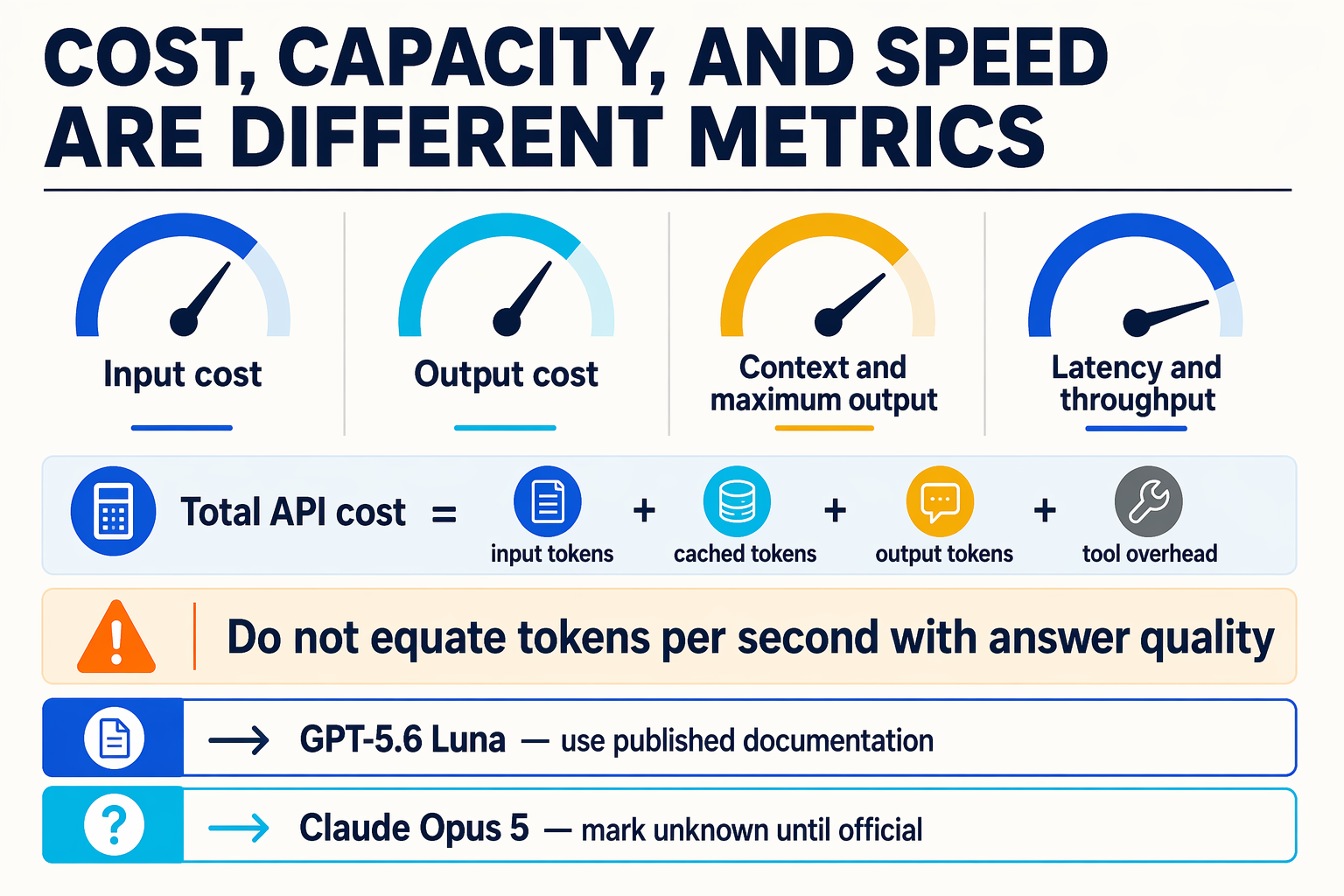
GPT-5.6 Luna is the only model in this pairing with verified commercial specifications as of July 24, 2026. OpenAI lists Luna at $1 per million input tokens and $6 per million output tokens, with a 1,050,000-token context window and 128,000-token maximum output. It is positioned as the fastest and lowest-cost GPT-5.6 tier.
Claude Opus 5 does not appear in Anthropic’s official model catalogue. Anthropic has not announced its pricing, context window, output limit, latency, throughput or availability, so a numerical comparison is not yet possible.
Evidence-status comparison
| Metric | GPT-5.6 Luna | Claude Opus 5 | Practical conclusion |
|---|---|---|---|
| Input price | $1 per million tokens | Unannounced | Luna can be included in production cost estimates |
| Output price | $6 per million tokens | Unannounced | Generated output costs six times as much as input, so control output length |
| Context window | 1,050,000 tokens | Unannounced | Luna supports very large prompts, but test retrieval quality and total request cost |
| Maximum output | 128,000 tokens | Unannounced | Confirm application and gateway limits before relying on the full allowance |
| Latency and throughput | Positioned as the fastest GPT-5.6 tier and optimized for high-volume, low-cost use; no universal speed figure | Unannounced | Benchmark both models under the intended workload if Opus 5 becomes available |
At Luna’s published rates, a request containing 100,000 input tokens and 10,000 output tokens costs approximately $0.16 before caching, tools or other billable features: $0.10 for input plus $0.06 for output. One million input tokens paired with 100,000 output tokens would cost approximately $1.60.
No equivalent calculation is defensible for Claude Opus 5. Pricing from Claude Opus 4.x or any other existing Anthropic model should not be presented as Opus 5 pricing.
Context and output limits are model-specific
Luna’s 1,050,000-token context window and 128,000-token maximum output are substantially different concepts. The context window governs how much information the model can accommodate in a request, while the output limit caps how much it can generate. Applications must remain within both constraints.
Those specifications should not be inferred from GPT-5.6 Sol, Terra or earlier GPT models. Each tier can have different limits, pricing and performance characteristics. The same rule applies to Anthropic: specifications for an existing Claude Opus model do not verify anything about the unannounced Claude Opus 5.
Before deployment, teams should also confirm:
- Whether the context limit includes generated and reasoning tokens
- How reasoning tokens affect billing and output allowances
- Cache-read and cache-write pricing
- Tool-use and other feature charges
- Rate limits by account tier, region and API endpoint
- Any lower limits imposed by an SDK, gateway or application
Latency is not the same as throughput
Latency measures how quickly an individual request starts and completes. Throughput measures how much work a deployment can process over time. OpenAI’s description of Luna as the fastest GPT-5.6 tier is a relative product-positioning claim, not a universal tokens-per-second guarantee.
Actual performance will vary with prompt size, output length, reasoning settings, tool calls, region, concurrency and service load. Buyers should test time to first token, tokens per second, p50 and p95 latency, concurrency limits, error rates, and cost per successfully completed task using representative workloads.
Until Anthropic announces Claude Opus 5 and makes it available for testing, any latency or throughput comparison would be speculative. Gateways such as CallMissed’s OpenAI-compatible multi-model API can support workload-level evaluations once both models are accessible, without treating unverified specifications as production facts.
Which model is likely to be stronger for reasoning, coding, tools, agents, and multimodality?
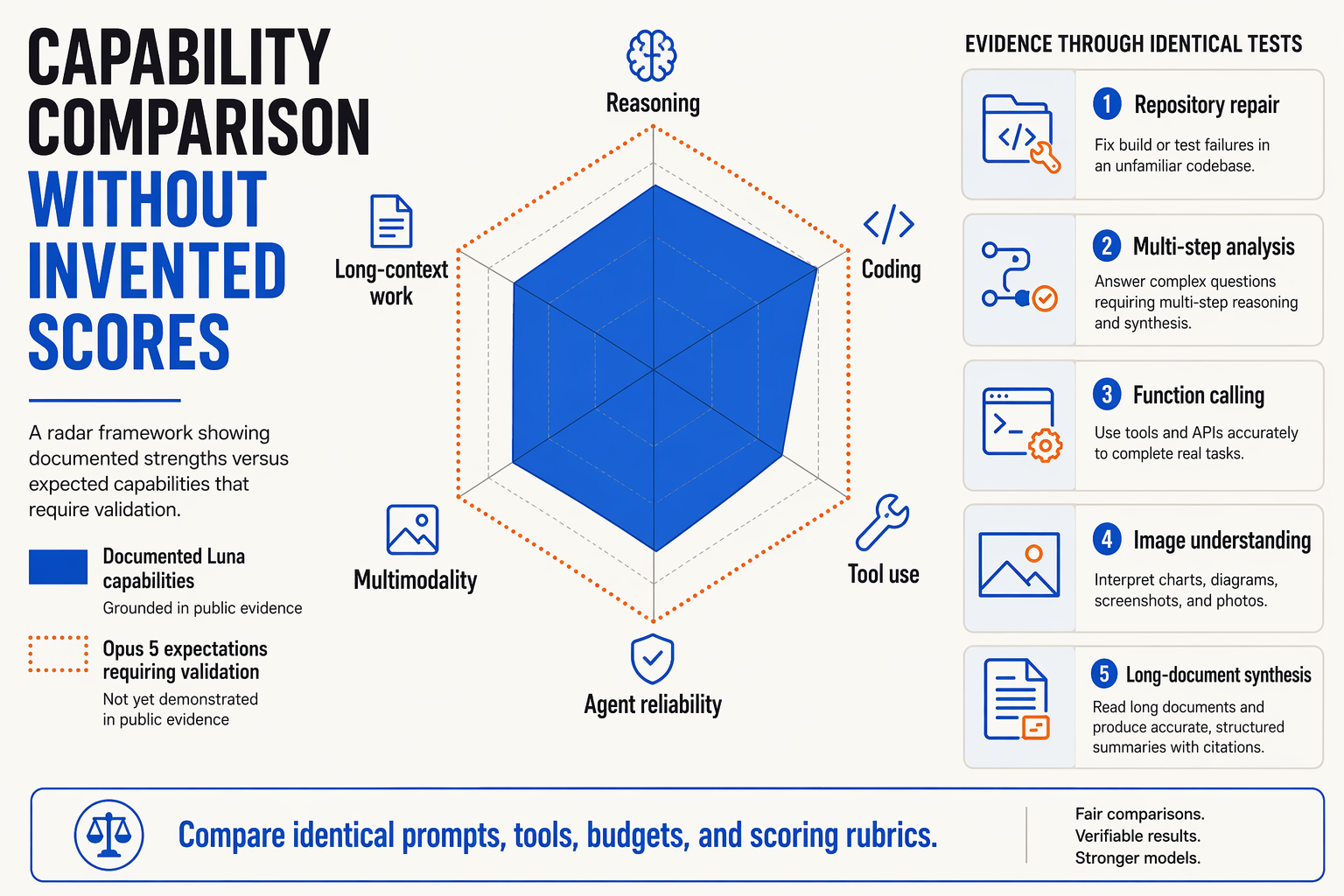
Claude Opus 5 is more likely to lead on maximum reasoning and coding quality if Anthropic releases it as a true flagship, but GPT-5.6 Luna is the stronger choice for deployable tools, agents, and high-volume production today. Multimodality remains inconclusive because comparable, primary-source specifications are not available for Opus 5.
Capability verdict by workload
| Capability | Likely leader | Confidence | Why |
|---|---|---|---|
| Deep reasoning | Claude Opus 5 | Low | Expected flagship positioning, but no verified benchmarks |
| Complex coding | Claude Opus 5 | Low | Opus models traditionally target demanding work; Opus 5 evidence is unavailable |
| Tool use | GPT-5.6 Luna today | Medium | Released model that developers can test in real API workflows |
| Autonomous agents | GPT-5.6 Luna today | Medium | Availability, cost control, and repeatable evaluation outweigh speculative capability |
| Multimodality | No defensible winner | Low | No comparable Opus 5 model card or confirmed modality matrix |
| High-volume execution | GPT-5.6 Luna | High | Luna is explicitly positioned for high-volume efficiency |
The crucial distinction is between likely capability and demonstrable capability. Anthropic may ultimately deliver a more capable model, but unreleased performance cannot complete tasks, pass regression tests, or satisfy a production service-level objective.
Reasoning and coding favour Opus 5—conditionally
If Claude Opus 5 becomes Anthropic’s next top-tier model, it would reasonably be expected to target difficult activities such as:
- Long-horizon software engineering
- Multi-stage mathematical or scientific reasoning
- Large-repository analysis and architectural planning
- Complex instruction following with extensive intermediate context
That is a forecast based on expected product positioning, not a benchmark result. As of July 24, 2026, no verified Anthropic score establishes Opus 5’s performance on SWE-bench, Terminal-Bench, GPQA, AIME, or similar evaluations.
GPT-5.6 Luna should not be treated as OpenAI’s maximum-intelligence offering. The OpenAI GPT-5.6 Preview System Card, published June 26, 2026, describes GPT-5.6 Terra and GPT-5.6 Luna as “less capable” than the top GPT-5.6 model receiving the cited safety designation. Luna can still be useful for coding and reasoning, but its role is optimized production execution rather than undisputed frontier performance.
Tools and agents favour what can be tested now
For agentic systems, model intelligence is only one variable. Teams also need reliable structured outputs, tool selection, latency, error recovery, observability, and predictable cost across repeated steps.
GPT-5.6 Luna therefore has the practical advantage because developers can:
- Run task-specific tool-calling evaluations.
- Measure completion rates and total token consumption.
- Test retries, caching, and multi-turn agent loops.
- Deploy without waiting for hypothetical API terms.
OpenAI community reports include a controlled Responses API test claiming Luna cost approximately 96% more than GPT-5.4 mini, illustrating why teams should measure complete agent runs rather than compare list prices alone. Community tests are useful signals, however, not standardized vendor benchmarks.
Multimodality needs feature-level verification
Neither model should receive a blanket “multimodal winner” label without matched tests. Buyers should separately verify image input, audio processing, video understanding, document fidelity, tool compatibility, and output modalities.
The practical verdict is clear: wait for Opus 5 evidence when peak reasoning quality matters; evaluate GPT-5.6 Luna now when deployment readiness, tool execution, and throughput matter more.
How could a flagship-versus-efficiency mismatch affect benchmarks and buying decisions?

A flagship-versus-efficiency comparison can produce a technically correct benchmark winner but the wrong purchasing decision. Claude Opus 5 is expected to target maximum capability, whereas GPT-5.6 Luna is positioned for economical, high-volume execution, so raw scores must be normalized for cost, latency, availability, and task success.
Why headline benchmark scores could mislead
Benchmark rankings become unreliable when one model is optimized for difficult frontier tasks and the other for production efficiency. OpenAI’s GPT-5.6 Preview System Card, published June 26, 2026, explicitly describes GPT-5.6 Terra and GPT-5.6 Luna as “less capable” than the top GPT-5.6 model covered by its safety designation.
That positioning has several implications:
- Reasoning benchmarks may favor an eventual Opus 5 flagship without showing whether the extra quality matters for routine tickets, extraction, classification, or summarization.
- Speed tests can favor Luna while obscuring differences in reasoning depth, output quality, retries, and tool-call accuracy.
- Coding scores may not predict repository-level performance unless both models receive identical tools, context, prompts, and reasoning budgets.
- Cost-per-token comparisons can miss cache charges, repeated tool calls, longer outputs, and failed attempts.
Any chart assigning Claude Opus 5 a score before Anthropic publishes reproducible results should be treated as speculation, not a benchmark. Scores from Claude Opus 4.8 also cannot serve as Opus 5 results merely because both use the Opus name.
Measure cost per successful task, not tokens alone
At GPT-5.6 Luna’s reported rates of $1 per million input tokens and $6 per million output tokens, a workload consuming 100 million input tokens and 20 million output tokens would have a base model cost of $220, before caching, search, or other tool charges. That calculation is more useful than a leaderboard when estimating a customer-support or document-processing deployment.
However, published rates are not identical to realized costs. An OpenAI Community test posted July 15, 2026, reported that GPT-5.6 Luna cost approximately 96% more than GPT-5.4 mini in one controlled multi-turn Responses API experiment. That is a user-reported workload result—not an official universal benchmark—but it illustrates why buyers should replay their own prompts and inspect total token consumption.
A fair buying framework
Teams should evaluate both models through four separate gates:
- Quality floor: What percentage of real tasks pass human or automated acceptance criteria?
- Production economics: What is the cost per accepted answer after retries, reasoning tokens, tool calls, and output length?
- Operational performance: What are median and p95 latency, throughput, rate limits, and failure rates?
- Procurement readiness: Is the model generally available with documented pricing, data controls, service terms, and stable model identifiers?
GPT-5.6 Luna can pass the fourth gate now for supported API products, although OpenAI’s Help Center says Luna is not selectable in standard ChatGPT conversations. Claude Opus 5 cannot be evaluated equivalently until Anthropic publishes official access and commercial documentation.
What this means for the decision
Choose GPT-5.6 Luna now when the workload rewards scale, predictable token pricing, and deployability more than maximum frontier capability. Wait for verified Opus 5 evidence when difficult reasoning, coding, or agentic reliability could justify flagship economics—but run the eventual comparison using the same prompts, tools, budgets, and acceptance tests.
The defensible conclusion is not that one tier universally wins. It is that benchmark leadership and production value answer different questions, and buyers should pay for capability only when measured task outcomes require it.
What do official sources, independent evaluators, and early users actually say?
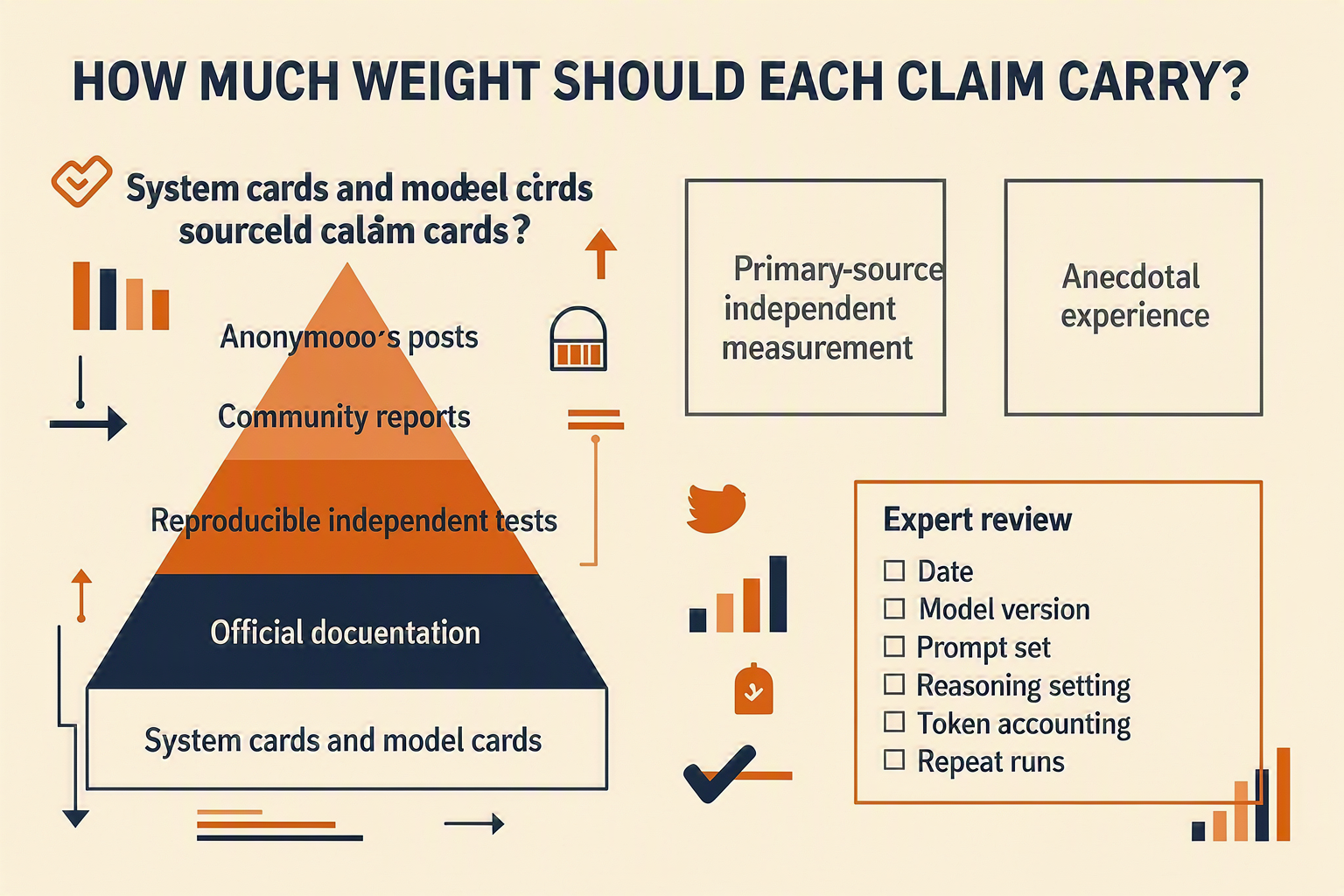
Official evidence supports GPT-5.6 Luna as a deployable, high-volume efficiency model, while no official or independently reproducible evidence yet establishes Claude Opus 5’s capabilities. Early Luna reports raise legitimate questions about real-world token consumption, but they do not constitute a controlled Claude Opus 5 vs GPT-5.6 Luna benchmark.
What OpenAI’s official sources confirm
OpenAI’s documentation consistently positions Luna below the family’s most capable tier rather than as a direct flagship challenger.
- OpenAI’s GPT-5.6 Preview System Card, published on June 26, 2026, calls GPT-5.6 Terra and GPT-5.6 Luna “less capable” than the top GPT-5.6 model covered by the safety designation.
- OpenAI introduced the GPT-5.6 Sol, Terra, and Luna series in July 2026, describing Luna as the option for high-volume efficiency.
- OpenAI lists GPT-5.6 Luna at $1 per million input tokens and $6 per million output tokens, giving buyers a concrete basis for estimating API expenditure.
- OpenAI’s Help Center states that GPT-5.6 Terra and GPT-5.6 Luna are not selectable in standard ChatGPT conversations. Luna’s relevance is therefore primarily API- and product-integration-oriented.
These statements establish Luna’s role, price and availability, but they should not be stretched into claims that Luna matches the reasoning ceiling of GPT-5.6 Sol or an expected Anthropic flagship.
What Anthropic has—and has not—said
As of July 24, 2026, Anthropic has not provided a verifiable Claude Opus 5 release announcement, model card, API identifier, pricing schedule or generally available product page in the supplied evidence. Consequently, purported details about its context window, output limit, latency, coding scores, multimodal inputs or tool-use reliability remain expected or leaked, not confirmed.
Three evidence rules are essential:
- Claude Opus 4.8 results are not Claude Opus 5 results.
- A screenshot or anonymous claim is not equivalent to Anthropic API documentation.
- A benchmark score without prompts, sampling settings, tool configuration and reproducible outputs cannot support a purchasing decision.
Search interest in GPT-5.6 Luna vs Claude Opus 4.8 may offer historical context, but it cannot fill the Opus 5 evidence gap.
What early GPT-5.6 Luna users report
OpenAI Community users have supplied useful—but anecdotal—production observations. In a July 15, 2026 community report, one developer said GPT-5.6 Luna cost approximately 96% more than GPT-5.4 mini in a controlled multi-turn Responses API test; the discussion referenced a shared mean of 35,145 cache-write tokens.
Another OpenAI Community user reported that GPT-5.6 Luna at “xhigh” used substantially more limits than GPT-5.5 at the same setting. These accounts suggest that headline token prices do not determine total workload cost: reasoning effort, cache writes, conversation length and generated-token volume can materially change the bill.
However, neither report:
- compares Luna directly with Claude Opus 5;
- establishes representative latency or quality;
- replaces provider documentation or a multi-run independent evaluation.
The defensible evidence verdict
Independent evaluators cannot yet conduct a reproducible 1v1 test without an accessible, documented Opus 5 endpoint. For now, teams should treat Luna’s official specifications as verified, community cost reports as signals to test, and every Claude Opus 5 performance claim as unconfirmed pending Anthropic documentation.
Should you use GPT-5.6 Luna now, test an available Claude model, or wait for Opus 5?
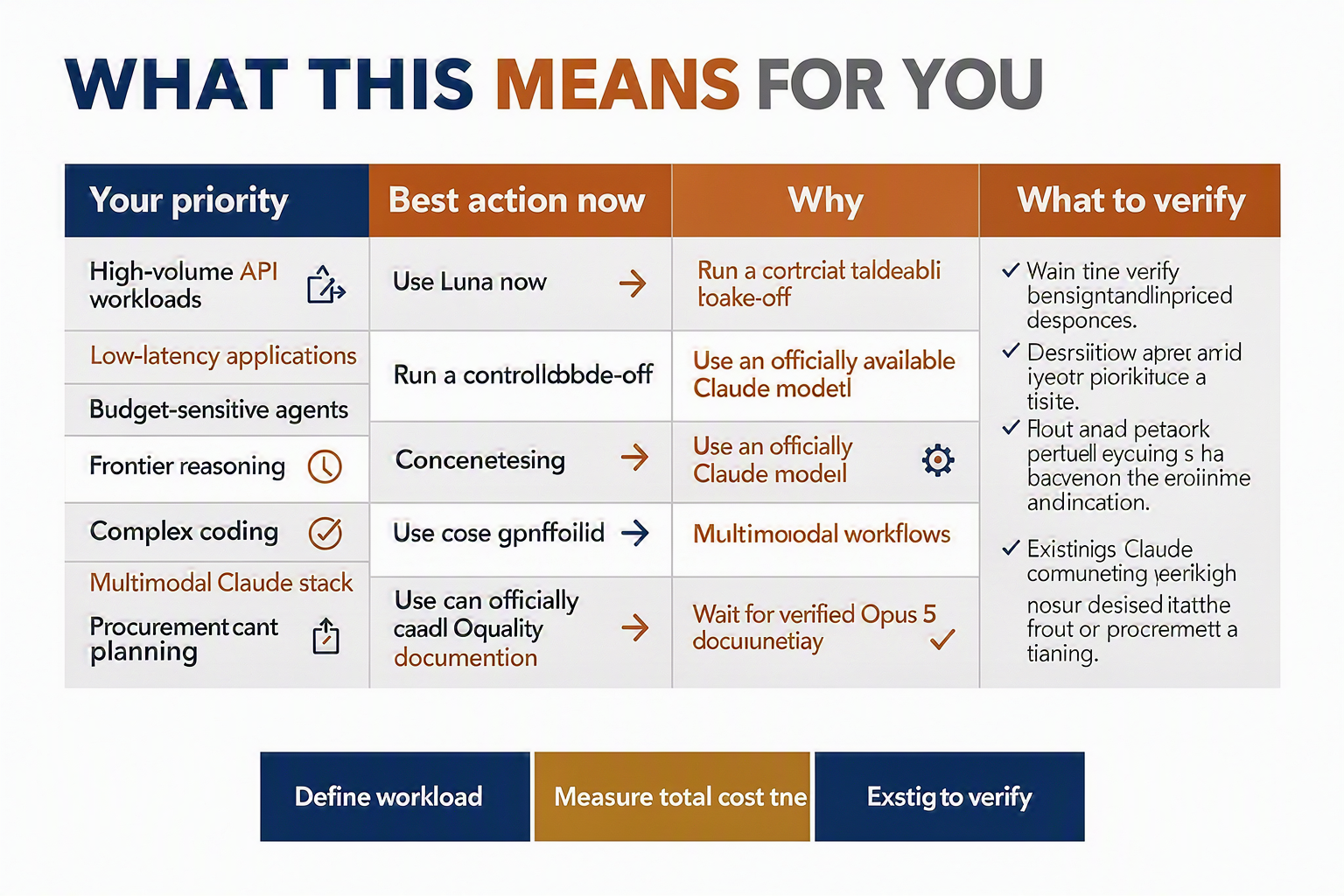
Use GPT-5.6 Luna now for cost-sensitive, high-volume production workloads; test an available Claude model when reasoning quality is the priority; wait for Claude Opus 5 only if your timeline allows an unpriced, undocumented option. As of July 24, 2026, Luna supports an evidence-based deployment decision, while Opus 5 supports only a watchlist decision.
Deployment decision matrix
| Situation | Best action now | Evidence-based rationale | Main caution |
|---|---|---|---|
| High-volume support, extraction, classification, or summarisation | Deploy GPT-5.6 Luna | OpenAI positions Luna for high-volume efficiency, with reported pricing of $1 per million input tokens and $6 per million output tokens | Validate quality on domain-specific prompts before scaling |
| Complex coding, planning, or long-horizon reasoning | Test an available Claude model against Luna | A released Claude model provides measurable latency, accuracy, and tool-use results; Opus 5 does not | Do not relabel Claude Opus 4.8 results as Opus 5 performance |
| Workload explicitly requires the next Anthropic flagship | Wait for Claude Opus 5 documentation | Anthropic has not supplied verified Opus 5 pricing, benchmarks, context limits, or general availability | Release timing and production economics remain unknown |
| Consumer ChatGPT workflow | Do not choose Luna on this basis | OpenAI’s Help Center states that GPT-5.6 Luna is not selectable in standard ChatGPT conversations as of July 24, 2026 | Product access differs from API availability |
| API product with strict unit economics | Pilot Luna and calculate total task cost | Luna has published token pricing, enabling budget forecasts and controlled tests | Token price alone does not measure retries, tool calls, or cache behaviour |
| Provider-flexible AI application | Benchmark both available model families | Real traffic reveals differences in correctness, latency, structured output, and failure rates | Keep Opus 5 out of the scorecard until it is accessible |
When GPT-5.6 Luna is the practical choice
Choose Luna when deployment certainty and throughput economics matter more than obtaining the strongest possible model on every request. OpenAI’s GPT-5.6 Preview System Card, published June 26, 2026, describes GPT-5.6 Terra and GPT-5.6 Luna as “less capable” than the top GPT-5.6 model covered by the safety designation. That wording makes Luna’s role clear: it is an efficiency tier, not a direct substitute for every flagship reasoning workload.
A community report claimed that GPT-5.6 Luna cost approximately 96% more than GPT-5.4 mini in one controlled multi-turn Responses API test posted in July 2026. OpenAI Community results are useful warning signals, but one configuration should not replace testing with your own cache patterns, reasoning settings, response lengths, and tool calls.
When testing Claude—or waiting—makes sense
Test a currently available, officially documented Claude model if your application depends on nuanced writing, difficult code changes, agent planning, or instruction adherence. Use a fixed evaluation set and compare:
- Task success rate and human preference
- End-to-end latency, not just generation speed
- Tool-call accuracy and structured-output validity
- Total cost per completed task, including retries
- Safety refusals and escalation frequency
Wait for Opus 5 only when a possible flagship-quality improvement is worth delaying procurement. Before treating Claude Opus 5 as deployable, require an Anthropic release announcement, model card, API identifier, pricing page, context and output limits, and availability terms.
Platforms such as CallMissed, the OpenAI-compatible multi-model gateway, can help teams test available models through one integration and use same-tier fallbacks. The defensible decision remains simple: deploy verified capability now, benchmark accessible alternatives, and never build a production forecast from Opus 5 leaks.
Frequently asked questions about GPT-5.6 Luna vs Claude Opus
Which model is better in GPT-5.6 Luna vs Claude Opus 5?
Is Claude Opus 5 released, and can I use GPT-5.6 Luna now?
How much does GPT-5.6 Luna cost compared with Claude Opus 5?
What are the context-window and output limits in Claude Opus 5 vs GPT-5.6 Luna?
Is GPT-5.6 Luna or Claude Opus 5 better for coding, reasoning, and tool use?
Should developers use GPT-5.6 Luna now or wait for Claude Opus 5?
Conclusion
As of July 24, 2026, use this GPT-5.6 Luna vs Claude Opus 5 decision checklist:
- Availability: Choose GPT-5.6 Luna if its API or product access fits your deployment. It is not selectable in standard ChatGPT conversations.
- Cost: OpenAI reports Luna pricing of $1 per million input tokens and $6 per million output tokens. Claude Opus 5 pricing remains unverified.
- Efficiency: Consider Luna for high-volume support, document processing, and automation where production economics matter.
- Coding: Do not assume a winner without official, reproducible head-to-head results.
- Agents: Luna is the deployable option for agentic workflows today; Claude Opus 5 capabilities remain unconfirmed.
- Context: Verify Luna’s current API documentation for workload-specific limits. Do not rely on leaked Claude Opus 5 context-window claims.
- Verification: OpenAI documents Luna but describes it as less capable than the GPT-5.6 family’s leading model. Claude Opus 5 specifications, benchmarks, pricing, speed, coding performance, and multimodality are unverified.
Verdict: In GPT-5.6 Luna vs Claude Opus 5, choose Luna for verified efficiency now—or wait for Anthropic’s official model card, API documentation, pricing, and reproducible benchmarks.
Explore multi-model voice agents, multilingual chatbots, and developer APIs at CallMissed.
Related Reading
- Claude Opus 5 vs GPT-5.6 Terra: Verified Facts, Expected Features and Verdict
- Claude Opus 5 vs Claude Mythos 5: Verified Facts, Claims and Verdict
- Claude Opus 5 vs Kimi K3: Leaks vs Verified Facts (July 2026)
Sources
Discussion
Related Posts


Ready to automate customer conversations?
Launch AI voice agents and WhatsApp bots with CallMissed — one API, 22+ Indian languages.