GPT-6 Astra Cybersecurity: Capabilities, Thresholds and Safeguards



Understand GPT-6 Astra cybersecurity claims, Critical capability thresholds, access controls, monitoring, dual-use risks and enterprise actions.
GPT-6 Astra Cybersecurity: Capabilities, Thresholds and Safeguards
What happens when an AI model crosses from helping analysts investigate incidents to independently performing consequential cyber work? OpenAI’s September 1, 2026, publication says Astra represents a “significant increase in cybersecurity capabilities,” making GPT-6 Astra cybersecurity a timely test of whether frontier capability gains can be matched by equally strong controls.
The term Astra needs careful handling. In the material surfaced here, OpenAI frames Path to Astra around critical capabilities and frontier safeguards; the related release sequence names GPT-5.5, GPT-5.5-Cyber and GPT-5.6-Cyber. Accordingly, this analysis treats “GPT-6 Astra” as the searched label for OpenAI’s Astra-stage cyber capability, not as proof of a separately documented product name. That distinction matters because model branding, capability thresholds and deployment permissions are not interchangeable.
Why now? OpenAI’s publication arrived only two days before this analysis and is accompanied by posts on trusted access, the Daybreak defensive program and GPT-5.6-Cyber. OpenAI says the cyber-defense window is narrowing, while its product trajectory moves from general models toward cybersecurity-specific systems. Those are consequential OpenAI claims, but they are not independent validation. Publicly reproducible evaluations, third-party red-team results and real-world incident data remain essential before enterprises infer operational safety or broad superiority.
The central issue is dual use. The same model that can accelerate vulnerability triage, secure-code review, detection engineering and incident response may also reduce the expertise, time or cost required for harmful activity. An assessment therefore cannot stop at benchmark scores; it must ask what tasks the system can complete, with what autonomy, reliability, scale and access to tools—and what happens when a user approaches a defined capability threshold.
What this analysis covers
This analysis will separate the documented record from inference and examine:
- Capability thresholds: How frontier cyber performance should be classified, measured and escalated before release.
- Defensive value: Where Astra-stage systems could help security operations centers, developers and incident responders without exposing misuse-enabling procedures.
- Dual-use risk: How autonomy, tool use, persistence and speed can change the threat model even when techniques are already public.
- OpenAI Astra safeguards: Trusted-access tiers, identity controls, activity monitoring, abuse detection, tool restrictions, human review and incident response.
- Enterprise implications: Procurement evidence, sandboxing, least privilege, logging, vendor governance and criteria for suspending access.
The goal is not to predict attacks or provide operational exploitation guidance. It is to determine whether OpenAI’s proposed safeguards are proportionate, testable and auditable as cyber capability advances toward Astra-level autonomy.
What is GPT-6 Astra, and what does OpenAI claim it can do?
GPT-6 Astra is OpenAI’s officially released frontier cybersecurity model. OpenAI launched it on September 3, 2026, deployed it broadly, and made it available through the API under the model identifier gpt-6-astra. The release replaces earlier pre-launch ambiguity about whether “Astra” was merely a capability milestone or an informal name.
OpenAI also identifies GPT-6 Astra as its first model to reach the Critical cybersecurity capability threshold under the company’s Preparedness Framework. That is a significant internal classification, but it should not be interpreted as proof that the model can conduct unrestricted, fully autonomous cyber operations.
Astra is both a model and a capability milestone
“Astra” previously described a frontier on OpenAI’s cybersecurity capability-and-safeguards path. Following the September 3 release, the name now applies to a specific deployed model as well as the capability level associated with it.
Three distinctions remain important:
- Model identity: GPT-6 Astra is the released system, accessible in the API as
gpt-6-astra. - Capability classification: OpenAI says the model has reached its Preparedness Framework’s Critical cybersecurity threshold.
- Deployment conditions: Broad availability does not mean unmonitored or unrestricted use; access remains subject to OpenAI’s policies, safeguards and enforcement systems.
The Critical label is OpenAI’s own risk-classification judgment. It indicates that the company believes the model has crossed a defined capability threshold requiring stronger safeguards. It does not, by itself, establish universal reliability, unlimited autonomy, superiority to expert security teams or successful operation in every real-world environment.
What OpenAI claims GPT-6 Astra can do
OpenAI presents GPT-6 Astra as a substantial advance over its earlier general-purpose and cybersecurity-specialized models, including GPT-5.5-Cyber and GPT-5.6-Cyber. Its claimed capability envelope covers sustained, technically demanding security work such as:
- Vulnerability research and triage, including analyzing complex systems and identifying security-relevant weaknesses.
- Secure-software workflows, including code review, risk assessment and remediation support.
- Incident investigation, where the model can organize technical evidence and assist response teams.
- Cyber-defense tooling and operations, extending the defensive direction represented by OpenAI’s Daybreak initiative.
- Complex, multi-step cyber tasks requiring more persistence and tool use than conventional question answering.
- Assistance for expert defenders, including accelerating research and helping prioritize time-sensitive security work.
The release therefore represents more than a rebranding of a general chatbot. OpenAI’s claim is that GPT-6 Astra can perform cybersecurity tasks at a level that triggers the company’s highest relevant capability classification and corresponding safeguard requirements.
However, reaching a Critical threshold does not mean every task succeeds or that human oversight is unnecessary. Performance can still depend on the target environment, available tools, context quality, task duration and the model’s ability to recover from errors. A capability demonstrated in a controlled evaluation may also behave differently in an uncontrolled production network.
Claim versus established evidence
The evidentiary boundary should remain explicit:
- Documented OpenAI fact: GPT-6 Astra was officially released on September 3, 2026, is broadly deployed, and is available via the API as
gpt-6-astra. - Documented OpenAI classification: It is the company’s first model to reach the Critical cybersecurity capability threshold in its Preparedness Framework.
- Documented OpenAI claim: The model represents a significant increase in cybersecurity capability and can support more demanding, multi-step security work.
- Reasonable inference: Greater specialization and stronger tool use may improve vulnerability research, incident analysis and defensive workflows.
- Not established by the classification alone: Unrestricted autonomous hacking, consistent success against arbitrary targets, universal superiority over human experts, or safe performance in every environment.
As of September 5, 2026, GPT-6 Astra is a real, deployed OpenAI model rather than a speculative label. Nevertheless, most public capability characterizations still originate with OpenAI. Independent testing, reproducible evaluation details and evidence from varied operational settings remain necessary to determine how reliably the model performs—and how effectively its safeguards limit misuse.
How did OpenAI’s Path to Astra emerge from earlier cyber models and safeguards?
OpenAI’s Path to Astra emerged as an escalation of earlier cyber-specific models, defensive programs and restricted-access safeguards—not as a single model release. The documented progression runs from general-purpose GPT-5.5 to GPT-5.5-Cyber, the Daybreak defense initiative and GPT-5.6-Cyber, culminating in an Astra-stage framework for managing substantially higher cyber capability.
From general assistance to cyber-specialized models
OpenAI’s publication sequence indicates three broad stages:
- General-purpose cyber assistance: GPT-5.5 could support activities such as code analysis, troubleshooting and defensive investigation, even though cybersecurity was not its sole purpose.
- Domain specialization: OpenAI introduced GPT-5.5-Cyber and later GPT-5.6-Cyber as systems optimized for demanding cybersecurity work.
- Frontier capability governance: Path to Astra: critical capabilities and frontier safeguards, published by OpenAI on September 1, 2026, describes Astra as a “significant increase in cybersecurity capabilities.”
This sequence matters because specialization can alter more than benchmark performance. A cyber-focused model may become more persistent across multistep tasks, more effective with security tools and better able to connect findings into an actionable workflow. Those properties can improve defense while also lowering the expertise or time needed for misuse.
OpenAI’s Daybreak: Tools for securing every organization in the world reported that GPT-5.5-Cyber outperformed GPT-5.5 on two demanding real-world evaluations. The surfaced official material does not provide enough methodological detail to independently reproduce that result, however. It should therefore be treated as an OpenAI-reported comparison, not external confirmation that the specialized model performs better across all environments or task classes.
Why earlier safeguards were no longer sufficient
The move toward Astra implies that ordinary consumer-model controls—policy filters, reactive enforcement and broad rate limits—may become inadequate once a model approaches critical cyber thresholds. OpenAI’s related publication, Scaling Trusted Access for Cyber with GPT-5.5 and GPT-5.5-Cyber, points toward differentiated access rather than identical permissions for every user.
That transition reflects several changes in the risk model:
- Capability: Can the model complete consequential tasks rather than merely describe concepts?
- Reliability: Can it succeed repeatedly instead of producing occasional useful output?
- Autonomy: Can it plan, use tools and adapt across multiple steps with limited supervision?
- Scale: Can one operator run many workflows quickly or concurrently?
- Access: Are advanced functions reserved for verified defenders with accountable identities?
A threshold framework must consider these dimensions together. High benchmark performance alone does not establish critical capability, while moderate performance combined with automation, tool access and scale could still create material risk.
Daybreak and trusted access became complementary safeguards
OpenAI’s 2026 publications frame Daybreak and trusted access as two sides of the same response. Daybreak seeks to distribute defensive capabilities as OpenAI says the “cyber defense window narrows,” while trusted access limits who can use higher-risk functions and under what conditions.
The resulting lineage is therefore best understood as:
- stronger general models;
- cybersecurity-specific variants;
- expanded defensive deployment through Daybreak;
- identity- and risk-sensitive access controls;
- Astra-stage frontier safeguards tied to capability thresholds.
This is a coherent governance direction, but it remains principally OpenAI’s account. Independent red-team reports, reproducible evaluations and deployment evidence are still needed to determine whether the OpenAI Astra safeguards reliably constrain real-world dual-use risk.
Which developments define Astra’s cybersecurity posture?
Astra’s cybersecurity posture is defined by a shift from general-purpose assistance toward cyber-specialized capability, threshold-based governance, trusted access and defense-oriented deployment. OpenAI’s publications present these elements as a connected safety strategy, but the available record does not yet provide enough independent evidence to establish how reliably the controls perform under sustained real-world pressure.
Development timeline and security significance
| Development | Documented status | Security significance | Key evidence gap |
|---|---|---|---|
| Path to Astra | OpenAI published the framework on September 1, 2026 | Treats advanced cyber capability as a frontier-risk issue requiring stronger safeguards | No public, independently reproduced threshold evaluation is identified in the supplied record |
| Astra-stage capability increase | OpenAI describes Astra as a “significant increase in cybersecurity capabilities” | Signals that ordinary model-level moderation may be insufficient for consequential cyber tasks | “Significant” is qualitative without disclosed scores, pass rates or confidence intervals |
| GPT-5.5 and GPT-5.5-Cyber trusted access | OpenAI’s related publication explicitly links these models with Trusted Access for Cyber | Moves governance from universal access toward differentiated permissions for verified users and use cases | Public evidence is needed on false approvals, false denials and resistance to identity or account abuse |
| Daybreak expansion | OpenAI says it is expanding Daybreak because the “Cyber Defense Window Narrows” | Directs advanced capability toward defensive tools and organizations rather than unrestricted availability | Defensive impact requires measurements such as remediation time, vulnerability closure rates and harmful-output rates |
| GPT-5.6-Cyber | OpenAI identifies GPT-5.6-Cyber as a cybersecurity-specific model | Specialization may improve security analysis while simultaneously increasing dual-use potential | Comparative results, evaluation methodology and third-party replication remain necessary |
| External incident collaboration | OpenAI reports partnering with Hugging Face to address a security incident | Shows an emphasis on coordinated response and learning from operational events | One disclosed collaboration cannot establish ecosystem-wide response effectiveness |
From model scores to capability thresholds
The most important development is conceptual: cyber risk depends on operational capability, not merely model identity. A credible threshold should test whether a system can complete consequential tasks reliably across unfamiliar environments, especially when it has tools, memory, repeated attempts or limited autonomy.
Threshold evaluation should therefore distinguish among:
- Advisory capability, such as explaining secure coding or summarizing alerts.
- Workflow capability, where a model completes multiple connected defensive steps.
- Agentic capability, involving planning, tool use, persistence and adaptation.
- Critical capability, where performance could materially lower barriers to serious cyber harm.
Crossing a threshold should trigger predetermined controls—restricted deployment, stronger identity verification, narrower tools, enhanced monitoring or delayed release—rather than a retrospective policy debate.
What the publication sequence actually establishes
OpenAI’s September 1, 2026, statement establishes a clear claim: Astra materially raises cyber capability and therefore warrants frontier safeguards. The surrounding GPT-5.5-Cyber, GPT-5.6-Cyber, Trusted Access and Daybreak publications indicate a layered posture spanning model design, user eligibility, deployment context and incident response.
What the sequence does not independently establish is equally important. The supplied official material contains no independently replicated success rates, misuse-blocking percentages or longitudinal incident statistics. Enterprises should consequently treat the framework as a serious governance signal—not as proof that residual risk is low—and request evaluation protocols, access-review procedures, audit evidence and escalation criteria before permitting Astra-stage systems to operate with sensitive credentials or production tools.
What does the Critical cybersecurity capability threshold actually mean?
A Critical cybersecurity capability threshold is a governance boundary: it marks the point at which a model could materially increase the feasibility or scale of consequential cyber operations, requiring stronger safeguards before deployment. It is not synonymous with “good at cybersecurity,” nor does crossing it prove that a model can autonomously compromise real-world systems.
A threshold, not a benchmark badge
OpenAI’s Path to Astra: critical capabilities and frontier safeguards, published on September 1, 2026, describes Astra as a “significant increase in cybersecurity capabilities.” That statement identifies a capability escalation, but the publicly surfaced material does not provide enough reproducible evidence to translate “Critical” into a universal score or independently verified level of operational effectiveness.
A rigorous threshold should evaluate at least five dimensions:
- Task severity: Could successful performance contribute to substantial disruption, unauthorized access or compromise of high-value systems?
- Autonomy: Can the model plan, execute, evaluate and revise multi-stage work with limited human intervention?
- Reliability: Does it succeed consistently across unfamiliar environments, rather than only on curated challenges?
- Scale and speed: Can one operator use the system to pursue many targets or compress work that previously required a skilled team?
- Tool access: Does the model merely produce text, or can it interact with code execution, networks, credentials and external services?
These factors matter because a high score on vulnerability-identification or capture-the-flag evaluations is not automatically evidence of Critical capability. Controlled benchmarks can omit access restrictions, defensive interference, environmental uncertainty and the consequences of failure.
What crossing the boundary should trigger
The threshold should function as a release-control mechanism, not merely a disclosure label. Once evaluation evidence indicates that a system is approaching or exceeding the boundary, proportionate controls should include:
- Restricted and identity-verified access instead of unrestricted availability.
- Least-privilege tool permissions, with sensitive actions isolated or disabled by default.
- Continuous abuse monitoring across prompts, outputs, tool calls and repeated behavioral patterns.
- Human authorization checkpoints before consequential actions.
- Rate, concurrency and automation limits that constrain harmful scaling.
- Incident-response procedures, including credential revocation, investigation and model-level mitigation.
- Repeated evaluations after fine-tuning, tool integration or infrastructure changes, because deployment context can alter effective capability.
OpenAI’s related September 2026 publications emphasize trusted access and the Daybreak defensive program, indicating that access design is part of the proposed safety case. However, the existence of a control is different from evidence that it works under adversarial pressure.
Claim, evidence and residual uncertainty
Three evidentiary layers should remain separate:
- Documented OpenAI claim: Astra represents a significant cyber-capability increase.
- Required technical evidence: Task definitions, pass criteria, evaluator independence, trial counts, failure rates and comparisons with skilled human operators.
- Required operational evidence: Whether identity checks, monitoring and intervention reliably prevent misuse without blocking legitimate defensive work.
No percentage, benchmark score or observed attack-success rate appears in the supplied Path to Astra search context. It would therefore be misleading to assign GPT-6 Astra cybersecurity a numerical “Critical” performance level from this record alone.
The practical interpretation is conditional: Critical means the potential impact is serious enough that ordinary API safeguards are no longer sufficient. Confidence in that classification—and in the OpenAI Astra safeguards surrounding it—depends on transparent evaluation methods, independent replication and evidence from controlled deployments.
Can OpenAI Astra find zero-day flaws or assemble exploit chains?
OpenAI’s public material supports the conclusion that Astra-stage models may materially improve vulnerability discovery and multi-step cyber reasoning, but it does not yet establish that “GPT-6 Astra” can reliably discover real zero-days or autonomously complete end-to-end exploit chains. OpenAI’s claims should therefore be treated as capability warnings, not independently verified proof of operational exploitation ability.
Zero-day discovery requires more than finding suspicious code
A zero-day vulnerability is a previously unknown flaw for which defenders have had no opportunity to issue a patch. Identifying a potentially unsafe function is not equivalent to discovering one: the model must establish reachability, security impact, affected configurations and reproducibility while excluding false positives.
OpenAI stated on September 1, 2026, in Path to Astra: Critical Capabilities and Frontier Safeguards, that Astra represents a “significant increase in cybersecurity capabilities.” That is an important first-party assessment, but the available publication summary does not disclose a reproducible zero-day discovery rate, false-positive rate or independently audited corpus.
A rigorous zero-day claim would require evidence such as:
- Evaluation against previously unseen, time-sealed software rather than vulnerabilities likely represented in training data.
- Independent reproduction by maintainers or accredited security researchers.
- Measurement of precision, recall, severity and duplicate-report rates.
- Proof that successful findings generalise across languages, architectures and codebases.
- Controlled disclosure records showing that reported flaws were genuinely unknown.
Without those controls, strong performance may reflect code review, vulnerability pattern matching or retrieval of known techniques—not novel discovery.
Exploit chains represent a higher capability threshold
An exploit chain combines multiple weaknesses or system conditions to achieve a consequential outcome. Assembling one demands more than generating isolated technical suggestions: it requires planning, adapting to failed steps, maintaining context and reasoning across software, identity and network boundaries.
The related OpenAI release sequence—GPT-5.5, GPT-5.5-Cyber and GPT-5.6-Cyber—shows an explicit progression toward cybersecurity-specialised systems. OpenAI’s Expanding Daybreak as the Cyber Defense Window Narrows identifies GPT-5.6-Cyber as a cybersecurity-specific model, while the earlier Daybreak publication says GPT-5.5-Cyber outperformed GPT-5.5 on two demanding real-world evaluations. Those statements indicate increasing cyber competence, but the surfaced material provides neither the underlying scores nor enough methodology for independent replication.
A frontier threshold should therefore evaluate at least four dimensions:
- Reliability: How often does the system complete a consequential task rather than merely suggest plausible steps?
- Autonomy: Can it recover from errors and pursue objectives without continuous human direction?
- Tool access: Can it execute code, inspect live systems or invoke external services?
- Scale: Can one user run many parallel investigations at low cost?
The defensible interpretation
Astra-stage capability may help authorised teams identify suspicious code paths, connect related findings and prioritise remediation. The same advances could lower the expertise and time needed for harmful multi-stage activity, making access conditions as important as raw model performance.
Enterprises should not interpret OpenAI Astra cybersecurity branding as permission for unsupervised production testing. Until OpenAI publishes detailed evaluations and independent researchers reproduce them, the prudent position is: credible potential for zero-day and chain-related assistance, but no public proof of consistently autonomous, real-world success.
How do identity, use, monitoring and post-deployment controls work together?
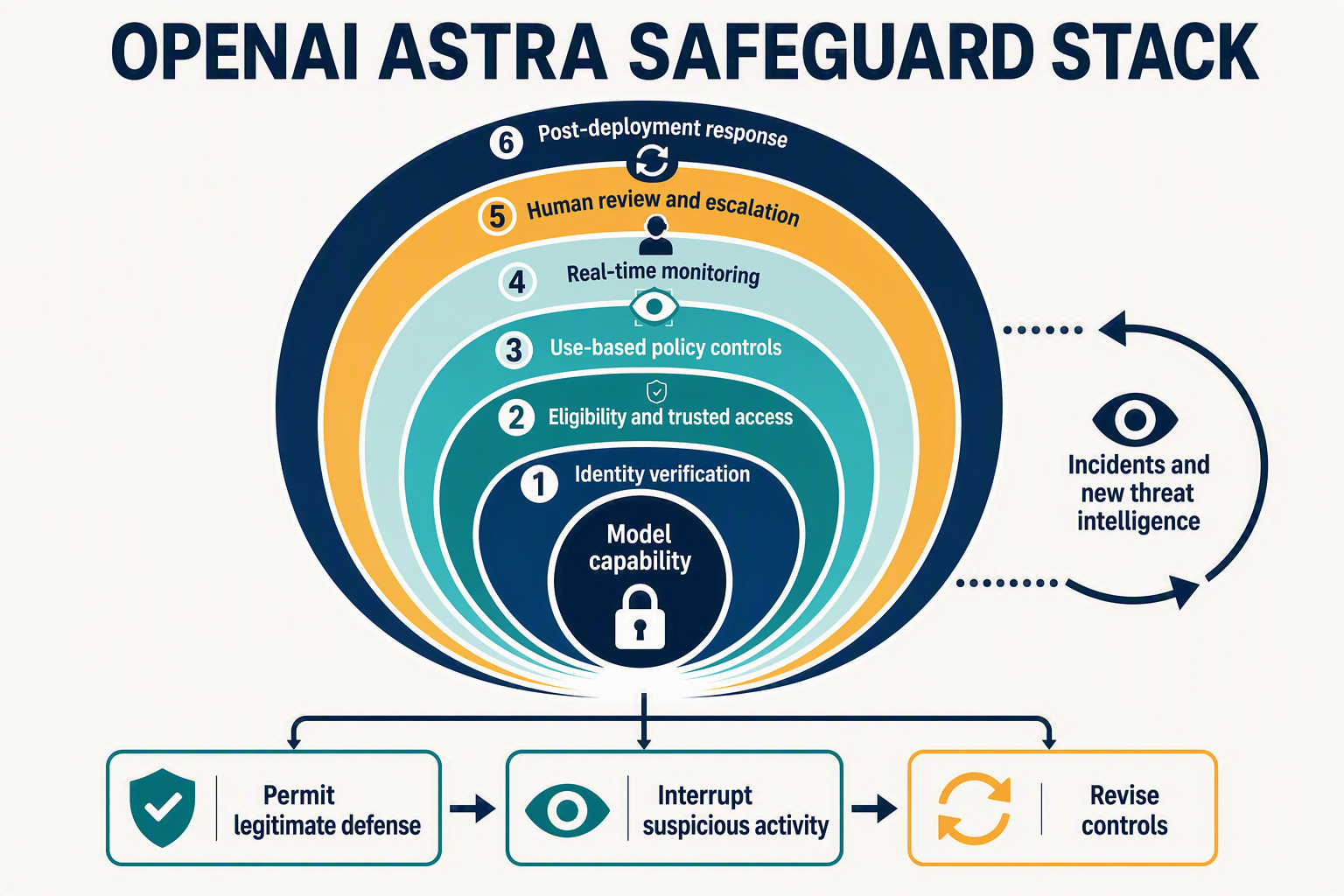
Identity, permitted-use rules, continuous monitoring and post-deployment response form a closed control loop: identity establishes accountability, use controls limit what an account can do, monitoring detects deviations, and response mechanisms restrict access or update safeguards when risk changes. No layer is sufficient independently, especially for Astra-stage systems with consequential cybersecurity capabilities.
Identity is the first gate, not the final safeguard
OpenAI’s trusted-access publications indicate that more capable cyber functionality is intended to be distributed selectively rather than made uniformly available. OpenAI’s September 1, 2026, Path to Astra publication positions these access decisions as part of its frontier-safeguard strategy.
A defensible identity layer should connect an account to a verified person or organization and support:
- Know-your-customer or organizational verification proportionate to capability.
- Named administrators and accountable end users.
- Strong authentication, preferably phishing-resistant multifactor authentication.
- Reverification when ownership, geography or usage patterns materially change.
- Separation between ordinary product access and privileged cyber capabilities.
Identity verification improves attribution, but it does not establish benign intent. Compromised accounts, insiders and apparently legitimate organizations can still misuse access.
Use controls turn trust decisions into technical limits
Authorization should be capability-specific, not a binary approved-or-denied decision. OpenAI’s related 2026 release sequence names three systems—GPT-5.5, GPT-5.5-Cyber and GPT-5.6-Cyber—across its trusted-access and Daybreak publications, illustrating why permissions may need to vary by model and risk tier.
Practical controls can include:
- Least-privilege model access, with stronger systems available only for justified use cases.
- Restrictions on connected tools, credentials, network destinations and autonomous execution.
- Rate, concurrency and resource limits that constrain harmful scaling.
- Human approval before consequential actions.
- Sandboxed environments for evaluation and defensive research.
These measures should reduce both deliberate abuse and accidental harm. However, OpenAI’s public material surfaced here does not provide enough detail to verify precise thresholds, false-positive rates or every enforcement mechanism.
Monitoring tests whether declared use matches actual behavior
Monitoring closes the gap between what a customer says it will do and what occurs after approval. It should evaluate behavioral sequences, not merely isolated prompts, because risk may emerge across repeated requests, tool calls and account relationships.
Relevant signals include unusual volume, attempts to bypass restrictions, abrupt changes in model or tool usage, repeated policy-triggering requests and coordinated activity across accounts. High-risk signals should trigger graduated responses:
- Additional authentication or human review.
- Reduced rate limits or tool permissions.
- Temporary containment.
- Suspension and incident investigation.
Monitoring also creates privacy and governance obligations. Enterprises need clarity about log retention, reviewer access, regional processing and how proprietary security data is protected.
Post-deployment controls make safeguards adaptive
OpenAI’s Expanding Daybreak as the Cyber Defense Window Narrows frames cyber risk as evolving rather than fixed. That makes launch approval a checkpoint, not proof of continuing safety.
Post-deployment governance should feed incidents, red-team findings and observed misuse back into access tiers, detectors, model behavior and capability evaluations. Enterprises should independently retain audit logs, rotate credentials, isolate AI tools from production systems and define suspension criteria before deployment.
The unresolved issue is evidence. OpenAI’s publications document its intended safeguard direction, but independent audits, reproducible evaluations, aggregate enforcement statistics and incident disclosures are still needed to determine whether the full control loop works reliably at scale.
What defensive value and dual-use risks could Astra create?
Astra-stage models could materially improve vulnerability management, secure-code review and incident response, but the same speed, persistence and tool use could lower barriers to harmful cyber activity. The decisive variable is not whether a technique is publicly known; it is whether GPT-6 Astra cybersecurity capabilities make consequential workflows cheaper, faster, more reliable or more autonomous.
Where Astra could strengthen cyber defense
OpenAI’s Path to Astra: critical capabilities and frontier safeguards, published on September 1, 2026, describes Astra as a “significant increase in cybersecurity capabilities.” That is an official OpenAI assessment—not yet independent evidence—but it indicates potential value across several defensive workflows:
- Vulnerability triage: Ranking findings, removing duplicates and connecting scanner output with source-code context.
- Secure software development: Reviewing code changes, explaining risky patterns and proposing patches for human validation.
- Detection engineering: Translating threat intelligence into candidate detection logic and identifying gaps in existing coverage.
- Incident response: Summarising logs, reconstructing timelines and recommending containment priorities.
- Security accessibility: Giving smaller organisations analytical support that previously required scarce specialist expertise.
OpenAI’s related Daybreak publication names GPT-5.6-Cyber as a cybersecurity-specific model, while earlier official material discusses GPT-5.5 and GPT-5.5-Cyber under trusted access. This progression suggests that Astra is better understood as a capability frontier and deployment regime than as a single, independently verified “GPT-6 Astra” product.
The greatest defensive benefit may come from reducing time to understanding. A model that rapidly correlates code, telemetry and documentation can help analysts focus on judgement-intensive decisions. It should not, however, be treated as an autonomous authority: plausible but incorrect remediation can create outages, miss attacker persistence or introduce new vulnerabilities.
Why the same capabilities are dual use
Cybersecurity tasks are unusually difficult to separate into benign and malicious categories because intent often depends on authorization, target and operational context. Code analysis, reconnaissance and automated validation can support either defenders or attackers.
Astra-stage risks include:
- Expertise compression: Less-skilled users may complete tasks that previously required substantial specialist knowledge.
- Operational scaling: One operator could investigate more systems or run more parallel workflows.
- Persistence: Agentic systems can retry, adapt and continue multi-step tasks longer than a conventional chatbot.
- Tool amplification: Access to browsers, terminals, repositories or cloud consoles can convert advice into action.
- Novel combination: Individually familiar techniques may become more consequential when assembled into reliable end-to-end workflows.
Risk therefore depends on more than benchmark success. Evaluators should measure task completion rate, autonomy, reproducibility, tool access, target scope, parallelism and recovery from failure.
What evidence would justify confidence
OpenAI says in its 2026 Daybreak publication that the “cyber defense window narrows,” but public claims do not establish the net effect on attackers and defenders. A rigorous assessment needs:
- Independently reproduced evaluations using realistic, authorized environments.
- False-positive, false-negative and unsafe-action rates.
- Comparisons between assisted analysts and unassisted analysts.
- Evidence that access controls and monitoring detect misuse without blocking legitimate research.
- Post-deployment incident reporting and measurable response times.
Until such evidence is public, Astra’s defensive upside is credible but conditional, while its dual-use risk should be treated as a deployment and governance problem—not merely a model-performance question.
Which claims are documented, and where is independent evidence still needed?
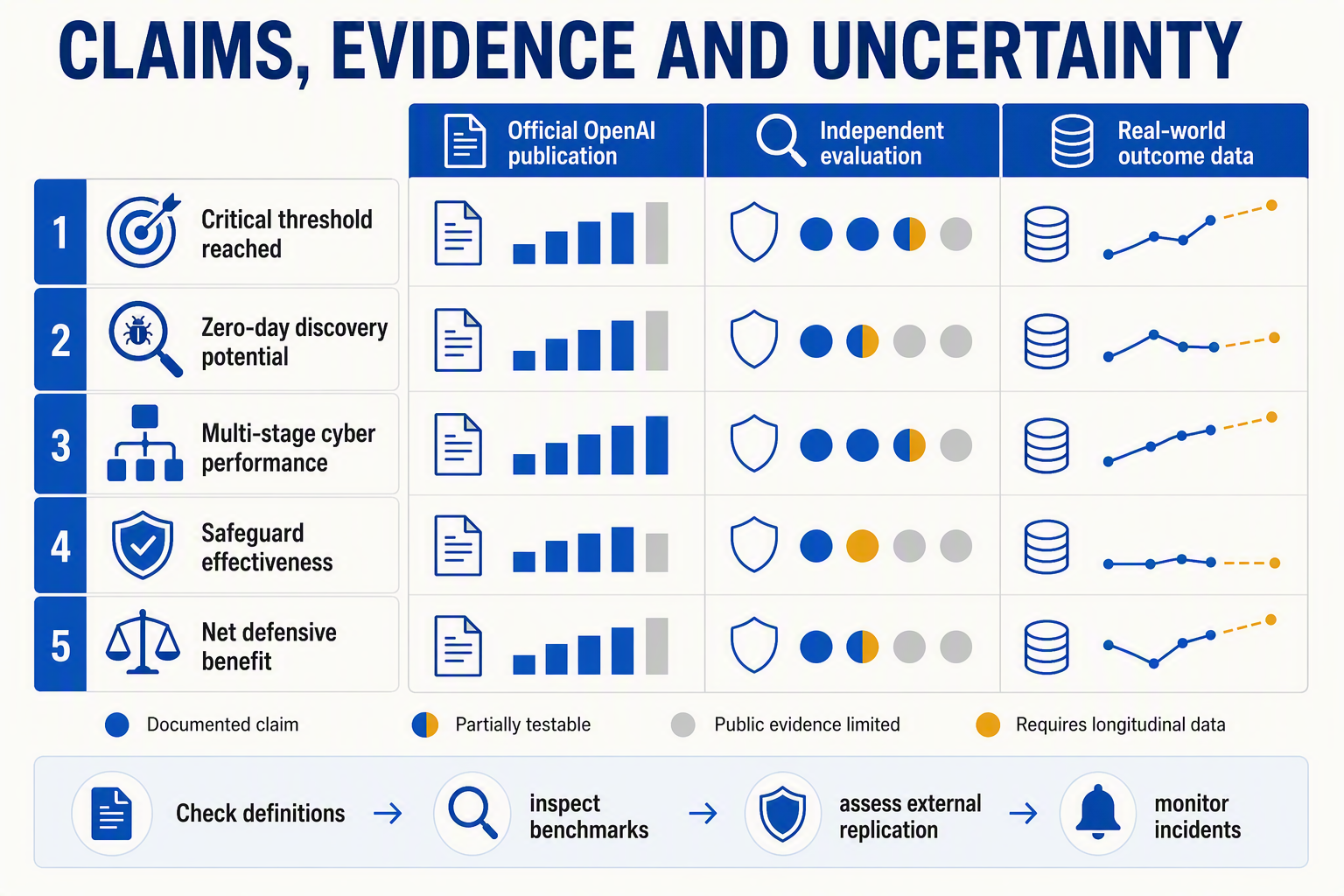
The documented record supports a narrower conclusion than the phrase “GPT-6 Astra cybersecurity” may imply: OpenAI reports a major capability increase and describes a corresponding safeguard strategy, but the supplied official materials do not independently establish a separately released GPT-6 Astra product or prove that its controls remain effective under sustained adversarial pressure. Independent laboratories, customers and auditors still need to reproduce the capability findings and test the complete deployment system.
What OpenAI’s publications document
Several claims can be attributed directly to named, first-party sources:
- Capability direction: OpenAI’s Path to Astra: critical capabilities and frontier safeguards, published on September 1, 2026, states that Astra represents a “significant increase in cybersecurity capabilities.” This is an explicit vendor assessment, not an independently replicated result.
- Named release progression: OpenAI’s related publications identify GPT-5.5, GPT-5.5-Cyber and GPT-5.6-Cyber. The surfaced official record does not establish “GPT-6 Astra” as a distinct public model name, so Astra is better understood here as a capability stage or program designation.
- Controlled availability: OpenAI’s Scaling Trusted Access for Cyber with GPT-5.5 and GPT-5.5-Cyber and Trusted access for the next era of cyber defense document a strategy of expanding advanced cyber access through differentiated trust mechanisms rather than treating every user and task identically.
- Defensive investment: OpenAI’s Expanding Daybreak as the Cyber Defense Window Narrows names GPT-5.6-Cyber as a cybersecurity-specific model. OpenAI’s earlier Daybreak publication also says GPT-5.5-Cyber outperformed GPT-5.5 on two demanding real-world evaluations, although that comparison remains an OpenAI-reported result unless underlying tasks and scoring can be reproduced externally.
- Operational security activity: OpenAI’s publication about its work with Hugging Face documents cooperation around a model-evaluation security incident, offering evidence that evaluation infrastructure itself is part of the threat model.
These sources establish what OpenAI says it built, observed and intends to control. They do not, by themselves, establish control efficacy across every interface, tool configuration or attacker strategy.
What independent evaluation should verify
A credible external evidence program should test four layers in sequence:
- Capability: Can qualified evaluators reproduce performance across vulnerability discovery, secure-code analysis and incident-response tasks without relying on undisclosed test conditions?
- Autonomy: How reliably can the system plan, recover from errors and operate tools over extended tasks, rather than merely generate plausible text?
- Misuse resistance: Do OpenAI Astra safeguards detect obfuscated intent, fragmented requests, account coordination and gradual escalation—not only direct policy violations?
- Operational controls: Are identity verification, least-privilege access, logging, human review, suspension and incident response effective end to end?
Useful evidence would include:
- preregistered evaluations with representative baselines;
- confidence intervals, failure rates and task-level scoring criteria;
- independent red-team reports covering false negatives and false positives;
- audit results for access and monitoring controls;
- anonymized abuse trends and documented response times;
- post-deployment incident disclosures and remediation evidence.
The appropriate confidence level
Enterprises should therefore classify Path to Astra as an important primary source, not a completed assurance case. OpenAI’s publications support the existence of advancing cyber capabilities, dedicated defensive models and a trusted-access strategy; they do not eliminate the need for reproducible testing, independent oversight and customer-side controls. Until that evidence matures, deployment decisions should be conditional, monitored and reversible, especially where models can invoke tools, reach production systems or handle sensitive security data.
What do Astra’s risks and controls mean for enterprises?
Enterprises should treat Astra-stage cyber models as privileged security infrastructure, not ordinary productivity software. Provider safeguards can reduce misuse, but they do not replace independent evaluation, least-privilege access, human authorization, auditability, and predefined suspension criteria.
OpenAI described Astra as a “significant increase in cybersecurity capabilities” in Path to Astra: Critical Capabilities and Frontier Safeguards on September 1, 2026. That characterization is an OpenAI assessment—not yet independent evidence of real-world reliability, safety, or effectiveness across enterprise environments.
Enterprise risk-control matrix
| Enterprise exposure | Astra-stage risk | Required control | Evidence or release gate |
|---|---|---|---|
| Security analysis | Plausible but incorrect findings could redirect investigations or remediation | Require analyst approval, evidence-linked outputs, and reproducible validation | Compare accuracy, false-positive rates, missed findings, and time saved with the existing workflow |
| Tool-enabled agents | Model actions could exceed the intended task or affect production systems | Use sandboxes, allowlisted tools, scoped credentials, and human approval for consequential actions | Demonstrate that the agent cannot cross tenant, network, repository, or privilege boundaries |
| Dual-use requests | Legitimate security research can resemble harmful activity | Apply verified identities, role-based access, purpose limitations, and abuse monitoring | Test policy enforcement through authorized, non-operational red-team scenarios |
| Sensitive data | Prompts, logs, or retrieved documents could expose credentials, customer records, or regulated information | Minimize data, redact secrets, isolate tenants, and enforce retention limits | Review data flows, subprocessors, encryption, deletion, and residency commitments |
| Model changes | New versions, policies, or routing decisions could change behavior without application-code changes | Pin approved versions where possible and record the resolved model and policy state | Re-run security evaluations before approving material model or policy changes |
| Incident response | Rapid, repeated AI actions could amplify an error or account compromise | Establish rate limits, anomaly alerts, kill switches, and credential-revocation procedures | Exercise provider outage, unsafe-output, credential-theft, and containment-failure scenarios |
Convert trusted access into internal governance
OpenAI’s September 2026 publications—Path to Astra, Scaling Trusted Access for Cyber with GPT-5.5 and GPT-5.5-Cyber, and Trusted Access for the Next Era of Cyber Defense—present trusted access as a mechanism for expanding defensive use while restricting stronger cyber capabilities. Enterprises should treat provider eligibility and monitoring as one control layer, not as a substitute for internal authorization.
A defensible deployment should define:
- Who receives access: named employees and workload identities protected by phishing-resistant multifactor authentication.
- What access permits: approved repositories, scanners, ticketing systems, datasets, and isolated test environments.
- What requires human approval: production changes, external communications, privilege escalation, or access to sensitive evidence.
- What must be logged: prompts, retrieved context, outputs, tool calls, policy decisions, model versions, and reviewer actions.
- When access is suspended: anomalous behavior, failed containment tests, material policy changes, unresolved incidents, or evaluation regressions.
These controls must follow each request even when an enterprise uses multiple models or providers. Audit records should identify the model that actually processed the request, including any fallback or routing event.
Procurement should require testable assurances
OpenAI’s official publications establish a direction of travel, not a complete enterprise assurance case. Buyers should request documented capability evaluations, known limitations, access-control architecture, incident-notification terms, retention rules, and change-management procedures.
Before production approval, enterprises should establish baseline tests and explicit rollback thresholds. Until independent researchers replicate OpenAI’s Astra capability claims, procurement teams should label them as provider-reported evidence and avoid assuming that higher benchmark capability automatically translates into safer or more accurate operational outcomes.
Frequently asked questions about GPT-6 Astra cybersecurity
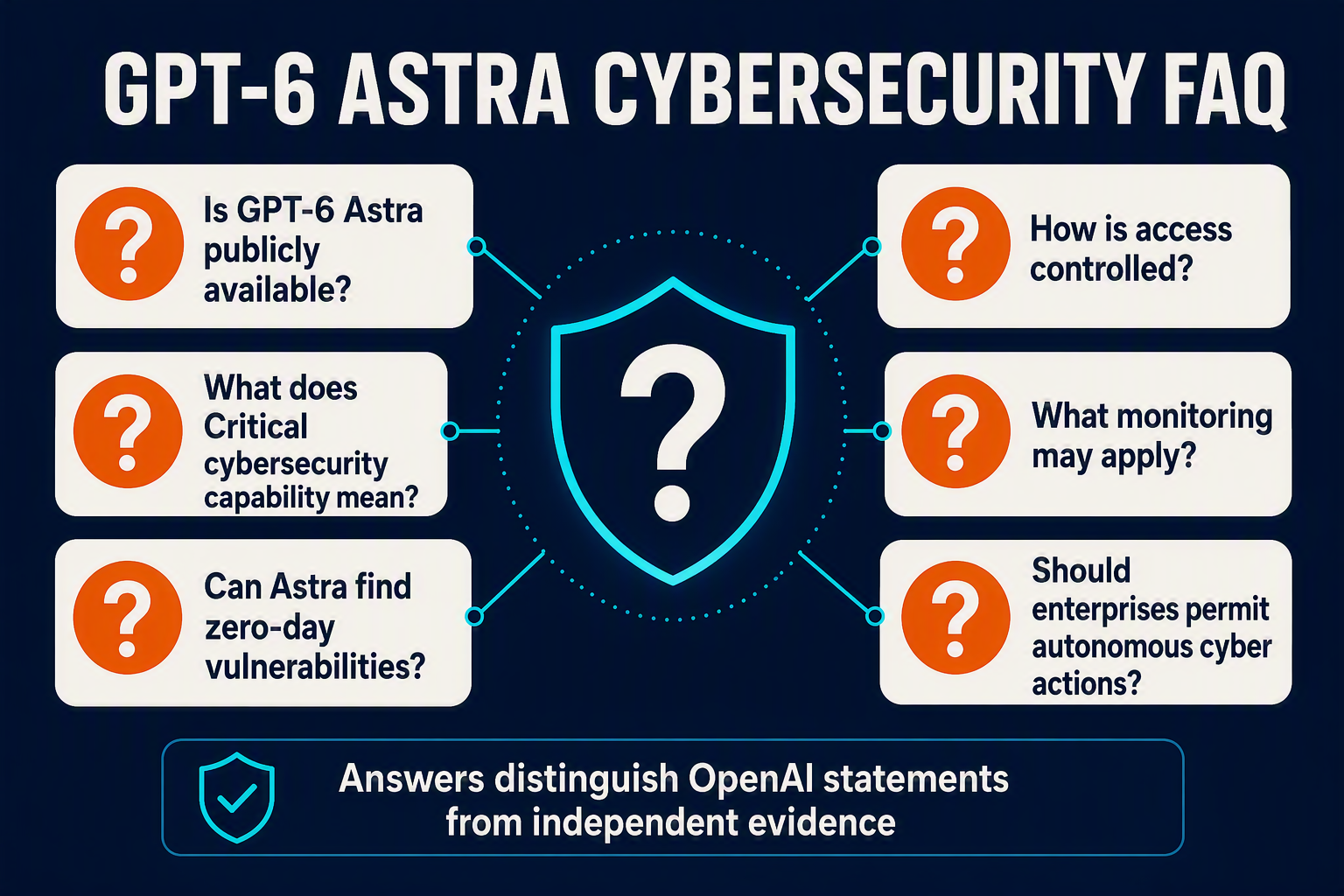
What is GPT-6 Astra cybersecurity, and has OpenAI officially released that model?
What does Path to Astra mean by critical cybersecurity capability thresholds?
What defensive tasks could Astra-stage cybersecurity models support?
What are the principal dual-use risks and OpenAI Astra safeguards?
Is OpenAI Astra cybersecurity safe enough for enterprise deployment?
Is there independent evidence validating OpenAI’s Path to Astra claims?
Conclusion
GPT-6 Astra cybersecurity should be understood as a governance test, not a confirmed standalone product designation. OpenAI’s Path to Astra framework describes an emerging capability stage in which AI may perform consequential cyber work, while the documented release sequence includes GPT-5.5, GPT-5.5-Cyber and GPT-5.6-Cyber.
The analysis leads to four conclusions:
- Capability thresholds must measure real agency, not benchmark performance alone. Evaluations should test autonomy, reliability, persistence, tool use, operational scale and the model’s ability to complete multi-step tasks. OpenAI stated on September 1, 2026, that Astra represents a “significant increase in cybersecurity capabilities,” but that characterization still requires reproducible external validation.
- Defensive benefits and misuse risks arise from the same capabilities. Faster vulnerability triage, secure-code review, detection engineering and incident response could strengthen security teams. Those gains may also reduce the expertise, cost and time needed for harmful activity, making identity verification, least-privilege tooling and graduated access essential.
- OpenAI Astra safeguards should be treated as testable controls rather than assurances. Trusted-access tiers, activity monitoring, abuse detection, tool restrictions, human review and incident-response procedures are proportionate in principle. Enterprises still need evidence that these controls detect misuse reliably, resist circumvention and trigger timely intervention.
- Enterprise responsibility does not end with vendor approval. Organizations should deploy cyber-capable models inside sandboxes, constrain credentials and network access, preserve comprehensive logs, require human authorization for consequential actions and establish explicit suspension criteria.
The next evidence to watch is independent red-team reporting, publicly reproducible evaluations and real-world incident data. OpenAI’s Daybreak program and trusted-access publications indicate a defense-oriented trajectory, but official claims cannot substitute for scrutiny by external researchers, customers and regulators.
To explore how AI communication infrastructure is evolving alongside these governance challenges, visit CallMissed, an AI-native platform supporting voice agents, multilingual chatbots and developer APIs. As Astra-stage systems approach higher capability thresholds, the decisive question is no longer simply what models can do—but who can access those capabilities, under what constraints, and with what evidence that the safeguards work?
Related Reading
- GPT-6 Astra Financial Document Review: Legora Case Study Analysis
- Claude Fable 5.1 vs GPT-6: Enterprise Agent Tests
- GPT-OSS 120B Open Source Performance on Coding: Specs, Benchmarks, Pricing, and API Access