
Conversation Intelligence Software for AI Phone Calls: 2026 Implementation Guide



Implement conversation intelligence software with a 2026 architecture for accurate analytics, safer QA, compliance, coaching, and measurable ROI.
Conversation Intelligence Software for AI Phone Calls: 2026 Implementation Guide
What if every AI phone call could become a searchable, measurable source of operational evidence—without reducing a complex customer conversation to a misleading “positive” or “negative” label? In 2026, conversation intelligence software makes that possible by converting recordings into structured data for quality assurance, compliance, coaching, attribution, and workflow improvement.
The urgency is practical. Gartner predicted in 2023 that 80% of customer-service organizations would use generative AI in some form by 2025, making reliable evaluation essential as adoption moves from pilots to production. Privacy risk is equally material: IBM’s 2024 Cost of a Data Breach Report put the global average breach cost at $4.88 million, the highest recorded by the study at that time. Meanwhile, most provisions of the European Union AI Act become applicable on August 2, 2026, increasing pressure on organizations to document how automated systems operate and are governed.
The challenge is that AI call analytics requires more than recording calls and displaying dashboards. A production architecture must connect audio capture, speaker diarization, call transcription and summarization, intent and outcome extraction, policy checks, CRM events, and human review. Each layer can introduce errors. A strong summary can omit a customer’s qualification; an intent classifier can confuse a complaint with a cancellation request; and voice analytics AI cannot reliably infer a person’s emotions from tone alone across languages, accents, cultures, health conditions, and noisy connections.
This guide explains how to implement that architecture responsibly and turn conversation data into measurable action. You will learn how to:
- Establish transcription accuracy baselines by language, channel, and audio condition.
- Design evidence-linked summaries, intent taxonomies, and confidence thresholds.
- Build AI quality assurance calls scorecards with human calibration.
- Monitor consent language, required disclosures, prohibited claims, and sensitive-data handling.
- Create coaching workflows that identify behaviors rather than merely rank agents.
- Attribute bookings, qualified leads, collections, and conversions to calls.
- Connect contact center intelligence with CRM, product, marketing, and knowledge-base improvements.
- Apply retention, redaction, access-control, and audit requirements throughout the pipeline.
Indian platforms such as CallMissed reflect this shift by combining AI voice agents, WhatsApp Business calling, omnichannel workflows, and Indic-first speech support across 22 Indian languages.
The objective is not to collect more transcripts. It is to build a governed feedback system in which every detected issue has supporting evidence, an accountable owner, and a measurable operational outcome.
How do you implement conversation intelligence software in 2026? Use this 10-step architecture and launch checklist
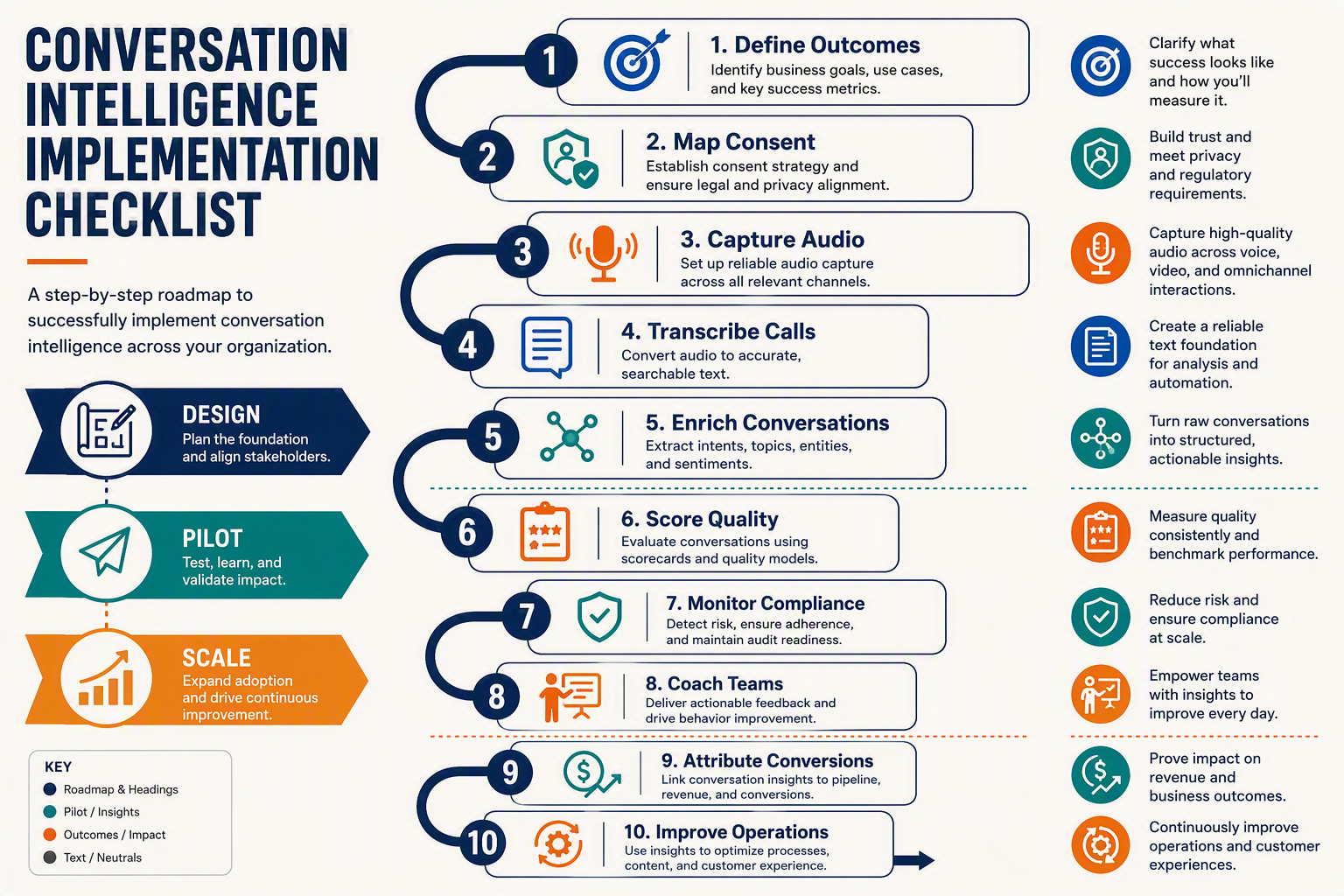
Implement conversation intelligence software as a governed evidence pipeline: capture consented audio, produce time-aligned transcripts, extract structured findings, validate them against source evidence, and route approved insights into operational systems. In 2026, the correct architecture combines automation with confidence thresholds, human review, privacy controls, and measurable business outcomes.
The 10-step reference architecture
- Define outcomes and governance.
Start with specific decisions: detect cancellation intent, verify disclosures, identify qualified leads, evaluate resolutions, or coach call handling. Assign owners for each use case and document lawful basis, consent requirements, retention periods, and acceptable error rates.
- Capture audio and call metadata.
Store recording consent, timestamps, direction, queue, agent or model version, phone channel, language, campaign, and session ID. Preserve the original audio as controlled evidence rather than treating the transcript as authoritative.
- Normalize and secure recordings.
Standardize sample rates, separate stereo channels where available, encrypt data in transit and at rest, and restrict raw-audio access. Apply malware scanning, regional storage rules, and deletion schedules before downstream processing.
- Transcribe and diarize speakers.
Benchmark word error rate by language, accent, device, background noise, and telephony codec. For multilingual operations, platforms such as CallMissed provide Indic-first speech capabilities across 22 Indian languages, helping teams evaluate regional calls rather than relying on English-only baselines.
- Generate evidence-linked summaries.
Call transcription and summarization should produce structured fields—reason for calling, commitments, objections, resolution, and next action—with timestamps or transcript spans supporting every material statement. Unsupported summary claims should be rejected or sent for review.
- Extract intent, entities, and outcomes.
Build a controlled taxonomy for intents such as purchase, complaint, cancellation, payment difficulty, and escalation. Record confidence scores, support multiple intents per call, and distinguish customer-stated outcomes from CRM-confirmed outcomes.
- Treat sentiment as a weak signal.
Voice analytics AI must not present inferred emotion as fact. Tone varies across languages, cultures, disabilities, health conditions, and noisy connections; combine lexical cues, conversation events, customer feedback, and human assessment instead of making consequential decisions from pitch or speaking rate.
- Run QA and compliance scorecards.
Configure AI quality assurance calls against observable criteria: required disclosure delivered, identity verified, interruption rate, knowledge-grounded answer, prohibited claim, escalation completed, and promised follow-up recorded. Calibrate automated scores against multiple trained reviewers and track disagreement by criterion.
- Connect insights to systems of action.
Send validated events into CRM, ticketing, workforce management, analytics, and knowledge-base workflows. AI call analytics becomes useful when a detected issue creates an owner, deadline, and traceable action—not merely another dashboard tile.
- Measure and continuously recalibrate.
Monitor transcription error, extraction precision and recall, false compliance alerts, reviewer agreement, escalation accuracy, conversion attribution, and resolution rates. Re-test whenever prompts, models, policies, languages, or telephony infrastructure change.
2026 launch checklist
Before production, confirm that:
- Consent and disclosure scripts have received jurisdiction-specific legal review.
- Every extracted finding can link back to audio or transcript evidence.
- Low-confidence and high-risk cases enter a human-review queue.
- Sensitive data is redacted before model processing where required.
- Role-based access, audit logs, retention, deletion, and incident response are operational.
- CRM outcomes—not model assumptions—determine final conversion attribution.
- QA reviewers complete regular calibration sessions.
- Coaching identifies correctable behaviors rather than ranking people by inferred emotion.
- Drift dashboards segment performance by language, channel, model, and audio quality.
Governance is now time-sensitive: most provisions of the European Union AI Act become applicable on August 2, 2026. IBM’s 2024 Cost of a Data Breach Report also placed the global average breach cost at $4.88 million, reinforcing why privacy controls must be embedded throughout the contact center intelligence architecture rather than added after launch.
How does conversation intelligence differ from call performance metrics and contact center intelligence?
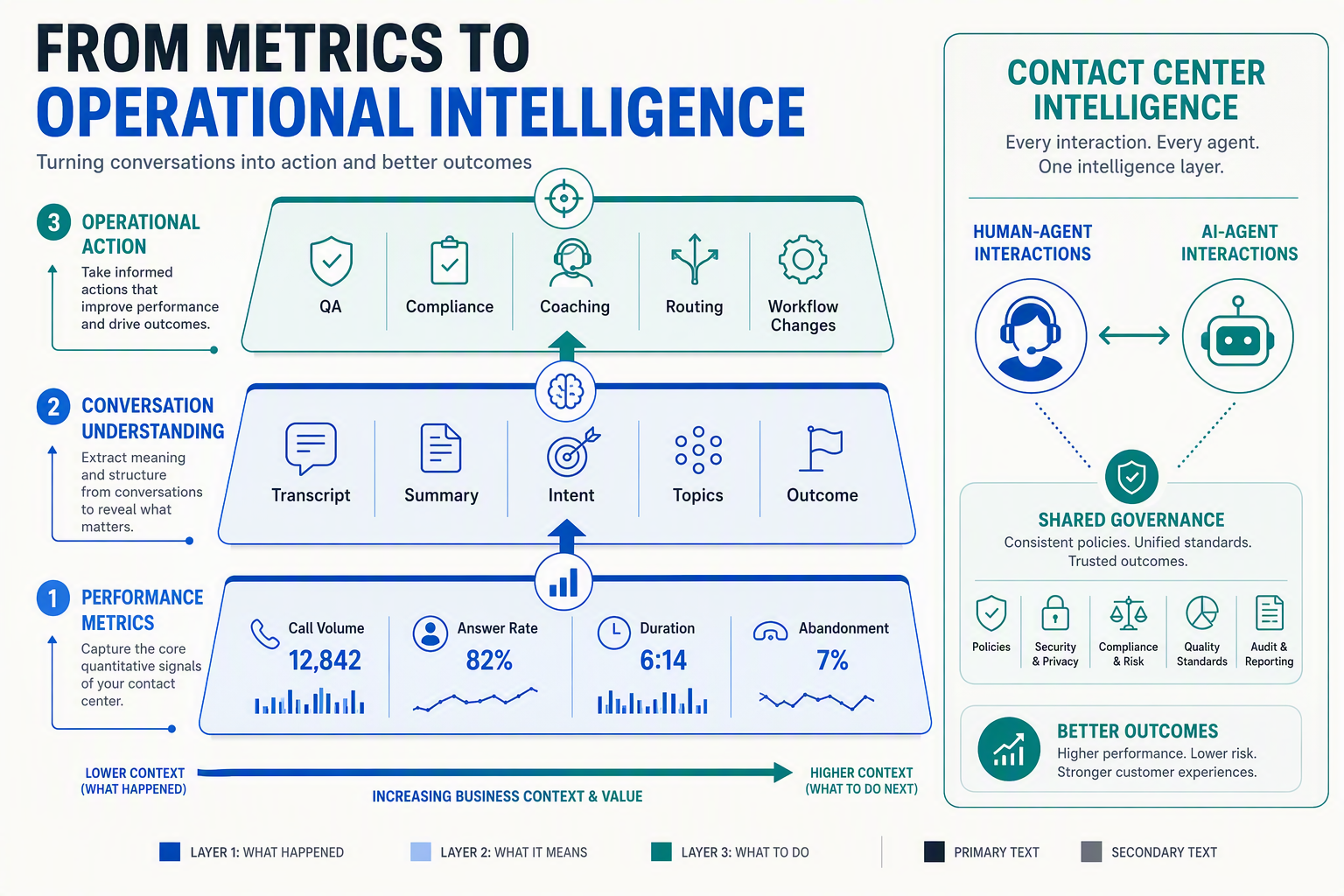
Call performance metrics measure what happened around a call, conversation intelligence software examines what was said and how the interaction unfolded, and contact center intelligence connects those findings across channels, teams, systems, and business outcomes. The categories overlap, but they require different data, controls, and implementation architectures.
Call performance metrics describe operational behavior
Performance metrics come primarily from telephony infrastructure and workflow events rather than conversation content. They answer questions such as “Was the call answered?” or “How long did the transfer take?”
Typical measures include:
- Answer rate, abandonment rate, and missed-call rate
- Ring time, queue time, talk time, and after-call work
- Transfer, hold, callback, and escalation rates
- AI-agent latency, interruption frequency, and task-completion rate
- Cost per call, booking rate, and conversion rate
These metrics can reveal an operational symptom but not necessarily its cause. A high transfer rate may indicate incorrect routing, missing knowledge, caller preference, or an AI agent failing to understand an accent. Telephony data alone cannot distinguish among those explanations.
For a deeper treatment of these measures, the related AI Agent Analytics 2026 guide covers conversation intelligence, QA, and ROI. This implementation guide instead focuses on the semantic evidence needed to explain performance.
Conversation intelligence interprets call content
AI call analytics adds a content-processing layer to recordings and event data. Its pipeline performs call transcription and summarization, speaker diarization, intent classification, topic extraction, outcome detection, policy checks, and evidence-linked scoring.
It answers more diagnostic questions:
- What outcome was the caller trying to achieve?
- Which objection, promise, disclosure, or product issue appeared?
- Did the AI agent retrieve correct information and follow policy?
- What language or behavior preceded a conversion, escalation, or failure?
- Which transcript passage supports the classification?
For AI quality assurance calls, the unit of analysis is not merely call duration or disposition. It is whether specific behaviors occurred—for example, identity verification before account disclosure or confirmation of a booking date before ending the call.
Voice analytics AI may also estimate acoustic properties such as silence, overlap, speaking pace, or interruptions. However, teams should not treat vocal tone as definitive evidence of emotion. Sentiment labels require confidence thresholds, multilingual validation, and human review because accent, culture, illness, background noise, and synthetic voices can distort inference.
Contact center intelligence operates at organizational scale
Contact center intelligence is the broader decision layer that combines conversation findings with CRM records, ticket histories, workforce data, product telemetry, marketing attribution, and omnichannel interactions. It asks not only why one call failed, but whether the same issue is recurring across thousands of phone, WhatsApp, email, and web conversations.
Its outputs may include:
- Root-cause trends by product, language, campaign, or customer segment
- Knowledge-base gaps and outdated policy content
- Coaching priorities for human agents or AI-agent prompt revisions
- Compliance exceptions requiring investigation
- Revenue attribution across calls and downstream CRM events
The distinction matters as adoption scales. Gartner predicted in 2023 that 80% of customer-service organizations would use generative AI in some form by 2025, increasing the need to move from basic activity dashboards to evidence-backed evaluation.
A practical hierarchy is therefore: performance metrics detect anomalies, conversation intelligence explains them, and contact center intelligence coordinates the response. Mature implementations retain all three rather than expecting a transcript model or dashboard to replace the others.
Which 2026 developments are changing AI call analytics implementation?
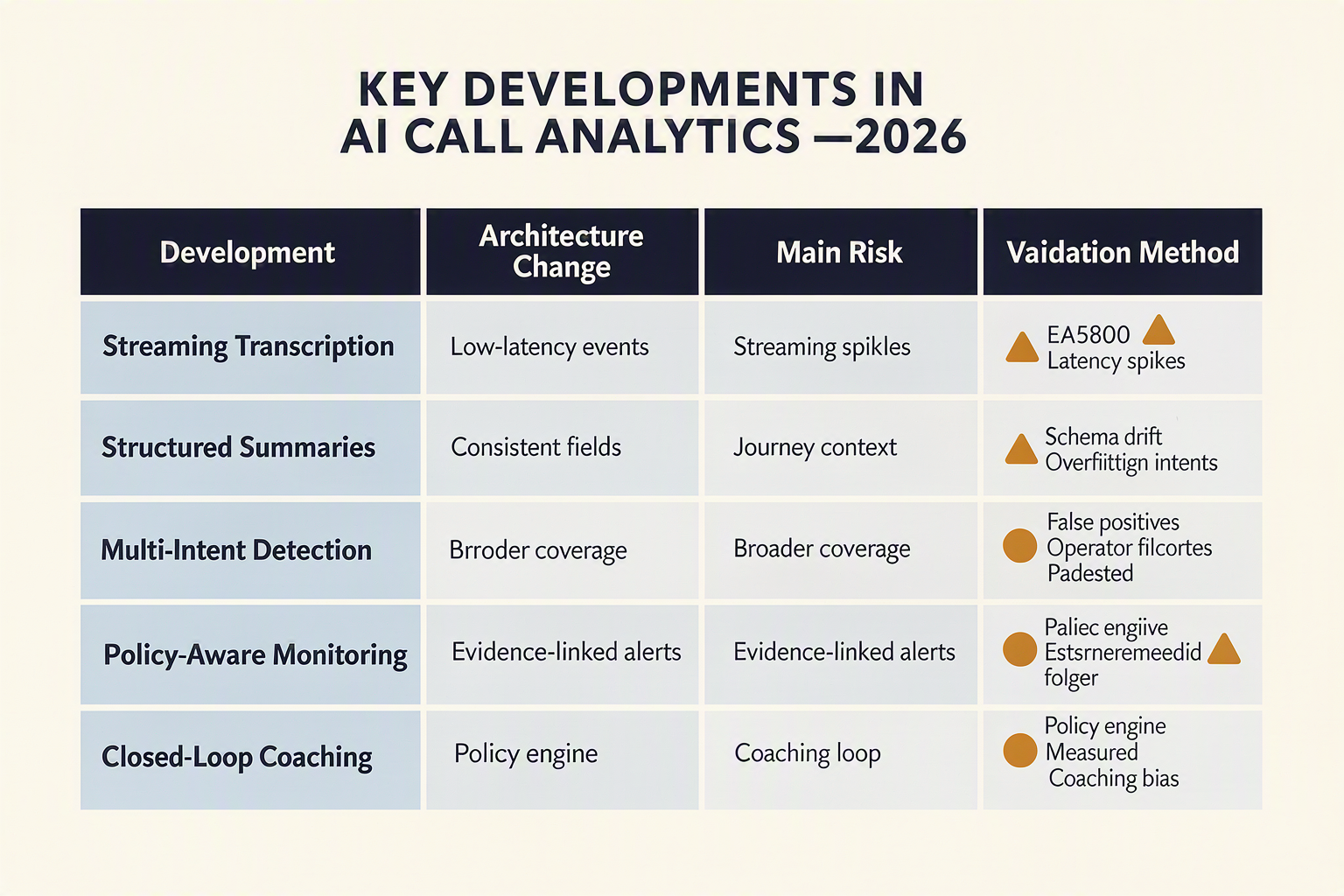
AI call analytics implementation in 2026 is moving beyond transcript dashboards toward evidence-linked, near-real-time decision support. Streaming speech recognition, schema-constrained model outputs, lower inference prices, workflow automation, and new regulatory obligations require conversation intelligence software to preserve source evidence, quantify uncertainty, and separate analysis from consequential actions.
Six developments and their implementation impact
| 2026 development | What has changed | Required implementation response | Acceptance evidence |
|---|---|---|---|
| Streaming multilingual speech recognition | Speech APIs increasingly support live transcription, speaker diarization, and multilingual processing. Performance still varies materially by language, accent, audio codec, noise, overlapping speech, and domain vocabulary. | Test each supported call segment rather than relying on a single aggregate accuracy score. Measure critical-entity recall for names, amounts, dates, addresses, account numbers, and legally significant phrases. Retain timestamp references and, where lawful, controlled access to the corresponding audio. | Word or character error rates by test segment; entity-level precision and recall; latency percentiles; diarization error results; documented failure and fallback behavior. |
| Schema-constrained LLM extraction | Models can produce summaries, intents, outcomes, objections, and next actions in validated JSON. Schema compliance does not establish that the extracted facts are correct. | Enforce typed schemas, controlled taxonomies, null values for unsupported fields, and citations to transcript spans. Validate outputs before they reach CRM records or downstream workflows, and retry or quarantine malformed responses. | Each material claim links to a timestamped utterance; schema-validation results, unsupported-claim rates, confidence calibration, model identifiers, and prompt versions are logged. |
| Economical multi-pass analysis | Stanford’s 2025 AI Index reported that the price of querying a model achieving GPT-3.5-level MMLU performance fell from approximately $20 to $0.07 per million tokens between November 2022 and October 2024—more than 280-fold. This historical benchmark does not guarantee equivalent savings for audio, low-latency, multilingual, or regulated workloads. | Use separately evaluated passes for summarization, classification, policy checks, QA, and attribution when that improves reliability. Route routine cases to smaller models and reserve more capable models or human review for ambiguous, sensitive, or high-impact cases. | Cost and latency per call and per pass; model and prompt versions; routing criteria; fallback rates; quality results by language and use case. |
| Real-time workflow orchestration | Detected conversation events can initiate CRM updates, supervisor alerts, scheduling, or follow-up messages while a call is active. A detected event is not, by itself, authorization to perform a consequential action. | Separate event detection, policy evaluation, authorization, and execution. Require appropriate approval for refunds, contractual commitments, account-security changes, payment handling, or other high-impact actions. Use idempotency controls so retries cannot create duplicate actions. | Event and action logs; authorization records; idempotency keys; false-trigger and missed-trigger rates; rollback tests; documented timeout and human-handoff procedures. |
| Narrower use of emotion and sentiment inference | The EU AI Act has prohibited certain biometric emotion-recognition uses in workplaces and educational institutions since February 2, 2025, subject to the Act’s medical or safety exception. The prohibition does not automatically cover every text-based sentiment classifier, and applicability depends on the system’s inputs, intended purpose, context, and jurisdiction. Other permitted emotion-recognition systems may face transparency or high-risk requirements. | Do not present a sentiment score as proof of a person’s emotional state. Prefer observable evidence such as interruptions, long silences, repeated requests, explicit dissatisfaction, or escalation language. Do not use uncertain inferences as the sole basis for employee discipline or another significant decision. | Intended-purpose assessment; legal classification by deployment; language and subgroup testing; human calibration records; source-utterance citations; documented limits on how scores may be used. |
| Risk-based, audit-ready governance | Most EU AI Act provisions became applicable on August 2, 2026, but obligations differ by role, system category, and intended use. For example, some systems used to monitor or evaluate workers may be high-risk, while ordinary customer-call summarization is not automatically high-risk. Article 6(1) rules for certain AI used as a safety component of, or itself constituting, a regulated product follow the Act’s separate August 2, 2027 schedule. | Classify each use case instead of treating all call analytics identically. Version models, prompts, taxonomies, scorecards, and reviewer decisions. Where recordings or transcripts contain personal data, apply the GDPR’s applicable principles—including purpose limitation, data minimization, security, retention controls, and data-subject rights—and account for local recording and communications rules. | Documented provider/deployer roles; use-case and jurisdiction inventory; risk classification; access and deletion records; reproducible evaluations; change approvals; named control owners; required notices and human-oversight procedures. |
What teams should change now
These developments make call transcription and summarization only the first layer of production-grade conversation intelligence software. Teams should:
- Decouple transcription, extraction, evaluation, authorization, and workflow execution so each component can be tested, monitored, or replaced independently.
- Build AI quality assurance scorecards around evidence-backed, clearly defined behaviors instead of opaque judgments about attitude, personality, or emotion.
- Measure precision, recall, calibration, and business impact for costly classes such as cancellation, complaint, payment dispute, safety escalation, and marketing opt-out.
- Evaluate performance separately by language, accent, channel, call direction, audio conditions, and customer cohort; an overall average can conceal serious failure modes.
- Preserve transcript offsets and authorized audio references so reviewers can verify summaries, scores, and workflow triggers.
- Apply human review according to the consequence of the decision. The EU AI Act and GDPR do not impose the same review requirement on every use case, although GDPR Article 22 can restrict certain solely automated decisions with legal or similarly significant effects.
- Combine phone, CRM, and messaging events only under documented purposes, access controls, retention periods, and channel- and jurisdiction-specific recording or privacy rules. Consent is not the only possible legal basis, nor is it universally sufficient.
For a CallMissed deployment—or any other conversation intelligence software implementation—teams should document the languages, channels, integrations, and automation features actually enabled in their contracted configuration rather than assuming that every advertised capability applies. Every operational analytic output should carry its source evidence, confidence or uncertainty indicator, model and prompt version, processing time, and the set of actions it is authorized to initiate.
What reference architecture connects audio capture, call transcription and summarization, storage, models, and business systems?
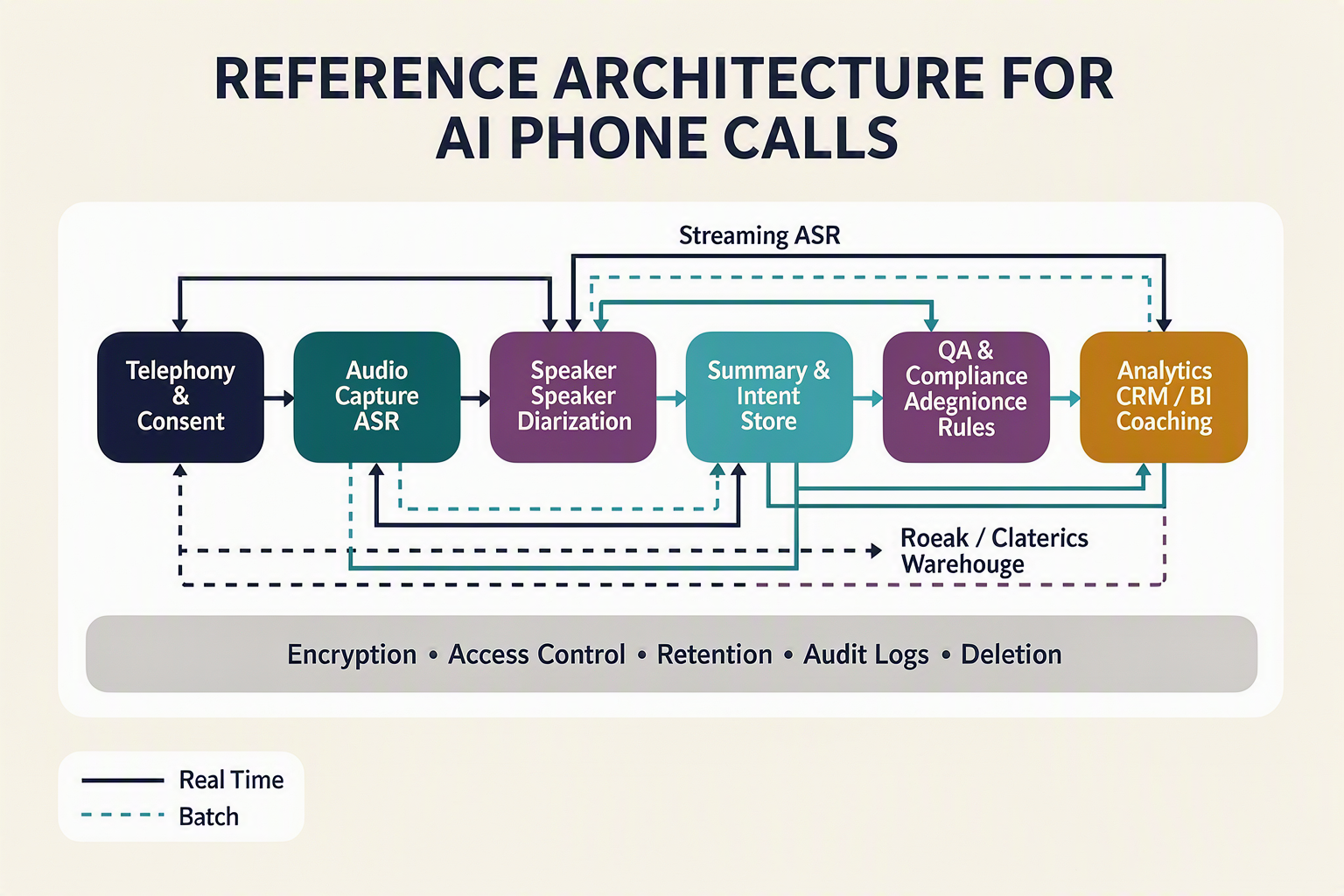
A production reference architecture should use an event-driven pipeline that preserves the original audio, creates time-aligned evidence, runs versioned models, and publishes approved outputs to business systems. The central rule is simple: every summary, intent, QA finding, or compliance alert must remain traceable to the exact transcript span and audio timestamp that supports it.
1. Capture audio and call metadata
The telephony layer should emit separate events for call initiation, consent, connection, transfer, recording, and termination. Store:
- A globally unique call ID and conversation ID.
- Recording-consent status and disclosure timestamps.
- Direction, phone number, queue, campaign, and agent identifiers.
- Codec, sample rate, packet loss, and channel configuration.
- IVR selections, transfers, tool calls, and call outcome events.
Where possible, record the customer and AI agent on separate channels. Dual-channel audio improves speaker attribution and prevents interruptions from becoming a single, ambiguous transcript segment.
2. Create an evidence-preserving transcription pipeline
Send encrypted audio to automatic speech recognition, followed by language identification, speaker diarization, punctuation, and timestamp alignment. Each transcript segment should contain speaker, start time, end time, text, confidence, language, and model version.
Do not overwrite raw transcripts after correction. Preserve immutable source output and store human edits as a separate revision. This lets teams distinguish model errors from what was actually said when investigating AI quality assurance calls or compliance disputes.
Indian platforms such as CallMissed can support this layer with Indic-first speech models across 22 Indian languages. That coverage is operationally relevant because transcription models should be routed by language and audio conditions rather than forcing every call through one default model.
3. Enrich transcripts through independent model services
Once transcription passes minimum quality checks, publish a transcript.completed event to specialized services for:
- Call transcription and summarization, with claims linked to transcript spans.
- Intent, objection, topic, entity, and outcome extraction.
- Required-disclosure and prohibited-phrase detection.
- QA scorecard evaluation against explicit rubric criteria.
- Sentiment or interaction-state estimation, marked as probabilistic rather than factual.
Keep these services independent. A failed sentiment model should not block a booking outcome from reaching the CRM, while a low-confidence transcript should prevent unsupported compliance conclusions. An OpenAI-compatible gateway can simplify model switching; for example, CallMissed provides one endpoint across LLM, speech, image, and search models with same-tier fallbacks.
4. Separate evidence, derived data, and operational records
Use three storage zones:
- Evidence store: encrypted audio, raw transcripts, consent records, and access logs.
- Analytics store: intents, summaries, QA scores, confidence values, embeddings, and model versions.
- Operational systems: CRM opportunities, tickets, coaching tasks, campaign attribution, and knowledge-base feedback.
Apply role-based access controls, regional retention policies, redaction, and deletion propagation across all three. Vector databases should store redacted transcript chunks where practical, not unrestricted recordings or payment data.
5. Close the loop with business systems
The final integration layer should publish signed, idempotent events such as lead.qualified, compliance.review_required, or coaching.task_created. Conversation intelligence software should never write uncertain predictions directly into authoritative CRM fields without thresholds or review.
A reliable contact center intelligence architecture therefore connects AI call analytics to action while retaining provenance. Dashboards show patterns, but queues assign owners; evidence supports decisions; and human corrections become evaluation data for the next model release.
How should you validate transcription, summaries, intent detection, and the limitations of voice analytics AI sentiment?
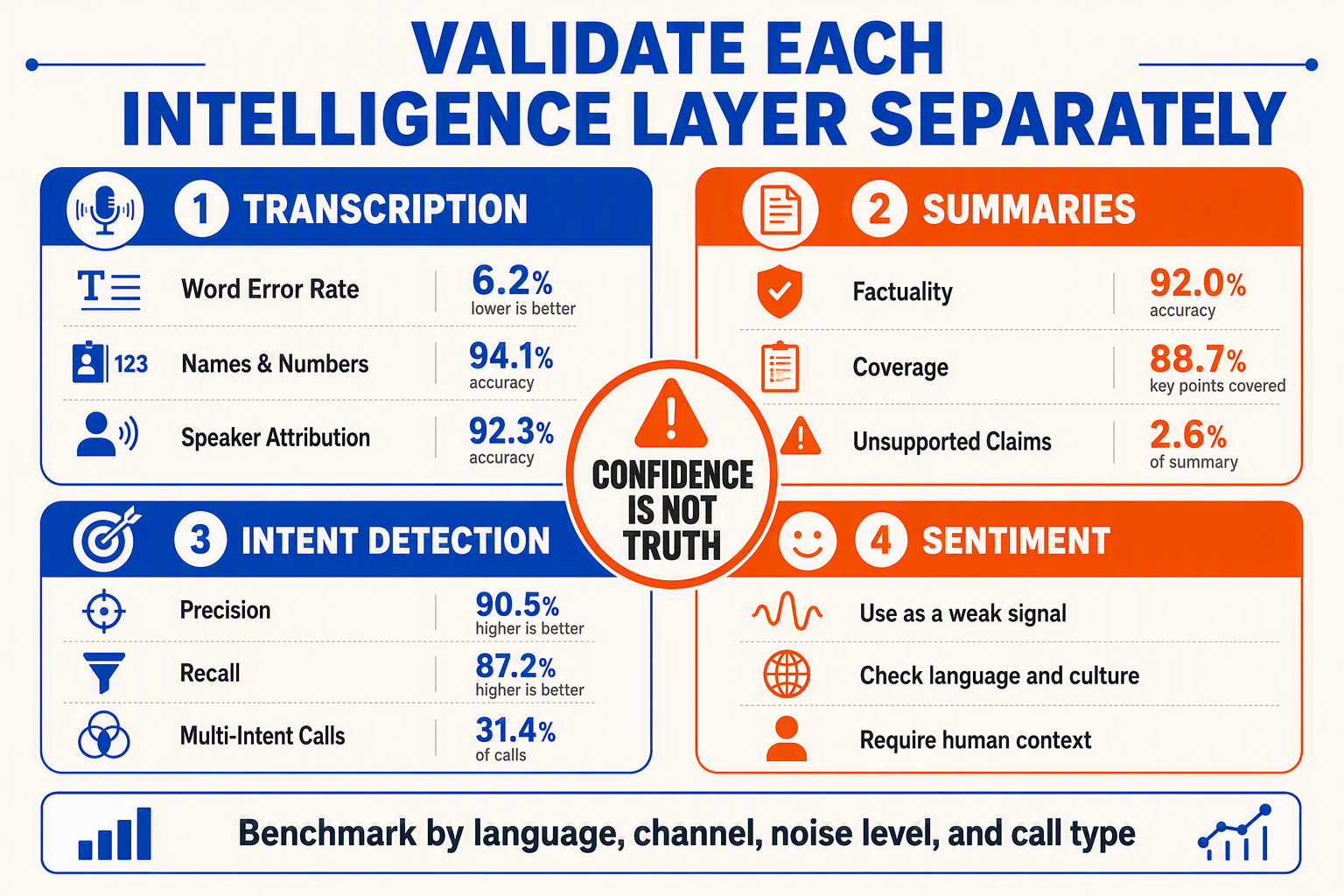
Validate each model output against a human-annotated, evidence-linked test set segmented by language, accent, channel, call type, and audio quality. Approve models independently: accurate transcription does not guarantee faithful summaries, correct intent detection, or defensible sentiment analysis.
Build a representative evaluation set
Sample real, consented calls rather than studio-quality recordings. The set should include short and long calls, interruptions, code-switching, background noise, proper nouns, numbers, and rare but high-risk scenarios.
For every call, have trained reviewers create:
- A verbatim reference transcript with speaker labels and timestamps.
- A factual summary containing required and prohibited inclusions.
- One or more approved intents from a documented taxonomy.
- Evidence spans linking each label or summary claim to the transcript.
- An “uncertain” label when the recording does not support a conclusion.
Use at least two annotators for ambiguous examples and adjudicate disagreements. Inter-annotator disagreement often reveals unclear labeling rules rather than model failure.
Measure transcription beyond word error rate
Evaluate call transcription and summarization separately. Word error rate, calculated as substitutions plus deletions plus insertions divided by reference words, is useful but can hide expensive mistakes.
Track additional metrics by segment:
- Entity error rate: customer names, products, addresses, dates, amounts, account numbers, and consent phrases.
- Speaker-attribution accuracy: whether customer and AI-agent statements are assigned correctly.
- Timestamp accuracy: whether evidence can be replayed from the cited moment.
- Critical-phrase recall: whether disclosures, objections, cancellation requests, and payment commitments were captured.
- Language-specific performance: publish separate results for each supported language and code-switched combination.
A transcript that changes “₹15,000” to “₹50,000” can have a low overall word error rate while still causing a serious workflow error. Conversation intelligence software should therefore route low-confidence audio and critical entities to human review.
Test summaries for evidence and omissions
A good summary must be grounded, complete, and operationally useful, not merely fluent. Score each generated statement as supported, contradicted, or unsupported by the recording.
Validate:
- Factual precision: What proportion of summary claims have transcript evidence?
- Required-fact recall: Were the customer’s request, commitments, objections, dates, and next steps retained?
- Attribution: Did the system distinguish what the customer said from what the AI agent promised?
- Abstention: Does the model state uncertainty instead of inventing missing details?
For AI quality assurance calls, reviewers should be able to select any summary claim and open its supporting timestamp.
Validate intent as a decision system
Define intents around actions—such as book appointment, request refund, or cancel service—rather than broad topics. Measure per-class precision, recall, F1 score, confusion matrices, and confidence calibration within AI call analytics.
Set thresholds according to consequences. A low-confidence sales inquiry might enter a general queue; a suspected cancellation or compliance complaint should trigger review. Also test multi-intent calls and an explicit unknown/other class so the classifier is not forced to guess.
Treat sentiment as a weak signal
Voice analytics AI should not present inferred emotion as objective fact. Tone varies with language, accent, culture, disability, health, connection quality, and speaking style; transcript sentiment also misses sarcasm and context.
Use sentiment only as a review-prioritization feature within contact center intelligence, alongside observable signals such as repeated interruptions, escalation requests, unresolved intents, and explicit complaint phrases. Never use it alone for adverse decisions, agent discipline, or customer eligibility. This caution supports auditability as most European Union AI Act provisions become applicable on August 2, 2026, according to the European Union’s implementation timeline.
How should teams implement AI quality assurance calls, compliance monitoring, and privacy controls?
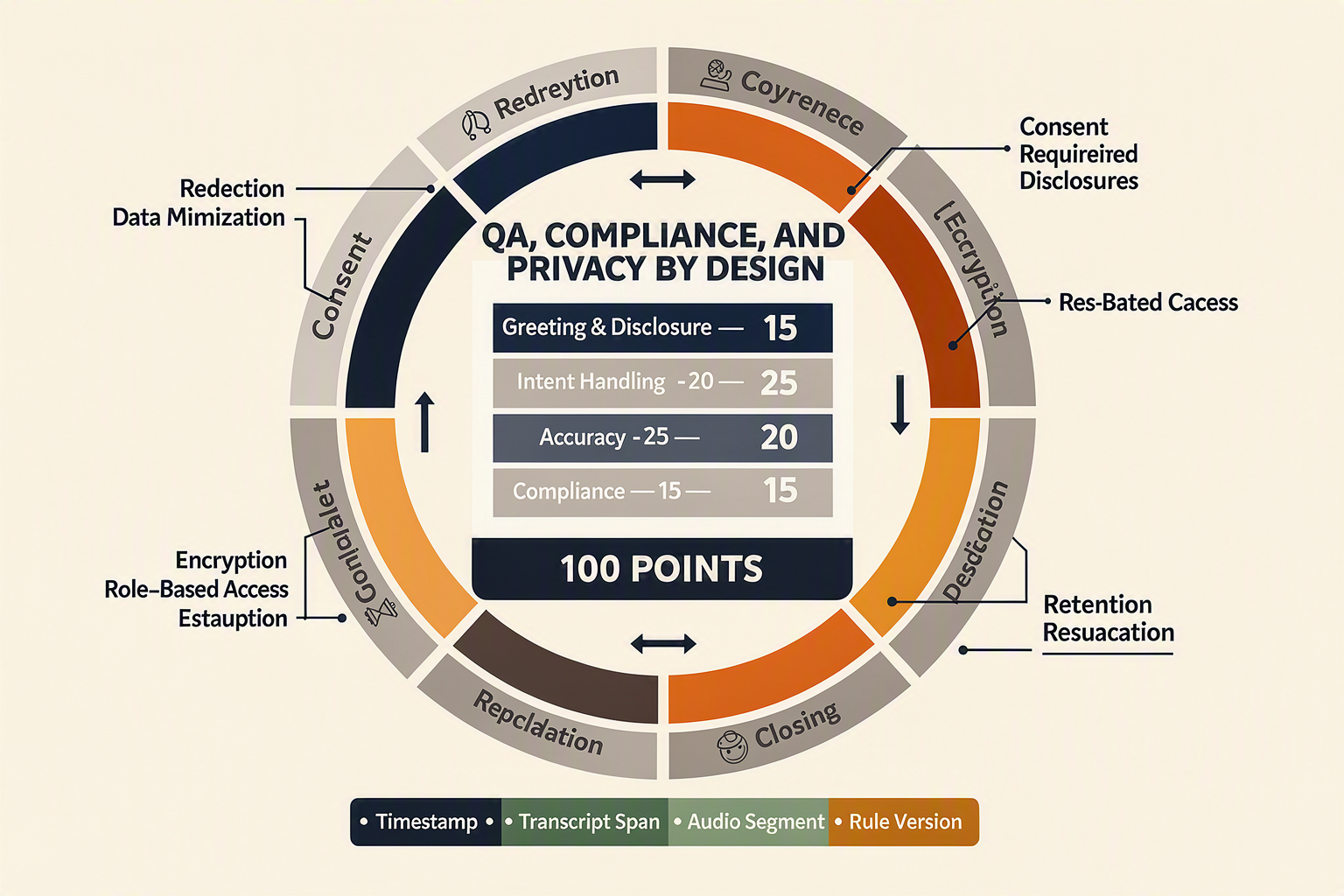
Teams should implement AI quality assurance calls, compliance monitoring, and privacy as three connected but separately governed systems. QA measures performance, compliance detects policy or regulatory risk, and privacy controls determine what conversation data may be collected, processed, retained, and accessed.
Build evidence-linked QA scorecards
Do not ask a language model to assign an unexplained “quality score.” Define a versioned scorecard in which every result links to transcript timestamps, audio segments, tool events, or CRM records.
- Set measurable criteria: greeting completed, identity verified, intent confirmed, required information captured, knowledge source used, objection handled, and next step recorded.
- Separate critical failures: missing consent, making a prohibited claim, exposing sensitive information, or completing an unauthorized transaction should trigger escalation rather than merely reduce an average score.
- Use mixed evaluation methods: deterministic rules can verify exact disclosures, while model-based evaluators can assess whether an explanation was clear or a response addressed the caller’s question.
- Require human calibration: reviewers should score the same representative calls and reconcile disagreements before automated scoring affects production decisions.
- Track evaluator versions: store the scorecard, prompt, model, policy version, confidence, and evidence for every assessment.
Measure agreement between automated and human evaluations by criterion, language, call type, and audio condition. Voice analytics AI should flag uncertain cases for review rather than convert ambiguous tone into unsupported conclusions about emotion or intent.
Operate compliance monitoring as a control system
Compliance rules must be jurisdiction-, campaign-, and workflow-specific. A single global checklist cannot reliably cover consent, recording notices, marketing permissions, payment handling, sector requirements, and business-initiated calling rules.
Monitor for:
- Required recording notices and consent language.
- Identity and authorization checks before account disclosure.
- Prohibited promises, unsupported claims, or restricted advice.
- Payment-card, government-identifier, health, and authentication data.
- Requests to opt out, stop calling, delete data, or speak with a human.
- AI-agent disclosures and escalation obligations where applicable.
Each alert should include the exact evidence span, applicable policy, severity, confidence, owner, and remediation deadline. Human reviewers—not the model alone—should determine whether a legally significant breach occurred. This becomes especially important as most provisions of the European Union AI Act apply from August 2, 2026.
Apply privacy controls before analytics
Privacy protection should begin before call transcription and summarization, not after data reaches an analytics dashboard. IBM’s 2024 Cost of a Data Breach Report estimated the global average breach cost at $4.88 million, supporting investment in preventive controls rather than retention-by-default.
Implement the following safeguards:
- Data minimization: record and extract only information required for a documented purpose.
- Pre-processing redaction: remove payment-card numbers, passwords, one-time passcodes, and sensitive identifiers before sending text to downstream models.
- Encryption and isolation: protect audio, transcripts, summaries, embeddings, and exports in transit and at rest.
- Least-privilege access: restrict raw recordings separately from aggregated AI call analytics.
- Retention automation: assign deletion periods by data type, jurisdiction, consent basis, and dispute requirements.
- Auditability: log playback, search, export, correction, policy overrides, and deletion events.
Production conversation intelligence software should also support legal holds, data-subject requests, regional storage requirements, and deletion across derived artifacts—not merely the original recording. This governance layer turns contact center intelligence into defensible operational evidence rather than an uncontrolled archive.
How do QA scorecards and coaching turn call data into measurable operational improvements?
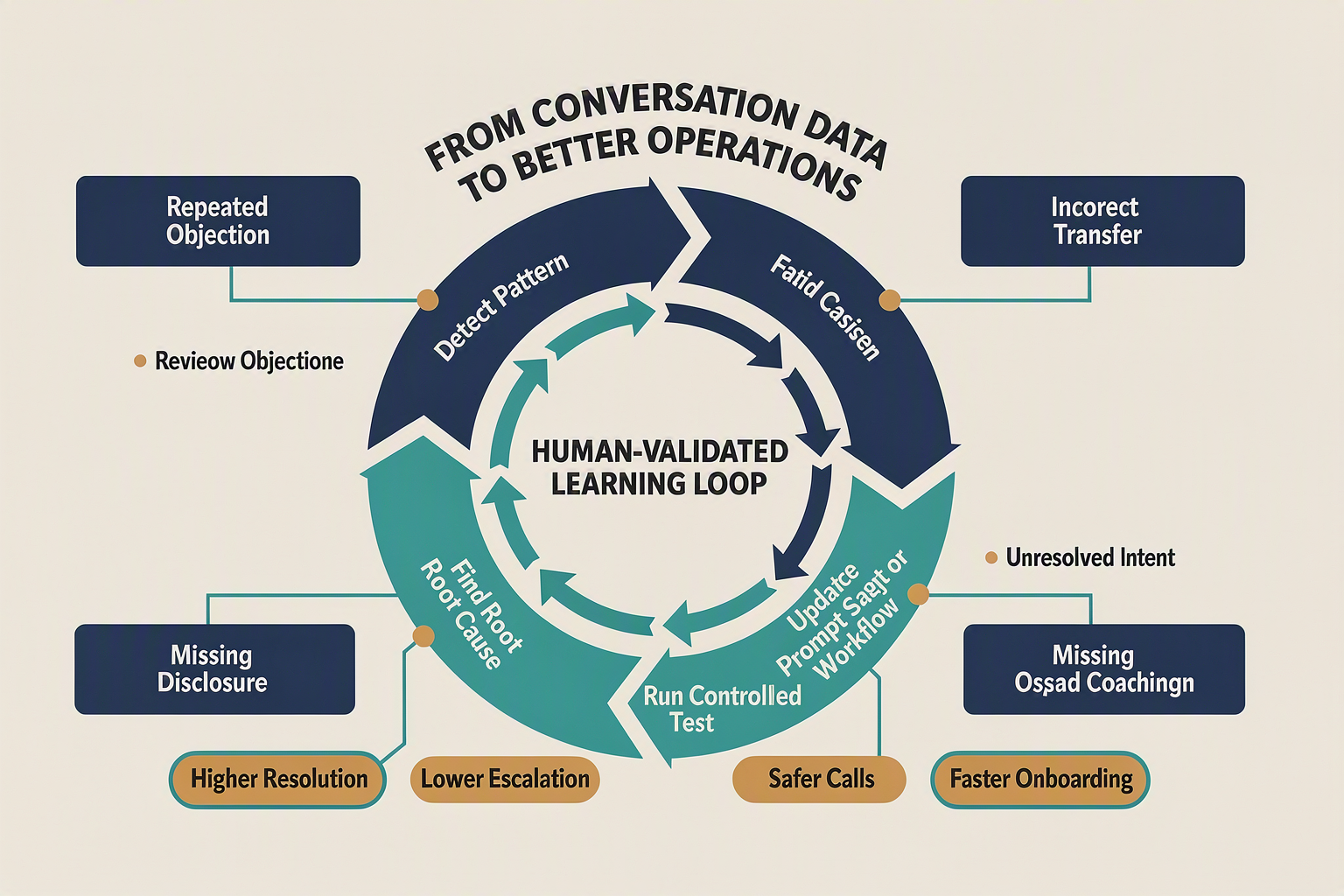
QA scorecards turn call data into improvement when every scored criterion is tied to transcript evidence, an accountable owner, and a business metric. Coaching then converts recurring failures into targeted changes to prompts, knowledge bases, routing rules, workflows, or human-agent behavior—and verifies whether those changes improved later calls.
Build an evidence-linked QA scorecard
A useful scorecard evaluates observable actions rather than vague impressions. Conversation intelligence software should store the timestamp, transcript excerpt, recording segment, model confidence, and applicable policy version behind every score.
A practical scorecard can combine:
- Opening and disclosure: Did the AI identify the business, disclose automation where required, and obtain appropriate consent?
- Intent handling: Did the system identify the customer’s primary and secondary intents correctly?
- Resolution quality: Was the answer accurate, complete, relevant, and grounded in an approved knowledge source?
- Process adherence: Did the AI collect required fields, confirm critical details, and trigger the correct CRM or ticketing workflow?
- Escalation: Did the call transfer or schedule follow-up when confidence was low, the customer requested a person, or policy required intervention?
- Communication quality: Was the response concise, understandable, and free from excessive interruption or repetition?
- Outcome integrity: Does the claimed booking, payment promise, lead qualification, or resolution match downstream system records?
Use weighted scoring rather than treating every failure equally. For example, compliance and factual accuracy might each carry 25%, resolution and workflow completion 15% each, escalation 10%, and communication quality 10%. A prohibited claim should also trigger an automatic critical failure regardless of the aggregate score.
Calibrate automated and human review
Automating AI quality assurance calls does not eliminate human judgment. Establish a human-reviewed reference set stratified by language, intent, call outcome, audio quality, and risk category; then compare automated decisions against that set.
A production calibration process should:
- Have at least two reviewers independently score the same calls.
- Resolve disagreements and document criterion-specific examples.
- Measure precision and recall for critical-failure detection.
- Route low-confidence and high-risk decisions to human review.
- Recalibrate after changing prompts, models, policies, or scorecard definitions.
Do not use voice analytics AI sentiment as a proxy for service quality or customer emotion. Tone varies across accents, languages, cultures, health conditions, and connection quality; use explicit statements, conversational events, and verified outcomes instead.
Turn findings into a coaching loop
Coaching should diagnose causes, not merely rank performance. AI call analytics can group failures by intent, prompt version, knowledge article, language, transfer destination, or workflow step.
Assign each pattern to the right intervention:
- Prompt issue: revise instructions or add counterexamples.
- Knowledge gap: update the approved RAG source.
- Recognition issue: improve vocabulary, language routing, or acoustic handling.
- Workflow failure: repair API calls, CRM mappings, or escalation logic.
- Human handling issue: provide targeted practice using evidence-linked call excerpts.
Measure improvement with controlled comparisons
Track a baseline before intervention, then compare matched cohorts by intent, language, channel, and customer segment. Measure both QA and operational outcomes: critical-error rate, transfer rate, repeat-contact rate, booking completion, average handling time, and verified resolution.
For example, if call transcription and summarization flags repeated address-confirmation failures, update the confirmation flow and compare the next 200 eligible calls with the previous 200—not with the entire call population. This closed loop turns contact center intelligence from a reporting layer into an operational control system.
How do experts recommend connecting conversion attribution, business impact, and trustworthy AI call analytics?
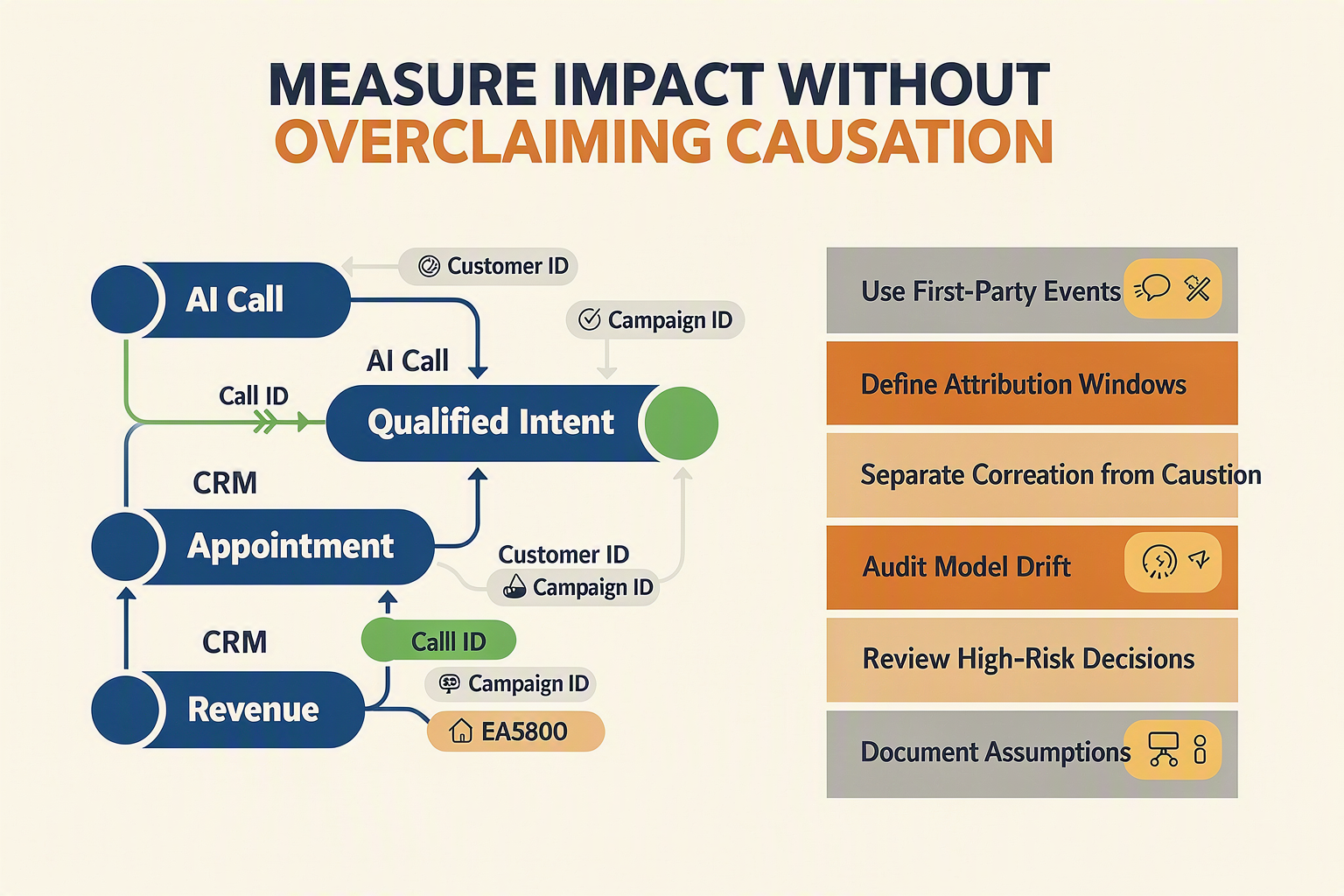
Connect call-level evidence to CRM outcomes through persistent identifiers, then measure incremental revenue, cost, risk, and customer outcomes—not merely correlations. Trustworthy AI call analytics should make every conversion claim reproducible from the recording, model output, business event, and attribution rule.
Build a traceable attribution chain
Assign a persistent conversation ID when the call begins and propagate it across telephony, conversation intelligence software, CRM, payment, scheduling, and support systems. Preserve timestamps and identifiers for:
- Campaign, source, keyword, or referral.
- Phone number or routing endpoint reached.
- AI-agent version, prompt version, and knowledge-base version.
- Detected intent and qualification evidence.
- Transfer, appointment, quote, payment, or follow-up action.
- Final CRM outcome, value, and cancellation or refund status.
Avoid defining “conversion” as a phrase such as “sounds good.” Use verifiable downstream events: an appointment attended, payment settled, application completed, qualified opportunity accepted, or debt collected.
Use multiple attribution views rather than presenting one model as objective truth:
- Call-sourced: the call created the opportunity.
- Call-assisted: the call occurred before conversion but was not necessarily causal.
- Last-touch: the call was the final recorded interaction.
- Incremental: a controlled test indicates that the AI-call workflow changed the outcome.
Measure business impact beyond conversion rate
A credible scorecard combines revenue, operational efficiency, customer outcomes, and risk. Recommended measures include:
- Incremental gross profit: additional conversions × contribution margin, minus platform and operating costs.
- Cost per qualified outcome: total call-program cost ÷ verified qualified outcomes.
- Transfer effectiveness: successful human-assisted outcomes ÷ transfers.
- Resolution durability: cases that remain resolved after 7, 14, or 30 days.
- Compliance-adjusted value: commercial value minus remediation, refund, complaint, and regulatory costs.
- Coaching impact: pre/post change in specific behaviors and outcomes among comparable call cohorts.
Where feasible, use randomized holdouts, phased rollouts, or matched cohorts. A dashboard showing that AI-handled calls convert more often does not establish causality if call intent, customer value, operating hours, or routing rules differ.
Make every analytical claim auditable
Trustworthy contact center intelligence separates observed facts from model inference. A booking event is observed; “purchase intent” is inferred. Each inferred field should store its confidence, transcript span, audio timestamp, model version, and review status.
Implement these controls:
- Require abstention or human review below defined confidence thresholds.
- Validate call transcription and summarization separately by language, accent, noise condition, and call type.
- Audit false positives and false negatives for high-impact intents such as cancellation, vulnerability, consent withdrawal, and financial hardship.
- Prevent voice analytics AI sentiment labels from independently triggering adverse decisions.
- Reconcile analytics against CRM and payment records on a scheduled basis.
- Record attribution-rule changes so historical reports remain reproducible.
Privacy failures also belong in the business-impact model. IBM reported in its 2024 Cost of a Data Breach Report that the global average breach cost reached $4.88 million, demonstrating why retention, redaction, and access controls cannot be treated as dashboard administration.
Close the operational feedback loop
Route each finding to an accountable owner: sales operations for attribution gaps, compliance for disclosure failures, product teams for recurring objections, knowledge managers for unsupported answers, and coaches for behavior-level interventions. AI quality assurance calls become valuable when teams can connect evidence to an action, action to an owner, and the resulting change to a verified business outcome.
What does this mean for operations, compliance, sales, and analytics teams?
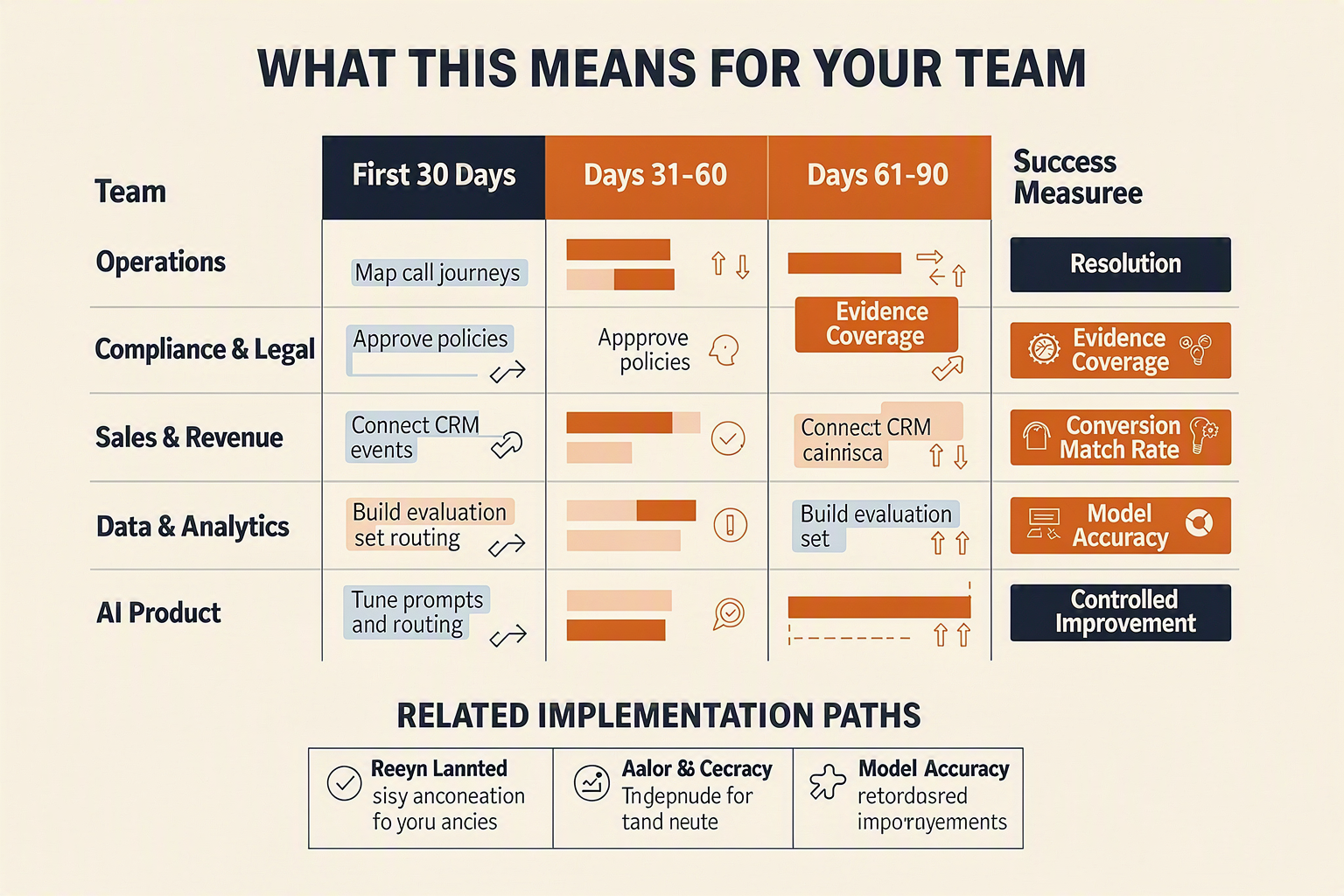
Conversation intelligence changes each team’s job differently: operations owns workflow performance, compliance owns policy evidence, sales owns conversion outcomes, and analytics owns data quality and measurement design. The shared requirement is an evidence-linked operating model in which every score, alert, and business outcome can be traced to transcript timestamps, call metadata, and system events.
Cross-functional ownership model
| Team | Primary decisions | Required evidence and controls | Core measures | Review cadence |
|---|---|---|---|---|
| Operations | Routing, escalation, staffing, and workflow fixes | Intent, transfer reason, containment outcome, latency, failure stage | Resolution rate, repeat-call rate, transfer rate, task completion | Daily exceptions; weekly trends |
| Compliance and privacy | Consent, disclosures, prohibited claims, retention, and access | Timestamped transcript excerpts, recording status, policy version, reviewer action | Disclosure coverage, confirmed violations, false-positive rate, remediation time | Real-time alerts; monthly audit |
| Sales and revenue | Lead qualification, follow-up, coaching, and attribution | CRM identity, qualification evidence, objections, appointment or payment event | Qualified-lead rate, booking rate, conversion rate, revenue per call | Daily follow-up; weekly funnel |
| QA and coaching | Scorecards, calibration, and behavior improvement | Call sample, rubric version, evidence spans, human overrides | QA score, inter-rater agreement, repeat-error rate, coaching completion | Weekly calibration |
| Analytics and data | Taxonomies, thresholds, experiments, and drift detection | Model version, confidence, language, channel, audio condition, ground-truth label | Precision, recall, coverage, transcription error, drift | Weekly monitoring; quarterly validation |
| Product and knowledge | Script, prompt, policy, and knowledge-base improvements | Unanswered questions, retrieval citations, correction patterns, lost intents | Answer success, escalation reduction, knowledge-gap recurrence | Biweekly backlog review |
What each team should change
Operations teams should use AI call analytics to manage exceptions rather than watch aggregate dashboards alone. A rising transfer rate, for example, becomes actionable only when operations can segment it by intent, language, call path, model version, and failure reason.
Compliance teams should treat automated detection as triage—not a final legal determination. Most provisions of the European Union AI Act become applicable on August 2, 2026, so affected organizations should preserve system versions, policy rules, human-review decisions, and change histories as auditable records. Privacy controls also need executive attention: IBM’s 2024 Cost of a Data Breach Report estimated the global average breach cost at $4.88 million.
Sales teams should connect call transcription and summarization to CRM outcomes, not merely count calls labelled “positive.” Qualification criteria, objections, commitments, and next steps should be captured as separate structured fields. Conversion attribution should require a stable customer or lead identifier plus an observable event such as a booking, payment, or qualified-opportunity transition.
QA and coaching teams should configure AI quality assurance calls around observable behaviors: whether the agent verified details, provided a required disclosure, answered accurately, or completed the promised action. Coaching should prioritize recurring behaviors and provide timestamped examples instead of ranking people through opaque composite scores.
Analytics teams must publish the limitations of voice analytics AI, especially sentiment inference. Tone is not reliable ground truth across accents, languages, cultures, health conditions, and poor audio; sentiment should therefore remain a low-stakes contextual signal with confidence thresholds and human review.
The shared operating contract
Every team using conversation intelligence software should agree on:
- A common intent, outcome, and escalation taxonomy.
- Named owners for alerts and remediation deadlines.
- Versioned scorecards, prompts, models, and compliance rules.
- Human-review queues for low-confidence or high-risk findings.
- A monthly council that turns contact center intelligence into approved workflow, script, CRM, and knowledge-base changes.
Gartner predicted in 2023 that 80% of customer-service organizations would use generative AI in some form by 2025; in 2026, the differentiator is therefore not adoption alone, but disciplined cross-functional governance.
What are the most frequently asked questions about conversation intelligence software for AI phone calls?
What does conversation intelligence software do for AI phone calls?
How accurate are call transcription and summarization tools in multiple languages?
Can voice analytics AI reliably detect customer sentiment and emotion?
How should businesses implement scorecards for AI quality assurance calls?
What compliance and privacy controls should AI call analytics include?
How does conversation intelligence software improve contact-center performance?
Conclusion
Production-ready conversation intelligence software is not simply a transcript repository; it is a governed feedback system that connects every finding to source evidence, accountable owners, and measurable outcomes. Successful 2026 implementations will prioritize reliability, human oversight, and operational action over simplistic dashboards.
Key takeaways
- Validate every analytical layer. Benchmark call transcription and summarization by language, channel, accent, and audio condition. Link summaries, detected intents, and outcomes to transcript evidence, then route low-confidence or high-risk findings for human review.
- Treat sentiment as a limited signal, not a fact. Voice analytics AI cannot reliably determine emotion from tone alone across cultures, languages, health conditions, accents, or noisy connections. Combine carefully defined conversational signals with context and reviewer judgment instead of assigning reductive “positive” or “negative” labels.
- Build QA and compliance into the architecture. Effective AI quality assurance calls programs use calibrated scorecards to assess observable behaviors, while compliance monitoring checks consent language, required disclosures, prohibited claims, and sensitive-data handling. Privacy controls—including retention limits, redaction, access management, and audit trails—must span the entire pipeline. IBM’s 2024 Cost of a Data Breach Report placed the global average breach cost at $4.88 million, showing why these controls cannot be postponed.
- Connect analysis to business systems and decisions. AI call analytics becomes valuable when bookings, qualified leads, collections, and conversions are attributed to calls—and when recurring issues improve coaching, CRM workflows, product decisions, marketing, and knowledge bases. That is how contact center intelligence moves from observation to operational improvement.
What to watch next
The defining shift will be from automated analysis to demonstrable governance. Gartner predicted in 2023 that 80% of customer-service organizations would use generative AI by 2025, while most European Union AI Act provisions become applicable on August 2, 2026. Organizations should therefore expect stronger demands for explainability, documented controls, and reproducible evaluations.
Platforms such as CallMissed—with AI voice agents, WhatsApp Business calling, omnichannel workflows, and Indic-first speech support across 22 Indian languages—offer a practical environment for exploring this evolution. The next question is not whether every call can be analyzed, but whether your organization can turn that analysis into evidence-based action responsibly.
Related Reading
Discussion
Related Posts



Ready to automate customer conversations?
Launch AI voice agents and WhatsApp bots with CallMissed — one API, 22+ Indian languages.