Claude Opus 5 vs Gemini 3.1 Pro: Verified 2026 Comparison

Fact-checked July 24, 2026: compare Claude Opus 5 and Gemini 3.1 Pro on release status, pricing, context, coding, agents and enterprise fit.
Which model wins as of July 24, 2026? The answer-first verdict
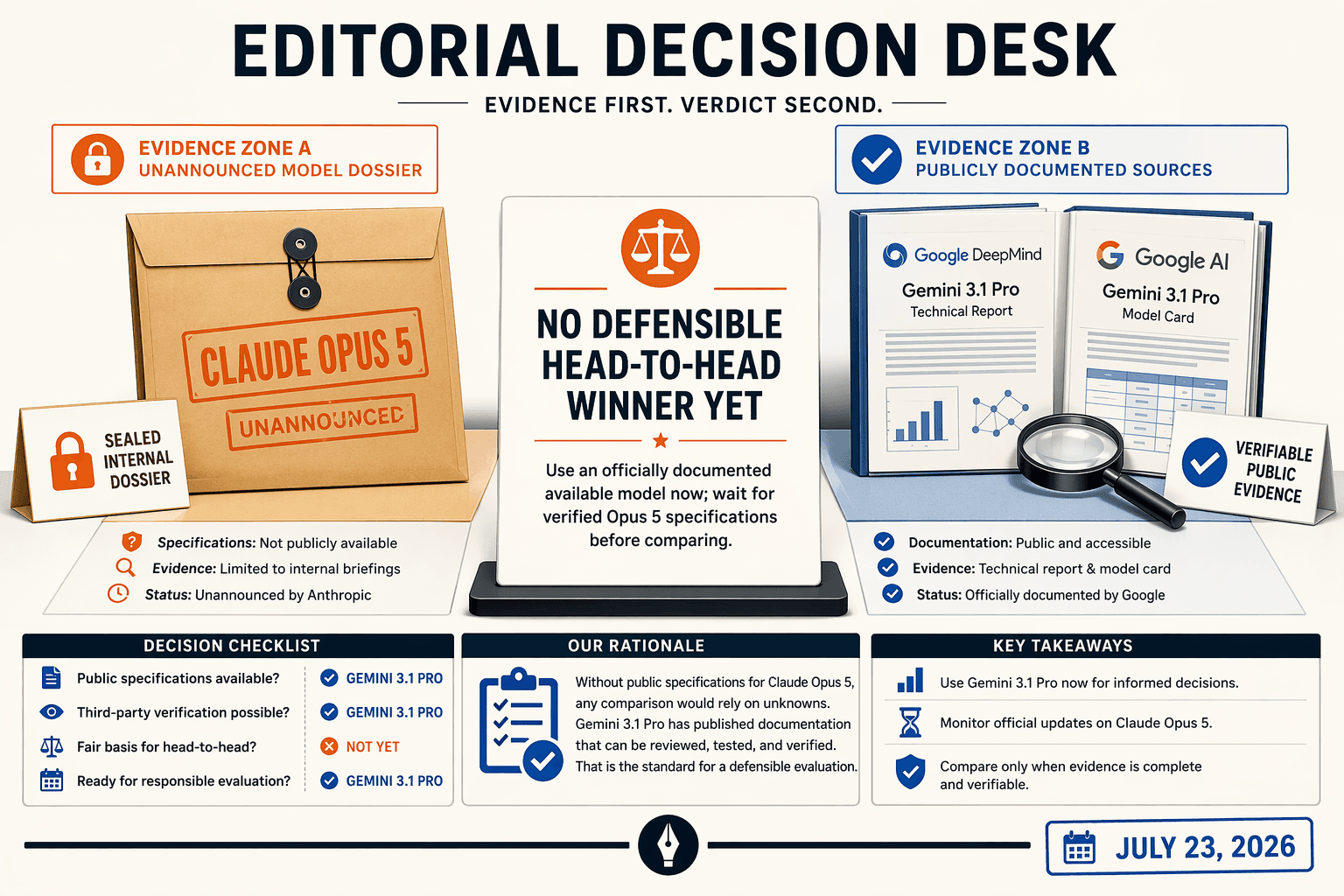
No defensible performance winner can be named in Claude Opus 5 vs Gemini 3.1 Pro as of July 24, 2026. Claude Opus 5 has not been verified as launched. No official Anthropic announcement, product documentation, model card, API identifier, pricing page, or availability notice for that model was found. Without an accessible, officially identified model, a reproducible head-to-head comparison is impossible.
The answer-first verdict
The outcome depends on what “winner” means:
- For immediate deployment: choose a documented Gemini endpoint. Google has publicly identified deployable Gemini models and their access channels. Confirm that the specific endpoint is supported in your environment before committing.
- For model quality: no winner. Claude Opus 5 cannot be tested against Gemini 3.1 Pro until Anthropic officially launches or documents it and provides reproducible access.
- For Claude Opus 5 procurement: wait. Its pricing, context window, output limits, modalities, benchmarks, API identifier, safety documentation, and release date remain not officially announced.
This is a deployability verdict, not evidence that one model is more capable at reasoning, coding, multimodal analysis, or agentic tasks.
What Google’s primary-source evidence confirms
Google’s announcements provide evidence about parts of the broader Gemini portfolio, but facts about one Gemini release should not be transferred to another model without supporting documentation.
- The Google AI blog announced Gemini 3.6 Flash, Gemini 3.5 Flash-Lite, and Gemini 3.5 Flash Cyber on July 21, 2026.
- At Google I/O 2026, Google stated that Gemini 3.5 Flash was generally available through the Gemini API, Google AI Studio, and Google Antigravity.
- At Google I/O 2026, Google CEO Sundar Pichai said Google was “using [Gemini 3.5 Pro] internally.” That statement does not establish the same general availability announced for Gemini 3.5 Flash.
None of those statements, by itself, verifies Gemini 3.1 Pro’s current API identifier, endpoint status, pricing, quotas, regional coverage, or deprecation schedule. Capabilities or availability announced for Gemini 3.5 and Gemini 3.6 also cannot be attributed retroactively to Gemini 3.1 Pro.
Why a benchmark winner would be misleading
A Claude Opus 5 vs Gemini 3.1 Pro scorecard would currently have an unverified Claude side. Rumored specifications, screenshots, benchmark numbers, or references from unofficial sources are not substitutes for an Anthropic announcement and a testable model endpoint.
A valid future comparison should use:
- Exact official API model identifiers
- Identical prompts and system instructions
- Equivalent tool access and permissions
- Matching token, latency, and cost budgets
- Controlled temperature and sampling settings
- The same benchmark versions and scoring methods
- A clearly stated evaluation date
Vendor-published benchmark results should also be separated from independent testing because prompts, test harnesses, sampling methods, and access conditions can materially change scores.
Decision rule for July 24, 2026
- Shipping now: Use a Gemini endpoint whose model identifier, access method, limits, and support status are documented for your environment.
- Evaluating Gemini 3.1 Pro specifically: Verify its live API identifier, pricing, quotas, regional availability, and lifecycle status in current Google documentation.
- Considering Claude Opus 5: Mark all product fields as “not officially announced” rather than estimating them.
- Revisiting the comparison: Wait for Anthropic to publish an official announcement, documentation, model card, API access details, pricing, and safety information.
The practical verdict is that a documented Gemini endpoint can be selected for deployment; it is not that Gemini 3.1 Pro has proven superior to Claude Opus 5. Any stronger conclusion would invent a head-to-head winner without comparable evidence.
What are Claude Opus 5 and Gemini 3.1 Pro, and which details are actually confirmed?
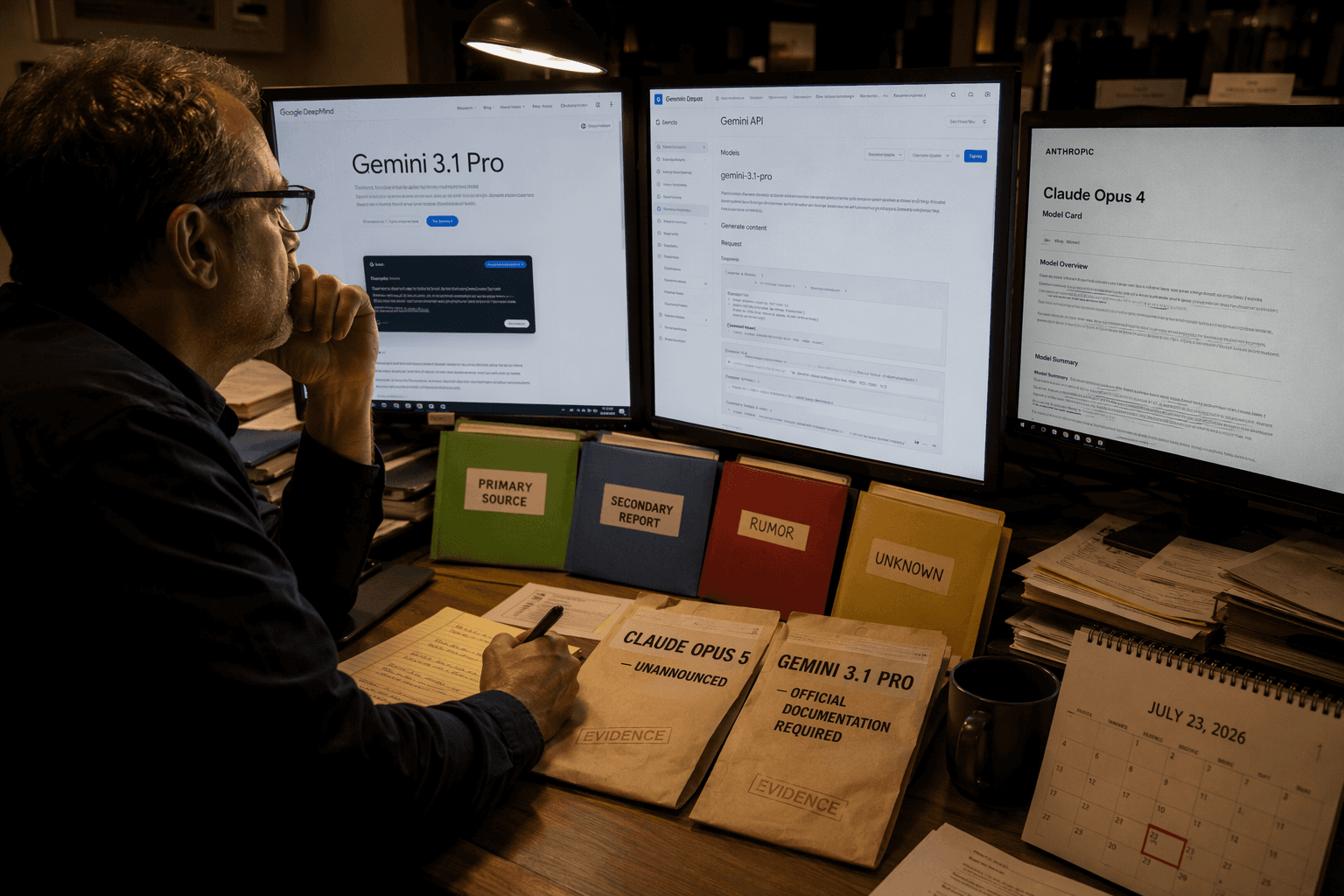
Claude Opus 5 is unannounced, and the supplied Google primary sources do not establish exact specifications for a model named Gemini 3.1 Pro. As of July 24, 2026, this comparison must therefore distinguish confirmed product-family developments from rumors, assumptions, and details borrowed from other model versions.
Claude Opus 5 remains entirely unverified
Anthropic has not officially announced Claude Opus 5 in the evidence available for this comparison. No Anthropic release announcement, model card, system card, API documentation, or pricing page supplied here confirms that Claude Opus 5 exists as a publicly documented product.
Consequently, every proposed Claude Opus 5 specification remains unverified, including:
- Release date and availability
- API model identifier
- Input context window and maximum output
- Text, image, audio, or video capabilities
- Knowledge or training-data cutoff
- Input, output, caching, and batch prices
- Reasoning, coding, and agentic benchmark results
- Tool use, computer use, and extended-thinking features
- Safety controls, rate limits, and enterprise availability
Specifications from Claude Opus 4.x, Claude Sonnet, or another Anthropic model cannot be carried forward to an unannounced product. Even plausible values should be labeled as rumors rather than presented as estimates.
Gemini 3.1 Pro requires model-specific evidence
The supplied official Google sources confirm continued development across the Gemini 3.x family, but they do not provide an exact Gemini 3.1 Pro specification sheet. Facts about Gemini 3.5, Gemini 3.6, or Gemini 3 Pro Image must not be attributed retroactively to Gemini 3.1 Pro.
Google announced Gemini 3.6 Flash, Gemini 3.5 Flash-Lite, and Gemini 3.5 Flash Cyber on July 21, 2026, according to the official Google AI blog. That announcement confirms those three models, not Gemini 3.1 Pro’s context window, pricing, benchmarks, modalities, or API status.
Google’s official I/O 2026 materials establish several additional family-level facts:
- Google’s I/O 2026 roundup says Gemini 3.5 Flash is generally available through the Gemini API, Google AI Studio, and Google Antigravity.
- Google CEO Sundar Pichai’s I/O 2026 keynote post says Google is “using [Gemini 3.5 Pro] internally.” Internal use does not establish public general availability.
- Google identifies Nano Banana Pro as Gemini 3 Pro Image in an official Gemini model announcement. That image model is not evidence for the specifications of a text-oriented Gemini 3.1 Pro.
How claims are classified in this comparison
Each detail should receive an evidence label before entering a scorecard:
- Confirmed: Explicitly documented for the exact model by Anthropic, Google DeepMind, Google AI, Gemini API, or Vertex AI.
- Historically confirmed: Documented for an earlier model but not transferable to this matchup.
- Inferred: Derived from model-family naming, chronology, or adjacent releases.
- Rumored: Based on leaks, social posts, snippets, or unsourced databases.
- Stale or contradicted: Superseded by official availability, deprecation, or documentation updates.
The governing rule is straightforward: family-level progress is not model-level confirmation. Any price, token limit, benchmark, endpoint, or capability not assigned to the exact model by a primary source should remain undisclosed rather than be guessed.
Which release, specification and availability claims pass the evidence test?

As of July 24, 2026, Google’s primary documentation confirms Gemini 3.1 Pro as an official preview model. Anthropic has not announced Claude Opus 5. The evidence therefore supports documenting Gemini 3.1 Pro’s published preview specifications and benchmarks, while every precise Claude Opus 5 claim remains unverified.
Evidence-status table
| Claim category | Claude Opus 5 | Gemini 3.1 Pro | Evidence verdict |
|---|---|---|---|
| Official release | Anthropic has not announced this model | Officially documented by Google as a preview model | Only Gemini 3.1 Pro is established |
| API availability | No confirmed model identifier or endpoint | Available in preview through the Gemini API as gemini-3.1-pro-preview | Gemini access is confirmed but not generally available |
| Pricing | No official pricing evidence | Google’s API pricing page lists usage-based preview pricing | Use Google’s live pricing page; do not infer Claude pricing |
| Context and output | No official specification evidence | Gemini 3 developer documentation specifies a 1 million-token input context window | Gemini input context is documented; Claude limits are unknown |
| Modalities and tools | No confirmed capability documentation | Governed by Gemini 3.1 Pro’s model card and Gemini developer documentation | Do not transfer features from Gemini 3.5 or 3.6 |
| Benchmarks | No official results for this model | Google reports 77.1% verified on ARC-AGI-2, alongside other model-card results | Gemini has official results, but no direct Opus 5 comparison is possible |
What Google’s primary documentation establishes
Google’s Gemini developer pages and DeepMind model card establish the following for Gemini 3.1 Pro:
- Gemini 3.1 Pro is an official Google model, not a rumored name.
- It is offered as a preview model, so its identifier, limits, behavior, and availability may change before general availability.
- The Gemini API exposes it under the preview identifier
gemini-3.1-pro-preview. - Google’s Gemini 3 developer guide specifies support for a 1 million-token input context window.
- Google publishes an official model card and benchmark results, including 77.1% verified on ARC-AGI-2.
- Google’s current Gemini API pricing page lists standard paid-tier rates of $2 per million input tokens and $12 per million output tokens for prompts up to 200,000 tokens, rising to $4 input and $18 output per million tokens for prompts above 200,000 tokens. Output pricing includes thinking tokens.
These are Google-published claims, not proof that Gemini 3.1 Pro will reproduce the same benchmark score in every application. Benchmark interpretation still depends on the stated evaluation setup, tool access, reasoning configuration, and scoring method.
What remains unknown about Claude Opus 5
Anthropic has not published an announcement, model card, API identifier, pricing schedule, context limit, modality list, tool specification, or benchmark report for a product named Claude Opus 5. Consequently, claims about its release date, token limits, speed, price, benchmark scores, or availability should be labeled speculative.
Specifications from earlier Claude models cannot be assigned to Claude Opus 5. Likewise, Gemini 3.5 or 3.6 specifications must not be presented as Gemini 3.1 Pro capabilities merely because the models share a family name.
How to evaluate disputed claims
Accept a precise model claim only when the provider’s primary documentation supplies:
- The exact model name and deployable API identifier.
- A dated release note, model card, or developer-documentation entry.
- A clear availability stage, such as preview or general availability.
- Separate limits for input context, maximum output, modalities, tools, and supported regions.
- Current pricing from the provider’s official API pricing page.
- Reproducible benchmark conditions, including prompting, reasoning settings, tool access, and evaluation methodology.
For production systems—including multi-model gateways such as CallMissed’s OpenAI-compatible API—teams should inspect the live provider catalog immediately before deployment. The evidence supports a documented evaluation of Gemini 3.1 Pro Preview, but not a completed Claude Opus 5 versus Gemini 3.1 Pro contest: one model is officially available in preview, while the other remains unannounced.
How much do the models cost, and where can developers access their APIs?
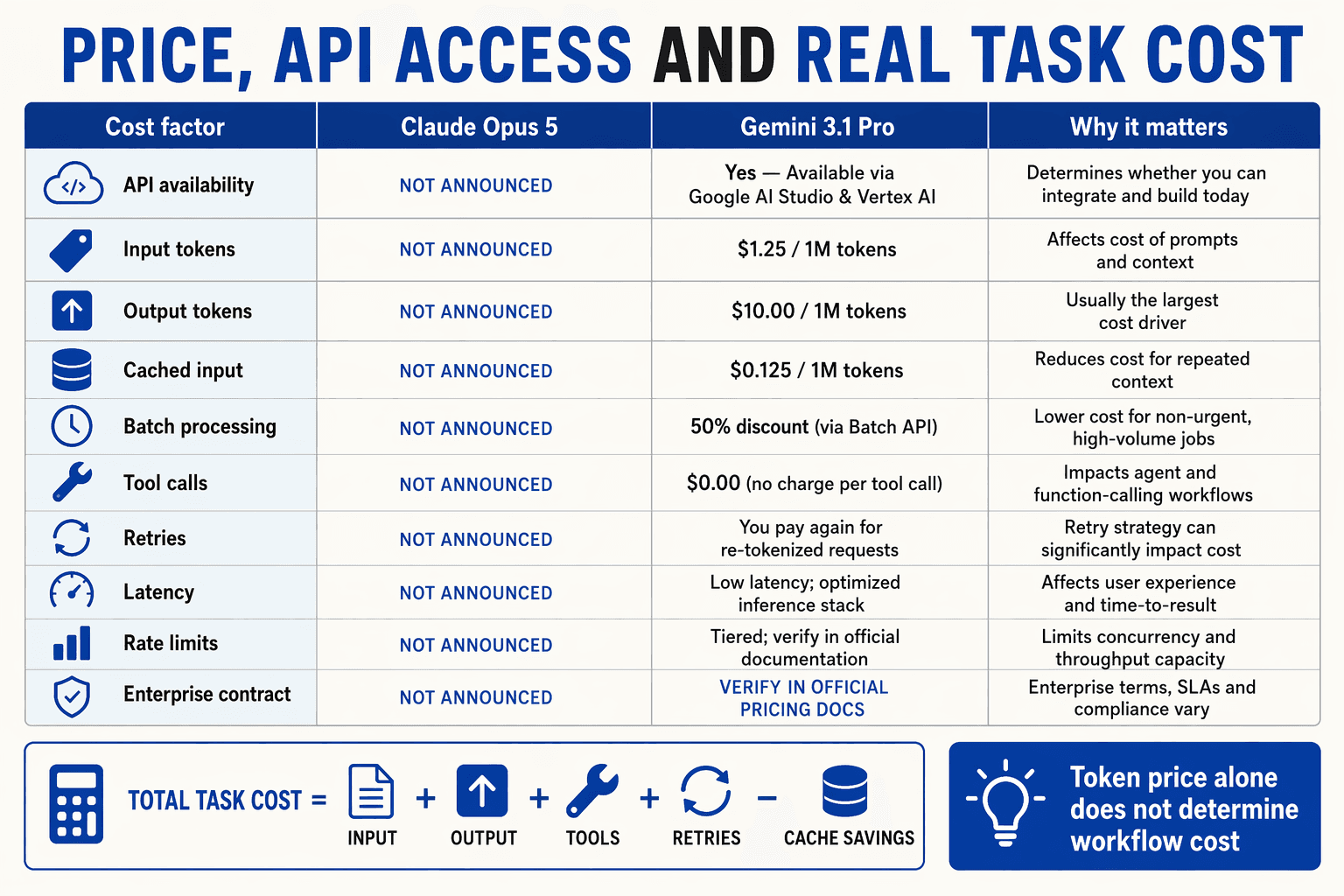
Claude Opus 5 has no announced API identifier or price. Gemini 3.1 Pro is available as an official Google preview endpoint, with paid Gemini API pricing published in separate standard- and long-context tiers as of July 24, 2026.
Pricing and API-access status
_All prices below are in USD per 1 million tokens._
| Cost or access item | Claude Opus 5 | Gemini 3.1 Pro Preview | Developer takeaway |
|---|---|---|---|
| Official model identifier | None announced | gemini-3.1-pro-preview | Use the documented preview ID rather than a guessed model slug |
| Standard input price | No official price | $2.00 for prompts up to 200,000 tokens | Estimate costs using the prompt-length tier for each request |
| Long-context input price | No official price | $4.00 for prompts over 200,000 tokens | Long prompts double the input-token rate |
| Standard output price | No official price | $12.00 for prompts up to 200,000 tokens | Google includes thinking tokens in billed output |
| Long-context output price | No official price | $18.00 for prompts over 200,000 tokens | The higher output rate applies when the prompt exceeds 200,000 tokens |
| Context-caching price | No official price | $0.20 up to 200,000 tokens; $0.40 over 200,000 tokens | Cached-token storage and other applicable charges should be calculated separately |
| Direct developer access | No Opus 5 endpoint | Preview access through the Gemini API and Google AI Studio | Confirm preview availability, quotas, and regional support before production use |
The 200,000-token boundary is based on prompt length. It is not a blended or marginal tier: requests above that threshold use Google’s published long-context input and output rates.
What developers can verify now
Google’s Gemini developer model documentation lists gemini-3.1-pro-preview as an official preview model. Developers can select it in Google AI Studio or call it through the Gemini API, subject to account eligibility, regional availability, quotas, and preview-model restrictions.
Claude Opus 5 remains unannounced. There is therefore no official Anthropic model ID, API endpoint, input-token rate, output-token rate, or release date to use in a procurement estimate. The absence of pricing does not mean that access is free; it means no reliable Opus 5 cost calculation is currently possible.
How to calculate the Gemini 3.1 Pro bill
For a standard request with a prompt of 200,000 tokens or fewer:
cost = (input tokens × $2 / 1M) + (output and thinking tokens × $12 / 1M)
For a request whose prompt exceeds 200,000 tokens:
cost = (input tokens × $4 / 1M) + (output and thinking tokens × $18 / 1M)
Developers should also check Google’s live pricing documentation for context-caching storage, grounding, tool-use, batch-processing, and other charges that may apply. Because Gemini 3.1 Pro is a preview endpoint, its identifier, limits, availability, and pricing can change before a stable release.
The procurement conclusion is straightforward: Gemini 3.1 Pro can be tested and budgeted using Google’s published preview pricing, while Claude Opus 5 should receive no API-cost allocation until Anthropic officially announces the model and its rates.
How do context, output, multimodality, reasoning and coding compare?

Claude Opus 5 and Gemini 3.1 Pro cannot be compared reliably across context, output, multimodality, reasoning, or coding as of July 24, 2026. Anthropic has not announced Claude Opus 5, and the supplied Google primary sources do not establish current Gemini 3.1 Pro limits or benchmark results; assigning either model a capability advantage would therefore be speculative.
Context and maximum output
A context window measures how much input—and, depending on the API’s accounting rules, generated output—a model can process in one request. Maximum output is a separate limit that affects long-form reports, code generation, document transformation, and agent traces.
No official Anthropic specification confirms Claude Opus 5’s:
- Input-token context window
- Maximum generated-token limit
- Support for context caching
- Long-context retrieval accuracy
- API identifier or availability tier
Likewise, Gemini limits must be tied to an exact documented model ID rather than inherited from another Gemini generation. Google announced Gemini 3.6 Flash, Gemini 3.5 Flash-Lite, and Gemini 3.5 Flash Cyber on July 21, 2026, according to the Google AI blog, but those releases do not prove that Gemini 3.1 Pro has the same context or output limits.
Multimodal capabilities
A valid multimodal comparison should separately test text, images, audio, video, and document inputs, plus any native output modalities. It should not treat “multimodal” as a single yes-or-no feature.
| Capability | Claude Opus 5 | Gemini 3.1 Pro | Evidence-based conclusion |
|---|---|---|---|
| Text input and output | Unannounced | Requires exact Google model documentation | No direct comparison |
| Image understanding | Unannounced | Must be verified for the specific endpoint | Do not infer from the Gemini family |
| Audio or video input | Unannounced | Must be confirmed by Google AI documentation | No verified winner |
| Native media generation | Unannounced | Product-specific capability | Test separately from understanding |
| Long multimodal context | Unannounced | Limit not established by supplied sources | Unknown |
Google’s broader product portfolio includes specialized media models: the official Google AI material identifies Nano Banana Pro as Gemini 3 Pro Image, optimized for complex professional image use cases. That does not automatically make image generation a native Gemini 3.1 Pro capability.
Reasoning quality
“Reasoning” should be evaluated by task category rather than one aggregate score:
- Constrained logic: Does the model follow every condition?
- Long-context synthesis: Can it locate and reconcile dispersed evidence?
- Quantitative work: Are calculations reproducible and tool-assisted?
- Agent planning: Can it recover from failed steps without drifting?
- Factual calibration: Does it acknowledge missing evidence instead of guessing?
Google described Gemini 3.5 Pro as being used internally at I/O 2026, while Google reported that Gemini 3.5 Flash was generally available through the Gemini API, Google AI Studio, and Google Antigravity. These statements show different deployment stages within one model family; they are not evidence about Gemini 3.1 Pro’s reasoning score.
Coding comparison
Coding performance must use identical repositories, prompts, tool permissions, token budgets, and test suites. Useful measures include tests passed, regression rate, build success, security defects, latency, and cost per accepted patch.
Until Claude Opus 5 is released, claims that it writes better code—or that Gemini 3.1 Pro decisively outperforms it—remain unsupported. For production selection, run a version-pinned evaluation against private code and record the exact API model identifiers and evaluation date.
Which model is better for agents, tool use and enterprise ecosystems?

Gemini 3.1 Pro is the more actionable option for agentic and enterprise development, but only where its exact model ID remains supported in Google’s current catalog. Claude Opus 5 cannot win this category because Anthropic has not announced it or documented its tools, API behavior, security controls, or enterprise availability as of July 24, 2026.
Agent and tool-use readiness
Production agents need more than strong reasoning. They require reliable tool calling, authentication, state management, asynchronous execution, observability, and predictable model-version policies.
Google’s broader Gemini platform has verifiable momentum in these areas:
- Google AI announced an expansion of Managed Agents in the Gemini API—including background tasks and remote Model Context Protocol support—on July 1, 2026.
- Google stated at I/O 2026 that Gemini 3.5 Flash was generally available through the Gemini API, Google AI Studio, and Google Antigravity.
- Google announced Gemini 3.6 Flash, Gemini 3.5 Flash-Lite, and Gemini 3.5 Flash Cyber on July 21, 2026, demonstrating how quickly the supported Gemini model catalog is changing.
- Google Antigravity is explicitly described by Google as an “agent-first development platform,” making the surrounding Gemini ecosystem relevant to multi-step coding and automation workflows.
These platform-level capabilities do not automatically prove that every feature works identically with Gemini 3.1 Pro. Before deployment, developers should confirm the exact endpoint’s support for function schemas, remote MCP, background execution, quotas, regional availability and deprecation dates.
For Claude Opus 5, all equivalent claims remain unverified. There is no official basis for asserting that the hypothetical model supports computer use, MCP, parallel tools, long-running agents or any particular function-calling format.
Enterprise ecosystem advantage
Google currently has the clearer enterprise adoption path because Gemini development sits alongside established Google AI and cloud tooling. That makes Gemini the lower-uncertainty choice for organizations already standardizing identity, billing, governance and development workflows around Google.
A practical enterprise evaluation should test:
- Tool-call accuracy: Does the model select the correct function and generate valid arguments?
- Recovery behavior: Can the agent handle failed APIs, timeouts and partial results?
- Security boundaries: Are permissions scoped per user, tool and environment?
- Operational controls: Can teams monitor cost, latency, traces and model-version changes?
- Data governance: Do retention, residency and processing terms meet organizational requirements?
Google’s rapid release cadence is both an advantage and an operational consideration. At I/O 2026, Google said Gemini 3.5 Pro was being used internally, while Gemini 3.5 Flash was already generally available; teams should therefore avoid assuming that model numbering alone indicates production status.
Bottom line for agent builders
Choose a currently documented Gemini endpoint when an agent must ship now, especially if the organization already uses Google’s AI development stack. Do not architect around Claude Opus 5 until Anthropic publishes an official model card, API documentation and enterprise terms.
For provider portability, CallMissed’s OpenAI-compatible multi-model gateway reflects a broader infrastructure strategy: isolate application logic from individual model providers and use automatic same-tier fallbacks where appropriate. Regardless of gateway, consequential tool actions should still require validation, least-privilege credentials and human approval.
Can benchmark scores prove which model is better in real workflows?

No. Benchmark scores can indicate how a model performs on a defined test, but they cannot prove which model will be better in your production workflow. For Claude Opus 5 versus Gemini 3.1 Pro, even a benchmark-only comparison is currently impossible because Anthropic has not published verified Claude Opus 5 results.
Why a leaderboard is not a workflow
A benchmark measures performance under a particular dataset, prompt format, scoring method, tool configuration, and model snapshot. Real applications introduce different constraints: private data, ambiguous instructions, multi-turn conversations, API latency, structured outputs, retrieval quality, and failures that may carry financial or operational consequences.
Headline scores can mislead when comparisons differ in:
- Model version: Preview, experimental, and production endpoints may behave differently.
- Evaluation date: Providers can update routed or aliased models without changing an article’s old score.
- Reasoning budget: More inference-time computation can improve accuracy while increasing latency and cost.
- Tool access: Browsing, code execution, retrieval, and external agents can transform task performance.
- Prompting: Zero-shot, few-shot, and model-specific prompts are not equivalent conditions.
- Scoring: Pass@1, majority voting, human preference, and judge-model grading measure different things.
- Test contamination: Public benchmark questions may appear in training data or prompt libraries.
Consequently, a higher score on coding questions does not establish better repository-level debugging, just as a strong reasoning result does not prove reliable customer-support automation.
Why this matchup has no valid scorecard yet
Anthropic had not officially announced Claude Opus 5 as of July 24, 2026, so there is no authenticated model card, API identifier, benchmark methodology, or reproducible result to evaluate. Any “Claude Opus 5” leaderboard entry without an Anthropic primary source should be labeled unverified, not treated as a product result.
Gemini comparisons also require exact version control. Google announced three newer models—Gemini 3.6 Flash, Gemini 3.5 Flash-Lite, and Gemini 3.5 Flash—on July 21, 2026, according to the official Google AI blog. Google I/O 2026 separately stated that Gemini 3.5 Flash was generally available through the Gemini API, Google AI Studio, and Google Antigravity, while Google described Gemini 3.5 Pro as being used internally. Results from those models cannot automatically be attributed to Gemini 3.1 Pro.
A defensible real-workflow evaluation
Teams should run an internal test using the exact deployable API endpoints:
- Build 50–200 representative tasks from real, permissioned workloads.
- Remove sensitive data and define objective acceptance criteria before testing.
- Use identical system instructions, tools, retrieval documents, and output schemas.
- Record task success, groundedness, latency, cost, format compliance, and human escalation rate.
- Repeat non-deterministic tasks and report the distribution, not merely the best run.
- Blind model identities during human review where practical.
For agentic tasks, measure complete outcomes—such as resolving a ticket or producing a passing pull request—rather than counting persuasive intermediate text. Customer-facing evaluations should additionally test multilingual accuracy, interruption handling, policy adherence, and unsafe-action refusal.
What benchmark evidence can establish
Benchmarks remain useful for shortlisting models and forming testable hypotheses. They become decision-grade only when the model versions are identifiable, conditions are comparable, methods are disclosed, and results correlate with your workload.
Until Anthropic publishes Claude Opus 5 and both endpoints undergo the same evaluation, benchmark scores cannot establish a Claude Opus 5 versus Gemini 3.1 Pro winner. The honest conclusion is insufficient comparable evidence, not a speculative leaderboard verdict.
What do official sources and credible experts say about the matchup?

Official sources do not support a conclusive Claude Opus 5 vs Gemini 3.1 Pro verdict as of July 24, 2026. Anthropic has not announced Claude Opus 5, while Google’s latest primary-source communications focus on newer Gemini 3.5 and 3.6 models rather than presenting Gemini 3.1 Pro as the current flagship.
What Anthropic’s silence means
No Anthropic announcement, model card, API documentation, system card, or pricing page currently establishes Claude Opus 5 as a released product. Consequently, credible experts cannot independently verify any claimed Opus 5:
- Benchmark scores or leaderboard positions
- Context and maximum-output limits
- Input and output pricing
- API model identifier or availability date
- Multimodal, coding, agentic, or computer-use capabilities
This is more than a documentation gap. Without a fixed model version, researchers cannot reproduce results, inspect evaluation settings, or determine whether an alleged test used a private preview, another Claude model, or fabricated data. Any expert presenting precise Opus 5 numbers should therefore identify them explicitly as rumors, not specifications.
What Google’s primary sources confirm
Google’s official announcements show that the Gemini portfolio has already progressed beyond the terminology implied by this matchup.
Google announced three models—Gemini 3.6 Flash, Gemini 3.5 Flash-Lite, and Gemini 3.5 Flash Cyber—on July 21, 2026, according to the official Google AI blog. That dated announcement is stronger evidence of Google’s current model direction than an undated comparison page or third-party leaderboard.
At Google I/O 2026, Google stated that Gemini 3.5 Flash was generally available through the Gemini API, Google AI Studio, and Google Antigravity. Google CEO Sundar Pichai separately described Gemini 3.5 Pro more cautiously: “We’re also excited for Gemini 3.5 Pro. We are using it internally.”
These statements establish an important distinction:
- Gemini 3.5 Flash had confirmed general availability.
- Gemini 3.5 Pro was acknowledged but described as being used internally.
- Gemini 3.6 Flash and two additional 3.5 variants were officially announced on July 21, 2026.
- The cited current Google sources do not provide enough evidence to treat Gemini 3.1 Pro as Google’s latest generally available Pro model.
Accordingly, any Gemini 3.1 Pro price, endpoint, benchmark, or availability claim should be checked against the live Gemini API and Vertex AI documentation before procurement.
How credible expert analysis should frame the matchup
A trustworthy analyst should separate vendor evidence, independent testing, and speculation rather than averaging them together. A valid expert comparison would require:
- Public, immutable model identifiers
- Identical prompts, tools, sampling settings, and token budgets
- The same evaluation date and benchmark version
- Disclosed retry policies and human-grading criteria
- Published pricing and regional API availability
Until those conditions exist, expert commentary can assess Google’s documented ecosystem and explain possible Claude-family directions, but it cannot declare Claude Opus 5 faster, cheaper, smarter, or more capable than Gemini 3.1 Pro. The expert consensus justified by the available evidence is procedural: verify the exact Google endpoint before deploying, and wait for Anthropic’s official Claude Opus 5 documentation before comparing performance.
Which model should you use for your workload, and should you wait?
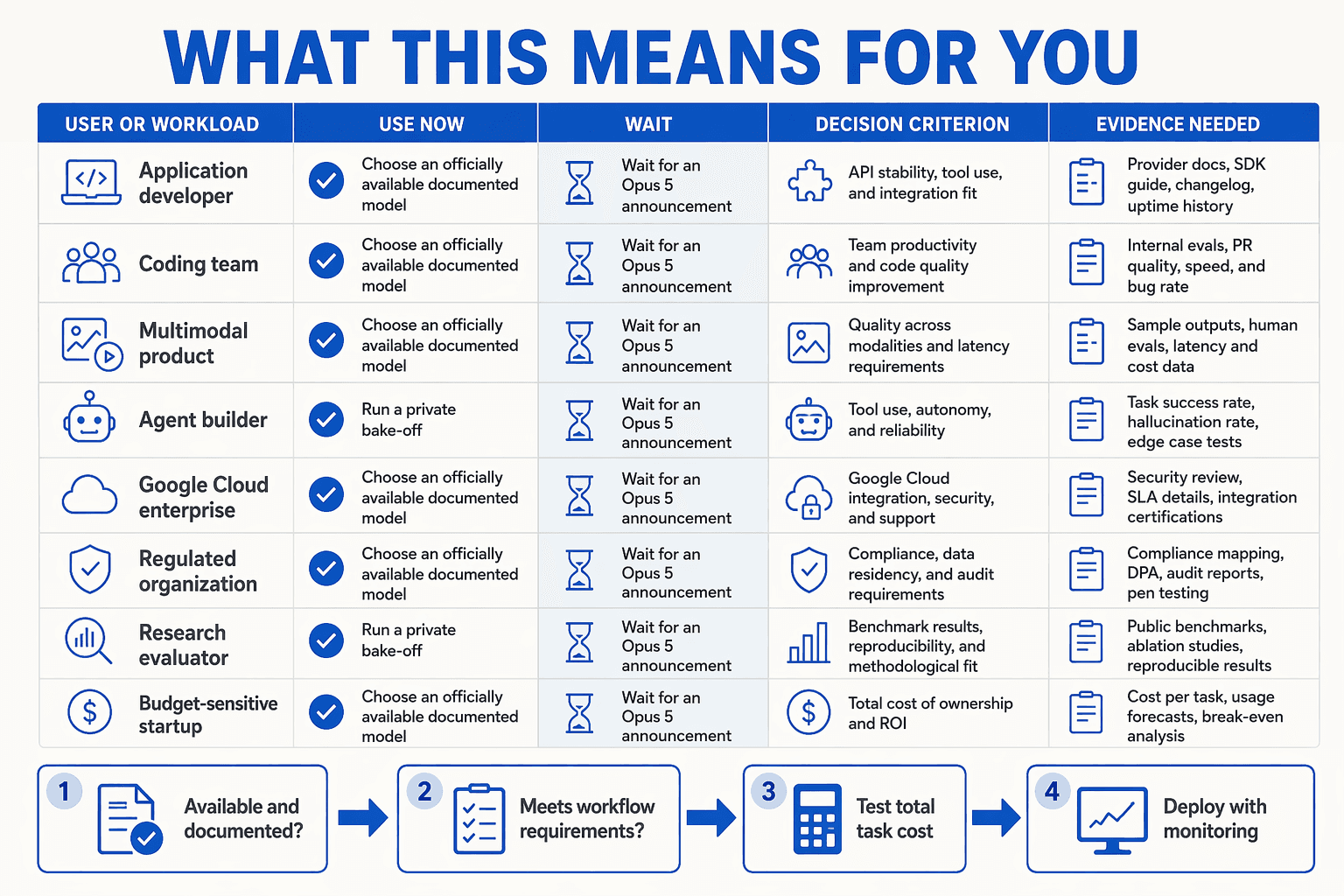
Use a currently supported Gemini model when your workload must launch now; wait if your decision specifically depends on Claude Opus 5. As of July 24, 2026, Anthropic has not announced Claude Opus 5, so teams cannot responsibly evaluate its cost, latency, context capacity, safety controls, or production availability.
Workload-by-workload recommendation
| Workload | Recommended action now | Why | When to reconsider |
|---|---|---|---|
| Production application with a near-term deadline | Use a supported Gemini API endpoint | Google provides documented, deployable models and an established developer ecosystem | Re-test after Anthropic officially releases Claude Opus 5 |
| Google Cloud or Workspace workflow | Prefer Gemini | Gemini offers the more direct path into Google’s enterprise and productivity stack | Reconsider if Claude Opus 5 gains required integrations or governance controls |
| Complex reasoning or coding evaluation | Run a Gemini pilot, but avoid declaring a winner | Claude Opus 5 has no verified benchmark scores, API, or model card | Compare both models with identical prompts, tools, budgets, and dates |
| Long-running agent or tool-use system | Prototype on an available Gemini endpoint | An agent requires documented tool interfaces, limits, reliability, and billing | Wait for Anthropic to publish Opus 5 tool-use and agent specifications |
| Cost-sensitive, high-volume automation | Benchmark current Flash-class Gemini models | Google announced new efficiency-oriented Gemini models on July 21, 2026 | Add Claude Opus 5 only after official token pricing and latency data exist |
| Claude-specific strategic migration | Wait; do not build against rumored specifications | No verified Claude Opus 5 API identifier, price, context window, or release date exists | Proceed after Anthropic documentation and production access are available |
Why “Gemini” does not automatically mean Gemini 3.1 Pro
Before deployment, confirm that Gemini 3.1 Pro’s exact endpoint remains supported in your target region and platform. Google’s portfolio has advanced beyond that generation: the official Google AI blog announced Gemini 3.6 Flash, Gemini 3.5 Flash-Lite, and Gemini 3.5 Flash Cyber on July 21, 2026.
Google’s I/O 2026 announcement says Gemini 3.5 Flash is generally available through the Gemini API, Google AI Studio, and Google Antigravity. At the same event, Google CEO Sundar Pichai described Gemini 3.5 Pro as being used internally, which is not equivalent to general API availability. These distinctions matter: a newer model name does not guarantee that developers can deploy it, and an older endpoint should not be selected without checking current Google AI documentation.
A defensible wait-or-use-now policy
Use this three-step procurement rule:
- Ship with verified access. Select a documented endpoint that meets your region, quota, compliance, latency, and modality requirements.
- Preserve portability. Keep prompts, tool schemas, retrieval, and evaluation suites separate from provider-specific code. An OpenAI-compatible multi-model gateway can reduce integration changes when approved alternatives become available.
- Reopen the comparison after launch evidence exists. Require Anthropic’s official Claude Opus 5 model card, API documentation, pricing, context and output limits, regional availability, and deprecation policy.
Waiting makes sense when model selection is reversible and frontier reasoning quality could materially affect outcomes. It does not make sense when waiting delays revenue, customer support, compliance work, or a validated product launch. The practical decision is therefore available Gemini infrastructure now, optional Claude Opus 5 evaluation later—not a speculative commitment today.
Frequently asked questions: Is Claude Opus 5 released, is Gemini 3.1 Pro official, and should you wait?

Is Claude Opus 5 officially released as of July 24, 2026?
Is Gemini 3.1 Pro an official Google model?
Who wins the Claude Opus 5 vs Gemini 3.1 Pro comparison?
Should I wait for Claude Opus 5 or use Gemini now?
What should developers verify before choosing Claude Opus 5 vs Gemini 3.1 Pro?
Could Gemini 3.5 or Gemini 3.6 make a Gemini 3.1 Pro comparison outdated?
Conclusion
The evidence-based conclusion as of July 24, 2026 is straightforward: Gemini is the practical option for teams that need a documented Google model now, while any Claude Opus 5 buying decision should wait for an official Anthropic announcement. No credible winner can be named until Anthropic publishes specifications and both models undergo controlled, like-for-like testing.
- Claude Opus 5 remains unannounced. Its pricing, API identifier, context window, output limits, multimodal capabilities, benchmark results, and release date are therefore unverified. Rumors cannot support production architecture or procurement decisions.
- Google’s Gemini ecosystem is documented but evolving rapidly. The official Google AI blog announced Gemini 3.6 Flash, Gemini 3.5 Flash-Lite, and Gemini 3.5 Flash Cyber on July 21, 2026. Google’s I/O 2026 coverage also says Gemini 3.5 Flash is generally available through the Gemini API, Google AI Studio, and Google Antigravity, while Gemini 3.5 Pro was described as being used internally.
- Deployment readiness and model superiority are different questions. A supported Gemini endpoint offers an actionable path today, particularly for Google Cloud and enterprise workflows. However, that availability does not prove Gemini 3.1 Pro would outperform Claude Opus 5 across reasoning, coding, multimodality, agents, or tool use.
- Future benchmarks must be genuinely apples-to-apples. Meaningful results require identical prompts, model versions, evaluation dates, sampling settings, tool permissions, context lengths, and scoring methods. Comparisons that mix different configurations—or attribute later Gemini-family capabilities to Gemini 3.1 Pro—should not determine a purchasing decision.
The signals to watch are an official Anthropic Claude Opus 5 model card, API documentation, pricing, safety report, and release status, alongside any Google DeepMind or Google AI updates that clarify Gemini 3.1 Pro’s current availability and lifecycle. Only then can independent evaluators establish a defensible performance and cost comparison.
In the meantime, multi-model infrastructure can reduce the cost of changing providers as the evidence develops. To explore how AI communication is evolving, check out CallMissed—an OpenAI-compatible AI infrastructure platform supporting multi-model access, voice agents, WhatsApp automation, and multilingual engagement across 22 Indian languages.
Will your 2026 AI strategy depend on speculative benchmark headlines, or on verified models that can be tested in your own workflows?
Related Reading
- Claude Opus 5 vs DeepSeek V4 Pro: Verified 2026 Comparison
- Claude Opus 5 vs Mistral Large 3: Verified 2026 Comparison
- Claude Opus 5 vs Qwen3.8-Max: Verified July 2026 Comparison
Sources
Discussion
Loading discussion…