Claude Opus 5 vs Qwen3.8-Max: Verified July 2026 Comparison



Fact-checked July 24, 2026: compare Claude Opus 5 and Qwen3.8-Max on release status, parameters, price, access, coding, licensing and deployment.
Claude Opus 5 vs Qwen3.8-Max: Verified July 2026 Comparison
What happens when a reported 2.4-trillion-parameter model faces a flagship that has not yet been publicly confirmed? The honest Claude Opus 5 vs Qwen3.8-Max comparison, current as of July 24, 2026, is not a conventional benchmark showdown: Qwen3.8-Max has entered preview channels with limited disclosure, while reliable specifications, pricing, benchmarks, and even formal launch details for Claude Opus 5 remain unconfirmed.
The short verdict
Qwen3.8-Max is the more tangible option today, but neither model supports a definitive performance verdict. Alibaba has reportedly made Qwen3.8-Max-Preview available through Token Plan, Qoder, and QoderWork, whereas claims about Anthropic’s Claude Opus 5 must be treated as expectations rather than established facts. Teams needing immediate access can investigate Qwen’s preview; teams considering Opus 5 should wait for an official Anthropic model card, API documentation, safety report, and pricing page.
The numbers require particular care. MarkTechPost reported on July 19, 2026, that Alibaba previewed Qwen3.8-Max as a 2.4-trillion-parameter multimodal model. That figure should not be confused with Moonshot AI’s reported 2.8-trillion-parameter Kimi K3, which is a separate model from a separate company. Moreover, total parameter count does not reveal inference cost or capability: if Qwen3.8-Max uses a sparse Mixture-of-Experts architecture, its active parameter count per token matters far more operationally, yet that figure had not been publicly disclosed in the cited reporting.
Why this comparison matters now
The uncertainty is itself the story. Frontier-model announcements increasingly arrive before complete evidence packages, encouraging comparisons based on model scale, screenshots, or informal testing rather than reproducible evaluation. MarkTechPost stated on July 19, 2026, that Alibaba had not yet shipped official benchmarks, licensing terms, or an active-parameter count for Qwen3.8-Max. CometAPI similarly reported on July 20, 2026, that standard per-million-token API pricing had not been published.
This comparison therefore separates three evidence levels:
- Verified or directly documented facts, such as observable access routes
- Reported claims, including Qwen3.8-Max’s 2.4-trillion-parameter scale
- Unconfirmed expectations, including Claude Opus 5 specifications and rumored codenames such as “Honeycomb”
You will learn how the models compare—or cannot yet be compared—across architecture, weights and licensing, API access, price, context windows, coding, reasoning, agents, multilingual performance, deployment, and benchmarks. The analysis also explains benchmark methodology caveats and provides practical use-now-versus-wait guidance.
For developers preparing to adopt whichever models prove suitable, CallMissed’s OpenAI-compatible gateway reflects the broader shift toward accessing multiple AI providers through one integration with same-tier fallbacks, reducing the cost of changing models as verified evidence emerges.
Which model should you choose as of July 24, 2026? The answer-first verdict
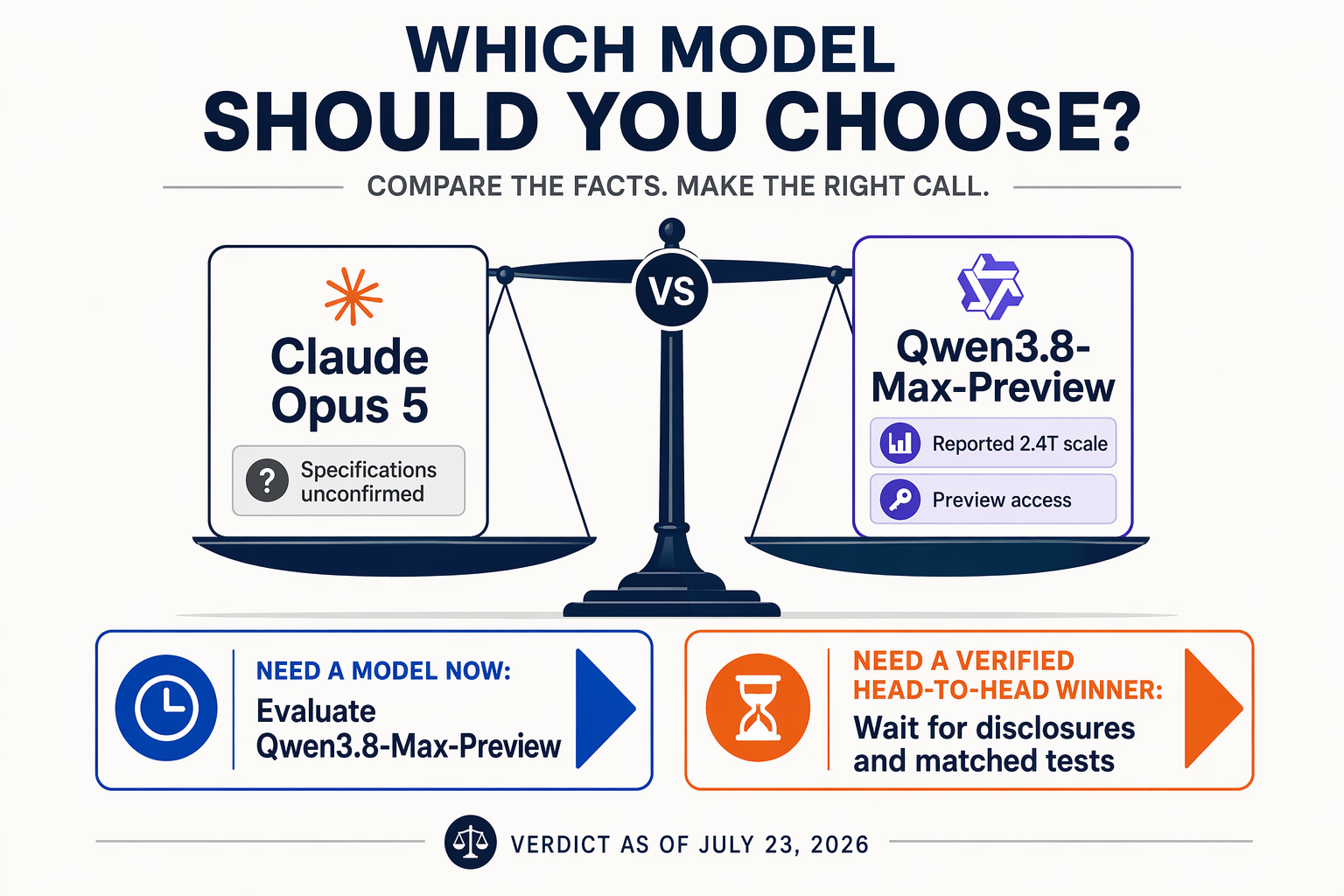
The answer-first verdict for Claude Opus 5 vs Qwen3.8-Max is: consider Qwen3.8-Max-Preview only for controlled experimentation, and do not treat Claude Opus 5 as a launched or purchasable model. As of July 24, 2026, the available primary-source record does not support declaring either model an overall winner.
Anthropic has not officially confirmed a Claude Opus 5 launch. The evidence reviewed contains no Anthropic newsroom announcement, documentation entry, model card, pricing page, API model ID, benchmark release, or newly listed catalogue model for Claude Opus 5. Any claimed specifications, release dates, codenames, prices, or performance results therefore remain unconfirmed and should not inform procurement.
The practical decision
Choose according to evidence quality and deployment readiness:
- Test Qwen3.8-Max-Preview only if you can verify access through an official Alibaba or Qwen product and independently evaluate it on your workloads.
- Wait for official Qwen documentation if you need stable API access, transparent pricing, licensing terms, regional availability, capacity commitments, or reproducible benchmarks.
- Use an existing, documented Claude model if you need Anthropic access now; do not substitute rumored Claude Opus 5 capabilities into an evaluation.
- Do not make purchasing, migration, or architecture decisions based on Claude Opus 5 rumors or the reported “Honeycomb” codename.
Coursiv reported on July 19, 2026, that Qwen3.8-Max-Preview was available through Alibaba’s Token Plan, Qoder, and QoderWork. That is a secondary-source availability report, not equivalent to an official model announcement or durable API commitment. Teams should confirm the exact model name, version, access conditions, and continued availability directly within Alibaba Cloud or official Qwen documentation.
Why Qwen’s reported preview does not settle the comparison
Qwen3.8-Max has more publicly reported evidence than Claude Opus 5, but that does not establish production readiness or benchmark superiority. Key unresolved questions include:
- Is the reported 2.4-trillion-parameter figure officially documented?
- What is the active parameter count per token?
- Has Alibaba formally confirmed the reported sparse Mixture-of-Experts architecture?
- What are the context-window and maximum-output limits?
- Will model weights be released, and under what license?
- What are the official input, output, cached-token, and multimodal prices?
- Which regions, rate limits, data-handling terms, and service guarantees apply?
- Which benchmark results are reproducible from official model artifacts and disclosed test settings?
CometAPI reported on July 20, 2026, that Alibaba had not published standard per-million-token pricing for Qwen3.8-Max. MarkTechPost reported on July 19, 2026, that official benchmarks, licensing terms, and the active-parameter count had not been released. These are secondary reports and should be labeled as such rather than presented as Alibaba confirmations.
Likewise, the reported 2.4-trillion-parameter scale is not proof of accuracy, latency, reasoning quality, reliability, or cost efficiency. It must not be conflated with the separately reported 2.8-trillion-parameter scale of Moonshot AI’s Kimi K3. Neither figure, by itself, determines which model performs better.
Recommendation by user type
- Researchers and early adopters: Run limited Qwen3.8-Max-Preview tests, preserve prompts and outputs, and record the exact product, endpoint, and model-version identifier.
- Production engineering teams: Test security, latency, tool use, multilingual performance, failure rates, data retention, and regression behavior before considering deployment.
- Procurement teams: Wait for primary-source pricing, licensing, service-level, capacity, and data-governance documentation.
- Teams evaluating Claude Opus 5: Prepare a benchmark suite, but leave Claude Opus 5 results blank until Anthropic publishes an official model and verifiable access details.
- API-platform users: Confirm that any gateway, including an OpenAI-compatible multi-model service such as CallMissed, explicitly lists the intended model ID and version before assuming availability.
The defensible Claude Opus 5 vs Qwen3.8-Max verdict as of July 24, 2026, is Qwen3.8-Max-Preview for cautious, verified testing only; neither model as an evidence-backed overall winner; and no Claude Opus 5 recommendation unless and until Anthropic officially announces and documents it.
What are Claude Opus 5 and Qwen3.8-Max, and why is this comparison unusual?

Qwen3.8-Max is a reported Alibaba flagship multimodal model in limited preview, whereas Claude Opus 5 is an anticipated Anthropic flagship with no confirmed release or specifications as of July 24, 2026. This comparison is unusual because one model is incompletely documented and the other is not yet a formally announced product, so no valid performance showdown is possible.
Two model names with different levels of evidence
Qwen3.8-Max-Preview is reported to be the preview identifier for Alibaba’s next large Qwen model. MarkTechPost reported on July 19, 2026, that Qwen3.8-Max has 2.4 trillion total parameters and multimodal capabilities, but that Alibaba had not published benchmarks, licensing terms, or an active-parameter count.
Secondary sources describe Qwen3.8-Max as a sparse Mixture-of-Experts model. However, that architecture should remain provisional until Alibaba or the Qwen team publishes a model card, technical report, or equivalent primary documentation. Without an official active-parameter count, developers cannot reliably estimate serving cost, latency, memory requirements, or computational efficiency from the reported 2.4-trillion total.
Claude Opus 5 has an even less certain status. As of July 24, 2026, Anthropic has not provided an official announcement, model card, API identifier, pricing schedule, context window, safety report, benchmark package, or parameter disclosure for a product named Claude Opus 5.
The name Honeycomb must therefore be treated as an unconfirmed rumor or possible internal reference. It is not an official substitute for an Anthropic product announcement, and it provides no reliable basis for estimating Claude Opus 5’s architecture or capabilities.
Why the reported parameter figures require careful attribution
Three separate model claims must not be conflated:
- Qwen3.8-Max: MarkTechPost reported a scale of 2.4 trillion total parameters on July 19, 2026.
- Kimi K3: Moonshot AI’s separate model has been reported at 2.8 trillion total parameters.
- Claude Opus 5: No parameter count has been officially disclosed because Anthropic has not publicly confirmed the model.
Qwen3.8-Max’s reported 2.4-trillion scale does not belong to Kimi K3, while Kimi K3’s reported 2.8-trillion scale does not belong to Qwen3.8-Max. These are separate models from separate organizations.
Total parameter count is also not a direct measure of model quality. Active parameters, training data, multimodal design, post-training, tool use, inference-time computation, and evaluation methodology can matter more than the headline total.
Why this is not yet a conventional 1v1 comparison
A normal model comparison requires accessible endpoints, stable documentation, and reproducible tests. Claude Opus 5 vs Qwen3.8-Max does not yet meet those conditions:
- Qwen3.8-Max reportedly has limited preview access. Coursiv stated that Qwen3.8-Max-Preview became available through Token Plan, Qoder, and QoderWork following the July 19 preview.
- Qwen3.8-Max remains incompletely documented. MarkTechPost reported that no official benchmark suite, license, or active-parameter count accompanied the preview.
- Pricing remains unclear. CometAPI reported on July 20, 2026, that Alibaba had not published standard per-million-token input and output pricing.
- Claude Opus 5 cannot be independently tested. Claims about its coding, reasoning, speed, context length, agent performance, or cost would be speculative.
- No apples-to-apples benchmark verdict is currently defensible. Qwen3.8-Max lacks a complete official evaluation package in the cited reporting, while Claude Opus 5 lacks a confirmed public model.
For now, the responsible comparison focuses on evidence quality, disclosure, and availability—not an unsupported winner. Capability rankings should wait until both companies publish verifiable specifications and reproducibly accessible models.
Which claims are verified, reported, unconfirmed, or unknown?
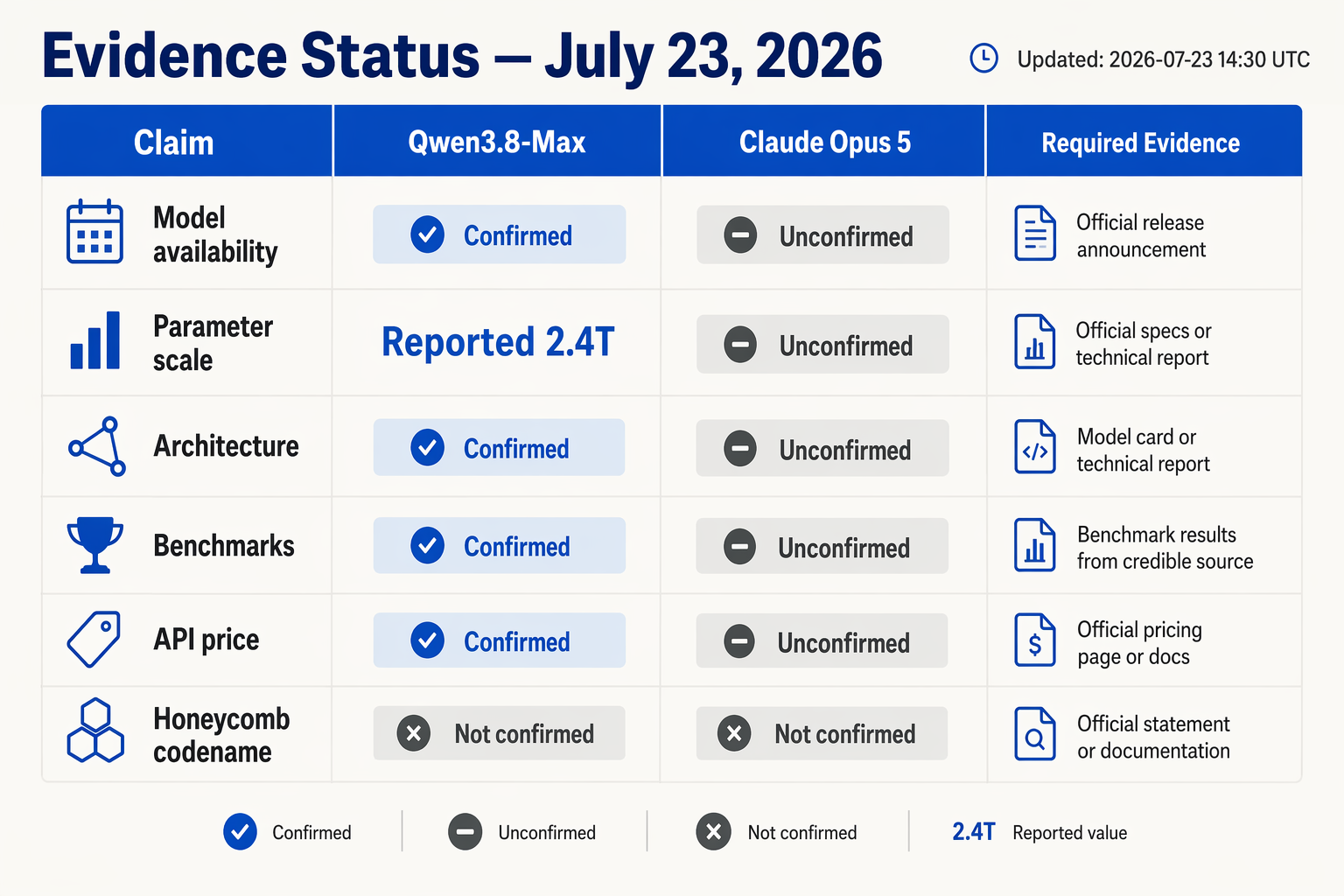
The evidence supports Qwen3.8-Max-Preview’s availability and reported 2.4-trillion-parameter scale, but it does not yet support a reproducible performance verdict. For Claude Opus 5, no specifications, benchmark scores, release date, or pricing should be treated as confirmed as of July 24, 2026.
Evidence-status snapshot
| Claim | Model | Status | Evidence and limitation |
|---|---|---|---|
| A preview is accessible through Token Plan, Qoder, and QoderWork | Qwen3.8-Max | Verified / directly checkable | Coursiv reported these access routes on July 19, 2026, under the identifier qwen3.8-max-preview; availability may still vary by account, region, or preview entitlement. |
| The model has 2.4 trillion total parameters | Qwen3.8-Max | Reported | MarkTechPost reported the 2.4T figure on July 19, 2026. A detailed Alibaba/Qwen model card disclosing architecture and parameter accounting was not available in the supplied evidence. |
| The model uses sparse Mixture-of-Experts architecture | Qwen3.8-Max | Reported, not fully documented | Eesel AI described Qwen3.8-Max as a sparse Mixture-of-Experts model, but the number of experts and active parameters per token remain undisclosed. |
| Official benchmarks, active parameters, weights, and licence terms are available | Qwen3.8-Max | Unknown / not published | MarkTechPost stated on July 19, 2026, that Alibaba had shipped no official benchmarks, licence, or active-parameter count. Preview access does not establish an open-weight release. |
| Standard API pricing, context window, and maximum output are known | Qwen3.8-Max | Unknown | CometAPI reported on July 20, 2026, that Alibaba had not published standard per-million-token input and output pricing. No reliable context or output limit appears in the supplied evidence. |
| Claude Opus 5, its “Honeycomb” codename, specifications, and benchmark results are official | Claude Opus 5 | Unconfirmed | No cited Anthropic announcement, model card, API documentation, system card, or pricing page verifies these claims. “Honeycomb” must therefore remain labelled as a rumour, not an official model identity. |
What each status means
- Verified means the fact is directly observable or documented through an attributable product surface. Preview availability can be verified without assuming that every reported technical specification is also correct.
- Reported means named publications have stated the claim, but the available evidence does not include sufficient primary technical documentation to independently validate it.
- Unconfirmed applies to circulating names, expectations, leaks, and projected capabilities that the relevant developer—such as Anthropic—has not formally announced.
- Unknown means no reliable value is available. It does not mean zero, unavailable forever, or technically inferior.
The 2.4T-versus-2.8T correction
Qwen3.8-Max’s reported scale is 2.4 trillion parameters, while Kimi K3’s reported scale is 2.8 trillion parameters. Kimi K3 is a separate Moonshot AI model and its figure must not be attributed to Alibaba’s Qwen family.
Parameter totals also require architectural context. In a sparse Mixture-of-Experts system, only a subset of total parameters may be activated for each token. Without Qwen3.8-Max’s active-parameter count, routing design, precision, and serving configuration, 2.4T cannot be converted reliably into speed, cost, memory demand, or quality.
The defensible comparison is therefore asymmetric: Qwen3.8-Max has a reported preview footprint but incomplete technical disclosure, while Claude Opus 5 remains largely an anticipated model. Any precise leaderboard, price, context-window, or capability comparison would currently overstate the evidence.
How do parameters, architecture, weights, licensing, API access, price, and token limits compare?
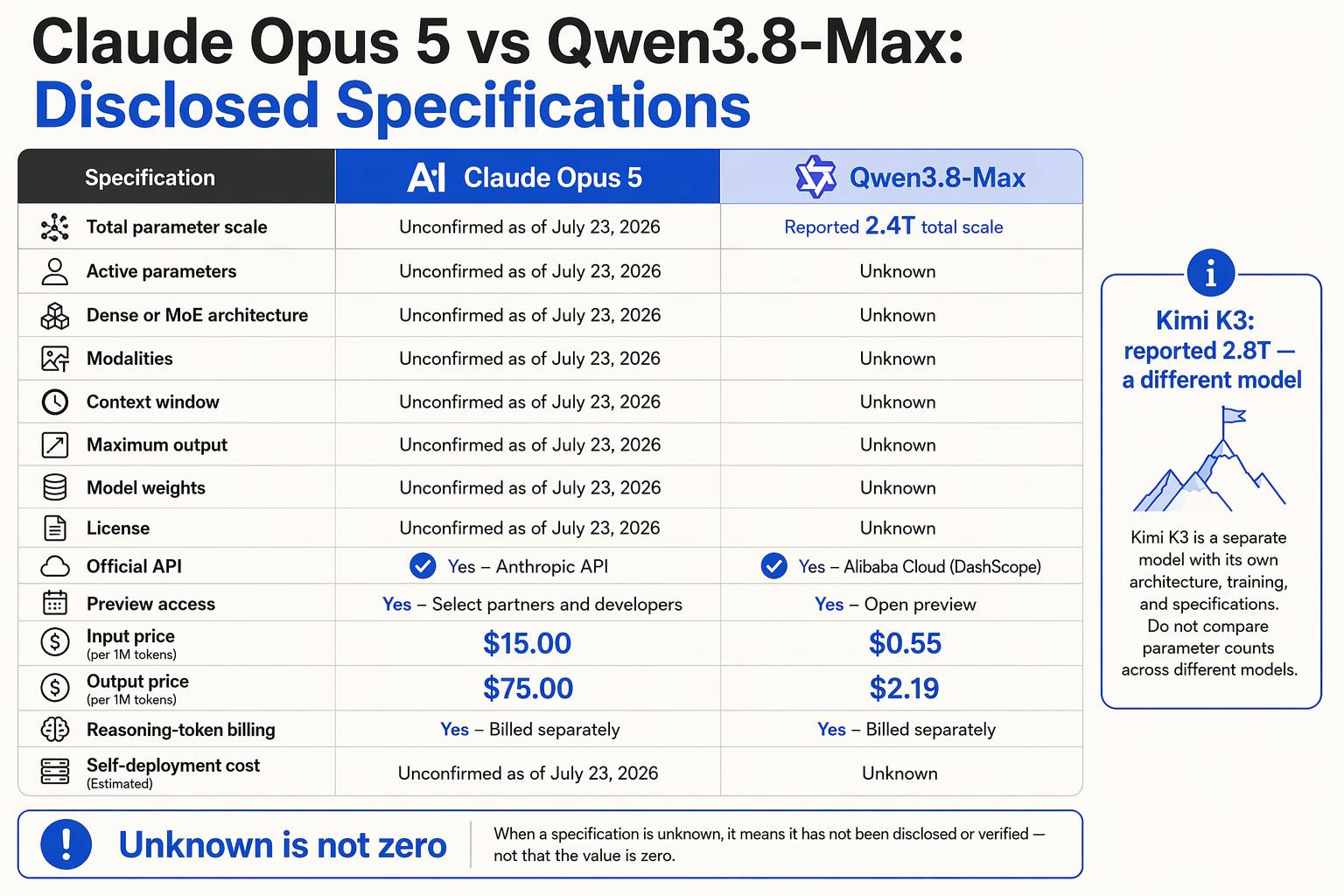
Qwen3.8-Max-Preview has more reported information than Claude Opus 5, but neither model has sufficient primary documentation for a complete deployment or cost comparison. As of July 24, 2026, Claude Opus 5 remains unannounced, while Qwen3.8-Max-Preview and its reported scale appear only in credible secondary coverage—not in a matching Qwen or Alibaba primary announcement located for this review.
Specification and access comparison
| Category | Claude Opus 5 | Qwen3.8-Max | Evidence status |
|---|---|---|---|
| Parameters | Unknown. Anthropic has not announced Opus 5 or disclosed a parameter count. | Reported: 2.4 trillion total parameters. No matching Alibaba/Qwen primary source or active-parameter count was found. | Qwen figure is Reported, not Verified; Opus 5 is Unknown. |
| Architecture | Unknown. No official architecture, expert count, or active-parameter specification exists. | Unknown. No primary source confirming the architecture, expert count, or parameters activated per token was found. | Unknown for both models. |
| Weights and licensing | Unknown. No weights or licensing terms have been announced. | Unknown. No primary source confirming downloadable weights or a license for Qwen3.8-Max was found. | Do not infer open-weight availability from other Qwen releases. |
| API and product access | Unknown. No official API model identifier or availability announcement exists. | Reported preview identifier: qwen3.8-max-preview. No matching primary API documentation or general-availability announcement was found. | Qwen preview access is Reported, not Verified; production API access is Unknown. |
| Price | Unknown. No official input, output, caching, or batch pricing has been published. | Unknown. No primary standard per-million-token price was found. | A reliable cost comparison is not currently possible. |
| Context and output limits | Unknown. | Unknown. | No primary context-window, maximum-output, or extended-context specifications were found. |
What the reported parameter figure does—and does not—prove
Credible secondary coverage reports that Qwen3.8-Max has 2.4 trillion total parameters, but this review found no corresponding Qwen or Alibaba announcement. The figure should therefore be labeled Reported, not Verified. The number of parameters activated per token is also Unknown, preventing reliable conclusions about inference memory, latency, throughput, or cost.
The 2.4-trillion figure is associated with Qwen3.8-Max, while the separately reported 2.8-trillion figure belongs to Moonshot AI’s Kimi K3. Describing Qwen3.8-Max as a 2.8-trillion-parameter model conflates two different models. Parameter totals alone also do not establish quality, especially without primary architecture details, reproducible benchmarks, training information, or documented inference settings.
Practical interpretation for buyers
- Treat Qwen3.8-Max-Preview and its 2.4T parameter count as secondary-source reports pending confirmation from Qwen or Alibaba.
- Treat all Claude Opus 5 details—including parameters, architecture, pricing, token limits, access methods, and rumored codenames—as Unknown until Anthropic announces the model.
- Do not assume that Qwen3.8-Max is open weight or covered by another Qwen model’s license.
- Do not estimate operating costs from total parameters. Wait for official pricing, active-parameter details, caching rules, rate limits, and token limits.
- Before procurement or integration, verify the model identifier, availability, data-retention terms, service-level commitments, regional restrictions, and context limits in primary vendor documentation.
- Do not present benchmark claims as verified unless they are supported by an identifiable primary source and documented test conditions.
The defensible conclusion is limited: Qwen3.8-Max has a reported preview name and reported 2.4T scale, while Claude Opus 5 remains unannounced. Nearly all deployment-critical fields are still Unknown.
Which model is stronger for coding, reasoning, agents, long context, and multilingual work?
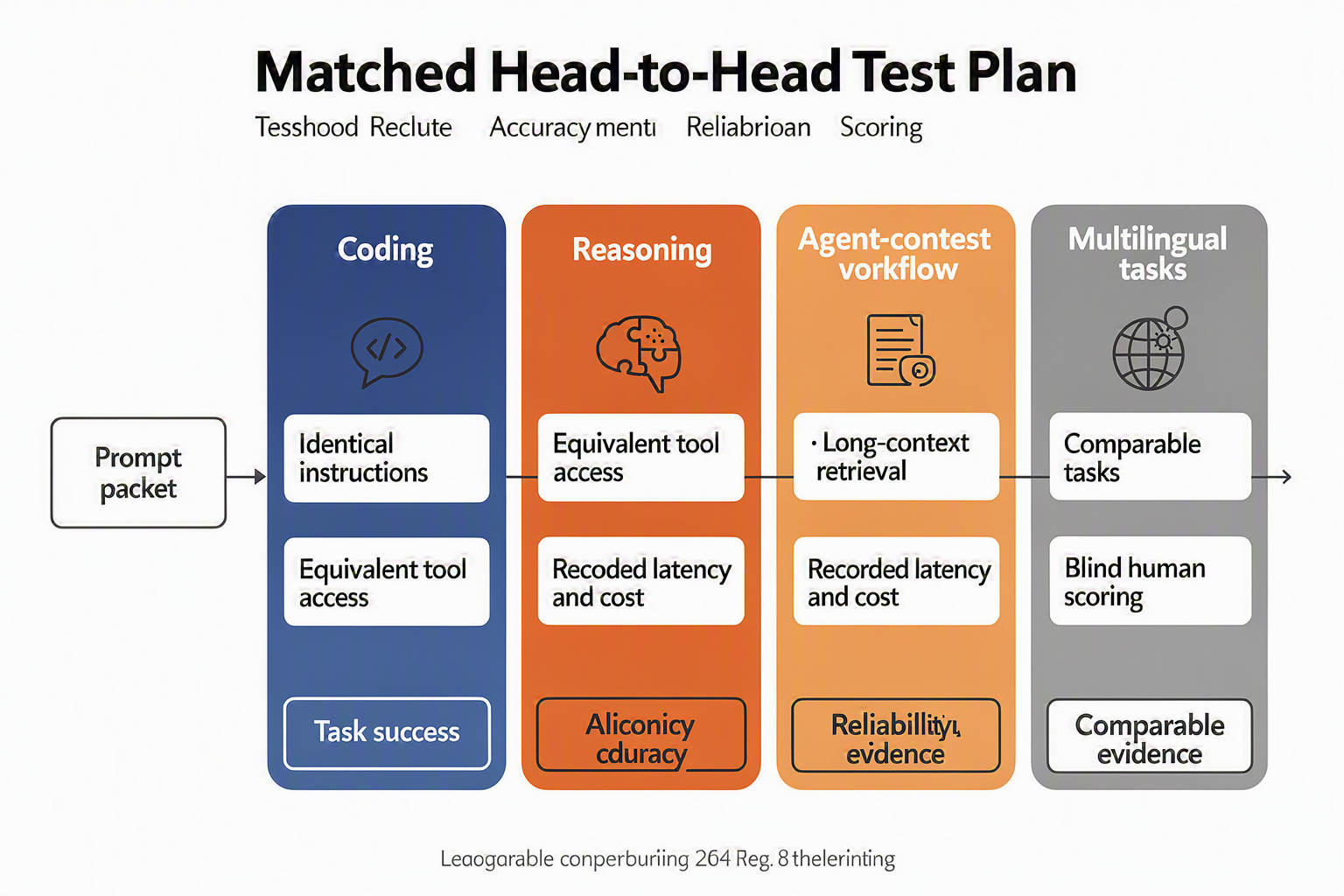
Neither Claude Opus 5 nor Qwen3.8-Max can be declared stronger across coding, reasoning, agents, long context, or multilingual work as of July 24, 2026. Qwen3.8-Max is testable through reported preview channels, giving it an advantage for immediate evaluation, while Claude Opus 5 lacks the official specifications and reproducible results required for a capability comparison.
Coding and software engineering
Qwen3.8-Max has the stronger evidence of availability, not yet the stronger evidence of coding performance. Coursiv reported in July 2026 that Qwen3.8-Max-Preview was accessible through Qoder and QoderWork, products oriented toward software-development workflows. Access through coding tools indicates intended use, but it does not establish performance on repository-scale engineering.
A credible coding verdict requires controlled results on evaluations such as:
- SWE-bench Verified for resolving real GitHub issues
- LiveCodeBench for contamination-resistant code generation
- Terminal-Bench for command-line and environment interaction
- Internal tests covering code review, debugging, migrations, and regression rates
No verified Claude Opus 5 scores or directly comparable Qwen3.8-Max scores were available in the supplied evidence. Consequently, claims that either model “wins coding” are premature.
Reasoning and agentic workflows
The reported 2.4-trillion-parameter scale of Qwen3.8-Max does not prove superior reasoning. MarkTechPost described Qwen3.8-Max on July 19, 2026, as a 2.4-trillion-parameter multimodal model, but Alibaba had not disclosed how many parameters are active per token. This figure is separate from Moonshot AI’s reported 2.8-trillion-parameter Kimi K3.
Agent quality also depends on more than model size. Teams should evaluate:
- Tool-selection accuracy and argument formatting
- Recovery from failed API calls
- Multi-step plan completion
- Resistance to prompt injection from retrieved content
- Cost and latency over complete tasks—not individual prompts
Qoder integration makes Qwen3.8-Max relevant to agent experiments, but it is not a substitute for published tool-use specifications or reproducible agent benchmarks. Claude Opus 5’s tool use, computer interaction, and reasoning modes remain unconfirmed; “Honeycomb” should not be treated as an official model identity.
Long-context and multimodal work
There is no verified long-context winner because comparable context-window and maximum-output limits have not been established. Even after vendors publish token limits, advertised context length should not be confused with effective retrieval performance.
Practical testing should measure:
- Fact retrieval at multiple document positions
- Cross-document synthesis and citation accuracy
- Instruction retention near the context boundary
- Latency, cost, and output quality as context grows
- Image understanding for genuinely multimodal tasks
Qwen3.8-Max has been reported as multimodal, but the available reporting does not provide enough modality-specific benchmarks to quantify that capability. Equivalent Claude Opus 5 limits and evaluations remain unavailable.
Multilingual performance
Qwen3.8-Max is a plausible candidate for Chinese and cross-lingual workflows, but the preview evidence does not establish a universal multilingual lead. Buyers should test their actual language pairs, scripts, code-switching patterns, cultural terminology, and regional speech transcripts rather than relying on aggregate multilingual scores.
For Indian deployments, this means separately evaluating Hindi, Bengali, Marathi, Tamil, Telugu, and other Indic languages, including mixed-language customer conversations. The defensible decision today is therefore simple: pilot Qwen3.8-Max where preview access is practical, but postpone any Claude Opus 5 capability verdict until Anthropic publishes official documentation and comparable evaluations.
Can published benchmarks support a fair Claude Opus 5 vs Qwen3.8-Max ranking?
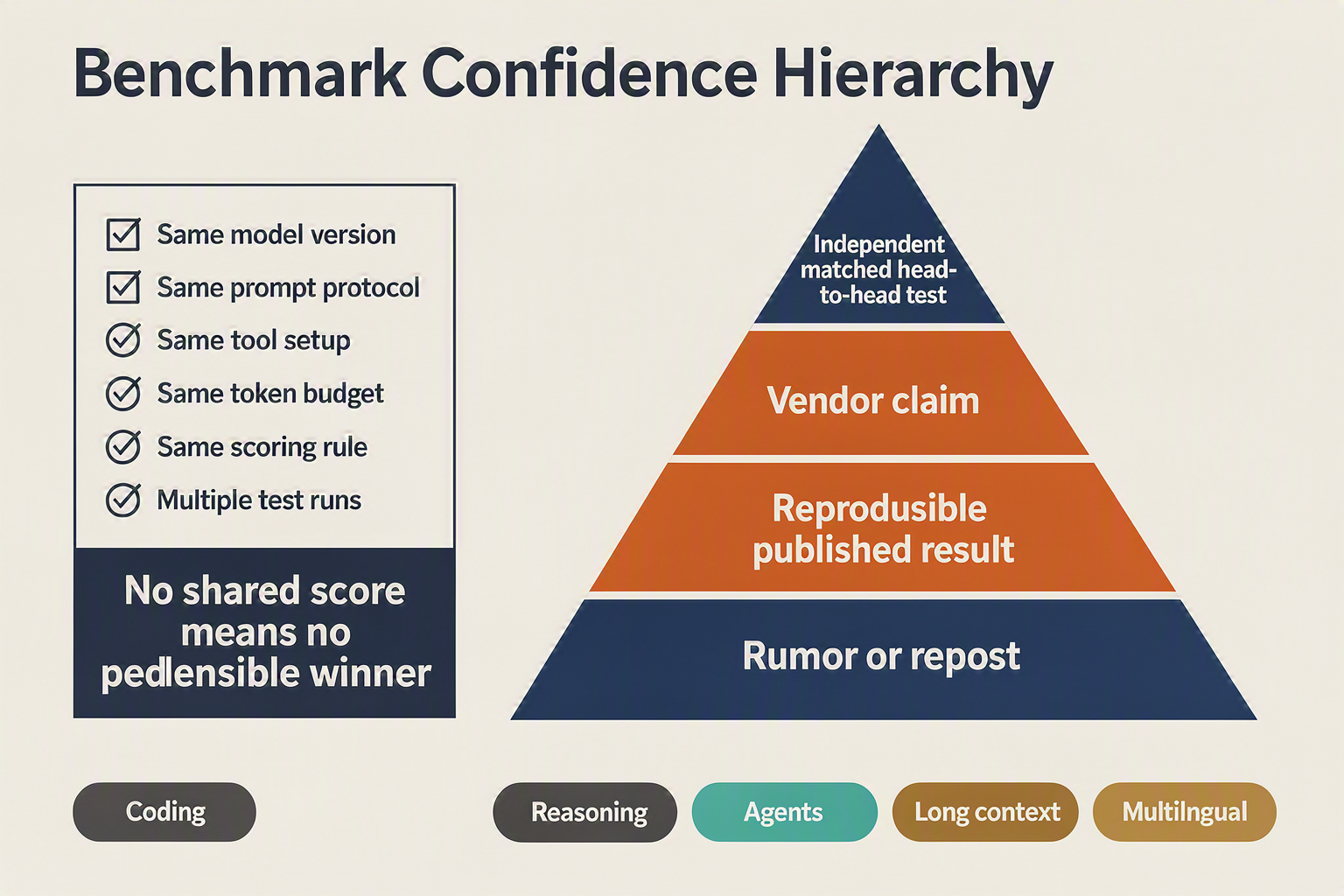
No—published evidence does not support a fair Claude Opus 5 vs Qwen3.8-Max ranking as of July 24, 2026. Claude Opus 5 has no official benchmarks, while this review located no primary benchmark table for the Qwen3.8-Max preview. Any winner claim would therefore rely on incomplete or noncomparable evidence.
Why no defensible leaderboard exists yet
Neither model has the verified, like-for-like results needed for a reliable ranking. In particular:
- Results from earlier Claude models cannot be presented as Claude Opus 5 scores.
- Results from other Qwen variants cannot be assumed to represent Qwen3.8-Max.
- Third-party screenshots, selected prompts, and anecdotal tests may illustrate behavior but do not establish overall superiority.
- Scores produced with different prompts, tools, reasoning settings, or endpoint versions are not directly comparable.
Without primary benchmark documentation and reproducible side-by-side testing, reported scores or rankings should not be attributed to this matchup.
What a fair comparison would require
A future evaluation should publish and control:
- Exact endpoint: Record the complete model or API identifier so readers know which version was tested.
- Test date: Preview endpoints may change, making the evaluation date essential.
- Prompt set: Give both models the same prompts and publish the complete test set where possible.
- Reasoning budget: Match reasoning effort, token limits, and related inference settings.
- Tools: Provide equivalent browsing, code execution, retrieval, and tool schemas.
- Context: Use the same system instructions, supplied documents, conversation history, and context limits.
- Retries: Disclose retry rules, sample counts, failure handling, and whether the reported score is based on first attempts or selected runs.
- Cost: Report input, output, reasoning, and tool costs using the prices applicable on the test date.
- Independent reproducibility: Document scoring rules and execution environments so unaffiliated researchers can repeat the evaluation.
Latency, error rates, contamination controls, and multilingual coverage should also be reported when relevant. Agent evaluations require multiple runs because browser state, network conditions, tool failures, and evaluator choices can introduce substantial variance.
The responsible verdict
The matchup should remain unranked due to insufficient comparable evidence. Experimental tests may still be useful, but they should be labeled with the exact endpoint, date, prompts, settings, tools, and limitations. A defensible ranking requires official benchmark information and independently reproducible, controlled testing of both models.
How could availability, openness, and deployment options affect teams and the AI market?

Availability may matter more than theoretical capability: Qwen3.8-Max can be evaluated through limited preview channels, while Claude Opus 5 remains unconfirmed as of July 24, 2026. However, preview access does not make Qwen3.8-Max open-weight, self-hostable, or production-ready; teams still need licensing, pricing, and deployment documentation.
Available does not mean open
Qwen3.8-Max currently occupies an important middle ground: more accessible than an unreleased model, but less open than a downloadable model with published weights and a clear licence. MarkTechPost reported on July 19, 2026, that Alibaba had not published Qwen3.8-Max’s weights, licensing terms, official benchmarks, or active-parameter count.
This distinction prevents three concepts from being conflated:
- Preview availability: Selected users can test a hosted model through designated products.
- API availability: Developers receive a documented endpoint, quotas, service terms, and predictable billing.
- Open-weight availability: Teams can download model weights and run or fine-tune them on their own infrastructure.
The broader Qwen family includes openly released models, but that history does not establish Qwen3.8-Max’s status. Until Alibaba or the Qwen team publishes an official licence and weight repository, Qwen3.8-Max should not be described as open-weight.
Likewise, Anthropic has not provided a confirmed release package for Claude Opus 5. Its API access, supported regions, cloud distribution, pricing, context limits, and deployment terms therefore cannot be treated as established.
Self-hosting would be an infrastructure-scale decision
The reported parameter count highlights why openness alone would not guarantee practical deployment. MarkTechPost reported on July 19, 2026, that Qwen3.8-Max has 2.4 trillion total parameters; Moonshot AI’s Kimi K3—not Qwen3.8-Max—is the model reported at 2.8 trillion parameters.
Storing 2.4 trillion parameters would require approximately:
- 4.8 TB at 16-bit precision
- 2.4 TB at 8-bit precision
- 1.2 TB at 4-bit precision
Those figures cover raw parameter storage only, excluding runtime memory, caches, routing, redundancy, and networking. Qwen3.8-Max is reported to use a sparse Mixture-of-Experts design, but without its active-parameter count or serving specifications, teams cannot reliably estimate latency, accelerator requirements, or inference cost.
How teams should plan deployment
A defensible adoption process is:
- Use preview access for evaluation, not business-critical workloads.
- Wait for official model cards, licences, API terms, and data-governance documentation before production approval.
- Design a provider-neutral application layer so an unreleased or repriced model can be substituted without rewriting the product.
- Benchmark complete workflows, including latency, tool use, regional-language quality, reliability, and cost—not merely headline parameter counts.
CometAPI reported on July 20, 2026, that Alibaba had not published standard per-million-token pricing for Qwen3.8-Max, making production cost forecasting premature.
The wider market effect
If Alibaba later releases weights or broadly priced API access, Qwen3.8-Max could intensify competition around deployment flexibility, sovereignty, multilingual systems, and frontier-model economics. A hosted-only Claude Opus 5 would instead emphasize managed reliability and ecosystem integration—but that remains hypothetical until Anthropic announces it.
Multi-model infrastructure can reduce this uncertainty. CallMissed’s OpenAI-compatible gateway, for example, reflects the market shift toward accessing multiple model providers through one integration with same-tier fallbacks, rather than binding an application permanently to one flagship model.
What do primary sources and expert assessments actually say?
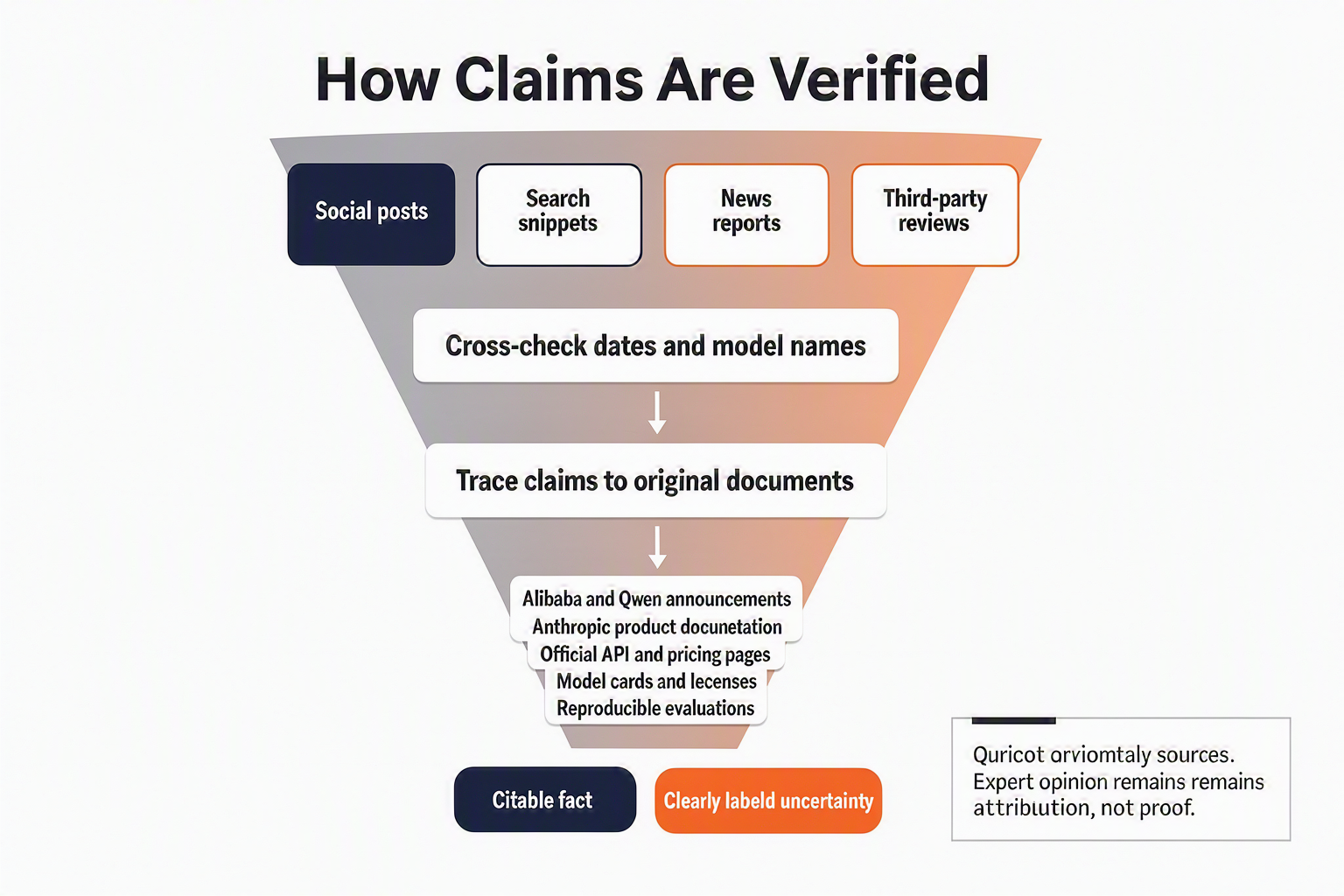
The supplied evidence supports only a cautious conclusion: Qwen3.8-Max is described by multiple secondary sources as a 2.4-trillion-parameter multimodal preview, while Claude Opus 5 remains unconfirmed as of July 24, 2026. No primary Alibaba/Qwen model card or technical report was available in the supplied research, so preview access, architecture, benchmarks, and licensing cannot be treated as primary-source-verified facts.
What evidence is actually available?
Every Qwen3.8-Max source supplied for this comparison is secondary reporting. The research contains no Alibaba Cloud API documentation, Qwen model card, repository, technical paper, benchmark log, pricing page, or license text for the model.
The secondary evidence indicates:
- MarkTechPost reported on July 19, 2026, that Qwen3.8-Max was previewed as a 2.4-trillion-parameter multimodal model without benchmarks, licensing terms, or an active-parameter count.
- Coursiv reported on July 19, 2026, that Qwen3.8-Max-Preview was available through Token Plan, Qoder, and QoderWork. This is a reported access claim, not confirmation from primary Alibaba/Qwen documentation in the supplied evidence.
- CometAPI reported on July 20, 2026, that Alibaba had not published standard per-million-token input and output pricing for Qwen3.8-Max.
- eesel.ai characterized Qwen3.8-Max as a sparse Mixture-of-Experts model, but the supplied material does not include a dated Alibaba/Qwen architecture disclosure confirming that characterization.
The scale figures must not be conflated: Qwen3.8-Max is reported at 2.4 trillion total parameters, whereas Moonshot AI’s Kimi K3 is reported at 2.8 trillion. Neither figure reveals active parameters per token, inference compute, data quality, post-training methods, or real-world accuracy.
For Claude Opus 5, the supplied research contains no Anthropic announcement, model card, system card, API reference, pricing page, or benchmark publication. Claude Opus 5 and the rumored “Honeycomb” codename therefore remain explicitly unconfirmed as of July 24, 2026.
How expert assessments should be weighted
A defensible evidence hierarchy is:
- Vendor model cards, technical reports, API references, and license files
- Reproducible benchmark artifacts identifying model versions, prompts, settings, tools, and graders
- Independent technical reporting with clear attribution
- Social posts, screenshots, and anecdotal tests used only as leads
Early reviews cannot establish that either model wins coding, reasoning, agentic, multilingual, or long-context tasks. Meaningful testing must disclose the exact model identifier, test date, context length, system prompt, sampling settings, tool permissions, inference budget, repeated-trial pass rate, and grading procedure.
Sources
- MarkTechPost — July 19, 2026: Reports a 2.4T multimodal Qwen3.8-Max preview and notes the absence of benchmarks, licensing details, and an active-parameter count.
https://www.marktechpost.com/2026/07/19/alibaba-previews-qwen3-8-max-a-2-4-trillion-parameter-multimodal-model-days-after-moonshots-kimi-k3-open-weight-launch/
- Coursiv — July 19, 2026: Reports Qwen3.8-Max-Preview access through Token Plan, Qoder, and QoderWork.
https://coursiv.io/blog/qwen-3-8
- CometAPI — July 20, 2026: Reports that standard per-million-token pricing had not been published.
https://www.cometapi.com/qwen3-8-max-preview-api-access/
- eesel.ai — date not specified in the supplied evidence: Provides a secondary sparse-MoE characterization.
https://www.eesel.ai/blog/qwen38-max-review
Should you use Qwen3.8-Max now, test alternatives, or wait for Claude Opus 5?
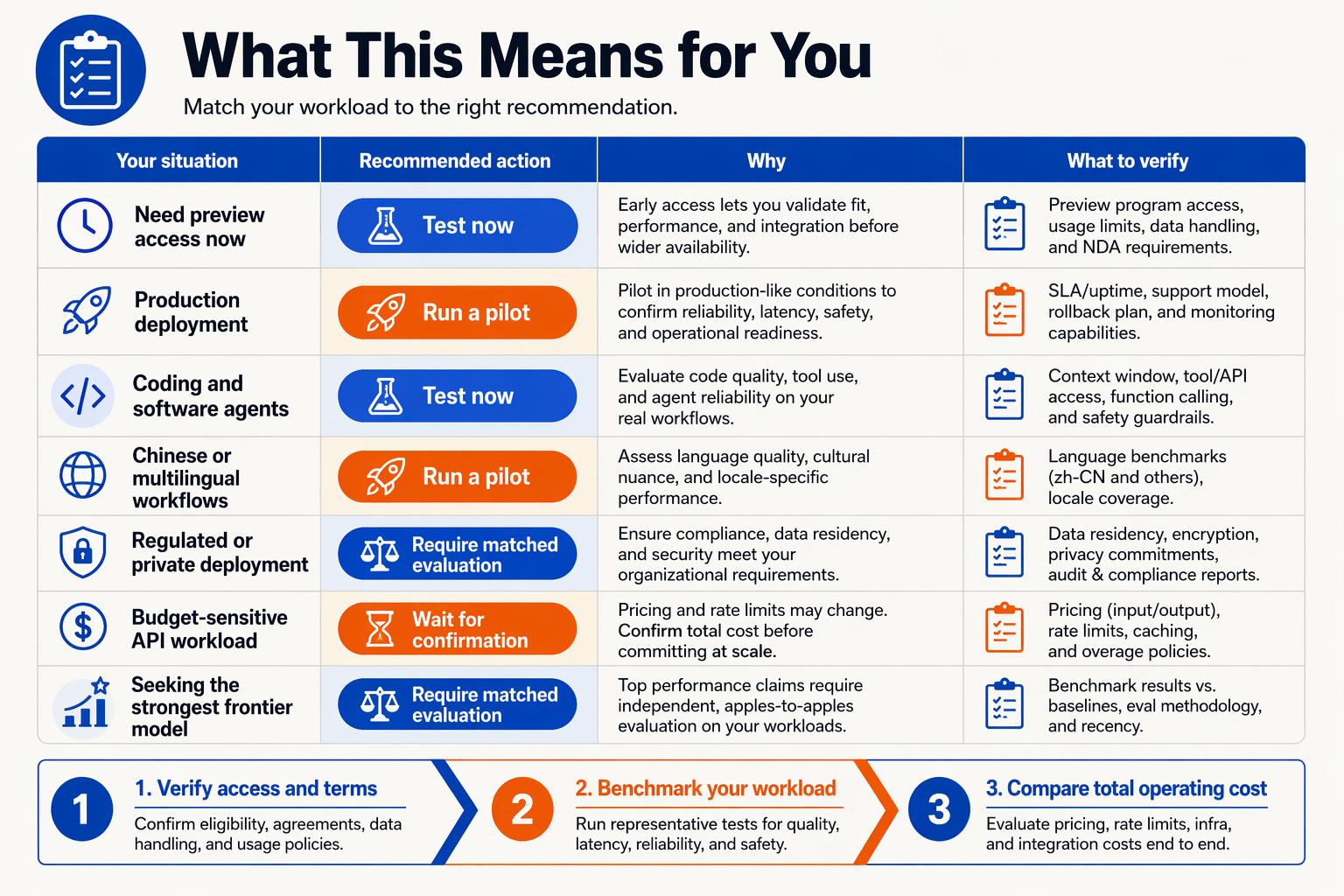
Use Qwen3.8-Max-Preview now only for controlled evaluation, test established alternatives for production, and wait for Anthropic’s official Claude Opus 5 release before making a direct purchase decision. As of July 24, 2026, neither model has enough public evidence to justify a high-stakes migration based on performance claims alone.
Decision matrix
| Your situation | Recommended action | Why | Evidence needed next |
|---|---|---|---|
| Research or prototyping | Test Qwen3.8-Max now | Preview access has been reported through Token Plan, Qoder, and QoderWork | Confirm availability and terms in Alibaba/Qwen’s official console |
| Production launch within weeks | Test available production models | Qwen3.8-Max pricing, licensing, and service guarantees remain unclear | Published API rates, SLA, data policy, and stable model ID |
| Existing Anthropic deployment | Wait for Claude Opus 5 documentation | Replacing a working model with an unconfirmed release creates unnecessary risk | Anthropic model card, API docs, pricing, context limits, and safety report |
| Coding or agent evaluation | Run a private bake-off | Informal demos cannot predict repository-level or tool-use reliability | Identical prompts, tools, retry rules, and human scoring |
| Regulated or sensitive workload | Wait or use a documented alternative | Preview status complicates governance, retention, and audit review | Deployment region, retention controls, compliance terms, and incident process |
| Multilingual application | Test real language traffic | Aggregate multilingual claims may hide language- and dialect-specific gaps | Per-language accuracy, latency, safety, and human preference results |
What would justify using Qwen3.8-Max now?
Qwen3.8-Max is the actionable candidate when a team can tolerate preview-stage uncertainty and wants to investigate Alibaba’s newest reported flagship. MarkTechPost reported on July 19, 2026, that Qwen3.8-Max has 2.4 trillion total parameters but no published active-parameter count, official benchmark suite, or licensing terms.
That reported 2.4-trillion scale belongs to Qwen3.8-Max, not Moonshot AI’s Kimi K3, which has been reported at 2.8 trillion parameters. Neither total alone establishes quality, latency, memory requirements, or cost—particularly for a sparse Mixture-of-Experts model.
Before committing, verify:
- The model identifier and access route against an Alibaba Cloud or Qwen primary source.
- Whether preview prompts may be retained or used for service improvement.
- Rate limits, regional availability, uptime commitments, and version stability.
- Standard input, output, cached-token, multimodal, and tool-use charges.
CometAPI reported on July 20, 2026, that Alibaba had not published standard per-million-token pricing for Qwen3.8-Max. A production cost forecast is therefore premature.
When waiting for Claude Opus 5 is rational
Waiting makes sense if Anthropic compatibility, governance, or flagship reasoning quality is strategically important. However, Claude Opus 5 should remain a roadmap candidate—not a benchmarked product—until Anthropic publishes authoritative documentation. “Honeycomb” must not be treated as a confirmed codename, and expected capabilities must not be converted into specifications.
Set a time-boxed review rather than waiting indefinitely. Reassess when Anthropic publishes the model card and when Alibaba supplies complete Qwen3.8-Max pricing, licensing, context, benchmark, and deployment information.
For teams testing several available models meanwhile, CallMissed’s OpenAI-compatible gateway illustrates a practical multi-model strategy: keep the application interface stable while evaluating providers with the same workload. The final choice should follow measured task success, p95 latency, human preference, safety failures, and cost per completed task, not parameter count or launch-day claims.
Frequently asked questions about Claude Opus 5 vs Qwen3.8-Max
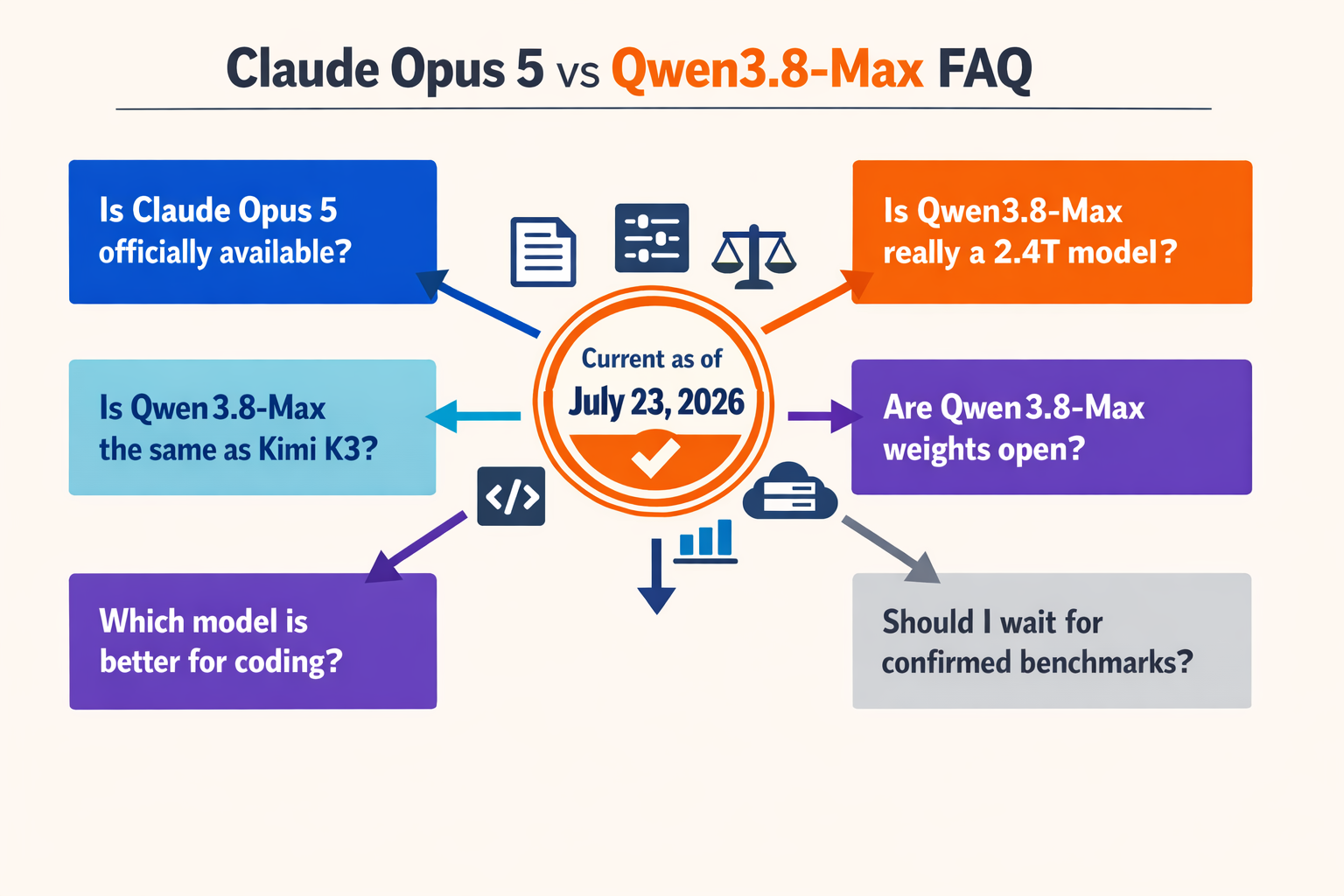
Availability and model identity
Which model wins the Claude Opus 5 vs Qwen3.8-Max comparison as of July 24, 2026?
Has Anthropic officially released Claude Opus 5 or confirmed the Honeycomb codename?
Scale, architecture, and evidence
Does Qwen3.8-Max have 2.4 trillion parameters or 2.8 trillion parameters?
Are there trustworthy Claude Opus 5 vs Qwen3.8-Max benchmarks for coding and reasoning?
Cost and adoption decisions
What are the API price, context window, output limit, and license for Qwen3.8-Max?
Should developers use Qwen3.8-Max now or wait for Claude Opus 5?
Conclusion
As of July 24, 2026, the Claude Opus 5 vs Qwen3.8-Max comparison has no verified winner. Qwen3.8-Max is the more tangible model because preview access has been reported, while Anthropic has not publicly confirmed Claude Opus 5, its specifications, release date, benchmarks, or pricing.
Fact status
- Availability: Qwen3.8-Max has reportedly appeared in preview through Token Plan, Qoder, and QoderWork. Claude Opus 5 remains unverified and has no confirmed public access path.
- Parameters: MarkTechPost reported on July 19, 2026, that Qwen3.8-Max has 2.4 trillion total parameters. Alibaba has not disclosed an active-parameter count or evidence that scale translates into better performance. The reported 2.8T figure belongs to Moonshot AI’s separate Kimi K3, not Qwen3.8-Max.
- Licensing and pricing: Public commercial-use terms, API pricing, rate limits, and deployment conditions remain unclear.
- Coding and benchmarks: No sufficiently documented, reproducible evaluations establish a coding or general-performance advantage for either model.
- Production readiness: Context limits, latency, uptime, safety documentation, data-handling policies, and enterprise support still require verification.
Buyer checklist for Claude Opus 5 vs Qwen3.8-Max
- Confirm generally available API or platform access—not preview access alone.
- Review the official model card, parameter architecture, context window, and licensing terms.
- Test coding quality on private repositories and realistic agent workflows.
- Compare total costs, including token pricing, caching, tools, retries, and hosting.
- Require reproducible benchmarks, latency measurements, reliability data, and safety documentation.
Until those details are published, Claude Opus 5 vs Qwen3.8-Max should be treated as a developing comparison rather than a purchasing verdict.
To explore multi-model AI communication infrastructure, visit CallMissed, which supports voice agents, multilingual chatbots, and OpenAI-compatible model access. The production winner will be determined not by trillion-parameter claims alone, but by transparent evidence, dependable access, and measurable value.
Related Reading
- Claude Opus 5 vs Kimi K3 vs Qwen3.8-Max: July 2026 Comparison
- Claude Opus 4.8 vs Qwen3.8-Max: July 2026 Comparison
- Claude Opus 5 vs Kimi K3: Leaks vs Verified Facts (July 2026)