Qwen3.8-Max Release: What We Know About Alibaba’s Reported 2.4T Model



Get a sourced Qwen3.8-Max release update, separating confirmed access details from the reported 2.4T parameter claim and open-weight unknowns.
Qwen3.8-Max Release: What We Know About Alibaba’s Reported 2.4T Model
Qwen3.8-Max is reportedly a 2.4-trillion-parameter Alibaba model now in preview—but the headline number is not yet a complete specification. As of July 20, 2026, the clearest public signal is that Qwen3.8-Max-Preview is being tested through Alibaba Cloud and Qwen Chat; however, key details—including whether 2.4 trillion refers to total or active parameters, the architecture, final benchmark results, pricing, and a general release date—remain unconfirmed in the material currently available.
That distinction matters. A 2.4T-parameter claim would place Qwen3.8-Max among the largest publicly discussed foundation models, but parameter count alone does not tell developers whether a model will be reliable at coding, agentic tool use, multilingual support, long-context reasoning, or production cost. A model may use a mixture-of-experts design, where only part of its total parameter base is activated for each token; without an official technical report, it would be premature to assume how Qwen3.8-Max works internally.
What is publicly reported is still notable. TestingCatalog stated that “Qwen3.8-Max-Preview is now available on Alibaba Cloud and Qwen Chat for testing,” describing it as a 2.4T-parameter model. Separately, Qoder’s launch material identifies Qwen3.8-Max-Preview as the latest Qwen-family foundation model and repeats the 2.4T-parameter figure. These are meaningful launch signals, but they should be treated as reports until Alibaba’s Qwen team publishes primary documentation with model-card details, evaluation methodology, access terms, and architecture disclosures.
The “Preview” label is equally important. Preview availability means interested teams can experiment, not that they should immediately make the model the backbone of a customer-facing workflow. Early versions can change behaviour, capability, rate limits, and API interfaces as providers iterate. A Reddit post citing Qwen messaging also says Qwen3.8 is expected to be released with open weights, but the scope, timing, licence, and whether that applies to the Max variant are not established by the available evidence.
This launch is bigger than one model name. It reflects a fast-moving shift toward AI infrastructure where businesses can evaluate multiple models for specific tasks instead of treating parameter size as a purchasing decision. For example, CallMissed’s OpenAI-compatible AI gateway gives developers a single integration point for multiple LLMs and AI services, making model testing and fallback strategies more practical than a one-provider commitment.
In this explainer, we separate confirmed facts from circulating claims, examine what a 2.4T model could—and cannot—signal, and outline the questions developers and businesses should ask before placing Qwen3.8-Max into production.
What is Qwen3.8-Max, and is Alibaba’s reported 2.4-trillion-parameter model actually available?

Qwen3.8-Max is a preview-stage Qwen-family model reported to contain 2.4 trillion parameters, but Alibaba has not yet published enough primary technical documentation to treat that number as a complete performance or deployment specification. As of July 20, 2026, the evidence supports test availability through Alibaba channels; it does not confirm the final architecture, active parameter count, benchmark methodology, price, or general-release timeline.
What is confirmed, reported, and still unknown?
| Category | Current evidence | What it means for users |
|---|---|---|
| Preview access | TestingCatalog reported that “Qwen3.8-Max-Preview is now available on Alibaba Cloud and Qwen Chat for testing.” | Developers can evaluate the preview, but should not assume stable production behaviour. |
| Parameter count | TestingCatalog and Qoder both describe Qwen3.8-Max-Preview as a 2.4T-parameter model. | The figure is widely reported, but Alibaba has not supplied a full technical breakdown in the available research. |
| Model status | Qoder calls Qwen3.8-Max-Preview the latest Qwen-family foundation model. | “Preview” signals an iterating release rather than a final, fixed product specification. |
| Open weights | A Reddit post reproducing Qwen-related messaging says Qwen3.8 is expected to be released with open weights. | This does not verify that the Max variant, its licence terms, or a release date are confirmed. |
Is Qwen3.8-Max actually available?
Qwen3.8-Max-Preview appears to be available for testing, rather than broadly released as a finalized model. TestingCatalog specifically identified Alibaba Cloud and Qwen Chat as access points, while Qoder’s launch material describes a promotional preview rollout.
That distinction matters. Preview models may change their:
- API behaviour and rate limits
- safety policies and tool-use reliability
- model version, output quality, and supported features
- commercial pricing and availability terms
A third-party listing discussed on Hacker News also shows a 1,048,576-token context limit and 65,536-token output limit for qwen3.8-max-preview. However, without an Alibaba or Qwen model card in the supplied material, those limits should be treated as unverified listing data, not final product commitments.
Does 2.4 trillion parameters mean 2.4 trillion active parameters?
No—reported parameter count alone does not reveal how much compute Qwen3.8-Max uses per generated token. The crucial missing detail is whether the reported 2.4T figure describes all stored model weights or the subset activated during inference.
This distinction is especially relevant for mixture-of-experts (MoE) models:
- Total parameters are all learned weights in the full model.
- Active parameters are the weights selected for a particular token or request.
- An MoE system can have trillions of total parameters while activating a substantially smaller expert subset at runtime.
No supplied official documentation confirms that Qwen3.8-Max uses MoE, identifies active parameters, or explains its training data, modalities, evaluation protocol, or inference efficiency. It would be inaccurate to infer any of those characteristics from the 2.4T claim.
What should teams do now?
Treat Qwen3.8-Max-Preview as an evaluation candidate, not a procurement decision based on scale. Test representative workloads—including coding tasks, retrieval-grounded answers, tool calling, regional-language prompts, latency, failure recovery, and cost per successful task—against existing fallback options.
The defensible conclusion is straightforward: Qwen3.8-Max is publicly previewed and consistently reported as a 2.4-trillion-parameter Qwen model, but its final technical and commercial specifications remain unverified.
How does Qwen3.8-Max fit into the Qwen new model timeline from Qwen3-Max to Qwen3.7-Max?
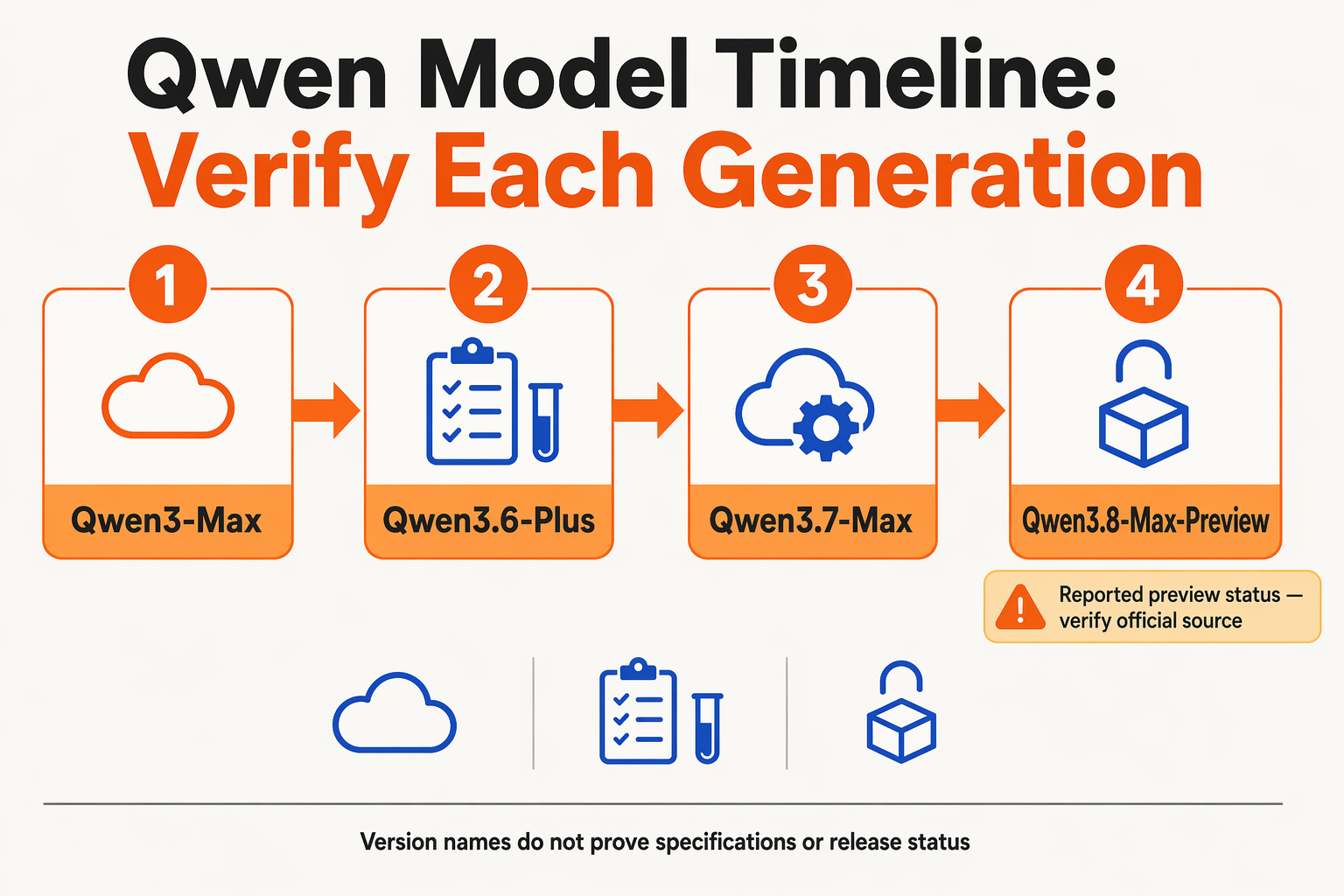
Available evidence places Qwen3.8-Max-Preview after Qwen3.7-Max in Alibaba’s flagship Qwen “Max” line, but it does not establish a fully documented release chronology for every Qwen3-Max iteration. Qoder’s launch material identifies Qwen3.8-Max-Preview as the latest Qwen-family foundation model and calls Qwen3.7-Max the previous flagship.
The best-supported Qwen Max sequence
The most defensible working sequence is Qwen3-Max → Qwen3.7-Max → Qwen3.8-Max-Preview. However, this is partly a naming-based sequence rather than a complete, officially dated product history.
- Qwen3-Max established the “Max” flagship tier.
In the Qwen naming system, Max signals a large, frontier-oriented model tier. It should not be read as proof of a fixed parameter count, architecture, context window, or performance level across versions.
- Qwen3.7-Max is the documented immediate predecessor.
Qoder’s Qwen3.8-Max-Preview launch page explicitly describes Qwen3.7-Max as the previous flagship. That makes Qwen3.7-Max the clearest confirmed predecessor in the currently available launch narrative.
- Qwen3.8-Max-Preview is the latest preview-stage entry.
TestingCatalog reported that “Qwen3.8-Max-Preview is now available on Alibaba Cloud and Qwen Chat for testing” and described it as a 2.4-trillion-parameter model. Qoder separately calls Qwen3.8-Max-Preview the latest Qwen-family foundation model and repeats the 2.4T figure.
What the version change confirms—and what it does not
The shift from Qwen3.7-Max to Qwen3.8-Max-Preview confirms that the Qwen Max line is continuing to evolve. It does not, by itself, establish why the model is different or whether it will outperform its predecessor on a particular workload.
Several important questions remain unresolved in the supplied launch information:
- Whether 2.4 trillion parameters means total parameters, active parameters per token, or another measurement.
- Whether Qwen3.8-Max uses a mixture-of-experts (MoE) design.
- Its independently reproducible performance on coding, reasoning, tool use, multilingual tasks, long-context retrieval, and safety.
- Its production pricing, rate limits, API stability, and general-availability date.
- Whether an anticipated open-weight Qwen3.8 release will include the Max model, and under what licence.
A Reddit post reproducing purported Qwen messaging says Qwen3.8 is expected to be released with open weights and that the preview will be “continuously iterated and upgraded.” That is useful context, but it is not sufficient confirmation of an open-weight release for Qwen3.8-Max.
What developers should do with a preview model
Qwen3.8-Max-Preview should be evaluated as a changing preview, not assumed to be a drop-in production upgrade from Qwen3.7-Max. A larger reported parameter count does not reliably predict lower latency, better tool calling, stronger regional-language output, or lower operating cost.
Run a controlled comparison using the same prompts, settings, tool schemas, and success criteria across candidate models. Track:
- Task completion rate on real business workflows
- Structured-output and tool-call validity
- Latency, token consumption, and failure rates
- Multilingual quality, including the languages customers actually use
- Regression behavior after preview-model updates
Teams should also retain a documented fallback model and route a small share of traffic first. This approach limits exposure if preview access, output behavior, or service limits change before the Qwen3.8 Max release reaches general availability.
Which Qwen3.8-Max facts are confirmed, reported, or still unknown?
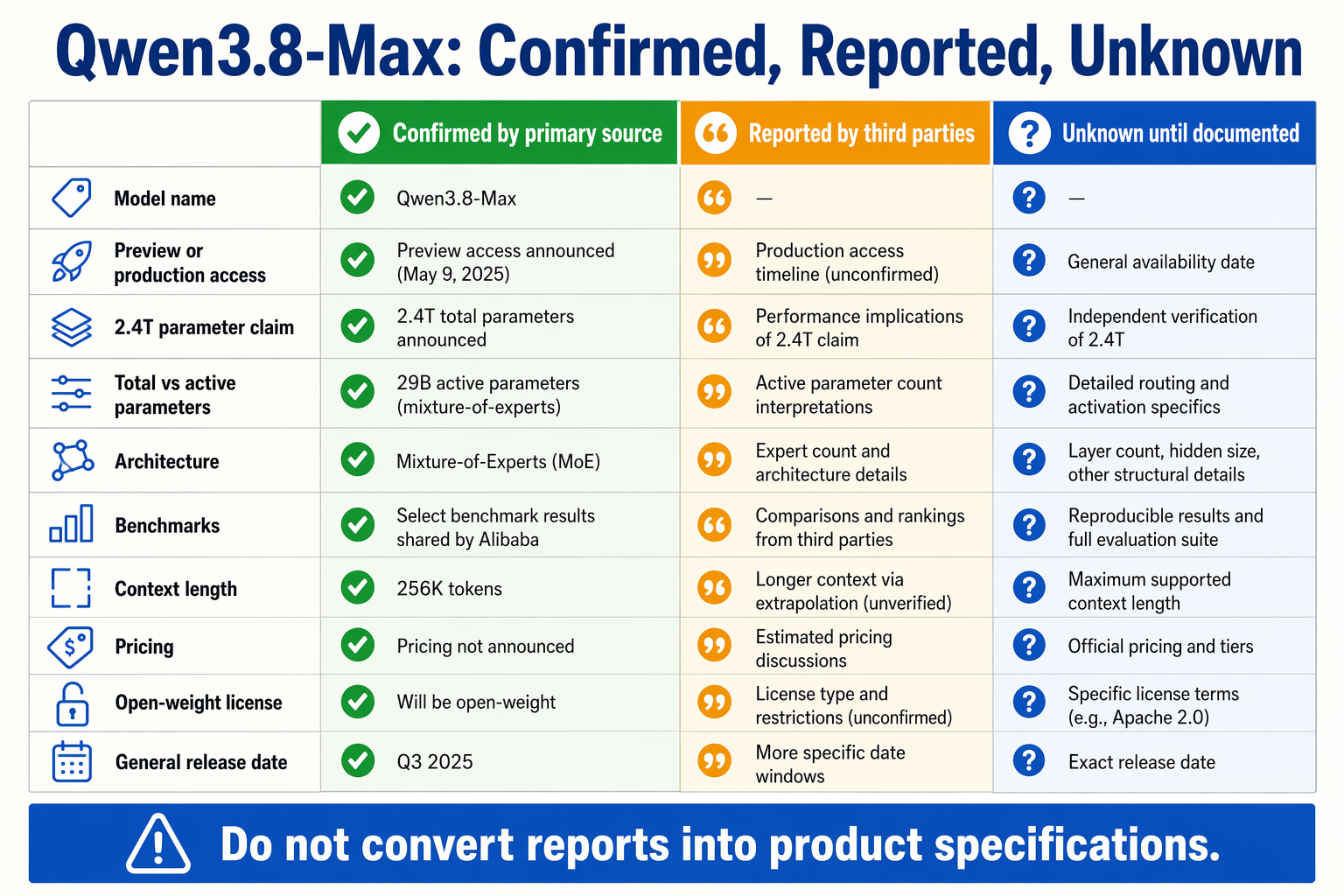
The reliable takeaway is narrow: Qwen3.8-Max-Preview appears to be available for early testing, while its headline 2.4-trillion-parameter size is publicly reported but not yet explained in an official technical report. Alibaba’s Qwen team has not, in the materials available for this explainer as of July 20, 2026, published the architectural, evaluation, commercial, or release details needed to turn preview claims into production assumptions.
Qwen3.8-Max fact-check table
| Topic | Status | What the available evidence says | What remains unknown |
|---|---|---|---|
| Model name | Confirmed in launch materials | Qoder’s launch page calls Qwen3.8-Max-Preview the latest foundation model in the Qwen family. | Whether “Max” denotes a permanent flagship tier, a preview-only label, or a specific architecture. |
| Preview availability | Reported and corroborated | TestingCatalog stated that “Qwen3.8-Max-Preview is now available on Alibaba Cloud and Qwen Chat for testing.” Qwen messaging reposted on Reddit also describes the model as being in preview. | Exact regional availability, account requirements, rate limits, API endpoints, and service-level commitments. |
| 2.4T parameter count | Reported, not fully specified | TestingCatalog describes Qwen3.8-Max-Preview as a “2.4T-parameter model,” and Qoder repeats the 2.4T figure. | Whether 2.4 trillion means total parameters, active parameters per token, or another measurement convention. |
| Architecture | Unknown | No primary technical documentation in the supplied material identifies Qwen3.8-Max as dense, mixture-of-experts (MoE), multimodal, or another design. | Expert count, routing method, active compute, training data, training compute, and inference hardware requirements. |
| Benchmarks and quality | Unknown | Third-party hands-on reports and comparisons are emerging, but they are not substitute for reproducible provider evaluations. | Official scores, test sets, methodology, safety evaluations, coding reliability, tool-use performance, and multilingual results. |
| Open-weight release | Anticipated, not established | A Reddit post citing Qwen messaging says Qwen3.8 is about to be released with open weights. | Release date, licence, model sizes, downloadable checkpoints, and whether open weights would include the Max variant. |
| Production pricing and terms | Unknown | Qoder’s page is promotional launch material rather than a complete pricing specification. | Token pricing, preview discounts, quotas, data-retention policy, commercial terms, and final general-availability pricing. |
How to interpret the 2.4T claim
A parameter count is a capacity indicator, not a quality score. If Qwen3.8-Max uses an MoE architecture, it could contain 2.4 trillion total parameters while activating only a fraction for each token. Conversely, a dense 2.4T model would have very different latency, serving-cost, and infrastructure implications. Neither interpretation should be assumed without Alibaba’s documentation.
Developers should therefore treat the preview as an evaluation candidate, not a final specification. A practical validation plan should include:
- Test representative tasks such as code generation, retrieval-grounded answers, structured output, and tool calling.
- Measure operational behaviour: latency, failure rate, context handling, and consistency across repeated prompts.
- Check commercial readiness before customer deployment, including quotas, data handling, pricing, and fallback options.
- Separate provider claims from independently repeatable results, especially for benchmark comparisons.
For now, the defensible description is: Qwen3.8-Max-Preview is an early-access Qwen model reported at 2.4 trillion parameters, with major technical and commercial details still undisclosed.
Does “Qwen 2.4 trillion parameters” mean total parameters or active parameters?
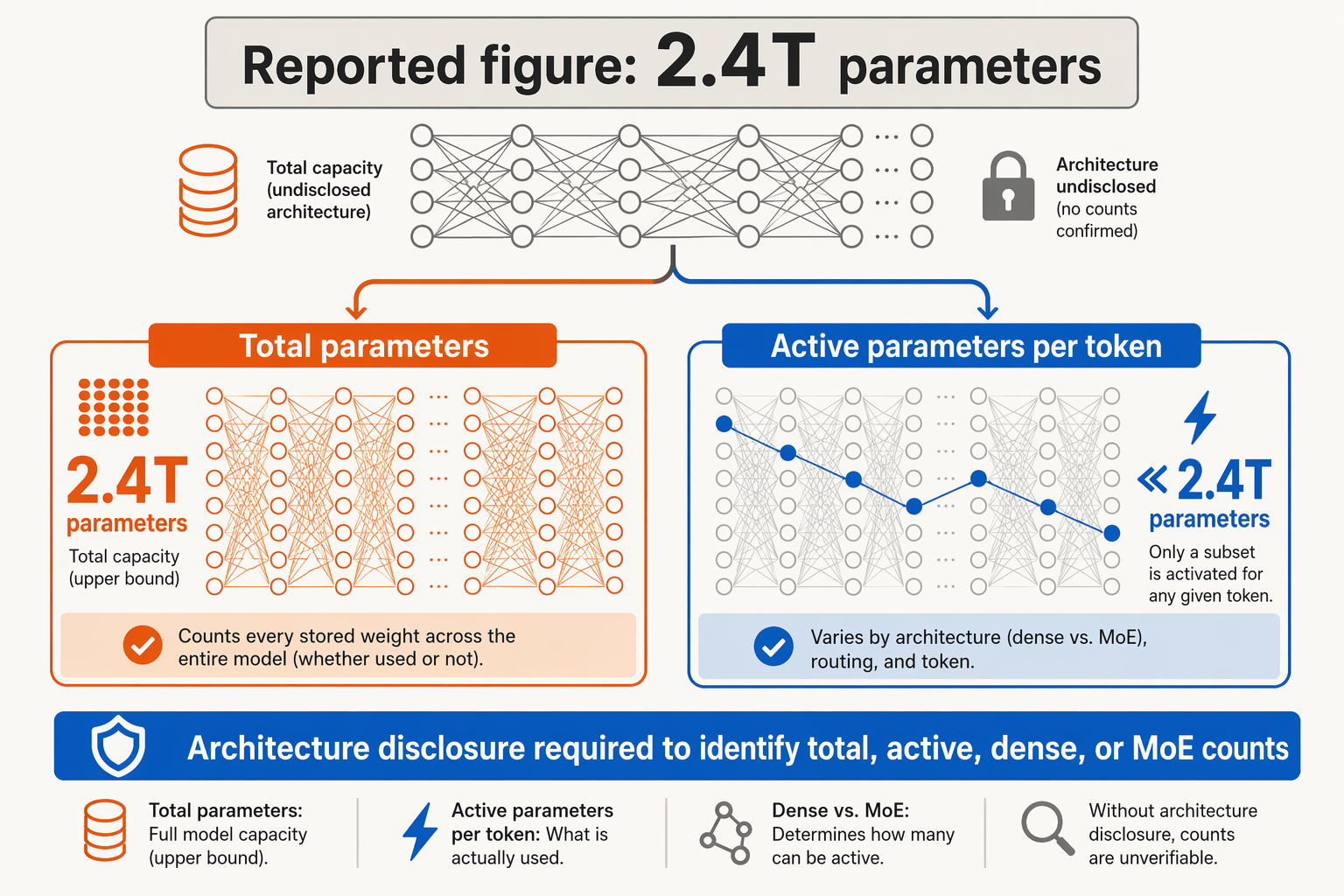
No available launch source establishes whether Qwen3.8-Max’s reported 2.4 trillion parameters are total parameters or active parameters per token. Developers should treat “2.4T parameters” as an unqualified reported model-size figure, not evidence that 2.4 trillion weights are used during every inference.
Total parameters and active parameters are not the same metric
A model’s total parameter count is the full number of learned weights stored in its architecture. An active parameter count is the portion of those weights actually used to generate a token or process an input.
The difference matters most for Mixture-of-Experts (MoE) architectures:
- A dense transformer generally uses nearly all of its parameters in every forward pass.
- An MoE model contains multiple specialist subnetworks, called experts, and a router selects only some experts for each token.
- As a result, an MoE model can have very large total capacity while using substantially less compute per token than a dense model with the same headline parameter count.
For example, “2.4T total parameters” and “2.4T active parameters” would imply dramatically different infrastructure, latency, and cost characteristics. The former could describe a sparsely activated MoE system; the latter would suggest an exceptionally compute-intensive dense or near-dense inference path. Neither interpretation is confirmed for Qwen3.8-Max-Preview in the supplied launch reporting.
What is reported—and what remains unknown
TestingCatalog reported that “Qwen3.8-Max-Preview is now available on Alibaba Cloud and Qwen Chat for testing” and described it as a “massive 2.4T-parameter model.” Qoder’s Qwen3.8-Max-Preview launch material likewise describes the model as the latest Qwen-family foundation model with 2.4T parameters.
Those reports support the following limited conclusion: a Qwen3.8-Max preview with a 2.4-trillion-parameter headline figure is being presented for testing. They do not establish the architectural meaning of that number.
Key unanswered questions include:
- Does 2.4T represent total stored parameters, active parameters, or another counting convention?
- Is Qwen3.8-Max a dense model, an MoE model, or a hybrid design?
- If it uses MoE, how many experts are available and how many are routed per token?
- What are the verified context window, API rate limits, latency characteristics, and pricing terms?
- Will the preview configuration match any later production or open-weight release?
Qoder’s material identifies the release as a preview, while the Qwen community post surfaced in the supplied context says the preview’s capabilities will be “continuously iterated and upgraded.” That makes performance observations useful but provisional: a preview endpoint can change without preserving identical behavior, limits, or economics.
Why parameter count should not decide adoption
Parameter count is a capacity indicator, not a direct benchmark for quality, speed, reliability, or cost. A smaller model may be more effective for a specific workflow because of better training data, post-training, multilingual performance, tool calling, retrieval integration, or instruction following.
Before moving a preview model into production, teams should request or verify:
- A model card that distinguishes total and active parameters.
- Architecture documentation covering dense, MoE, or hybrid routing.
- Reproducible benchmark results with tasks, prompts, versions, and methodology.
- Operational details covering pricing, rate limits, context limits, data handling, and preview-change policies.
- Task-specific evaluations using the organisation’s own support, coding, extraction, or agentic workflows.
The practical approach is provider-neutral: test Qwen3.8-Max-Preview alongside alternatives on representative workloads, measure quality and end-to-end cost, and keep application interfaces portable where possible. That reduces lock-in while Alibaba clarifies what the reported Qwen 2.4 trillion parameters figure means in architectural and operational terms.
Why can’t parameter count alone tell developers whether Qwen3.8-Max is better?
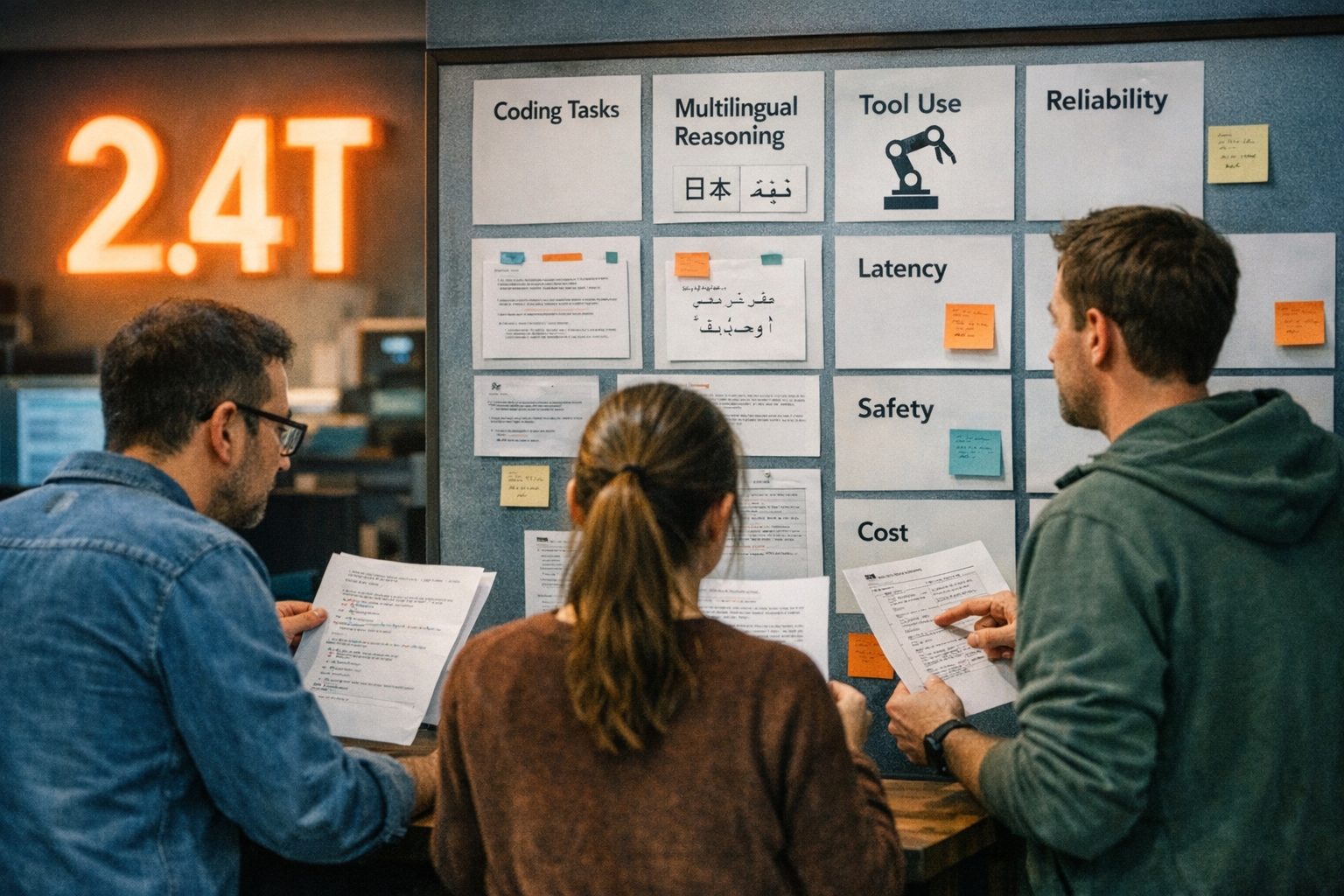
No—parameter count is an incomplete proxy for developer value. The reported 2.4 trillion parameters for Alibaba’s Qwen3.8-Max-Preview indicates potential scale, but it does not establish how capable, fast, affordable, reliable, or deployable the model will be for a particular workload.
Total parameters are not the same as active parameters
The central unanswered question is whether the reported figure represents total parameters or parameters activated per token. TestingCatalog described Qwen3.8-Max-Preview as a “massive 2.4T-parameter model” available for testing on Alibaba Cloud and Qwen Chat, while Qoder’s launch material also identifies the model as having 2.4T parameters. Neither source excerpt establishes its architecture or active-parameter count.
That distinction is consequential:
- Dense models generally use all parameters during each inference step.
- Mixture-of-experts (MoE) models contain many specialist subnetworks but route each token through only a subset of them.
- A 2.4T total-parameter MoE model may therefore have a substantially smaller active computation footprint than a similarly sized dense model—but that cannot be assumed for Qwen3.8-Max without Alibaba’s technical documentation.
Until Alibaba publishes a model card or technical report, developers should treat the 2.4T figure as a reported scale claim, not as a performance or cost specification.
What actually determines production quality?
A model’s usefulness depends on measurable outcomes, not a single headline number. Teams evaluating Qwen3.8-Max-Preview should compare it against alternatives on their own inputs across at least five dimensions:
- Task accuracy: Does the model produce correct code, extract fields accurately, follow policies, or answer customer questions grounded in supplied knowledge?
- Tool-use reliability: Can it choose the right function, generate valid arguments, recover from tool errors, and avoid taking unapproved actions?
- Latency and throughput: A stronger result is less useful in a live support or voice workflow if response times are inconsistent.
- Cost per successful task: Token price alone misses retries, long prompts, tool failures, and the human review needed to correct errors.
- Safety and multilingual performance: Businesses should test prompt injection resistance, refusal behaviour, regional-language comprehension, and dialect-specific output.
A third-party Substack evaluation by Trilogy AI reported sustained repository exploration and function-tool use with Qwen3.8-Max-Preview, but this should be read as an early, independent observation—not a controlled benchmark or an Alibaba-supported performance guarantee.
Benchmark claims need methodology
Even official benchmark scores require context: dataset version, prompt format, tool configuration, sampling settings, model version, and whether results were independently reproduced. For a preview release whose capabilities are said to be “continuously iterated and upgraded,” as Qwen messaging quoted in a Reddit post indicates, a result captured today may not describe the same endpoint later.
The practical rule is simple: evaluate a fixed model version on a representative test set before deployment. Include real tickets, code repositories, product catalogues, Indian-language messages, and edge cases—not just public multiple-choice benchmarks.
A better decision than betting on scale
For developers, the most resilient architecture is one that makes model comparison routine. Solutions such as CallMissed’s OpenAI-compatible AI gateway let teams test multiple LLMs through one integration and apply same-tier fallbacks, rather than redesigning an application around a parameter-count headline.
Qwen3.8-Max’s reported 2.4T scale is noteworthy. But until Alibaba confirms its architecture, active parameters, pricing, benchmarks, and final release terms, observed task performance and operational fit—not parameter count—should determine whether developers use it.
What could Qwen3.8-Max mean for Alibaba Cloud, developers, and enterprise AI adoption?
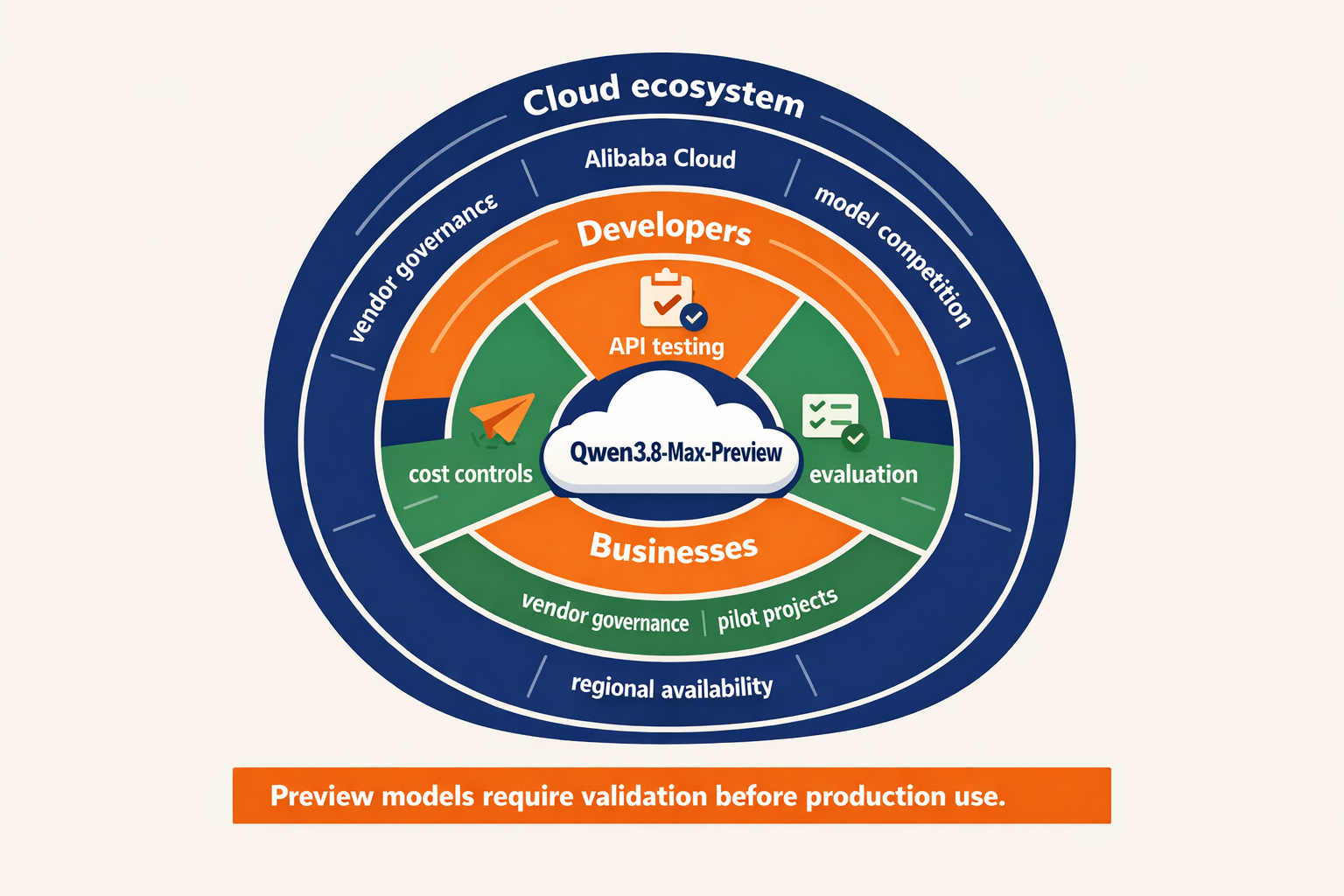
Qwen3.8-Max could strengthen Alibaba Cloud’s position as a venue for frontier-model experimentation, but its immediate value for developers and enterprises is optionality—not a reason to standardise on a preview model. The reported scale and cloud availability make it relevant to teams evaluating advanced reasoning, coding, and agent workflows, while the lack of an official technical report means production decisions should remain evidence-led.
For Alibaba Cloud: a platform and ecosystem signal
If Qwen3.8-Max-Preview performs well after broader testing, Alibaba Cloud could use it to attract workloads that would otherwise be evaluated across several model providers. TestingCatalog reported that “Qwen3.8-Max-Preview is now available on Alibaba Cloud and Qwen Chat for testing,” making the preview a practical product-distribution move as well as a model announcement.
The potential implications include:
- More AI workload consolidation: Enterprises already using Alibaba Cloud may prefer to test Qwen models close to their existing data, compute, identity, and application infrastructure.
- A stronger Qwen developer ecosystem: Qoder describes Qwen3.8-Max-Preview as the latest Qwen-family foundation model and reports the 2.4-trillion-parameter figure. That can generate developer interest even before independent evaluation establishes where the model is strongest.
- Pressure to publish operational detail: Serious adoption will depend on official information about reliability, safety controls, data handling, rate limits, service-level commitments, supported regions, and final commercial terms—not model scale alone.
For developers: test capabilities, portability, and cost
Developers should treat Qwen3.8-Max-Preview as a candidate in a structured evaluation set, rather than assume a reported 2.4T parameter count predicts application quality. The available material does not establish whether that number represents total parameters or active parameters, so it cannot be used to infer latency, inference cost, or real-world capability.
A useful preview evaluation should measure:
- Task success: Test the model on anonymised versions of real code, support, research, extraction, and tool-calling tasks.
- Consistency: Run repeated prompts and adversarial cases to identify hallucinations, formatting failures, and unsafe tool actions.
- Operational fit: Record response time, error rates, context handling, API stability, and rate-limit behaviour under realistic traffic.
- Economics: Separate temporary launch incentives from durable production pricing. Qoder’s launch page advertises a 90% off preview offer, but a promotional rate is not evidence of long-term total cost of ownership.
- Exit options: Keep prompts, tools, retrieval pipelines, and evaluation harnesses provider-neutral where possible.
Multi-model gateways can make this process less burdensome. For example, CallMissed’s OpenAI-compatible AI gateway lets developers test multiple LLMs and configure same-tier fallbacks through one integration, reducing the engineering cost of avoiding premature lock-in.
For enterprise AI adoption: more choice, not automatic readiness
For enterprises, the launch reinforces a broader shift: model selection is becoming a continuous procurement and engineering discipline. A large preview model may be especially worth exploring for high-value, human-reviewed workflows such as software assistance, document analysis, internal knowledge retrieval, and multilingual customer operations—but only after security and quality validation.
The key unanswered questions remain consequential:
- Will Alibaba or the Qwen team publish a model card, architecture details, and reproducible evaluations?
- What are the final API prices, throughput limits, and availability terms?
- Will Qwen3.8 be released with open weights, and if so, does that include Qwen3.8-Max under a usable licence?
- How does the model perform across languages, domains, and enterprise-specific tasks rather than headline benchmarks?
Until those answers arrive, Qwen3.8-Max is best understood as a significant preview signal from Alibaba’s Qwen ecosystem—not yet a fully specified production foundation model.
What should developers and businesses do while Qwen3.8-Max remains in preview?
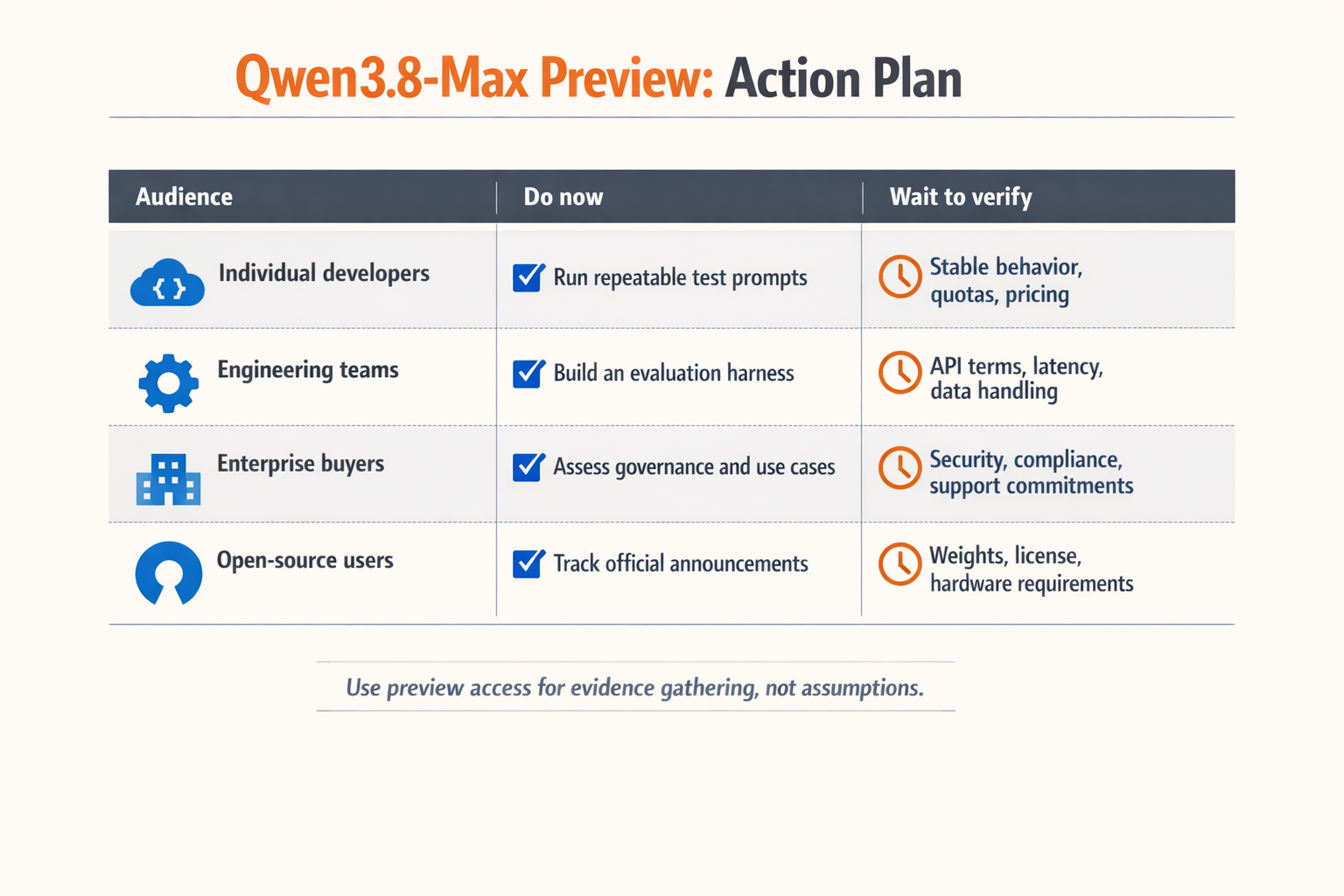
Treat Qwen3.8-Max-Preview as an evaluation candidate, not a production default, until Alibaba publishes primary documentation and the model clears your own workload, safety, latency, and cost tests. The reported 2.4-trillion-parameter scale is worth investigating, but it does not yet establish active-parameter count, architecture, benchmark reproducibility, pricing, or a Qwen3.8 Max release date.
A practical preview-stage action plan
| Priority | What teams should do now | Evidence to collect | Production gate |
|---|---|---|---|
| 1. Verify access | Confirm whether your Alibaba Cloud account can access Qwen3.8-Max-Preview and record API limits, regions, terms, and version identifiers. | TestingCatalog reported that the preview is available through Alibaba Cloud and Qwen Chat for testing. | Do not assume preview availability equals a stable SLA or long-term API compatibility. |
| 2. Build a task-specific eval | Test 50–200 representative prompts from real workflows: retrieval Q&A, coding, extraction, customer support, and tool calls. | Measure task success, factuality, format adherence, refusal quality, latency, and human-correction rate. | Promote only if it outperforms your current baseline at an acceptable total cost. |
| 3. Test multilingual behaviour | Include the languages your customers actually use, plus mixed-language, transliterated, and domain-specific inputs. | Record accuracy separately by language and user segment rather than averaging all results into one score. | Require consistent performance for each customer-facing language before deployment. |
| 4. Stress-test agent workflows | Run sandboxed tests for JSON generation, function selection, retries, long conversations, and prompt-injection resistance. | Keep traces of tool arguments, failure modes, recovery behaviour, and unsafe outputs. | Never grant unrestricted production actions based on a preview model’s first-pass tool output. |
| 5. Model cost uncertainty | Treat promotional or third-party pricing as provisional; model the cost per completed business task, not per token alone. | Qoder’s launch material describes Qwen3.8-Max-Preview as a 2.4T-parameter Qwen-family model, while final official pricing remains unclear in available materials. | Set spend caps, rate limits, and a fallback model before opening traffic. |
| 6. Plan portability | Put the model behind an internal abstraction layer so prompts, tools, logs, and evaluations can travel across providers. | Compare outputs against at least one established model using the same test set and rubric. | Avoid making a preview model a single point of failure for customer operations. |
What to wait for before making stronger claims
Teams should request or monitor for an Alibaba/Qwen model card that answers the questions the current launch reporting does not:
- Is 2.4 trillion parameters the total parameter count, or the number activated per token?
- Is Qwen3.8-Max a mixture-of-experts model, and what are its context-window and output limits?
- Which benchmarks, datasets, evaluation protocols, and safety tests support performance claims?
- What are the stable API terms, data-handling commitments, rate limits, and commercial prices?
- Will open weights arrive, and if so, which Qwen3.8 variants, licences, and dates are covered?
A Reddit post relaying Qwen messaging says Qwen3.8 is expected to be released with open weights, but the available evidence does not confirm the timing, licence, or whether that commitment includes the Max variant. Treat that as an anticipated development, not a procurement assumption.
Use preview access to improve your model strategy
The sensible near-term outcome is not “bet everything on 2.4T”; it is a better evaluation discipline. Keep an auditable prompt set, version every result, and route low-confidence or high-impact decisions to humans. For Indian businesses, test local-language voice and chat workflows end-to-end rather than evaluating English-only demos.
Infrastructure that preserves choice makes this easier. For example, CallMissed’s OpenAI-compatible AI gateway lets developers evaluate multiple LLMs through one integration and use same-tier fallbacks, while its business platform supports customer engagement across WhatsApp, voice, email, and web. That is the operational mindset Qwen3.8-Max-Preview should encourage: measure the model against the job, maintain fallbacks, and wait for primary documentation before treating reported scale as settled capability.
What are the most common questions about the Qwen3.8-Max release?
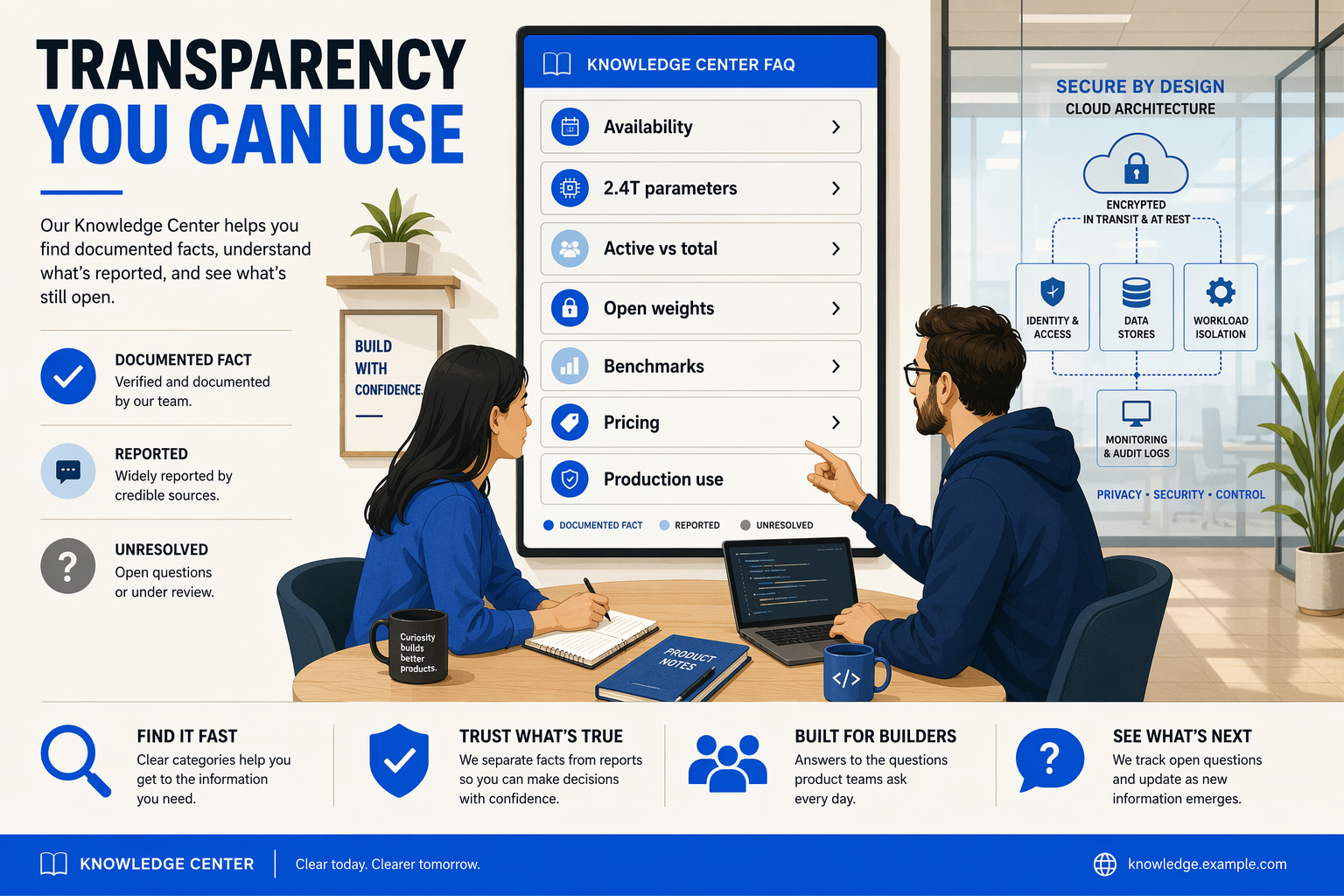
What is Qwen3.8-Max, and is it available now?
Does Qwen3.8-Max really have 2.4 trillion parameters?
When is the Qwen3.8 Max release date?
Will Qwen3.8-Max be released as open weights?
Is a 2.4-trillion-parameter Qwen model automatically better than smaller models?
How should developers test Qwen3.8-Max before production use?
Conclusion
Qwen3.8-Max-Preview is a meaningful Alibaba launch signal, but it is not yet a complete production-ready specification. The reported 2.4-trillion-parameter scale is notable, yet developers should treat it as a reported headline rather than a definitive measure of capability, cost, or reliability until Alibaba publishes primary technical documentation.
Key takeaways
- Preview access appears to be real. TestingCatalog reported that “Qwen3.8-Max-Preview is now available on Alibaba Cloud and Qwen Chat for testing,” while Qoder’s launch material also identifies Qwen3.8-Max-Preview as a Qwen-family model.
- The 2.4T figure still needs technical context. TestingCatalog and Qoder repeat the 2.4T-parameter claim, but currently available material does not establish whether that means total parameters, active parameters per token, or a particular mixture-of-experts configuration.
- There is no confirmed basis for broad performance claims. Without an Alibaba model card, official benchmark methodology, architecture details, pricing, API terms, or a general-availability date, teams should not infer that Qwen3.8-Max will outperform another model for coding, multilingual reasoning, tool use, or long-context workloads.
- Reported open-weight plans remain uncertain for the Max model. A Reddit post relaying Qwen messaging says Qwen3.8 is expected to be released with open weights, but the available evidence does not confirm the licence, timeline, scope, or whether that commitment includes Qwen3.8-Max.
What to watch next
The most consequential Qwen3.8 Max release updates will be an official Alibaba or Qwen announcement covering the model’s architecture, evaluation results, context and output limits, deployment options, access pricing, and the precise meaning of 2.4 trillion parameters. Those details—not parameter count alone—will determine whether Qwen3.8-Max is practical for a specific production workflow.
For businesses, the sensible next step is controlled evaluation: test representative prompts, measure latency and tool-call reliability, assess regional-language quality, and retain fallback options before committing customer interactions to a preview model. Platforms such as CallMissed reflect this broader shift by giving developers one OpenAI-compatible gateway for experimenting with multiple AI models and services, while supporting AI voice agents and multilingual customer engagement.
The question is not simply whether Qwen3.8-Max is large—it is whether Alibaba’s eventual disclosures show that its scale translates into dependable, affordable outcomes for your use case.
Related Reading
- OpenAI GPT-5.6: What We Know So Far About the Next-Generation Model
- GPT-5.6 Sol: Everything You Need to Know About OpenAI’s Flagship Next-Gen Model
- Everything You Need to Know About GPT-5.6 Terra: OpenAI’s Balanced AI Model for 2026