Claude Fable 5 vs Fable 5.1: Pricing, Context, and Upgrade Guide



Compare Claude Fable 5 vs Fable 5.1 on pricing, context, coding, tools, agents, availability, and migration to choose the right model.
Claude Fable 5 vs Fable 5.1: Pricing, Context, and Upgrade Guide
What if upgrading to Anthropic’s newest model could cut cache-read costs by 75% without changing standard token prices? This Claude Fable 5 vs Fable 5.1 comparison examines whether that saving—and the newer model’s agentic capabilities—justifies migration for real production workloads.
Anthropic launched Claude Fable 5.1 on September 1, 2026, positioning it as the successor to Claude Fable 5 for long-running agentic coding, knowledge work, and complex tool-driven tasks. Anthropic’s release notes identify the API model as claude-fable-5-1, while the company’s model documentation recommends Fable 5.1 for demanding reasoning and long-horizon work when other Claude models fall short.
Why this upgrade deserves scrutiny
A point release can imply incremental change, but Anthropic describes Claude Fable 5.1 as a Mythos-level model built for ambitious, long-running projects. Anthropic also reports that Fable 5.1 leads its internal incident-investigation evaluations, which use real production incidents to measure how effectively the company’s Bits agent investigates operational failures.
The headline specifications are equally relevant to deployment decisions:
- Context: Claude Fable 5.1 supports a 1 million-token context window, enabling analysis of large repositories, document collections, and extended agent histories.
- Pricing: Anthropic retains the standard token pricing associated with Fable 5 while reducing cache-read pricing by 75%, potentially changing the economics of repeated-context workflows.
- Availability: Anthropic’s September 2026 system card says Claude Fable 5.1 is available for general use, with additional safeguards for certain high-risk cybersecurity and biology tasks.
- Model design: Anthropic states that Claude Fable 5.1 shares its underlying model with Claude Mythos 5.1 but applies more restrictive safeguards.
For multi-model applications, OpenAI-compatible gateways such as CallMissed reflect the broader move toward testing and switching models without rebuilding an entire integration.
What this guide will help you decide
This guide compares capabilities, pricing, context limits, coding quality, tool use, long-running agents, and availability using first-party Anthropic information. It also examines migration risks that specifications alone cannot capture, including changed tool-call sequences, response behavior, coding summaries, latency, and safeguard-related refusals.
The goal is not to assume that “5.1” is automatically better for every workload. You will get a workload-based decision table, practical evaluation criteria, and a concise Claude Fable 5.1 upgrade guide for determining whether to migrate immediately, run a controlled side-by-side test, or remain on Fable 5 until the evidence supports a change.
Should you upgrade from Claude Fable 5 to Fable 5.1? Choose 5.1 for demanding long-running agents, but validate existing workloads first
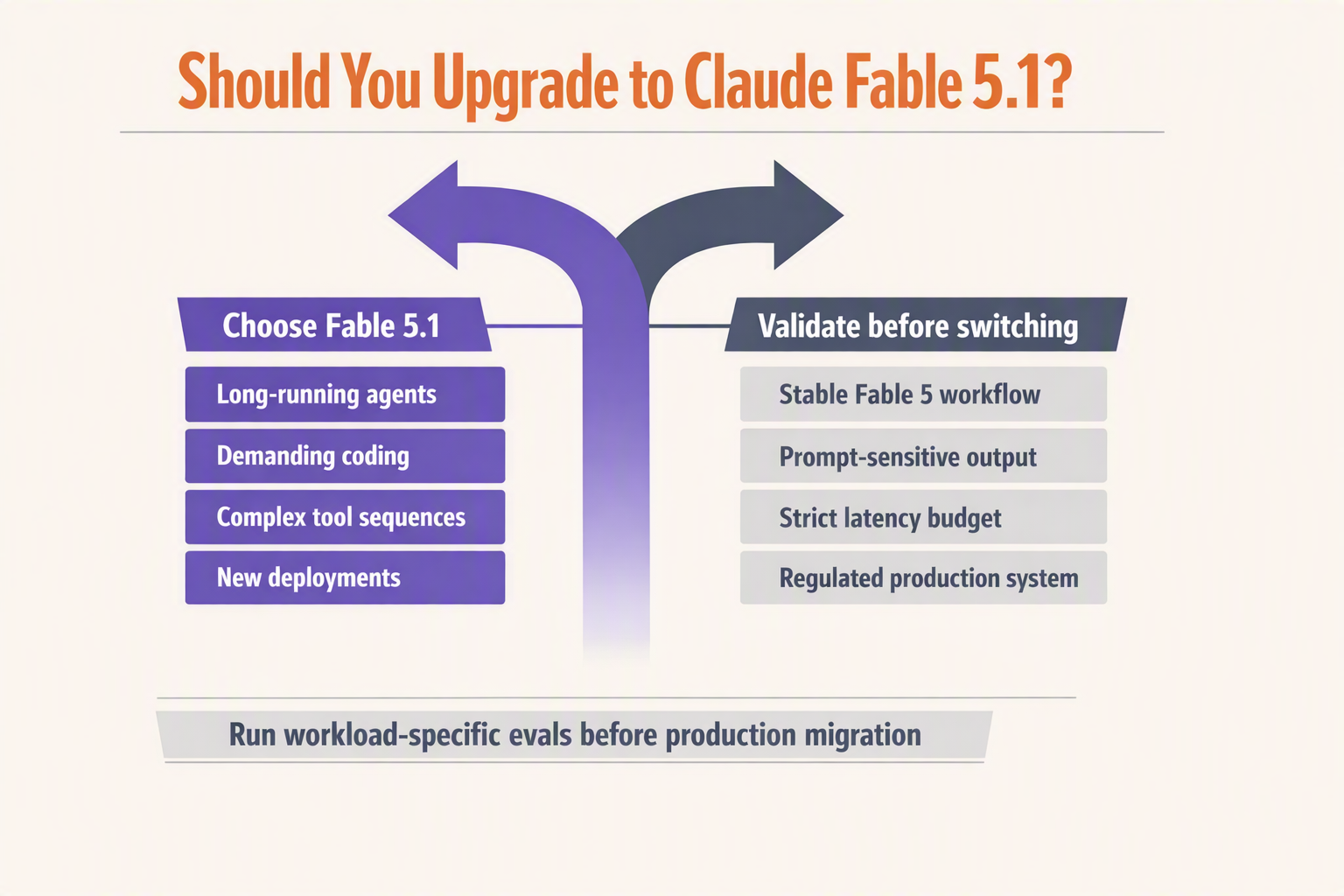
Upgrade to Claude Fable 5.1 for demanding, long-running agents, large-context analysis, and workflows that repeatedly reuse cached context. Keep Claude Fable 5 in production until controlled evaluations show that 5.1 preserves or improves prompt handling, tool behavior, latency, cost, and refusal patterns. The decision between Claude Fable 5 vs Fable 5.1 should be based on measured workload outcomes, not the newer version number alone.
Where Fable 5.1 has the clearest case
As of September 5, 2026, Anthropic documents Claude Fable 5.1 as generally available, with standard API pricing of:
- $10 per million input tokens
- $50 per million output tokens
- $0.25 per million prompt-cache read tokens
Standard input and output prices are unchanged from Fable 5. The largest pricing difference in Claude Fable 5 vs Fable 5.1 is therefore cache-read pricing: Anthropic says 5.1 cache reads cost 75% less. Teams should include cache writes, cache misses, outputs, and any applicable platform charges when calculating total cost rather than comparing the cache-read rate in isolation.
That reduction is most valuable for agents that repeatedly reuse large system prompts, repository snapshots, policies, tool instructions, or document collections. It has little effect on short, uncached requests.
Anthropic also documents a 1 million-token context window for Claude Fable 5.1. This can make 5.1 a stronger candidate for repository-scale coding, incident investigation, and large-document analysis. However, context capacity is not the same as reliable recall: evaluations should place critical information at different positions and test whether the model retrieves, cites, and applies it correctly.
Anthropic’s release materials emphasize agentic coding, complex knowledge work, and sustained tool-driven execution. Its strongest upgrade case is therefore for agents that must inspect extensive context, form hypotheses, call tools, evaluate results, and recover from unsuccessful approaches over many steps—not necessarily every short-form chat or generation task.
Recommendation by workload
| Workload | Recommended choice | Why | Validation priority |
|---|---|---|---|
| Long-running coding agents | Fable 5.1 | Better fit for sustained, tool-driven work | Patch quality, completion rate, tool loops |
| Incident investigation | Fable 5.1 | Designed for complex investigation across many steps | Accuracy on your own incidents and telemetry |
| Large cached repositories or document sets | Fable 5.1 | Documented 1M context and $0.25/M cache reads | Recall, cache-hit rate, latency, total cost |
| Stable short-form production workflows | Test before upgrading | Lower cache-read pricing may provide little benefit | Output consistency, p95 latency, token use |
| Strict structured-output or tool workflows | Test before upgrading | Model behavior can change despite API compatibility | Schemas, arguments, retries, tool selection |
| Safeguard-sensitive workflows | Evaluate carefully | Refusal boundaries and permitted-task handling may differ | False refusals, task coverage, escalation paths |
For many teams, the practical Claude Fable 5 vs Fable 5.1 choice will depend less on headline capability and more on whether the application benefits from long context, repeated cache reads, and extended autonomous execution.
Migrate as a behavioral change, not a model-name swap
Anthropic exposes claude-fable-5-1 as a separate model identifier. Treat migration as a versioned behavioral change, even if the request and response formats remain compatible. A newer model may interpret prompts differently, select different tools, alter argument structures, spend more or fewer reasoning tokens, or respond differently to the same effort setting.
A practical Claude Fable 5 vs Fable 5.1 rollout should:
- Replay representative prompts and traces. Include successful sessions, failures, edge cases, long conversations, cache-heavy requests, and adversarial inputs.
- Validate tools end to end. Measure tool selection, argument validity, call ordering, retry behavior, loop frequency, and recovery after tool errors.
- Compare effort settings explicitly. Test each production-relevant effort level rather than assuming the same setting produces equivalent quality, latency, or token consumption.
- Score complete outcomes. Track task success, code correctness, structured-output validity, factual accuracy, citation quality, refusal rates, and human-review burden.
- Measure latency by percentile. Compare time to first token, end-to-end duration, and p50, p95, and p99 latency for both short and long-running tasks.
- Recalculate total cost. Include uncached input, cache writes, $0.25/M cache reads, $50/M output, retries, longer completions, and additional tool calls.
- Canary production traffic. Route a limited share to 5.1, monitor regressions, and retain a tested Fable 5 rollback path.
The balanced conclusion for Claude Fable 5 vs Fable 5.1 is straightforward: choose Fable 5.1 as the leading candidate for ambitious agents and cache-intensive, large-context workloads, but keep Fable 5 wherever established behavior remains more valuable than 5.1’s additional capabilities or lower cache-read price.
What changed between Claude Fable 5 and Fable 5.1, and why does the September 2026 release matter?

Claude Fable 5.1 changes the economics and reliability profile of long-horizon agentic work, rather than simply adding a larger version number. Compared with Claude Fable 5, the September 2026 successor keeps standard token pricing unchanged while lowering cache-read costs, expanding context capacity, and targeting more demanding coding and tool-driven workflows.
The practical changes at a glance
Anthropic’s Claude Platform release notes dated September 1, 2026 identify claude-fable-5-1 as the successor to Claude Fable 5 for long-running agentic coding, knowledge work, and complex projects. The meaningful changes fall into four categories:
- A 1 million-token context window: Anthropic documents a 1 million-token context window for Claude Fable 5.1, allowing one request or agent history to contain large codebases, document sets, tool results, and lengthy conversations.
- Lower repeated-context costs: Anthropic kept Fable 5.1’s standard input and output token rates aligned with Fable 5 while reducing cache-read pricing by 75%. That change can materially lower costs for agents that repeatedly reference the same repository, instructions, knowledge base, or conversation history.
- A stronger focus on long-running execution: Anthropic describes Fable 5.1 as a “Mythos-level model” intended for ambitious projects that require sustained reasoning rather than quick, isolated answers. Anthropic’s product page says the model avoids “easy-seeming shortcuts” and seeks to fix root causes, although teams should verify that behavior on their own tasks.
- Updated safeguards: Anthropic states that Claude Fable 5.1 uses the same underlying model as Claude Mythos 5.1 but applies more restrictive safeguards for cybersecurity and biology. The September 2026 system card says Fable 5.1 remains available for general use while declining certain high-risk requests.
Why the September 2026 release matters
The release matters because production AI is moving from short prompts toward persistent agents that inspect systems, invoke tools, retain context, and complete multi-stage work. In those applications, context capacity and cache economics can matter as much as raw benchmark performance.
Anthropic reports that Claude Fable 5.1 is a leading model on its incident-investigation evaluations, which test the Bits agent against real production incidents. This is relevant evidence for debugging and operational analysis, but it is an Anthropic internal evaluation—not proof that Fable 5.1 will outperform Fable 5 on every external coding benchmark or application.
The larger context window also changes what developers can attempt:
- Repository-wide code review without aggressive file selection
- Long incident timelines combining logs, metrics, and deployment records
- Multi-document research with retained citations and intermediate findings
- Extended tool-use sessions with less frequent context compression
What the release does not establish
Anthropic’s announcement does not guarantee lower total cost, faster responses, or better results for every workload. A million-token capacity is a ceiling, not a recommendation to fill every request; larger prompts can still increase processing cost and latency.
Likewise, migrating to Claude Fable 5.1 may change tool-call ordering, response structure, coding summaries, refusal behavior, and agent trajectories. The September release is therefore significant because it raises the ceiling for long-running agents and reduces cache-read expense—not because it eliminates the need for workload-specific evaluation.
Which key capabilities, limits, and documented changes distinguish Fable 5.1 from Fable 5?
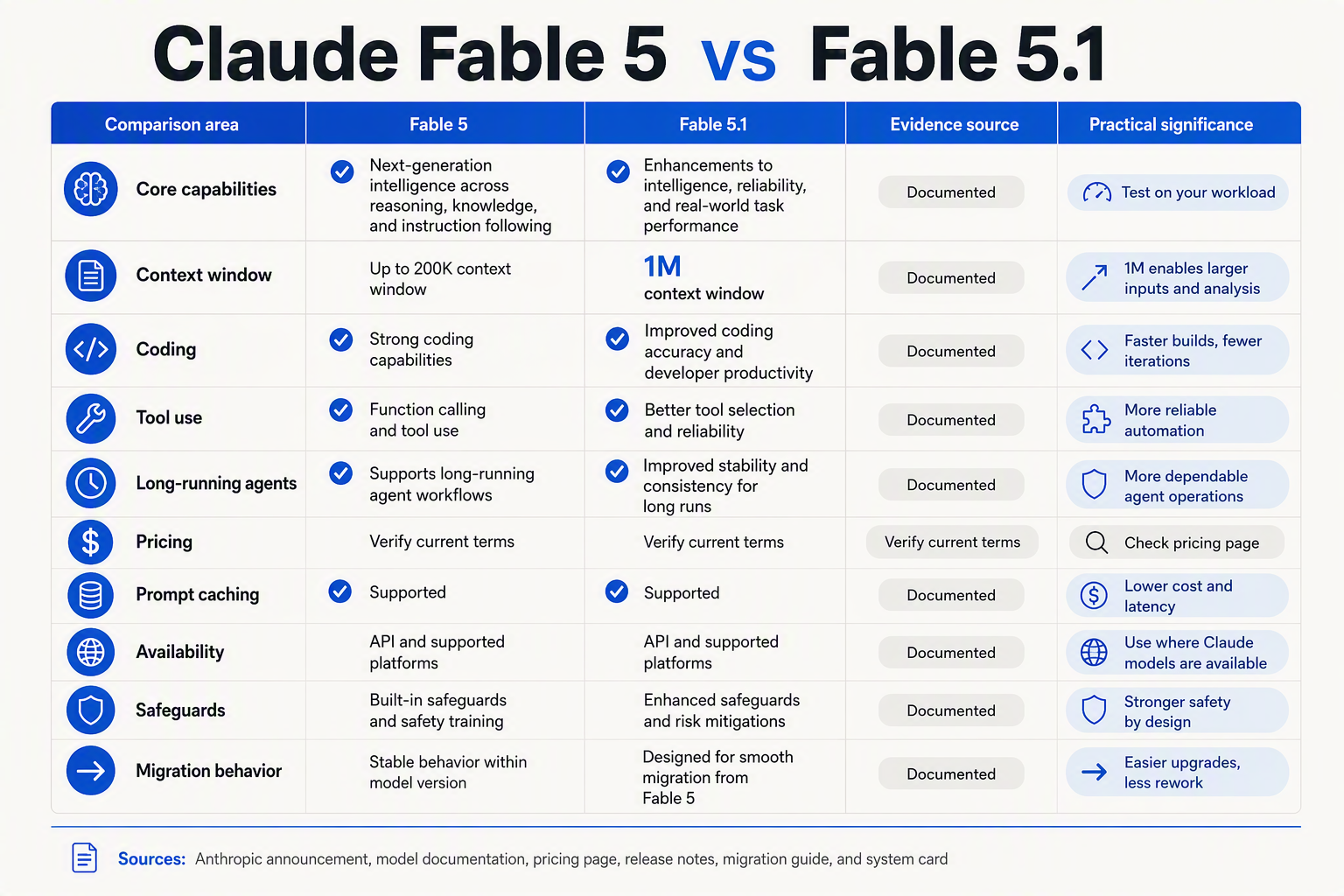
Claude Fable 5.1 is a targeted upgrade for long-horizon coding, tool-driven work, and repeated-context workloads—not a universal replacement for Claude Fable 5. Anthropic documents the same standard token pricing, a 1 million-token context window, and 75% lower cache-read pricing, but teams should benchmark behavioral compatibility before migrating.
Side-by-side capability and limit summary
| Area | Claude Fable 5 | Claude Fable 5.1 | Practical significance |
|---|---|---|---|
| Intended workload | Long-running agentic coding and knowledge work | Successor designed for demanding reasoning, ambitious projects, and long-horizon agentic work | The strongest documented case for upgrading is sustained, multi-step work rather than simple prompts. |
| Context window | Not specified in the supplied first-party context | 1 million tokens | Fable 5.1 can accommodate large repositories, document sets, and lengthy agent histories, subject to application-level limits. |
| Standard token pricing | Baseline Fable pricing | Unchanged from Fable 5 | Moving versions does not inherently raise standard input or output token rates. |
| Prompt-cache reads | Baseline rate | 75% cheaper than Fable 5 | Reusing large system prompts, codebases, or knowledge corpora can materially reduce costs. |
| Coding and investigation | Agentic coding support | Positioned for long-running coding; leads Anthropic’s internal incident-investigation evaluations | Evidence supports stronger suitability, but Anthropic’s internal result is not a universal coding benchmark. |
| Tool use and agents | Supports tool-driven workflows | Emphasizes root-cause fixes, fewer easy-seeming shortcuts, and sustained agentic execution | Existing tools may work, but call order, arguments, retries, and stopping behavior still require regression testing. |
| Availability and safeguards | Predecessor model | Generally available as claude-fable-5-1; tighter controls for certain high-risk cyber and biology tasks | Most applications can deploy it, while sensitive workflows may encounter different refusals. |
| Model relationship | Earlier Fable generation | Same underlying model as Claude Mythos 5.1, with more restrictive safeguards | Capability may resemble Mythos 5.1, but permitted behavior is intentionally narrower in specified risk domains. |
What Anthropic has explicitly documented
Anthropic’s September 1, 2026 Claude Platform release notes identify claude-fable-5-1 as the successor to Claude Fable 5 for long-running agentic coding, knowledge work, and complex tasks. Anthropic’s model overview separately recommends Fable 5.1 for demanding reasoning and long-horizon agentic work, particularly when evaluations on Claude Opus 5 at higher effort remain insufficient.
Anthropic reported on September 1, 2026 that Claude Fable 5.1 leads its internal incident-investigation evaluations, which test the Bits agent against real production incidents. That finding is directly relevant to debugging and operational investigation, but it should not be interpreted as proof of superiority across every programming language, repository, or toolchain.
Anthropic’s September 2026 system card states that Claude Fable 5.1 is available for general use while applying additional safeguards to certain high-risk cybersecurity and biology requests. This distinction matters when migrating security research, vulnerability analysis, or scientific workflows: identical prompts may not produce identical completion or tool-use behavior.
What the specifications do not establish
The documentation does not provide enough evidence to assume that every workload will gain accuracy, speed, or reliability. In particular, the published facts do not guarantee:
- Lower end-to-end latency despite unchanged standard token prices.
- Identical tool-call sequences, argument structures, retries, or coding summaries.
- Better results for short chats, extraction, classification, or low-complexity code edits.
- Automatic savings when prompt caching is not enabled or cache reuse is low.
Treat Claude Fable 5.1’s 1 million-token context window as capacity, not guaranteed recall quality across every token. For migration, compare task success, tool correctness, latency, refusal rates, token consumption, and cache-hit economics on representative traces; version-specific model IDs should remain pinned until those evaluations pass.
How do Claude Fable 5.1 pricing, the context window, and prompt caching affect real operating costs?
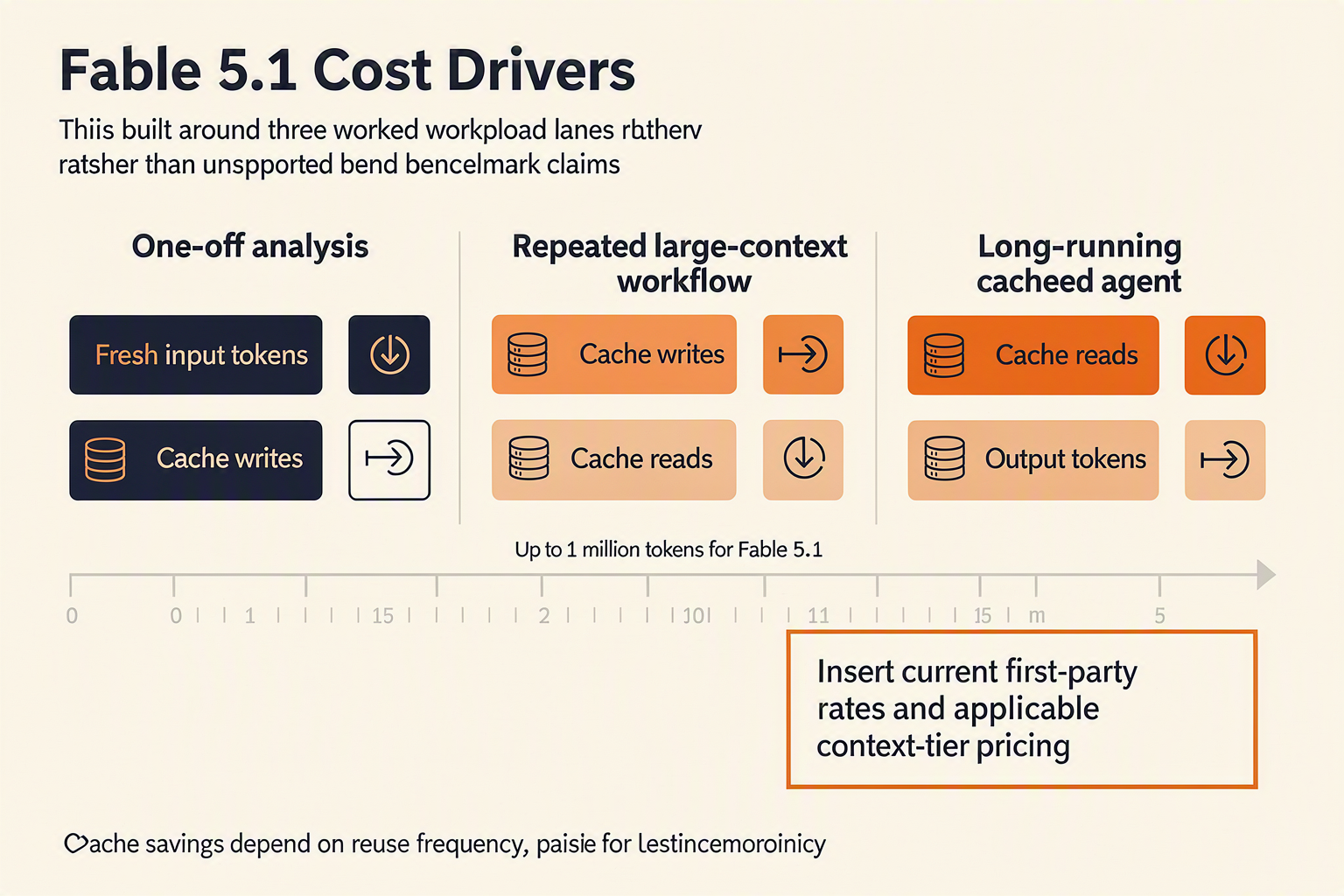
Claude Fable 5.1 keeps Fable 5’s standard token pricing but lowers cache-read pricing by 75%, so the largest savings apply to workloads that repeatedly reuse stable context. Its 1 million-token context window can reduce retrieval and chunking complexity, but sending more tokens still increases cost unless prompt caching is used effectively.
What changed in Claude Fable 5.1 pricing?
Anthropic’s September 1, 2026 announcement states that standard input and output token prices remain unchanged from Claude Fable 5, while cache reads cost 75% less. In practical terms, a cached token read by Fable 5.1 costs one-quarter of the corresponding Fable 5 cache-read rate.
The basic operating-cost calculation is:
Total cost = uncached input + cache writes + cache reads + output tokens + external tool costs
Because only the cache-read component received the stated reduction, savings vary substantially by architecture:
- High-reuse agents: Coding agents repeatedly loading repository instructions, architecture documents, or dependency maps may save materially.
- Knowledge assistants: Applications that reuse a large policy manual or document corpus across many requests can benefit from cheaper cached prefixes.
- One-shot prompts: Requests with mostly unique context receive little or no benefit from lower cache-read pricing.
- Frequently changing prompts: Dynamic timestamps, reordered documents, or user-specific content can reduce cache hits and therefore weaken the expected saving.
How large could the cache saving be?
Consider an application that reads the same 800,000 cached tokens 1,000 times. That represents 800 million cache-read tokens.
If R is Fable 5’s cache-read price per million tokens:
- Fable 5’s indexed cache-read cost would be 800 × R.
- Fable 5.1’s 75%-lower rate would cost 200 × R.
- The indexed saving would be 600 × R, excluding cache creation, uncached input, output, and tool charges.
This example does not assume an unpublished tariff; it shows why cache-hit rate matters more than the headline percentage alone. Teams should measure cached tokens per request, cache-write frequency, cache lifetime, and hit rate before forecasting savings.
Does the 1 million-token context window reduce costs?
Anthropic documents a 1 million-token context window for Claude Fable 5.1, making it possible to process large repositories, extensive document sets, or long agent histories in one request. However, a larger context window is a capacity limit—not a free token allowance.
A million-token request may simplify engineering by reducing manual chunking, but it can also increase:
- Uncached input-token spend
- Prompt-processing latency
- Repeated-context costs when caching misses
- Agent-history growth across long-running sessions
The most economical design is rarely “send everything.” Instead, teams should:
- Keep stable instructions and reference material in cacheable prompt prefixes.
- Retrieve only task-relevant files or passages.
- Summarise older agent history while preserving decisions and tool results.
- Track cost per completed task, not merely cost per API call.
For Claude Fable 5 vs Fable 5.1, standard rates alone do not create a universal cost advantage. Fable 5.1 becomes economically compelling when production workloads combine large, stable prompts with frequent reuse; otherwise, migration should be justified by measured capability gains rather than assumed token savings.
Is Fable 5.1 better for agentic coding, tool use, and long-running agents?
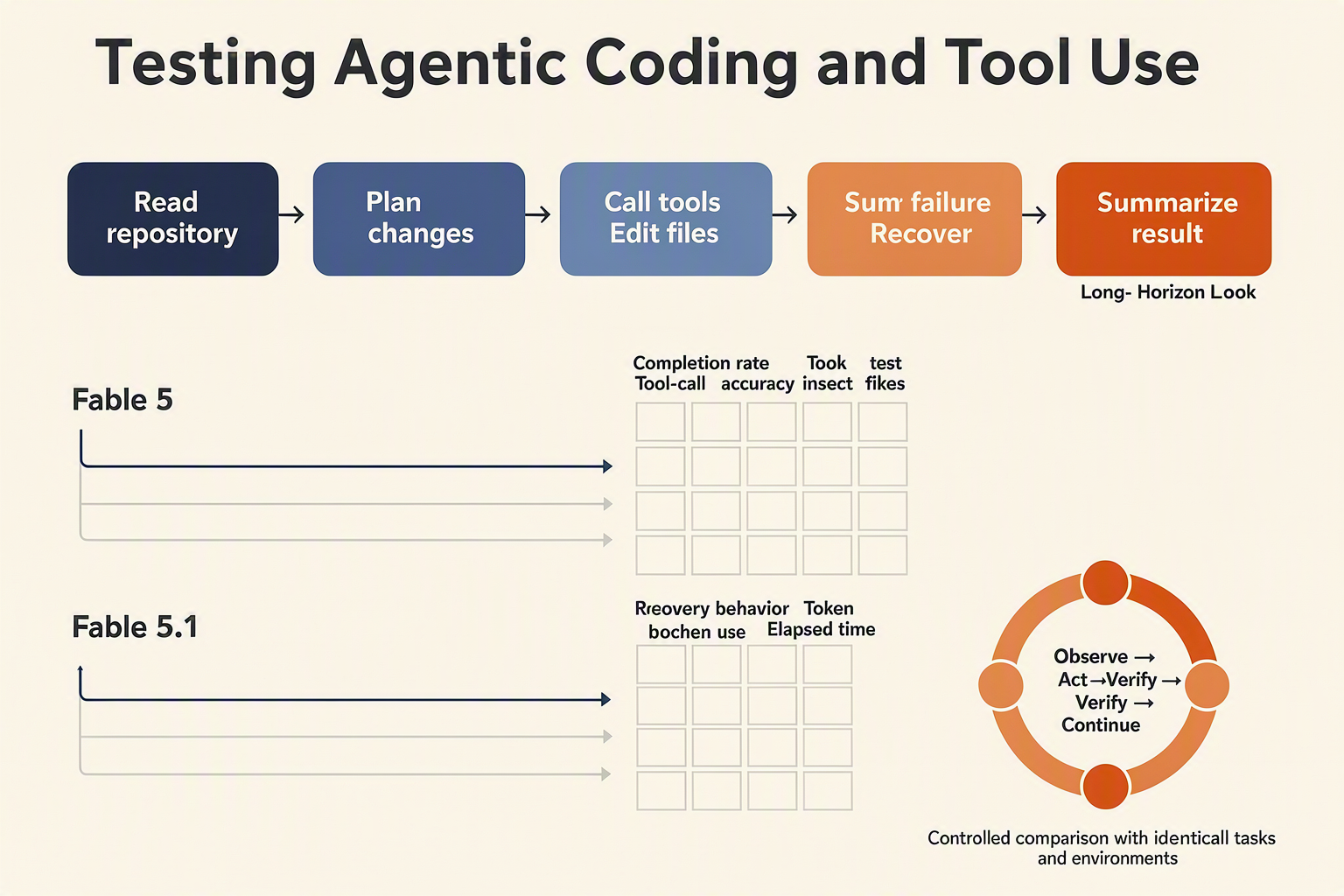
Claude Fable 5.1 is the stronger default for complex agentic coding and long-running, tool-driven workflows—but Anthropic has not published enough task-level benchmark scores to conclude that it improves every Fable 5 deployment. Teams should treat the upgrade as evidence-backed for long-horizon work and evaluation-dependent for narrower agents.
Agentic coding: stronger positioning, limited public numbers
Anthropic’s September 1, 2026 release notes identify claude-fable-5-1 as the successor to Claude Fable 5 for long-running agentic coding, knowledge work, and complex tasks. Anthropic’s model page adds that Fable 5.1 avoids “easy-seeming shortcuts” and aims to fix root causes—useful behavior when an agent must investigate a repository, modify several files, run tests, and revisit failed assumptions.
That makes Fable 5.1 particularly relevant for:
- Repository-scale debugging and refactoring
- Multi-file feature implementation
- Test generation followed by iterative repair
- Dependency upgrades requiring code, configuration, and documentation changes
- Engineering investigations that combine logs, source code, and operational context
However, Anthropic’s cited launch materials do not provide a public percentage improvement over Fable 5 on a named coding benchmark. A fair Claude Fable 5 vs Fable 5.1 comparison should therefore distinguish Anthropic’s product recommendation from independently reproducible proof across every programming language and framework.
Tool use: incident investigation provides practical evidence
The clearest first-party evidence comes from Anthropic’s internal operational evaluation. Anthropic reported on September 1, 2026 that Claude Fable 5.1 was a leading model in its incident-investigation evaluations, which use real production incidents to test the Bits agent.
Incident investigation is a meaningful agentic test because success can require the model to:
- Search logs and monitoring data.
- Form and revise hypotheses.
- Select tools in the appropriate sequence.
- correlate evidence across systems.
- Explain the root cause and propose remediation.
This result supports Fable 5.1 for complex tool orchestration, but it does not guarantee higher reliability with every custom schema, API, or tool framework. Teams should measure tool-selection accuracy, valid argument generation, unnecessary calls, loop frequency, recovery from tool errors, and completion rate against Fable 5.
Long-running agents: where 5.1 has the clearest case
Anthropic’s Claude Platform documentation recommends Claude Fable 5.1 for demanding reasoning and long-horizon agentic work, including workloads where Claude Opus 5 at higher effort still falls short. Its 1 million-token context window can hold large codebases, lengthy agent histories, and substantial tool output, although context capacity alone does not ensure that every token receives equal attention.
Fable 5.1 is the more compelling candidate when an agent must preserve goals across many steps, recover from failed approaches, or maintain consistency during extended execution. Fable 5 may remain reasonable when existing agents already meet quality and latency targets.
What to test before migrating
Run both models on production-like traces and compare:
- End-to-end task completion, not just first-response quality
- Tool-call order, argument validity, and retry behavior
- Code correctness, regression rates, and test-pass rates
- Token usage, latency, and cache-read costs
- Summary quality after context compaction
- Refusal behavior for cybersecurity or biology-adjacent tasks
The practical verdict is Fable 5.1 for ambitious, long-running agents; side-by-side validation for stable coding and tool workflows. Its strongest evidence concerns long-horizon behavior, not universal superiority.
Where is Claude Fable 5.1 available, and what deployment constraints should teams check?
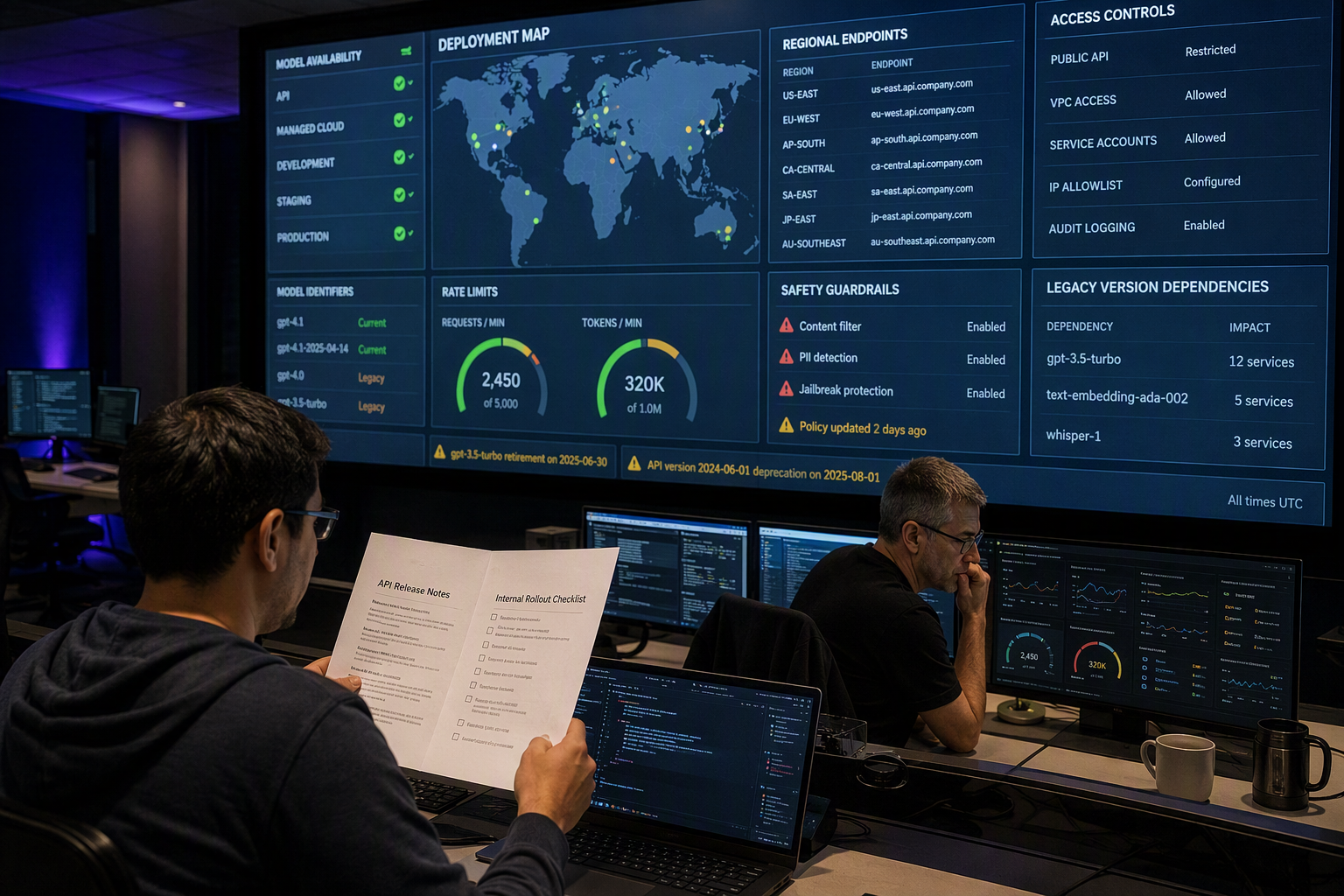
Claude Fable 5.1 is confirmed for general use through the Claude Platform API, under the model identifier claude-fable-5-1. Teams should not interpret “general use” as universal availability across every cloud marketplace, region, account tier, or high-risk workload.
What availability is confirmed?
Anthropic’s Claude Platform release notes state that Claude Fable 5.1 launched on September 1, 2026, as the successor to Claude Fable 5 for long-running agentic coding, knowledge work, and complex tool use. The documented API model name is claude-fable-5-1.
As of September 3, 2026, the supplied first-party Anthropic sources establish:
- Claude Platform API access: Confirmed through Anthropic’s API documentation and release notes.
- General-use status: Anthropic’s September 2026 system card describes Claude Fable 5.1 as available for general use.
- A 1 million-token context window: Anthropic’s September 2026 model documentation specifies this maximum for Fable 5.1.
- Additional safeguards: Cybersecurity and biology restrictions apply to certain high-risk requests.
- Third-party cloud availability: The cited materials do not confirm deployment through Amazon Bedrock, Google Cloud Vertex AI, Microsoft Azure, or other marketplaces.
Teams requiring a particular cloud should therefore verify the provider’s regional model catalog and exact version identifier, rather than assuming availability because an earlier Claude model is listed there.
Which deployment constraints matter most?
Before migrating to Claude Fable 5.1, check these six areas:
- Account and regional access: Confirm that
claude-fable-5-1appears for the production account, billing entity, and deployment region—not merely in a development console.
- Safeguard compatibility: Anthropic says Fable 5.1 shares its underlying model with Claude Mythos 5.1 but applies more restrictive cybersecurity and biology safeguards. Security research, vulnerability analysis, laboratory workflows, and dual-use requests require targeted refusal testing.
- Model pinning: Use the documented model identifier rather than assuming an alias will remain behaviorally stable. Preserve Claude Fable 5 as a rollback option until production evaluations pass; Anthropic’s launch announcement does not itself establish a retirement date for Fable 5.
- Context engineering: A 1 million-token context window supports large repositories and extended histories, but teams must still validate request-size limits, retrieval quality, latency, token budgets, and the tendency for important instructions to become diluted in very long prompts.
- Tool and agent controls: Re-run tests for tool schemas, permission boundaries, retry logic, maximum turns, timeouts, and human approvals. A model suited to longer-running work can consume more tools and wall-clock time if orchestration limits are weak.
- Governance requirements: Review data residency, retention, logging, encryption, auditability, and regulated-data policies for the actual access channel. “General use” is a model-availability statement, not a guarantee that every deployment satisfies an organisation’s compliance obligations.
A practical pre-production gate
Do not route all Claude Fable 5 traffic to Fable 5.1 immediately. Start with shadow evaluations or a small canary, compare refusal rates, tool-call validity, latency, task completion, and cost, and retain rapid rollback.
The safest conclusion is straightforward: Claude Fable 5.1 is broadly available through Anthropic’s documented API, but cloud-channel support, safeguards, quotas, and governance constraints must be verified independently before production migration.
How should you migrate to Claude Fable 5.1 without breaking prompts, tools, or coding workflows?
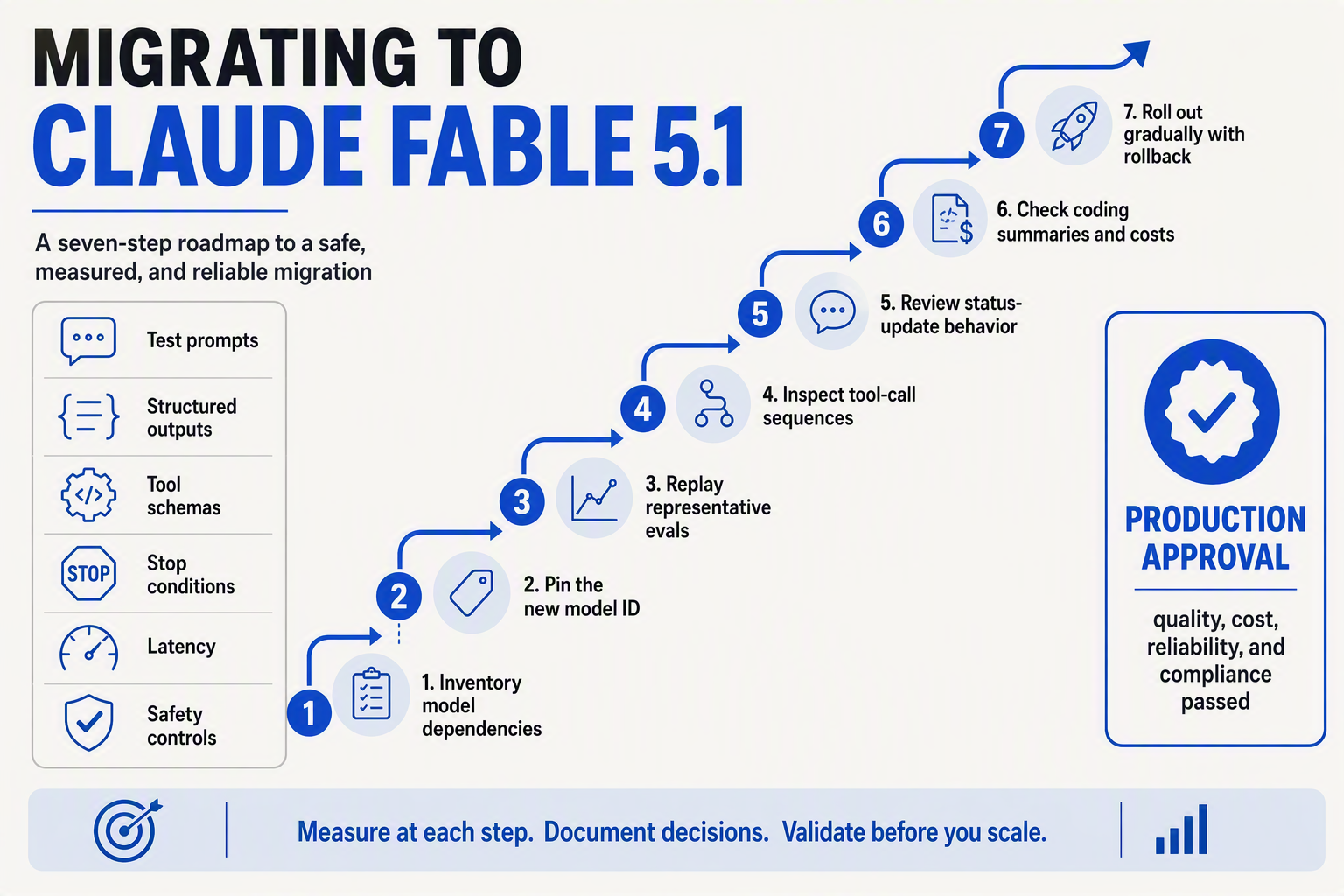
Migrate to Claude Fable 5.1 through a staged rollout, not a one-line production model swap. Keep prompts, tool schemas, runtime controls, and test inputs fixed initially; then compare outputs and agent traces against Claude Fable 5 before promoting the new model.
1. Establish a reproducible baseline
Anthropic launched the API model claude-fable-5-1 on September 1, 2026, as the successor to Claude Fable 5 for agentic coding, knowledge work, and long-running tasks, according to the Claude Platform release notes. Before changing that model identifier, capture a representative Fable 5 baseline:
- Final answers, structured outputs, and refusal rates
- Tool selections, arguments, order, retries, and loop counts
- Code patches, test results, and repository changes
- Input, output, and cache-read tokens
- End-to-end latency and cost per completed task
Include ordinary cases, malformed tool responses, context near the limit, and high-risk prompts relevant to your application.
2. Run shadow traffic with identical controls
Replay production requests against Fable 5.1 without exposing its responses to users. Keep system prompts, temperature, token limits, stop conditions, tool definitions, and context unchanged so that model version is the primary variable.
Anthropic recommends Claude Fable 5.1 for demanding reasoning and long-horizon agentic work in its model documentation. However, that positioning does not guarantee identical behavior: a stronger agent may choose different tools, call them in a different sequence, investigate deeper, or avoid a shortcut that Fable 5 previously took.
Score outcomes rather than requiring exact text matches. For coding, prioritize compilation, tests, static analysis, security checks, and task completion over patch similarity.
3. Harden prompts and tools before rollout
Migration often exposes assumptions that were never part of the formal contract. Make those contracts explicit:
- Prompts: Specify deliverables, constraints, stopping criteria, and required evidence. Avoid instructions that depend on a particular prose style or undocumented ordering.
- Tool schemas: Use strict JSON Schema, enums where appropriate, required fields, and clear descriptions. Validate every argument server-side.
- Tool execution: Add idempotency keys, timeouts, retry ceilings, loop limits, and permission boundaries.
- Structured output: Parse and validate fields rather than scraping natural-language responses.
- Coding agents: Run changes in isolated branches or sandboxes; require tests and human approval for destructive operations.
Anthropic says Fable 5.1 “avoids easy-seeming shortcuts” and “fixes the root causes.” That can improve complex coding work while also increasing tool calls, runtime, or patch scope, so set explicit budgets.
4. Test safeguards and long-context behavior
Anthropic’s September 2026 system card says Claude Fable 5.1 is available for general use but applies additional safeguards to certain high-risk cybersecurity and biology tasks. Teams in adjacent domains should regression-test legitimate workflows and create escalation paths for unexpected refusals.
For the 1 million-token context window, test retrieval quality at multiple context depths—not merely whether the request is accepted. Measure citation accuracy, instruction retention, duplicated work, latency, and cost across large repositories or extended agent histories.
5. Canary, observe, and retain rollback
Route a small, low-risk traffic percentage to Fable 5.1, then expand only after predefined thresholds pass. Monitor task success, tool errors, human overrides, latency percentiles, refusal rates, token usage, cache hits, and cost per successful outcome.
Keep Fable 5 available behind a feature flag until production stability is proven. The 75% lower cache-read price reported by Anthropic can materially benefit repeated-context agents, but migration approval should depend on quality-adjusted cost—not token price alone. For multi-model estates, an OpenAI-compatible gateway such as CallMissed can centralize model routing and simplify rollback without forcing application-wide integration changes.
What do Anthropic’s evaluations and system card establish—and what remains unproven for your workload?
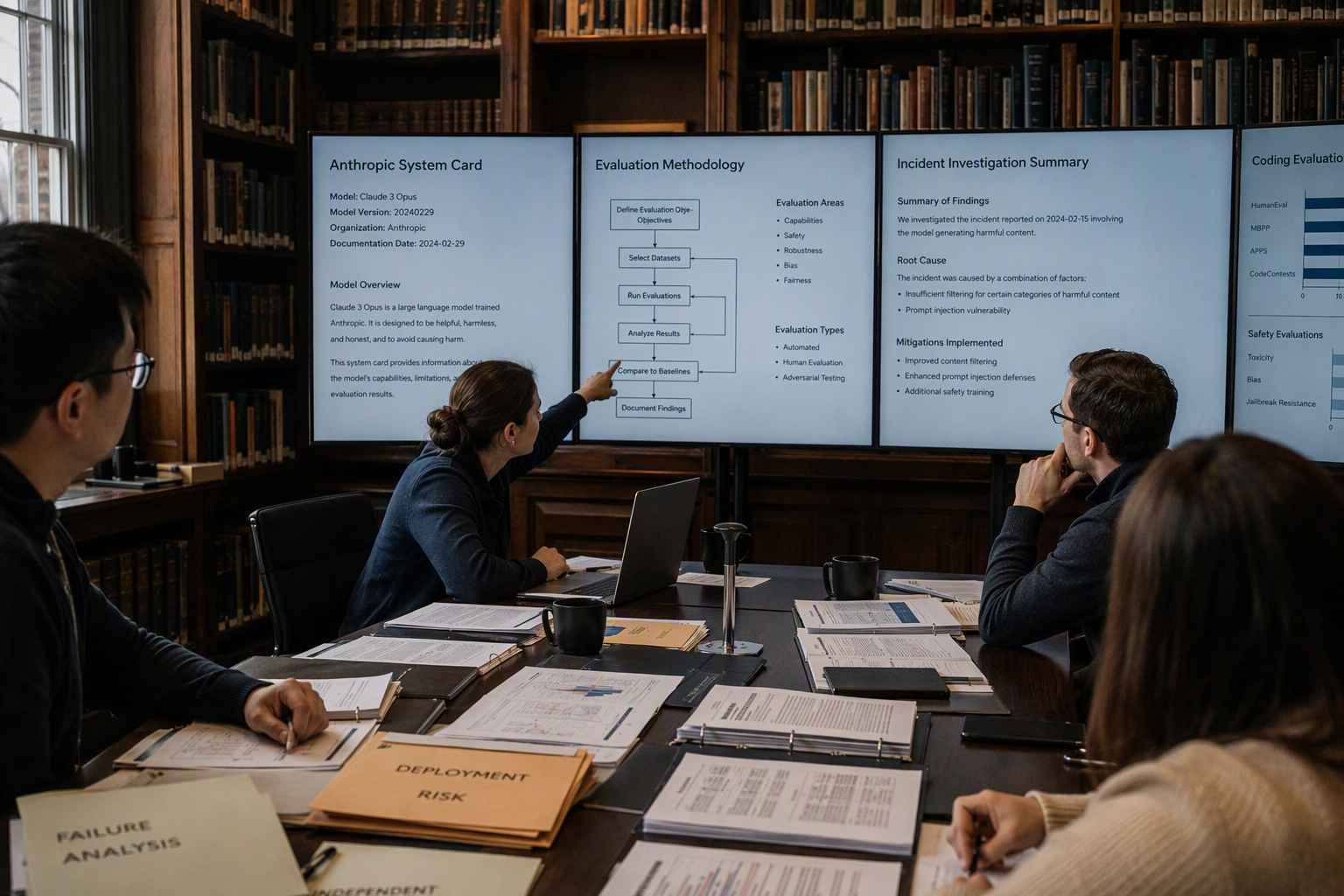
Anthropic’s evidence establishes that Claude Fable 5.1 is designed and safety-tested for long-horizon agentic work, but it does not prove that Fable 5.1 will outperform Claude Fable 5 on every production workload. Internal evaluations and system cards are useful decision inputs—not substitutes for workload-specific testing.
What Anthropic’s evidence establishes
Anthropic makes several concrete, first-party claims:
- Incident investigation: On September 1, 2026, Anthropic described Claude Fable 5.1 as “a leading model” on its incident-investigation evaluations, which use real production incidents to test how effectively the Bits agent investigates operational failures.
- Intended workload: Anthropic’s Claude Platform documentation recommends Fable 5.1 for demanding reasoning and long-horizon agentic work, particularly when evaluations using Claude Opus 5 at higher effort remain insufficient.
- Large-context operation: Anthropic documents a 1 million-token context window for Claude Fable 5.1, establishing the amount of context the API can accept—not how accurately the model will use every token.
- Model relationship: Anthropic states that Claude Fable 5.1 and Claude Mythos 5.1 use the same underlying model, while Fable 5.1 applies more restrictive safeguards in cybersecurity and biology.
- Availability and safeguards: Anthropic’s September 2026 system card says Claude Fable 5.1 is available for general use but blocks certain high-risk cybersecurity and biology tasks.
These findings support a credible hypothesis that Fable 5.1 is suitable for complex coding, investigation, and tool-driven workflows. They also clarify expected safety boundaries before deployment.
What remains unproven
Anthropic’s published description does not, by itself, establish a universal performance improvement over Fable 5. Important unanswered questions include:
- Whether Fable 5.1 produces more correct patches in your repositories.
- Whether longer agent runs reduce human intervention or merely consume more tokens.
- Whether tool calls follow your expected sequence, schema, and retry behavior.
- Whether the model uses a million-token prompt reliably when critical evidence appears at different positions.
- Whether additional safeguards create false refusals for legitimate security, healthcare, or scientific workflows.
- Whether total task cost falls after accounting for reasoning tokens, retries, tool loops, latency, and cache utilization.
- Whether output style changes affect coding summaries, structured extraction, or downstream parsers.
“A leading model” also requires context: the cited incident evaluation is operated by Anthropic and measures the company’s Bits agent. Without published workload-level results directly matching your environment, it should not be interpreted as an independent guarantee of superiority over Fable 5.
How to validate the upgrade fairly
Run a paired evaluation using identical prompts, tools, permissions, and stopping conditions:
- Coding: Measure test-pass rate, regressions, review acceptance, and time to a merge-ready patch.
- Tool use: Track valid calls, argument errors, retries, unnecessary calls, and completed tasks.
- Long-running agents: Record completion rate, intervention frequency, elapsed time, and tokens per successful outcome.
- Context use: Place decisive facts at the beginning, middle, and end of large inputs and score grounded retrieval.
- Safety: Test both prohibited requests and legitimate domain tasks to measure appropriate blocks and false refusals.
- Operations: Compare p50 and p95 latency, failure rates, cache hit rates, and total cost per completed task.
The fair conclusion is that Anthropic provides meaningful evidence of intended capability and documented safeguards, while the case for migrating from Claude Fable 5 to Fable 5.1 must still be proven against your own acceptance criteria.
Which model should you choose for your workload?
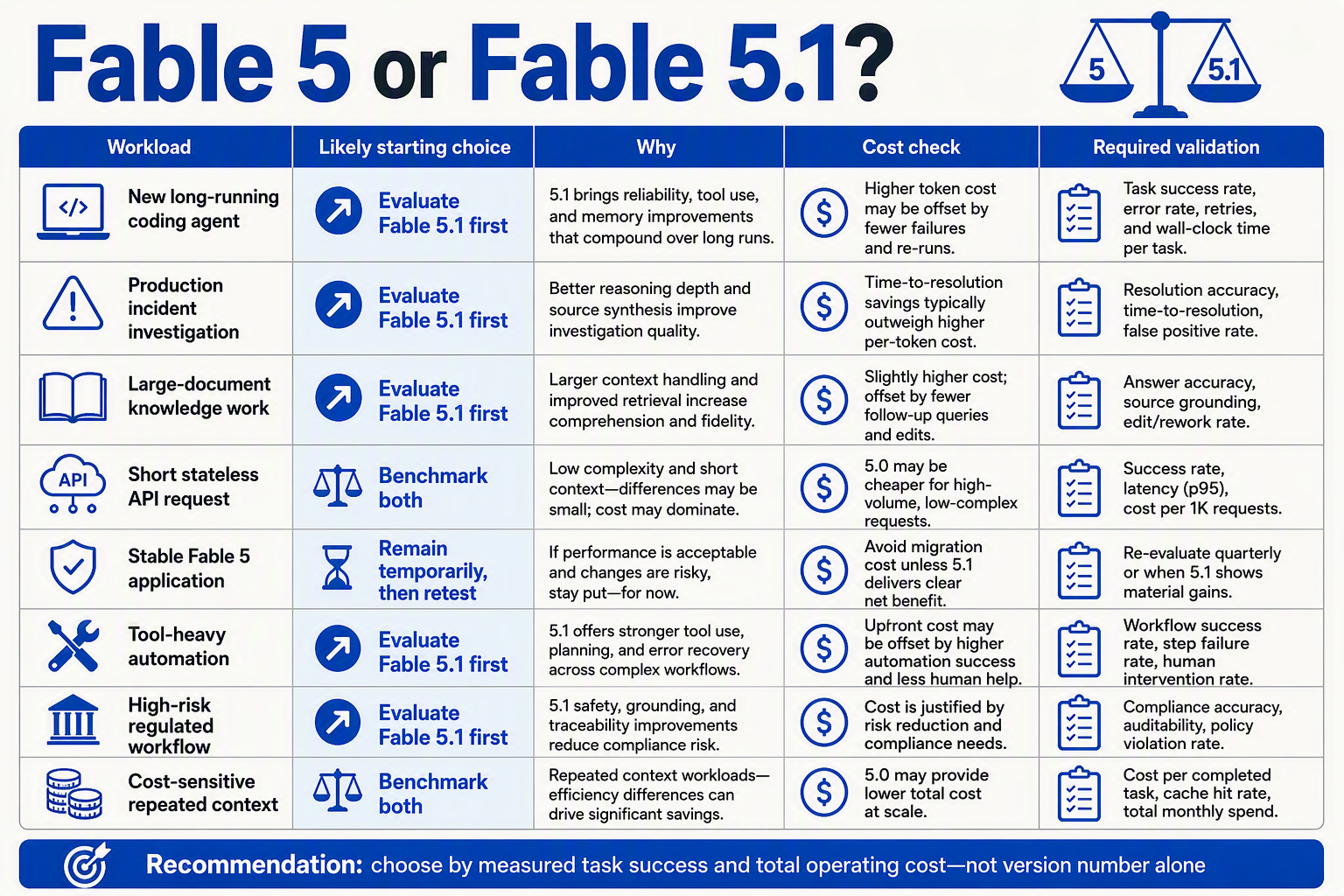
Choose Claude Fable 5.1 for new, demanding agentic systems, repository-scale coding, and workflows that repeatedly reuse large prompts. Keep Claude Fable 5 temporarily when production behavior is already validated and migration benefits have not yet been demonstrated by workload-specific evaluations.
Workload-based decision table
| Workload | Recommended model | Why | Migration priority |
|---|---|---|---|
| Long-running coding agents | Fable 5.1 | Anthropic explicitly positions claude-fable-5-1 for long-running agentic coding and complex projects. | High |
| Incident investigation and root-cause analysis | Fable 5.1 | Anthropic reports that Fable 5.1 leads its internal incident-investigation evaluations based on real production incidents. | High |
| Large repositories or document collections | Fable 5.1 | The 1 million-token context window can accommodate extensive code, documents, and agent history, subject to retrieval and cost design. | High if current context limits are restrictive |
| Repeated-context or cache-heavy applications | Fable 5.1 | Anthropic reduced cache-read pricing by 75% while retaining Fable 5’s standard token pricing. | High where cache reads materially affect spend |
| Stable tool-using production agents | Side-by-side test | A model change can alter tool selection, argument generation, call order, latency, and stopping behavior. | Medium; migrate only after replay tests |
| Low-volume, validated Fable 5 workflows | Fable 5 or Fable 5.1 after testing | Upgrading adds operational risk when current quality and costs already meet requirements. | Low unless support or capability needs change |
When Fable 5.1 is the stronger default
Anthropic’s Claude Platform documentation recommends Claude Fable 5.1 for demanding reasoning and long-horizon agentic work, including cases where evaluations on Claude Opus 5 at higher effort remain insufficient. That recommendation makes Fable 5.1 the logical starting point for new systems involving:
- Multi-stage software changes across a large repository
- Extended research or knowledge-work sessions
- Agents that inspect logs, invoke tools, test hypotheses, and revise plans
- Workloads that repeatedly retrieve the same cached instructions or reference material
On September 1, 2026, Anthropic released Claude Fable 5.1 as the successor to Fable 5 for agentic coding and knowledge work, according to the Claude Platform release notes. Anthropic also describes Fable 5.1 as a “Mythos-level model” intended for ambitious, long-running projects.
When staying on Fable 5 is reasonable
A newer model should not replace a stable production dependency solely because of its version number. Continue using Fable 5 while testing if your application depends on tightly controlled JSON, deterministic tool routing, established latency thresholds, or approved response patterns.
Before migrating to Claude Fable 5.1:
- Replay representative traces, including failures and edge cases.
- Compare task success, tool-call validity, total tokens, cache usage, latency, and refusal rates.
- Test cybersecurity or biology workflows separately because Anthropic’s September 2026 system card documents additional safeguards for certain high-risk tasks.
- Use staged traffic rather than an immediate full cutover.
For multi-model teams, an OpenAI-compatible gateway such as CallMissed can support controlled model evaluation without requiring a separate integration pattern for every provider. The final choice should follow measured production outcomes: adopt Fable 5.1 where its long-horizon capabilities or cache economics create a clear gain, and retain Fable 5 until your evaluations prove that gain.
Frequently Asked Questions about Claude Fable 5 vs Fable 5.1
Is Claude Fable 5.1 better than Claude Fable 5 for every workload?
How does Claude Fable 5.1 pricing compare with Claude Fable 5?
What is the Claude Fable 5.1 context window?
Which model wins the Claude Fable 5 vs Fable 5.1 comparison for coding?
claude-fable-5-1 for long-running agentic coding and knowledge work. However, developers should regression-test patch correctness, test-pass rates, coding summaries, latency, and tool-call sequences before replacing Fable 5.Does Claude Fable 5.1 improve tool use and long-running agents?
What should developers check before migrating from Claude Fable 5 to Fable 5.1?
claude-fable-5-1, then run side-by-side evaluations against representative production traces. Anthropic’s September 2026 system card states that Fable 5.1 is generally available but applies additional safeguards to certain high-risk cybersecurity and biology tasks; Anthropic also says it shares an underlying model with Claude Mythos 5.1 while using more restrictive safeguards. Migration checks should cover prompts, structured outputs, tool-call ordering, refusals, latency, cache behavior, costs, rollback procedures, and monitoring thresholds.Conclusion
Claude Fable 5.1 is the stronger upgrade candidate for demanding, long-running agents, but production teams should migrate only after workload-specific testing. Stable Claude Fable 5 deployments may not benefit enough to justify an immediate switch.
- Pricing: Anthropic’s September 1, 2026 announcement keeps standard token pricing unchanged while reducing cache-read pricing by 75%, materially benefiting repeated-context workflows.
- Context and agents: The 1 million-token context window makes Claude Fable 5.1 suitable for large repositories, extensive document sets, and long agent histories.
- Coding and tool use: Anthropic positions
claude-fable-5-1for agentic coding, complex knowledge work, and tool-driven projects, but teams should verify performance using their own tasks rather than assuming universal improvement. - Migration and availability: Claude Fable 5.1 is generally available, although Anthropic’s September 2026 system card documents additional safeguards for certain high-risk cybersecurity and biology requests. Test tool-call sequences, latency, coding summaries, refusals, and response consistency before changing production traffic.
Looking ahead, watch for independent evaluations of long-horizon reliability, real-world cache savings, and behavioral stability across extended agent runs. Multi-model infrastructure will also make controlled comparisons and fallbacks increasingly practical.
To stay ahead of this shift, explore CallMissed, an AI communication infrastructure platform supporting multi-model access, voice agents, and multilingual chatbots. Will your next upgrade decision be driven by a model name—or by measurable production outcomes?
Related Reading
- Claude Fable 5.1 Features: What’s New, Pricing and Upgrade Guide
- Claude Fable 5.1 vs GPT-5.6 Sol: Pricing, Coding & Voice Agents
- Claude Fable 5.1 Pricing: API Costs, Calculator and Examples