
AI Receptionist for Coworking Spaces: 2026 Phone, WhatsApp and Email Guide


Learn how an AI receptionist for coworking spaces handles enquiries, tours and leads safely across phone, WhatsApp and email.
AI Receptionist for Coworking Spaces: 2026 Phone, WhatsApp and Email Guide
What happens when a prospective member calls during a site tour, messages on WhatsApp after hours, and emails three locations before your team replies? An AI receptionist for coworking spaces can answer immediately, qualify the requirement, route it to the right centre, and offer a tour slot—without pretending every request should be automated.
This matters in 2026: speed and channel continuity now shape whether workspace enquiries become tours or disappear into a competitor’s pipeline. Meta reported in May 2025 that WhatsApp had more than 3 billion monthly users, making messaging a mainstream service channel, not an optional add-on. For Indian operators, multilingual coverage is practical: CallMissed, an AI-native communication platform, supports voice and chat across 22 Indian languages and can bridge WhatsApp Business calls to an AI voice agent.
From enquiry to qualified tour
The opportunity is larger than simply “answering the phone.” A workflow can recognise whether someone wants a hot desk, dedicated desk, private office, virtual office, meeting room, or enterprise suite; capture team size, move-in date, budget band, preferred location, and term length; then check verified availability before booking. That turns coworking lead qualification AI into an operational system rather than a generic chatbot. It also makes office tour booking automation useful: tours can be scheduled, confirmed, rescheduled, and written back to the CRM with an audit trail.
This guide explains how to design that system across phone, WhatsApp, and email while keeping humans in control. You’ll learn how to:
- Recover missed calls with a prompt callback or consent-based WhatsApp follow-up.
- Route prospects by city, building, workspace type, language, and sales ownership.
- Automate meeting-room requests and member FAQs without exposing access credentials or personal data.
- Define visitor-intake boundaries, escalation rules, consent records, retention periods, and human handoff.
- Verify CRM, calendar, telephony, email, WhatsApp Business, and access-system integrations before launch.
- Measure enquiry-to-tour conversion, response time, booking completion, handoff rate, no-shows, containment, and data-correction errors.
Automation with clear limits
You won’t just get a happy-path script. The guide shows where coworking WhatsApp automation should stop—for example, when a visitor asks for door access, a member disputes a charge, availability is uncertain, or an enterprise buyer needs negotiated terms. The goal is a receptionist that is fast across channels, accurate about each location, transparent that it is AI, and ready to transfer context to a person. By the end, you will have a rollout plan for one site, a verification checklist, and KPIs for expanding safely across a serviced-office portfolio.
How should an AI receptionist for coworking spaces work in 2026? Use one governed agent to answer enquiries, qualify leads, route locations, schedule tours and hand exceptions to people

An AI receptionist for coworking spaces should provide one governed orchestration layer across phone, WhatsApp, and email rather than operate as three disconnected bots. It should identify intent, collect only necessary information, use approved data sources, complete authorised actions, and transfer exceptions to a named employee with the full context intact.
One agent and one customer record
“One agent” does not require one AI model for every task. It means using a shared customer identity, knowledge base, workflow policy, conversation history, and audit trail across channels. A prospect should be able to call, continue the enquiry on WhatsApp, and receive an email confirmation without repeating team size, budget, or location preferences.
Meta reported in May 2025 that WhatsApp had more than 3 billion monthly users. Coworking WhatsApp automation should therefore connect with telephony, email, calendars, inventory systems, and the customer relationship management platform instead of becoming another isolated inbox.
Platforms such as CallMissed can support this model by connecting AI voice agents, WhatsApp chat and business calls, email, and a shared omnichannel inbox. For multilingual coworking operators in India, support for 22 Indian languages can also help maintain consistent service across regional markets.
The unified enquiry record should contain:
- Contact details, preferred language, source channel, and communication consent.
- Workspace type, team size, budget band, move-in date, and expected term.
- Preferred city, neighbourhood, building, and acceptable alternatives.
- Tour status, assigned sales owner, follow-up time, and conversation history.
- Confidence flags, unresolved questions, and human-handoff status.
Run enquiries through a governed workflow
A practical coworking lead qualification AI workflow should follow six controlled steps:
- Recognise the person and intent. Separate new workspace prospects from members, visitors, vendors, job applicants, and meeting-room customers.
- Collect minimum qualification data. Ask progressively because a two-person hot-desk enquiry requires different information from a 100-seat managed-office requirement.
- Route using verified rules. Match city, capacity, workspace type, business hours, preferred language, and sales territory without inferring availability from marketing pages.
- Retrieve approved information. Use location-specific records for amenities, accessibility, parking, opening hours, pricing policies, and house rules.
- Take an authorised action. Create or update the CRM lead, offer eligible tour slots, send directions, or arrange a callback.
- Escalate exceptions. Transfer the transcript, captured fields, consulted records, and recommended next step so an employee does not have to restart discovery.
Separate recommendations from commitments
Office tour booking automation can read live calendar availability, apply buffers and host-capacity rules, reserve a slot, and issue confirmations. However, AI office tour booking automation should not promise a specific office, price, discount, fit-out, or move-in date unless a connected inventory or commercial system has verified it.
The same boundary applies to member and visitor requests. The receptionist may explain meeting-room procedures or collect a visitor’s name and host, but it should not disclose door codes, create access credentials without validation, or override building-security controls.
Human handoff should occur when:
- Location, pricing, or inventory data is missing, stale, or contradictory.
- An enterprise lead requests custom terms, negotiations, or compliance documents.
- A member disputes an invoice, deposit, cancellation, or service failure.
- A caller asks for a person, appears distressed, or repeatedly rejects the answer.
- Identity, consent, access rights, or visitor authorisation cannot be verified.
The governing principle is straightforward: automate repeatable reception work, not accountability. Every answer should trace back to an approved source, every system action should be logged, and every uncertain or high-impact decision should remain reviewable by a person.
Why are coworking operators connecting phone, WhatsApp and email instead of automating each channel separately?
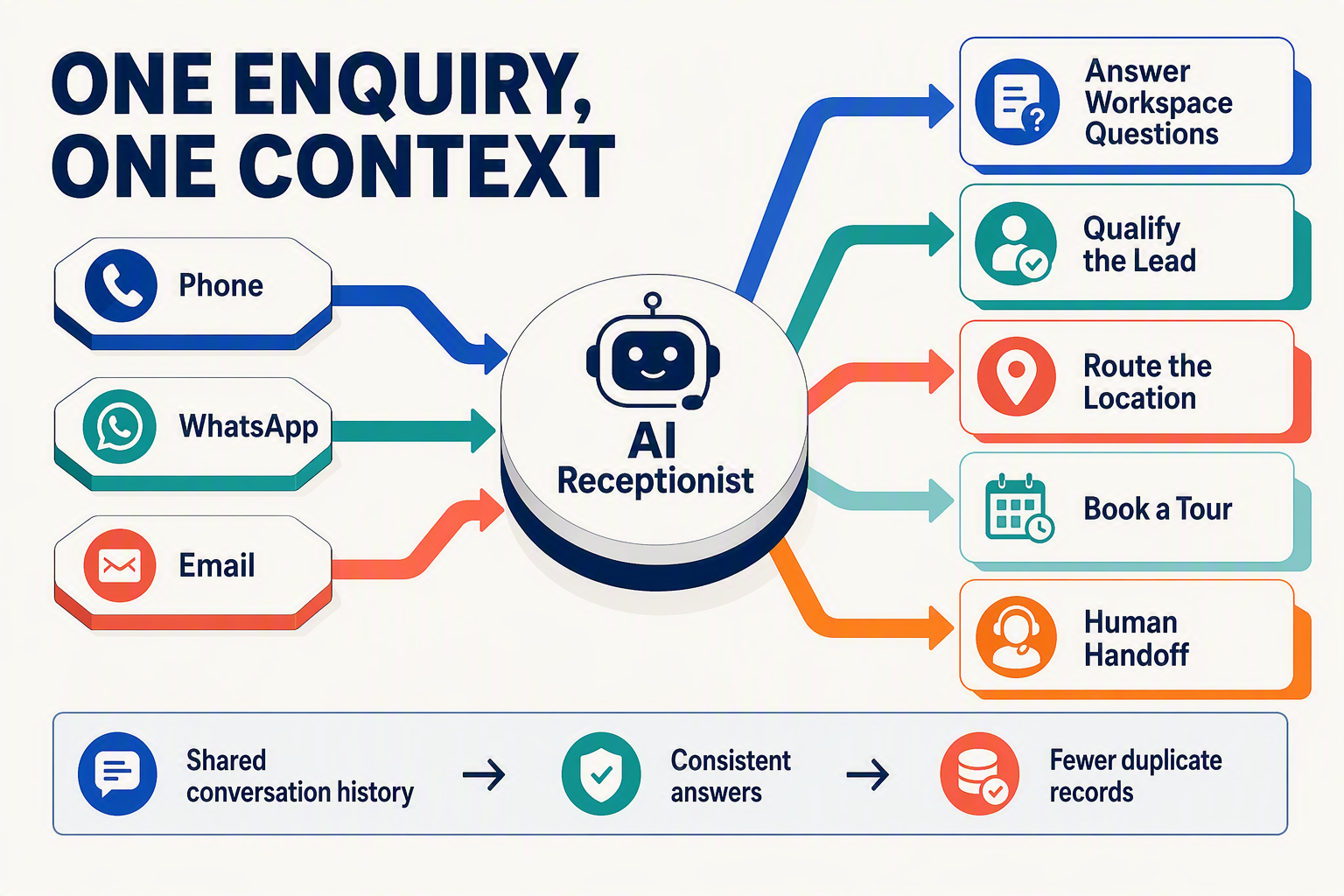
Coworking operators connect phone, WhatsApp, and email because prospects often use several channels during one workspace search. A shared orchestration layer preserves identity, location preferences, qualification details, consent, and booking status, preventing one enquiry from becoming multiple contradictory CRM records.
One enquiry, not three disconnected conversations
Consider a prospect who calls about a six-person office, requests photographs on WhatsApp, and later emails a procurement checklist. Separate automations could create three leads, repeat questions, or offer tours at different centres. A connected AI receptionist for coworking spaces instead maintains one conversation state while adapting the response to each channel.
The shared lead record should include:
- Name, company, phone number, and verified email address
- Preferred city, building, and acceptable alternative locations
- Workspace type, team size, budget range, and intended move-in date
- Tour status, assigned salesperson, and latest verified availability
- Communication consent, preferred language, and preferred channel
- Previous questions, documents sent, and unresolved human actions
Identity matching should rely on verified identifiers rather than names alone. Two people with the same name must not be merged merely because they contacted the same location.
Each channel performs a different role
Omnichannel automation does not require identical conversations everywhere. Each channel can handle the tasks it suits while updating the same CRM record:
- Phone supports urgent or nuanced enquiries requiring immediate clarification. An AI voice agent can collect requirements and, with permission, send a written summary.
- WhatsApp supports location pins, brochures, photographs, tour confirmations, and rescheduling. Coworking WhatsApp automation can also follow up after a missed call when the business has an appropriate lawful basis or consent and follows approved WhatsApp Business processes.
- Email is better suited to procurement documents, detailed proposals, contractual questions, and conversations involving several stakeholders.
CallMissed can connect AI voice agents, WhatsApp chat, WhatsApp Business calling, email, and an omnichannel inbox. CallMissed also supports speech workflows across 22 Indian languages, which is relevant when a prospect speaks a regional language during qualification but needs an English proposal for an employer or procurement team.
Shared context improves qualification and tour booking
A connected coworking lead qualification AI should request only missing information. If a caller has already specified “12 desks in Bengaluru from October,” the WhatsApp workflow should not ask for team size again. It can instead identify suitable centres, clarify parking or meeting-room needs, and continue into office tour booking automation.
A practical workflow is:
- Resolve the prospect’s identity and retrieve the existing CRM record.
- Add new information without overwriting verified data.
- Query centre-specific inventory and calendar availability.
- Offer valid tour slots for the requested location.
- Record the appointment, source channel, and conversation summary in the CRM.
- Notify the responsible location team and escalate uncertain or conflicting information.
Availability should come from a verified scheduling or inventory system. The AI should not promise an office, meeting room, price, or tour slot based only on an outdated knowledge-base answer.
Governance must cross channels too
Connected channels need one policy layer. A WhatsApp opt-out should be visible to campaign systems, while sensitive information received by email should not automatically appear in broadly accessible chat summaries.
Operators should centralise:
- Consent and communication preferences
- Data-retention rules and access permissions
- Human-handoff and escalation triggers
- Audit logs for messages, bookings, and record changes
- Rules governing which systems are authoritative
The goal is not maximum automation. It is one controlled customer journey in which prospects can change channels without losing context, repeating information, or receiving inconsistent answers from different coworking locations.
Which 2026 developments matter most for coworking WhatsApp automation and AI reception?
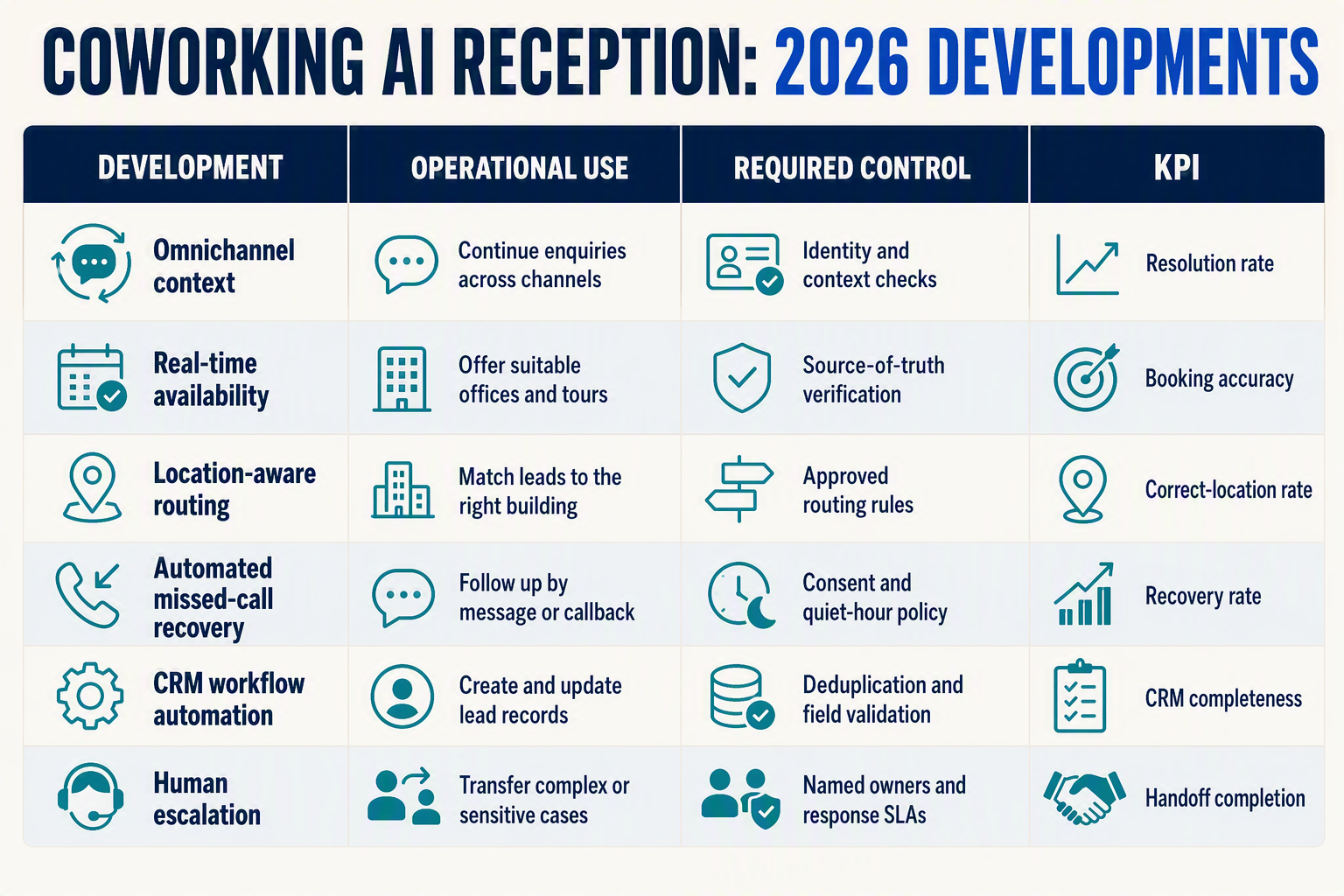
The most important 2026 development is the convergence of phone, WhatsApp, email, CRM, and calendars into one governed workflow. For coworking operators, the practical advantage is not a more conversational bot; it is reliable movement from first contact to qualified lead, correctly routed location, confirmed tour, or context-rich human handoff.
The developments to prioritise
| 2026 development | Coworking use case | Operational requirement | KPI to monitor |
|---|---|---|---|
| WhatsApp chat and calling convergence | Answer messages and WhatsApp Business calls, then continue the same enquiry in chat | Preserve consent, identity, location preference, and conversation history across modes | First-response time and cross-channel completion |
| Tool-connected AI agents | Read approved inventory, offer tour slots, create CRM leads, and send confirmations | Use authenticated APIs, permission limits, idempotency, and action logs | Booking completion and duplicate-record rate |
| Location-aware knowledge retrieval | Answer centre-specific questions about pricing, hours, parking, amenities, and policies | Separate each location’s verified data and attach effective dates | Incorrect-answer and human-correction rates |
| Multilingual voice and messaging | Qualify prospects in English, Hindi, Tamil, Bengali, Marathi, and other regional languages | Test speech recognition, names, addresses, and code-switching with real callers | Completion rate by language |
| Structured lead qualification | Capture workspace type, team size, move-in date, budget, term, and preferred building | Require field validation instead of allowing the model to infer missing facts | Qualified-lead and enquiry-to-tour rates |
| Consent-led automation and escalation | Recover missed calls, follow up on WhatsApp, and transfer sensitive requests | Record opt-in source, respect opt-outs, minimise retention, and define handoff triggers | Opt-out, escalation, and unresolved-enquiry rates |
Why WhatsApp calling changes the workflow
Meta reported in May 2025 that WhatsApp had more than 3 billion monthly users, giving operators a strong reason to treat WhatsApp as a service surface rather than merely a marketing channel. In 2026, effective coworking WhatsApp automation should handle chat and calling as connected interactions.
For example, a prospect may call about a six-person office, ask for photographs in WhatsApp chat, and then select a tour slot. Platforms such as CallMissed can bridge WhatsApp Business calls to an AI voice agent, allowing the voice interaction and subsequent messages to feed the same workflow. The system should still confirm before writing important details such as budget, email address, or appointment time into the CRM.
What makes these systems dependable
A modern AI receptionist for coworking spaces should use tools rather than generate operational facts from memory. Three controls matter:
- Ground every answer: retrieve availability, pricing, access hours, and amenities from an approved location record.
- Confirm every consequential action: repeat the centre, date, time, timezone, attendee count, and contact details before completing office tour booking automation.
- Escalate uncertainty: transfer enterprise negotiations, disputed charges, unverified availability, access requests, and safety issues to a person.
This also makes coworking lead qualification AI measurable. Operators can compare how many enquiries contain all mandatory fields, how many become booked tours, and how often staff must correct captured data. The winning 2026 architecture is therefore not “AI everywhere”; it is AI connected to verified systems, constrained by permissions, and monitored through business outcomes.
How should coworking lead qualification AI and office tour booking automation route enquiries by need, budget and location?
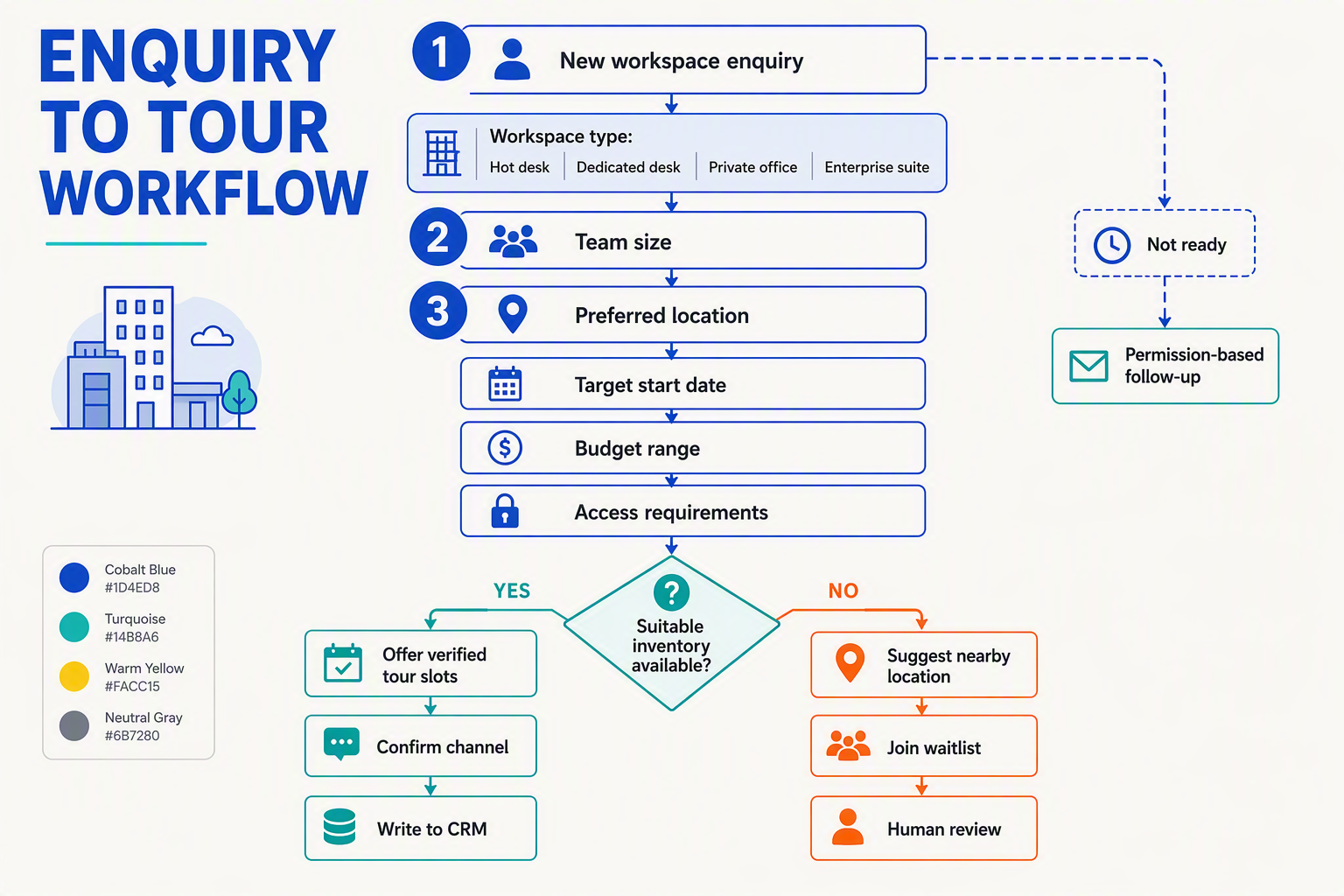
A coworking lead qualification AI should first identify the workspace requirement, then match it against budget, capacity, location, availability and sales ownership. It should book a tour only when the selected centre and calendar slot are verified; ambiguous, high-value or exception-based enquiries should reach a human with the collected context.
Capture the minimum viable qualification record
The AI receptionist for coworking spaces should ask one question at a time and avoid turning the conversation into a form. Across phone, WhatsApp and email, collect:
- Need: hot desk, dedicated desk, private office, virtual office, meeting room or enterprise suite.
- Capacity: current team size and expected headcount at move-in.
- Location: preferred city, micro-market or building, plus acceptable alternatives.
- Timing: move-in date, required tour date and urgency.
- Budget: a monthly range, whether it includes taxes, and per-seat versus total budget.
- Term: day pass, monthly membership, fixed term or flexible commitment.
- Requirements: parking, 24/7 access, compliance, branding, accessibility or meeting-room allocation.
- Contact and consent: name, company, preferred channel and permission for follow-up.
Budget should guide matching rather than cause automatic rejection. If the requested private office exceeds the prospect’s range, the agent can offer a smaller office, dedicated desks, another centre or a later availability date.
Apply deterministic routing before lead scoring
Use explicit operational rules for assignment; do not let a generative model invent which centre owns the lead. A practical sequence is:
- Filter by workspace type and capacity. Exclude locations that cannot accommodate the requirement.
- Rank eligible locations. Consider preferred micro-market, commute constraints, budget band and confirmed availability.
- Assign ownership. Route by building, city, account territory or existing CRM owner.
- Check exceptions. Escalate enterprise, broker, multi-city and custom-contract enquiries.
- Create or update the CRM record. Deduplicate using verified phone number, email address and company domain.
Lead scoring can then prioritise follow-up. For example, an operator might classify a verified requirement with a near-term move-in date and matching inventory as sales-ready, while an exploratory enquiry without timing becomes nurture. These thresholds must reflect the operator’s actual sales process rather than an unverified industry benchmark.
Book tours against verified inventory and calendars
Office tour booking automation should query the location’s calendar in real time, apply opening hours and host availability, and present two or three valid slots in the prospect’s time zone. After selection, the workflow should:
- Recheck the slot immediately before committing it.
- Create the calendar event with centre, address and host.
- Send confirmation through the prospect’s preferred channel.
- Offer consent-based reminders and a rescheduling option.
- Write the booking source, qualification fields and conversation summary to the CRM.
With coworking WhatsApp automation, interactive slot choices can reduce back-and-forth, but WhatsApp, phone and email must share one enquiry record. A prospect who emails after calling should not repeat team size, budget and location preferences.
Escalate without losing context
Send the conversation to a person when inventory is uncertain, the budget needs negotiation, multiple locations are involved, or the prospect requests legal, security or customised commercial terms. The handoff should include captured answers, matched centres, rejected options, consent status and proposed slots—not merely a transcript—so the sales team can continue from the next decision rather than restart qualification.
Where should automation stop for meeting-room requests, member FAQs, visitor intake, consent, privacy and human handoff?
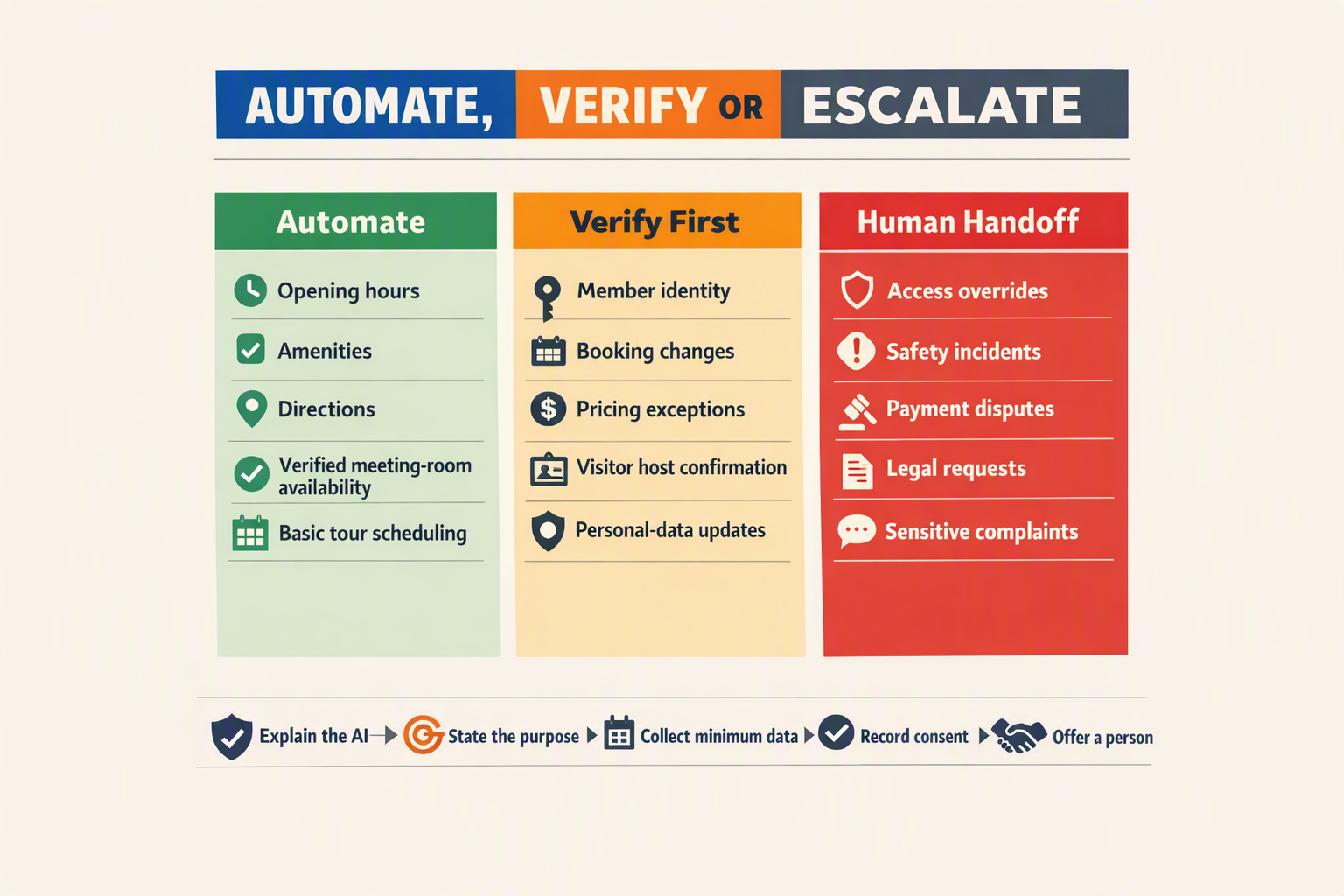
Automation should stop whenever a request involves identity, physical access, payment disputes, sensitive personal data, uncertain inventory, negotiated terms, or safety. An AI receptionist for coworking spaces may collect and route information, but a named employee should approve consequential actions and receive the full conversation context.
Automate routine requests, not exceptions
Meeting-room automation works well when the booking system is authoritative and the request follows standard policy. The agent can check capacity, equipment, location, member entitlement and available times before creating a provisional or confirmed reservation.
Require human review when:
- The calendar and workspace-management system disagree.
- A member requests an exception, refund, credit or fee waiver.
- The booking involves catering, recording equipment, after-hours use or unusually large groups.
- The requester wants access for an unverified external attendee.
- The room is unavailable and displacement of another booking is proposed.
Apply the same principle to office tour booking automation: the system can book verified slots, but it should not invent availability or promise a custom enterprise configuration.
Use a controlled source for member FAQs
Automate answers only from an approved knowledge base containing current opening hours, amenities, parking rules, guest limits, room-booking policies and support contacts. Every article should have an owner, location scope and review date.
The AI should escalate questions about:
- Billing disputes, contract interpretation or cancellation penalties.
- Complaints involving another member or employee.
- Lost access cards, lockouts and security incidents.
- Wi-Fi passwords, alarm codes, door PINs or internal staff details.
- Health emergencies, threats, harassment or damaged property.
A coworking lead qualification AI can ask commercial questions, but it should not reuse prospect data to answer member questions unless the operator has defined a lawful purpose and appropriate access controls.
Minimise visitor intake
Visitor intake should collect only what the site needs: typically visitor name, host, arrival window and a contact method. Do not ask for government identification numbers, photographs or accessibility information by default. If local security policy requires additional data, explain why it is needed, restrict access and set a documented deletion period.
The agent must never remotely unlock a door merely because a caller knows an employee’s name. Access should depend on host confirmation or a verified access-system workflow, with reception or security handling exceptions.
Record consent and preserve channel boundaries
Consent is not a vague checkbox. Store the channel, purpose, wording, timestamp and source of consent, particularly before sending promotional WhatsApp or email messages. Operational replies about an active enquiry should remain separate from marketing permission.
For Indian deployments, privacy design should be reviewed against the Digital Personal Data Protection Act, 2023, applicable rules and sector-specific obligations. Operators serving other markets should map workflows to the relevant local requirements rather than assuming one global notice is sufficient.
Make human handoff immediate and contextual
Coworking WhatsApp automation should offer a person when the user asks, repeats a failed request, expresses frustration or enters a high-risk topic. Phone callers should receive a warm transfer where possible; WhatsApp and email users should receive an owner and expected response window.
Each handoff should include:
- Conversation summary and original transcript
- Verified identity and consent status
- Location, request type and urgency
- Actions already attempted
- The precise decision required
The safest operating rule is simple: automate retrieval and routine execution, but keep humans accountable for exceptions, access, disputes and sensitive decisions.
How do you verify CRM, calendar, telephony, WhatsApp, email and access-system integrations before launch?
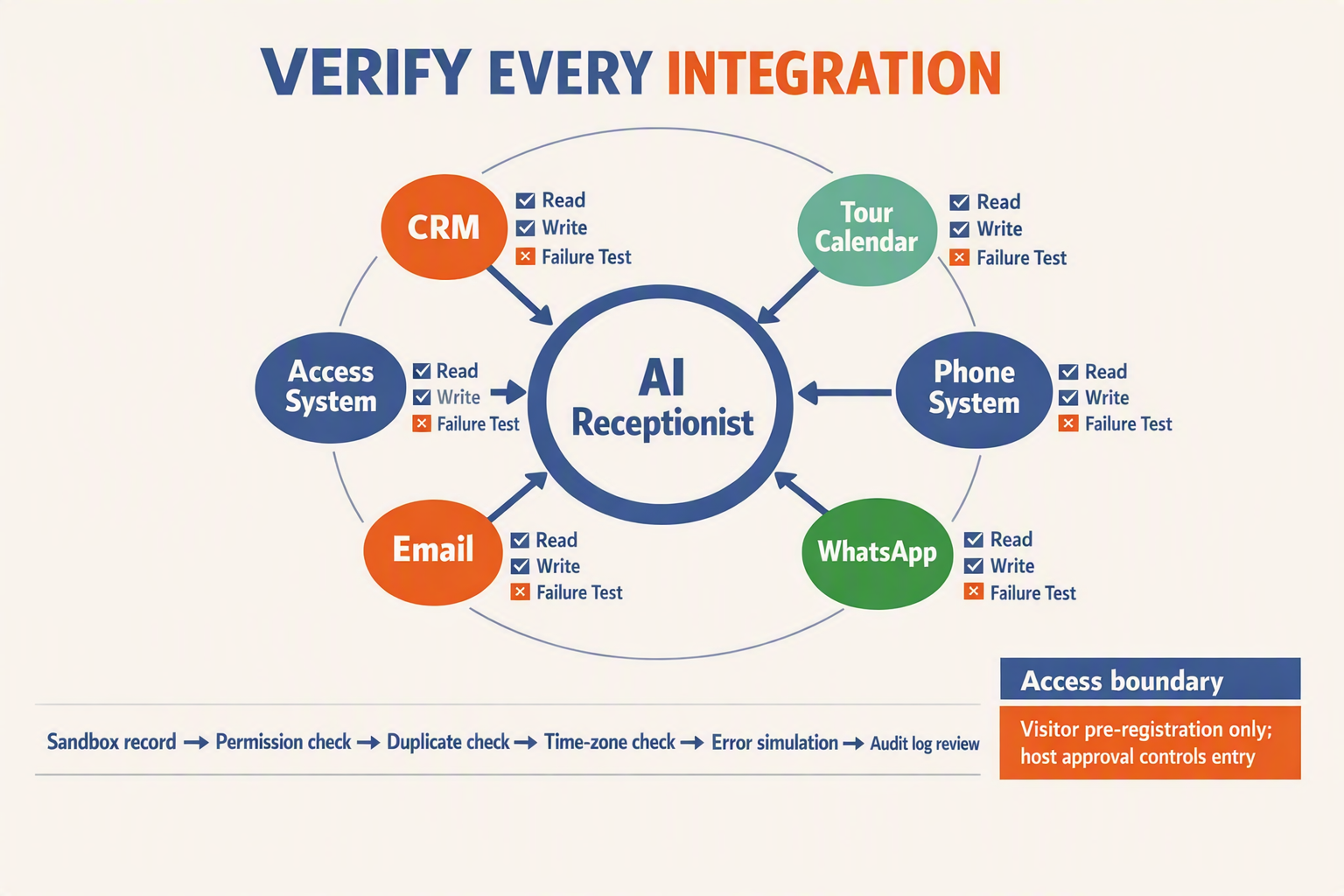
Verify every integration in a production-like sandbox with end-to-end test enquiries, failure simulations, permission checks and record reconciliation. An AI receptionist for coworking spaces is ready only when the same lead, tour and handoff appear correctly across every connected system—not merely when each API reports a successful connection.
Build a channel-to-system test matrix
Create test personas covering a new prospect, existing member, visitor, enterprise buyer and unknown caller. Run each persona through phone, WhatsApp and email, including multilingual and after-hours scenarios.
For every test, confirm:
- Identity matching: Phone numbers use a consistent international format, email addresses are normalised, and duplicate contacts merge only under approved rules.
- CRM writes: Source channel, consent status, location, team size, workspace type, budget band, move-in date and conversation summary reach the correct fields.
- Ownership: City, building and product rules assign the lead to the correct sales queue without overwriting an existing owner.
- Auditability: The CRM retains timestamps, message or call identifiers, workflow decisions and human edits.
- Cross-channel continuity: A person who calls and later messages on WhatsApp is recognised without exposing one contact’s history to another.
Do not accept screenshots as proof. Export test records and compare them field by field with the original conversation.
Test booking and availability under contention
Office tour booking automation must survive simultaneous demand. Ask two test users to select the same slot, then verify that calendar locking permits only one confirmed booking.
Test cancellation, rescheduling, time-zone conversion, public holidays, staff leave and location-specific opening hours. A confirmed tour should create the calendar event, update the CRM stage, send the approved confirmation and notify the centre team. If any write fails, the receptionist should say that the request is pending—not claim that a tour is booked.
Also verify idempotency: replaying the same webhook must not create duplicate tours, contacts or follow-up tasks.
Validate each communication channel
Use real test numbers, mailboxes and approved WhatsApp templates before launch:
- Telephony: Check inbound routing, caller-ID formatting, recording consent, transfers, voicemail, dropped calls and missed-call recovery.
- WhatsApp Business: Test inbound chat, approved business-initiated templates, opt-outs, delivery failures, media handling and the 24-hour customer-service window. For platforms that support WhatsApp Business calling, verify call consent and fallback routing separately.
- Email: Confirm SPF, DKIM and DMARC alignment, reply threading, bounce processing, suppression lists and protection against prompt injection in attachments or quoted text.
- CRM: Simulate API timeouts, rate limits, expired credentials and partial writes.
- Calendar: Confirm resource calendars, buffers, host assignment and double-booking prevention.
These tests determine whether coworking WhatsApp automation and coworking lead qualification AI operate as one workflow rather than disconnected bots.
Keep access systems behind a strict boundary
The receptionist may collect a visitor’s name, host and expected arrival time, but it should not independently reveal PINs, unlock doors or issue permanent credentials. Test that access-system permissions are least-privilege, time-bound and restricted by location.
Require human approval for unexpected visitors, changed host details, denied-entry disputes and after-hours access. Then simulate revoked credentials, an unavailable access API and a mismatched identity; every case should fail closed and alert staff.
Set a launch gate
Launch only when all critical tests pass, failed transactions enter a monitored retry queue, and staff can take over with full context. Record the test owner, timestamp, expected result, actual result and evidence for every scenario; unresolved high-risk failures should block go-live.
How should missed-call recovery and location routing preserve context without creating duplicate leads?
Missed-call recovery should update one canonical enquiry record, not create a fresh lead for every phone call, WhatsApp message, email, or location selected. Preserve the original intent, conversation summary, consent status, and routing history under a stable contact-and-enquiry ID, while allowing separate opportunities only when the prospect has genuinely distinct workspace requirements.
Resolve identity before creating a lead
An AI receptionist for coworking spaces should search the CRM before inserting a record. Exact matches are safest; probabilistic matches should be flagged for review rather than merged automatically.
Use identity signals in this order:
- Verified phone number, normalised to E.164 format.
- WhatsApp Business user number, matched with the phone identity where appropriate.
- Normalised email address.
- Existing CRM contact, account, or opportunity ID supplied by an authenticated workflow.
- Name, company, and location as supporting—not decisive—signals.
Keep the person separate from the enquiry. One facilities manager may legitimately request 20 desks in Bengaluru and a meeting room in Mumbai; those should remain two opportunities under one contact. Conversely, three calls about the same Bengaluru requirement should remain one opportunity with three interaction events.
Recover the call without resetting qualification
A missed call should trigger an event-driven recovery workflow:
- Record the called number, timestamp, source campaign, dialled location, and any IVR selection.
- Check for an open enquiry associated with the caller.
- Attempt a callback within the operator’s configured service window.
- If permitted, send a consent-compliant WhatsApp message identifying the business and purpose.
- Resume from the last unanswered qualification field rather than restarting the script.
- Append the transcript, summary, disposition, and next action to the existing timeline.
For example: “You previously asked about a six-person private office in Andheri for October. Would you like to continue with budget range or see available tour times?” This makes coworking lead qualification AI feel continuous while giving the prospect an opportunity to correct stale information.
Route requirements, not merely phone numbers
Location routing should evaluate structured fields rather than assigning every interaction to whichever centre received the latest call. A practical routing sequence is:
- Explicit preferred building
- City or micro-market
- Workspace type and required capacity
- Verified inventory or tour availability
- Language and accessibility needs
- Existing sales ownership
- Overflow or regional queue
Store both preferred_location and assigned_location. If the preferred centre lacks capacity, the AI can suggest alternatives without silently rewriting the original requirement. Office tour booking automation should also retain the location’s time zone, calendar resource, host, visitor count, and rescheduling history.
Make every write idempotent
Duplicate prevention requires an idempotency key for each inbound event and a deterministic enquiry key for CRM writes. A practical key can combine channel event ID, tenant ID, and event timestamp; retries with the same key should update or return the original result rather than insert another row.
Add safeguards for:
- Simultaneous phone and WhatsApp responses
- Email aliases and forwarded messages
- Telephony webhook retries
- Tour rescheduling mistaken for a new booking
- Two centres claiming the same prospect
- Manual merges that could erase consent history
With coworking WhatsApp automation, preserve each channel’s raw event reference but display one chronological conversation timeline. Human agents should see the captured requirement, previous locations considered, unresolved questions, consent basis, and routing reason—not just an AI-generated summary. If identity confidence is low, create a review task instead of merging records automatically; preventing one duplicate is not worth combining two different people’s data.
What do coworking operations, sales and security experts recommend before trusting an AI receptionist?

Before trusting an AI receptionist for coworking spaces, require separate approval from operations, sales, security, and privacy owners after a controlled pilot. Experts should treat the system as a new operational user—with limited permissions, documented responsibilities, test evidence, and an immediate human fallback—not as an autonomous replacement for the front desk.
Operations: prove that every answer has an owner
Coworking operations leaders should first define a verified source of truth for opening hours, amenities, workspace types, parking, accessibility, meeting-room policies, and location-specific availability. The AI must not infer that one centre’s facilities apply to another.
Before launch, operations should test at least 50–100 representative scenarios, including:
- Similar building or locality names and callers who change locations mid-conversation.
- Closures, sold-out inventory, calendar conflicts, and interrupted bookings.
- Existing members mistakenly entering the prospect workflow.
- Requests involving deliveries, lost property, maintenance, or emergency assistance.
- Unsupported languages, poor call quality, and incomplete email threads.
Every answer should be classified as approved, needs correction, or must escalate. Do not enable door control, visitor admission, or credential retrieval merely because the agent performs well on general enquiries.
Sales: validate qualification without creating friction
Sales leaders should review whether coworking lead qualification AI captures useful information without turning every conversation into an interrogation. Team size, preferred location, move-in date, workspace type, term, and budget band are usually sufficient for initial routing; negotiated pricing and enterprise requirements belong with a salesperson.
For office tour booking automation, sales should confirm that the agent:
- Reads live, location-specific calendar availability.
- Respects travel time, host capacity, holidays, and minimum notice.
- Prevents duplicate bookings across phone, email, and WhatsApp.
- Records the transcript, attribution source, qualification fields, and consent status in the CRM.
- Transfers high-intent or unusual enquiries with context intact.
The acceptance metric should not be booking volume alone. Track qualified-enquiry-to-tour conversion, no-show rate, incorrect-location bookings, duplicate records, and human correction rate.
Security and privacy: assume inputs may be hostile
Security teams should test prompt injection, impersonation, data leakage, excessive permissions, and malicious attachments before connecting the receptionist to production systems. OWASP ranked prompt injection as LLM01 in its 2025 Top 10 for Large Language Model Applications, reinforcing that customer-provided text, documents, and web content must be treated as untrusted input.
The review should verify:
- Role-based access and separate credentials for CRM, calendar, telephony, and access systems.
- Encryption, audit logs, retention periods, deletion procedures, and vendor-subprocessor visibility.
- Redaction of payment data, identity documents, door codes, Wi-Fi credentials, and other secrets.
- Explicit approval before a conversation moves from phone or email into coworking WhatsApp automation.
- A tested kill switch, incident owner, and manual reception process.
The NIST AI Risk Management Framework 1.0, published in January 2023, structures AI oversight around four functions: Govern, Map, Measure, and Manage. That is a useful approval model: document ownership, map potential harm, measure performance under realistic conditions, and manage failures continuously.
Final trust gate: use four signatures
Production access should require written sign-off from operations, sales, security/privacy, and the site manager. Platforms such as CallMissed can unify AI voice, WhatsApp, email, CRM workflows, and multilingual engagement, but each connected action should still receive the minimum permission necessary. Launch one location first, review transcripts and exceptions daily, and expand only when error thresholds and escalation targets remain stable.
What should your rollout plan, operating checklist and KPI dashboard include?
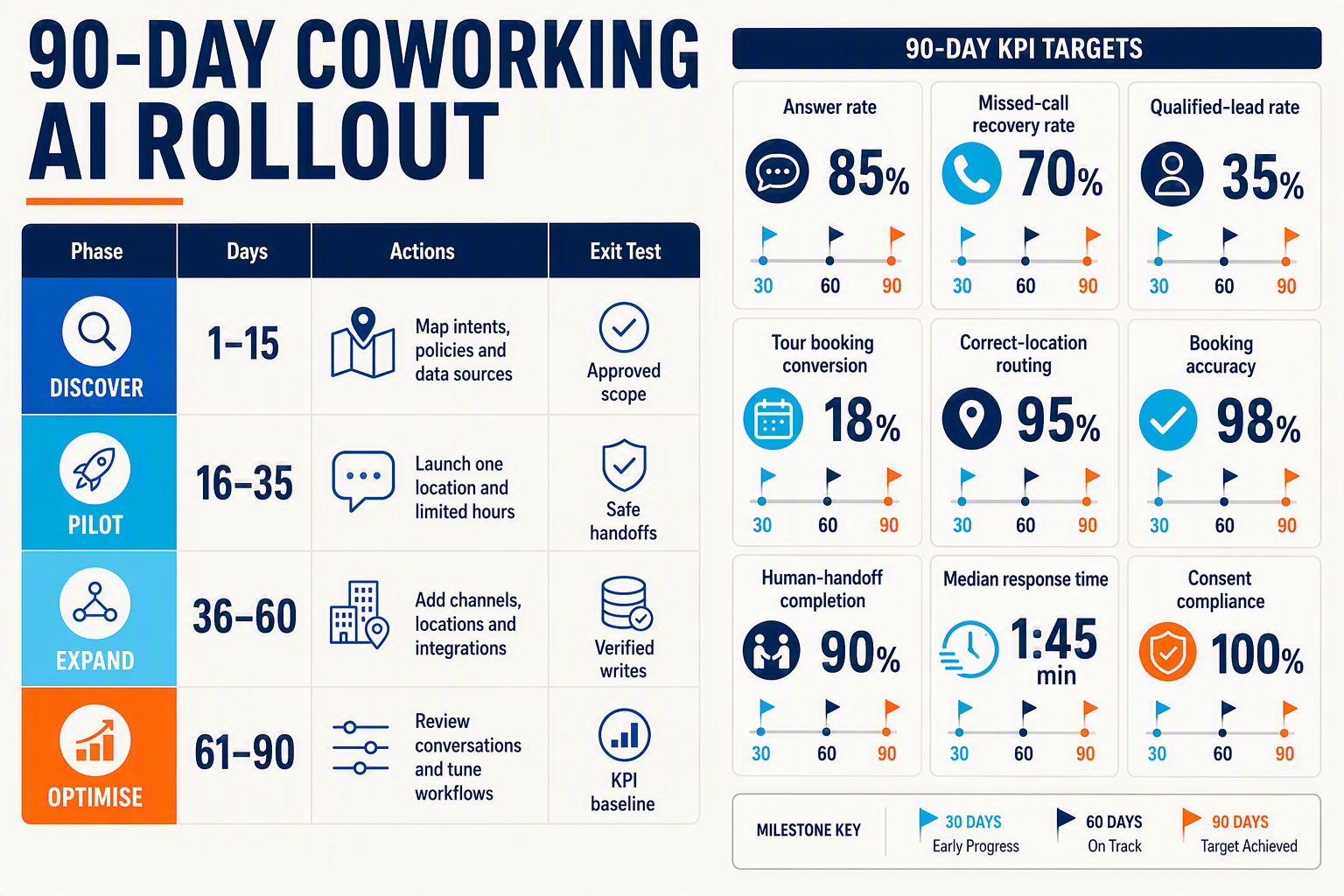
Use a gated pilot rather than a portfolio-wide launch: establish clean location data, test integrations, run one site in shadow mode, then expand only when booking accuracy, handoffs, consent capture and CRM writes meet documented targets. The dashboard should measure business outcomes and operational risk—not simply how many conversations the AI handled.
Rollout plan and operating gates
| Phase | Operating checklist | Exit gate | KPI to monitor |
|---|---|---|---|
| 1. Baseline | Record 2–4 weeks of enquiry volume, response time, missed calls, tours and no-shows by channel and location | Baseline approved by sales and operations | Median response time; enquiry-to-tour rate |
| 2. Data readiness | Validate addresses, hours, amenities, pricing rules, workspace types, availability source and escalation owners | Sample answers match approved records | Answer accuracy; data-correction rate |
| 3. Integration testing | Test CRM create/update, calendar holds, email delivery, telephony, WhatsApp consent and duplicate detection | Every critical test has a pass/fail record | CRM write success; booking completion |
| 4. Shadow pilot | Run one centre for 7–14 days with staff reviewing conversations before actions are confirmed | No unresolved critical privacy or routing errors | Handoff rate; routing accuracy |
| 5. Controlled live pilot | Enable selected intents, channels and opening hours; review failures daily | Targets sustained for two consecutive weeks | Tour conversion; no-show rate; containment |
| 6. Portfolio expansion | Add locations in cohorts, preserving local knowledge, ownership and language rules | Each cohort passes the same acceptance suite | Performance by site, channel and language |
The figures above are recommended operating windows, not universal industry benchmarks. Each operator should set thresholds from its own baseline, lead value, staffing model and location complexity.
For multilingual deployments, test each enabled language independently rather than assuming one successful English workflow generalises. CallMissed supports speech and chat across 22 Indian languages, but operators should activate only languages for which location content, human escalation and quality-review capacity are ready.
KPI dashboard definitions
Your dashboard for an AI receptionist for coworking spaces should show daily operational alerts and weekly conversion trends:
- First-response time: elapsed time from the first phone call, WhatsApp message or email to a meaningful reply. Report median and 90th percentile; averages can hide long waits.
- Enquiry-to-qualified-lead rate: percentage of genuine prospects with workspace type, team size, location, move-in date and contact permission captured. This is the core quality measure for coworking lead qualification AI.
- Booking completion rate: confirmed tours divided by prospects who accepted a proposed slot. Track calendar conflicts, abandoned bookings and failed confirmations separately to evaluate office tour booking automation.
- Enquiry-to-tour conversion: completed tour bookings divided by eligible workspace enquiries, segmented by source, centre and channel.
- No-show rate: booked tours not attended or cancelled before the agreed cut-off, divided by all confirmed tours.
- Human-handoff rate: conversations transferred to staff divided by handled conversations. A high rate may indicate poor knowledge coverage; an unusually low rate may reveal unsafe over-automation.
- CRM write success: successful, correctly mapped creates or updates divided by attempted writes.
- Correction rate: records that staff must amend because of wrong location, intent, availability, contact details or consent status.
Daily operating checklist
Assign a named owner to verify:
- Failed calls, undelivered messages, calendar conflicts and integration alerts.
- Consent records, suppression requests and retention-policy exceptions.
- Escalations awaiting a human response, including billing disputes and uncertain availability.
- Knowledge changes covering prices, closures, amenities and inventory.
- Samples from coworking WhatsApp automation, phone and email—not only successful conversations.
Never connect the receptionist directly to unrestricted access-control actions. Test access-system integrations in a sandbox or read-only mode, prohibit the disclosure of door codes or credentials, and require authorised staff approval for visitor access.
Frequently Asked Questions about AI receptionists, tour booking and coworking automation
What can an AI receptionist for coworking spaces handle?
How does coworking lead qualification AI identify high-intent prospects?
Can office tour booking automation prevent double bookings and no-shows?
Is coworking WhatsApp automation suitable for enquiries and missed-call recovery?
What boundaries should apply to visitor intake, privacy, and building access?
How should operators verify CRM, calendar, telephony, and access-system integrations?
How much does coworking automation cost, and how should ROI be measured?
Conclusion
An AI receptionist for coworking spaces should do more than answer calls: it should connect phone, WhatsApp, and email enquiries, qualify prospects, route them to the correct location, and book verified tour slots while preserving a clear path to human support. In 2026, the strongest deployments will combine fast responses with accurate centre-level data, explicit consent, privacy controls, and disciplined escalation.
The practical takeaways are clear:
- Design one governed, omnichannel workflow. Maintain context when a prospect moves from a missed call to WhatsApp or emails several locations. Capture workspace type, team size, budget band, preferred centre, move-in date, and term length once, then write verified information and interactions back to the CRM.
- Treat qualification and booking as operational processes. Effective coworking lead qualification AI identifies whether a prospect needs a hot desk, private office, meeting room, virtual office, or enterprise suite. Office tour booking automation should check current availability, schedule or reschedule appointments, issue confirmations, assign sales ownership, and retain an audit trail.
- Automate routine requests, not sensitive decisions. Coworking WhatsApp automation can recover missed calls, answer approved member FAQs, handle meeting-room requests, and route enquiries by language or location. Human teams should take over when availability is uncertain, a member disputes a charge, a visitor requests access credentials, or an enterprise buyer needs negotiated terms.
- Roll out cautiously and measure outcomes. Start with one centre and verify CRM, calendar, telephony, email, WhatsApp Business, and access-system integrations before expanding. Track response time, enquiry-to-tour conversion, booking completion, no-shows, handoff rate, containment, and data-correction errors.
Meta reported in May 2025 that WhatsApp had more than 3 billion monthly users, reinforcing why channel continuity now matters. Operators can explore CallMissed, an AI-native communication platform supporting voice and chat across 22 Indian languages, including AI agents for WhatsApp Business calls.
Looking ahead, watch whether automation improves conversion without increasing incorrect bookings, privacy exposure, or frustrating handoffs. The defining question is not how many conversations AI can contain, but how many qualified enquiries it can move safely toward a successful tour—so which centre and workflow will you pilot first?
Related Reading
Discussion
Related Posts



Ready to automate customer conversations?
Launch AI voice agents and WhatsApp bots with CallMissed — one API, 22+ Indian languages.