
AI Call Center Software for Small Businesses: 2026 Comparison and Selection Guide



Compare AI call center software by use case, voice quality, latency, compliance, pricing, integrations, analytics, and rollout fit.
AI Call Center Software for Small Businesses: 2026 Comparison and Selection Guide
Could an AI agent answer every routine customer call without making callers wait—or exposing a small business to compliance and reputational risk? In 2026, AI call center software can handle inbound support, qualify outbound leads, schedule appointments, retrieve knowledge, and transfer complex conversations to employees, but the right choice depends on measurable performance rather than impressive demonstrations.
The stakes are rising because AI calling now sits at the intersection of customer expectations, rapidly improving speech technology, and stricter regulation. On February 8, 2024, the U.S. Federal Communications Commission ruled that AI-generated voices count as “artificial or prerecorded voice” under the Telephone Consumer Protection Act, making consent and identification controls essential for automated calling. The European Union’s AI Act entered into force on August 1, 2024, with important transparency provisions becoming applicable on August 2, 2026. These requirements mean that an affordable system can still become an expensive mistake if it lacks consent records, disclosure controls, audit logs, data-retention settings, or reliable human escalation.
Choosing between AI contact center software, a standalone voice AI platform for small business, and a broader AI customer service platform also requires looking beyond feature checklists. A polished voice is not enough if latency causes callers to speak over the agent, integrations fail to update the CRM, or analytics cannot explain why calls convert, escalate, or end early. Likewise, automated call center software designed for inbound appointment booking may not provide the campaign controls, permission management, and suppression lists needed for outbound engagement.
This guide provides a verification-first framework for evaluating a conversational AI call center, including:
- Inbound and outbound workflows, from reception and support to reminders and permission-based lead follow-up
- Voice quality and latency, including interruption handling, pronunciation, background noise, and real-world response times
- Integrations and analytics, covering CRM updates, APIs, call outcomes, transcripts, quality assurance, and ROI measurement
- Multilingual support, with attention to regional accents, code-switching, and language-specific speech models
- Compliance, security, and human handoff, including consent, disclosures, escalation context, and auditability
- Pricing and implementation, including per-minute, subscription, usage-based, and build-versus-buy models
Platforms such as CallMissed reflect this shift by combining AI voice agents with WhatsApp Business calling, omnichannel engagement, and support for speech across 22 Indian languages—capabilities particularly relevant to businesses serving multilingual Indian customers.
Rather than publishing an unverified ranking or vendor price list, this buyer guide will show you what to test, what to ask, and how to compare total operational value before committing.
What is the best AI call center software for a small business in 2026? The best choice is the verified option that fits your call flows, integrations, compliance duties, budget, and human-escalation needs—not a universal top-ranked vendor
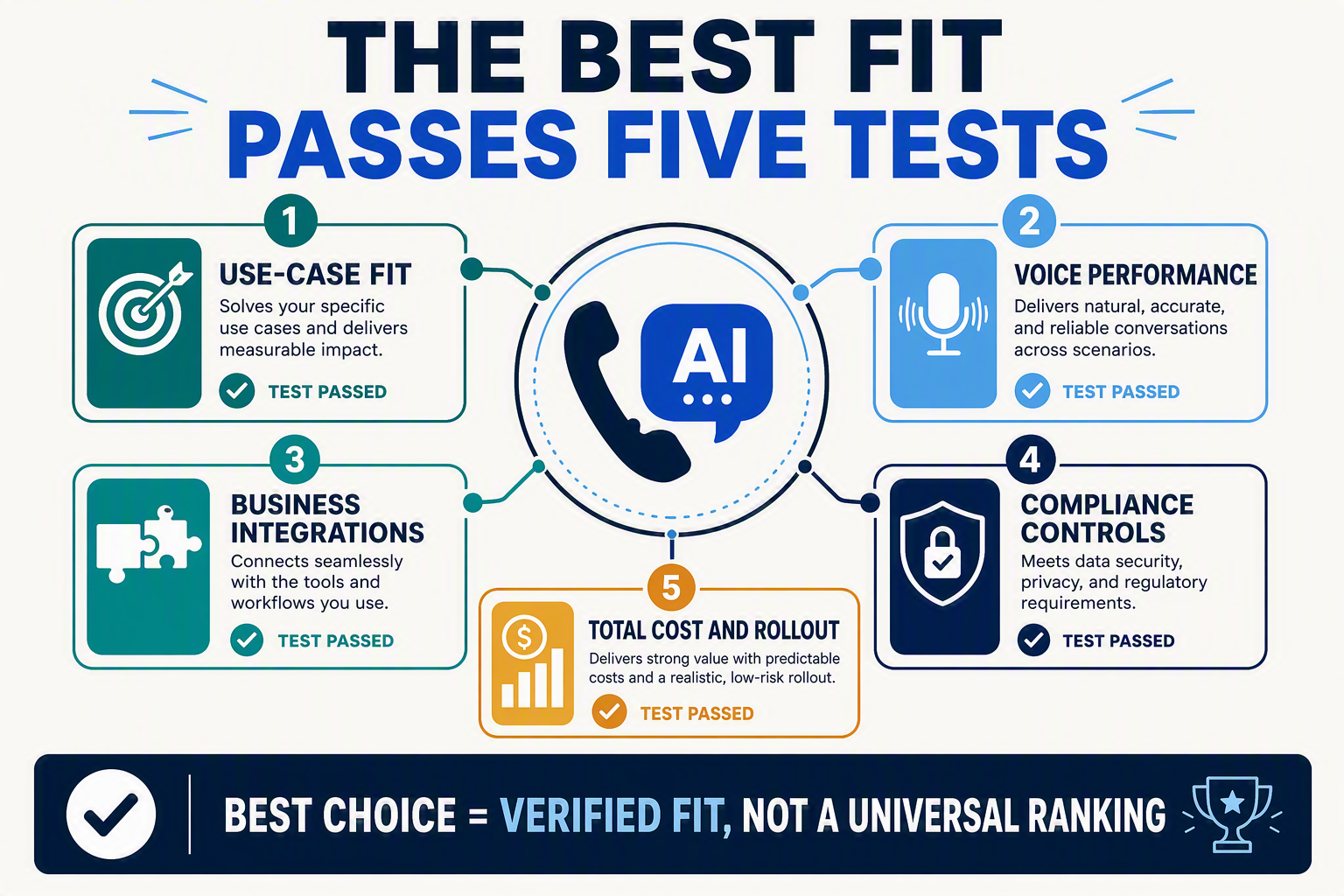
The best AI call center software for a small business in 2026 is the product that passes a real-world test of the business’s call flows, integrations, compliance controls, total cost, and human handoffs. No vendor is universally optimal: an effective appointment-booking agent may be unsuitable for outbound collections, multilingual support, or regulated customer data.
Start with the job, not the vendor
Define exactly what the AI must accomplish before requesting demonstrations or proposals. Small-business requirements commonly fall into three categories:
- Inbound service: Answer FAQs, identify callers, book appointments, check order status, capture messages, route calls, and escalate urgent cases.
- Outbound engagement: Send reminders, follow up with permission-based leads, confirm bookings, conduct surveys, or recover abandoned enquiries.
- Blended operations: Continue conversations across telephone, web, email, CRM, and messaging channels.
A standalone voice AI platform for small business may be sufficient for one narrow workflow. AI contact center software is generally more appropriate when managers need queues, routing, agent workspaces, quality assurance, and workforce reporting. An AI customer service platform becomes relevant when conversations must persist across several channels.
Build a verification-first scorecard
Evaluate every shortlisted product against the same weighted criteria rather than relying on feature pages or staged demos:
- Call-flow fit: Can the system complete the intended task, validate information, recover from errors, and recognize when it should stop?
- Voice performance: Test pronunciation, interruption handling, background noise, silence, accents, code-switching, and response latency on actual telephone connections.
- Integration depth: Confirm whether CRM, calendar, help-desk, payment, and telephony integrations support two-way updates—not merely contact imports.
- Analytics: Require searchable transcripts, call outcomes, transfer reasons, task-completion rates, latency measurements, and exportable audit records.
- Human escalation: Verify warm transfers, fallback numbers, operating-hours rules, queue handling, and whether employees receive the transcript and collected context.
- Commercial model: Compare subscription fees, usage charges, telephone costs, implementation work, premium voices, integrations, support, and overage rates.
- Operational control: Look for role-based permissions, versioning, test environments, prompt-change logs, retention settings, and rapid shutdown controls.
A conversational AI call center should be tested with adversarial scenarios as well as successful calls. Ask employees to interrupt it, provide ambiguous dates, change languages mid-call, request a human repeatedly, and supply information that conflicts with the knowledge base.
Treat compliance as a deployment requirement
Outbound capability does not automatically make automated call center software lawful for every campaign. The U.S. Federal Communications Commission confirmed on February 8, 2024, that AI-generated voices fall under the Telephone Consumer Protection Act’s rules for artificial or prerecorded voices. Buyers should therefore verify consent evidence, identity disclosures, opt-out processing, suppression lists, calling-hour controls, and campaign-level audit trails with qualified legal advisers.
The European Union AI Act’s relevant transparency provisions became applicable on August 2, 2026, according to the European Commission’s implementation timeline. Businesses operating across jurisdictions should confirm where recordings, transcripts, embeddings, and customer identifiers are processed and retained.
Require proof before committing
Run a time-limited pilot using representative calls and predetermined acceptance thresholds. The winning option should demonstrate reliable task completion, acceptable latency, accurate system updates, compliant outbound controls, predictable costs, and graceful escalation—not simply the most human-sounding demo.
How do AI contact center software, a conversational AI call center, an AI customer service platform, and automated call center software differ? Background, scope, and terminology
These terms overlap, but they describe different channels, automation depths, and product boundaries. For a small business, the practical distinction is whether the system manages voice calls alone, coordinates multiple customer channels, provides a complete service workspace, or simply automates predefined telephony tasks.
From call centers to AI-managed contact centers
A traditional call center primarily handles telephone conversations through queues, interactive voice response, routing, recording, and agent desktops. A contact center expands that scope to channels such as WhatsApp, SMS, email, web chat, and social messaging.
AI adds another layer rather than creating one universally defined product category. Depending on the platform, AI may transcribe calls, summarize conversations, recommend answers, independently conduct dialogue, or orchestrate workflows across several channels. Consequently, vendors may use similar terminology for materially different capabilities.
The following working definitions make comparisons more consistent:
- AI call center software focuses on inbound or outbound telephone operations enhanced by AI. Typical functions include autonomous voice agents, intelligent routing, transcription, call summaries, quality assurance, appointment booking, lead qualification, and human transfer.
- AI contact center software manages voice alongside digital channels, ideally preserving customer identity, conversation history, consent status, and escalation context across them.
- A conversational AI call center emphasizes autonomous, natural-language interaction. It should understand caller intent, retrieve information, maintain conversational context, handle interruptions, perform actions, and escalate when confidence is low.
- An AI customer service platform is broader than telephony. It may combine knowledge management, ticketing, agent assistance, workflow automation, customer profiles, analytics, and self-service across voice and messaging.
- Automated call center software is the broadest—and often least specific—term. It can describe anything from menu-based interactive voice response and automatic dialling to a generative AI agent, so buyers must verify what “automated” actually means.
- A voice AI platform for small business usually provides the speech and orchestration components needed to build or deploy voice agents, sometimes without the full CRM, workforce-management, campaign, or omnichannel capabilities of a contact-center suite.
Automation is not necessarily conversational AI
Rules-based automation follows predefined branches: “Press 1,” detect a keyword, play a recording, or route the call. Conversational AI interprets open-ended speech and determines an appropriate response or action.
A genuine conversational system should demonstrate:
- Multi-turn context, including references to information provided earlier in the call
- Interruption handling, so callers can correct or redirect the agent
- Tool execution, such as checking availability or updating a customer record
- Knowledge grounding, with answers constrained by approved business information
- Confidence-based escalation, including a transcript and collected details for the employee
Scripted automation can still be appropriate for payment reminders, opening-hours announcements, and simple routing. It may be cheaper, more predictable, and easier to audit than a generative agent.
Product labels do not determine operational fit
A platform calling itself an “AI contact center” may offer only voice and SMS, while an “AI customer service platform” may depend on a separate telephony provider. Buyers should therefore map products by deployable capability, not category name.
Ask whether each platform includes:
- Native inbound numbers and outbound calling controls
- Autonomous voice agents or only employee assistance
- CRM, ticketing, calendar, and payment integrations
- Unified analytics across calls and messages
- Human handoff with complete conversation context
- Multilingual speech recognition and synthesis
- APIs for custom workflows and data portability
Terminology also does not alter legal obligations. The U.S. Federal Communications Commission ruled on February 8, 2024, that AI-generated voices fall under Telephone Consumer Protection Act restrictions on artificial or prerecorded voices. Whether software is marketed as conversational, automated, or omnichannel, its real workflows determine the required consent, disclosure, recordkeeping, and suppression controls.
What changed in AI calling for small businesses in 2026? Key developments to verify rather than assume
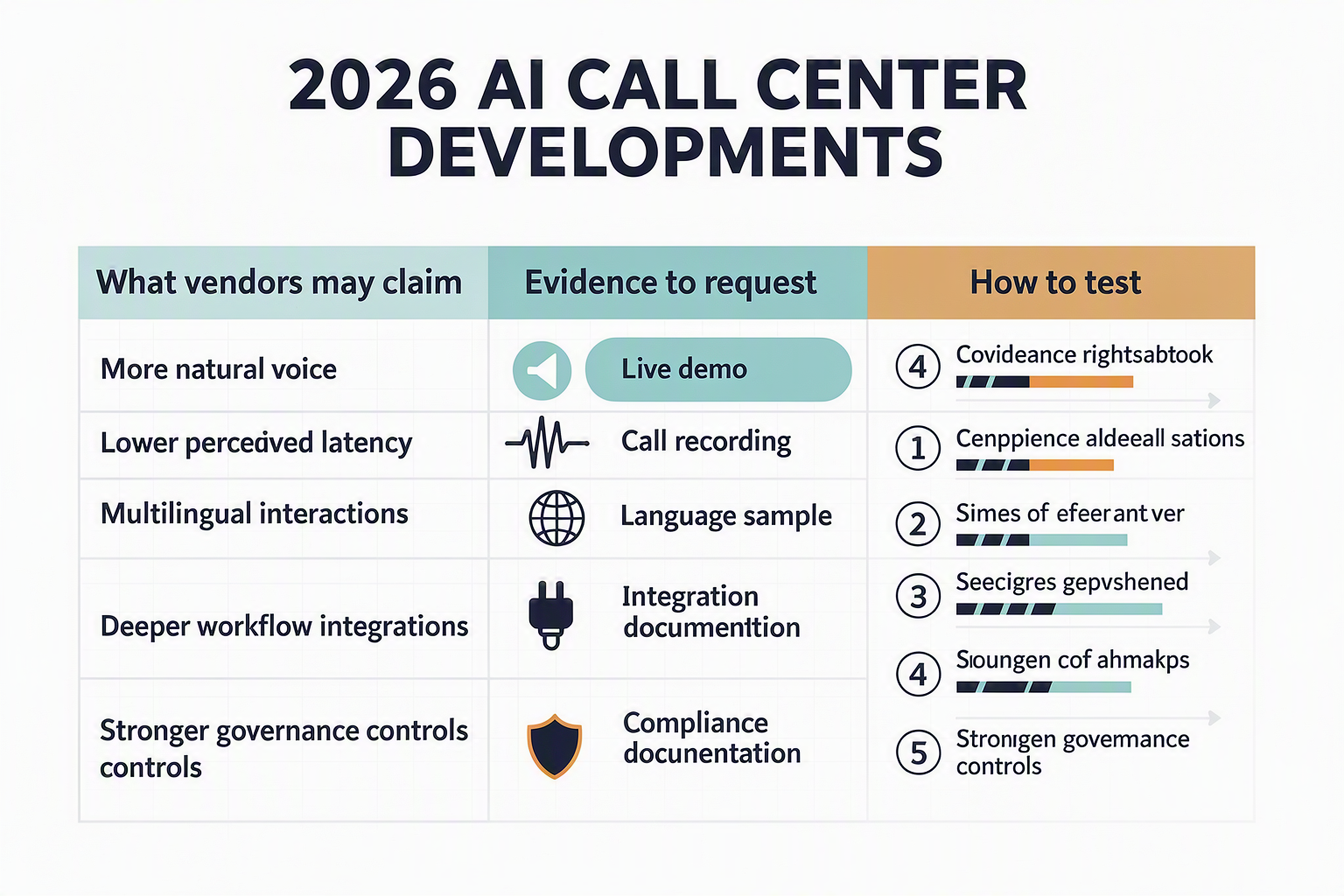
AI calling in 2026 has moved beyond scripted demonstrations toward production workflows that can listen, respond, trigger approved actions, and escalate across channels. However, buyers evaluating AI call center software for small businesses should treat claims about human-like speech, instant responses, multilingual accuracy, autonomous resolution, and compliance as testable claims—not guaranteed capabilities.
Developments that require evidence
| 2026 development | Why it matters | What to verify | Evidence to request |
|---|---|---|---|
| More natural, interruptible voice | Better turn-taking can reduce callers talking over the agent | End-to-end latency over the public phone network, barge-in accuracy, background-noise handling, pronunciation, and recovery from dropped audio | Recordings from representative calls; median and 95th-percentile latency; results under concurrent load |
| Task-performing agents | Agents may book appointments, qualify leads, update records, or initiate approved service actions instead of merely answering questions | Whether each action reaches the correct CRM, calendar, help desk, or payment workflow without duplication | API logs, sandbox demonstrations, permission controls, rollback procedures, and failure-handling tests |
| Multilingual and code-switched speech | Language coverage can expand access, but support quality may vary significantly by language and accent | Recognition accuracy, voice quality, local accents, brand terminology, code-switching, and language-specific escalation | Native-speaker tests, transcripts, task-completion rates, and results for each language being purchased |
| Omnichannel continuity | A conversation may begin by phone and continue through WhatsApp, email, SMS, or web chat | Whether identity, history, consent status, and agent notes remain synchronized across supported channels | An end-to-end journey test showing matching inbox, CRM, consent, and handoff records |
| Deeper conversation analytics | Transcripts and event data can support quality assurance, intent analysis, and outcome measurement | Whether dashboards distinguish resolution, transfer, abandonment, conversion, silence, integration failure, and system error | Metric definitions, exportable event data, recording links, retention settings, and sample audit trails |
| Stronger governance controls | Automated calls may trigger consent, disclosure, suppression, privacy, recording, retention, and audit obligations | Jurisdiction controls, calling-hour rules, suppression lists, disclosure scripts, consent evidence, deletion workflows, and human escalation | Timestamped consent records, policy configuration, role-based access, change logs, and an independent legal or compliance review |
“Available” does not mean “production-ready”
A capability advertised by AI call center software for small businesses may be limited to particular languages, countries, phone-number types, integrations, channels, or subscription tiers. “Multilingual,” for example, does not establish equivalent accuracy in every supported language. An integration listing also does not prove that failed or duplicate actions are handled safely.
Run a controlled pilot using at least three call conditions:
- Normal calls: Common requests spoken clearly in a quiet environment.
- Difficult calls: Interruptions, background noise, uncommon names, code-switching, weak connections, and frustrated callers.
- High-risk calls: Refund demands, payment information, uncertain consent, emergencies, account changes, or requests outside the approved knowledge base.
Score each platform on task completion, factual accuracy, transfer success, latency, transcription quality, integration success, caller effort, and policy compliance. Report median and poor-case performance separately. Require enough calls to expose intermittent failures and repeat the test under expected concurrent-call load.
Compliance became a product capability
Compliance should be evaluated inside the calling workflow, but software controls do not replace legal analysis.
In the United States, the FCC’s February 2024 declaratory ruling confirmed that AI-generated voices fall within the Telephone Consumer Protection Act’s restrictions on calls using an “artificial or prerecorded voice.” That ruling did not make every AI-assisted call unlawful. Applicable consent standards depend on factors including whether the call is inbound or outbound, its purpose, the number called, and whether a statutory or regulatory exemption applies. Telemarketing calls generally face stricter consent requirements than non-marketing calls, while federal identification, opt-out, Do-Not-Call, and recordkeeping rules may also apply.
The FCC has also considered AI-specific disclosure requirements through rulemaking. A proposed rule is not the same as an effective rule, so businesses should verify the current FCC regulations and docket status rather than relying on summaries. State telemarketing, privacy, call-recording, and AI-disclosure laws can impose separate obligations.
In the European Union, Article 50 of Regulation (EU) 2024/1689—the EU AI Act—became applicable on August 2, 2026 under the regulation’s implementation timetable. Among other transparency duties, it requires providers of AI systems intended to interact directly with people to ensure that individuals are informed they are interacting with AI, unless that fact is obvious to a reasonably well-informed and observant person in the circumstances, subject to specified exceptions. Businesses should verify whether they are acting as a provider or deployer and whether other consumer-protection, privacy, employment, recording, or sector-specific rules also apply.
For multilingual Indian operations, CallMissed publishes support for 22 Indian languages and connectivity between WhatsApp Business calling and an AI agent. Buyers should confirm which languages, accents, telephony regions, WhatsApp configurations, and pricing tiers are currently enabled for their account. Native-speaker testing should cover local pronunciation, mixed-language conversations, business terminology, consent prompts, and escalation to a person.
The central 2026 change is not that every conversational platform has become fully autonomous. It is that stronger AI call center software for small businesses can demonstrate measurable operational outcomes—and that responsible buyers now require reproducible evidence, jurisdiction-specific controls, and reliable human fallback before deployment.
How should small businesses compare vendors? A verification-first matrix for inbound, outbound, voice quality, latency, integrations, analytics, multilingual support, compliance, and human handoff
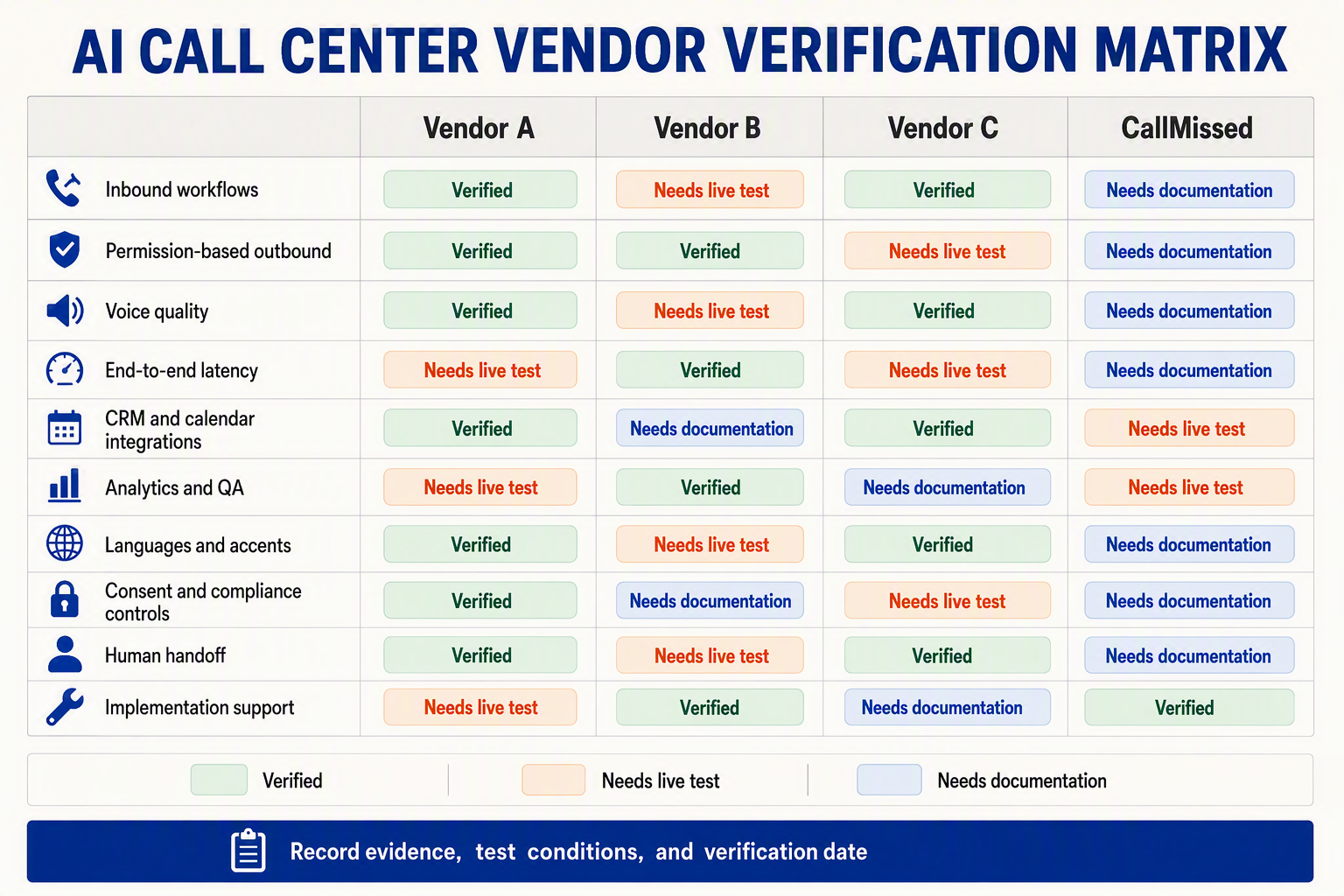
The right vendor is the one that can prove performance in your workflows, languages, telephony environment, and compliance regime. Compare every shortlisted product with the same test calls, acceptance criteria, and evidence requests—not vendor demos or feature checkmarks.
Verification-first comparison matrix
| Evaluation area | Evidence to request | Real-world test | Warning signs |
|---|---|---|---|
| Inbound and outbound | Supported call flows, campaign controls, consent records, suppression lists, retry rules, and after-hours routing | Run booking, support, missed-call recovery, reminder, and permission-based follow-up scenarios from start to finish | One generic demo; uncontrolled retries; no distinction between inbound service and outbound campaigns |
| Voice quality and latency | Recordings, pronunciation controls, interruption handling, and median plus P95 response latency | Test noisy rooms, mobile connections, names, addresses, numbers, barge-ins, silence, and rapid turn-taking | Only studio recordings; frequent caller overlap; averages reported without tail latency |
| Integrations | CRM connector documentation, API references, webhooks, field mappings, retry behavior, and failure logs | Create and update a real contact, appointment, ticket, disposition, and callback task in a sandbox | “Integration available” without write-back, authentication details, retries, or error visibility |
| Analytics | Call outcomes, transcripts, recordings, funnel reports, escalation reasons, QA controls, and export options | Reconcile total calls, completed tasks, transfers, opt-outs, failures, and billable usage against source records | Vanity metrics; opaque outcome labels; no raw-data export or explanation of failed calls |
| Multilingual support | Language and locale list, speech-model details, custom vocabulary, transliteration, and code-switching support | Use native speakers to test regional accents, mixed-language sentences, proper nouns, dates, and local place names | “Multilingual” means translation only; no language-specific speech testing or production samples |
| Compliance and human handoff | Disclosure settings, consent logs, retention controls, role-based access, audit trails, transfer rules, and data residency terms | Revoke consent, request deletion, trigger an urgent escalation, and confirm the employee receives transcript and context | No immutable event history; blind transfers; continued calling after opt-out; unclear subprocessors |
Turn demonstrations into controlled trials
Whether evaluating AI call center software, AI contact center software, a voice AI platform for small business, or a broader AI customer service platform, use an identical test pack. A conversational AI call center should be evaluated conversationally, while automated call center software must also be tested for operational controls.
Create 20–30 representative calls using anonymized examples from your business. Include successful tasks, ambiguous requests, angry callers, unsupported questions, silence, voicemail, opt-outs, and transfer requests. Record:
- Task-completion rate, not merely whether the agent answered
- Median and P95 latency, because averages can conceal disruptive slow turns
- Transfer success and context completeness
- CRM write-back accuracy and duplicate-record rates
- Language-specific accuracy, rather than one blended multilingual score
- Cost per successfully completed outcome, including telephony, model usage, and transfers
Apply gates before weighted scoring
Treat compliance, opt-out enforcement, emergency escalation, and data protection as pass/fail gates. A vendor with a polished voice should not compensate for a failed consent or handoff test.
After those gates, score each category from 1 to 5 and assign weights based on actual call volume. For example, a regional Indian service business may weight multilingual speech and telephony more heavily than outbound campaign scale. CallMissed’s support for speech across 22 Indian languages and AI-agent bridging for WhatsApp Business calls can be tested directly with native speakers and live transfer scenarios; those capabilities should still undergo the same verification process as every other shortlisted platform.
Which voice AI platform for small business can handle inbound and outbound calls with natural voice, low latency, and reliable multilingual support?
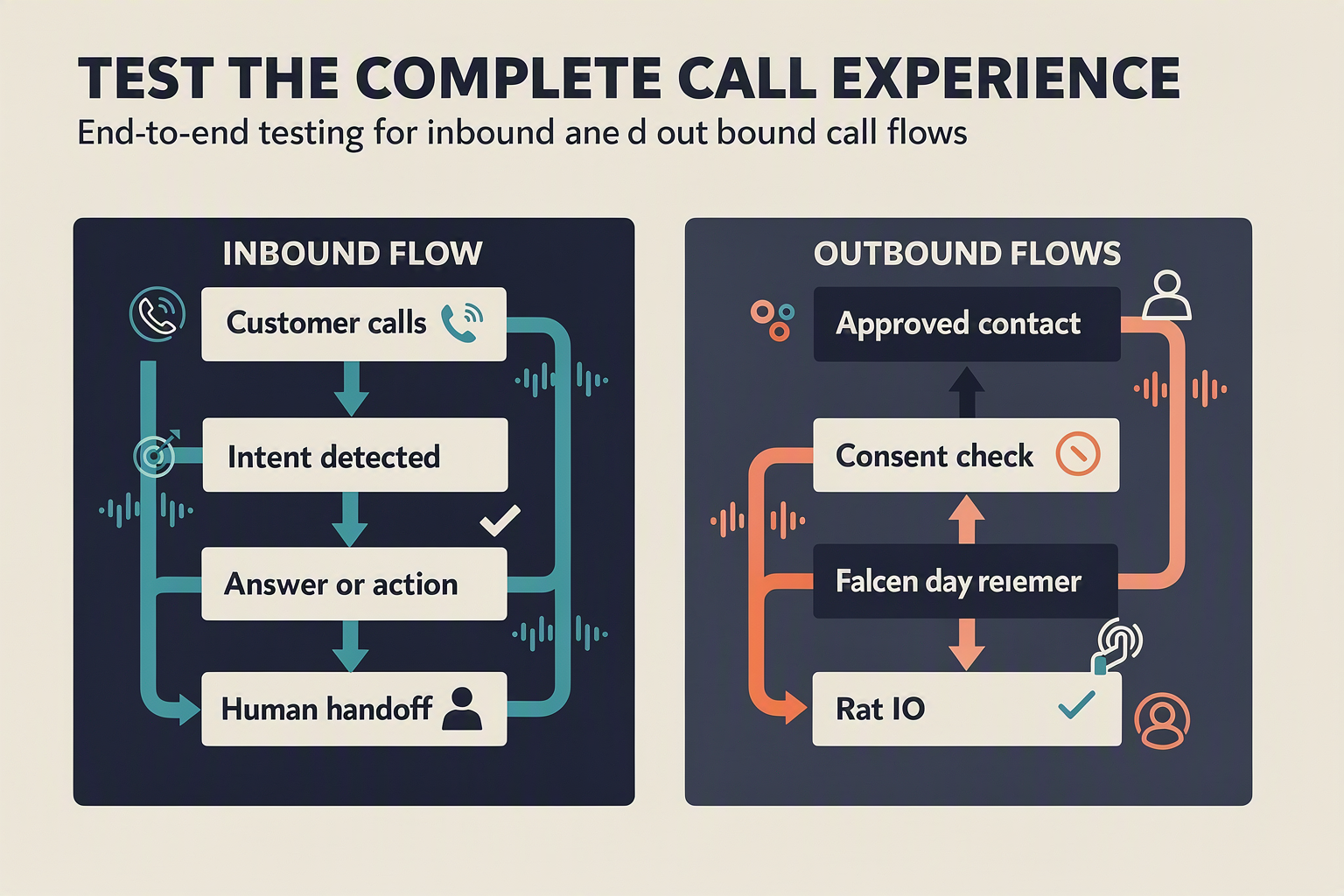
The right voice AI platform for small business is the one that passes a real-call bake-off across inbound and outbound workflows—not the one with the most convincing studio demo. Evaluate naturalness, end-to-end latency, multilingual accuracy, integration reliability, and escalation performance using your own phone numbers, scripts, customer accents, and background conditions.
Match the platform to the calling workflow
Start by distinguishing what the system must do on each side of the call:
- Inbound: identify intent, answer from an approved knowledge base, authenticate callers, book appointments, update records, route calls, and transfer unresolved cases.
- Outbound: obtain or verify permission, identify the business and AI agent, respect suppression lists, retry within defined limits, record dispositions, and stop when consent is withdrawn.
- Blended: preserve customer context when a conversation moves between inbound calls, outbound follow-ups, WhatsApp, email, and human agents.
Some automated call center software is optimized for structured reminders or appointment booking, while broader AI contact center software may provide routing, workforce tools, quality assurance, and multiple channels. A full AI customer service platform is more appropriate when voice interactions must share customer history and knowledge with messaging or email.
Test natural voice and latency under realistic conditions
“Low latency” should be treated as a measurable service objective. Ask vendors to report median, 95th-percentile, and 99th-percentile response latency, then independently measure the time between the caller finishing a phrase and the agent beginning a relevant response.
Run at least these tests:
- Interrupt the agent mid-sentence and verify that speech stops promptly.
- Use speakerphone, road noise, weak mobile connectivity, and overlapping speech.
- Read names, addresses, prices, dates, abbreviations, and industry terminology.
- Introduce silence, corrections, ambiguous answers, and topic changes.
- Transfer to an employee and confirm that the transcript, intent, and collected details arrive with the call.
Naturalness depends on more than the text-to-speech voice. A conversational AI call center must recognize turn boundaries, avoid repetitive acknowledgements, pronounce local names correctly, and recover gracefully rather than hallucinating an answer.
Verify multilingual support language by language
A vendor’s language count does not establish production reliability. Test speech recognition, voice synthesis, intent detection, retrieval, and analytics separately for every required language.
Your multilingual evaluation set should include:
- Regional accents and mixed-language sentences
- Code-switching, such as Hindi-English or Tamil-English
- Numbers, currencies, addresses, and proper nouns
- Formal and colloquial phrasing
- Human handoff without losing the selected language
CallMissed is particularly relevant for Indian operations because its product scope covers Speech-to-Text and Text-to-Speech across 22 Indian languages, alongside AI voice agents and WhatsApp Business calls connected to an AI agent. That breadth should still be validated against the business’s actual vocabulary and caller population.
Use a pass-or-fail shortlist
Before selecting AI call center software, require each finalist to complete the same scripted trial. Set minimum acceptance criteria for task completion, incorrect actions, transfer success, CRM write-back, transcript accuracy, call-disposition accuracy, and latency percentiles.
Reject a platform if it cannot demonstrate:
- Reliable inbound and permission-based outbound controls
- API or native integration with your CRM and calendar
- Searchable transcripts and outcome analytics
- Language-specific testing rather than a generic “multilingual” label
- Safe failure behaviour and immediate human escalation
- Exportable logs for operational and compliance review
The strongest shortlist will come from measured production-like calls, not feature-count comparisons.
How much does an AI call center cost, and what should buyers verify about pricing models, integrations, analytics, security, and compliance?
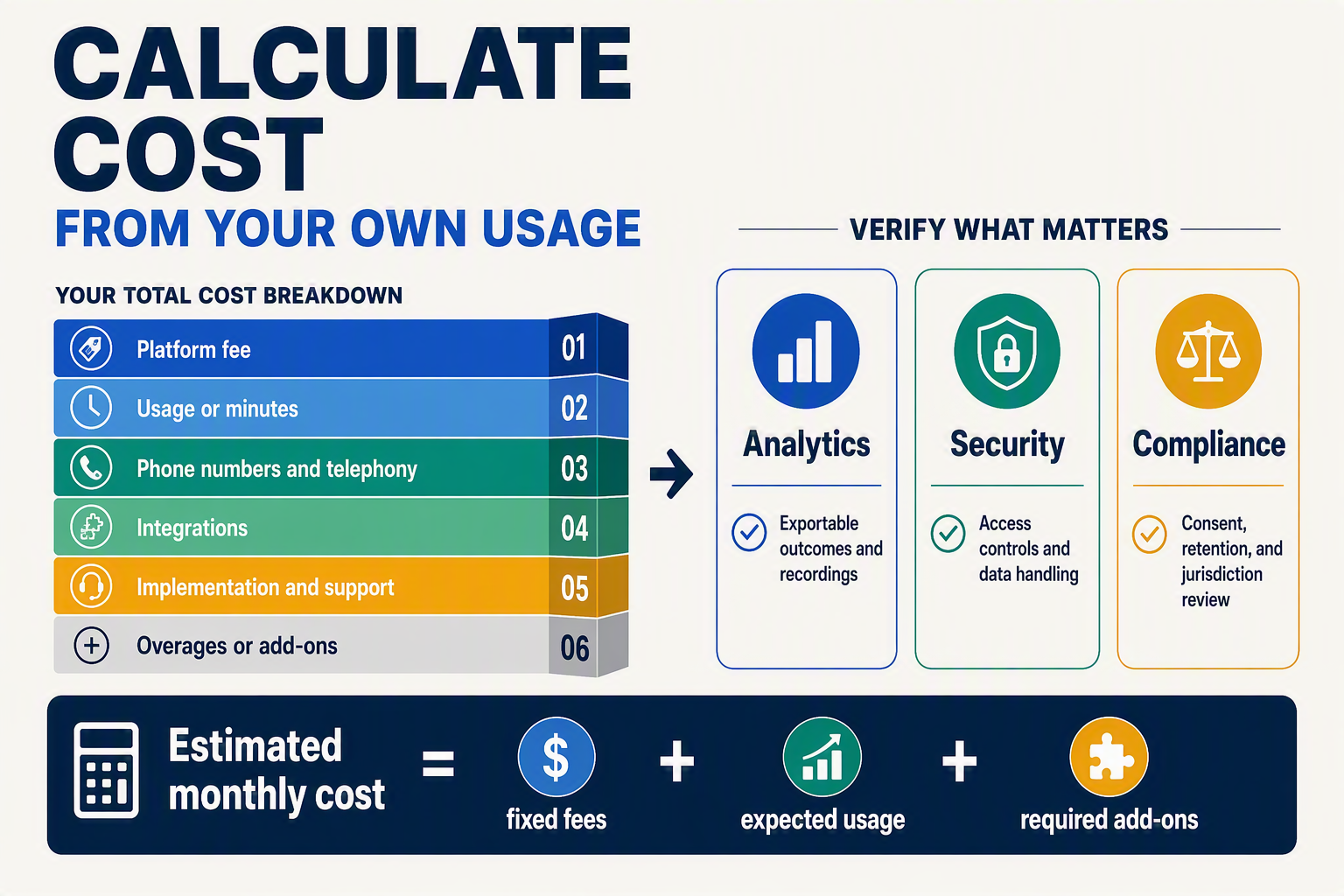
AI call center costs vary because the invoice may combine subscriptions, call minutes, telephony, speech processing, model usage, phone numbers, integrations, and support. Buyers should compare the total cost of one completed business outcome—not merely the advertised per-minute rate—and verify every integration, analytics, security, and compliance claim in a pilot.
Calculate total cost, not headline price
Common pricing models for AI call center software include:
- Per-minute: Charges for connected call time, sometimes with separate inbound, outbound, or carrier rates.
- Usage-based: Speech-to-Text, Text-to-Speech, large language model tokens, recordings, and webhooks may be metered independently.
- Per-agent or subscription: A monthly fee may include usage allowances, workflows, inbox seats, or analytics.
- Outcome-based: Pricing may be tied to qualified leads, completed bookings, or resolved calls; buyers must define outcomes and disputed events precisely.
- Implementation fees: Custom CRM work, knowledge-base preparation, prompt design, number provisioning, and staff training can be separate.
Use a workload model:
Monthly cost = platform fee + telephony + AI processing + numbers + storage + integrations + support + overages.
Calculate this for normal volume and a peak-volume scenario. Ask whether silence, ringing, transfers, voicemail detection, failed outbound attempts, and human-agent time are billable. Also verify concurrency limits: inexpensive minutes offer little value if the system cannot answer simultaneous calls during demand spikes.
CallMissed uses transparent credits where one credit equals ₹1, with a free tier and pay-as-you-go access. Small businesses should still model each intended workflow because voice, models, channels, and call duration can affect consumption.
Verify integrations and analytics with live tests
A conversational AI call center should complete actions rather than merely claim integration compatibility. During evaluation, require the vendor to demonstrate:
- Reading the correct CRM contact and consent status.
- Creating or updating a lead without duplicates.
- Booking, changing, and cancelling an appointment.
- Passing the transcript, summary, disposition, and caller context to a human.
- Retrying safely when an API or CRM is unavailable.
For analytics, confirm that the AI customer service platform reports containment, transfer rate, task completion, abandonment, average call duration, latency, failed tool calls, and cost per outcome. Buyers should be able to filter results by workflow, language, campaign, location, and time period—not rely solely on an overall “success rate.”
Examine security and compliance evidence
Request documented answers rather than accepting a compliance logo. The security review for AI contact center software should cover:
- Encryption in transit and at rest, role-based access, multifactor authentication, and audit logs.
- Data location, subprocessors, retention periods, deletion workflows, and whether customer data trains shared models.
- Redaction of payment details, identity numbers, health information, and authentication credentials.
- Incident-response commitments, penetration-test summaries, and exportable consent records.
- Contracts such as a Data Processing Agreement or, for applicable U.S. healthcare workloads, a Business Associate Agreement.
The European Commission states that GDPR Article 33 can require controllers to notify the supervisory authority of a personal-data breach within 72 hours after becoming aware of it. PCI Security Standards Council made the future-dated requirements of PCI DSS 4.0.1 effective on March 31, 2025, so businesses taking card payments should prevent sensitive card data from entering transcripts or recordings.
Finally, require the automated call center software vendor to price and document a representative pilot. A credible comparison uses the same call volume, languages, integrations, retention period, support level, and human-handoff workflow across every shortlisted voice AI platform for small business.
What do experts recommend for implementation, human handoff, and build versus buy?
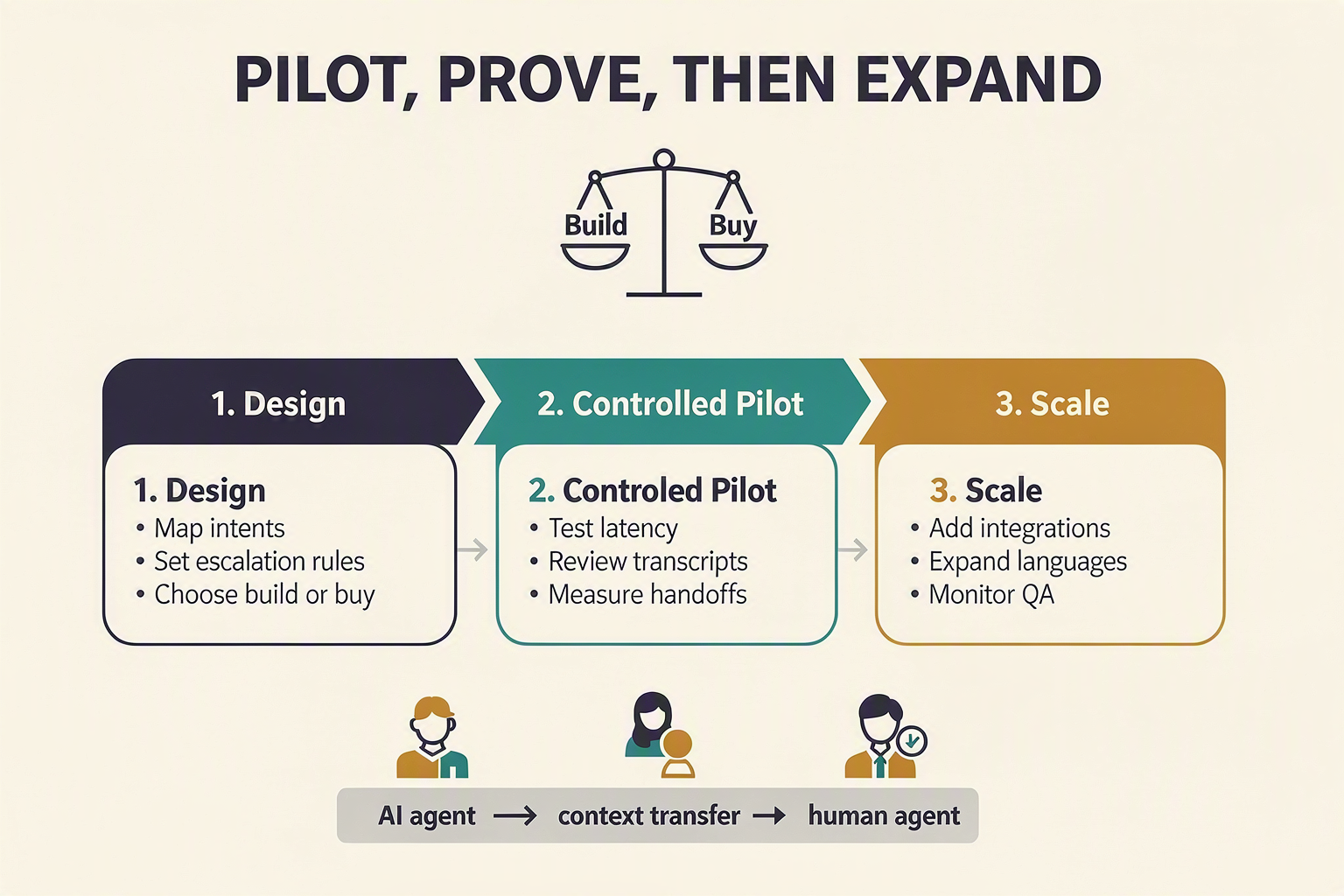
Implement AI call center software in phases: buy the dependable communication infrastructure, customize workflows and knowledge, and build proprietary components only when they create measurable differentiation. Every production deployment should also provide immediate human escalation with the transcript, caller identity, intent, and actions already taken.
Start with one bounded workflow
Experts generally recommend avoiding an “automate everything” launch. Select one high-volume, low-risk use case—such as appointment booking, order-status enquiries, missed-call recovery, or permission-based follow-up—and establish its current baseline before introducing automation.
A practical implementation sequence is:
- Map the conversation: Document intents, required data, system actions, failure states, disclosures, and escalation routes.
- Connect a controlled knowledge source: Use approved FAQs, policies, product data, and operating procedures rather than allowing unrestricted answers. The CallMissed knowledge-base RAG implementation guide explains document preparation, retrieval testing, and answer governance.
- Test realistic conditions: Include accents, code-switching, background noise, interruptions, silence, ambiguous requests, and unavailable integrations.
- Run a limited pilot: Restrict the initial audience, operating hours, call types, or outbound campaign size.
- Review outcomes weekly: Track containment, transfers, task completion, abandonment, latency, incorrect answers, complaints, and cost per completed outcome.
The CallMissed AI agent analytics guide provides a deeper framework for conversation intelligence, quality assurance, and ROI measurement. A successful pilot should improve business outcomes—not merely generate a high number of automated conversations.
Design human handoff before launch
A conversational AI call center needs escalation by design, not as an emergency patch. Transfer rules should cover explicit requests for an employee as well as inferred risk signals.
Common escalation triggers include:
- Repeated misunderstanding or low speech-recognition confidence
- Customer frustration, threats, complaints, or vulnerable-customer indicators
- Refunds, disputes, cancellations, emergencies, or high-value transactions
- Failed CRM, payment, scheduling, or authentication actions
- Questions unsupported by the approved knowledge base
- Any caller requesting a person
The receiving employee should see a structured handoff package containing the transcript, concise summary, detected intent, authentication status, collected fields, sentiment indicators, and completed tool actions. Avoid forcing customers to repeat information. The CallMissed human-handoff guide covers transfer triggers, context preservation, routing, and post-transfer measurement.
Compliance must also be a launch gate. The U.S. Federal Communications Commission ruled on February 8, 2024, that AI-generated voices qualify as an “artificial or prerecorded voice” under the Telephone Consumer Protection Act. The European Union AI Act’s relevant transparency provisions become applicable on August 2, 2026, reinforcing the need for clear disclosure, consent controls, and auditable records.
Decide what to buy and what to build
For most small businesses, buying AI contact center software is more practical than assembling telephony, speech recognition, text-to-speech, orchestration, monitoring, security, and failover independently.
Buy when speed, standard CRM integrations, managed telephony, compliance controls, and predictable operations matter most. Build when the business needs proprietary routing logic, specialized models, unusual data residency, or deeply differentiated workflows. A hybrid approach often works best: purchase the voice AI platform for small business, then customize prompts, RAG, APIs, analytics, and escalation policies.
CallMissed supports this hybrid model through AI voice agents, WhatsApp Business calling, omnichannel workflows, and an OpenAI-compatible developer gateway. Teams evaluating broader AI customer service platform or automated call center software deployments can use the CallMissed customer-service operations guide to plan staffing, QA, escalation, and continuous improvement.
What does this mean for your shortlist, and where may CallMissed fit? Use-case recommendations and vendor questions without invented rankings
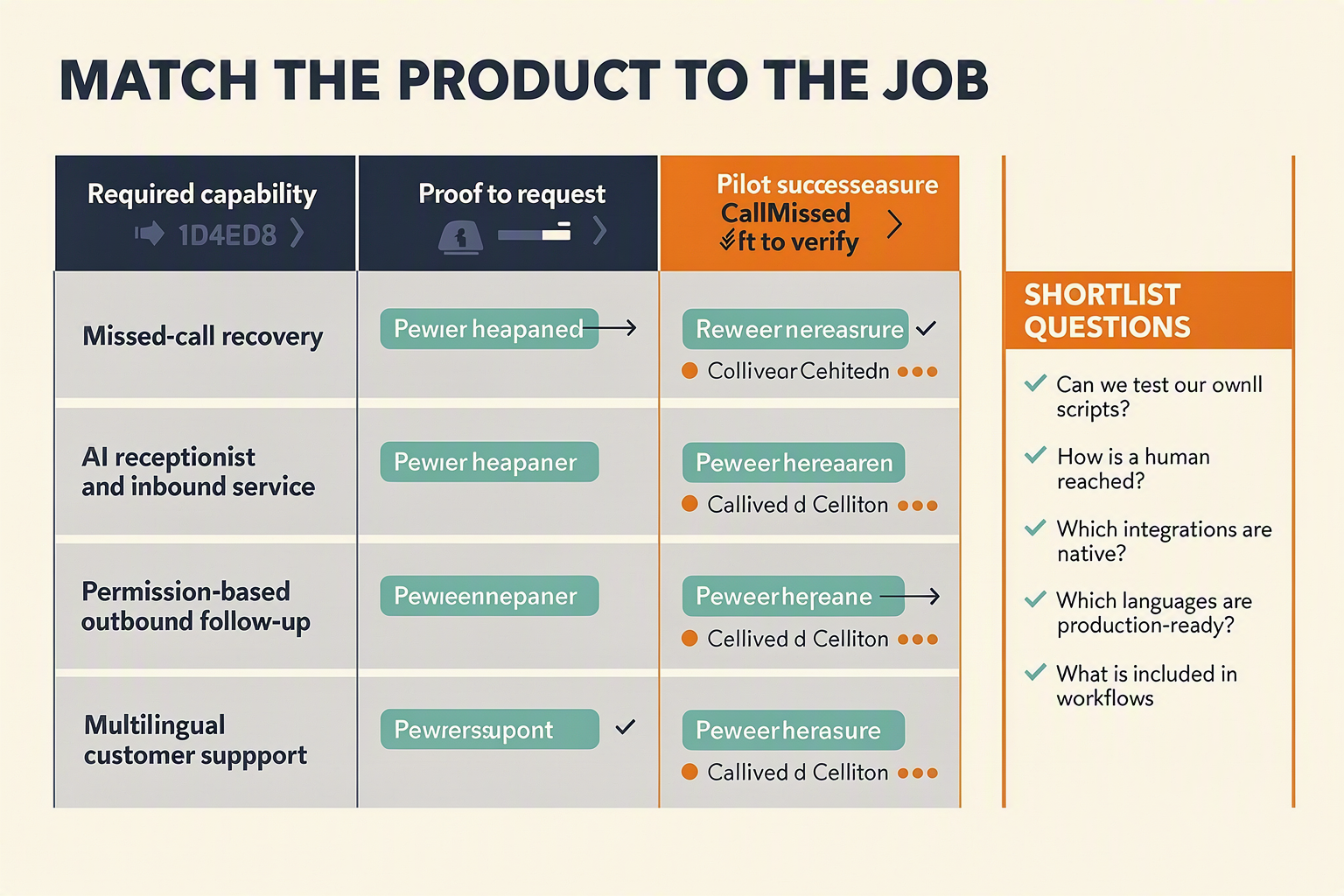
Your shortlist should contain two or three vendors that can prove performance in your actual workflows, languages, integrations, and regulatory environment. CallMissed may fit particularly well when an Indian small business needs multilingual voice automation, WhatsApp Business calling, or omnichannel engagement rather than a voice-only tool.
Use-case shortlist matrix
| Business requirement | Prioritise in the shortlist | Proof to request in a pilot | Where CallMissed may fit |
|---|---|---|---|
| Inbound reception and booking | Interruption handling, calendar integration, transfer rules, after-hours coverage | Successful bookings, transfer accuracy, median and p95 response latency | AI voice agents can answer routine calls, schedule actions, use knowledge-base RAG, and escalate conversations |
| Customer support | CRM access, authenticated workflows, transcript quality, human handoff | Resolution rate, repeat-call rate, escalation context, incorrect-answer review | Suitable when voice, WhatsApp, email, and web interactions should appear in an omnichannel inbox |
| Permission-based outbound calling | Consent records, suppression lists, campaign controls, disclosures | Auditable consent, opt-out handling, call disposition accuracy | Consider alongside a documented permission-based outbound workflow; do not treat automation as permission to contact |
| Regional Indian audiences | Accent testing, code-switching, language-specific STT and TTS | Native-speaker evaluation using real names, addresses, noise, and mixed-language speech | CallMissed supports Speech-to-Text and Text-to-Speech across 22 Indian languages using Indic-focused capabilities |
| WhatsApp-led engagement | Chat, inbound calling, business-initiated calling, shared customer history | End-to-end WhatsApp call, AI-agent response, escalation, and CRM update | CallMissed can bridge WhatsApp Business voice calls to an AI agent, in addition to supporting WhatsApp chatbots |
| Custom developer build | APIs, webhooks, model choice, fallbacks, observability | Failure simulation, provider fallback, rate limits, usage reconciliation | The OpenAI-compatible CallMissed API gateway provides LLM, STT, TTS, image-generation, and web-search models through one integration |
This matrix does not rank vendors. A specialised voice AI platform for small business may be appropriate for one tightly defined workflow, while broader AI contact center software or an AI customer service platform may reduce integration work across channels. Teams with engineering capacity may instead assemble a conversational AI call center from telephony, speech, model, and analytics APIs.
Questions every shortlisted vendor should answer
Ask each provider to respond in writing and demonstrate the answers with your data:
- What latency do you measure? Request median and p95 end-to-end conversational latency—not only model inference time—and test interruptions, silence, and background noise.
- What happens when a dependency fails? Verify retry behaviour, model or carrier fallback, duplicate-action prevention, and whether calls can still reach an employee.
- How is human handoff implemented? The employee should receive the caller’s identity, transcript, intent, completed steps, and reason for escalation.
- Which integrations are native? Distinguish a productised CRM or calendar connector from a webhook that your team must maintain.
- Can analytics explain outcomes? Require searchable transcripts, call dispositions, conversion or resolution events, escalation reasons, and exportable logs.
- How are consent and disclosures recorded? On February 8, 2024, the U.S. Federal Communications Commission ruled that AI-generated voices qualify as “artificial or prerecorded voice” under the Telephone Consumer Protection Act. The European Union AI Act entered into force on August 1, 2024, and important transparency provisions became applicable on August 2, 2026.
- What is included in the total cost? Separate subscriptions, call minutes, telephony, model usage, recordings, storage, integrations, support, and implementation.
Make the decision with evidence
Run the same two-to-four-week pilot for every shortlisted AI call center software provider. Score task completion, p95 latency, handoff success, language accuracy, integration reliability, compliance evidence, and total operating cost; reject any automated call center software that cannot produce auditable results for the workflows that matter most.
Frequently asked questions: Is AI call center software suitable for very small teams, can it replace human agents, how is latency tested, which languages are supported, is outbound AI calling legal, how long does implementation take, and should you build or buy?
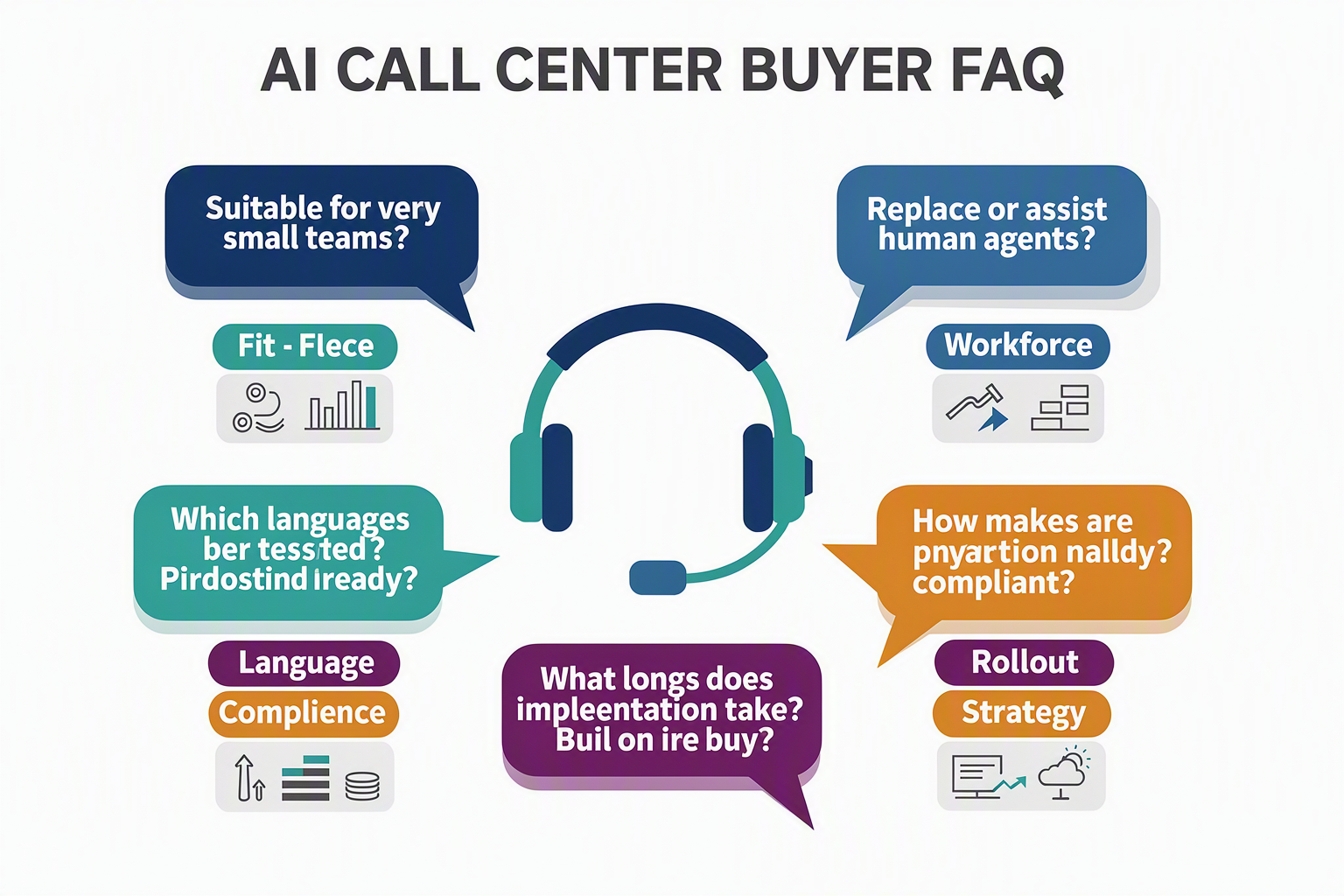
Is AI call center software suitable for a very small business or solo team?
Can an AI voice agent completely replace human call center agents?
How should small businesses test latency in AI call center software?
Which languages should a multilingual voice AI platform for small business support?
Is outbound calling with AI call center software legal in 2026?
How long does conversational AI call center implementation take, and should a business build or buy?
Conclusion
The right AI call center software in 2026 is not necessarily the platform with the most features; it is the one that performs reliably in real customer conversations, fits the intended workflows, and provides verifiable compliance and business outcomes. Small businesses should compare systems using live pilots, measurable service levels, and total operating costs rather than demonstrations or unverified rankings.
Key takeaways
- Match the platform to the workflow. Inbound support, appointment scheduling, missed-call recovery, outbound reminders, and permission-based lead follow-up require different routing, campaign, consent, suppression-list, and escalation capabilities. Confirm whether automated call center software supports each intended use case before committing.
- Test conversations under realistic conditions. Evaluate voice quality, response latency, interruption handling, pronunciation, background noise, regional accents, code-switching, and human handoff. A voice AI platform for small business should transfer the transcript, customer details, and reason for escalation—not merely redirect the call.
- Verify operational visibility and integration depth. A credible conversational AI call center should update CRM records consistently and expose transcripts, call outcomes, conversion rates, escalation reasons, quality-assurance data, and audit logs. Whether choosing standalone AI contact center software or a broader AI customer service platform, calculate ROI using resolved calls, booked appointments, recovered leads, employee time saved, and total implementation costs.
- Treat compliance as a selection criterion. The U.S. Federal Communications Commission ruled on February 8, 2024, that AI-generated voices qualify as “artificial or prerecorded voice” under the Telephone Consumer Protection Act. The European Union’s AI Act entered into force on August 1, 2024, with important transparency provisions applying from August 2, 2026; buyers should therefore verify consent records, disclosures, retention controls, and auditability.
What to watch next
As speech models improve, differentiation will increasingly depend on dependable multilingual performance, lower real-world latency, stronger analytics, omnichannel continuity, and graceful escalation—not synthetic voice quality alone. Businesses should also reassess build-versus-buy decisions as usage grows and compare subscription, per-minute, and usage-based pricing against integration and maintenance costs.
To explore how AI communication is evolving, consider CallMissed, an AI-native platform combining voice agents, WhatsApp Business calling, omnichannel engagement, and speech support across 22 Indian languages. Which platform can prove it will handle your customers, languages, integrations, and compliance requirements reliably—not just perform well in a scripted demo?
Related Reading
Discussion
Related Posts
Ready to automate customer conversations?
Launch AI voice agents and WhatsApp bots with CallMissed — one API, 22+ Indian languages.