Voice Agent API & Phone Numbers API: CallMissed Developer Guide


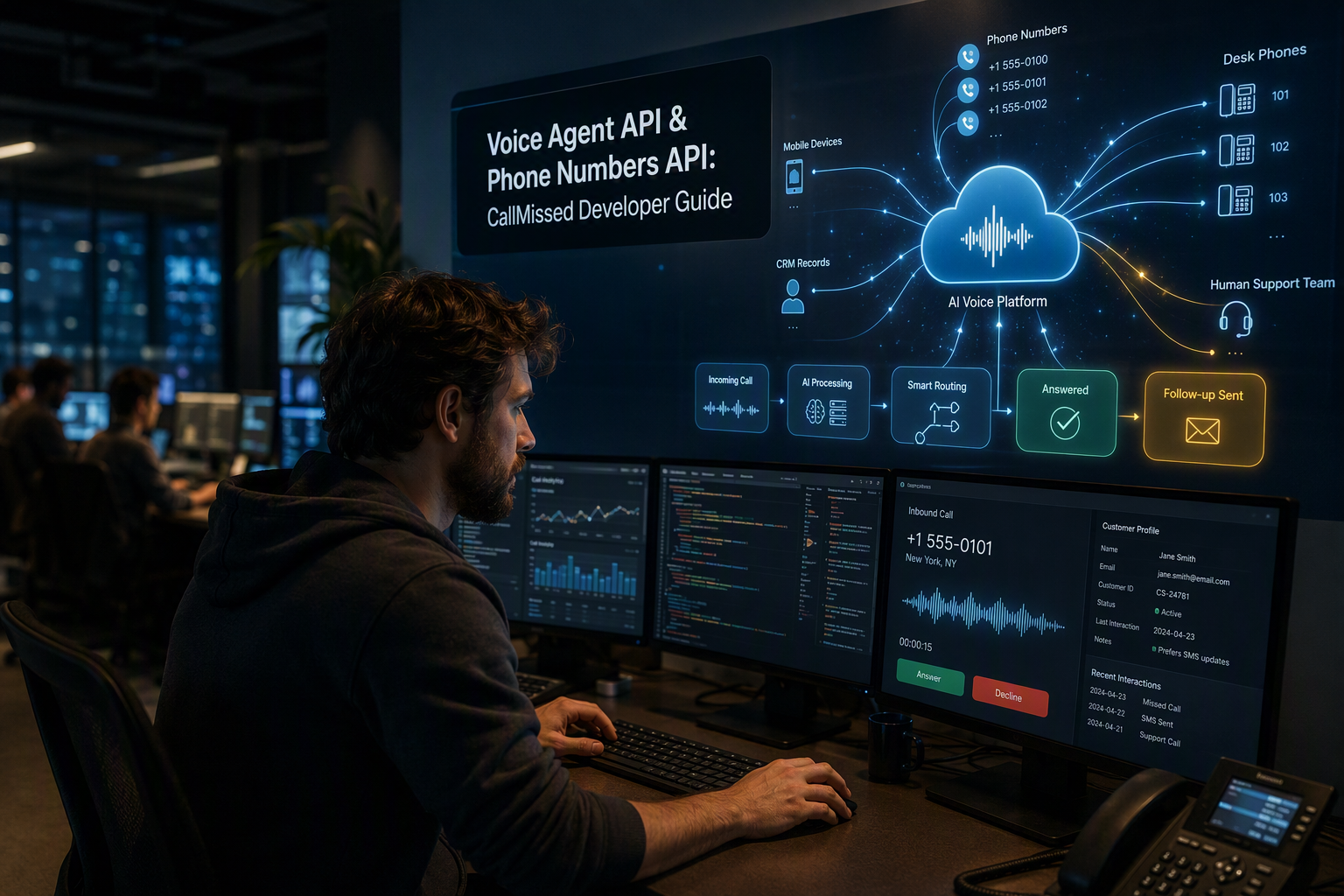
Learn how a voice agent API links business numbers, AI calls, webhooks, transfers, follow-ups, context, security and human handoff.
Voice Agent API & Phone Numbers API: CallMissed Developer Guide
What if launching an AI phone agent required API calls—not weeks of carrier coordination, IVR configuration, and custom speech infrastructure? The Voice Agent API & Phone Numbers API from CallMissed gives developers a programmatic path to provision or connect business numbers, attach AI voice agents, and build inbound or outbound calling workflows into their own products.
Why programmable voice matters now
Business calling is shifting from rigid menu-based interactive voice response systems to agents that can understand intent, hold natural conversations, and complete tasks. CallMissed describes its AI voice bot as an alternative to traditional IVR that understands “accents, nuances, and intent,” while its platform supports both inbound and outbound voice-call AI agents.
This transition is especially relevant in India, where one voice experience may need to serve customers across several languages, accents, and regions. CallMissed reported support for 22 Indian languages and 300-plus AI models as of September 2026, combining Indic-focused speech capabilities with a broad developer model catalog. Instead of treating multilingual speech as an optional layer, developers can design regional-language interactions into the calling workflow from the beginning.
Phone-number automation is the other half of that architecture. A capable conversational model cannot answer a customer’s call until a reachable business number is connected, routed, and associated with the correct agent. A Phone Numbers API brings that telecom resource into the application lifecycle, helping developers build repeatable onboarding instead of asking every customer to complete a manual setup process.
That matters for products such as:
- AI receptionist platforms that answer calls outside business hours
- Customer-support systems that resolve routine requests before escalation
- Lead-qualification tools that conduct structured outbound conversations
- Vertical SaaS applications for clinics, dealerships, education, logistics, or local services
- Multi-tenant platforms that assign separate numbers and agents to different businesses
What this developer guide covers
This guide follows the practical sequence required to turn an API credential into a working voice product. You will learn how to approach authentication, create and configure a voice agent, provision or connect a business phone number, associate that number with the appropriate agent, and prepare the workflow for inbound or business-initiated calls. It will also explain the operational details that production systems must consider, including configuration state, request validation, call-event handling, testing, error management, and secure credential storage.
The objective is not merely to demonstrate an isolated request. It is to show how the Voice Agent API and Phone Numbers API fit together as application infrastructure—so number assignment, agent configuration, and call routing can become part of your product’s own onboarding and automation experience.
How do developers connect business phone numbers to the CallMissed voice agent API?
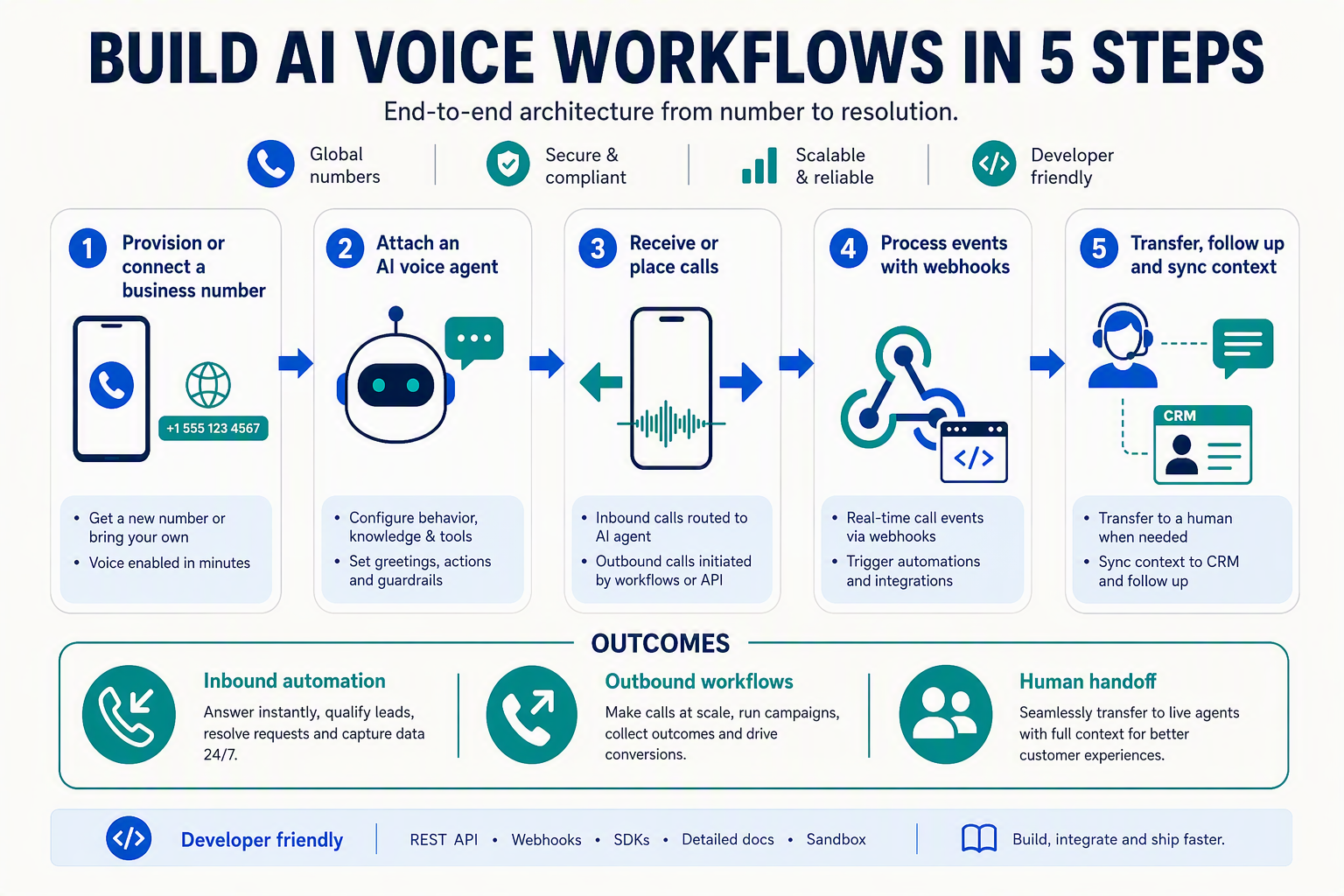
Developers should connect a business phone number to a CallMissed voice agent by treating the agent, number, and routing relationship as separate application resources. The exact operations—such as acquiring a number, registering an existing number, or associating it with an agent—must follow the capabilities and schemas currently published in the CallMissed Developer Hub.
Choose the supported number-onboarding path
Start by checking which Phone Numbers API workflows are documented for the target country and account. Depending on the current API capabilities, an implementation may support:
- Obtaining a business number through a documented number-acquisition workflow.
- Connecting or routing an existing business number using a supported carrier or forwarding configuration.
- Referencing a number already available in the authenticated CallMissed workspace.
- Managing numbers as tenant-scoped resources in a multi-customer SaaS application.
Do not assume that every country, number type, or existing carrier is supported. Telecom regulations, identity requirements, and calling permissions differ by jurisdiction.
Store telephone numbers in E.164 format, represented conceptually as +[country code][subscriber number]. The International Telecommunication Union’s E.164 recommendation allows a maximum of 15 digits, excluding the leading plus sign.
Follow a schema-driven lifecycle
A robust integration can use the following lifecycle pattern, adapting each step to the fields and operations available in the current CallMissed documentation:
- Create or configure the voice agent. Supply only documented properties, which may cover instructions, language, voice, knowledge sources, or call behavior.
- Persist the returned agent identifier. Use stable API identifiers rather than display names when building relationships.
- Obtain a phone-number reference. Follow the documented Phone Numbers API path for selecting, adding, or referencing a business number.
- Observe readiness where applicable. If the API exposes lifecycle state, polling, callbacks, or events, wait for the documented condition before enabling production traffic.
- Configure number-to-agent routing. Use the supported assignment or routing mechanism, if exposed by the current schema.
- Place a controlled test call. Verify agent selection, conversation behavior, latency, language configuration, and escalation handling.
Conceptually, the integration may look like this:
agent = createVoiceAgent(agentConfiguration)

phoneNumber = obtainOrReferenceNumber(
  phoneConfiguration
)

if documentationRequiresReadinessCheck:
  waitForDocumentedReadyCondition(phoneNumber)

routing = connectNumberToAgent(
  numberReference = phoneNumber.id,
  agentReference = agent.id
)

runTestCall(routing)
This is architecture pseudocode, not a fixed CallMissed endpoint contract. CallMissed says its Developer Hub provides documented endpoints, request schemas, model catalogs, and playground paths; developers should use those materials for current URLs, authentication headers, accepted fields, and responses.
Build a production-safe routing layer
Persist only fields actually returned or required by the documented APIs. A practical internal record may include:
- Workspace or tenant ID
- Agent ID
- Phone-number reference and normalized number
- Routing configuration
- Last known API state, if provided
- Creation and update timestamps
- Internal audit metadata
Use idempotency controls when the API supports them; otherwise, implement application-level deduplication before retrying resource-changing requests. Keep credentials server-side, enforce workspace isolation, and validate callbacks using the documented authentication mechanism—without assuming webhook signing is available.
CallMissed’s Terms of Service describes CallMissed as a multi-tenant SaaS platform supporting inbound and outbound voice-call AI agents. CallMissed also states that its broader platform supports 22 Indian languages and 300+ models, although developers should verify language, voice, and model compatibility for each specific agent configuration rather than assuming universal support.
What are voice agent, phone number, phone call and programmable Voice APIs?
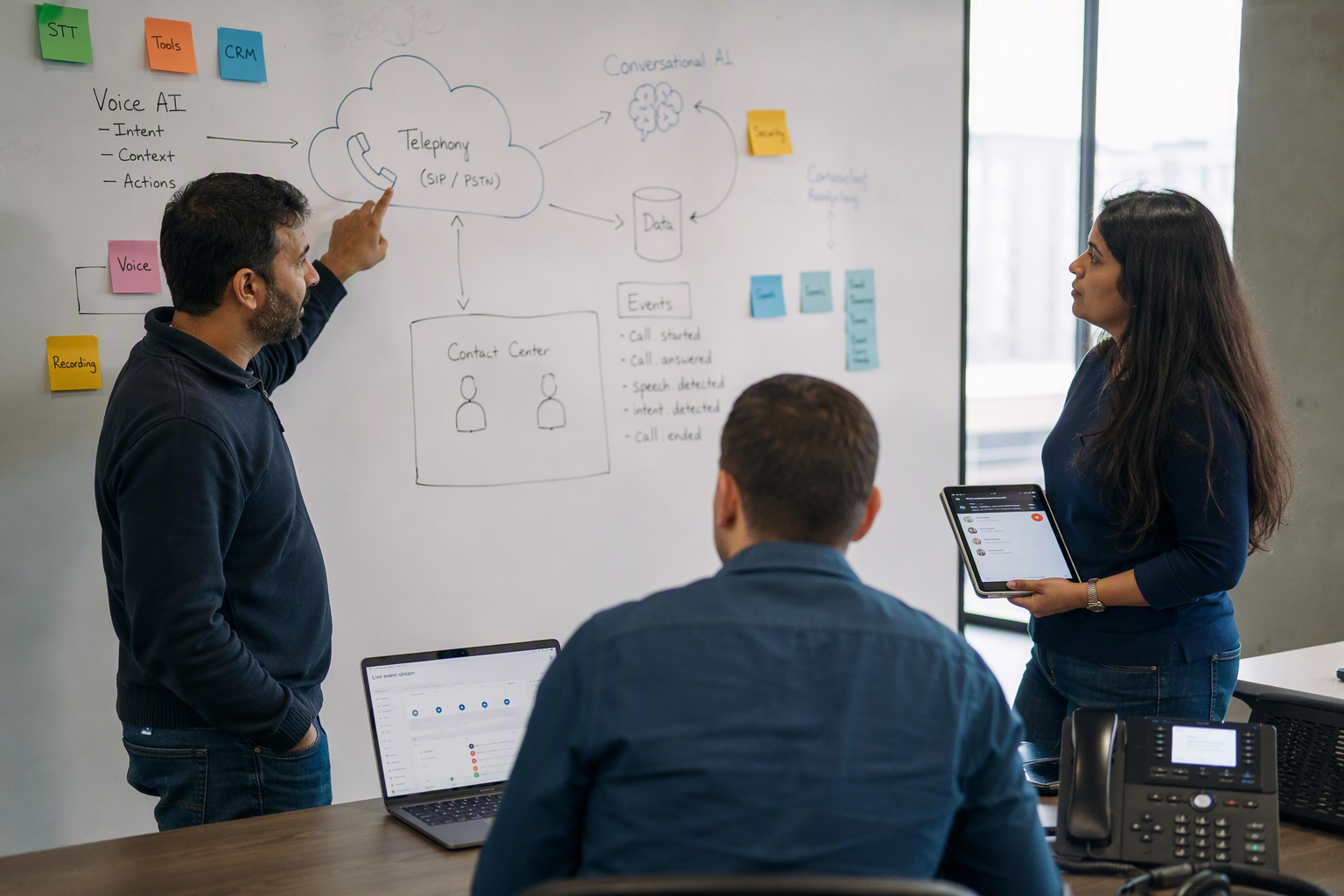
A Voice Agent API defines conversational behavior, a Phone Numbers API handles telephone identities, and a Phone Call API controls or observes individual call sessions. Programmable Voice API is the broader industry term for using software to build calling workflows; the exact operations available depend on each provider’s current documentation.
Voice Agent API: conversational intelligence
A Voice Agent API gives developers programmatic access to an AI system that listens, reasons, and responds during a voice conversation. Conceptually, the agent is the conversation layer—not the telephone number callers dial or the call session carrying the audio.
Depending on the platform, voice-agent capabilities may include:
- Instructions: purpose, tone, guardrails, and escalation policies
- Speech processing: speech-to-text, text-to-speech, language selection, and turn-taking
- Knowledge access: retrieval-augmented generation, business documents, or FAQs
- Tool use: CRM lookups, appointment booking, order checks, or ticket creation
- Handoffs: transferring a conversation to a person or another workflow
CallMissed’s product website describes its AI Voice Bot as understanding “accents, nuances, and intent,” while the CallMissed Terms of Service confirms support for inbound and outbound voice-call AI agents. These agents differ from traditional interactive voice response systems, which generally guide callers through predefined keypad or menu paths.
Phone Numbers API: telecom identity
A Phone Numbers API manages the business numbers through which calls are received or presented. It concerns the telephone identity and its lifecycle rather than what an AI agent says.
Across programmable-voice platforms, this API category can cover operations such as:
- Searching for or provisioning numbers
- Connecting or verifying an existing business number
- Inspecting geographic or calling capabilities
- Configuring an approved destination or application
- Releasing or updating a number
Availability varies by country, carrier, number type, and telecommunications regulations. A number may be represented in E.164, the ITU-T international numbering format, but developers should not assume a specific schema, verification process, or routing model. CallMissed now provides Voice Agents and Phone Numbers APIs; the precise supported operations, required parameters, and regional constraints are defined by the current CallMissed documentation.
Phone Call API: an individual interaction
A Phone Call API conceptually concerns a single inbound or outbound call. It may let an application initiate a call, retrieve information about it, perform permitted in-call actions, or receive lifecycle notifications.
Common industry concepts include:
- A call request or incoming call
- Connection attempts and ringing
- An active conversation
- Completion or another terminal outcome
These are conceptual stages, not guaranteed CallMissed state names. Developers should likewise avoid assuming webhook event names, transcript fields, retry behavior, or call-control commands based on another provider’s implementation.
Programmable Voice API: the umbrella category
Programmable Voice means controlling telephony and voice experiences through software rather than relying entirely on manual telecom configuration. The category can combine number management, call control, speech processing, AI agents, routing, webhooks, and integrations with external business systems.
A useful conceptual flow is:
telephone identity → call connection → conversational agent → business action
This is an architectural model, not a claim about CallMissed’s internal objects or routing cardinality. Keeping the concepts distinct helps developers reason about provisioning, conversations, and call activity while treating the current API schemas as the authoritative implementation contract.
Which CallMissed API capability handles each part of the calling stack?
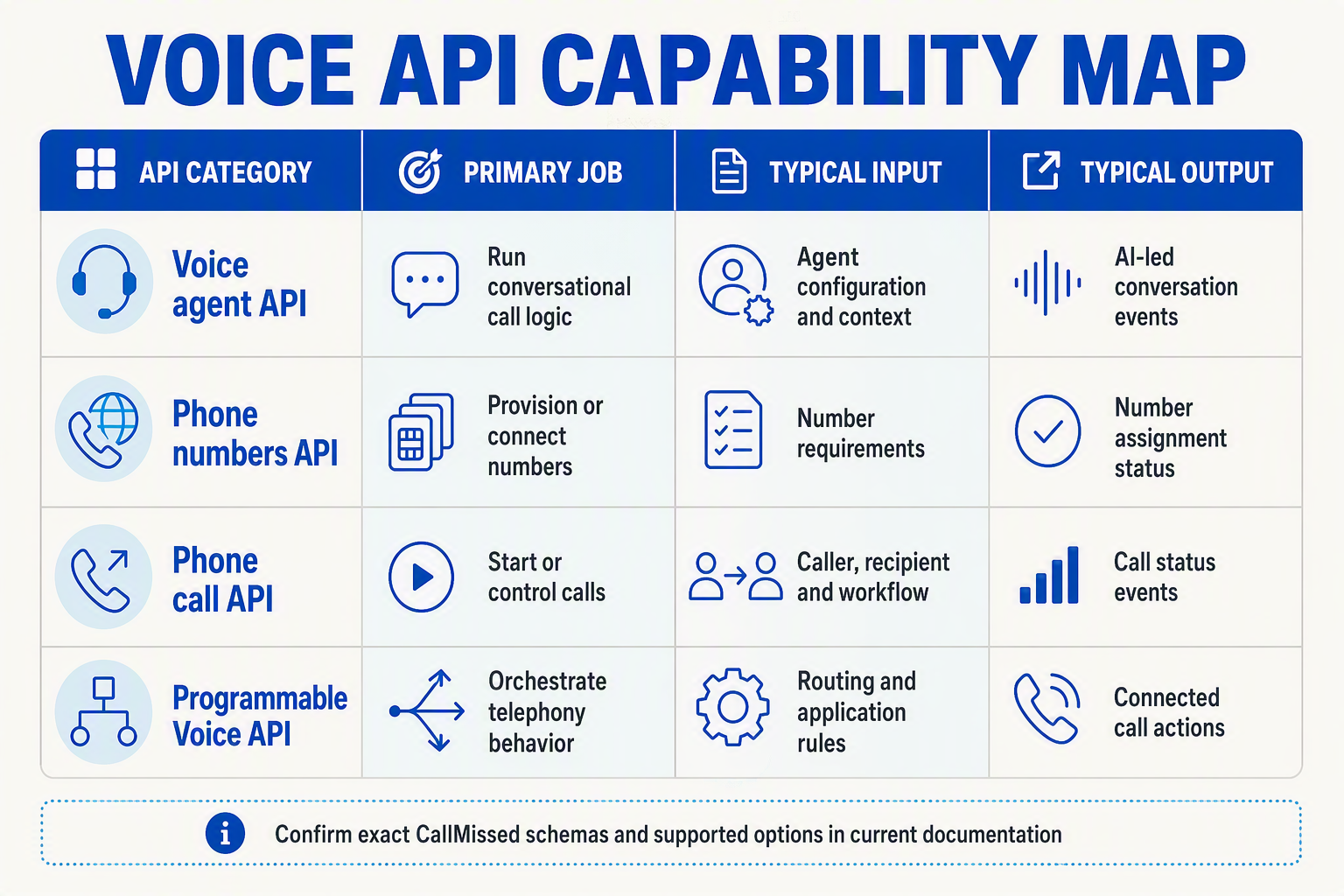
CallMissed has confirmed that Voice Agents APIs and Phone Numbers APIs exist, but the Developer Hub should remain the source of truth for their exact operations. The table below is an intended architecture map, not a statement that every provisioning, routing, versioning, outbound, or real-time method is currently exposed.
Capability map for the calling stack
| Calling-stack layer | Likely capability boundary | Buyer value | Developer interpretation | Contract status |
|---|---|---|---|---|
| Business phone identity | Phone Numbers API | Establishes a business calling presence | Provision or connect a number if documented and supported for the account, country, and number type | API existence confirmed; acquisition and connection methods require documentation verification |
| Number configuration | Phone Numbers API | Centralizes number metadata and operational status | Read or update supported number properties using the published schema | Fields, lifecycle states, and release operations are not assumed |
| Conversation behavior | Voice Agents API | Defines how an AI agent should conduct calls | Create or configure instructions, language, voice, knowledge, and behavior where documented | API existence confirmed; supported fields must be checked |
| Number-to-agent routing | Phone Numbers API and/or Voice Agents API | Connects an inbound destination to the appropriate experience | Associate a number and agent if an assignment endpoint is documented | Intended architecture; API ownership and routing semantics are unverified |
| Outbound call execution | Voice Agents API or a separate calls endpoint | Enables business-initiated AI conversations | Start an outbound call with approved recipient and context data if supported | Platform capability confirmed; invocation contract must be verified |
| Speech and reasoning runtime | CallMissed voice infrastructure | Produces a responsive spoken conversation | Configure available speech or language models if the API exposes those choices | Real-time event transport, model selection, and streaming controls are not assumed |
| Agent revisions | Voice Agents API | Allows conversational behavior to evolve without changing the number | Update an agent or create a version if versioning is documented | Version resources and deployment semantics are unverified |
CallMissed’s Terms of Service describes CallMissed as a “multi-tenant SaaS platform” providing “inbound and outbound voice call AI agents.” This confirms the platform-level calling capability, but it does not by itself define endpoint paths, request fields, resource relationships, or state transitions.
Read the table as a design guide
For buyers, the intended separation creates a useful mental model:
- Phone identity answers where customers call or what business identity appears.
- Agent behavior answers how the AI conducts the conversation.
- Call execution answers when a conversation starts and how its status is tracked.
- Application orchestration connects consent, CRM context, escalation, and audit records.
For developers, each boundary should be validated before implementation. A safe discovery sequence is:
- Confirm authentication and tenant-scoping rules.
- Inspect the documented Phone Numbers API operations.
- Inspect the documented Voice Agents API resource schema.
- Check whether number assignment, outbound invocation, and agent versioning have dedicated endpoints.
- Verify webhook, polling, or streaming support for call status and real-time events.
- Test idempotency and failure recovery in a sandbox or playground where available.
Treat published schemas as the contract
The CallMissed Developer Hub states that each capability has a documented endpoint, request schema, model catalog, and playground path. Consequently, developers should not infer payloads such as phone_number_id, agent_id, version, or status from this conceptual map.
Keep authentication, consent, retry policy, duplicate prevention, CRM synchronization, and human escalation in the surrounding application unless the current documentation explicitly assigns them to CallMissed. This preserves the table’s comparison value while avoiding assumptions about capabilities that may differ by account, geography, release stage, or API version.
How should the CallMissed calling architecture manage webhooks and conversation context?
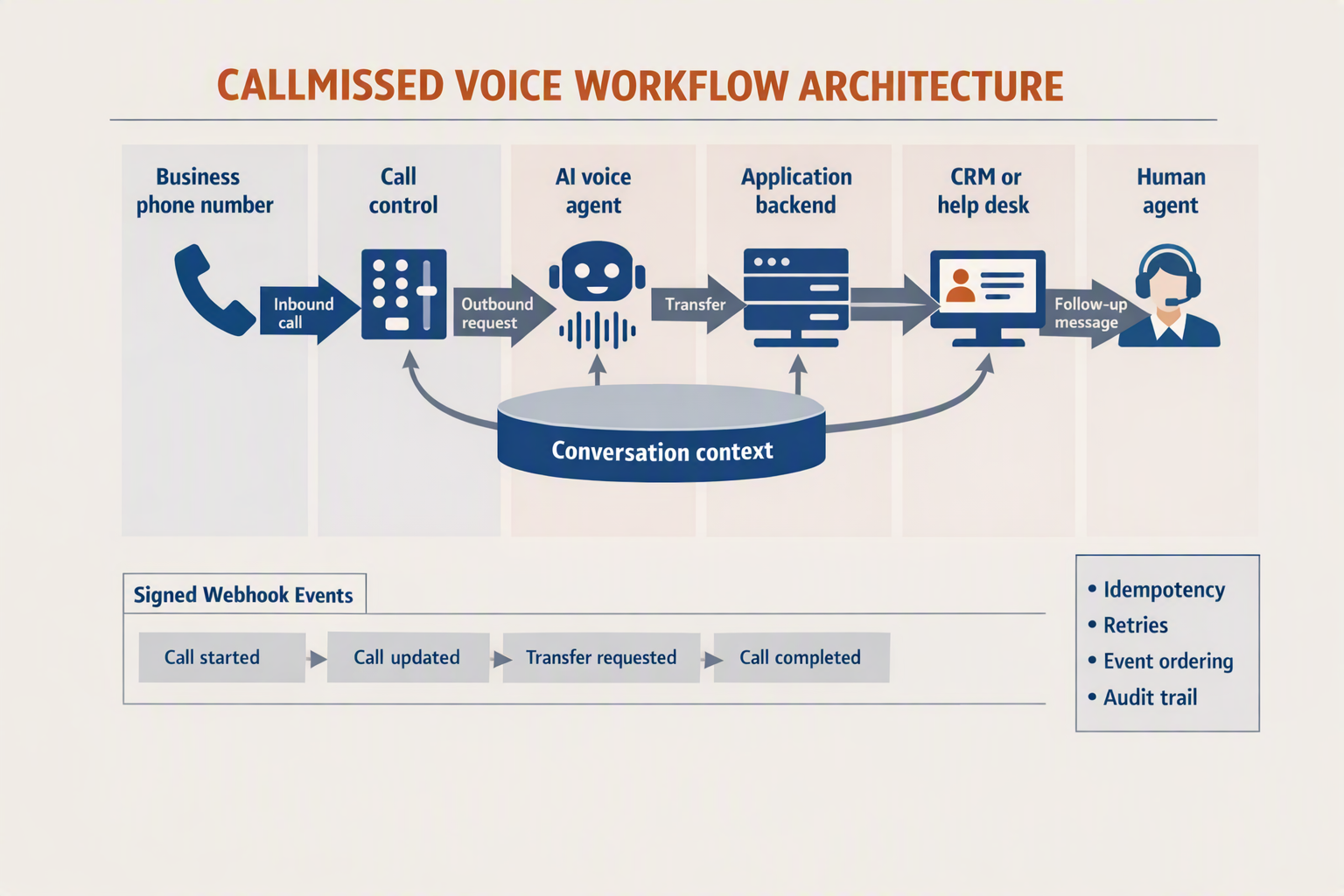
The calling architecture should treat webhooks as an asynchronous event stream and keep conversation context in an application-owned state store keyed by tenant, phone number, agent, and call. Webhook handlers should validate, acknowledge, persist, and enqueue events quickly; separate workers should perform CRM updates, retrieval, analytics, and follow-up actions.
Build a thin, durable webhook layer
Call events can arrive more than once, out of order, or after a network timeout. Design the receiver for at-least-once delivery, even if initial testing appears perfectly sequential.
A reliable processing path is:
- Authenticate the request using the verification mechanism specified in the current CallMissed webhook documentation.
- Capture the raw request before transforming it, including headers and receipt time.
- Validate the payload against the documented event schema.
- Check idempotency using the provider event ID—or a deterministic hash if the schema does not supply one.
- Persist and enqueue the event for asynchronous processing.
- Return a successful response quickly, without waiting for an LLM, CRM, or analytics service.
The CallMissed Developer Hub states that each capability has a documented endpoint and request schema. Implement against those published schemas rather than assuming field names or inventing event types; version the internal adapter so upstream schema changes do not propagate across the application.
Use an internal event envelope such as:
- tenant_id for account isolation
- call_id as the primary interaction key
- agent_id and phone_number_id for routing
- provider_event_id for deduplication
- event_type, occurred_at, and received_at for ordering
- raw_payload for replay and incident investigation
Model each call as a state machine
Normalize provider callbacks into application states such as created, ringing, connected, completed, failed, or transferred, but map these labels from the actual API documentation. Never infer a completed call merely because a “connected” event arrived.
Store state transitions conditionally. A delayed ringing callback, for example, must not move an already completed call backward. For conflicting updates, prefer provider timestamps and terminal-state rules while retaining the original events in an append-only log.
Retries should use exponential backoff with jitter and a dead-letter queue. Alert on repeated signature failures, unknown event versions, growing queue age, and calls that remain in non-terminal states beyond an operational threshold.
Separate live context from durable customer memory
Conversation context has at least three layers:
- Turn context: recent utterances and tool results needed for the next response
- Call context: language, intent, collected fields, consent, escalation status, and a rolling summary
- Customer context: verified CRM facts, prior interactions, preferences, and unresolved cases
Pass only the minimum relevant context into each model call. Summarize older turns rather than continually resending a full transcript, and keep authoritative business data outside the prompt. Tool results should include timestamps because balances, appointment slots, and order states can become stale.
This separation is especially important for multi-tenant systems. The CallMissed Terms of Service describes the product as a multi-tenant SaaS platform supporting inbound and outbound AI voice agents; every context read should therefore enforce tenant ownership, not merely match a call ID.
Finally, encrypt transcripts and recordings, restrict access by role, define retention periods, and redact unnecessary payment or identity data. A completed-call worker can then generate the summary, update the CRM, record disposition, and trigger approved follow-ups without delaying the live conversation.
How do inbound calls, outbound calls, transfers and follow-ups work in pseudocode?
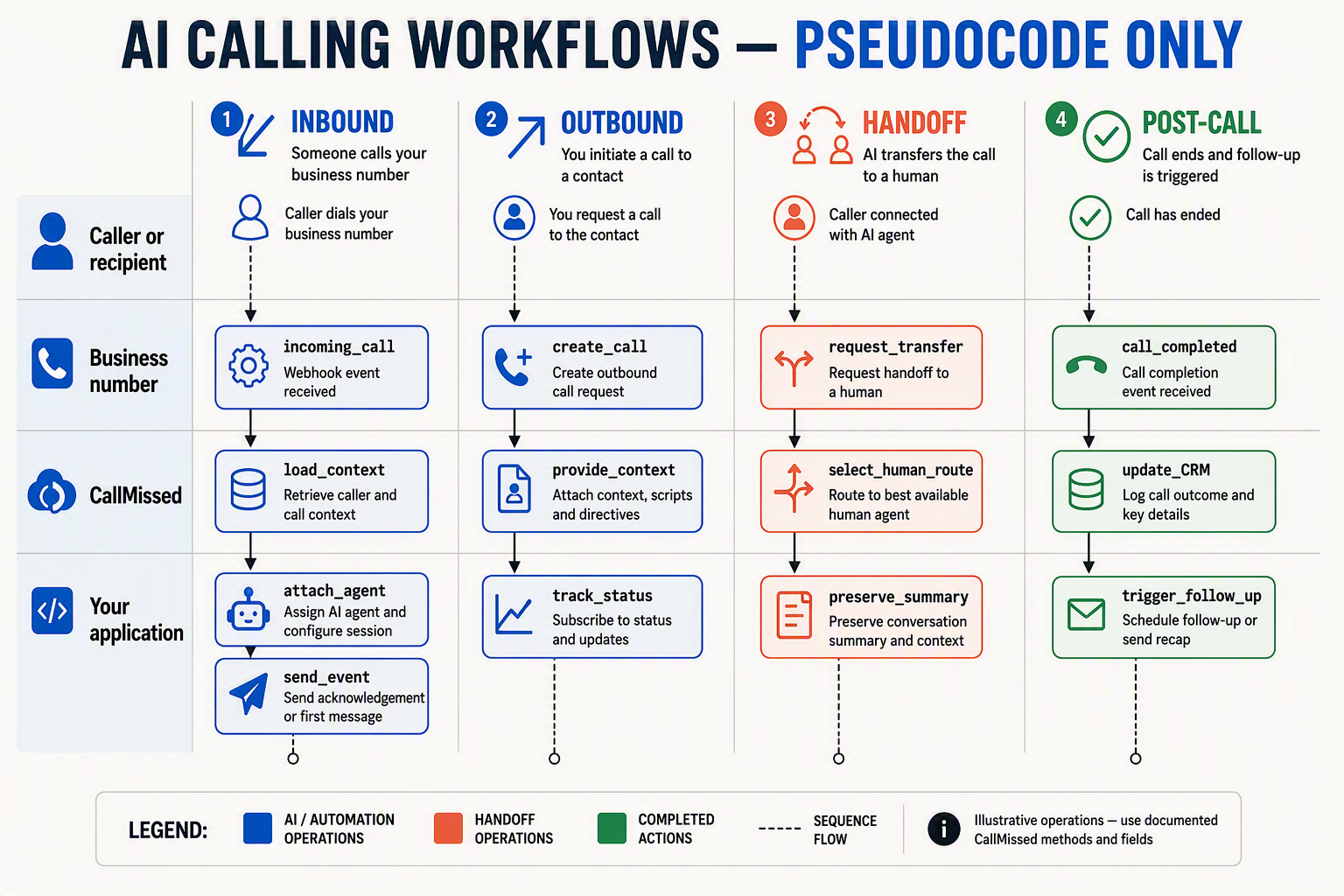
Inbound calls begin when a provisioned or connected number routes to an assigned voice agent; outbound calls begin when the application requests a call to a consented destination. Transfers and follow-ups should be driven by call events, explicit agent actions, and durable workflow state rather than timing assumptions.
Shared setup and event handling
The examples below use symbolic SDK methods, not literal endpoint names; map them to the current CallMissed documentation and schemas. CallMissed’s Terms of Service confirms support for both inbound and outbound voice-call AI agents as of September 2026.
client = CallMissed(api_key = ENV["CALLMISSED_API_KEY"])

agent = client.voice_agents.get(AGENT_ID)
number = client.phone_numbers.get(NUMBER_ID)

assert number.assigned_agent_id == agent.id

function handle_webhook(request):
    verify_signature(request.headers, request.raw_body)

    event = parse_json(request.body)

    if events.already_processed(event.id):
        return HTTP_200                    // idempotent retry handling

    events.record(event.id)

    switch event.type:
        case "call.started":       on_call_started(event.data)
        case "call.transcript":    store_transcript(event.data)
        case "call.transfer_requested": transfer_call(event.data)
        case "call.completed":     complete_call(event.data)
        case "call.failed":        handle_failure(event.data)

    return HTTP_200
Use the provider-issued event ID as an idempotency key, validate webhook signatures before processing data, and return success quickly before running slower CRM or messaging jobs.
Inbound-call flow
An inbound call should resolve the dialled number to its tenant, agent, language policy, and business context before conversation begins.
function on_inbound_call(call):
    mapping = database.find_number(call.to_number)

    if mapping is null or mapping.status != "active":
        return reject_or_play_fallback(call.id)

    customer = crm.find_by_phone(call.from_number)

    context = {
        tenant_id: mapping.tenant_id,
        customer_id: customer?.id,
        preferred_language: customer?.language ?? "auto-detect",
        previous_cases: crm.open_cases(customer?.id)
    }

    client.calls.attach_agent(
        call_id = call.id,
        agent_id = mapping.agent_id,
        context = context
    )
CallMissed reported support for 22 Indian languages and more than 300 AI models in September 2026, making language detection and regional-language responses practical design inputs rather than afterthoughts.
Outbound-call flow
Outbound calls should be queued only after checking consent, calling windows, suppression lists, and retry limits.
function start_outbound_call(lead):
    assert lead.voice_consent == true
    assert is_permitted_calling_time(lead.timezone)
    assert not suppression_list.contains(lead.phone)

    return client.calls.create({
        direction: "outbound",
        from_number_id: NUMBER_ID,
        to: lead.phone,
        agent_id: AGENT_ID,
        metadata: { lead_id: lead.id, campaign_id: CAMPAIGN_ID },
        idempotency_key: "campaign:" + CAMPAIGN_ID + ":lead:" + lead.id
    })
Never retry blindly: distinguish busy, no answer, invalid number, provider failure, and customer opt-out.
Transfers and post-call follow-ups
Transfer when the caller requests a person, the AI reaches a restricted action, confidence remains low, or policy requires human approval.
function transfer_call(call):
    destination = routing.select_available_queue(
        skill = call.detected_intent,
        language = call.detected_language
    )

    client.calls.transfer(
        call_id = call.id,
        destination = destination,
        handoff_summary = summarize(call.transcript)
    )
After completion, enqueue asynchronous work:
function complete_call(call):
    outcome = classify(call.transcript)

    crm.save_summary(call.customer_id, outcome.summary)
    crm.update_disposition(call.id, outcome.label)

    if outcome.follow_up_requested:
        jobs.enqueue("send_follow_up", {
            channel: outcome.preferred_channel,
            customer_id: call.customer_id,
            template: outcome.template
        })
This pattern keeps telephony responsive while allowing CRM updates, WhatsApp or email follow-ups, analytics, and retries to run safely outside the live call.
What would telephony, security and compliance experts validate before launch?
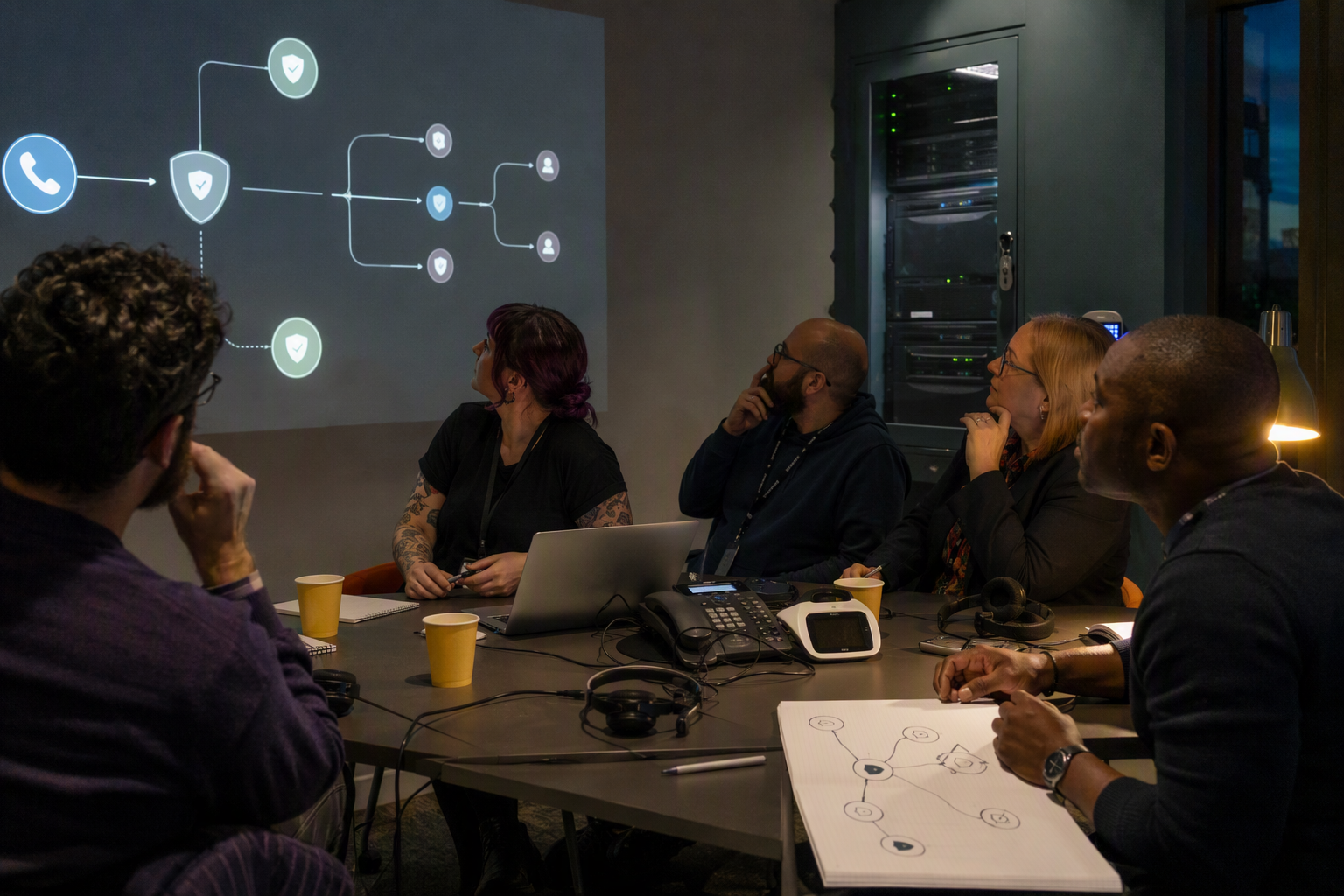
Before launch, telephony, security, and compliance experts should validate that every number is legally provisioned, every call is correctly routed and observable, credentials and customer data are protected, and each workflow follows the consent, privacy, and retention rules of its operating jurisdiction. API success is not equivalent to production readiness.
Telephony validation: prove the complete call path
A telephony specialist should test the CallMissed Voice Agent API and Phone Numbers API as one end-to-end system rather than as separate resources. CallMissed’s Terms of Service describes the platform as supporting both inbound and outbound voice-call AI agents, so each enabled direction requires its own launch checks.
Validate:
- Number ownership and activation: Confirm that provisioned numbers are active and that connected business numbers have completed any required ownership verification or carrier process.
- Routing integrity: Ensure each number resolves to the intended tenant, environment, and agent—especially after reassignment, agent deletion, or configuration changes.
- Caller identity: Verify outbound caller ID presentation, number eligibility, and country-specific restrictions; never assume a purchased or connected number may be used for every destination.
- Failure handling: Test busy, rejected, unanswered, unreachable, carrier-error, agent-timeout, and provider-degradation scenarios.
- Audio quality: Measure connection time, conversational latency, interruptions, echo, packet loss, silence handling, and speech recognition across representative devices and networks.
- Escalation: Confirm that transfers to human agents preserve context and fail safely if the destination is unavailable.
Testing should include regional accents and languages actually used by customers. CallMissed reported support for 22 Indian languages as of September 2026, making multilingual acceptance testing particularly relevant for businesses serving Bharat.
Security review: protect the control plane and call data
Security teams should treat API credentials, number assignments, prompts, transcripts, recordings, and call-event payloads as sensitive assets. CallMissed is a multi-tenant SaaS platform, according to its Terms of Service, so customer-level isolation must also be enforced within the integrating application.
Before production approval:
- Store API keys in a secrets manager, not source code, browser storage, mobile applications, or logs.
- Separate development, staging, and production credentials and resources.
- Apply least-privilege access, role-based administration, and multi-factor authentication.
- Authenticate webhook events using the mechanism documented by CallMissed, reject stale or replayed requests, and make event processing idempotent.
- Encrypt sensitive data in transit and at rest; redact phone numbers, credentials, transcripts, and payment or identity data from logs.
- Run tenant-isolation tests that attempt unauthorized reads, updates, number assignments, and agent associations.
- Define incident-response procedures for exposed credentials, number hijacking, anomalous outbound traffic, and data leakage.
Do not invent a webhook-signature format or retention guarantee: verify both against the current CallMissed documentation and contract before implementation.
Compliance review: map obligations to each call flow
Legal and compliance specialists should review inbound, outbound, recorded, transcribed, and AI-generated calls separately. Requirements vary by jurisdiction, call purpose, recipient relationship, and whether personal data crosses borders.
The launch checklist should document:
- The lawful basis or valid consent for calling, recording, transcription, and automated processing.
- Required disclosure that the caller is interacting with an AI agent.
- Suppression-list, opt-out, calling-hours, and frequency controls for outbound campaigns.
- India-specific telecom and commercial-communication obligations, including applicable Telecom Regulatory Authority of India (TRAI) requirements.
- Data minimisation, retention periods, deletion workflows, and data-subject request handling.
- Approved regions, subprocessors, international transfers, and access to recordings or transcripts.
- Human escalation for emergencies, regulated advice, disputes, and high-impact decisions.
Finally, obtain written sign-off from telephony, security, privacy, and business owners, with evidence attached to every control. Launch gradually using restricted destinations, rate limits, spend alerts, and rapid rollback; expand only after real call data confirms that routing, safety, and compliance controls behave as designed.
What does the CallMissed API mean for your use case and phone-number requirements?
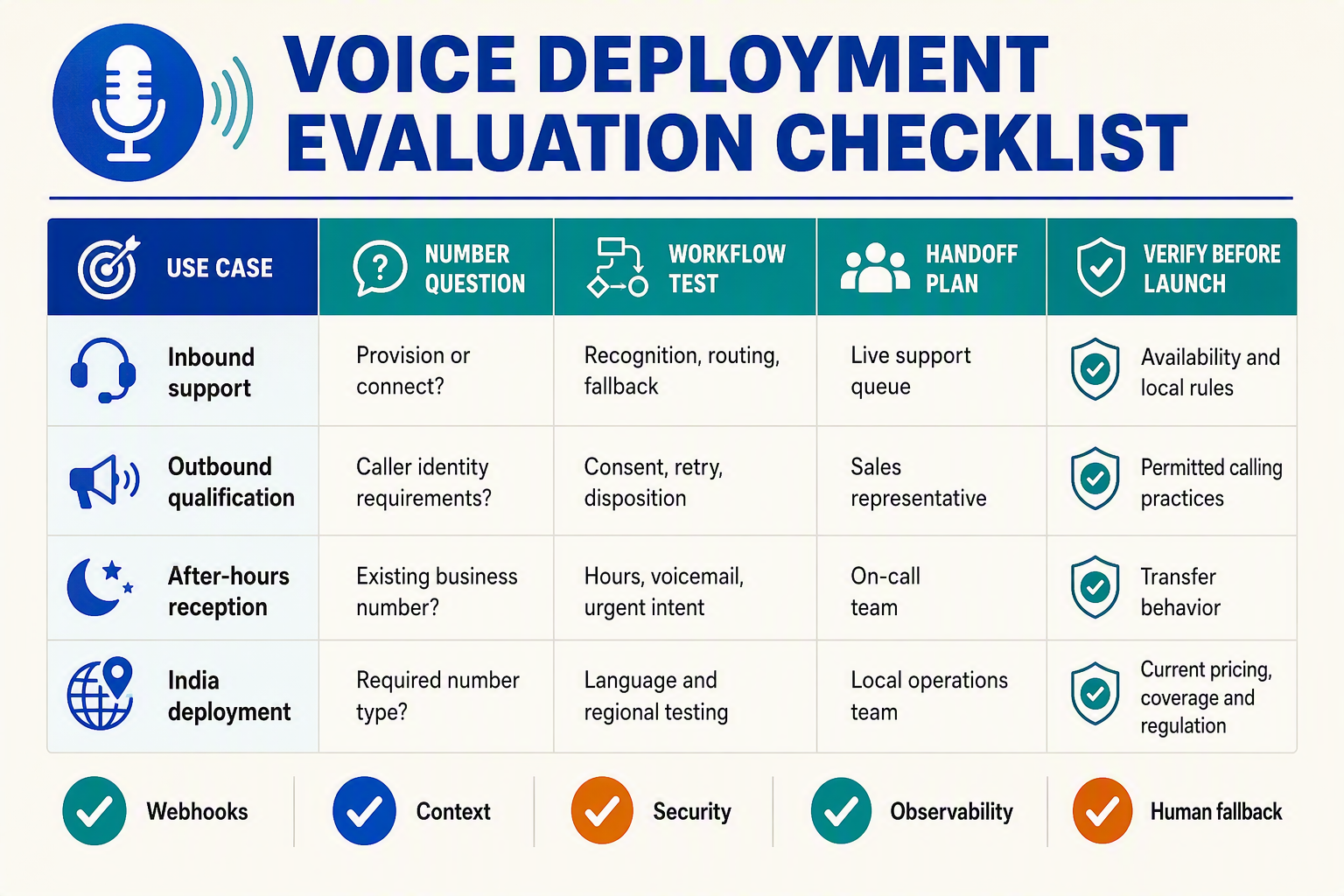
The CallMissed Voice Agent API and Phone Numbers API fit use cases where software must control both the conversational agent and the number customers call. Your number strategy should follow the call direction, geography, tenant model, expected concurrency, and whether the business wants a new number or must retain an existing one.
Use-case and number-selection matrix
| Use case | Call direction | Recommended number approach | Key API requirement |
|---|---|---|---|
| AI receptionist | Inbound | Provision a dedicated business number or connect the company’s existing number | Route the number to one published agent and define human-transfer behavior |
| Customer-support automation | Primarily inbound | Use a support number associated with the relevant queue, brand, or region | Pass customer context, capture call events, and support escalation |
| Lead qualification | Outbound | Use an approved business number suited to the target geography | Record consent, enforce calling windows, and process disposition events |
| Appointment reminders | Outbound with inbound callbacks | Assign a recognizable callback-enabled business number | Link calls to booking IDs and handle confirmation, rescheduling, or opt-out |
| Multi-tenant SaaS | Inbound and outbound | Allocate or connect a separate number for each tenant | Store tenant-to-number-to-agent mappings and enforce strict data isolation |
| Multilingual regional service | Either | Select numbers aligned with served markets and customer expectations | Choose language, speech configuration, and fallback routing per agent |
This matrix reflects an important architectural rule: a phone number is not merely an agent setting; it is a managed resource with its own lifecycle. Create or connect the number, verify that it is usable, associate it with the intended agent, and expose calling only after every dependent resource reaches the required state.
Questions to answer before provisioning
Developers should turn business requirements into explicit configuration decisions:
- Is the workflow inbound, outbound, or bidirectional?
Inbound products need deterministic routing. Outbound products additionally require consent controls, permitted calling hours, caller identity, and retry policies.
- Does the customer need a new number or an existing business identity?
Provisioning can simplify automated onboarding. Connecting an existing number may preserve recognition, but can require ownership verification, carrier coordination, forwarding, or another documented connection method.
- Is the application single-tenant or multi-tenant?
A SaaS platform should maintain a durable mapping such as tenant_id → phone_number_id → voice_agent_id, rather than relying on labels or visible phone-number strings.
- Which languages and regions must the agent serve?
CallMissed reported support for 22 Indian languages as of September 2026, making language selection a first-class requirement for businesses serving regional Indian audiences rather than a post-launch localization task.
Production checks for phone-number workflows
Before enabling real traffic, verify:
- Inventory and geography: Number types and availability can vary by country, region, and account eligibility; query current API data rather than hard-coding assumptions.
- Regulatory readiness: Apply applicable consent, telemarketing, recording, privacy, and data-retention rules for each market.
- Agent status: Do not attach production traffic to an incomplete, draft, or untested configuration.
- Idempotency: Prevent retries from provisioning duplicate numbers or creating conflicting assignments.
- Observability: Persist provider resource IDs, request IDs, call states, timestamps, and failure reasons.
- Fallback behavior: Decide what happens when the AI cannot resolve a request, the destination is unavailable, or a downstream tool times out.
CallMissed’s Terms of Service describes the platform as supporting inbound and outbound voice-call AI agents, while the CallMissed Developer Hub documents capabilities through dedicated endpoints, request schemas, model catalogs, and playground paths. Treat those current API schemas—not assumed field names or static inventory—as the source of truth when implementing number provisioning and agent association.
Frequently asked questions about CallMissed voice agents and phone numbers
How do I get started with the CallMissed voice agent API and Phone Numbers API?
Can I connect an existing business number through the CallMissed Phone Numbers API?
How do I connect a business number to a voice agent?
Does the CallMissed voice agent API support inbound and outbound calls?
What is the difference between an inbound and an outbound voice agent API workflow?
Can CallMissed send webhooks for voice-agent events?
Can a CallMissed voice agent transfer a caller to a human?
How should I test a voice agent API integration before launch?
Which languages can CallMissed AI voice agents speak and understand?
Are the voice agent API and Phone Numbers API OpenAI-compatible?
What compliance requirements apply to inbound and outbound AI calls?
How should I secure and monitor a production CallMissed voice integration?
Conclusion
The CallMissed Voice Agent API and Phone Numbers API turn business telephony into programmable infrastructure: developers can provision or connect numbers, configure AI agents, and build inbound or outbound calling workflows without assembling each layer manually.
- Voice and numbering belong in one lifecycle. A conversational agent becomes useful only when a reachable business number is correctly connected, routed, and assigned.
- API-led provisioning enables repeatable onboarding. AI receptionist, support, lead-qualification, and vertical SaaS products can create consistent workflows across multiple customers.
- Multilingual design should begin at configuration time. CallMissed reported support for 22 Indian languages and more than 300 AI models as of September 2026, making regional-language voice experiences practical for businesses serving India.
- Production readiness extends beyond the first successful call. Developers must validate requests, track configuration state, process call events, handle errors, test thoroughly, and secure credentials.
What comes next is a shift from standalone phone bots toward voice capabilities embedded directly inside customer-support systems, CRM workflows, and multi-tenant applications. Watch for increasingly automated number assignment, agent configuration, and call routing as these APIs mature.
To explore this direction, visit CallMissed, an AI communication infrastructure platform for voice agents and multilingual customer engagement. What could your product deliver if launching a business phone agent became an API workflow rather than a telecom project?
Related Reading
- CallMissed Phone Numbers: How to Buy a Business Number for an AI Voice Agent
- CallMissed API: Build a WhatsApp and Voice AI Appointment Booking Agent
- Build a WhatsApp AI Agent Through CallMissed API: Complete Developer Guide