
Kimi K3 vs Qwen3.8-Max: July 2026 Comparison



Compare Kimi K3 vs Qwen3.8-Max in July 2026: verified access, open-weight status, context, pricing, benchmarks, and use-case picks.
Kimi K3 vs Qwen3.8-Max: July 2026 Comparison
Two frontier models now claim a combined 5.2 trillion parameters—but parameter totals alone cannot tell a developer which model can actually ship in production today. This Kimi K3 vs Qwen3.8-Max comparison, current to July 20, 2026, separates Moonshot AI’s documented flagship from Alibaba’s newly previewed and still partly unverified Qwen release.
The timing matters because the two announcements represent different stages of the AI-model lifecycle. Moonshot AI states that Kimi K3 has 2.8 trillion parameters, a 1 million-token context window, native multimodal understanding, and tool calling through its Kimi API platform. In contrast, Qwen3.8-Max has been reported as a 2.4-trillion-parameter multimodal model in preview, meaning developers should distinguish confirmed specifications from announcement-stage claims before making architecture, budget, or vendor decisions.
That distinction is more important than the headline scale suggests. A model’s total parameter count does not reveal its active parameters per request, inference speed, benchmark performance, API reliability, licensing terms, or cost. Nor does it answer practical questions: Can the model process a full enterprise knowledge base? Does it support image inputs and agents? Is it available through a public API? Can teams self-host it, or are weights restricted? For coding teams, the difference between a promising preview and a documented production endpoint can determine whether an agent workflow launches this quarter or remains an experiment.
Moonshot AI’s official documentation positions Kimi K3 for “long-horizon programming, knowledge work and deep reasoning,” while its API documentation confirms a default output limit of 131,072 tokens and a configurable maximum of 1,048,576 tokens. Moonshot AI also lists Kimi K3 pricing beginning at ¥20 per million input tokens and ¥2 per million cached input tokens, providing a concrete baseline for cost comparisons. Equivalent public details for Qwen3.8-Max—including final API pricing, context limits, active-parameter architecture, benchmark methodology, and open-weight status—must be labeled unknown unless Alibaba publishes them directly.
This guide will compare what is confirmed, what remains a preview claim, and where each model may fit: long-context research, coding agents, multimodal workflows, enterprise APIs, and self-hosting considerations. It will also avoid treating a larger model as automatically smarter—a useful safeguard as frontier-model announcements increasingly emphasize trillion-parameter scale.
For developers routing applications across fast-moving model catalogs, platforms such as CallMissed, the OpenAI-compatible AI gateway, reflect the broader trend toward one integration that can access multiple LLM providers without repeatedly rewriting application code.
Which is better in July 2026: Kimi K3 or Qwen3.8-Max?
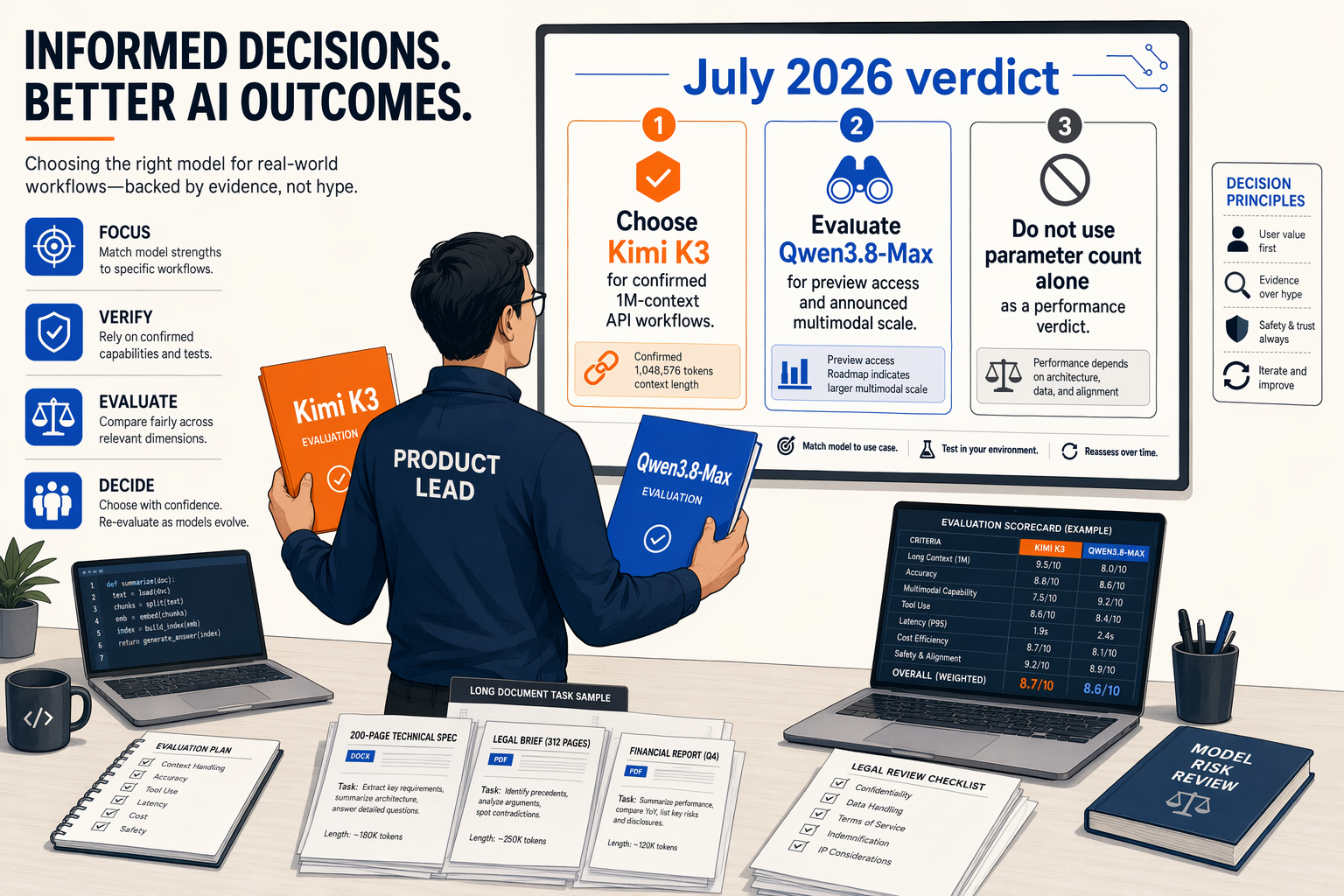
Kimi K3 is the better choice for production work on July 20, 2026 because Moonshot AI publicly documents its API, 1 million-token context window, multimodal support, output limits, and token pricing. Qwen3.8-Max is a model to monitor: it is reported as a newly previewed 2.4-trillion-parameter multimodal Qwen model, but comparable information on public availability, licensing, API behavior, pricing, and benchmarks is not confirmed in the supplied materials.
Kimi K3 vs Qwen3.8-Max: confirmed facts and preview claims
| Category | Kimi K3 | Qwen3.8-Max | July 2026 assessment |
|---|---|---|---|
| Total parameters | 2.8 trillion, according to Moonshot AI | 2.4 trillion reported in preview coverage | Total parameters alone do not predict quality, latency, or inference cost |
| Public availability | Available through the Kimi API platform | Previewed; public production API availability is unconfirmed | Kimi K3 is the documented shippable option |
| Context window | 1,000,000 tokens, according to Moonshot AI | Unknown | Kimi K3 has a confirmed long-context advantage |
| Multimodality | Native visual understanding is documented | Reported as multimodal | Kimi K3 has clearer implementation documentation |
| Pricing | ¥20/MTok input; ¥2/MTok cached input | Unknown | Only Kimi K3 has a published cost baseline |
Why deployment evidence matters more than parameter scale
Moonshot AI states that Kimi K3 has 2.8 trillion parameters, provides native multimodal understanding, and is designed for long-horizon programming, knowledge work, and deep reasoning. Moonshot AI’s API documentation also states that Kimi K3 has a default maximum output of 131,072 tokens and can be configured up to 1,048,576 tokens.
Moonshot AI lists Kimi K3 pricing at ¥20 per million input tokens and ¥2 per million cached-input tokens. That 10× cached-input discount matters for applications that repeatedly send stable instructions, policy documents, codebase context, product catalogs, or retrieved knowledge.
The reported 2.4-trillion-parameter scale of Qwen3.8-Max signals an ambitious frontier-model release, but it is not sufficient evidence for a deployment decision. As of July 20, 2026, the supplied record does not confirm:
- A public Qwen3.8-Max API endpoint or stable model identifier
- Input, output, or cache-token pricing
- Maximum context window or output-token limit
- Whether Qwen3.8-Max weights are open, source-available, or proprietary
- Total parameters versus active parameters per inference request
- Reproducible coding, reasoning, multimodal, or agent benchmarks
Likewise, the supplied Moonshot AI documentation does not establish Kimi K3’s current weight-license or self-hosting terms. Teams should verify licensing directly from Moonshot AI and Alibaba before treating either trillion-parameter model as an open-weight, privately deployable option.
Verdict by use case
- Long-document research and enterprise RAG: Choose Kimi K3 today. Its documented 1 million-token context window can reduce chunking and retrieval complexity for large contracts, repositories, and research collections.
- Coding agents and tool-using workflows: Choose Kimi K3 for current production experiments. Moonshot AI documents Kimi K3’s coding, reasoning, and tool-calling capabilities; Qwen3.8-Max agent reliability remains unsubstantiated in the available record.
- Multimodal prototypes: Kimi K3 is the lower-risk option because Moonshot AI documents visual understanding. Qwen3.8-Max being described as “multimodal” does not yet confirm supported input types, file limits, tool interfaces, or API behavior.
- Self-hosting or open-weight evaluation: No winner can be declared from confirmed information. Open-weight status, license terms, and infrastructure requirements are explicit unknowns for Qwen3.8-Max and require direct verification for Kimi K3.
The practical conclusion is straightforward: Kimi K3 wins this July 2026 comparison on verifiable readiness, not parameter count. Qwen3.8-Max may change that conclusion after Alibaba publishes production access, licensing, context limits, pricing, and independently reproducible benchmarks.
What is confirmed about Kimi K3 and the Qwen3.8-Max preview?
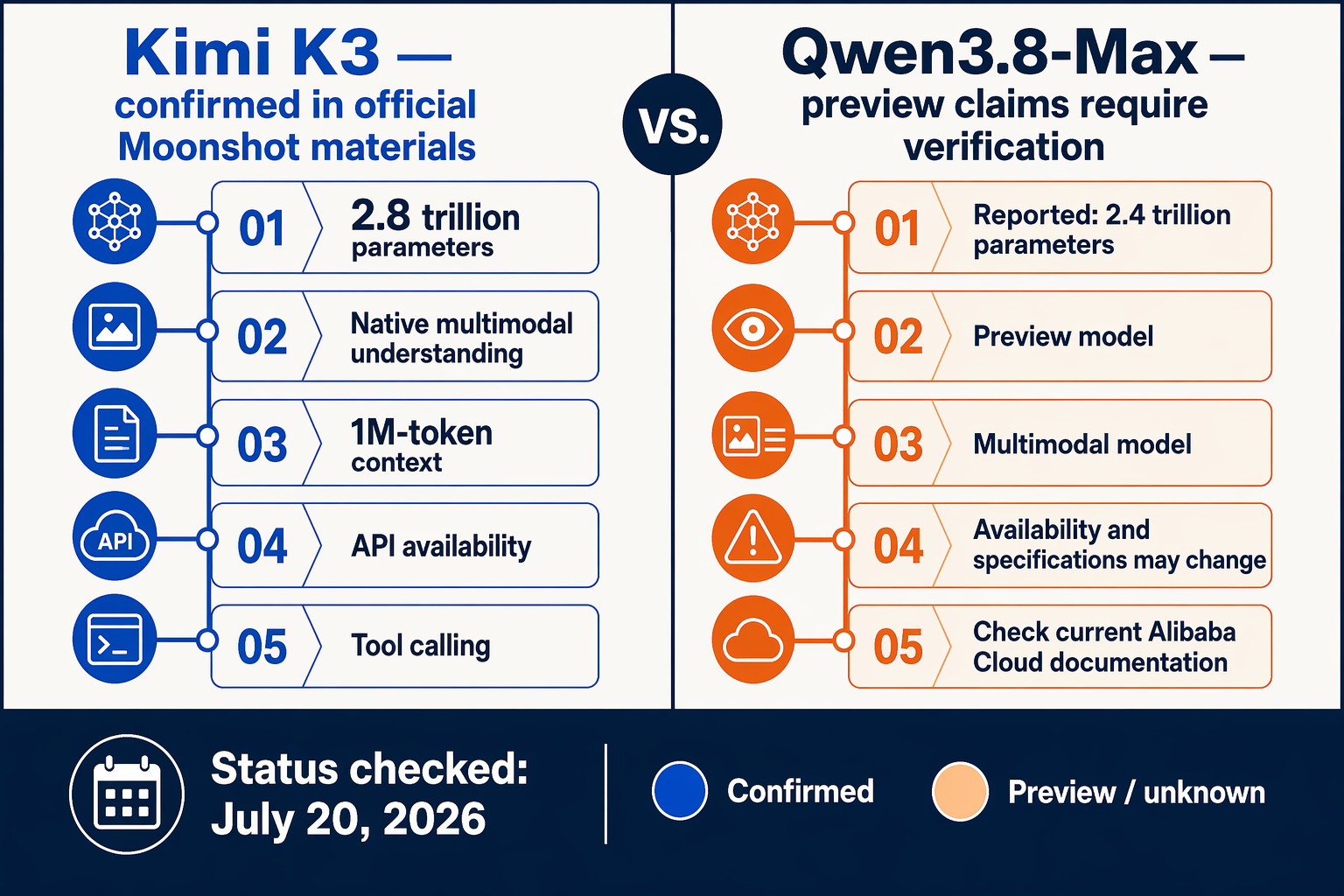
As of July 20, 2026, Kimi K3 is a documented Moonshot AI flagship available through the Kimi API, while Qwen3.8-Max is a reported preview whose production deployment details remain unconfirmed. The reported 2.8 trillion parameters for Kimi K3 and 2.4 trillion parameters for Qwen3.8-Max indicate model scale, not measured quality, latency, cost, or real-world deployability.
Kimi K3: documented API model with published specifications
Moonshot AI describes Kimi K3 as its flagship model for long-horizon programming, end-to-end knowledge work, and deep reasoning. Moonshot AI’s official Kimi platform states that Kimi K3 has 2.8 trillion total parameters, native multimodal understanding, a 1 million-token context window, and tool-calling capabilities.
Several operating details are publicly documented:
- Availability: Kimi K3 is listed on Moonshot AI’s Kimi API platform, so it is more than an announcement-stage model.
- Context and output: Moonshot AI’s Chat Completions documentation states that Kimi K3 has a default maximum output of 131,072 tokens and a configurable maximum of 1,048,576 tokens.
- Multimodality: Moonshot AI’s model documentation identifies
kimi-k3as supporting native visual understanding. Teams should still test accepted media formats and endpoint behavior before deploying image-based workflows. - Coding and agents: Moonshot AI positions Kimi K3 for software engineering and publishes an agent-building guide that combines its web-search tool with a custom tool. That is evidence that tool use is an intended workflow, rather than an inferred capability.
- Published pricing: Moonshot AI lists Kimi K3 input pricing at ¥20 per million tokens and cached-input pricing at ¥2 per million tokens. Buyers should verify output-token, tool, and any region-specific charges on the live pricing page before forecasting spend.
Kimi K3’s API availability does not, by itself, confirm open-weight availability or self-hosting rights. The supplied Moonshot AI materials document hosted API access, but they do not establish a complete public license covering model weights, redistribution, commercial self-hosting, or on-premises deployment. Organizations with data-residency requirements should obtain explicit licensing documentation from Moonshot AI.
Qwen3.8-Max: reported preview with unconfirmed deployment details
The supplied July 2026 research brief reports Qwen3.8-Max as a 2.4-trillion-parameter multimodal Qwen model in preview. However, this reported preview status is not enough to treat the model as publicly deployable or to present specifications as confirmed.
As of July 20, 2026, every practical deployment detail below should be considered unconfirmed unless Alibaba publishes a primary-source specification:
- Public API availability, supported regions, rate limits, quotas, and service-level commitments are unconfirmed.
- Context-window length, maximum output tokens, and supported image, video, or audio inputs are unconfirmed.
- Whether 2.4 trillion represents total parameters, active parameters, or a mixture-of-experts configuration is unconfirmed.
- Open-weight availability, license terms, commercial-use permissions, and self-hosting requirements are unconfirmed.
- Token pricing, cached-token discounts, batch pricing, latency figures, and throughput limits are unconfirmed.
- Published benchmarks, evaluation methodology, test sets, and version identifiers are unconfirmed.
This uncertainty does not mean Qwen3.8-Max lacks these features. It means a responsible Kimi K3 vs Qwen3.8-Max comparison must distinguish Moonshot AI’s documented Kimi K3 specifications from Qwen3.8-Max preview claims until Alibaba provides verifiable technical and commercial documentation.
How do Kimi K3 and Qwen3.8-Max compare on availability, licensing, context, and price? (TABLE)
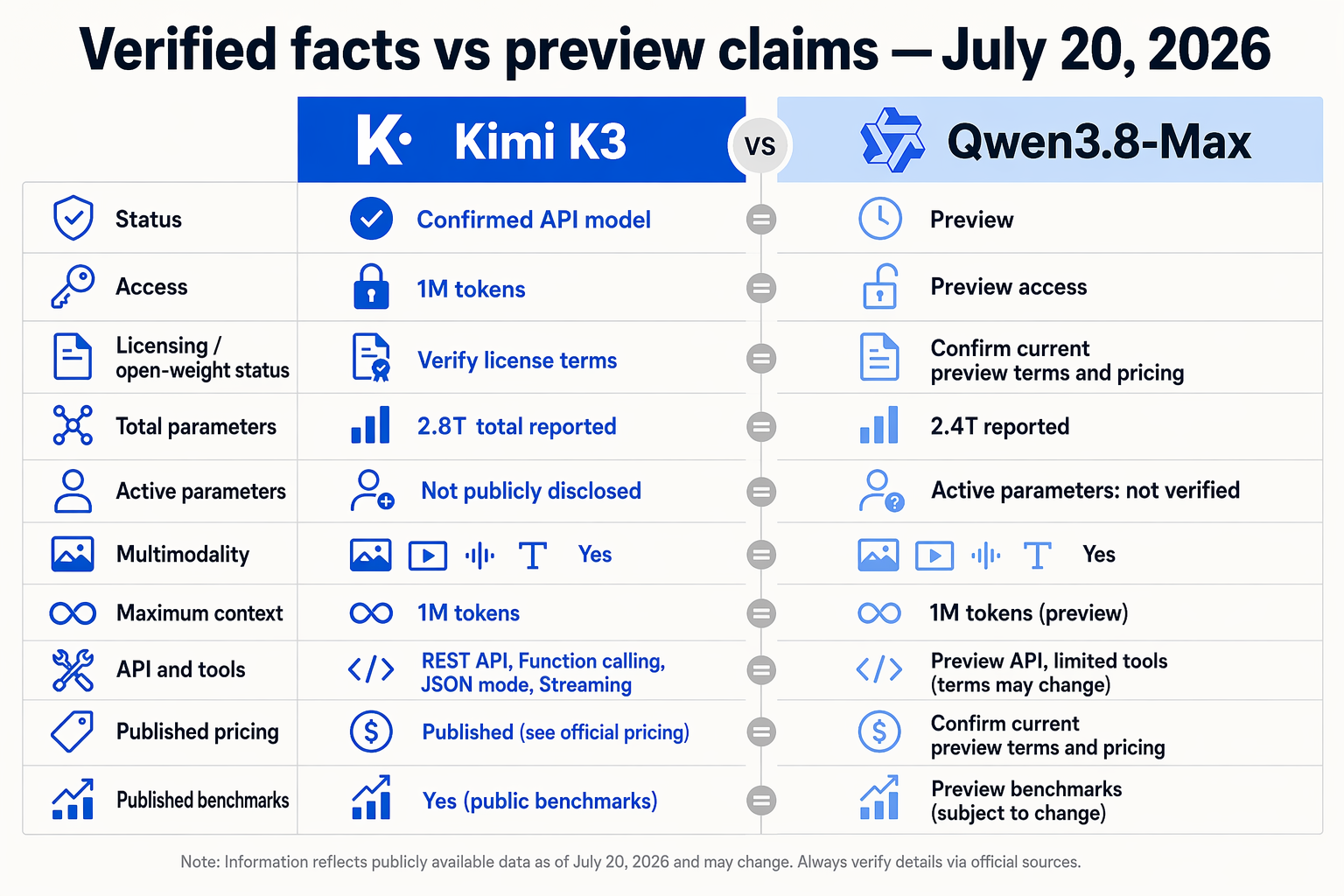
Kimi K3 is the only model in this comparison with publicly documented API access, context limits, and token pricing as of July 20, 2026. Qwen3.8-Max is reported as a 2.4-trillion-parameter multimodal model in preview, but its final API availability, licensing, context window, pricing, and benchmark methodology remain unconfirmed in the supplied research.
Confirmed deployment details at a glance
| Category | Kimi K3 | Qwen3.8-Max | Practical implication |
|---|---|---|---|
| Model status | Publicly documented flagship model on the Kimi API platform | Newly previewed; production release status is unconfirmed | Teams can plan an integration around Kimi K3 documentation today, while Qwen3.8-Max should remain an evaluation-stage option until Alibaba publishes deployment details. |
| Total parameters | 2.8 trillion parameters | Reported 2.4 trillion parameters | Parameter totals describe scale, not guaranteed quality, latency, reasoning performance, or per-request cost. |
| Active parameters and architecture | Not specified in the cited Moonshot AI documentation | Not publicly confirmed | Do not estimate Mixture-of-Experts routing, active parameters, or inference cost from total parameter counts alone. |
| Context and output | 1 million-token context; 131,072-token default output limit, configurable up to 1,048,576 tokens | Context window and output cap are unconfirmed | Kimi K3 has documented limits for large codebases, research corpora, and knowledge-base workflows. |
| Multimodality and agents | Native visual understanding and tool calling are documented | Reported as multimodal; supported inputs, tools, and structured-output behavior are unconfirmed | Validate image, video, function calling, and agent reliability before committing a production workflow. |
| API, pricing, and licensing | Kimi API lists ¥20 per million input tokens and ¥2 per million cached input tokens; weight-license terms are not established by the cited API pages | Public endpoint, API pricing, downloadable-weight status, and license terms are unconfirmed | Kimi K3 offers a documented cost baseline; Qwen3.8-Max requires direct vendor confirmation for procurement. |
Moonshot AI states on its Kimi API platform that Kimi K3 has 2.8 trillion parameters and a 1 million-token context window as of July 2026. Moonshot AI’s chat-completions documentation states that Kimi K3 defaults to a 131,072-token maximum output and can be configured up to 1,048,576 tokens. Context capacity and maximum generated output are separate technical limits, so buyers should assess both.
What “available” should mean for engineering teams
A preview can be strategically significant without being ready for production. Before selecting Qwen3.8-Max, teams should seek primary Alibaba documentation covering:
- Endpoint access: API regions, authentication, rate limits, uptime commitments, and model identifiers.
- Commercial terms: Input, output, cached-token, batch-processing, and multimodal pricing.
- Licensing: Whether weights can be downloaded, modified, redistributed, or used commercially under a named license.
- Technical boundaries: Final context length, output cap, supported languages, modalities, safety controls, and tool-calling schema.
- Evaluation evidence: Published benchmarks, prompt sets, scoring methodology, latency measurements, and hardware configuration.
Moonshot AI documents Kimi K3 as supporting visual understanding, long-context processing, and tool calling for complex reasoning and coding-oriented agent workflows. By contrast, the supplied July 2026 reporting identifies Qwen3.8-Max as a 2.4-trillion-parameter multimodal preview, not a fully specified public API release. Until Alibaba publishes primary materials, Qwen3.8-Max’s active parameter count, open-weight status, context capacity, pricing, coding performance, and benchmark results should be treated as unknown, not inferred from prior Qwen models.
Do 2.8 trillion versus 2.4 trillion parameters predict the better model?
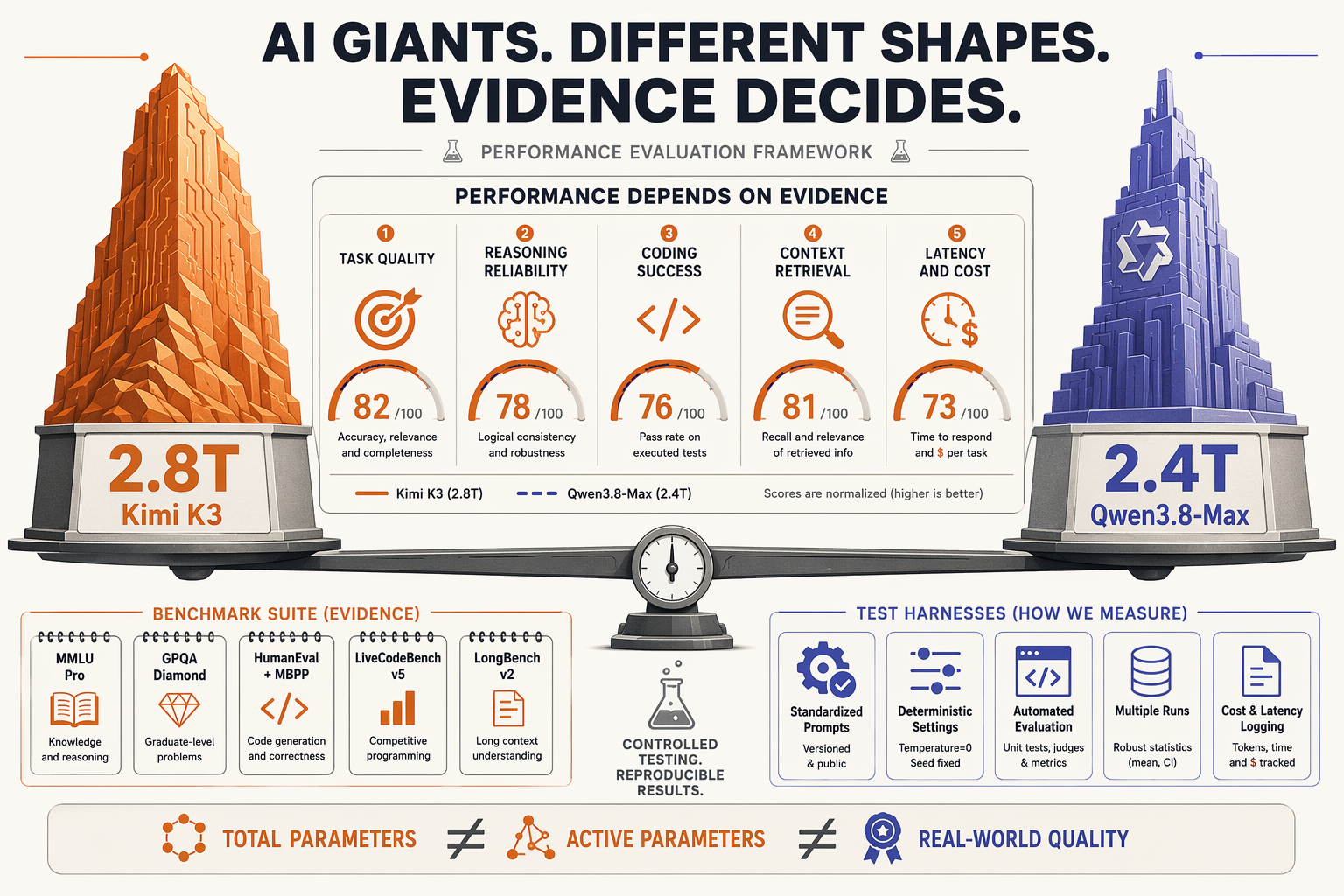
No. A 2.8-trillion-parameter model is not automatically better than a 2.4-trillion-parameter model. Kimi K3’s stated total is 400 billion parameters larger—about 16.7% more than 2.4 trillion—but that arithmetic does not establish superior reasoning, coding accuracy, latency, cost, or agent reliability.
Why total parameters are an incomplete signal
A parameter count measures the number of learned values in a model, not the quality of every answer it produces. It is especially limited when comparing frontier systems because developers also need to know:
- Architecture: A dense model activates all parameters for every token, while a mixture-of-experts (MoE) model may activate only a subset of specialist experts.
- Active parameters: The number of parameters used per inference step has a major impact on compute cost and latency. Neither the supplied Kimi K3 documentation nor the Qwen3.8-Max preview information here confirms an active-parameter figure.
- Training and post-training: Dataset quality, reasoning training, reinforcement learning, tool-use training, and safety tuning can change real-world performance far more than a modest difference in total scale.
- Evaluation conditions: Benchmark scores depend on the test version, prompting method, tool access, sampling settings, and whether a model was optimized for that benchmark.
Moonshot AI explicitly describes Kimi K3 as a 2.8-trillion-parameter flagship built for “long-horizon programming, knowledge work and deep reasoning.” Moonshot AI also confirms production-relevant capabilities that parameter totals cannot express: native multimodal understanding, tool calling, and up to 1,048,576 tokens of configured output/context capacity through its API documentation.
What the 2.8T vs 2.4T gap does—and does not—tell us
The reported 2.4-trillion-parameter Qwen3.8-Max figure positions Alibaba’s preview model in the same frontier-scale category as Kimi K3. But, as of July 20, 2026, it should be treated as an announcement-stage specification rather than evidence of a completed head-to-head result.
| Evaluation question | Kimi K3 | Qwen3.8-Max | Why it matters |
|---|---|---|---|
| Reported total parameters | 2.8 trillion | 2.4 trillion, preview-reported | Total scale is not active compute or quality |
| Active parameters per token | Not confirmed in supplied documentation | Not publicly confirmed here | Determines much of inference efficiency |
| Long-context specification | 1 million tokens confirmed | Unknown from supplied primary material | Affects repository and knowledge-base tasks |
| Tool calling | Confirmed by Moonshot AI | Unknown from supplied material | Critical for agent workflows |
| Published comparable benchmarks | No like-for-like result cited here | No like-for-like result cited here | Required for a performance verdict |
A practical way to evaluate both models
Treat parameter count as a screening metric, not a procurement decision. Before selecting Kimi K3 or waiting for Qwen3.8-Max, test the workloads that create business value:
- Run identical coding, retrieval, vision, and tool-use tasks.
- Measure task completion rate, not just a single benchmark score.
- Track first-token latency, total runtime, token use, and failure recovery.
- Test long-context recall with documents that resemble your real data.
- Verify API availability, pricing, licensing, and model-version stability.
Kimi K3 currently has the stronger documented deployment case because Moonshot AI publishes its API positioning, 1M-token context window, and pricing starting at ¥20 per million input tokens and ¥2 per million cached input tokens. Qwen3.8-Max may prove highly capable when Alibaba releases primary documentation and reproducible evaluations, but its reported 2.4T total alone cannot justify a performance claim.
For teams testing several frontier models as details evolve, an OpenAI-compatible gateway such as CallMissed can reduce integration churn by allowing multiple LLMs to be evaluated through one API pattern rather than rebuilding application logic for each provider.
Which model is stronger for coding, agents, multimodal work, and long documents?
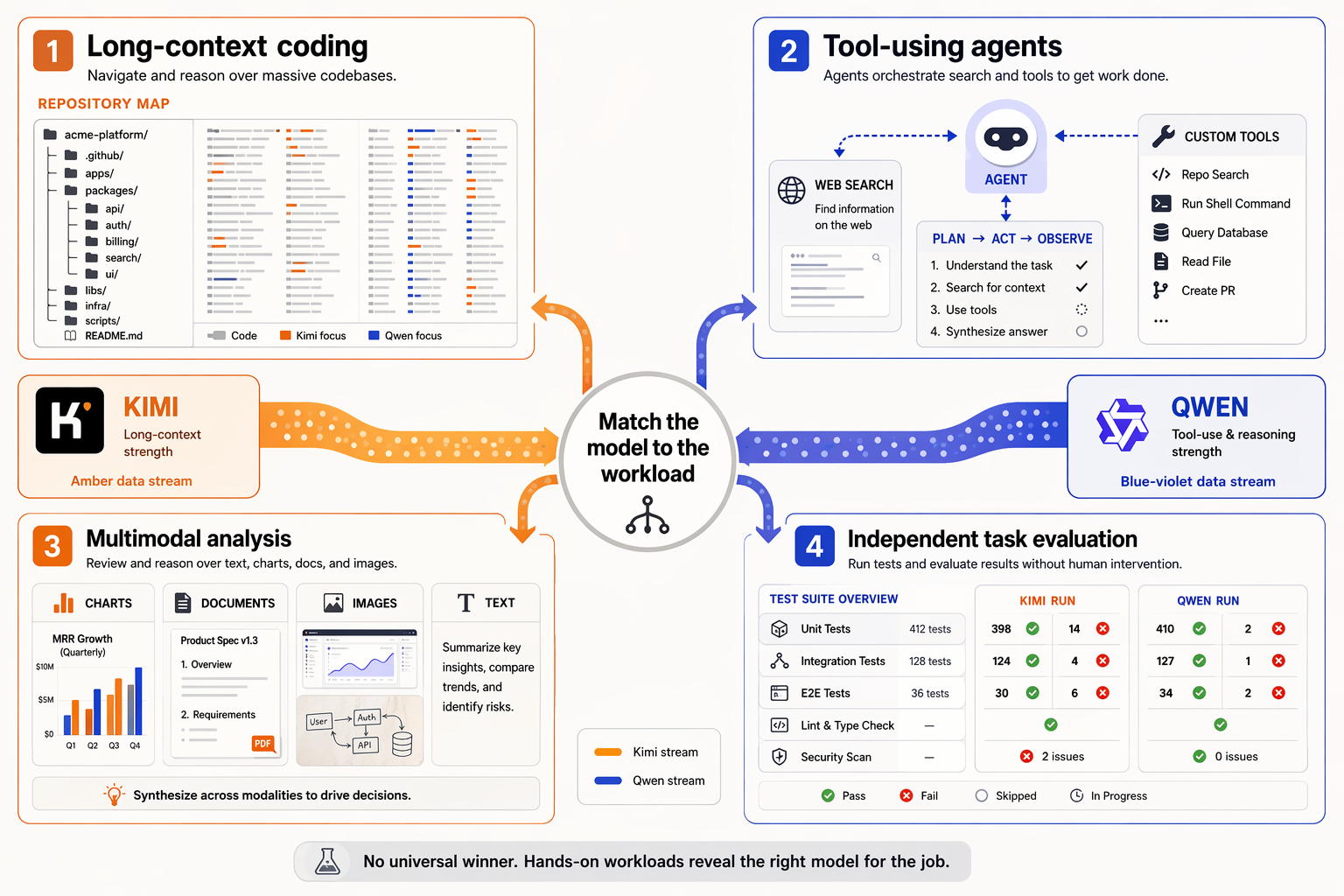
Kimi K3 is the stronger documented option for coding agents, multimodal analysis, and million-token document workflows as of July 20, 2026. Qwen3.8-Max may prove competitive once Alibaba publishes its final model card, API documentation, and independent evaluations, but its reported 2.4-trillion-parameter preview status does not yet establish task-level superiority.
Coding and agent workflows
For production coding agents, the decisive feature is not total parameters—it is whether a model has documented tool calling, long-horizon execution support, reliable context handling, and accessible APIs.
- Kimi K3 is explicitly designed for long-horizon programming, knowledge work, and deep reasoning, according to Moonshot AI’s Kimi API platform.
- Moonshot AI’s agent-building guide states that Kimi K3 supports reasoning, coding, and tool calling for complex tasks, including workflows that combine an official web-search tool with custom tools.
- That makes Kimi K3 a concrete fit for agent patterns such as repository analysis, bug triage, research pipelines, code-review assistants, and multi-step internal-support automation.
- Qwen3.8-Max’s coding-agent performance remains unverified as of the July 20, 2026 cutoff. The preview reporting identifies it as a 2.4-trillion-parameter multimodal model, but does not yet provide a comparable public specification for tool calling, agent SDKs, coding benchmarks, or production API behavior.
Verdict for coding and agents: Kimi K3. Its documented tool-use capabilities make it deployable today; Qwen3.8-Max should remain an evaluation candidate until Alibaba publishes reproducible evidence.
Multimodal work
Both models are associated with multimodality, but they differ sharply in how much developers can confirm.
| Workload | Kimi K3 | Qwen3.8-Max | July 2026 assessment |
|---|---|---|---|
| Image understanding | Officially documented native vision understanding | Reported as multimodal in preview | Kimi K3 is verified |
| Video input | Not confirmed for Kimi K3 in the provided K3 documentation | Not publicly confirmed | Treat as unknown |
| Tool-using visual agent | Vision plus documented tool calling | Tool-use specification not confirmed | Kimi K3 has clearer implementation path |
| Multimodal benchmarks | No specific published score supplied here | No specific published score supplied here | No benchmark winner can be declared |
Moonshot AI’s API documentation identifies Kimi K3 as natively supporting visual understanding. That is sufficient for documented image-plus-text workflows, such as reading screenshots, reviewing visual reports, extracting information from scanned materials, or grounding an agent’s response in an image.
However, native multimodality is not a benchmark result. Neither the available Kimi K3 material nor the Qwen3.8-Max preview details in this comparison provide directly comparable scores for chart reasoning, document visual question answering, video understanding, or image-grounded coding. Teams should test their own image sets rather than infer quality from a parameter count.
Long documents and enterprise knowledge
Kimi K3 has its clearest advantage in confirmed long-context work. Moonshot AI states that Kimi K3 supports a 1,000,000-token context window. Moonshot AI’s chat-completions documentation also states that Kimi K3 has a default output limit of 131,072 tokens and a configurable maximum output limit of 1,048,576 tokens.
Those limits matter for workflows involving:
- Large codebases and multi-file dependency tracing.
- Lengthy policy manuals, contracts, call transcripts, and research corpora.
- Agent tasks that must retain substantial intermediate evidence without aggressive chunking.
Qwen3.8-Max has no confirmed public context-window or output-token limit in the provided July 2026 information. Until Alibaba documents those figures, it cannot be credibly recommended over Kimi K3 for full-corpus analysis.
For teams that want to test several models without repeatedly changing request formats, CallMissed’s OpenAI-compatible AI gateway reflects a practical multi-model approach: route experiments through one integration, then evaluate coding accuracy, tool reliability, latency, and cost on representative workloads.
What do official documentation and published benchmarks actually prove?

Official documentation proves Kimi K3’s documented product capabilities and API controls; it does not, by itself, prove that Kimi K3 outperforms Qwen3.8-Max. As of July 20, 2026, the reported 2.4-trillion-parameter Qwen3.8-Max preview does not have an equivalent public evidence trail for reproducible performance, deployment, or licensing decisions.
What Moonshot AI’s documentation establishes
Moonshot AI’s Kimi API documentation identifies Kimi K3 as its flagship model for long-horizon programming, end-to-end knowledge work, and deep reasoning. Moonshot AI also documents practical features that developers can validate through the platform rather than infer from a model announcement:
- Native vision understanding: Moonshot AI’s model documentation states that
kimi-k3supports visual understanding, supporting multimodal application designs involving image input. - Agent-oriented interfaces: Moonshot AI’s agent guide describes using Kimi K3 for reasoning, coding, and tool calling, including workflows that combine the official web-search tool with custom tools.
- Controllable generation limits: Moonshot AI’s Chat Completions API documentation specifies a 131,072-token default output limit and a configurable maximum of 1,048,576 tokens for Kimi K3.
- Published commercial terms: Moonshot AI publishes input and cache-hit prices, allowing teams to estimate at least one component of production inference cost before integration.
These are product-documentation facts, not independent measures of model intelligence. They establish that Kimi K3’s capabilities are described, exposed through an API, and accompanied by operational parameters.
What published benchmarks need to show
A credible Kimi K3 vs Qwen3.8-Max benchmark comparison requires more than a vendor scorecard. It should identify the exact model version, prompt format, thinking or tool-use settings, test date, hardware or API conditions, and whether results were independently reproduced.
For coding and agent systems, the most decision-useful evidence would include:
- Software-engineering evaluation: Scores on versioned tests such as SWE-bench Verified, plus pass@1 methodology and repository setup details.
- Long-context retrieval: Needle-in-a-haystack and multi-document QA tests at declared context lengths, with accuracy reported at multiple positions—not just a maximum-context claim.
- Multimodal reasoning: Image, chart, document, and visual-grounding evaluations with disclosed input preprocessing.
- Production metrics: Median and tail latency, tokens per second, tool-call success rate, uptime, rate limits, and cost per completed task.
A single aggregate benchmark number cannot establish all of those outcomes. Parameter count is an architecture statistic, not a benchmark result.
What remains unproven for Qwen3.8-Max
The Qwen3.8-Max 2.4-trillion-parameter figure should be treated as a preview-stage reported claim until Alibaba publishes primary technical documentation. As of July 20, 2026, the available context does not verify:
- active parameters per token or mixture-of-experts routing;
- public API endpoint, rate limits, or pricing;
- context-window and output-token limits;
- open-weight, source-available, or proprietary licensing status;
- official benchmark tables and their methodology;
- independent third-party reproductions.
The practical verdict is therefore evidence-based rather than size-based: Kimi K3 is currently easier to evaluate for API-led coding, knowledge-work, multimodal, and agent experiments because Moonshot AI has published implementation details. Qwen3.8-Max may become compelling once Alibaba releases comparable documentation and reproducible evaluations, but its reported scale alone cannot justify a production-model decision.
What does Kimi K3 vs Qwen3.8-Max mean for your team? (TABLE)
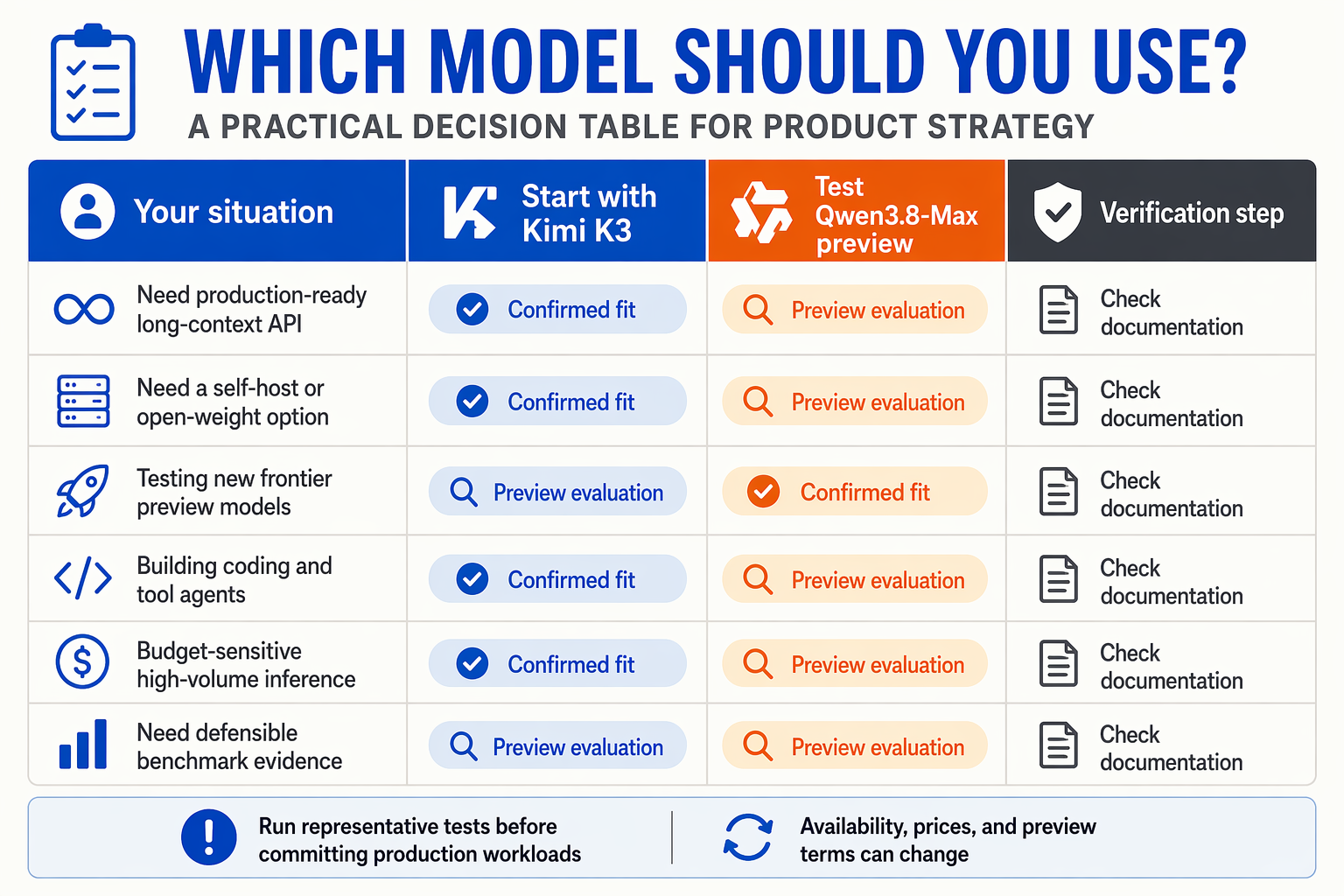
For Kimi K3 vs Qwen3.8-Max, Kimi K3 is the practical choice wherever its documented API, released weights, specifications, and applicable license meet your requirements. Qwen3.8-Max should remain an evaluation candidate until Alibaba publishes official production access, pricing, licensing, architecture details, and independently reproducible benchmarks. The reported 2.8 trillion parameters for Kimi K3 and 2.4 trillion for Qwen3.8-Max are not evidence that either model is more capable: total parameter counts do not establish active parameters, task quality, latency, cost, or reliability.
| Team decision | Kimi K3 | Qwen3.8-Max | Practical implication |
|---|---|---|---|
| Production availability | Publicly documented through the Kimi API platform, with released model artifacts | Preview-reported; official production endpoint documentation remains unconfirmed as of July 20, 2026 | Build production systems around verifiable access rather than expected announcements |
| Total parameters | 2.8 trillion, according to Moonshot AI | 2.4 trillion reported in preview coverage | Do not infer intelligence or application performance from total parameters |
| Architecture and active parameters | Do not model cost or latency from the total count without confirming architecture, routing, and active parameters for the chosen deployment | Official architecture and active-parameter details remain unconfirmed | Request deployment-specific architecture and throughput information from each provider |
| Context and output | 1 million-token context; default output is 131,072 tokens, configurable to 1,048,576 | Official context and output limits remain unconfirmed | Kimi K3 offers the lower-risk path for very large document and repository workflows |
| Multimodality and agents | Native visual understanding and documented tool calling | Reported as multimodal; production tool and API behavior remains unconfirmed | Test image handling, tool schemas, retries, and multi-step agent behavior on representative tasks |
| Published commercial terms | API pricing starts at ¥20/MTok input and ¥2/MTok cached input | Final API pricing is unconfirmed | Kimi K3 supports preliminary cost modeling; complete forecasts still require output usage, throughput, and workload data |
| Weights and licensing | Released weights provide an additional deployment path, subject to the exact artifact’s license and technical requirements | Weight availability, commercial permissions, and final license are unconfirmed | Legal and infrastructure teams must review the specific release—not rely on model-family assumptions |
| Benchmark confidence | Official claims should be reproduced on your tasks and deployment configuration | Final official results and independent reproduction are not yet available | Decide from controlled evaluations, not preview coverage or parameter headlines |
A sensible deployment split
For long-context research, enterprise knowledge work, and coding agents, Kimi K3 has the clearer current path. Moonshot AI documents API access, context configuration, tool calling, and pricing, and describes Kimi K3 as intended for “long-horizon programming, knowledge work and deep reasoning.” Its API documentation also specifies a 1,048,576-token maximum output setting.
For multimodal and agent experimentation, the Kimi K3 vs Qwen3.8-Max comparison should be based on a workload-specific test suite:
- Grounded answers over internal documents, including citation accuracy and abstention behavior.
- Repository-level code changes, test-pass rate, and recovery from failed tool calls.
- Image understanding for relevant inputs such as invoices, product photos, diagrams, or screenshots.
- Median and tail latency, throughput, failure rate, and cost per successfully completed task.
- Security controls, data retention, regional availability, rate limits, and operational support.
For self-hosting or regulated deployments, verify the exact Kimi K3 weight artifact, license, hardware requirements, quantization support, and update policy before committing. Do not assume that a parameter count, preview announcement, or association with an open-weight model family grants access, redistribution rights, or commercial permission. Qwen3.8-Max should not enter a self-hosting plan until Alibaba publishes the relevant weights and license, if it elects to release them.
What to do this quarter
- Deploy Kimi K3 where its documented API or released weights satisfy your technical, legal, security, and cost requirements, especially for workflows that benefit from million-token context.
- Keep Qwen3.8-Max behind a feature flag or in an offline evaluation track until Alibaba confirms production endpoints, rate limits, pricing, context and output limits, architecture, licensing, and benchmark methodology.
- Run the same private evaluation set against both models once Qwen3.8-Max becomes officially accessible; compare completed-task quality and cost rather than total parameters.
- Use a provider-neutral abstraction layer so revisiting Kimi K3 vs Qwen3.8-Max becomes a routing decision rather than an application rewrite. Solutions such as CallMissed, the OpenAI-compatible AI gateway, support this multi-model approach through one integration.
The near-term verdict is about verified capabilities and execution readiness—not whether 2.8T is larger than 2.4T.
Frequently asked questions about Kimi K3 and Qwen3.8-Max
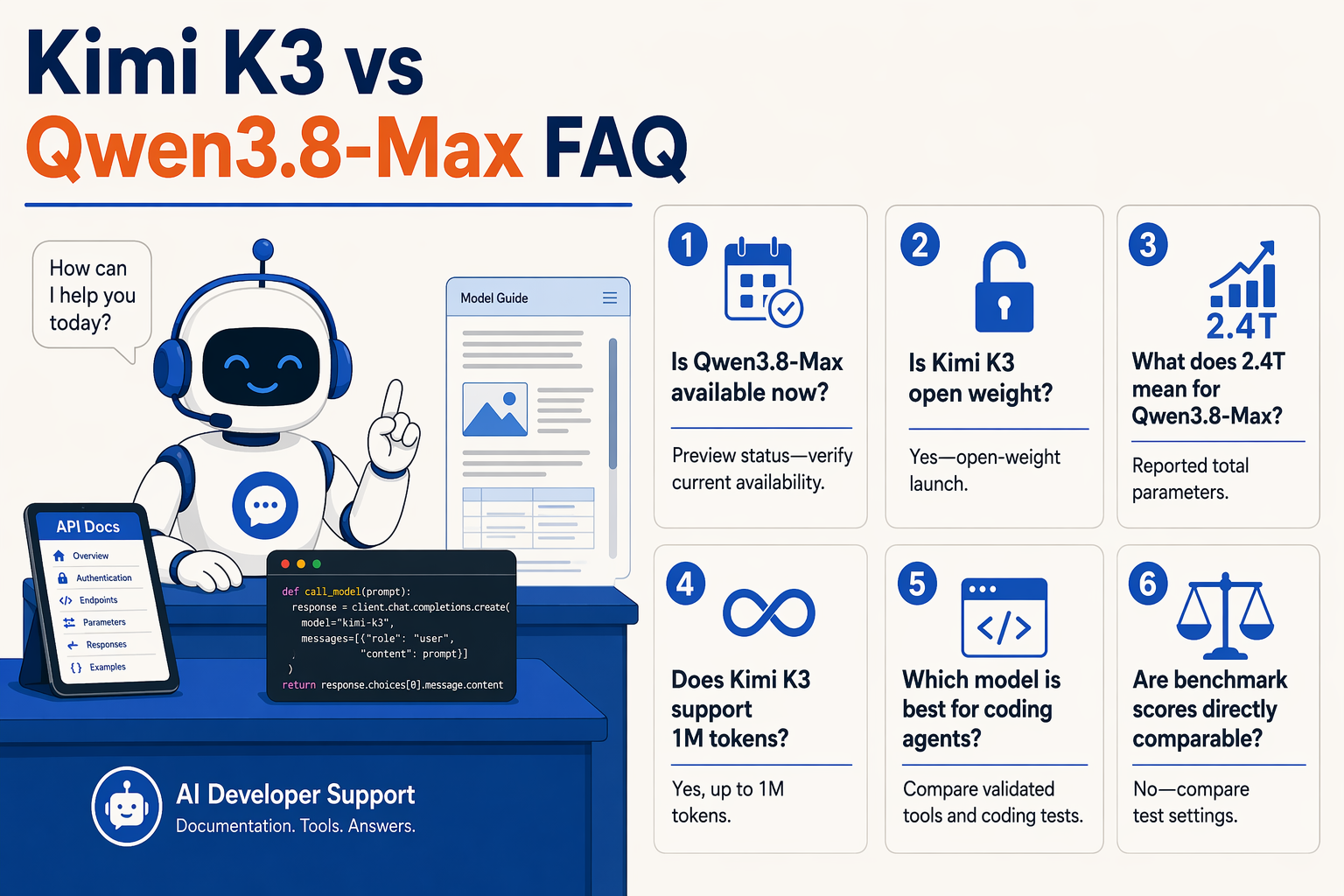
What is the main difference in the Kimi K3 vs Qwen3.8-Max comparison as of July 20, 2026?
Is Qwen3.8-Max publicly available through an API?
Is Kimi K3 available for production use today?
Are Kimi K3 or Qwen3.8-Max open-weight models?
Which model is better for coding agents and long-context knowledge work?
How much does Kimi K3 cost compared with Qwen3.8-Max?
Conclusion
The July 20, 2026 verdict on Kimi K3 vs Qwen3.8-Max favors Kimi K3 for practical deployment. Moonshot AI has documented Kimi K3’s access, specifications and pricing, while Qwen3.8-Max remains promising but provisional pending primary Alibaba documentation and independent benchmarks.
- Kimi K3 offers the stronger practical case today, with documented API access, a 2.8-trillion-parameter architecture, a 1 million-token context window, multimodal capabilities, tool calling and published pricing.
- Qwen3.8-Max should remain on the watchlist, as its reported specifications, API availability, context limit, licensing and benchmark methodology have not yet been confirmed by Alibaba.
- The Kimi K3 vs Qwen3.8-Max decision should not rest on parameter counts alone; production fit also depends on reliability, latency, tool use and operating costs.
For now, Kimi K3 vs Qwen3.8-Max is a choice between a documented deployment option and an emerging model awaiting verification. Follow Alibaba’s official releases and independently reproducible testing, then explore CallMissed for AI infrastructure powering voice agents and multilingual chatbots.
Related Reading
- Claude Opus 4.8 vs Qwen3.8-Max: July 2026 Comparison
- GPT-5.6 Sol vs Qwen3.8-Max: Verified July 2026 Comparison
- Claude Fable 5 vs Qwen3.7 Max: July 2026 Facts on the Qwen3.8-Max Preview
Sources
Discussion
Related Posts


Ready to automate customer conversations?
Launch AI voice agents and WhatsApp bots with CallMissed — one API, 22+ Indian languages.