GPT-6 Astra vs GPT-5.6 Sol: Official Facts, Unknowns, and the Practical Choice


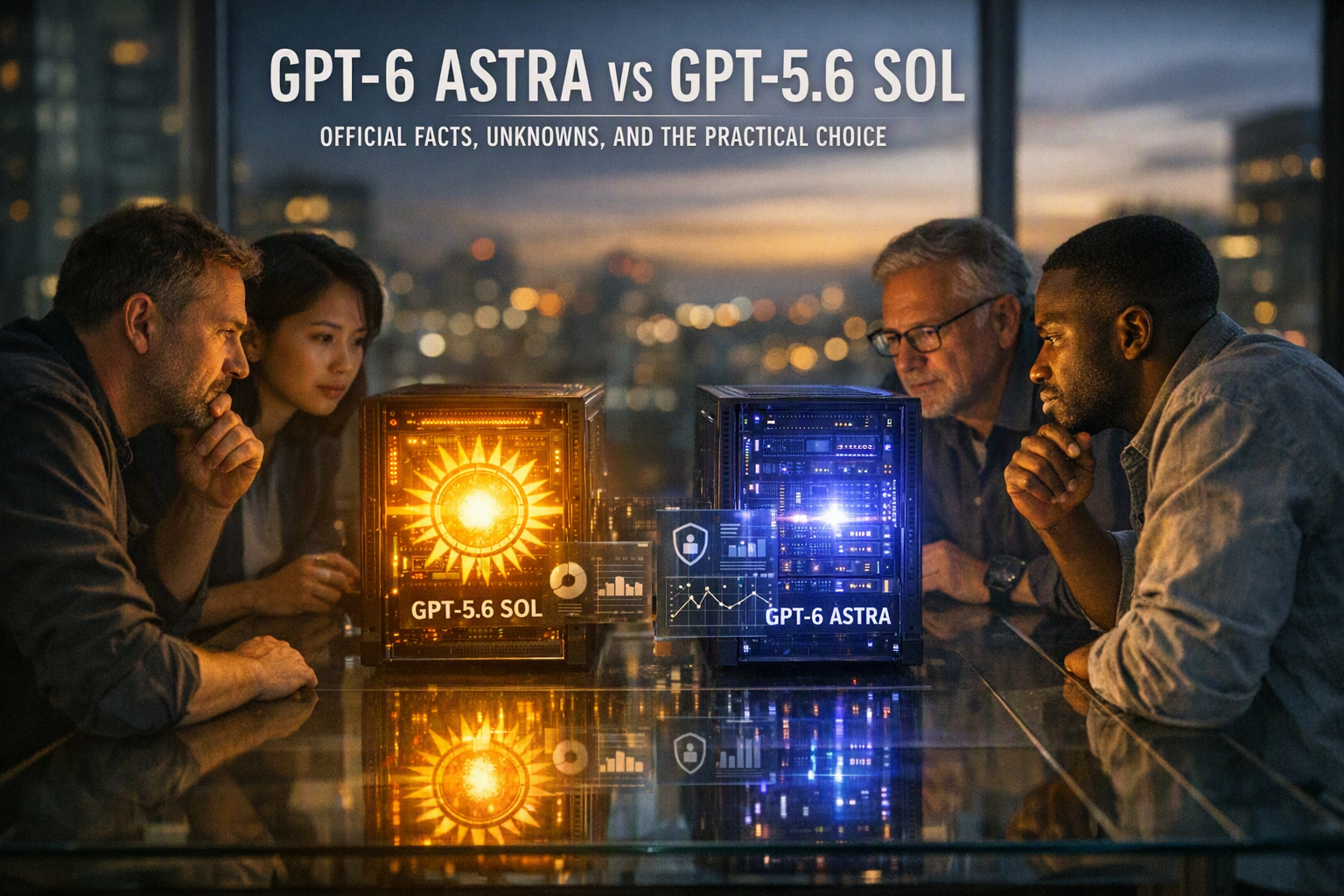
Compare GPT-6 Astra vs GPT-5.6 Sol using official evidence on token efficiency, cybersecurity, pricing, access, tools, and safeguards.
GPT-6 Astra vs GPT-5.6 Sol: Official Facts, Unknowns, and the Practical Choice
As of September 5, 2026, both sides of the GPT-6 Astra vs GPT-5.6 Sol comparison are officially documented. OpenAI released GPT-6 Astra on September 3, published its system card and safety overview, and lists gpt-6-astra for API use. GPT-5.6 Sol remains an established member of the GPT-5.6 family, so the practical comparison now turns on workload performance, safeguards, latency and total cost rather than release uncertainty.
That distinction matters because online comparisons can easily turn an internal roadmap, research milestone, or future capability target into an apparently finished product. OpenAI’s “Path to Astra: critical capabilities and frontier safeguards” discusses Astra-oriented development and evaluates GPT-5.6 Sol against emerging capability and safety thresholds. However, the official material provided here does not publish the information required for a like-for-like commercial comparison: an Astra model identifier, release status, price, context window, modality support, tool compatibility, rate limits, or token-efficiency benchmark.
GPT-5.6 Sol has a much firmer evidence base. OpenAI describes GPT-5.6 Sol as the flagship model in the GPT-5.6 family, roughly corresponding to the unsuffixed flagship tier in earlier GPT-5 generations. OpenAI’s preview highlights stronger capabilities in coding, science, and cybersecurity, while a subsequent ChatGPT update describes GPT-5.6 Sol as delivering more focused answers, more reliable facts, and greater consistency across quick and deeper reasoning tasks.
Cybersecurity deserves particular scrutiny because higher capability can increase both defensive value and misuse risk. OpenAI’s GPT-5.6 System Card reports that GPT-5.6 Sol remains strong at avoiding data overwrites, scores slightly below GPT-5.5 on the avoidance-only measure, and matches GPT-5.5 on the combined metric. That is a useful official finding—but it is not evidence that Astra is safer, less safe, or more capable unless OpenAI publishes directly comparable results.
This comparison therefore separates three categories:
- Official facts, including documented GPT-5.6 Sol capabilities and safeguards
- Explicit unknowns, such as Astra pricing, token usage, availability, context length, modalities, and API access
- Practical decisions, including when a deployable, documented model is preferable to waiting for an unconfirmed successor
We will examine token efficiency, cybersecurity, availability, pricing, tools, modalities, context limits, and frontier safeguards without filling documentation gaps with rumor. For developers using multi-model infrastructure, platforms such as CallMissed’s OpenAI-compatible gateway also illustrate why model availability and integration stability can matter as much as headline capability.
The practical question is not whether Astra sounds more advanced. It is whether OpenAI has published enough verifiable information to choose it—and, until that threshold is met, whether GPT-5.6 Sol remains the model teams can actually evaluate, integrate, govern, and budget for today.
GPT-6 Astra vs GPT-5.6 Sol: What is the evidence-based answer as of September 3, 2026?
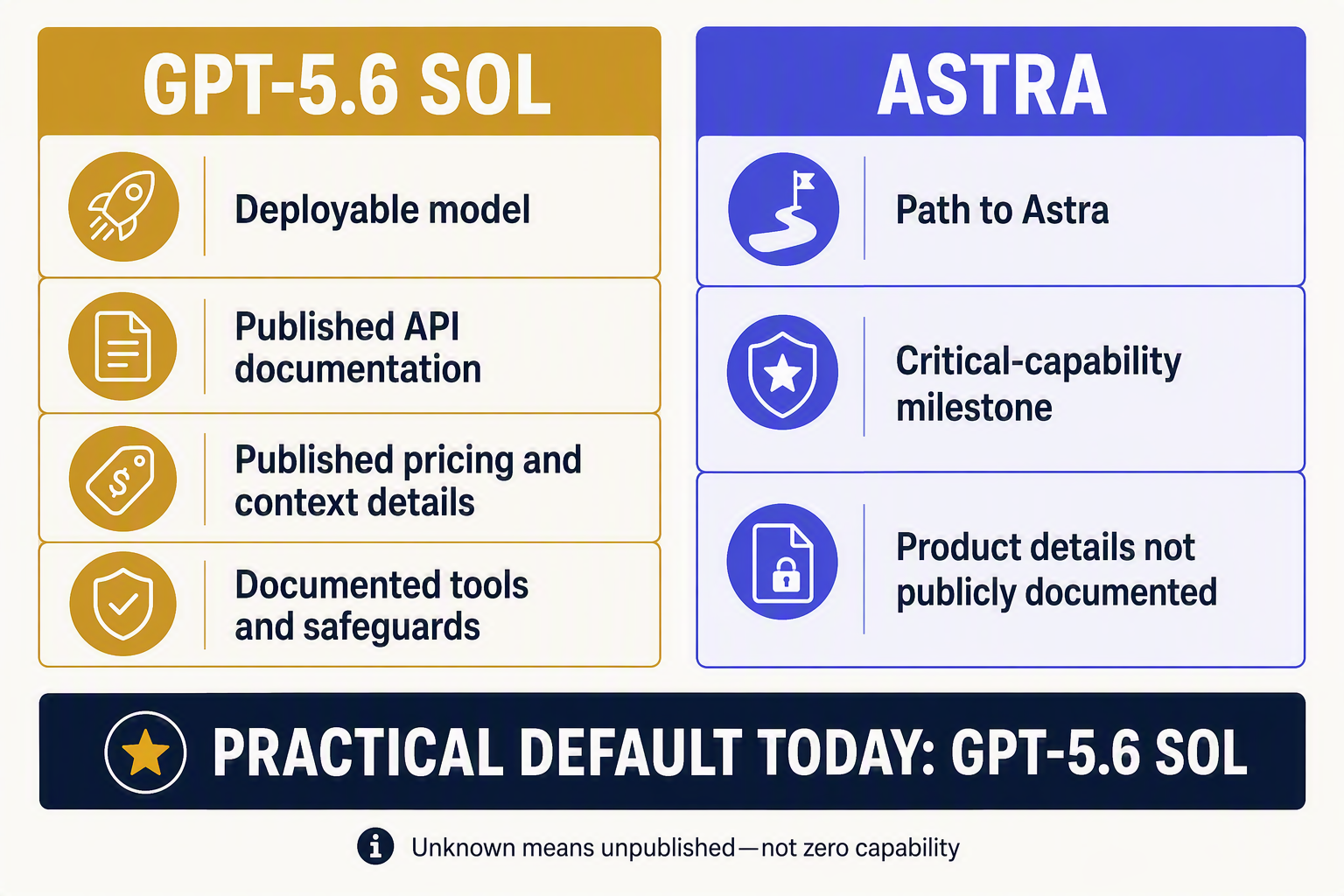
As of September 5, 2026, both GPT-6 Astra and GPT-5.6 Sol are officially documented OpenAI models. OpenAI released GPT-6 Astra on September 3 and broadly deployed it, so the evidence-based answer is no longer to dismiss Astra as an unreleased roadmap model. Astra is the stronger candidate when its documented cybersecurity capability increase matters, but the practical production choice still depends on access, latency, total cost, and safeguards.
What OpenAI officially documents
A credible GPT-6 Astra vs GPT-5.6 Sol comparison can now evaluate two released models rather than comparing a deployable model with a development roadmap.
OpenAI’s official materials establish these relevant facts:
- GPT-6 Astra is a released model. OpenAI officially launched it on September 3, 2026, and describes it as broadly deployed.
- Astra has a documented API identity and pricing. OpenAI lists the model as
gpt-6-astra, priced at $10 per million input tokens, $1 per million cached input tokens, $12.50 per million cache-write tokens, and $50 per million output tokens. - GPT-5.6 Sol remains an officially documented option. OpenAI identifies
gpt-5.6-solas a flagship model in the GPT-5.6 family and documents thegpt-5.6alias as pointing to that tier. - The models have published capability and safety materials. OpenAI documents GPT-5.6 Sol’s strengths in coding, science, and cybersecurity, while its Astra materials describe a further increase in cybersecurity capability.
These facts make GPT-6 Astra vs GPT-5.6 Sol a valid production comparison. They do not, by themselves, establish which model will deliver better latency, reliability, or cost per successful task in a specific application.
Token efficiency requires direct testing
Astra’s published prices do not prove that it uses fewer tokens than GPT-5.6 Sol. Token consumption, cached-token discounts, cache-write charges, output pricing, latency, and task completion rate are separate measurements.
A defensible GPT-6 Astra vs GPT-5.6 Sol efficiency test should hold constant:
- Task set and required answer quality
- Prompt and context construction
- Reasoning configuration
- Tool-use policy
- Cache strategy
- Output limits and success criteria
Astra’s $50-per-million-output-token price makes output length particularly relevant to cost modeling. Its lower cached-input rate may benefit workloads that repeatedly reuse context, but cache-write charges must also be included. The correct metric is usually total cost per successful task, not the lowest price for one token category.
Cybersecurity capability is not the same as safety
OpenAI documents a cybersecurity capability increase for GPT-6 Astra. That supports evaluating Astra for demanding cybersecurity work, but it should not be interpreted as proof of universal safety superiority.
Higher cybersecurity capability can improve legitimate analysis while also increasing dual-use risk. Production teams should therefore examine:
- Safeguard and misuse-resistance evaluations
- Tool permissions and network access
- Human approval requirements
- Logging, monitoring, and incident response
- Whether the deployment is permitted for the intended use case
GPT-5.6 Sol also has published cybersecurity and safeguard evidence. Its system card reported that Sol scored slightly below GPT-5.5 on the avoidance-only data-overwrite measure while matching GPT-5.5 on the combined metric. Comparisons should distinguish cybersecurity task capability from resistance to destructive or unauthorized behavior.
Practical deployment verdict
Choose GPT-6 Astra when:
- Its documented cybersecurity capability increase is important
- Your account and deployment environment provide suitable access
- Testing shows acceptable latency and reliability
- Its input, cache, and output pricing produces a sustainable total cost
- Your safeguards are appropriate for its capability level
Choose GPT-5.6 Sol when:
- It already meets the application’s quality requirements
- Existing integrations and evaluations reduce migration risk
- It offers better measured latency or cost for the workload
- Its published capability and safeguard profile better fits the deployment
The evidence-based GPT-6 Astra vs GPT-5.6 Sol answer is therefore workload-dependent: Astra is now an official, broadly deployed API model with documented pricing and increased cybersecurity capability, while Sol remains a valid production option. Benchmark both under realistic prompts, tools, caching behavior, safeguards, and traffic before making the final choice.
What are GPT-5.6 Sol and Astra, and is Astra officially called GPT-6?
As of September 3, 2026, OpenAI officially documents GPT-5.6 Sol as a model, but the cited OpenAI materials do not officially name Astra “GPT-6” or identify a commercially available model called GPT-6 Astra. In the available evidence, Sol is a deployable member of the GPT-5.6 family, while Astra is presented as a frontier-development direction tied to future capabilities and safeguards.
GPT-5.6 Sol is an officially documented model
OpenAI’s developer documentation describes GPT-5.6 Sol as the flagship model in the GPT-5.6 family. OpenAI also says Sol roughly corresponds to the unsuffixed flagship tier used in earlier GPT-5 families, distinguishing it from other family variants such as GPT-5.6 Terra and GPT-5.6 Luna.
The official evidence supporting GPT-5.6 Sol includes:
- An OpenAI API model page for
gpt-5.6-sol - A documented
gpt-5.6alias - OpenAI’s “Previewing GPT-5.6 Sol” announcement
- A dedicated GPT-5.6 System Card in OpenAI’s Deployment Safety Hub
- An OpenAI ChatGPT update describing subsequent improvements to Sol
OpenAI’s GPT-5.6 Sol preview characterizes the model as stronger in coding, science, and cybersecurity. OpenAI’s later ChatGPT update says GPT-5.6 Sol provides more focused answers, more reliable facts, and more consistent performance from quick responses through deeper reasoning.
These materials establish a recognizable product identity and an official documentation trail. They do not imply that every OpenAI product or interface necessarily supports Sol in the same way; model-page documentation and availability in a particular tool, account type, or application are separate questions.
Astra is a destination, not a documented GPT-6 product
OpenAI’s “Path to Astra: critical capabilities and frontier safeguards” frames Astra around critical capability development and the safeguards required for more advanced systems. Crucially, that publication evaluates GPT-5.6 Sol in relation to Astra-oriented thresholds; it does not, in the material cited here, publish a standalone Astra API model.
No official source provided for this comparison specifies:
- A model identifier such as
gpt-6-astra - A general-availability or preview release date
- API or ChatGPT access
- Input and output pricing
- Context-window or maximum-output limits
- Supported modalities or tools
- Token-efficiency measurements
- Astra-specific cybersecurity benchmark results
Calling Astra “GPT-6” would therefore add a product designation that OpenAI has not established in the cited documentation. Search phrases such as “GPT-6 Astra vs GPT-5.6 Sol,” “GPT Astra 6 vs GPT-5.6,” and “OpenAI Astra comparison” reflect user interest, not official nomenclature.
The naming distinction changes the comparison
A careful comparison should use three labels consistently:
- GPT-5.6 Sol: an officially named and documented GPT-5.6 flagship model.
- Astra: an OpenAI frontier-capability and safeguards direction described in “Path to Astra.”
- “GPT-6 Astra”: an unofficial shorthand unless OpenAI subsequently publishes that exact product name.
The defensible conclusion on September 3, 2026 is straightforward: GPT-5.6 Sol can be assessed from model documentation and safety reporting, whereas Astra cannot yet be treated as a fully specified GPT-6 product. Any feature attributed to Astra without an official model page, system card, release announcement, or API specification should remain marked unknown, not inferred from its anticipated position beyond GPT-5.6.
Which officially documented developments define the OpenAI Astra comparison?
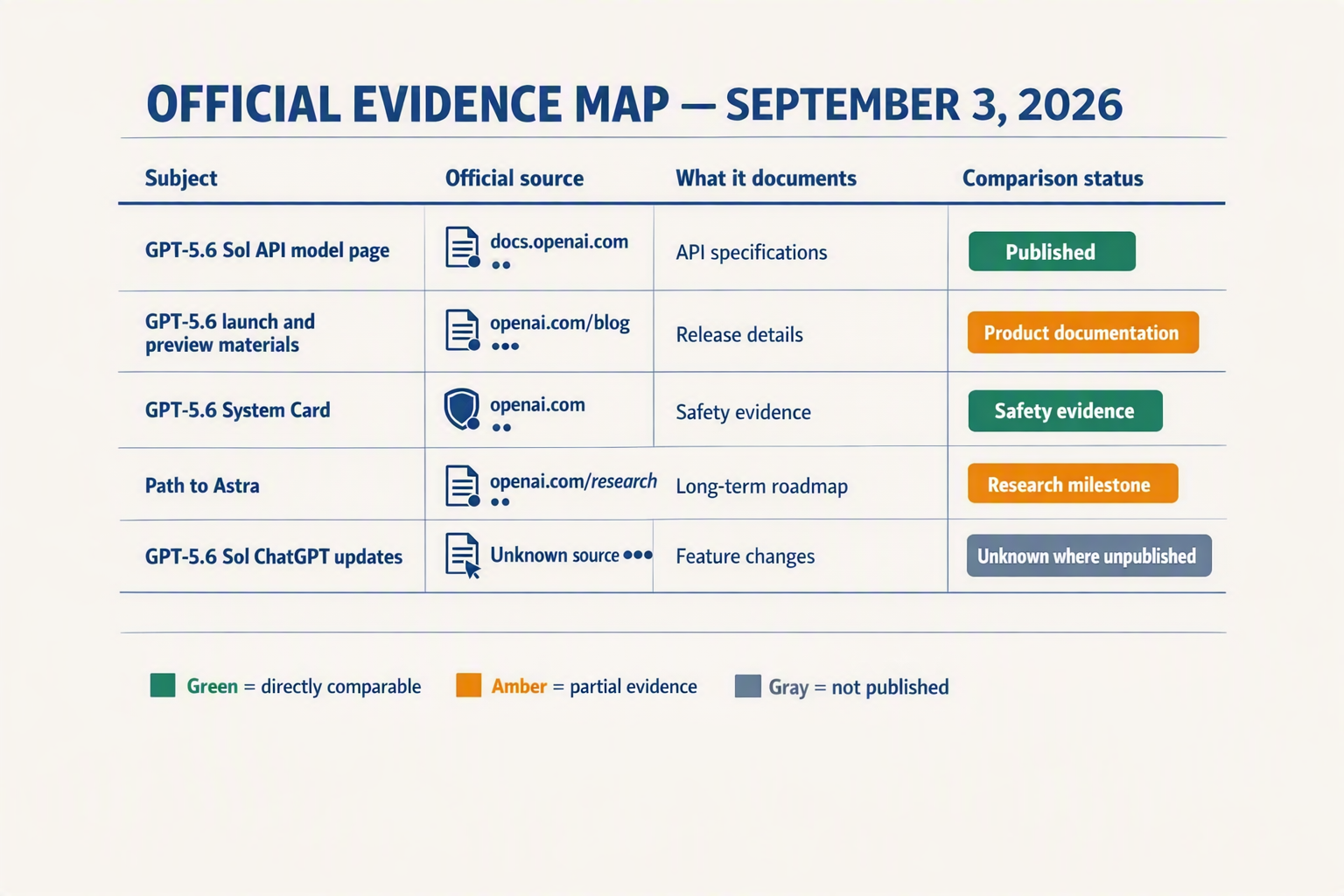
As of September 3, 2026, the OpenAI Astra comparison is defined by six official developments: a documented GPT-5.6 Sol API listing, capability and family announcements, a ChatGPT update, a system card, and an Astra roadmap focused on critical capabilities and frontier safeguards. Collectively, these sources document GPT-5.6 Sol as a deployable model, while presenting Astra as a direction of travel without a complete public product specification.
Official evidence at a glance
| Official development | GPT-5.6 Sol evidence | Astra evidence | Comparison significance |
|---|---|---|---|
| OpenAI API model page | Identifies GPT-5.6 Sol as the GPT-5.6 family’s flagship and provides the gpt-5.6-sol model name plus a gpt-5.6 alias | No Astra API model identifier is documented in the supplied official sources | Sol can be evaluated for integration; Astra cannot yet be compared as a documented API product |
| GPT-5.6 Sol preview | OpenAI reports stronger capabilities in coding, science, and cybersecurity | No equivalent Astra launch preview or benchmark package is provided | Capability claims exist for Sol, but not enough matching evidence exists for an Astra-versus-Sol scorecard |
| GPT-5.6 family announcement | OpenAI publishes a score-versus-API-cost comparison involving Sol, Terra, Luna, GPT-5.5, GPT-5.4, Claude Opus 4.8, and Gemini 3.5 Flash | No corresponding Astra cost or efficiency point is published | Cost-performance evidence is not the same as measured token efficiency, and Astra lacks either figure |
| Path to Astra | Uses GPT-5.6 Sol in Astra-oriented capability and safeguard evaluation, including a test informed by Hugging Face | Describes critical capabilities and frontier safeguards associated with the path toward Astra | This is roadmap and evaluation evidence—not proof of a released product called GPT-6 Astra |
| GPT-5.6 System Card | Reports strong resistance to data overwrites; the avoidance-only score is slightly below GPT-5.5, while the combined metric matches GPT-5.5 | No directly comparable Astra system-card result is supplied | Cybersecurity comparisons must remain limited to Sol’s published measurements |
| ChatGPT improvement announcement | OpenAI describes Sol as providing “more focused answers,” “more reliable facts,” and greater consistency from quick answers to deeper thinking | No equivalent Astra deployment update appears in the provided record | Sol has documented product tuning; Astra’s user-facing behavior remains unspecified |
What these developments establish
The evidence supports three bounded conclusions:
- Availability: GPT-5.6 Sol has an official API identity and documented ChatGPT deployment updates. The supplied OpenAI materials do not establish Astra pricing, rate limits, model aliases, rollout regions, or general API access.
- Token efficiency: OpenAI’s GPT-5.6 family announcement includes an API cost versus score chart, but that does not independently reveal input tokens, output tokens, reasoning-token consumption, latency, or tokens required per successful task. No official Astra token benchmark is available for normalization.
- Cybersecurity: OpenAI officially attributes stronger cybersecurity capability to GPT-5.6 Sol and publishes overwrite-avoidance findings in the GPT-5.6 System Card. The “Path to Astra” material concerns developing and testing frontier safeguards, but it does not supply a directly matched Astra result.
The correct interpretation
“Astra compared to GPT-5.6 Sol” currently means comparing a documented model with a documented frontier-development program—not two equally specified commercial models. A defensible comparison should therefore mark Astra’s context window, modalities, tools, pricing, token consumption, cybersecurity scores, and release status as unknown, rather than inferring them from the Astra name or roadmap language.
Is Astra more token-efficient than GPT-5.6 Sol?
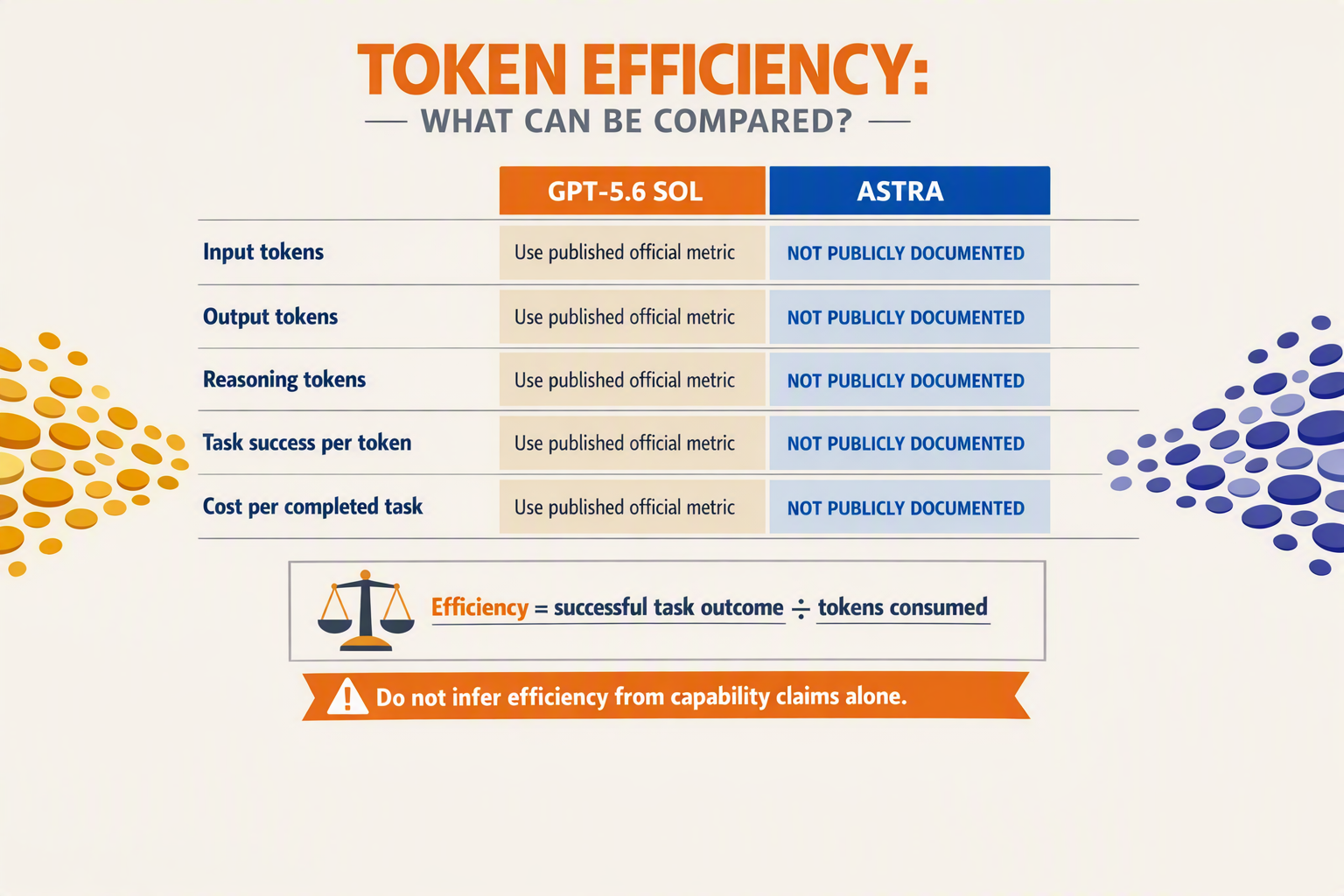
No—OpenAI has not published evidence showing that GPT-6 Astra is more token-efficient than GPT-5.6 Sol as of September 3, 2026. Any claim that Astra uses fewer tokens, produces better results per token, or costs less for equivalent work would currently be speculative.
What “token-efficient” should mean
Token efficiency is not simply the ability to return shorter answers. A credible OpenAI Astra vs GPT-5.6 Sol evaluation would need to measure how many input, reasoning, cached, and output tokens each model consumes while achieving the same quality threshold.
At minimum, an official comparison should disclose:
- Total tokens per successful task, including hidden reasoning tokens where applicable
- Accuracy or task-completion rate at a fixed token budget
- API cost per successful task, rather than price per million tokens alone
- Latency and retry rates, because failed or repeated generations increase real consumption
- Quality-adjusted efficiency across coding, science, cybersecurity, and general reasoning workloads
A model can produce fewer visible tokens yet consume more internal reasoning tokens. Conversely, a more expensive model can be operationally efficient if it solves a task correctly on the first attempt and avoids retries.
What OpenAI officially documents
OpenAI’s GPT-5.6: Frontier intelligence that scales with your ambition publication includes a cost-versus-score visualization covering GPT-5.6 Sol, GPT-5.6 Terra, GPT-5.6 Luna, GPT-5.5, GPT-5.4, Claude Opus 4.8, and Gemini 3.5 Flash. The displayed chart uses an API-cost axis from $0 to $4 and a score axis from 10% to 30%, but the provided official material does not establish a comparable Astra datapoint.
That evidence supports three careful conclusions:
- GPT-5.6 Sol has documented cost-performance positioning. OpenAI places it within a named GPT-5.6 family and provides an official API model page.
- Astra has no published token-efficiency result in the supplied documentation. OpenAI’s Path to Astra discusses critical capabilities and frontier safeguards, not a complete commercial efficiency benchmark.
- The models cannot yet be ranked fairly. There is no disclosed Astra API price, token accounting method, benchmark score, or equivalent workload result.
Why shorter answers are not proof
OpenAI says in Improving GPT-5.6 Sol in ChatGPT that GPT-5.6 Sol delivers more focused answers, more reliable facts, and greater consistency from quick responses to deeper reasoning. More focused output could reduce unnecessary completion tokens in some interactions, but OpenAI does not quantify that improvement as a percentage or publish average token savings.
For production teams, the defensible approach is to:
- Record input, cached, reasoning, and output tokens separately.
- Compare cost per accepted response, not cost per request.
- Use identical prompts, tools, and success criteria.
- Test multiple workload categories rather than extrapolating from one benchmark.
Bottom line: GPT-5.6 Sol has some official cost-performance evidence, while Astra’s token efficiency remains unknown. Until OpenAI releases matching prices, token telemetry, and benchmark methodology, “Astra is more token-efficient” is not a verified comparison.
How do Astra and GPT-5.6 Sol compare on cybersecurity capabilities and safeguards?
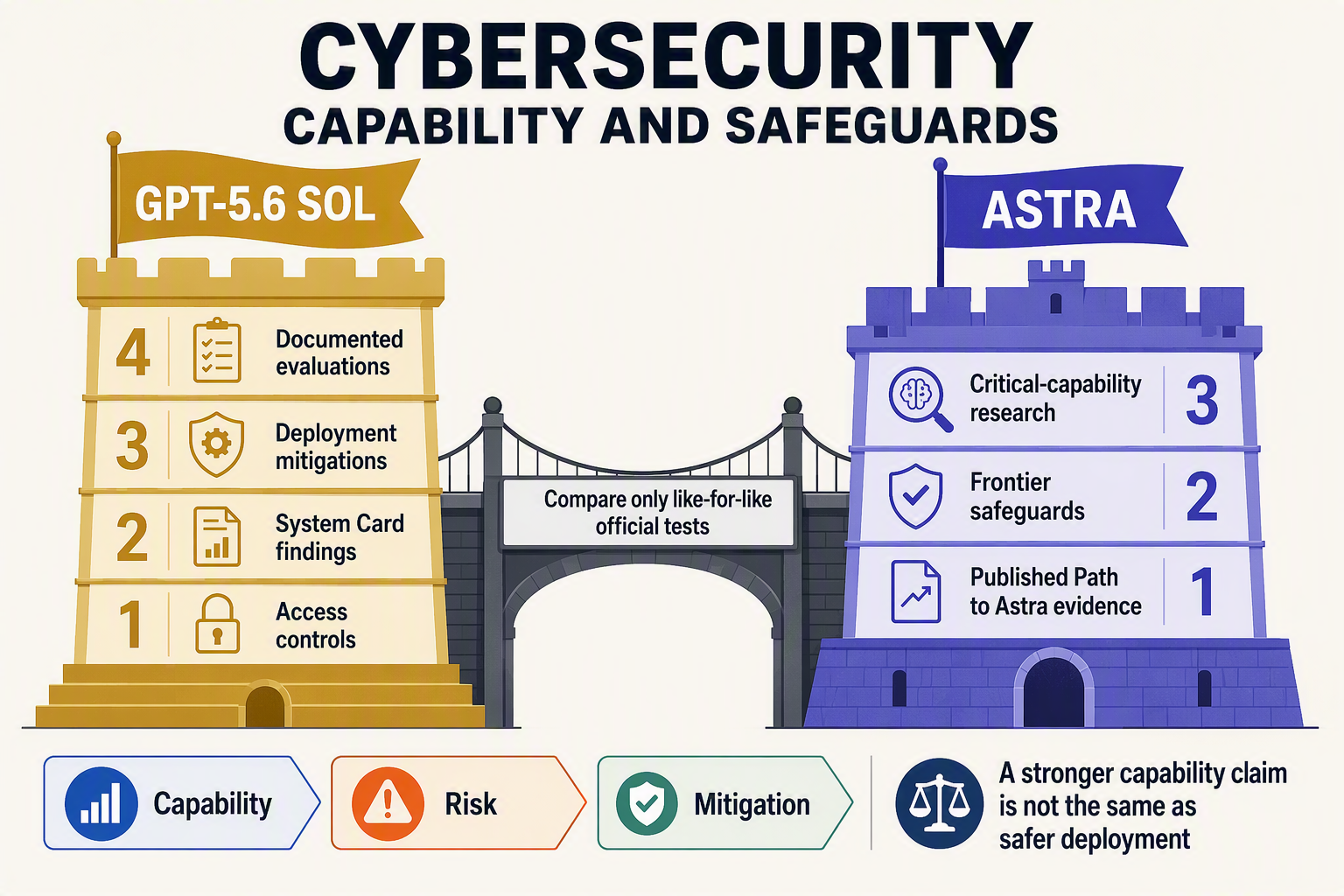
GPT-5.6 Sol has documented cybersecurity improvements and evaluated safeguards, while GPT-6 Astra does not yet have enough published evidence for a direct security comparison. As of September 3, 2026, claims that Astra is more capable—or safer—than GPT-5.6 Sol remain unverified.
Cybersecurity capability: documented strength versus an unknown baseline
OpenAI’s “Previewing GPT-5.6 Sol” describes GPT-5.6 Sol as having stronger capabilities in cybersecurity, alongside coding and science. This establishes an official capability claim, but the supplied OpenAI materials do not provide enough benchmark details to calculate a percentage advantage over Astra or earlier models.
The evidence supports three conclusions:
- GPT-5.6 Sol is positioned for advanced cybersecurity work. OpenAI explicitly includes cybersecurity among the model’s strengthened capability areas.
- Higher capability can support defensive use cases, such as analyzing code, investigating vulnerabilities, interpreting security telemetry, and helping engineers reason through remediation.
- Capability is not the same as safe deployment. A model that can reason more effectively about software and systems may also require stronger controls against malicious or destructive use.
For Astra, the official position is materially less complete. OpenAI’s “Path to Astra: critical capabilities and frontier safeguards” discusses Astra-oriented capability thresholds and assesses GPT-5.6 Sol in that broader development context. However, it does not establish a released GPT-6 Astra model with published cybersecurity benchmark scores, system-card results, or deployment safeguards.
What safeguards are officially documented?
The OpenAI GPT-5.6 System Card, available as of September 3, 2026, reports that GPT-5.6 Sol remains strong at avoiding data overwrites. OpenAI also states that GPT-5.6 Sol’s avoidance-only result is slightly below GPT-5.5, while its combined result matches GPT-5.5.
That finding is important because it prevents an overly simplistic conclusion that every newer model improves every safety measurement. Instead, the published result shows a more nuanced pattern:
- GPT-5.6 Sol retained strong overwrite-avoidance behavior.
- Its avoidance-only measurement did not exceed GPT-5.5.
- Its combined metric reached parity with GPT-5.5.
OpenAI’s Path to Astra also frames frontier development around both critical capabilities and safeguards, including evaluation work informed by a Hugging Face-derived test. The material shows that OpenAI is testing models against emerging risk thresholds; it does not prove that Astra has passed a particular cybersecurity standard or is cleared for deployment.
What should security teams conclude?
For a production decision, GPT-5.6 Sol is the assessable option because it has an official model page, capability statements, and a system card. Astra currently lacks equivalent public documentation, so no defensible ranking can be assigned.
Organizations deploying GPT-5.6 Sol for security workflows should still apply independent controls:
- Restrict tool permissions and use least-privilege credentials.
- Sandbox code execution and require approval for destructive actions.
- Log prompts, tool calls, file changes, and network activity.
- Separate vulnerability analysis from autonomous exploitation.
- Test overwrite avoidance and refusal behavior against the organization’s own environment.
The evidence-based verdict in the GPT-6 Astra vs GPT-5.6 Sol cybersecurity comparison is therefore clear: GPT-5.6 Sol has documented capability and safeguards, whereas Astra’s relative security remains unknown—not superior, inferior, or equivalent.
How do availability, pricing, context windows, modalities, and tools compare?
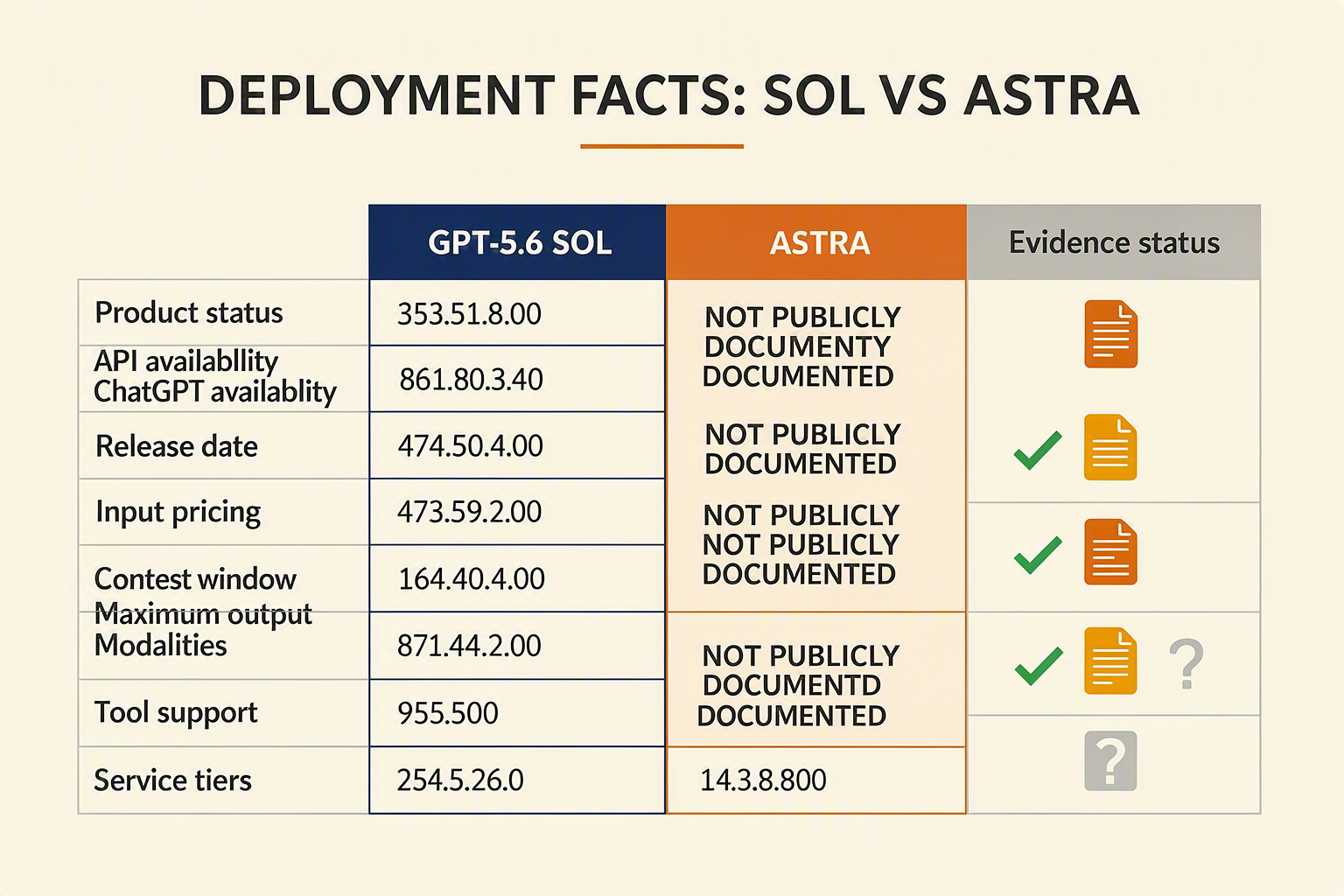
As of September 3, 2026, GPT-5.6 Sol is the only deployable model in this comparison with an official OpenAI API page and documented model alias. OpenAI has not published equivalent commercial specifications for GPT-6 Astra, so Astra’s availability, pricing, context window, modalities, and tool support must remain marked unknown.
Official specification comparison
| Category | GPT-5.6 Sol | GPT-6 Astra | Practical implication |
|---|---|---|---|
| Availability | Official OpenAI API model page exists; OpenAI identifies gpt-5.6-sol and the gpt-5.6 alias. OpenAI has also announced GPT-5.6 Sol improvements and expanded access in ChatGPT. | No officially documented API model, generally available release, or ChatGPT deployment appears in the supplied OpenAI materials. | Choose Sol when a project requires a model that can be evaluated and integrated now. |
| Pricing | OpenAI’s GPT-5.6 launch material includes an API cost-versus-score comparison, but the supplied extract does not state exact input, cached-input, or output-token prices. | Unknown: no official Astra price card, billing unit, or API-cost benchmark is documented. | Obtain current Sol prices from OpenAI’s live pricing documentation before budgeting; no defensible Astra estimate is possible. |
| Context window | The official model page is the authoritative source, but the supplied evidence does not reproduce a numeric context-window or maximum-output-token limit. | Unknown: OpenAI’s “Path to Astra” publication does not provide a production context limit. | Do not size prompts, retrieval pipelines, or memory systems around an assumed Astra window. |
| Modalities | GPT-5.6 Sol is officially presented as a flagship model, but the supplied extracts do not enumerate accepted text, image, audio, or video input and output formats. | Unknown: no official modality matrix has been published in the evidence reviewed. | Validate each required modality against current API documentation rather than inferring support from the model generation. |
| Tools and API compatibility | A dedicated OpenAI API page and stable model naming provide a documented integration target. Tool-by-tool support is not listed in the supplied extract. | Unknown: there is no published model identifier, endpoint, tool list, SDK requirement, or rate-limit schedule. | Sol is the practical option for production testing, observability, and integration planning. |
| Token efficiency | OpenAI publishes a cost-versus-score graphic for the GPT-5.6 family, including Sol, Terra, and Luna, but this is not itself a tokens-per-task benchmark. | Unknown: no official Astra token count, latency, cost-per-task, or quality-per-token result is available. | Claims that Astra uses fewer tokens than Sol are unsupported until OpenAI releases a controlled comparison. |
What “available” should mean in a production comparison
An announcement, research target, or safety evaluation is not equivalent to an API product. A model becomes operationally comparable only when developers can verify:
- A model identifier and endpoint
- Published prices and billing rules
- Context and output limits
- Supported modalities and tools
- Rate limits, regional access, and data-handling terms
- Versioning, deprecation, and fallback behavior
OpenAI’s official model page satisfies the first threshold for GPT-5.6 Sol. By contrast, “Path to Astra: critical capabilities and frontier safeguards” discusses the route toward Astra and evaluates GPT-5.6 Sol against emerging thresholds; it does not establish Astra as a purchasable API model.
The decision boundary
GPT-5.6 Sol remains the practical choice when a team must deploy, estimate costs, conduct security testing, or build against a documented API today. Waiting for Astra may be reasonable for non-urgent research planning, but architecture and procurement decisions should not rely on an unpublished context window, speculative multimodality, or assumed token savings.
The evidence-based conclusion is narrow but important: GPT-5.6 Sol has a documented access path, while GPT-6 Astra does not yet have enough official product information for a like-for-like commercial comparison.
What limitations prevent a clean Astra compared to GPT-5.6 Sol benchmark?

A clean GPT-6 Astra vs GPT-5.6 Sol benchmark is not currently possible because OpenAI has documented only one side as a deployable model. As of September 3, 2026, the official sources provide no Astra model identifier, fixed checkpoint, API specification, pricing, or reproducible head-to-head results.
Astra is not a defined benchmark target
A valid benchmark must identify exactly what was tested. OpenAI’s “Path to Astra: critical capabilities and frontier safeguards” presents Astra as a development direction involving capability thresholds and safeguards, but the supplied documentation does not define a commercially available model called GPT-6 Astra.
Researchers therefore lack several essentials:
- A fixed Astra model or snapshot identifier
- Release or general-availability status
- API access and inference settings
- Supported reasoning-effort parameters
- Context-window and maximum-output limits
- Tool, image, audio, and other modality support
- Versioned safety documentation
By comparison, OpenAI’s API documentation identifies GPT-5.6 Sol as the flagship model in the GPT-5.6 family and documents the gpt-5.6-sol model and gpt-5.6 alias. Benchmarking an accessible GPT-5.6 Sol endpoint against an unspecified Astra milestone would compare a product with a concept rather than two controlled systems.
Token efficiency has no shared measurement
Token efficiency cannot be inferred from answer quality, latency, or model-generation numbers. A defensible comparison would require both models to process the same prompts under equivalent settings while reporting input tokens, cached tokens, reasoning tokens, output tokens, cost, latency, and task success.
OpenAI’s GPT-5.6 launch material includes a chart relating score to API cost in US dollars across GPT-5.6 Sol, GPT-5.6 Terra, GPT-5.6 Luna, GPT-5.5, GPT-5.4, Claude Opus 4.8, and Gemini 3.5 Flash. However, that published comparison does not establish Astra’s token consumption or cost because Astra is not included as a priced API model.
Three distinctions are especially important:
- Fewer visible output tokens do not prove less internal reasoning.
- Lower API cost does not necessarily mean fewer tokens because model prices can differ.
- Higher accuracy per token requires a declared task set and scoring rule, neither of which is published for an Astra-versus-Sol test.
Cybersecurity results need identical conditions
Cybersecurity benchmarking is highly sensitive to scaffolding, tool permissions, time budgets, retries, and human assistance. OpenAI’s preview says GPT-5.6 Sol has stronger capabilities in cybersecurity, coding, and science, while the GPT-5.6 System Card reports documented safeguard evaluations. Those results describe GPT-5.6 Sol; they do not create a numerical Astra baseline.
A credible Astra compared to GPT-5.6 Sol cybersecurity test would need:
- The same challenge set and contamination controls
- Identical tools, network access, and execution environments
- Matching token and time budgets
- Separate measures for autonomous success and assisted success
- Comparable refusal, misuse-prevention, and destructive-action tests
Availability creates a practical selection bias
Even an informal comparison would be distorted if selected testers had access to an experimental Astra build while GPT-5.6 Sol ran through a production API with different limits. Until OpenAI publishes a versioned Astra endpoint and evaluation methodology, claims that Astra is faster, more token-efficient, cheaper, or safer should be labeled unknown—not negative, positive, or approximately equivalent.
What do OpenAI's documented evaluations and expert statements actually establish?
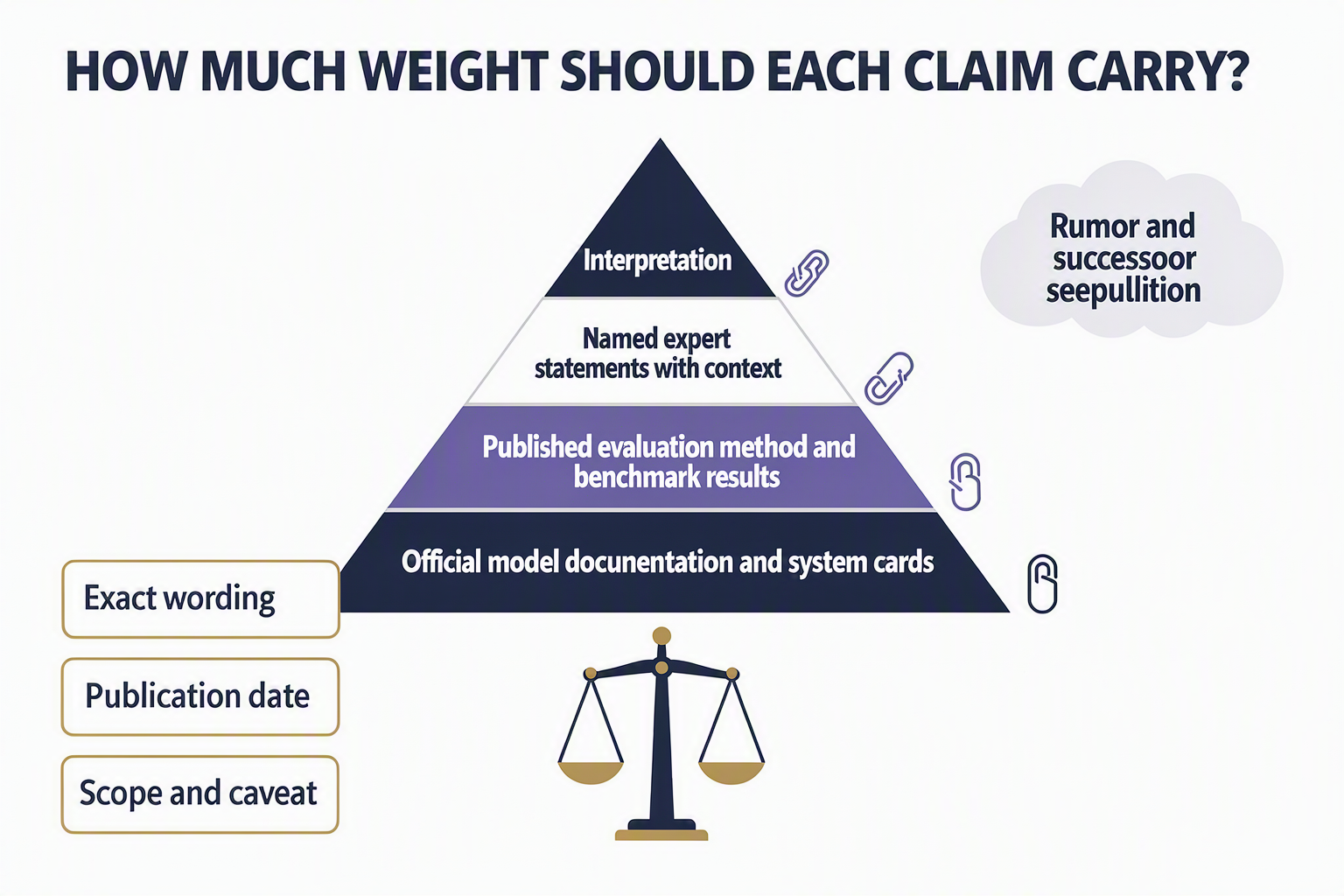
OpenAI’s documentation establishes that GPT-5.6 Sol is a deployable flagship with measured capabilities and published safeguards, while Astra remains a development direction rather than a fully specified commercial model. It does not establish that GPT-6 Astra is faster, safer, more token-efficient, or otherwise superior to GPT-5.6 Sol.
A hierarchy of evidence matters
The available claims fall into three evidence tiers:
- Product documentation: OpenAI’s API model page identifies GPT-5.6 Sol as the flagship model in the GPT-5.6 family and documents the
gpt-5.6alias. - Evaluation and safety documentation: The GPT-5.6 System Card reports safety-test outcomes, including data-overwrite behavior.
- Preview and product statements: OpenAI describes GPT-5.6 Sol as stronger in coding, science, and cybersecurity and says its ChatGPT update produces “more focused answers,” “more reliable facts,” and greater consistency from quick responses to deeper reasoning.
These are all official sources, but they answer different questions. An API page establishes availability and integration status; a system card documents evaluation methodology and limitations; a launch preview communicates intended strengths. Product language should not be treated as an independent benchmark.
What the evaluations support
OpenAI’s GPT-5.6 System Card establishes a narrow but meaningful cybersecurity-related result: GPT-5.6 Sol’s avoidance-only data-overwrite score is slightly below GPT-5.5, while its combined metric matches GPT-5.5. This supports three conclusions:
- GPT-5.6 Sol remained strong in the tested overwrite-avoidance setting.
- A newer model did not improve every individual safety measure.
- The combined result indicates parity with GPT-5.5 on that specific evaluation, not universal cybersecurity equivalence.
OpenAI’s Path to Astra material also discusses critical capabilities, frontier safeguards, and testing informed by work associated with Hugging Face. However, references to Astra-oriented thresholds do not constitute a complete head-to-head OpenAI Astra vs GPT-5.6 Sol benchmark unless both systems are evaluated under identical prompts, tools, scoring rules, inference settings, and safety mitigations.
What the expert statements do not prove
As of September 3, 2026, OpenAI’s cited materials provide zero published Astra figures for API price, context-window size, token consumption, latency, rate limits, or production availability. Consequently, several popular conclusions remain unsupported:
- “Astra uses fewer tokens” cannot be verified without matched task-level token counts.
- “Astra is better at cybersecurity” requires comparable offensive, defensive, autonomy, and misuse evaluations.
- “Astra replaces GPT-5.6 Sol” requires an official release, migration guidance, or deprecation notice.
- “GPT-6 Astra” is a finalized API product cannot be inferred from roadmap terminology alone.
Token efficiency is especially easy to misrepresent. A lower token count may reflect terser output rather than better reasoning, while lower API cost may come from pricing rather than fewer tokens. A defensible evaluation must report input tokens, output tokens, successful-task rate, total cost, latency, and retry frequency together.
The defensible reading
The official record supports a restrained conclusion: GPT-5.6 Sol has documented capability, deployment, and safety evidence; Astra has strategic significance but insufficient public product evidence for a symmetric comparison. Expert commentary may help interpret OpenAI’s direction, but it cannot supply missing specifications or convert a frontier-capability program into an available model.
When is GPT-5.6 Sol still the practical choice for you?
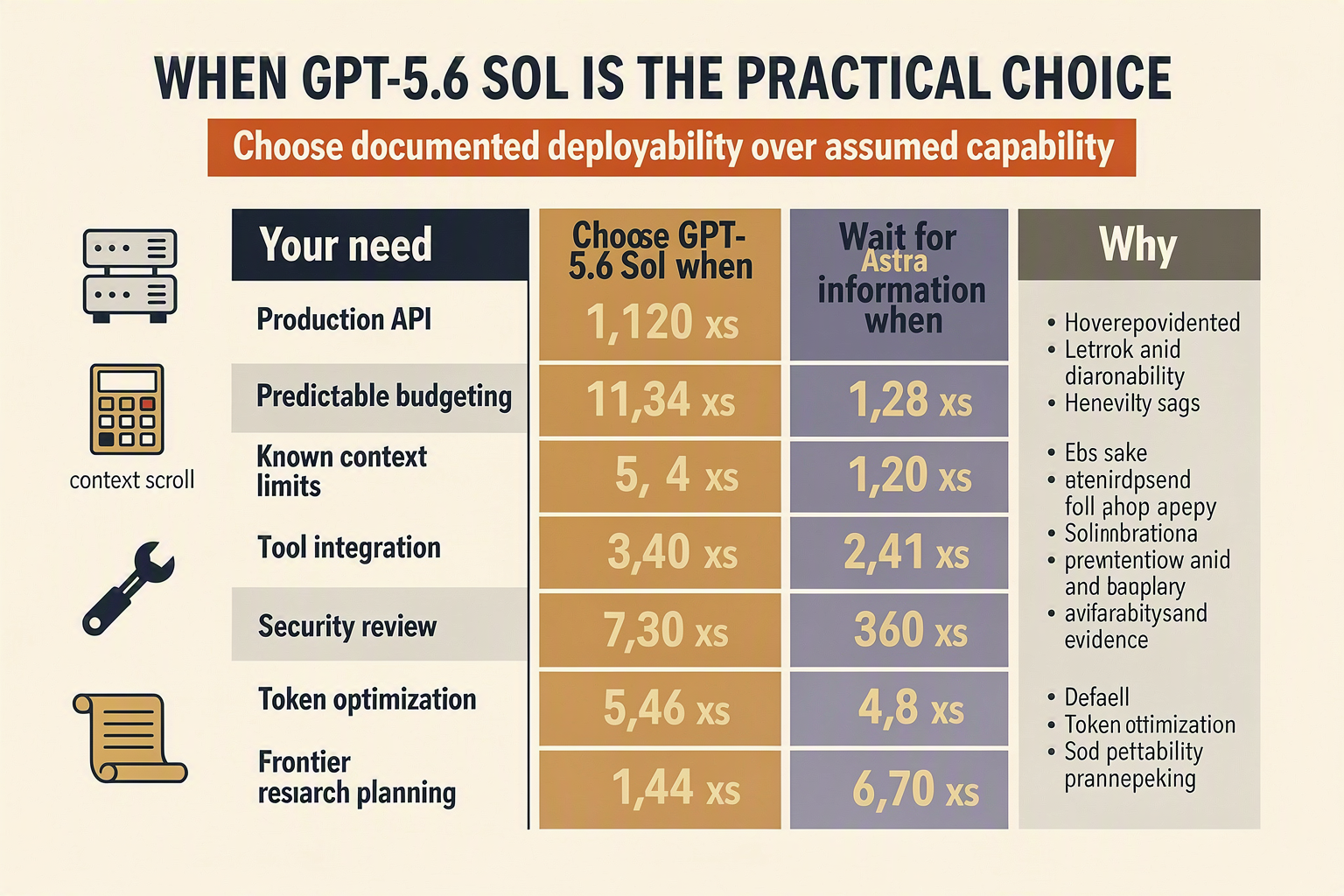
GPT-5.6 Sol remains the documented practical choice when you need a model that can be evaluated, integrated, governed, and deployed now. As of September 3, 2026, OpenAI publishes an API model page for GPT-5.6 Sol, while the supplied official OpenAI sources do not document GPT-6 Astra as a generally available model with comparable commercial specifications.
Decision table: documented capability versus unknowns
| Requirement | Documented GPT-5.6 Sol evidence | GPT-6 Astra evidence | Practical decision |
|---|---|---|---|
| Production deployment now | OpenAI’s API documentation identifies GPT-5.6 Sol as the flagship model in the GPT-5.6 family and provides the gpt-5.6-sol model name. | The supplied OpenAI sources provide no Astra API model identifier or general-availability date. | Build and validate production workloads with GPT-5.6 Sol. |
| Integration planning | GPT-5.6 Sol has an official API model page, enabling teams to evaluate it against documented interfaces. | Astra endpoints, SDK compatibility, rate limits, and tool support are not specified in the supplied sources. | Do not create production dependencies based on assumed Astra interfaces. |
| Token and cost evaluation | OpenAI’s GPT-5.6 publication includes an API-cost-versus-score chart covering GPT-5.6 Sol and other models. | No matching Astra token-efficiency result, token price, or billing specification is provided. | Benchmark Sol on your own tasks and calculate cost per successful outcome. |
| Cybersecurity workflows | OpenAI’s GPT-5.6 preview highlights stronger cybersecurity capabilities, and the GPT-5.6 System Card publishes deployment-safety findings. | OpenAI’s Path to Astra discusses critical capabilities and frontier safeguards, but does not supply a deployable, like-for-like Astra evaluation. | Use GPT-5.6 Sol with independent security controls and human oversight. |
| Procurement and governance | Teams can cite OpenAI’s API documentation, GPT-5.6 preview, product update, and System Card. | Astra pricing, service terms, context limit, modalities, availability, and operational safeguards remain undocumented in the supplied sources. | Base procurement and risk approval on published specifications. |
| Replaceable model architecture | GPT-5.6 Sol can be tested now and assigned a measured operational role. | Astra cannot yet be given a verified production role or fallback policy. | Keep the model layer replaceable and reassess after official Astra documentation appears. |
Evaluate token efficiency at the task level
No defensible token-efficiency percentage can currently be calculated for GPT-6 Astra vs GPT-5.6 Sol. OpenAI publishes an API-cost-versus-score comparison for GPT-5.6 Sol, but the supplied official sources contain no equivalent Astra result under identical conditions.
A useful internal evaluation should measure:
- Input and output tokens per completed task
- Cost per accepted result, rather than price per token alone
- Retry, correction, and human-escalation rates
- End-to-end latency at the required reasoning setting
- Tool-call success rate and total workflow cost
- Quality against a task-specific rubric, using blind review where practical
Use representative production prompts, fixed acceptance criteria, and repeated trials. A model that uses fewer tokens but requires more retries may be less efficient overall.
Treat cybersecurity evidence as bounded, not absolute
OpenAI’s GPT-5.6 System Card reports that GPT-5.6 Sol’s avoidance-only result for data overwrites is slightly below GPT-5.5, while its combined metric matches GPT-5.5. OpenAI’s GPT-5.6 preview also describes stronger cybersecurity capability, but neither statement guarantees protection against insecure code, credential exposure, harmful tool calls, or autonomous misuse.
Deploy GPT-5.6 Sol with least-privilege permissions, sandboxing, logging, output validation, rate limits, and human approval for high-impact actions. Revisit the OpenAI Astra comparison only after OpenAI publishes Astra’s model identifier, availability, pricing, token measurements, context limit, modalities, tool support, and cybersecurity evaluations. Until then, GPT-5.6 Sol is the documented practical choice—not a proven winner in a like-for-like Astra benchmark.
Frequently asked questions about GPT-6 Astra vs GPT-5.6 Sol
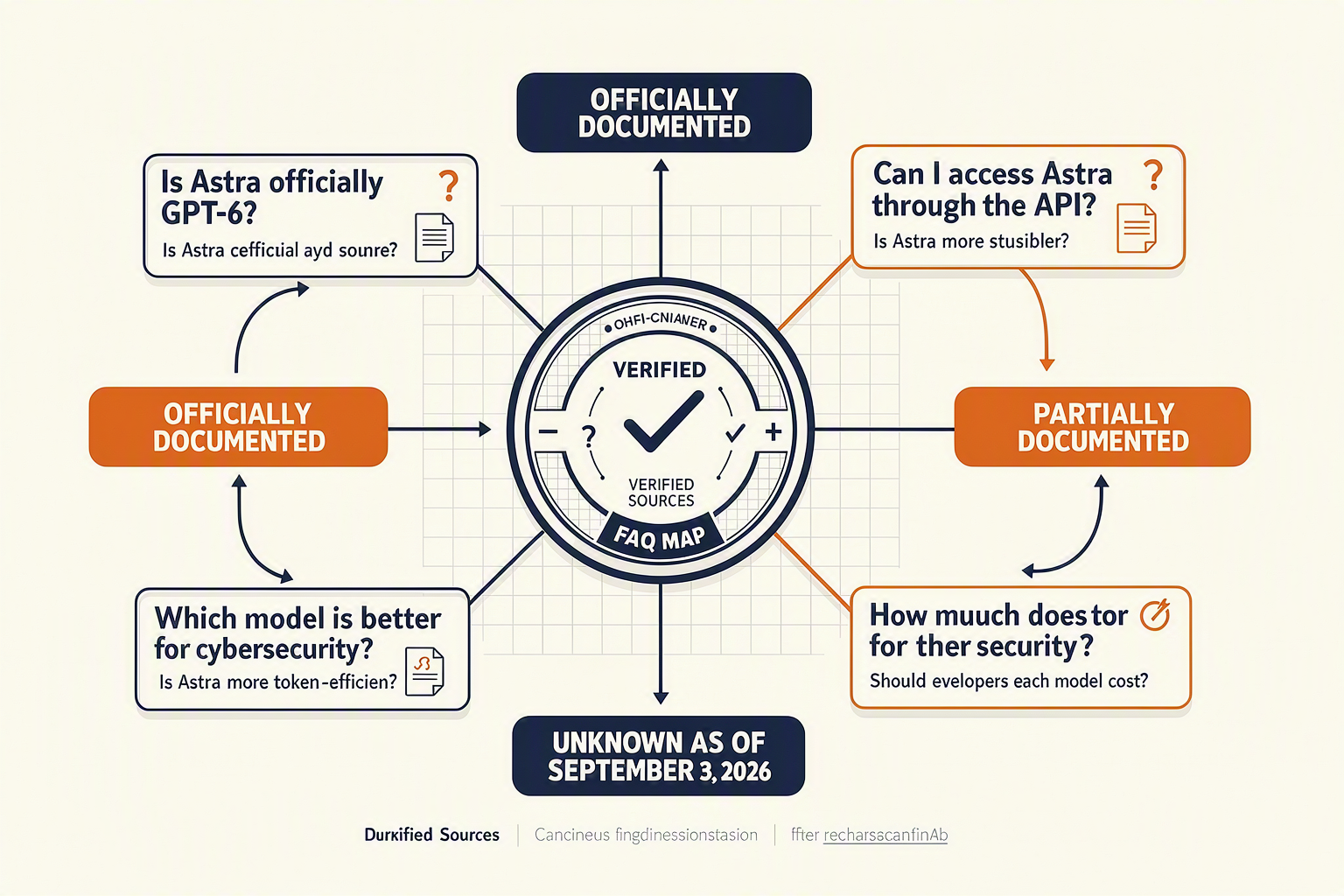
Is GPT-6 Astra officially available as of September 3, 2026?
What is the main difference between GPT-6 Astra and GPT-5.6 Sol?
Is GPT-6 Astra more token-efficient than GPT-5.6 Sol?
- Input and output tokens
- API cost per successful task
- Latency and completion rate
- Retries and tool-call overhead
OpenAI’s GPT-5.6 materials discuss performance relative to API cost, but the supplied sources contain no equivalent public Astra product data. Claims that Astra is cheaper or more token-efficient therefore remain unverified.
Which model has stronger documented cybersecurity capabilities?
Should developers deploy GPT-5.6 Sol now or wait for Astra?
- Current API and regional availability
- Pricing, rate limits, and context length
- Supported modalities, tools, and endpoints
- Model aliases, version pinning, and fallback behavior
- Cybersecurity safeguards and token accounting
A model’s appearance in research material does not guarantee compatibility with ChatGPT, Codex, every API endpoint, or an existing OpenAI-compatible gateway.
What is the evidence-based conclusion of the GPT-6 Astra vs GPT-5.6 Sol comparison?
Conclusion
The defensible conclusion is straightforward: as of September 3, 2026, GPT-5.6 Sol is the practical choice for production evaluation because OpenAI documents it as an available flagship model, while the reviewed official materials do not establish GPT-6 Astra as a generally available model with a complete API specification. “Astra” currently represents a direction of travel—not enough evidence for a like-for-like purchasing or architecture decision.
- Availability outweighs speculation. OpenAI provides an API model page, launch preview, ChatGPT update, and System Card for GPT-5.6 Sol. The reviewed Astra material does not provide a public model identifier, release date, pricing structure, rate limits, or deployment status.
- Token efficiency remains an explicit unknown. OpenAI has not published directly comparable Astra figures for token consumption, output quality per token, latency, or API cost. Any assertion that GPT-6 Astra is more token-efficient than GPT-5.6 Sol would therefore go beyond the available evidence.
- Cybersecurity claims require benchmark parity. OpenAI’s GPT-5.6 System Card reports that GPT-5.6 Sol remains strong at avoiding data overwrites, scores slightly below GPT-5.5 on the avoidance-only measure, and matches GPT-5.5 on the combined metric. OpenAI’s Path to Astra discusses critical capabilities and frontier safeguards, but it does not establish that a deployable Astra model outperforms GPT-5.6 Sol.
- Documented integration details matter. Until OpenAI publishes Astra’s context window, supported modalities, tools, safeguards, pricing, and API compatibility, teams can test GPT-5.6 Sol against measurable requirements instead of planning around assumptions.
What should teams watch next? The decisive signals will be an official Astra model page, a stable API identifier, transparent pricing, reproducible token-efficiency results, comparable cybersecurity evaluations, and a deployment-focused System Card. Those disclosures would turn the OpenAI Astra vs GPT-5.6 Sol comparison from roadmap analysis into an engineering decision.
In the meantime, developers can reduce model lock-in by separating application logic from individual providers. To explore how AI communication infrastructure is evolving, visit CallMissed, whose OpenAI-compatible gateway provides access to multiple model types while its business platform supports AI voice agents and multilingual engagement across 22 Indian languages.
The question is not whether Astra may eventually advance the frontier—it is whether your project should wait for undocumented capabilities when GPT-5.6 Sol can be evaluated today.
Related Reading
- GPT-6 Astra Rumors vs Confirmed Facts: September 2026 Fact Check
- Best LLM for Voice Agents in 2026: GPT-6 Astra vs Claude Fable 5.1
- GPT-6 Astra vs Claude Fable 5.1: Verified 2026 Comparison