Claude Fable 5.1 vs Claude Mythos 5.1: Which Is Best for Developers?


Compare Claude Fable 5.1 vs Claude Mythos 5.1 on access, safeguards, coding, reasoning, pricing, latency evidence, and team fit.
Claude Fable 5.1 vs Claude Mythos 5.1: Which Is Best for Developers?
What if the “best Claude 5.1 model” is not a different model at all? In the Claude Fable 5.1 vs Claude Mythos 5.1 comparison, Anthropic says both configurations use the same underlying large language model; the decisive differences are their safeguard levels, availability, and permitted use cases—not raw model architecture.
The timing matters. Anthropic announced Claude Fable 5.1 and Claude Mythos 5.1 on September 1, 2026, positioning them as its most advanced models for coding and knowledge work. Anthropic’s Claude Platform documentation recommends Fable 5.1 for demanding reasoning and long-horizon agentic workloads, including tasks where Claude Opus 5 at higher effort still falls short. That makes the release immediately relevant to developers building autonomous coding agents, research systems, tool-using workflows, and other applications in which a model may operate across many steps.
Access, however, changes the buying decision. Anthropic lists Claude Fable 5.1 at $10 per million input tokens and $50 per million output tokens, while describing it as the generally available configuration. Claude Mythos 5.1 is reserved for vetted organizations through Anthropic’s trusted-access process and applies different safeguards for sensitive cybersecurity and biology work. For most teams, therefore, Fable is the practical production choice; Mythos is a specialized-access configuration rather than a universally available performance upgrade.
This distinction also prevents a common comparison mistake: treating the two names as if they represented separate intelligence tiers. Because Anthropic identifies them as configurations of the same model, benchmark differences must be interpreted through safeguards, refusals, task eligibility, and access conditions. Claims that Mythos is inherently faster, smarter, or better at everyday coding require evidence—and Anthropic’s supplied materials should be the authority where latency or benchmark data are documented.
This guide will compare:
- Intended positioning and developer access
- Reasoning, coding, and agentic tool use
- Published pricing and context specifications
- Latency evidence without unsupported speed claims
- Safeguard-related limitations and sensitive-domain workloads
- A decision matrix for choosing Fable 5.1 or Mythos 5.1
As model catalogs expand, OpenAI-compatible gateways such as CallMissed reflect the broader shift toward giving developers one integration for evaluating and routing workloads across multiple AI models. By the end, you will know which Claude 5.1 configuration fits your workload—and when access policy, not benchmark performance, settles the decision.
Which Claude 5.1 model is best? Fable 5.1 is the default for most teams, while Mythos 5.1 serves vetted organizations needing less restrictive cyber and biology safeguards
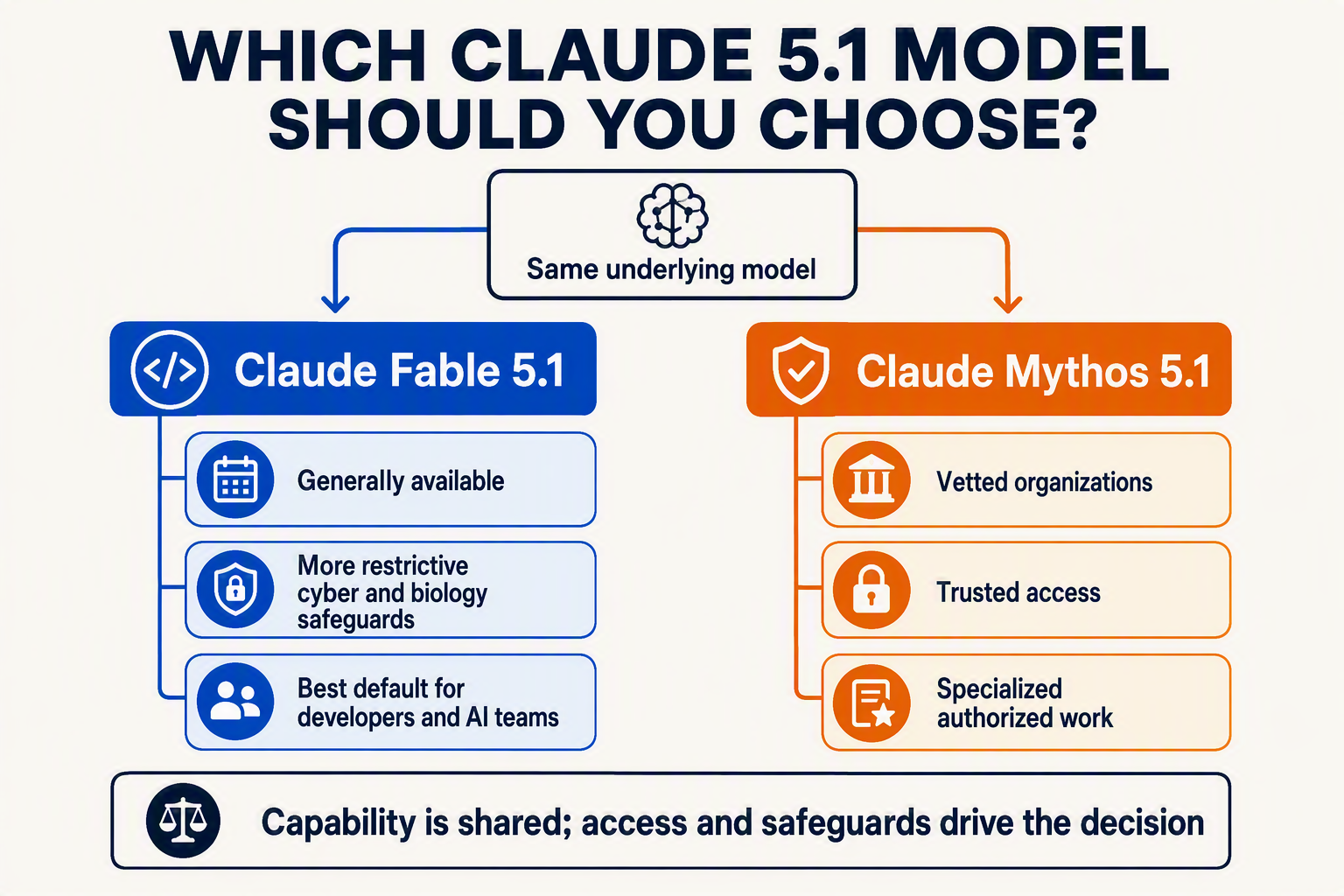
For most developers and AI teams, Claude Fable 5.1 is the best default Claude 5.1 model. Anthropic makes it generally available, publishes standard API pricing, and describes it as having the same underlying capabilities as Claude Mythos 5.1. Mythos is intended for vetted organizations whose authorized cybersecurity or biology work requires less restrictive safeguards.
Same model, different safeguard configurations
Anthropic’s September 1, 2026 announcement and system card describe Claude Fable 5.1 vs Claude Mythos 5.1 as two configurations of the same underlying model—not separate intelligence or performance tiers.
The practical differences concern safeguards and access:
- Claude Fable 5.1 uses more restrictive safeguards for sensitive cybersecurity and biology requests.
- Claude Mythos 5.1 uses less restrictive safeguards for approved organizations conducting legitimate work in those fields.
- Fable 5.1 is generally available through the Claude Platform.
- Mythos 5.1 is invite-only and provided through Anthropic’s trusted-access process.
Anthropic positions both configurations as advanced models for coding and knowledge work. Its first-party materials do not establish Mythos as smarter, faster, or more capable at general software development. Consequently, the Claude Fable 5.1 vs Claude Mythos 5.1 decision should be based on safeguard requirements and access eligibility rather than an assumed difference in core intelligence.
Why Fable 5.1 is the practical default
Anthropic recommends Claude Fable 5.1 for demanding reasoning, coding, and long-horizon agentic work. It is the appropriate starting point for:
- Complex software development and coding agents
- Multi-step research and knowledge-work applications
- Tool-using systems that plan, execute, and revise tasks
- Production workloads requiring standard API availability
- Enterprise assistants without specialized cyber or biology requirements
As of September 5, 2026, Anthropic’s published Claude Platform pricing lists Fable 5.1 at $10 per million input tokens and $50 per million output tokens. Eligible prompt-cache reads cost $0.25 per million tokens, which can substantially reduce repeated-context costs. Cache-read pricing applies only when requests satisfy Anthropic’s prompt-caching requirements; ordinary uncached input remains billed at the standard input rate.
Mythos does not have the same self-service purchasing path because organizations must first qualify for trusted access. For most teams comparing Claude Fable 5.1 vs Claude Mythos 5.1, Fable therefore offers the clearest combination of capability, availability, and predictable public pricing.
Teams using multiple providers can access supported models through an OpenAI-compatible gateway such as CallMissed. However, a gateway cannot bypass Anthropic’s eligibility rules or grant Mythos access to an organization that has not completed Anthropic’s vetting process.
When Mythos 5.1 is the better fit
Claude Mythos 5.1 is not a generally unrestricted or premium-performance edition of Fable 5.1. It is a trusted-access configuration for approved organizations whose legitimate cybersecurity or biology workflows may be obstructed by Fable’s stronger safeguards.
The selection rule is straightforward:
- Choose Fable 5.1 for general coding, reasoning, research, agents, and production applications.
- Consider Mythos 5.1 when authorized cybersecurity or biology work encounters safeguard-related limitations and your organization qualifies for Anthropic’s invite-only access process.
In short, Claude Fable 5.1 vs Claude Mythos 5.1 is primarily an access-and-safeguards comparison. Mythos is the better fit only when its specialized policy configuration is operationally necessary and Anthropic approves the organization.
Latency and thinking-block compatibility
Anthropic has not published configuration-specific benchmarks showing that Mythos has lower latency or higher throughput than Fable. Its documentation provides no separate p50 latency, p95 latency, time-to-first-token, or tokens-per-second results that support treating Mythos as the faster tier. Teams should benchmark representative prompts, tools, regions, context lengths, and output patterns themselves.
Anthropic’s Claude Platform release notes also document an important compatibility rule: thinking blocks created by Fable 5.1 or Mythos 5.1 can be preserved when used with the originating model or a newer model, but earlier models cannot read them. For persistent agents, this version constraint may matter more operationally than any unsupported speed assumption in a Claude Fable 5.1 vs Claude Mythos 5.1 comparison.
Why did Anthropic release Fable 5.1 and Mythos 5.1 as two configurations of the same underlying model?

Anthropic released Claude Fable 5.1 and Claude Mythos 5.1 as two configurations of the same underlying model, differentiated by safeguards and access rather than documented differences in architecture or performance. Fable 5.1 is generally available, while Mythos 5.1 is restricted to vetted organizations through trusted access.
Same model, different safeguards
Anthropic’s September 1, 2026 announcement states that Claude Fable 5.1 and Claude Mythos 5.1 are “the same model, but with different levels of safeguards.” Anthropic’s system card likewise describes Fable 5.1 and Mythos 5.1 as “two configurations of our latest and most capable large language model.”
The distinction is therefore about deployment policy:
- Claude Fable 5.1: Generally available and configured with stronger safeguards for cybersecurity and biology.
- Claude Mythos 5.1: Available to vetted organizations through Anthropic’s trusted-access process.
- Underlying model: Shared across both configurations, according to Anthropic.
- Configuration choice: Driven by eligibility and safeguard requirements, not a published difference in model size, architecture, or inference hardware.
Anthropic has not documented separate parameter counts, reasoning engines, coding capabilities, or latency profiles for the two configurations. Developers should therefore avoid treating Mythos 5.1 as a larger, faster, or inherently more capable model unless Anthropic publishes evidence supporting that conclusion.
Why Anthropic uses two configurations
The two-configuration approach allows Anthropic to make advanced Claude capabilities broadly available while applying different controls to sensitive domains. In practical terms, Anthropic can maintain a generally available product for mainstream development and a trusted-access configuration for vetted organizations with specialized requirements.
This creates a clear operational split:
- Fable 5.1 serves general production use. Developers and AI teams can use it without Mythos-specific organizational vetting.
- Mythos 5.1 serves approved organizations. Access depends on Anthropic’s trusted-access process rather than a standard model-selection decision.
- Safeguards remain explicit. Separate model names help security, compliance, and platform teams identify which policy configuration an application uses.
- Capability claims remain aligned. Anthropic presents both products as configurations of one model, not separate intelligence tiers.
Anthropic’s Claude Platform documentation recommends Claude Fable 5.1 for demanding reasoning and long-horizon agentic work, including situations where evaluations using Claude Opus 5 at higher effort still fall short. This positioning shows that Fable 5.1 is intended for advanced workloads, not as a reduced-capability substitute for Mythos 5.1.
What this means for developer evaluations
A rigorous Claude Fable 5.1 vs Claude Mythos 5.1 comparison should separate model quality from safeguard behavior. For example, a refusal or constrained answer on a sensitive cybersecurity or biology prompt may reflect the selected configuration’s safeguards rather than a reasoning limitation.
Teams should record:
- Whether a task was completed, constrained, or refused
- Whether the prompt falls into a safeguard-sensitive domain
- Coding and reasoning quality on mutually permitted tasks
- Tool-use behavior in equivalent workflows
- End-to-end latency under matched API conditions
- Whether the organization qualifies for Mythos 5.1 access
Anthropic’s Claude Platform release notes add an important compatibility detail: thinking blocks produced by Fable 5.1 or Mythos 5.1 can be preserved only for the originating model or a newer model; earlier models cannot read them. Teams that persist thinking blocks across multi-step workflows should therefore track the originating model and avoid assuming backward compatibility.
For most developers, the practical choice is straightforward: use generally available Fable 5.1 for demanding reasoning and long-horizon agentic workloads, and consider Mythos 5.1 only when trusted access is available and the organization has a justified need for its safeguard configuration.
What are the key developments, specifications, access rules, and documented differences?
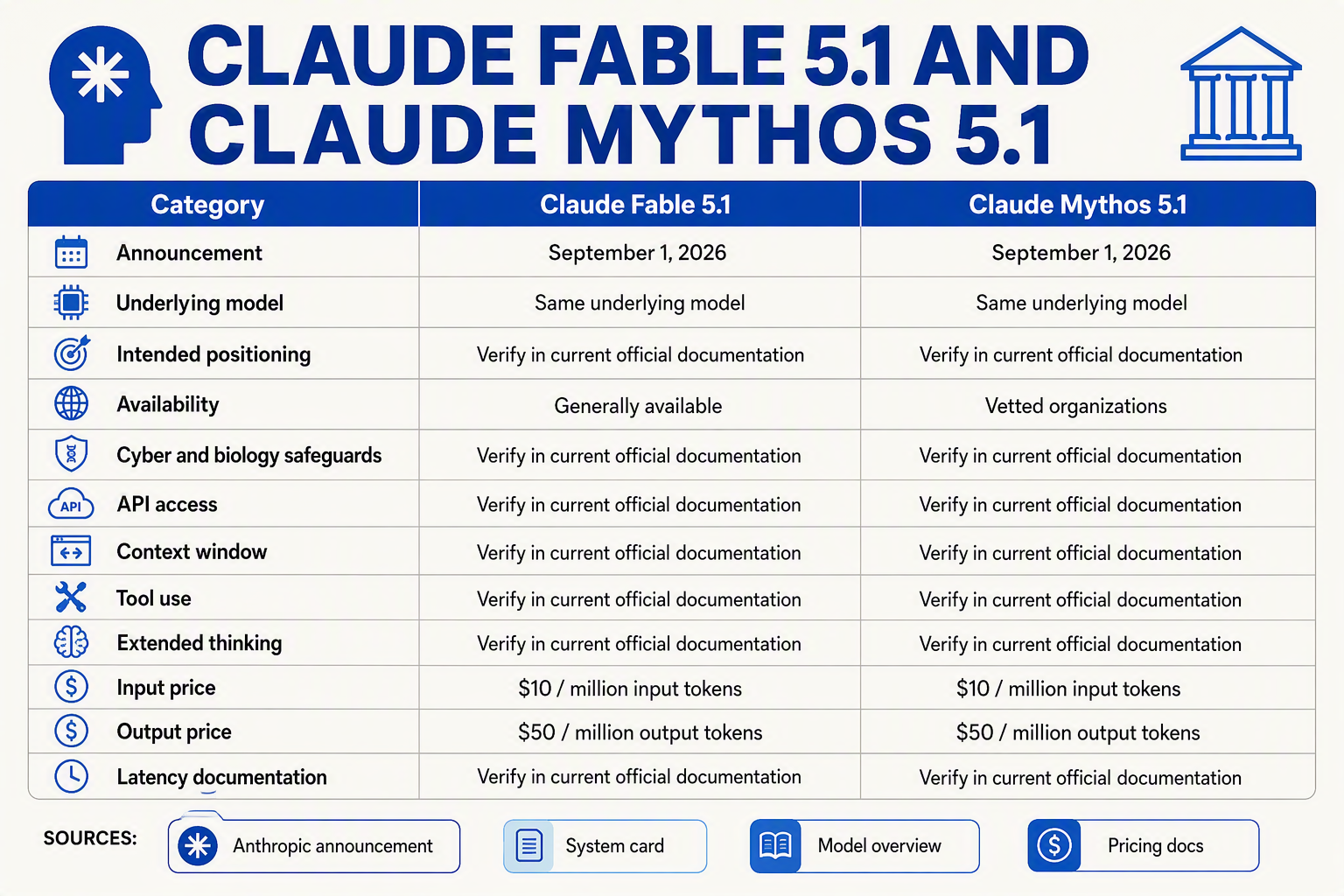
Anthropic documents Claude Fable 5.1 and Claude Mythos 5.1 as two safeguard configurations of the same underlying model. The official differences are their cybersecurity and biology safeguards, availability, and published commercial information—not documented differences in reasoning quality, coding ability, context length, tools, benchmarks, or latency.
Claude Fable 5.1 vs Claude Mythos 5.1 comparison
| Criterion | Claude Fable 5.1 | Claude Mythos 5.1 | What the official sources establish |
|---|---|---|---|
| Underlying model | Claude 5.1 | Claude 5.1 | Anthropic’s system card describes Fable 5.1 and Mythos 5.1 as “two configurations of our latest and most capable large language model.” |
| Intended positioning | Demanding reasoning, coding, knowledge work, and long-horizon agentic tasks | Approved work requiring a different safeguard configuration in sensitive domains | Anthropic does not position Mythos as a higher-capability intelligence tier. |
| Cybersecurity and biology safeguards | More restrictive | Different safeguard level | Anthropic’s Claude Mythos page says Fable applies more restrictive safeguards in cybersecurity and biology. |
| Access | Generally available | Available to vetted organizations through trusted access | Mythos access requires vetting; the supplied official excerpts do not document eligibility criteria or approval timelines. |
| Published price | $10 per million input tokens and $50 per million output tokens | No separate public price documented in the supplied excerpts | Anthropic publishes Fable pricing, but Mythos commercial terms should not be inferred. |
| Context window | Undocumented in the supplied excerpts | Undocumented in the supplied excerpts | No configuration-specific context limit can be established here. |
| Tool interfaces | Undocumented separately | Undocumented separately | The excerpts do not establish identical or different tool-use interfaces. |
| Benchmarks and latency | No configuration-specific result documented | No configuration-specific result documented | The supplied sources support no benchmark winner or comparative speed claim. |
What changed on September 1, 2026?
Anthropic announced Claude Fable 5.1 and Claude Mythos 5.1 on September 1, 2026, calling them its most advanced models for coding and knowledge work in the Anthropic Newsroom. The central development was a configuration-based release model: the same underlying Claude 5.1 model is offered with different safeguard levels.
Three documented changes matter to developers:
- General versus trusted access: Claude Fable 5.1 is generally available, while Claude Mythos 5.1 is limited to vetted organizations through Anthropic’s trusted-access pathway.
- Sensitive-domain controls: Anthropic identifies cybersecurity and biology as the relevant safeguard areas and states that Fable’s safeguards are more restrictive.
- Reasoning-state compatibility: Anthropic’s Claude Platform release notes state that thinking blocks created by Fable 5.1 or Mythos 5.1 are preserved only for the originating model or a newer model; earlier models cannot read them.
The thinking-block rule affects routing and fallback design. Teams should test conversations that move between models, especially workflows that persist reasoning state before retries, downgrades, or failovers.
What remains undocumented?
Anthropic’s Models Overview recommends Claude Fable 5.1 for demanding reasoning and long-horizon agentic work, including cases where evaluations on Claude Opus 5 at higher effort still fall short. However, the supplied official excerpts do not establish a separate reasoning engine or coding architecture for Mythos.
The following should therefore be labeled undocumented, rather than assumed equal or different:
- Configuration-specific context-window limits
- Separate tool-use interfaces
- Comparative coding or reasoning benchmarks
- Relative latency, throughput, or time to first token
- Public Claude Mythos 5.1 pricing
- Mythos eligibility criteria, approval timing, or contractual terms
For a defensible evaluation, teams should measure task completion, refusal behavior, tool-call reliability, latency, and token cost using their own approved access and production prompts.
Do Fable 5.1 and Mythos 5.1 differ in reasoning, coding, benchmarks, or agentic performance?
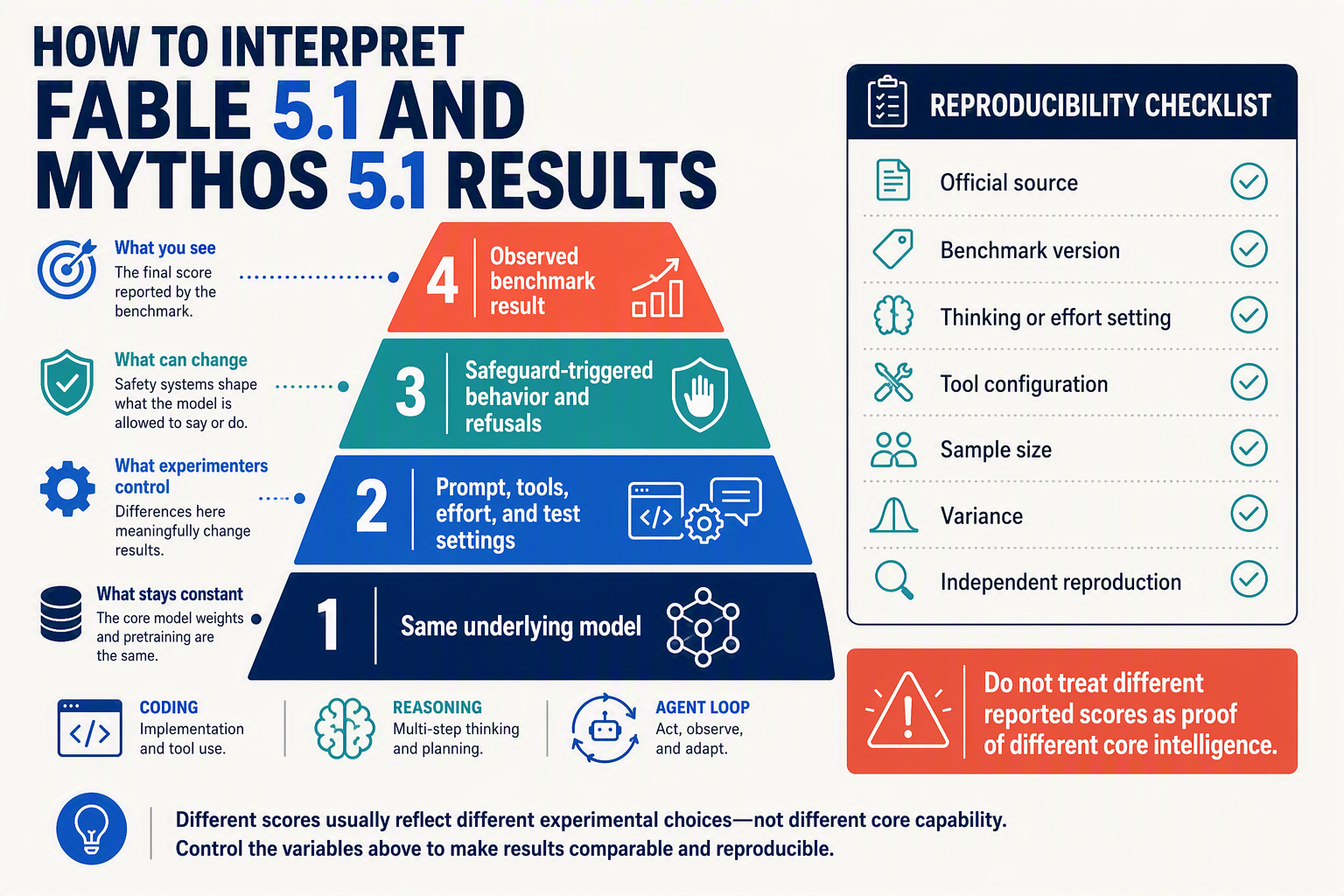
Claude Fable 5.1 and Claude Mythos 5.1 should deliver equivalent baseline reasoning, coding, benchmark, and agentic capability because Anthropic identifies them as configurations of the same underlying model. Any observed difference is more likely to result from safeguard behavior, refusals, prompting, tool configuration, or runtime conditions than from a separate intelligence tier.
Reasoning and coding capability
Anthropic announced both configurations on September 1, 2026, describing Claude Fable 5.1 and Claude Mythos 5.1 as its most advanced models for coding and knowledge work. Anthropic’s Claude Platform documentation specifically recommends Claude Fable 5.1 for demanding reasoning and long-horizon agentic work, including cases where evaluations on Claude Opus 5 at higher effort remain insufficient.
Because Mythos 5.1 uses the same model, developers should expect the same underlying strengths in tasks such as:
- Planning and completing multi-file software changes
- Debugging code across large repositories
- Reasoning through ambiguous technical requirements
- Synthesizing knowledge from long documents
- Operating tools across extended, multi-step workflows
The meaningful distinction appears when a request enters sensitive cybersecurity or biology domains. Fable applies more restrictive safeguards, while Mythos provides vetted organizations with a configuration designed for authorized work that may otherwise trigger refusals. Mythos can therefore complete a broader range of approved sensitive tasks without necessarily being better at ordinary application development.
How to interpret Claude Fable 5.1 benchmarks
Anthropic’s Fable 5.1 and Mythos 5.1 system card describes them as “two configurations of our latest and most capable large language model.” That wording does not support treating their benchmark results as evidence of two different capability classes.
A valid comparison should separate four variables:
- Raw capability: Reasoning and coding ability inherited from the shared model.
- Task completion: Whether safeguards permit the model to answer fully.
- Agent configuration: Tool definitions, context, prompting, and iteration limits.
- Operational performance: Latency, throughput, rate limits, and provider infrastructure.
For general coding benchmarks, the expected comparison is effectively model versus itself. In sensitive evaluations, however, a lower Fable completion rate could reflect safeguard interventions rather than weaker reasoning. Teams should record refusals and policy blocks separately from incorrect answers when running internal evaluations.
Agentic workflows and tool use
Fable 5.1’s documented positioning makes it the relevant configuration for mainstream coding agents, research pipelines, and tool-using enterprise systems. Anthropic’s API release notes also state that thinking blocks generated by Fable 5.1 or Mythos 5.1 can be preserved for the originating model or a newer model, but earlier models cannot read them. Agent frameworks should therefore avoid assuming backward compatibility when replaying reasoning state across model versions.
Useful evaluation metrics include:
- End-to-end task success rate
- Tool-call accuracy and recovery rate
- Human interventions per completed task
- Refusal rate by workload category
- Tokens, latency, and cost per successful outcome
Is Mythos 5.1 faster?
Anthropic’s cited product materials do not document a latency advantage for Mythos 5.1 over Fable 5.1. Without controlled first-token latency, output-speed, and end-to-end agent-run measurements, claims that either configuration is faster would be unsupported.
The practical conclusion is straightforward: choose Fable 5.1 for general reasoning, coding, and agentic work. Consider Mythos 5.1 only when a vetted organization’s authorized cyber or biology workload requires its different safeguard profile.
How do safeguards and tool use change coding, cybersecurity, biology, and long-horizon agent workflows?
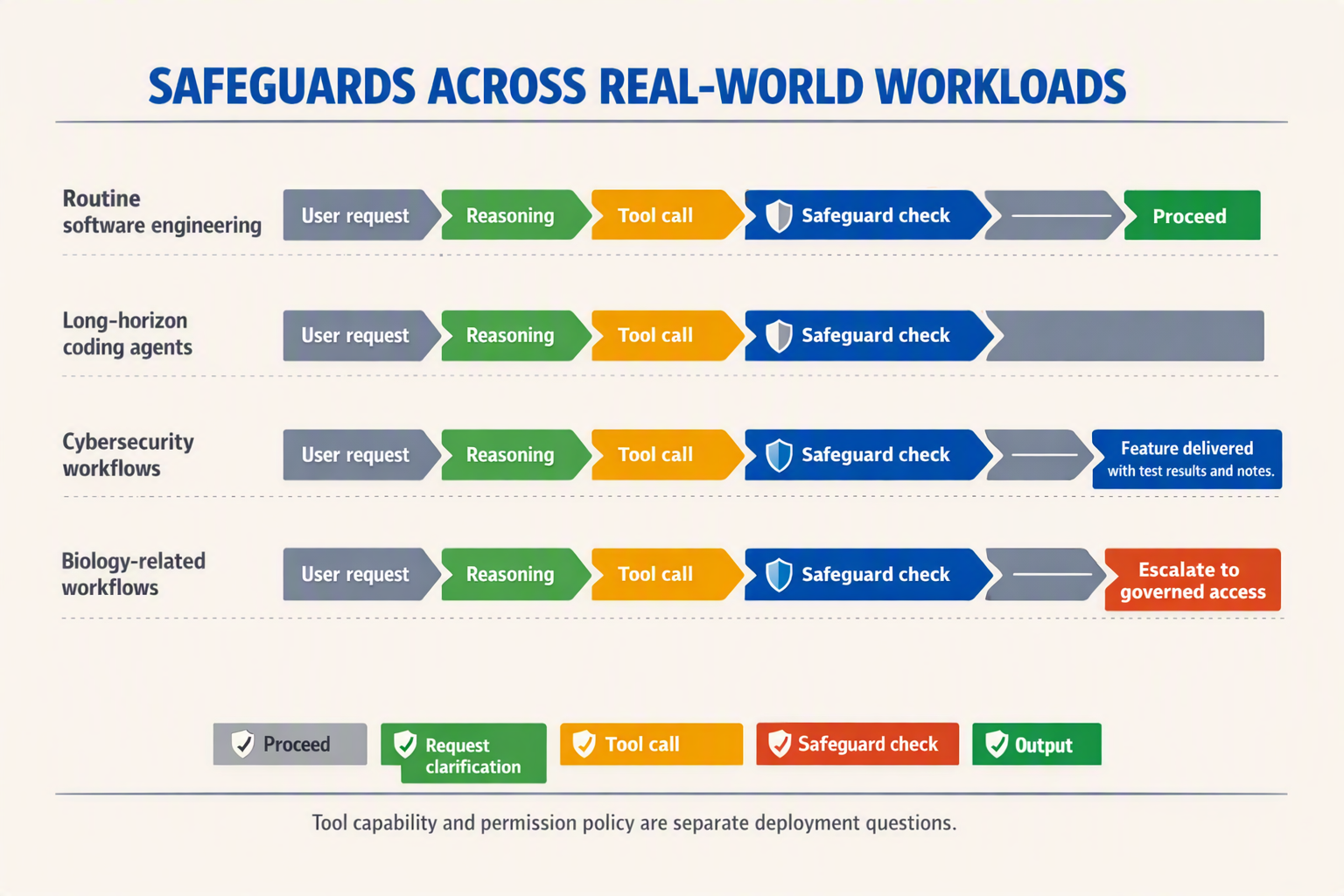
Safeguards change which requests Claude will complete, while tool permissions change what completed outputs can affect. Claude Fable 5.1 and Claude Mythos 5.1 share the same underlying model, but Mythos is intended for vetted organizations whose legitimate cybersecurity or biology workflows require different safeguard boundaries.
Everyday coding remains broadly comparable
For conventional software engineering, teams should not assume Mythos produces inherently better code. Anthropic’s September 1, 2026 announcement describes Claude Fable 5.1 and Claude Mythos 5.1 as the same model with different safeguard levels, so their underlying reasoning and coding capabilities are not separate intelligence tiers.
Typical workflows may include:
- Navigating large repositories
- Writing and reviewing application code
- Running tests through approved tools
- Investigating build failures
- Refactoring across multiple files
- Maintaining plans over long agent trajectories
Safeguard differences become relevant when a coding task crosses into sensitive capabilities. A benign authentication review, for example, differs from instructions designed to bypass authentication against a real target. The resulting refusal or restriction should not automatically be counted as a coding failure in model evaluations.
Cybersecurity and biology expose the main policy difference
Anthropic says Fable 5.1 applies more restrictive cybersecurity and biology safeguards, while Mythos 5.1 is available to vetted organizations through trusted access. Mythos should therefore be evaluated as a controlled configuration for qualified sensitive-domain work—not as an unrestricted public model.
For cybersecurity, the distinction can affect workflows involving:
- Vulnerability discovery and exploit validation
- Malware analysis or advanced threat research
- Autonomous interaction with security tools
- Dual-use code that could support either defense or abuse
For biology, additional scrutiny can apply when requests move from general scientific analysis toward detailed, operationally consequential procedures. Mythos access does not eliminate organizational responsibility: teams still need identity controls, authorization boundaries, audit logs, human review, and domain-specific risk assessments.
Tool use amplifies both capability and risk
A text response is advisory; an agent with shell, browser, repository, laboratory-data, or deployment access can take consequential actions. Teams should therefore treat model safeguards and runtime controls as separate security layers.
A robust tool-using deployment should enforce:
- Least-privilege credentials for every tool and environment.
- Sandboxing for generated code and command execution.
- Allowlisted actions rather than unrestricted shell or network access.
- Human approval gates for destructive, external, or sensitive operations.
- Complete audit trails covering prompts, tool calls, outputs, and overrides.
Neither configuration should be granted production privileges merely because it performs well on coding or reasoning evaluations.
Long-horizon agents need continuity controls
Anthropic’s Claude Platform documentation recommends Claude Fable 5.1 for demanding reasoning and long-horizon agentic work, including cases where Claude Opus 5 at higher effort does not meet a team’s evaluations. That positioning makes Fable the practical baseline for most autonomous coding and knowledge-work systems.
State compatibility also matters. Anthropic’s Claude Platform release notes say that thinking blocks generated by Fable 5.1 or Mythos 5.1 can be preserved only for the originating model or a newer model; earlier Claude models cannot read them. Agent platforms should consequently version model state, define migration behavior, and avoid assuming that internal reasoning artifacts are portable across older models.
The operational conclusion is clear: choose Fable for general agentic development, pursue Mythos only when vetted sensitive-domain requirements justify its safeguard profile, and secure tool access independently of either model choice.
How much do Fable 5.1 and Mythos 5.1 cost, and what do context, caching, and undocumented latency mean in production?
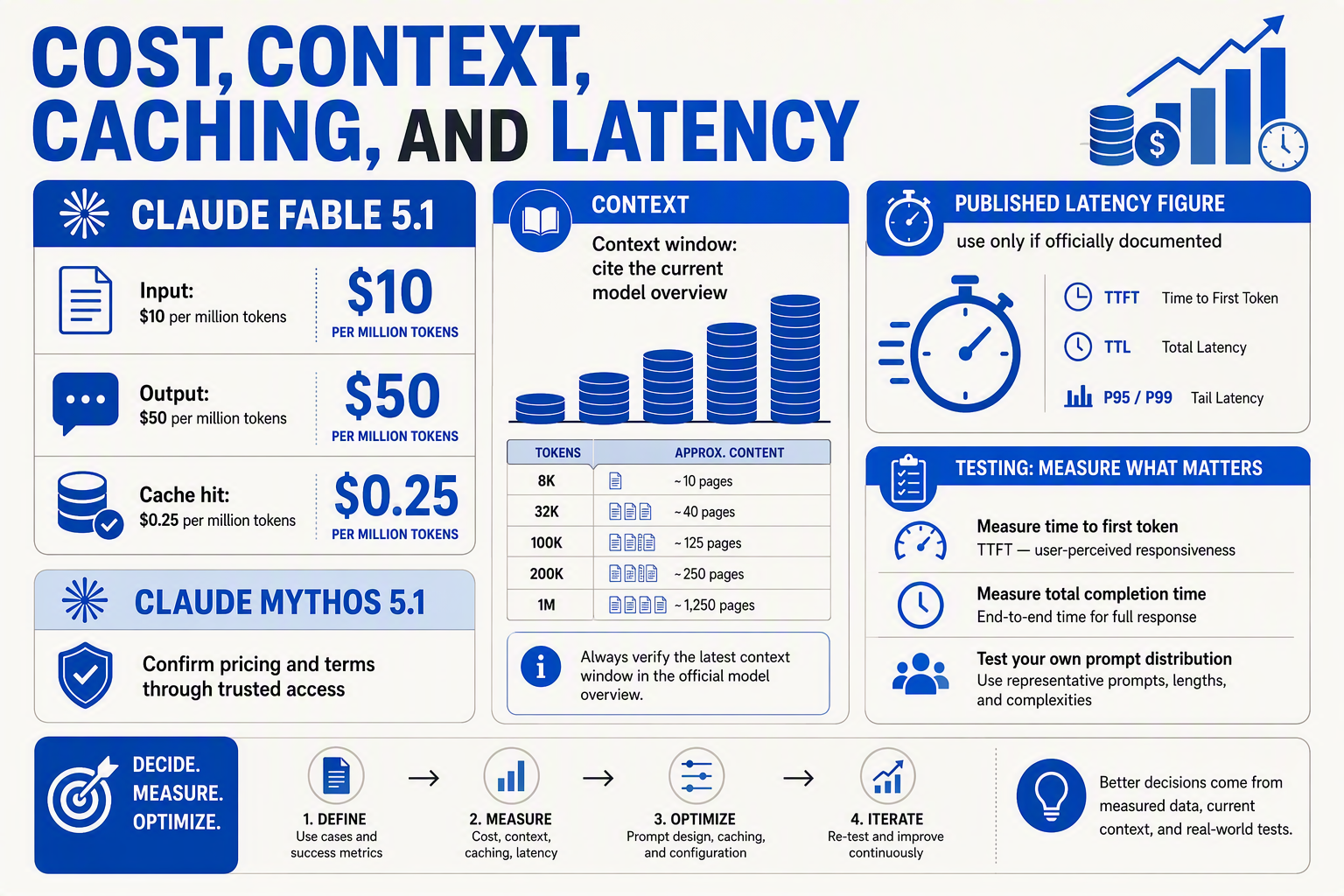
Claude Fable 5.1 costs $10 per million input tokens and $50 per million output tokens, according to Anthropic’s September 2026 product page. Anthropic has not published an equivalent standard price, a separate context-window figure, or comparative latency data for Claude Mythos 5.1 in the cited public materials, so production plans should not assume parity where specifications remain undocumented.
Published pricing versus contract pricing
Anthropic positions Claude Fable 5.1 as the generally available configuration and Claude Mythos 5.1 as trusted access for vetted organizations. This creates two different procurement paths:
- Fable 5.1: Public usage pricing of $10 per million input tokens and $50 per million output tokens.
- Mythos 5.1: No public per-token price is specified in the supplied Anthropic sources; approved organizations should obtain contractual pricing directly from Anthropic.
- Architecture: Anthropic’s September 1, 2026 announcement says Fable 5.1 and Mythos 5.1 use the same underlying model, but different safeguards do not guarantee identical commercial terms.
For example, a Fable workload consuming 2 million input tokens and 200,000 output tokens would cost $30 at published rates: $20 for input plus $10 for output. Real invoices may also depend on eligible caching, tool calls, retries, and how reasoning-related tokens are metered.
Context limits require verified model-specific documentation
The available Anthropic excerpts do not provide a numeric context-window limit for either Claude 5.1 configuration. Teams should therefore avoid copying a limit from Claude Opus 5, another Claude model, or an unverified comparison page.
Before deployment, verify:
- Maximum combined context, including prompts, retrieved documents, tool results, and generated output.
- Maximum output length, which can be lower than the overall context capacity.
- Whether extended thinking consumes context or billable tokens differently.
- How context behaves across long-running agent sessions.
Anthropic’s Claude Platform release notes add an important compatibility constraint: thinking blocks generated by Fable 5.1 or Mythos 5.1 can be preserved only for the originating model or a newer model; earlier models cannot read them. Agent frameworks should not assume that an in-progress reasoning state can be downgraded safely to an older Claude model.
Treat caching as an optimization, not a guaranteed discount
Prompt caching can improve economics when requests repeatedly include the same system prompt, policy document, codebase summary, or retrieval prefix. However, the provided Anthropic materials do not establish Fable 5.1- or Mythos 5.1-specific cache-write prices, cache-read prices, eligibility rules, or time-to-live values.
Production estimates should model three cases:
- No cache hits
- Expected cache-hit rates under normal traffic
- Cache invalidation after prompt or knowledge-base updates
Use the uncached Fable rate as the conservative baseline until Anthropic’s current pricing documentation confirms model-specific caching terms.
Undocumented latency must be measured, not inferred
Anthropic’s cited materials provide no comparative time to first token, tokens per second, or p95 latency for Fable 5.1 versus Mythos 5.1. The shared underlying model does not prove identical end-to-end speed because safeguards, routing, tool use, load, and access infrastructure may affect response time.
Teams should benchmark both eligible configurations using representative prompts and report p50, p95, and p99 latency, time to first token, generation throughput, timeout rate, and total task completion time. Until those measurements exist, claims that Mythos is faster—or that Fable’s stronger safeguards make it slower—remain unsupported.
What do Anthropic's announcement, system card, model documentation, and release notes establish—and what remains unverified?

Anthropic’s official materials establish that Claude Fable 5.1 and Claude Mythos 5.1 share one underlying model but apply different safeguards and access policies. They do not establish that Mythos is faster, more intelligent, or universally better at coding, so those claims should remain unverified until Anthropic publishes configuration-specific results.
What each official source confirms
The four source types answer different questions and should not be treated as interchangeable:
- Anthropic’s announcement establishes the release and positioning.
Anthropic announced Claude Fable 5.1 and Claude Mythos 5.1 on September 1, 2026, describing them as its most advanced models for coding and knowledge work. The announcement explicitly says that Fable 5.1 and Mythos 5.1 are the same model with different levels of safeguards.
- The system card establishes the safety and evaluation context.
Anthropic’s Claude Fable 5.1 & Claude Mythos 5.1 System Card describes the products as “two configurations” of Anthropic’s latest and most capable large language model. This supports a safeguard-based comparison, particularly for cybersecurity and biology, rather than an assumption that the names represent separate intelligence tiers.
- Claude Platform documentation establishes recommended usage.
Anthropic’s Models Overview recommends Claude Fable 5.1 for demanding reasoning and long-horizon agentic work, including cases where evaluations on Claude Opus 5 at higher effort still fall short. That is a workload recommendation—not proof that Fable outperforms Mythos, which uses the same underlying model.
- Release notes establish operational API behavior.
Anthropic’s Claude Platform release notes state that thinking blocks generated by Fable 5.1 or Mythos 5.1 are preserved only for the model that produced them or a newer model; earlier Claude models cannot read those blocks. Developers maintaining multi-model conversations should therefore test model switching, stored reasoning state, and fallback paths.
Facts that are documented
The official record supports the following conclusions:
- Fable 5.1 is generally available, whereas Mythos 5.1 requires Anthropic’s trusted-access vetting.
- Mythos applies a different safeguard profile for approved sensitive cybersecurity and biology use cases.
- Anthropic lists Fable 5.1 at $10 per million input tokens and $50 per million output tokens.
- Both configurations inherit their core reasoning and coding capabilities from the same underlying model.
- Safeguards can still produce different practical outcomes through refusals, restricted assistance, or task eligibility.
Claims that remain unverified
Anthropic’s supplied official materials do not, on their own, substantiate several common comparison claims:
- No documented side-by-side latency result establishes that Fable or Mythos has lower time to first token or higher output throughput.
- No evidence establishes that Mythos has a larger model, different architecture, or intrinsically stronger general reasoning.
- No configuration-specific coding benchmark cited here proves that Mythos writes better software than Fable.
- Fable’s published price should not automatically be assigned to Mythos without trusted-access commercial terms.
- Third-party benchmark results cannot be generalized unless they disclose the exact model identifier, safeguard configuration, prompting method, tool setup, effort level, and test date.
The defensible conclusion is narrow but useful: choose between Claude Fable 5.1 and Claude Mythos 5.1 according to access and safeguard requirements, not unsupported assumptions about speed or intelligence. Teams should validate latency, refusal rates, coding success, and agent completion rates with workload-specific evaluations before production deployment.
Which model fits your team, workload, risk profile, and access status?
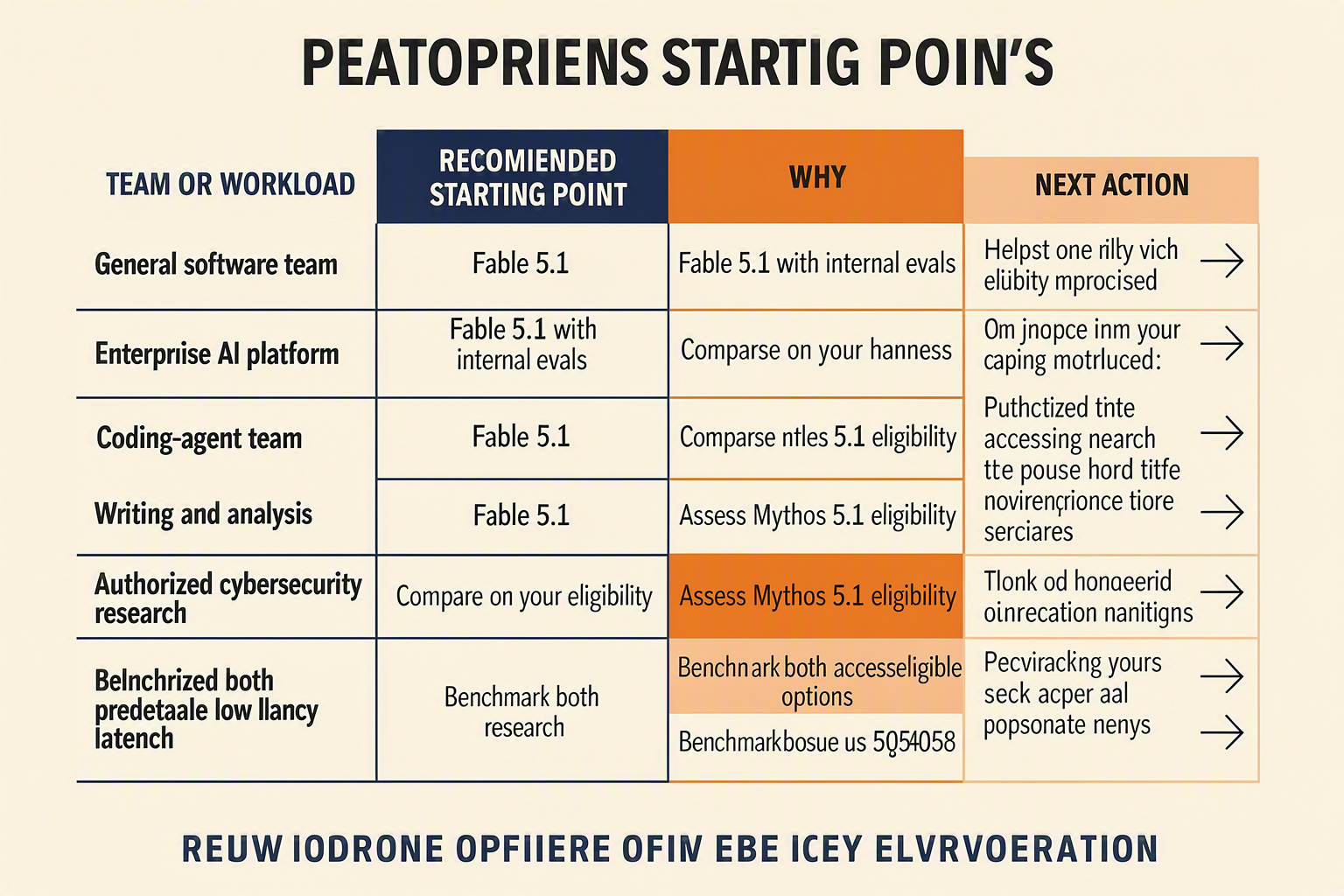
Choose Claude Fable 5.1 unless your organization has approved Claude Mythos 5.1 access and a validated need for its different cybersecurity or biology safeguards. Anthropic describes both configurations as the same underlying model, so team fit depends primarily on workload eligibility, risk controls, procurement status, and cost visibility, not an assumed intelligence advantage.
Decision matrix for developers and AI teams
| Team or workload | Recommended configuration | Why it fits | Access or risk check |
|---|---|---|---|
| General software engineering | Fable 5.1 | Supports advanced coding, debugging, repository analysis, and agentic development without requiring specialized access | Generally available; run code-quality, security, and cost evaluations before deployment |
| Long-horizon AI agents | Fable 5.1 | Anthropic recommends Fable 5.1 for demanding reasoning and long-horizon agentic work, including cases where Claude Opus 5 at higher effort falls short | Require tool permissions, spending limits, checkpoints, and rollback mechanisms |
| Customer-facing knowledge work | Fable 5.1 | Provides the shared Claude 5.1 model capabilities while retaining the generally available safeguard profile | Add retrieval grounding, citations, human escalation, and personal-data controls |
| Routine or defensive cybersecurity | Start with Fable 5.1 | Appropriate when legitimate tasks remain within Fable’s cybersecurity safeguards | Test realistic prompts early because safeguard boundaries may affect task completion |
| Authorized advanced cyber or biology research | Mythos 5.1, if approved | Different safeguards can support eligible sensitive-domain work that Fable may restrict | Anthropic limits Mythos 5.1 to vetted organizations through trusted access |
| Team without Mythos approval | Fable 5.1 | Mythos is not a normal performance-tier upgrade available through standard selection | Do not design production dependencies around Mythos until access is formally confirmed |
Match the model to the risk profile
The key question is not simply, “Which configuration answers more prompts?” It is, “Which safeguard boundary is appropriate for this organization’s authorized work?”
- Low-to-moderate operational risk: Fable 5.1 is the practical baseline for coding assistants, research agents, workflow automation, and enterprise knowledge tasks.
- High autonomy risk: Either configuration needs controls around shell access, production credentials, external communications, and irreversible tool actions. Model capability does not replace application-layer governance.
- Sensitive-domain risk: Mythos 5.1 should be considered only when the organization has a legitimate cyber or biology requirement, institutional controls, and Anthropic approval.
- Regulated-data risk: Neither name by itself resolves privacy, residency, retention, audit, or sector-specific compliance requirements. Teams must review the applicable Anthropic contractual and platform terms.
Validate access, economics, and latency before committing
Anthropic lists Claude Fable 5.1 at $10 per million input tokens and $50 per million output tokens on the Claude Fable product page. Because the supplied official materials do not establish equivalent public Mythos pricing, teams should obtain contractual pricing rather than assume parity.
Anthropic’s September 1, 2026 announcement calls Claude Fable 5.1 and Claude Mythos 5.1 its most advanced models for coding and knowledge work, but Anthropic does not provide evidence here that one configuration has inherently lower latency. Benchmark both against your own prompt lengths, reasoning settings, tool chains, concurrency, and region.
Before selection:
- Confirm Mythos access status with Anthropic.
- Measure task success and refusal rates on representative evaluations.
- Record end-to-end latency, not merely first-token response time.
- Model full costs, including output tokens, retries, tools, and human review.
- Choose Fable by default unless approved sensitive-domain requirements clearly justify Mythos.
Frequently asked questions about Claude Fable 5.1 vs Claude Mythos 5.1
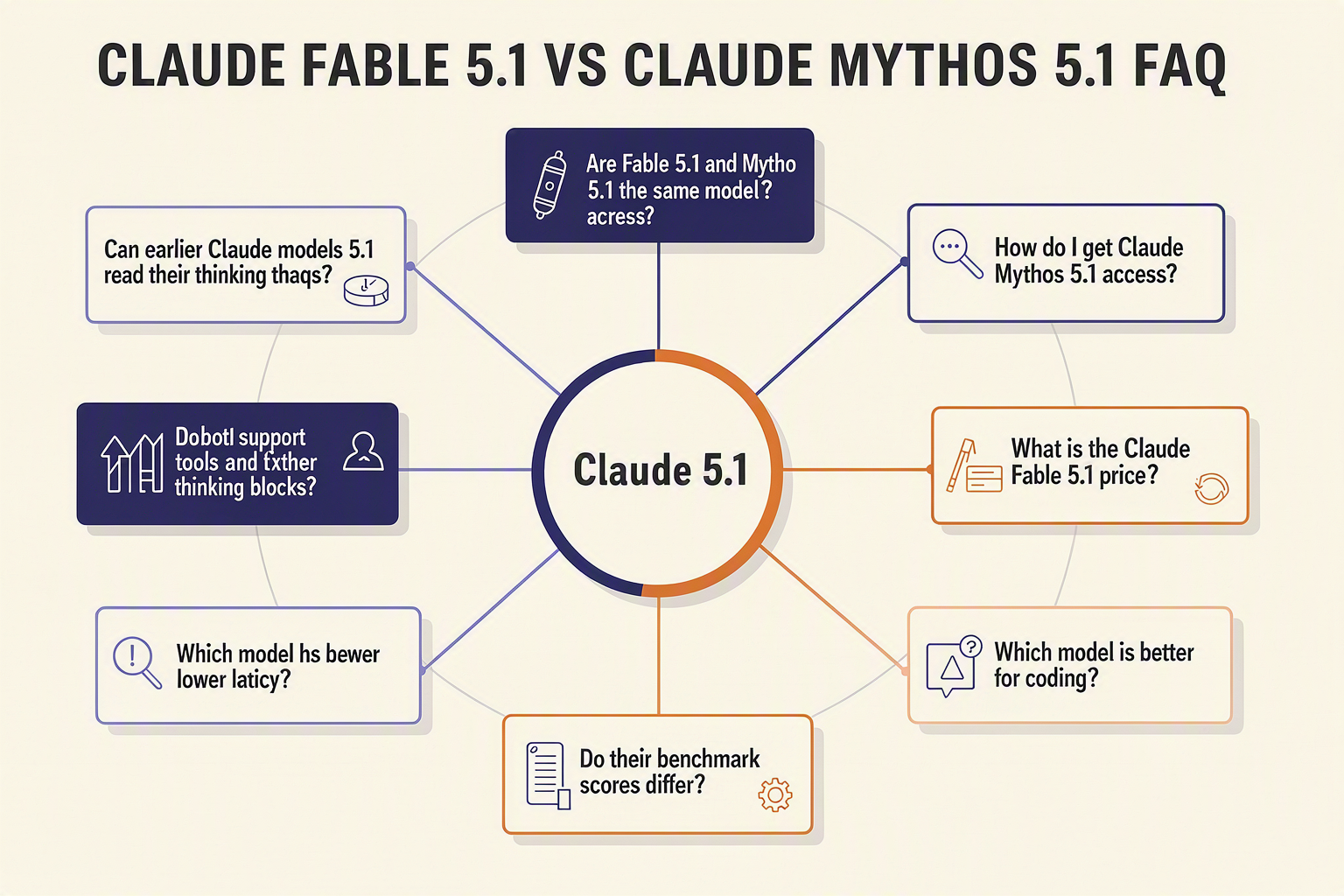
Model choice and availability
What is the main difference in the Claude Fable 5.1 vs Claude Mythos 5.1 comparison?
What is the best Claude 5.1 model for developers and AI teams?
How can an organization get Claude Mythos 5.1 access?
Performance, pricing, and implementation
Is Claude Mythos 5.1 faster or better at coding than Claude Fable 5.1?
What does Claude Fable 5.1 cost through the Anthropic API?
What should developers test in a Claude Fable 5.1 vs Claude Mythos 5.1 evaluation?
Conclusion
Claude Fable 5.1 is the practical choice for most developers, while Claude Mythos 5.1 is a controlled-access configuration for vetted organizations working on sensitive cybersecurity or biology use cases. Anthropic describes both as the same underlying large language model, so the decision is primarily about safeguards, availability, and workload eligibility—not a difference in baseline intelligence.
- Choose Fable 5.1 for mainstream production workloads. Anthropic’s Claude Platform documentation recommends Claude Fable 5.1 for demanding reasoning, advanced coding, and long-horizon agentic tasks, including workloads where Claude Opus 5 at higher effort does not meet a team’s evaluation threshold.
- Treat Mythos 5.1 as specialized access, not a universal upgrade. Anthropic announced on September 1, 2026, that Claude Mythos 5.1 uses different safeguards for sensitive cybersecurity and biology work and is available only to vetted organizations through its trusted-access process.
- Budget around documented costs rather than presumed performance differences. Anthropic lists Claude Fable 5.1 at $10 per million input tokens and $50 per million output tokens. Teams should model complete workflow costs—including long reasoning traces, tool calls, retries, and generated code—rather than comparing headline token prices alone.
- Do not infer a speed or benchmark winner without official evidence. Because Fable 5.1 and Mythos 5.1 share the same underlying model, any observed difference may reflect safeguards, refusals, access policies, or task eligibility. Anthropic’s published system card and model documentation should remain the authority for latency and benchmark claims.
The most important development to watch is how Anthropic turns trusted access into an operational framework: eligibility requirements, safeguard updates, API availability, evaluation guidance, and whether documented behavior diverges for specialized workloads. Developers should also monitor release notes closely; Anthropic notes that thinking blocks generated by Fable 5.1 and Mythos 5.1 can be preserved only for the originating model or a newer model, which matters when upgrading agentic systems.
As AI catalogs grow, model choice will increasingly become a routing and governance decision rather than a simple leaderboard contest. To explore this shift, visit CallMissed, an AI communication-infrastructure platform offering an OpenAI-compatible gateway alongside voice agents and multilingual chatbots. Will your next model decision be driven by benchmark scores—or by the access, safeguards, and operational controls surrounding the model?
Related Reading
- Claude Fable 5 vs Claude Mythos 5 vs Claude Opus 5: Which Should You Choose?
- Best LLM for Voice Agents in 2026: GPT-6 Astra vs Claude Fable 5.1
- Claude Fable 5 vs Fable 5.1: Pricing, Context, and Upgrade Guide