
The Ultimate 2026 Guide to Automating Your Business Operations with CallMissed


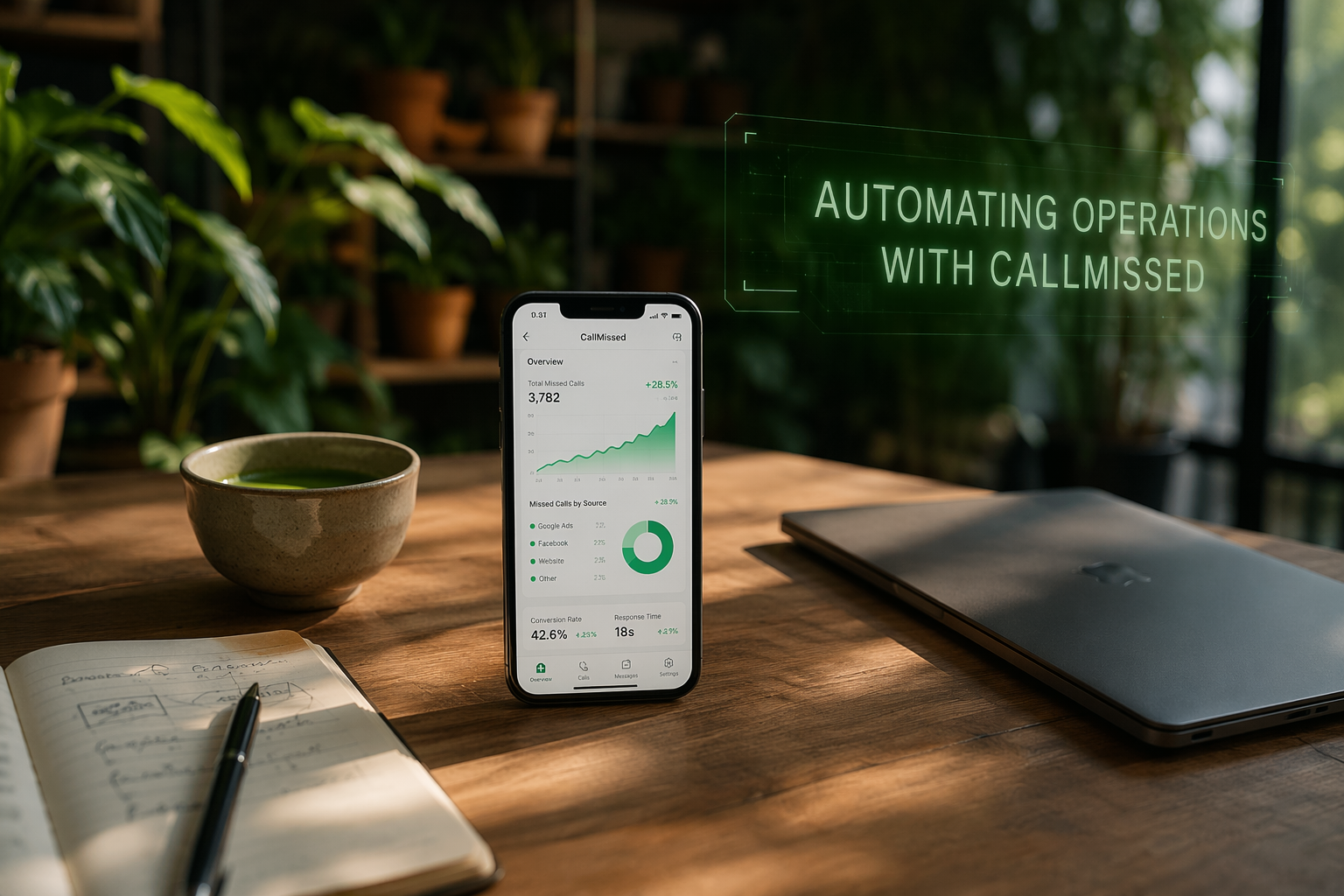
Learn how to use CallMissed to automate your business operations, rescue missed leads with AI voice agents, and streamline omnichannel workflows.
The Ultimate 2026 Guide to Automating Your Business Operations with CallMissed
Did you know that over 60% of customers will hang up and call a competitor if their first call goes unanswered, yet the average enterprise still misses nearly a quarter of its incoming communication? In 2026, the baseline expectation for customer experience has fundamentally shifted. Long hold times, rigid interactive voice response (IVR) menus, and restricted operational hours are no longer just minor inconveniences—they are active revenue leaks. Today's fast-paced market demands instant, hyper-personalized, 24/7 responsiveness across every communication channel.
This operational pressure is driving a massive global shift toward cognitive voice automation. Rather than relying on overwhelmed, expensive human call centers to manage repetitive tasks, forward-thinking companies are deploying intelligent AI voice agents to handle high-volume operations. These next-generation systems can resolve complex support inquiries, qualify warm leads, and book calendar appointments natively and in real time. Platforms like CallMissed are at the forefront of this paradigm shift, enabling organizations to deploy production-ready AI voice agents that handle multi-channel operations—spanning voice, WhatsApp, and SMS—simultaneously.
But how do you transition from fragmented, manual workflows to a completely automated, hands-off communication infrastructure?
This ultimate guide will show you exactly how to scale your growth by automating your business operations with CallMissed. You will learn how to leverage multi-model AI agents, integrate automated WhatsApp chatbots to capture missed opportunities, utilize low-latency speech-to-text APIs, and configure a unified communication system that operates seamlessly 24/7. Whether you want to eliminate call abandonment entirely, support regional customers in their native languages, or scale your outbound operations without adding headcount, this guide provides the step-by-step roadmap to transforming how your business communicates.
Introduction: Why Missed Calls are Costing Your Business (and How CallMissed Fixes It)

Every missed call is a missed revenue opportunity. In today's hyper-competitive marketplace, the cost of unanswered communication is higher than ever. Research reveals that over 60% of customers will hang up and immediately call a competitor if their first call goes unanswered, yet the average enterprise still misses nearly 25% of its incoming inquiries. When a prospect reaches a busy signal, a rigid interactive voice response (IVR) menu, or an endless hold queue, they do not wait—they walk away.
For modern businesses, managing this communication bottleneck manually is a losing battle. Relying solely on human agents to handle high-volume inbound calls leads to inevitable operational challenges:
- The 24/7 Availability Gap: Customers expect instant answers at midnight, over the weekend, and during holiday rushes. Human staff cannot scale to meet round-the-clock demands without astronomical overhead costs.
- Inconsistent Lead Qualification: Understaffed sales teams often fail to follow up with inbound leads quickly, allowing warm prospects to go cold.
- Repetitive Support Bottlenecks: Human agents spend up to 70% of their time answering repetitive inquiries—such as order tracking, refund policies, and business hours—distracting them from complex, high-value tasks.
The Rise of Cognitive Voice Automation
To solve these persistent operational leaks, forward-thinking enterprises are shifting toward cognitive voice automation. Rather than treating phone lines as static, isolated channels, businesses are deploying intelligent AI voice agents capable of managing natural, human-like conversations. According to 2026 industry benchmarks, these advanced AI systems can resolve complex customer support issues, qualify leads, and book calendar appointments entirely in real time without human intervention.
Implementing these systems does not require a complete overhaul of your existing software stack. Comprehensive AI communication infrastructure platforms, such as CallMissed, allow businesses to seamlessly deploy production-ready AI voice agents. By integrating advanced Speech-to-Text (STT) and Text-to-Speech (TTS) APIs with state-of-the-art LLMs, these voice agents can understand customer intent, access backend databases, and execute tasks instantly.
How CallMissed Plugs the Revenue Leaks
CallMissed transforms missed calls from an operational liability into a structured automation funnel. Instead of letting unanswered rings end in a dead dial or a neglected voicemail box, the platform instantly engages callers through automated, omni-channel workflows.
- Instant AI Voice Agents: Inbound calls are answered on the first ring by an AI agent that speaks naturally, answers complex questions, and processes transactions.
- Omni-Channel Failover: If a call cannot be completed, CallMissed can automatically trigger a WhatsApp chatbot or SMS follow-up, keeping the conversation alive and capturing the lead.
- Multilingual Support at Scale: With native support for 22 regional Indian languages, CallMissed ensures your business can communicate effectively with a diverse global customer base, eliminating language barriers that often lead to dropped calls.
By automating these foundational touchpoints, companies can eliminate call abandonment, slash customer support overhead, and ensure that every single inbound inquiry is captured, qualified, and resolved.
Prerequisites & Setup: Getting Ready for Automation
Before you can deploy intelligent, conversational AI agents to handle your customer operations, you need to establish a solid structural foundation. Transitioning from legacy telephony to an automated, AI-driven communication stack is not about writing thousands of lines of complex code; rather, it is about setting up the right configurations, credentials, and data pipelines.
To achieve the sub-second latency and high-accuracy responses required for modern business operations, your organization must prepare key assets across four core pillars: telephony routing, knowledge base ingestion, integration endpoints, and multilingual localization.
The table below outlines the essential prerequisites and setup steps required to transition your business operations to an automated framework.
| Implementation Pillar | Required Assets & Inputs | Purpose & Operational Impact | Target Benchmark (2026) |
|---|---|---|---|
| 1. Telephony & SIP Trunking | Existing business numbers, SIP credentials, or virtual DID numbers | Routes incoming and outgoing PSTN calls directly to your AI voice agents. | Latency < 120ms network transit |
| 2. Knowledge Ingestion (RAG) | FAQs, standard operating procedures (SOPs), pricing sheets, and policy PDFs | Feeds the LLM with accurate context to eliminate hallucinations and resolve inquiries. | Up-to-date real-time document sync |
| 3. API & Webhook Integration | CRM API keys (HubSpot, Salesforce), calendar links, and database endpoints | Allows the AI agent to book appointments, update lead statuses, and trigger automated workflows. | Bi-directional, secure HTTPS handshakes |
| 4. Localization & NLP Map | Target geographic demographics and regional language preferences | Configures the speech-to-text engines to recognize and respond in specific accents or regional languages. | Native support for 22+ regional languages |
Step-by-Step Setup: From Zero to Automated Agent
To bring these elements together, your technical or operations team should follow a structured deployment sequence:
- Map Your Conversational Workflows:
Document your most common inbound scenarios—such as appointment booking, lead qualification, or billing support. Clearly define the "happy path" (the ideal conversation flow) as well as escalation paths for complex issues that require transfer to a human teammate.
- Configure Your Infrastructure on CallMissed:
Setting up these parameters is straightforward. Solutions like CallMissed’s multi-model API gateway let developers configure voice agent infrastructure, connect to 300+ LLMs, and integrate WhatsApp chatbots without rewriting core application code. You can instantly map your existing business phone lines to the platform.
- Connect Your Business Systems:
Link your CRM or calendar tools. By establishing webhook connections, your AI voice agent will not just talk—it will act. For instance, when a customer says, "Book me in for Tuesday at 3 PM," the agent queries your calendar API in real-time, verifies availability, and books the slot instantly.
- Define Language and Voice Personas:
Select the synthetic voice profile (text-to-speech) and speech-to-text engines that match your customer base. For businesses targeting diverse regional demographics, configuring multilingual capabilities—such as CallMissed's support for 22 Indian languages natively—ensures your automated agents communicate with hyper-local precision.
- Run Latency and Accuracy Tests:
Before going live, conduct mock call runs to verify response speed and accuracy. In 2026, the baseline expectation for natural voice conversation is sub-second latency. Ensure your LLM prompts, database queries, and speech processing steps are highly optimized.
Getting Started with CallMissed: Basic Configuration
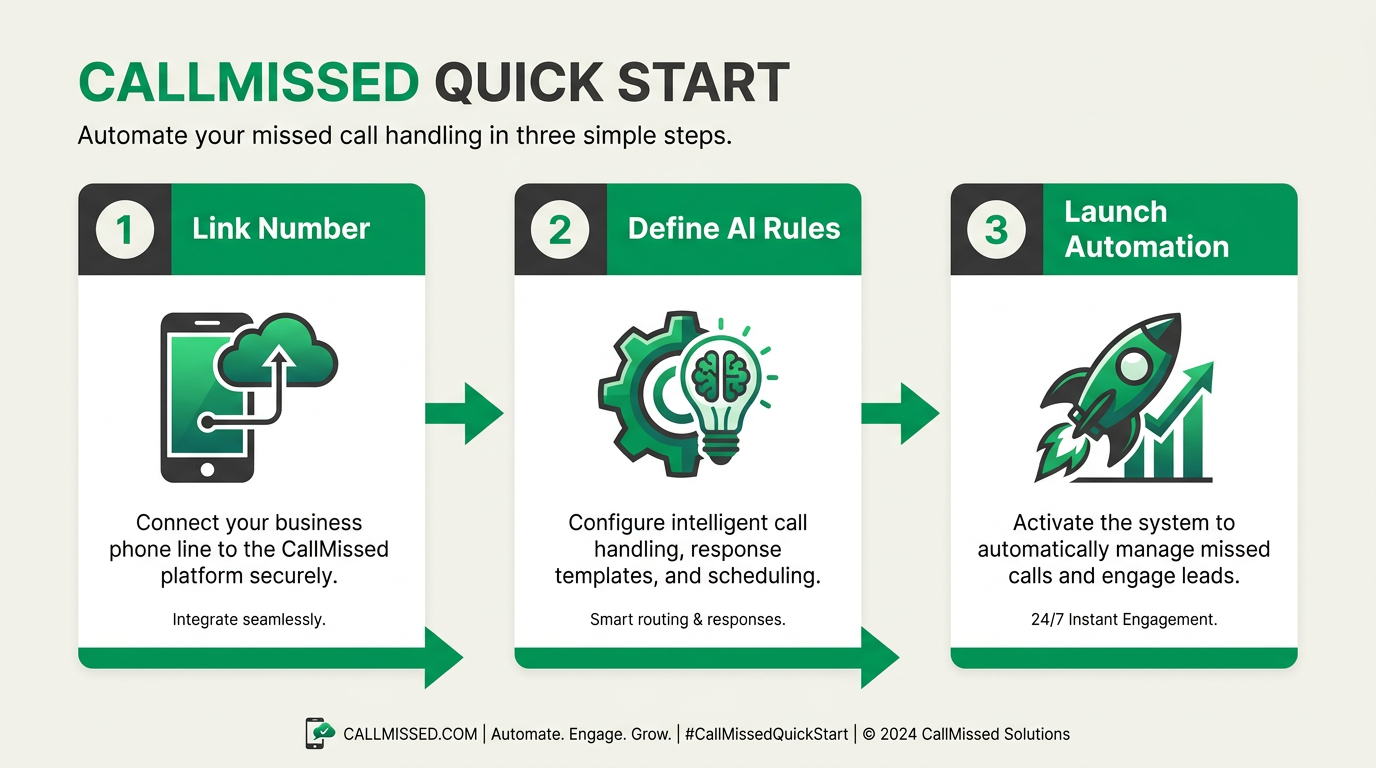
Setting up an automated communication infrastructure might sound daunting, but the CallMissed platform is designed to transition your business from manual call-handling to a fully autonomous setup in a matter of minutes. In 2026, implementing AI voice agents is no longer a luxury reserved for tech giants with massive engineering budgets. According to industry analyses, the best approach to deploying these systems involves defining a clear business use case, structuring conversation flows, and leveraging pre-built infrastructure to build, test, and optimize in real time.
Here is the step-by-step blueprint to configure your CallMissed account and launch your first AI-driven workflow.
Step 1: Claim Your Number and Choose Your Channels
The onboarding process begins by securing a dedicated virtual phone number or linking your existing business line directly to CallMissed.
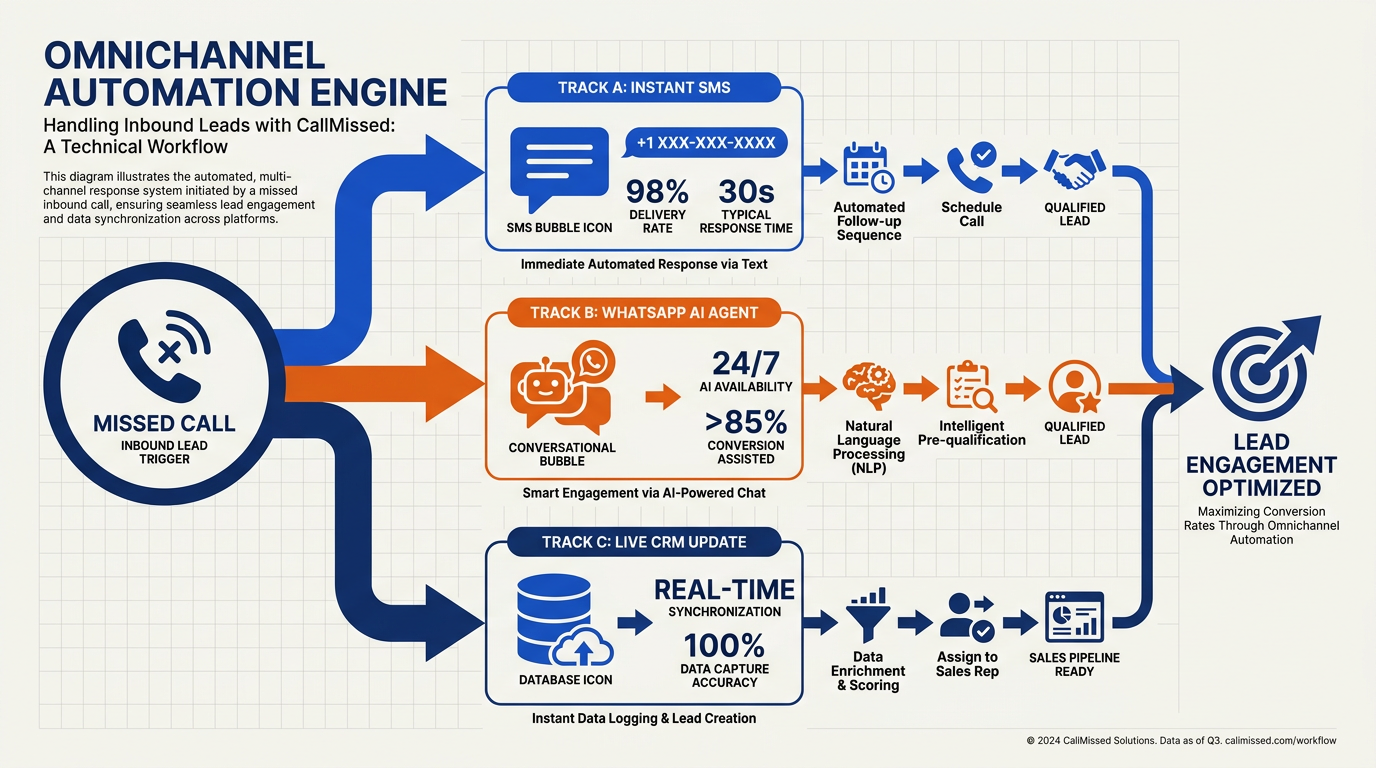
- Multi-Channel Orchestration: Once inside the dashboard, you can toggle active channels with a single click. You can route inbound inquiries strictly to voice agents, activate a WhatsApp chatbot, or set up an SMS fallback system.
- The Omnichannel Advantage: This ensures that if a customer calls and hangs up early, the system can instantly send a WhatsApp message to qualify the lead, effectively capturing what would have otherwise been a lost revenue opportunity.
Step 2: Select Your LLM Engine
One of CallMissed’s most powerful differentiators is its multi-model AI gateway, which gives you access to over 300 Large Language Models (LLMs). Rather than locking you into a single provider, the platform allows you to match the model to your specific operational needs:
- High-Speed, Low-Latency Models: Ideal for live phone conversations where sub-second response times are crucial to keeping the conversation sounding natural.
- Complex Reasoning Models: Best suited for WhatsApp customer support and back-office ticket resolution where deep contextual understanding is necessary.
Step 3: Configure Speech-to-Text (STT) and Regional Languages
To serve a diverse, global customer base, localized communication is critical. Within the configuration panel, you can set your Speech-to-Text (STT) preferences.
- Language Support: CallMissed natively supports 22 regional Indian languages alongside global languages.
- Accent & Dialect Tuning: This setup guarantees that whether a customer calls speaking Hindi, Tamil, Telugu, or English, the AI voice agent transcribes, understands, and responds in the correct dialect without awkward translation delays.
Step 4: Define the Agent’s Persona and Guardrails
Your AI agent is the voice of your brand, and CallMissed allows you to customize its behavior precisely. Through the prompt builder, you define the system instructions:
- The Persona: Instruct the agent to be "a professional, empathetic customer success representative for an e-commerce brand" or "a fast, efficient booking assistant for a medical clinic."
- System Guardrails: Define exactly what the agent can and cannot say. For instance, you can program the AI to never quote custom pricing without first transferring the call to a human agent, or restrict it from discussing competitor platforms.
- Integration Hooks: Link the agent directly to your existing tech stack—such as your CRM, Google Calendar, or Shopify store—allowing the AI to check live inventory, schedule appointments, or update customer records automatically during the call.
Step-by-Step Walkthrough: Automating Your Operational Workflows
Transitioning from traditional, fragmented phone systems to a fully automated communication workflow does not require a complete overhaul of your existing software stack. By breaking the deployment down into structured phases, businesses can transition seamlessly to an automated, hands-off operational model.
Here is the step-by-step roadmap to configuring, deploying, and optimizing your business workflows using CallMissed:
Step 1: Identify and Map High-Volume Use Cases
Before writing a single line of prompt or integration logic, audit your incoming and outgoing call patterns. According to 2026 industry reports, the most lucrative operational bottlenecks to automate include 24/7 basic customer support, instant appointment scheduling, lead qualification, and order status tracking.
- Action: Map out the exact path a customer takes when calling your business. Define the transition points—such as when a customer needs to book an appointment versus when they need a technical support representative.
Step 2: Define Conversation Flows and Prompt Engineering
An AI voice agent is only as good as its behavioral instructions. Using natural language, define the persona, boundaries, and objectives of your agent. Platforms like CallMissed allow you to hook these agents directly to advanced LLMs via a multi-model gateway supporting over 300 models.
- The Greeting: Keep it concise to minimize initial latency.
- Guardrails: Explicitly list what the AI agent cannot say or do (e.g., "Do not offer discounts above 15%").
- Fallback Rules: Program instructions for handling edge cases, such as routing complex queries directly to a human specialist.
Step 3: Connect Live Business Data via APIs
Static voice agents cannot check inventory, confirm bookings, or update shipping statuses. To make your workflows truly intelligent, you must connect the agent to your internal tools (like CRM, ERP, or calendar systems).
- Calendar Integration: Link APIs like Google Calendar or Cal.com so the voice agent can instantly check real-time availability and schedule meetings natively.
- Database Lookups: Enable your agent to fetch customer records using Speech-to-Text (STT) parsing of names or customer IDs, which CallMissed processes with ultra-low latency across 22 regional Indian languages.
Step 4: Configure Multichannel Omnipresence
True operational automation is cross-channel. When a customer contacts your business, their journey shouldn't be trapped in a single medium.
- Inbound Handling: The voice agent answers the call, answers basic questions, or schedules an appointment.
- WhatsApp Automation: Configure a post-call automated workflow. If a user hangs up or requires written confirmation, CallMissed's integrated WhatsApp chatbot instantly sends a booking confirmation, invoice, or follow-up questionnaire.
Step 5: Test, Monitor, and Continuously Optimize
Before pointing your main business number to your new AI agents, execute dry runs. Test for voice latency, regional accent handling, and API timeouts. Once live, utilize real-time analytics dashboards to monitor call duration, customer satisfaction scores, and transfer rates to human agents. Continuous prompt tweaking ensures your agent adapts to real-world customer behaviors over time.
Advanced Tips & Tricks for Peak Efficiency
To extract the absolute maximum ROI from your automated communication setup, deploying basic conversational agents is just the first step. True operational excellence in 2026 relies on fine-tuning, latency management, and seamless platform cross-talk. According to industry analyses from Vellum and CloudTalk, the top-performing AI voice systems succeed because they prioritize speed, context preservation, and deep integration with existing customer relationship management (CRM) software.
To help you optimize your setup, we have compiled the ultimate playbook of advanced strategies. Implementing these optimization techniques ensures your workflows remain rapid, frictionless, and highly cost-effective.
Optimization Strategies for Enterprise-Grade AI Operations
To achieve peak efficiency, your technical team should focus on four key pillars: latency reduction, multi-channel context synchronization, dynamic fallback routing, and localized linguistic adaptation.
- Optimize for Sub-Second Latency: In voice operations, delays kill conversational flow. To maintain a natural cadence, aim for an end-to-end latency of under 1 second. Platforms like CallMissed achieve this by leveraging high-speed LLM inference pipelines and ultra-fast Speech-to-Text (STT) engines.
- Synchronize Context Across Channels: If a customer starts an interaction on an AI voice call, they should be able to seamlessly continue it on WhatsApp without repeating themselves. Use unified session IDs across your communication stack to pass structured metadata (such as intent, sentiment, and extracted variables) between channels instantly.
- Implement Warm Handoffs: When a complex query requires a human touch, design a fail-safe routing system. The AI agent should summarize the conversation and pass this structured summary to the live agent's dashboard before the call is transferred, eliminating frustrating repetitive explanations for the customer.
- Localize with High-Fidelity Dialects: If your business serves regional markets, generic language models will fall short. Implement localized Text-to-Speech (TTS) and STT models that natively support regional dialects and accents.
Performance Tuning & Workflow Configuration
The table below outlines the core configuration strategies, performance benchmarks, and expected business impacts when optimizing your automated communication infrastructure.
| Optimization Focus | Key Configuration Metric | Target Benchmark | Business Impact |
|---|---|---|---|
| Response Latency | Time-to-First-Byte (TTFB) | < 800 milliseconds | Eliminates awkward conversational pauses; mimics human speech patterns. |
| Channel Handshake | Cross-platform sync delay | < 2 seconds | Allows immediate WhatsApp follow-ups after a missed call is detected. |
| Multilingual STT | Dialect word error rate (WER) | < 5% WER across 22 languages | Ensures accurate transcription for regional Indian and global accents. |
| API Fallback Routing | Gateway failover rate | 99.99% system uptime | Ensures uninterrupted service by switching LLM providers instantly if one goes offline. |
| Context Retention | Session state retention | Up to 30 days | Enables personalized greetings and continuous problem resolution across touchpoints. |
By implementing these advanced parameters, your business can transition from simple call forwarding to a highly sophisticated, self-optimizing communication engine. Platforms like CallMissed provide the robust developer infrastructure—including a multi-model gateway supporting over 300 LLMs and low-latency APIs—needed to turn these advanced configurations into everyday operational realities.
Common Mistakes to Avoid When Automating Operations
Transitioning to cognitive voice automation is a game-changer for scaling business operations, but execution is everything. In 2026, simply deploying a generic chatbot or a rigid interactive voice response (IVR) script is no longer enough to satisfy demanding, digitally native customers. When organizations rush their automation strategy without considering natural conversation flows, API latency, or multi-channel integration, they often exchange one set of operational bottlenecks for another.
To ensure your transition to automated communication is seamless and highly profitable, you must avoid several critical implementation pitfalls.
| Common Mistake | Operational Impact | The Better Approach | How CallMissed Solves It |
|---|---|---|---|
| Using High-Latency APIs | Delays of over 2 seconds cause awkward pauses, leading to customers talking over the AI and hanging up. | Opt for sub-second, low-latency Speech-to-Text (STT) and LLM inference pipelines. | CallMissed utilizes highly optimized STT and inference networks to maintain ultra-low, life-like conversational latency. |
| Strict, Script-Based IVRs | Customers get trapped in rigid "press 1 for sales" loops, failing to resolve complex, fluid inquiries. | Leverage dynamic, LLM-powered cognitive voice agents that understand natural context and intent. | Deploy advanced AI voice agents that handle unstructured, natural speech across 300+ LLM configurations. |
| Ignoring Regional Languages | Alienates non-English-speaking customers, drastically reducing market reach in diverse regions. | Implement native, multi-dialect support across all voice and chat communication channels. | Features built-in STT and TTS APIs supporting 22 Indian languages and dozens of global dialects. |
| Siloed Communication Channels | Call details don't sync with WhatsApp, forcing customers to repeat their issues across channels. | Integrate omnichannel orchestration where voice agents, chatbots, and CRMs share a single state. | Natively integrates WhatsApp chatbots and voice systems to capture missed calls and instantly follow up via SMS. |
| No Human-in-the-Loop Backup | Complex or highly sensitive escalations hit a dead end, resulting in negative brand experiences. | Build smooth handoff protocols that seamlessly transfer high-value or frustrated callers to live agents. | Offers instant, context-aware human escalation protocols, forwarding the full AI call transcript to the live agent. |
Key Pitfalls to Avoid in Your Automation Strategy
- The Latency Trap: Human conversation relies on rapid, split-second turn-taking. If your voice agent takes more than 1.5 seconds to process audio and respond, the user experience collapses. Minimizing latency is the single most critical factor for customer retention in automated voice interactions.
- The "One-Size-Fits-All" LLM Constraint: Depending on a single language model can lock your business into rigid pricing structures or suboptimal performance for specific use cases. Platforms like CallMissed solve this by offering a multi-model API gateway with access to over 300+ LLMs, allowing developers to switch models dynamically based on cost, speed, or task complexity.
- Forgetting the Post-Call Workflow: Automation doesn't end when the call terminates. To fully automate operations, the data gathered during the conversation must instantly trigger downstream actions—such as updating a CRM, sending a calendar invite, or triggering a automated WhatsApp confirmation. Ensure your voice platform connects directly with your existing tech stack to prevent manual data-entry bottlenecks.
Frequently Asked Questions
How does automating your business operations with CallMissed improve lead conversion rates?
Can I use CallMissed to automate both phone calls and WhatsApp messaging?
Is it possible for an AI voice agent to handle complex business operations like live scheduling?
How does CallMissed support businesses operating in multilingual regions?
How fast are the response times when automating your business operations with CallMissed?
Do I need advanced technical expertise to integrate CallMissed with my current software?
Resources & Next Steps: Your Path to a 24/7 Automated Business

The transition to a 24/7 automated business is no longer a futuristic goal—in 2026, it is an operational necessity. By replacing rigid IVR systems and overwhelmed manual phone lines with intelligent, multi-channel agents, you secure every potential lead and support touchpoint. Implementing this system requires a structured approach to ensure smooth integration and immediate ROI.
Step-by-Step Implementation Blueprint
To transition your operations to a fully automated model without disrupting daily business, follow this structured roadmap:
- Identify High-Volume Bottlenecks: Review your communication logs to find where most manual time is spent. Common starting points include answering FAQs, verifying order statuses, qualifying inbound leads, or booking calendar appointments.
- Design Your Conversation Flows: Map out the typical paths a customer takes. Outline how your AI voice agent should handle specific inquiries, when it should trigger a WhatsApp follow-up, and exactly when a complex issue should be escalated to a live human agent.
- Configure Your Integrations: Connect your communication layer to your existing business tools. Ensure your AI agents can read and write data directly to your CRM, ERP, and scheduling software (such as Google Calendar or Calendly) in real time.
- Deploy Multilingual Support: Implement localized speech-to-text and text-to-speech capabilities. Modern platforms allow you to serve diverse markets by deploying agents that comprehend regional dialects and respond instantly.
- Monitor, Test, and Optimize: Run initial testing phases to measure latency, accuracy, and customer satisfaction. Use real call transcripts to refine prompts, adjust voice tones, and continuously improve resolution rates.
Essential Automation Resources
To help you scale your operational automation, leverage these key resources and industry benchmarks:
- The 2026 AI Voice Agent Buyer's Guide: Understand how to compare platforms based on critical technical metrics, focusing on processing speed, pricing structures, and conversational latency to ensure natural interactions.
- Low-Latency API Documentation: Access developer resources for Speech-to-Text and Text-to-Speech APIs to build custom voice solutions that feel fluid, life-like, and human.
- Multi-Channel Integration Playbooks: Detailed guides on connecting voice agents with WhatsApp chatbots, allowing your business to capture missed calls and instantly redirect the conversation to SMS or WhatsApp.
Launch Your Automated Era with CallMissed
Building this level of infrastructure from scratch can require extensive engineering resources. For businesses seeking a production-ready solution, CallMissed provides the complete AI communication infrastructure to automate your operations end-to-end.
Through CallMissed’s unified platform, developers can access a multi-model API gateway supporting over 300 LLMs to find the perfect intelligence level for their brand. To truly eliminate operational boundaries, CallMissed supports native Speech-to-Text and Text-to-Speech APIs in 22 regional Indian languages, ensuring your automated systems communicate naturally with a global audience. Whether you need to deploy conversational WhatsApp chatbots, launch autonomous voice agents, or completely eliminate missed calls, CallMissed provides the scale, speed, and low latency your business requires.
Stop letting unanswered calls dictate your growth. Turn on 24/7 automated operations today and ensure your business never misses another opportunity.
Conclusion
As we look ahead through 2026, the cost of unanswered communication is too high for any growing enterprise to ignore. Transitioning away from rigid, manual call centers toward automated, cognitive communication is no longer a luxury—it is an operational necessity. By implementing the strategies outlined in this guide, you can completely transform how your business connects with its customers.
Here are the key takeaways to remember:
- Eliminate Revenue Leakage: Replace endless hold queues and rigid IVR systems with instant, human-like voice agents to capture the 60% of frustrated customers who would otherwise hang up and call your competitors.
- Achieve True 24/7 Availability: Deliver round-the-clock responsiveness across voice, WhatsApp, and SMS, ensuring global and regional customers are supported natively in their preferred languages.
- Scale Without Overhead: Seamlessly handle high-volume operations like lead qualification, appointment booking, and complex support inquiries without expanding your human headcount.
As AI voice agents become faster, cheaper, and more linguistically diverse, the gap between businesses that automate and those that rely on manual workflows will only widen. To explore how AI communication is evolving and start building your own low-latency, multi-channel automated workflows, check out CallMissed—an AI infrastructure platform powering voice agents and multilingual chatbots for businesses. Are you ready to let your business run on autopilot, or will you keep letting valuable opportunities slip through the cracks?
Discussion
Related Posts



Ready to automate customer conversations?
Launch AI voice agents and WhatsApp bots with CallMissed — one API, 22+ Indian languages.