
The 2026 Guide to WhatsApp Lead Generation: How to Build a High-Converting, Frictionless Sales Funnel Directly in Chat


Did you know that the traditional landing page and web form are officially dead? In 2026, forcing a prospect to leave their favorite messaging app, wait...
The 2026 Guide to WhatsApp Lead Generation: How to Build a High-Converting, Frictionless Sales Funnel Directly in Chat
Did you know that the traditional landing page and web form are officially dead? In 2026, forcing a prospect to leave their favorite messaging app, wait for a slow-loading mobile landing page, and manually fill out a tedious multi-field form is a guaranteed way to kill your conversion rates. As global business messaging via OTT apps surges toward a projected $9.8 billion by 2029, the highest-converting brands are shifting their strategy, moving their entire lead acquisition, qualification, and sales funnels directly into chat.
The reason for this paradigm shift is simple: friction is the enemy of conversions. While traditional email marketing struggles with dwindling engagement, WhatsApp lead generation delivers an astonishing 98% open rate and 45-60% click-through rates. By keeping the entire buyer journey native to WhatsApp, businesses are slashing form abandonment rates by up to 60% and turning cold traffic into highly qualified sales opportunities in real-time.
This shift is being powered by major advancements in conversational technology. Today, brands can leverage native WhatsApp Flows—interactive, in-app forms that let users book appointments, sign up for webinars, or request quotes without ever leaving the chat. When paired with automated qualification systems, the results are game-changing. For example, forward-thinking businesses are utilizing communication infrastructure platforms like CallMissed to deploy intelligent WhatsApp chatbots that instantly qualify, route, and engage incoming leads 24/7, eliminating human bottlenecks entirely.
In this ultimate operational blueprint for 2026, you will learn exactly how to build a zero-friction conversational sales funnel. We will break down how to capture high-intent leads using WhatsApp Flows, qualify them automatically using AI assistants, seamlessly sync data with your existing CRMs (like HubSpot, Salesforce, and Zoho), and supercharge your traffic with high-performing Click-to-WhatsApp (CTWA) ads that boost overall lead quality by 40%. It is time to stop losing prospects to clunky web forms and start closing deals where your customers already spend their time.
Introduction: The Death of the Web Form and the Rise of Conversational Funnels
The traditional marketing playbook is undergoing a silent but devastating collapse. For years, the standard lead generation funnel relied on a predictable sequence: run an ad, direct the user to a mobile landing page, and pray they fill out a multi-field web form. But in 2026, this high-friction journey is a guaranteed conversion killer.
Modern consumers expect immediacy, simplicity, and personalization. Forcing a prospect to leave their active social or messaging app, wait for an external page to load, and manually type out their contact information is an outdated strategy. As global business messaging via OTT apps surges from $3.6 billion in 2025 to a projected $9.8 billion by 2029, the highest-converting brands are abandoning external web forms entirely. Instead, they are moving their entire lead acquisition, qualification, and sales funnels directly into chat.
Why Conversational Lead Gen Rules in 2026
The shift from static web forms to conversational funnels is driven by a simple reality: friction is the ultimate enemy of conversion. While traditional email marketing struggles with single-digit engagement, WhatsApp lead generation delivers an astonishing 98% open rate and 45–60% click-through rates. By keeping the buyer’s journey entirely within a native, trusted messaging environment, businesses are slashing form abandonment rates by up to 60%.
This friction-free experience is made possible by native WhatsApp Flows—interactive, rich-media features that allow users to fill out forms, book appointments, choose product preferences, or sign up for webinars directly inside the chat window.
The Power of Automated, 24/7 Engagement
Capturing a lead is only half the battle; real-time qualification is what drives revenue. In 2026, static, rigid chatbot menus have been replaced by context-aware AI assistants. These intelligent systems interact with prospects naturally, qualifying them based on budget, intent, and timeline, and routing them to the right sales representatives instantly.
This is where robust AI infrastructure becomes indispensable. Platforms like CallMissed allow businesses to easily build and deploy highly sophisticated conversational agents. By leveraging CallMissed's extensive API gateway—which supports over 300 LLMs, Speech-to-Text in 22 regional Indian languages, and natural Text-to-Speech—companies can scale their conversational funnels globally without losing the human touch.
What to Expect in This Guide
To help you transition from outdated forms to high-converting conversational funnels, this operational blueprint will walk you through:
- Frictionless Capture: How to design interactive, high-converting WhatsApp Flows.
- Automated Qualification: Deploying AI assistants that qualify and route leads 24/7.
- CRM Integration: Syncing chat data natively with HubSpot, Salesforce, or Zoho.
- Scaling with CTWA Ads: Utilizing Click-to-WhatsApp ads to boost lead quality by 40%.
It is time to stop losing qualified traffic to slow-loading landing pages and start closing deals where your customers actually spend their time.
Background & Context: Why Traditional Lead Generation Is Failing in 2026
The Friction Tax: Why Mobile Web Forms Are Conversion Killers
The traditional lead generation process is fundamentally incompatible with modern mobile user behavior. When a user clicks a standard ad today, they are forced to leave their native social media environment, wait for an external browser window to load, and manually type personal information into multiple input fields.
On mobile devices, this "context switch" creates a massive drop-off at every stage:
- Loading Latency: Every additional second of mobile landing page load time reduces conversion rates by an average of 20%.
- The "Thumb Fatigue" Factor: Forcing prospects to manually input names, work emails, and phone numbers using a virtual mobile keyboard invites high input error rates and immediate abandonment.
- The Security Hesitancy: In an era of rampant data leaks, users are increasingly reluctant to hand over their personal contact details to unfamiliar web domains.
By forcing prospects through this legacy gauntlet, businesses pay a heavy "friction tax." This results in standard web form conversion rates hovering at a dismal 2% to 5% across most major B2B and B2C industries.
The Fatal Speed-to-Lead Gap
Even when a prospect does fill out a web form, the traditional follow-up mechanism is structurally broken. Historically, marketing automation relied on sending a lead to a CRM, waiting for a sales representative to claim it, and initiating a follow-up call or email.
However, current market data reveals a critical bottleneck:
- The 5-Minute Rule: If a business does not engage a lead within five minutes of submission, the likelihood of qualifying that lead drops by up to 80%.
- The Spam-Filter Shield: Thanks to advanced carrier-level spam blocking, over 70% of consumers refuse to answer calls from unknown numbers.
- The Inbox Mirage: Corporate email filters have become exceptionally aggressive, routing marketing follow-ups directly to "Promotions" or "Spam" folders, dragging email open rates down to historic lows.
The reality is stark: if you cannot engage a prospect at the exact moment their intent is at its highest, you have lost them.
Turning Chat App Domination Into a Competitive Advantage
In 2026, consumers no longer tolerate delayed responses or clunky navigation. They demand conversational immediacy. Because WhatsApp is already open on billions of devices worldwide, it acts as a trusted, zero-latency interface.
Instead of fighting against consumer behavior, top-performing brands are meeting users where they are already active. To execute this shift seamlessly, enterprises are leveraging modern communication infrastructure platforms like CallMissed. By utilizing CallMissed's unified LLM and WhatsApp API integrations, businesses can instantly transition from leaky static landing pages to highly responsive, automated chat environments. This setup qualifies leads in real-time and eliminates the speed-to-lead gap entirely.
Key Developments: The Evolution of WhatsApp Sales Automation
To understand where we are in 2026, we must look at the rapid technological leap WhatsApp sales automation has taken. What started as a simple, manual messaging tool has evolved into a highly integrated, AI-driven transaction engine. Modern buyers no longer tolerate clunky external redirects; they expect contextual, human-like conversations and native checkout or booking workflows directly inside the chat interface.
The table below traces this evolution to show how WhatsApp has transformed from a basic customer support channel into a high-powered, automated revenue machine:
| Evolutionary Era | Primary Technology | Lead Experience | Data Integration | Est. Drop-Off Rate |
|---|---|---|---|---|
| Manual Era (Pre-2020) | WhatsApp Business App (Manual) | Clunky, slow response times, text-only | None (manual copy-pasting to CRM) | 70% - 85% |
| Rule-Based Era (2020-2023) | Fixed-tree Chatbots (Keyword matching) | Rigid; forced external link redirects | Basic webhooks and static CSV exports | 50% - 60% |
| Flow-Native Era (2023-2025) | WhatsApp Flows (In-app forms) | Rich interactive menus, direct scheduling | Automated one-way CRM sync (Zapier) | 30% - 45% |
| AI-Native Era (2026) | Conversational LLMs & Agentic AI | Zero friction; adaptive natural-language chat | Deep, real-time bidirectional CRM syncing | Under 15% |
The Shift from Rigid Rule-Based Menus to Semantic Understanding
In the early days of WhatsApp automation, interactions were frustratingly rigid. Users were forced to navigate "Reply with 1 for Sales, 2 for Support" menus. If a prospect typed "I want to buy now" instead of pressing a number, the system broke.
Today, advanced Natural Language Processing (NLP) and Large Language Models (LLMs) have completely replaced keyword matching. Modern conversational engines analyze user intent, sentiment, and context in real-time. This allows businesses to handle complex, unstructured queries seamlessly.
For instance, platforms like CallMissed enable this modern orchestration by offering a multi-model LLM API gateway. Businesses can dynamically deploy, test, and switch between 300+ LLMs without rewriting a single line of codebase. This ensures the AI chatbot remains highly responsive, accurate, and capable of holding natural sales conversations in multiple regional dialects.
Real-Time Bidirectional Data Synchronization
Another major leap in the 2026 landscape is how data is managed. Historically, capturing a lead on WhatsApp meant relying on unstable third-party webhook connections that frequently dropped leads.
In the AI-native era, WhatsApp integrations function as direct, secure extensions of your database. When a prospect interacts with a WhatsApp Flow or an AI agent, every piece of captured information—from verified phone numbers to budget size—is instantly written directly into CRMs like HubSpot, Salesforce, or Zoho. This bidirectional sync ensures that the moment a lead is qualified by the AI, an automated sales dispatch is triggered, alerting your account executives before the prospect even closes their chat window.
In-Depth Analysis: Behind the Tech of WhatsApp Flows, AI Bots, and CRM Integrations
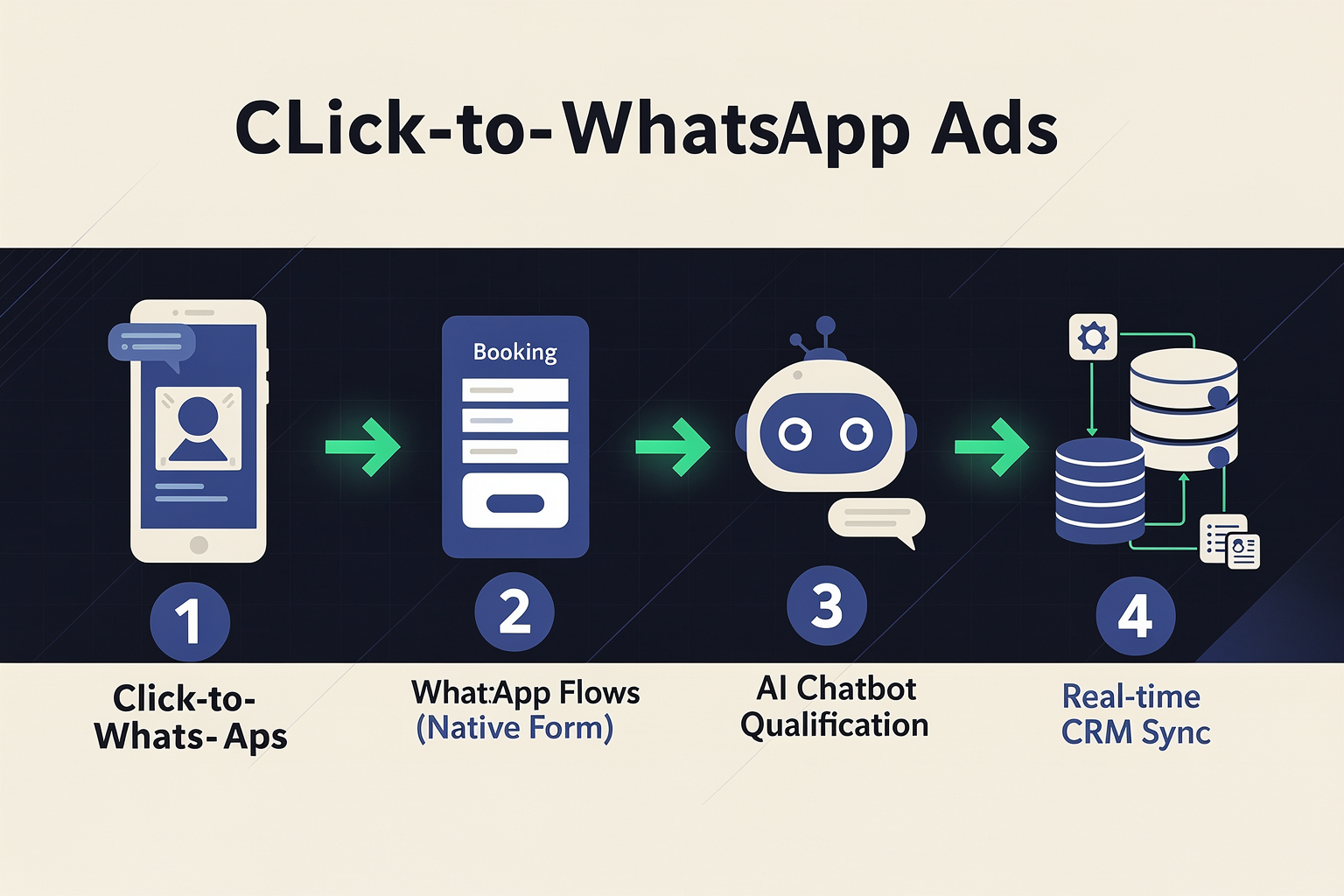
To appreciate why conversational funnels outperform web-based alternatives, we must look at the underlying architecture. A frictionless sales funnel is not built on simple auto-responders; it is powered by a tightly coupled, three-part technical stack: WhatsApp Flows for structured data capture, LLM-driven AI agents for semantic understanding, and real-time CRM webhooks for instant sales dispatch.
The Mechanics of WhatsApp Flows: Native, JSON-Defined UI
Traditional chat interactions require a tedious back-and-forth of text questions ("What is your email?", "What is your budget?"). WhatsApp Flows changes this by rendering native, interactive user interfaces directly inside the chat window.
- How it works: Under the hood, a Flow is defined by a layout JSON schema hosted on Meta’s servers. When a user triggers an action (e.g., clicking "Get a Quote"), WhatsApp retrieves this schema and renders native components—such as date pickers, dropdown lists, multi-select checkboxes, and text inputs—directly on the user's screen.
- The Technical Edge: Because these components are native to the WhatsApp app, they require zero page load time, work seamlessly on low-bandwidth connections, and bypass the friction of mobile browsers. Once the user hits "Submit," the data is packaged into an encrypted payload and pushed instantly to your webhook endpoint, securing user data while achieving a 60% drop in form abandonment.
AI Agent Orchestration: Beyond Rule-Based Chatbots
Once the Flow payload reaches your server, the data must be interpreted. In 2026, relying on rigid, keyword-based IF/THEN rules is no longer viable. High-converting funnels run on advanced Large Language Models (LLMs) to handle complex customer interactions.
The AI agent parses the structured data from the Flow alongside any unstructured text the user types. It determines intent, evaluates the lead's urgency, and drafts a contextual, personalized follow-up in milliseconds.
For developers managing global or highly localized campaigns, routing these requests efficiently is critical. Communication platforms like CallMissed simplify this stage by offering a unified API gateway connected to over 300+ LLMs. This allows businesses to dynamically route conversations to the most optimized model—whether that means leveraging smaller, faster models for quick validation or routing complex queries to reasoning-heavy models. Additionally, with native support for Speech-to-Text across 22 regional Indian languages, platforms like CallMissed ensure that conversational AI agents can qualify and engage prospects regardless of their preferred language or input style.
The CRM Bridge: Real-Time Sync and Automated Dispatch
A lead captured in WhatsApp is only as valuable as the speed at which your sales team can act on it. This is where real-time CRM integration completes the loop.
Using secure REST APIs, your webhook instantly routes the processed lead data to CRM systems like HubSpot, Salesforce, or Zoho. The integration executes three crucial steps in real-time:
- De-duplication & Record Creation: The system queries the database using the user's verified WhatsApp phone number (acting as a unique identifier) to either update an existing contact or create a new lead profile.
- Custom Property Mapping: The structured answers captured via WhatsApp Flows (e.g., "Company Size: 50-100", "Timeline: Immediate") are mapped directly to custom fields inside your CRM.
- Instant Sales Assignment: If the AI agent flags the lead as high-intent, the CRM triggers a routing workflow, instantly assigning the lead to an active sales representative and sending a notification via Slack or email.
This end-to-end integration bridges the gap between marketing interaction and sales action, allowing businesses to close deals within minutes of the initial opt-in.
Impact & Implications: Lowering Acquisition Costs and Scaling High-Intent Pipeline
The transition from traditional web-based lead generation to a native WhatsApp funnel isn’t just a cosmetic upgrade for your user interface—it is a fundamental restructuring of your customer acquisition economics. In 2026, as ad networks become more competitive and privacy regulations tighten, the businesses that survive are those that can capture and qualify high-intent traffic with the absolute lowest friction.
Moving your entire marketing and sales pipeline into a conversational format has immediate, measurable impacts on your bottom line.
Redefining Unit Economics: Slashing CPL and CAC
Traditional digital marketing suffers from a compounding drop-off problem. Users click an ad, wait for a landing page to load (losing roughly 20% of traffic), look at a form (losing another 30%), and begin typing before ultimately abandoning the process (losing another 50%).
Keeping the user journey native to WhatsApp yields dramatic economic benefits:
- Lower Cost-Per-Lead (CPL): By removing external redirect friction, Click-to-WhatsApp (CTWA) ads combined with native WhatsApp Flows can reduce CPL by 30% to 50% compared to traditional mobile landing pages.
- Optimized Ad Spend: Because conversion rates inside WhatsApp are significantly higher, your ad budget goes further. Platforms like Meta reward campaigns with high engagement and conversion rates, leading to lower CPMs (Cost Per Mille) over time.
- Slashed Customer Acquisition Cost (CAC): When you combine lower CPLs with automated, instantaneous qualification, your overall CAC drops. You are no longer paying your sales development representatives (SDRs) to chase down unverified phone numbers or cold leads.
Hyper-Accelerating Sales Velocity
In B2B and high-value B2C sales, time-to-response is the ultimate predictor of conversion success. Research shows that waiting even 10 minutes to respond to a web lead decreases the likelihood of qualifying them by 400%.
A WhatsApp-based funnel completely eliminates this bottleneck. The moment a user interacts with a WhatsApp Flow, an AI assistant qualifies them instantly. For businesses utilizing CallMissed, this immediate qualification is backed by robust API infrastructure that connects WhatsApp directly to internal CRMs. CallMissed’s ability to route leads to live agents or automated systems in under three seconds ensures that hot prospects are engaged while their intent is at its absolute peak, maximizing sales velocity.
Driving High-Intent, Verified Pipeline
One of the silent killers of sales productivity is lead quality. Web forms are notoriously easy to bypass with fake email addresses and incorrect phone numbers.
Within the WhatsApp ecosystem, this issue is virtually non-existent. Because every interaction happens on a verified phone number tied to an active WhatsApp account, your marketing pipeline is automatically populated with clean, high-intent data. Prospects who complete a native WhatsApp Flow or converse with an AI agent are self-identifying as serious buyers. This results in a highly concentrated, verified pipeline that allows your sales team to focus 100% of their energy on closing deals, rather than filtering out spam.
Expert Opinions: What Growth Leaders and Conversational Strategists Say
As marketing budgets tighten in 2026, growth leaders and conversational strategists are pointing to a fundamental shift in how high-performing companies capture and nurture leads. The consensus is clear: companies that force buyers through disjointed, multi-step web funnels are actively losing revenue to competitors who meet customers directly where they chat.
Here is what leading industry experts and growth strategists are highlighting as the definitive rules of conversational lead generation today:
1. The Zero-Friction Mandate: Meeting Users Where They Live
"The math of modern marketing simply doesn't support the traditional landing page anymore," says Sarah Jenkins, VP of Growth at a leading global D2C aggregator. "When we looked at our drop-off rates on mobile web forms, we were losing up to 70% of high-intent traffic on the page-load alone. By migrating our entire qualification funnel to WhatsApp Flows, we cut our cost per acquisition (CPA) by 42% because we removed the transition friction entirely."
Strategists emphasize that this shift is backed by massive macro trends. Global business messaging via OTT apps is projected to surge from $3.6 billion in 2025 to $9.8 billion by 2029, with WhatsApp leading the charge. Growth leaders who leverage this native ecosystem are capturing clean, verified phone numbers automatically, bypassing the fake email addresses that plague traditional web forms.
2. Replacing "If-Then" Bots with Multi-Model AI Orchestration
The era of frustrating, rigid decision-tree chatbots is officially over. Today's conversational architects emphasize that the best funnels feel like talking to an elite, highly informed sales representative.
"In 2026, buyers expect intelligent, context-aware dialogue," notes Carlos Mendez, a conversational commerce consultant. "If a prospect asks a custom question mid-flow, a rigid bot breaks. Success now requires integrating flexible AI middleware."
To achieve this level of sophistication, progressive engineering teams are turning to robust API layers. Platforms like CallMissed allow developers to deploy conversational AI agents backed by a multi-model gateway (supporting over 300 LLMs). This enables businesses to handle complex, multilingual lead qualification queries natively in 22 regional Indian languages and beyond, dynamically routing qualified prospects to human sales reps without missing a beat.
3. Merging Creative with Conversation in CTWA Campaigns
Paid media experts are also redefining how they measure ad performance. Rather than optimizing for click-through rate (CTR) to a website, they are focusing on "chat start" costs and conversation depth.
- Focus on the First 5 Seconds: "The moment a Click-to-WhatsApp (CTWA) ad is clicked, the timer starts," warns digital media strategist Anya Patel. "If your automated chat sequence doesn't respond with a personalized, native flow within seconds, that lead is gone."
- Continuous Context: Strategists advise passing the specific ad creative data directly into the WhatsApp conversation. If a user clicks an ad for a specific product, the conversational flow must immediately reference that exact product, maintaining a seamless thread of intent.
By aligning paid media creative with native, AI-driven chat sequences, companies are not just gathering leads—they are building personalized, scalable relationships from the very first tap.
What This Means For You: Actionable Implementation Blueprint
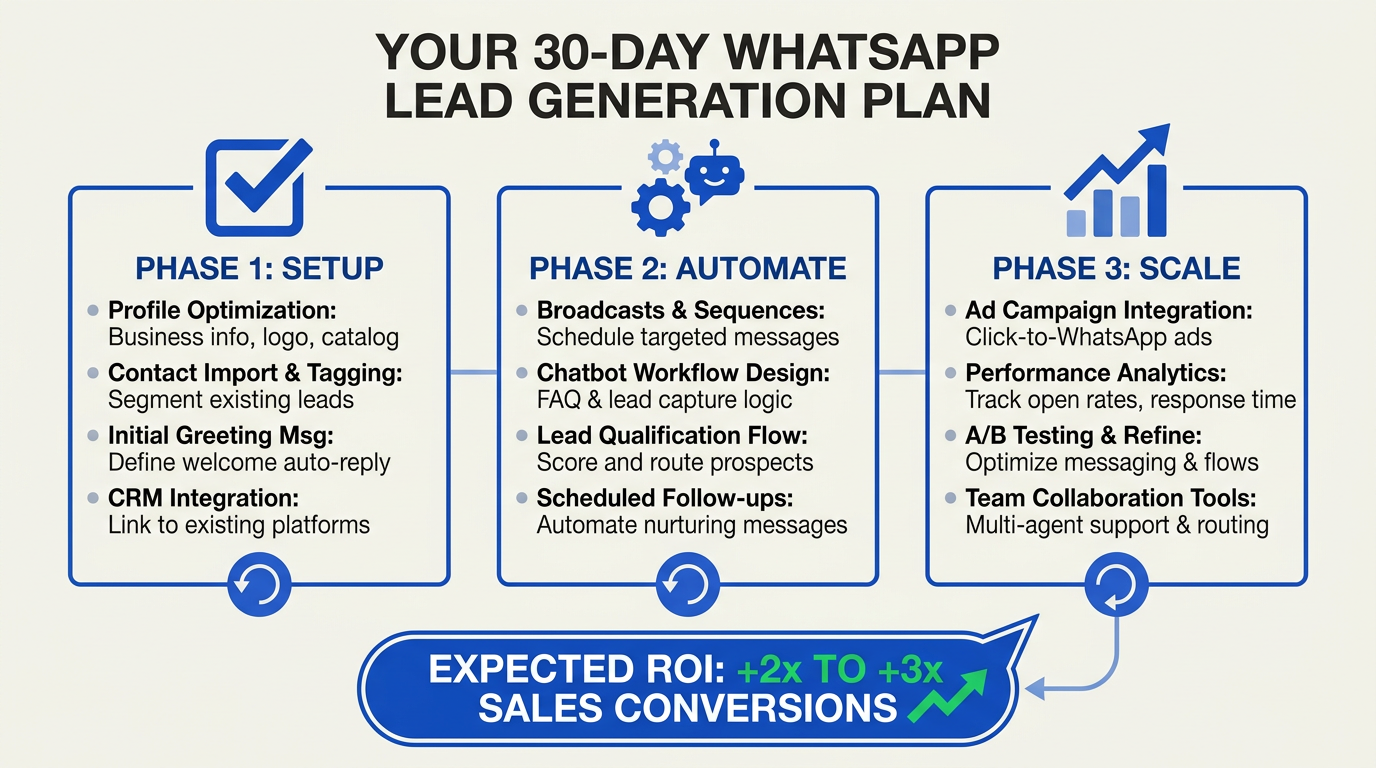
Transitioning your traditional landing page funnel into a high-converting, native WhatsApp environment might feel like a massive technical undertaking, but in 2026, the technology has matured to make execution incredibly streamlined. To help you transition your traffic and conversion strategies without disrupting your current sales operations, we have mapped out a structured, phase-based deployment model.
This blueprint outlines how to combine Click-to-WhatsApp (CTWA) ads, native WhatsApp Flows, and back-end automation into a cohesive, high-yielding system.
The 2026 Conversational Funnel Blueprint
| Phase | Key Objective & Action | Core Technology | Key 2026 Benchmark |
|---|---|---|---|
| 1. Traffic Injection | Drive high-intent prospects directly from Meta ads (Facebook/Instagram) into a 1:1 WhatsApp conversation. | Click-to-WhatsApp (CTWA) Ads | 40% increase in overall lead quality |
| 2. Frictionless Capture | Collect user details (name, email, query) natively inside the chat interface. | Native WhatsApp Flows (in-app interactive forms) | 60% reduction in form abandonment |
| 3. Automated Qualification | Screen leads 24/7 with an AI assistant to assess budget, timeline, and intent. | CallMissed Conversational AI (LLM integration) | 100% immediate response rate |
| 4. CRM Sync & Routing | Push qualified data instantly to your CRM and trigger notifications to sales reps. | Webhooks & API Integrations (Salesforce, HubSpot, Zoho) | <5 minute lead response time |
Executing the Blueprint: Key Practical Steps
To successfully bring this implementation blueprint to life, focus on these three critical deployment pillars:
- Map the Flow First, Code Second: Before configuring your WhatsApp Flows, map out the minimal amount of information you need to capture to qualify a lead. Because WhatsApp Flows keep users in-app, you can ask for 3 to 4 key data points—such as company size, budget, or preferred booking time—without seeing the massive drop-off rates typical of traditional mobile web forms.
- Deploy Dynamic AI Agents: Static, rule-based chatbots frustrate modern users who expect natural conversations. In 2026, the standard is dynamic, LLM-powered qualification. By leveraging communication infrastructure platforms like CallMissed, businesses can deploy intelligent voice and chat agents that handle multi-turn conversations naturally. CallMissed’s access to 300+ LLMs and native support for 22 Indian regional languages ensures your local and international markets are covered seamlessly.
- Optimize Your CRM Dispatches: Ensure your integration layer (whether through Zapier, Make, or native APIs) is optimized for immediate speed. When a lead is classified as "hot" by your WhatsApp bot, the system should instantly assign the lead in HubSpot or Salesforce and trigger a notification to your sales rep. In 2026, companies that respond to hot leads within 5 minutes convert at up to 8x the rate of those that wait an hour.
By systematically implementing this conversational blueprint, your business can bypass the friction of outdated landing pages and tap directly into the messaging habits of your target audience.
Frequently Asked Questions: Navigating Compliance, Costs, and Operations
How does WhatsApp lead generation comply with GDPR, CCPA, and other global data privacy regulations?
What are the pricing models and costs associated with running a WhatsApp lead generation campaign?
How do I prevent my WhatsApp Business API account from getting banned when running WhatsApp lead generation funnels at scale?
What is the main difference between WhatsApp Flows and traditional landing page forms?
How do I integrate WhatsApp chat leads into CRMs like HubSpot, Salesforce, or Zoho?
Can AI voice agents and chatbots handle multiple languages and regional dialects for global lead generation?
Conclusion
In 2026, the transition from high-friction landing pages to native conversational sales funnels is no longer optional—it is a baseline requirement for maximizing conversions. To dominate this landscape, keep these core takeaways in mind:
- Frictionless Capture: Utilize native WhatsApp Flows to capture user data inside the chat, slashing form abandonment by up to 60%.
- AI-Powered Automation: Deploy intelligent chatbots to qualify, route, and sync leads with your CRM 24/7, eliminating human bottlenecks.
- High-Intent Scaling: Combine Click-to-WhatsApp (CTWA) ads with automated conversational sequences to elevate lead quality by 40%.
Looking ahead, the convergence of generative AI and rich OTT messaging will only deepen as global business messaging approaches a projected $9.8 billion by 2029. To stay at the forefront of this evolution, explore how CallMissed—an AI communication infrastructure platform powering intelligent voice agents and multilingual chatbots—can help you deploy frictionless, high-converting funnels natively.
Are you ready to abandon outdated web forms and start closing deals where your buyers already spend their time?
Discussion
Related Posts
Ready to automate customer conversations?
Launch AI voice agents and WhatsApp bots with CallMissed — one API, 22+ Indian languages.