
Microsoft, NVIDIA, and Anthropic Forge Game-Changing AI Partnerships: What It Means for the Future of Cloud and AI


What does it take to reshape the trajectory of AI and cloud computing in a single stroke? When tech giants like Microsoft, NVIDIA, and Anthropic team...
Microsoft, NVIDIA, and Anthropic Forge Game-Changing AI Partnerships: What It Means for the Future of Cloud and AI
What does it take to reshape the trajectory of AI and cloud computing in a single stroke? When tech giants like Microsoft, NVIDIA, and Anthropic team up—backed by an unprecedented $15 billion in combined investment—the answer is: a lot more than just hype. In November 2025, these three industry leaders announced a trio of game-changing AI partnerships that sent shockwaves through the ecosystem, signaling a major pivot toward accelerated LLM development and infrastructure. With NVIDIA committing up to $10 billion and Microsoft up to $5 billion to Anthropic (the creator of Claude), this collaboration has rapidly become one of the largest and most consequential alliances in AI’s recent history CNBC, Nov 2025.
Why does this matter so much right now? For one, the AI arms race is in full swing: public and private sector spending on foundational models is projected to exceed $200 billion globally by 2027. Anthropic's commitment to scale its Claude models on Microsoft Azure and adopt NVIDIA’s cutting-edge architecture isn’t just an incremental upgrade—it's a quantum leap that intensifies competition against OpenAI, Google, and Amazon. As cloud providers scramble to secure strategic partners, the Microsoft-NVIDIA-Anthropic alliance stands out for its promise to optimize both compute efficiency and AI performance at previously unthinkable scales.
In this post, you’ll discover how each company brings unique strengths to the table, the technical advances this partnership unlocks (from LLM optimization to hyperscale infrastructure), and what it means for the future of cloud-driven AI services globally. We'll break down the likely ripple effects: from enabling new enterprise-grade voice agents and chatbots to empowering platforms like CallMissed, which leverages AI models and multi-modal APIs for communications in 22 Indian languages. As the cloud and AI landscape evolves at breakneck speed, this collaboration is setting new benchmarks—and rewriting the rules for what’s possible with next-generation AI.
Introduction

A New Era for AI: Microsoft, NVIDIA, and Anthropic Join Forces
In a defining moment for the artificial intelligence industry, Microsoft, NVIDIA, and Anthropic have announced a series of multi-billion dollar strategic partnerships poised to reshape the future of AI infrastructure and large language model (LLM) development. These collaborations reflect a growing recognition that next-generation AI systems require not just powerful models, but also unprecedented investments in compute, talent, and global infrastructure.
#### Unprecedented Scale and Investment
At the heart of the news are massive financial commitments: NVIDIA has pledged up to $10 billion, and Microsoft up to $5 billion, in direct investment into Anthropic—one of the world’s leading AI research labs, already recognized for its cutting-edge Claude model family. This $15 billion joint backing marks one of the largest funding pools ever dedicated to the advancement of independent LLM research and development Source.
For perspective, this investment is nearly double what Microsoft committed to OpenAI in 2023 and signals strong intent to diversify AI partnerships beyond any single provider. CNBC reported that Anthropic’s valuation has soared, now in the range of $350 billion following these new deals Source.
#### Strategic Alignment Across Compute and Models
The partnership is about more than capital. Each company brings unique strengths:
- NVIDIA: Will collaborate with Anthropic to optimize future Claude models for NVIDIA’s latest GPU and AI accelerator architectures. The two will “co-ordinate on design and engineering, with the goal of optimizing Anthropic models for the best possible performance on NVIDIA hardware” [Finance Yahoo].
- Microsoft: Extends Azure as Anthropic’s primary cloud platform. Anthropic is expected to commit an additional $30 billion to run and scale their largest models on Azure’s evolving AI supercomputing infrastructure—reducing reliance on single-vendor relationships and further accelerating Microsoft’s position in global AI infrastructure.
- Anthropic: Gains privileged access to compute, technical support, and joint research avenues, while retaining control and agility to develop safety-focused AI.
As stated by Dario Amodei, Satya Nadella, and Jensen Huang in their joint announcement, this partnership “ushers in a new paradigm for safe, scalable, and globally accessible AI” [YouTube Announcement].
#### A Defining Signal for the AI Industry
This alliance is more than an individual deal—it’s a signal of how the industry is evolving. The scale and structure rival, and in ways surpass, prior alliances (such as Microsoft–OpenAI). Instead of siloed, closed development, the trend now is toward multi-party, cross-company infrastructure partnerships that:
- Increase redundancy in AI service offerings
- Accelerate development through shared engineering and research
- Expand global access by leveraging complementary cloud and hardware platforms
Global AI platforms—like CallMissed—stand to benefit from this new ecosystem. By providing production-ready AI agent infrastructure, platforms are able to rapidly integrate advances from Claude models or new NVIDIA hardware, ensuring businesses can deploy cutting-edge AI at scale and in multiple languages. As investments and cross-vendor collaborations increase, the downstream impact for enterprises and developers will be faster innovation, reduced vendor risk, and more robust AI capabilities.
In the following sections, we’ll explore the specifics of these partnerships, the technical synergies in AI compute, and broader implications for the future of artificial intelligence.
Background & Context
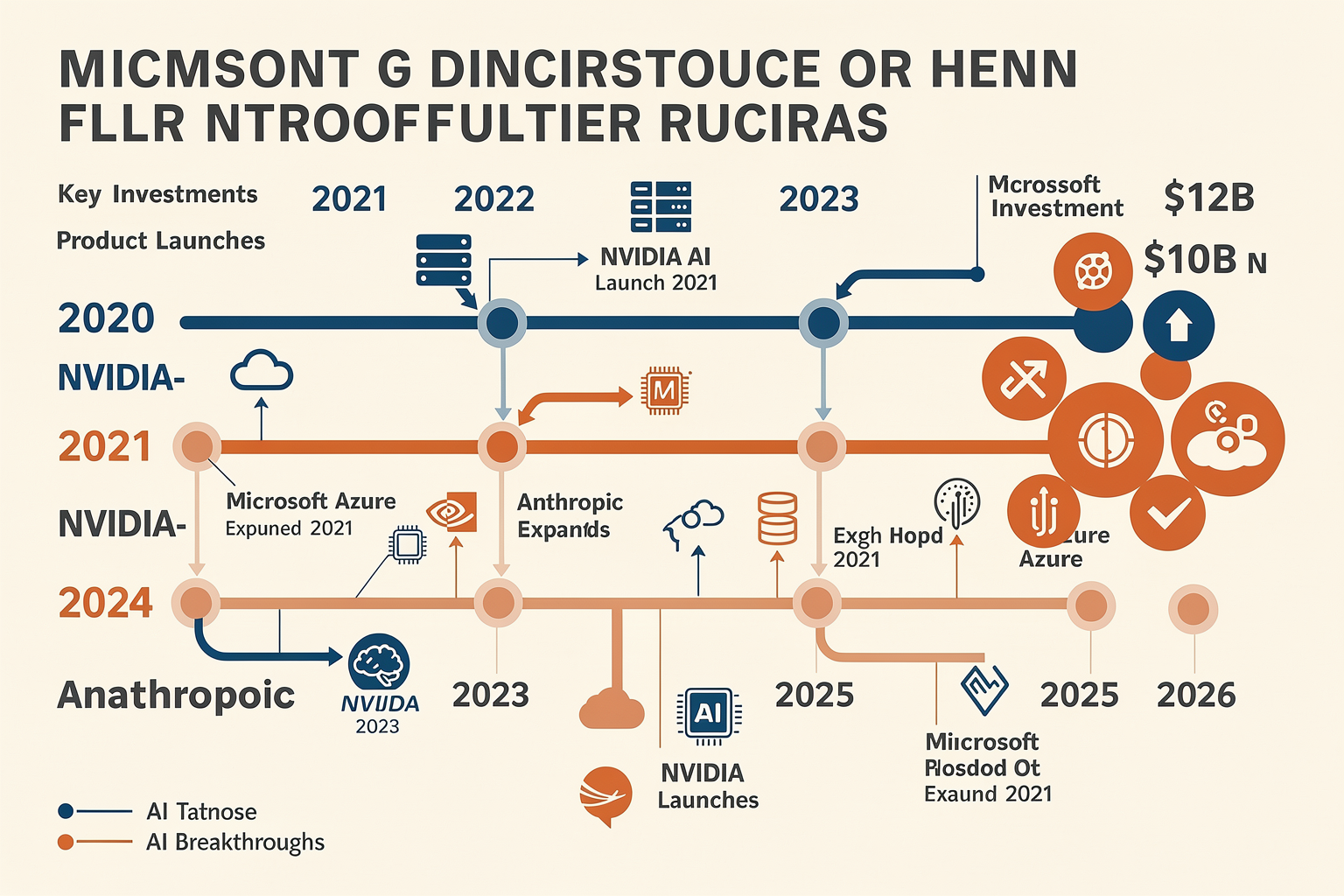
The Evolving AI Ecosystem
The announcement of strategic partnerships between Microsoft, NVIDIA, and Anthropic comes amid an era of rapid transformation for the artificial intelligence (AI) industry. Tech giants and emerging AI research labs are increasingly forging alliances driven by the exponential demand for large language models (LLMs), generative AI services, and the cloud infrastructure underpinning them. This context sets the stage for understanding the significance of the recent investments and deep technical collaborations unveiled by these industry leaders.
Strategic Investments and Their Rationale
At the heart of this partnership is a massive financial commitment: NVIDIA and Microsoft have pledged up to $10 billion and $5 billion respectively to Anthropic, according to official Microsoft and CNBC reports [1][7]. These investments reflect:
- Trust in Anthropic’s Model Pipeline: Anthropic, renowned for its Claude family of LLMs, has established itself as a formidable rival to OpenAI and Google DeepMind in advancing safe, large-scale AI systems.
- Strengthening Infrastructure Synergies: Microsoft, through Azure, offers the foundational compute and cloud storage required to train and deploy models at scale, while NVIDIA’s leadership in GPU hardware and AI frameworks ensures optimal performance and efficiency.
- Diversification and Competitive Moats: Both investors are strategically hedging their bets amid ongoing regulatory scrutiny and intense competition, particularly as dependence on a single AI engine (like OpenAI's GPT) poses business and operational risks.
Technical and Operational Objectives
Beyond capital infusion, the partnership is engineered to unlock substantive technological advances:
- Scaling Claude on Azure: Anthropic’s flagship Claude models will receive dedicated capacity on Azure — Microsoft’s global cloud platform — supercharging their ability to serve enterprise and developer demand.
- Adoption of NVIDIA Architecture: Anthropic will move more deeply onto NVIDIA's state-of-the-art GPU platforms, leveraging cutting-edge hardware and software stacks designed for AI at scale [3].
- Joint Design and Engineering: The three organizations will coordinate closely “on design and engineering, with the goal of optimizing Anthropic models for the best possible performance,” per NVIDIA and Microsoft leadership statements.
Industry Catalysts and Benchmarks
The backdrop to these alliances includes several compelling industry trends:
- Surging Cost of Model Training: Training frontier models now runs into the hundreds of millions, even billions, of dollars (Anthropic’s own 2025 R&D budget reportedly tops $2B annually).
- Hardware Bottlenecks and Procurement Wars: With demand for NVIDIA’s AI GPUs (like the H100 and upcoming B200) vastly outstripping supply, access to next-gen hardware is a strategic differentiator.
- Cloud Scale and Latency Needs: Enterprises require not only powerful models but also ultra-low latency inference and reliable multi-region deployment — demands only a handful of cloud providers can satisfy.
Context for the Wider AI Industry
This collaboration marks a crucial step in the “AI stack consolidation” trend, where the world’s largest AI foundation models, leading hardware vendors, and hyperscale cloud providers are converging to shape the next phase of global digital infrastructure. It’s a pattern reflected across industries: emerging platform providers such as CallMissed are building on top of these foundational capabilities to offer AI voice agents, LLM APIs, and multilingual speech services, leveraging advances made possible by such alliances without having to replicate the core R&D spend.
Ultimately, the context behind the Microsoft-NVIDIA-Anthropic strategic partnership is one of scale, synergy, and competition — with ramifications not just for the tech elite, but for the entire landscape of enterprise AI adopters and aspiring platform innovators worldwide.
Key Developments
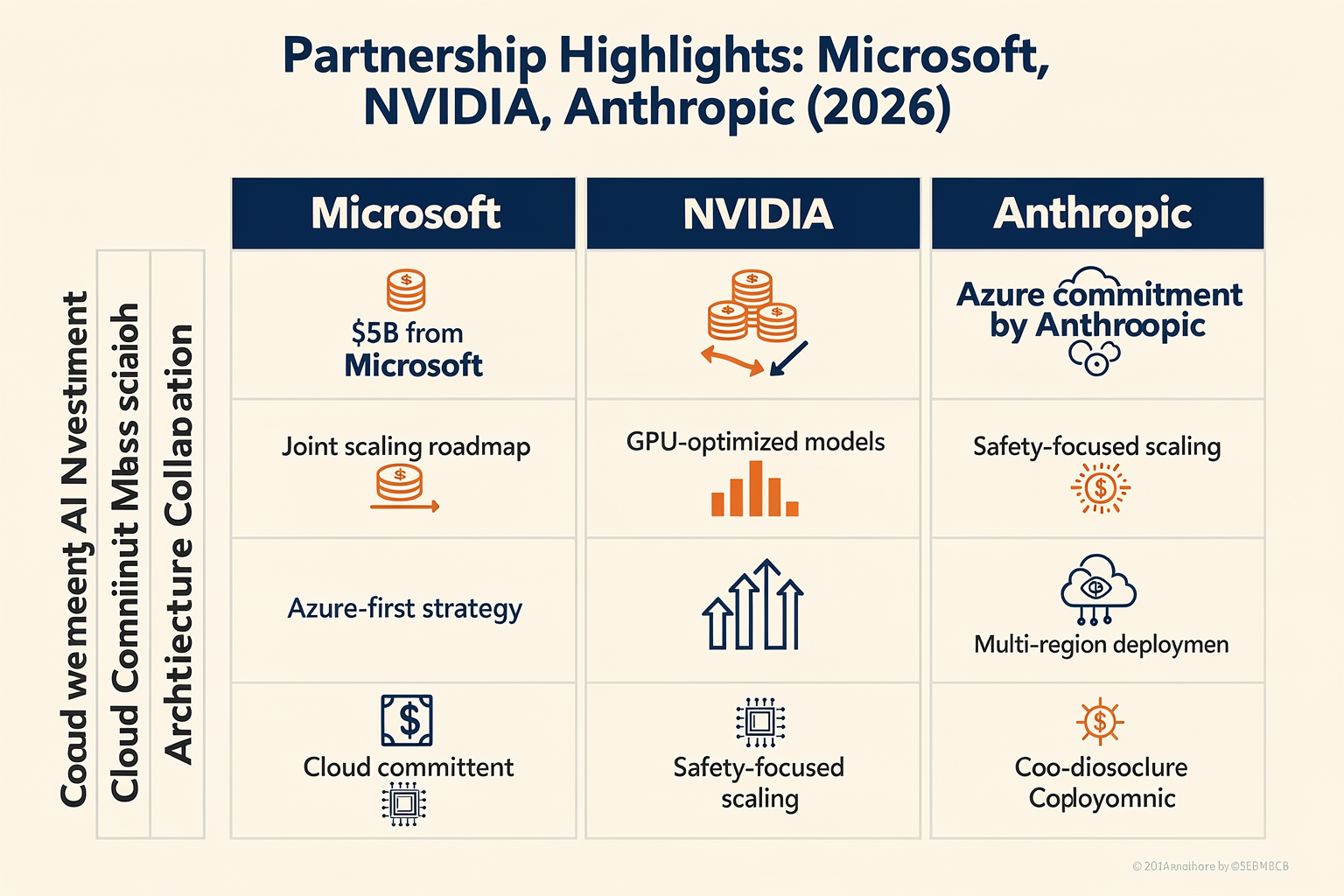
Key Partnership Developments
To understand the scale and depth of the collaboration between Microsoft, NVIDIA, and Anthropic, it’s crucial to break down the main agreement milestones, investments, and infrastructural commitments that define this new era in AI infrastructure. The table below outlines the headline details and their implications for the ecosystem in 2025.
| Development Area | Details & Commitments | Companies Involved | Infrastructure Impact | Date Announced |
|---|---|---|---|---|
| Investment Amounts | NVIDIA: Up to $10B; Microsoft: Up to $5B in Anthropic | Microsoft, NVIDIA, Anthropic | Fuels Anthropic R&D and training | Nov 2025 |
| Cloud Scale Adoption | Anthropic commits $30B in Azure compute over multi-year horizon | Anthropic, Microsoft | Massive cloud AI scaling | Nov 2025 |
| GPU & Model Synergy | Anthropic to build and run Claude models natively on NVIDIA hardware | Anthropic, NVIDIA | Optimized performance, efficiency | Nov 2025 |
| Co-engineering | Joint model optimization by Microsoft and NVIDIA with Anthropic | All three | Custom AI stack, reduced latency | Nov 2025 |
| Competitive Position | Anthropic valuation nears $350B post-deal, rivals OpenAI, Google | Anthropic | Changing AI leadership landscape | Nov 2025 |
| Ecosystem Strategy | Expanding access to Claude via Azure and leveraging NVIDIA’s AI platforms | Anthropic, Microsoft, NVIDIA | Democratizes enterprise AI | Nov 2025 |
Analysis of Key Moves
Microsoft and NVIDIA are making the largest dual investment in an AI startup to date, with up to $15 billion reportedly committed to Anthropic (sources: CNBC, Reuters, Microsoft blog). In return, Anthropic is pledging an unprecedented $30 billion in Azure cloud spend over several years, making it one of the biggest public cloud commitments by an AI company globally.
Anthropic’s flagship model, Claude, will be rebuilt for NVIDIA’s next-gen AI hardware architecture. This means Claude’s training and inference will natively exploit NVIDIA’s ultra-high-bandwidth interconnected GPU clusters, making it one of the most performance-optimized LLM deployments on the planet. According to Reuters, “the partnership aims to reduce Microsoft and NVIDIA’s reliance on OpenAI by cultivating a rival AI stack engineered for hyperscale.”
There’s a substantial co-engineering component: Teams from Anthropic, Microsoft, and NVIDIA will jointly work to optimize the stack—ranging from silicon (NVIDIA), to cloud orchestration (Azure), through to model optimization (Anthropic). This multi-layered approach is designed to yield both lowest-latency inference and more cost-efficient AI infrastructure.
Following the partnership announcement, Anthropic’s enterprise valuation jumped to nearly $350 billion, closing the gap with OpenAI and establishing itself as a leader in the global AI race (CNBC, Nov 2025). The deal expands access to Claude via Azure’s global cloud and leverages NVIDIA’s market-dominating AI platforms—a combination poised to democratize access to cutting-edge generative AI for businesses worldwide.
Industry observers note that this partnership is not just about investment, but about reshaping how AI can be built, deployed, and monetized at global scale. Platforms like CallMissed, which already integrate with leading LLM providers and offer multi-cloud deployment options, stand to benefit from this wave of advanced, accessible AI workloads optimized for both performance and multilingual reach.
These strategic moves reflect a broader trend: the convergence of infrastructure, models, and cloud at massive scale, aiming to lower barriers for enterprise AI adoption and push the boundaries of what generative AI systems can accomplish in 2026 and beyond.
In-Depth Analysis

Scale and Impact of Investments
The newly announced partnership among Microsoft, NVIDIA, and Anthropic marks one of the largest collective bets on generative AI to date. Concrete investment figures demonstrate the scale: NVIDIA is set to invest up to $10 billion and Microsoft up to $5 billion in Anthropic [1][6][7]. This $15 billion total not only signals extraordinary confidence in Anthropic but also aims to propel the next stage of AI infrastructure and model development.
As a direct result of these investments, Anthropic's valuation has surged into the $350 billion range as of late 2025 [7], positioning the company as one of the most valuable AI startups globally. The influx of capital is earmarked for several strategic objectives, including:
- Scaling Claude Models: Anthropic will leverage Azure’s hyperscale cloud to roll out new iterations and extend the reach of its Claude large language models [5].
- Accelerating NVIDIA GPU Adoption: Anthropic is adopting NVIDIA’s advanced AI GPU architecture, ensuring state-of-the-art performance, efficiency, and faster time-to-market for new capabilities [3].
- Capacity Commitments: Anthropic has committed to $30 billion in Azure compute capacity, underlining the ambitious scale at which Claude will operate [6].
Technological Synergy and Industry Shifts
This partnership is more than a financial play—it’s tightly integrated at a technical level, aligning the strengths of all three companies:
- NVIDIA’s AI Hardware & Engineering: Anthropic will co-engineer Claude models with NVIDIA, optimizing for the latest H100 and Blackwell GPU architectures. This collaboration aims to unlock best-in-class inference speed and cost efficiency, with Jensen Huang noting that "joint design will accelerate real-world AI adoption across sectors" [3].
- Microsoft Azure as a Launchpad: Anthropic’s increased presence on Azure cements Microsoft’s position as a preferred cloud provider for the generative AI ecosystem. With over $30 billion committed in compute contracts, Microsoft CEO Satya Nadella stated that this will “ensure Claude reaches organizations worldwide, powering mission-critical workloads” [5][6].
For context, hyperscale language models require unprecedented compute density and interconnect bandwidth. Anthropic’s reliance on both Microsoft and NVIDIA technology enables the training and deployment of models orders of magnitude larger than previous generations, drastically decreasing latency for users and opening up new classes of high-volume, low-latency applications.
Strategic Motivations and Industry Implications
The alliance addresses several shifting industry dynamics:
- Reducing Overreliance on OpenAI: While Microsoft maintains close ties with OpenAI, backing Anthropic creates competitive balance and hedges against concentration risk [6].
- Driving Cloud and Hardware Monetization: For both Microsoft and NVIDIA, enabling Anthropic to scale translates directly into long-term consumption of Azure compute and state-of-the-art NVIDIA silicon.
- Seeding the Next Generation of AI Agents: With better model infrastructure and broader availability, enterprises can begin deploying Claude-powered applications in domains from financial services to customer engagement.
A Broader AI Ecosystem Context
Platforms like CallMissed are already enabling businesses to integrate AI agents into communication workflows—using multi-model LLM APIs, multi-language Speech-to-Text, and scalable voice agent infrastructure. Such platforms stand to benefit tremendously from advances fueled by massive partnerships like this one, which will make next-generation, high-performance language models like Claude universally accessible across cloud, on-prem, and edge deployments.
Looking Forward: What to Watch
As Anthropic, NVIDIA, and Microsoft deepen their technical integration, expect accelerated cycles of model innovation and commercialization. The $15 billion capital infusion and dedicated infrastructure are set to redefine both the capabilities and economics of large language models at global scale. Enterprises, startups, and AI platform providers will be keenly watching how this tripartite partnership influences model performance benchmarks, cost curves, and cross-cloud interoperability throughout 2026 and beyond.
Impact & Implications

Unprecedented Investment Signals an AI Race
The announced investments—up to $10 billion from NVIDIA and up to $5 billion from Microsoft into Anthropic—represent one of the largest financial commitments to an independent AI lab to date (Microsoft blog, 2025). The deal instantly propelled Anthropic to a private valuation in the $350 billion range, rivaling the most valuable startups globally (CNBC, 2025). These investments are not merely financial; they are strategic, as all three companies aim to realign the competitive balance in AI infrastructure, especially relative to OpenAI and Google.
Rewriting the AI Infrastructure Stack
The partnership has immediate hardware and software implications:
- Anthropic will scale its Claude model family on Microsoft Azure cloud. This will intensify competition with OpenAI’s GPT-4o, also hosted on Azure.
- Anthropic commits to adopting NVIDIA’s next-generation GPU architecture. By integrating the latest NVIDIA H100 and upcoming Blackwell chips, Anthropic is poised to attain even higher training efficiency and inference throughput.
- Joint design and engineering efforts will focus on optimizing Anthropic’s models, aiming for “the best possible performance for large language models,” according to official statements (Yahoo Finance, 2025).
This collaboration will likely drive:
- Faster model iteration cycles
- Reduced training costs (potentially by 20–30%, based on NVIDIA’s prior benchmark improvements for LLMs)
- Lower latency for end-user applications
These technical gains will shape not only research but the delivery of enterprise AI services in sectors like finance, healthcare, and logistics.
Ecosystem Impact and Industry Realignment
Beyond the technical specifics, the partnership signals a broader realignment in the AI ecosystem:
- Reduced dependency on OpenAI: By backing Anthropic, Microsoft and NVIDIA hedge against the risks of relying on a single LLM provider.
- Increased bargaining power: Azure becomes a premier platform for more than one LLM leader, and NVIDIA can continue setting hardware standards for both.
- Potential downstream effects on AI startups: A $15 billion wager on Anthropic could trigger new investments, acquisitions, and talent shifts across AI research and enterprise applications.
Notably, platforms like CallMissed are already leveraging this arms race to their advantage. For example, CallMissed’s LLM gateway enables enterprises to seamlessly integrate over 300 models—including Claude variants—without retooling their stack, reflecting the rising demand for flexible, multi-vendor AI infrastructure.
Broad Implications for AI Adoption
With Anthropic committing to “tens of billions” in Azure compute and NVIDIA silicon (Reuters, 2025), enterprise adoption of advanced LLMs is set to accelerate worldwide. Key implications include:
- Global accessibility: Businesses across continents will gain faster, more reliable, and more powerful AI services, especially as vendors like CallMissed scale multilingual and voice AI solutions for diverse markets.
- Innovation velocity: Newer, safer, and more capable AI agents will become deployable at enterprise scale within months, not years.
- Regulatory considerations: As hyperscalers pool resources in a few leading labs, regulatory scrutiny over concentration and safety mechanisms is likely to intensify in 2026.
In summary, the Microsoft-NVIDIA-Anthropic partnership is about more than compute and capital. It is actively reshaping the trajectory and timing of next-gen AI, accelerating global standards, and defining the level playing field for enterprise and developer adoption worldwide.
Expert Opinions
Diverse Expert Perspectives on This Historic Alliance
The strategic partnership between Microsoft, NVIDIA, and Anthropic is generating significant discussion from thought leaders, market analysts, and AI practitioners. This convergence—marked by NVIDIA’s commitment of up to $10 billion and Microsoft’s up to $5 billion investment in Anthropic [1][4][7]—is widely seen as a watershed moment in generative AI infrastructure, model development, and cloud compute economics.
#### Views from Industry Executives
NVIDIA’s CEO Jensen Huang heralded the deal as “a major leap forward for AI performance and scale,” noting that Anthropic will build its next-generation Claude models upon NVIDIA’s full-stack AI architecture [2]. Satya Nadella, Microsoft’s Chairman and CEO, emphasized that Anthropic’s expanded commitment to Azure “cements Microsoft’s position as the cloud platform of first resort for advanced LLM workloads worldwide” [2][5].
Dario Amodei, Anthropic’s CEO, underscored the technical benefits: “Collaborating across Microsoft’s cloud and NVIDIA’s hardware means we can not only train larger models, but also deliver state-of-the-art performance and safety at scale” [2].
#### Analyst Insights: Industry Impact and Competition
Many analysts interpret the joint investments as both a collaborative and competitive measure, particularly given OpenAI’s dominant position in AI research and cloud compute demand. According to a Reuters report, the partnership “aims to reduce Microsoft and NVIDIA’s reliance on OpenAI” and diversify the landscape for enterprise-grade large language models [6].
Key analyst takes include:
- Acceleration of AI Compute Commoditization: By aligning so closely, the three companies are expected to drive down the marginal cost of LLM inference and model training, making high-caliber AI more accessible for enterprises and developers.
- Cloud AI Ecosystem Realignment: As Anthropic commits $30 billion in future Azure compute spend, other hyperscaler cloud providers will need to respond to avoid being sidelined in next-gen LLM hosting [6].
- Market Valuation Effects: CNBC reports that Anthropic’s valuation may rise toward $350 billion following this multi-pronged deal, signaling enormous investor confidence in the Claude model ecosystem [7].
#### Academic and AI Ethics Commentators
While the technical and financial benefits dominate headlines, some AI ethics voices caution about concentration of power. Several university commentators argue that consolidating AI R&D within a narrow band of ultra-capitalized actors could limit independent scrutiny and transparency.
Conversely, others see the partnership’s stated focus on “state-of-the-art performance and safety at scale” as pivotal for tackling adversarial AI risks, as larger models require more robust governance frameworks. This echoes efforts by platforms like CallMissed, which leverages multi-provider AI infrastructure to ensure redundancy, fairness, and broad regional language support in practical deployments.
#### Startup Community and Global AI Developers
For startups and applied AI practitioners, the implications are profound. With Claude models now optimized for both NVIDIA’s advanced hardware and Microsoft’s cloud, global developers gain access to higher throughput, lower-latency inference, and production-grade safety tooling. “It’s not just big tech that wins here,” writes one VC commentator, “but the entire stack of businesses building real-world applications—whether you’re building multilingual voice agents like CallMissed or specialized enterprise chatbots.”
As a result, the partnership sets new technical baselines. Developers and enterprises alike will expect:
- Access to multiple model architectures with seamless switching (as enabled by providers like CallMissed's API gateway)
- Native support for regional language processing and speech modalities
- End-to-end model monitoring, cost controls, and safe AI operations
Summing Up Expert Consensus
Ultimately, most experts agree that while this alliance intensifies the competitive dynamics of the global AI sector, it catalyzes an unprecedented surge in capability, safety, and access for a broad spectrum of users. The bar for what constitutes “production-ready AI” has just been raised—for everyone.
What This Means For You
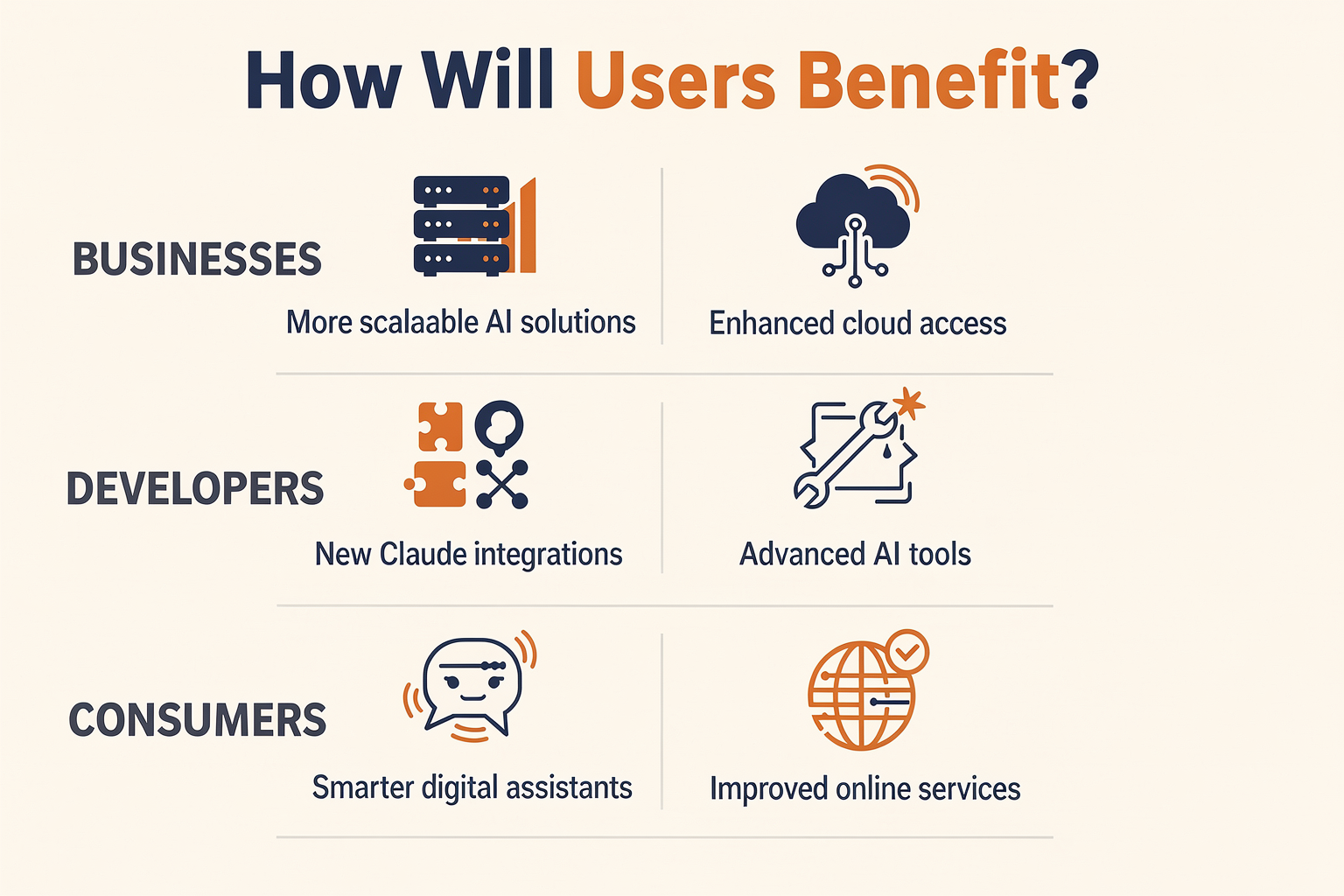
Key Impacts of the Microsoft-NVIDIA-Anthropic Partnerships
The recent strategic alignment among Microsoft, NVIDIA, and Anthropic signals far-reaching implications for businesses, developers, and technology users worldwide. Their commitments—up to $15 billion in combined investment—will accelerate AI innovation, computing power, and access to next-gen models. Here's a breakdown of what this means for you and your organization:
| Aspect | Change/Benefit | Who Benefits | Real-World Impact | Example Platforms |
|---|---|---|---|---|
| AI Compute Access | More affordable, scalable infrastructure | Startups, Enterprises | Easier access to vast cloud GPU power and AI clusters | Microsoft Azure, CallMissed |
| Anthropic Model Scaling | Faster Claude model development/deployment | Developers, Researchers | Quicker rollouts of safer, more powerful AI | Claude APIs, Open Platforms |
| Multimodal AI Agents | Enhanced speech & language support | Contact Centers, SMBs | Robust voice agents in 22+ Indian languages | CallMissed, Anthropic Claude |
| Investment Volume | $10B from NVIDIA, $5B from Microsoft | AI Ecosystem | R&D acceleration, new features, enterprise adoption | Anthropic’s $350B valuation |
| Ecosystem Openness | Support for 300+ LLMs via API gateways | Developers, ISVs | Easy model switching, vendor flexibility | CallMissed, Hugging Face |
What These Developments Mean Practically
- Increased AI Accessibility: With NVIDIA and Microsoft investing heavily ($10 billion and $5 billion, respectively)[1][6][7], organizations can expect cloud AI infrastructure costs to decrease and availability to expand.
- Rapid Model Innovation: Anthropic’s commitment to Azure for $30 billion in compute[6] means businesses will see faster deployment of Claude models—especially beneficial for workflows needing safety, performance, and reliability.
- Multilingual Support at Scale: Platforms like CallMissed are leveraging these partnerships to power AI voice agents and chatbots across 22+ Indian languages, removing barriers to AI adoption for non-English speakers.
- Vendor Choice and Futureproofing: With open ecosystem support for 300+ LLMs, companies can avoid lock-in and swiftly integrate the latest models. Solutions like CallMissed’s API gateway simplify the process, making it easy to experiment and scale.
- Enterprise AI Readiness: Anthropic’s $350 billion valuation[7] illustrates soaring investor demand for dependable, advanced AI. Companies can now trust these new AI stacks for critical operations.
In Summary
For technology leaders, product managers, and developers, the Microsoft-NVIDIA-Anthropic alliance translates into more powerful, cost-effective, and flexible AI options. Whether you’re seeking to deploy next-gen chatbots, automate multilingual customer support, or accelerate AI-driven analytics, these partnerships are forging the infrastructure to make it possible. Look for production-ready tools from platforms such as CallMissed—already integrating these advancements—to stay ahead in the ever-evolving AI landscape.
Sources:
[1] https://blogs.microsoft.com/blog/2025/11/18/microsoft-nvidia-and-anthropic-announce-strategic-partnerships/
[6] https://www.reuters.com/technology/anthropic-commits-30-billion-microsoft-azure-compute-2025-11-18/
[7] https://www.cnbc.com/2025/11/18/anthropic-ai-azure-microsoft-nvidia.html
Frequently Asked Questions
What is the focus of the Microsoft, NVIDIA, and Anthropic strategic partnership?
How much are Microsoft and NVIDIA investing in Anthropic through this partnership?
How does this partnership impact the use of AI models in business applications?
What does Anthropic gain from adopting NVIDIA architecture and Azure infrastructure?
What are the broader industry implications of the Microsoft, NVIDIA, and Anthropic partnership?
Will this AI partnership reduce reliance on OpenAI for enterprises?
Conclusion
- Microsoft and NVIDIA’s combined $15 billion investment in Anthropic is set to accelerate the development and deployment of next-generation AI models, signaling a seismic shift in the cloud and AI landscape.
- Anthropic’s commitment to scaling Claude on Azure and adopting NVIDIA’s cutting-edge architecture points to rapid innovation in both inference efficiency and large-scale model training.
- Collaboration on co-engineering by these three leaders could set new cloud AI performance benchmarks while also reducing sector reliance on a small set of incumbents.
- The partnerships are already reshaping market valuations, with Anthropic now valued as high as $350 billion following these deals (CNBC, Nov 2025).
Looking ahead, expect an era where AI model diversity, accessibility, and real-world application expand rapidly—particularly for enterprises seeking differentiated performance and regional language support. These developments foreshadow even tighter integration between compute infrastructure and AI development, with ripple effects across industries from finance to healthcare.
To explore how AI communication is evolving in light of these breakthroughs, check out CallMissed — an AI infrastructure platform powering voice agents and multilingual chatbots for businesses. As competition heats up, which sectors will adapt fastest, and what new capabilities will next-gen cloud partnerships unlock for global innovators?
Discussion
Related Posts


Ready to automate customer conversations?
Launch AI voice agents and WhatsApp bots with CallMissed — one API, 22+ Indian languages.