
LLM Fallback Strategy: What Model Archives Can’t Solve


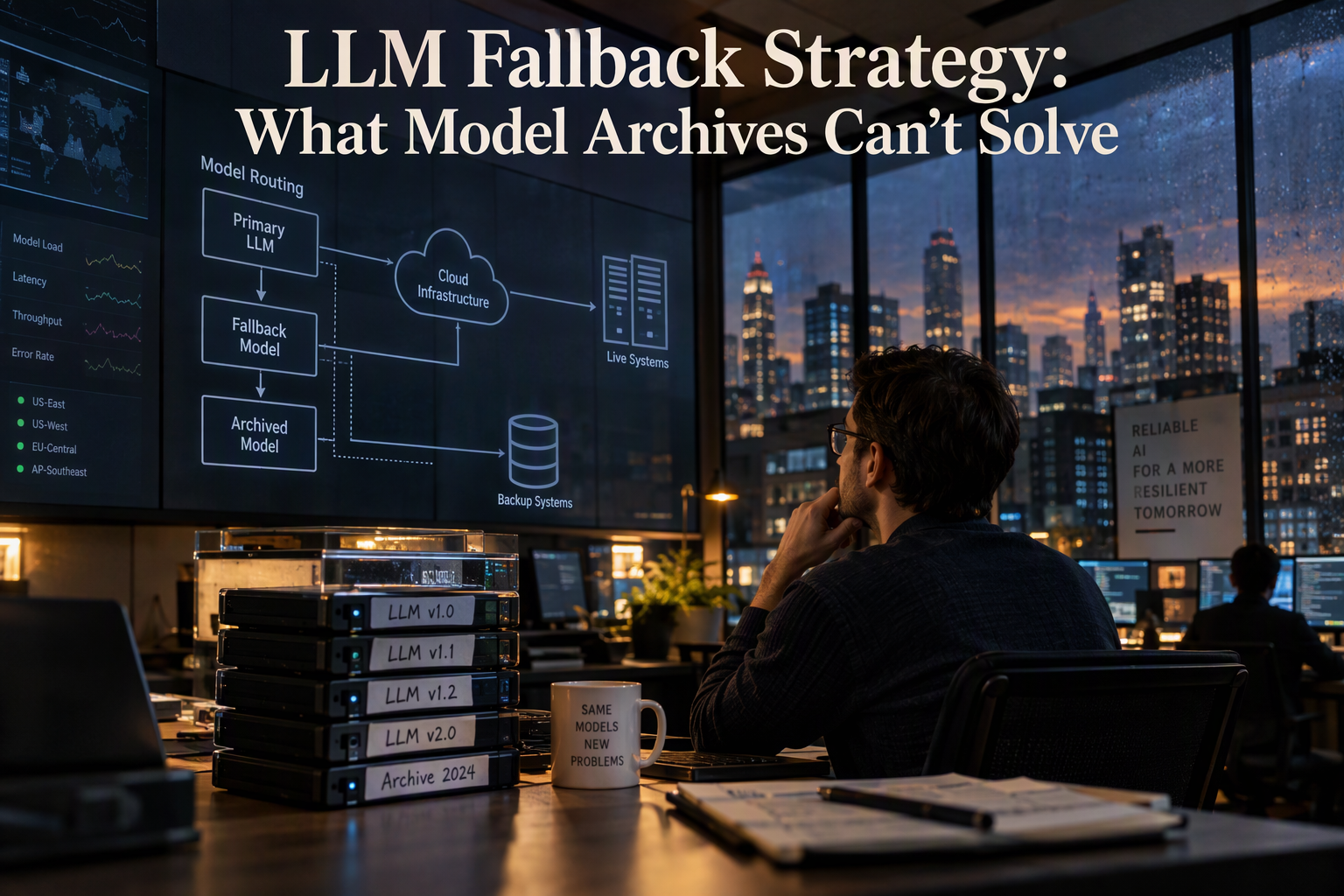
Build an LLM fallback strategy that separates model archives from failover, tests backup behavior, and plans provider deprecations before cutover.
LLM Fallback Strategy: What Model Archives Can’t Solve
What good is a perfectly preserved language model if the service that runs it disappears? A sound LLM fallback strategy has to plan for more than vanished model weights: it must keep an application working when an endpoint is withdrawn, access changes, or a replacement behaves differently.
Model archives can be valuable. They may preserve weights, configuration files, tokenizer details, and other artifacts needed to reproduce a model—especially when those materials are legally available and complete. But preserved files don’t automatically provide the compute, libraries, compatible runtime, license rights, security updates, or production support required to run them. And even a successfully revived model may not answer like the original hosted service: prompts, safety rules, output formats, and performance can change.
That distinction matters as AI products become dependent on services they don’t control. A fallback that simply retries another endpoint may keep a request moving, but it can also return a weaker answer, break structured output, exceed a latency budget, or send sensitive data somewhere the application did not intend. Reliability is therefore not just “Can another model respond?” It is “Can the system respond acceptably, safely, and predictably when its preferred model is unavailable?”
This article separates what model preservation can protect from what it cannot. You’ll learn how to design fallbacks around application requirements, test model substitutions before an outage, and decide when an archived model is a practical recovery option versus a costly paper backup. We’ll also examine the trade-offs between preserving a specific model and building portability across providers, including the importance of compatible APIs, observability, and caller-controlled routing.
The growing model-catalogue approach is one response to that challenge. As of September 2026, CallMissed’s developer AI API offers access to 138 models through one API key and balance, with caller-chosen fallback models; the catalogue includes 42 general-purpose LLMs alongside speech, image, embedding, and voice-agent models. That kind of access can make switching more manageable, but no catalogue removes the need to test behavior, define failure policies, and keep a recovery plan for the parts an archive cannot preserve.
Can model preservation replace an LLM fallback strategy?

Model preservation can support an LLM fallback strategy, but it cannot replace one. An archived model is a recovery asset; a fallback strategy is the tested process for keeping an application within its quality, safety, privacy, and availability requirements when its normal model is unavailable.
What does model preservation actually protect?
Preservation can retain a particular model’s identity: its weights and associated artifacts can help teams reproduce a version, compare later outputs, or keep a known option for constrained environments. That matters when an application depends on behavior that may shift as hosted models are updated or withdrawn.
But “the files are preserved” is not the same as “the service is recoverable.” A practical preservation plan needs an owner, a lawful path to use the artifacts, and a tested way to load and serve them. It also needs a decision about when that preserved version is acceptable: for example, whether it can handle only low-risk requests or can serve the full production workload.
Think of an archived model as one candidate in a recovery plan—not as the plan itself. It may help restore a specific capability, but the application still needs rules for routing, timeouts, retries, degraded responses, and escalation when that capability cannot be restored quickly.
What does a fallback strategy still need to handle?
A fallback should be selected against application requirements, not just model availability. A customer-support workflow might tolerate a slower response but require accurate policy citations. A structured extraction endpoint might prioritize valid JSON over conversational fluency. A voice agent may need to preserve turn-taking and response speed.
Before routing traffic to an alternate model, define what “acceptable” means for each task. Useful checks include:
- Output contract: Does the fallback return the required schema, tool call, or language?
- Task quality: Does it pass representative evaluations, including difficult and ambiguous inputs?
- Risk controls: Are refusal behavior and sensitive-data handling suitable for the use case?
- Operational limits: Does it fit the request’s latency, cost, and context-window budgets?
- Recovery behavior: If the fallback also fails, should the system retry, offer a limited response, or hand off to a person?
Then rehearse the transition. Run the same test set against the primary model, candidate fallbacks, and any preserved model; compare task-specific results rather than relying on a single overall score. Keep the evaluation inputs versioned, and require approval before a candidate receives production traffic.
How can model catalogues complement preservation?
A multi-model catalogue can provide alternatives without making preservation unnecessary. As of September 2026, CallMissed’s developer AI API offers 138 models through one API key and balance, including 42 general-purpose LLMs; its API also supports caller-chosen fallback models. That provides a way to configure alternatives across models, while teams remain responsible for checking compatibility and output quality.
The practical distinction is simple: preservation reduces dependence on a model disappearing; fallback engineering reduces dependence on any single model being available and suitable. A resilient design can use both—preserve a specific model where continuity or reproducibility matters, and maintain tested alternatives for the broader service. Neither approach makes switching behavior identical, so monitor real requests and revisit fallback evaluations as models and application requirements change.
What does Pirate Face preserve—and what does its archive not promise?

Pirate Face can preserve only the artifacts actually present in its archive; an archive entry alone does not guarantee a runnable, licensed, secure, or equivalent replacement for a vanished model service. The available context does not include Pirate Face’s inventory or preservation terms, so its exact files and guarantees should be checked against the archive’s manifest rather than assumed.
What should you verify in Pirate Face’s archive?
Start with the specific model version your application depends on. A model name may refer to multiple releases, fine-tunes, or configurations, and preserving one does not necessarily reproduce another. Check whether Pirate Face documents:
- The exact version and files: model weights, configuration, tokenizer, and any required adapters or other components.
- Integrity and provenance: checksums, source, and enough version information to confirm that the files are complete and unaltered.
- Usage rights: whether the license permits your intended use, including commercial deployment and redistribution.
- Reproduction instructions: supported software, dependencies, hardware expectations, and any known limitations.
These details distinguish a usable recovery asset from a record that a model once existed. If the archive does not document a requirement, treat it as unresolved—not as a guarantee that the requirement is satisfied.
What does an archive not promise?
Even a complete copy of model files does not, by itself, provide the surrounding service. Your team may still need compatible compute and software, a secure deployment process, monitoring, and a way to meet production requirements for throughput and response time. Those needs can change as hardware, dependencies, and security expectations evolve.
Nor does preservation promise behavioral equivalence. A hosted model’s results can depend on more than its weights: the provider may also control prompts, safety policies, tool use, decoding settings, and other parts of the serving stack. Rehosting the model may therefore produce different answers, formats, or refusal behavior. That difference matters when an application relies on structured output, domain-specific quality, or a particular safety boundary.
Finally, preservation does not automatically grant legal rights or provide ongoing maintenance. Teams should assess license terms and operational risk before treating an archived model as an approved production fallback.
How should teams use Pirate Face in a fallback plan?
Treat the archive as one layer of recovery, then test whether it can meet your application’s requirements. A practical evaluation is to:
- Identify the exact model version and artifacts in the archive.
- Confirm the license and deployment dependencies.
- Run representative prompts through the recovered model.
- Compare quality, output format, safety behavior, and performance against acceptance thresholds.
- Decide what the application should do if the recovered model fails those tests.
A multi-model route can provide another option, but it solves a different problem: access to alternatives is not the same as reproducing a particular archived model. As of September 2026, CallMissed’s developer AI API offers access to 138 models through one API key and balance, with caller-chosen fallback models. That can support provider portability; teams still need to validate replacement behavior and define when a fallback is acceptable.
The useful question is therefore not simply “Is the model archived?” It is “Can we legally and reliably run this exact version, and does it still meet our application’s requirements?”
How do model archives, hosted APIs, and model retirements differ?
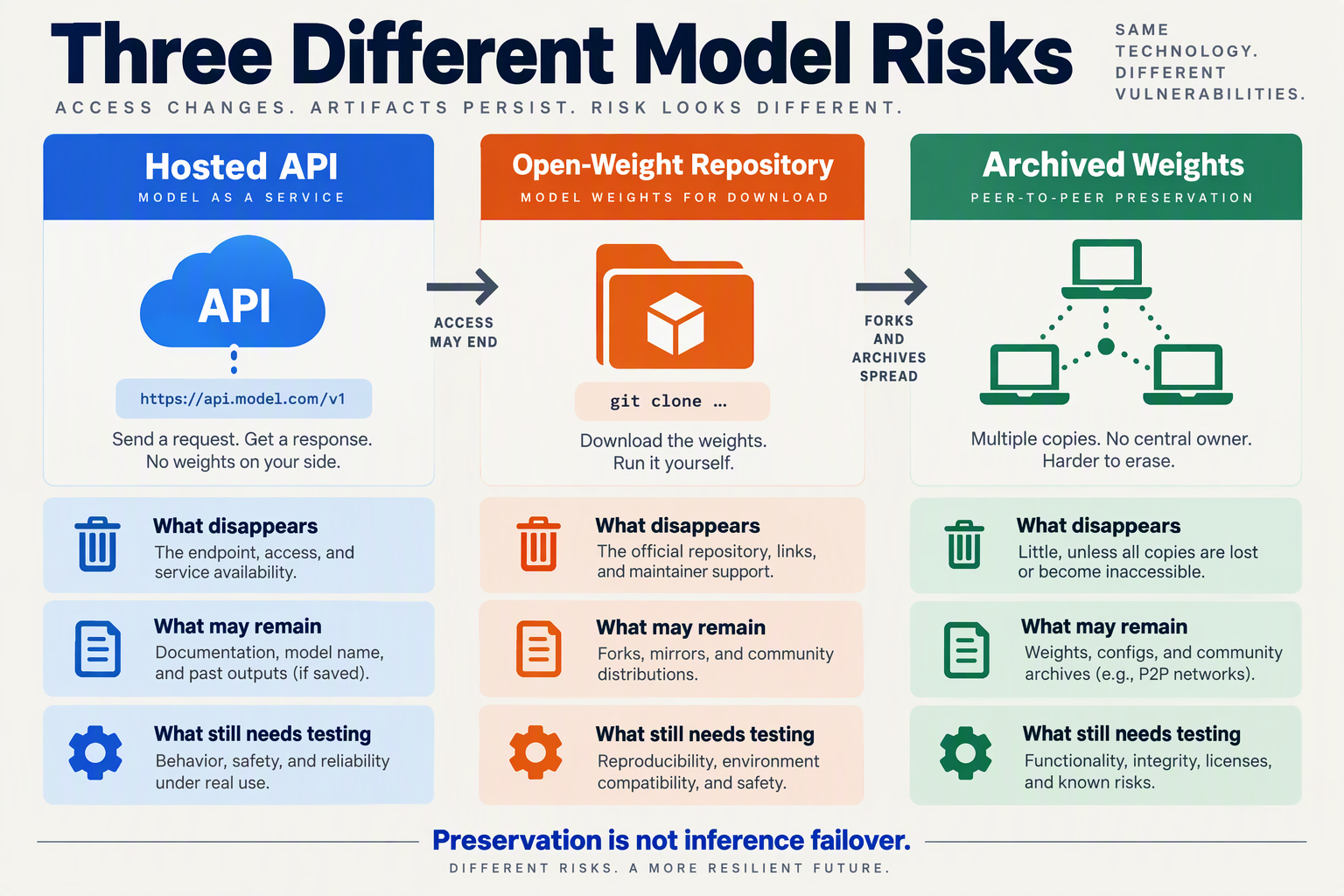
Archives, hosted APIs, and model retirements describe different parts of the continuity problem: an archive preserves artifacts, a hosted API provides a managed way to run a model, and a retirement is a provider’s withdrawal or change of service. None alone guarantees that an application will keep producing acceptable results.
What does each option preserve or change?
| Option or event | What it preserves or provides | What it does not guarantee | Practical response |
|---|---|---|---|
| Model archive | A recoverable copy of available artifacts, such as weights and configuration files | Legal permission, complete dependencies, compatible hardware, security updates, or production support | Verify rights and completeness; test whether the model can actually run |
| Hosted model API | Provider-managed access to a model through an endpoint | Continued access, unchanged behavior, or control over the provider’s infrastructure | Track provider notices and keep a tested alternative |
| API-compatible gateway | A common interface for sending requests to multiple models or providers | Identical outputs, equivalent safety behavior, or seamless substitution for every feature | Test each candidate against application-specific requirements |
| Model or endpoint retirement | Notice that access, a model version, or an endpoint may change or end | A drop-in replacement with the same quality, format, or cost | Identify affected calls and validate a replacement before switching |
| Self-hosted archived model | More direct control over deployment, if the artifacts and operating environment are usable | Low operating cost, easy scaling, or parity with a hosted service | Budget for compute, maintenance, security, and performance testing |
The distinctions matter because preserving a model is not the same as preserving a service. An archive may help recreate a particular model, but a hosted API also depends on the provider’s endpoint, policies, runtime, and continued availability. Conversely, an API that remains reachable may still change the model or its behavior.
An API-compatible gateway can reduce integration work, but compatibility is about the request interface—not guaranteed equivalence in answers. For example, two models may accept the same chat-completion request while differing in tool use, structured output, refusal behavior, or response length. Treat each change as a product change that needs evaluation, not merely a routing change.
What should teams compare before choosing a fallback?
Compare options against the requirements of the application, rather than asking only whether another model can respond:
- Recoverability: Are the archive, dependencies, and rights available—or is the alternative dependent on a live provider?
- Interface fit: Does the candidate support the application’s required inputs, tools, streaming, and output formats?
- Behavior: Does it pass representative tests for accuracy, safety, and task completion?
- Operations: Can the team meet its latency, privacy, cost, and maintenance constraints?
- Change control: Can engineers detect a retirement or behavior change and test a replacement before production traffic moves?
As of September 2026, CallMissed’s developer AI API lists 138 models across general-purpose, voice-agent, speech, image, and embedding categories; it supports OpenAI-compatible and Anthropic-compatible endpoints and caller-chosen fallback models. Those capabilities can make model selection and routing more portable, but they do not establish that two models behave alike. Teams still need to test the models they plan to use and decide what happens when a candidate fails.
A practical rule is to keep archives for models that are legally and operationally recoverable, use hosted APIs where managed access fits the workload, and treat retirement notices as prompts to run a migration test. The dependable fallback is not just a stored model or a second endpoint; it is a validated path with explicit limits and a safe failure mode.
How should an LLM fallback strategy handle outages, unknown model IDs, and retirement?
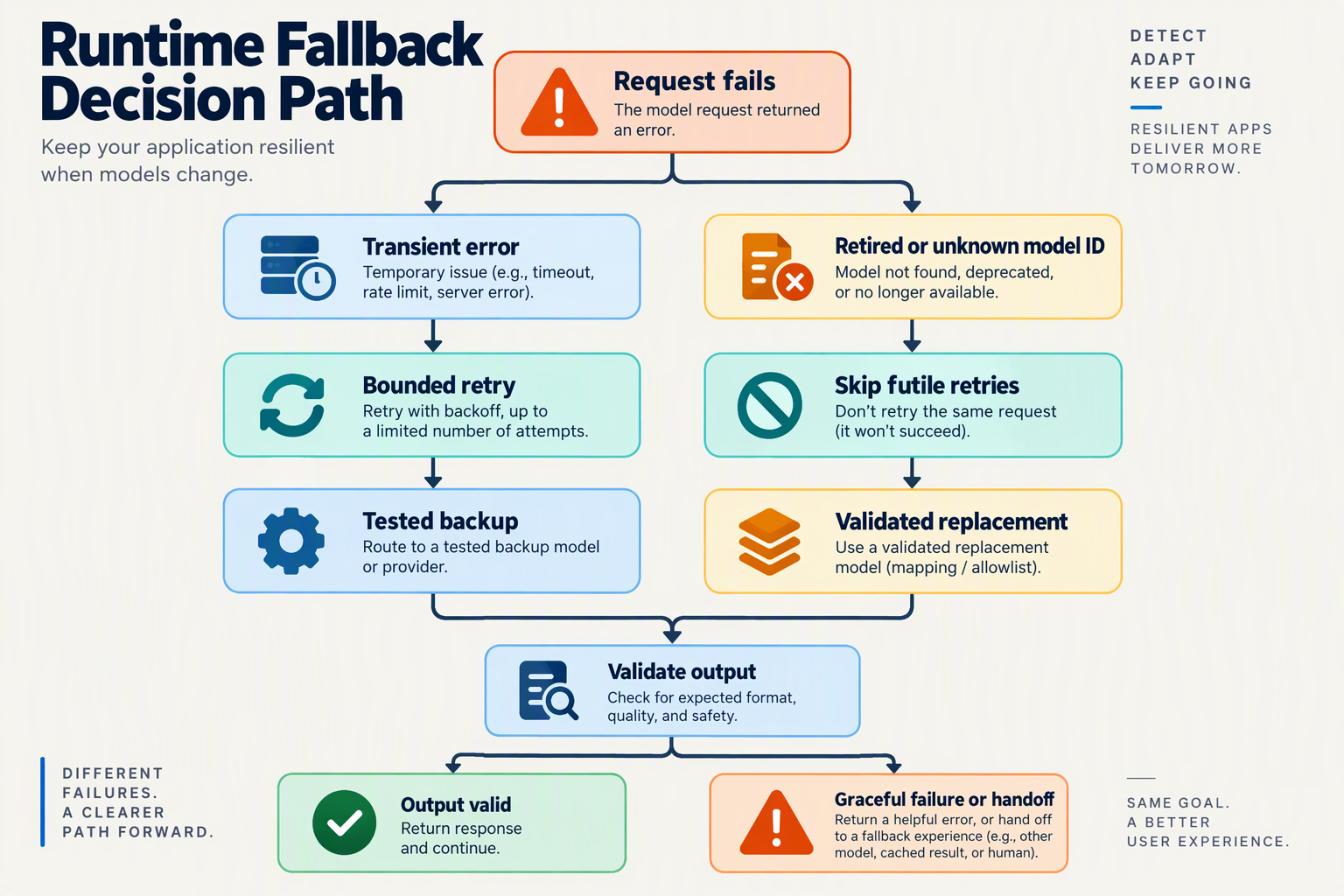
An effective LLM fallback strategy should distinguish temporary outages from invalid model IDs and permanent retirement, because each failure needs a different response. Route only when a failure is understood, and check that the replacement still meets the application’s safety, format, privacy, and latency requirements.
What should happen when a model endpoint is down?
Treat an outage as a potentially temporary failure—not as proof that the model has disappeared. Use bounded retries with backoff for transient errors, then route to a preconfigured fallback if the request remains within its time budget. Repeatedly retrying a failing endpoint can increase latency and cost without improving the result.
Define the policy before production:
- Retry transient timeouts and server errors a limited number of times.
- Switch models when the primary remains unavailable, using a fallback tested for the same task.
- Degrade gracefully if no acceptable model is reachable—for example, return a clear temporary-unavailable message rather than an unverified answer.
- Record the outcome, including the original model, error class, fallback chosen, and whether the response passed validation.
Do not assume every error warrants a switch. Authentication failures, quota exhaustion, and malformed requests may affect every model behind the same account or integration; routing around them can hide the real fault.
How should an application handle an unknown model ID?
An unknown model ID usually signals a configuration or catalogue mismatch, not a transient outage. Check the exact model identifier, provider, endpoint, and account permissions. If the ID was recently changed or removed, alert the owner and use a known, approved fallback rather than cycling through guessed identifiers.
Keep model names and routing rules in configuration instead of scattering them through application code. Validate the configured primary and fallback IDs during deployment or startup, and maintain an explicit mapping from each workload to its approved alternatives. A support chatbot, for instance, may require reliable structured outputs; a fallback that only produces loosely formatted text can break downstream ticket creation even if it answers promptly.
What is different when a model is retired?
Retirement requires a migration plan, not just retry logic. Identify a replacement, compare it against representative prompts and edge cases, then update the route deliberately. Test tool calls, JSON or other structured responses, refusal behavior, and any safety checks the application depends on. Record the retirement date, replacement, test results, and rollback path so a later incident does not depend on someone remembering an undocumented change.
A practical policy can be expressed as a short sequence:
- Classify the failure as transient, configuration-related, or permanent.
- Apply the matching action: bounded retry, configuration repair, or planned migration.
- Validate the replacement response before passing it downstream.
- Escalate or fail closed when no approved model meets the required standard.
Portability can simplify the switching mechanics, but it does not establish behavioral equivalence. As of September 2026, CallMissed’s developer AI API provides one key and balance for 138 models and supports caller-chosen fallback models; its OpenAI-compatible endpoints can also let existing SDKs work by changing the base URL. Those capabilities offer options for routing, while teams still need to select and test model-specific fallbacks for their own workloads.
Which backup model should you choose, and how can you control behavior drift?
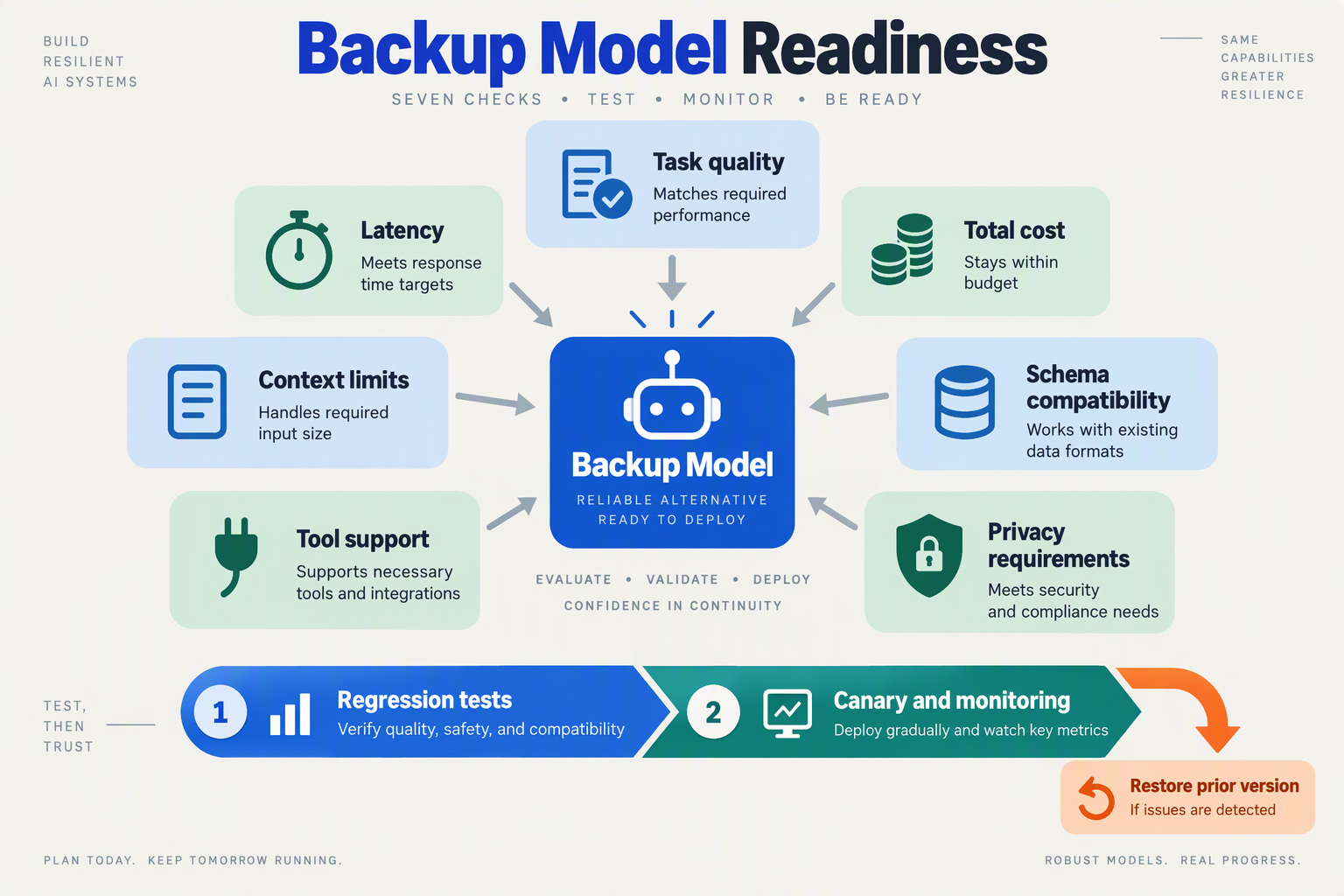
Choose a backup model by the job it must perform—not by reputation or general benchmark rank—and define acceptable behavior before routing production traffic to it. Control behavior drift with representative evaluations, strict output checks, and a staged rollout; API compatibility alone does not guarantee equivalent answers.
What should you compare when choosing a backup model?
Start with the application’s requirements. A customer-support assistant, a classifier that returns JSON, and a code-generation feature have different failure costs, so one universal fallback may be the wrong choice. Score candidates against the same real or carefully anonymized requests, then choose the one that meets your minimum thresholds.
Compare:
- Task quality: Does it answer correctly on your domain-specific cases, including edge cases?
- Format reliability: Does it produce valid JSON, follow tool instructions, and respect required fields?
- Safety and privacy: Are refusal behavior, data handling, and provider terms acceptable for this request?
- Operational fit: Does the model meet your latency, context-length, and cost limits under expected load?
- Recoverability: Can the team switch to it quickly, and can it be tested again when models or provider terms change?
Use a weighted scorecard if trade-offs need to be explicit, but keep hard requirements as pass/fail gates. For example, a fallback that is cheaper but frequently omits a required field should not pass a workflow that depends on that field.
As of September 2026, CallMissed’s developer AI API provides access to 138 models through one API key and balance, including 42 general-purpose LLMs, and supports caller-chosen fallback models. That gives developers a way to specify alternatives within a multi-model catalogue; it does not determine whether a substitute is suitable for a particular product.
How can you measure and limit behavior drift?
Treat each model change as a change to an application dependency. Build a small evaluation set from representative prompts and expected outcomes, including normal requests, ambiguous inputs, long contexts, tool calls, and adversarial or out-of-scope cases. For each candidate, record task success, schema validity, safety outcomes, and operational measures such as response time and cost.
Then apply controls in layers:
- Constrain the contract. Specify the output schema, allowed tools, and refusal or escalation conditions. Validate outputs in application code; retry or route elsewhere when a response fails a critical check.
- Compare before switching. Run the backup against the same evaluation set as the primary model. Review meaningful disagreements, not only aggregate scores.
- Roll out gradually. Start with internal or low-risk traffic, monitor errors and user-impact signals, and retain a clear route back to the previous configuration.
- Re-test continuously. Repeat evaluations after prompt, model, provider, or policy changes. Keep versioned test cases so improvements do not quietly break established behavior.
OpenAI-compatible or Anthropic-compatible endpoints can reduce integration work, but compatibility is mainly an interface advantage: the same request shape does not ensure the same reasoning, tone, safety decisions, or tool use. CallMissed’s API supports compatible endpoints, structured outputs, request logs, and caller-chosen fallback models; those capabilities can help teams route and inspect requests, while application-specific evaluation remains the team’s responsibility.
The practical rule is simple: select the backup that passes your own acceptance tests, not the one that merely responds. When no candidate meets the bar, a controlled message, human handoff, or temporary reduction in functionality may be safer than silently returning a lower-quality answer.
What should operators and model-preservation projects emphasize?

Operators should emphasize application-level behavior, explicit failure policies, and repeatable recovery tests; model-preservation projects should preserve the evidence and instructions needed to run and evaluate an archived model, not just its weights. Neither effort is complete until a substitute can be shown to meet the application’s requirements under realistic conditions.
What should operators test before routing to a fallback model?
Test fallbacks against the tasks the application actually performs, not only general-purpose benchmarks. A replacement that writes fluent prose may still break an app that depends on valid JSON, precise tool calls, consistent refusals, or answers grounded in approved documents.
Build a small evaluation set from representative production cases, including difficult and failure-prone inputs. For each candidate fallback, measure:
- Task quality: Does it answer correctly and follow the application’s instructions?
- Interface compatibility: Are required fields, schemas, and tool calls preserved?
- Safety and privacy: Does the model follow the same data-handling rules and escalation boundaries?
- Operational fit: Are latency and cost acceptable for this specific use case?
- Degraded-mode behavior: If no model meets the minimum bar, does the product pause, ask the user to retry, or hand the case to a person?
Define the routing policy before an incident: which failures trigger a fallback, whether retries are allowed, and what happens when every candidate fails. For a payment workflow, for example, an uncertain or malformed answer should not be treated like a successful response simply because another endpoint returned text.
What should a model-preservation project archive besides weights?
Preserve a reproducible package, not a file with an “archive” label. Alongside model weights, record the tokenizer, configuration, dependencies, runtime instructions, hardware assumptions, artifact checksums, provenance, and applicable license information. Capture the evaluation prompts and expected behavior that let a future team determine whether the revived model is fit for its intended role.
A preservation project should also test the package periodically in a documented environment. A model that once loaded successfully may become difficult to run when dependencies, hardware, or security requirements change. Record what worked, what failed, and the compute and operational support required; these details help distinguish a usable recovery option from a paper backup.
How can teams make switching less disruptive?
Separate application logic from provider-specific behavior wherever practical. Keep prompts, schemas, tool definitions, and routing decisions under version control, and log which model handled each request so teams can investigate changes in output. Portability helps with the mechanics of switching, but it does not prove that two models behave alike.
As of September 2026, CallMissed’s developer AI API supports OpenAI-compatible and Anthropic-compatible endpoints, structured outputs, caller-chosen fallback models, and request logs. Those capabilities can help teams connect and inspect alternative routes; operators still need to run their own evaluations and set acceptable failure behavior.
The practical goal is not to preserve every model indefinitely or to assume every replacement is equivalent. It is to preserve enough artifacts to make recovery possible, and to give operators a tested way to decide whether a fallback is safe and useful for the task at hand.
What should you do in each model failure or retirement scenario?
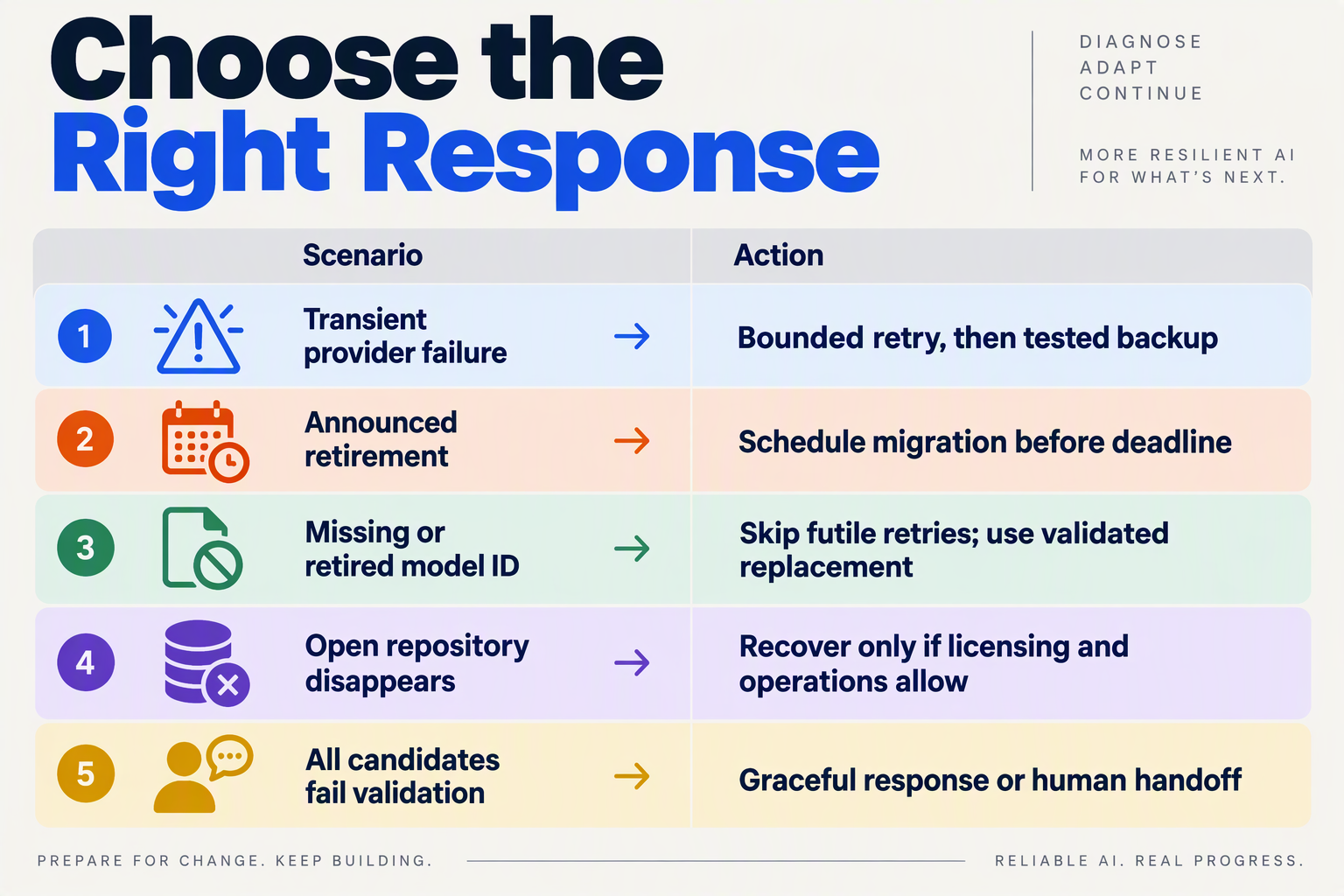
Treat model failures as different operational scenarios, not as one generic outage: an endpoint outage may justify a tested alternate, while retirement, access loss, or unacceptable output can require a migration or a controlled fallback to a simpler service. Preservation helps only when the archived model is legally usable, runnable on available infrastructure, and validated against the application’s requirements.
What should you do when a model endpoint is temporarily unavailable?
| Scenario | Immediate response | Role of preservation | What to verify |
|---|---|---|---|
| Temporary outage or elevated errors | Apply bounded retries with backoff, then route eligible requests to a pre-approved alternate. Stop retrying when the request’s latency budget is exhausted. | An archived model may provide another candidate if the team can run it, but it is not a ready-made hosted endpoint. | Error rate, response time, output validity, and whether fallback traffic is within budget. |
| Provider announces model retirement | Identify affected features and deadlines; test a replacement in parallel before changing production traffic. Keep a rollback path to the current version while access remains available. | Preserve weights and configuration where permitted, then check runtime, dependency, and license requirements. | Migration date, feature parity, license terms, and representative task quality. |
| Credentials, account access, or policy changes | Confirm whether the failure is account-wide or limited to a model; contact the provider and route only to an approved alternative. | A preserved model can reduce reliance on a particular service only if the organization has the rights and infrastructure to operate it. | Data-handling rules, provider permissions, access scopes, and operational ownership. |
| Replacement returns different or malformed outputs | Validate schemas and safety constraints; reject invalid results, retry selectively, or return a safe “unable to complete” response. | Preservation can support comparison with a known version, but identical weights do not guarantee identical behavior across runtimes or prompts. | Structured-output validity, refusal behavior, factual quality, and task-specific evaluation results. |
| Archived model cannot be deployed | Treat the archive as a reference artifact, not an active recovery path; use a tested hosted alternative or degrade the feature gracefully. | Recovery may be blocked by missing dependencies, unsuitable hardware, incomplete files, security concerns, or license restrictions. | Reproducibility, compute capacity, security maintenance, and a documented owner for deployment. |
| Sensitive-data or regional constraint blocks an alternate | Do not send the request to an unapproved provider. Redact, defer, or route to an authorized environment; otherwise return a limited response. | An archive may help if it can run in an approved environment, but preservation alone does not establish compliance. | Data residency, retention, access controls, and legal approval for the specific use. |
How should teams decide whether to fail over or fail closed?
Set a policy per task, rather than letting every error trigger another model. For a low-risk classification task, a validated alternate may be acceptable; for a high-impact decision, blocking completion or escalating to a human may be safer than silently changing model behavior.
Before enabling automatic failover, define:
- Eligibility: Which errors trigger a switch, and which—such as invalid credentials or policy blocks—require investigation?
- Quality floor: What checks must pass before a fallback answer reaches a user?
- Limits: How many retries or model switches are allowed before stopping?
- Auditability: Record the selected model, failure reason, and validation result without logging sensitive content unnecessarily.
As of September 2026, CallMissed’s developer AI API lists 138 models, including 42 general-purpose LLMs, and supports caller-chosen fallback models. That offers developers a way to configure alternate model choices through one API, but teams still need to test each route and define what happens when none meets their requirements.
What is the practical recovery test?
Run a failure drill before an incident: simulate an unavailable endpoint, a retired model, and a malformed response. Confirm that the application either produces an acceptable validated result or stops safely—and that operators can tell which path occurred. A preserved model belongs in that drill only after the team has demonstrated that it can legally deploy and maintain it.
Frequently Asked Questions
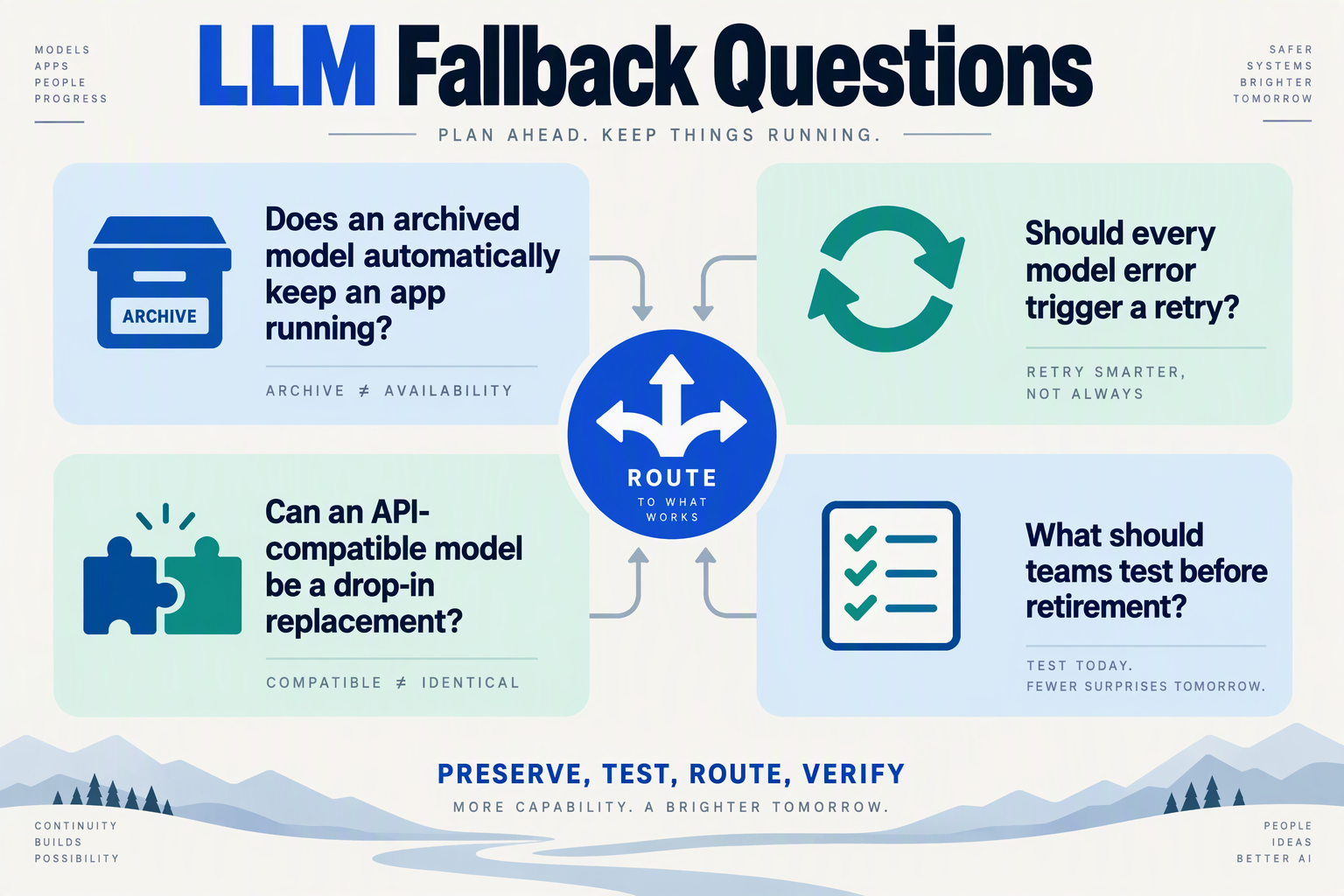
What is an LLM fallback strategy, and how is it different from model preservation?
How do I choose a fallback model when my primary LLM is deprecated?
How can I test an LLM fallback strategy before an outage?
Can an API-compatible model provider prevent fallback problems?
Should my LLM fallback strategy automatically retry another model?
When is preserving an open-weight model a practical fallback?
Conclusion
A reliable LLM fallback strategy is not a folder of preserved model files; it is a tested plan for keeping an application safe and useful when its preferred service changes or disappears. Model archives can preserve valuable artifacts, but teams still need compatible infrastructure, legal access, and tests proving that a substitute meets real application requirements.
Key takeaways:
- Preservation protects a model version; it does not guarantee a working production service. Compute, runtimes, licenses, security updates, and support remain separate dependencies.
- Fallbacks can change behavior. A replacement may weaken answer quality, break structured output, exceed latency limits, or route sensitive data inappropriately.
- Portability helps, but testing makes it dependable. Define acceptable quality, safety, privacy, and availability thresholds, then validate substitutions before an outage.
- Archives and provider choice solve different problems. Keep preservation as a recovery option while designing routing and failure policies around application needs.
As of September 2026, CallMissed’s developer AI API provides access to 138 models through one API key and balance, with caller-chosen fallback models. That illustrates the growing shift toward model choice through common interfaces—without removing the need to evaluate each replacement.
Watch how API compatibility, model behavior, and access conditions evolve; those changes will determine whether a fallback is genuinely usable. To explore how AI communication infrastructure is evolving, visit CallMissed. Which parts of your own AI system would still work if its primary model vanished tomorrow?
Related Reading
- How Can I Connect an LLM API Gateway to Voice and WhatsApp Agents? A Developer Guide
- Five-Day Banking India: Can Support Stay Available?
- GPT-6 Sol vs GPT-6 Luna: Verified 2026 Model Comparison
Sources
Discussion
Related Posts
Ready to automate customer conversations?
Launch AI voice agents and WhatsApp bots with CallMissed — one API, 22+ Indian languages.