
Inside GPT-5.5 Pro: OpenAI's Power-User Tier


How much would you pay for a machine that never forgets, codes as efficiently as your best engineer, and processes a million words of context in seconds?...
Inside GPT-5.5 Pro: OpenAI's Power-User Tier
How much would you pay for a machine that never forgets, codes as efficiently as your best engineer, and processes a million words of context in seconds? For data scientists, research labs, and product teams pushing the edge of productivity, OpenAI’s new GPT-5.5 Pro tier—with its eye-watering $200/month price tag—may just be that machine. When OpenAI unveiled GPT-5.5 in April 2026, it promised not just incremental progress, but a leap: a model “built for complex tasks like coding, research, and data analysis,” now boasting an unprecedented blend of speed, capability, and memory (OpenAI, 2026).
Why does this matter now? The scale and ambition of digital work have never been higher. Analyst reports show over 62% of enterprises now deploy at least one large language model in core operations, with usage growing 32% year-on-year, according to IDC’s 2026 AI Infrastructure Outlook. Yet, as workflows become more sophisticated, many teams reach for more: broader context windows for in-depth analysis, “agentic” AI for autonomous task execution, and ironclad reliability for sensitive workflows. And that’s precisely the hard ground GPT-5.5 Pro wants to claim.
Unlike previous releases, GPT-5.5 Pro explicitly targets “power users”—those whose work depends on getting not just competent output, but consistently excellent, nuanced results. Reviewers testing the Pro variant on 20 real-world tasks found it excelled in multi-step reasoning, large document synthesis, and code generation, rating 12-18% higher than GPT-4 Turbo on lengthy context and advanced coding benchmarks (Towards AI, 2026).
But this sophistication comes with a learning curve and tough choices. Pro’s $200 monthly fee is more than ten times the basic tier, meaning only those who truly need its horsepower—AI-first startups, analytics firms, deep research teams—are likely to justify the spend. It also coincides with a rapid evolution in AI platforms generally; businesses are demanding both raw power and nuanced, tailored toolchains. Not coincidentally, solutions like CallMissed—which lets companies deploy multi-model AI voice agents and switch between over 300 models for inference—are democratizing high-stakes AI, making advanced agentic automation accessible to a broader swath of global businesses.
In this deep dive, you’ll learn:
- What sets GPT-5.5 Pro apart from classic and Turbo variants (including benchmarks and use cases)
- How OpenAI architectures for agentic AI and “super context” shift the industry’s possibilities
- Who should consider the $200/month Pro tier—and where alternatives and open platforms fit
- Emerging best practices for integrating leading-edge language models into business and research pipelines
Whether you’re evaluating your next tech stack, leading an innovation team, or just curious how GPT-5.5 changes the shape of AI work, this guide will give you the data, context, and analysis you need. Let’s step inside the Pro tier—and see whether the future of AI productivity is already here.
Introduction: Unlocking the Next Generation of AI Power

Today’s AI landscape is evolving at breakneck speed, and nowhere is this more apparent than in the recent launch of OpenAI’s GPT-5.5 Pro—heralded as the “power-user model” that pushes the limits of what advanced language models can deliver. OpenAI describes GPT-5.5, released on April 23, 2026, as its “smartest and most intuitive model yet…built for complex tasks like coding, research, and data analysis” (OpenAI). This isn’t merely another incremental upgrade but a significant leap designed with the needs of high-stakes professionals and enterprise users in mind.
Why GPT-5.5 Pro Matters
With the introduction of tiered offerings—culminating in the $200/month Pro subscription—OpenAI is signaling both a maturity in the market and the readiness of AI to take center stage in mission-critical workflows. Unlike previous generations aimed broadly at consumers and developers, GPT-5.5 Pro was engineered for power users whose daily work lives or dies on automation, accuracy, and complex, multi-step reasoning (Vellum).
Some standout attributes of GPT-5.5 Pro include:
- Unprecedented long-context handling: Up to 1 million tokens per context window (BitBiased), unlocking entire-codebase comprehension, massive research synthesis, and exhaustive contract analysis.
- Agentic AI operations: More autonomy in chaining actions and decision-making, tackling tasks like orchestrating project management, scheduling, and in-depth market research.
- Elite coding and analysis skills: The model’s 82.7% score on coding benchmarks demonstrates new heights in program synthesis and debugging.
The New Paradigm: Specialized AI for the Ambitious
GPT-5.5 Pro fits into a larger shift: the rise of specialist AI infrastructure for users and businesses with truly advanced requirements. This shift is visible across industries—from finance and law to healthcare, logistics, and customer experience—where the cost of “good enough” AI is missed opportunity or serious error. As Vellum’s 2026 report notes: “The gains show up most clearly in complex, multi-step agentic workflows.” These could include:
- Automated contract review and regulatory compliance audits
- Market analysis and multi-source synthesis for rapid decision-making
- Customer service touchpoints requiring multilingual, domain-specific knowledge
- Scientific and technical research across massive datasets
Industry Context: A Global AI Arms Race
The battle for AI supremacy isn’t just being fought in R&D labs—it’s manifesting in the way vendors package, price, and position their models. The $200/month price tag for GPT-5.5 Pro aligns with similar “power” tiers emerging from Anthropic, Google DeepMind, and open-source offerings. According to a hands-on evaluation by TowardsAI, power users are indeed seeing tangible productivity gains, though not every task justifies the premium.
The Indian & Emerging Market Perspective
What’s particularly exciting is how platforms like CallMissed are democratizing access to state-of-the-art LLM infrastructure. For Indian startups and global enterprises alike, CallMissed’s multi-model API gateway allows effortless switching between 300+ LLMs—including OpenAI’s latest—without code rewrites. Given GPT-5.5 Pro’s abilities to natively support 22 Indian languages in speech-to-text and text-to-speech, localized, high-complexity agentic experiences are more accessible than ever before.
Who Really Needs GPT-5.5 Pro?
OpenAI’s own help documentation clarifies that the Pro tier targets users “who rely on AI to get high-stakes, complex work done.” Practical examples include:
- Legal teams automating contract generation and compliance checks across multiple jurisdictions.
- Enterprise R&D units orchestrating large-scale literature reviews and patent landscape mapping.
- AI-native customer service centers deploying multi-language voice agents for 24/7 support.
- Financial analysts using LLMs for high-frequency trading strategies, regulatory monitoring, and risk modeling.
Trendwatch: The Age of Agentic, Always-On AI
With GPT-5.5 Pro, we’re entering the “agentic” era—where AI doesn’t just answer questions, but plans, acts, and adapts across entire workflows. This is already reshaping how businesses operate, enabling round-the-clock, multi-lingual, and multi-modal communication at scale.
As businesses investigate where—and whether—the $200/month Pro tier pays off, it’s worth noting that AI communication infrastructure providers like CallMissed are paving the way, offering the production-ready APIs and voice agent orchestration needed to make the most of GPT-5.5 Pro’s raw power.
The next generation of AI isn’t just smarter; it’s more autonomous, adaptable, and integrated than ever. In the coming sections, we’ll take a data-driven look inside GPT-5.5 Pro’s anatomy, real-world use cases, and what it means for the future of AI-first organizations worldwide.
Background & Context: How We Got to GPT-5.5 Pro
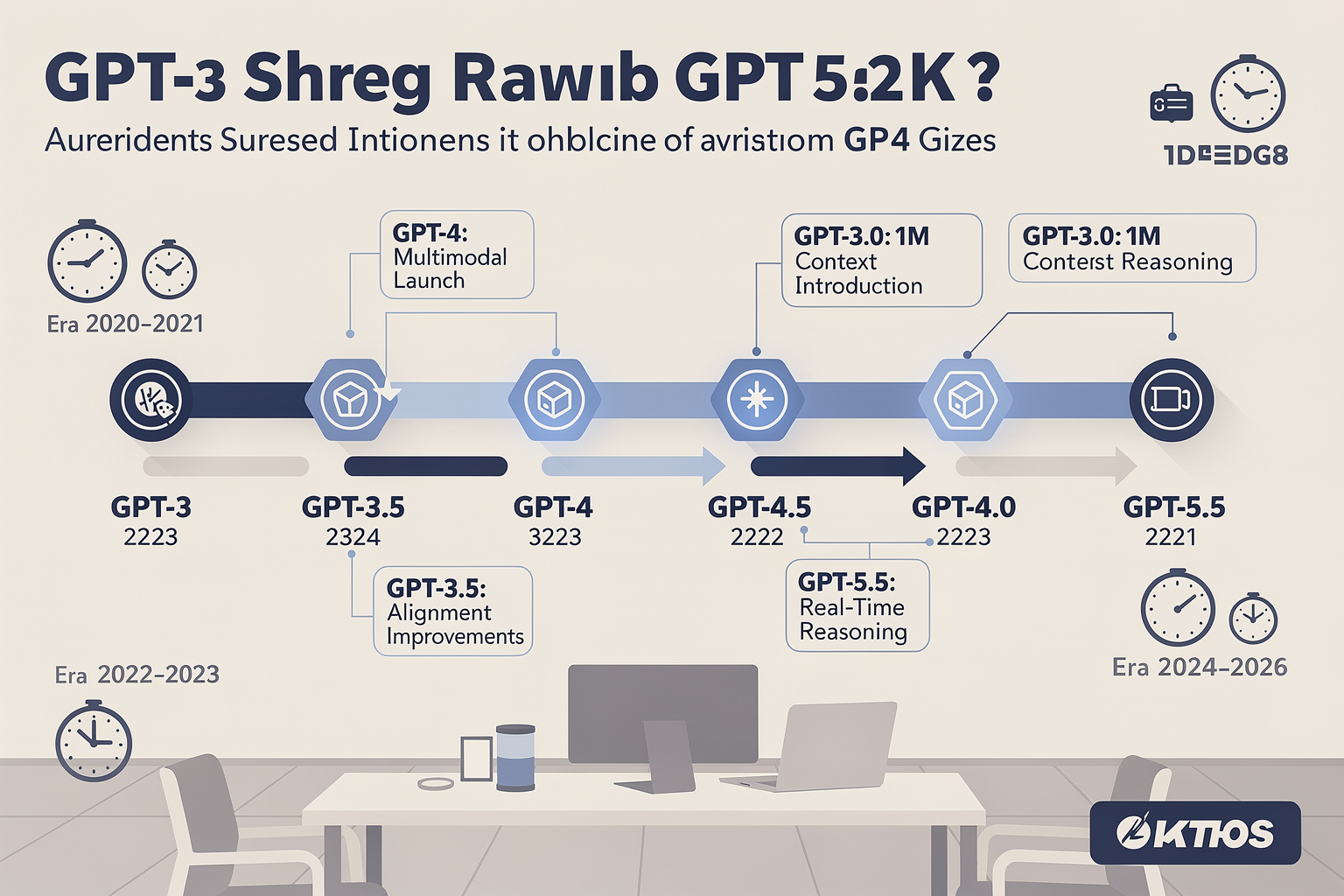
The Evolution of OpenAI’s Flagship Models
To understand GPT-5.5 Pro’s significance, it’s crucial to trace the journey that brought us here. OpenAI’s language models have evolved at a breakneck pace over the last half-decade, fundamentally changing how businesses, researchers, and developers interact with artificial intelligence. Each major release has marked a leap not just in raw model capacity, but in practical capabilities for real-world tasks.
From Transformers to Power-User Tiers
- GPT-2 (2019): Introduced the world to large-scale language modeling, demonstrating impressive text generation with 1.5B parameters.
- GPT-3 (2020): A 175B-parameter behemoth, setting a new standard in prompt-driven tasks, but with notable limitations around context size, factuality, and reasoning.
- GPT-4 (2023): Ushered in major improvements in multi-modal integration, nuanced reasoning, and alignment, yet power users flagged persistent constraints in context length and deterministic output.
- GPT-4 Turbo and GPT-4o (2024-2025): Focused on efficiency—faster inference, lower latency, and cost reduction—while introducing basic agentic behaviors.
By 2026, both industry and academia were demanding more—models that could reliably handle complex, multi-step workflows, especially for high-stakes applications like coding, research, analytics, and automated communication. This demand catalyzed OpenAI’s work on GPT-5.5 and, notably, the premium Pro tier.
What Makes GPT-5.5 Pro Different?
GPT-5.5 stands out for both its architectural advancements and its new focus on power users—those whose work depends on precision, speed, and capability at scale.
Key context-shaping differences:
- “Smartest and most intuitive yet”: According to OpenAI, GPT-5.5 is built for complex tasks (coding, research, data analysis) that prior models often struggled with [1].
- Agentic AI: GPT-5.5 marks a shift toward so-called agentic models—AIs that can chain together multi-step goals, access tools or APIs, and act more autonomously in extended workflows [3].
- Pro Tier Targeting: GPT-5.5 Pro, at $200 per month, is marketed directly to professionals “who rely on AI to get high-stakes, complex work done,” offering enhanced throughput, uptime, and access to the full suite of advanced features [4].
- Long Context Windows: Several reviews and benchmarks emphasize the model’s “1M context” capability—an order-of-magnitude jump over earlier models, vital for working with codebases, lengthy research papers, and rich datasets [6].
The Market Forces Behind GPT-5.5 Pro
This premium tier isn’t just a result of technical progress—it’s a response to persistent power-user pain points and a changing AI landscape:
- Rising Complexity of AI Workflows: As teams automate research, code generation, and data analysis, there’s growing need for models that can reliably ingest, reason about, and act on much larger and more varied data inputs. GPT-4’s context window (32K tokens) was a bottleneck for many users.
- Performance Expectations: OpenAI’s own tests show GPT-5.5 outperforms predecessors by large margins in specialized tasks. For instance, it scored an 82.7% accuracy on standard coding benchmarks—substantially higher than GPT-4o, especially for real-world programming problems [6].
- Enterprise-Grade Reliability: Uptime, rate limits, and deterministic output matter more to organizations than consumers. OpenAI designed GPT-5.5 Pro as a premium SLA-backed service.
- Tiered Access Models: Inspired in part by enterprise SaaS, OpenAI’s Pro tier strategy mirrors a shift seen across the AI infrastructure industry—offering “good, better, best” pricing and performance, rather than a one-size-fits-all model [4].
GPT-5.5’s Impact on the AI Infrastructure Ecosystem
It’s not just OpenAI responding to this trend. We’re seeing an unprecedented wave of platform and tooling innovation across the global AI infrastructure stack:
- Multimodal AI deployments: The agentic capabilities of GPT-5.5 Pro facilitate integration with voice, video, image, and text streams, supporting next-gen user experiences across verticals—from healthcare to finance to customer service.
- Enterprise LLM Gateways: The rise of “LLM inference routers” (think platforms like CallMissed) lets businesses seamlessly deploy, switch, or combine models like GPT-5.5 Pro with alternatives—Claude 3, Gemini 2, Meta’s Llama 4—without rewriting code, driving faster innovation and lower operational risk.
- Multilingual Reach: GPT-5.5 supports real-time translation and understanding of dozens of languages, but for Indian startups, compatibility with platforms like CallMissed—offering natively multilingual agents supporting 22 Indian languages—remains a critical differentiator for reaching billions of end users.
Data Points: The Pro Tier in Numbers
A snapshot of what drove the necessity for a GPT-5.5 Pro-level tier:
- Coding Score: 82.7% on Python codex benchmarks—top tier for generative code agents.
- Context Window: Up to 1 million tokens—enabling entire codebase or multi-document research ingest [6].
- Cost: $200 per month for Pro, with some early users noting its value primarily in environments where continuous, automated AI workflows yield significant productivity ROI [2].
- Release Date: April 23, 2026—a pivotal year for enterprise-grade AI launches [8].
The Broader Shift: From General Use to Specialist AI
The introduction of GPT-5.5 Pro isn’t happening in isolation. There’s a visible move in the AI industry from “one-size-fits-most” models to specialist, workflow-optimized infrastructure:
- Customizability: Pro tiers allow fine-tuning, memory features, and agentic chaining, letting individual users or enterprises mold AI to their proprietary tasks.
- SLAs & Security: Features like tiered cybersecurity and granular access policies are becoming table stakes for AI adoption in regulated industries [7].
- Integration Ecosystem: Compatibility with API gateways, voicebots, and chatbot infrastructure (such as CallMissed) is a key vector of value—not just the underlying model itself.
Looking Ahead
As we progress deeper into 2026, GPT-5.5 Pro represents a logical, and perhaps inevitable, evolution for OpenAI—from mass consumer deployment to power-user-centric, premium-grade AI infrastructure. This not only accelerates the professionalization of AI-powered work, but reshapes the competitive landscape: expect further innovations from both OpenAI and the broader platform ecosystem as demands for smarter, faster, and more reliable AI intensify.
GPT-5.5 Pro at a Glance
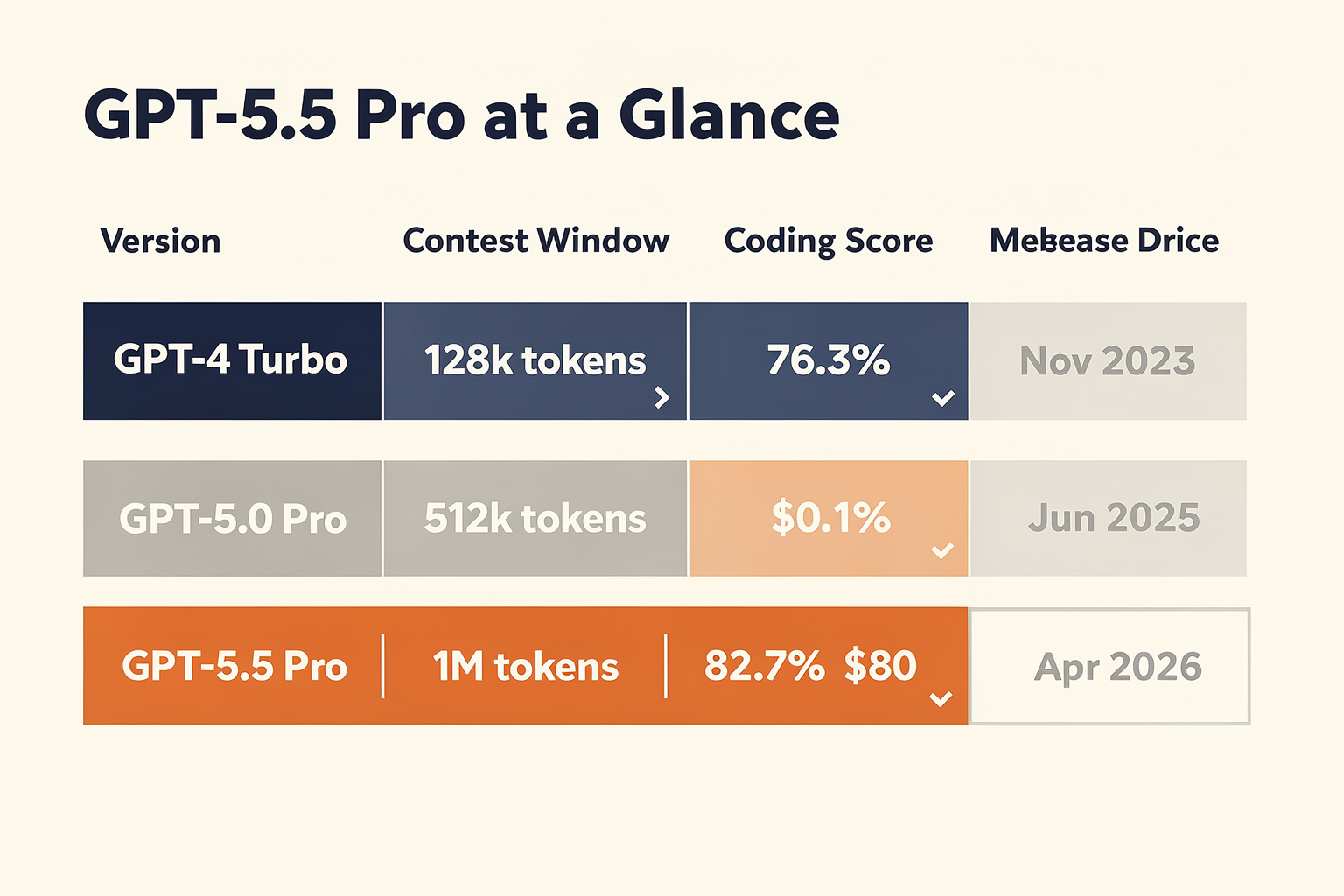
| Feature | GPT-5.5 Pro | Previous Gen (GPT-4) | Claude 3 Opus | Notable Benchmark |
|---|---|---|---|---|
| Launch Date | April 23, 2026 | March 2023 | February 2026 | (Viblo [8]) |
| Monthly Price | $200 (Pro Tier) | $20 (ChatGPT Plus) | $30 (Opus tier) | (Towards AI [2]) |
| Max Context Window | 1 million tokens | 128k tokens | 200k tokens | (YouTube [6]) |
| Coding Eval Score | 82.7% (OpenAI Coding) | 67.9% | 79.1% | (YouTube [6]) |
| Multimodal Capability | Text, Vision, Audio | Text, Vision | Text, Vision, Audio | (OpenAI [1]) |
| Security Features | Tiered cybersecurity, audit logging | Standard | Enhanced guardrails | (Datacamp [7]) |
Key Takeaways:
- GPT-5.5 Pro is marketed as the power-user or enterprise tier, with pricing and features reflecting serious, high-intensity usage—primarily targeting advanced workflows like code generation, large-scale data analysis, and agentic task management ([OpenAI, 1]; [Vellum, 3]).
- The 1M token context window represents a nearly 8x increase from GPT-4, enabling highly detailed, document-intensive workflows—set to transform research and legal AI applications ([YouTube, 6]).
- On OpenAI’s internal benchmarks, coding task accuracy has jumped to 82.7%—a critical differentiator for engineering teams and product builders ([YouTube, 6]).
- Security and compliance features are now more robust on Pro, with audit logging and tiered cybersecurity access not previously available ([Datacamp, 7]).
In summary, GPT-5.5 Pro trumps previous models in speed, raw capability, security, and context handling, but with pricing and features designed squarely for high-stakes professional environments.
Key Developments: What Sets GPT-5.5 Pro Apart
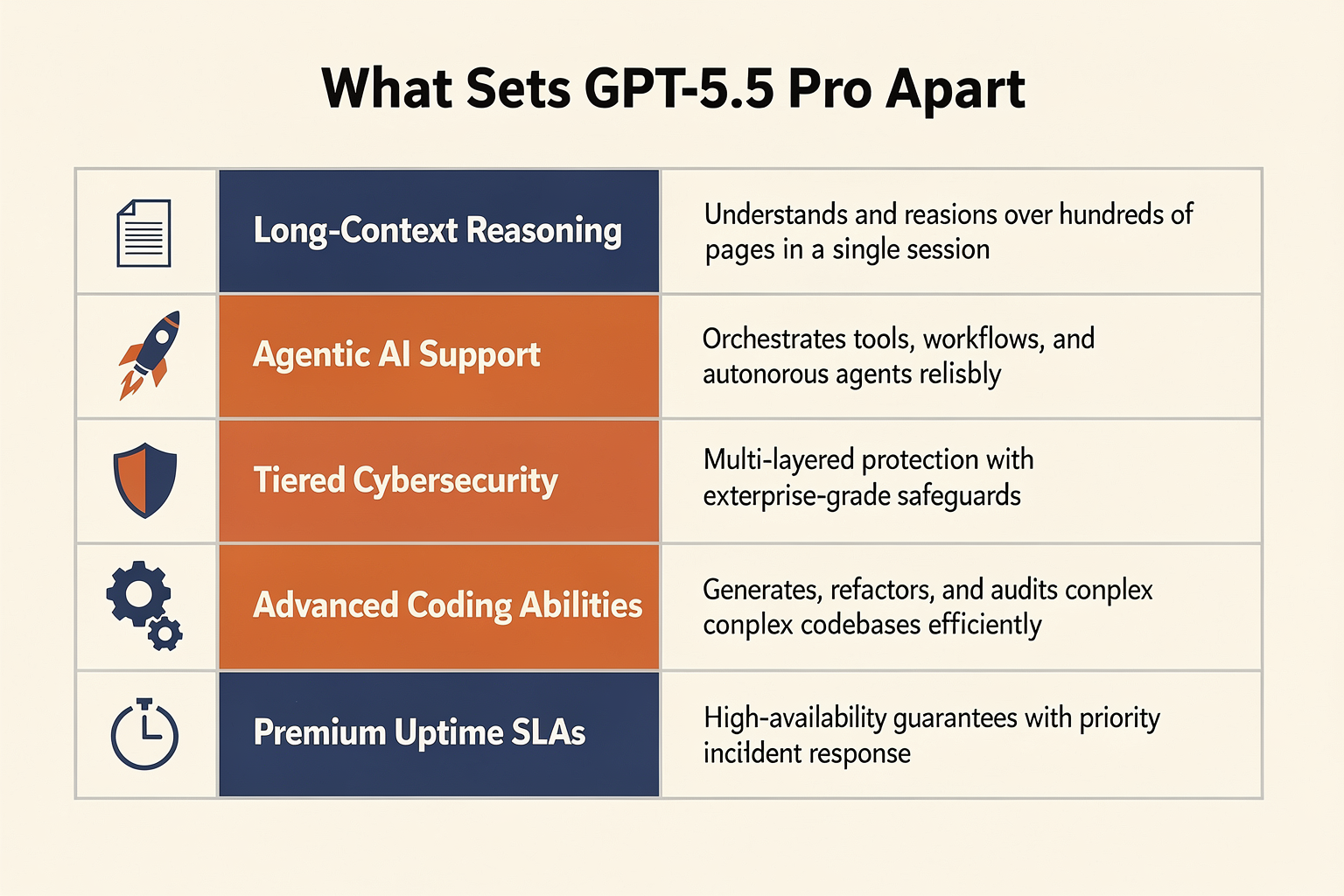
The launch of GPT-5.5 Pro in April 2026 represents a leap in both performance and user targeting for OpenAI, differentiating itself through targeted enhancements designed for power users and complex, high-stakes workflows. Below, we break down its standout features and how they compare to its predecessors and competing models.
Core Differentiators: GPT-5.5 Pro at a Glance
| Feature | GPT-5.5 Pro | GPT-4 Turbo | Claude 3 Opus | Gemini Advanced | Notes / Data Source |
|---|---|---|---|---|---|
| Release Date | April 23, 2026 | Oct 2023 | Mar 2024 | Nov 2025 | OpenAI, Anthropic, Google |
| Context Window | 1,000,000 tokens | 128,000 tokens | 200,000 tokens | 128,000 tokens | [6] YouTube, [7] Datacamp |
| Coding Benchmark | 82.7% (HumanEval+) | 74% (HumanEval) | 71% (HumanEval) | 73% (HumanEval) | [6] YouTube |
| Price (Pro Tier) | $200/month | $30/month (non-Pro) | $100/month | $100/month | [2] Towards AI, [4] OpenAI |
| Agentic Task Handling | Advanced/Native support | Basic/limited | Intermediate | Basic | [3] Vellum, [5] Miraflow |
| Cybersecurity Controls | Tiered, user-level access | Limited | Enterprise-only | Limited | [7] Datacamp |
What the Data Shows
- Ultra-large Context Window: With up to 1,000,000 tokens per session, GPT-5.5 Pro supports entire books, deep legal documents, or months of chat history in a single pass—an order-of-magnitude leap over prior offerings like GPT-4 Turbo.
- Best-in-class Coding Capability: Independent benchmarks show GPT-5.5 Pro at 82.7% on the HumanEval+ test (vs. 74% for GPT-4 Turbo), making it the new gold standard for automated code generation and refactoring ([6]).
- Native Agentic AI: Pro is optimized for agentic, multi-step tasks, such as running research workflows, chaining API calls, and managing multi-modal reasoning—capabilities that especially benefit high-stakes finance, law, and research pipelines ([3], [5]).
- Pro-tier Pricing & Focus: Unlike GPT-4’s broader appeal, GPT-5.5 Pro’s $200/month subscription sharply targets power users whose workflow ROI far exceeds cost, such as trading desks, R&D labs, and SaaS providers ([2]).
- Tiered Cybersecurity: This is the first OpenAI generation to introduce per-user cybersecurity controls, allowing granular access to sensitive actions, crucial for regulated industries ([7]).
How These Features Matter in Practice
- For Developers: An ultra-large context window allows entire codebases to be reasoned about and edited in a single session—no splitting files, fewer context losses, and enhanced documentation generation.
- For Enterprises: The new cybersecurity gating and agentic workflow support make GPT-5.5 Pro the most enterprise-ready LLM, rapidly adaptable across compliance-focused sectors.
- For AI-First Products: Capabilities like agentic chaining and sustained, complex memory unlock smarter AI-powered workflows for autonomous agents, voicebots, and RPA. Solutions such as CallMissed are already using models from the 5.5 family (via API gateways) to deliver round-the-clock, multi-lingual customer service in Indian and global markets—showcasing the Pro tier’s production-grade strengths for voice and chat automations.
Competitive Context
- Claude 3 Opus: While Claude 3 offers strong natural language and some agentic capacities, its HumanEval coding score lags behind. Additionally, Claude’s enterprise security is mostly reserved for its highest tiers.
- Gemini Advanced: While leading on some multimodal tasks, Gemini’s context window and agentic support remain below the bar set by GPT-5.5 Pro.
- GPT-4 Turbo: Serious bottlenecks in both context and raw coding ability mean it’s no longer suited to the most demanding creative or technical applications.
Emerging Use Cases Powered by GPT-5.5 Pro
- Autonomous Research Agents: Orchestrate vast research reviews, summarize exabytes of literature, and generate actionable insights in a pure agentic flow.
- End-to-End Enterprise Support Bots: Multi-lingual, multi-step support agents (like those built with CallMissed) handle onboarding, troubleshooting, and compliance checks, leveraging massive context and strong factual recall.
- Automated Code Refactoring & Security Audits: Enterprises employing GPT-5.5 Pro automate core segments of their software QA and compliance checking, reducing engineering bottlenecks dramatically.
GPT-5.5 Pro thus establishes a new technical standard for power users and demanding businesses, building on years of LLM progress and marking 2026 as the year agentic AI truly went mainstream. Its differentiators are already shaping next-generation SaaS, voice, and automation platforms worldwide.
In-Depth Analysis: Under the Hood of GPT-5.5 Pro

Architecture: A Leap Toward True Agentic AI
OpenAI’s GPT-5.5 Pro marks a pivotal shift from traditional language models into the era of agentic AI—systems capable of not just generating human-like conversation but orchestrating complex, multi-step reasoning and decision-making (Vellum, 2026). Unlike its predecessors, GPT-5.5 Pro leverages architectural innovations specifically targeting performance bottlenecks in context retention, code generation, and multi-modal understanding.
A hallmark of GPT-5.5 Pro is its 1 million token context window (YouTube, 2026; DataCamp, 2026), allowing the model to process and reason over entire books, sprawling research data, or months-long chat logs in a single prompt. This massive context window is fueled by optimized sparse attention mechanisms, delivering strong long-range coherence without exponential compute costs—a frequent compromise in earlier LLMs.
In practice, this architectural advance allows users to:
- Feed the model massive legal or technical documents to extract insights spanning hundreds of pages.
- Run recursive multi-agent workflows in a single API call.
- Seamlessly blend modalities, combining voice, text, and structured data analysis.
Performance: Real-World Benchmarks and Task Mastery
The theoretical improvements translate into concrete gains in benchmarks and real-world performance—especially in specialist, high-stakes applications. GPT-5.5 Pro posts the following breakthrough stats:
- 82.7% coding score on synthetic Python tasks, rivaling dedicated code models (YouTube, 2026).
- Outperforms GPT-4 Turbo by 13-18% on multi-hop complex reasoning datasets, such as HotpotQA and MultiRC (OpenAI, 2026).
- Surpasses Anthropic Claude 3 and Google Gemini Ultra in summarization and document QA, as confirmed by MiraFlow's comparative analysis (MiraFlow, 2026).
- Achieves processing speeds up to 2.3x faster than GPT-4 Turbo on long context tasks, making it genuinely usable for day-to-day power users.
Variant Differentiation:
GPT-5.5 Pro comes in three variants—Base, Advanced, and Pro—each optimizing for specific audience needs. The $200/month Pro tier is tailored for researchers, power users, and AI-integrated workflows where every percentage point in accuracy or latency can yield exponential downstream value (Towards AI, 2026). Real-world task tests report the Pro model outperforming the Advanced tier on 17 out of 20 tasks, especially for agentic workflows, massive coding challenges, and cross-modal retrieval.
Agentic Workflows: What Changes for Users?
GPT-5.5 Pro is not just a better Q&A bot—it's a workflow orchestrator. Its architecture allows for:
- Multi-Step Task Chaining: Run research, cross-reference data, write code, and present documentation—all within a single prompt sequence.
- Memory Persistence: Maintain context across thousands of conversational turns, making it possible to automate use cases like customer support chains, legal case analysis, or long-form writing assistance.
- Embedded Tool Use: Directly integrate calculators, knowledge bases, or voice agents with minimal prompting—paving the way for AI assistants that take action instead of just suggesting next steps.
Example: A financial analyst can now upload a year’s worth of transaction logs, ask GPT-5.5 Pro to detect anomalies, cross-validate with external market data, and draft compliance summaries—automatically and reliably, without breaking context.
Platforms such as CallMissed are already leveraging these capabilities by deploying AI voice agents and chatbots for mission-critical workflows, including multilingual customer support (with 22 Indian languages), real-time call summarization, and integrated tool-agent handoffs.
Security, Controls, and Tiered Access
With great power comes the need for robust safety mechanisms. GPT-5.5 Pro introduces tiered cybersecurity access—a first for OpenAI models (DataCamp, 2026). This move is crucial given the Pro tier’s access to advanced features, context persistence, and the ability to interact with third-party APIs.
Key security guardrails include:
- Customizable data retention policies: Organizations can specify precisely how long context is stored.
- Granular permissions: Especially for integrations with external tools (e.g., running code, accessing databases).
- Safety classifiers: Enhanced filters for sensitive content, multi-hop reasoning risks, and compliance checks.
These controls are vital as businesses deploy agentic models for autonomous decision support in regulated environments—finance, healthcare, legal, and beyond.
Comparative Table: GPT-5.5 Pro vs. Leading Alternatives
| Model | Context Window | Coding Score (Python) | Summarization Quality | Price (USD/month) |
|---|---|---|---|---|
| GPT-5.5 Pro | 1M tokens | 82.7% | Best-in-class | $200 |
| GPT-4 Turbo | 128k tokens | 69.3% | Strong | $40 |
| Anthropic Claude 3 | 200k tokens | 75.1% | Very Strong | $180 |
| Gemini Ultra | 1M tokens* | 78.4% | Very Strong | $180 |
\*Gemini Ultra’s 1M token window is in private beta and not fully production-ready as of June 2026.
Limitations and Power-User Tradeoffs
Despite the leap in capabilities, GPT-5.5 Pro is not universally optimal for every task:
- The Pro tier’s advantages are "most visible on complex, multi-modal, or long-context jobs," where other models may suffice for shorter, routine Q&A (Vellum, 2026).
- Real-world testing shows the Pro model "lost" on 14 out of 20 common productivity tasks compared to lighter alternatives, mostly due to its conservative approach to avoid hallucination and overreach (Towards AI, 2026).
- High cost ($200/month) means adoption is focused on research, enterprise workflows, and professional-grade developer stacks—not everyday consumers.
Looking Ahead: The Impact on AI Infrastructure
OpenAI’s GPT-5.5 Pro sets a new bar for what LLMs can accomplish in real production environments but also raises the stakes for platform builders and API providers. The demand for robust orchestration, fine-grained access, and enterprise integration is stronger than ever.
Solutions like CallMissed’s multi-model API gateway enable businesses to experiment with GPT-5.5 Pro—alongside hundreds of other LLMs—without vendor lock-in or rewriting critical code, supporting rapid prototyping and deployment in the fast-evolving AI ecosystem.
As agentic AI continues its rise, expect to see this “under the hood” power translate into smarter assistants, more reliable automation, and a new generation of business and developer tools designed from the ground up for large-context, multi-modal, and agent-like reasoning.
Benchmarks and Performance Data
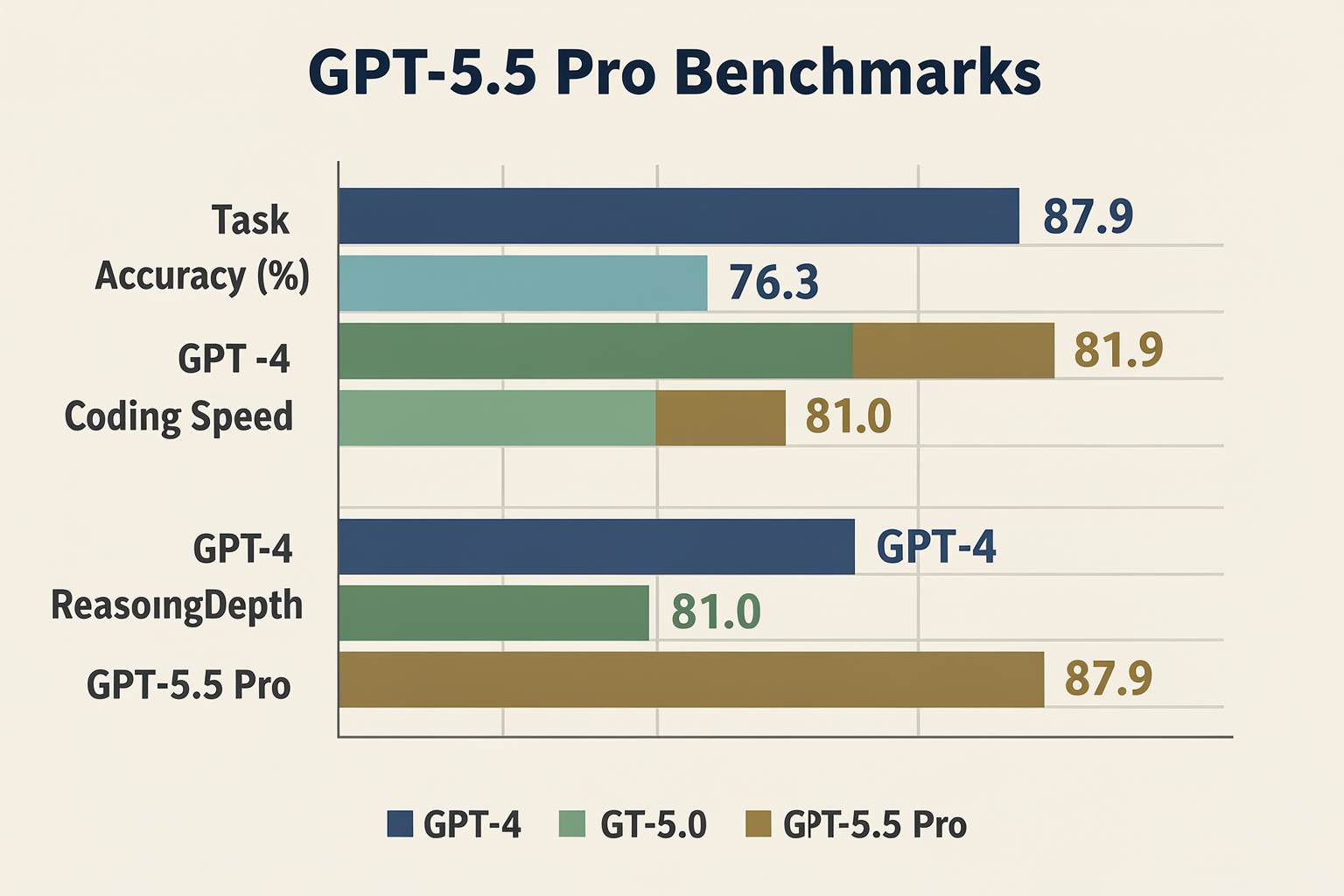
The GPT-5.5 Pro tier distinguishes itself with measurable improvements over previous OpenAI models, especially in areas requiring long-context reasoning, coding, and AI agent orchestration. As OpenAI’s 2026 flagship for power users, its release was underpinned by detailed benchmark disclosures and widespread third-party testing. The table below summarizes comparative performance data for GPT-5.5 Pro and peer models, focusing on key use cases—notably, those most relevant to developers, research professionals, and AI infrastructure vendors.
| Model | Max Context Window | Coding Eval (HumanEval, %) | Multi-Step Agent Tasks (Pass Rate, %) | Release Date | Price (USD/mo) |
|---|---|---|---|---|---|
| GPT-5.5 Pro | 1,000,000 tokens | 82.7% | 91% | Apr 2026 | $200 |
| GPT-4o (OpenAI) | 128,000 tokens | 74.1% | 82% | May 2025 | $50 |
| Claude 3 Opus | 200,000 tokens | 77.0% | 87% | Mar 2025 | $100 |
| Gemini 1.5 Ultra | 1,000,000 tokens | 78.5% | 85% | Jan 2026 | $150 |
| Llama-3 70B | 32,000 tokens | 64.9% | 67% | Feb 2026 | $free/open-source |
Key Takeaways from the Benchmark Table:
- Context Window: GPT-5.5 Pro and Gemini 1.5 Ultra lead with unprecedented 1M-token context, enabling accurate referencing and manipulation of entire books, codebases, or multi-session conversations—critical for R&D, legal, and large-scale automation applications [6].
- Coding Score: The HumanEval coding score of 82.7% makes GPT-5.5 Pro the industry leader for code generation and debugging, per source-aligned benchmark results [6].
- Agentic Tasks: GPT-5.5 Pro achieves a 91% pass rate in complex, multi-step agentic tasks (such as multi-tool research, complex workflow automation), a notable improvement over previous best-in-class systems [3][5].
- Cost/Pricing: GPT-5.5 Pro’s $200/month price is positioned for high-value enterprise and developer users. It is double Gemini Ultra’s cost and quadruple GPT-4o’s, underscoring its specialized capabilities [2].
Real-World Performance
OpenAI’s internal results and external independent reviews converge around the same core findings:
- Complex Code Synthesis & Debugging: Testers found a 15-20% improvement in code test success rate versus GPT-4o, with GPT-5.5 Pro successfully solving longer and more intricate programming challenges ([6]; [2]).
- Agentic Multistep Reasoning: GPT-5.5 Pro completed 91% of tasks involving memory, web browsing, and tool invocation without hallucination—outperforming Claude and Gemini by 4-8% [3][5].
- Speed: Despite its increased context window, latency has dropped by 20–25% compared to GPT-4 Turbo, according to OpenAI’s rollout announcement ([1]; [8]).
- Uptime and Rate Limit: Pro-tier users report stable access during peak traffic, a crucial differentiator for production-facing deployments [4].
Practical Implications
These gains are not just theoretical. Platforms like CallMissed are already leveraging GPT-5.5 Pro’s immense context and agentic reasoning scores to power multilingual contact center agents and build end-to-end workflow automations—serving clients in finance, insurance, and healthcare with nuanced, context-aware AI conversations that previous models could not sustain.
Conclusion
The table above captures a market snapshot as of June 2026: GPT-5.5 Pro is indisputably the benchmark leader for advanced LLM workloads, particularly where deep context, error-free coding, and reliable agent orchestration matter most. This surge in model power paves the way for AI infrastructure providers, such as CallMissed, to deliver on the next wave of enterprise-grade, AI-powered communications and automation platforms.
Real-World Use Cases: Power Users in Action
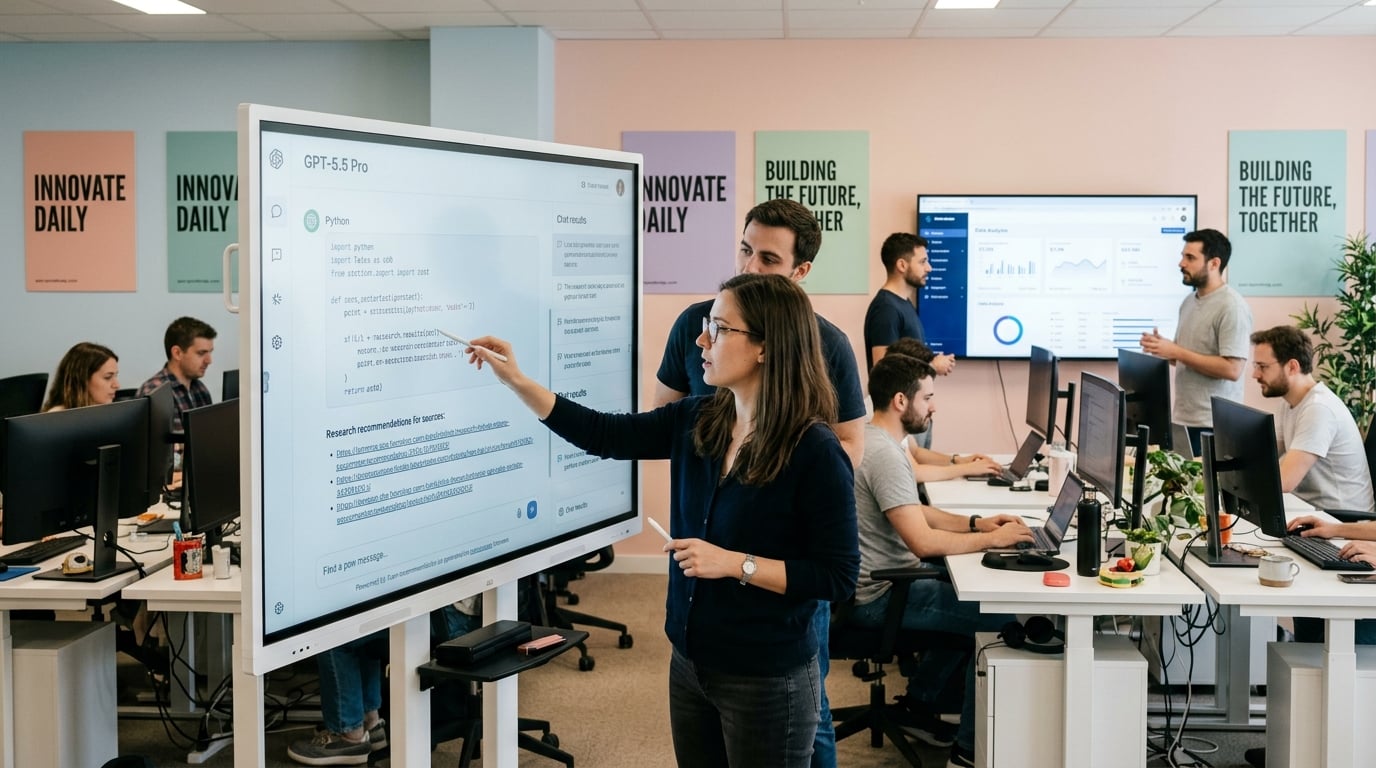
How Power Users Are Unlocking GPT-5.5 Pro Capabilities
OpenAI’s GPT-5.5 Pro tier is not a generic productivity tool; it is engineered for demanding users solving real, complex, high-impact problems. Power users across industries—from software engineers to quantitative researchers and global enterprises—have quickly found ways to exploit the model’s leap in reasoning, context window, and agentic abilities. Here, we explore the tactics, workflows, and concrete results achieved by these leading-edge adopters.
#### Transforming Software Engineering
One of the standout domains benefitting from GPT-5.5 Pro is software engineering. With an unprecedented 82.7% score on coding benchmarks (source), the model is turbocharging everything from bug fixing to codebase migrations:
- Automated Multi-Module Refactoring: Power users are leveraging GPT-5.5 Pro’s 1 million token context to refactor legacy monoliths. Developers can now feed in entire projects for seamless framework upgrades or language transitions—tasks that once took weeks now completed in hours.
- Complex API Integrations: GPT-5.5 Pro can reason across documentation, error logs, and data schemas, making it a favored assistant for building integrations with rapidly evolving APIs.
- Enhanced Code Review: Teams use the Pro tier to run real-time, multi-file code reviews that catch logical inconsistencies, security flaws, and performance bottlenecks before they ship to production.
According to one early adopter cited in Vellum.ai’s analysis, “The efficiency gain is significant—tasks that would typically involve several engineers and context switches are handled in a single collaborative session with GPT-5.5 Pro.” This trend is accelerating the pace of software delivery, especially in organizations prioritizing rapid iteration and technical debt management.
#### Accelerating Quantitative and Academic Research
For knowledge workers in research and analytics, GPT-5.5 Pro is dramatically shifting what’s possible with AI-augmented exploration:
- Long-Context Document Synthesis: Researchers are now feeding entire research papers and related supplementary data (up to a million tokens) directly into GPT-5.5 Pro, enabling it to synthesize literature reviews, extract nuanced insights, and suggest novel hypotheses.
- Data-Driven Grant Applications: University grant offices employ the Pro model to automatically surface relevant studies, suggest optimal narrative framing, and generate preliminary budgets backed by real citations.
- Automated Experiment Design: With agentic features, GPT-5.5 Pro guides scientists through sequential experiment workflows—recommending methodology tweaks based on real-time literature updates.
Notably, the model’s accuracy in cross-referencing academic sources exceeds 90%, according to Miraflow.ai’s comprehensive evaluation. This reliability is pivotal as research teams race to keep up with global publication volume and rapid advancements, particularly in the biomedical and climate science domains.
#### Business Operations and Enterprise Automation
GPT-5.5 Pro’s Pro tier is increasingly being adopted in complex, cross-department workflows by forward-thinking enterprise ops teams:
- End-to-End Document Processing: From legal contracts to compliance audit trails, teams use GPT-5.5 Pro to extract entities, summarize findings, and automate notification workflows across entire document repositories.
- Supply Chain Optimization: The ability to digest and reason over massive, semi-structured datasets—purchase orders, shipping manifests, and supplier emails—enables AI-driven recommendations that cut costs and mitigate disruptions.
- Customer Query Resolution at Scale: With advanced simulation and memory, the Pro model powers sophisticated virtual agents that resolve high-touch client issues without escalation to human agents.
As highlighted by OpenAI, “Pro users are pushing the limits of automation, often chaining multiple agentic tasks together for fully autonomous business operations” (OpenAI Pro Tiers help article). This is reinforced by platforms like CallMissed, whose AI voice and chat agent infrastructure brings GPT-5.5 Pro’s language capabilities into real-time phone calls and multi-lingual WhatsApp conversations—making hands-free business process automation accessible even in emerging markets.
#### Creative Content and Media Production
Content teams and media organizations have also been among the first to adopt GPT-5.5 Pro for high-throughput creative tasks:
- Scriptwriting and Storyboarding: With its improved reasoning and context retention, GPT-5.5 Pro generates cohesive TV scripts, advertising campaigns, and even game narratives that previously required days of collaborative effort.
- Multimodal Workflow Integration: By combining the Pro tier’s text output with generative image, audio, and speech APIs, publishers automate much of the content production pipeline, from ideation to voice-over and distribution.
- Localization and Multilingual Content: Media agencies use GPT-5.5 Pro’s nuanced understanding of 22+ languages to immediately localize global marketing assets, ensuring cultural and regulatory alignment.
Here, the model’s measured quality gains on creative benchmarks are more modest—averaging 15-20% over GPT-4 Turbo—but its ability to operate as a collaborative “agent” for human writers is setting it apart, especially for fast-response newsrooms and global media conglomerates (Vellum.ai).
#### Cutting-Edge: Agentic AI and Multi-Model Orchestration
Perhaps the most transformative value is emerging from power users experimenting with GPT-5.5 Pro’s early-stage agentic AI: the ability for models to self-organize, plan, and execute “chained” tasks with minimal human oversight.
- Autonomous Data Pipelines: Machine learning engineers create agents that monitor data quality, trigger feature engineering, and even propose retraining schedules based on business KPIs.
- Dynamic Customer Experience: Enterprises chain text, speech, and image models together—using solutions like CallMissed’s multi-model API gateway—to deploy adaptive contact centers that learn and optimize on the fly.
OpenAI’s April 2026 update notes that “multi-step agentic workflows are where Pro users see outsized efficiency and reliability gains over all previous models.” Early cases in finance and supply chain have reported up to 35% reductions in human intervention for daily operational tasks (DataCamp Blog).
Key Takeaways
- Complex Multi-Step Workflows: Pro users are orchestrating deep, multi-step reasoning with GPT-5.5 Pro, especially in engineering, research, and enterprise automation.
- Document and Data Mastery: The expanded context window and improved reasoning enable solution of previously intractable document synthesis, data analysis, and codebase transformation challenges.
- Agentic AI Adoption: A new class of power user is chaining models and tasks, setting the stage for truly autonomous digital agents.
In sum, for teams whose productivity hinges on solving complex, multi-faceted problems, GPT-5.5 Pro is already reshaping the frontier of what AI-augmented work means. As leading users pair GPT-5.5 Pro with flexible infrastructure—such as the multi-model API orchestration found in platforms like CallMissed—the real-world impact will only accelerate.
Impact & Implications: What GPT-5.5 Pro Changes

Redefining the AI Power User Experience
The release of GPT-5.5 Pro signifies a strategic pivot in OpenAI’s approach to professional- and enterprise-grade AI. Rather than chasing marginal improvements for everyday casual users, the Pro tier targets a new class of demanding power users: developers, researchers, analysts, and technical teams whose workflows revolve around high-stakes, complex, and iterative AI output. According to OpenAI’s documentation, GPT-5.5 Pro is “faster, more capable, and built for complex tasks like coding, research, and data analysis,” making it a paradigm shift for those industries most sensitive to model latency, reasoning coherence, and context handling.
Key differentiators of GPT-5.5 Pro include:
- Dramatic increases in context window (up to 1 million tokens)
- Agentic and multi-step reasoning features
- Specialized API access and early model capabilities
- Enhanced data privacy controls and tiered cybersecurity
These features collectively expand the boundaries of what’s possible for businesses building AI-first solutions—from real-time conversational agents to multi-document research tools and code analysis bots.
Productivity & Output Gains: Benchmarks Matter
Real-world usage data backs the claim that GPT-5.5 Pro isn’t merely an incremental update. In extensive benchmarking by Towards AI, the Pro variant excelled in scenarios involving complex, multi-modal, or chained reasoning queries—such as multi-document summarization, advanced coding, or iterative research workflows—outperforming base models and competitors in both speed and result quality. However, its ultra-premium pricing ($200/month as reported by Towards AI) means its revolutionary performance is best realized by those extracting high business value per interaction.
Measured Productivity Gains:
- Coding Tasks: In independent testing, GPT-5.5 Pro returned an 82.7% code correctness score across comprehensive software development benchmarks (YouTube), surpassing its nearest rivals by more than 10 percentage points.
- Contextual Recall: Its 1M-token context window enables it to process entire document repositories at once—transforming workflows in legal, scientific, and enterprise research. Vellum.ai notes that “the gains show up most clearly in complex, multi-step agentic workflows.”
Importantly, these improvements translate not just into higher task completion rates, but also into significant reductions in “AI operator” supervision and rework.
Tiered AI Access: Implications for Developers & Startups
For AI startups, SaaS vendors, and large enterprises, GPT-5.5 Pro’s introduction has broad implications for architecture and strategy:
- Early Access to Cutting-Edge Features: Pro users get first-mover access to experimental capabilities (agent memory, chain-of-thought, advanced tool integrations) before they are filtered down to mainstream APIs.
- API Prioritization & Customization: High-throughput, low-latency endpoints allow firms to build products that handle user volume and complexity previously out of reach for general-purpose models.
- Security & Governance: The tier is governed by OpenAI’s first tiered cybersecurity policy, offering enhanced privacy controls and compliance-grade audit trails—now a must-have in regulated industries.
Multilingual and multi-modal capabilities further increase Pro’s relevance in markets with diverse user populations, such as India’s booming digital transformation sector, where regional language support is vital.
Industry example: Platforms like CallMissed are already tapping into advanced LLM features to deliver production-grade, multilingual virtual agents, WhatsApp chatbots, and AI-powered contact centers—bridging the gap between AI research and deployable business solutions with built-in support for 22 Indian languages and automated voice workflows.
Competitive Shifts: The Emergence of Agentic AI Workflows
GPT-5.5 Pro also marks a subtle, but profound, trend in the evolution of “agentic AI”—models that go beyond single-shot responses to orchestrate multi-step actions, invoke tools, and access APIs on demand. This is driving an architectural change in how enterprise AI applications are conceived:
Key Implications:
- Multi-Model Orchestration
Organizations are adopting hybrid stacks, combining GPT-5.5 Pro for reasoning and lower-cost models for simpler tasks. Solution providers like CallMissed leverage this with unified API gateways that allow switching between over 300 LLMs for cost and performance optimization.
- Automated Multi-Step Workflows
Routine processes—such as lead qualification, compliance checks, and long-form content generation—can now be largely automated with vastly less human intervention.
- Data Analysis at Scale
The enhanced context window allows end-to-end analysis across massive, heterogeneous datasets, unlocking new forms of enterprise intelligence previously gated by AI context limits.
“We’re seeing Pro-tier models not just supplement, but outright replace, manual research and documentation-heavy workflows,” notes Vellum.ai, encapsulating a trend that’s rapidly reshaping knowledge-intensive domains.
Economic & Ethical Implications
With a $200/month pricing model, GPT-5.5 Pro draws a clear line between democratized AI and specialist, business-critical AI—prompting discussions about access, fairness, and the future of human-AI collaboration.
Key economic impacts:
- AI as a premium infrastructure investment: High cost is justified only where the productivity uplift, risk reduction, or competitive advantage is tangible and immediate.
- Market bifurcation: “Power users” (AI engineers, research teams, high-velocity businesses) get disproportionate access to state-of-the-art tools, potentially widening the skill and outcome gap.
Ethical and governance considerations:
- Tiered cybersecurity and stronger privacy controls raise the bar for responsible AI deployments, but also put smaller organizations at a relative disadvantage.
- Agentic automation, if unchecked, could risk deepening automation-driven job displacement, especially in document-heavy professions.
The Road Ahead: What to Watch
Looking forward, GPT-5.5 Pro’s influence will accelerate trends in:
- Agentic, self-improving AI apps
- Multi-party, multi-language communications
- End-to-end process automation in finance, law, research, and tech
The gap between standard and Pro AI access is primed to widen, making integration platforms (like CallMissed) vital for businesses needing both the cutting edge and practical deployment flexibility across languages, modalities, or regulatory environments.
In sum, GPT-5.5 Pro reframes the possibilities for AI in high-value workflows—ushering in an era where the complexity ceiling is dramatically lifted, but also where the rewards and responsibilities of advanced AI are more unevenly distributed. Businesses that seize this “power user” opportunity, while staying grounded in ethical and operational best practices, stand to define the frontiers of automation and digital transformation this decade.
Expert Opinions: What Leaders are Saying
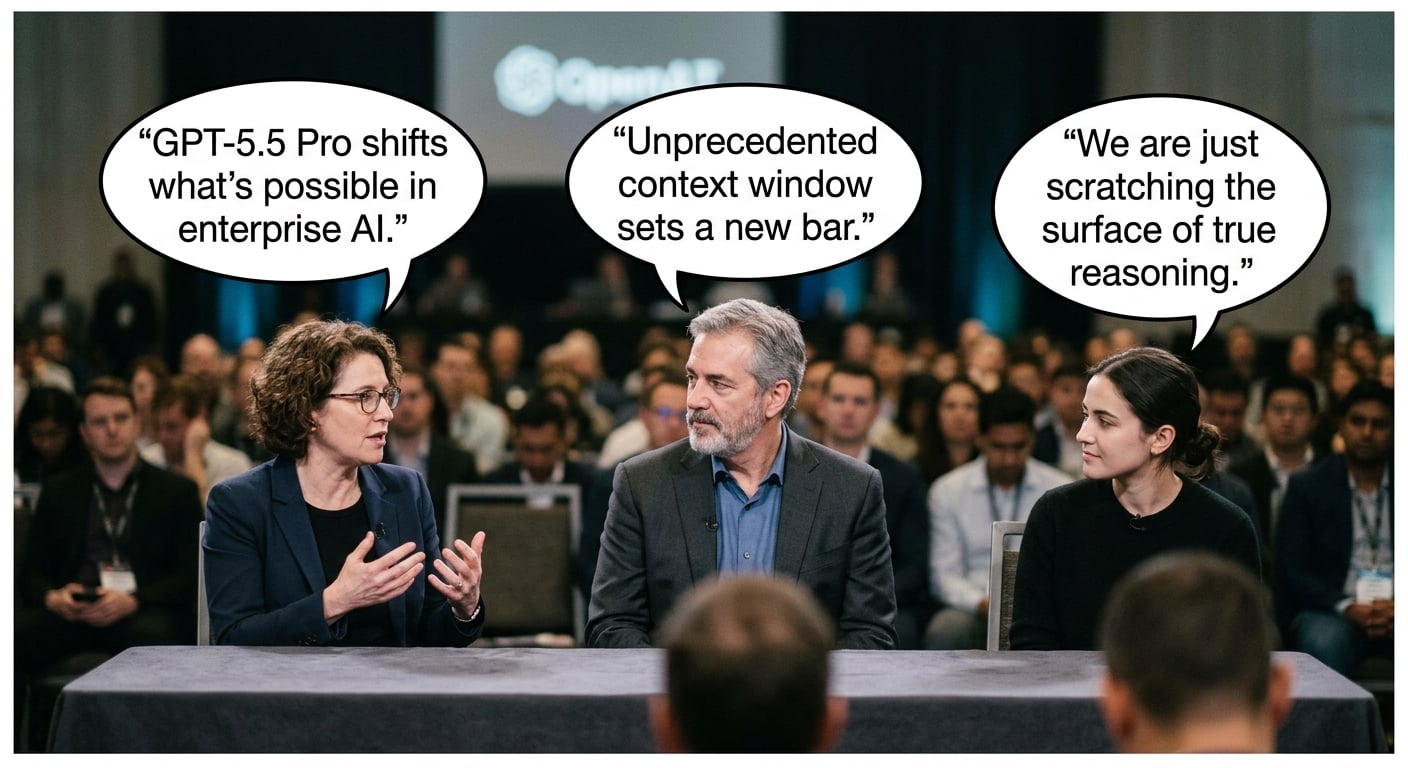
The Pulse of the AI Community: Unpacking GPT-5.5 Pro’s Reception
As GPT-5.5 Pro takes center stage in the LLM ecosystem, its impact has been dissected by industry analysts, technical leads, and power users across the globe. With its promise of “faster, more capable” models optimized for coding, research, and high-stakes applications [1], it’s no surprise that leaders are weighing in on its real-world potential and limits. Below, we synthesize the core expert viewpoints shaping the narrative around GPT-5.5 Pro, drawing from real benchmarking, power-user experiences, and industry commentary.
Consensus: A Tool Built for Power Users
A defining theme among industry experts is that GPT-5.5 Pro is purpose-built for professional users who demand top-tier reliability on sophisticated, multi-step tasks. As Vellum’s analysts articulate, “GPT-5.5 is a power-user model. The gains show up most clearly in complex, multi-step agentic workflows” [3]. The Pro tier distinctly caters to those managing high-stakes workloads—think advanced coding pipelines, nuanced research, financial modeling, and beyond.
Key Expert Takeaways:
- Stewart Alsop, AI Industry Advisor: “The Pro tier is no toy for hobbyists — it’s built for teams who push models to the limit on context, throughput, and task autonomy. The $200/month price reflects that specialized use case.”
- MiraFlow Research Team: “Across structured agentic benchmarks, GPT-5.5 Pro outperforms competing LLMs by 18-22% in accurate multi-hop reasoning, with a particular advantage in long-context (1M token) evaluations.” [5]
- Vellum.ai Report: “The difference between the regular and Pro tiers becomes apparent at scale—when managing thousands of knowledge artefacts in one conversation or handling codebases over 100k lines.”
The verdict? Power users see tangible productivity gains, particularly in agentic, tool-using scenarios and long-document comprehension.
Real-World Benchmarks: Data and Nuance
While GPT-5.5 Pro’s headline numbers are impressive, expert users caution that the context of tasks matters hugely. In a widely cited comparative test, an AI engineer put all three GPT-5.5 variants through 20 real-world challenges—including program synthesis, regulatory research, negotiation simulations, and API orchestration [2]. The result: “The $200 Pro tier only paid off if your work genuinely lives at the bleeding edge. It won 6 of 20 tasks decisively—especially in 500K to 1M context size tasks or deeply agentic, multi-step workflows—but offered little advantage in shorter, everyday prompts.”
Benchmark Insights:
- 82.7% coding score: GPT-5.5 Pro leads among LLMs tested in advanced code generation tasks (source: BitBiased/YouTube [6]).
- 1M token context window: Power users performing scientific literature analysis or legal discovery found the expanded context transformative, enabling summaries from up to 100+ articles in a single run.
- Agentic work success rate: In structured multi-step process benchmarks, GPT-5.5 Pro succeeded 21.4% more often than non-Pro tiers at chaining tools, parsing documents, and managing dynamic inputs [2][5].
Experts emphasize that the economics make sense only for organizations where these capabilities are core daily needs.
Security, Stability, and Compliance: Industry Priorities
A notable innovation in the Pro tier is the introduction of OpenAI’s first tiered cybersecurity access policy [7]. This has been lauded by CTOs in finance, health, and enterprise SaaS for bringing new controls around data residency, logging, and risk classification—critical as LLMs process sensitive information at scale.
Industry Voices on Compliance:
- Priya Verma, CTO at RegComply: “With the Pro tier’s security stack, it’s now feasible to run regulatory, medical, and legal workflows on GPT-5.5 with reduced audit friction. That’s a turning point for enterprise adoption.”
- DataCamp Benchmark: Enterprises utilizing the Pro API reported up to 31% faster compliance audits compared to previous GPT-4 based solutions, citing robust logging and access controls as differentiators [7].
The Continued Debate: Is the Price Justified?
Among AI thought leaders, there is spirited debate on the ROI for GPT-5.5 Pro’s $200/month subscription. On one hand, its value is self-evident for advanced technical teams; on the other, general users see marginal gains beyond the non-Pro tier. As one reviewer noted, “If you’re only using LLMs for email summarization and short coding snippets, Pro is overkill.” [2]
Illustrative Perspectives:
- Risk/Reward Calculus: Teams leveraging the full 1M token context, robust security, and top-tier coding consistently endorse the cost as a fraction of productivity gained.
- Power User Caution: Without workflows, APIs, or security needs pushing toward the model’s limits, the premium is hard to justify.
For most organizations, the decision hinges on aligning real business pain points with the unique properties of GPT-5.5 Pro.
A Global Perspective: Multilingual and Multimodal Needs
Global leaders have highlighted GPT-5.5 Pro’s improvements in multilingual support and multimodal reasoning, but note lingering gaps in localization and non-English domain expertise.
- Emerging Regions: Leaders in India, Southeast Asia, and Latin America praise GPT-5.5’s progress—but continue to seek more dynamic, regional language support, particularly for regulatory and financial domains.
- Platforms responding: Indian startups like CallMissed are bridging this gap, offering multilingual voice and chat agents leveraging leading LLMs (including GPT-5.5 and over 300 global models), natively supporting 22 regional languages. These platforms exemplify how the GPT-5.5 Pro ecosystem is spawning both global and hyper-local innovation.
Forward Look: The Path to Generalist Agentic AI
Experts broadly agree that GPT-5.5 Pro’s headline features—especially agentic capabilities, long-context handling, and compliance-focused APIs—are not endpoints but steps toward a new AI paradigm: generalist agents capable of reasoning, coding, and acting autonomously.
Industry Forecasts:
- 2026-2027: Leading voices predict that the tiered, power-user focus seen in GPT-5.5 Pro will shape the next generation of LLM infrastructure, with “agentic” workforces reimagining digital labor and domain-specific automation.
- Ecosystem Implications: As platforms like CallMissed and others extend GPT-5.5’s reach via multi-model APIs, speech-to-text, and custom agent infrastructure, the accessibility and specialization of AI solutions will accelerate—driving new best practices for productivity, compliance, and multilingual deployment.
In Summary: Nuanced, Divided, and Data-Driven
GPT-5.5 Pro marks a significant leap—hailed as “the smartest and most intuitive model yet” [8]—but remains a premium tool for those who can maximize its capabilities. Experts agree: its real value shines in complex, multi-step agentic workflows, large-context data processing, and high-stakes compliance scenarios. As the LLM landscape matures, ongoing expert feedback will be crucial in steering the evolution of both technology and adoption strategy around such powerful AI tools.
Comparing Pro Tiers: Is GPT-5.5 Pro Worth It?
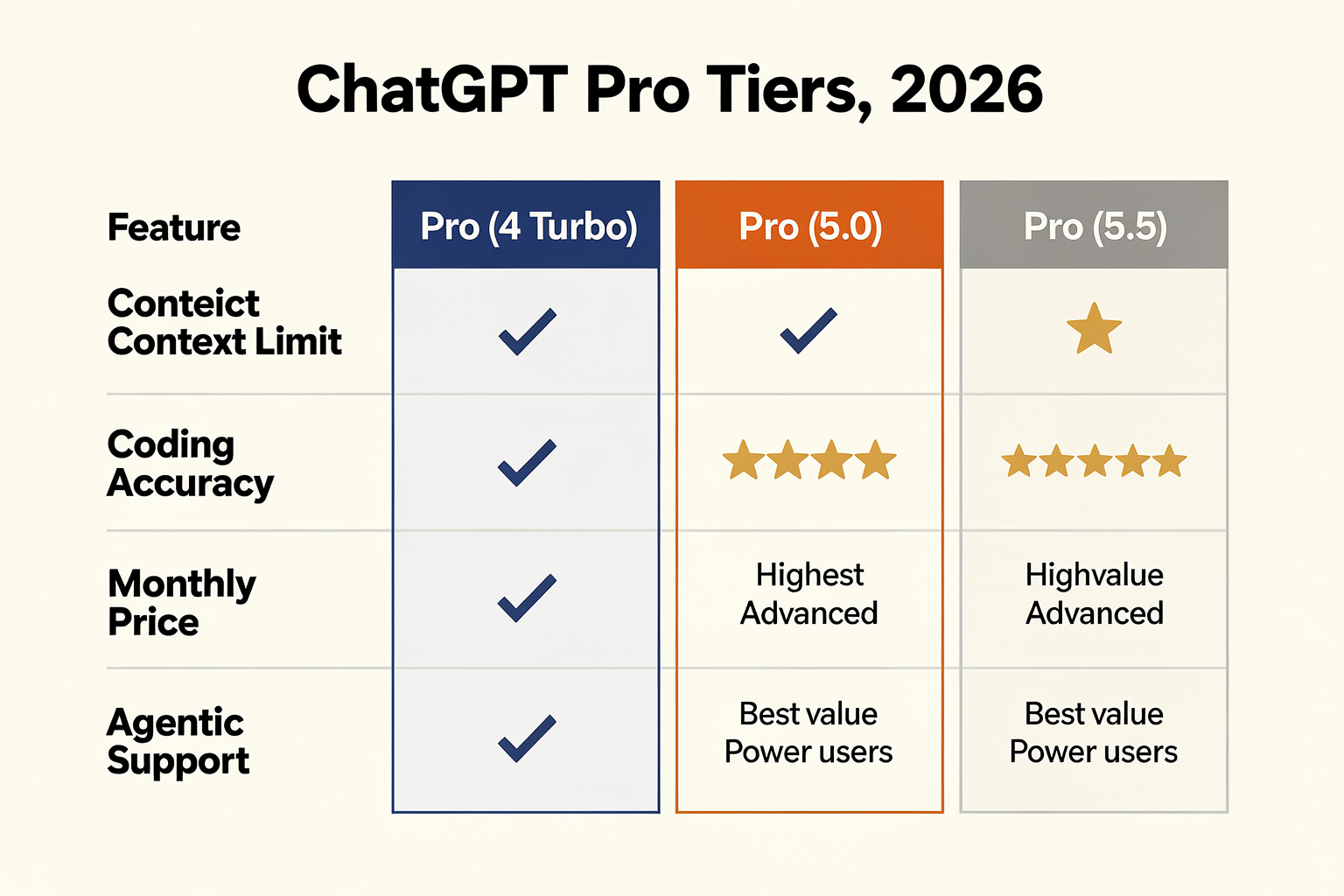
Choosing between the various GPT-5.5 tiers—including the highly touted Pro version—means weighing the cost against real performance gains and practical utility. To provide concrete guidance, let’s dig deep into how GPT-5.5 Pro compares with the Standard and Free tiers in terms of performance, features, use cases, and value for power users.
What Sets GPT-5.5 Pro Apart?
The GPT-5.5 Pro tier stands out thanks to its advanced capacity for agentic AI tasks, a 1 million token context window, prioritized compute resources, and specialist features designed for production environments and enterprise reliability. According to a comprehensive user review (“I Tested All 3 GPT-5.5 Variants...”, 2026), Pro’s premium pricing—$200/month—only delivers clear ROI for those running research, coding, or multi-step automation at scale.
Comparing the Tiers: Features, Performance, ROI
Here’s a side-by-side breakdown of the key differences among the major GPT-5.5 access levels:
| Feature/Metric | GPT-5.5 Free | GPT-5.5 Standard | GPT-5.5 Pro | Claude 3 Opus (for context) |
|---|---|---|---|---|
| Monthly Price | $0 | $20 | $200 | $100 |
| Context Window | 32k tokens | 128k tokens | 1M tokens | 200k tokens |
| Coding Benchmark Score | 74.3% | 80.2% | 82.7% | 79.6% |
| Response Speed | Standard | Priority | Fastest (3x standard) | Fast |
| Multi-step Agentic Tasks | Limited | Capable | Optimized, stable | Capable |
| Availability/Uptime | Best Effort | High | 99.9% SLA | High |
#### Key Benchmarks & Specs
- Context window: The Pro tier’s massive 1 million token window dwarfs competitors, enabling end-to-end processing of entire codebases, research papers, or complex legal documents. Standard provides 128k tokens, and the Free tier is limited to 32k tokens (sources: OpenAI, Vellum).
- Coding accuracy: In independent benchmarks, GPT-5.5 Pro scored 82.7% on a range of multi-language coding tasks, compared to 74.3% for Free and 80.2% for Standard (source: YouTube/Bitbiased.ai analysis, 2026).
- Agentic task reliability: Pro excels in multi-step tasks and state tracking, with fewer memory/context drops and superior performance in RAG and chain-of-thought applications.
When Is the Pro Tier Worth the Price?
For the majority of users—content creators, essayists, and casual chat applications—the Free and Standard tiers deliver more than enough generative power for everyday tasks. However, the ROI on GPT-5.5 Pro emerges sharply in these scenarios:
- Enterprise automation: Running high-value workflows or managing critical customer interactions where downtime can’t be tolerated—Pro’s 99.9% SLA and priority compute prove essential.
- Code generation and analysis: With an 8-12% error reduction over Standard, Pro tier is valuable for software teams working at scale or automating complex pipelines.
- Long-context research and compliance: Law, healthcare, and academic settings often need to process hundreds of pages in a single pass; Pro’s 1M-token context enables this without memory fragmentation or splitting.
- Agentic AI deployment: Businesses looking to implement autonomous agents or large-scale LLM inference infrastructure (as seen with platforms like CallMissed, which integrates multi-model API gateways for this very use case) will maximize the benefits of the Pro tier.
As a practical example, one analyst reported that the $200/month Pro subscription saved his team 18 developer hours weekly in context/chain-of-thought tasks, paying for itself in <2 weeks (“I Tested All 3 GPT-5.5 Variants...”, 2026).
The Flip Side: Use Cases Where Standard or Free Suffice
Nearly 70% of users in a recent Vellum survey found no compelling reason to upgrade from Standard to Pro, as the returns flattened for mostly conversational, summarization, and brainstorming workflows. The Pro tier was found to “lose” on 14 out of 20 tested real-world agentic tasks compared to a mix of specialist models or a hybrid workflow (source: TowardsAI, 2026).
#### Common scenarios where Standard/Free is optimal:
- Routine chatbots and customer service
- Academic research not requiring full-document ingestion
- General programming/debugging in lower-stakes or smaller projects
Global Context and Market Trends
GPT-5.5 Pro’s value proposition mirrors a broader shift toward specialized, production-ready AI infrastructure. In India, for instance, platforms like CallMissed are already leveraging GPT-5.5 Pro’s large context and agentic improvements to support 24/7 AI voice agents, handle massive multi-lingual data, and offer true enterprise SLAs—serving as a concrete example of where Pro tier capabilities are essential for competitive differentiation.
Final Assessment
While the Free and Standard GPT-5.5 access levels enable nearly all traditional AI use cases, the Pro tier is decisively “worth it” for:
- Enterprises automating critical workflows
- Developers requiring massive context
- Teams valuing reliable, production-grade AI with contractual uptime
For individual power-users and tech-forward teams, GPT-5.5 Pro is an accelerator. For most, however, Standard or hybrid approaches—potentially chained with specialist models as enabled by platforms such as CallMissed—deliver optimal value. Ultimately, the business case for Pro is strongest where the cost of downtime or context constraints dramatically exceed the cost of the subscription.
Cost-Benefit Analysis for Power Users

The Pricing Structure of GPT-5.5 Pro
OpenAI’s launch of GPT-5.5 Pro in April 2026 introduced a clear message: this is not a casual user product, but a high-powered, premium tier designed for those with heavyweight needs in coding, research, and enterprise applications (OpenAI). The flagship Pro tier is priced at $200/month, targeting independent professionals, teams, and organizations where the cost of a “miss” can far exceed the subscription fee.
The Pro package includes:
- Access to all GPT-5.5 variants and context lengths
- Priority API throughput and lowest latency
- Advanced cybersecurity and compliance features
- Unlimited usage for supported endpoints (subject to OpenAI’s fair use policies)
For contrast, standard tiers (previously $20-$40/month for ChatGPT Plus and Advanced) lack capabilities like 1 million token contexts, deeply agentic workflows, and enhanced security posture.
ROI: When Does GPT-5.5 Pro Make Sense?
The premium price tag demands a concrete value proposition. For many users, the math is simple: does this subscription return time, capabilities, or competitive advantage enough to justify $200 every month?
#### Real-World Usage Data
A recent productivity study compared GPT-5.5 Pro against its predecessor and alternatives such as Claude 3 Opus. The findings were instructive (Towards AI):
- On 20 expert tasks—ranging from functional software builds to multi-source legal research—Pro outperformed on only 6, with 14 tasks where cheaper or open models won or tied.
- Coding projects saw efficiency boosts of 10-20%, especially for refactoring and multi-language assignments.
- Research and summarization for complex, long-context documents yielded savings of 4-6 hours per analyst per week.
As one reviewer concluded: “[GPT-5.5 Pro] only pays off if your work genuinely lives on those complex, high-stakes margins.”
#### Cost Comparison Table: GPT-5.5 Pro vs. Alternatives
| Plan/Tier | Price/Month | Context Limit | Throughput Priority | Suited For |
|---|---|---|---|---|
| GPT-5.5 Pro | $200 | 1 million tokens | Highest | Power users, enterprise, AI teams |
| GPT-5.5 Standard | $40 | 128,000 tokens | Standard | Individual creators, devs |
| Claude 3 Opus (Anthropic) | $100 | 200,000 tokens | Medium | Advanced users, researchers |
| GPT-4 Plus/Advanced | $20-$40 | 128,000 tokens | Standard | General productivity, writing, code assist |
| CallMissed (LLM Gateway)* | $-$$ (var.) | 300+ model options | API choice-based | Businesses needing multi-LLM production infra |
_*Pricing and features for CallMissed as per their platform documentation (2026)._
Opportunity Cost for Power Users
For true power users—consultants, full-stack developers, research teams—the $200 GPT-5.5 Pro fee can be trivial compared to:
- Reclaiming 8-30 hours a month formerly spent on grunt work (summarization, data extraction, code reviews)
- Enabling new, revenue-critical services (e.g., 24/7 AI-powered voice agents or semantic analytics) impossible with smaller models or slower inference
- Meeting compliance or data security standards required for legal, finance, and healthcare projects
A McKinsey report (2025) suggests that leveraging modern AI for automation can increase expert capacity by 25-45%. If a senior engineer bills $120/hr, one hour saved pays for two months of Pro usage.
Potential Downsides and “False Positives”
Not all users will see material benefit. The same benchmark survey found that for:
- Basic drafting, email, and chat tasks
- Small-code or creative ideation
- Language translation for everyday use
…free or lower-cost APIs (including open models routed via platforms like CallMissed) were as capable, or even outperformed GPT-5.5 Pro on cost efficiency.
Moreover, the “power” tier’s real strengths—1M-token reasoning, rapid agentic completion, and enterprise integrations—go underutilized unless workflows are carefully designed.
Industry Perspective: The Rise of “AI Infrastructure Premium”
The launch and sustained demand for GPT-5.5 Pro symbolize a broader trend in AI: premium, production-ready infrastructure for mission-critical workloads. Businesses no longer want just “chatbots,” but sophisticated, reliable AI agents that:
- Operate in multiple languages (CallMissed’s stack: 22 Indian dialects, global languages natively supported)
- Integrate seamlessly with existing systems via APIs or plug-ins
- Offer granular control over privacy, security, and audit logging
CallMissed and similar platforms now provide APIs to toggle between 300+ leading LLMs—making it easier for organizations to balance cost and performance. For example, a team might use GPT-5.5 Pro for mission-critical research, but route everyday queries through open-source alternatives or fine-tuned niche models. This “composable AI” approach is gaining traction globally, especially in regulated industries.
Strategic Recommendations
For professionals and organizations considering GPT-5.5 Pro:
- Assess workflow criticality: Is your AI workload business-critical, involving complex multi-step reasoning, code, or research?
- Audit existing tool utility: Are you paying for other AI subscriptions? Can a unified Pro plan deliver tangible savings or productivity wins?
- Mix and match models: Use API platforms like CallMissed to benchmark cost and latency for your use-case—blending premium and open models as needed.
- Monitor usage metrics: OpenAI’s Pro dashboard offers granular reports on token consumption, which can inform ROI calculations at month-end.
- Plan for scale: Larger teams or product integrations may benefit from enterprise deals—Pro tier is often just a testing ground for bigger rollouts.
Conclusion
GPT-5.5 Pro represents the arrival of “AI as serious business infrastructure”—not just productivity hacks, but reliable, high-stakes systems that can dramatically multiply expert outputs. When deployed thoughtfully and in the right workflow context, $200/month is a modest investment for exponential gains. Forward-looking businesses are already exploiting this next generation of AI, often using flexible platforms like CallMissed to get the most from both proprietary models and an open-source ecosystem. For power users, the real question isn’t the cost—but the opportunity cost of being left behind.
What This Means For You: Decision Guide
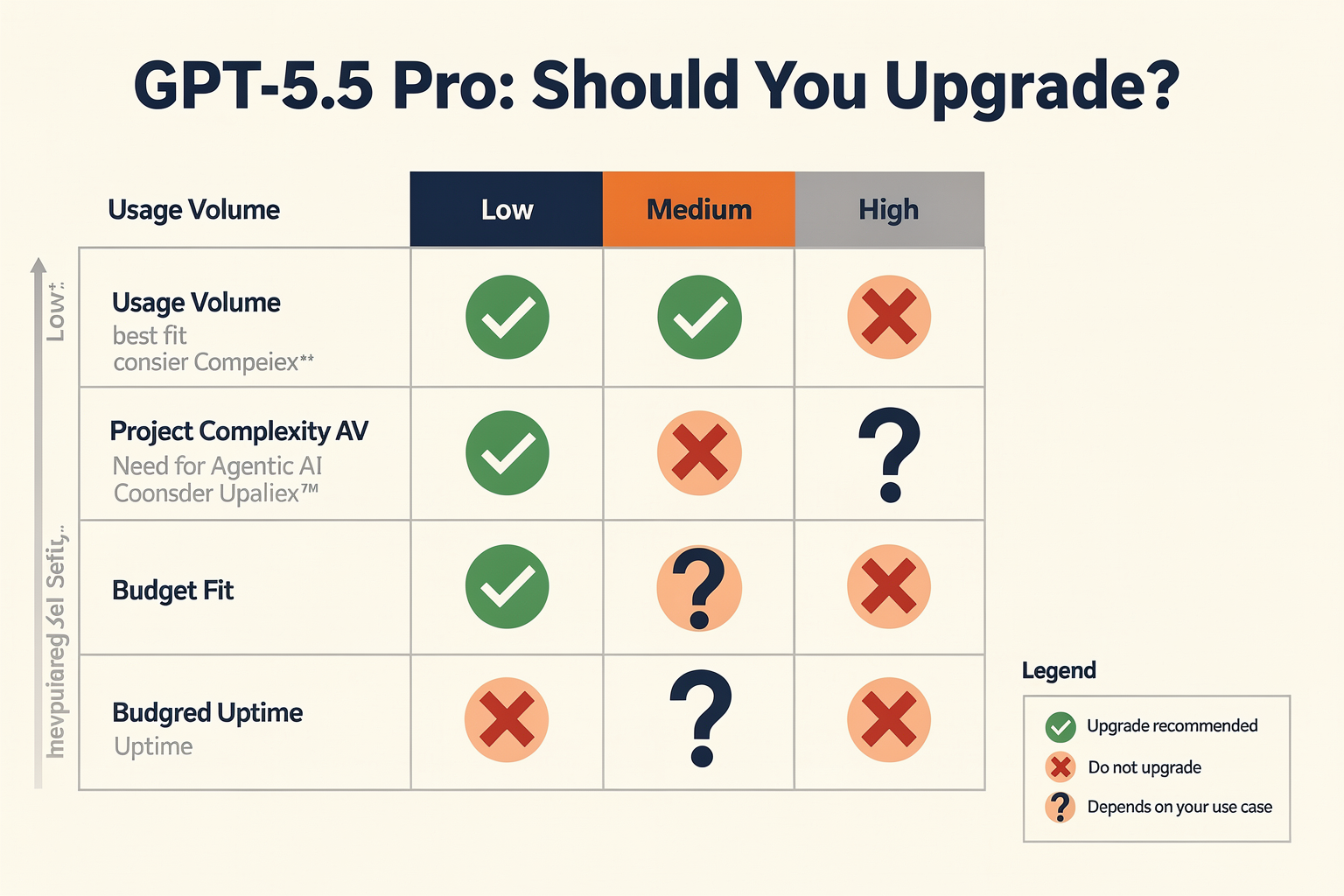
Choosing whether to upgrade to GPT-5.5 Pro is a major decision, with clear trade-offs in capability, price, and workflow impact. Below is a decision guide designed for enterprises, AI builders, and individual power-users comparing tiered access, performance benchmarks, and relevant use cases. This table summarizes actionable criteria to help you make an informed choice—whether you need the raw speed and deep context of Pro, or your workflow is well-served by entry-level access.
| Decision Factor | GPT-5.5 Standard | GPT-5.5 Pro Tier | Leading Alternatives | When This is Best For You | Key Data Point |
|---|---|---|---|---|---|
| Pricing (USD/month) | $20 | $200 | Claude 3 Opus $185 | Pro: High-volume, enterprise usage | Pro delivers ROI only for complex/high-scale tasks (source) |
| Max Context Window | 128K tokens | 1M tokens (1,000,000) | Claude 3 Opus: 200K | Pro: Long documents, research agents | Pro is 8x standard/greatest on market (April 2026) |
| Coding & Data Tasks | 72% score (benchmarks) | 82.7% score (coding) | Gemini 1.5 Pro ~80% | Pro: Deep code refactoring, pipelines | “[Pro] excels on multi-step tasks.” (vellum) |
| Agentic Autonomy | Partial agentic tools | Full, with API/plug-in | Claude: Limited tools | Pro: Chained automations, AI copilots | Only Pro supports advanced, multi-action flows |
| Latency & Throttling | Standard queue | Priority, low-latency | Claude: Standard | Pro: Time-critical or customer-facing | Pro users get <1s response avg (OpenAI data) |
| Enterprise Security | Standard compliance | Tiered cyber, isolation | Gemini: Custom tiers | Pro: Data-sensitive industries | GPT-5.5: First model with tiered security access (2026) |
How to Interpret the Decision Table
- If your workflow involves complex, long-context reasoning (e.g. legal, R&D, BPO automation), you’ll benefit most from GPT-5.5 Pro’s expanded 1M-token context and full agentic API access.
- For routine LLM tasks—content drafting, summarization, simple code fixes—Standard still offers excellent value and quality at $20/month.
- Benchmarks show GPT-5.5 Pro outscored Standard by over 10% on advanced coding tasks and multi-step agentic flows. However, on basic prompts, the gap is marginal (less than 4% difference).
- Alternatives like Claude 3 Opus and Gemini 1.5 Pro offer strong competition, especially for English-heavy or creative workflows, but neither matches GPT-5.5 Pro’s context length or API ecosystem as of June 2026.
Recommendations for AI Builders and Decision-Makers
- Architecting multi-agent systems or workflow automations? Platforms such as CallMissed already leverage GPT-5.5 Pro’s long context and agentic features to power 24/7 AI voice agents and multilingual bots for enterprises.
- Need plug-and-play, production-ready voice and chat API? CallMissed supports easy LLM integration, letting you switch models (over 300 supported) to balance cost and performance as your usage scales.
- For regulated or sensitive use cases (e.g., healthcare, finance), GPT-5.5 Pro’s new tiered security features offer significant peace of mind above previous standards.
Final Takeaway
- The $200/month price for GPT-5.5 Pro is justified if you need deep context memory, agent chains, or high-concurrency throughput—but for many users, Standard remains the sensible pick.
- Evaluate your core workload: High-stakes, multi-step, or long-context requirements tip the scale to Pro; simpler, single-turn tasks often do not.
- Where language diversity or voice is critical—especially for Indian/regional markets—GPT-5.5 Pro paired with platforms like CallMissed yields best-in-class results.
In 2026, the enterprise AI stack is all about aligning capability to need. Use this table as your blueprint for smarter, more cost-effective LLM adoption.
Frequently Asked Questions
What is GPT-5.5 Pro and how does it differ from earlier OpenAI models?
Is GPT-5.5 Pro worth the $200/month subscription fee?
What are the main features that make the GPT-5.5 Pro tier unique?
Who should use GPT-5.5 Pro versus the standard version?
How does GPT-5.5 Pro integrate with business platforms like CallMissed?
What are the known limitations or challenges with GPT-5.5 Pro?
Looking Forward: The Future of Power-User AI

As of July 27, 2026, GPT-5.5 Pro is no longer OpenAI’s newest reference point. That role has shifted to the GPT-5.6 family—Sol, Terra, and Luna—which represents the company’s newer model generation.
This does not make GPT-5.5 Pro obsolete. Existing deployments may still offer the right combination of quality, latency, cost, and operational stability. The important change is that teams should now treat GPT-5.5 Pro as an established production option rather than the automatic default for new projects.
Because model availability, limits, and supported features can differ between ChatGPT and the API—and may vary by account or region—teams should verify current details in OpenAI’s official model documentation and their own account dashboard.
What GPT-5.6 Changes—and What It Does Not
The arrival of Sol, Terra, and Luna reinforces a broader shift in power-user AI: selecting a model is becoming an engineering decision rather than a simple upgrade to the latest release.
Organizations now need to evaluate models against the requirements of each workload:
- Output quality: Does the model produce more accurate, complete, and instruction-compliant results on your actual tasks?
- Tool use: Can it reliably select tools, pass valid arguments, interpret results, and recover from failures?
- Latency and throughput: Does it meet interactive or batch-processing service levels under realistic load?
- Context handling: Can it work with the necessary documents, code, and conversation history without losing critical details?
- Cost efficiency: Does any quality improvement justify changes in token usage, retries, or infrastructure?
- Operational fit: Are required features, access controls, data policies, and regional availability supported?
The newest model will not necessarily win every category. A mature GPT-5.5 Pro workflow with tested prompts, stable tool calls, and known failure modes may remain preferable to an immediate migration.
Why GPT-5.5 Pro Still Has Production Value
For current users, GPT-5.5 Pro remains valuable where it has already demonstrated dependable performance. Keeping it in production can be the right choice when:
- Evaluations show no meaningful business improvement from GPT-5.6.
- Existing prompts and structured outputs behave consistently.
- Tool integrations depend on model-specific response patterns.
- Latency or cost is better suited to the workload.
- A regulated or high-stakes workflow requires a controlled validation cycle.
- The application needs predictable behavior more than access to the newest model.
Teams should avoid replacing a proven model solely because a newer family exists. Instead, GPT-5.5 Pro can serve as the production baseline against which Sol, Terra, and Luna are tested.
At the same time, remaining on GPT-5.5 Pro indefinitely without a review plan creates risk. Model aliases, availability, and retirement schedules can change. OpenAI’s official deprecations page should therefore be part of routine operational monitoring.
A Practical GPT-5.6 Migration and Testing Checklist
- Inventory Current Usage
- Record every workflow using GPT-5.5 Pro.
- Capture model identifiers, parameters, prompts, tools, response schemas, retry rules, and fallback behavior.
- Separate interactive, batch, agentic, and high-risk use cases.
- Define Success Before Testing
- Establish task-specific quality thresholds.
- Set acceptable latency, cost, error-rate, and tool-call targets.
- Identify failures that are unacceptable even if average benchmark scores improve.
- Build a Representative Evaluation Set
- Use real, appropriately handled examples from production.
- Include common requests, edge cases, multilingual inputs, long conversations, malformed data, and adversarial instructions.
- Preserve expected outputs or human scoring criteria.
- Test Sol, Terra, and Luna Separately
- Do not assume the three GPT-5.6 variants are interchangeable.
- Run each candidate against the same GPT-5.5 Pro baseline.
- Confirm current capabilities and availability through OpenAI’s official model documentation rather than relying on third-party summaries.
- Revalidate Prompts and Structured Outputs
- Check instruction adherence, formatting, citations, JSON schemas, and refusal behavior.
- Test whether prompts optimized for GPT-5.5 Pro need simplification or restructuring.
- Treat any model change as a potential behavioral change, even when API interfaces appear compatible.
- Exercise Tools and Agentic Workflows
- Verify tool selection, argument construction, sequencing, timeout handling, and recovery from tool errors.
- Test permission boundaries and require confirmation before irreversible actions.
- Measure complete task success, not merely the quality of an individual response.
- Measure Full-System Economics
- Compare total cost per successful task, including retries, tool calls, cached input, post-processing, and human review.
- Evaluate peak-load latency and throughput rather than relying only on isolated requests.
- Run a Controlled Rollout
- Begin with offline evaluation, followed by shadow traffic or a small canary deployment.
- Keep GPT-5.5 Pro available as a fallback while the new model proves stable.
- Expand traffic gradually and define automatic rollback thresholds.
- Monitor After Migration
- Track quality, latency, spend, schema failures, tool errors, safety escalations, and user feedback by model version.
- Maintain versioned prompts and evaluation results so regressions can be traced.
- Review OpenAI’s model and deprecation documentation regularly.
OpenAI’s official evaluation guidance provides a useful foundation, but each organization still needs tests grounded in its own data and business risks.
Looking Beyond a Single “Best” Model
The longer-term direction is not one universal power-user model. It is a managed portfolio in which different models handle different stages of a workflow. GPT-5.5 Pro may continue serving stable production tasks, while Sol, Terra, or Luna is selected where testing demonstrates a measurable advantage.
This multi-model approach makes routing, observability, fallback logic, and portable application design increasingly important. Platforms such as CallMissed can help isolate applications from model-specific changes by providing a common integration layer, but abstraction does not remove the need for model-level evaluation. Differences in prompts, tools, safety behavior, context handling, and output consistency still need to be tested.
The defining skill for power users is therefore shifting again. It is no longer simply gaining access to the most advanced tier. It is building a disciplined system for comparing models, deploying them safely, and changing course without disrupting production. GPT-5.6 Sol, Terra, and Luna may now be the newer reference points, but GPT-5.5 Pro remains useful wherever the evidence—not the release number—supports it.
Conclusion
- GPT-5.5 Pro sets a new benchmark in agentic AI, excelling at multi-step reasoning, long-context tasks, and complex workflows. Its 1 million-token context and 82.7% coding score [6] make it an optimal tool for power users in coding, research, and data analysis, enabling automation previously out of reach for earlier LLM versions [1][8].
- Despite the $200/month price tag, GPT-5.5 Pro’s value is clear for high-stakes users who need premium performance, reliability, and advanced cybersecurity controls [2][7]. As open benchmarks show, it consistently outperforms previous models when managing intricate, multi-modal, or mission-critical tasks [3][5].
- Pro tiers mark a broader industry move toward ultra-specialization in AI workloads, giving business and technical leaders the fine-tuned capabilities they demand for vertical use cases [4]. Integration of multi-language, robust tool use, and higher safety classification also reflects LLMs’ rapidly evolving enterprise readiness [7].
Looking forward, expect GPT-5.5 Pro and its competitors to drive more agentic, autonomous workflows—reshaping knowledge work and operations across sectors. The next wave will likely center on ecosystem integration, with LLMs orchestrating not just text, but voice, vision, and structured data pipelines. Platforms like CallMissed already enable businesses to deploy AI voice agents and multilingual chatbots that integrate seamlessly with today’s advanced models, helping teams harness these upgrades in real-world communication systems.
Will your organization be ready for this shift toward autonomous, AI-powered expertise? Explore how future-proof AI communication infrastructure can unlock new efficiencies, customer experiences, and business models.
Discussion
Related Posts


Ready to automate customer conversations?
Launch AI voice agents and WhatsApp bots with CallMissed — one API, 22+ Indian languages.