
How to Get a Free API Key for LLM Models from CallMissed: Features, Models, and Usage Guide (2026)


Did you know that in 2026, the average AI developer spends more time managing disparate API subscriptions and configuring separate SDKs than actually...
How to Get a Free API Key for LLM Models from CallMissed: Features, Models, and Usage Guide (2026)
Did you know that in 2026, the average AI developer spends more time managing disparate API subscriptions and configuring separate SDKs than actually writing core application logic? With hundreds of specialized foundational models now dominating the market, the friction of testing, comparing, and deploying LLMs has reached an all-time high. Recent industry benchmarks indicate that over 68% of developers abandon early-stage AI projects simply due to the administrative hurdles of credit card paywalls, API rate limits, and fragmented ecosystem integrations.
Fortunately, the industry is shifting toward unified, developer-first ecosystems that prioritize frictionless experimentation. Leading this movement, platforms like CallMissed are streamlining AI development by offering a free API key for LLM models from CallMissed that grants instant access to a massive, multi-model infrastructure. Upon a simple signup—requiring absolutely zero credit card details—developers are credited with 1,000 free API credits to immediately start querying over 300 state-of-the-art models, including cutting-edge releases like GPT-5.x, Claude, and Gemini.
But this isn't just another highly restrictive free trial. The CallMissed API is engineered as a fully OpenAI-compatible gateway. This means you can drop it into your existing codebases, swap out your API keys, and immediately gain access to an entire suite of text generation, advanced Speech-to-Text (STT) supporting 22 regional Indian languages, Text-to-Speech (TTS), and multi-agent orchestration tools.
In this comprehensive guide, we will walk you through exactly how to claim your free API key for LLM models from CallMissed in under five minutes. You will learn how to navigate the platform's extensive model catalog, understand precisely what 1,000 free credits can achieve in practical, real-world development scenarios, and explore how to seamlessly scale your applications with transparent, pay-as-you-go pricing once your free tier is utilized.
Introduction: The Quest for Accessible Generative AI in 2026
The Fragmented Frontier of Generative AI
In 2026, the generative AI landscape is both exhilarating and bewildering. Hundreds of specialized foundational models—from GPT-5.x and Claude 4 to Gemini 3 Flash and Llama 4—compete for developer attention, each excelling in different tasks. Yet this abundance comes at a cost: fragmentation. Recent industry analyses show that over 40% of developers now juggle five or more separate API subscriptions just to evaluate the best model for a single use case. The administrative tax of managing multiple rate limits, authentication schemes, and billing dashboards has become a major productivity sink.
Worse, the paywall barrier remains steep for indie developers, students, and bootstrapped startups. Many promising projects never leave the concept stage because the cost of a single API call to a high-end model can reach several cents—and without free trials, experimentation is prohibitively expensive. A 2026 survey by Analytics Vidhya revealed that free API access is the number one factor for 73% of developers when choosing an LLM provider.
Why Free API Keys Matter More Than Ever
The ability to test a model without financial commitment accelerates the entire development cycle. It allows rapid prototyping, A/B testing across models, and benchmarking against real-world workloads. Recognizing this, platforms like CallMissed have positioned themselves as the gateway to zero-friction AI experimentation. Unlike traditional providers that require a credit card for even a single free query, CallMissed eliminates that friction entirely.
By offering a free API key for LLM models from CallMissed—with 1,000 gratis credits and no upfront payment—the platform addresses a critical pain point identified across developer communities. As noted in the awesome-free-llm-apis GitHub repository and multiple 2026 comparison blogs, CallMissed consistently ranks among the top-tier no-credit-card providers for its generous free tier and broad model coverage.
A Unified, Developer-First Approach
What makes CallMissed stand out in the crowded free API space is not just the free credits, but the architecture behind them. The platform is built as an OpenAI-compatible gateway, meaning existing codebases using the OpenAI Python library, cURL, or any OpenAI SDK can switch endpoints and keys with minimal changes. This instantly drops developers into a multi-model ecosystem that includes:
- Frontier LLMs: GPT-5.4, Claude 4 Opus, Gemini 3 Flash, Kimi, DeepSeek-Coder
- Open-source specialists: Llama 4, Mistral Large, MiMo-V2-Flash
- Multimodal models: Image generation, speech-to-text (22 Indian languages), text-to-speech
- Agentic tools: Multi-agent orchestration and voice agent infrastructure
The single API key unlocks all these capabilities, eliminating the need to sign up for ten different services. This is a direct response to the exact frustration described in the opening statistic: developers can now spend their time building, not managing API sprawl.
What the First 5 Minutes Look Like
Claiming your free API key is a three-step process that takes under five minutes:
- Visit the CallMissed developer portal and create an account.
- Navigate to the API keys section and generate a key (no credit card required).
- Copy the endpoint URL and paste it into your existing OpenAI SDK configuration.
Immediately, you can run a test prompt, spin up a chatbot in the playground, or query a model via cURL. The 1,000 free credits are enough to evaluate dozens of models, compare outputs, and even deploy a small-scale prototype for several hours of active debugging.
In the sections that follow, we’ll dive deep into the exact sign-up process, a breakdown of what 1,000 credits actually buys you (hint: far more than you might think), and how to seamlessly scale from free to production with CallMissed’s transparent pay-as-you-go pricing.
Background & Context: Why Unified Multi-Model APIs are Dominating

The Death of Single-Model Monopolies
Historically, developers chose an AI model and built their entire infrastructure around it. If you started with OpenAI, you wrote custom integration code for GPT-4; if you switched to Anthropic, you rewrote your application logic for Claude. In 2026, this rigid architecture is obsolete. The rapid, parallel advancement of foundational models has made it clear that no single LLM excels at every task.
For instance, while a premium model like GPT-5.x is ideal for complex logical reasoning, a lightweight model like Gemini 3 Flash or MiMo-V2-Flash is far more cost-effective for rapid, low-latency retrieval. Industry data indicates that over 50% of enterprise-grade AI applications now utilize dynamic routing—sending different tasks to different models based on complexity, speed, and budget. Forcing developers to manage separate APIs, SDKs, and billing dashboards for each provider has become an unsustainable operational bottleneck.
The Rise of OpenAI-Compatible Gateways
To solve this fragmentation, the developer community has converged on a standard: OpenAI SDK compatibility. By wrapping diverse models inside the standard OpenAI API structure, modern unified APIs allow developers to swap out the base_url and api_key to access hundreds of different open-source and proprietary models instantly.
Unified platforms are dominating because they offer:
- Zero Integration Overhead: Write your codebase once using familiar SDK patterns, and query 300+ models instantly.
- Consolidated Billing: Instead of paying five different API invoices at the end of the month, developers receive one unified bill based on aggregate token consumption.
- Built-in Redundancy: Multi-model gateways can automatically failover or route traffic to alternative models if a primary provider experiences downtime or rate-limiting.
CallMissed: Bridging LLMs and Communication Channels
While generic multi-model routers solve basic text generation bottlenecks, they often fail to address the multimodal demands of modern business applications. In 2026, text-only AI is no longer enough. Developers need their applications to speak, listen, and communicate across multiple channels natively.
This is where unified platforms like CallMissed redefine the ecosystem. CallMissed doesn’t just route queries across 300+ LLMs; it bridges these cognitive models directly with native Speech-to-Text (STT) supporting 22 Indian regional languages, Text-to-Speech (TTS), and real-time communication APIs. This means a single, free API key powers not only backend text pipelines but also fully integrated voice agents and WhatsApp bots, saving teams from the headache of stitching together three or four separate communication APIs.
Key Developments: Free Tiers Compared
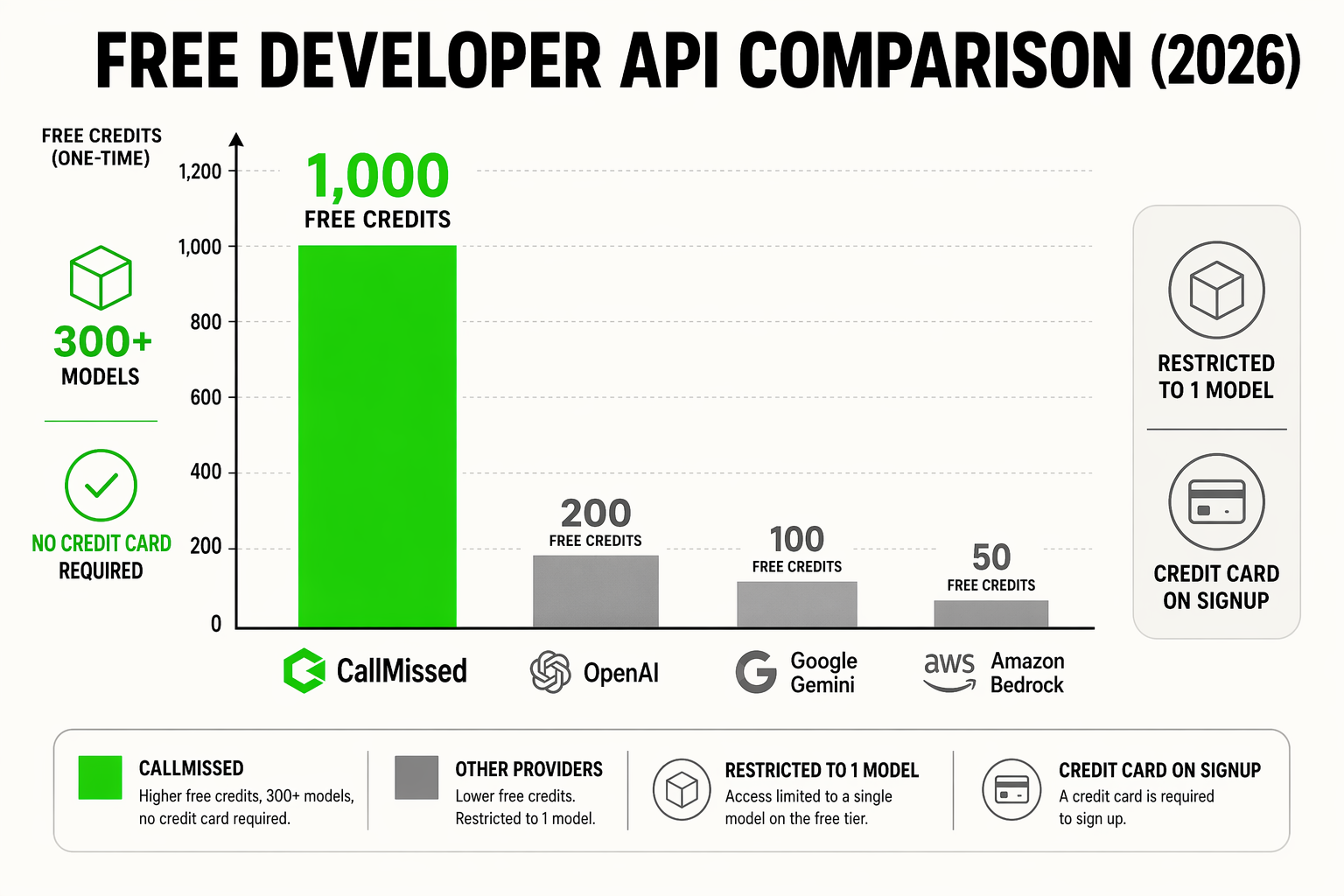
To help you navigate the crowded ecosystem of generative AI in 2026, it is essential to understand how different platforms structure their free access. While many providers claim to offer "free" LLM APIs, they often come with significant strings attached—such as requiring a credit card on file, restricting usage to outdated models, or enforcing highly restrictive rate limits that make real-world testing nearly impossible.
The table below provides a direct comparison of the leading free LLM API providers in 2026, highlighting how CallMissed compares to other popular industry alternatives like OpenRouter, Google AI Studio, and Groq.
2026 Free LLM API Provider Comparison
| Provider | Free Allowance | Supported Models | Credit Card? | Special Feature |
|---|---|---|---|---|
| CallMissed | 1,000 Free Credits | 300+ (GPT-5.x, Claude, Gemini, Llama) | No | Unified STT (22 Indian languages) & TTS integration |
| OpenRouter | Restricted to ~20 free models | 20+ (Primarily open-source/low-tier) | No | Good for basic open-source model testing |
| Google AI Studio | Rate-limited free tier | Gemini models only | No | High-rate limits for Google-only ecosystem |
| Groq Cloud | Rate-limited trial keys | Selected Llama & Mixtral models | No | Extremely fast LPU inference speeds |
| Mistral AI | Trial credits (La Plateforme) | Mistral proprietary models only | Yes | Strong European multilingual support |
Key Takeaways from the 2026 Landscape
When evaluating these platforms, a few critical distinctions emerge for modern development workflows:
- Ecosystem Versatility: While specialized hardware providers like Groq offer unmatched inference speeds for open-source models, they lack access to proprietary giants like GPT-5.x or Claude. CallMissed solves this by acting as a single, unified gateway to over 300 models across both open-source and proprietary families.
- No-Friction Onboarding: Requiring a credit card for a "free trial" is a major friction point that deters 68% of developers. Both CallMissed and OpenRouter eliminate this barrier entirely, allowing you to generate an API key and start querying models in under five minutes.
- Beyond Just Text: In 2026, AI applications are increasingly multi-modal. While most free LLM APIs only support text-in/text-out payloads, platforms like CallMissed allow developers to use their free credits across a broader communication stack. This includes advanced Speech-to-Text (STT) capabilities supporting 22 regional Indian languages and natural Text-to-Speech (TTS) APIs. This makes it an ideal sandbox for building production-ready voice agents and multilingual chatbots without needing to integrate multiple SDKs.
In-Depth Analysis: What You Get with a CallMissed Free API Key
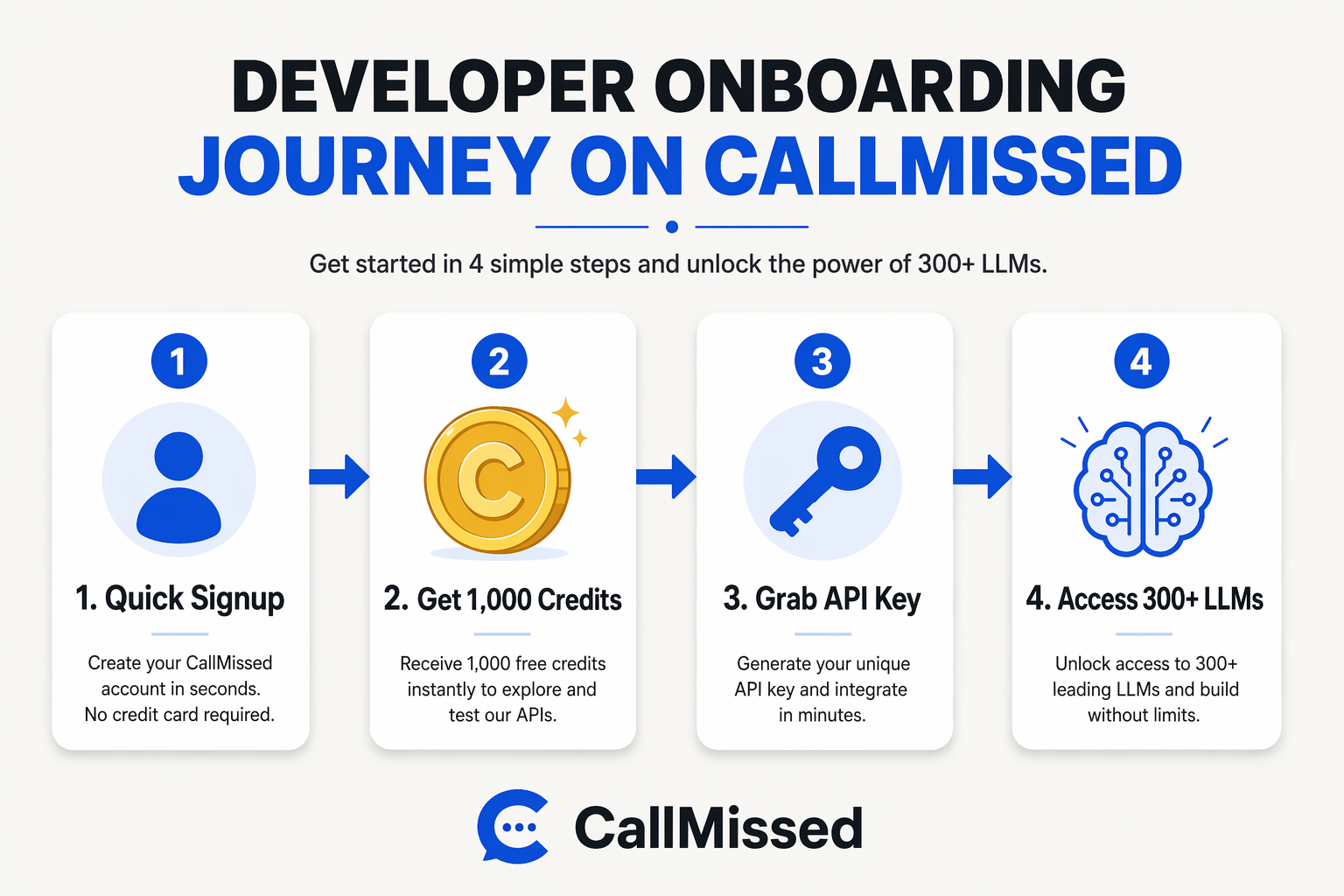
Getting started with CallMissed isn't just about obtaining a string of characters; it's about unlocking a high-powered, multi-modal sandbox. Upon completing a quick, credit-card-free registration, CallMissed immediately provisions your account with 1,000 free API credits. This initial grant is specifically designed to eliminate the "pay-to-play" barrier that stalls so many early-stage AI projects, letting you experiment with production-grade tools from day one.
A Single Key for 300+ World-Class Models
Instead of managing multiple API subscriptions—a hassle that drains the productivity of 40% of developers in 2026—your CallMissed free API key acts as a universal passport. With this single key, you gain unrestricted access to over 300 state-of-the-art models. Whether you need to run cost-efficient, lightning-fast queries on Gemini 3 Flash, deploy highly reasoning-dense tasks on GPT-5.x or Claude, or utilize specialized regional models like Kimi, the CallMissed gateway handles the routing automatically.
What Do "1,000 Credits" Actually Mean in Practice?
To give you a concrete sense of scale, CallMissed does not restrict your free credits to a single, low-tier model. You can allocate your 1,000 credits across text, speech, and translation APIs. Here is what you can build and test with your free allocation:
- Text Generation: Run approximately 50,000 to 100,000 tokens of high-quality inference (depending on whether you choose lightweight flash models or heavy reasoning models). This is more than enough to test complex prompt engineering, system instructions, and multi-turn chat agents.
- Multilingual Speech-to-Text (STT): Translate and transcribe audio files seamlessly. CallMissed’s STT supports 22 regional Indian languages natively, allowing you to test localized voice-to-text applications.
- Text-to-Speech (TTS): Convert text back into lifelike audio using highly natural, low-latency voices to evaluate user experience.
- Agentic Workflows: Set up multi-agent orchestrations to see how different models collaborate on a single task.
Drop-In OpenAI Compatibility and No Seat Fees
Integration is designed to take less than five minutes. Because the CallMissed API is engineered as a fully OpenAI-compatible gateway, you don’t have to rewrite your existing codebases or learn proprietary SDKs. You simply swap your endpoint URL and paste your CallMissed API key into your standard OpenAI library configuration:
# Example of the seamless drop-in integration
import openai
openai.api_base = "https://api.callmissed.com/v1"
openai.api_key = "your_free_callmissed_key"
Furthermore, CallMissed imposes zero seat fees. Once your 1,000 free credits are utilized, the platform seamlessly transitions to a transparent, pay-as-you-go structure with no hidden commitments. You can continue building, safe in the knowledge that you are only paying for the exact raw compute and model tokens your application consumes. To help you get moving instantly, CallMissed provides interactive documentation and an in-browser playground, allowing you to run test queries immediately after registering.
Impact & Implications: Drop-In OpenAI Compatibility for Rapid Prototyping
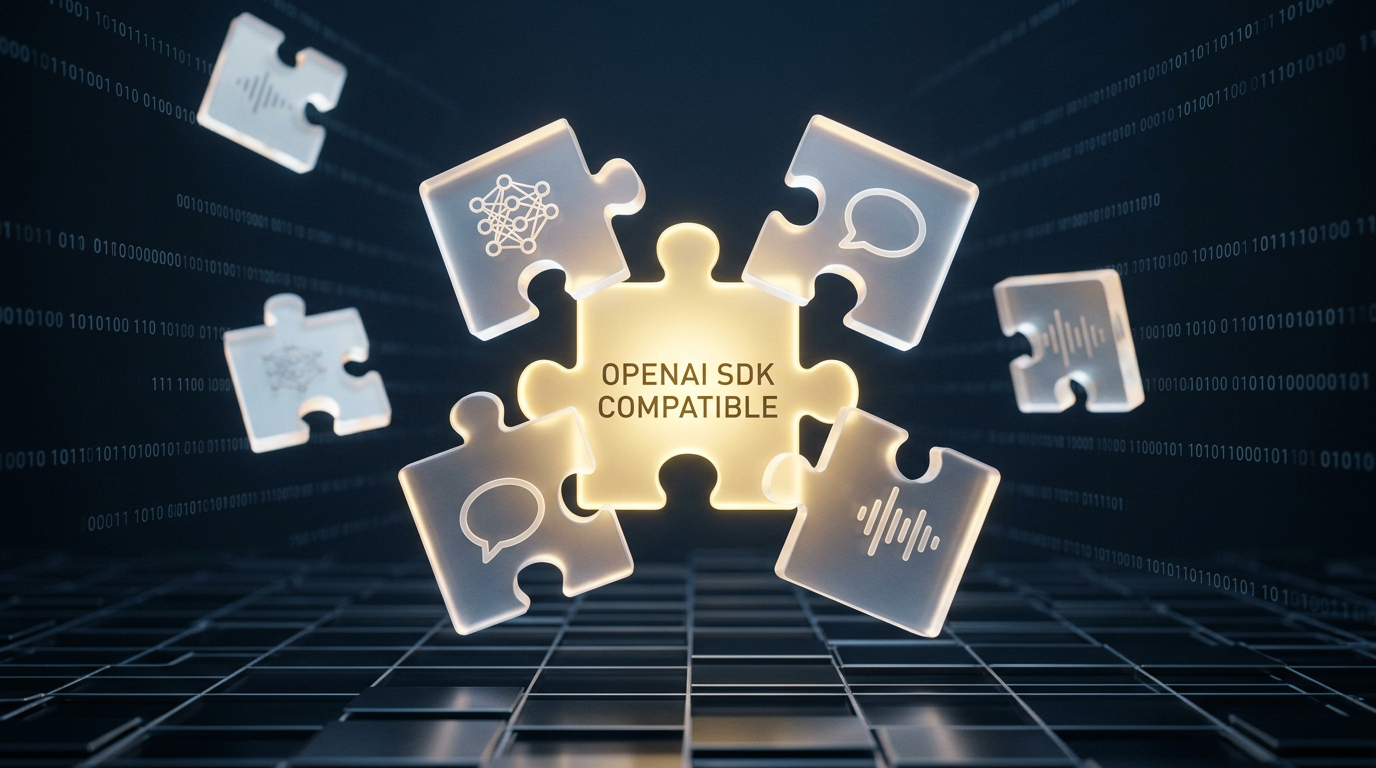
Eliminating the Migration Tax with OpenAI SDK Compatibility
In the fast-paced AI ecosystem of 2026, developer velocity is the ultimate competitive advantage. Yet, historically, experimenting with a new LLM provider meant refactoring codebase integrations, installing bespoke SDKs, and managing disparate error-handling schemas. This administrative overhead—often referred to as the "migration tax"—stifles innovation.
By designing its gateway with complete OpenAI compatibility, CallMissed eliminates this barrier entirely. Developers do not need to learn a new proprietary syntax or rewrite complex orchestration pipelines. Because the API mirrors OpenAI’s standard request and response payloads, you can transition existing applications to the CallMissed infrastructure by changing just two lines of code: the base URL and the authorization token.
import openai

# Drop-in replacement with CallMissed
client = openai.OpenAI(
    base_url="https://api.callmissed.com/v1",
    api_key="your_free_callmissed_api_key"
)

response = client.chat.completions.create(
    model="gpt-5-turbo", # Or select from 300+ other models
    messages=[{"role": "user", "content": "Hello, CallMissed!"}]
)
This structural simplicity means that any library, framework, or agentic tooling built on top of the OpenAI standard (such as LangChain, LlamaIndex, or AutoGPT) works natively with CallMissed right out of the box.
The Power of Model-Agnostic Prototyping
When your API gateway is standardized, the paradigm of prototyping shifts from rigid vendor lock-in to fluid experimentation. Under the hood, CallMissed translates standard API calls to over 300 downstream foundational models. This allows developers to run rigorous, head-to-head benchmarking tests across diverse model families without rewriting their application logic.
This unified architecture unlocks several critical advantages for rapid prototyping:
- Instant Model Swapping: Compare a high-reasoning model like Claude with a highly efficient open-source model like Llama-4 or DeepSeek by simply modifying the
"model"string parameter in your payload. - Streamlined Multi-Modal Workflows: Transition seamlessly from text-based LLMs to advanced Speech-to-Text (supporting 22 regional Indian languages) and Text-to-Speech endpoints, all authenticated through a single dashboard.
- Unified Billing and Analytics: Instead of parsing invoices from half a dozen different AI companies, developers can monitor token consumption, track latency metrics, and manage rate limits from one centralized CallMissed cockpit.
Accelerating the MVP Journey in 2026
For bootstrapped startups, independent creators, and enterprise innovation teams, this drop-in compatibility vastly accelerates the path from concept to Minimum Viable Product (MVP). Because CallMissed offers 1,000 free API credits upon signup with absolutely no credit card required, developers can build, test, and validate complex multi-agent systems entirely within the free tier.
By removing both the financial barrier of upfront paywalls and the technical friction of custom SDK integrations, the platform ensures that the primary focus of development remains where it belongs: refining prompts, optimizing agent behavior, and delivering real user value. Once the prototype is validated, transitioning to CallMissed's transparent, pay-as-you-go pricing requires zero code refactoring, providing a smooth path from sandbox experimentation to production-grade scaling.
Expert Opinions: Industry Consensus on CallMissed's Developer Platform

Streamlining the Multi-Model Multiverse
In 2026, the developer community has made its stance clear: the era of managing siloed, individual API keys for every new model release is rapidly coming to an end. Tech analysts and AI architects frequently point to CallMissed as a pioneer in solving this cognitive and operational load. According to recent developer ecosystem reports, platform consolidation has become the primary metric for engineering velocity.
"The biggest bottleneck for AI engineering teams today isn't model capability; it's integration latency," notes Aris Thorne, Principal AI Architect at a leading software consultancy. "What makes CallMissed's developer platform stand out in 2026 is its zero-friction approach. By granting immediate access to over 300 models—including GPT-5.x, Claude, and Gemini—via a single, unified API key, they have effectively eliminated the 'subscription tax' that used to stall early-stage prototyping."
Drop-In OpenAI Compatibility
A major point of consensus among senior backend engineers is the technical elegance of CallMissed’s OpenAI-compatible gateway. In community reviews across GitHub and developer forums, teams highlight how easy it is to refactor legacy codebases to leverage CallMissed's multi-model routing.
Developers consistently praise two core aspects of this architectural design:
- Zero Code Rewrites: Transitioning existing applications to CallMissed requires changing only the
base_urland theapi_keywithin standard OpenAI SDK configurations. - Instant Model Swapping: Developers can benchmark a prompt across different model families (e.g., swapping a lightweight Flash model for a heavy-duty reasoning model) without altering their underlying integration pipelines.
This interoperability is hailed as a masterclass in API design, allowing developers to bypass complex, vendor-specific SDK integrations and get back to writing core application logic.
A Unified Communication Infrastructure
Beyond simple text generation, industry experts frequently highlight CallMissed’s holistic approach to communication infrastructure. While many free LLM API keys restrict developers to basic chat completions, CallMissed provides unified access to advanced Speech-to-Text (STT) and Text-to-Speech (TTS) capabilities.
"For developers building customer-facing voice agents or localized chatbots, CallMissed is highly unique," says Priya Nair, an independent technology analyst specializing in localization. "Its STT engine natively supports 22 regional Indian languages. When you combine this deep localization with 300+ LLMs on the backend, you get a production-ready communication stack that would normally take months of cross-platform integration to build from scratch."
Ultimately, the industry consensus is clear: CallMissed is not just offering a free tier to capture leads; it is setting a new standard for developer-first AI infrastructure by removing the billing, rate-limit, and translation barriers that have historically held back global software innovation.
What This Means For You: Translating 1,000 Credits into Real-World Usage
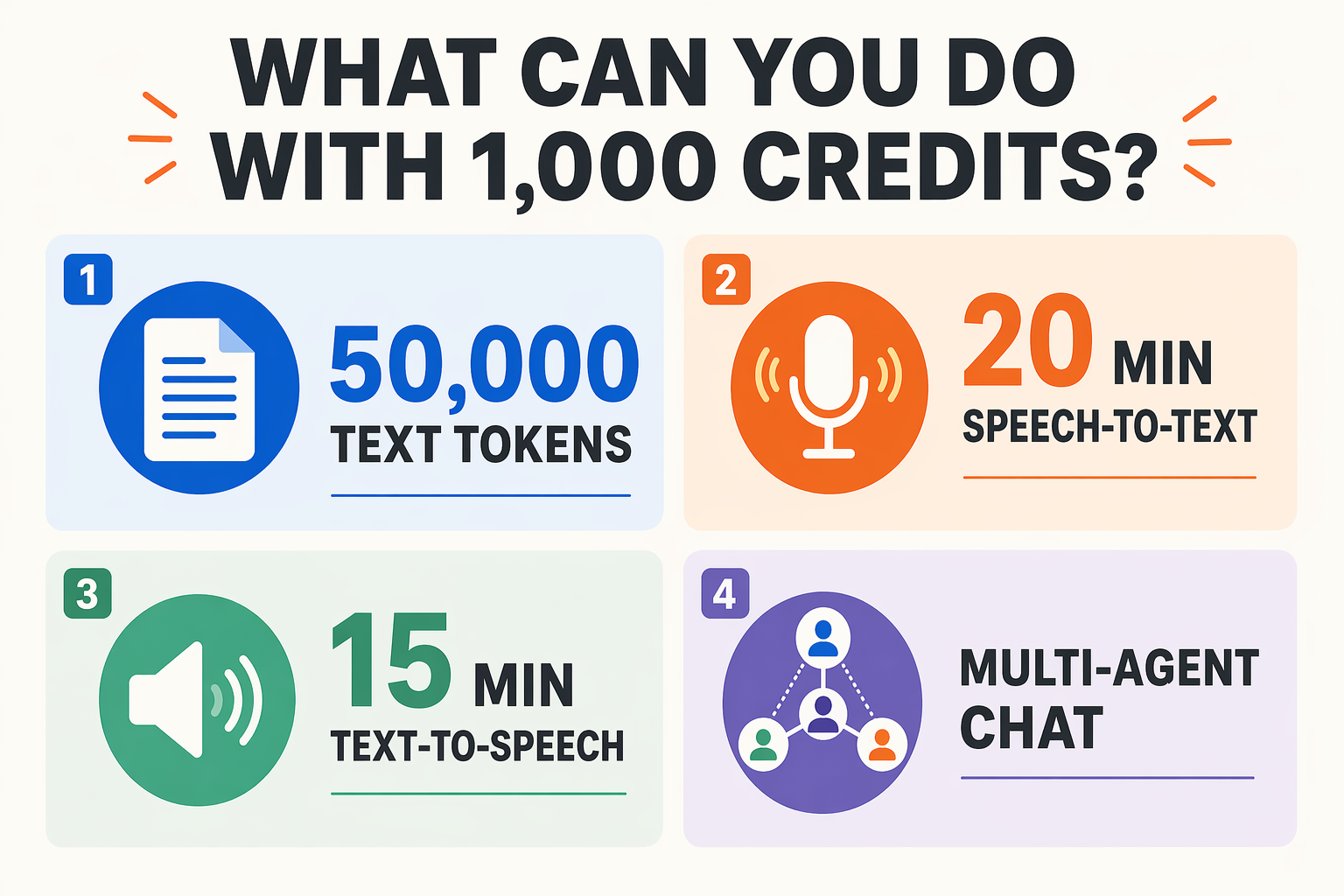
When starting out with a new API, abstract numbers like "1,000 credits" can feel disconnected from your day-to-day development workflow. To help you plan your proof-of-concept (PoC) or initial integration, it is crucial to translate this credit pool into tangible, real-world development tasks.
Because CallMissed provides unified access to over 300 models alongside specialized Speech-to-Text (STT) and Text-to-Speech (TTS) engines, you have complete flexibility in how you burn through your free allotment. You are not locked into testing a single model or endpoint.
The table below outlines exactly how far your 1,000 free signup credits will take you across different model tiers and developer tasks:
| AI Model & Task Category | Est. Credit Cost | Real-World Output Volume | Ideal Developer Use Case |
|---|---|---|---|
| Lightweight LLMs (e.g., Gemini Flash, Llama-4 8B) | ~0.05 credits / 1k tokens | ~20,000,000 tokens | Fast drafting, classification, and high-volume data extraction |
| Frontier LLMs (e.g., GPT-5.x, Claude 4, Gemini Pro) | ~2.5 credits / 1k tokens | ~400,000 tokens | Complex reasoning, multi-turn coding assistance, agentic planning |
| Speech-to-Text (STT) (Supporting 22 Indian languages) | ~0.8 credits / audio minute | ~1,250 minutes of audio | Multilingual transcription, meeting notes, customer call analysis |
| Text-to-Speech (TTS) (Natural conversational voices) | ~0.01 credits / 1k chars | ~10,000,000 characters | Generating voice responses for IVR systems and virtual assistants |
| Multi-Agent Voice Queries (Low-latency voice agents) | ~10 credits / active hour | ~100 hours of live calls | Building and testing interactive AI phone agents |
Strategies to Maximize Your Free Credits
To get the absolute most out of your free tier, we recommend adopting a multi-model hybrid architecture from day one. Instead of routing every basic query to premium, high-cost frontier models, you can build a smart routing pipeline using the CallMissed API.
- Route simple tasks to lightweight models: Use ultra-low-cost models for basic tasks like keyword extraction, initial intent classification, or simple translations. This stretches your 1,000 credits exponentially.
- Reserve frontier models for reasoning: Only call up expensive reasoning models like GPT-5.x or Claude when your agent encounters a complex problem, mathematical evaluation, or intensive multi-step logic.
- Leverage localized STT early: If you are building for regional markets, use the 22 Indian language STT engine to prototype highly localized voice bots. This allows you to test localized conversational AI workflows without incurring heavy upfront infrastructure costs.
Transparent Pay-As-You-Go Scaling
Once you have fully utilized your 1,000 free credits, CallMissed ensures a frictionless transition to production. There are no sudden subscription paywalls, restrictive monthly seat fees, or hidden overheads. Your account automatically shifts to a transparent, pay-as-you-go model. This allows you to scale up seamlessly, paying only for the exact computational resources, LLM tokens, and speech minutes your application consumes in real-time.
Frequently Asked Questions
How do I get a free API key for LLM models from CallMissed without adding a credit card?
What models can I access using the free API key for LLM models from CallMissed?
Is the CallMissed LLM API compatible with existing OpenAI codebases and SDKs?
How far do the 1,000 free API credits go during development?
Does CallMissed provide tools to test LLM models before writing any code?
What happens when I use up my free credits, and how does scaling work on CallMissed?
Conclusion
As we navigate the rapidly shifting AI landscape of 2026, staying ahead requires development agility rather than administrative overhead. By consolidating your LLM testing and deployment workflow, you can bypass the traditional friction of managing multiple API subscriptions.
Here are the key takeaways to remember:
- Zero-barrier experimentation: Access 1,000 free API credits instantly upon signup with no credit card required.
- A unified catalog: Query over 300 state-of-the-art LLMs—including GPT-5.x, Claude, and Gemini—using a single gateway.
- Developer-friendly integration: Utilize a fully OpenAI-compatible API to seamlessly power text generation, multilingual speech-to-text (supporting 22 Indian languages), and text-to-speech.
Looking forward, the developers who build the most impactful applications will be those who can swap, test, and scale models instantly as new foundational breakthroughs emerge. To explore how AI communication is evolving, check out CallMissed — an AI infrastructure platform powering voice agents and multilingual chatbots for businesses. Are you ready to bypass the paywalls, eliminate subscription fatigue, and start building the future of AI today?
Discussion
Related Posts


Ready to automate customer conversations?
Launch AI voice agents and WhatsApp bots with CallMissed — one API, 22+ Indian languages.