Grok Bot Pricing 2026: Verified Access, Features, Risks and Limits


Understand Grok Bot pricing 2026, verified access, persistent cloud-computer features, security risks, limits and practical use cases.
Grok Bot Pricing 2026: Verified Access, Features, Risks and Limits
What if an AI bot could keep working after you closed your laptop—using its own browser, files and terminal on a dedicated cloud computer? That is the proposition behind Grok Bot pricing 2026, but understanding its real cost requires separating verified access terms from launch promotions, product claims and the better-known Grok chatbot.
As of September 8, 2026, first-party SpaceXAI documentation describes Grok Bot as a computer-use agent, not simply another conversational interface. Each user’s work runs on a persistent computer in Cursor’s cloud, where the bot can operate websites, applications and development environments. SpaceXAI Docs says Grok Bot can use a browser, command line, filesystem and connected tools without requiring the user’s laptop to remain open.
That distinction matters because Grok Bot is designed to complete delegated work rather than merely generate an answer. Users can establish routines, leave tasks running in the background and watch activity through the Agent Computer interface. SpaceXAI also says multiple bots can work independently, pass context and hand tasks to one another—although such parallel-agent capabilities should be treated as vendor claims until tested against real workloads.
Access is not universally open. SpaceXAI’s current getting-started documentation lists SuperGrok Plus, SuperGrok Heavy, Cursor Pro+, Cursor Ultra, Cursor Teams Standard and Cursor Teams Premium as eligible plans, alongside a desktop application for macOS, Windows or Linux. A separate enterprise announcement offered Grok and Cursor Enterprise customers free usage for two weeks, but a time-limited promotion is not evidence of permanently free access or a standalone Grok Bot subscription price.
The product also introduces risks that ordinary chat interfaces do not. A bot capable of signing into websites, handling credentials, modifying files and executing terminal commands can make consequential mistakes—or encounter prompt injection and malicious web content. SpaceXAI documents approval controls and treats access to a user’s local Mac or Windows computer as a separate permission from the cloud machine, making configuration and human review essential.
Grok Bot reflects a broader move from answer engines to action-oriented AI infrastructure; platforms such as CallMissed apply the same trend to customer engagement through AI voice agents, WhatsApp automation and persistent business workflows.
This explainer verifies what Grok Bot is, who can access it, how pricing and eligibility work, what its cloud computer can do, and where security, credentials and practical limitations demand caution.
What is Grok Bot in 2026, and which pricing and access facts are verified?
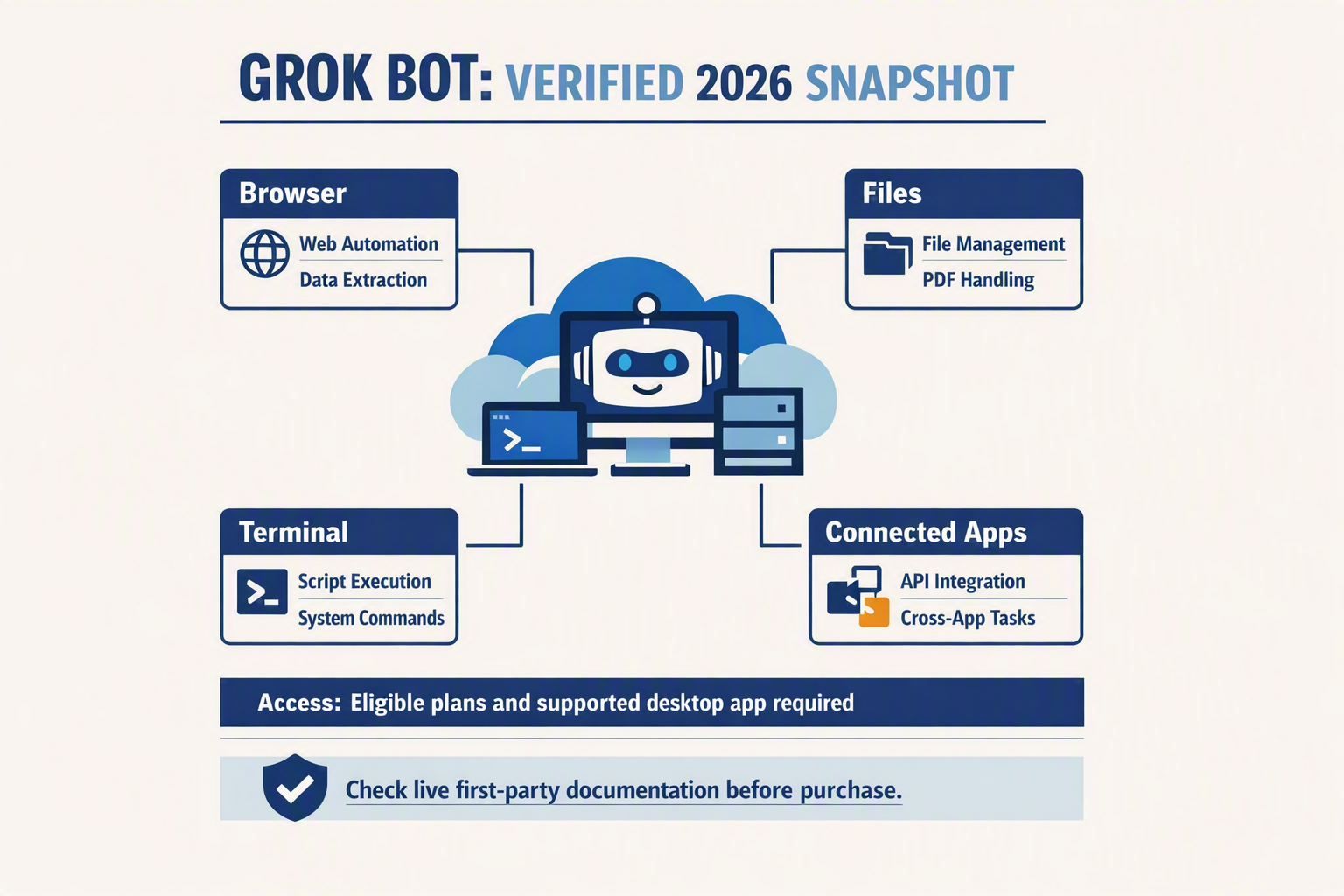
Grok Bot is a computer-use agent that performs delegated tasks on a persistent cloud computer; it is distinct from the Grok chatbot and the underlying Grok language models. As of September 8, 2026, its availability is verified through specific SuperGrok and Cursor plans, but first-party materials do not establish a universal standalone price.
What SpaceXAI means by “Grok Bot”
SpaceXAI Docs describes bots as “AI teammates you can give real work to.” The important word is work: Grok Bot is intended to interact with software rather than only return text in a chat window.
SpaceXAI’s enterprise documentation says each user’s work executes on a dedicated computer in Cursor’s cloud. According to SpaceXAI Docs in 2026, that environment lets Grok Bot:
- Navigate websites and web applications through a browser
- Read, create and modify files in its cloud filesystem
- Run command-line and development tools
- Use connected services and authenticated applications
- Continue background work without the user’s laptop staying open
- Expose its activity through the Agent Computer interface
The dedicated environment is persistent, meaning files, sessions and working context can remain available between tasks. This architecture differs from a conventional chatbot session, where the model generally produces responses but does not continuously operate a computer.
What Grok Bot is not
Several similarly named products make verification especially important. Grok Bot is not synonymous with the Grok chatbot on X, a Grok foundation model or an older voice-agent concept carrying the Grok name. Grok models may provide intelligence within a product, while Grok Bot adds an execution environment, tools and workflow controls.
SpaceXAI also says bots can work independently, pass context and hand off tasks. These are documented product claims, not independent proof that multi-agent workflows will complete every real-world task reliably. Buyers should evaluate completion rates, intervention requirements and error recovery using their own applications.
Which access facts are confirmed?
SpaceXAI’s current getting-started documentation lists six eligible plan categories:
- SuperGrok Plus
- SuperGrok Heavy
- Cursor Pro+
- Cursor Ultra
- Cursor Teams Standard
- Cursor Teams Premium
Users also need the Grok Bot desktop application for macOS, Windows or Linux, according to SpaceXAI Docs. Eligibility therefore depends on both an accepted account plan and supported desktop software; a standard Grok account should not be assumed to include access.
SpaceXAI separately announced enterprise availability for Grok Enterprise and Cursor Enterprise customers. That announcement offered two weeks of free usage and allowed participating organizations to invite people without existing seats. The duration matters: two weeks is a launch promotion, not confirmation of an enduring free tier.
What is verified—and what remains unclear—about pricing?
The safest pricing conclusion is narrow: Grok Bot access is bundled with named eligible plans, while a definitive standalone Grok Bot price is not stated in the supplied first-party documentation.
Before budgeting, teams should verify:
- The current subscription price for their eligible plan
- Whether bot usage has separate compute or consumption limits
- Whether multiple bots consume allowances independently
- Enterprise seat, invitation and overage rules
- Whether promotional credits expire after the stated two-week period
This distinction prevents “free access” headlines from being mistaken for permanent zero-cost usage. In 2026, verified eligibility is clearer than verified total cost; organizations should rely on current account checkout pages and contracts rather than extrapolating from promotional announcements.
How is Grok Bot different from the Grok chatbot, Grok models and earlier voice-agent concepts?
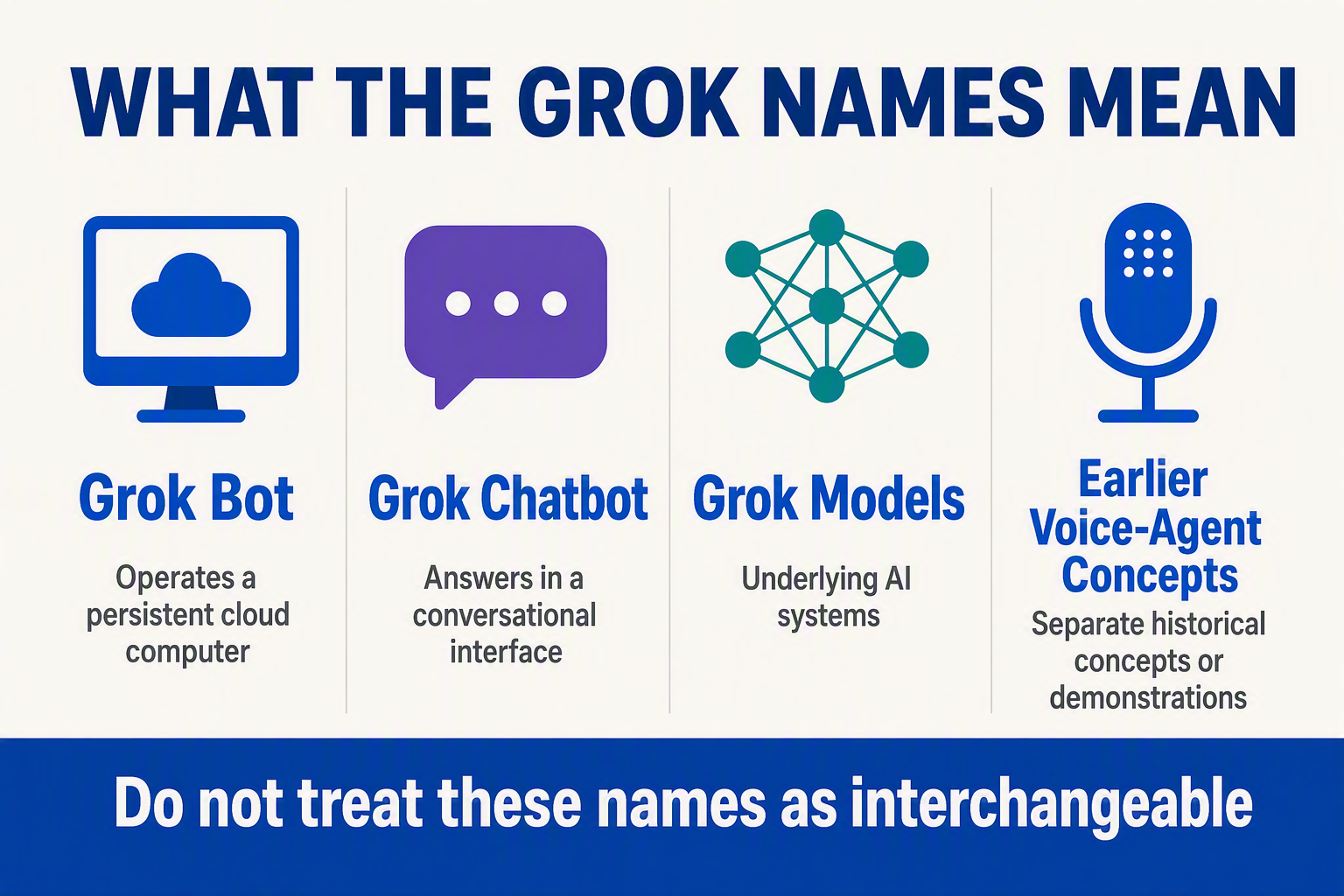
Grok Bot is an agentic execution product, while the Grok chatbot is a conversational interface, Grok models supply underlying AI capabilities, and earlier voice-agent concepts primarily changed how users interacted with Grok. The crucial difference is not merely voice versus text; it is whether the system can operate a persistent computer and carry work forward across applications.
Four layers that should not be conflated
The “Grok” name now spans several product layers:
- Grok models: Foundation models provide reasoning, language generation and related intelligence. A model can propose code or describe how to complete a task, but model access alone does not provide a persistent desktop, authenticated applications or an independent workflow.
- The Grok chatbot: The chatbot is designed mainly around a user asking questions and receiving responses. It may search, reason or generate content, but the interaction remains conversation-led rather than centered on a dedicated execution environment.
- Grok Bot: SpaceXAI Docs defines Grok Bot as a computer-use agent that can complete work using websites, applications, files and development environments. The agent layer combines model intelligence with tools, state, permissions and a cloud-hosted computer.
- Voice-agent or voice-mode concepts: Voice changes the input and output channel: users speak, and an AI responds audibly. That does not automatically mean the system can maintain a workspace, execute terminal commands or continue a multi-step assignment after the conversation ends.
Consequently, references to a Grok voice experience should not be treated as evidence of Grok Bot availability or functionality. They describe different product categories unless first-party documentation explicitly connects them.
Persistence changes the operating model
The defining distinction is continuity of execution. SpaceXAI’s Grok Bot FAQ says bots use “a persistent cloud computer, connected tools, websites, and files to complete work—not only answer questions.” SpaceXAI’s enterprise architecture documentation further states that each user’s work executes on a dedicated cloud computer in Cursor’s cloud.
That architecture enables workflows beyond a conventional chat response:
- Opening a browser and interacting with web applications
- Reading, creating and modifying files inside the cloud environment
- Running commands through a terminal or command line
- Returning to retained workspace state during subsequent tasks
- Performing routines or background work without keeping the user’s laptop active
- Handing context or tasks between multiple bots
As of September 8, 2026, SpaceXAI documentation describes multi-bot collaboration as bots passing context and handing off tasks independently. That is a product claim, not proof that parallel bots will coordinate reliably in every production workflow.
Agency also creates a different risk boundary
A chatbot’s incorrect answer can mislead a user; a computer-use agent’s incorrect action can alter a file, submit a form or run an unsafe command. Grok Bot therefore needs controls that are less relevant to ordinary chat, including execution approvals, credential boundaries, activity monitoring and least-privilege access.
SpaceXAI also distinguishes the shared cloud computer from the user’s local Mac or Windows machine. Local execution is a separate permission, reinforcing that “Grok Bot” should be understood as an orchestration and computer-use layer—not as a renamed chatbot, a standalone Grok model or simply Grok with speech enabled.
When did Grok Bot launch, who can access it, and which developments are confirmed?
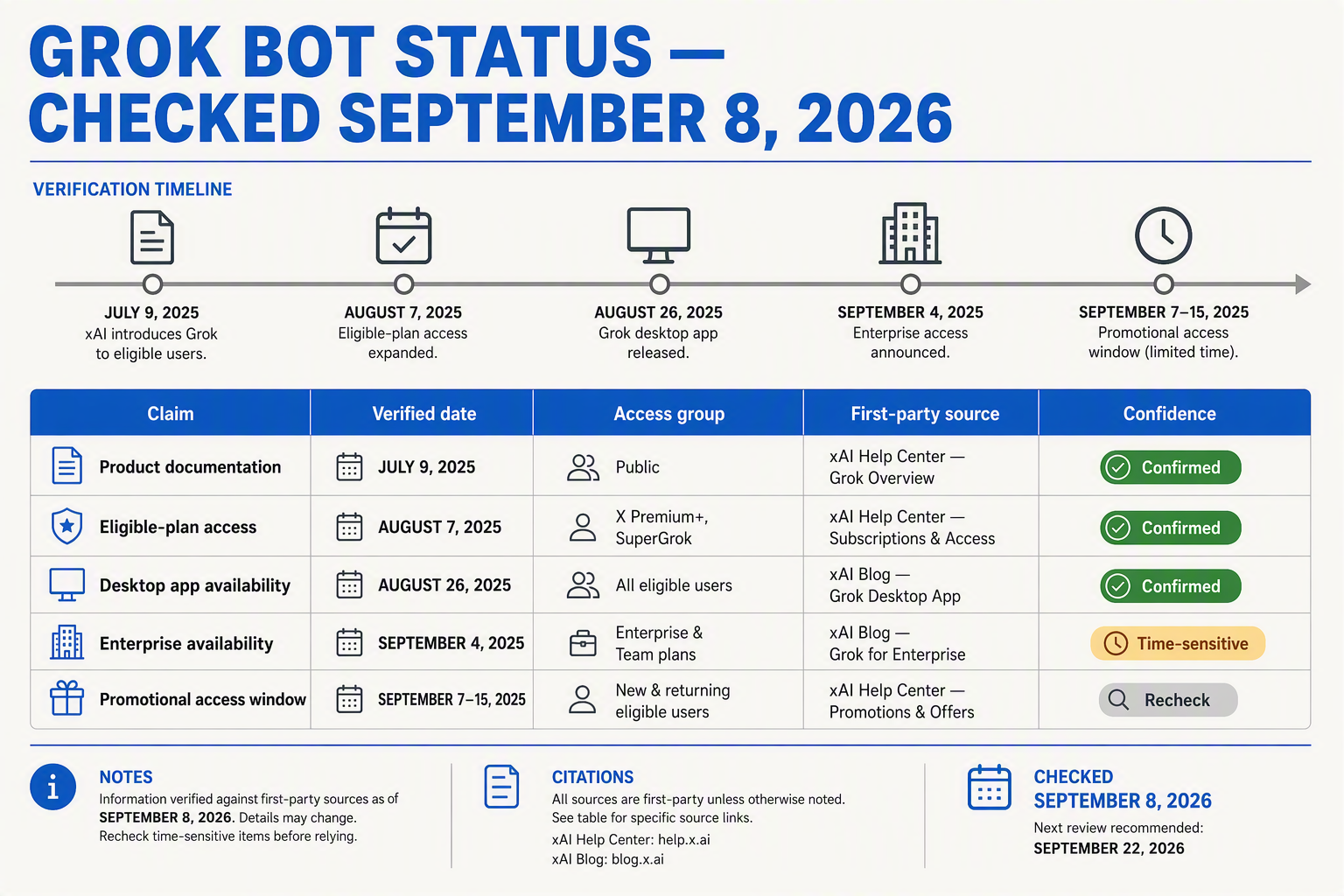
Grok Bot was publicly documented and available to eligible users by September 8, 2026, but the supplied first-party sources do not establish one definitive launch date. The strongest evidence confirms a plan-gated desktop rollout and a later enterprise availability announcement—not universal public access.
Verified rollout and access timeline
| Development | Confirmed status as of Sept. 8, 2026 | First-party evidence | Verification caveat |
|---|---|---|---|
| General Grok Bot availability | Available to eligible accounts | SpaceXAI’s Get started documentation provides installation and sign-in requirements | Documentation does not state an exact initial launch date |
| Individual paid-plan access | Confirmed | Eligible plans are SuperGrok Plus, SuperGrok Heavy, Cursor Pro+ and Cursor Ultra | Eligibility does not prove inclusion at every usage level or geography |
| Cursor team access | Confirmed | SpaceXAI lists Cursor Teams Standard and Cursor Teams Premium | Workspace administrators may still control organizational access |
| Enterprise rollout | Confirmed as an announced release | SpaceXAI said Grok Bot was “now available for enterprises” | The announcement excerpt does not provide a publication date |
| Enterprise promotion | Confirmed as time-limited | Grok and Cursor Enterprise customers were offered “free usage for the next two weeks” | Without the announcement date, the offer cannot be assumed active on September 8 |
| Desktop operating systems | Confirmed | SpaceXAI’s setup guide specifies applications for macOS, Windows and Linux | Desktop availability is not evidence of a browser-only or mobile release |
What “available” means here
As checked on September 8, 2026, SpaceXAI’s getting-started documentation requires both an eligible subscription and the Grok Bot desktop app. Grok Bot therefore should not be described as an unrestricted feature available to every Grok chatbot user.
The confirmed access paths are:
- SuperGrok: Plus or Heavy
- Cursor individual: Pro+ or Ultra
- Cursor teams: Teams Standard or Teams Premium
- Enterprise: Grok Enterprise or Cursor Enterprise, subject to organizational enablement and current commercial terms
The enterprise announcement also said organizations could invite employees “including people without an existing seat.” That is a significant deployment development, but it does not necessarily create independent free accounts: access may remain sponsored, administered and governed by the enterprise organization.
Which product developments are firmly documented?
Several capabilities have stronger evidence than launch-date speculation. SpaceXAI’s enterprise architecture documentation confirms that Grok Bot operates in Cursor’s cloud, with each user’s work executing on a dedicated cloud computer. SpaceXAI’s computer-and-apps documentation further confirms support for a browser, command line, files and connected tools, including operation without the user’s laptop remaining open.
SpaceXAI also documents bots collaborating independently, passing context and handing off tasks. This verifies that multi-bot coordination is an advertised product capability, but not its reliability, speed or cost in production environments.
Three conclusions follow from the available evidence:
- The product is launched in a practical access sense, because installation and eligibility instructions exist.
- No exact original launch date should be asserted without a dated release post or archived changelog.
- The two-week enterprise offer is promotional, not proof that Grok Bot is permanently free or included without usage limits.
This distinction prevents documentation, eligibility and temporary promotions from being misreported as a single universal launch event.
How does Grok Bot’s persistent cloud computer use browsers, filesystems and terminals?
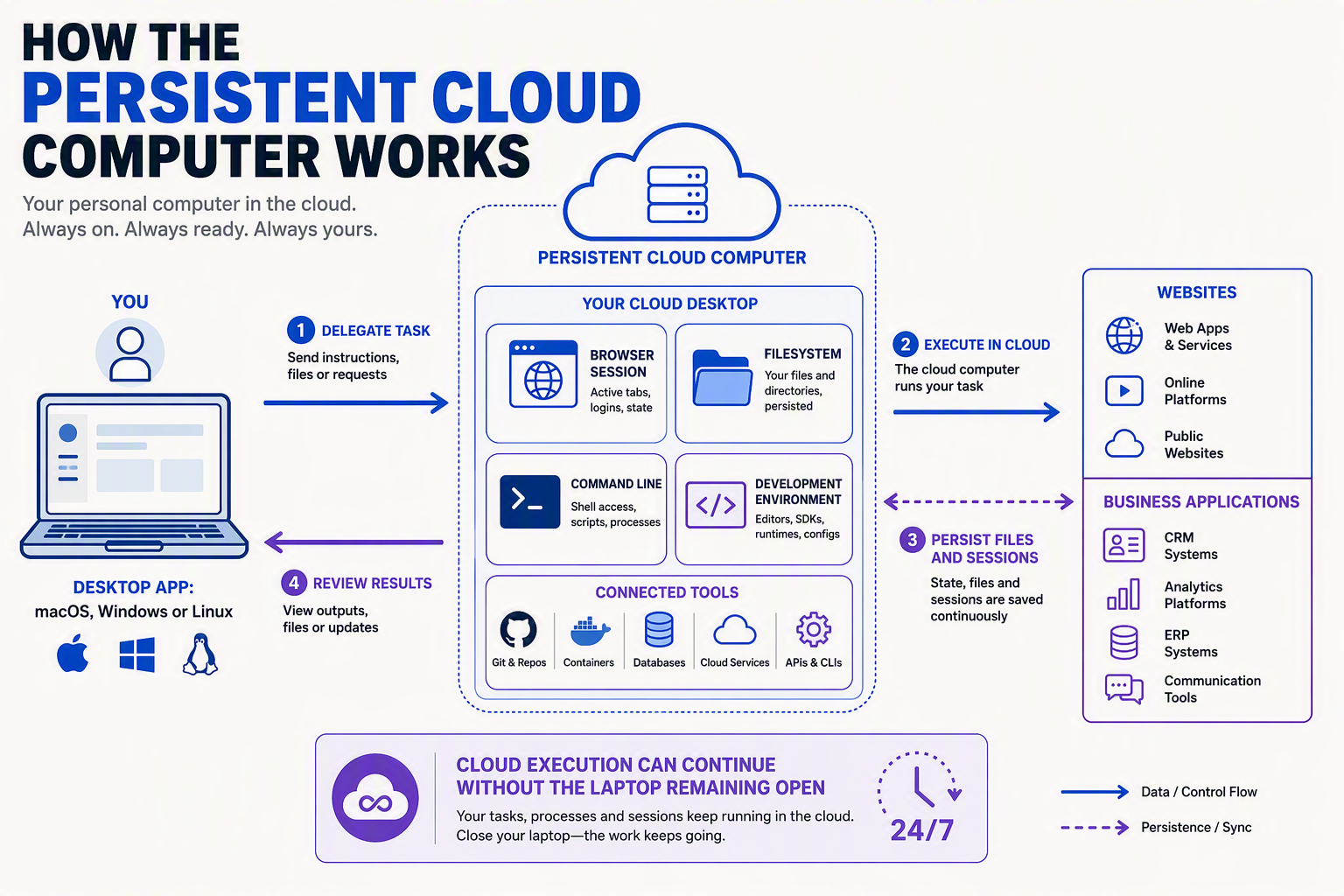
Grok Bot uses a dedicated computer in Cursor’s cloud to operate a browser, manage files and run command-line tools while the user’s laptop is closed. “Persistent” means the working environment can retain task state between interactions, enabling longer workflows—but it should not be interpreted as guaranteed unlimited storage, uptime or execution.
A cloud workspace, not remote control by default
SpaceXAI’s Grok Bot for teams and enterprises documentation says each user’s work executes on a dedicated cloud computer running in Cursor’s cloud. The desktop app for macOS, Windows and Linux provides access to that environment, but the actual work does not depend on the desktop app remaining open.
SpaceXAI’s Use the computer and apps documentation states that Grok Bot can use a browser, command line, files and connected tools without depending on the user’s laptop remaining open. This architecture separates two environments:
- Cloud computer: The bot’s primary browser, filesystem, terminal and application workspace.
- Local computer: The user’s physical Mac or Windows machine, which requires a separate capability and permission.
- Agent Computer: The interface where a user can open the cloud desktop and observe the bot’s actions.
According to SpaceXAI’s security documentation, access to the computer in front of the user is distinct from access to the shared Grok Bot cloud computer. That boundary is important: assigning a task to Grok Bot does not automatically mean granting control over every local file or application.
What the browser, filesystem and terminal enable
The three core interfaces allow Grok Bot to move beyond generating instructions and instead carry out multi-step work:
- Browser: The bot can navigate websites and web applications, enter information and interact with authenticated services where access has been configured.
- Filesystem: It can create, read, organize and modify working files used across a task, such as source code, reports or downloaded assets.
- Terminal: It can execute command-line operations in its cloud environment, including development commands, scripts and file-processing utilities.
- Connected tools: Integrations can provide additional context or actions beyond the cloud desktop itself.
For example, a delegated development workflow could involve reviewing requirements in a browser, editing project files, running tests through the terminal and checking the resulting web application. SpaceXAI characterizes Grok Bot as operating “applications, browsers, and development environments,” but the reliability of any particular workflow depends on website behavior, permissions, tool availability and the agent’s decisions.
What persistence does—and does not—mean
Persistence is valuable because the workspace can preserve files, application state and task context instead of starting from an empty session whenever the user returns. A bot can therefore continue background work or resume a workflow through its existing cloud environment.
However, persistence is not the same as unrestricted autonomy. Users should verify:
- whether a task is still running or has stalled;
- which files and account sessions remain available;
- whether a website introduced a CAPTCHA, approval request or changed interface;
- what commands the terminal executed and what data they modified;
- whether outputs are complete before using or publishing them.
The practical model is supervised delegation: Grok Bot receives a real workspace and action tools, while the user monitors consequential steps through Agent Computer and applies approval controls where appropriate.
Can Grok Bot run routines, work in the background and coordinate multiple agents?
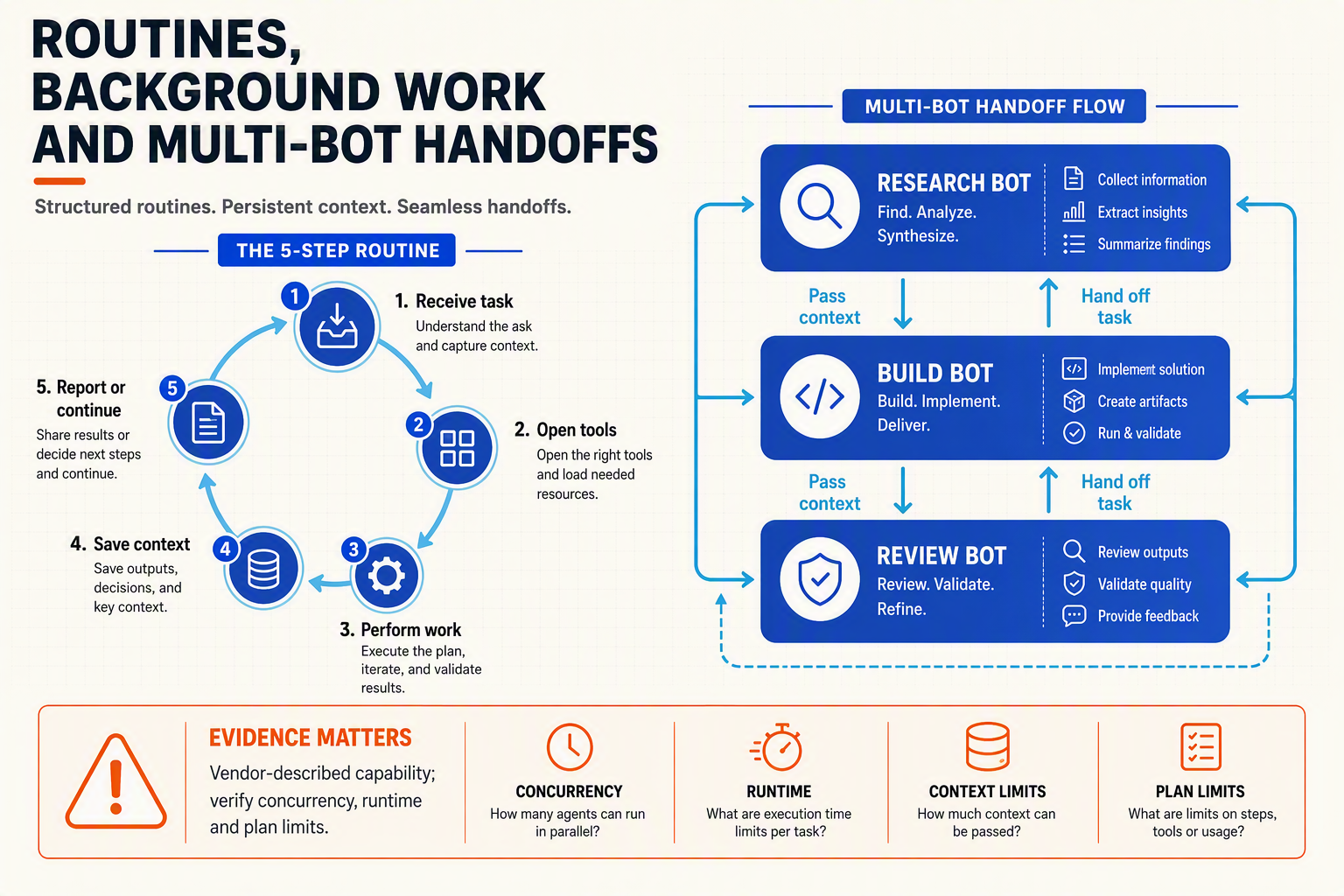
Yes—Grok Bot can run scheduled routines, continue cloud-based work after a user’s laptop is closed, and coordinate several independent bots. As of September 8, 2026, these capabilities are described in first-party SpaceXAI documentation, but their reliability, latency and resource limits have not been independently established in the supplied sources.
Routines turn prompts into recurring workflows
A routine is a reusable task that Grok Bot executes on a schedule rather than only in response to a live prompt. Because execution occurs on its persistent cloud computer, the workflow does not depend on the desktop app remaining in the foreground.
Potential routines include:
- Reviewing a shared inbox each morning and preparing a prioritized summary.
- Checking websites or dashboards at fixed intervals and recording changes.
- Running tests, scripts or repository checks overnight.
- Collecting files, organizing outputs and preparing a recurring report.
- Monitoring a task queue and initiating follow-up work.
The important distinction is that a routine is not merely a reminder. Grok Bot can use its browser, command line, filesystem and connected tools during execution, according to SpaceXAI Docs. Whether a particular routine succeeds still depends on permissions, authenticated sessions, website behavior and clear completion criteria.
Background work happens in Cursor’s cloud
Grok Bot’s background operation follows directly from its architecture. SpaceXAI Docs says each user’s work executes on a dedicated cloud computer in Cursor’s cloud, while the product FAQ says bots can use websites, connected tools and files to complete work rather than only answer questions.
A typical delegated workflow is:
- The user defines the task, constraints and expected output.
- Grok Bot opens the required browser, app, files or terminal session.
- The cloud computer continues processing without relying on the user’s laptop.
- The user inspects progress through Agent Computer and reviews consequential actions.
“Background” should not be interpreted as “unrestricted.” Login expiration, CAPTCHA challenges, approval requirements, unavailable services and ambiguous instructions can pause or derail a task. Teams should therefore define checkpoints, retry rules and escalation paths instead of assuming indefinite autonomous execution.
Multiple bots can divide and hand off work
SpaceXAI Docs states that Grok Bot agents can “collaborate independently, passing context between each other and handing off tasks.” This supports a coordinator-worker pattern in which separate bots handle research, implementation, testing or reporting.
SpaceXAI’s mobile-development guide describes a concrete vendor-authored example: six bots running one mobile game studio, with each bot assigned its own job, computer and to-do list. That example demonstrates the intended operating model, not a controlled benchmark proving that six agents are optimal or consistently reliable.
Useful coordination patterns include:
- Parallel research: several bots investigate different sources simultaneously.
- Specialized execution: one bot edits code while another runs tests.
- Sequential handoffs: a research bot passes findings to a reporting bot.
- Independent review: one bot checks another bot’s output against defined criteria.
Multi-agent work also multiplies coordination risk. Context may be lost during handoffs, two bots may modify the same resource, and parallel actions can duplicate costs or create conflicting results. For production use, assign clear ownership, isolate workspaces where possible, require structured handoff notes and place approval gates before publishing, deleting data, deploying code or contacting customers.
The verified capability is persistent, scheduled and collaborative execution; the unverified question is how dependably it performs on a specific real-world workflow. Start with low-risk routines, measure completion and intervention rates, and expand autonomy only after observing repeatable results.
How much does Grok Bot cost, which plans are eligible, and are there separate API costs?
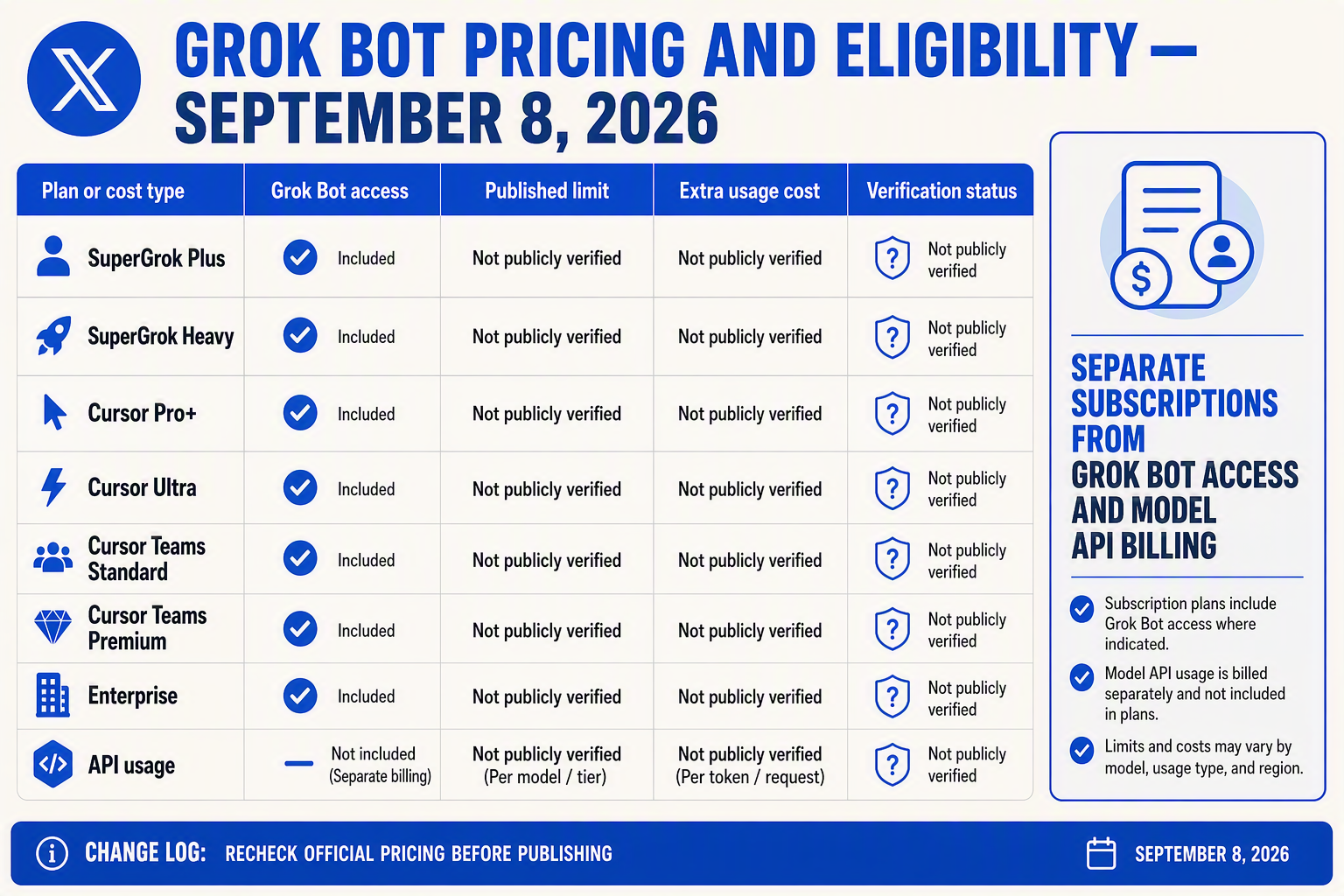
Grok Bot pricing 2026 does not have a verified standalone public rate in the first-party material reviewed on September 8, 2026. Instead, Grok Bot is available through specified SuperGrok and Cursor subscriptions. The Bot documentation does not state that xAI API usage is included, so API charges should be treated as a separate cost unless an account dashboard or contract says otherwise.
Grok Bot pricing and eligible plans
The first-party Grok Bot getting-started documentation listed the following six eligible plans on September 8, 2026. Eligibility means the plan can provide access; it does not establish a separate Bot price, unlimited usage or an included API allowance.
| Plan family | Eligible plan as of September 8, 2026 | Grok Bot access | Verified Bot-specific price as of September 8, 2026 | Access method |
|---|---|---|---|---|
| SuperGrok | SuperGrok Plus | Listed as eligible | No standalone rate published | Authenticate with an eligible SuperGrok account |
| SuperGrok | SuperGrok Heavy | Listed as eligible | No standalone rate published | Authenticate with an eligible SuperGrok account |
| Cursor | Cursor Pro+ | Listed as eligible | No standalone rate published | Sign in with Cursor |
| Cursor | Cursor Ultra | Listed as eligible | No standalone rate published | Sign in with Cursor |
| Cursor Teams | Teams Standard | Listed as eligible | No standalone rate published | Use an eligible Cursor team account |
| Cursor Teams | Teams Premium | Listed as eligible | No standalone rate published | Use an eligible Cursor team account |
This Grok Bot pricing 2026 table intentionally does not reproduce unverified or third-party subscription numbers. Cursor and SuperGrok plan prices can change by billing interval, region, tax treatment, seat count or contract. Readers should re-check the live first-party Cursor and xAI pricing pages before purchasing.
The Grok Bot documentation reviewed on September 8, 2026 also did not publish a universal Bot allowance, per-task charge, compute-hour rate, concurrency limit or overage tariff. Check the limits and billing information shown inside the applicable account before launching persistent routines, parallel bots or high-volume workloads.
As of September 8, 2026, setup also required the Grok Bot desktop application for macOS, Windows or Linux. Installing and authenticating the client is a deployment requirement, not a separate confirmation that usage is unlimited or free.
What is included—and what remains unknown
| Cost or entitlement question | Verified position as of September 8, 2026 |
|---|---|
| Is there a standalone Grok Bot price? | No standalone public rate was stated in the reviewed first-party Bot material. |
| Is a subscription required? | Access was tied to one of the six listed SuperGrok or Cursor plans. |
| Is usage unlimited? | Not established by the public Bot documentation. |
| Are overage rates published? | No universal Bot overage rate was found in the reviewed material. |
| Are xAI API credits included? | The reviewed pages did not state that eligible subscriptions include API credits. |
| Does every Bot action create an API charge? | Not established; ordinary Bot activity should not automatically be equated with separately configured developer API usage. |
| Can connected services create additional charges? | Potentially, depending on paid websites, cloud services, external tools or credentials used by the Bot. |
What the enterprise promotion means
A first-party xAI enterprise announcement available by September 8, 2026 described “free usage for the next two weeks” for Grok and Cursor Enterprise customers and said people without an existing seat could be invited.
That language describes a limited promotional window, not a permanent zero-dollar plan. The two-week period must be calculated from the promotion’s applicable launch or activation terms—not from September 8, 2026—and should not be treated as continuing unless xAI or Cursor confirms an extension in writing.
Enterprise buyers should confirm:
- The promotion’s precise start and expiration timestamps
- Which users, workspaces and plans qualify
- Included tasks, storage, concurrency and compute allowances
- Whether invited users require paid seats after the promotion
- Post-promotion subscription and overage charges
- Security, data-retention, support and cancellation terms
Are xAI API costs separate?
As of September 8, 2026, the reviewed Grok Bot pages did not say that an eligible SuperGrok or Cursor subscription includes xAI developer API credits. xAI’s API has its own model- and usage-based pricing documentation, but those rates should not be presented as the price of Grok Bot itself.
For budgeting purposes, keep these potential cost layers separate:
- Eligible-plan subscription: the live SuperGrok or Cursor plan price applicable on the purchase date.
- Bot limits or overages: any account-specific allowances or charges shown in the product, invoice terms or enterprise contract.
- xAI API usage: separately billed developer usage when API credentials or API-based integrations are configured.
- External services: charges from cloud platforms, paid websites, software subscriptions or other tools the Bot accesses.
The defensible conclusion for Grok Bot pricing 2026, as of September 8, 2026, is that access is plan-gated but no separate public Bot rate is verified. Re-check live xAI and Cursor pricing, the account billing console and contractual terms before committing to long-running or multi-user deployments.
What security, privacy and credential risks should Grok Bot users manage?
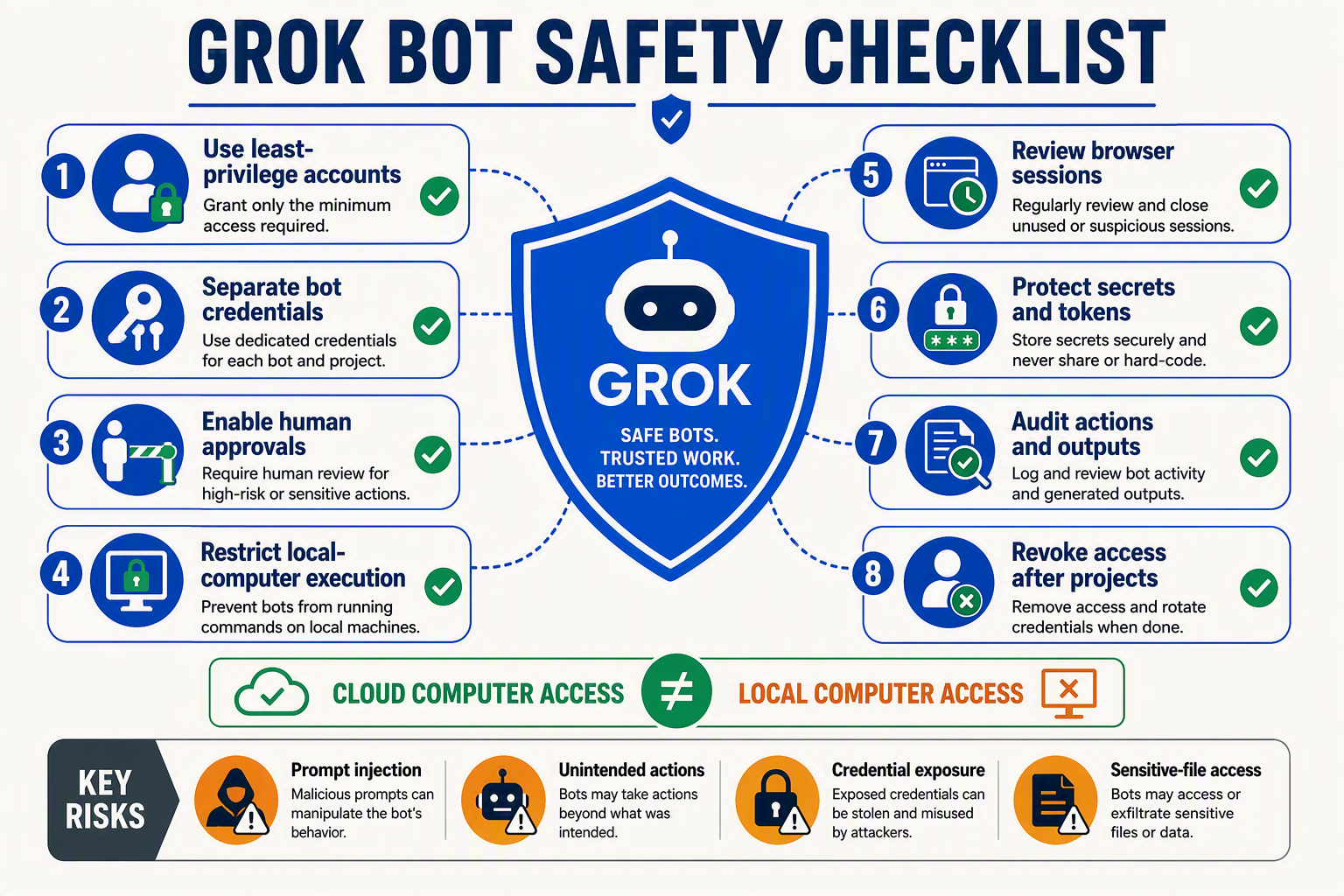
Grok Bot users should treat the agent’s cloud computer like a privileged workstation, not a disposable chatbot session. The main risks are excessive permissions, stored credentials, prompt injection, destructive terminal actions and sensitive data persisting in browser sessions or files.
Why the cloud computer changes the threat model
SpaceXAI Docs says Grok Bot runs on a dedicated computer in Cursor’s cloud and can operate browsers, applications and development environments. Because that computer is persistent, authentication state, downloaded documents, source code and command history may remain available across tasks unless users deliberately remove them.
Persistence improves continuity, but it also increases exposure. A compromised website, unsafe download or poorly scoped instruction could affect later work—not merely the current chat. Users should therefore assume that anything placed on the bot computer may remain accessible to future routines and delegated tasks.
Prompt injection can become real-world action
A conventional chatbot may repeat malicious text; a computer-use agent may act on it. A webpage, email, support ticket, repository issue or document can contain instructions crafted to redirect the bot, extract information or trigger an unintended command.
High-risk actions include:
- Sending messages, publishing content or submitting forms
- Downloading and executing untrusted files
- Changing production code, infrastructure or DNS settings
- Exposing API keys through logs, screenshots or copied text
- Making purchases or altering account permissions
- Deleting, encrypting or overwriting files
Users should require human approval before any action that is irreversible, external-facing, financial or privilege-changing. SpaceXAI’s “Approvals, security, and privacy” documentation describes approval controls, but their practical protection depends on how narrowly they are configured.
Credentials require least-privilege handling
Do not give Grok Bot an owner account when a restricted service account will do. Credentials should be scoped to the specific application, task and duration required.
A safer operating model includes:
- Use separate bot identities. Create dedicated accounts rather than sharing an employee’s primary login.
- Prefer short-lived tokens. Avoid permanent API keys and long-lived session cookies where possible.
- Restrict permissions. Use read-only repository access, sandbox databases and limited cloud roles by default.
- Keep secrets out of prompts and files. Store credentials in an approved secrets manager instead of plaintext notes, shell history or source code.
- Rotate and revoke access. Remove tokens after a project, suspected compromise or employee-role change.
- Protect multifactor authentication. Never delegate recovery codes or unrestricted access to authenticator systems.
Local-computer access must remain a separate decision
SpaceXAI Docs explicitly states that the shared Grok Bot computer runs in the cloud and that access to the user’s local Mac or Windows computer is a separate capability. Administrators and individual users can manage this under Settings → General → Agent → Execution on Local Computer.
That separation should be preserved unless local execution is genuinely necessary. Enabling it expands the blast radius from a cloud workspace to local documents, development credentials, network shares and potentially corporate systems.
Practical controls for teams
Before production use, organisations should establish:
- Allow-listed sites, applications and commands
- Sandboxed test environments and non-production datasets
- Approval gates for deployments, payments and outbound communication
- Activity logs, periodic session review and anomaly alerts
- Data-retention rules for downloads, screenshots and generated files
- Incident procedures for token revocation and account isolation
SpaceXAI’s documentation confirms available capabilities and controls, but it does not eliminate customer responsibility. The safest default is constrained autonomy: minimum access, observable actions, reversible changes and human review at consequential boundaries.
What do first-party demonstrations and independent reports actually prove—and what remains unknown?
First-party material proves that Grok Bot has a documented computer-use workflow, eligible-plan access and controls for cloud and local execution. It does not yet prove production-grade reliability, economic value or consistent autonomous performance, and the reviewed evidence contains no independent benchmark that resolves those questions.
What the first-party evidence establishes
SpaceXAI Docs describes a concrete architecture rather than a speculative concept: each user’s work executes on a dedicated computer in Cursor’s cloud, while the Grok Bot desktop app is available for macOS, Windows and Linux. This documentation supports several narrow conclusions:
- Persistent execution is an intended product capability. SpaceXAI Docs says Grok Bot can use its browser, command line, files and connected tools without the user’s laptop remaining open.
- Computer activity is inspectable. Users can open the Agent Computer interface to watch work performed on the cloud machine.
- Local-device access is separately controlled. SpaceXAI’s security documentation distinguishes the shared cloud computer from execution on a user’s Mac or Windows computer.
- Access is plan-gated. As of September 8, 2026, SpaceXAI’s getting-started documentation lists six eligible plan categories: SuperGrok Plus, SuperGrok Heavy, Cursor Pro+, Cursor Ultra, Cursor Teams Standard and Cursor Teams Premium.
- Enterprise availability has been announced. SpaceXAI offered Grok and Cursor Enterprise customers two weeks of free usage, but that announcement establishes only a temporary promotion—not a permanent price or unrestricted public launch.
These sources prove that SpaceXAI has specified and exposed a product workflow. They do not prove how frequently tasks succeed without intervention.
What demonstrations show—and what they cannot show
SpaceXAI’s mobile-development guide presents a six-bot workflow for building, shipping and improving the mobile game Rank’em. Each bot is described as having its own role, computer and task list. That demonstration is useful evidence that SpaceXAI intends Grok Bot to support parallel specialization and handoffs.
However, a vendor-authored case study is not equivalent to a controlled evaluation. It does not establish:
- Task-completion rate across unrelated websites, applications or codebases.
- Error frequency when interfaces change or instructions are ambiguous.
- Human-review burden, including approvals, corrections and credential entry.
- Cost per completed outcome, especially for long-running or multi-bot jobs.
- Performance at scale under enterprise concurrency, rate limits or service interruptions.
Likewise, a polished demonstration can confirm that a workflow worked in the presented setting, but not that every eligible subscriber will reproduce it consistently.
What independent reporting currently proves
Within the reviewed source set, no independent report provides a repeatable benchmark, large-sample reliability study or security audit for Grok Bot as of September 8, 2026. Consequently, claims about dependable background autonomy, seamless bot-to-bot collaboration or enterprise readiness remain insufficiently corroborated outside SpaceXAI’s own documentation and guides.
Credible independent testing should report:
- The exact task set, account tier and operating environment.
- Success rates over repeated trials, not selected examples.
- Time, usage and intervention required per completed task.
- Failures involving login flows, CAPTCHAs, changed interfaces and prompt injection.
- Whether bots correctly stopped before destructive or irreversible actions.
The defensible conclusion is therefore precise: Grok Bot’s architecture, interface and advertised capabilities are documented; its general reliability, safety and return on investment remain open empirical questions.
What does Grok Bot mean for individuals, developers and enterprise teams?
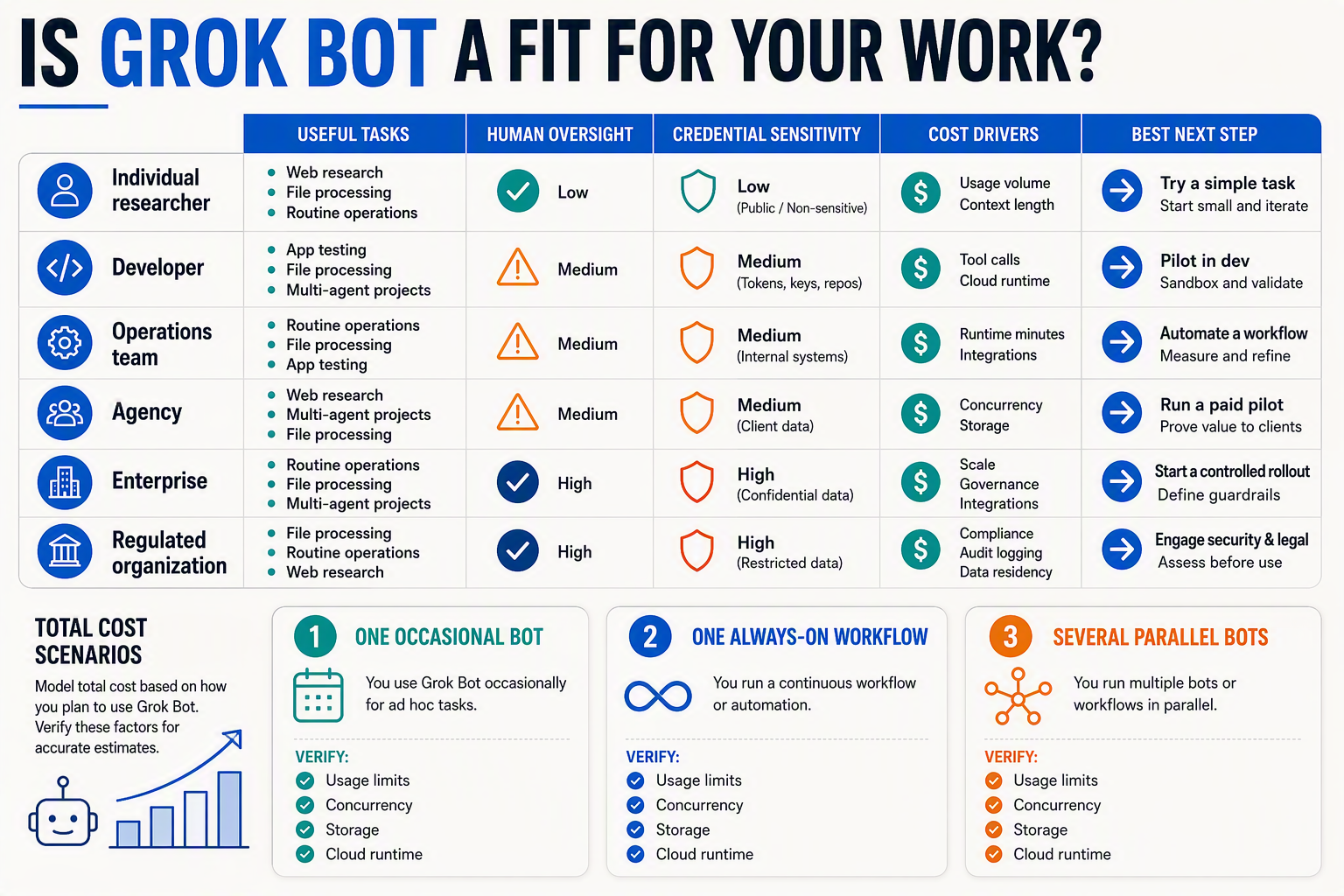
Grok Bot’s practical meaning is different for each audience: individuals gain an always-available task runner, developers gain a cloud development worker, and enterprises gain delegable automation—but also a larger security and governance burden. The central shift is from asking an AI for advice to authorizing a computer-use agent to act across browsers, files, terminals and connected applications.
Impact by user group
| Audience | High-value use cases | Material benefit | Main risk or constraint |
|---|---|---|---|
| Individuals | Research, form filling, file organization and recurring web tasks | Work can continue after the laptop closes because execution occurs in the cloud | Incorrect actions, exposed personal credentials and unintended submissions |
| Software developers | Repository analysis, coding, testing, command-line workflows and app operations | A persistent environment retains files and task context between sessions | Unsafe commands, dependency attacks, secrets leakage and unreviewed code |
| Indie teams | Parallel research, QA, content operations and product maintenance | Multiple bots may work independently and hand off tasks | Coordination errors and uncertain cost or reliability at scale |
| Enterprise operations | Internal workflows, application use, reporting and repetitive back-office tasks | Delegation can extend automation into software lacking purpose-built APIs | Access control, auditability, data residency and compliance requirements |
| IT and security teams | Controlled agent deployment, permissions and incident monitoring | Central governance can standardize how agents access systems | Larger attack surface from browsers, terminals, credentials and prompt injection |
| Customer-engagement teams | Lead handling, support follow-up and cross-channel workflow execution | Action-oriented agents can connect conversations with operational work | Customer consent, message accuracy and human-escalation design |
What changes for individuals and developers
For individuals, persistence is the defining feature. SpaceXAI Docs says Grok Bot can use a browser, command line, files and connected tools without depending on the user’s laptop remaining open. That makes long-running research, monitoring and routine tasks more practical, but it also means users must remember that activity may continue when they are no longer watching.
For developers, the dedicated environment could compress several steps—inspect a codebase, modify files, run commands and test an application—into one delegated workflow. A first-party SpaceXAI guide describes a mobile-game workflow involving six bots, each with its own computer, role and to-do list. That example demonstrates the intended parallel-agent model, not an independent benchmark of productivity or correctness.
Developers should therefore treat bot output like a pull request from an untrusted contributor:
- Require review before merging or deploying.
- Keep production secrets out of broadly accessible environments.
- Restrict terminal permissions and network destinations.
- Log commands, file changes and external actions.
- Test generated changes in isolated staging systems.
What enterprises must solve first
Enterprise value depends less on raw model intelligence than on identity, permissions and accountability. SpaceXAI Docs states that each user’s work runs on a dedicated computer in Cursor’s cloud, while access to the user’s local Mac or Windows machine is a separate capability. That separation is useful, but it does not replace least-privilege controls.
Before deployment, enterprise teams should define:
- Which applications and data classes bots may access.
- Which actions require human approval, especially payments, publishing, deletion and customer communication.
- How credentials are issued, rotated and revoked.
- How browser sessions, terminal commands and file changes are audited.
- What happens when malicious web content attempts prompt injection.
The wider implication extends beyond Grok Bot. Customer-engagement platforms such as CallMissed similarly turn AI from an answer layer into an action layer—connecting AI voice agents, WhatsApp Business calls and persistent workflows. Across both developer and customer-facing automation, the winning operating model will be bounded autonomy: useful independent execution inside explicit permissions, observable logs and reliable human escalation.
Frequently asked questions about Grok Bot pricing, access, capabilities and safety
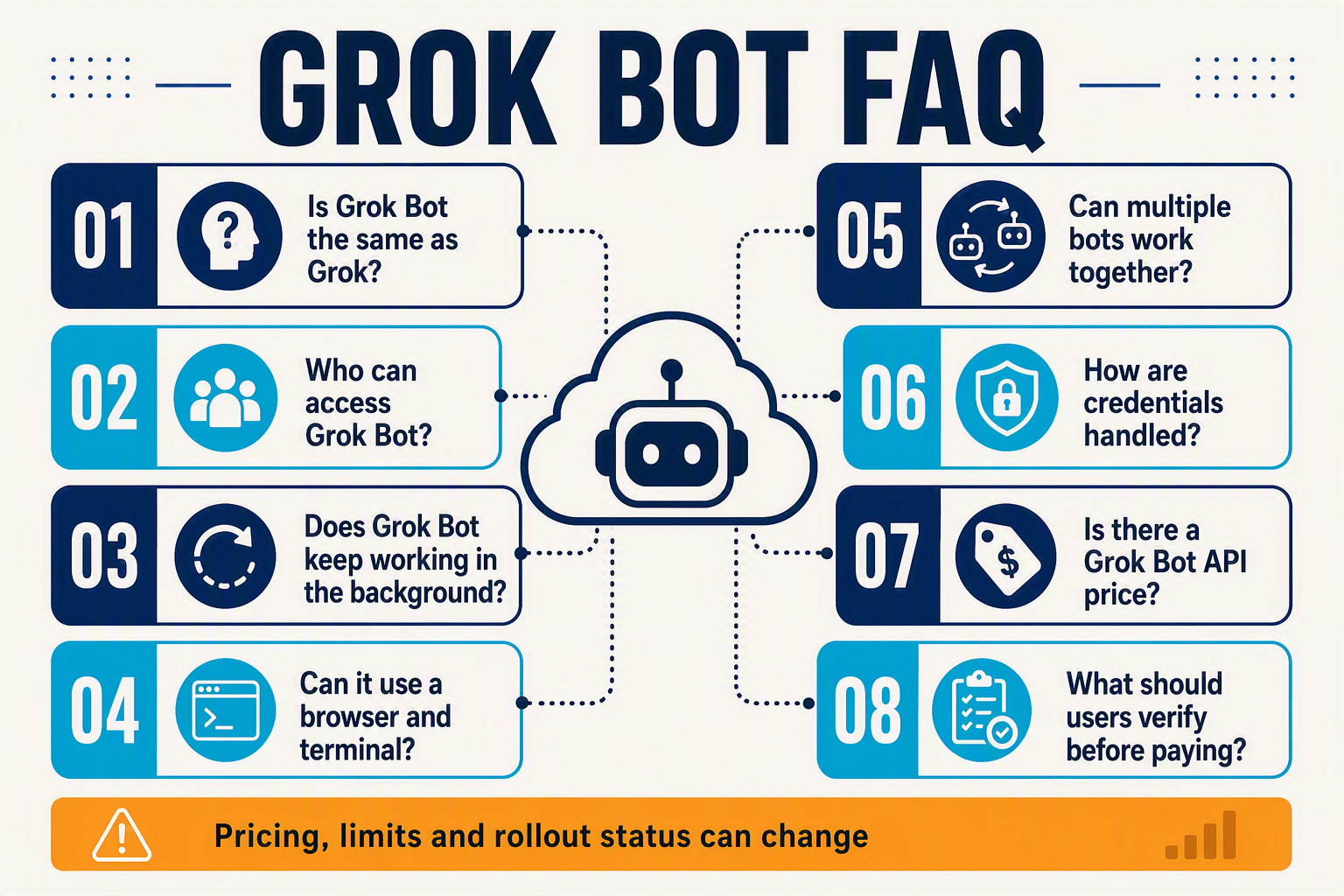
What is the verified Grok Bot pricing in 2026?
Who can access Grok Bot, and which plans are eligible?
What can Grok Bot do on its persistent cloud computer?
Can Grok Bot run routines and multiple agents in the background?
Is Grok Bot safe for passwords, business accounts and terminal access?
How is Grok Bot different from the Grok chatbot and Grok AI models?
Conclusion
Grok Bot’s 2026 proposition is compelling but still requires verification: it is a computer-use agent running on persistent cloud infrastructure, not merely a Grok chatbot with extra tools. Its practical value—and true cost—will depend on plan eligibility, usage limits, reliability and the safeguards organizations apply to delegated work.
Key takeaways
- Access is bundled with eligible plans, not proven to be permanently free. As of September 8, 2026, SpaceXAI Docs lists SuperGrok Plus, SuperGrok Heavy, Cursor Pro+, Cursor Ultra, Cursor Teams Standard and Cursor Teams Premium as eligible plans. SpaceXAI’s separate two-week enterprise offer should be understood as a launch promotion, not a confirmed standalone price.
- The persistent cloud computer is the defining capability. SpaceXAI Docs says Grok Bot can operate a browser, command line, filesystem and connected tools without the user’s laptop remaining open. This architecture supports routines, background execution and task monitoring through the Agent Computer interface.
- Autonomy increases both utility and risk. A bot that signs into websites, handles files or executes terminal commands can complete meaningful work, but it can also make consequential errors or encounter prompt injection and malicious content. SpaceXAI documents approval controls and treats access to a local Mac or Windows machine as a separate permission, making least-privilege configuration and human review essential.
- Parallel bots remain a capability to validate in practice. SpaceXAI says bots can operate independently, exchange context and hand off tasks, but teams should test those claims against real workflows before relying on them for production-critical operations.
What to watch next
The most important developments will be clearer standalone pricing, transparent usage quotas, broader availability and evidence of reliable multi-agent execution. Buyers should also watch how credential handling, approval policies and recovery from failed actions evolve as Grok Bot moves from demonstrations to routine business use.
Grok Bot reflects the wider shift from AI that answers questions to AI that performs persistent work. To explore how that shift is reaching customer communication, check out CallMissed—an AI infrastructure platform powering voice agents, WhatsApp automation and multilingual chatbots across 22 Indian languages.
As autonomous agents gain browsers, terminals and credentials, is your organization ready to delegate work without delegating away control?
Related Reading
- GPT-6 Astra API Availability, Access, and Pricing: Verified Status as of September 3, 2026
- Meta Muse vs Grok Bot: Which Personal AI Agent Wins in 2026?
- Best WhatsApp AI Agent Platform in 2026: Pricing, Features, and Fit Compared