Dessa Speech-Only Voice Model: Voice-Agent Developer Guide


Explore how the Dessa speech-only voice model could fit voice agents, with architecture guidance, access checks, testing steps and safety trade-offs.
Dessa Speech-Only Voice Model: Voice-Agent Developer Guide
What if a voice agent learned to converse without ever reading a word? The Dessa speech-only voice model offers a glimpse of that approach: according to Unite.AI’s October 23, 2026 reporting, Block unveiled a full-duplex speech-to-speech research model trained from human conversation audio, without text or pretrained models. For developers, its potential role is as a conversational audio layer—not automatically a replacement for the tools, knowledge retrieval, and controls that make a business agent useful.
The timing matters. In the trending context supplied for October 24, 2026, the Hacker News discussion about Dessa had 421 points, signalling developer interest in an alternative to text-centred voice architectures. Block’s announcement also arrives with an important qualification: AI Chat Daily described Dessa as a research preview on October 23, 2026. An intriguing demonstration is not the same thing as a documented, production-ready integration.
Most familiar voice-agent pipelines turn speech into text, ask a language model to generate a response, and convert that response back into audio. That architecture gives developers convenient places to inspect transcripts, invoke tools, and enforce business rules. But a transcript alone does not preserve every hesitation, overlapping utterance, or change in vocal delivery.
Full-duplex speech-to-speech changes the design question. Rather than treating listening and speaking as strictly separate phases, a model can support both simultaneously. Imagine a customer interrupting an appointment-booking agent with “Actually, Thursday”—the engineering challenge is not merely recognising Thursday, but stopping appropriately, updating the request, and avoiding an incorrect booking.
That is why Dessa deserves attention beyond its unusual training recipe. Block’s claim, quoted in NewKerala’s reporting provided for this October 2026 guide, is that it “learned to hold a real-time conversation simply by listening.” The practical question is whether that conversational behaviour can coexist with reliable execution, observability, and safety.
As of October 2026, CallMissed supports real-time voice sessions through an API and SDK, alongside custom REST tools and call transcripts—illustrating the surrounding infrastructure that conversational models still need.
What will developers learn about speech-only voice agents?
This guide separates reported capabilities from integration assumptions, then examines:
- Architecture: Where a speech-only model could sit within a voice-agent stack.
- Conversation handling: How to evaluate interruptions, overlapping speech, and turn-taking.
- Business execution: What to verify before connecting retrieval, scheduling, or other tools.
- Deployment readiness: Which access, logging, evaluation, and safety questions remain unanswered.
The goal is a practical evaluation framework, not an assumption that Dessa is ready to deploy.
How could Dessa fit voice agents? As a speech layer, if access and controls are verified
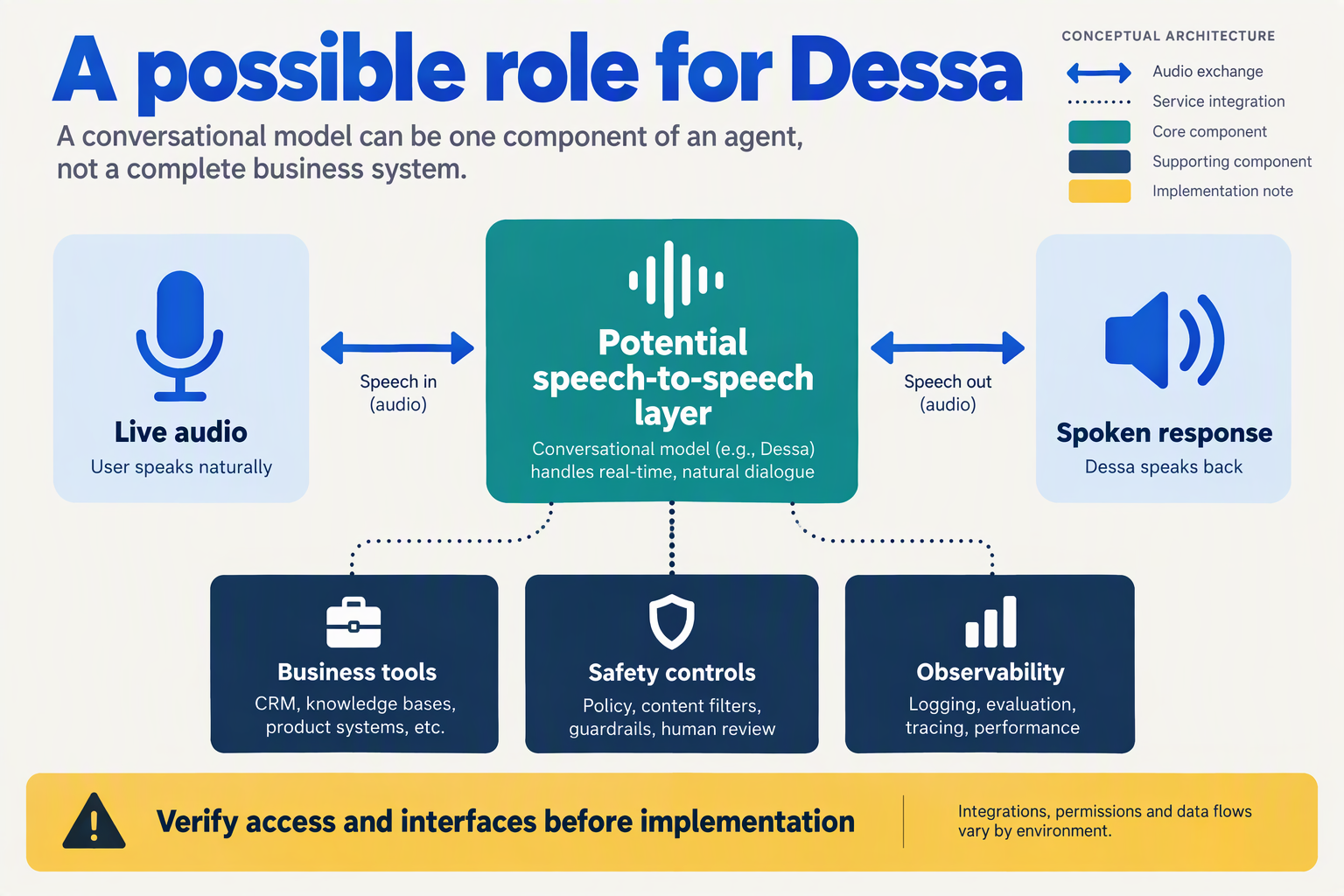
Dessa could fit a voice agent as its conversational speech layer, while a separate application manages business decisions and execution. That architecture is conditional: developers first need to verify model access, audio interfaces, and whether the application can reliably constrain what Dessa says and does.
Where would Dessa sit in a voice-agent architecture?
For an initial evaluation, treat Block’s Dessa speech-only conversation model as a candidate audio component—not the system of record for customer requests. The surrounding application should retain responsibility for identity checks, permissions, retrieval, and transaction state.
A proposed integration would have three boundaries:
- Audio transport: Move microphone or telephone audio into the model and return generated speech to the caller.
- Conversation control: Handle interruption events, session termination, and escalation to a human.
- Business orchestration: Validate requests, retrieve approved information, invoke authorised tools, and record outcomes.
These are integration requirements, not documented Dessa capabilities. As of October 24, 2026, the supplied reporting does not establish that Dessa exposes tool calling, structured outputs, or application-level instructions.
The critical question is whether developers can connect those boundaries without losing control over spoken responses. If the model cannot reliably receive verified results or respect an application’s constraints, its role may need to remain a sandboxed conversation experiment.
What access and runtime details should developers verify?
Access comes before architecture. NewKerala’s reporting supplied for this October 2026 guide says Block gave early access to AI safety researchers; that does not establish general developer availability or commercial deployment rights.
AICoder’s October 24, 2026 report describes Dessa running locally on a MacBook Pro M4 Max. That is a useful feasibility signal, but it is not a published benchmark for concurrent calls, memory consumption, or telephone-quality audio.
Before planning an integration, request:
- Access terms: Who can obtain the model, and which evaluation or commercial uses are permitted?
- Interface documentation: What audio formats, streaming methods, and session events are exposed?
- Runtime measurements: What hardware, memory, and sustained processing capacity does the workload require?
- Control mechanisms: Can the application stop speech, supply verified information, and enforce escalation?
Local execution alone also does not establish a deployment’s privacy properties. Developers must examine recordings, logs, retention, and any surrounding services.
How would a controlled booking example work?
Consider an appointment assistant. The customer asks for Thursday afternoon, but only the scheduling service can establish availability.
In a proposed controlled design, the application would retrieve available slots, obtain explicit customer confirmation, and submit the booking only after validation. The challenge is ensuring that Dessa’s spoken response matches that verified state.
A failed tool request must not produce “You’re booked.” If developers cannot enforce that distinction, they should keep transaction completion outside the speech model’s authority—potentially using a separate confirmation channel.
What infrastructure would still be needed?
As of October 2026, CallMissed provides real-time voice sessions through an API and SDK, custom REST tools, call transcripts, and live supervisor monitoring. Those capabilities illustrate the surrounding infrastructure a conversational audio model would still need; they do not establish Dessa compatibility.
The practical go/no-go criterion is therefore not simply whether Dessa sounds convincing. It is whether a documented integration can preserve verified business state, controllable speech, and observable outcomes throughout a call.
What do Dessa's speech-only training and full-duplex claims actually establish?
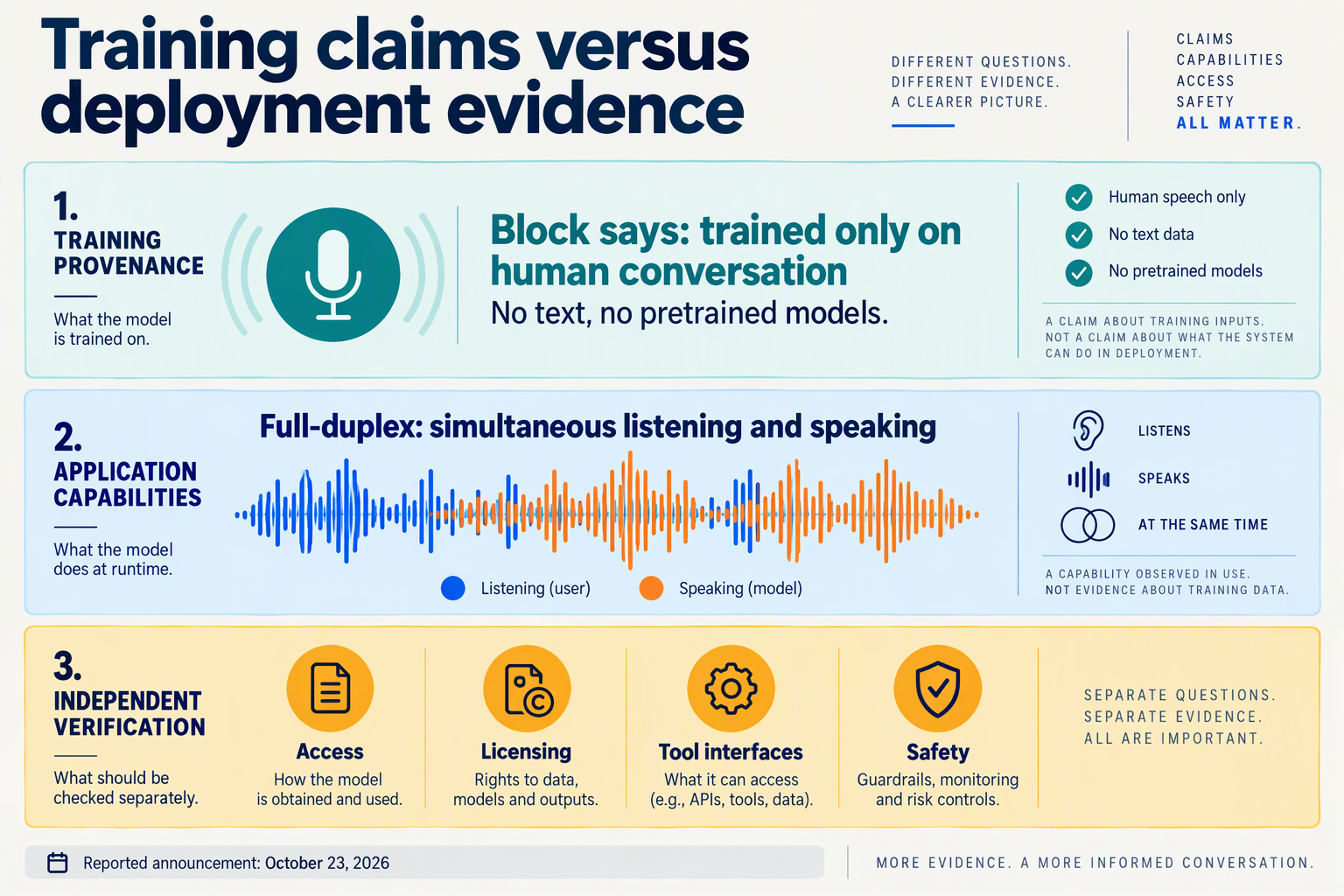
Dessa’s speech-only training claim establishes a reported training approach; its full-duplex claim establishes a reported ability to listen and speak simultaneously. Neither claim, by itself, demonstrates factual accuracy, reliable tool use, or production readiness for business voice agents.
What does “trained only on speech” actually mean?
According to Unite.AI’s October 23, 2026 report, Block describes Dessa as trained from scratch on human conversation audio, without text or pretrained models. That is a claim about the model’s training inputs and starting point—not evidence that every part of a future deployment would operate without text.
The distinction matters because training modality and application architecture are separate decisions. A speech-trained model could potentially sit inside a system that also generates transcripts, queries a text-based knowledge base, or sends structured requests to a scheduling service. Whether Dessa supports those arrangements remains an integration question, not something its training description answers.
ArtRealmAI’s reporting supplied for this October 2026 guide summarises Block’s approach as “no text, no pretrained models.” Developers should interpret that narrowly rather than extending it into unsupported conclusions:
- Supported by the reported claim: Human conversation audio supplies the training material, rather than a text-trained model providing the starting foundation.
- Not established: The model can reliably retrieve business facts, follow complex policies, or produce valid tool arguments.
- Also not established: The model’s internal representations, training-data scale, language coverage, or performance relative to text-centred alternatives.
Learning from conversational audio may help capture information that transcripts omit, including timing and vocal delivery. But that is a motivation for evaluation—not proof of superior performance.
Does full-duplex mean an agent handles interruptions correctly?
Full-duplex means simultaneous listening and speaking; successful interruption handling requires additional behaviour. AI Chat Daily’s October 23, 2026 report identifies Dessa as a full-duplex speech-to-speech research preview, but the supplied coverage does not provide quantified interruption-handling benchmarks.
Consider a caller who says, “Yes, that works,” while an agent is still explaining an option. The system must distinguish an acknowledgement from a request to stop. Simultaneous audio processing makes that interaction possible; it does not establish that the interpretation will be correct.
A practical evaluation should separate three questions:
- Detection: Does the model notice speech during its own response, including quiet voices and noisy connections?
- Conversation control: Does it pause for a genuine interruption without stopping unnecessarily for every acknowledgement?
- State correction: Does it incorporate the caller’s revised intent before any downstream action occurs?
These are distinct outcomes. A convincing conversational demonstration can show natural overlap while leaving business-state correctness untested.
What does the local-running claim prove?
AICoder’s October 24, 2026 coverage reports Dessa running locally on a MacBook Pro M4 Max. That establishes a reported hardware demonstration, not a capacity plan: the supplied reporting gives no measured concurrency, memory requirement, sustained throughput, or end-to-end latency figure.
Similarly, NewKerala’s reporting supplied for this October 2026 guide says early access was given to AI safety researchers. That is not evidence of general developer availability.
The useful conclusion is specific: Dessa presents a research direction worth testing for conversational audio behaviour. Before selecting it for a voice-agent stack, developers still need documented access, reproducible measurements, and evidence that natural conversation can coexist with dependable business execution.
What prerequisites and access checks come before a Dessa prototype?
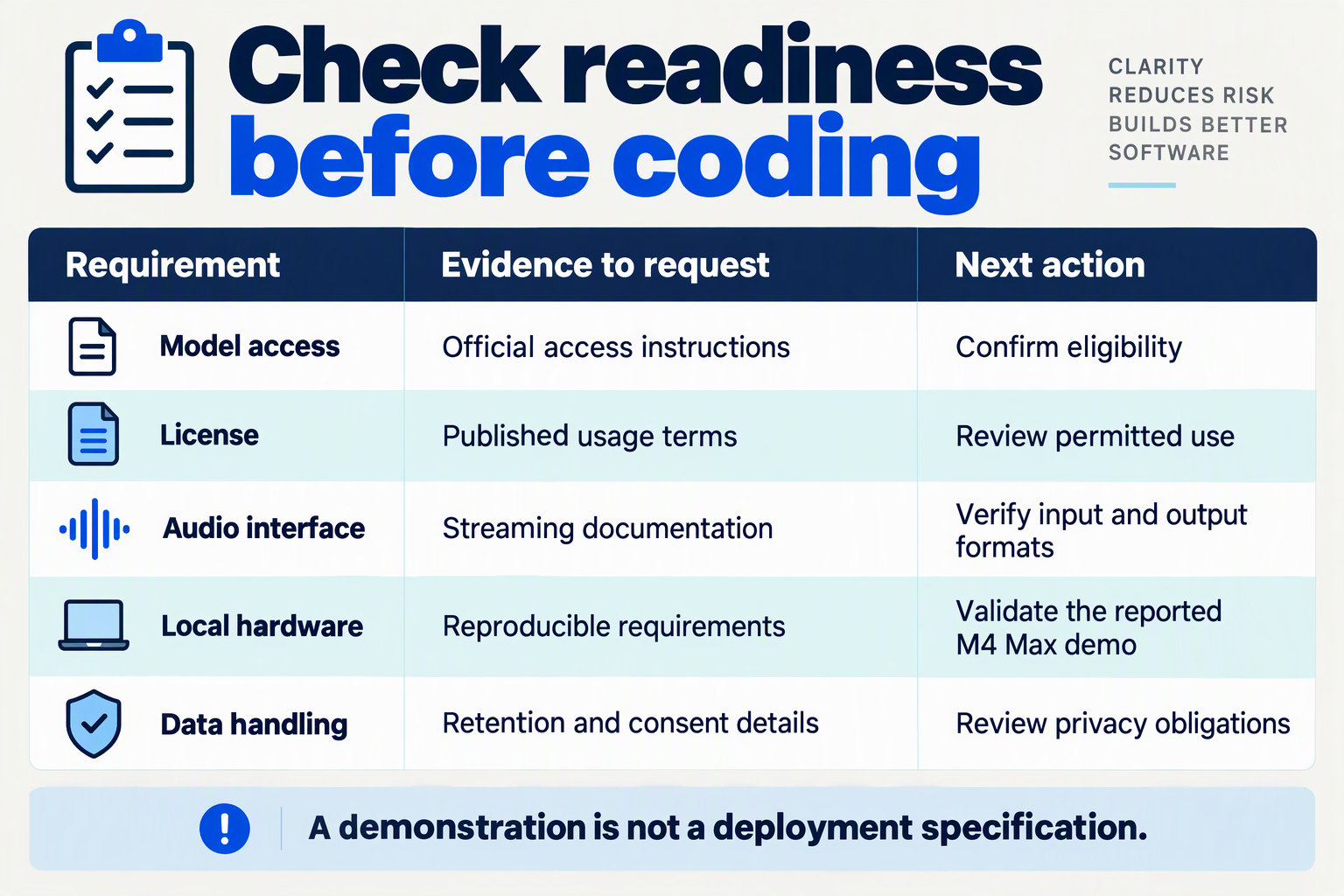
Before building a Dessa prototype, verify authorised access, permitted uses, runtime requirements, and the audio interface—not just whether the demonstration sounds convincing. As of October 24, 2026, the supplied reporting does not establish a public developer API, downloadable weights, or a commercial-use licence; treat those as verification tasks, not available capabilities.
NewKerala’s reporting supplied for this October 2026 guide says early access was given to AI safety researchers. That makes eligibility the first gate: a developer evaluating customer-service applications should not assume the same access route applies.
What must you verify before starting a Dessa prototype?
Use this checklist to decide whether to proceed with model testing or limit work to an interface-independent evaluation harness. All status descriptions below reflect the supplied information as of October 24, 2026.
| Prerequisite | Reported evidence | Check before proceeding | Pass condition |
|---|---|---|---|
| Access eligibility | NewKerala reports early access for AI safety researchers. | Ask Block about eligibility, application steps, and access conditions. | Written approval or an official access route covering your team. |
| Usage rights | Supplied coverage does not establish commercial licensing. | Confirm evaluation, recording, redistribution, and business-use permissions separately. | Terms explicitly permit the planned experiment. |
| Runtime and hardware | AICoder reports local operation on a MacBook Pro M4 Max. | Obtain memory, operating-system, dependency, and installation requirements. | Your machine meets documented requirements. |
| Audio contract | Reporting describes simultaneous listening and speaking. | Verify sample rate, encoding, chunk sizes, streaming transport, and cancellation behaviour. | A documented interface supports your test harness. |
| Data handling | Supplied coverage does not establish retention or processing-location policies. | Determine where audio goes, who can access it, and how deletion works. | The experiment satisfies your organisation’s privacy rules. |
| Control and observability | Supplied coverage does not establish tool-call or logging interfaces. | Check session controls, error signals, diagnostic outputs, and termination options. | You can inspect failures and stop sessions reliably. |
AICoder’s October 24, 2026 coverage reports that Dessa runs locally on a MacBook Pro M4 Max. That is a useful hardware reference, but it is not a minimum specification or evidence that every similarly configured laptop will deliver acceptable performance.
What should the first experiment include—and exclude?
Start with a bounded audio experiment, not a connected business workflow. Until permissions and interfaces are confirmed, use consenting internal testers, synthetic scenarios, and no customer records.
A practical sequence is:
- Define one task: test whether a speaker can interrupt a response and receive a relevant continuation.
- Prepare controlled inputs: use the same microphone, room conditions, and scenario across runs.
- Record permitted evidence: capture input/output audio and harness timestamps where access terms allow.
- Set stop conditions: terminate sessions on repeated unintelligible output, unexpected content, or interface errors.
Keep payments, account changes, and appointment writes outside the first prototype. Audio fluency does not establish that a model can safely authorise an action.
Can surrounding infrastructure be prepared before access arrives?
Yes. Build an adapter boundary separating audio transport, model interaction, and business actions, so unresolved Dessa access does not block the entire evaluation.
As of October 2026, CallMissed provides real-time voice sessions through an API and SDK, custom REST tools, and call recordings and transcripts. Those capabilities illustrate infrastructure you can evaluate separately; they do not establish a supported Dessa integration.
Before investing further, keep three explicit decisions:
- Proceed: access, permissions, and interfaces are documented.
- Pause: essential requirements remain unanswered.
- Narrow scope: test the surrounding harness without claiming to have tested Dessa.
How do you get started with a transcription-first baseline and a speech-to-speech design?
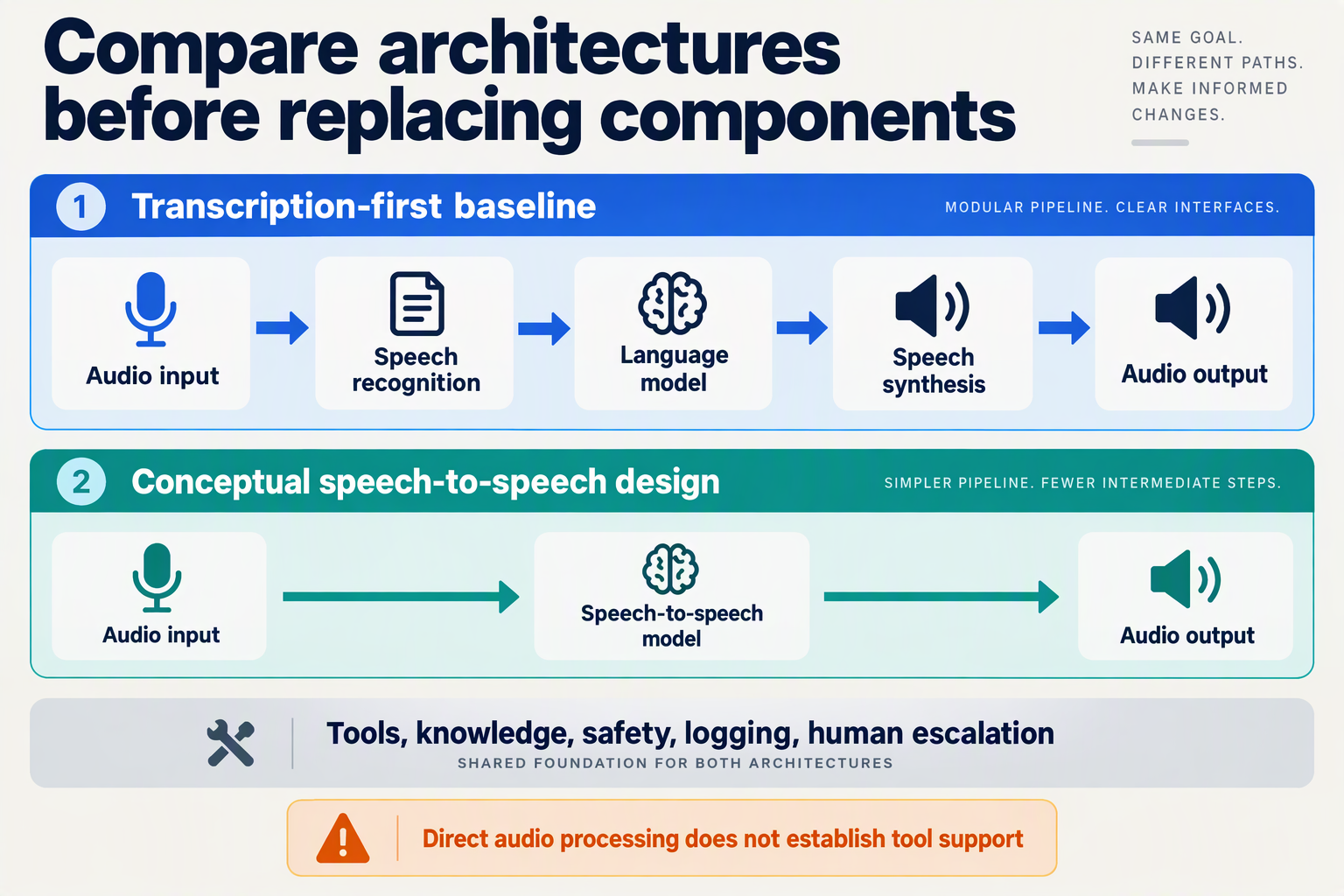
Start with a transcription-first baseline that completes one narrow task reliably, then evaluate a speech-to-speech design against the same task and test recordings. Keep business logic separate from the conversational layer so that changing models does not change booking rules, permissions, or success criteria.
How do you build a transcription-first voice-agent baseline?
Choose a bounded workflow, such as checking appointment availability and booking a slot after explicit confirmation. Avoid starting with an agent that handles every customer request: a narrow scope makes failures easier to diagnose.
Build the baseline in four steps:
- Define the task contract. Specify required inputs, permitted actions, confirmation wording, and conditions for human escalation.
- Connect speech recognition, a text model, and speech synthesis. Preserve intermediate transcripts and tool results so you can identify where errors originate.
- Put execution behind validated tools. Let the model request an availability lookup, but let application code validate dates, enforce permissions, and commit bookings.
- Record a repeatable evaluation set. Include clean speech, background noise, corrections, silence, and interruptions using consented or purpose-recorded audio.
For example, “Book Tuesday—sorry, Wednesday afternoon” should produce a Wednesday availability lookup, not two bookings. Evaluate the final action alongside the conversation: a fluent response does not prove that the correct transaction occurred.
As of October 2026, CallMissed’s developer AI API offers OpenAI-compatible audio transcription, speech, and chat-completion endpoints, alongside function calling and request logs. Those components provide practical building blocks for an inspectable baseline without requiring a single conversational model to perform every function.
How do you prototype a speech-to-speech design safely?
Treat speech-to-speech as an alternative conversational interface, not an automatic replacement for your application backend. Your proposed architecture should connect an audio session to the conversational model while keeping tool execution and authorization in a separate service.
Do not assume Dessa exposes the interfaces this design requires. AI Chat Daily reported on October 23, 2026, that Block introduced Dessa as a research preview; the supplied reporting does not establish a public developer API, tool-calling schema, or production service guarantees.
Before attempting integration, verify:
- Access: Can your team obtain documented model access and permitted development use?
- Audio transport: Which formats, streaming mechanisms, and session controls are supported?
- Control signals: Can the application cancel output, detect interruptions, and receive structured action requests?
- Observability: What recordings, events, or transcripts can you retain under your privacy policy?
If those interfaces are unavailable, prototype the surrounding architecture with an accessible speech-to-speech system. Label that experiment clearly: it tests your design, not Dessa’s performance.
How do you compare both designs fairly?
Use the same scenarios, backend tools, and completion criteria for both architectures. Measure task completion, incorrect tool actions, response-start delay, interruption recovery, and escalation quality; report distributions rather than one impressive demo.
A useful interruption test is: “Wednesday afternoon—actually, don’t book anything yet.” Check whether the agent stops speaking, withdraws the pending action, and asks what the caller wants next.
AICoder’s October 24, 2026 reporting describes Dessa running locally on a MacBook Pro M4 Max. Treat that as a reported execution environment, not a latency benchmark or proof of deployment economics.
Set acceptance thresholds before testing. Advance the speech-to-speech design only when it improves conversational behaviour without weakening transaction correctness, consent handling, or debuggability.
How do you prototype and evaluate a speech-only voice agent step by step?
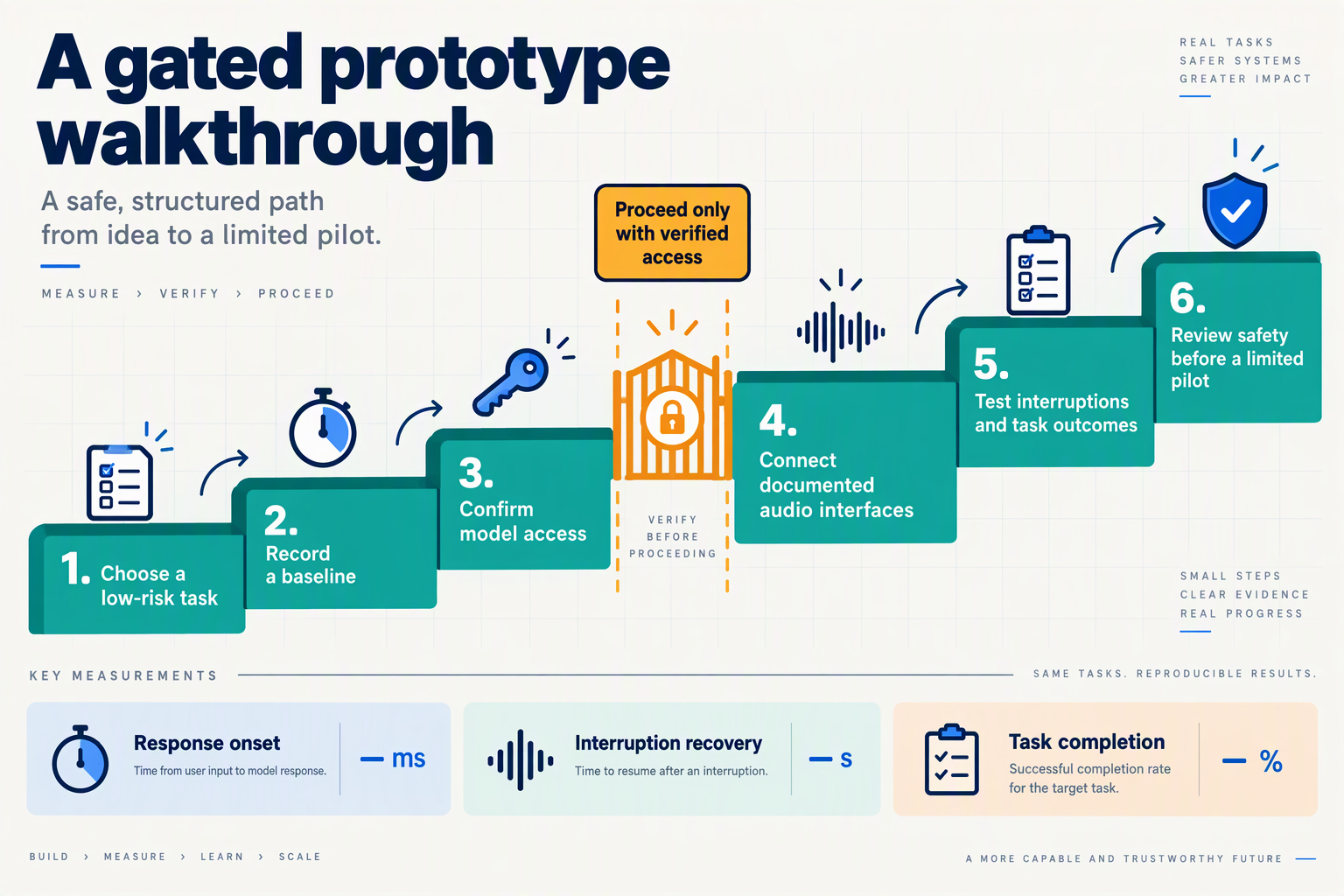
Prototype a speech-only voice agent by isolating its audio interface, testing conversational behaviour, and adding business actions only behind explicit controls. Evaluate conversation quality and task correctness separately: a natural-sounding exchange can still produce the wrong booking.
How do you confirm model access before building?
1. Establish what you can actually run. AI Chat Daily described Block’s Dessa as a research preview on October 23, 2026, while NewKerala’s October 2026 reporting said early access was given to AI safety researchers. Those reports do not establish a generally available developer API.
Before designing an integration, verify:
- Access eligibility, licensing, and permitted deployment environments.
- Supported audio formats, streaming interfaces, and session limits.
- Whether interruption controls, tool interfaces, and diagnostic outputs exist.
AICoder’s October 24, 2026 reporting describes Dessa running locally on a MacBook Pro M4 Max. Treat that as a reported demonstration environment—not evidence of capacity on your hardware. If access is unavailable, build the evaluation harness with an accessible voice model, but do not label its results as Dessa benchmarks.
What should the first prototype include?
2. Choose one bounded task. Start with appointment rescheduling using fictional customers and a mock calendar. Exclude payments, sensitive records, and irreversible actions.
3. Separate conversation from execution. Create distinct components for audio transport, the conversational model, and a deterministic action service. If the model exposes no documented structured-action interface, keep the prototype conversational; do not infer booking commands from expressive audio and execute them automatically.
As of October 2026, CallMissed supports real-time voice sessions through an API and SDK, custom REST tools, and call recordings and transcripts. These capabilities illustrate the surrounding infrastructure needed for a test harness; they do not establish Dessa compatibility.
Record input audio, output audio, interruption timestamps, proposed actions, and confirmed outcomes. Any external transcription used for evaluation should remain clearly identified as an observer—not part of the speech-only model’s training claim.
How do you test interruptions and task accuracy?
4. Build a repeatable audio test set. Use consented recordings or scripted sessions covering:
- Corrections: “Tuesday—sorry, Thursday.”
- Barge-in: Interrupt while the agent explains available slots.
- Backchannels: Say “mm-hmm” without intending to take the floor.
- Acoustic variation: Test background noise, accents, and code-switching.
- Action ambiguity: Request a change without identifying which appointment.
5. Score audio behaviour and business outcomes separately. Measure interruption-to-stop time and end-of-turn-to-response time, reporting median and tail values rather than one flattering average. Count false interruptions, ignored corrections, task successes, duplicate actions, and unsupported claims.
For an illustrative October 2026 test plan—not a published benchmark—suppose an agent handles 45 of 50 scenarios correctly: task success is 90%. Report the five failures by category; that percentage alone cannot reveal whether failures were harmless clarification loops or incorrect bookings.
When is a prototype ready for a limited pilot?
6. Compare against a conventional baseline. Run identical scenarios through a speech-recognition–language-model–speech-synthesis pipeline, keeping tools and business rules constant. Use blinded human ratings for conversational quality alongside logged task outcomes.
7. Apply explicit release gates. Require confirmation before calendar writes, block duplicate submissions, and define a human escalation path. Set thresholds according to task risk before testing.
A convincing speech-only demo earns further evaluation—not automatic production approval. Advance only when the prototype’s conversational benefits survive realistic audio conditions without weakening execution controls.
Which advanced tests reveal turn-taking and integration weaknesses?
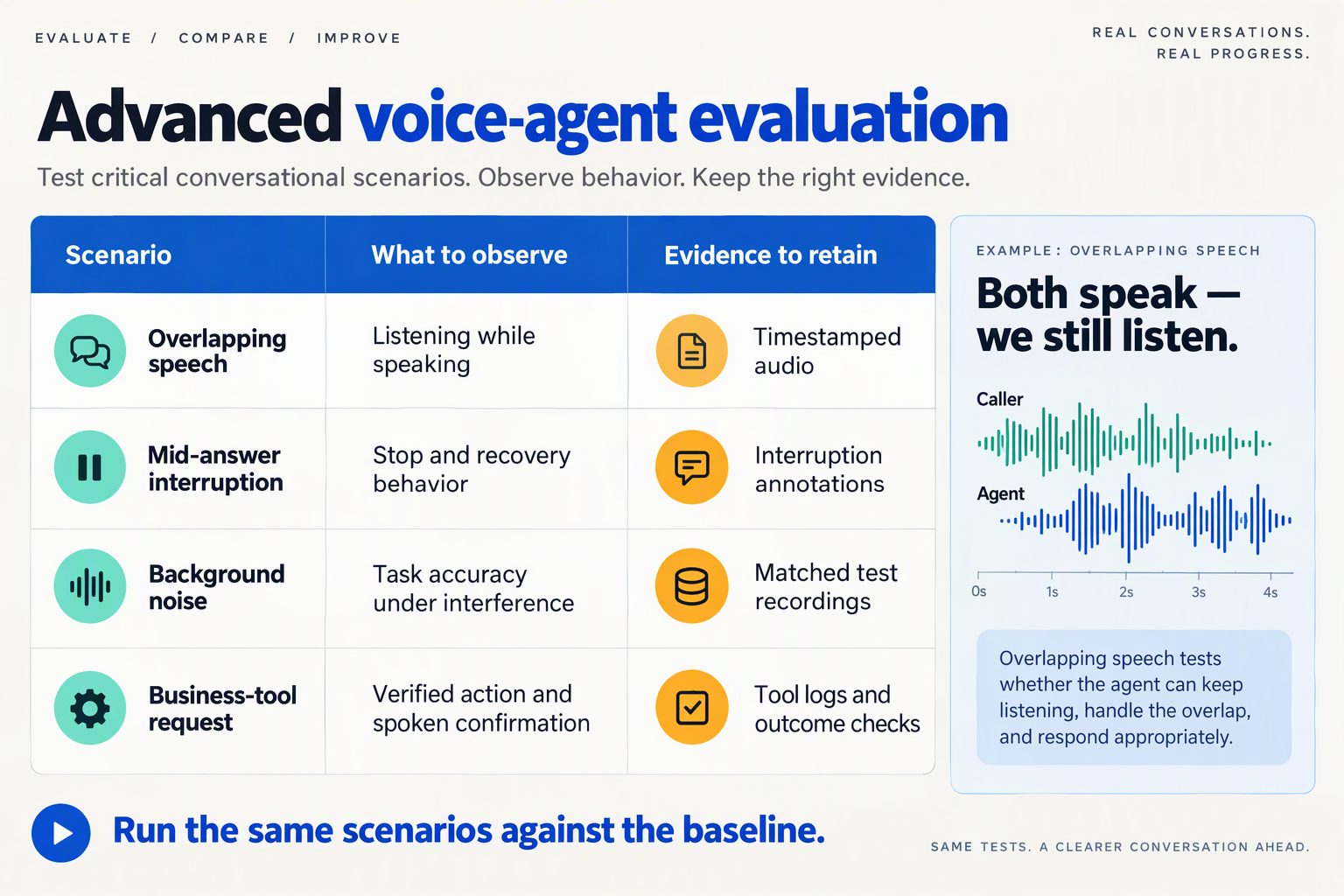
Adversarial overlap, delayed-tool, and recovery tests reveal weaknesses that scripted conversations miss. Evaluate whether a speech-only conversation model handles conversational timing and preserves application state: sounding natural is not enough if an interruption leaves an incorrect action running.
AI Chat Daily described Block’s Dessa as a research preview on October 23, 2026, so the tests below are proposed evaluation procedures—not published Dessa benchmarks. Apply them to whichever model interface becomes available, distinguishing model behaviour from failures in your audio transport or application controller.
Which advanced voice-agent tests should developers run?
Use a repeatable audio harness with separate recordings for incoming and outgoing speech. Capture tool requests, cancellation events, and state changes on the same timeline.
| Test | Stress scenario | Measure | Failure signal |
|---|---|---|---|
| Interruption sweep | Start “Stop” or a correction at several points during the agent’s reply. | Time from interruption onset to output stopping; correction retention. | Speech stops, but the abandoned action still executes. |
| Backchannel discrimination | Alternate “mm-hmm,” “yes,” and “wait” while the agent speaks. | False interruption rate; missed genuine interruptions. | Acknowledgements cancel replies, or “wait” is ignored. |
| Ambiguous turn endings | Insert pauses, trailing phrases, and mid-sentence hesitations. | Premature responses; delay after genuine completion. | The agent talks over unfinished requests or waits excessively. |
| Delayed-tool race | Delay a booking response while the caller changes the requested date. | Stale-result acceptance; duplicate writes; final-state correctness. | An old result overrides the caller’s newer instruction. |
| Audio-path degradation | Replay the same exchange with jitter, packet loss, noise, and echo. | Task success by condition; self-interruption events. | Echo triggers interruptions, or missing audio changes intent. |
| Handoff and reconnect | Transfer to a human or reconnect during an unresolved request. | Context retained; action ownership; recovery outcome. | Both participants act, or neither owns the pending task. |
How should you score turn-taking without hiding failures?
Report distributions and error counts, not just an average response time. A fast median can conceal occasional long interruptions that make a conversation feel unresponsive.
For an October 2026 evaluation plan, record:
- Interruption-stop latency: time from the caller’s interruption onset to the last audible agent output. Also log cancellation timing to distinguish model delay from buffered playback.
- False interruption rate: acknowledgements incorrectly treated as stop requests, divided by acknowledgement trials.
- Correction success rate: trials where the final action matches the corrected instruction, divided by correction trials.
- Duplicate-action count: repeated external writes arising from retries, reconnects, or overlapping requests.
Set acceptance thresholds before testing, based on the task’s risk. Read-only information retrieval and appointment creation should not share identical failure tolerances. Repeat each scenario with different speakers and speaking styles; a single successful demonstration establishes very little.
How can developers isolate integration failures?
Use a controlled scheduling example rather than a live calendar:
- Ask the agent to book Tuesday, then hold the simulated tool response.
- Interrupt with “Make that Thursday,” then release Tuesday’s delayed result.
- Verify that Tuesday is not confirmed and that the final state reflects Thursday.
This exposes whether conversational correction reaches the execution layer, rather than merely changing the spoken reply.
As of October 2026, CallMissed provides custom REST tools, call recordings, transcripts, eval suites, and A/B experiments—useful surrounding capabilities for investigating these behaviours. That does not establish Dessa compatibility.
Keep audio evidence alongside transcripts: words alone cannot show whether a correction arrived before an action committed. When a test fails, identify the responsible layer—model, playback buffer, controller, tool adapter, or recovery logic—before deciding that the speech-only architecture itself is unsuitable.
Which mistakes should developers avoid with Dessa and speech-only models?
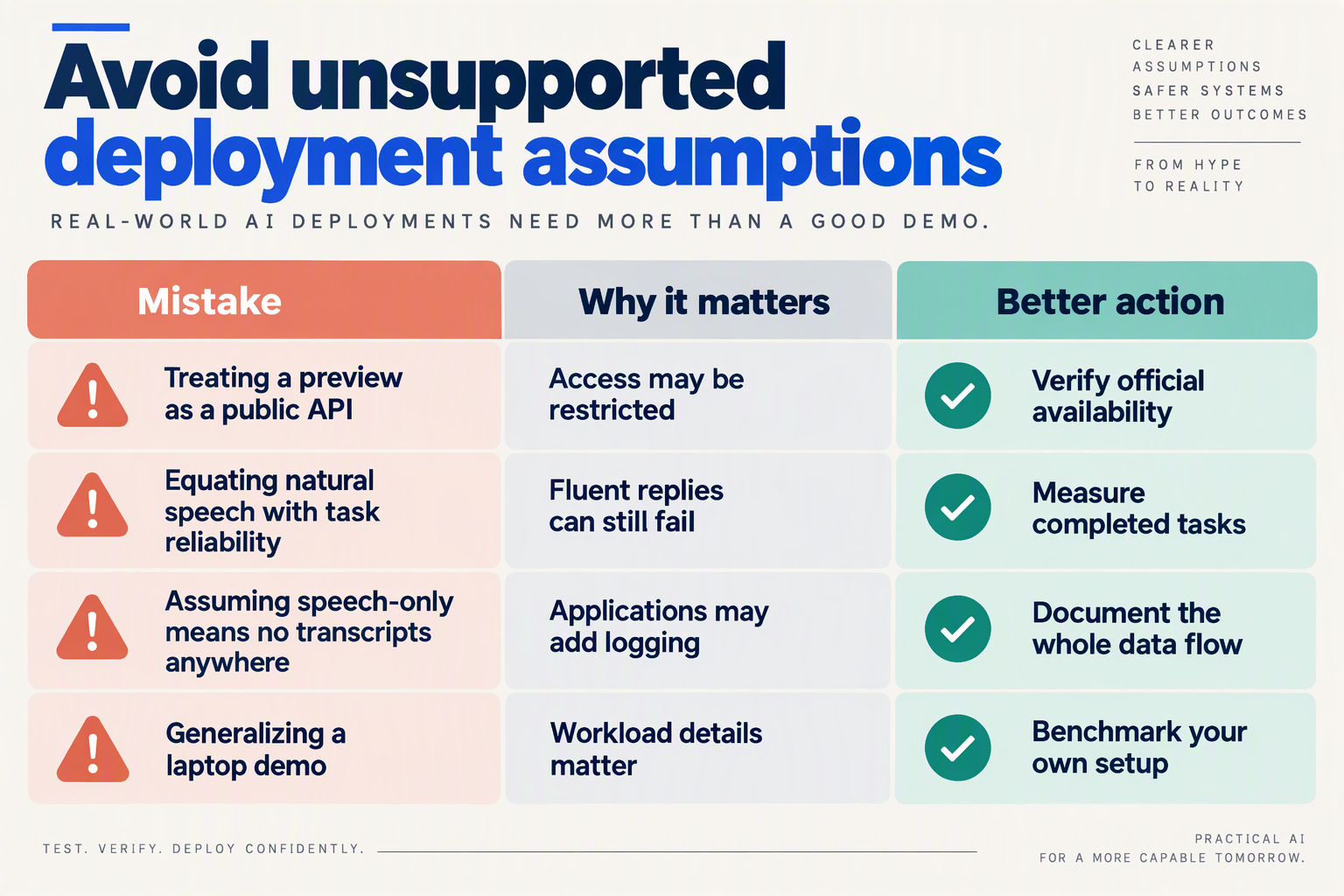
Developers should avoid treating Dessa’s conversational fluency as evidence of production readiness or assuming that speech-only training removes the need for tools, audit trails, and safety controls. Evaluate the audio model separately from the business workflow: sounding natural and completing an authorised action correctly are different acceptance criteria.
What are the biggest speech-only model integration mistakes?
As of October 24, 2026, the supplied reporting does not establish Dessa’s production API contract, business-tool interface, or deployment guarantees. The following checklist distinguishes reported capabilities from engineering requirements that developers must verify.
| Mistake | Why it matters | Better development practice |
|---|---|---|
| Assuming preview access means deployment access | AI Chat Daily described Dessa as a research preview on October 23, 2026. | Confirm access terms, permitted uses, support, and interface documentation before planning an integration. |
| Treating local execution as a capacity benchmark | AICoder’s October 24, 2026 report describes Dessa running locally on a MacBook Pro M4 Max, not a documented concurrent-call benchmark. | Measure memory use, sustained performance, and simultaneous-session capacity on your target hardware. |
| Equating fluent speech with factual correctness | A convincing spoken answer does not verify a price, appointment slot, or account balance. | Retrieve authoritative business data and validate it before communicating or acting. |
| Assuming full-duplex means safe interruption handling | Overlapping speech can change a request while an action is already pending. | Test cancellation, revised instructions, background voices, and duplicate-action prevention. |
| Removing observability because training uses no text | Audio alone makes operational review harder without searchable records and event traces. | Design consent-aware recording, transcription where appropriate, and timestamped tool logs around the model. |
| Inferring multilingual or safety coverage from a demo | The supplied October 2026 reporting provides no language-by-language accuracy or safety benchmark. | Evaluate target languages, code-switching, accents, refusal behaviour, and human escalation separately. |
How should developers test an interrupted business action?
Use an appointment-change test, not just an informal conversation. The critical failure is an incorrect booking, even if the agent’s voice sounds perfectly natural.
- Ask the agent to book Tuesday at 10 a.m.
- Interrupt with “Actually, Thursday” while the agent is responding.
- Check whether the application updates the pending request, verifies availability, and obtains confirmation before committing.
Record the outcome at three layers: audio behaviour, interpreted request, and backend state. An agent might stop speaking correctly but still submit Tuesday to the scheduling system; that is an execution failure, not a successful interruption.
Set acceptance thresholds before testing. Useful measures include:
- Wrong-action rate: completed actions that contradict the confirmed request.
- Duplicate-action rate: repeated bookings or other repeated writes.
- Recovery success: interrupted requests resolved correctly without restarting the entire interaction.
These are proposed evaluation measures, not published Dessa results.
What safety assumptions should developers avoid?
Do not interpret restricted research access as proof that safety evaluation is complete. As of October 2026, NewKerala reports that Dessa’s early access is being provided to AI safety researchers; that describes an evaluation audience, not a safety certification.
For sensitive workflows, keep permissions, explicit confirmations, and human escalation outside the conversational model’s discretion. As of October 2026, CallMissed provides custom REST tools, call transcripts, and evaluation suites—examples of surrounding infrastructure worth retaining when assessing a new audio model, without implying a verified Dessa integration.
The practical rule is simple: replace a conversational component only after proving that the surrounding workflow remains observable, recoverable, and correct.
Frequently Asked Questions
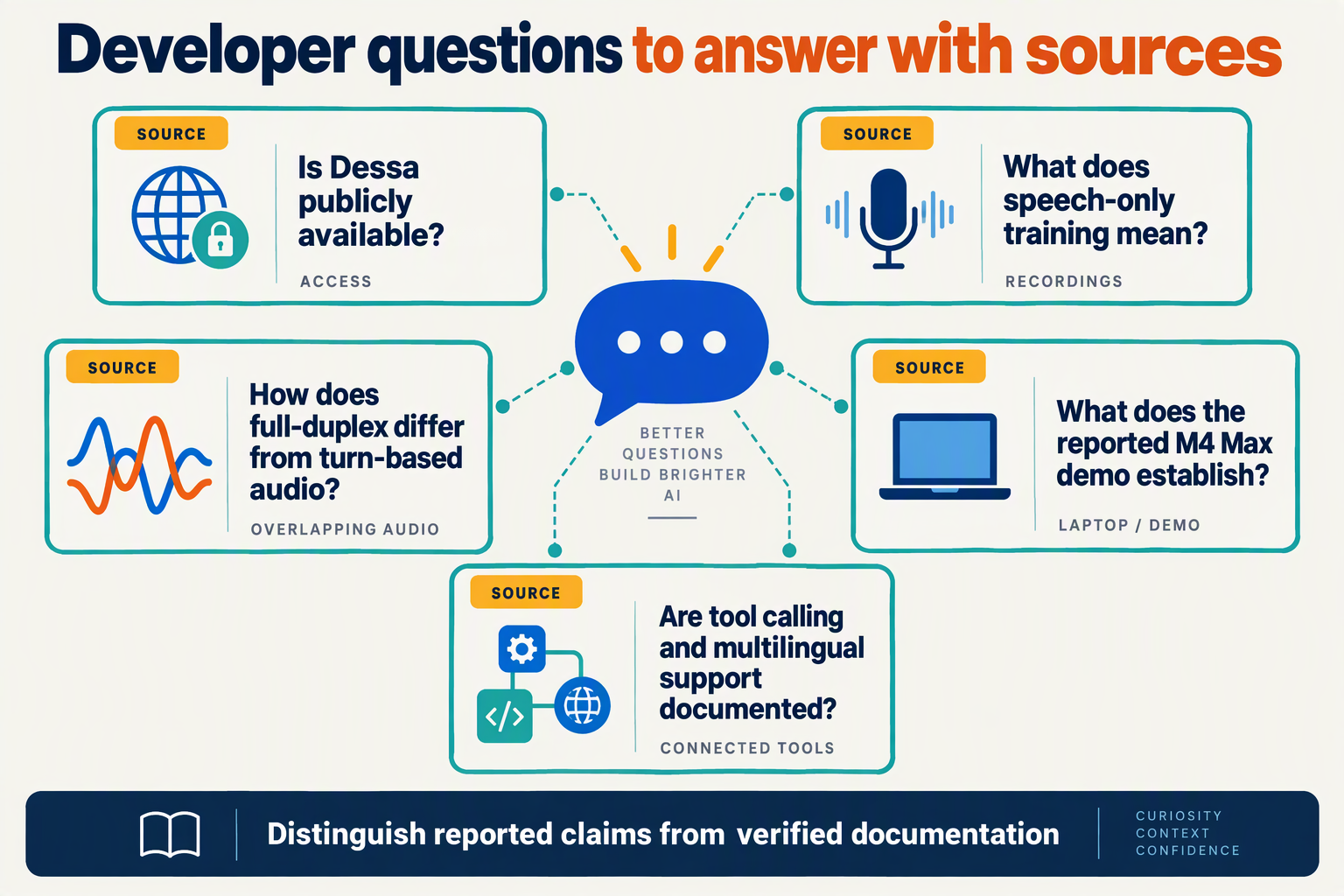
Is the Dessa speech-only voice model available for developers to use?
Does the Dessa speech-only voice model use text or transcripts?
Can the Dessa speech-only voice model run locally on a MacBook?
Can Dessa replace the language model in a business voice agent?
Can developers connect Dessa to APIs, CRM systems, or a knowledge base?
What should developers test before using Dessa with real customers?
Which sources should you verify next, and where can CallMissed provide a separate baseline?
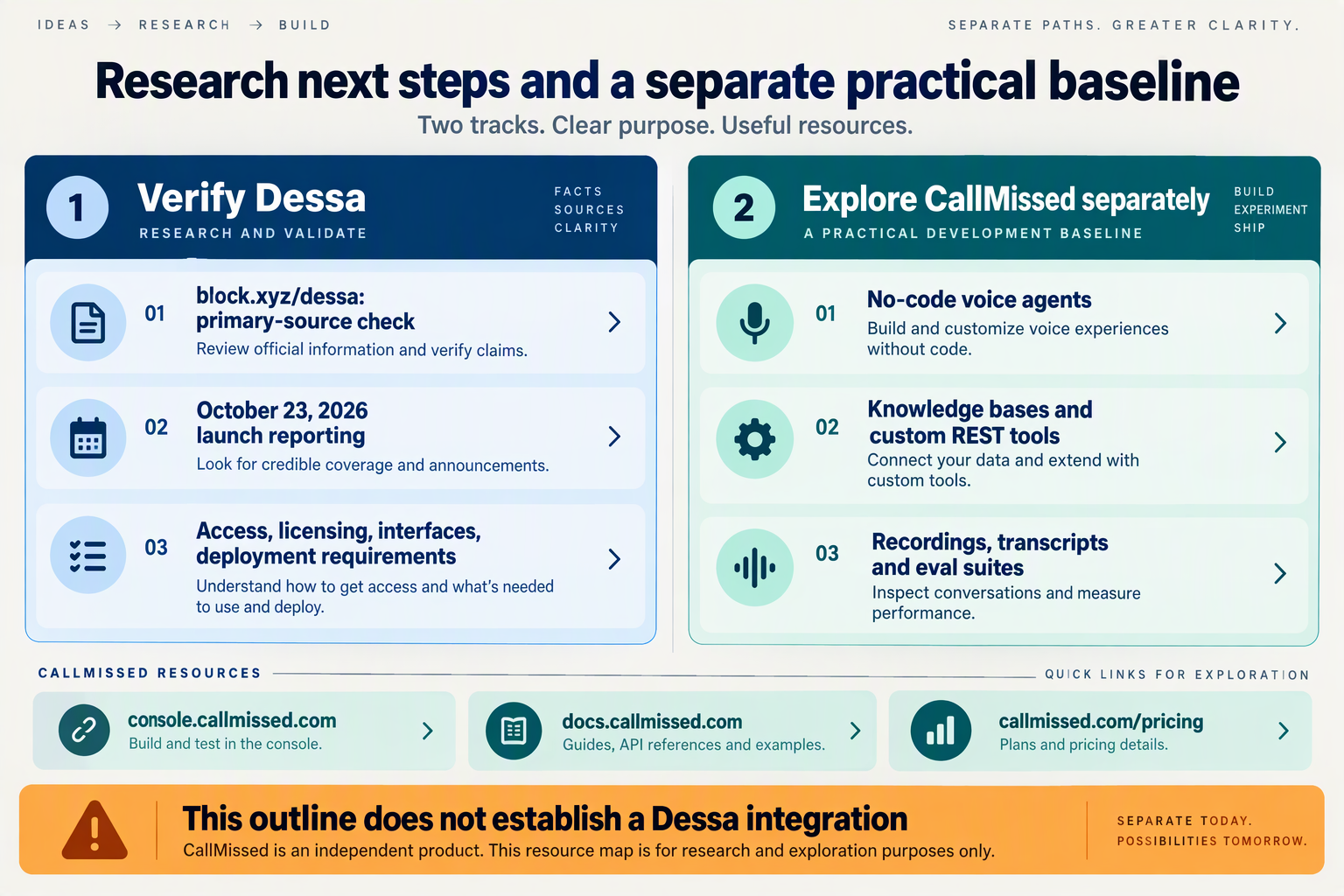
Verify Block’s primary Dessa materials first, then check access terms, technical documentation, and independent evaluations before planning an integration. CallMissed can provide a separate, documented voice-agent baseline for testing business workflows—not evidence that Dessa is supported or production-ready.
Which Dessa sources should developers check first?
Follow a source hierarchy rather than treating every article as independent confirmation:
- Block’s official Dessa page and announcement: Establish exactly what Block claims, what artifacts are available, and whether developers can reproduce the demonstration. AICoder’s October 24, 2026 coverage identifies Block’s official page and an announcement dated October 23, 2026, at 16:53 UTC.
- Access and research-preview documentation: Check eligibility, permitted uses, licensing, and whether access includes an API, model weights, or only a demonstration. AI Chat Daily described Dessa as a research preview on October 23, 2026; NewKerala’s reporting supplied for this October 2026 guide says early access was given to AI safety researchers.
- Technical reports and evaluation artifacts, if available: Look for training-data provenance, supported languages, audio formats, hardware requirements, and reproducible tests. Treat missing documentation as an unresolved question, not proof that a capability exists or is absent.
- Independent reporting and developer discussion: Use these to identify questions worth testing. The supplied Hacker News snapshot recorded 421 points on October 24, 2026—a measure of attention, not conversational accuracy or deployment readiness.
Unite.AI’s October 23, 2026 report attributes the phrase “without any text or pretrained models” to Dessa’s training approach. Verify the scope of that statement in Block’s materials: a training claim does not establish what interfaces, safety controls, or surrounding software a deployment might require.
How should you verify the local-running claim?
AICoder’s October 24, 2026 coverage reports Dessa running locally on a MacBook Pro M4 Max. That is a useful reproduction lead, but it is not a published capacity benchmark.
Before using the claim in an architecture decision, request or locate:
- Hardware details: Memory configuration, accelerator use, and model size.
- Runtime conditions: Audio configuration, session duration, and whether any processing depends on external services.
- Measurement definitions: How response delay, interruptions, and simultaneous listening and speaking were measured.
- Reproduction steps: Software versions, setup instructions, and representative recordings.
A local demonstration should become a testable specification before it becomes a deployment assumption.
Where can CallMissed provide a separate baseline?
As of October 2026, CallMissed’s developer AI API provides one API key and balance across 134 models, including 24 realtime voice-agent models, with OpenAI-compatible and Anthropic-compatible endpoints. Its documented request logs and caller-chosen fallback models offer a separate environment for evaluating supported integrations; these facts do not establish Dessa availability through CallMissed.
For an end-to-end workflow baseline, CallMissed’s October 2026 capabilities include custom REST tools, call transcripts, call scoring against your own QA rubrics, and evaluation suites. Use those capabilities to establish measurable task outcomes before assessing an experimental conversational layer.
For example, run the same interrupted appointment-booking scenario across candidate systems. Record whether the agent captures the corrected date, invokes the appropriate tool, avoids duplicate bookings, and leaves an auditable outcome. Keep conversation quality and business execution as separate scores.
The next step is not to declare a winner. It is to maintain a dated evidence log separating vendor claims, reproduced observations, and unanswered questions—then decide whether Dessa merits a sandbox experiment, further research, or eventual integration work.
Conclusion
The Dessa speech-only voice model could become a conversational audio layer within a voice-agent stack, but developers should not assume it replaces retrieval, tools, or operational controls. Its promise is more natural conversation; its practical value will depend on whether that behaviour can coexist with reliable business execution.
According to Unite.AI’s October 23, 2026 reporting, Block unveiled Dessa as a full-duplex speech-to-speech model trained on human conversation audio without text or pretrained models. AI Chat Daily described Dessa as a research preview on October 23, 2026—an important distinction between an interesting research direction and a documented production integration.
Four takeaways should guide your evaluation:
- Separate conversational intelligence from business execution. A model that learns from speech may handle conversational cues differently from a speech-to-text pipeline. That does not establish whether it can retrieve the right information, invoke a scheduling tool correctly, or enforce business rules. Evaluate those responsibilities separately rather than treating fluent audio as proof of agent reliability.
- Test interruptions as complete workflows. Full-duplex interaction is not just simultaneous listening and speaking. In the appointment example, “Actually, Thursday” should trigger an appropriate interruption, update the request, and prevent an incorrect booking. Assess the final action as carefully as the conversational response.
- Preserve observability around the audio layer. Conventional pipelines provide transcripts and explicit stages developers can inspect. A speech-only approach changes that architecture, but does not remove the need for logging, evaluation, and safety controls. Before integration, establish what evidence will let your team understand and investigate a failed interaction.
- Treat deployment readiness as an unanswered question. Research demonstrations can reveal promising behaviour without establishing accessible APIs, tool interfaces, or production controls. As of October 2026, the reporting supplied for this guide supports evaluating Dessa’s direction—not assuming those integration requirements have been met.
What should voice-agent developers watch for next?
Watch for documented access, integration interfaces, and reproducible evaluations of turn-taking, overlapping speech, and reliable execution. The meaningful milestone will be evidence that a conversational audio model can handle interruptions while keeping the surrounding agent’s actions understandable and controlled.
Meanwhile, developers can explore the infrastructure these models would need. As of October 2026, CallMissed supports real-time voice sessions through an API and SDK, custom REST tools, call transcripts, and evaluation suites—relevant building blocks for investigating voice-agent architectures without assuming Dessa is available through the platform.
The forward-looking lesson is to keep conversational quality and operational reliability connected, but independently testable. Explore CallMissed’s voice-agent capabilities, then ask: what evidence would your team require before trusting a speech-only model to move from conversation to action?
Related Reading
- AI Voice Agent CRM Integration India: Zoho, HubSpot & More
- AI Voice Agent for Insurance India: Rules and Cost (2026)
- AI Voice Agent vs IVR in India: Replace, Keep or Combine