DeepSeek Inference: What DeepInfer Means for Developers



Understand DeepSeek inference, assess DeepInfer and deepseek-recipe, and compare deployment work, benchmarking needs, and managed API options.
DeepSeek Inference: What DeepInfer Means for Developers
What if the next breakthrough in your LLM application comes not from a smarter model, but from the software serving it? DeepSeek inference is moving into that spotlight: according to Crypto Briefing, DeepSeek released its production inference framework, DeepInfer, under the Apache-2.0 license on October 20, 2026.
That makes this more than another model announcement. Model weights determine what an AI system can generate; an inference engine helps determine how efficiently those weights become responses. For developers building chatbots, coding assistants, or multi-step agents, that distinction matters: serving infrastructure affects response times, concurrent capacity, and the economics of every interaction.
The announcement is attracting developer attention. The supplied Hacker News snapshot lists “DeepSeek just open-sourced its inference engine” at 712 points on October 20, 2026. That is a signal of community interest—not evidence of performance—but it explains why inference infrastructure is suddenly a conversation beyond specialist GPU engineering teams.
What does DeepInfer mean for LLM application developers?
DeepInfer potentially gives developers access to production serving techniques, not just another model endpoint. AI Weekly reported on October 20, 2026, that DeepSeek says the framework powers its own large-scale production services, including DeepSeek-V4.1-Flash. TechFlow also reported that DeepSeek announced the release of deepseek-recipe, a production-grade token encoding and decoding component, alongside the framework.
The practical question is what that access changes for your application. Consider an agent that makes several sequential model calls: even a useful serving improvement must translate into better end-to-end behavior, rather than merely an impressive isolated benchmark.
Three questions should guide the evaluation:
- Performance: What happens to throughput and latency under your actual prompt lengths, output lengths, and concurrent traffic?
- Deployment: Which hardware, model configurations, and operational requirements does the released stack support?
- Economics: Does self-hosting justify GPU capacity, engineering effort, monitoring, and maintenance compared with a managed API?
Those questions matter because open source is not a guaranteed cost reduction. The supplied announcement coverage does not establish a universal speedup or savings percentage; developers need reproducible measurements before changing production infrastructure.
As of October 2026, CallMissed’s OpenAI-compatible developer API includes DeepSeek among its model providers, illustrating the parallel route of accessing models through a unified gateway rather than operating their serving stacks yourself.
This article will explain what DeepInfer opens up, distinguish reported capabilities from demonstrated results, and show how to evaluate deployment trade-offs—whether you maintain inference infrastructure or simply want faster, more economical applications at scale.
What does DeepInfer mean for developers? More serving control, with operational trade-offs
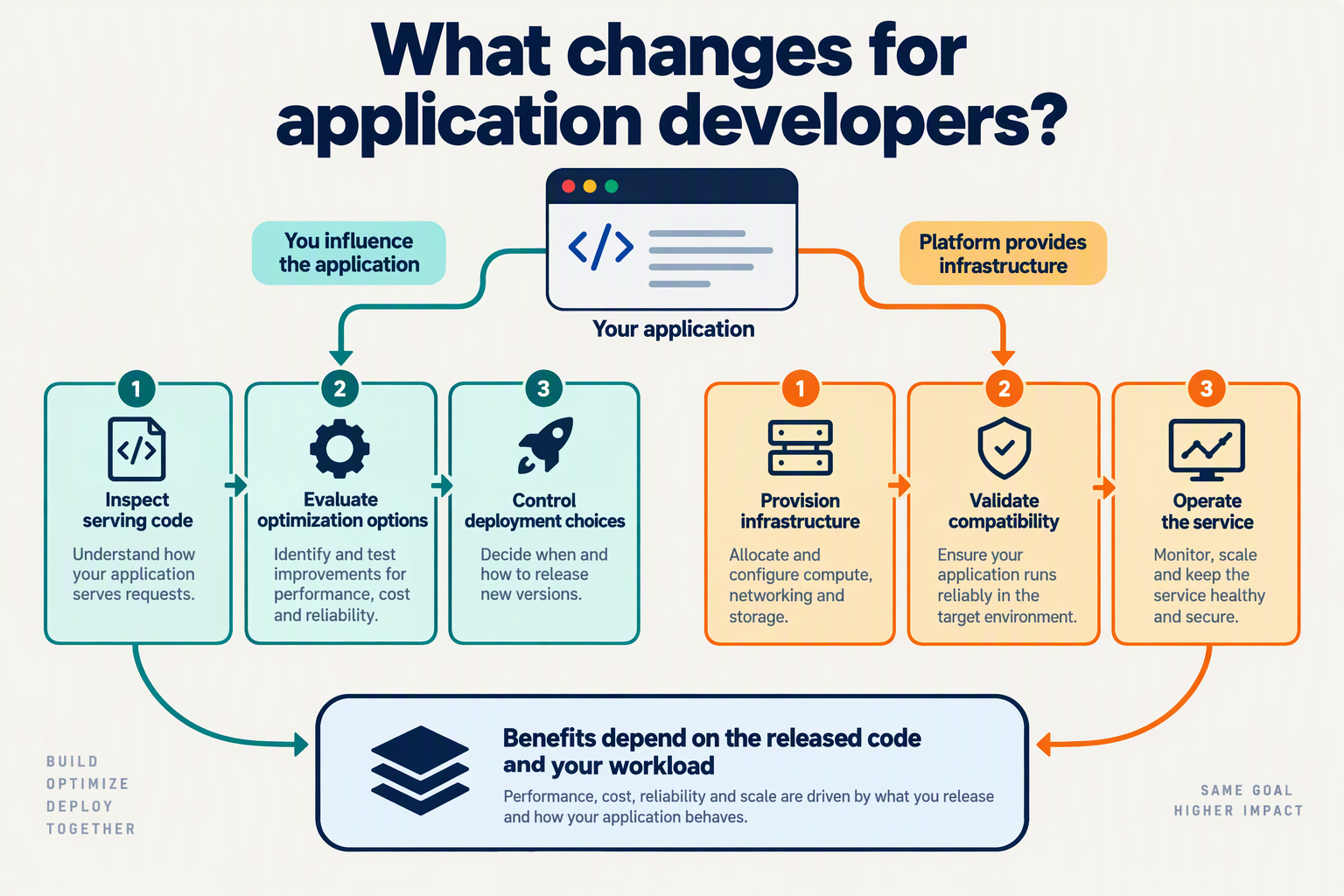
DeepInfer gives LLM application developers more scope to inspect, adapt, and operate the serving layer—but also shifts responsibility for reliability and capacity onto the team deploying it. The practical benefit is greater control over how inference runs; the trade-off is owning infrastructure that a managed model API normally abstracts away.
What serving decisions can developers control?
With an accessible inference codebase, developers can investigate how requests move through the serving system rather than treating performance as an endpoint-level mystery. That can help teams determine whether bottlenecks come from application orchestration, token processing, or model execution.
According to ChainCatcher’s October 20, 2026 announcement coverage, DeepInfer integrates high-performance operators and a deeply optimized inference engine. That describes the framework’s engineering emphasis, not a verified performance advantage for every deployment.
For an application team, the useful questions become more specific:
- Request scheduling: Can the deployment balance short interactive requests against longer generation jobs?
- Resource allocation: Which configurations keep accelerators productive without creating unacceptable queues?
- Instrumentation: Can engineers distinguish waiting time from execution time when diagnosing slow responses?
These are evaluation questions—not confirmed DeepInfer features from the supplied coverage. Developers should verify configuration options and observability support in the released documentation before designing around them.
Does hardware compatibility make deployment easier?
Reported hardware support can expand deployment options, but compatibility alone does not establish production readiness. KuCoin’s October 20, 2026 coverage, citing ChainCatcher, describes DeepInfer as compatible with Huawei Ascend; the supplied reporting does not establish supported device versions, deployment requirements, or comparative benchmarks.
That distinction matters for organizations evaluating different accelerator ecosystems. A framework running on a hardware family is only the beginning: operators still need to validate drivers, runtime dependencies, model support, and upgrade procedures.
Before committing infrastructure, follow three steps:
- Confirm the supported configuration. Match the intended model, accelerator, and software versions against release documentation.
- Reproduce a minimal deployment. Record installation steps and dependencies so another engineer can rebuild it.
- Test failure recovery. Check what happens when a worker stops, memory runs short, or traffic exceeds available capacity.
A successful demonstration answers “Can this run?” Production validation answers “Can our team keep this running?”
When is self-hosting worth the operational work?
Self-hosting is most compelling when serving control addresses a concrete constraint, such as workload-specific optimization or a required deployment environment. It is less compelling when the team’s main priority is shipping application features quickly.
Consider a hypothetical support assistant with short daytime conversations and occasional long document queries. Combining both workloads on one deployment may improve utilization, but long requests could also delay interactive responses. The decision should depend on measured user experience and operating cost—not an assumption that owning the engine automatically makes inference cheaper.
As of October 2026, CallMissed’s OpenAI-compatible developer API offers caller-chosen fallback models, usage and request logs, and response caching, according to its verified product fact sheet. Those capabilities illustrate the managed-gateway alternative: application developers can control routing and integration behavior without necessarily operating the underlying inference engine.
The emerging shift is therefore choice across infrastructure layers. DeepInfer makes the serving layer more accessible; developers still need to decide whether controlling that layer is strategically valuable enough to justify maintaining it.
What happened on October 20, 2026, and which DeepInfer release facts need verification?
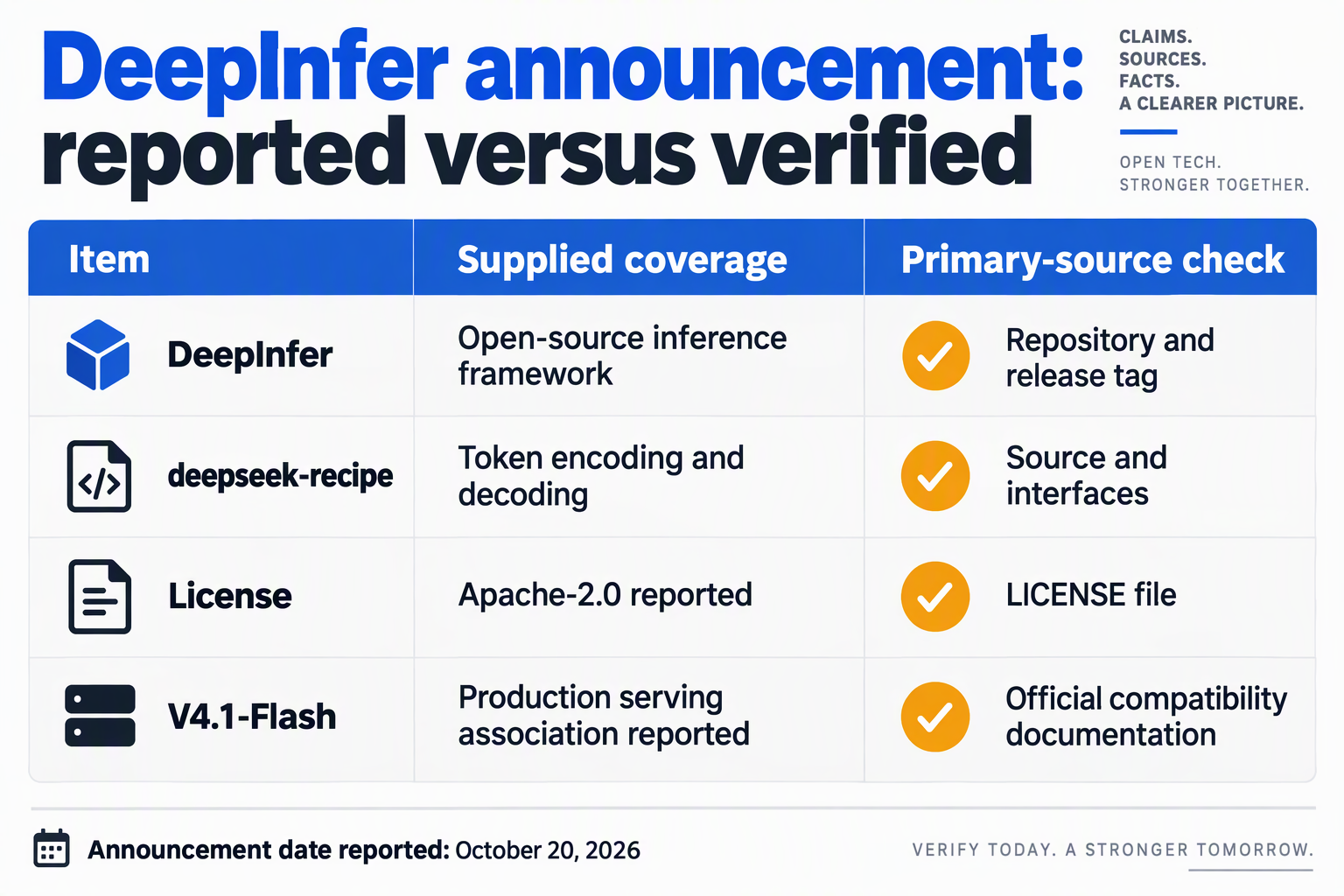
October 20, 2026 brought reports of DeepSeek’s DeepInfer release, but the supplied coverage does not independently establish repository completeness, hardware compatibility, or performance gains. For developers, the immediate task is to separate reported release facts from details that require checking against official source code, documentation, and reproducible tests.
Which DeepInfer release facts are reported, and what still needs checking?
The following verification checklist reflects the supplied reporting as of October 20, 2026. “Reported” means a named publication describes the claim—not that this article has independently inspected the implementation.
| Release detail | What the coverage says | Source | What developers should verify |
|---|---|---|---|
| Announcement and availability | DeepSeek announced full open-sourcing on October 20; other coverage describes a completed release. | TechFlow; Crypto Briefing | Official repository, accessible code, release tag, and announcement timestamp. |
| License | DeepInfer was released under Apache-2.0 on October 20, 2026. | Crypto Briefing; AI Weekly | Repository LICENSE, notices, and separate dependency or model-weight terms. |
| Production use | DeepSeek says DeepInfer powers large-scale services, including DeepSeek-V4.1-Flash. | AI Weekly | Which production components and configurations are actually included. |
| Companion component | DeepSeek also announced deepseek-recipe, described as production-grade token encoding/decoding software. | TechFlow; ChainCatcher | Component availability, interface, supported tokenizers, and version compatibility. |
| Hardware support | Coverage describes compatibility with Huawei Ascend. | KuCoin, citing ChainCatcher | Supported devices, runtime versions, installation instructions, and working examples. |
| Serving optimizations | Coverage mentions vLLM integration, expert parallelism, and MLA optimization. | StableLearn | Actual integration scope, supported configurations, and benchmark methodology. |
The wording difference in the first row matters. “Will fully open-source” and “has open-sourced” are not equivalent operational states: an announcement can precede usable code, installation documentation, or a packaged release. Confirming those artifacts is more useful than counting how many outlets repeat the announcement.
Does Apache-2.0 mean the entire deployment is unrestricted?
A reported Apache-2.0 license for DeepInfer does not establish the licensing terms of every component needed to serve a model. Crypto Briefing and AI Weekly identify Apache-2.0 in their October 20, 2026 coverage, but developers should inspect the actual license files before approving commercial deployment.
Review three layers separately:
- Engine code: confirm the license, attribution requirements, and notices.
- Dependencies: check bundled libraries, kernels, and hardware-specific components.
- Model artifacts: inspect model-weight and tokenizer terms independently of the inference engine.
This distinction prevents a common procurement mistake: treating an open-source serving framework as blanket permission for everything loaded into it.
Which claims should not become benchmark headlines yet?
The supplied context provides no reproducible throughput figure, latency measurement, or percentage cost reduction for DeepInfer as of October 20, 2026. Descriptions such as “high-performance” and “low latency” should therefore remain attributed claims, not numerical conclusions.
AI Weekly published its DeepInfer report at 11:04 UTC on October 20, 2026, according to the supplied listing. That timestamp helps establish the reporting timeline; it does not validate the engine’s results.
Before turning coverage into an engineering recommendation:
- Pin the release: record the repository commit and dependency versions.
- Check the supported path: establish whether your model and accelerator combination is documented.
- Demand comparable evidence: look for hardware specifications, workload definitions, concurrency, and measurement procedures.
The useful news is the reported availability of infrastructure previously used internally. The unresolved question is how completely—and reproducibly—that infrastructure transfers to developers’ own environments.
What is deepseek-recipe, and why does token encoding and decoding matter?
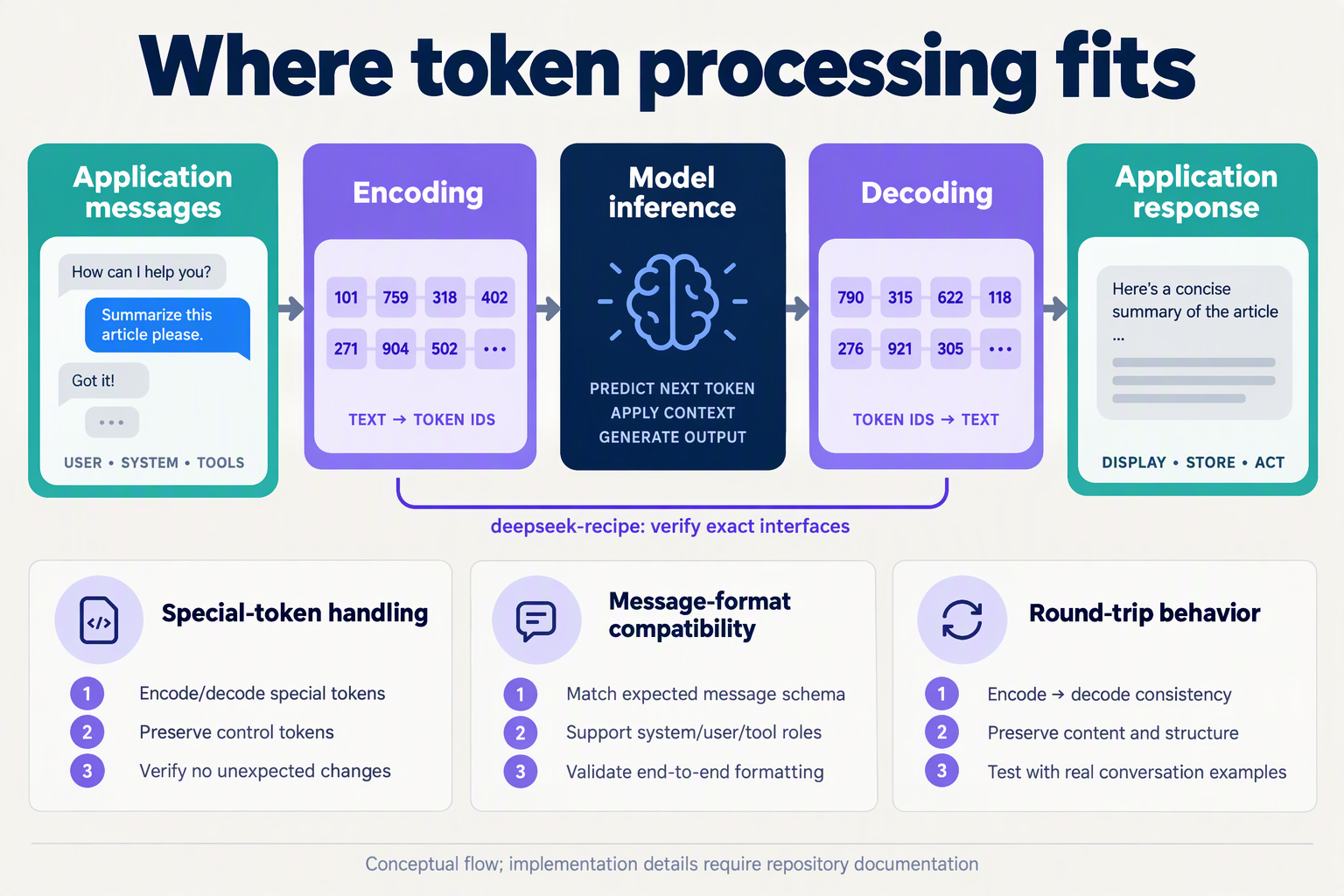
deepseek-recipe is the production-grade token encoding and decoding component that DeepSeek announced alongside DeepInfer, according to TechFlow on October 20, 2026. It matters because an LLM application must translate messages into model-compatible inputs—and translate generated outputs back into usable responses—without introducing formatting errors or avoidable processing overhead.
The available announcement coverage establishes the component’s role, but does not document its exact interfaces, supported tokenizers, or standalone performance. Developers should therefore treat “production-grade” as the announcement’s description, not as an independently verified benchmark.
What does token encoding and decoding actually do?
At a basic level, encoding converts text into token IDs that a model can process. Decoding converts generated token IDs back into text. Tokens are vocabulary units rather than necessarily whole words: punctuation, whitespace, code, and multilingual text can produce different token sequences.
For a conversational application, the surrounding preparation can also include organizing system instructions, user messages, assistant replies, and tool results into the format a model expects. Whether deepseek-recipe handles each of those responsibilities needs confirmation from its documentation; the news summaries do not establish that scope.
One distinction is particularly important: token decoding is not the same as the inference engine’s autoregressive decode phase. The former reconstructs output text; the latter runs the model repeatedly to predict subsequent tokens. Releasing an encoding/decoding component does not, by itself, demonstrate faster GPU generation.
Why should application developers care about token handling?
Correct token handling affects the boundary between your application and the model. A serving engine can execute efficiently while an incorrectly formatted request still produces an unusable answer.
Consider a support assistant that receives a customer question, retrieves an account record, and asks the model to return structured data. Its processing path might be:
- Prepare the conversation: Preserve the distinction between instructions, customer text, and retrieved information.
- Encode the input: Use the vocabulary and special-token conventions expected by the deployed model.
- Generate the response: Let the inference engine produce output tokens.
- Decode and deliver: Reconstruct the response and validate it before another service acts on it.
Errors at these boundaries can cause misplaced message roles, incorrect termination, or malformed output. Encoding also determines the input token count, which matters for context-window management and token-based API billing.
For multilingual workloads, test actual customer language rather than assuming English token counts are representative. A Hindi-English support conversation and an English-only paraphrase may require different token budgets, even when they communicate similar information.
What should teams verify before adopting deepseek-recipe?
As of October 2026, the supplied TechFlow and ChainCatcher reports identify deepseek-recipe as a production-level component, but provide no measured encoding throughput, decoding latency, or percentage cost reduction. A useful evaluation should cover:
- Compatibility: Does it reproduce the expected token IDs, special tokens, and conversation formatting for your model version?
- Streaming behavior: Does incremental output reconstruct Unicode text correctly across chunk boundaries?
- Edge cases: What happens with empty messages, long documents, code blocks, tool results, and mixed-language input?
- Operational impact: How much request time does encoding and decoding consume under representative concurrency?
Teams using managed infrastructure still benefit from understanding these boundaries. As of October 2026, CallMissed’s OpenAI-compatible developer API supports streaming, function calling, and structured outputs—application interfaces whose behavior should be tested when changing model providers or serving backends.
The practical takeaway is straightforward: evaluate deepseek-recipe as a correctness and integration component first, and measure performance benefits separately. Reliable token handling makes infrastructure improvements usable; it is not evidence of those improvements on its own.
How can you build a reproducible DeepInfer quickstart from the released repository?
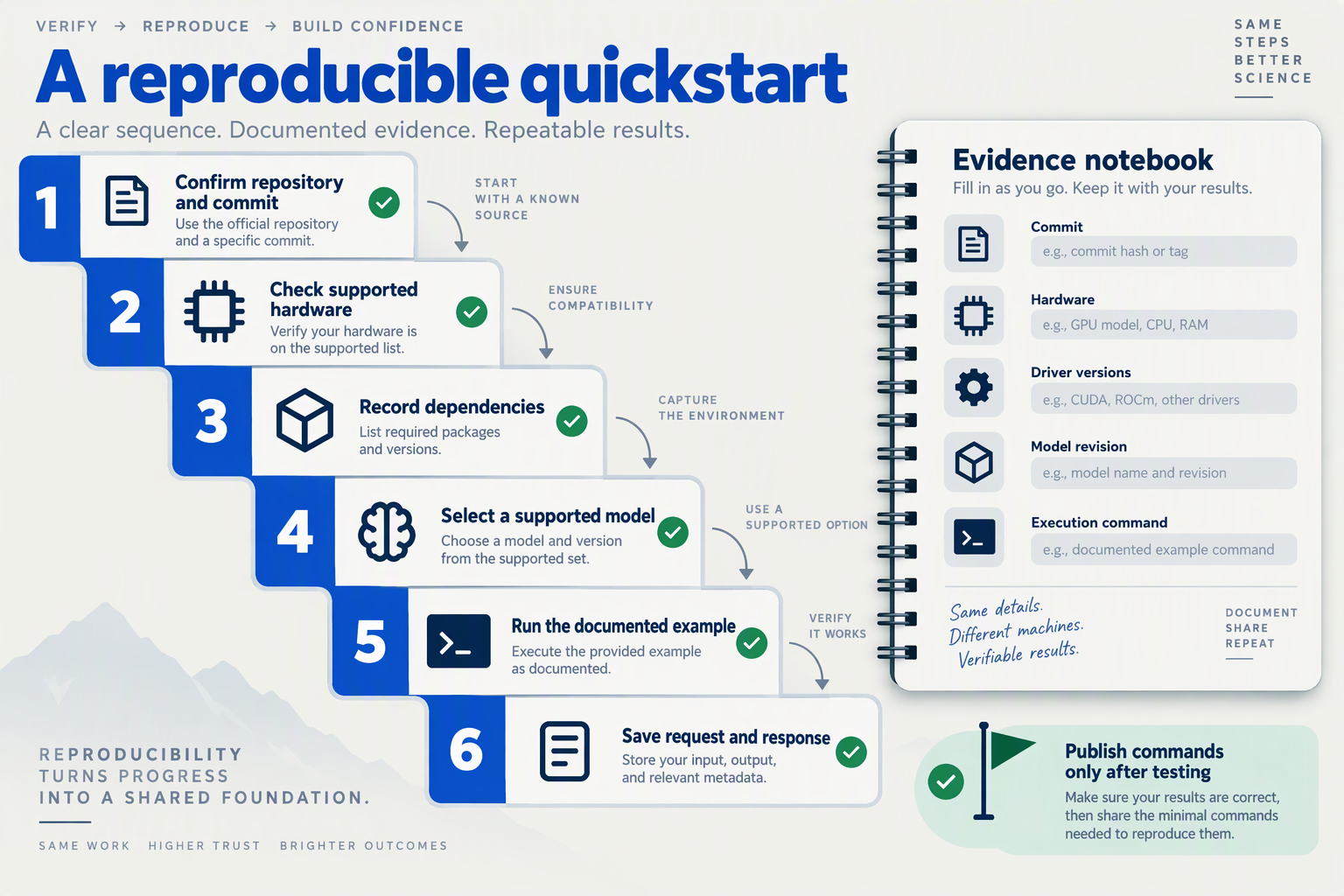
Build a reproducible DeepInfer quickstart by pinning the official repository to an exact commit, following that revision’s documented installation path, and saving a fixed test workload alongside your results. As of October 20, 2026, the supplied reporting establishes the release announcement, but does not provide verified repository commands, dependency versions, or hardware requirements; those must come from DeepSeek’s official release documentation.
What should you verify before installing DeepInfer?
Start with repository provenance, not a third-party installation snippet. Crypto Briefing reports that DeepSeek released DeepInfer under Apache-2.0 on October 20, 2026; check the repository’s license file and release notes before distributing a modified build.
Use this verification sequence:
- Find the official repository through DeepSeek’s announcement or organization, and confirm that it contains the serving framework rather than an unrelated project with the same name.
- Select a documented release or commit. Record the full commit hash; a moving branch is not a reproducible dependency.
- Check supported configurations. Verify the model, accelerator, driver, runtime, and distributed deployment requirements documented at that revision.
- Inspect model access and licensing separately. The engine’s license does not establish the license or availability of every model it can serve.
TechFlow reported on October 20, 2026, that DeepSeek also announced deepseek-recipe, a production-grade token encoding and decoding component. Check whether your chosen DeepInfer configuration requires that component, and pin its revision if it does.
How do you capture a repeatable installation?
Treat the quickstart as a small, version-controlled experiment. The following is a generic Git scaffold, not a verified DeepInfer installation procedure; replace both placeholders with values verified from the official release:
REPO_URL="<official-repository-clone-url>"
COMMIT="<full-commit-hash>"

git clone "$REPO_URL" deepinfer
cd deepinfer
git checkout --detach "$COMMIT"
git rev-parse HEAD > ../deepinfer-commit.txt
Then follow the installation instructions at that commit, including any required submodules or build steps. Avoid guessing package names, launch flags, container images, or OpenAI-compatible routes.
Create a short environment manifest containing:
- Software: operating system, runtime versions, dependency lockfile, build options, and container digest if applicable.
- Hardware: accelerator model and count, available memory, driver version, and relevant interconnect details.
- Model: identifier, revision, tokenizer revision, precision or quantization, and configuration.
- Serving: the exact documented launch command, environment variables, and startup logs.
Save resolved dependency versions rather than recording only “installed the latest packages.” Another developer should be able to recreate the environment without reconstructing your decisions.
What should the first DeepInfer smoke test measure?
First prove that the documented example runs; only then test application-shaped traffic. AI Weekly reported on October 20, 2026, that DeepSeek says DeepInfer powers DeepSeek-V4.1-Flash in production, but that statement does not establish performance on your hardware.
Use fixed prompts, explicit generation settings, and recorded input and output token counts. Where supported, set a seed, but do not assume identical outputs across different hardware or software builds.
Keep the first workload deliberately small:
- One short request to validate loading and generation.
- One longer input to exercise prefill.
- Several simultaneous requests to check behavior under concurrency.
Record time to first token, total request duration, throughput, and errors, stating how each metric was measured. Separate cold-start observations from warmed runs. Your quickstart succeeds when someone else can repeat the procedure and understand the results—not when one screenshot shows an impressive speed.
Which production service components must you verify or supply around DeepInfer?
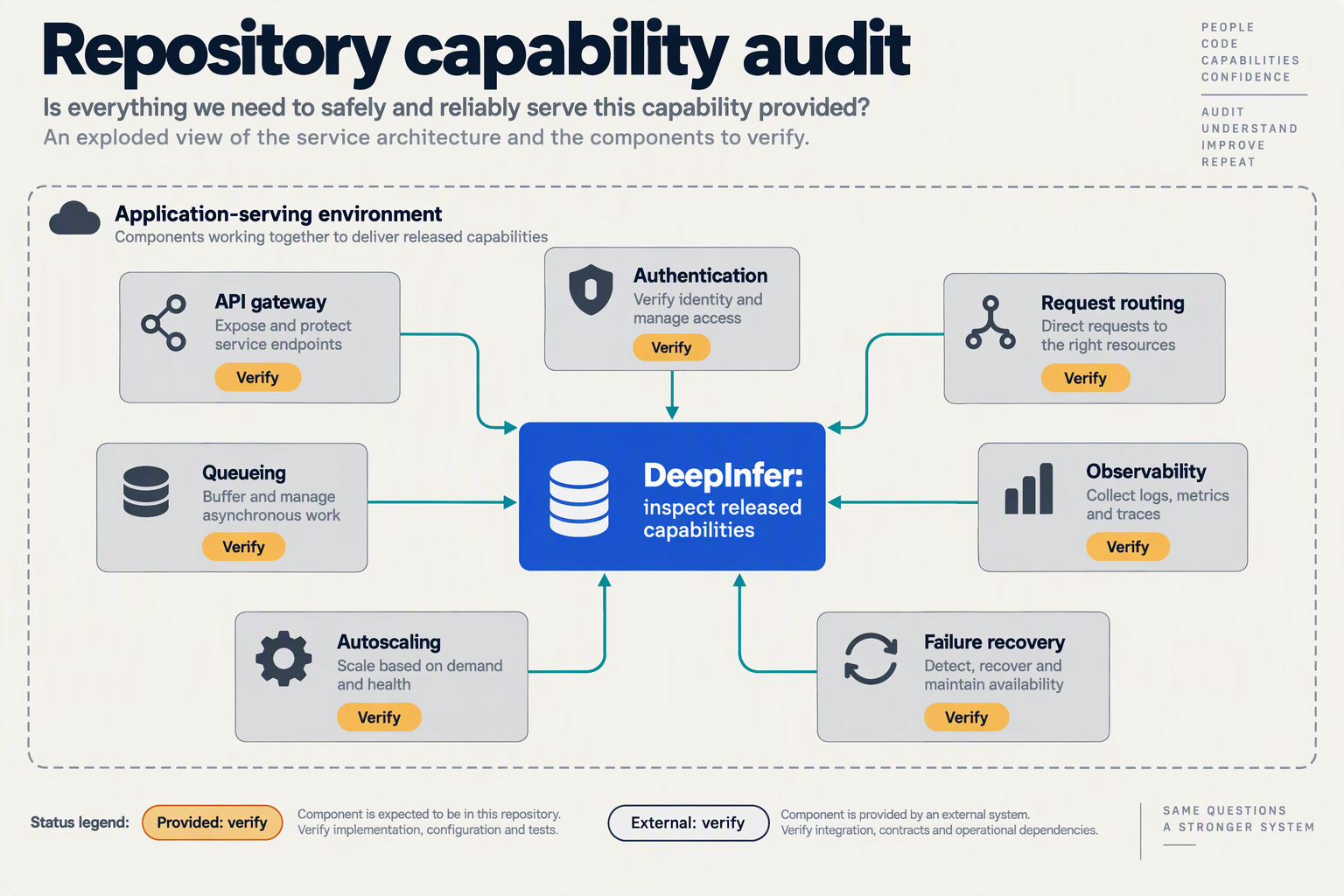
Before deploying DeepInfer, verify the API contract, access controls, traffic management, observability, recovery procedures, and data-handling policies around the inference engine. Treat each as an acceptance test: the October 2026 announcement coverage does not establish which surrounding service components the released stack includes.
AI Weekly reported on October 20, 2026, that DeepSeek says DeepInfer powers its large-scale production services, including DeepSeek-V4.1-Flash. That production pedigree makes the framework worth evaluating, but it does not establish that your deployment will inherit DeepSeek’s complete operating environment.
Which API behaviors should developers test before integration?
Start with the interface your application actually consumes. An engine that generates tokens is not automatically a drop-in replacement for your existing model API.
Verify these behaviors against the released documentation and a running deployment:
- Request compatibility: Model identifiers, message roles, generation parameters, context limits, and error formats.
- Streaming: Event framing, completion signals, client disconnects, and cancellation propagation.
- Application features: Tool-call formatting, structured-output validation, and usage reporting where your application requires them.
- Token processing: Chat templates, special tokens, encoding, and decoding for the exact model version deployed.
TechFlow reported on October 20, 2026, that DeepSeek announced the production-grade token encoding and decoding component deepseek-recipe alongside DeepInfer. Test how that component integrates with your application rather than assuming an existing tokenizer configuration remains interchangeable.
For example, a coding assistant may display streamed text correctly yet fail when its tool-call parser receives an unexpected payload. Contract tests should cover both paths.
What controls belong around a production inference endpoint?
Verify what DeepInfer supplies, then assign ownership for anything supplied by a gateway, orchestration platform, or application service. The essential controls are:
- Identity and isolation: API-key validation, credential rotation, tenant authorization, and separation of customer data.
- Traffic admission: Per-tenant quotas, request-size limits, bounded queues, and explicit overload responses.
- Resource protection: Output-token limits, request deadlines, and cancellation that stops unnecessary computation.
- Data governance: Logging redaction, retention rules, access permissions, and approved locations for prompts and responses.
A practical test is to have one tenant submit long-running requests while another sends short interactive prompts. Check whether your service preserves the intended isolation and rejects excess work predictably.
As of October 2026, CallMissed’s OpenAI-compatible developer API provides usage and request logs, caller-chosen fallback models, and per-key rate limits. Those are useful examples of the service-layer capabilities to inventory when comparing a managed API with operating DeepInfer yourself—not evidence that either approach meets every application requirement.
How should teams verify reliability before launch?
Use a staged release checklist, not a successful demonstration request:
- Instrument the request lifecycle. Measure queue time, time to first token, generation duration, failures, and cancellations; report latency distributions rather than averages alone.
- Exercise failure paths. Restart workers, interrupt connections, and simulate unavailable dependencies. Confirm readiness checks prevent traffic reaching an unready instance.
- Validate deployment changes. Pin engine, model, tokenizer, and configuration versions; test rollback before introducing production traffic.
- Define retry and fallback rules. Avoid blindly retrying partially streamed responses or repeating application-side tool actions.
The launch criterion is predictable service behavior under load and failure, not merely that DeepInfer can serve a model. Document the evidence for each component and the team responsible for operating it.
How should you benchmark DeepInfer against your current serving stack?
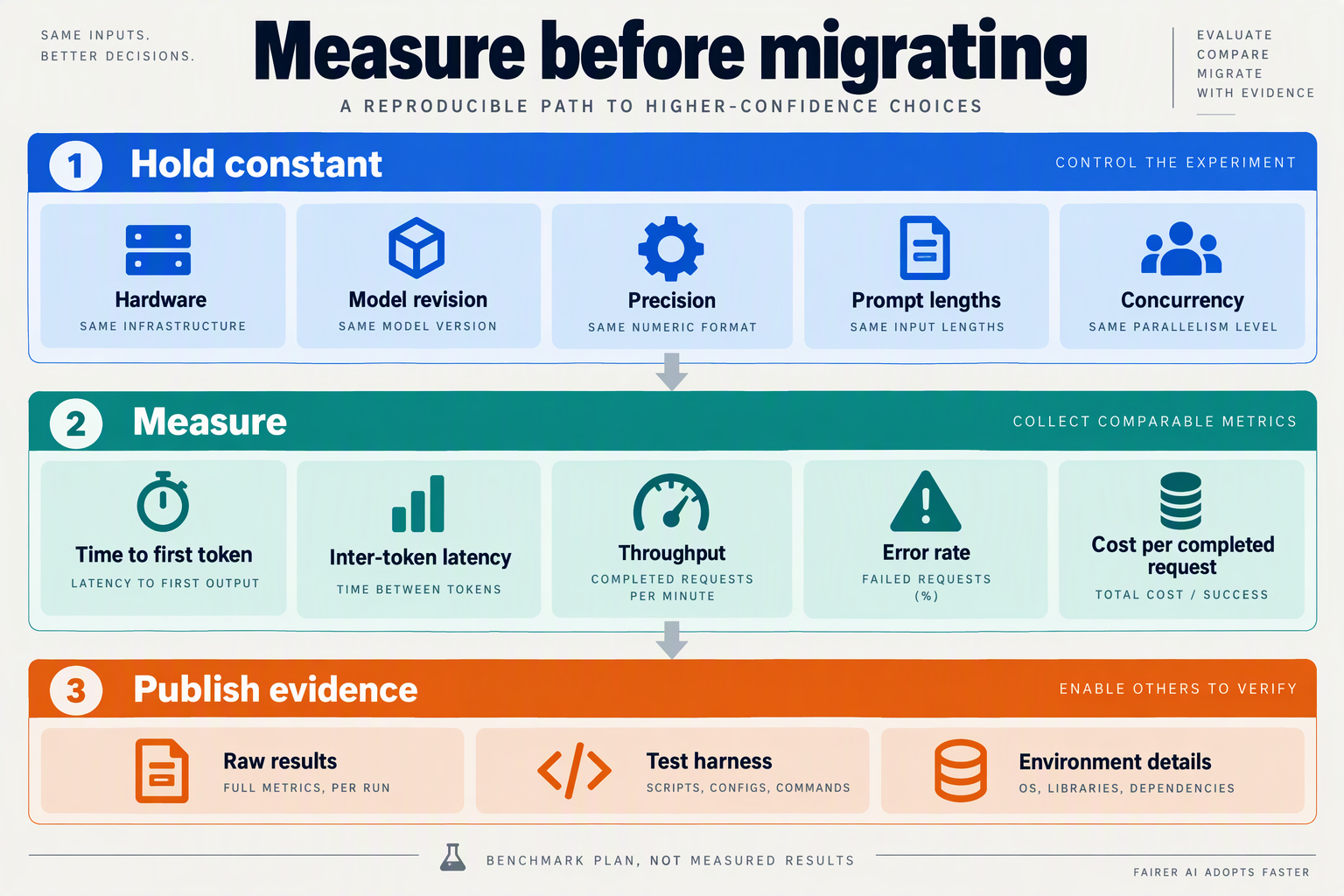
Benchmark DeepInfer against your current serving stack using identical model configurations, realistic traffic, and application-level success criteria. Prioritize cost per successful request at your latency target, not peak tokens per second in isolation.
AI Weekly reported on October 20, 2026, that DeepSeek says DeepInfer powers its large-scale production services. However, the supplied release coverage provides no reproducible, apples-to-apples performance figures against your deployment. Treat the announcement as a reason to test—not a benchmark result.
How do you make a DeepInfer comparison fair?
Start with a reproducible baseline. An engine comparison becomes misleading if DeepInfer runs different weights, lower precision, shorter outputs, or more aggressive caching than your existing stack.
- Freeze the model configuration: Match weights, tokenizer, precision or quantization, context limits, generation settings, and output-token limits wherever supported.
- Match infrastructure: Use equivalent accelerator types, device counts, memory capacity, networking, and deployment boundaries.
- Record software versions: Save engine commits, drivers, dependencies, launch flags, and tuning settings.
- Separate test conditions: Measure cold starts, warmed-up serving, and cache-enabled traffic independently.
If equivalent configurations are unavailable, label the result a deployment comparison, not an isolated inference-engine speedup. That distinction keeps useful operational findings from becoming unsupported performance claims.
Which workloads should you replay?
Use sanitized production traces where possible. Preserve the distributions of prompt lengths, output lengths, arrival patterns, and multi-turn conversations—not just their averages.
Include these workload categories:
- Interactive chat: Short exchanges where first-token delay affects perceived responsiveness.
- Retrieval-augmented generation: Longer inputs containing retrieved documents.
- Coding or document generation: Longer outputs that expose decoding performance.
- Tool-using agents: Sequential calls where small delays accumulate across a workflow.
Run both steady traffic and bursts. A fixed arrival-rate test, where requests arrive independently of earlier completions, helps reveal queue growth that a fixed-concurrency test can obscure.
Which metrics actually determine the winner?
Measure time to first token, inter-token latency, end-to-end latency, completed requests per second, and input/output token throughput separately. Report median and p95/p99 latency alongside timeout, rejection, and error rates; averages can hide unacceptable tail behavior.
Then connect infrastructure performance to application outcomes:
- Quality: Does task success remain comparable on a frozen evaluation set?
- Reliability: Are structured outputs valid and tool calls usable?
- Economics: What are accelerator, hosting, and operational costs per successful request?
- Capacity: What traffic level can each stack sustain while meeting your service-level objective?
For an illustrative acceptance rule, require p95 completion latency below five seconds and errors below 1%, then compare sustainable throughput. These are proposed test thresholds, not reported DeepInfer results.
How should you decide whether to migrate?
Repeat trials, report variability, and include engineering effort in the decision. A throughput improvement that requires expensive integration or worsens agent success may not justify migration.
Keep managed APIs as a separate architectural baseline. As of October 2026, CallMissed’s OpenAI-compatible developer API provides usage and request logs and caller-chosen fallback models; those capabilities can support an API-based comparison, but gateway observations do not isolate inference-engine performance.
Finish with a limited canary rollout and rollback criteria. Adopt DeepInfer only when measured gains survive real traffic, quality checks, and the operating costs your team will actually bear.
Should you self-host DeepInfer or use a managed API such as CallMissed?
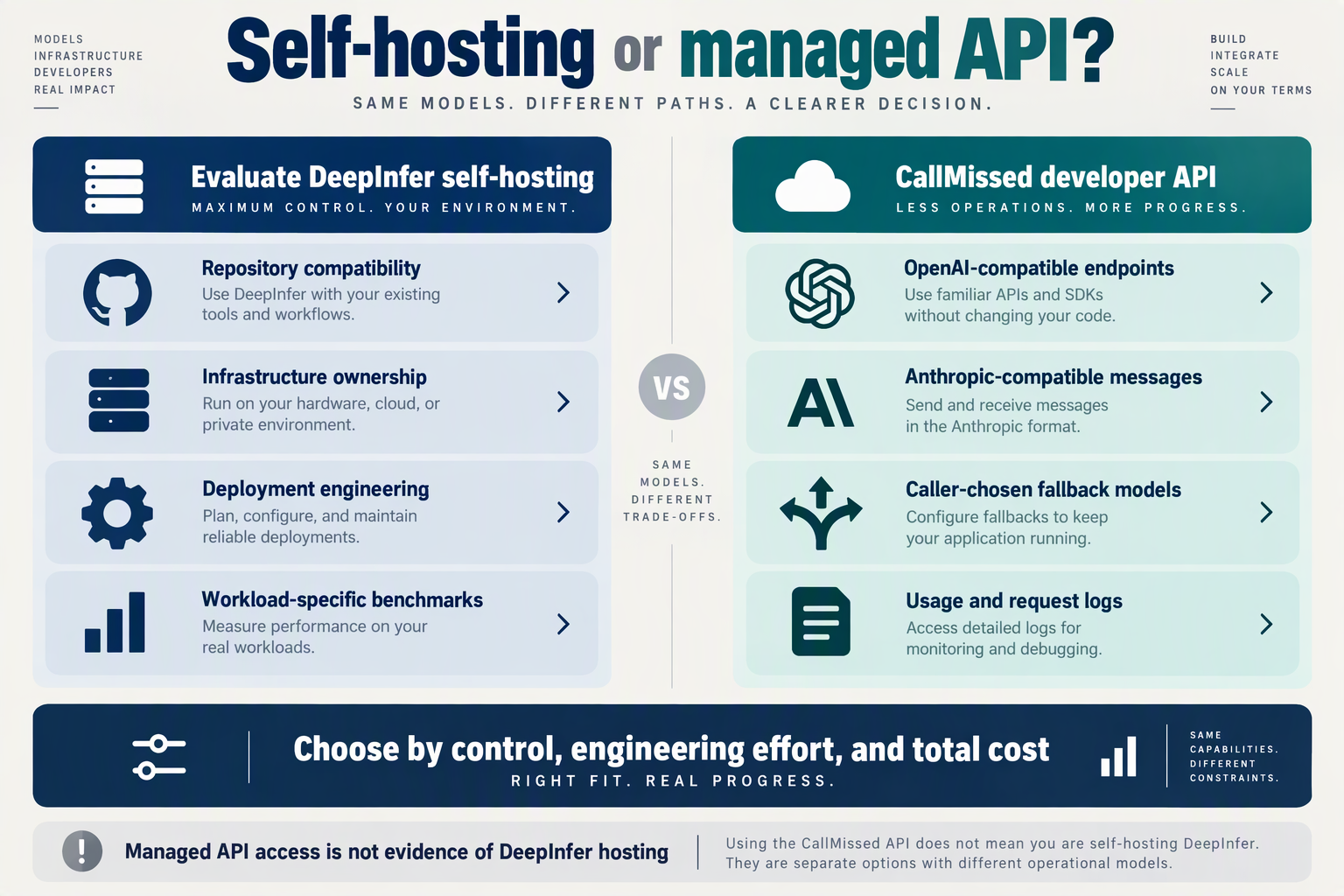
Self-host DeepInfer when infrastructure control is essential and your workload can justify a dedicated serving team; choose a managed API when shipping features and handling variable demand matter more than operating inference infrastructure. As of October 2026, the decision should rest on measured application economics—not the assumption that open-source software makes inference cheaper.
When does self-hosting DeepInfer make sense?
Self-hosting is worth investigating when you have sustained demand, engineers who can operate accelerator infrastructure, and requirements that managed endpoints cannot satisfy. Examples include controlling where model execution happens or experimenting with serving configurations for a narrowly defined workload.
AI Weekly reported on October 20, 2026, that DeepSeek says DeepInfer powers its large-scale production services, including DeepSeek-V4.1-Flash. That establishes a relevant production claim, but it does not establish your deployment’s hardware compatibility, operating cost, or achievable service levels.
Before committing, verify:
- Deployment fit: Does the released implementation support your intended model, accelerator hardware, and execution environment?
- Operational ownership: Who handles capacity planning, upgrades, security patches, monitoring, and incidents?
- Utilization: Will demand keep provisioned capacity productive, or leave expensive resources idle?
- Control requirements: Do you genuinely need serving-level customization, or simply reliable access to a model?
Self-hosting also does not automatically establish data privacy. Your team must configure access controls, logging, retention, and network boundaries across the complete application.
When is a managed API the practical choice?
A managed API is often the more practical starting point for prototypes, small teams, unpredictable traffic, and applications that need several model providers. It shifts model-serving operations outside your team, although you still own application reliability, privacy decisions, and output evaluation.
According to CallMissed’s verified product information, as of October 2026, CallMissed’s developer AI API provides one API key and one balance for 134 models, including 40 general-purpose LLMs, with DeepSeek among its catalogue providers. Its OpenAI-compatible and Anthropic-compatible endpoints support existing SDK integrations through a base-URL change; caller-chosen fallback models, usage logs, and request logs give developers practical tools for managing multi-model applications.
That is a different proposition from running DeepInfer: access to models through a gateway is not control over their inference engine. The supplied information also does not establish that CallMissed serves DeepSeek through DeepInfer, so developers should not equate the two.
How should you compare costs before choosing?
Compare cost per successful application task, not just token prices or accelerator rental rates. A support agent that retries failed tool calls can consume more resources than a longer conversation that resolves correctly.
Use a short, repeatable evaluation:
- Build a representative test set. Include typical requests, long contexts, bursts, and failures—not just short demonstration prompts.
- Measure both routes consistently. Track completion quality, time to first token, end-to-end latency, errors, and retries.
- Account for full costs. Include API usage or infrastructure spending, plus engineering time, observability, storage, and idle capacity.
- Set migration criteria. Define the savings, control, or reliability improvement required before taking on serving operations.
For illustration, 100,000 monthly tasks at an assumed 1.2 model calls per task require 120,000 calls. That workload estimate is not a benchmark; it is a starting point for testing whether self-hosting delivers enough value to justify its additional responsibilities.
What does the Hacker News response reveal—and what still needs independent evidence?
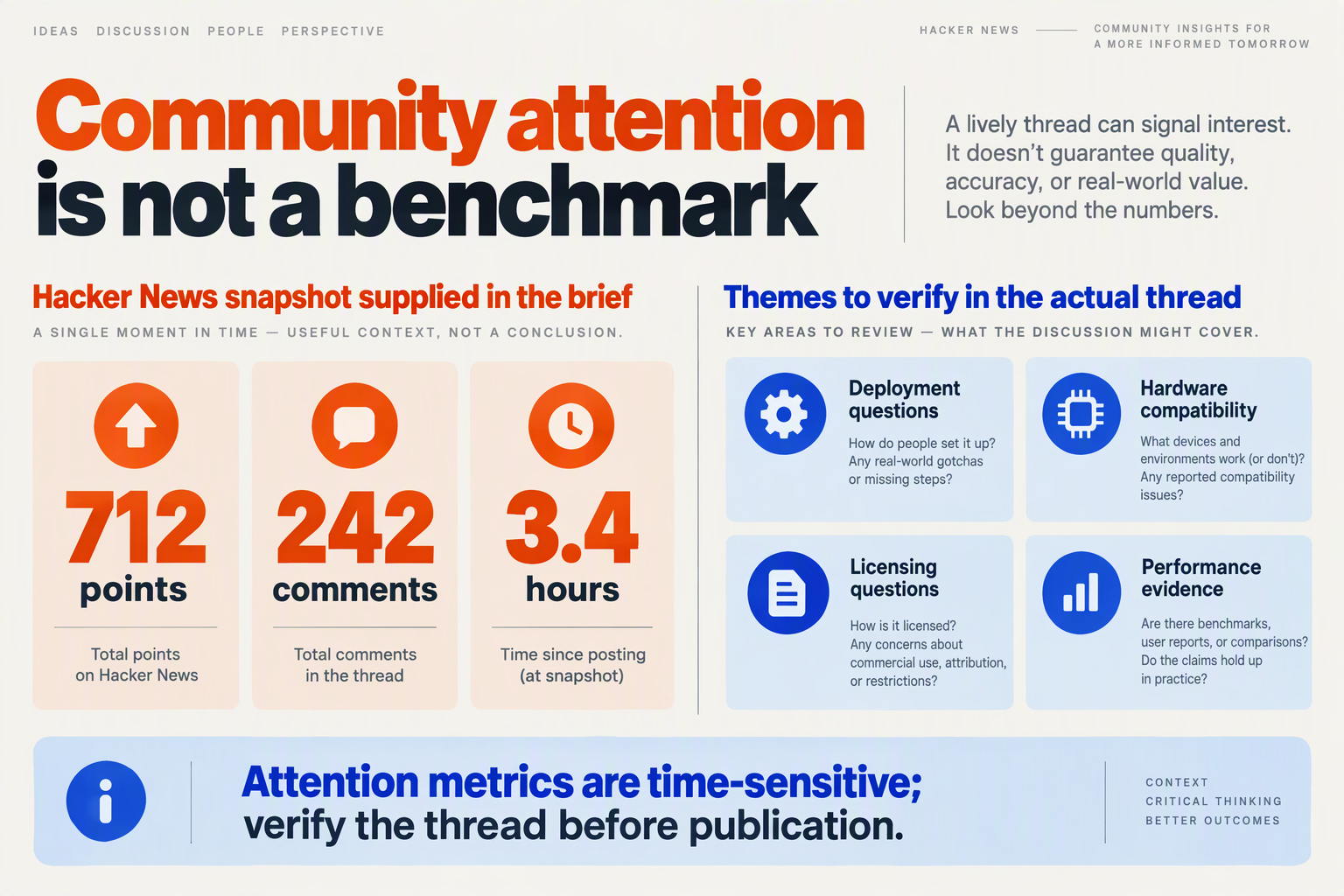
The Hacker News response reveals strong developer interest in open inference infrastructure, not independent validation of DeepInfer’s performance. The supplied coverage establishes an announcement and reported production use; it does not establish reproducible speedups, cost savings, or deployment reliability outside DeepSeek.
What does Hacker News attention actually tell developers?
The supplied Hacker News snapshot records 712 points for “DeepSeek just open-sourced its inference engine” on October 20, 2026. That score measures attention within a particular technical community—not benchmark quality, adoption, or agreement with every claim in the announcement.
For LLM application developers, the useful signal is that serving infrastructure is attracting scrutiny alongside model capabilities. An open release gives engineers something they can potentially inspect, test, and improve rather than evaluating only a hosted endpoint.
But the supplied context does not include substantive Hacker News comments. It therefore cannot support claims that commenters endorsed DeepInfer’s architecture, identified specific bugs, or reached consensus about its production readiness. An upvote total is not a peer review.
Which DeepInfer claims still need independent evidence?
As of October 20, 2026, DeepSeek’s supplied X announcement describes DeepInfer as delivering “high throughput and low latency.” AI Weekly’s October 20, 2026 report says DeepSeek identifies the framework as powering its own large-scale production services, including DeepSeek-V4.1-Flash.
Those are relevant claims, but several questions remain:
- Performance portability: Do results hold across different accelerators, model configurations, prompt lengths, and concurrency levels?
- Operational completeness: Can an outside team reproduce deployment from the released code, documentation, and dependencies?
- Economic impact: Do serving improvements reduce total application costs after engineering time, idle capacity, and maintenance?
- Compatibility: Which reported integrations work in the released version, and under what constraints?
For example, the supplied StableLearn coverage describes vLLM integration, expert parallelism, and MLA optimization, while KuCoin coverage reports Huawei Ascend compatibility. As of October 2026, those descriptions should be treated as reported capabilities requiring repository-level verification, not proof that every deployment combination works.
Multiple articles repeating an announcement do not constitute multiple independent tests.
What would credible independent validation look like?
A useful evaluation should make its methods reproducible and its limitations visible:
- Identify the exact build. Publish the DeepInfer commit, model revision, accelerator configuration, driver versions, and serving settings.
- Use matched workloads. Compare systems using identical prompts, output limits, precision, and concurrency; disclose any tuning differences.
- Report user-facing behavior. Measure time to first token, inter-token latency, tail latency, errors, and throughput together—not throughput alone.
- Calculate complete costs. Include capacity utilization and operational overhead rather than treating GPU rental as the entire bill.
Consider a hypothetical support assistant: higher aggregate throughput would not justify a migration if users experience slower first responses during peak traffic.
As of October 2026, CallMissed’s developer API offers caller-chosen fallback models and usage and request logs. For teams taking the managed-API route, these capabilities support application-level evaluation, but they do not independently validate DeepInfer’s underlying engine.
The practical takeaway is to treat Hacker News enthusiasm as a reason to investigate. Move production only when reproducible evidence matches your workload—not when an announcement wins attention.
How did the DeepInfer announcement unfold, and what should developers watch next?
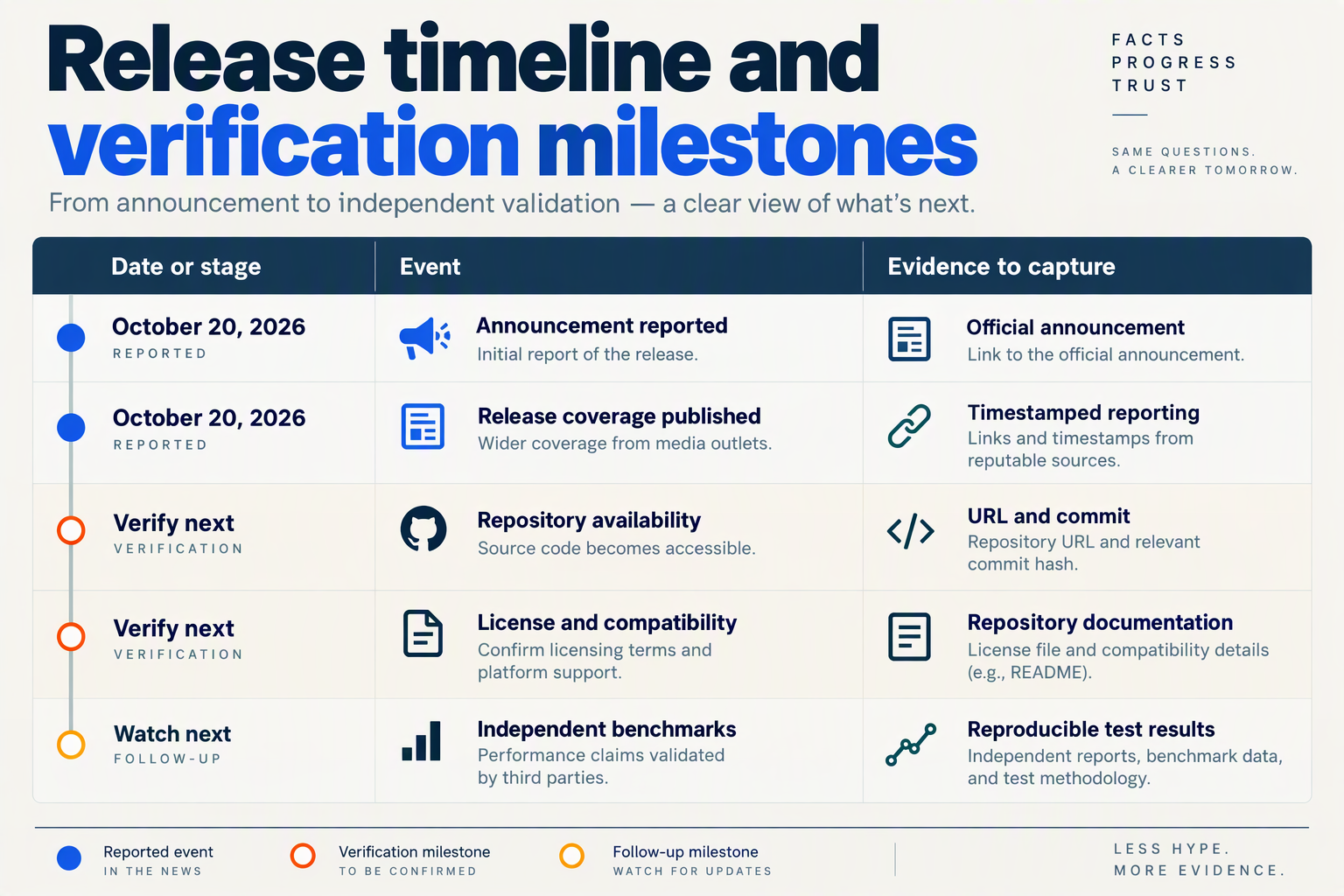
DeepInfer’s announcement unfolded through same-day release coverage, reports about companion tooling, and rapid developer discussion on October 20, 2026. Developers should now watch for repository-level confirmation, reproducible deployment instructions, and independent benchmarks—not treat the initial coverage as a complete operational specification.
What is the verified timeline of the DeepInfer announcement?
The supplied sources establish a same-day reporting sequence, but not the exact order of every announcement. AI Weekly provides a publication timestamp; the other excerpts primarily establish the date or describe the release without a precise time.
| Date or timestamp | Source | Reported development | What developers should verify |
|---|---|---|---|
| October 20, 2026 | TechFlow | Announcement of full open-sourcing of DeepInfer and companion component deepseek-recipe | Repository availability, release tags, and component boundaries |
| October 20, 2026 | Crypto Briefing | DeepInfer released under Apache-2.0 | License files and any separate dependency licenses |
| October 20, 2026, 11:04 UTC | AI Weekly | Coverage connects DeepInfer to DeepSeek-V4.1-Flash production serving | Supported model configurations and deployment examples |
| October 20, 2026 coverage | ChainCatcher | Report describes high-performance operators and an optimized inference engine | Which optimizations are included and reproducible |
| October 20, 2026 coverage | KuCoin, citing ChainCatcher | Report describes Huawei Ascend compatibility | Supported devices, software versions, and installation requirements |
| October 20, 2026 snapshot | Hacker News | “DeepSeek just open-sourced its inference engine” reaches 712 points | Whether discussion produces useful tests, fixes, or integrations |
According to AI Weekly, its DeepInfer article was published at 11:04 UTC on October 20, 2026; that timestamp establishes when the article appeared, not when DeepSeek first published the code. The supplied Hacker News snapshot records 712 points on October 20, 2026, measuring attention rather than deployment readiness.
Which DeepInfer claims need closer inspection?
The next step is to distinguish reported compatibility from a configuration your team can actually operate. KuCoin’s October 20, 2026 coverage describes Huawei Ascend compatibility, but the supplied excerpt does not identify supported accelerator generations, driver versions, or feature parity.
Similarly, StableLearn describes vLLM integration, expert parallelism, and MLA optimization in the supplied coverage. Those are useful investigation leads, not sufficient evidence that every combination is supported in the initial release.
For each claim, look for:
- A documented configuration: hardware, dependencies, model version, and launch parameters.
- A runnable example: installation and serving commands that work outside DeepSeek’s internal environment.
- A measurable result: workload details and an equivalent baseline, rather than adjectives such as “high-performance.”
What should developers watch after release day?
Prioritize three signals over the next round of announcements:
- Reproducibility. Can an independent team deploy the released stack using public instructions? A working external reproduction is more actionable than another announcement summary.
- Maintenance responsiveness. Watch how maintainers handle installation failures, compatibility questions, and proposed fixes. Issue resolution helps reveal whether the project is becoming usable beyond its original production environment.
- Integration stability. Track API behavior, release notes, and migration requirements before connecting an application to an experimental deployment.
Keep a rollback path while evaluating. As of October 2026, CallMissed’s OpenAI-compatible developer API supports caller-chosen fallback models, illustrating an application-layer option for resilience; it does not establish compatibility with DeepInfer itself.
The milestone to watch next is therefore a documented, independently reproducible deployment, not a higher discussion score. That is when release-day interest starts becoming evidence developers can use.
Frequently Asked Questions
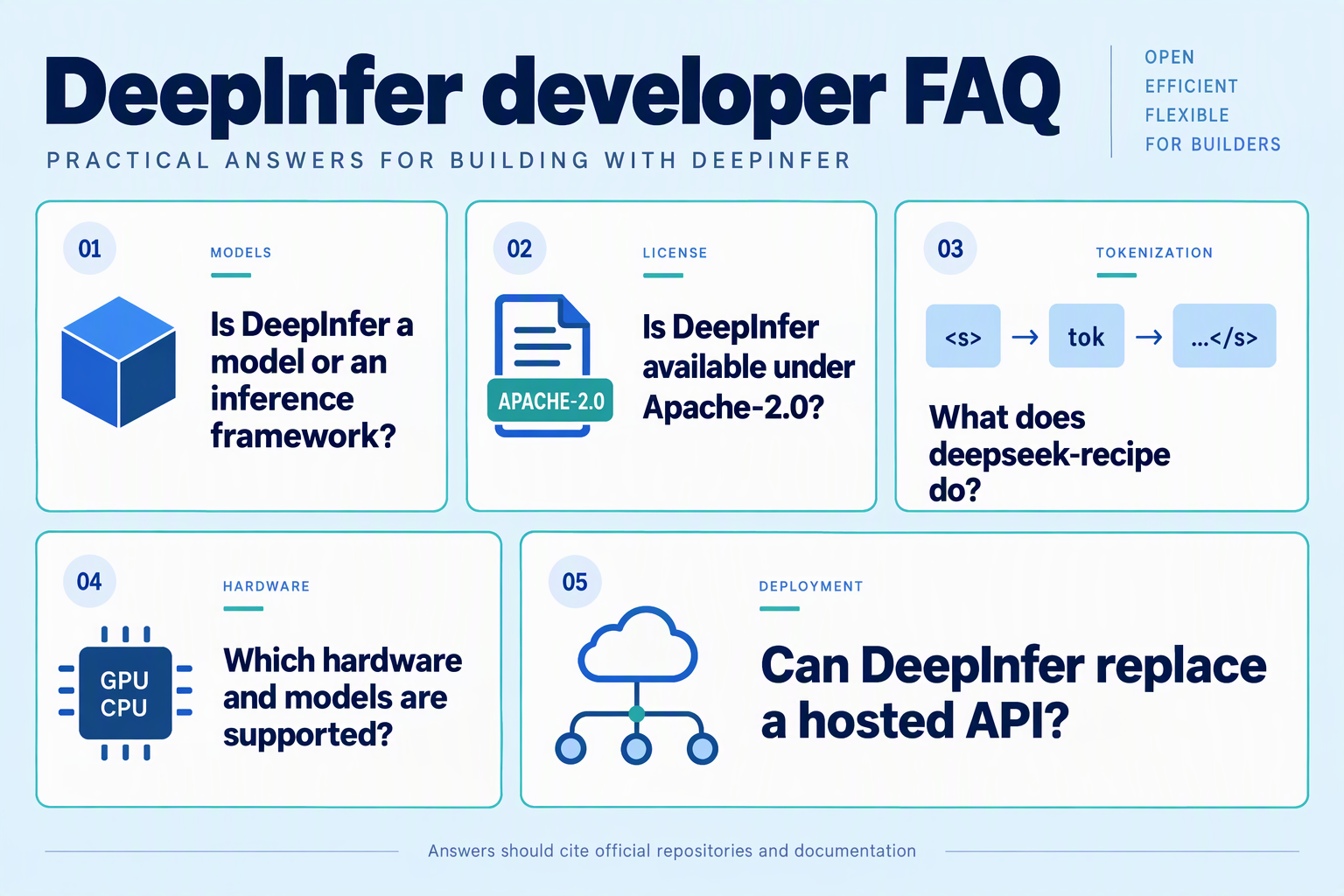
Is DeepInfer a model or a DeepSeek inference engine?
What license does DeepSeek’s open-source inference engine use?
Can DeepSeek inference with DeepInfer replace a hosted LLM API?
Does DeepInfer support Huawei Ascend GPUs and existing serving frameworks?
Will DeepInfer reduce LLM inference costs or improve latency?
What is deepseek-recipe, and do developers need it with DeepInfer?
Conclusion
DeepInfer makes DeepSeek inference a serving-infrastructure decision, not just a model-selection decision. For LLM application developers, the opportunity is to evaluate production serving techniques against real workloads—not assume that an open-source release automatically delivers faster responses or lower costs.
Crypto Briefing reports that DeepSeek released DeepInfer under Apache-2.0 on October 20, 2026. The significance is access: developers can investigate the framework behind DeepSeek’s reported production deployments, while retaining the choice between operating infrastructure themselves and consuming models through managed APIs.
Four takeaways should guide that decision:
- Serving software matters alongside model capability. An inference engine influences how efficiently model weights become responses, affecting latency, concurrent capacity, and interaction economics. For chatbots, coding assistants, and multi-step agents, those infrastructure characteristics must be assessed alongside the usefulness of generated answers.
- Production experience is relevant, but not a transferable benchmark. AI Weekly reported on October 20, 2026, that DeepSeek says DeepInfer powers its large-scale services, including DeepSeek-V4.1-Flash. That makes the framework worth investigating; it does not establish how another developer’s hardware, traffic patterns, or model configuration will perform.
- Measure application outcomes, not isolated improvements. Test throughput and latency using representative prompt lengths, output lengths, and concurrency. For an agent making sequential model calls, the meaningful result is better end-to-end behavior—not simply a faster individual request under favorable test conditions.
- Open source changes the options, not the accounting. Self-hosting still requires GPU capacity, engineering effort, monitoring, and maintenance. Compare those responsibilities with a managed API before treating access to DeepInfer as evidence of savings; the supplied announcement coverage establishes no universal speedup or cost-reduction percentage.
Looking ahead, watch for reproducible benchmarks, supported deployment configurations, and clearer operational requirements. TechFlow reported on October 20, 2026, that DeepSeek also announced deepseek-recipe, its production-grade token encoding and decoding component. The practical question is whether these released components translate into measurable improvements across the workloads developers actually run.
Community enthusiasm should motivate investigation rather than shortcut it. The supplied Hacker News snapshot recorded 712 points on October 20, 2026, demonstrating attention—not independently verified performance. A sensible next step is a bounded evaluation: define your workload, measure a baseline, and compare the complete operational trade-offs before changing production infrastructure.
For teams exploring the managed route, CallMissed’s OpenAI-compatible developer API includes DeepSeek among its model providers as of October 2026. Explore CallMissed alongside your self-hosting evaluation, then ask: which approach delivers the response quality, capacity, and economics your application actually needs?
Related Reading
- DeepSeek V4.1 Flash tool calls: Support Testing Guide
- DeepSeek V4.1 Flash benchmarks vs Claude Fable 5.5
- DeepSeek V4.1 Flash Now on CallMissed API: 1M Context