
Claude Sonnet 5 vs Opus 4.8 vs Kimi K3: Full Comparison


Compare Claude Sonnet 5, Opus 4.8 and Kimi K3 on coding, agents, API pricing, 1M context, benchmarks, open weights and best use cases.
Claude Sonnet 5 vs Opus 4.8 vs Kimi K3: Full Comparison
Claude Sonnet 5 vs Opus 4.8 vs Kimi K3 is now a three-way comparison of released models. This analysis compares Anthropic’s official Claude documentation with Kimi Platform’s Kimi K3 documentation and clearly labels provider-reported details. The practical choice is between Sonnet 5’s balanced Claude positioning, Opus 4.8’s premium capabilities, and Kimi K3’s 1-million-token context and competitive headline API pricing.
Anthropic announced Claude Sonnet 5 on June 30, 2026, positioning it for coding, AI agents, and professional work at scale. Anthropic lists Sonnet 5 introductory pricing at $2 per million input tokens and $10 per million output tokens through August 31, 2026, followed by $3/$15 standard pricing. Claude Opus 4.8 is listed at $5/$25. Kimi Platform documents Kimi K3 with a 1-million-token context window, while current provider listings report $3 cache-miss input, $0.30 cached input, and $15 output per million tokens. This comparison evaluates capabilities, evidence, price, and practical workloads without treating non-shared benchmarks as directly comparable.
Which model is the best choice: Claude Sonnet 5, Claude Opus 4.8, or Kimi K3?
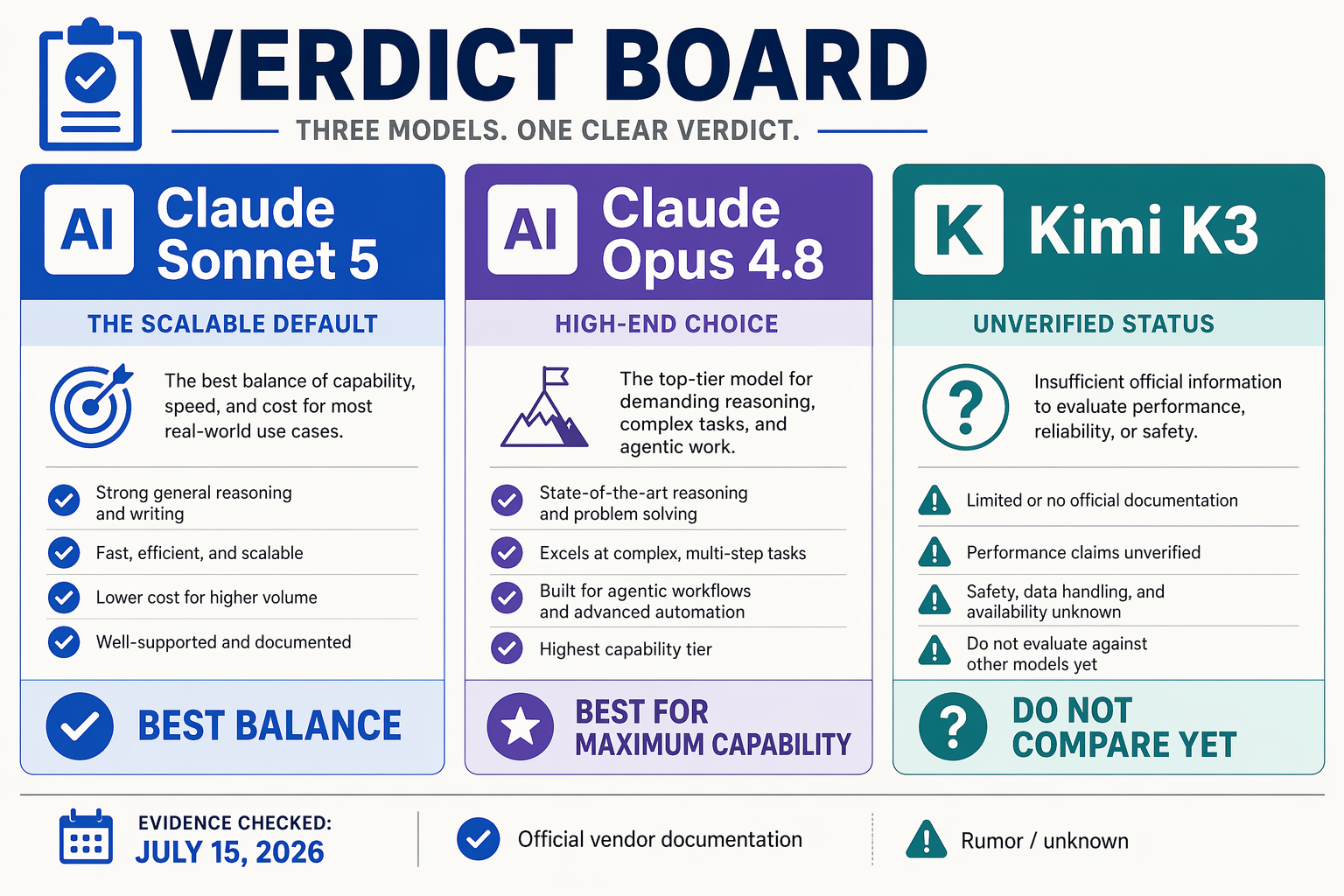
The best choice depends on the workload, but the answer is straightforward: Claude Sonnet 5 is the balanced option for Claude-based coding and agents, Claude Opus 4.8 is the premium option for high-stakes work, and Kimi K3 is the lower-priced, open-weight option for long-context evaluation and deployment flexibility.
As of July 17, 2026, all three models are available. K3’s official launch includes a 1M-token context window, published API pricing, and open-weight positioning, although independent benchmark evidence remains early and is not yet directly comparable across testing environments.
| Model | Best fit | Published pricing and context | Main caveat |
|---|---|---|---|
| Claude Sonnet 5 | Balanced coding, agents, and professional workloads at scale | Confirm current rates, context limits, and service tiers in Anthropic’s documentation | Not automatically better than Opus on the hardest tasks |
| Claude Opus 4.8 | High-stakes, complex, premium Claude workflows | $5/M input tokens and $25/M output tokens for regular usage | Higher inference cost |
| Kimi K3 | Lower-priced, long-context evaluation and open-weight deployment | 1M-token context; $3/M cache-miss input, $0.30/M cached input, and $15/M output through the official API | Early benchmark comparisons use different settings; verify licensing and deployment requirements |
Claude Sonnet 5: the balanced Claude choice
Choose Claude Sonnet 5 for coding assistants, AI agents, tool use, and professional workflows that need a practical balance of capability, responsiveness, and operating cost. Anthropic positions it for coding and agentic work at scale in Introducing Claude Sonnet 5.
Sonnet 5 is the most sensible default of the two Claude models for many production teams. Before estimating costs, confirm its current input, output, prompt-caching, context, and service-tier terms in Anthropic’s documentation. It should also be tested against Opus 4.8 using the repositories, tools, latency targets, and success criteria that matter to the application.
Claude Opus 4.8: the premium Claude choice
Choose Claude Opus 4.8 when performance on difficult or high-value tasks matters more than minimizing token cost. Potential use cases include complex coding, demanding agent workflows, consequential analysis, and tasks where even a modest reliability improvement can justify a higher inference bill.
Anthropic lists regular usage at $5 per million input tokens and $25 per million output tokens in Introducing Claude Opus 4.8. Opus is therefore the premium option, not the automatic winner for every prompt. Sonnet 5 may still be the better production choice for high-volume or latency-sensitive workloads.
Kimi K3: lower-priced, long-context, open-weight evaluation
Choose Kimi K3 when a 1M-token context window, lower official API rates, or greater deployment control is central to the decision. Its published rates are $3 per million cache-miss input tokens, $0.30 per million cached input tokens, and $15 per million output tokens.
The launch also positions K3 as an open-weight model, making it relevant to teams evaluating self-hosting, private infrastructure, customization, or alternatives to closed APIs. Open weights do not make every deployment simple or cost-effective, however. Confirm the exact weight release, license terms, hardware requirements, serving stack, quantization support, and commercial-use conditions before choosing a self-hosted configuration.
The listed rates apply to the official API. Third-party endpoints can have different prices, caching rules, rate limits, latency, data-retention policies, and context support. Self-hosting should be compared using total infrastructure and operations costs rather than token prices alone.
Early Kimi K3 benchmark evidence
Initial results suggest that the model is competitive enough to warrant evaluation, but the evidence remains early and non-comparable. Independent tests may use different prompts, model variants, reasoning budgets, tool access, sampling settings, context lengths, or scoring harnesses. A favorable result in one setup does not establish consistent superiority over Sonnet 5 or Opus 4.8.
For a fair comparison, run all three models on identical tasks with the same tools, token budgets, retry policies, and scoring criteria. Measure long-context retrieval accuracy, agent completion rate, coding correctness, end-to-end latency, cache-hit rate, infrastructure requirements, and total cost—not just headline benchmark scores.
Practical recommendation
- Select Claude Sonnet 5 as the balanced default for Claude coding, agents, and scaled professional work.
- Select Claude Opus 4.8 for premium, high-stakes workflows where additional capability can justify $5/M input and $25/M output pricing.
- Select Kimi K3 for lower-priced API use, 1M-context testing, or open-weight deployment evaluation.
- Treat early third-party benchmark results as preliminary evidence, not a settled cross-model ranking.
For most teams already using Anthropic, Sonnet 5 is the safest default and Opus 4.8 is the escalation path for the hardest work. K3 is a credible third choice for long-context, cost-sensitive, and deployment-controlled scenarios, but production adoption should follow workload-specific testing and license verification.
What do the official sources confirm about these three models?
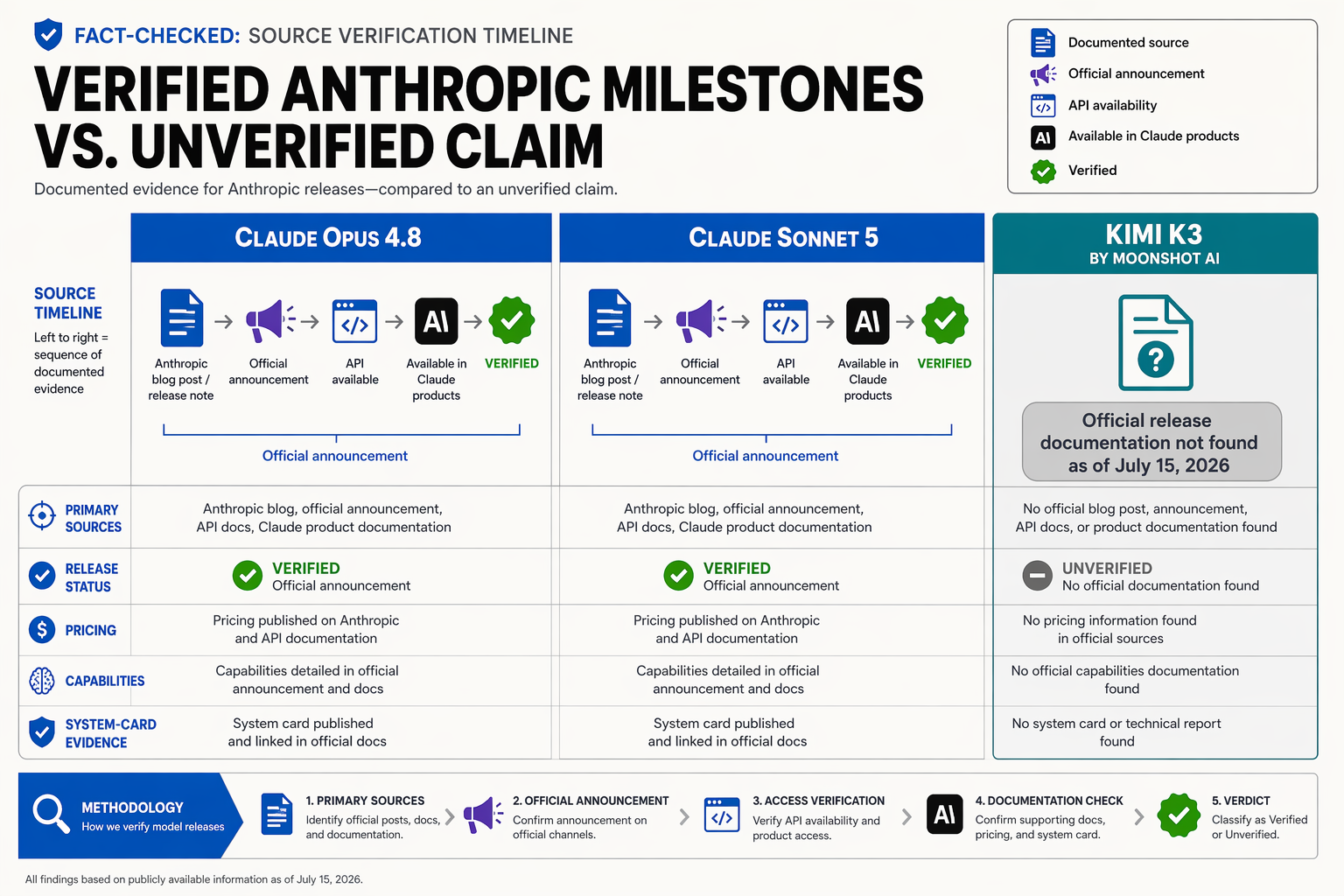
Anthropic’s official announcements document Claude Sonnet 5 and Claude Opus 4.8, while the Kimi Platform official K3 quickstart now confirms Kimi K3, a 1-million-token context window, and a flat-pricing structure. Provider catalogs and model-index results reviewed on July 16, 2026 also show Kimi K3 availability, although those third-party listings should not be treated as primary-source confirmation of every technical claim.
What Anthropic officially confirms
- Claude Sonnet 5: Anthropic announced Sonnet 5 on June 30, 2026, positioning it for “frontier performance across coding, agents, and professional work at scale.” Its release status and intended use cases are documented in Anthropic’s primary announcement: Introducing Claude Sonnet 5.
- Claude Opus 4.8: Anthropic’s official announcement confirms Opus 4.8 and states that regular usage costs $5 per million input tokens and $25 per million output tokens: Introducing Claude Opus 4.8.
These are vendor announcements, not independent performance evaluations. Production users should still verify current API access, context limits, latency, tool support, regional availability, and applicable pricing in their deployment environment.
What Kimi officially confirms about K3
The Kimi Platform official K3 quickstart confirms that Kimi K3 is available through the Kimi Platform. It also documents:
- A 1-million-token context window
- A flat-pricing structure, rather than pricing tiers that increase with context length
- The official API workflow and model-access instructions provided by Kimi Platform
These are first-party Kimi facts and can be cited as official product documentation. They replace the earlier characterization of Kimi K3 as an unverified model.
Pricing evidence and availability caveats
For Kimi K3, provider-catalog and model-index results reviewed on July 16, 2026 list availability and report rates of:
- $3 per million input tokens
- $15 per million output tokens
- $0.30 per million cached-input tokens
Those specific figures come from provider/index listings rather than the Kimi quickstart itself. They should therefore be labeled provider-reported rates and checked against the selected endpoint before deployment. Actual billing can vary by provider, caching eligibility, routing, region, and subsequent price changes.
Anthropic’s Sonnet 5 announcement confirms the model’s release and positioning but does not, in the reviewed announcement evidence, establish a Sonnet 5-specific input/output token price. Anthropic’s earlier Claude Sonnet 4.6 announcement listed $3 per million input tokens and $15 per million output tokens, but that pricing applies to Sonnet 4.6 and should not automatically be carried forward to Sonnet 5.
What still requires confirmation about Kimi K3
Kimi K3’s existence, API availability, 1M context window, and flat-pricing approach are now documented. However, third-party claims about its underlying architecture, parameter count, benchmark scores, open-weight status, downloadable weights, and license terms should remain clearly separated from those official facts.
Before publishing any such specification as definitive, verify it against a Kimi or Moonshot AI model card, technical report, official repository, or license file. Provider pages, benchmark indexes, social posts, and community repositories may be useful discovery sources, but they do not independently establish first-party technical specifications.
Practical comparison standard
A defensible comparison should distinguish among three evidence levels:
- Official vendor documentation: Anthropic announcements for Sonnet 5 and Opus 4.8, and the Kimi Platform K3 quickstart for Kimi K3’s context window and pricing structure.
- Provider/index observations: July 16 availability and the reported $3/$15 standard token rates plus $0.30 cached-input rate for Kimi K3.
- Unconfirmed third-party claims: Architecture, parameters, benchmarks, open-weight availability, and licensing details that still require primary-source verification.
All three models can now be included in the comparison, but benchmark rankings and architectural conclusions should be presented only when the underlying methods and primary evidence are available.
How do Claude Opus 4.8, Claude Sonnet 5, and Kimi K3 compare on features?
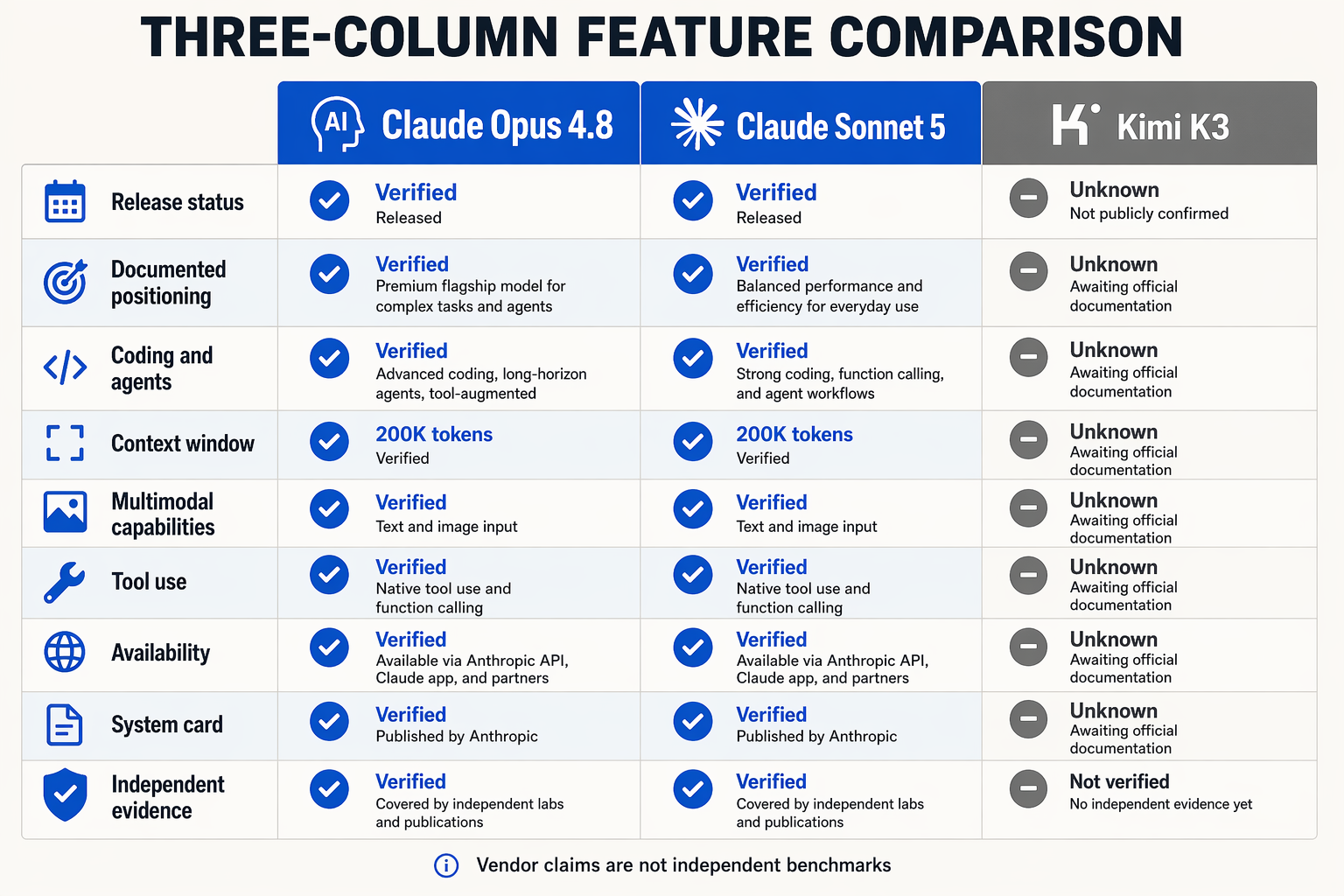
Anthropic has officially announced Claude Opus 4.8 and Claude Sonnet 5, while Kimi K3 is now an announced Moonshot AI model rather than a rumored release. However, the vendors do not publish every specification in the same format, so “not stated” should not be interpreted as “not supported.”
Feature comparison
| Feature | Claude Opus 4.8 | Claude Sonnet 5 | Kimi K3 |
|---|---|---|---|
| Release status | Officially announced by Anthropic in “Introducing Claude Opus 4.8” | Officially announced by Anthropic on June 30, 2026, in “Introducing Claude Sonnet 5” | Officially released by Moonshot AI; it should no longer be described as rumored |
| Context window | Not established by the cited announcement; verify the current Anthropic model documentation | Not established by the cited announcement; verify the current Anthropic model documentation | Use the context limit stated in Moonshot AI’s current Kimi K3 model or API documentation; do not substitute Kimi K2 specifications |
| Input pricing | $5 per million input tokens for regular usage, according to Anthropic’s announcement | Not established in the cited announcement; verify Anthropic’s live pricing page | Verify Moonshot AI’s current Kimi K3 pricing because API, platform, and deployment terms may differ |
| Output pricing | $25 per million output tokens for regular usage | Not established in the cited announcement; do not reuse Sonnet 4.6’s price without confirmation | Verify the live Kimi K3 rate in Moonshot AI’s official documentation |
| Cached pricing | The announcement confirms regular input/output pricing but does not provide enough information here to calculate every cache-write and cache-read case | Verify current cache-write, cache-read, and retention-tier pricing before estimating production costs | Verify whether Moonshot prices cached input separately for the specific Kimi K3 endpoint or deployment |
| Coding and agent fit | Appropriate to evaluate for difficult, high-value coding and agent workflows where the higher confirmed token price is justified | Anthropic positions it for “frontier performance across coding, agents, and professional work at scale” | Evaluate using Moonshot’s documented coding and agent examples plus tests that match the intended repository, tools, and workflow |
| Tool use | Exact supported tools, computer-use features, and API restrictions depend on the current Anthropic documentation and deployment channel | Agent positioning is official; exact tool availability and limits should be checked for the chosen Anthropic product or API | Use only the tool-calling and agent capabilities documented for Kimi K3’s specific API or deployment |
| Openness and deployment | Proprietary Claude model delivered through supported Anthropic channels; no open-weight release is established by the cited announcement | Proprietary Claude model available through supported Anthropic channels; no open-weight release is established by the cited announcement | Deployment and weight availability should be taken from Moonshot AI’s Kimi K3 release materials and license, not inferred from earlier Kimi models |
| Evidence maturity | High for release and regular token pricing; additional limits require the current model and pricing documentation | High for release and vendor positioning; pricing and detailed limits need current documentation | Release confirmed; specification-level claims should cite Moonshot AI’s Kimi K3 model card, API documentation, or repository directly |
| Best use | High-stakes work where maximum model quality may matter more than the confirmed premium price | Coding, agents, and professional workloads at scale, based on Anthropic’s stated positioning | Teams considering the Kimi ecosystem or its documented deployment options, after validating quality, latency, licensing, and total cost on their own workload |
The practical distinction is evidence quality as much as model capability. Opus 4.8 has confirmed regular API pricing, Sonnet 5 has clear official positioning, and Kimi K3 now has an official release—but each still requires live vendor documentation for fields not explicitly established above.
Benchmark tables should also be treated cautiously. Scores are not directly comparable unless the models use the same dataset version, prompt format, tool configuration, sampling settings, token budget, grading method, and execution harness. Vendor-reported results can help identify models to test, but a shared harness—or an evaluation on your own production tasks—is necessary for a defensible ranking.
How much do Claude Sonnet 5 and Claude Opus 4.8 cost, and what is known about Kimi K3 pricing?
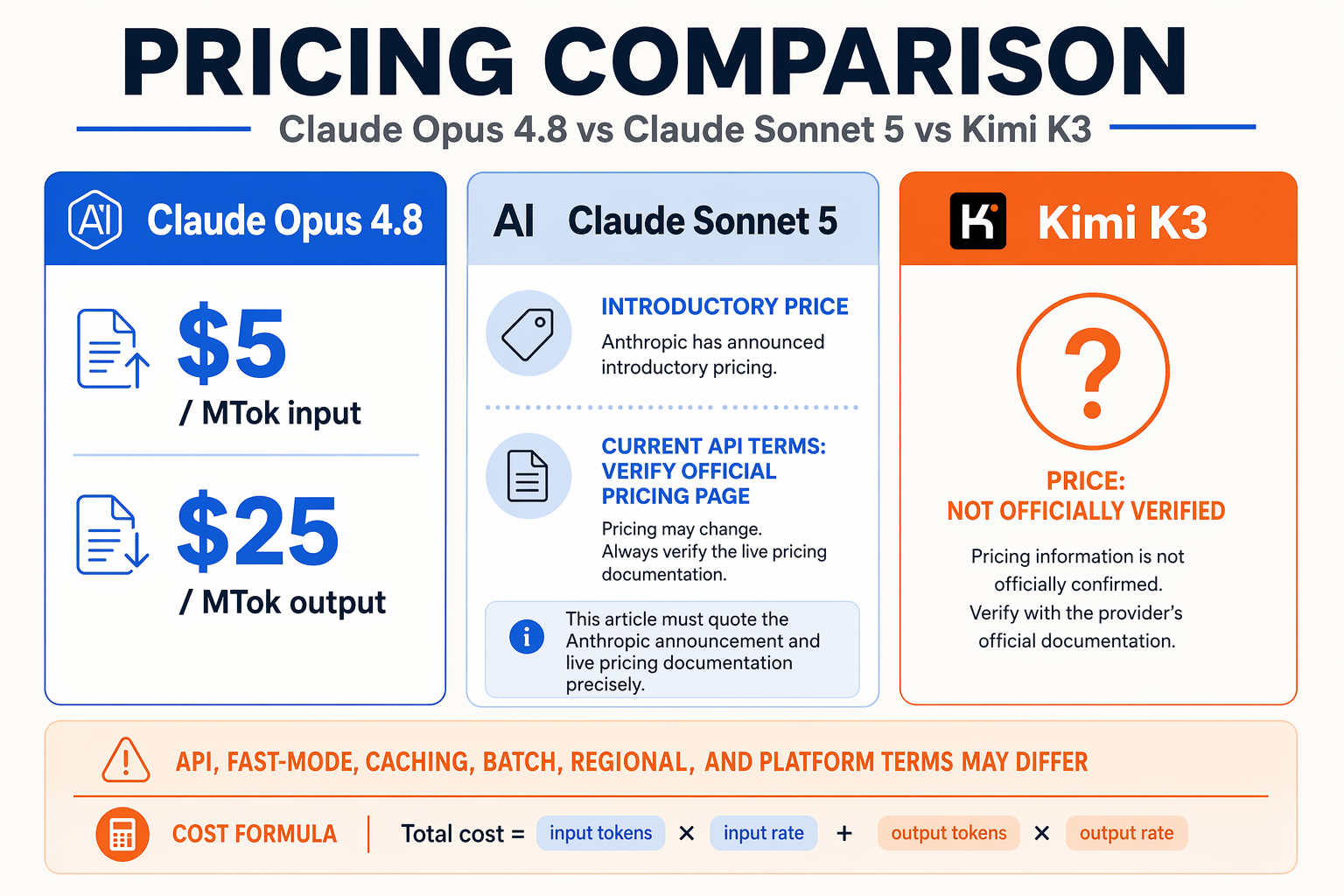
Anthropic’s current pricing materials list Claude Sonnet 5 at an introductory $2 per million input tokens and $10 per million output tokens through August 31, 2026, followed by standard pricing of $3/$15. Claude Opus 4.8 remains $5/$25. Post-launch Kimi K3 rates are reported as $3 for cache-miss input, $0.30 for cached input, and $15 for output, all per million tokens.
Current pricing snapshot
| Model | Input price per million tokens | Output price per million tokens | Pricing status |
|---|---|---|---|
| Claude Opus 4.8 | $5 | $25 | Official Anthropic rate |
| Claude Sonnet 5, introductory | $2 | $10 | Through August 31, 2026 |
| Claude Sonnet 5, standard | $3 | $15 | Standard rate after the introductory period |
| Kimi K3, cache-miss input | $3 | $15 | Reported post-launch Kimi Platform rate |
| Kimi K3, cached input | $0.30 | $15 | Reported rate when input qualifies for cache pricing |
- Claude Opus 4.8: Anthropic documents regular API pricing of $5 per million input tokens and $25 per million output tokens.
- Claude Sonnet 5: The introductory rate is $2/$10 per million input/output tokens through August 31, 2026. Its standard rate is $3/$15.
- Kimi K3: Current post-launch pricing is reported at $3 per million cache-miss input tokens, $0.30 per million cached input tokens, and $15 per million output tokens. Readers should verify the live Kimi Platform billing page, because cache eligibility, billing rules, and rates can change.
- Additional charges: These comparisons cover token charges only. They exclude taxes and any separate fees for tools, storage, premium speed modes, or other platform features.
Example cost calculations
Input-heavy workload: 10 million input tokens and 1 million output tokens
| Model | Formula | Estimated cost |
|---|---|---|
| Claude Opus 4.8 | (10 × $5) + (1 × $25) | $75 |
| Claude Sonnet 5, introductory | (10 × $2) + (1 × $10) | $30 |
| Claude Sonnet 5, standard | (10 × $3) + (1 × $15) | $45 |
| Kimi K3, all cache-miss input | (10 × $3) + (1 × $15) | $45 |
| Kimi K3, all cached input | (10 × $0.30) + (1 × $15) | $18 |
Output-heavy workload: 1 million input tokens and 10 million output tokens
| Model | Formula | Estimated cost |
|---|---|---|
| Claude Opus 4.8 | (1 × $5) + (10 × $25) | $255 |
| Claude Sonnet 5, introductory | (1 × $2) + (10 × $10) | $102 |
| Claude Sonnet 5, standard | (1 × $3) + (10 × $15) | $153 |
| Kimi K3, cache-miss input | (1 × $3) + (10 × $15) | $153 |
| Kimi K3, cached input | (1 × $0.30) + (10 × $15) | $150.30 |
These examples show that Kimi K3’s cache discount can materially reduce costs for input-heavy, repetitive workloads, while output-heavy usage is driven primarily by its $15-per-million output rate.
What are the main pros and cons of each model?
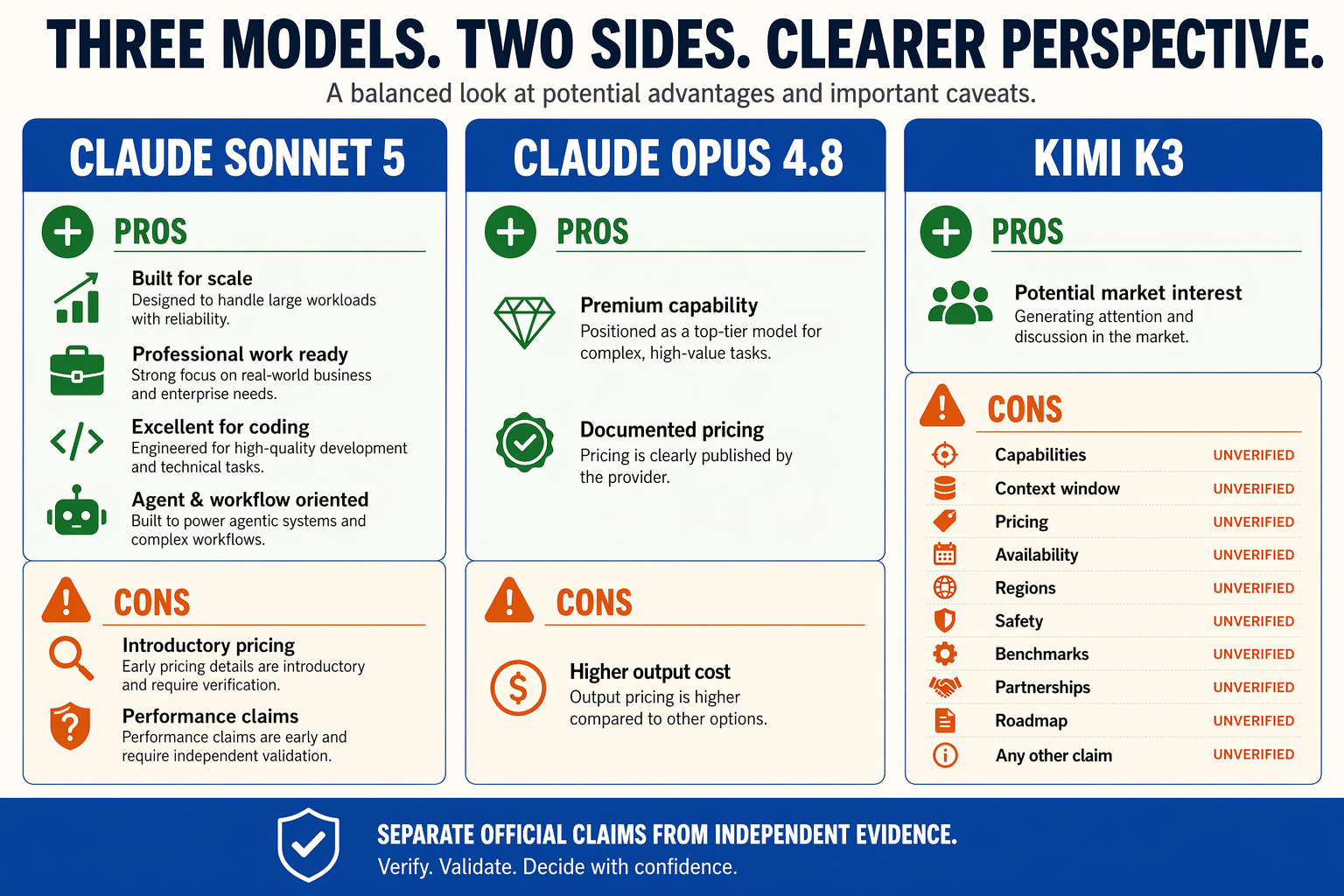
The main trade-off is documented capability versus documented cost: Claude Opus 4.8 has confirmed pricing, Claude Sonnet 5 is positioned for scalable work, and Kimi K3 remains unverified as of July 15, 2026.
| Comparison area | Claude Opus 4.8 | Claude Sonnet 5 | Kimi K3 |
|---|---|---|---|
| Primary strength | Higher-end Claude positioning for demanding reasoning and professional workloads | Coding, AI agents, and professional work at scale, according to Anthropic’s June 30, 2026 announcement | No verified strengths; public claims remain a Kimi K3 rumor |
| Main limitation | Premium output cost can make large production workloads expensive | Official input and output rates require confirmation before deployment | No verified release status, context window, tools, benchmarks, or system card in the available Moonshot AI documentation |
| Documented pricing | Anthropic lists $5 per million input tokens and $25 per million output tokens for regular usage | Pricing is not confirmed in the supplied Anthropic primary-source information; do not infer it from older Sonnet models | No verified pricing |
| Evidence and availability | Anthropic’s official “Introducing Claude Opus 4.8” announcement confirms the model and regular pricing | Anthropic’s official “Introducing Claude Sonnet 5,” dated June 30, 2026, confirms the announcement and availability claims | No comparable official Moonshot AI release documentation was identified as of July 15, 2026 |
| Best-fit decision | Choose when premium capability is justified by the workload and budget | Candidate for scalable coding and agent deployments, subject to pricing and limit checks | Keep on a watchlist; do not use for production comparisons until primary documentation appears |
- Opus 4.8 pros: Clear Anthropic documentation and transparent regular-use pricing make procurement and cost modeling easier.
- Opus 4.8 cons: At $25 per million output tokens, verbose agent workflows can accumulate costs quickly.
- Sonnet 5 pros: Anthropic explicitly targets coding, agents, and professional work at scale, making it relevant to production automation.
- Sonnet 5 cons: Teams should verify current pricing, rate limits, context limits, and system-card details directly with Anthropic before committing.
- Kimi K3: A fair comparison is currently impossible because unverified specifications cannot support a reliable feature or benchmark ranking.
- Evaluation option: A gateway such as CallMissed can simplify multi-model testing through one OpenAI-compatible integration, while model-specific pricing and availability remain separately verified.
Which model should you choose, and how should you test it before deployment?
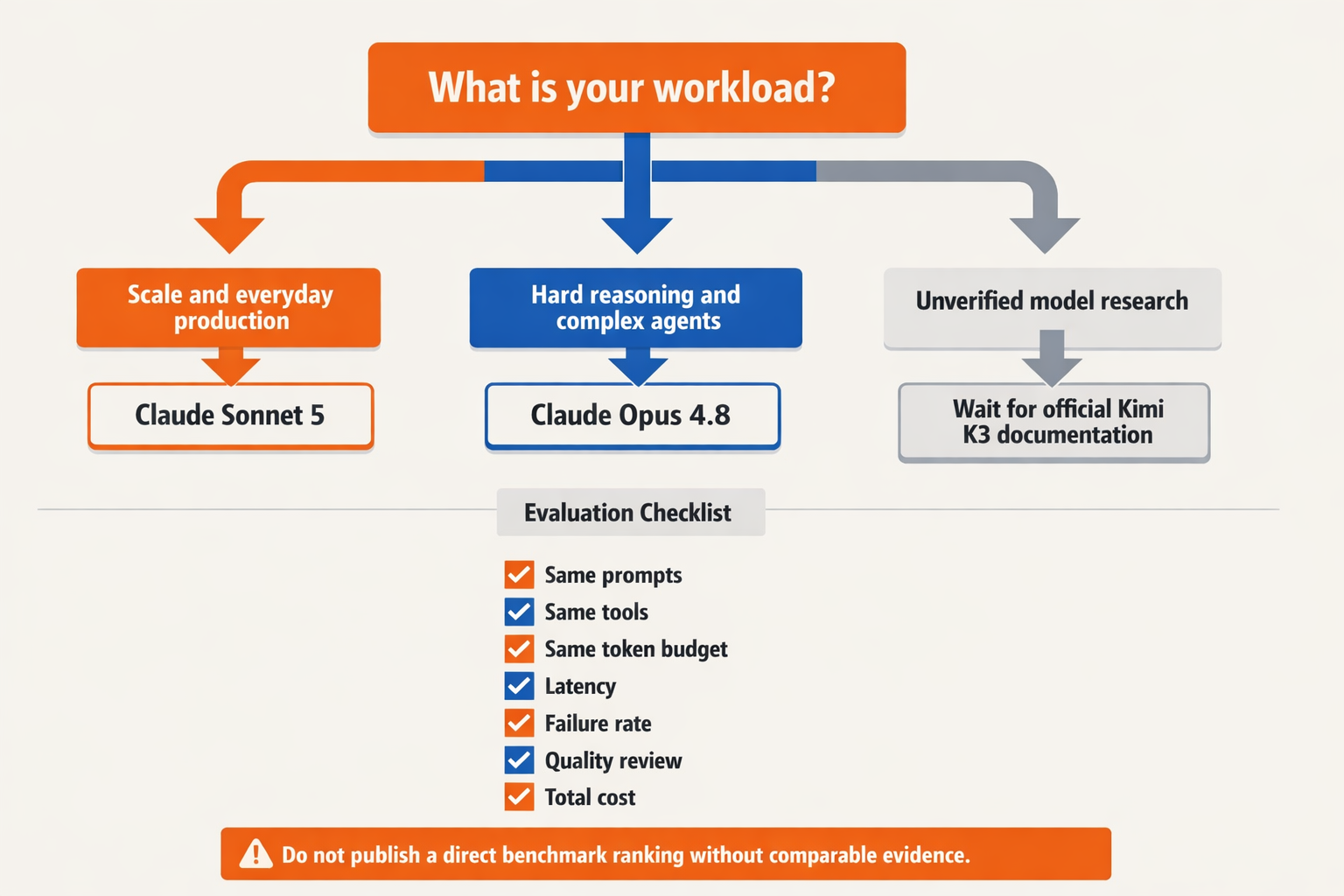
Choose by task fit, verified API access, and cost per successful task—not headline benchmarks.
Select the candidate
- Claude Sonnet 5: Start here for coding, agentic workflows, and high-volume professional tasks. Anthropic announced it on June 30, 2026; verify the current model ID, availability, limits, and official input/output pricing in Anthropic’s documentation before deployment.
- Claude Opus 4.8: Test for complex reasoning, difficult tool-use workflows, and high-stakes tasks where higher cost may be justified. Anthropic lists regular API pricing of $5 per million input tokens and $25 per million output tokens; confirm current pricing and any batch, caching, or long-context charges.
- Kimi K3: Consider it when long-context processing is central to the workload. Moonshot AI’s API documentation lists a 1-million-token context window. Treat its publication date and exact API rates as provider-reported, and verify the live documentation, endpoint access, and billing terms before testing.
- Multi-model deployments: A compatible gateway can simplify evaluation, but confirm that it exposes the official model versions and preserves provider-specific tool schemas, context limits, rate limits, and billing.
Test before deployment
- Build a representative evaluation set: Use 50–100 real tasks covering the intended workload, including coding, extraction, multilingual requests, long-context retrieval, tool use, refusals, and prompt-injection attempts.
- Run a controlled comparison: Give each model the same prompts, system instructions, documents, tools, temperature, output-token limit, retry policy, and scoring rubric.
- Run a budget-matched comparison: Set the same dollar budget per task and allow each model to use only the tokens, retries, and tool calls that budget permits. This better reflects production economics than token pricing alone.
- Measure outcomes: Track task accuracy, grounded-answer rate, tool-call success, unsafe or unauthorized actions, p50/p95 latency, token use, total cost, and cost per successful task.
- Review failures manually: Inspect hallucinations, missed instructions, malformed tool calls, personal-data handling, and cases requiring human escalation.
- Set deployment thresholds: Ship only if a model meets predetermined quality, safety, latency, and cost targets. Repeat the evaluation after model, prompt, tool, or pricing changes.
A cautious task-based verdict: begin with Sonnet 5 for balanced production workloads, test Opus 4.8 for the hardest or highest-value tasks, and evaluate Kimi K3 when its documented 1M context window provides a concrete advantage. Use routing only when measured gains outweigh the added operational complexity.
What are the answers to the most common Claude Sonnet 5, Opus 4.8, and Kimi K3 questions?
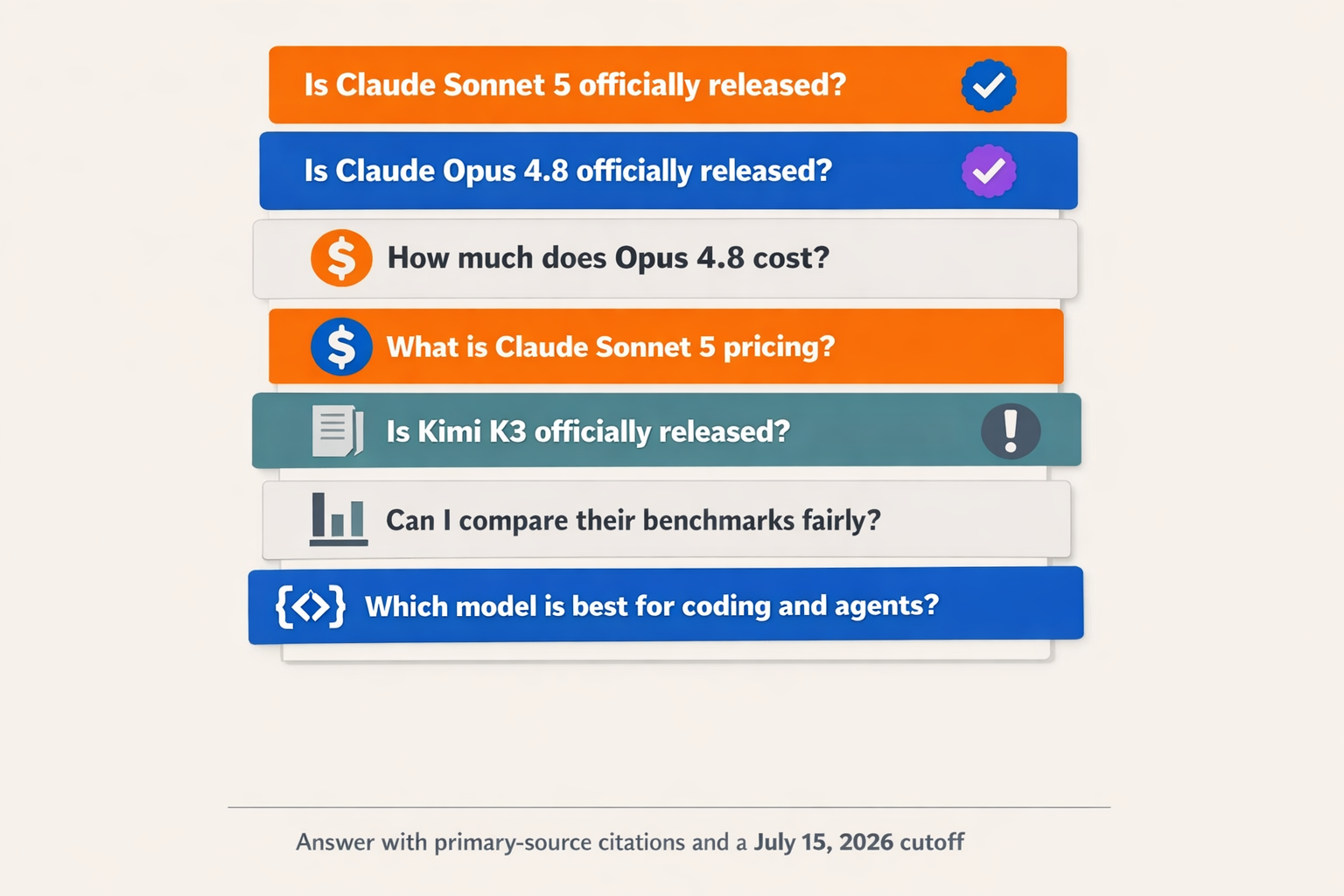
The key answer is that all three models are now available, but they target different priorities: Claude Sonnet 5 emphasizes efficient coding and production-scale work, Claude Opus 4.8 is Anthropic’s premium option for demanding agents and reasoning, and Kimi K3 offers a reported 1-million-token context window.
Frequently asked questions
- Q: Is Claude Sonnet 5 officially released, and what does it cost?
A: Yes. Anthropic announced Claude Sonnet 5 on June 30, 2026. Its launch pricing includes an introductory rate of $1.50 per million input tokens and $7.50 per million output tokens, followed by standard pricing of $3 per million input tokens and $15 per million output tokens. Check Anthropic’s current pricing page for the promotion’s end date, cache charges, regional availability, and provider-specific terms.
- Q: What is Claude Opus 4.8 pricing?
A: Anthropic lists Claude Opus 4.8 at $5 per million input tokens and $25 per million output tokens under regular API pricing. Batch processing, prompt caching, fast modes, and third-party cloud platforms may use different rates.
- Q: Has Kimi K3 been released, and how can developers access it?
A: Yes. Kimi K3 has launched with access through Moonshot AI’s supported Kimi products and API channels. Availability, quotas, model identifiers, regional restrictions, and billing can vary, so developers should confirm them in Moonshot AI’s current documentation before integrating it.
- Q: What are Kimi K3’s context window and API prices?
A: Kimi K3 is reported to support a 1-million-token context window. Reported API pricing is $3 per million uncached input tokens, $15 per million output tokens, and $0.30 per million cached input tokens. Verify those figures, cache eligibility rules, and maximum-output limits against Moonshot AI’s live pricing documentation.
- Q: Which model is best for coding?
A: Claude Sonnet 5 is the practical starting point for high-volume coding because it targets coding and professional workloads while retaining lower standard pricing than Opus 4.8. Opus 4.8 may be preferable for especially difficult repository-wide changes, debugging, or architecture work, but teams should compare both on their own codebase.
- Q: Which model is best for AI agents?
A: Opus 4.8 is the stronger candidate when an agent needs maximum reasoning quality, complex planning, and reliable tool coordination. Sonnet 5 can be the better production choice when latency, throughput, and cost matter across many agent steps. Kimi K3 should also be tested when an agent benefits from keeping exceptionally large histories or document sets in one prompt.
- Q: Which model is best for long-context tasks?
A: Kimi K3 has the clearest advantage on advertised context capacity because of its reported 1M-token window. A larger window does not automatically mean better retrieval or reasoning, however. Test accuracy at different document positions, instruction retention, latency, and the cost of processing or caching large prompts.
- Q: Is Kimi K3 an open-weights model?
A: Do not infer open weights from public API or chat access. Confirm that Moonshot AI has published downloadable weights and inspect the specific repository license, version, permitted uses, redistribution terms, and deployment restrictions. “Open weights,” “open source,” and “API-accessible” are not interchangeable.
- Q: Why should Claude Sonnet 5, Opus 4.8, and Kimi K3 be tested on shared benchmarks?
A: Vendor benchmark scores may use different prompts, tools, context lengths, sampling settings, and scoring methods. A fair comparison runs the same tasks with identical instructions, tool permissions, token budgets, retry policies, and evaluation criteria, then measures quality, latency, reliability, and total cost.
Conclusion
- Claude Opus 4.8 is the premium choice for high-stakes, quality-sensitive workloads. Its documented pricing is $5 per million input tokens and $25 per million output tokens.
- Claude Sonnet 5 is the practical default for coding, agents, and professional workloads at scale. Confirm current pricing and rate limits before committing to high-volume deployment.
- Kimi K3 is best treated as an evaluation candidate for teams seeking another deployment option. Its benchmark evidence is still early, so test it on representative workloads and check live billing and license documentation before procurement.
The three-way verdict: choose Opus 4.8 when capability justifies premium pricing, Sonnet 5 for scalable day-to-day production, and Kimi K3 for controlled evaluation until its operational terms and real-world performance are better established. To explore evolving AI communication infrastructure, visit CallMissed.
Related Reading
Discussion
Related Posts


Ready to automate customer conversations?
Launch AI voice agents and WhatsApp bots with CallMissed — one API, 22+ Indian languages.