
Claude Opus 5 vs Kimi K3: Specs, Benchmarks, Price & Verdict



Claude Opus 5 vs Kimi K3 compared on official specs, benchmarks, API pricing, context, coding, enterprise use, and deployment options.
Claude Opus 5 vs Kimi K3: Specs, Benchmarks, Price & Verdict
Claude Opus 5 vs Kimi K3 is now a comparison between two officially documented models. Anthropic launched Opus 5 on July 24, 2026, confirming its API identity, $5/$25 per-million-token pricing, 1M-token context window and 128k maximum output. Kimi K3 remains differentiated by its sparse architecture, economics and deployment model.
That distinction matters because Kimi K3 is not being discussed as a routine upgrade. Multiple industry analyses describe it as a 2.8-trillion-parameter sparse mixture-of-experts model, potentially making it one of the largest open-model releases by total parameter count. The Bimal Institute reported in July 2026 that Kimi K3 scored 1,679 on Arena’s front-end coding board, ahead of the models it identified as Claude Fable 5 at 1,631 and GPT-5.6 Sol at 1,618. Data Science Dojo, however, placed Kimi K3 at an aggregate score of approximately 57, while CoderSera ranked it behind Claude Fable 5 and GPT-5.6 Sol on its broader comparison. These conflicting results show why a single leaderboard cannot establish an overall winner.
There is also an important verification caveat. TECHSY reported that Kimi K3’s model weights were scheduled for July 27, 2026, four days after this comparison’s cutoff date. Therefore, “released” may refer to product or API availability rather than independently downloadable weights; claims about open-weight deployment must remain provisional until the files, licence, and technical documentation are publicly inspectable.
By contrast, there is no verified Claude Opus 5 model card, Anthropic pricing page, API identifier, system card, or reproducible benchmark package in the supplied evidence. Any claimed context window, parameter count, release date, price, or benchmark score for Claude Opus 5 should consequently be labelled expected or leaked—not factual.
This comparison will separate:
- Confirmed Kimi K3 evidence from secondary reporting and launch claims
- Claude Opus 5 rumours from official Anthropic information
- Coding scores from broader reasoning and agentic-performance results
- API availability from genuinely open-weight access
- Headline parameter counts from practical cost, latency, and deployment value
As model choice becomes increasingly dynamic, OpenAI-compatible gateways such as CallMissed reflect the shift toward accessing multiple AI providers through one integration rather than committing an application to one model family.
The goal is not to crown a winner using mismatched evidence. It is to show what can responsibly be concluded on July 24, 2026, what still requires verification, and which model deserves attention under specific workloads.
Which wins as of July 25, 2026: Claude Opus 5 or Kimi K3?
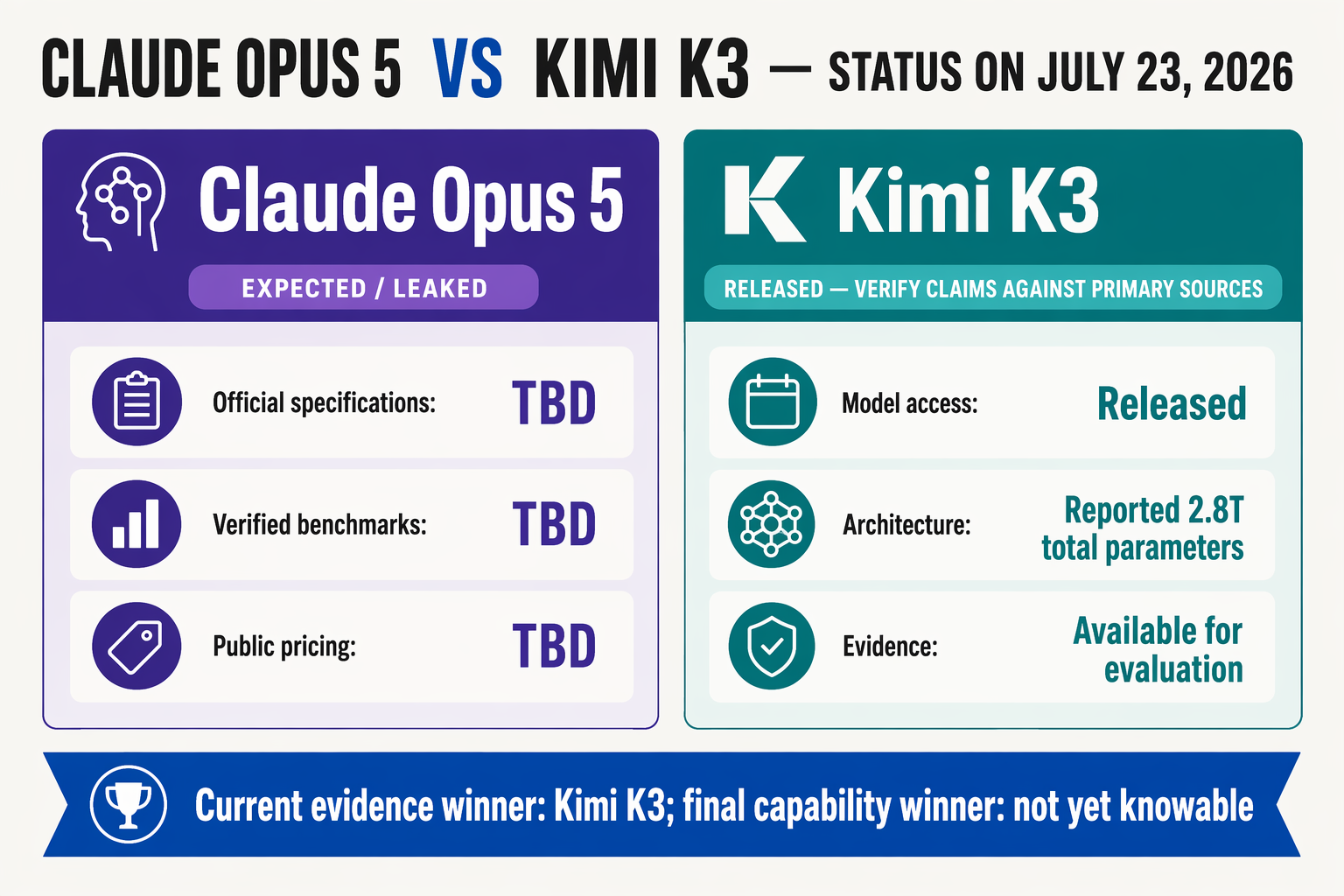
Claude Opus 5 is the stronger choice today for managed complex agents, advanced coding and enterprise workloads. Kimi K3 is the better fit when its sparse architecture, API economics or anticipated open-weight deployment model aligns more closely with a team’s cost and infrastructure requirements. Neither model wins every workload.
The comparison changed materially on July 24, 2026, when Anthropic officially launched Claude Opus 5. Kimi K3 is therefore no longer the only announced and testable model in this matchup.
The verified comparison as of July 25
Anthropic has published concrete product details for Claude Opus 5:
- Official model ID:
claude-opus-5-20260724 - Context window: 1 million tokens
- Maximum output: 128,000 tokens
- API pricing: $5 per million input tokens and $25 per million output tokens
- Availability: Claude apps, the Anthropic API, Amazon Bedrock and Google Cloud Vertex AI
Those specifications make Opus 5 immediately testable through managed production channels. Its long context window, large output allowance and broad platform availability make it the more straightforward default for teams building complex agents, working across large codebases or requiring enterprise cloud procurement and operations.
Kimi K3 remains a credible alternative, but its facts require more careful qualification:
- Moonshot AI reportedly released Kimi K3 on July 16, 2026.
- Published descriptions characterize it as a sparse mixture-of-experts model with 2.8 trillion total parameters.
- It is reportedly accessible through hosted products or APIs, enabling teams to evaluate quality, latency and API cost.
- TECHSY reported that the complete weights were scheduled for July 27, 2026. As of this July 25 cutoff, that date has not arrived, so the weights should not yet be described as available for download or independently audited.
Kimi K3’s potential open-weight economics and deployment control may become important differentiators after the promised weights are actually released, their licensing terms are confirmed and independent teams assess the infrastructure required to run them.
Which model should buyers choose?
Choose Claude Opus 5 when the priority is:
- Managed, production-ready access across major platforms
- Complex agentic workflows and long-running tasks
- Advanced coding over large repositories
- A 1 million-token context window and outputs of up to 128,000 tokens
- Enterprise procurement, security and cloud-platform integration
- Official pricing and documentation available today
Choose Kimi K3 when the priority is:
- Evaluating a sparse mixture-of-experts architecture
- API economics that outperform Opus 5 on the team’s actual workload
- Future self-hosting or infrastructure-level deployment control, subject to the reported July 27 weight release
- Avoiding dependence on a single managed-model provider
- Testing Kimi-specific strengths reported in coding and front-end evaluations
The economic comparison should be based on total cost per successful task, not token prices or parameter counts alone. A cheaper model can become more expensive if it requires additional retries, larger prompts or more human correction. Conversely, a model with higher listed prices may cost less overall if it completes difficult workflows reliably in fewer steps.
Benchmarks do not produce a universal winner
Previously reported Kimi K3 results remain useful as testing leads, not definitive proof.
The Bimal Institute reported that Kimi K3 scored 1,679 on Arena’s front-end coding leaderboard. TECHSY likewise reported that Kimi K3 led the Frontend Arena and five launch benchmarks. These claims concern particular evaluations and should be checked against disclosed prompts, runtime settings, scoring criteria and independent replication.
LLM-Stats separately reported that Claude Fable 5 won 22 of 35 shared evaluations against Kimi K3, while Kimi K3 won 12 and tied one. Claude Fable 5 is not Claude Opus 5, so that result cannot decide this comparison. It does illustrate how strongly outcomes depend on the workload and evaluation method.
Anthropic’s launch results for Opus 5 should be treated the same way: official benchmarks establish testable claims, but buyers should reproduce relevant tasks using their own code, documents, tool chains and quality standards.
The defensible verdict
As of July 25, 2026, Claude Opus 5 wins for buyers seeking a verified, managed model for complex coding, agents and enterprise deployment. Its official model identifier, pricing, context limits and multi-platform availability remove the uncertainty that existed before its July 24 launch.
Kimi K3 can still be the better choice where API cost, sparse-model characteristics or eventual open-weight deployment control matter more. However, its reported July 27 weight release remains pending, so local deployment and independent weight-level inspection are not yet verified capabilities as of this cutoff.
Teams should test both models on representative workflows and keep integrations reversible. An OpenAI-compatible gateway such as CallMissed can help compare providers without tightly coupling application logic to one model.
What background and release context explains the Claude Opus 5 vs Kimi K3 comparison?

The comparison exists because Moonshot AI’s Kimi K3 represents a documented product launch, while “Claude Opus 5” represents an anticipated Anthropic flagship without an official release record. As of July 24, 2026, this is therefore a comparison between observable Kimi K3 evidence and a hypothetical future Claude model—not two equally verifiable releases.
Kimi K3 emerged from Moonshot AI’s rapid scaling strategy
Moonshot AI has positioned the Kimi family around long-context work, coding, tool use and increasingly agentic workloads. Kimi K3 appears to extend that strategy through a reported sparse mixture-of-experts architecture, which activates only part of a model’s total capacity for each token rather than using every parameter on every inference pass.
Multiple July 2026 analyses describe Kimi K3 as having 2.8 trillion total parameters, including TECHSY and the Data Science in Your Pocket comparison. That figure is significant, but it does not reveal the number of active parameters, memory requirements, inference speed or real operating cost by itself.
Kimi K3 also follows an increasingly competitive Kimi lineage:
- Kimi K2.6 scored 58.6% on SWE-Bench Pro, according to BuildFastWithAI’s 2026 comparison.
- BuildFastWithAI reported that Kimi K2.6 could run 300 agents in parallel, illustrating Moonshot AI’s emphasis on multi-agent execution.
- Kimi K3 reporting shifts the focus toward larger-scale sparse architecture, front-end coding and broader comparisons with frontier proprietary models.
These earlier results provide relevant family context, but they must not be treated as Kimi K3 results.
“Released” does not necessarily mean downloadable
Kimi K3’s release context has three distinct layers that should not be conflated:
- Product access: Users may be able to interact with Kimi K3 through a hosted interface.
- API access: Developers may be able to invoke the model through Moonshot AI or another authorised service.
- Open-weight availability: Developers can download, inspect and independently deploy the published model files under a stated licence.
TECHSY reported in July 2026 that Kimi K3’s weights were due on July 27, 2026, after this article’s July 23 cutoff. Consequently, the model can reasonably be described as released at the product or API level, but its reported open-weight status remained pending independent confirmation on the comparison date.
Claude Opus 5 has no equivalent release trail
Anthropic’s Opus label historically denotes the highest-capability tier within the Claude family, making “Claude Opus 5” a plausible future product name. Plausibility, however, is not verification.
For a Claude Opus 5 claim to become factual, Anthropic would need to provide at least some of the following:
- An official announcement or documentation page
- A valid API model identifier
- Pricing and availability by region or platform
- A model card or system card
- Reproducible evaluations with disclosed settings
None appears in the supplied evidence as of July 24, 2026. References to other names—such as Claude Fable 5, which LLM-Stats said won 22 of 35 shared evaluations against Kimi K3—cannot be silently reassigned to Claude Opus 5. Model-family labels, tiers and benchmark entries are not interchangeable.
The background therefore explains the central methodological rule for this matchup: Kimi K3 can be assessed from released-product reporting, whereas Claude Opus 5 can only be discussed through clearly labelled expectations until Anthropic publishes primary evidence.
Which Claude Opus 5 and Kimi K3 claims are official, vendor-reported, or independently verified?
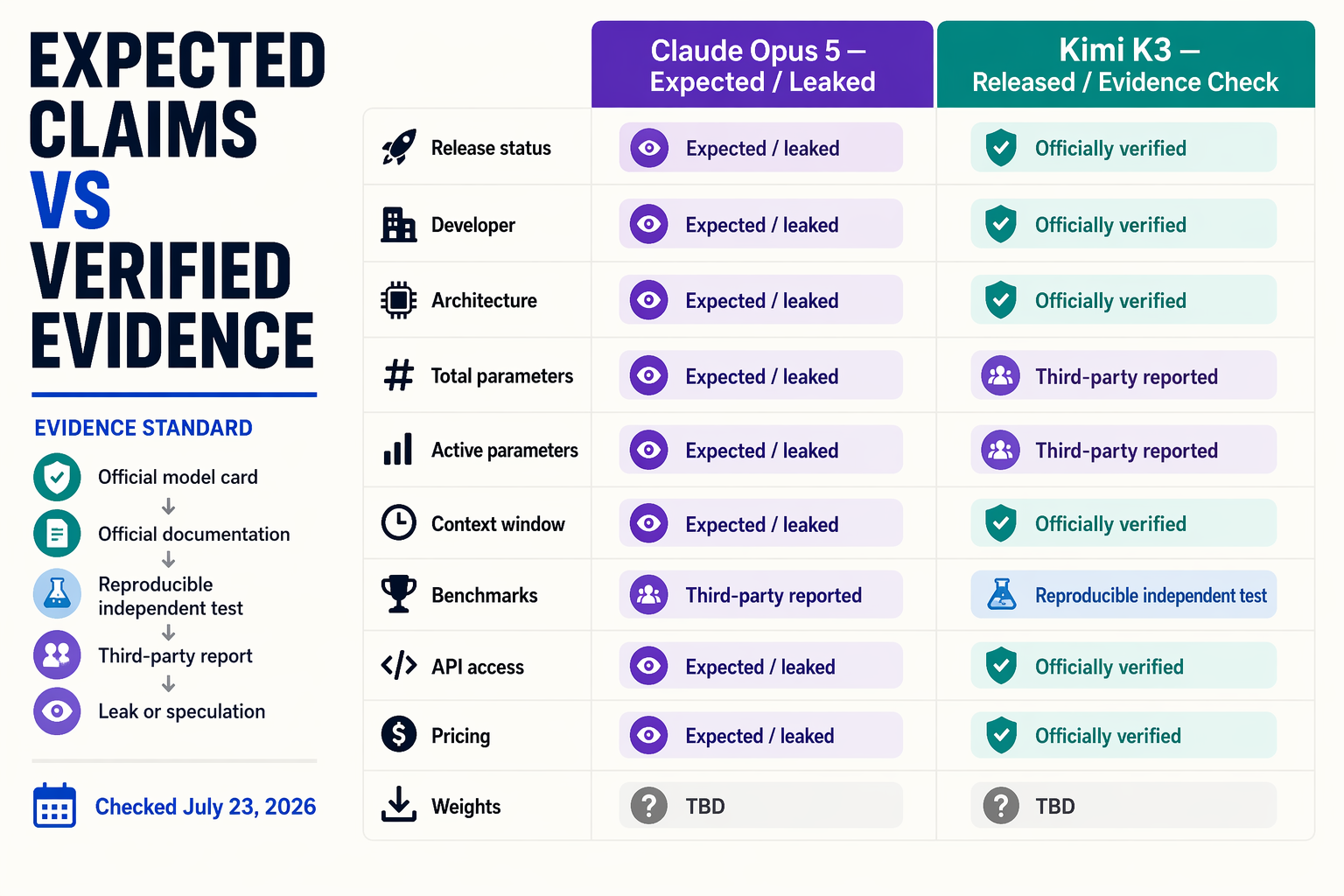
As of July 25, 2026, both Claude Opus 5 and Kimi K3 are officially documented, available models. Anthropic’s launch materials now supersede earlier leaks about Opus 5’s identity, access, context limits and pricing. However, benchmark, latency and real-world performance claims from either company remain vendor claims unless independently reproduced.
Evidence status at a glance
| Category | Claude Opus 5 | Kimi K3 | Evidence status on July 25, 2026 |
|---|---|---|---|
| Model existence | Anthropic officially launched Claude Opus 5 | Moonshot AI officially documents Kimi K3 | Both models are official |
| API model ID | Anthropic lists claude-opus-5 in its API documentation | K3 is listed through Moonshot’s services | Official first-party documentation |
| Availability | Available across Claude’s supported apps and plans, the Anthropic API, Amazon Bedrock and Google Cloud Vertex AI | Available through Moonshot’s services | Official platform availability; regional or account restrictions may still apply |
| Architecture and size | Anthropic has not published a parameter count or enough architecture detail for independent inspection | Moonshot describes K3 as a 2.8-trillion-parameter model | K3 figure is a vendor specification, not an independent measurement |
| Modalities | Use Anthropic’s published platform documentation for supported Opus 5 inputs and outputs | Moonshot describes K3 as natively multimodal | First-party capability descriptions |
| Context window | 1 million tokens | 1 million tokens | Officially documented limits; usable capacity can vary by workload and platform |
| Maximum output | 128,000 tokens | Moonshot’s documented service limit applies | Opus 5 limit is now official, not leaked |
| Thinking behaviour | Thinking is enabled by default | Moonshot documents K3’s own reasoning behaviour | Product behaviour documented by each vendor; quality is not independently established by the setting alone |
| API pricing | $5 per million input tokens and $25 per million output tokens | $0.30 per million cached input tokens, $3 per million cache-miss input tokens and $15 per million output tokens | Official list prices; caching, platform and provider charges can change effective cost |
| Benchmarks | Anthropic’s launch results are vendor-reported | Moonshot’s published results are vendor-reported | Not independent measurements unless reproduced under disclosed conditions |
| Latency and throughput | No universal latency figure can be inferred from the launch announcement | No universal latency figure can be inferred from Moonshot’s documentation | Requires independent testing by region, provider, prompt and load |
| Downloadable weights | No downloadable Opus 5 weights or open-weight licence announced | Moonshot said K3 weights would be released on July 27, 2026 | K3 was not yet independently inspectable as an open-weight release on July 25 |
Which Claude Opus 5 details are now official?
The following points no longer belong in the “expected” or “leaked” category:
- Launch: Anthropic has officially announced Claude Opus 5.
- Model ID: Anthropic’s API documentation lists
claude-opus-5. - Access: Opus 5 is available across Anthropic’s supported Claude surfaces and through the Anthropic API, Amazon Bedrock and Google Cloud Vertex AI.
- Context: Anthropic documents a 1-million-token context window.
- Output: The documented maximum output is 128,000 tokens.
- Pricing: Standard API list pricing is $5/MTok for input and $25/MTok for output.
- Thinking: Anthropic documents thinking as enabled by default.
These are verified as first-party product facts because they appear in Anthropic’s launch, model-catalogue or pricing materials. They should not be described as independently measured architecture or performance results.
Uncertainty remains around unsupported parameter-count claims, hidden architecture details, universal latency figures and benchmark numbers circulated without a traceable Anthropic source. Even Anthropic-published benchmark results are vendor measurements until an independent evaluator reproduces them under comparable conditions.
Which Kimi K3 details are verified?
For Kimi K3, “verified” likewise means confirmed by Moonshot AI’s primary documentation, unless an independent source is explicitly cited.
- Availability: Kimi K3 is officially available through Moonshot’s services.
- Model size: Moonshot specifies 2.8 trillion parameters.
- Multimodality: Moonshot describes K3 as natively multimodal.
- Context: The documented context window is 1 million tokens.
- Pricing: Moonshot lists $0.30/MTok for cached input, $3/MTok for cache-miss input and $15/MTok for output.
- Weights: Moonshot scheduled downloadable weights for July 27, 2026. As of July 25, that release had not yet occurred, so independent weight inspection was not possible.
The updated conclusion is therefore more balanced than the pre-launch comparison: Claude Opus 5 and Kimi K3 are both official, available products with vendor-documented limits and prices. Neither company’s benchmark, latency or broader capability claims should be treated as independent measurements without reproducible third-party testing.
What do Kimi K3's reported 2.8-trillion-parameter architecture, API, and weight plans actually mean?
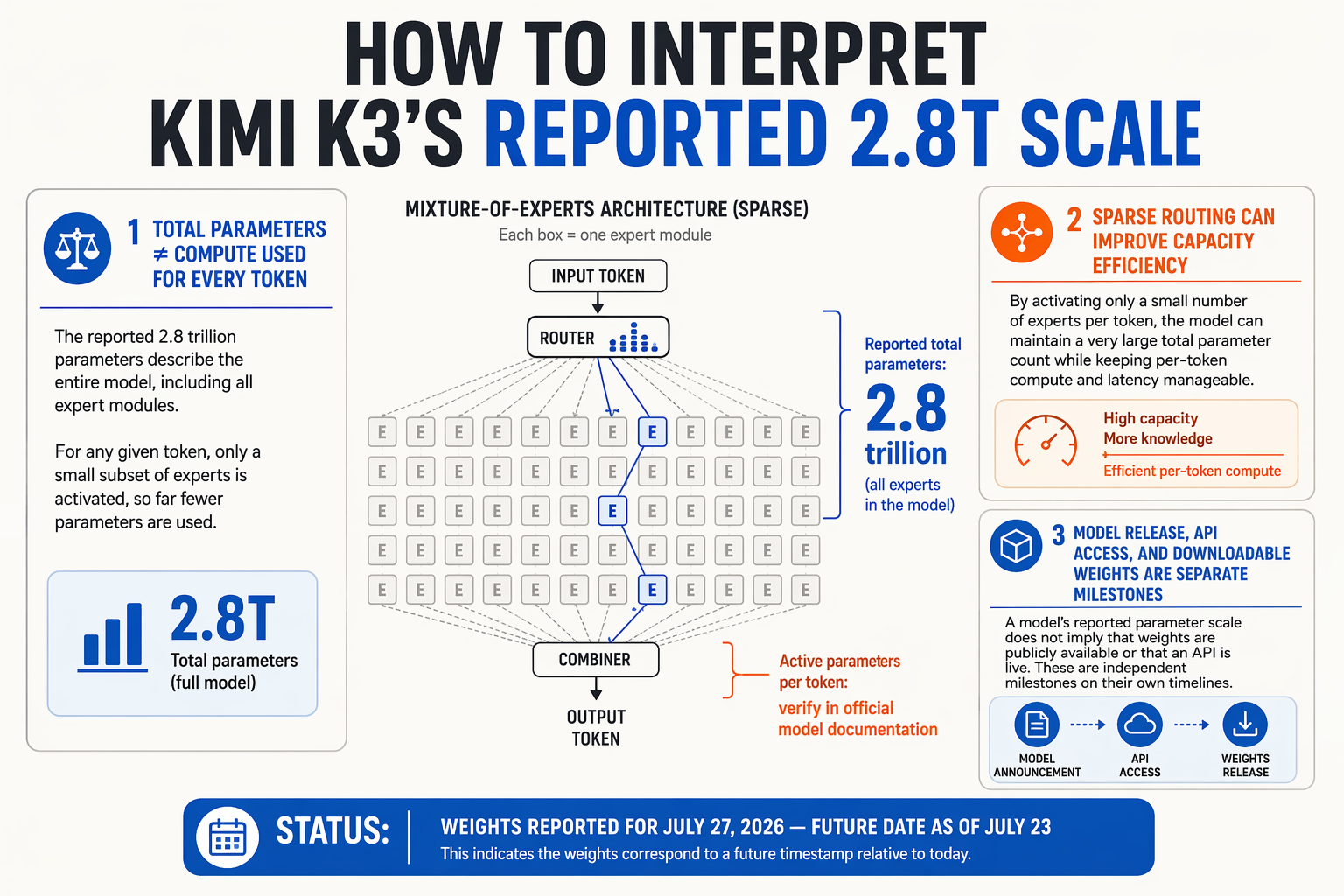
Kimi K3 is reported as a 2.8-trillion-parameter sparse mixture-of-experts model, but that figure describes total parameter capacity—not necessarily the computation used for each token. As of the July 24, 2026 cutoff, Kimi K3’s active parameter count is not established, API access does not independently verify its architecture, and downloadable weights remain a future plan.
What the reported 2.8-trillion-parameter figure means
Multiple July 2026 reports describe Moonshot AI’s Kimi K3 as having 2.8 trillion total parameters arranged in a sparse mixture-of-experts, or MoE, architecture. Sparse MoE systems generally route each token through a selected subset of expert networks instead of activating every parameter simultaneously.
The reported total therefore should not be interpreted as Kimi K3 running all 2.8 trillion parameters for every generated token. Three separate measurements matter:
- Total parameters indicate the model’s overall reported capacity.
- Active parameters indicate how much of that capacity is used for a token.
- Stored parameters affect memory, weight distribution and self-hosting requirements.
The available evidence does not establish Kimi K3’s active parameter count. Without that number and additional serving details, it is not possible to derive reliable conclusions about inference cost, accelerator requirements, throughput or latency from the 2.8-trillion figure alone.
The architecture should consequently be described as reported rather than independently confirmed. Parameter count also does not, by itself, prove model quality or application performance.
What API and product access can verify
Kimi K3’s presence in an API or hosted product allows developers to test observable behavior, including response quality, latency, tool use and reliability. It does not provide direct access to the model’s internal tensors, router or expert configuration.
API or product access does not independently verify:
- The reported 2.8-trillion total parameter count
- The number of parameters activated per token
- The expert-routing mechanism
- The precise model weights used by the hosted service
- Whether future downloadable weights will match the API deployment
Hosted services can also apply system prompts, inference optimizations, quantization or other serving-layer changes that are not visible to users. Evaluators should record the model identifier, test date, sampling configuration and prompts so that results remain interpretable if the service changes.
Why the July 27 weight date matters
TECHSY reported in July 2026 that Kimi K3’s weights would “land July 27.” That date falls four days after this comparison’s July 24, 2026 evidence cutoff, so the planned weight release cannot be treated here as completed or independently inspected.
If weights appear as reported, researchers could examine file structure, tensor dimensions, expert organization, quantization options and practical deployment requirements. They could also test whether local outputs reproduce the behavior of the hosted API.
A weight release would not automatically make Kimi K3 open-source. “Open-weight” generally means model parameters are downloadable, while open-source status depends on the accompanying licence and the availability of relevant code and documentation. Commercial-use restrictions, modification rights, redistribution terms, training-code availability and dataset disclosures must all be reviewed before characterizing the release as fully open.
How do Kimi K3 benchmarks compare with Claude models, and can they predict Opus 5 performance?
Kimi K3 benchmark results can describe its performance under specific test conditions, but they do not establish across-the-board leadership and cannot predict an unannounced Claude Opus 5.
What the available Kimi K3 benchmark evidence shows
Moonshot AI’s published benchmark claims should be treated as vendor-reported results. They may provide useful evidence about Kimi K3, but only for the named benchmark, model version and evaluation configuration. They are not equivalent to independent replication.
The available evidence does not support retaining exact scores from secondary rankings that fail to disclose a reproducible methodology. In particular, comparisons are not reliable when they omit:
- The evaluator and benchmark harness
- Exact model and API identifiers
- Prompts, system instructions and tool access
- Reasoning or token budgets
- Sampling settings and number of runs
- Scoring procedures, dates and confidence intervals
Labels such as “Claude Fable 5” and “Claude Opus 4.8” should also not be treated as Anthropic-verified products without corresponding Anthropic release documentation, model cards or API identifiers.
The defensible conclusion is therefore narrow: Moonshot’s official results may show that Kimi K3 performs strongly on particular evaluations under Moonshot’s stated setup. They do not, by themselves, demonstrate broader superiority over Claude models. Any independent comparison should name both the evaluator and the harness; otherwise, it is not sufficiently reproducible to support a precise ranking.
Why Kimi benchmarks cannot forecast Claude Opus 5
No Kimi K3 result—or benchmark from an earlier Kimi model—can produce a credible estimate of Claude Opus 5 performance before Anthropic releases and documents that model. Benchmark scores do not scale predictably across companies, model generations or product names.
Several factors prevent meaningful extrapolation:
- Different evaluation configurations: System prompts, tools, context limits, reasoning budgets and sampling settings can materially affect results.
- Leaderboard sensitivity: Human-preference rankings depend on prompt distribution, presentation, evaluator composition and the model versions tested.
- Benchmark contamination: Public test material may be represented in training data, making nominally identical tests less comparable.
- Architecture is not performance: Parameter counts and mixture-of-experts designs do not disclose training-data quality, active compute per token, post-training methods or inference efficiency.
- Unknown target model: Without an official Opus 5 model identifier and specification, there is no fixed system against which to compare Kimi K3.
Benchmarks from released models can set a competitive reference point. They cannot show that an unreleased model will score above or below that point.
What would make an Opus 5 comparison credible?
A defensible comparison would require:
- An official Anthropic Claude Opus 5 announcement, model card and API identifier
- A clearly identified Kimi K3 version
- Identical prompts, tools, token budgets and sampling settings
- A named evaluator using a documented, reproducible harness
- Repeated runs with uncertainty or confidence intervals
- Independent coding, reasoning, multilingual and agentic evaluations
- Transparent latency, price and failure-rate reporting
Until those conditions are met, Kimi K3 benchmarks measure Kimi K3 under the configurations tested. They cannot forecast Claude Opus 5, whose performance remains unknown rather than demonstrated to be higher or lower.
How much do Kimi K3 and Claude Opus 5 cost, and how can developers access them?
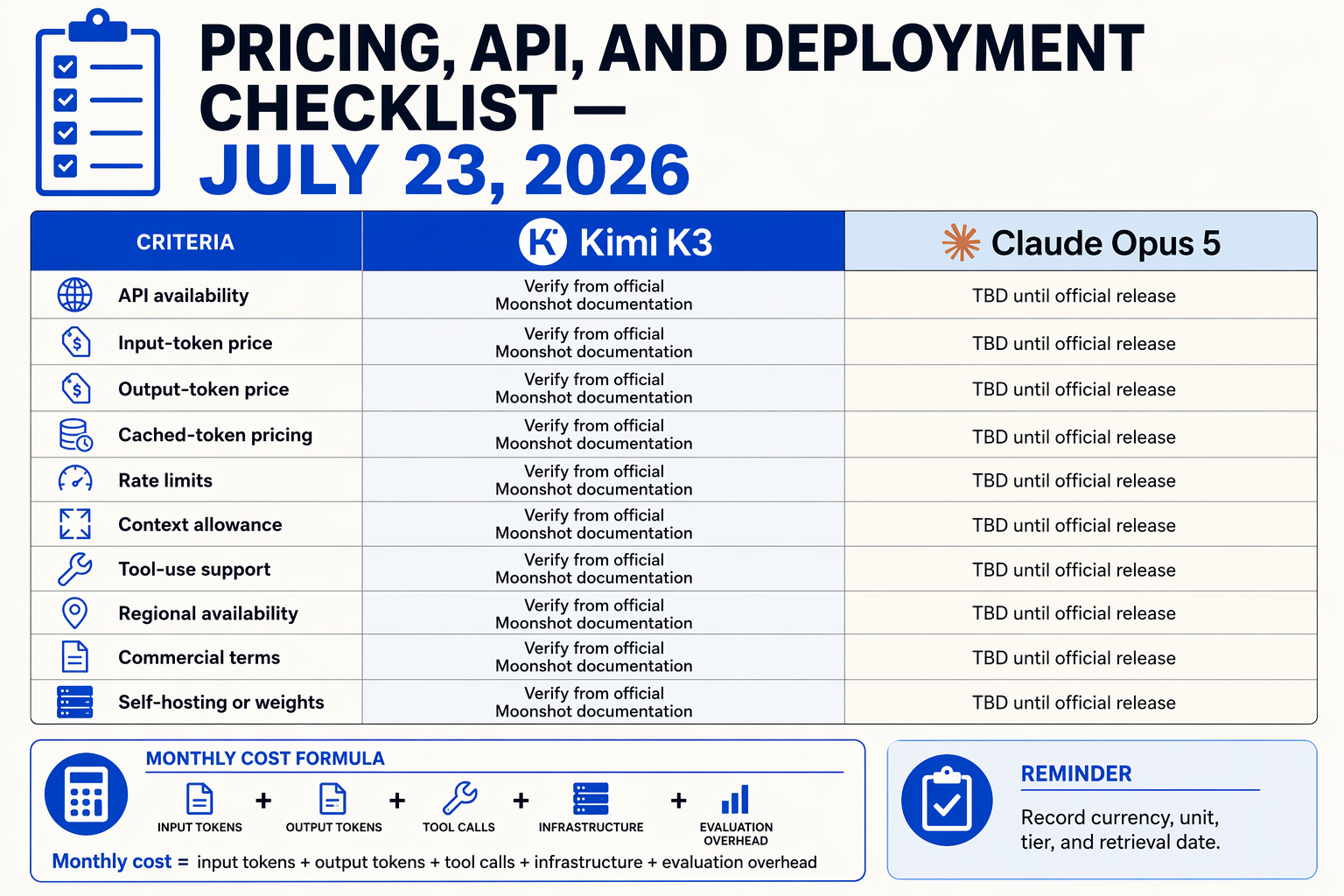
The defensible answer as of July 24, 2026 is that developers can reportedly access Kimi K3 through Moonshot AI’s hosted product or API, but its exact production pricing must be confirmed in Moonshot AI’s live documentation. Claude Opus 5 has no verified price, API identifier, or official access route, so any cost estimate attributed to it is speculative.
Pricing and access comparison
| Cost or access factor | Kimi K3 | Claude Opus 5 | Developer takeaway |
|---|---|---|---|
| Official per-token price | Not established by the supplied primary evidence | No official price exists | Do not build budgets from leaked or third-party figures |
| Hosted API access | Reported as available through Moonshot AI | No verified endpoint or model ID | Kimi K3 is the only presently testable option |
| Consumer access | Reported through Moonshot AI’s Kimi product | No confirmed Claude plan includes Opus 5 | Check regional availability and usage limits |
| Downloadable weights | TECHSY said weights were scheduled for July 27, 2026 | No weights announced | Kimi K3 self-hosting remains pending at this article’s cutoff |
| Infrastructure cost | Potentially substantial for a reported 2.8-trillion-parameter sparse MoE model | Impossible to calculate without architecture details | API access may be more practical than self-hosting |
| Price-confidence level | Product/API access reported; exact rates require live verification | Expected or leaked only | Recheck official pricing before deployment |
What “available” means for Kimi K3
Kimi K3’s availability should be divided into hosted inference and open-weight deployment. A developer may be able to call a hosted Kimi service without possessing the model files, licence, inference code, or hardware required to run it independently.
TECHSY reported in July 2026 that Kimi K3’s weights were scheduled to arrive on July 27, 2026, four days after this comparison’s cutoff. Consequently, developers should verify the following before describing Kimi K3 as self-hostable:
- Whether Moonshot AI has published the complete or quantized weights
- Which commercial-use and redistribution terms apply
- Whether the advertised 2.8 trillion parameters include all experts
- What accelerator memory, expert-routing and distributed-inference stack are required
Hosted access is nevertheless useful for real-world evaluation. The Bimal Institute reported in July 2026 that Kimi K3 scored 1,679 on Arena’s front-end coding board, giving developers a concrete reason to test it for coding workloads rather than waiting for local deployment.
Why no Claude Opus 5 price should be quoted
There is no verified Anthropic model card, system card, pricing page, API model name or release announcement for Claude Opus 5 in the supplied evidence as of July 24, 2026. Prices for earlier Claude Opus models cannot simply be carried forward because Anthropic could change token rates, caching discounts, batch pricing, context surcharges or subscription availability.
A responsible procurement process is therefore:
- Prototype with Kimi K3’s reported hosted API, subject to Moonshot AI’s current terms.
- Record input, output, cache and tool-call consumption separately.
- Wait for an official Anthropic pricing page before modelling Claude Opus 5 costs.
- Re-evaluate Kimi K3 self-hosting after the reported July 27 weight release.
For applications that may switch models, CallMissed’s OpenAI-compatible gateway illustrates a practical alternative: one integration can expose multiple model providers with transparent credit-based billing and same-tier fallbacks, reducing the engineering cost of changing endpoints even when underlying model prices move.
What impact could this matchup have on open models, enterprise AI, and agentic coding?

The matchup could accelerate open-model investment, multi-model enterprise architectures, and benchmark-driven competition in agentic coding. However, Kimi K3 can influence the market through observable product evidence today, while Claude Opus 5 can shape expectations only until Anthropic publishes official specifications, pricing, safety documentation, and reproducible evaluations.
Open models could compete on capability, not merely cost
Moonshot AI’s reported Kimi K3 architecture challenges the assumption that frontier-scale systems must remain fully proprietary. Industry reports describe Kimi K3 as a 2.8-trillion-parameter sparse mixture-of-experts model, although total parameters alone do not reveal active parameters, inference cost, latency, or real-world accuracy.
The consequences could include:
- Greater investment in sparse mixture-of-experts architectures that activate only part of a model for each token.
- More pressure to publish weights, licences, model cards, evaluation methods, and deployment requirements together.
- Faster development of quantisation, distributed inference, fine-tuning, and sovereign-AI infrastructure.
- Stronger competition between downloadable models and managed proprietary APIs.
Yet Kimi K3’s open-model impact remains conditional. TECHSY reported in July 2026 that Kimi K3’s weights were scheduled for July 27, 2026, after this article’s July 23 cutoff. Until Moonshot AI’s files and licence are inspectable, enterprises should distinguish API access from independently deployable open weights.
Enterprise AI will become more portfolio-based
Enterprises are unlikely to standardise every workload on whichever model tops one leaderboard. Instead, this matchup supports a model-portfolio strategy in which organisations route requests according to task quality, price, latency, data residency, availability, and governance requirements.
A practical enterprise evaluation should cover:
- Evidence: Is the capability documented by the model provider or inferred from leaks?
- Operations: Can the model satisfy uptime, throughput, observability, and support requirements?
- Governance: Are training disclosures, licences, safety controls, and regional processing options acceptable?
- Economics: What is the complete cost per successful task, including retries and human review?
- Portability: Can applications switch models without rebuilding their orchestration layer?
This is where OpenAI-compatible gateways such as CallMissed reflect a broader infrastructure shift: developers can access multiple model families through one integration and use same-tier fallbacks rather than hard-wiring an application to one vendor. That flexibility is especially valuable when one contender is released and another remains unverified.
Agentic coding will demand harder evaluations
Kimi K3’s strongest reported signal concerns coding, but the available results also demonstrate why agentic systems need multi-dimensional testing. The Bimal Institute reported in July 2026 that Kimi K3 scored 1,679 on Arena’s front-end coding board, versus 1,631 for Claude Fable 5 and 1,618 for GPT-5.6 Sol. By contrast, CoderSera reported an aggregate Kimi K3 score of about 57, behind Claude Fable 5 at roughly 60 and GPT-5.6 Sol at roughly 59.
Those results are not necessarily contradictory: front-end preference and broad capability measure different things. For agentic coding, teams should test:
- Repository-scale issue resolution and regression rates.
- Tool selection, terminal use, and recovery from failed actions.
- Long-horizon planning across many dependent steps.
- Security, test coverage, review burden, and cost per merged change.
An eventual Claude Opus 5 release could raise the standard further, but leaked claims cannot establish that outcome. The durable winner will be the ecosystem that delivers verifiable performance, deployable infrastructure, transparent economics, and reliable agent behaviour—not the model with the loudest prerelease narrative.
What do credible experts and independent evaluators say—and how should their claims be weighted?

The most credible conclusion is not that either model is universally superior, but that Kimi K3 has measurable—though still partly provisional—evidence while Claude Opus 5 has none that can be independently verified. Evaluator claims should be weighted by reproducibility, benchmark relevance and primary-source access rather than by headline rank.
What the evaluators actually found
Independent and secondary analyses do not agree on Kimi K3’s overall standing, which is normal when evaluations measure different capabilities.
- The Bimal Institute reported in July 2026 that Kimi K3 scored 1,679 on Arena’s front-end coding board, versus 1,631 for Claude Fable 5 and 1,618 for GPT-5.6 Sol. This is meaningful evidence for interactive front-end generation, but it does not prove superiority in reasoning, writing, reliability or backend engineering.
- Data Science Dojo reported in 2026 that Kimi K3 achieved an aggregate score of approximately 57, matching GPT-5.6 Terra and GPT-5.5 while narrowly exceeding Claude Opus 4.8 at approximately 56.
- CoderSera reported in 2026 that Kimi K3’s aggregate score of about 57 ranked behind Claude Fable 5 at approximately 60 and GPT-5.6 Sol at approximately 59.
- LLM-Stats reported in 2026 that Claude Fable 5 won 22 of 35 shared evaluations, while Kimi K3 won 12 and tied one. That result supports Claude Fable 5 as the broader performer within that test set, even though Kimi K3 led selected long-context or coding tasks.
These findings are not necessarily contradictory. Arena-style preference scores, composite indexes and collections of 35 evaluations answer different questions and may use different prompts, model settings and weighting systems.
A practical evidence hierarchy
Claims in this comparison should be weighted in the following order:
- Reproducible third-party testing: Evaluations with disclosed prompts, model versions, sampling settings and raw outputs deserve the greatest confidence.
- Public benchmark leaderboards: These provide useful comparative signals, but user preferences, category selection and testing conditions can shape rankings.
- Independent composite analyses: Aggregates can reveal broad patterns, although combining benchmarks into one score introduces subjective weighting.
- Vendor launch benchmarks: Moonshot AI’s reported Kimi K3 results are relevant, but selected launch tests should be treated as claims awaiting external replication.
- Leaks and unnamed-source reports: Supposed Claude Opus 5 specifications belong at the bottom until Anthropic publishes a model card, API documentation or system card.
Why “open” still requires qualification
One Medium analysis called Kimi K3 the “first open-weight model against Claude Fable 5,” but that description was not fully testable by the article’s cutoff. TECHSY reported in July 2026 that Kimi K3’s weights were scheduled to arrive on July 27, four days after the July 23 cutoff. Until researchers can inspect the files, licence, architecture and inference requirements, architectural claims—including the reported 2.8-trillion total parameters—remain better supported than Opus 5 rumours but not completely independently audited.
The responsible expert verdict
Credible evaluators presently support three narrow conclusions:
- Kimi K3 appears highly competitive in front-end coding.
- Its broad-capability position varies substantially by evaluation framework.
- No Kimi K3 result can establish a victory over Claude Opus 5 because no verified Opus 5 endpoint or benchmark package is available.
The correct weighting is therefore tested Kimi K3 evidence over Opus 5 speculation, while keeping Kimi K3’s launch claims separate from independently reproduced results.
Which model should you choose for coding, research, enterprise use, or self-hosting?
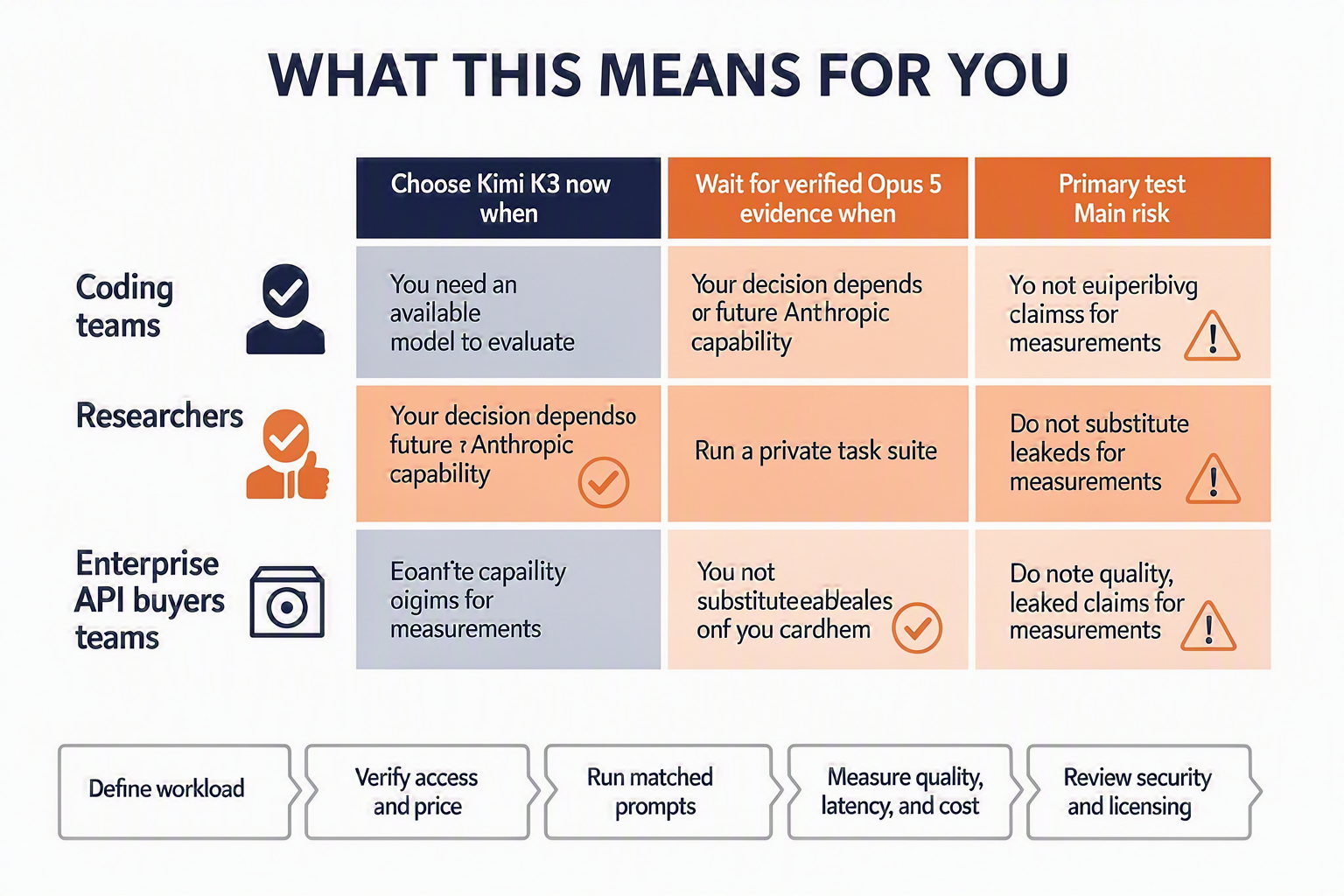
Choose Kimi K3 for immediate coding experiments, research pilots, and API evaluation because it has reported product availability and measurable results. Do not select the still-unverified Claude Opus 5 for production planning, and do not treat Kimi K3 as self-hostable until Moonshot AI publishes inspectable weights, licensing terms, and deployment documentation.
Workload-by-workload recommendation
| Workload | Recommended choice on July 24, 2026 | Evidence | Key caveat |
|---|---|---|---|
| Front-end coding | Kimi K3 | The Bimal Institute reported in July 2026 that Kimi K3 scored 1,679 on Arena’s front-end coding board, versus 1,631 for Claude Fable 5 and 1,618 for GPT-5.6 Sol. | A front-end leaderboard does not establish repository-level reliability or production code quality. |
| General software engineering | Kimi K3 pilot; no final winner | Kimi K3 has published or reported results that teams can test, whereas no reproducible Claude Opus 5 benchmark package is available. | Evaluate bug fixing, test generation, tool use, latency, and cost on your own repositories. |
| Research and analysis | Kimi K3 for evaluation | Data Science Dojo reported an aggregate Kimi K3 score of approximately 57 in July 2026. | CoderSera also placed Kimi K3 at roughly 57 but behind Claude Fable 5 at about 60, showing that benchmark composition changes the ranking. |
| Enterprise API deployment | Kimi K3, conditionally | Kimi K3 is the only candidate in this comparison with reported availability and concrete specifications. | Enterprises must still verify data residency, retention, security controls, uptime commitments, pricing, and support terms. |
| Regulated or high-risk workflows | Neither without validation | Claude Opus 5 lacks official documentation, while the supplied Kimi K3 evidence does not establish compliance for a specific jurisdiction. | Require human review, audit logs, access controls, red-team testing, and contractual assurances. |
| Self-hosting or private cloud | Wait for Kimi K3 weights | TECHSY reported in July 2026 that Kimi K3’s model weights were scheduled for July 27, 2026. | As of July 23, neither downloadable files nor their licence can be treated as independently verified from the supplied evidence. |
How teams should make the final decision
A defensible procurement process should prioritize deployable evidence over anticipated capability:
- Run task-specific evaluations. Use private repositories, representative research questions, expected context lengths, and real tool-calling sequences—not only public leaderboard prompts.
- Measure operational performance. Record accuracy, hallucination rate, tokens consumed, time to first token, end-to-end latency, retry frequency, and human correction time.
- Verify governance documents. Confirm model versioning, data-processing terms, regional hosting, retention policies, abuse monitoring, and incident-response commitments.
- Separate API access from weight access. A model available through a hosted product is not automatically open-weight, self-hostable, or suitable for air-gapped deployment.
- Reassess Claude Opus 5 after an official release. Anthropic would need to publish an API identifier, pricing, model or system card, and reproducible evaluations before a fair production comparison is possible.
For applications that may switch models as evidence changes, CallMissed’s OpenAI-compatible gateway illustrates a practical multi-model approach: developers can integrate once and evaluate different providers without redesigning the application around one model family. That flexibility is particularly useful here because Kimi K3 is testable now, while Claude Opus 5 remains an expected or leaked product rather than a verified procurement option.
Frequently asked questions about Claude Opus 5 vs Kimi K3
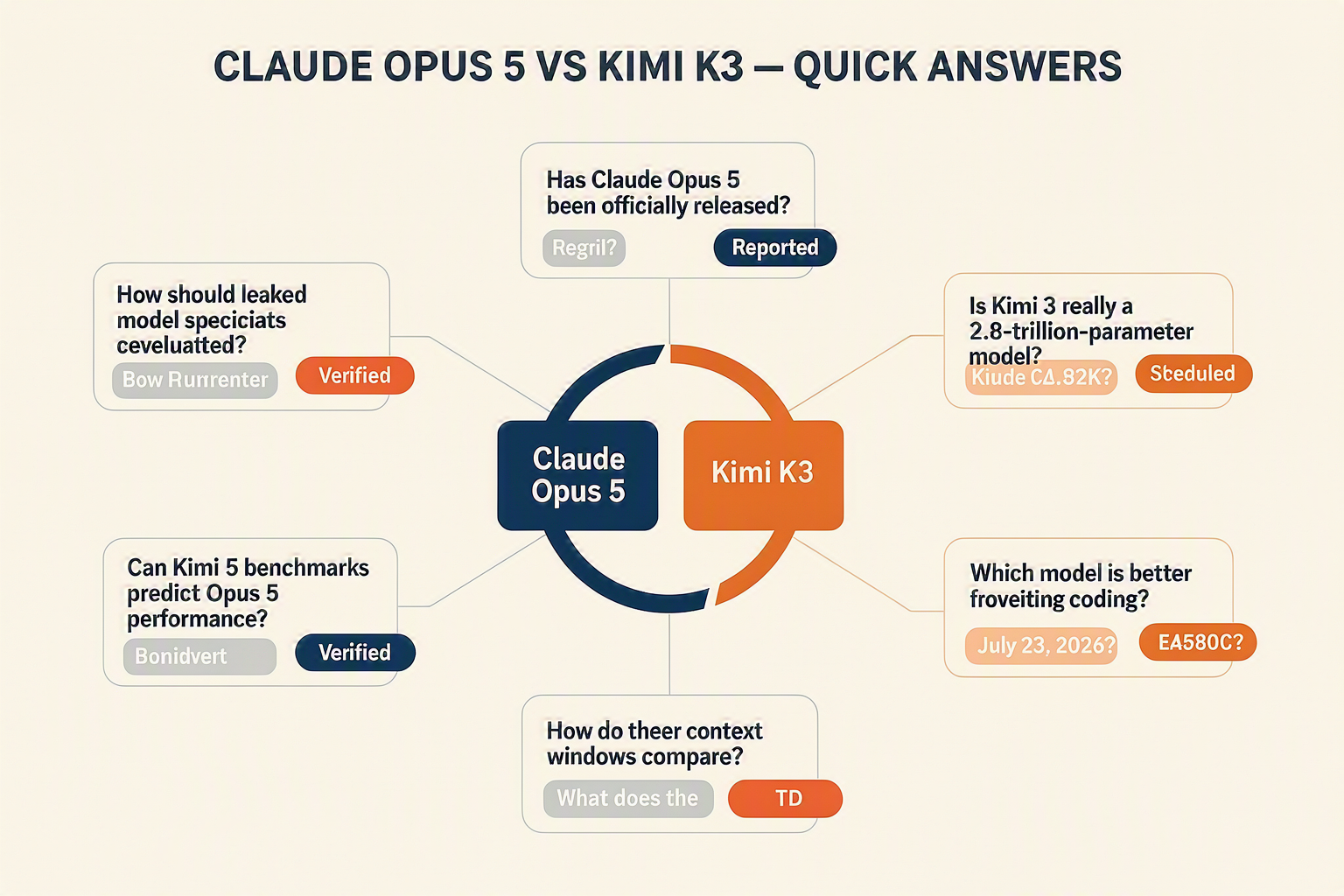
Availability and evidence
Is Claude Opus 5 officially released as of July 24, 2026?
Is Kimi K3 available, and can developers download its model weights?
Is the reported 2.8-trillion-parameter Kimi K3 larger than Claude Opus 5?
Performance and model selection
Which model wins the Claude Opus 5 vs Kimi K3 benchmark comparison?
Why do published Kimi K3 benchmark rankings disagree?
Should developers choose Claude Opus 5 vs Kimi K3 for production applications?
Conclusion
As of July 24, 2026, Kimi K3 is the evidence-based choice in this comparison—not necessarily the superior model overall, but the only contender supported by reported release information and testable results. Claude Opus 5 remains an expectation until Anthropic publishes official documentation.
- Evidence is unequal: Moonshot AI’s Kimi K3 has reported product or API availability, while Claude Opus 5 lacks a verified model card, API identifier, pricing page, system card, or reproducible benchmark package.
- Kimi K3’s strongest result is workload-specific: The Bimal Institute reported in July 2026 that Kimi K3 scored 1,679 on Arena’s front-end coding board, versus 1,631 for Claude Fable 5 and 1,618 for GPT-5.6 Sol.
- No leaderboard settles the contest: Data Science Dojo placed Kimi K3 at approximately 57 overall, while CoderSera ranked it behind Claude Fable 5 and GPT-5.6 Sol.
- “Open” still needs verification: TECHSY reported that Kimi K3’s weights were scheduled for July 27, 2026, so independent inspection of the files, licence, architecture, cost, and deployment requirements remains pending.
Next, watch for those Kimi K3 weights and any official Anthropic announcement confirming Claude Opus 5. Meanwhile, teams can explore multi-model access through CallMissed, an OpenAI-compatible AI infrastructure platform supporting voice agents and multilingual chatbots.
When verified evidence arrives, will the leaked expectations survive contact with reproducible testing?
Related Reading
- Claude Opus 5 vs Claude Sonnet 5: Verified Facts, Benchmarks, Pricing, and Verdict (July 2026)
- Claude Opus 5 vs GPT-5.6 Sol: Verified Facts vs Rumors (July 2026)
- Claude Opus 5 vs Kimi K3 vs Qwen3.8-Max: July 2026 Comparison
Sources
Discussion
Related Posts



Ready to automate customer conversations?
Launch AI voice agents and WhatsApp bots with CallMissed — one API, 22+ Indian languages.