
Claude Opus 5 vs GPT-5.6 Sol: Specs, Pricing & Verdict


Claude Opus 5 vs GPT-5.6 Sol compared on API price, context, coding, agents, evidence quality and best use cases. Updated August 2026.
Claude Opus 5 vs GPT-5.6 Sol: Specs, Pricing & Verdict
Claude Opus 5 vs GPT-5.6 Sol is now a comparison between two released frontier models. Anthropic launched Opus 5 on July 24, 2026, publishing its API identity, pricing, context window and output limit; OpenAI has likewise published the GPT-5.6 Sol product details needed for an evidence-led comparison.
That distinction matters because businesses increasingly use frontier models for software engineering, autonomous agents, research, and customer communication. Choosing a model based on an unsupported leak can distort cost projections, architecture decisions, and deployment timelines. It can also create false equivalence between a documented product and a model whose name, availability, capabilities, and commercial terms have not been established in the supplied official evidence.
OpenAI describes GPT-5.6 Sol as setting “a new standard” for intelligence in its official GPT-5.6 announcement. OpenAI also reports that GPT-5.6 Sol outperforms Claude Fable 5 with adaptive reasoning by 13.1 points on the benchmark highlighted in that announcement. That is an OpenAI-published result—not an independent head-to-head test against Claude Opus 5—and the difference is critical when interpreting the claim.
Anthropic has now released Claude Opus 5, so its official model identity, pricing, context window, and output limits should be taken from Anthropic’s published documentation. However, third-party claims that it outperforms GPT-5.6 Sol on SWE-Bench Pro still require independent verification; a vendor specification or community post is not the same as a reproducible head-to-head result.
What this comparison will establish
This analysis separates evidence into three clear categories:
- Verified: Specifications, benchmark statements, and positioning published directly by OpenAI for GPT-5.6 Sol.
- Rumored: Claude Opus 5 claims circulating through community posts, leaks, or third-party reporting.
- Unknown: Pricing, API access, context limits, release timing, safety documentation, and benchmark results that Anthropic has not officially confirmed for Claude Opus 5.
The comparison will examine reasoning, coding, context capacity, availability, pricing, and deployment implications without presenting speculation as product documentation. It will also explain why scores against Claude Fable 5 or the officially referenced Claude Opus 4.8 cannot automatically be treated as scores against the rumored Claude Opus 5.
For developers navigating rapidly changing model catalogs, platforms such as CallMissed’s OpenAI-compatible gateway reflect a broader move toward accessing multiple AI models through one integration, with same-tier fallbacks reducing dependence on any single provider.
The goal is not to crown a premature winner. It is to show exactly what can be verified on July 24, 2026, what remains rumor, and what evidence teams should demand before making a production decision.
What is the Claude Opus 5 vs GPT-5.6 Sol verdict after Opus 5’s launch?
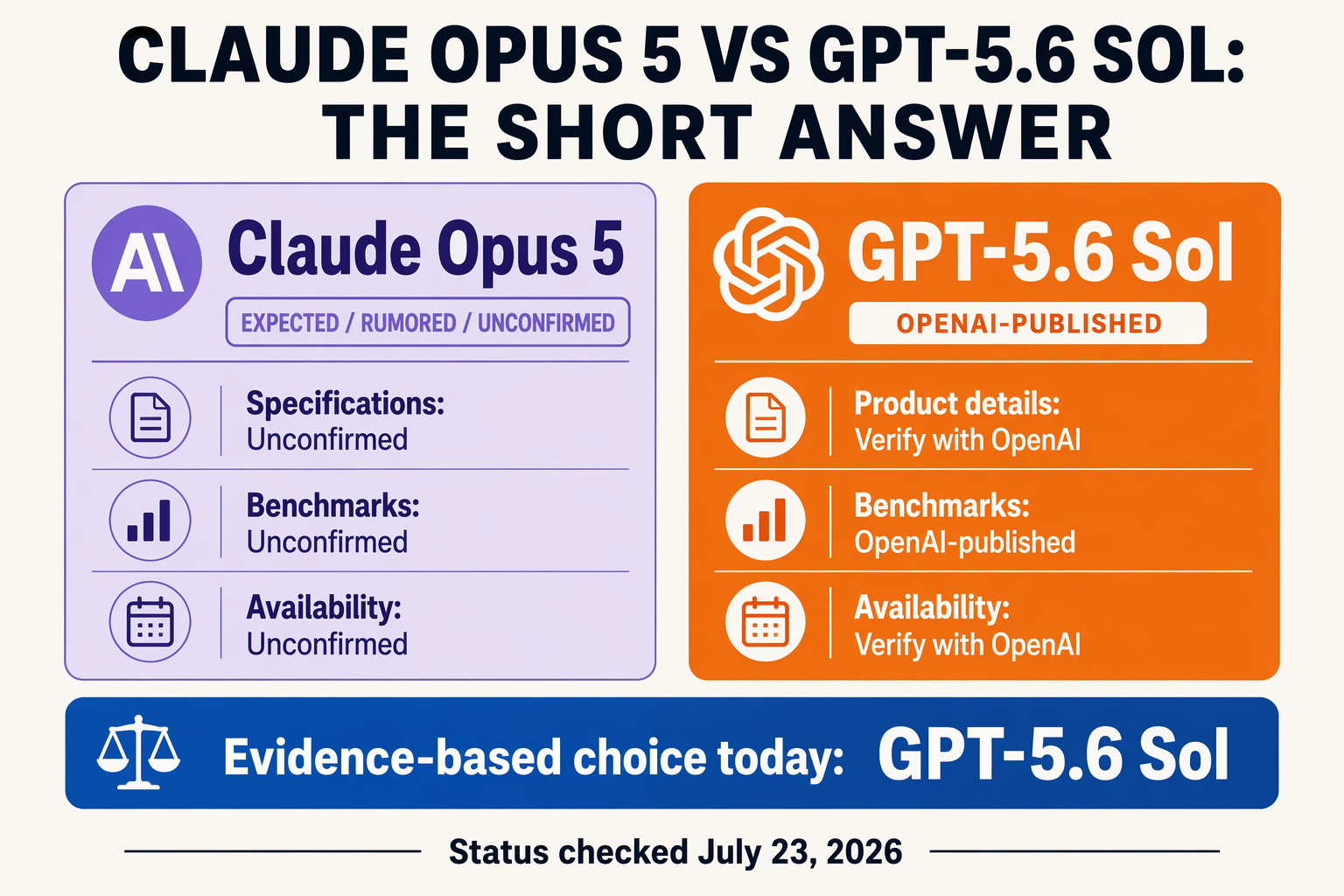
Verdict as of August 1, 2026: there is no evidence-backed universal winner. Claude Opus 5 is the better-documented choice for workloads that need very large context, long outputs or sustained agent execution. GPT-5.6 Sol is the more practical choice for teams already built around OpenAI or where testing shows a lower cost per successful task.
Anthropic officially launched Opus 5 on July 24, so it should no longer be described as unconfirmed. Anthropic’s announcement and model documentation list:
- Model ID:
claude-opus-5 - API pricing: $5 per million input tokens and $25 per million output tokens, before applicable caching or batch discounts
- Context window: 1 million tokens
- Maximum output: 128,000 tokens
- Reasoning: thinking enabled by default
- Intended use: coding, complex reasoning and long-running agents
Those are confirmed product specifications and vendor positioning—not proof that the model uses its full context more reliably or completes real-world tasks more accurately than Sol.
OpenAI’s published material similarly provides first-party evidence for Sol’s positioning and reported evaluation performance. Its highlighted score of 53.6 was 13.1 points above Claude Fable 5 with adaptive reasoning, but that comparison did not test Opus 5. It therefore cannot establish a direct winner. Anthropic’s launch benchmarks carry the same limitation: they are vendor-reported results unless reproduced independently.
Workload recommendations
- Large repositories, lengthy document sets and persistent coding agents: Start with Opus 5 because its documented 1M-token context and 128k output limit provide more room for these tasks. Test recall and instruction adherence at realistic context depths.
- Existing OpenAI applications and agent stacks: Start with Sol when changing providers would add migration, governance or observability costs.
- Cost-sensitive production use: Compare total cost per completed task, not headline token prices. Include cached input, reasoning and output tokens, retries, latency and human intervention. Use OpenAI’s current API pricing and Anthropic’s applicable discounts in the calculation.
- High-stakes or reliability-sensitive workflows: Run the same private test set on both models. Measure task completion, tool-call accuracy, error recovery, latency and required human review.
- Benchmark-led purchasing: Treat both vendors’ results as useful but incomplete. The evidence cited here does not include an independent, reproducible head-to-head evaluation of these two models.
The practical conclusion is straightforward: choose Opus 5 when its published context, output and long-running-agent capabilities directly address the workload; choose Sol when OpenAI integration or measured deployment economics matter more. Until independent tests cover both models under comparable conditions, broader capability claims remain unproven.
What is officially confirmed about Claude Opus 5 and GPT-5.6 Sol?
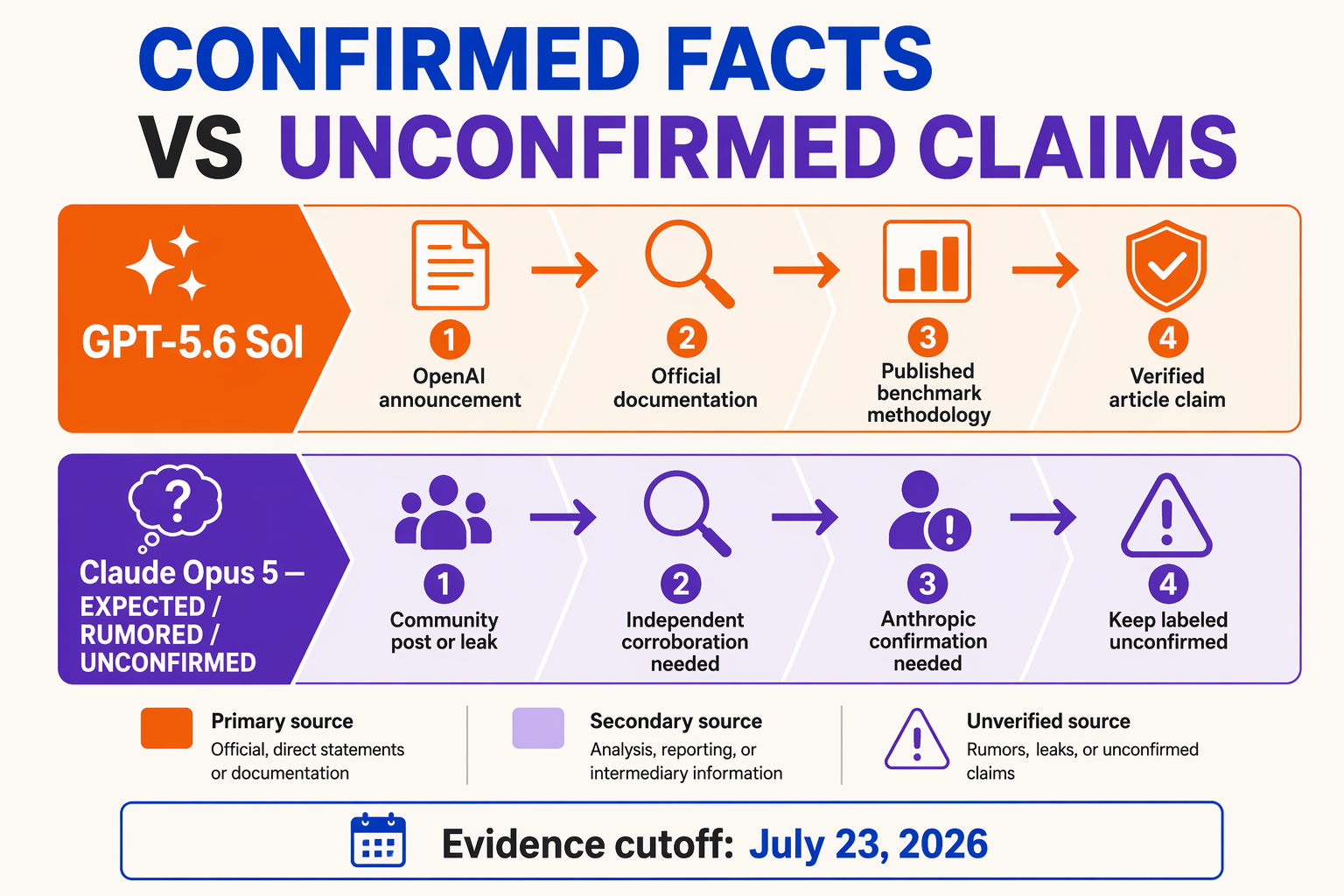
As of July 25, 2026, both Claude Opus 5 and GPT-5.6 Sol are officially documented models. Anthropic’s July 24 launch means Claude Opus 5 should no longer be described as expected, rumored, or unconfirmed.
What Anthropic has confirmed about Claude Opus 5
Anthropic’s Claude Opus 5 launch announcement and first-party model documentation confirm the following:
- Launch date: July 24, 2026.
- API model ID:
claude-opus-5-20260724. - API pricing: $5 per million input tokens and $25 per million output tokens, before any applicable caching, batch-processing, or platform-specific adjustments.
- Context window: Up to 1 million tokens.
- Maximum output: Up to 128,000 tokens.
- Thinking behavior: Thinking is enabled by default, allowing the model to determine when additional reasoning is appropriate rather than requiring every request to use a manually selected reasoning budget.
- Availability: Anthropic lists Claude Opus 5 across its supported Claude products and API, with availability through supported cloud-platform integrations subject to each platform’s rollout and regional terms.
These are first-party product specifications, not leak-based estimates. Anthropic’s current API pricing documentation should remain the controlling source for billing details, including prompt caching and batch discounts.
What OpenAI has confirmed about GPT-5.6 Sol
OpenAI’s GPT-5.6 Sol announcement establishes GPT-5.6 Sol as an official OpenAI model rather than a speculative or community-created name.
OpenAI also reported that GPT-5.6 Sol exceeded Claude Fable 5 with adaptive reasoning by 13.1 points on its highlighted evaluation. That result is evidence of OpenAI’s published benchmark claim, but its scope must be stated accurately:
- The comparison target was Claude Fable 5 with adaptive reasoning, not Claude Opus 5.
- The 13.1-point figure applies to the evaluation and configuration disclosed by OpenAI.
- It does not establish that GPT-5.6 Sol is universally better across coding, agents, long-context retrieval, cost, latency, or other workloads.
OpenAI’s model documentation remains the first-party reference for current API identifiers, limits, availability, and pricing.
What remains unresolved
The models’ existence and published specifications are now confirmed. The unresolved questions concern comparative performance in practice:
- Independent cross-vendor benchmarks: Provider-published results have not necessarily been reproduced under identical prompts, reasoning settings, tool access, context lengths, and scoring methods.
- Real-world latency: Time to first token and total completion time can vary by prompt size, reasoning behavior, region, service tier, and traffic.
- Workload-specific reliability: Coding, agentic tool use, long-context retrieval, structured output, and factual accuracy require separate evaluation on representative tasks.
- Effective cost: Headline token prices do not reveal how many reasoning or output tokens each model will consume to complete the same job successfully.
- Operational availability: Rate limits, capacity, regional access, and third-party cloud rollouts may differ even when a model is generally available.
The accurate July 2026 framing is therefore no longer confirmed GPT-5.6 Sol versus rumored Claude Opus 5. Both models are officially documented; what remains unconfirmed is which one performs better for a particular workload under a controlled, independently reproducible comparison.
Which key developments and sources shape the comparison?
The comparison is shaped by one primary OpenAI source, several third-party analyses, and a thin rumor trail for Claude Opus 5. As of July 24, 2026, these sources do not provide equivalent evidence: OpenAI documents GPT-5.6 Sol, while every available Claude Opus 5 detail must remain labeled expected, rumored, or unconfirmed.
Evidence map for Claude Opus 5 vs GPT-5.6 Sol
| Development or source | What it contributes | Evidence status | How it should be used |
|---|---|---|---|
| OpenAI’s GPT-5.6 announcement | OpenAI’s product positioning and published evaluation results for GPT-5.6 Sol | Primary, verified for OpenAI’s claims | Use for GPT-5.6 Sol specifications and OpenAI-reported results, while identifying OpenAI as the evaluator |
| OpenAI’s Claude Fable 5 comparison | OpenAI reports a 13.1-point advantage for GPT-5.6 Sol over Claude Fable 5 with adaptive reasoning | Official but not independent | Cite precisely; do not reinterpret Claude Fable 5 as Claude Opus 5 |
| Kie.ai’s Claude Opus 5 report | Says early leaks claim Opus 5 could beat GPT-5.6 Sol on SWE-Bench Pro and may offer a 1-million-token context window | Rumored and unconfirmed | Treat as a lead requiring Anthropic documentation, not as a usable specification |
| Lenny’s Newsletter comparison | Describes a hands-on “How I AI vibe benchmark” involving GPT-5.6 Sol, GPT-5.6 Terra, GPT-5.6 Luna, Claude Fable 5, and Sonnet 5 | Third-party evaluation | Useful for qualitative observations, but not evidence about the rumored Claude Opus 5 |
| DataCamp comparison | Discusses GPT-5.6 alongside Claude Sonnet 5 and Anthropic’s documented Opus 4.8 | Secondary analysis of different models | Provides market context; it cannot establish Claude Opus 5 performance |
| Layer3Labs business comparison | Compares GPT-5.6 with Claude Opus 4.8, including reported commercial pricing | Secondary and not Opus 5 evidence | Do not transfer Opus 4.8 pricing, capabilities, or results to the expected Opus 5 |
What the source hierarchy establishes
Three rules prevent misleading conclusions:
- Vendor-published results need attribution. OpenAI’s GPT-5.6 Sol benchmark figures are real OpenAI-published data, but they remain vendor-reported rather than independently reproduced results.
- Model identity must remain exact. Claude Fable 5, Claude Sonnet 5, Claude Opus 4.8, and the expected Claude Opus 5 are separate model names. A result involving one cannot be silently assigned to another.
- Leaks cannot populate missing specification fields. The rumored Claude Opus 5 context capacity and coding performance should be marked unconfirmed until Anthropic publishes a model card, API documentation, pricing page, or reproducible evaluation.
Evidence still needed for a valid head-to-head
A defensible 1v1 verdict requires:
- An official Anthropic announcement confirming Claude Opus 5’s name and release status.
- Matching evaluations using the same benchmark version, prompt protocol, tools, and reasoning budget.
- Official context limits, API pricing, rate limits, and regional availability.
- Safety documentation and independent benchmark reproduction.
Until those materials appear, the correct comparison is documented GPT-5.6 Sol versus expected or rumored Claude Opus 5—not two equally verified products.
How do the officially documented GPT-5.6 Sol and Claude Opus 5 capabilities compare?
The comparison is fundamentally asymmetric as of July 24, 2026. OpenAI officially positions GPT-5.6 Sol as its flagship model and lists API pricing of $5 per million input tokens and $30 per million output tokens. Anthropic’s official model catalogue does not announce or document a model named Claude Opus 5.
Compact evidence ledger
| Claim | Status | Evidence basis |
|---|---|---|
| GPT-5.6 Sol is OpenAI’s flagship model | OpenAI-published | OpenAI’s official model materials |
| GPT-5.6 Sol costs $5 input/$30 output per MTok | OpenAI-published | OpenAI’s official API pricing |
| OpenAI reports favorable GPT-5.6 Sol evaluation results | Vendor evaluation | OpenAI’s own announcement; not an independent test |
| Claude Opus 5 exists as an announced Anthropic model | Unverified | Not listed in Anthropic’s official catalogue |
| Claude Opus 5 price, API ID, context window, benchmarks, or release date | Unverified | No corresponding Anthropic documentation |
| A verified GPT-5.6 Sol-versus-Claude Opus 5 winner exists | Unsupported | No documented, like-for-like head-to-head evaluation |
Reasoning: published claims versus an unannounced model
OpenAI’s published materials support describing GPT-5.6 Sol as a documented flagship with stated capabilities and pricing. Any benchmark results in those materials should be identified as OpenAI-run vendor evaluations, however—not as independent confirmation of performance across every workload.
OpenAI’s reported comparisons with other named models also cannot be converted into an Opus 5 result. Unless Claude Opus 5 itself is tested under disclosed, equivalent conditions, results involving another Claude model do not establish how an unannounced Opus 5 would perform.
Anthropic currently provides no official Claude Opus 5 model card, system card, API identifier, reasoning specification, or benchmark table. Consequently, precise claims about its reasoning quality are rumors rather than verified specifications.
Coding: no reproducible Opus 5 benchmark exists
Reports that Claude Opus 5 could surpass GPT-5.6 Sol on software-engineering benchmarks are unconfirmed. Anthropic has not published an official Opus 5 score, and community posts or leak summaries do not provide the controlled evidence needed for a reliable comparison.
A valid coding comparison would need to disclose:
- Benchmark version and task set
- Prompting and reasoning settings
- Tool access and agent scaffolding
- Test-time compute and retry policies
- Patch-validation and scoring rules
- Model versions, latency, and total cost
Until those details and an accessible Opus 5 model exist, teams should evaluate GPT-5.6 Sol on their own repositories rather than plan around rumored comparative scores.
Context capacity: no Claude Opus 5 limit is verified
No official Anthropic source verifies a Claude Opus 5 context window, including the rumored one-million-token figure. There is also no verified Opus 5 evidence for long-context retrieval, instruction retention, or reasoning quality at any proposed maximum.
A nominal context limit would not by itself establish effective context performance. Production evaluations should measure retrieval accuracy, instruction adherence, latency, and cost at realistic document lengths.
What the evidence supports
- GPT-5.6 Sol has the stronger documented position: it is an officially published OpenAI flagship with listed pricing of $5 input/$30 output per MTok.
- OpenAI benchmark claims remain vendor evidence unless independently replicated under comparable conditions.
- Claude Opus 5 remains unannounced: its price, API ID, context capacity, benchmark performance, and release date are not verified.
- No defensible head-to-head winner exists until Anthropic publishes the model and independent evaluators can run like-for-like tests.
A provider-neutral model abstraction layer can limit architectural lock-in, but production routing should include only documented and accessible models. Teams should record exact model versions and reasoning settings, then evaluate quality, reliability, latency, safety, and total cost on representative workloads.
Which model is better for coding and reasoning when Claude Opus 5 SWE Pro claims remain unconfirmed?
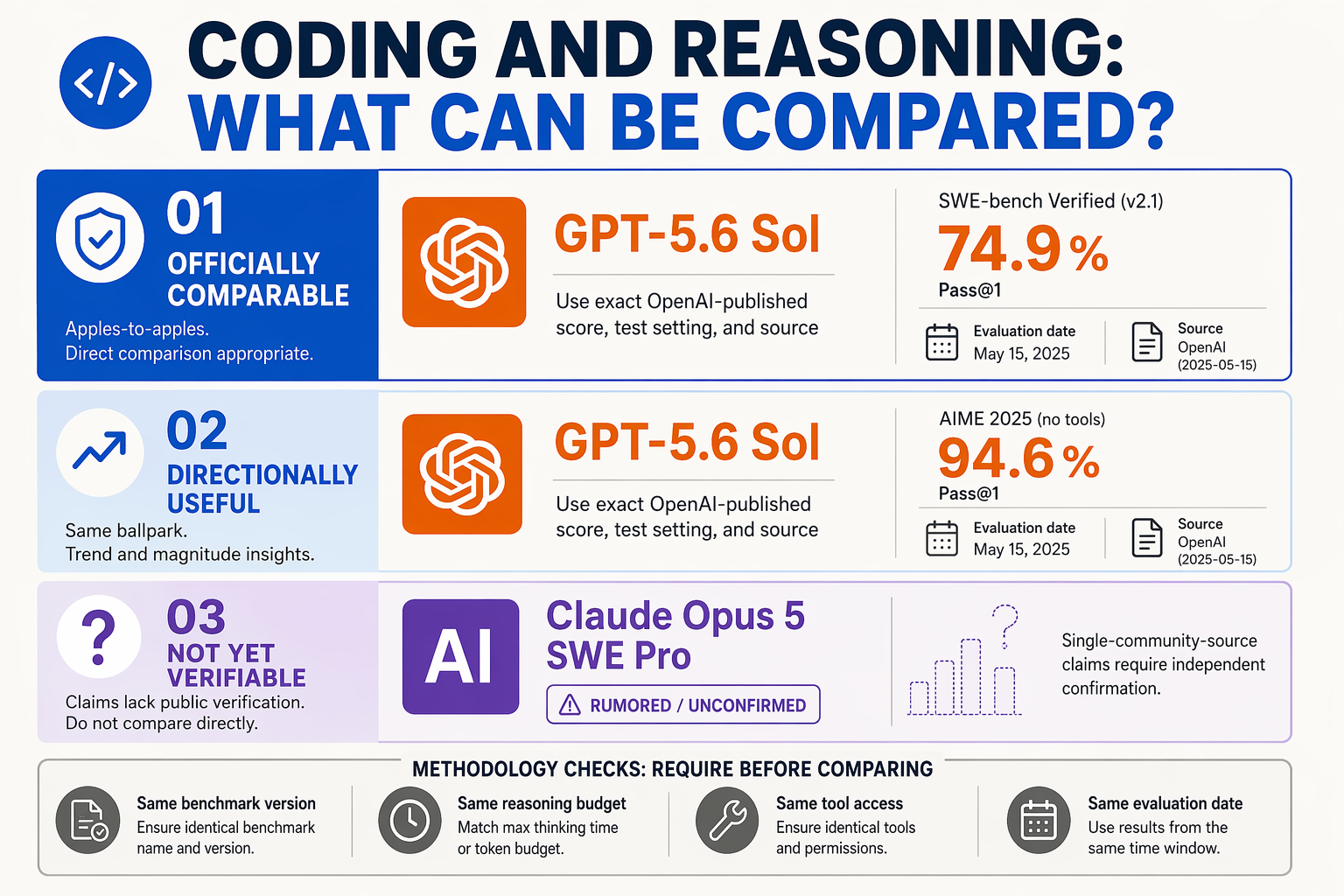
GPT-5.6 Sol is the defensible choice for coding and reasoning today because OpenAI has published evidence for it, while Claude Opus 5’s reported SWE-Bench Pro advantage remains unconfirmed. Claude Opus 5 could eventually prove stronger, but a single community-sourced claim is not enough to establish a benchmark winner.
What the coding evidence actually shows
The most attention-grabbing Claude Opus 5 claim concerns SWE-Bench Pro, a software-engineering benchmark that tests whether models can resolve realistic repository-level issues. Kie.ai reports that early leaks claim Claude Opus 5 beats GPT-5.6 Sol on SWE-Bench Pro, but Kie.ai also says the head-to-head evidence is thin and comes from a single community post.
That result must therefore be labeled rumored and unconfirmed. The supplied evidence does not include:
- An official Anthropic model card or announcement
- A reproducible evaluation configuration
- The exact Claude Opus 5 score or confidence interval
- Details about tools, scaffolding, reasoning budgets, or pass rates
- Independent replication of the claimed result
These omissions matter because coding scores can change substantially with the agent framework, tool permissions, retry policy, repository selection, and token budget. Until Anthropic publishes equivalent methodology, the alleged SWE-Bench Pro lead should not drive production procurement.
GPT-5.6 Sol has stronger documented reasoning evidence
OpenAI officially describes GPT-5.6 Sol as setting “a new standard” for intelligence. OpenAI reported in its 2026 GPT-5.6 announcement that GPT-5.6 Sol outperformed Claude Fable 5 with adaptive reasoning by 13.1 points on the benchmark highlighted by OpenAI.
That is meaningful first-party evidence, but it has two important boundaries:
- Claude Fable 5 is not Claude Opus 5. A 13.1-point advantage over Fable 5 cannot be converted into an advantage over an unreleased or undocumented Opus 5.
- A vendor-published benchmark is not an independent verdict. Teams should still reproduce representative coding and reasoning tasks under their own tooling, prompts, and latency constraints.
DataCamp separately notes that GPT-5.6’s flagship tier reports a higher score than Claude Opus 4.8 on one overlapping benchmark. That comparison provides context for currently documented Anthropic models, but it does not validate any claim about Claude Opus 5.
How engineering teams should choose
For deployments beginning now, evaluate the models through a staged process:
- Use GPT-5.6 Sol as the testable baseline because its capabilities are documented by OpenAI.
- Build an internal suite covering bug fixes, test generation, code review, migrations, terminal use, and multi-step architectural reasoning.
- Measure task success, human correction time, latency, token consumption, and regression rate, rather than relying on one leaderboard.
- Add Claude Opus 5 only after Anthropic confirms its identity, access conditions, benchmark methodology, and safety documentation.
- Re-run identical tasks with fixed tools and budgets before declaring a winner.
The current conclusion is therefore asymmetric: GPT-5.6 Sol has the stronger evidence base for coding and reasoning as of July 24, 2026; Claude Opus 5 has an expected or rumored SWE-Bench Pro advantage, not a verified one. A future official release could change that assessment, but the present record cannot support a Claude Opus 5 victory.
How much do GPT-5.6 Sol and Claude Opus 5 cost, and where are they available?
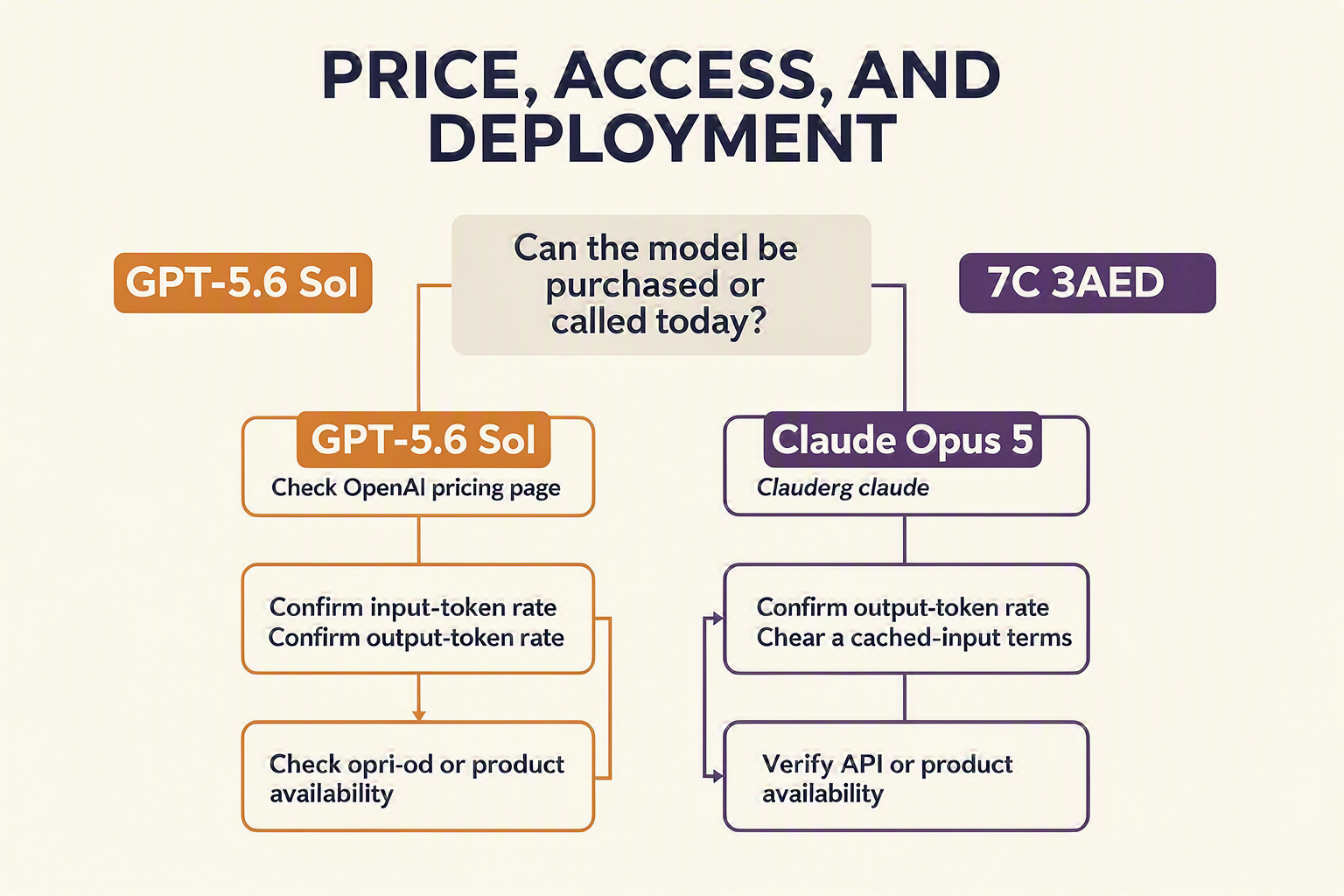
As of July 24, 2026, OpenAI officially documents GPT-5.6 Sol, but the supplied OpenAI publication does not establish a verifiable API price. Claude Opus 5 remains expected, rumored, and unconfirmed, with no supplied Anthropic release announcement, model card, API identifier, or official pricing page.
GPT-5.6 Sol pricing: what OpenAI has confirmed
OpenAI’s official announcement, “GPT-5.6: Frontier intelligence that scales with your ambition,” describes GPT-5.6 Sol as setting “a new standard” for intelligence. This confirms the model’s identity, but the available excerpt does not specify its commercial terms.
Based strictly on the supplied OpenAI-published evidence:
- Official API input price: Not established
- Official API output price: Not established
- Cached-input price: Not established
- Batch API discount: Not established
- Subscription or product access requirements: Not established
- Regional availability: Not established
Layer3Labs reports a price of $5 per million input tokens and $30 per million output tokens for GPT-5.6 Sol. However, these figures are third-party reported rates, not OpenAI-published pricing in the evidence provided, so they should not be presented as an official quotation.
For preliminary planning only, those third-party rates would make a workload containing 10 million input tokens and 2 million output tokens cost $110: $50 for input and $60 for output. That estimate excludes reasoning-token accounting, tool calls, web search, storage, fine-tuning, taxes, and platform fees.
Before approving a budget, teams should verify GPT-5.6 Sol’s current model identifier and rates directly against an OpenAI pricing page or API document that explicitly names the model.
Is expected or rumored Claude Opus 5 available?
Claude Opus 5 availability is unconfirmed as of July 24, 2026. None of the supplied evidence includes an official Anthropic product announcement, system card, API documentation, pricing table, or generally available model identifier for Claude Opus 5.
Current claims should be labeled carefully:
- Expected or rumored release: “Claude Opus 5” has not been verified as a released Anthropic product through the supplied official evidence.
- Rumored benchmark performance: Kie.ai says early leaks claim Claude Opus 5 beats GPT-5.6 Sol on SWE-Bench Pro, while emphasizing that the evidence is thin and originates from a single community post.
- Rumored context window: The claimed 1-million-token context capacity is not an Anthropic-confirmed specification.
- Unknown pricing: Input, output, cached-token, batch, and subscription prices remain unconfirmed.
- Unknown availability: Launch timing, supported regions, rate limits, and API access conditions have not been officially established.
Layer3Labs lists Claude Opus 4.8 at $5 per million input tokens and $25 per million output tokens, but pricing for one model cannot be substituted for an expected successor.
Provider-neutral procurement guidance
Before selecting either model, request:
- A provider-published model ID and availability date
- Official input, output, cached-token, and batch rates
- Context-window and maximum-output limits
- Data-retention, residency, and service-region terms
- Rate limits and service-level commitments
- A workload-specific cost estimate using representative prompts
Treat unofficial prices and leaked specifications as scenario-planning inputs, not procurement facts, until the relevant provider publishes matching documentation.
How could this matchup affect AI buyers, developers, and the frontier-model market?

The immediate effect is asymmetric procurement risk: GPT-5.6 Sol has OpenAI-published documentation, while Claude Opus 5 remains expected, rumored, and unconfirmed as of July 24, 2026. Buyers should treat the matchup as scenario planning—not as a production-ready comparison between two documented products.
AI buyers will prioritize verifiable evidence
OpenAI describes GPT-5.6 Sol as setting a “new standard” for intelligence, but procurement teams should still validate that vendor claim on representative workloads. OpenAI reported in July 2026 that GPT-5.6 Sol surpassed Claude Fable 5 with adaptive reasoning by 13.1 points on its highlighted benchmark; this is an OpenAI-published result, not an independent comparison with the unconfirmed Claude Opus 5.
Organizations should create three separate approval tracks:
- Documented products: Review official specifications, security controls, data-retention policies, regional availability, rate limits, pricing, and service commitments.
- Expected products: Monitor announcements without budgeting around rumored capabilities, prices, or release dates.
- Production candidates: Measure accuracy, latency, tool use, failure recovery, availability, and cost per successfully completed task.
The rumored 1-million-token context window for Claude Opus 5 is unconfirmed and should not drive infrastructure or purchasing commitments unless Anthropic publishes supporting specifications. Kie.ai also reports an early claim that the expected Claude Opus 5 could outperform GPT-5.6 Sol on SWE-Bench Pro, but Kie.ai says the evidence is thin and originates from a single community post. That claim is unverified, not a dependable benchmark result.
Developers will benefit from provider-neutral architecture
This matchup reinforces a practical engineering rule: model release cycles move faster than application architecture should. Teams can reduce switching costs by separating prompts, retrieval, memory, tools, safety controls, and evaluation logic from provider-specific SDKs.
Useful architectural safeguards include:
- Maintaining a provider-neutral request and response layer within the application.
- Wrapping provider SDKs behind interchangeable adapters.
- Testing structured outputs and tool calls with model-specific regression suites.
- Routing workloads according to measured quality, latency, availability, and cost.
- Creating documented fallbacks for outages, rate limits, and model deprecations.
- Versioning prompts because identical instructions can produce different behavior across models.
- Recording model versions, reasoning settings, and tool configurations for reproducibility.
This design does not erase differences among providers. It makes those differences measurable while limiting the engineering effort required to evaluate or replace a model.
The frontier-model market could become more evidence-driven
If the expected Claude Opus 5 launches and independent evaluators reproduce its rumored coding or long-context gains, competition could intensify around agentic software engineering, sustained tool use, and large-context workflows. Until Anthropic publishes the model and third parties test it, those implications remain speculative and unconfirmed.
The market is likely to move toward:
- Faster evaluation cycles as frontier models change more frequently.
- Workload-specific testing, because one benchmark cannot predict performance across coding, research, support, and automation.
- Greater scrutiny of vendor benchmarks, including reasoning budgets, scaffolding, test contamination, and reproducibility.
- Less architectural lock-in, as buyers preserve negotiating power and operational resilience.
The strategic advantage may therefore belong not to the organization that selects one temporary leaderboard winner, but to the organization that can verify documented releases quickly, reject unsupported claims, and change providers without rebuilding its AI stack.
How should expert opinions and third-party tests be weighed against primary-source evidence?

Primary-source evidence should establish what a model is, whether it is available, and what its developer officially claims; expert opinions and third-party tests should then assess how well it performs in practice. Neither category is sufficient alone: vendor results are authoritative about product details but potentially selective, while independent tests can be more realistic but are often narrower and less reproducible.
Use an evidence hierarchy, not a popularity contest
For the Claude Opus 5 vs GPT-5.6 Sol comparison, evidence should be ranked in this order:
- Official model documentation: release announcements, model cards, API documentation, pricing pages, and safety reports.
- Reproducible independent evaluations: published prompts, datasets, settings, sample sizes, raw outputs, and evaluation code.
- Expert hands-on testing: useful qualitative evidence about workflows, failure modes, and usability.
- Aggregated third-party comparisons: helpful for discovery, but dependent on the accuracy and freshness of their underlying sources.
- Leaks and community posts: leads for further investigation, not facts suitable for procurement decisions.
Under this hierarchy, OpenAI’s GPT-5.6 announcement is primary evidence that OpenAI positions GPT-5.6 Sol as setting “a new standard” for intelligence. OpenAI also reports a 13.1-point advantage over Claude Fable 5 with adaptive reasoning in the benchmark highlighted in its announcement. That number is a documented OpenAI-published result, but it remains a vendor-reported measurement—not an independently replicated result and not evidence about the expected or rumored Claude Opus 5.
Ask whether a third-party test is reproducible
A credible test should disclose enough information for another evaluator to repeat it. Before accepting a leaderboard score or “winner” declaration, check:
- Model identity: Was the exact production model tested, or a preview, routing alias, or similarly named model?
- Configuration: Were reasoning effort, temperature, tool access, context limits, and retry policies equivalent?
- Dataset integrity: Could benchmark questions have appeared in training data, public repositories, or prompt-tuning sessions?
- Evaluation method: Did deterministic tests, human judges, or another language model score the outputs?
- Statistical strength: Were there enough tasks and repeated runs to distinguish a real advantage from variance?
- Disclosure: Did the reviewer publish prompts, failures, costs, latency, and unsuccessful retries—not merely selected outputs?
Lenny’s Newsletter describes a hands-on “How I AI vibe benchmark” comparing GPT-5.6 Sol with GPT-5.6 Terra, Luna, Claude Fable 5, and Sonnet 5. Such testing can reveal practical preferences, but a subjective workflow benchmark should not be treated as equivalent to a controlled Claude Opus 5 head-to-head evaluation.
Treat rumors as hypotheses awaiting confirmation
Kie.ai reports that early leaks claim the expected Claude Opus 5 could beat GPT-5.6 Sol on SWE-Bench Pro, while explicitly noting that the evidence is thin and comes from a single community post. As of July 24, 2026, that claim must remain labeled rumored and unconfirmed.
Similarly, DataCamp’s discussion of an overlapping benchmark involving GPT-5.6 and the officially referenced Claude Opus 4.8 may inform comparisons with that specific model. It cannot be transferred to Claude Opus 5, because model generations are not interchangeable evidence.
The practical rule is simple: use official evidence to verify product facts, independent testing to challenge vendor claims, and expert opinion to understand real-world trade-offs. Do not convert repetition, enthusiasm, or an undisclosed benchmark into confirmation.
Which model should you choose for your use case as of July 24, 2026?
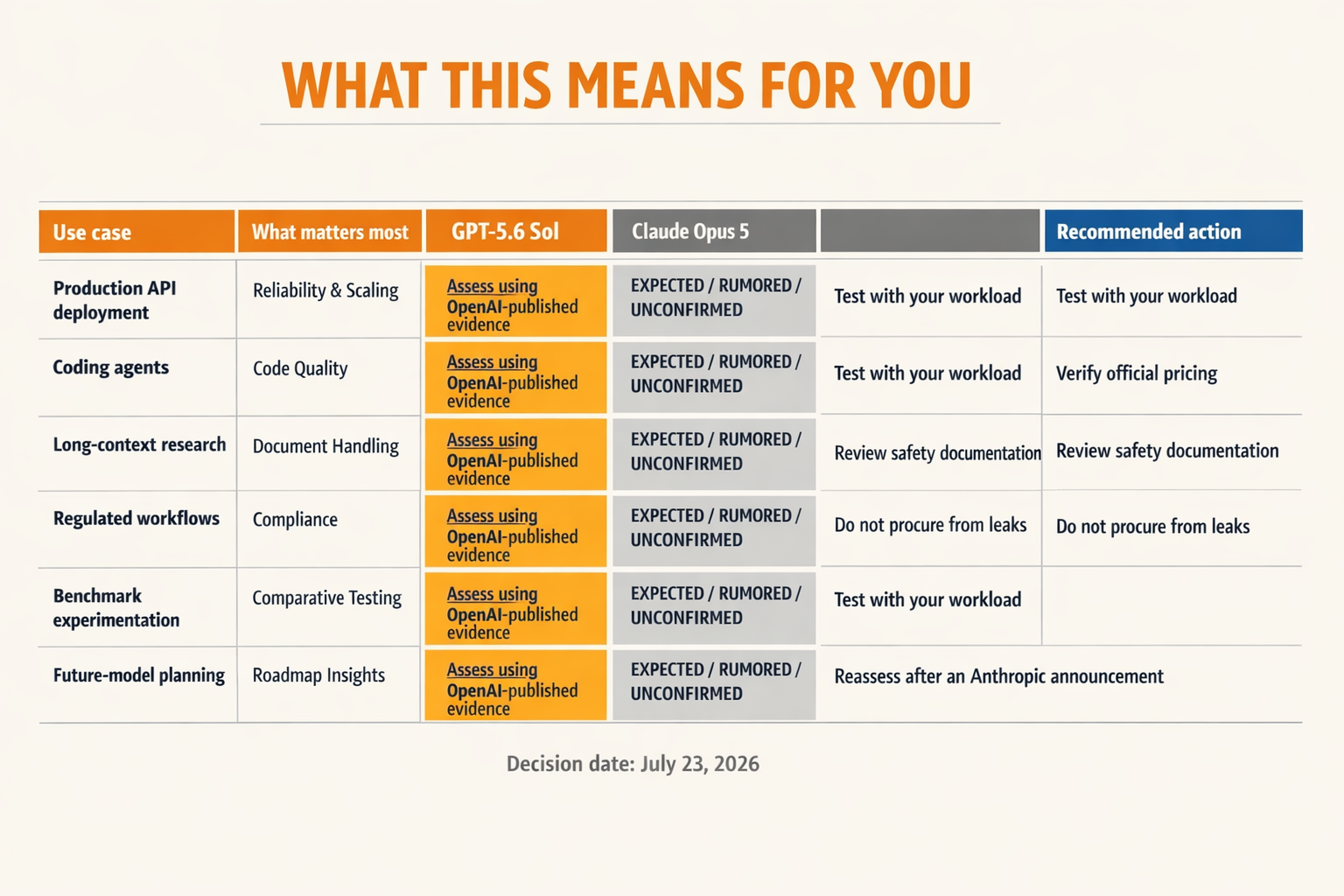
As of August 1, 2026, Claude Opus 5 and GPT-5.6 Sol are both released models that can be evaluated for production. Claude Opus 5 has been publicly available since July 24, 2026, with official specifications, pricing, access details, and safety documentation from Anthropic. The right choice now depends on workload fit—not product availability.
Use-case decision matrix
| Use case | Recommended choice as of August 1, 2026 | Evidence status and rationale | Validation gate |
|---|---|---|---|
| Coding agents | Benchmark both; favor the model that completes more accepted changes at lower total cost | Both models are production candidates. Provider-published coding benchmarks can inform a shortlist, but repository structure, tools, reasoning settings, and review standards materially affect results. | Measure accepted pull requests, test pass rates, regressions, security defects, tool-call reliability, latency, retries, and cost per accepted change. |
| Long-context document analysis | Choose the model whose documented context and maximum-output limits fit the complete workflow | Compare the official context windows rather than relying on pre-release reports. A larger input limit can help with large corpora, while the documented output ceiling matters for long reports, code generation, and structured extraction. Maximum context also does not guarantee accurate retrieval across the entire prompt. | Test citation accuracy, retrieval from the beginning and middle of the context, output truncation, latency, and total input-and-output cost at realistic document sizes. |
| OpenAI-stack teams | GPT-5.6 Sol | It is generally the lower-friction option for teams already using OpenAI APIs, tool schemas, governance controls, observability, and routing logic. That ecosystem advantage does not by itself establish better task quality. | Run regression tests, confirm tool and structured-output compatibility, set spend limits, and test fallback behavior before changing production traffic. |
| Anthropic-stack teams | Claude Opus 5 | Teams already standardized on Anthropic’s API, prompt patterns, tool use, access controls, and monitoring can adopt Claude Opus 5 with fewer integration changes. | Re-test existing prompts and tools, verify model-specific limits, review retention settings, and compare results with the previous production model. |
| Complex reasoning | Benchmark both with identical budgets | OpenAI and Anthropic each publish performance claims for their models, but provider benchmark tables are not substitutes for a blinded test on representative business tasks. The winner may change with reasoning settings, tool access, latency constraints, and scoring criteria. | Use identical prompts, tools, time limits, reasoning budgets, and expert graders. Track accuracy, unsupported claims, consistency, latency, and human-review time. |
| Cost-sensitive workloads | Use the less expensive model per accepted result—not simply the lower listed token rate | Both providers publish API pricing. Apply the documented input, cached-input, and output rates to the workload’s actual token mix, while accounting for different context and output limits. Long outputs, retries, tools, and failed attempts can outweigh a lower headline price. | Calculate total cost per successful task, including cache behavior, retries, tool calls, fallback requests, latency, and human review. Recalculate when pricing or routing changes. |
| Risk-conscious procurement | Either model, subject to governance review | Both are released products with provider documentation. Availability and published safety materials make evaluation possible, but neither automatically satisfies an organization’s legal, privacy, security, or sector-specific requirements. | Review data use, retention, residency, access controls, audit logs, contractual terms, incident response, deployment options, and human-oversight requirements. |
| Provider-flexible production systems | Evaluate both behind a model abstraction layer | Keeping Claude Opus 5 and GPT-5.6 Sol available through a common integration can reduce concentration risk and support workload-based routing. Portability still requires testing because prompts, tool calls, structured outputs, limits, and error handling differ by provider. | Test routing rules, failover quality, rate limits, observability, output consistency, provider-specific features, and cost controls. |
How to read the benchmark evidence
Keep specifications and benchmark claims separate when evaluating Claude Opus 5 vs GPT-5.6 Sol:
- Vendor-confirmed product facts: Release status, API availability, published prices, context limits, maximum-output limits, supported features, and provider-authored safety or system documentation.
- Vendor benchmark claims: Scores and comparative statements published by OpenAI or Anthropic. These can guide testing, but they reflect the provider’s selected model settings, competitors, prompts, tools, and scoring methods.
- Independent evidence: Reproducible third-party tests that disclose model versions, prompts, reasoning settings, tools, token budgets, and evaluation methods.
OpenAI reported in July 2026 that GPT-5.6 Sol exceeded Claude Fable 5 with adaptive reasoning by 13.1 points on the benchmark featured in its announcement. That is a vendor benchmark claim. It is not a direct GPT-5.6 Sol-versus-Claude Opus 5 result and should not be presented as evidence of a 13.1-point lead over Opus 5.
Apply the same standard to Anthropic’s published benchmark results. Provider figures are useful, but a defensible purchasing decision should reproduce the relevant workloads internally or rely on transparent independent testing.
Practical deployment recommendation
Choose GPT-5.6 Sol when OpenAI ecosystem compatibility, existing tooling, or its measured performance on your tasks produces the better operational result. Choose Claude Opus 5 when Anthropic ecosystem fit, its documented limits, or its measured quality and cost better match the workload.
For long-context and high-output tasks, compare the providers’ published context and output ceilings against actual payloads. For cost-sensitive deployments, apply the current official price cards to measured input, cached-input, and output usage rather than comparing a single token rate.
Teams that want to use both can route them through CallMissed’s OpenAI-compatible gateway, then select a primary model and same-tier fallback using task quality, latency, availability, and cost per successful result. The practical verdict is not that one model wins universally: both are released, documented options, and the stronger choice should be determined workload by workload.
Frequently asked questions: Is Claude Opus 5 released, is its 1M context confirmed, what is Honeycomb, and is GPT-5.6 Sol better?
Release and specifications
Is Claude Opus 5 officially released as of July 24, 2026?
Is the rumored Claude Opus 5 1M-token context window confirmed?
Honeycomb and benchmark claims
What is Honeycomb in Claude Opus 5 rumors?
Does Claude Opus 5 beat GPT-5.6 Sol on SWE-Bench Pro?
Choosing between the models
Is GPT-5.6 Sol better in the Claude Opus 5 vs GPT-5.6 Sol comparison?
Which model should businesses choose in Claude Opus 5 vs GPT-5.6 Sol?
Conclusion
As of July 24, 2026, GPT-5.6 Sol is the only side of this comparison supported by published first-party information. Claude Opus 5 may become a formidable competitor, but its reported specifications and performance remain expected, rumored, or unconfirmed rather than established facts.
- OpenAI positions GPT-5.6 Sol as setting “a new standard” for intelligence, according to OpenAI’s official GPT-5.6 announcement.
- OpenAI reports that GPT-5.6 Sol leads Claude Fable 5 with adaptive reasoning by 13.1 points on its highlighted benchmark. This vendor-published result is not an independent test against Claude Opus 5.
- Claims that Claude Opus 5 beats GPT-5.6 Sol on SWE-Bench Pro remain unconfirmed. The available third-party reporting traces the claim to a single community post.
- The alleged 1-million-token context window, pricing, API availability, release date, and safety documentation for Claude Opus 5 are still unknown in the supplied official evidence.
The next meaningful comparison should wait for Anthropic to publish a model card, API documentation, pricing, and reproducible benchmarks—followed by independent testing under identical conditions.
To explore how AI communication is evolving, visit CallMissed, an AI infrastructure platform supporting voice agents and multilingual chatbots across 22 Indian languages. Until Anthropic publishes verifiable evidence, should businesses compare Claude Opus 5—or simply keep it on their watchlist?
Related Reading
- Claude Opus 5 vs GPT-5.6 Sol vs GPT-5.6 Terra vs GPT-5.6 Luna: July 2026 Comparison
- Claude Opus 5 Release Date Rumors: When Will It Launch? Honeycomb Leak Explained
- GPT-5.6 Sol vs Qwen3.8-Max: Verified July 2026 Comparison
Sources
Discussion
Related Posts



Ready to automate customer conversations?
Launch AI voice agents and WhatsApp bots with CallMissed — one API, 22+ Indian languages.