CallMissed Integrations: Meta API Guide for Developers and Buyers


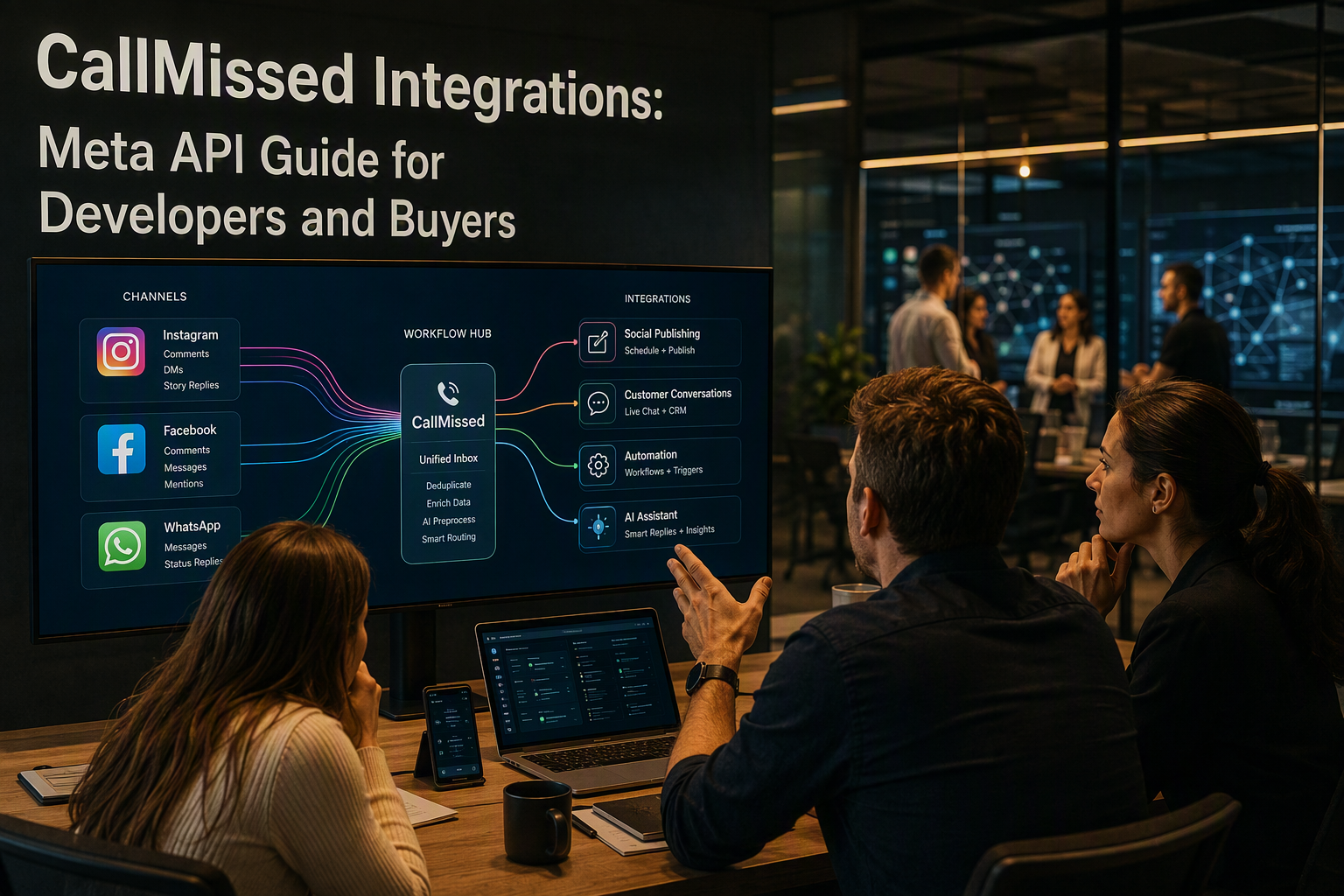
Learn how CallMissed integrations unify Meta APIs for Instagram, Facebook and WhatsApp posting, messaging, automation, AI agents and handoff.
CallMissed Integrations: Meta API Guide for Developers and Buyers
What if a single integration layer could connect customer conversations across Instagram, Facebook and WhatsApp—without forcing developers to build and maintain three disconnected workflows? This CallMissed Integrations: Meta API Guide for Developers and Buyers explains how the newly added Meta APIs bring these channels into a more unified customer-engagement architecture.
The timing matters because customer communication is increasingly fragmented. A buyer may discover a product on Instagram, ask a question through Facebook and expect order support on WhatsApp. When each channel uses separate inboxes, permissions, data models and automation rules, businesses risk losing context between interactions. Developers inherit a parallel problem: they must manage authentication, webhooks, message events, templates, routing logic and failure handling across multiple Meta surfaces.
CallMissed’s integrations catalogue now identifies implemented paths for Meta WhatsApp and Meta Facebook and Instagram, alongside Shopify, Twilio Voice, webhooks and REST APIs, according to the CallMissed Integrations documentation in 2026. That breadth is useful for teams evaluating whether a platform can connect social messaging to commerce, telephony and internal systems rather than operating as another isolated inbox.
For WhatsApp specifically, CallMissed uses Meta’s Tech Provider flow and Embedded Signup so businesses can connect their own WhatsApp Business assets, according to CallMissed’s Meta relationship documentation. The documented workflow supports WhatsApp numbers, message templates, business messaging, bots and account processes. This distinction matters to buyers because control over business assets, onboarding and governance can be as consequential as chatbot features.
This guide will help technical and commercial teams evaluate the integration from both sides:
- Developers will learn how Instagram, Facebook and WhatsApp APIs fit into an event-driven architecture, including authentication, webhooks, message routing and automation.
- Product teams will see how Meta conversations can connect with AI agents, CRM records and omnichannel workflows.
- Buyers will get a practical framework for assessing setup effort, asset ownership, scalability, security and ongoing operational costs.
- Business leaders will understand where social messaging automation creates value—and where human escalation remains necessary.
The goal is not merely to list endpoints. It is to show how CallMissed’s Meta APIs can support a coherent journey from social discovery to conversation, qualification, support and retention. By the end, developers should understand the integration model, while buyers should have a clearer basis for asking the right technical, commercial and governance questions before deployment.
What are CallMissed Meta APIs, and what can developers and businesses build with them?
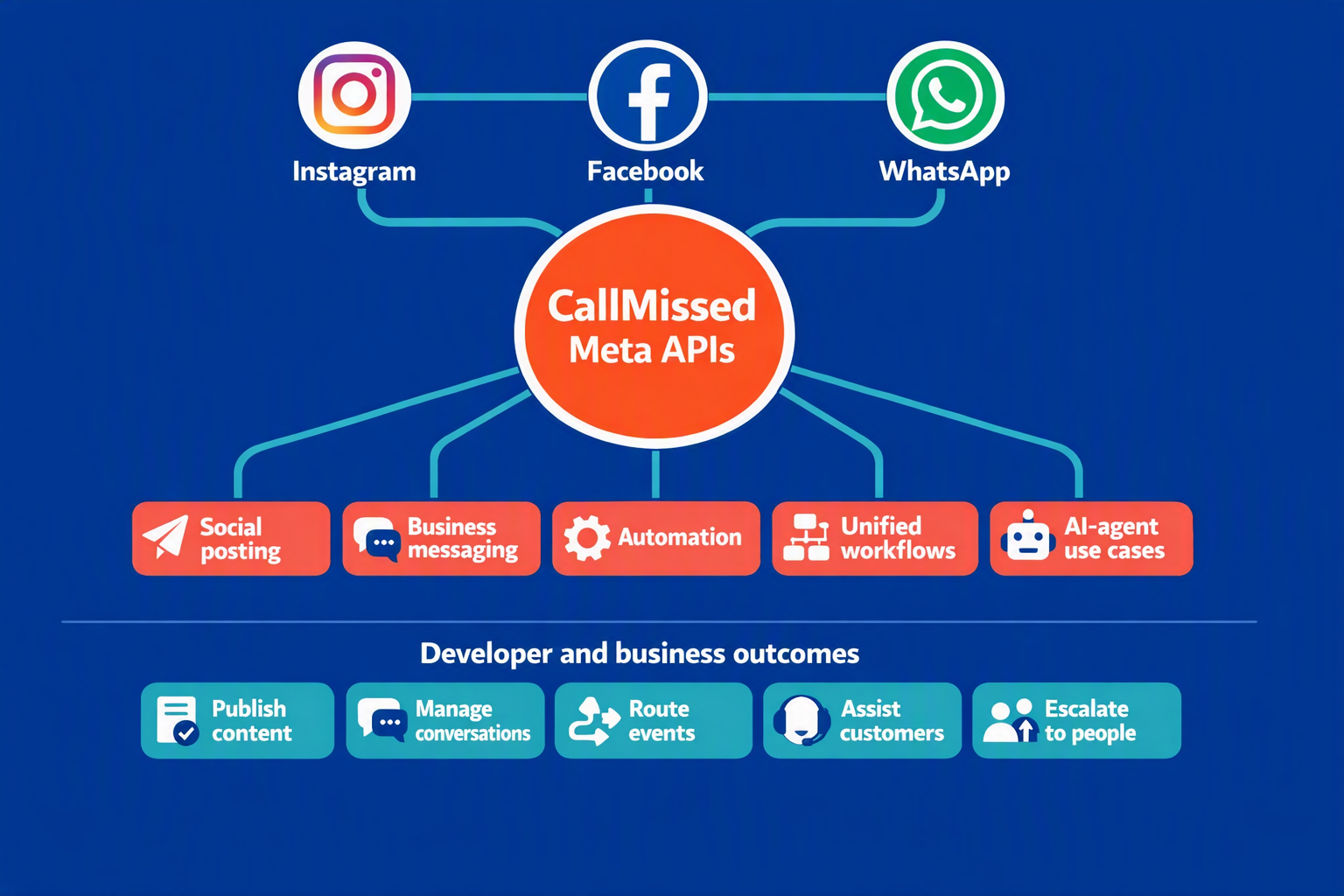
CallMissed Meta APIs are integration paths for connecting Instagram, Facebook and WhatsApp interactions with business workflows, AI agents and customer records. They give developers and businesses a shared engagement layer for building social discovery, messaging automation, lead management and support journeys without treating every Meta channel as a separate operational silo.
Three Meta channels, one engagement architecture
The CallMissed Integrations documentation lists Meta WhatsApp and Meta Facebook and Instagram as implemented connection paths in 2026. These integrations sit alongside Shopify, Twilio Voice, webhooks and REST APIs, allowing Meta conversations to participate in broader commerce, telephony and back-office workflows.
The practical capabilities differ by channel, account permissions and Meta’s supported APIs:
- Instagram: Capture supported customer interactions and route them into lead-qualification, sales or support workflows. A business could move a product-discovery conversation toward an assisted purchase or human follow-up.
- Facebook: Connect supported Page interactions to centralized routing and automation. Teams can use these events to answer common questions, collect lead details or create CRM tasks.
- WhatsApp: Manage business messaging, approved templates, bots and account workflows using connected WhatsApp Business assets.
- Cross-channel operations: Apply shared customer context, assignment rules, automation and escalation policies rather than operating independent social inboxes.
These APIs should not be confused with the Meta Model API, which exposes Meta AI models to developers. Here, “Meta APIs” refers to customer-communication integrations for Meta-owned channels.
What developers can build
Developers can treat channel activity as events that trigger business logic. A typical implementation follows four steps:
- Connect the business assets and obtain the required Meta permissions.
- Receive supported events through the platform’s channel integration or webhooks.
- Route each event to an AI agent, workflow, CRM record or human queue.
- Send an authorized response while retaining status and conversation context.
This architecture supports applications such as:
- AI-assisted replies grounded in a company knowledge base.
- Lead capture from Instagram or Facebook with CRM synchronization.
- WhatsApp order updates, booking reminders and support automation.
- Intent-based routing across sales, service and regional-language teams.
- Human escalation when confidence, policy or customer sentiment requires intervention.
- Commerce workflows linking social conversations with Shopify or custom systems.
For Indian deployments, CallMissed’s wider AI-native platform supports speech and conversational experiences across 22 Indian languages, making regional-language automation relevant when a social enquiry progresses to WhatsApp messaging or voice assistance.
What businesses can operationalize
For buyers, the value is not simply API access; it is the ability to turn fragmented interactions into governed customer journeys. A retailer, for example, could capture interest on Instagram, qualify the buyer through automation, continue the conversation on WhatsApp and hand the case to a salesperson with prior context intact.
WhatsApp onboarding also preserves an important governance boundary. According to CallMissed’s Meta relationship documentation, CallMissed uses Meta’s Tech Provider flow and Embedded Signup to connect a business’s own WhatsApp Business assets. The documented scope includes WhatsApp numbers, templates, business messaging, bots and account workflows.
Potential outcomes include faster first responses, fewer manually copied records and more consistent escalation. Actual availability still depends on Meta permissions, account status, messaging policies, template approval and channel-specific API limitations, so buyers should validate each intended workflow rather than assume feature parity across Instagram, Facebook and WhatsApp.
Why is CallMissed adding Instagram, Facebook and WhatsApp to its integration layer?

CallMissed is adding Instagram, Facebook and WhatsApp to its integration layer because customer journeys increasingly cross Meta channels, while businesses need one operational system for routing, automation and customer context. The objective is not simply to expose more endpoints; it is to connect social discovery, messaging and support with AI agents, CRM workflows and external business systems.
From channel silos to journey continuity
Each Meta channel often represents a different stage of the buying journey:
- Instagram supports discovery, product exploration and responses to social content.
- Facebook provides business-page interactions and another route for enquiries.
- WhatsApp enables direct conversations for qualification, transactions and ongoing support.
Treating these interactions as unrelated tickets can fragment the customer record. An integration layer can normalize channel events before sending them to shared workflows, allowing a business to apply consistent rules for identity matching, lead assignment, escalation and analytics.
For developers, normalization reduces the amount of channel-specific logic that spreads across an application. Individual Meta APIs still have distinct permissions, payloads and policies, but common internal objects—such as contact, conversation, message, status and assignment—can sit above those differences.
Connecting conversations to operational systems
The broader strategy becomes clearer when Meta channels are considered alongside commerce, telephony and programmable interfaces. The CallMissed Integrations documentation in 2026 lists implemented paths for Meta WhatsApp, Meta Facebook and Instagram, Shopify, Twilio Voice, webhooks and REST APIs.
That combination can support event-driven journeys such as:
- Sending an Instagram enquiry into a lead-qualification workflow.
- Associating a Facebook conversation with an existing CRM contact.
- Moving an eligible customer conversation to WhatsApp for continued assistance.
- Triggering a webhook when a conversation requires a human agent.
- Connecting a message to Shopify order or customer data.
- Using REST APIs to synchronize outcomes with an internal system.
These workflows are valuable because the message itself is rarely the final business outcome. The meaningful result may be a booked appointment, qualified lead, resolved support case or updated order.
Making AI automation reusable across channels
A shared integration layer also lets teams reuse AI orchestration instead of building a separate bot for every social surface. The same knowledge base, intent taxonomy, safety rules and escalation policy can potentially support multiple entry points, subject to each channel’s capabilities and Meta’s platform requirements.
This is particularly relevant for multilingual customer engagement. CallMissed supports speech and conversational experiences across 22 Indian languages, giving Indian businesses a foundation for serving regional audiences rather than restricting automation to English-first interactions. Channel support, language coverage and workflow logic remain separate architectural concerns, but combining them within one engagement platform simplifies deployment.
Why the expansion matters to buyers
For buyers, the rationale should be evaluated through operational outcomes rather than connector count. A useful Meta integration layer should help deliver:
- Faster deployment through reusable authentication, event handling and routing patterns.
- Consistent governance across permissions, customer data and human access.
- Shared context when customers move between social and messaging channels.
- Lower maintenance overhead when APIs, policies or webhook schemas change.
- Extensibility through webhooks and REST APIs when native workflows are insufficient.
The strategic value is therefore consolidation with flexibility: Meta channels become parts of a broader customer-engagement architecture, not three isolated automation projects.
Which CallMissed Meta API capabilities belong to each workflow?
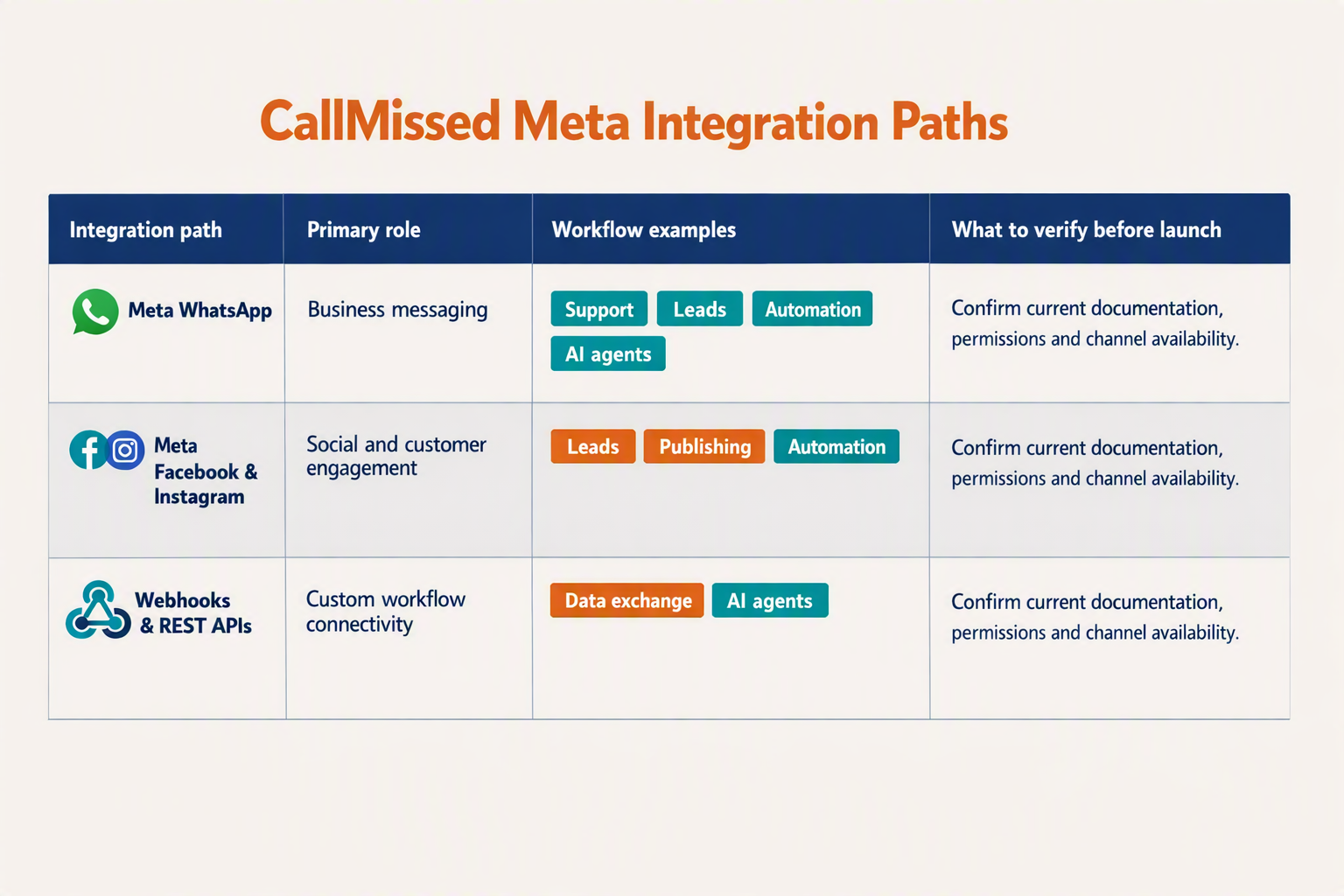
CallMissed maps Instagram and Facebook to social discovery and messaging workflows, while WhatsApp supports deeper business messaging, templates, bots and account-level processes. Cross-channel routing, CRM updates and AI-assisted responses sit above these channel-specific capabilities and should be designed as shared workflows.
Workflow-to-capability map
| Workflow | Meta channel | CallMissed capability | Best-fit automation | Deployment check |
|---|---|---|---|---|
| Social discovery and initial enquiry | Meta Facebook and Instagram integration path | Capture eligible interactions and route enquiries into an engagement workflow | Confirm supported Instagram account type, event coverage and Meta permissions | |
| Page-based customer communication | Meta Facebook and Instagram integration path | Centralise eligible Facebook conversations for triage and follow-up | Verify Page access, administrator roles and webhook events | |
| Lead qualification | Instagram or Facebook | Social-channel connection plus workflow routing | Collect intent, contact details and product interest before sales escalation | Define consent rules and the point at which the conversation moves to WhatsApp or a human |
| Transactional or service messaging | Business messaging and WhatsApp-number support | Order updates, support conversations, booking flows and missed-call follow-up | Confirm opt-in, template category and messaging-window requirements | |
| Proactive notifications | Meta-approved message templates | Send approved reminders, alerts and re-engagement messages | Establish template approval, language variants and delivery-failure handling | |
| Conversational automation | Bots connected to business messaging workflows | Answer common questions, qualify leads and escalate complex cases | Test knowledge boundaries, human handoff and conversation logging |
The CallMissed Integrations documentation listed implemented paths for Meta WhatsApp and Meta Facebook and Instagram in 2026. However, an implemented channel path should not be interpreted as universal access to every object or event available anywhere in Meta’s broader developer ecosystem. Developers should verify the exact permissions, webhook payloads, supported message types and account prerequisites for their intended deployment.
What belongs in the shared orchestration layer?
Several responsibilities should remain channel-independent rather than being duplicated for Instagram, Facebook and WhatsApp:
- Identity resolution: Associate channel-specific identifiers with one customer or CRM record without assuming that matching names represent the same person.
- Intent classification: Apply consistent labels such as sales, support, booking or complaint across incoming events.
- Routing: Send conversations to an AI agent, specialist queue or human operator according to urgency and confidence.
- Context retention: Preserve summaries and relevant history when a customer moves from a social channel to WhatsApp.
- Observability: Record webhook failures, delivery states, response times and escalation outcomes by channel.
This separation prevents channel adapters from becoming the system of record. Meta APIs should transport events and messages; the engagement layer should own business rules, customer context and operational reporting.
WhatsApp has the clearest documented capability boundary
CallMissed’s Meta relationship documentation states that CallMissed uses Meta’s Tech Provider flow and Embedded Signup to connect a business’s own WhatsApp Business assets. The same 2026 documentation explicitly identifies support for WhatsApp numbers, templates, business messaging, bots and account workflows.
That makes WhatsApp suitable for structured, ongoing engagement, but buyers should distinguish among three separate controls:
- Asset control: Which business owns the WhatsApp Business Account and phone number?
- Message governance: Who creates, submits and maintains templates?
- Automation governance: Which requests may be handled automatically, and which require human escalation?
For Instagram and Facebook, buyers should request an equivalent implementation matrix before procurement. The matrix should list supported account types, permissions, inbound and outbound actions, attachments, webhook events, rate-limit handling and retention rules. This converts a broad claim of “Meta integration” into a testable workflow specification.
How does a social media posting API differ from a messaging API?
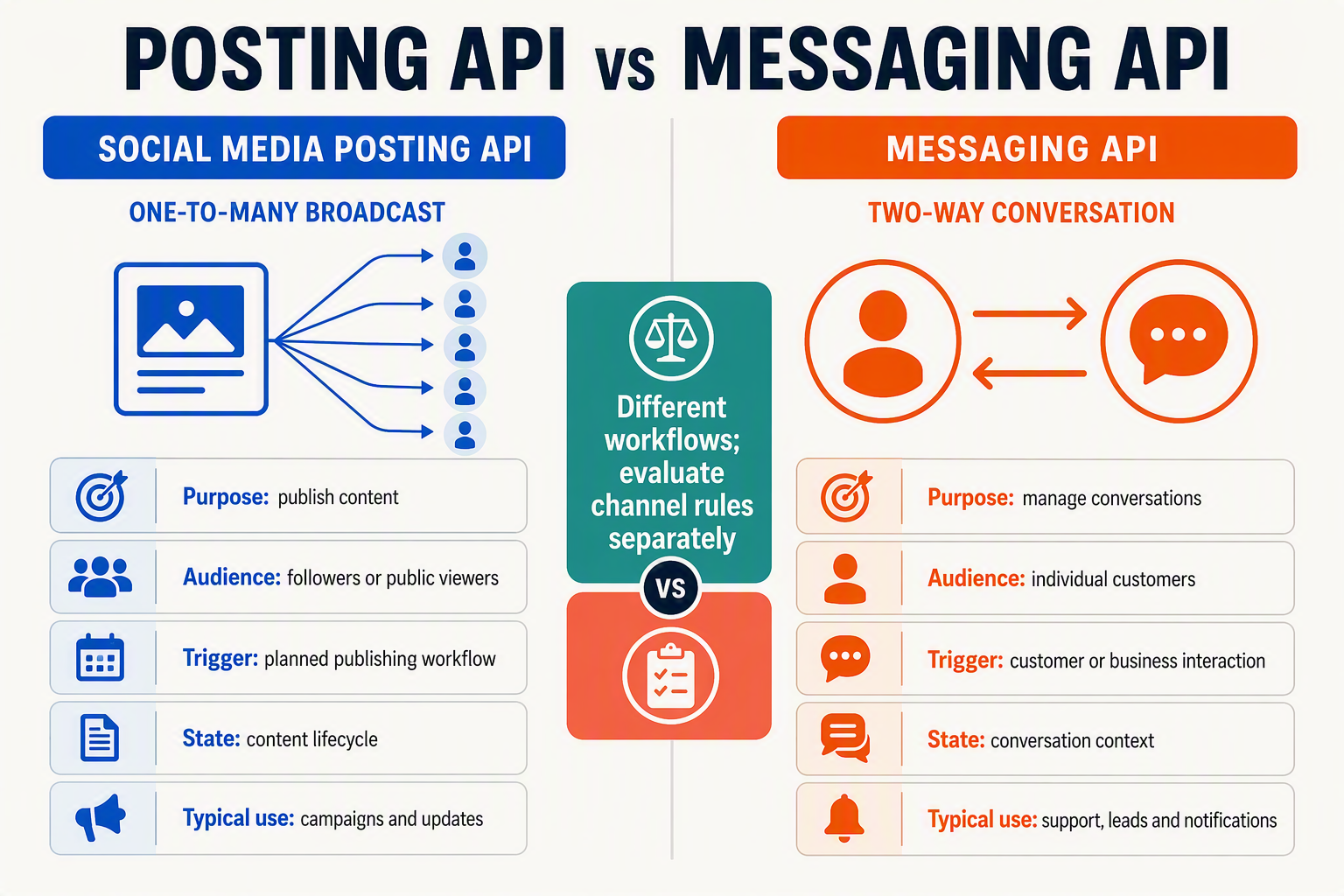
A social media posting API publishes one-to-many content such as Facebook Page posts or Instagram media, while a messaging API manages private, event-driven conversations with individual customers. Posting APIs optimize for content distribution; messaging APIs optimize for replies, routing, automation and conversation state.
Different objects, workflows and success metrics
Although both API types operate within Meta’s ecosystem, developers should treat them as separate application domains.
- Posting APIs work with objects such as media, captions, Page posts, publishing status and content identifiers. A successful request normally creates or schedules content for an audience.
- Messaging APIs work with senders, recipients, conversations, message events, delivery states and attachments. A successful request advances a customer interaction.
- Posting performance is commonly assessed through reach, engagement or publishing reliability.
- Messaging performance is assessed through response time, resolution rate, delivery status, escalation and customer satisfaction.
Facebook and Instagram can support both public content and private interactions, but WhatsApp is primarily a permission-based messaging channel rather than a public publishing network. This difference affects architecture: a post may trigger many comments or direct messages, while each resulting conversation needs its own customer identity, context and routing state.
Request-response versus event-driven architecture
A publishing workflow is often initiated by the business:
- An application uploads or references media.
- It supplies content metadata and the destination account.
- The platform returns a content or publishing identifier.
- The application checks the outcome and stores the result.
Messaging is more event-driven. A customer sends a message, Meta emits a webhook event, and the application must verify, parse, route and acknowledge it. The system may then invoke a bot, retrieve CRM context, send an approved response or escalate the conversation to a human agent.
That distinction creates different engineering requirements. Messaging systems generally need:
- Webhook reliability, deduplication and retry handling
- Conversation state across multiple inbound and outbound events
- Identity mapping between Meta users and CRM contacts
- Consent and policy controls for business-initiated communication
- Human handoff when automation cannot safely resolve the request
Posting integrations instead require robust media validation, publishing permissions, account selection and safeguards against duplicate publication.
What buyers should verify
“Supports Meta APIs” is not sufficiently precise for procurement. Buyers should ask whether a product supports publishing, private messaging, comment handling, analytics or a defined combination, because access to one category does not automatically imply access to every Meta capability.
The CallMissed Integrations documentation listed separate implemented paths for Meta WhatsApp and Meta Facebook and Instagram in 2026. That separation helps technical teams model channel-specific permissions and events while connecting them to a shared engagement layer.
Buyers should also distinguish integration availability from authorized asset ownership. According to CallMissed’s Meta relationship documentation, CallMissed uses Meta’s Tech Provider flow and Embedded Signup for businesses connecting their own WhatsApp Business assets. The documented WhatsApp scope covers five operational areas: numbers, templates, business messaging, bots and account workflows.
The practical rule is simple: use posting APIs to publish and distribute content, and messaging APIs to receive, understand and continue customer conversations. A unified platform may expose both, but developers must still preserve their distinct permissions, data models, policies and failure modes.
What does a typical CallMissed Meta Graph API integration architecture look like?
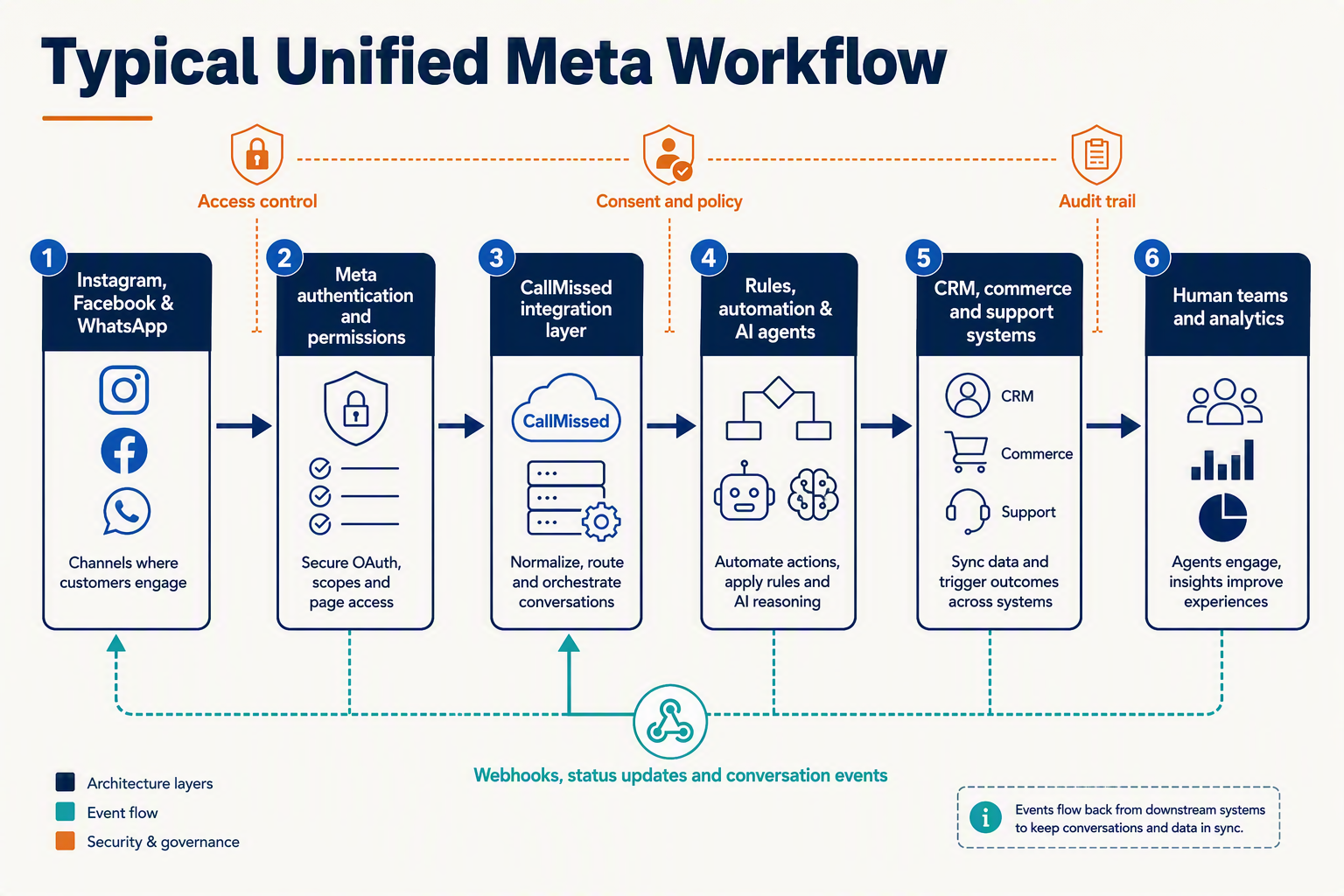
A typical CallMissed Meta Graph API integration is an event-driven, hub-and-spoke architecture: Instagram, Facebook and WhatsApp generate events through Meta, CallMissed normalises and routes those events, and connected AI agents, inboxes, CRM systems or business applications decide what happens next.
Reference architecture
Instagram | Facebook | WhatsApp
              ↓
     Meta Graph APIs + Webhooks
              ↓
 Authentication and Event Validation
              ↓
   CallMissed Integration Layer
              ↓
 Normalisation → Identity → Routing
        ↙          ↓          ↘
 AI agent    Omnichannel     CRM/ERP/
 or bot      human inbox     commerce
        ↘          ↓          ↙
     Outbound response service
              ↓
      Relevant Meta API
CallMissed’s integrations catalogue documented three relevant Meta surfaces—WhatsApp, Facebook and Instagram—in 2026, alongside Shopify, Twilio Voice, webhooks and REST API connection paths, according to CallMissed. This allows Meta conversations to participate in broader operational workflows rather than remaining confined to separate social inboxes.
How an inbound event moves through the stack
- A customer initiates an interaction.
The event might be a WhatsApp message, an Instagram interaction or a Facebook conversation supported by the configured Meta API permissions.
- Meta sends a webhook notification.
The public webhook endpoint validates the request, identifies the connected business asset and acknowledges receipt quickly. Production implementations should verify webhook authenticity, reject malformed payloads and store event identifiers for idempotency, preventing duplicate processing when Meta retries delivery.
- CallMissed normalises the event.
Channel-specific payloads are translated into a common internal structure containing fields such as channel, business account, customer identifier, message type, timestamp and conversation context. Normalisation lets downstream automation use one routing model while preserving the original Meta payload for troubleshooting.
- Routing and automation policies run.
Rules can send the interaction to an AI agent, bot workflow, campaign process, CRM update or human inbox. A knowledge-base retrieval layer may supply grounded answers, while confidence thresholds and intent rules determine whether the conversation should escalate.
- The response returns through the correct channel.
The integration converts the application response into the format required by the relevant Meta API. Channel-specific restrictions still apply—for example, WhatsApp templates and messaging rules must be enforced rather than abstracted away.
Authentication and asset boundaries
Authentication should be treated as its own architectural layer, not embedded inside bot logic. A robust deployment separates:
- Meta app configuration and permissions
- Business, Page, Instagram and WhatsApp asset mappings
- Access-token storage and rotation
- Webhook secrets and signature verification
- Development, staging and production environments
- Consent, retention and audit policies
For WhatsApp, CallMissed uses Meta’s Tech Provider flow and Embedded Signup, enabling businesses to connect their own WhatsApp Business assets, according to CallMissed’s Meta relationship documentation in 2026. The documented scope includes WhatsApp numbers, templates, business messaging, bots and account workflows.
Reliability and buyer checkpoints
Developers should place a queue between webhook ingestion and downstream processing so temporary AI, CRM or database failures do not block event receipt. Recommended controls include exponential retries, dead-letter queues, rate-limit handling, structured logs and correlation IDs.
Buyers should confirm who owns each Meta asset, where tokens and conversation data are stored, how human escalation works, and what happens when an API version, permission or template status changes. The essential design principle is separation of concerns: Meta transports channel events, CallMissed orchestrates engagement, and the business retains governance over customer workflows and connected assets.
How should teams handle authentication, permissions and Meta policy requirements?
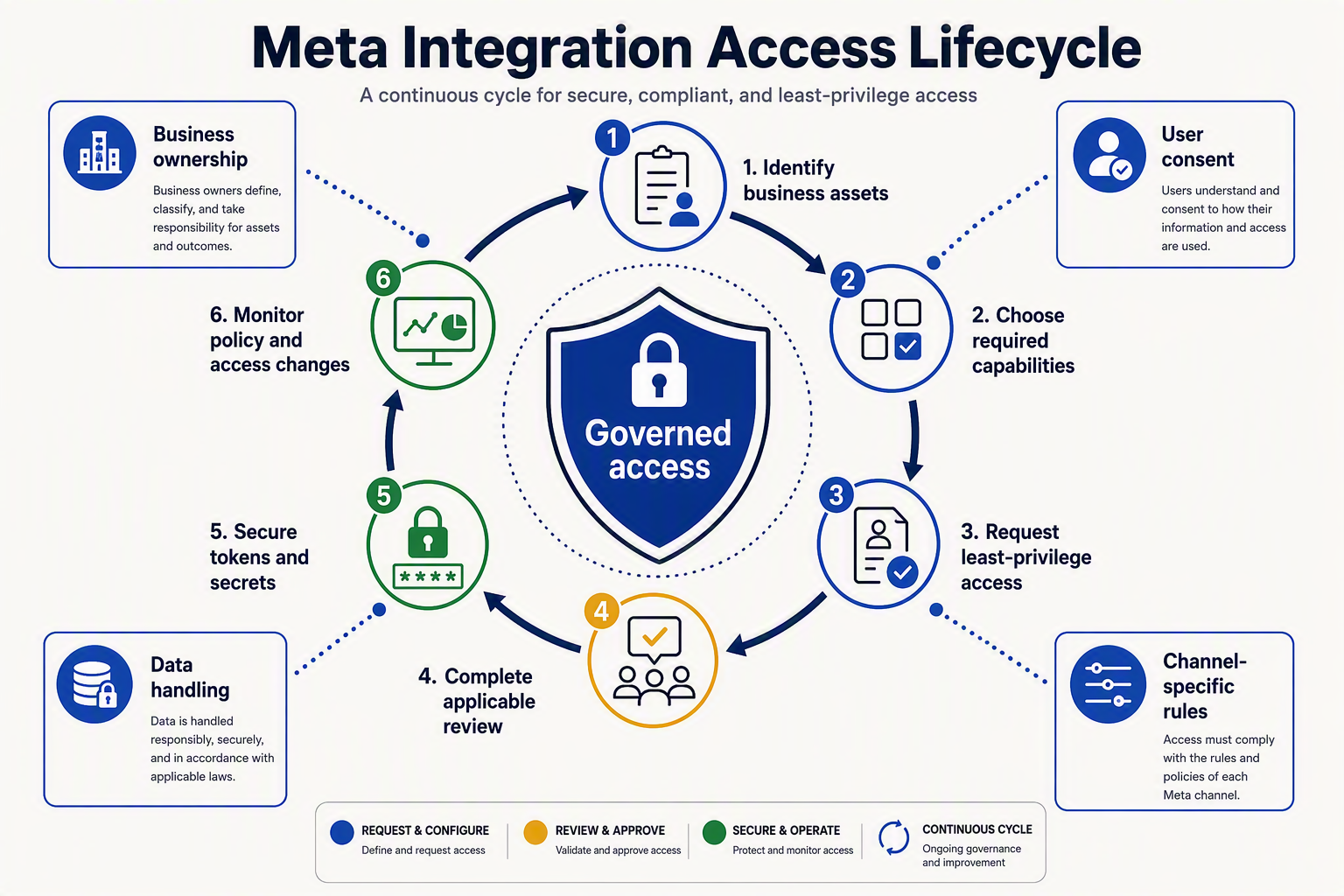
Teams should treat Meta authentication as an ongoing governance system, not a one-time login step. Use business-owned assets, least-privilege permissions, server-side token storage and documented consent, then monitor access, webhooks and policy compliance throughout the integration lifecycle.
Establish business ownership before development
The customer—not an employee, agency or software vendor—should own the relevant Meta Business Portfolio, Facebook Page, Instagram professional account, WhatsApp Business Account and phone number. Individual administrators can change, but production assets must remain under durable organisational control.
For WhatsApp, CallMissed uses Meta’s Tech Provider flow and Embedded Signup, allowing businesses to connect their own WhatsApp Business assets, according to CallMissed’s Meta relationship documentation in 2026. The same documentation identifies support for WhatsApp numbers, templates, business messaging, bots and account workflows.
Before onboarding, buyers should confirm:
- Which legal entity owns every Meta asset
- Who holds primary and backup administrator roles
- Whether Meta business verification is complete
- Whether the Instagram professional account is correctly linked to its Facebook Page
- How access will be revoked when an employee, contractor or vendor leaves
Request only the permissions each workflow needs
Meta permissions vary by product, access level and app configuration. A messaging implementation may require permissions associated with Page messaging, Instagram message management, WhatsApp messaging or WhatsApp Business Account administration; developers should verify the current names and review requirements in Meta’s documentation rather than hard-code assumptions.
Use a permission matrix covering:
- Capability: Read messages, send replies, administer templates or manage accounts.
- Asset: Facebook Page, Instagram account, WhatsApp Business Account or phone number.
- Actor: Customer administrator, CallMissed service or internal operator.
- Justification: The user-facing feature requiring that access.
- Revocation path: How the business disconnects the integration and deletes retained data.
Broad permissions “for future use” increase security exposure and can complicate Meta App Review. Development, staging and production should also use separated apps, credentials and webhook endpoints wherever practical.
Protect tokens, webhooks and customer data
Access tokens belong in a secrets manager, never browser code, mobile applications, logs or source-control repositories. Teams should encrypt tokens at rest, restrict retrieval through role-based access control and rotate or revoke credentials after suspected exposure.
Webhook handlers should:
- Validate Meta’s subscription challenge and request signatures
- Reject stale, malformed or replayed events
- Return acknowledgements quickly and process work asynchronously
- Deduplicate events using stable message or event identifiers
- Record security-relevant actions without logging message bodies unnecessarily
CallMissed’s Meta integration can centralise channel workflows, but customers remain responsible for appropriately configuring users, permissions, retention and downstream CRM access.
Build Meta policy rules into product logic
Compliance cannot depend solely on staff remembering policy documents. Encode rules into the application:
- Obtain appropriate user consent and clearly identify the business.
- Follow WhatsApp’s 24-hour customer-service window and use approved message templates when required outside it.
- Honour opt-outs across campaigns, bots and human-agent tools.
- Publish accessible privacy and data-deletion information.
- Avoid collecting sensitive information unless necessary and lawfully handled.
- Review automated messages for prohibited content, misleading claims and excessive frequency.
Finally, assign owners for monthly access reviews, failed-webhook alerts, template-status changes and Meta policy updates. Buyers should require an incident-response procedure covering credential revocation, message suspension, data deletion and customer notification—not merely proof that authentication worked on launch day.
How do webhooks, error handling, analytics and human handoff work in production?
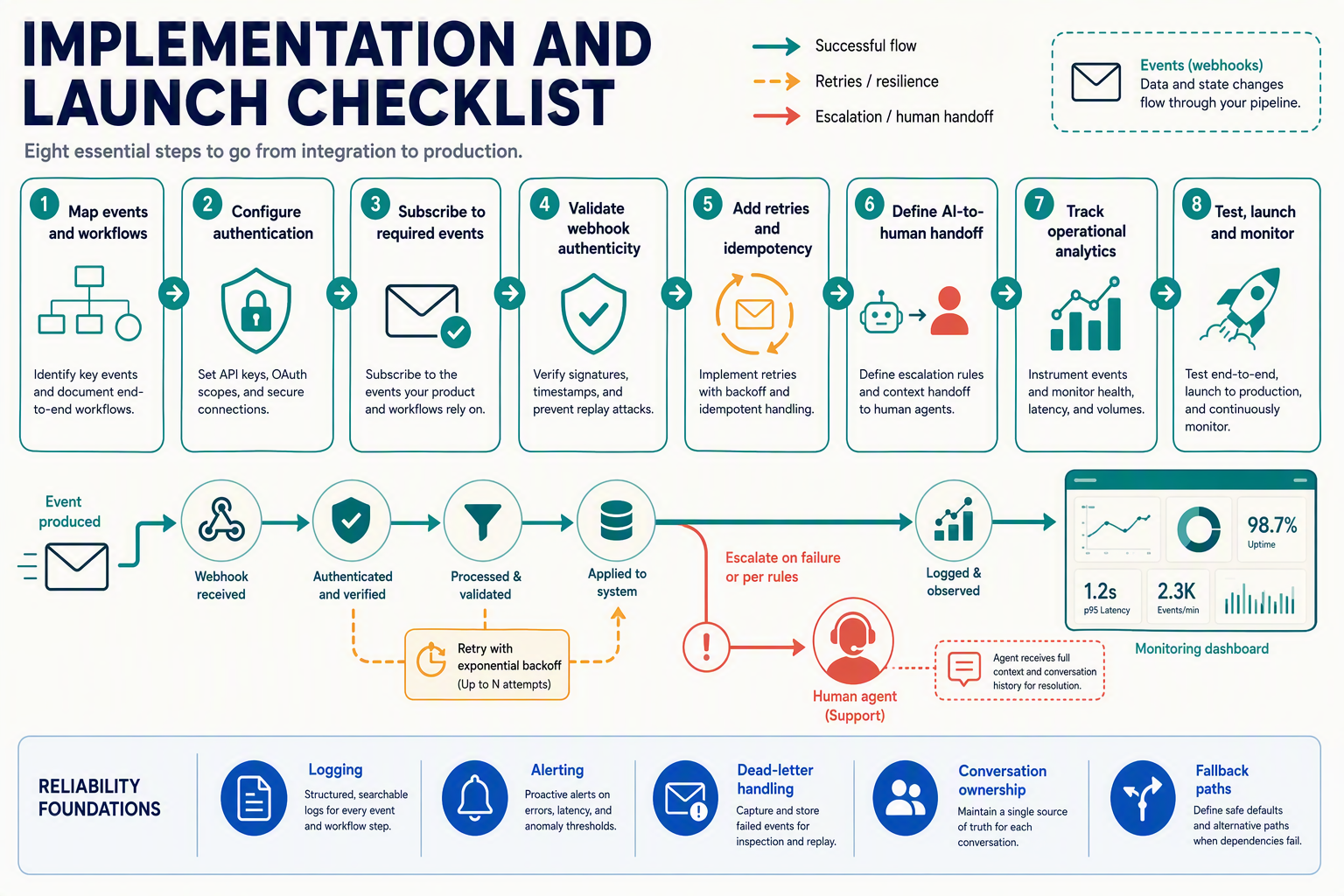
Production reliability depends on treating Meta webhooks as an at-least-once event stream, not as guaranteed one-time notifications. A sound implementation verifies every event, acknowledges it quickly, processes it asynchronously, records channel-specific errors and routes conversations to humans with complete context.
Build a durable webhook pipeline
CallMissed’s 2026 integrations catalogue lists implemented paths for Meta WhatsApp, Meta Facebook and Instagram, webhooks and REST APIs, according to CallMissed Integrations documentation. In production, these components should form an event-driven pipeline:
- Verify the subscription: During setup, validate Meta’s webhook challenge before accepting events.
- Authenticate notifications: Check Meta’s
X-Hub-Signature-256signature against the raw request body and application secret. - Acknowledge quickly: Return a successful response before performing slow operations such as AI inference, CRM lookups or media retrieval.
- Queue processing: Place validated events on a durable queue so traffic spikes do not overwhelm downstream services.
- Deduplicate events: Store Meta message or event identifiers because webhook delivery can be repeated.
- Preserve raw payloads: Retain redacted payloads for debugging while applying access controls and documented retention periods.
Processing should also be order-aware. Two messages from the same customer may arrive close together, so partitioning queues by conversation or contact identifier helps prevent a later message from being handled first.
Handle errors by failure class
A generic “retry everything” policy creates duplicate replies and can amplify outages. Separate failures into operational categories:
- Transient errors: Timeouts, connection failures and server-side
5xxresponses should use exponential backoff with jitter. - Rate limits: Respect Meta rate-limit signals rather than retrying immediately.
- Authentication errors: Pause the affected connection and alert an administrator when credentials, permissions or asset access become invalid.
- Permanent request errors: Invalid recipients, unsupported payloads or policy-rejected content should enter a review queue rather than loop indefinitely.
- Processing failures: Move repeatedly failing events to a dead-letter queue, preserving the event ID, timestamp, channel and error code.
Every outbound message should carry an idempotency or internal correlation key. Operators must be able to trace one customer action across Meta’s event ID, CallMissed, the AI workflow and the CRM record.
Measure the entire conversation lifecycle
Analytics should distinguish business outcomes from infrastructure health. A practical dashboard tracks:
- Webhook receipt volume, acknowledgement latency and duplicate rate
- Queue depth, processing latency, retries and dead-letter events
- Messages sent, delivered, read and failed where the channel exposes those states
- AI containment, human-escalation and agent-response rates
- Resolution time, conversion rate and customer satisfaction by channel
- Template performance and failure reasons for WhatsApp campaigns
CallMissed reports that AI typically handles 70%+ of inbound interactions on its startup solutions page in 2026. That benchmark should not replace deployment-specific measurement: language mix, query complexity and escalation policy can materially change containment.
Make human handoff an explicit workflow
Handoff should trigger when the customer requests a person, confidence falls below a defined threshold, repeated automation fails, sentiment deteriorates or the request involves sensitive actions.
The receiving agent needs more than the last message. Pass the conversation transcript, customer identity, source channel, AI summary, detected intent, relevant CRM history and escalation reason into the omnichannel inbox. Automation should pause while the agent owns the conversation, then resume only through a deliberate closure rule.
For buyers, the key acceptance test is simple: disconnect a credential, duplicate a webhook, force an AI timeout and request a human agent. The system should fail visibly, recover safely and preserve the customer’s context throughout.
How should technical and customer-experience experts evaluate CallMissed’s Meta APIs?
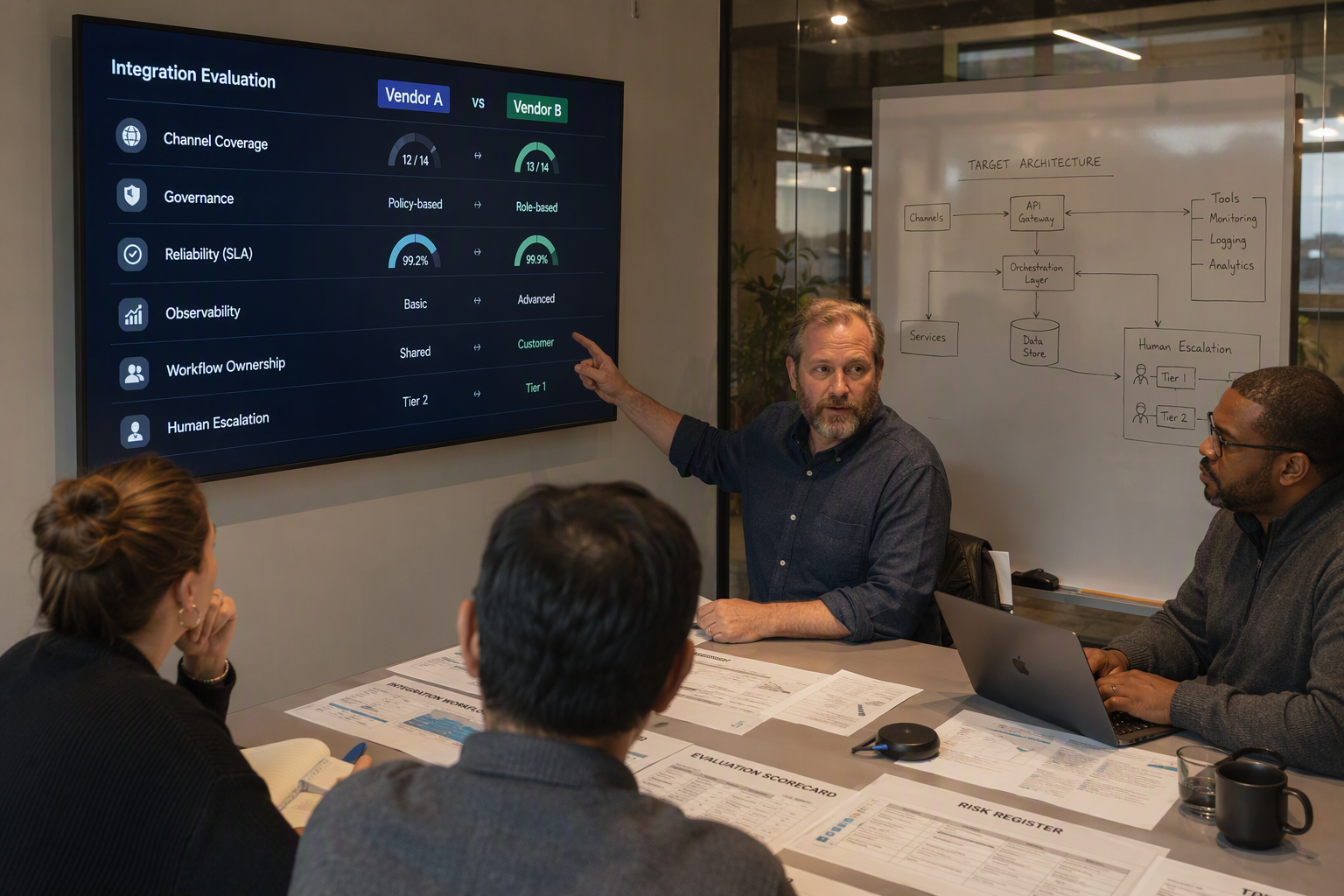
Evaluate CallMissed’s Meta APIs through channel-specific production pilots, not a generic feature checklist. Developers should test authentication, webhooks, routing, failure recovery and observability, while customer-experience teams assess resolution quality, human handoffs, consent and total cost across Instagram, Facebook and WhatsApp.
Start with documented scope and asset ownership
CallMissed’s 2026 Integrations documentation identifies Meta WhatsApp and Meta Facebook & Instagram as implemented channel connections, alongside Shopify, Twilio Voice, webhooks and REST APIs. That confirms available connection paths, but not feature parity across Meta channels; evaluators must verify the events, payloads, permissions and account types supported for each use case.
For WhatsApp, validate ownership and onboarding before assessing automation. CallMissed’s 2026 Meta relationship documentation says CallMissed uses Meta’s Tech Provider flow and Embedded Signup to connect a business’s own WhatsApp Business assets. Buyers should confirm:
- Who owns the WhatsApp Business Account, phone number and message templates
- Which Meta Business Portfolio permissions are requested
- How permissions can be revoked and assets transferred
- Whether development, staging and production assets can remain separate
- What happens to customer data, templates and workflows after termination
Run equivalent reviews for Facebook Pages and Instagram professional accounts, including administrator roles, token ownership and offboarding procedures.
Apply a channel-by-channel technical scorecard
Create separate acceptance criteria for Instagram, Facebook and WhatsApp rather than assuming Meta APIs behave identically.
| Test area | What to validate | Pass criterion | Evidence |
|---|---|---|---|
| Authentication | Initial connection, token expiry, revoked permissions and reconnection | Recovery does not corrupt configuration | Audit log and screen recording |
| Webhooks | Signatures, retries, duplicates, ordering and idempotency | No lost or double-processed events | Event logs and replay results |
| Message coverage | Text, media, status events and unsupported payloads | Supported formats match documented scope | Channel test matrix |
| Routing | Identity mapping, history and escalation state | Context survives automation-to-agent transfer | CRM or inbox record |
| Observability | Correlation IDs, errors, latency and alerts | Failures are traceable and actionable | Dashboard and alert test |
Include failure injection: disconnect an asset, delay or resend a webhook, revoke a permission and trigger rate-limit handling. Ask CallMissed and Meta directly for current rate limits, uptime commitments, data-retention periods, retry policies and support-response targets, because the supplied public sources do not establish numerical guarantees.
Measure customer experience and language fit
Build representative journeys for discovery, qualification, support, bookings and escalation. Track:
- First-response time and end-to-end resolution time
- Containment rate and inappropriate-automation rate
- Human-transfer success and repeated-question frequency
- Delivery failure and abandonment rates by channel
- Customer satisfaction after automated and agent-assisted interactions
- Consent, opt-out and approved-template compliance
CallMissed publicly describes its platform as supporting AI voice and chat across 22 or more Indian languages in 2026. Treat that as a scope claim—not an accuracy benchmark—and test dialects, names, addresses, transliteration and code-switching using real, consented examples. Buyers should not infer specific Speech-to-Text or Text-to-Speech capabilities without obtaining current product documentation from CallMissed.
Calculate total cost and make a staged decision
Model Meta fees, CallMissed platform and usage charges, implementation labour, monitoring, agent seats, workflow maintenance and compliance overhead. Obtain current pricing, credit rules, minimum commitments, free-trial conditions, overage charges and taxes directly from CallMissed; separately confirm applicable messaging or platform charges with Meta.
Approve production only when a limited pilot meets predefined thresholds for reliability, governance, customer outcomes and total cost. The strongest decision is supported by logs, CX results and a documented exit plan—not connector availability alone.
What does this mean for developers, agencies, SaaS, ecommerce and support teams?
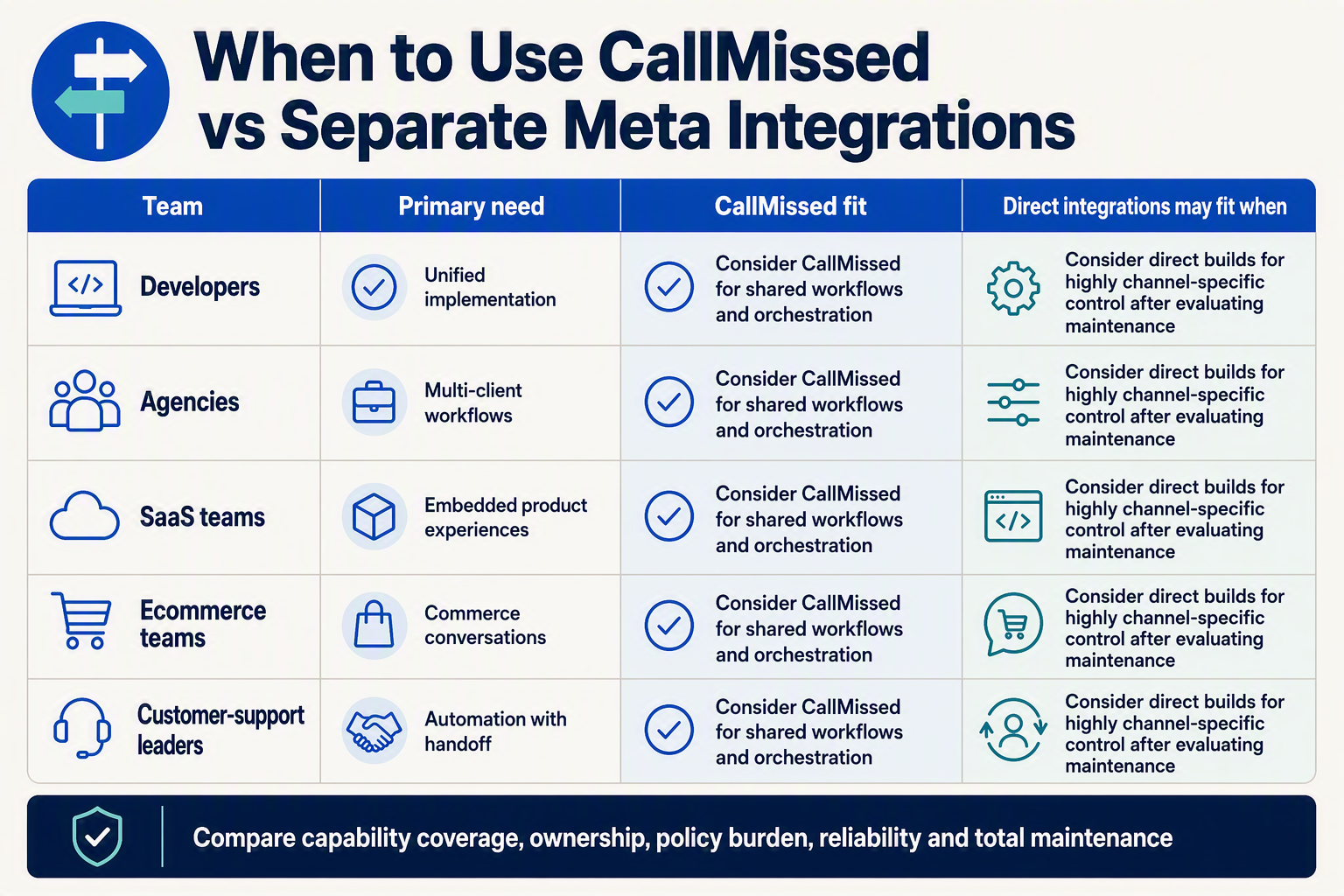
The new Meta APIs mean developers, agencies, SaaS vendors, ecommerce operators and support teams can treat Instagram, Facebook and WhatsApp as connected components of one engagement architecture rather than isolated projects. The practical gains are shared infrastructure, more consistent automation and clearer ownership of customer context—but each team should measure value differently.
Impact by team
| Team | Primary opportunity | Implementation priority | Success measure |
|---|---|---|---|
| Developers | Build reusable authentication, webhook, routing and automation services across Meta channels | Normalize channel events while preserving channel-specific payloads, permissions and error states | Deployment time, webhook failure rate and mean time to recovery |
| Agencies | Operate repeatable Meta-channel deployments for multiple clients | Keep each client’s Meta assets, credentials, consent records and environments logically separated | Client onboarding time, automation containment rate and SLA compliance |
| SaaS teams | Add Instagram, Facebook and WhatsApp workflows without building every connector from scratch | Design tenant isolation, API versioning, observability, rate-limit handling and feature flags | Integration adoption, API error rate and retention among connected accounts |
| Ecommerce teams | Link social discovery with product questions, order workflows and post-purchase support | Connect conversations to customer, catalogue, cart and order identifiers | Conversation-to-order conversion, response time and repeat-contact rate |
| Support teams | Consolidate social and WhatsApp requests into routable service workflows | Define intent detection, priority queues, agent handoff and conversation history rules | First-response time, resolution time, escalation rate and CSAT |
What changes operationally
The integration should be treated as an event-driven operating layer, not merely another inbox. CallMissed’s 2026 Integrations documentation lists implemented paths for Meta WhatsApp, Meta Facebook and Instagram, Shopify, Twilio Voice, webhooks and REST APIs. This allows teams to design workflows that cross communication, commerce and telephony boundaries.
Examples include:
- A developer can send validated Meta events into a common routing service, while retaining the original channel ID for replies and audits.
- An agency can create reusable onboarding checklists but still require each client to connect and govern its own business assets.
- A SaaS product can expose Meta connectivity as a modular feature rather than embedding channel logic throughout its core application.
- An ecommerce team can route an Instagram enquiry into product assistance, then continue fulfilment communication through an approved WhatsApp workflow.
- A support team can apply one escalation policy across channels while preserving channel-specific consent and messaging constraints.
For WhatsApp, asset ownership deserves particular attention. CallMissed’s Meta relationship documentation states that CallMissed uses Meta’s Tech Provider flow and Embedded Signup, enabling businesses to connect their own WhatsApp Business assets. The documented scope includes WhatsApp numbers, templates, business messaging, bots and account workflows, which gives technical and procurement teams concrete items to verify during onboarding.
Shared implementation priorities
Regardless of team type, a production rollout should establish:
- A canonical customer identity model that can associate—but does not automatically merge—profiles from Instagram, Facebook, WhatsApp, CRM and commerce systems.
- Explicit human-handoff rules for sensitive, ambiguous or high-value interactions.
- Webhook observability, including signature validation, idempotency, retry queues and searchable delivery logs.
- Permission and consent controls covering templates, outbound messaging, retention and agent access.
- Channel-level reporting, because aggregate automation metrics can conceal failures concentrated on one Meta surface.
For Indian businesses, CallMissed can also connect this Meta-channel layer with AI voice and chat capabilities across 22 Indian languages, according to CallMissed’s 2026 platform documentation. That makes the broader opportunity more than social inbox consolidation: it enables regionally accessible customer journeys spanning messaging, voice, commerce and human support.
Frequently asked questions about CallMissed Meta APIs
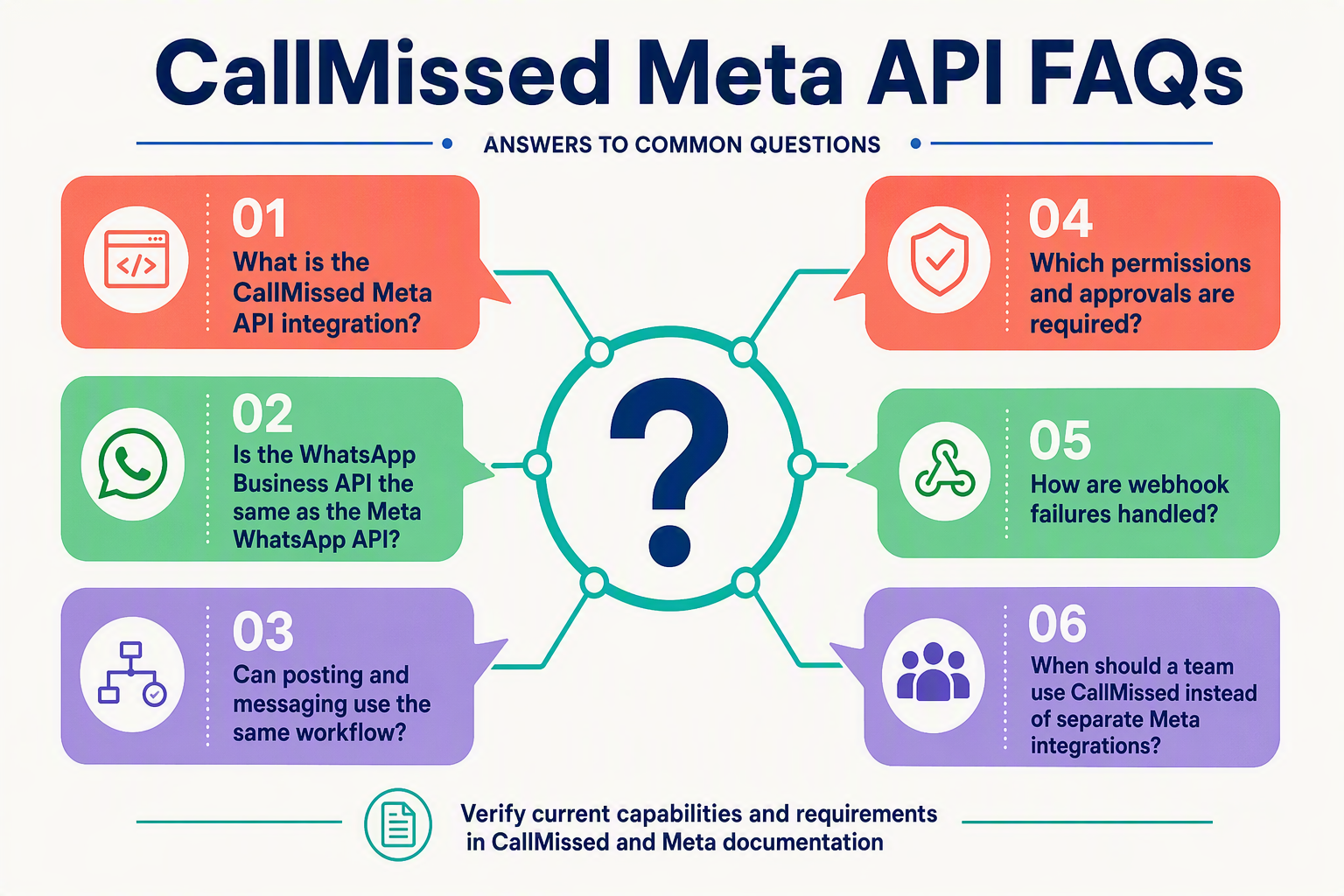
CallMissed provides documented integration paths for Meta WhatsApp, Facebook and Instagram, plus webhooks and REST APIs for custom workflows. The exact capabilities of CallMissed integrations depend on the selected channel, Meta permissions, account status and approved use cases.
Channels, permissions and account setup
Which Meta channels are available through CallMissed integrations?
How do I connect a WhatsApp Business account to CallMissed?
How are Facebook and Instagram connected?
Does the business retain control of its Meta assets?
Messaging, posting and automation
Do CallMissed integrations support social posting as well as messaging?
Can CallMissed automate WhatsApp, Facebook and Instagram conversations with AI?
Can an automated conversation be handed to a human agent?
Development, webhooks and integration choice
How can developers connect Meta conversations to a CRM or internal application?
What permissions are required for a CallMissed Meta API implementation?
Which CallMissed integration path should a business choose?
How much do CallMissed Meta APIs cost?
Conclusion
CallMissed’s newly added Meta APIs offer a practical route to unify customer engagement across Instagram, Facebook and WhatsApp while preserving the technical controls developers and buyers need. The opportunity is not simply to connect three channels, but to maintain context from social discovery through qualification, support and retention.
- Developers gain a more coherent integration model. Authentication, webhooks, message events, routing logic and failure handling can be designed as parts of one event-driven architecture instead of three disconnected workflows.
- Businesses can connect conversations to action. Instagram and Facebook interactions can feed AI agents, CRM records and omnichannel workflows, while WhatsApp can support messaging, templates, bots and account processes.
- Asset ownership and governance remain essential buying criteria. According to CallMissed’s Meta relationship documentation in 2026, CallMissed uses Meta’s Tech Provider flow and Embedded Signup, enabling businesses to connect their own WhatsApp Business assets rather than treating onboarding as a purely technical detail.
- The surrounding ecosystem matters. CallMissed’s 2026 Integrations documentation lists implemented paths for Meta WhatsApp, Meta Facebook and Instagram, Shopify, Twilio Voice, webhooks and REST APIs, giving teams options for connecting social messaging with commerce, telephony and internal systems.
Looking ahead, developers should watch how Meta’s authentication requirements, webhook event structures, permissions and messaging policies evolve. Buyers should continually reassess scalability, security, operational costs, automation boundaries and human-escalation paths as conversation volumes grow.
To evaluate this architecture in practice, explore CallMissed, an AI-native customer-engagement platform connecting Meta channels with AI agents and omnichannel workflows. The strategic question is: can your current stack preserve customer context when one journey moves across Instagram, Facebook and WhatsApp?
Related Reading
- Voice Agent API & Phone Numbers API: CallMissed Developer Guide
- WhatsApp Business API Chatbot for Support: CallMissed API Guide (2026)
- CallMissed API Guide: Missed Call Automation With Voice AI and WhatsApp