
AI Agent Human Handoff: CallMissed Escalation Guide for 2026


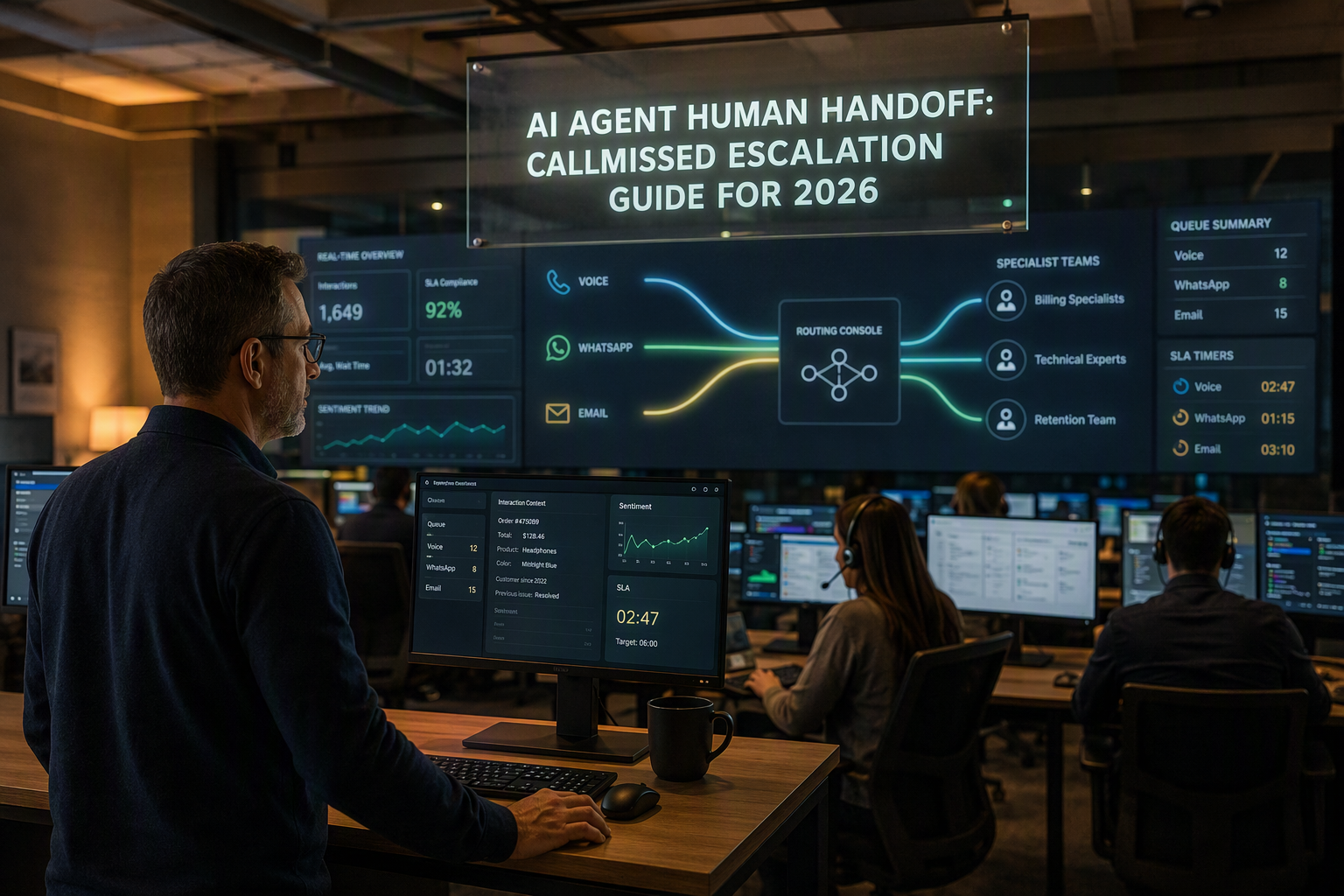
Build an AI agent human handoff workflow in CallMissed with channel triggers, queue ownership, context, SLAs, testing, recovery, and KPIs.
AI Agent Human Handoff: CallMissed Escalation Guide for 2026
What happens when an AI agent confidently mishandles the one conversation that required a person? An effective AI agent human handoff prevents that failure by recognizing risk, preserving context, and moving the customer to the right human owner before trust is lost. In 2026, the goal is no longer to automate every interaction; it is to automate routine work while making escalation fast, deliberate, and measurable.
The urgency is growing as AI assumes more service volume. Salesforce reported in its 2025 State of Service research that service teams expect AI to handle 50% of customer-service cases by 2027, up from 30% at the time of the study. Gartner predicted in 2025 that agentic AI could autonomously resolve 80% of common customer-service issues by 2029. As this share increases, contact center automation needs stronger safeguards for payment disputes, account access, legal threats, medical concerns, cancellations, vulnerable customers, repeated failures, and emotionally charged conversations.
A reliable AI escalation workflow therefore goes beyond adding a “talk to a person” button. It combines explicit customer requests with sentiment, intent, confidence, repetition, policy, and operational signals. It also distinguishes a basic live agent handoff from a warm transfer: where channel capabilities support it, the receiving employee should get the customer’s identity, conversation history, detected intent, actions already attempted, and reason for escalation—not a blank screen and a frustrated customer forced to start again.
This operations guide explains how to design customer service escalation across CallMissed voice agents, WhatsApp interactions, and email workflows, including:
- Trigger rules for negative sentiment, low-confidence answers, repeated requests, high-risk intents, and customer-selected escalation.
- Queue ownership, routing priorities, service-level agreements, after-hours recovery, and fallback paths when no agent is available.
- Concise context summaries that separate verified facts from AI-generated interpretations.
- Audit logs, test scenarios, failure recovery, and KPIs such as escalation rate, transfer acceptance, queue time, repeat-contact rate, and post-handoff resolution.
CallMissed brings voice, WhatsApp, email, CRM-style inboxes, and knowledge-base retrieval into one engagement platform, giving Indian businesses a practical foundation for multilingual human in the loop AI across 22 Indian languages.
The result is a blueprint for AI agent orchestration that treats escalation as part of customer-experience design rather than an automation failure. Done well, the AI handles speed and scale while people retain judgment, empathy, accountability, and control when those qualities matter most.
Introduction: How should AI agent human handoff work in CallMissed in 2026?
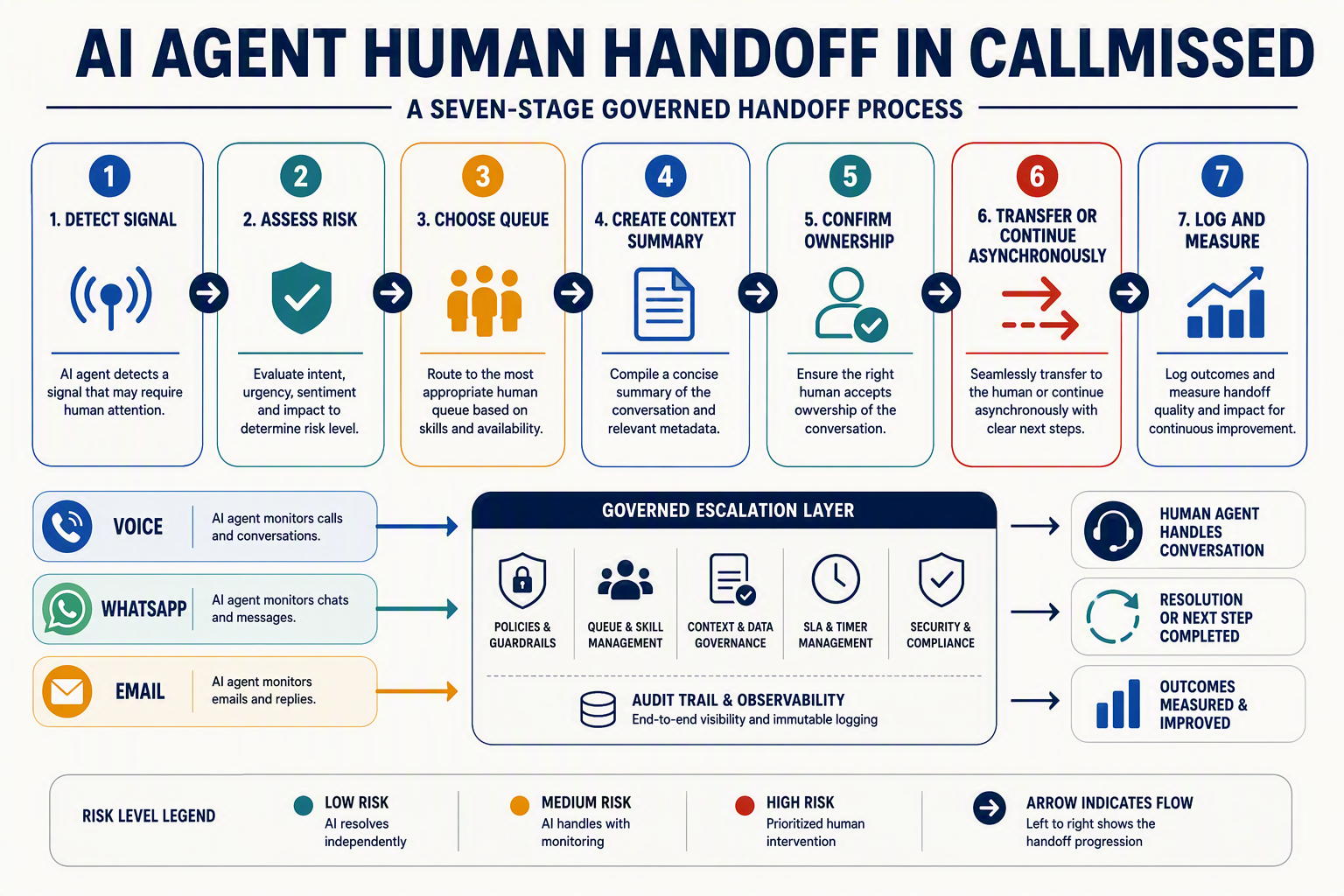
An AI agent human handoff in CallMissed should work as a controlled transition: detect when automation is unsafe or unhelpful, route the interaction to an accountable owner, and deliver enough verified context for that person to continue without restarting the conversation. The operating principle for 2026 is simple: automate predictable work, escalate consequential uncertainty.
Treat handoff as a customer journey, not an error state
Escalation should be designed before an AI agent goes live—not added after difficult conversations begin failing. This matters as service automation expands: Salesforce’s 2025 State of Service research found that service teams expect AI to handle 50% of customer-service cases by 2027, compared with 30% at the time of the study.
Every CallMissed workflow should define three possible outcomes:
- AI resolution: The agent completes a low-risk request with sufficient confidence.
- Assisted resolution: A person reviews, approves, or supplies information while the AI remains involved.
- Human ownership: A live agent handoff transfers responsibility to a named team or queue.
This is human in the loop AI in operational terms: people intervene according to defined risk, confidence, and accountability rules rather than monitoring every interaction.
Use layered escalation triggers
A dependable AI escalation workflow should evaluate multiple signals instead of relying on a single sentiment score. Trigger categories should include:
- Explicit requests: “Connect me to an agent,” “I want to speak to a manager,” or equivalent requests in supported languages.
- Intent signals: Refund disputes, cancellation requests, suspected fraud, account compromise, legal notices, medical concerns, or threats of self-harm.
- Conversation signals: Repeated questions, unsuccessful authentication, conflicting answers, prolonged silence on voice, or several failed knowledge-base searches.
- Sentiment signals: Sustained anger, distress, urgency, or rapid deterioration—not merely one negative phrase.
- Operational signals: An unavailable tool, failed payment action, missing customer record, model timeout, or unsupported request.
High-risk intent should override positive sentiment. A calm customer reporting unauthorized account activity still requires immediate customer service escalation.
Adapt the transfer to each channel
The escalation experience must reflect channel constraints:
- Voice: Announce the transfer, explain any expected wait, and avoid disconnecting the caller while routing is attempted.
- WhatsApp: Confirm that a person will respond, preserve the message thread, and set an accurate response-time expectation.
- Email: Assign an owner, retain the original message and attachments, and prevent duplicate automated replies after escalation.
Where channel and routing capabilities support it, use a warm transfer: provide the receiving employee with identity details, detected intent, verified facts, actions attempted, and the escalation reason. AI-generated interpretations should be clearly labelled rather than presented as customer-confirmed facts.
Make orchestration measurable
Effective contact center automation needs queue ownership, service-level targets, after-hours fallbacks, transfer-acceptance tracking, and complete audit logs. Gartner predicted in 2025 that agentic AI could autonomously resolve 80% of common customer-service issues by 2029, making escalation governance increasingly important.
CallMissed supports AI agent orchestration across voice, WhatsApp, email, and a CRM-style inbox, with multilingual engagement across 22 Indian languages. The objective is not zero escalations; it is timely escalation with preserved context, clear accountability, and minimal customer effort.
Background & Context: Why does contact center automation still need human oversight?

Contact center automation still needs human oversight because AI can accelerate decisions without owning their consequences. AI agents are effective at routine, well-defined requests, but people remain essential when evidence is incomplete, policy exceptions arise, or a decision could materially affect a customer.
Automation creates scale—and concentrates risk
Modern agents generate responses probabilistically, infer intent from imperfect signals, and depend on the accuracy of connected knowledge bases and business systems. A fluent answer may therefore be outdated, unsupported, or inappropriate for the customer’s circumstances.
The growing volume handled by AI increases the operational impact of these limitations. Salesforce reported in its 2025 State of Service research that service teams expect AI to handle 50% of customer-service cases by 2027, compared with 30% at the time of the study. An error affecting one automated workflow can consequently reach far more customers than an isolated employee mistake.
Human review is especially important when a conversation involves:
- Financial impact: disputed payments, refunds, debt, suspected fraud, or irreversible purchases.
- Identity and security: account recovery, unauthorized access, credential changes, or sensitive-data requests.
- Safety and vulnerability: medical concerns, threats of self-harm, harassment, or customers who may need additional support.
- Legal or regulatory exposure: formal complaints, legal threats, consent withdrawal, or data-deletion requests.
- Commercial exceptions: unusual cancellations, negotiated commitments, or requests outside published policy.
These categories should not depend on negative sentiment alone. A calm customer reporting account takeover may require a faster customer service escalation than an angry customer asking about delivery status.
AI cannot see every part of the situation
Channel conditions also affect what an agent can reliably infer. A voice agent must interpret speech, interruptions, silence, and accents in real time. A WhatsApp conversation may combine text, images, voice notes, and earlier messages. Email is asynchronous, often long-form, and can contain forwarded threads or attachments that change the apparent intent.
Even strong multilingual systems can encounter code-switching, regional expressions, sarcasm, background noise, or ambiguous phrasing. For Indian businesses, this is why human in the loop AI must account for language and channel—not merely apply one universal confidence threshold. CallMissed supports voice and chat across 22 Indian languages, providing a multilingual foundation, while escalation policy determines when automation should yield control.
Oversight should be designed, not improvised
A robust AI escalation workflow assigns clear authority before an incident occurs. Operations teams should define:
- What the AI may resolve independently.
- Which signals require clarification or verification.
- Which intents trigger an immediate live agent handoff.
- Which queue owns each escalation and within what SLA.
- What happens when no qualified employee is available.
This is the core of responsible AI agent orchestration: automation handles repeatable work, while people retain authority over exceptions and consequential decisions.
An effective AI agent human handoff is therefore not evidence that automation failed. It is an intentional control within the service architecture. Where channel capabilities permit a warm transfer, the human should receive the relevant history, verified customer details, attempted actions, and escalation reason—reducing repetition without presenting AI interpretations as established facts.
Key Developments: What defines human in the loop AI and AI agent orchestration in 2026?
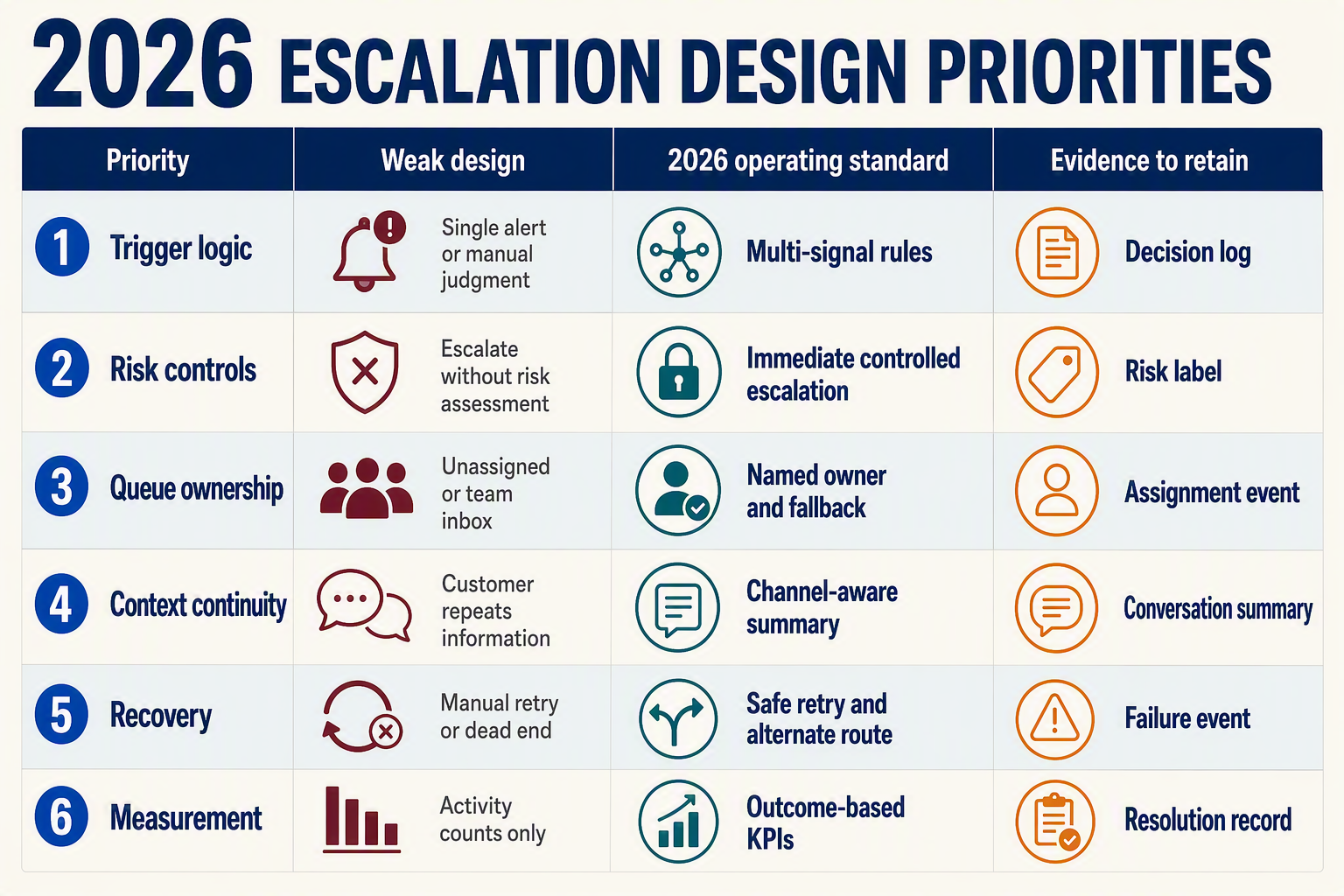
Human in the loop AI in 2026 is best treated as governed, risk-based intervention—not continuous human supervision. There is no single standard definition that mandates one handoff model. In practice, AI agent orchestration should define what an agent may do autonomously, which signals require review, how control transfers, and how the decision is recorded.
| 2026 development | What it means | Trigger examples | Required orchestration response | Operational measure |
|---|---|---|---|---|
| Multi-signal escalation | Routing considers validated combinations of signals rather than treating one keyword, sentiment label, or confidence score as conclusive. | Repeated failed answers plus an unresolved intent; uncertain identity plus an account-change request | Pause the affected action, evaluate policy and risk, and route to the appropriate queue | Escalation precision, missed-escalation rate, and unnecessary-transfer rate |
| Customer-requested handoff | A clear request for a person initiates the approved handoff path instead of forcing the customer through more automation. | “Human agent,” “call me,” or repeated refusal to continue with AI | Acknowledge the request, explain the available transfer or callback option, and create the handoff | Request-to-acknowledgement and request-to-queue time |
| Risk-gated autonomy | Permissions depend on the potential impact of an action, not only on predicted intent or model confidence. | Payment dispute, suspected fraud, legal complaint, safety concern, or irreversible account change | Prevent unapproved consequential action and route for authorised review | Blocked unauthorised actions and policy-compliant routing rate |
| Context-preserving transfer | The receiving employee gets a structured, source-labelled record of what happened before escalation. | Handoff after authentication, troubleshooting, policy retrieval, or a failed transaction | Pass verification status, customer statements, relevant history, attempted actions, and escalation reason | Context completeness and repeat-question rate |
| Channel-aware continuity | Handoff behavior reflects whether the channel and configured systems support synchronous transfer, asynchronous assignment, or callback | Voice agent unavailable; unassigned WhatsApp conversation; urgent email requiring specialist review | Use supported voice transfer, callback, inbox assignment, case routing, or an approved fallback | Queue time, callback completion, abandonment, and unassigned-case age |
| Auditable orchestration | Material decisions can be reconstructed for review, testing, incident response, and policy improvement. | Threshold crossed, route changed, tool call blocked, employee declined, or fallback activated | Record relevant inputs, policy and model versions, timestamps, actions, routing outcome, and human disposition | Audit coverage, override rate, and post-handoff resolution |
From deterministic rules to governed orchestration
Earlier contact center automation commonly used fixed branches: answer, retry, or transfer. A governed AI escalation workflow evaluates several categories of evidence:
- Explicit signals: a request for a person, cancellation demand, complaint, or refusal to continue.
- Conversation signals: repeated questions, failed verification, customer corrections, unresolved loops, or tool failures.
- Model-derived signals: intent classification, uncertainty indicators, and sentiment or emotion labels.
- Business signals: working hours, queue capacity, service-level targets, customer permissions, and applicable policy.
- Risk signals: possible financial loss, safety impact, privacy exposure, legal implications, or irreversible changes.
Model-derived signals should support—not independently decide—a consequential escalation or denial of service. Sentiment detection can be affected by context, sarcasm, code-switching, dialect, transcription quality, and short utterances. A model-provided confidence score also should not be treated as the probability that an answer is correct unless that interpretation has been validated for the specific model, language, channel, and use case.
The appropriate threshold must therefore be tested against representative traffic, including supported languages and common audio conditions. Teams should measure both unnecessary transfers and cases that should have been escalated but were not. They should also provide a deterministic route for explicit human requests and defined high-impact scenarios.
This approach is consistent with the voluntary NIST AI Risk Management Framework, which organises AI risk work around Govern, Map, Measure, and Manage, and the NIST Generative AI Profile, which provides generative-AI-specific risk-management actions. ISO/IEC 42001:2023 specifies requirements for an AI management system. Neither source prescribes a universal call-center threshold or guarantees that a particular sentiment model is reliable; organisations must define and validate controls for their own deployment.
Warm transfer becomes a context standard
A warm transfer should not be presented as a capability that works identically across every channel:
- Voice: A live warm transfer is possible only when the telephony and contact-center configuration supports consultation, conferencing, or transfer to an available employee. If it does not, the fallback may be a scheduled or queued callback.
- WhatsApp and other messaging: Continuity generally depends on the connected inbox, assignment rules, employee availability, and messaging-platform constraints. Reassignment can preserve the thread, but it is not the same as a synchronous voice transfer.
- Email: Handoff is normally asynchronous and should use case ownership, priority, service-level rules, and a complete conversation history.
- Unavailable queues: The system should disclose that an immediate transfer is unavailable and offer only configured alternatives, such as callback, message capture, or routing during service hours.
Regardless of channel, the handoff package should distinguish:
- Verified facts, including authentication status and confirmed transaction details.
- Customer statements, quoted or faithfully preserved without being presented as verified facts.
- AI-generated assessments, such as predicted intent, summary, or sentiment, clearly labelled as machine-generated.
- Actions attempted, including tool results, failures, approvals, and timestamps.
- Escalation reason, linked to the rule, risk condition, or customer request that caused the handoff.
- Suggested next step, labelled as guidance rather than a completed or authorised action.
Only information needed for the receiving employee’s task should be transferred, with access controlled according to the organisation’s privacy, security, and retention policies. When configuring an AI agent human handoff in CallMissed, teams should verify the capabilities of each enabled channel, telephony provider, inbox, and downstream integration rather than assuming that live transfer, queue assignment, or context synchronization is available in every configuration.
In-Depth Analysis: Which sentiment, intent, and event triggers belong in an AI escalation workflow?
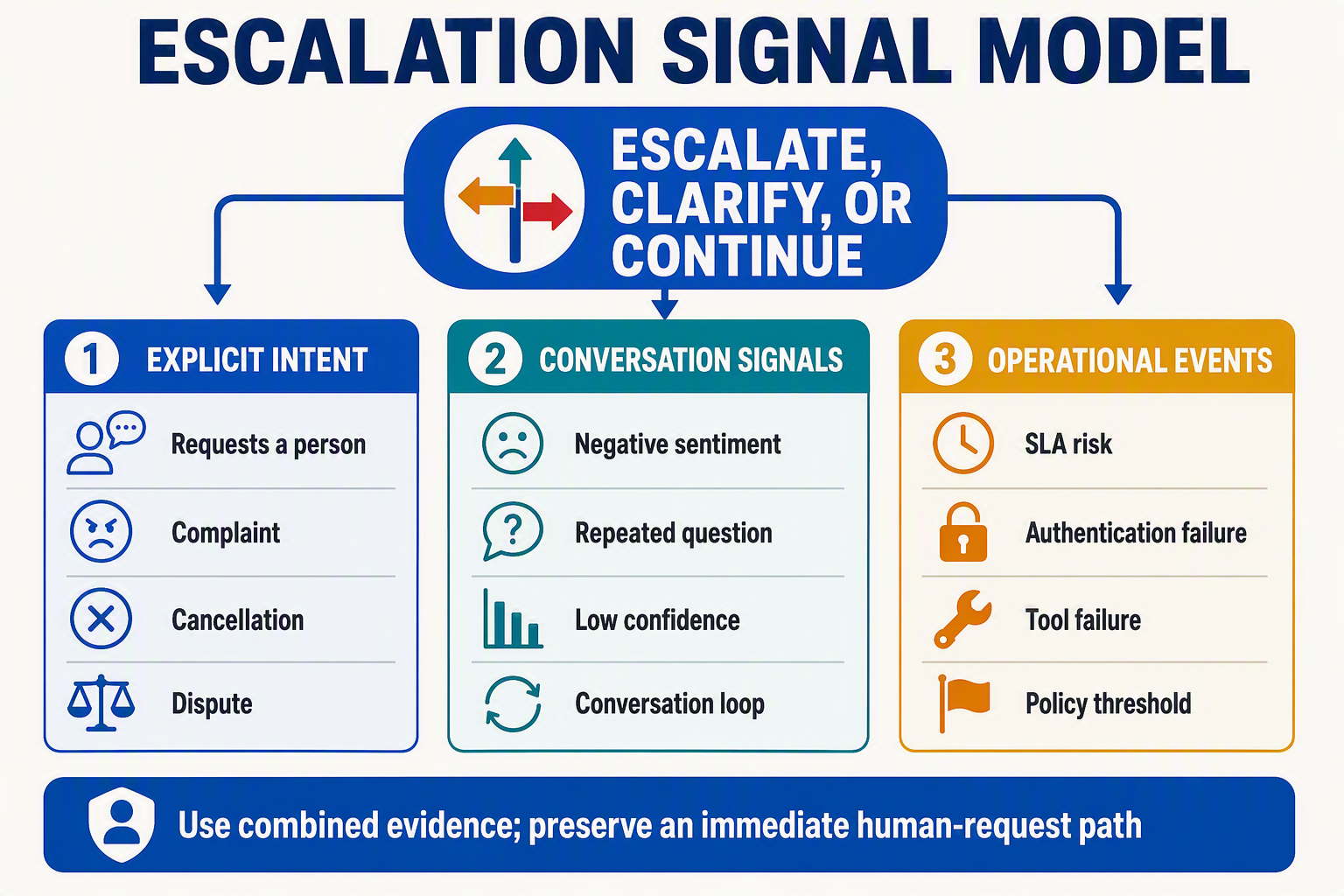
The strongest AI escalation workflow uses a hierarchy of triggers: explicit customer requests and high-risk events cause immediate escalation, while sentiment, intent, confidence, repetition, and operational conditions combine to identify less obvious cases. Sentiment alone should never determine an AI agent human handoff, because urgency, language variation, sarcasm, and transcription errors can distort a single score.
Use deterministic triggers for non-negotiable cases
Some signals should bypass scoring and initiate customer service escalation immediately:
- The customer asks for a “human,” “agent,” “manager,” or equivalent phrase in any supported language.
- The request concerns suspected fraud, an unauthorized payment, compromised credentials, or account takeover.
- The customer reports immediate physical danger, self-harm, a medical emergency, abuse, or another safety-critical situation.
- The conversation contains a legal notice, regulatory complaint, law-enforcement request, or threat of litigation.
- The requested action requires human authorization, such as exceptional refunds, identity overrides, contract changes, or disclosure of protected information.
- The AI detects that continuing would violate business policy or exceed its permitted tools.
These triggers require intent detection, not keyword matching alone. “I’m worried this transaction is fraudulent” and “How does your fraud detection work?” contain similar vocabulary but demand different actions.
Combine soft signals instead of trusting one model output
Lower-risk interactions should escalate when multiple warning signals accumulate. A practical trigger model evaluates:
- Negative sentiment: sustained anger, distress, fear, or distrust across multiple turns—not one impatient sentence.
- Low confidence: uncertain intent classification, conflicting retrieved documents, weak knowledge-base grounding, or an answer below the organization’s confidence threshold.
- Repeated failure: the customer rephrases the same question, rejects an answer, or returns to the same unresolved request.
- Tool failure: payment, CRM, booking, verification, or retrieval actions time out or return inconsistent results.
- Conversation drift: the AI repeatedly changes topics, contradicts itself, or cannot identify the requested outcome.
- Customer value and vulnerability: an unresolved service outage, time-sensitive journey, accessibility need, or other context makes delay disproportionately harmful.
For example, mild negative sentiment may not justify a live agent handoff. Mild negativity combined with two failed identity checks and a cancellation intent probably does.
Adapt event rules to each channel
Contact center automation needs channel-specific event triggers:
- Voice: long silence, repeated interruptions, poor Speech-to-Text confidence, dropped calls, or three unsuccessful clarification attempts.
- WhatsApp: repeated messages, failed interactive buttons, unsupported media, business-hours expiry, or a customer asking to continue by call.
- Email: legal language, executive complaints, unresolved reply chains, sensitive attachments, or an SLA deadline approaching without a confident draft.
CallMissed can support this human in the loop AI model across voice, WhatsApp, and email while accounting for interactions in 22 Indian languages. Thresholds should be tested separately by language and channel because transcript quality and expressions of frustration can differ substantially.
Make the escalation outcome explicit
Every trigger must map to an owner, priority, and fallback—not merely “send to human.” Where channel capabilities permit a warm transfer, AI agent orchestration should pass the customer identity, verified facts, detected intent, attempted actions, risk reason, and transcript summary. Voice may support a live bridge; WhatsApp and email more often use inbox assignment with contextual notes and an acknowledgement telling the customer what happens next.
When is a live agent handoff truly a warm transfer, and what must CallMissed verify?
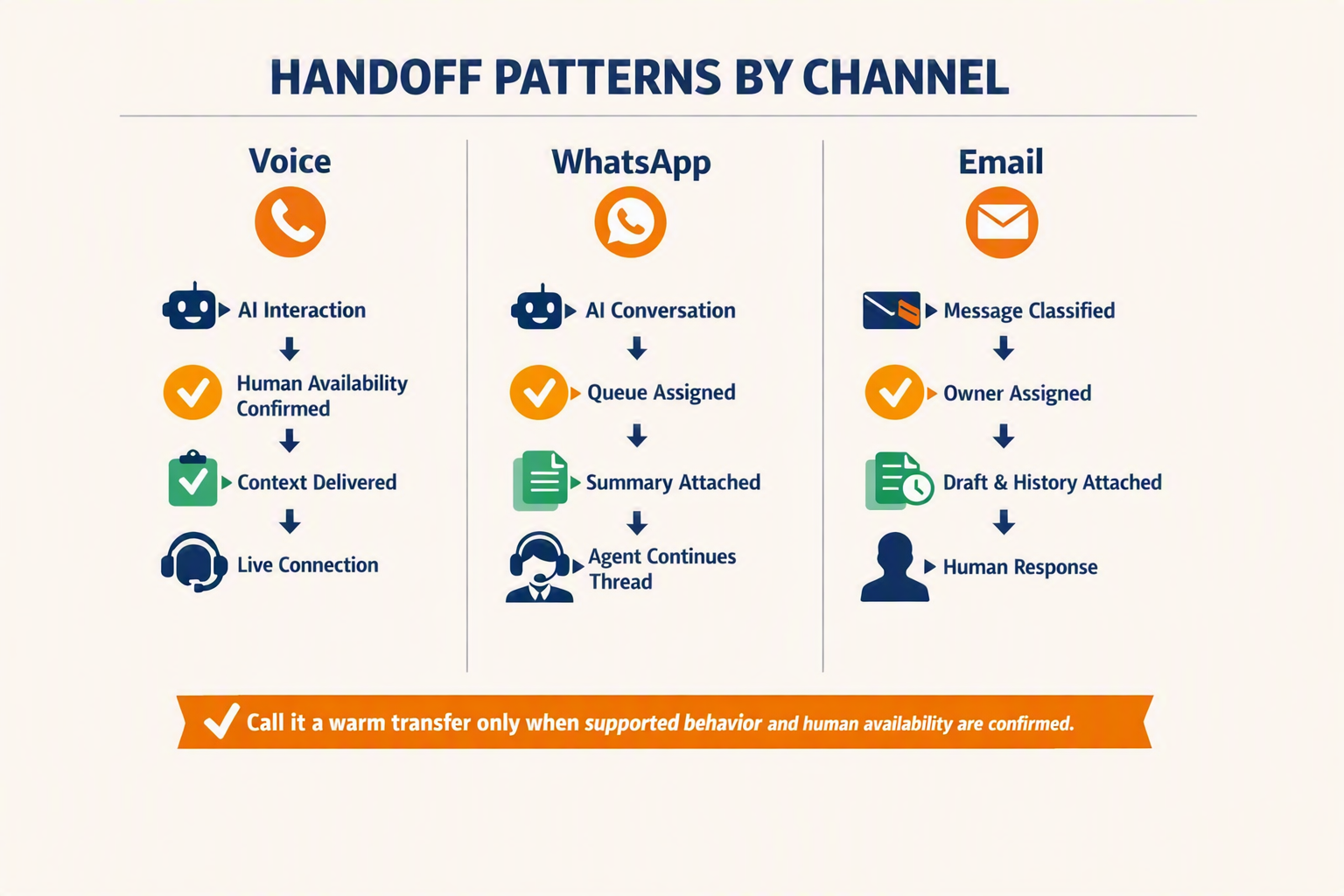
A live agent handoff is truly warm only when the receiving employee accepts ownership and receives usable context before engaging the customer. If the customer reaches a new queue, repeats the story, or waits without confirmed ownership, the interaction is a cold transfer—even if the transcript remains technically accessible.
Four conditions for a genuine warm transfer
CallMissed should classify an AI agent human handoff as warm only after verifying all four conditions:
- A human accepts the interaction. Routing the conversation to a queue is not acceptance. The system should record the assigned agent, acceptance timestamp, and any reassignment.
- Context arrives before customer engagement. The agent should see identity data, channel, detected intent, escalation reason, conversation summary, prior actions, and unresolved questions before speaking or replying.
- The transition is explained to the customer. The AI should state what will happen next, set an honest wait-time expectation, and avoid claiming that an agent is connected until acceptance is confirmed.
- Responsibility transfers without losing continuity. Once the human takes control, the AI should stop autonomous replies unless the workflow explicitly places it in an approved assistive role.
This distinction matters for human in the loop AI: human availability alone does not create oversight; the person needs authority, evidence, and sufficient context to act.
Warm transfer differs by channel
A correct AI escalation workflow must account for each channel’s mechanics:
- Voice: Where telephony capabilities support conferencing or bridged transfer, the AI can brief the agent privately, confirm acceptance, introduce the customer, and then leave the call. If the call disconnects and an employee calls back later, label the outcome as a callback—not a completed warm transfer.
- WhatsApp: A conversation can remain in the same thread while ownership changes. CallMissed should verify that the agent receives the transcript and summary, outbound messaging remains compliant with applicable WhatsApp Business rules, and duplicate AI replies are suppressed.
- Email: Email escalation is usually a context-preserving reassignment rather than a real-time transfer. Warmth comes from preserving the thread, assigning a named owner, passing internal notes, and communicating a realistic response deadline.
What CallMissed must verify before marking success
For every customer service escalation, the platform’s audit record should answer:
- What explicit request, sentiment signal, intent, confidence threshold, or policy rule triggered escalation?
- Was the customer’s identity verified, unverified, or disputed?
- Which facts came directly from the customer, and which conclusions were AI-generated?
- What troubleshooting, retrieval, or account actions were attempted?
- Which queue and employee received the interaction?
- Did that employee accept it within the applicable service-level agreement?
- Was the customer notified if no agent was available?
- Did the original channel remain intact, or was a callback or channel switch required?
- Did automation stop when human ownership began?
Sensitive information should not be copied indiscriminately into summaries. Payment credentials, authentication secrets, health details, and other restricted data should be masked or omitted according to the business’s policy.
Use precise operational labels
CallMissed should distinguish requested, queued, offered, accepted, connected, completed, declined, timed out, and recovered states. This gives contact center automation teams reliable denominators for transfer acceptance and failure analysis.
In effective AI agent orchestration, “warm transfer” is a verified outcome—not a reassuring phrase shown after the AI merely places the customer in a queue.
Impact & Implications: How should high-risk customer service escalation protect customers and the business?
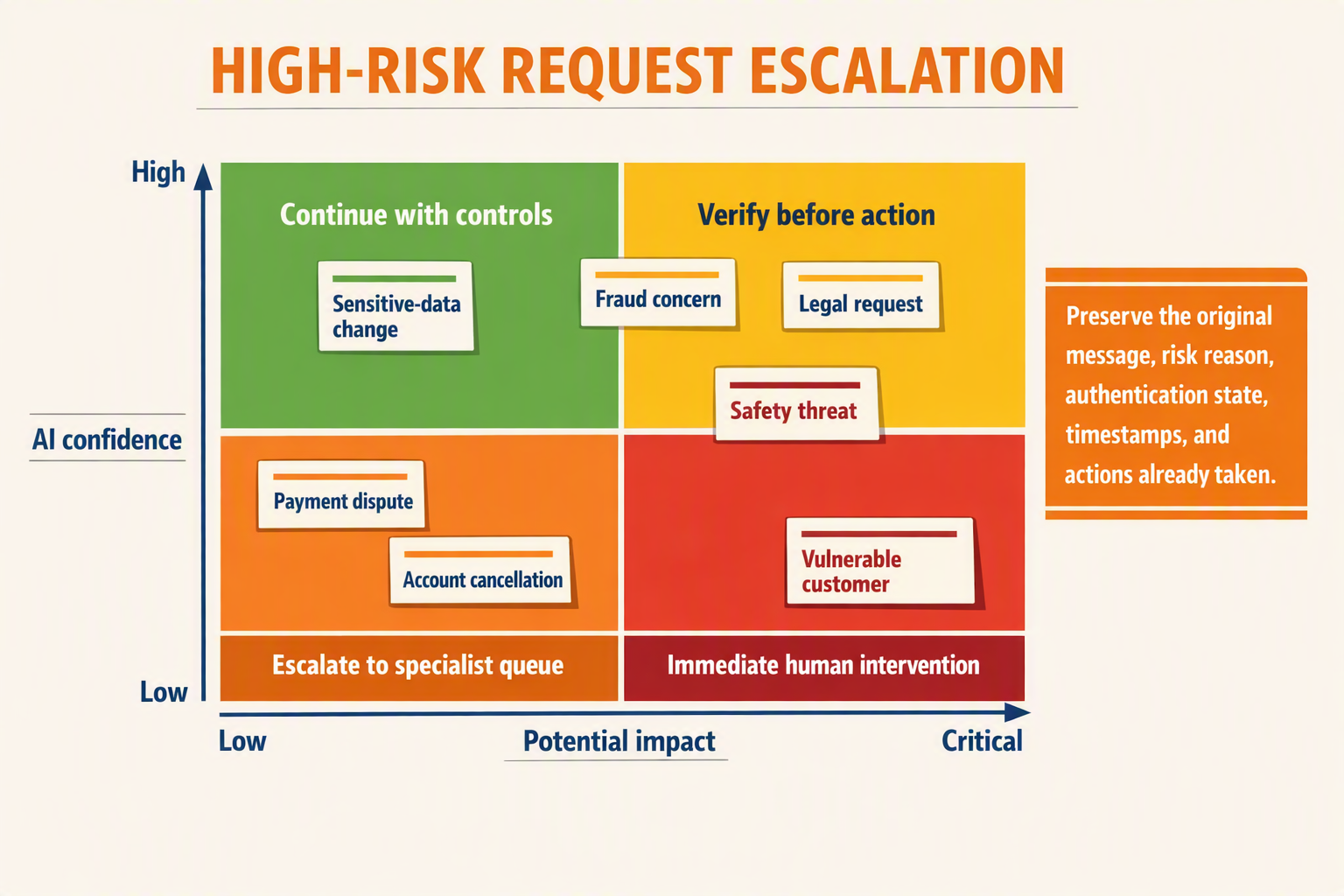
High-risk escalation should stop consequential automation, preserve evidence, verify identity, and assign an accountable human owner. The objective is not merely to calm an unhappy customer; it is to prevent financial harm, unsafe guidance, privacy breaches, regulatory exposure, and irreversible account actions.
Treat risk as a limit on automation
Gartner predicted in 2025 that agentic AI could autonomously resolve 80% of common customer-service issues by 2029, making robust controls over the remaining exceptional cases increasingly important. A high-risk AI escalation workflow should classify the potential impact of an error—not just the customer’s tone.
Requests that should trigger restricted handling or immediate review include:
- Money and contracts: disputed payments, refunds above an approved threshold, credit decisions, cancellations with penalties, or changes to binding terms.
- Identity and access: suspected account takeover, requests to change security credentials, disclosure of personal information, or failed verification attempts.
- Safety and vulnerability: threats of self-harm, medical emergencies, abuse, coercion, or indications that the customer may not understand the transaction.
- Legal and regulatory matters: litigation threats, law-enforcement requests, data-rights requests, fraud allegations, or demands to erase records.
- Irreversible actions: account deletion, service termination, large orders, beneficiary changes, or communications that could create legal commitments.
Sentiment alone must not determine these outcomes. A calm fraud report can be more consequential than an angry delivery complaint. Effective human in the loop AI combines intent, entity detection, authentication state, transaction value, model confidence, previous failures, and explicit customer requests.
Apply a safe-state escalation pattern
When a high-risk trigger fires, AI agent orchestration should move the interaction into a safe state:
- Pause the consequential action. The AI may gather facts but should not complete an unapproved refund, disclose protected data, or promise a legal outcome.
- Acknowledge without overcommitting. Tell the customer that specialist review is required and provide a realistic next step.
- Collect only necessary information. Avoid requesting payment credentials, passwords, health details, or identity documents in an unsuitable channel.
- Route to a named queue owner. Fraud, billing, safety, privacy, and legal matters need distinct ownership, permissions, and service levels.
- Record the decision path. Log the detected intent, trigger, confidence, authentication status, attempted actions, routing result, and timestamps.
This structure makes customer service escalation auditable while reducing the chance that contact center automation silently crosses a policy boundary.
Protect continuity without spreading risk
A live agent handoff should provide a compact summary containing verified customer details, the customer’s own request, relevant history, completed checks, unresolved questions, and the exact escalation reason. AI-generated sentiment or intent labels should be clearly identified as interpretations rather than facts.
Channel design also matters:
- Voice: where transfer capabilities are available, keep the customer informed and pass context before connecting the employee.
- WhatsApp: acknowledge immediately, retain the conversation thread, and state whether a specialist will reply or call.
- Email: preserve the original message, attachments, headers, and case ownership rather than forwarding an isolated AI summary.
CallMissed can centralize these interactions across voice, WhatsApp, email, and its CRM-style inbox. For WhatsApp Business calls bridged to an AI voice agent, the AI agent human handoff should still include fallback instructions if no employee accepts the transfer.
Ultimately, escalation protects the business only when it also protects the customer: no abandoned queue, no hidden automated decision, and no irreversible action without appropriate authority.
How should queue ownership, context summaries, SLAs, and audit logs work together?
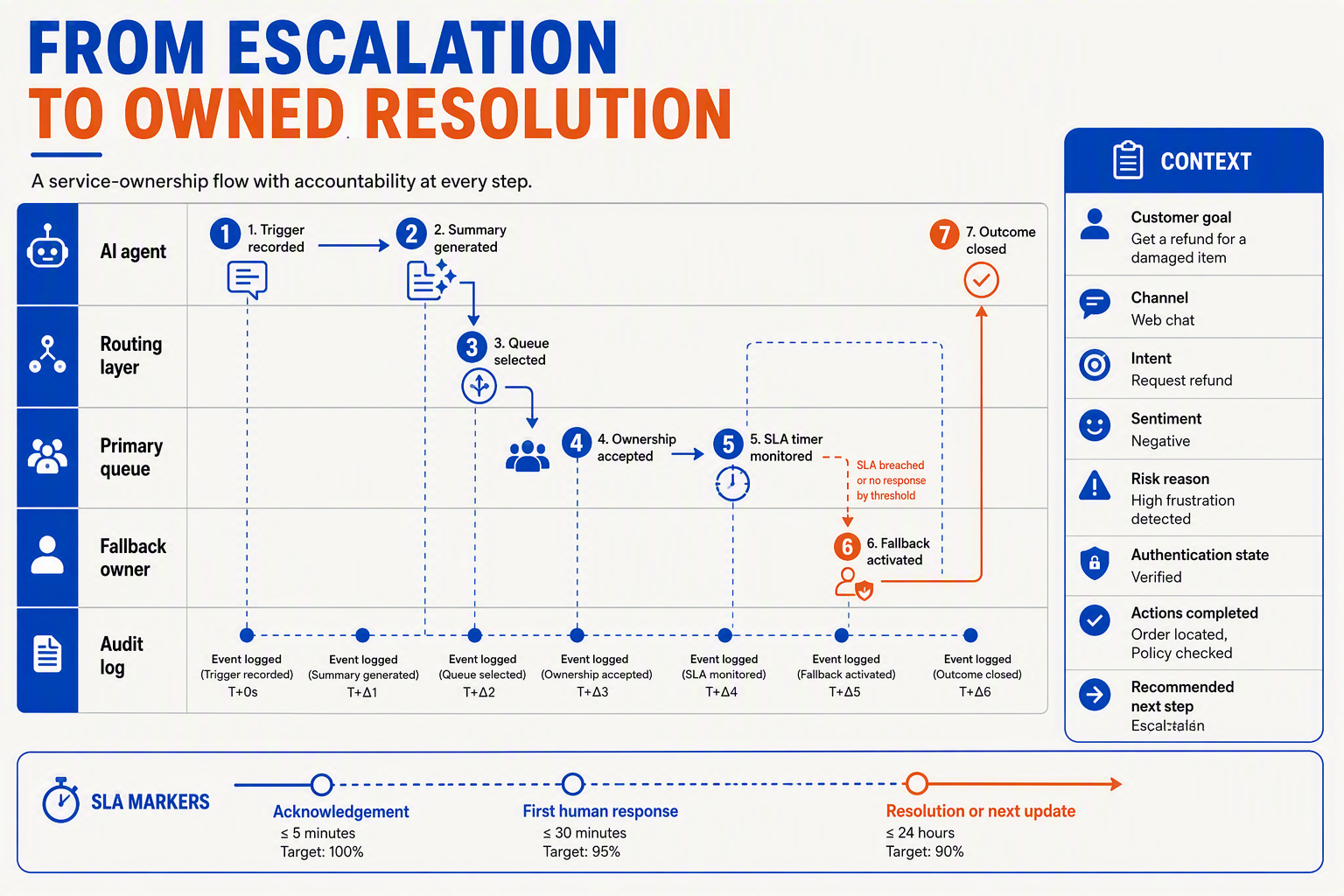
Queue ownership, context summaries, SLAs, and audit logs should operate as one control loop: ownership determines who must act, the summary explains what happened, the SLA sets when action is due, and the audit log proves whether the process worked. If any layer is missing, an AI agent human handoff can produce an informed but unowned case—or an assigned case with too little context to resolve.
Assign one accountable queue owner
Every escalation should enter a named queue with a clearly accountable team, not a generic “human support” bucket. Routing should evaluate intent, risk, language, customer tier, channel, operating hours, and agent availability.
A practical ownership hierarchy is:
- Route to the specialist queue for the detected intent, such as billing, cancellations, account security, or complaints.
- Select agents with the required language and channel skills.
- Overflow to a secondary queue when the primary SLA is at risk.
- Assign an on-call supervisor for high-risk or legally sensitive requests.
- Create a recoverable callback or follow-up task if no qualified employee is available.
CallMissed’s omnichannel inbox can provide shared operational visibility across voice, WhatsApp, and email, while its support for 22 Indian languages helps teams preserve language preference during routing. Ownership should remain explicit even when a conversation moves between channels.
Give the owner a concise, evidence-based summary
The handoff summary should reduce reading time without replacing the original transcript. A useful structure includes:
- Customer: verified identity, account reference, language, and preferred callback channel.
- Request: primary intent and the customer’s stated desired outcome.
- Escalation reason: explicit human request, high-risk intent, low confidence, repeated failure, or sentiment change.
- Actions taken: answers supplied, knowledge-base articles used, authentication completed, and transactions attempted.
- Current state: what succeeded, what failed, and what remains unresolved.
- Evidence labels: verified customer statements, system records, and AI-generated interpretations shown separately.
For voice, include a transcript and call disposition where available. For WhatsApp, retain relevant messages and attachments. For email, preserve the thread, subject, recipients, and prior promises. During a live agent handoff, the human should receive this package before responding; where channel capabilities permit a warm transfer, the customer and employee can be connected without restarting the interaction.
Start the right SLA clock
An AI escalation workflow needs multiple clocks rather than one generic response target:
- Acknowledgement SLA: time until the customer is told who owns the case.
- Acceptance SLA: time until a qualified employee accepts it.
- First-human-response SLA: time until meaningful human contact.
- Resolution or update SLA: deadline for resolution or the next promised update.
Illustrative internal targets might be 60 seconds for urgent voice acceptance, five minutes for high-risk WhatsApp review, and one business hour for priority email triage. These are design examples, not universal benchmarks; each business should set targets around staffing, risk, regulation, and published customer commitments.
Make every transition auditable
The audit log should record immutable, timestamped events: trigger signals, model confidence, policy rule matched, queue selected, summary version, SLA start and pause events, agent acceptance, reassignment, customer notifications, overrides, and outcome.
Supervisors should review logs for missed SLAs, excessive re-routing, unsupported AI conclusions, and repeated escalation loops. Together, these records turn human in the loop AI from an informal safety net into measurable AI agent orchestration, supporting root-cause analysis and continuous improvement in contact center automation.
How do you test failure recovery and measure whether escalation improves customer experience?
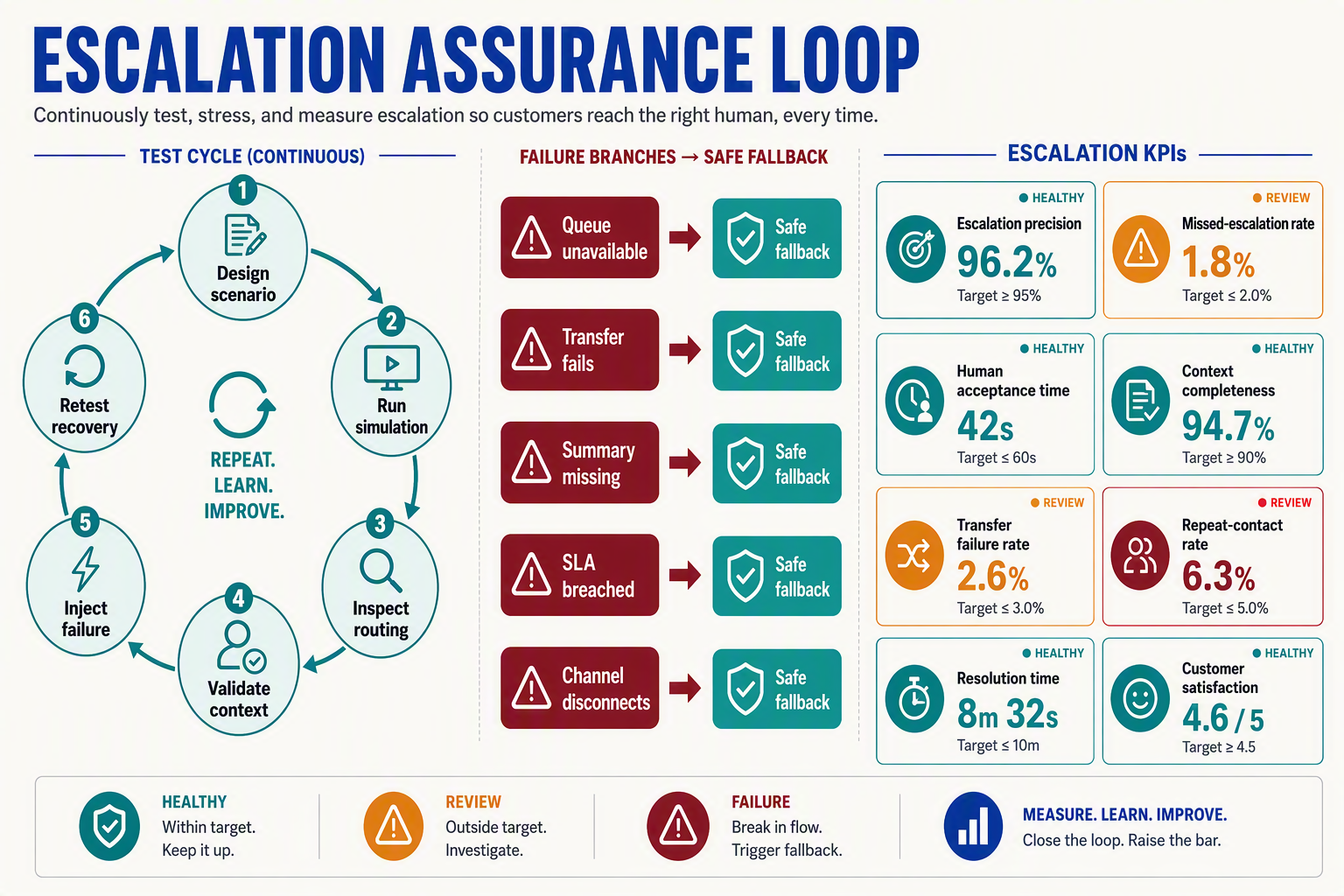
Testing should prove two things: the AI escalation workflow recovers safely when systems fail, and customers receive better outcomes after an AI agent human handoff. Validate both with controlled failure drills, end-to-end channel tests, and outcome metrics—not merely confirmation that a routing rule fired.
Build an escalation test matrix
Create a “golden set” of anonymised conversations covering ordinary requests, ambiguous language, regional-language variations, hostile phrasing, vulnerable customers, and high-risk intents. Every test should define the expected trigger, destination queue, context package, SLA, and fallback.
Include at least these scenarios:
- Trigger accuracy: Test explicit requests for a person, negative sentiment, repeated questions, low-confidence retrieval, policy restrictions, and high-risk intents.
- Channel behaviour: Place real test calls, send WhatsApp messages, and submit emails rather than testing only inside a workflow builder.
- Language variation: Test code-switching, accents, transliterated text, spelling errors, sarcasm, and indirect requests such as “Is there anyone else I can speak with?”
- Context continuity: Confirm the employee receives identity data, verified facts, conversation history, attempted actions, and the escalation reason without unsupported AI conclusions.
- Permission boundaries: Verify that the AI cannot complete restricted refunds, disclose sensitive data, or make legal, medical, or financial commitments.
- Duplicate handling: Check that retries do not create multiple tickets, callbacks, or contradictory responses.
For CallMissed deployments spanning voice, WhatsApp, email, and an omnichannel inbox, run the same intent through each channel. A rule that works in email may fail during a noisy voice call or a fragmented WhatsApp exchange.
Inject failures before customers encounter them
Failure-recovery testing should deliberately remove dependencies from contact center automation. Simulate:
- No employee accepting a live agent handoff
- A full or incorrectly assigned queue
- Telephony transfer failure or dropped calls
- Delayed WhatsApp delivery and duplicate webhooks
- Email ingestion or outbound-delivery failure
- CRM, knowledge-base, or identity-service timeouts
- Missing transcripts, malformed summaries, or stale customer records
- An agent becoming unavailable after accepting the transfer
Each failure needs a deterministic recovery path: retry once where safe, preserve the interaction state, offer a callback or asynchronous response, disclose the delay clearly, and alert the queue owner. The audit log should record trigger → routing decision → transfer attempt → acceptance or failure → recovery action → final outcome, with timestamps and correlation IDs.
Measure outcomes, not escalation volume alone
An escalation rate is not inherently good or bad. A high rate may reveal weak automation; a low rate may indicate that customers are trapped.
Track a balanced scorecard:
- Trigger precision: Percentage of escalations that reviewers judge necessary.
- Missed-escalation rate: Percentage of conversations that should have reached a person but did not.
- Transfer acceptance rate: Percentage accepted by the intended queue.
- Queue and time-to-human: Measure median and 90th-percentile waits separately.
- Post-handoff resolution: Percentage resolved without another transfer or repeat contact.
- Context completeness: Percentage of handoffs containing the required verified fields.
- Customer effort and satisfaction: Compare post-interaction CSAT, abandonment, complaint rates, and repeated explanations.
- Safety outcomes: Count prohibited actions, privacy incidents, and high-risk requests handled without required review.
Prove that handoff improves experience
Use phased releases or randomised holdouts where ethically appropriate. Compare the new customer service escalation policy with the previous workflow by intent, channel, language, and risk tier—not only by overall averages.
Review false positives and false negatives weekly during launch, then recalibrate thresholds. Effective human in the loop AI treats reviewer decisions as labelled feedback for future testing. This closes the AI agent orchestration loop: detect, escalate, recover, measure, learn, and retest after every material prompt, model, routing, or policy change.
Expert Opinions: Which governance principles should guide responsible AI agent orchestration?

Responsible AI agent orchestration should follow five principles: proportional risk controls, meaningful human authority, transparent customer choice, privacy-preserving context transfer, and end-to-end accountability. Experts and standards bodies consistently treat human intervention as a designed governance mechanism—not an improvised response after automation fails.
Build governance around risk, not automation volume
The NIST AI Risk Management Framework, published in January 2023, organizes responsible AI work into four functions: Govern, Map, Measure, and Manage. Applied to an AI escalation workflow, this means mapping risky intents before launch, measuring detection performance, assigning decision owners, and continuously managing failures.
A risk-tiered policy should specify:
- Low risk: FAQs, order status, appointment reminders, and other reversible tasks may remain automated.
- Moderate risk: Ambiguous cancellations, repeated authentication failures, or sustained negative sentiment should prompt clarification or a live agent handoff.
- High risk: Suspected fraud, payment disputes, legal threats, medical emergencies, self-harm signals, and vulnerable-customer concerns should receive immediate human review.
- Prohibited autonomy: The AI should not make irreversible decisions outside approved authority, even when its confidence score is high.
This approach prevents contact center automation targets from overriding customer safety or organizational accountability.
Preserve meaningful human control
The OECD AI Principles, updated in May 2024, call for human agency and oversight, transparency, robustness, security, and accountability throughout the AI lifecycle. In practice, human in the loop AI requires more than placing an employee somewhere downstream.
Humans must be able to:
- Interrupt or override the agent.
- See which statements are verified and which are AI-generated interpretations.
- Review the triggering intent, sentiment, confidence, and policy rule.
- Correct customer records and agent summaries.
- return the interaction to automation only when appropriate.
- Report unsafe patterns for investigation and rule changes.
A warm transfer should provide relevant identity data, conversation history, attempted actions, unresolved questions, and the escalation reason where channel and routing capabilities support that flow. It should not expose unnecessary personal information or imply that the human has reviewed facts they have not yet verified.
Make transparency and customer choice operational
The ISO/IEC 42001 artificial-intelligence management-system standard was published in December 2023 and establishes a structured approach to AI policies, responsibilities, risk assessment, monitoring, and continual improvement. For customer service escalation, those controls should appear in everyday operations:
- Tell customers when they are interacting with AI.
- Offer an accessible route to request a person.
- Avoid using sentiment inference as the sole basis for consequential treatment.
- Record why an AI agent human handoff occurred or was declined.
- Define queue owners, response SLAs, after-hours recovery, and outage fallbacks.
- Test voice, WhatsApp, and email paths separately because urgency and delivery behavior differ by channel.
Assign accountability before deployment
Every escalation rule needs a named business owner, technical owner, review frequency, and rollback procedure. Audit logs should capture model or workflow version, timestamps, detected signals, routing outcome, employee acceptance, overrides, and final disposition without retaining more customer data than necessary.
For CallMissed deployments spanning voice, WhatsApp, email, and 22 Indian languages, governance should also test regional-language intent recognition and escalation parity. A responsible system must not give customers weaker access to human help simply because they communicate in Hindi, Tamil, Bengali, Marathi, or another supported language.
What This Means For You: How can teams implement the workflow in CallMissed?
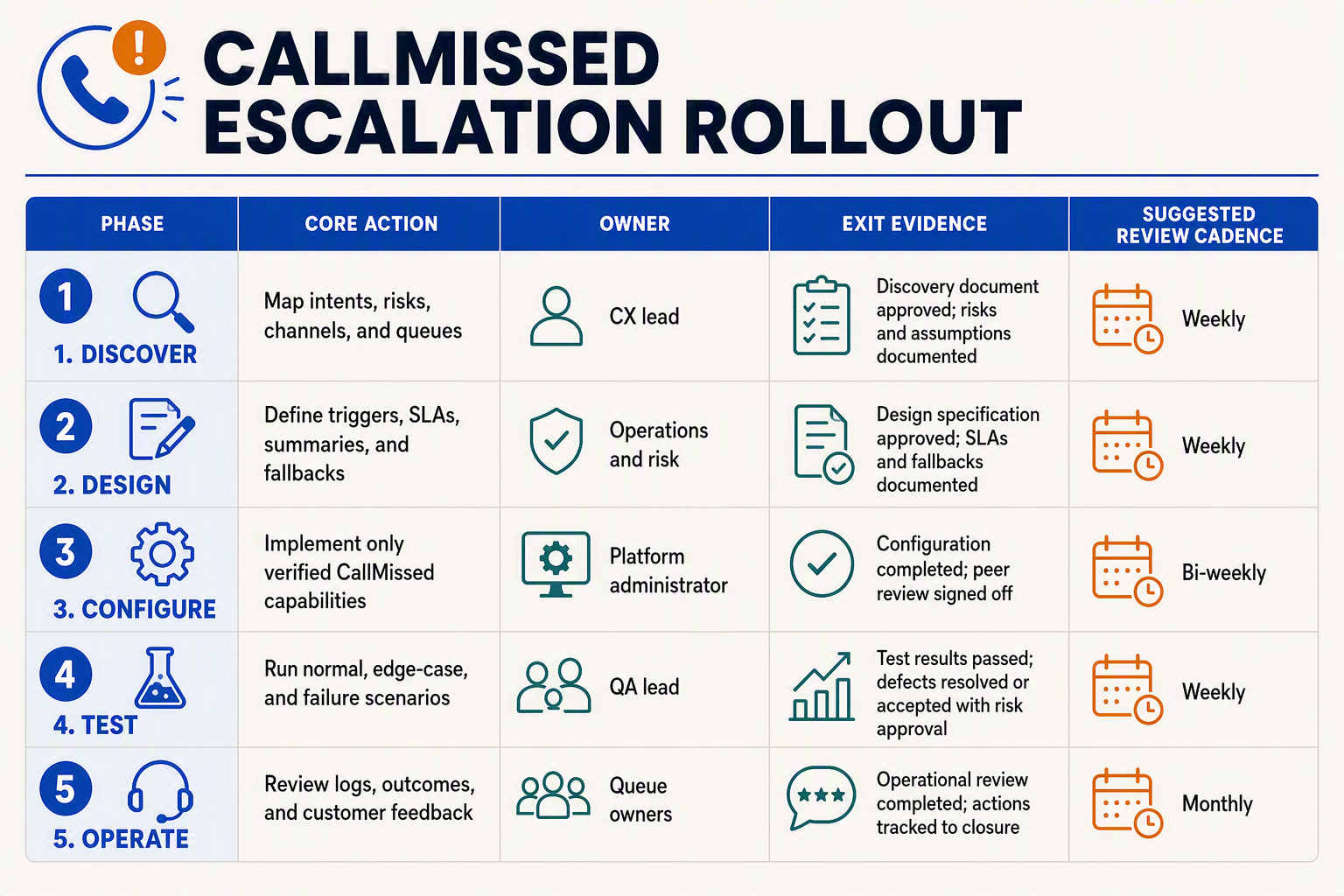
Implement the workflow in CallMissed as a risk-aware routing system, not a single transfer rule. Connect each trigger to an owner, response target, context package, fallback path, and audit event across voice, WhatsApp, and email.
Implementation blueprint
| Step | CallMissed configuration | Channel treatment | Operational control | Success signal |
|---|---|---|---|---|
| 1. Map intents | Classify routine, sensitive, regulated, and emergency-like requests | Apply consistent intent labels across voice, WhatsApp, and email | Assign each high-risk intent to a named queue owner | Correct routing rate |
| 2. Build triggers | Combine explicit human requests, negative sentiment, low confidence, repetition, and policy rules | Use speech and turn-taking signals for voice; message history for WhatsApp; subject and thread context for email | Require immediate escalation for legal threats, fraud, payment disputes, or safety concerns | Escalation precision |
| 3. Define routing | Send cases to skill-based queues in the omnichannel inbox | Route by language, issue type, customer tier, and working hours | Set primary owner, backup queue, and duty manager | Transfer acceptance rate |
| 4. Package context | Generate a concise summary with identity, intent, verified facts, actions attempted, and escalation reason | Attach transcript or thread history without making employees reread everything | Clearly separate customer statements from AI interpretations | Lower handling time |
| 5. Set recovery paths | Configure callback, queued response, or ticket creation when a person cannot accept | Avoid leaving voice callers on indefinite hold or WhatsApp and email users without acknowledgement | Define SLA timers and breach notifications | Queue time and SLA attainment |
| 6. Measure and improve | Review logs, outcomes, overrides, and knowledge gaps | Compare performance by channel, language, intent, and queue | Run regression tests after prompt, model, policy, or knowledge-base changes | Post-handoff resolution rate |
Configure decisions before automation
Start by documenting a customer service escalation matrix. For every intent, specify whether the AI may resolve it, must request confirmation, or must stop and escalate. A robust AI escalation workflow should also define what happens when several weak signals occur together—for example, moderately negative sentiment plus two failed answers and an account-access request.
Use three trigger levels:
- Immediate: The customer asks for a person, alleges fraud, raises a legal or safety issue, or requests an action requiring human authorization.
- Conditional: Confidence falls below the team’s tested threshold, sentiment deteriorates, or the customer repeats the same need.
- Operational: The knowledge base is unavailable, a downstream tool fails, identity cannot be verified, or the conversation approaches an SLA boundary.
Make the transfer usable
For every AI agent human handoff, provide the receiving employee with a structured context card. Include the customer’s channel, preferred language, detected intent, authenticated identifiers, key transcript excerpts, completed actions, unresolved question, risk flags, and transfer reason. This turns human in the loop AI into an operational control rather than an informal backup.
A live agent handoff should become a warm transfer only where the channel and deployment support continuity between the AI, customer, and employee. For voice—including WhatsApp Business calling bridged to an AI agent—validate transfer support before promising it; otherwise, use a clearly communicated callback or priority-queue workflow.
Launch with measurable guardrails
Run scripted tests for routine, ambiguous, adversarial, multilingual, after-hours, and tool-failure scenarios before production. Then review:
- Escalation rate and false escalations
- Transfer acceptance and abandonment
- Median and 90th-percentile queue time
- Repeat contact within the chosen measurement window
- Resolution after handoff and SLA breaches
Salesforce reported in 2025 that service teams expected AI to handle 50% of customer-service cases by 2027. That scale makes audit logs, fallback ownership, and continuous testing essential components of contact center automation and AI agent orchestration, not optional administrative work.
Frequently Asked Questions About AI Agent Human Handoff and Customer Service Escalation
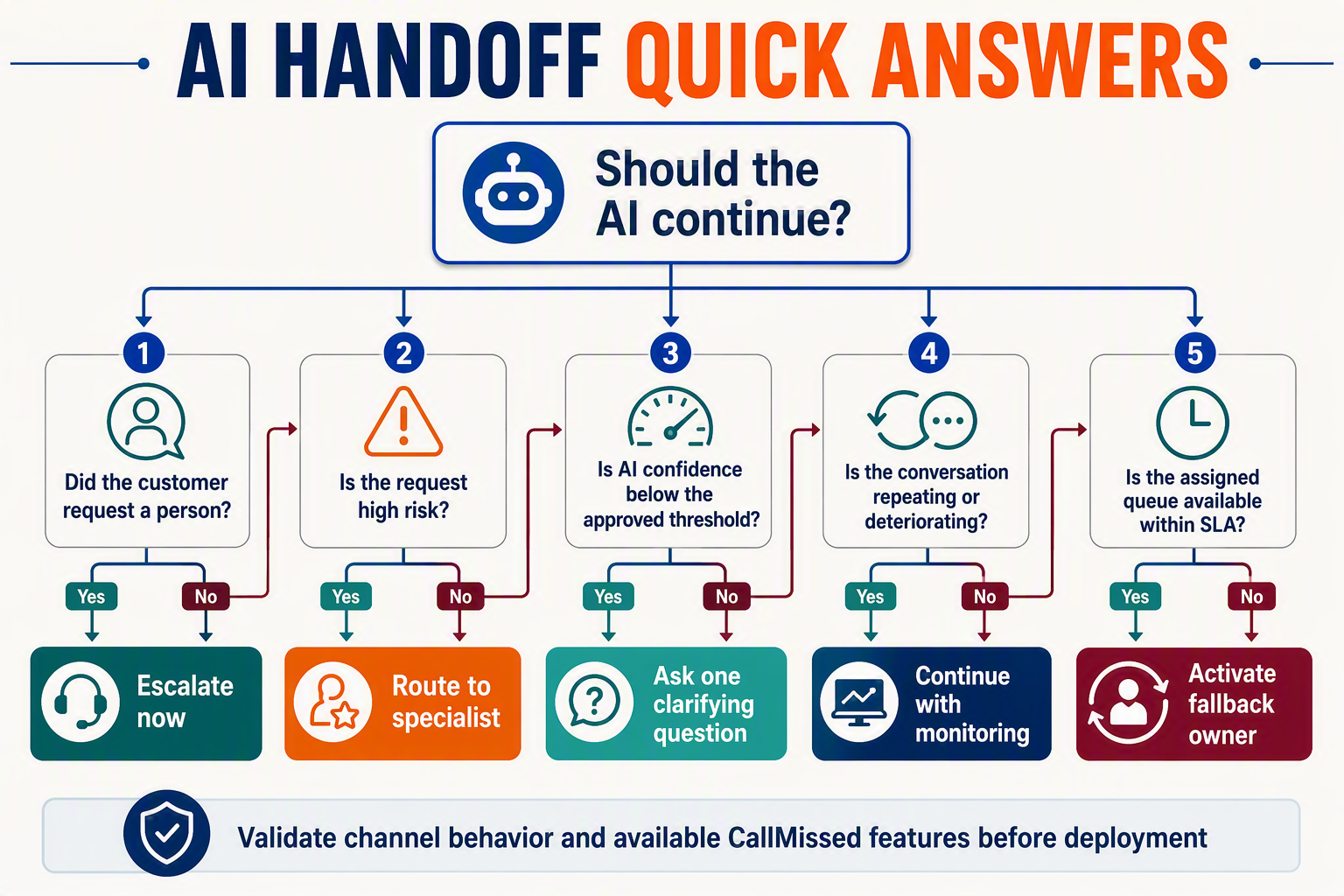
What is an AI agent human handoff in customer service?
What triggers should start an AI escalation workflow?
How should a live agent handoff work across voice, WhatsApp, and email?
What information should an AI agent human handoff summary include?
How do you measure whether customer service escalation is working?
How often should businesses test AI agent orchestration and escalation rules?
Conclusion
A dependable AI agent human handoff is not evidence that automation failed; it is evidence that the operating model recognizes where human judgment, empathy, and accountability matter. In 2026, effective AI agent orchestration will balance automated speed with controlled escalation across voice, WhatsApp, and email.
Key takeaways for operations teams are:
- Design triggers around multiple signals. An AI escalation workflow should combine explicit requests for a person with negative sentiment, high-risk intent, low answer confidence, repeated failures, policy rules, and operational conditions. Payment disputes, account-access problems, legal threats, medical concerns, cancellations, and vulnerable customers should receive appropriately conservative treatment.
- Make every live agent handoff context-rich. Where channel capabilities support a warm transfer, provide the receiving employee with the customer’s identity, conversation history, detected intent, verified facts, actions attempted, and escalation reason. Clearly separate confirmed information from AI-generated interpretations so employees can act without trusting an uncertain summary blindly.
- Treat routing and recovery as customer-experience design. Every customer service escalation needs a named queue owner, priority, service-level agreement, after-hours path, and fallback when no employee accepts the transfer. Audit logs and scenario testing should verify that sensitive requests cannot remain trapped in automation.
- Measure outcomes, not just automation volume. Track escalation rate, transfer acceptance, queue time, repeat-contact rate, failure recovery, and post-handoff resolution. These indicators reveal whether contact center automation is reducing effort or simply moving unresolved work downstream.
The scale of this challenge will increase. Salesforce reported in its 2025 State of Service research that service teams expect AI to handle 50% of customer-service cases by 2027, up from 30% at the time of the study. Gartner predicted in 2025 that agentic AI could autonomously resolve 80% of common customer-service issues by 2029. Operations leaders should therefore watch how rising autonomy affects trigger calibration, queue capacity, transfer quality, and accountability.
CallMissed gives Indian businesses a foundation for human in the loop AI across voice, WhatsApp, email, CRM-style inboxes, knowledge retrieval, and 22 Indian languages. To explore how escalation-ready AI communication is evolving, visit CallMissed—then ask: when your AI encounters the conversation that cannot safely wait, will the right person receive the right context at the right time?
Related Reading
Discussion
Related Posts
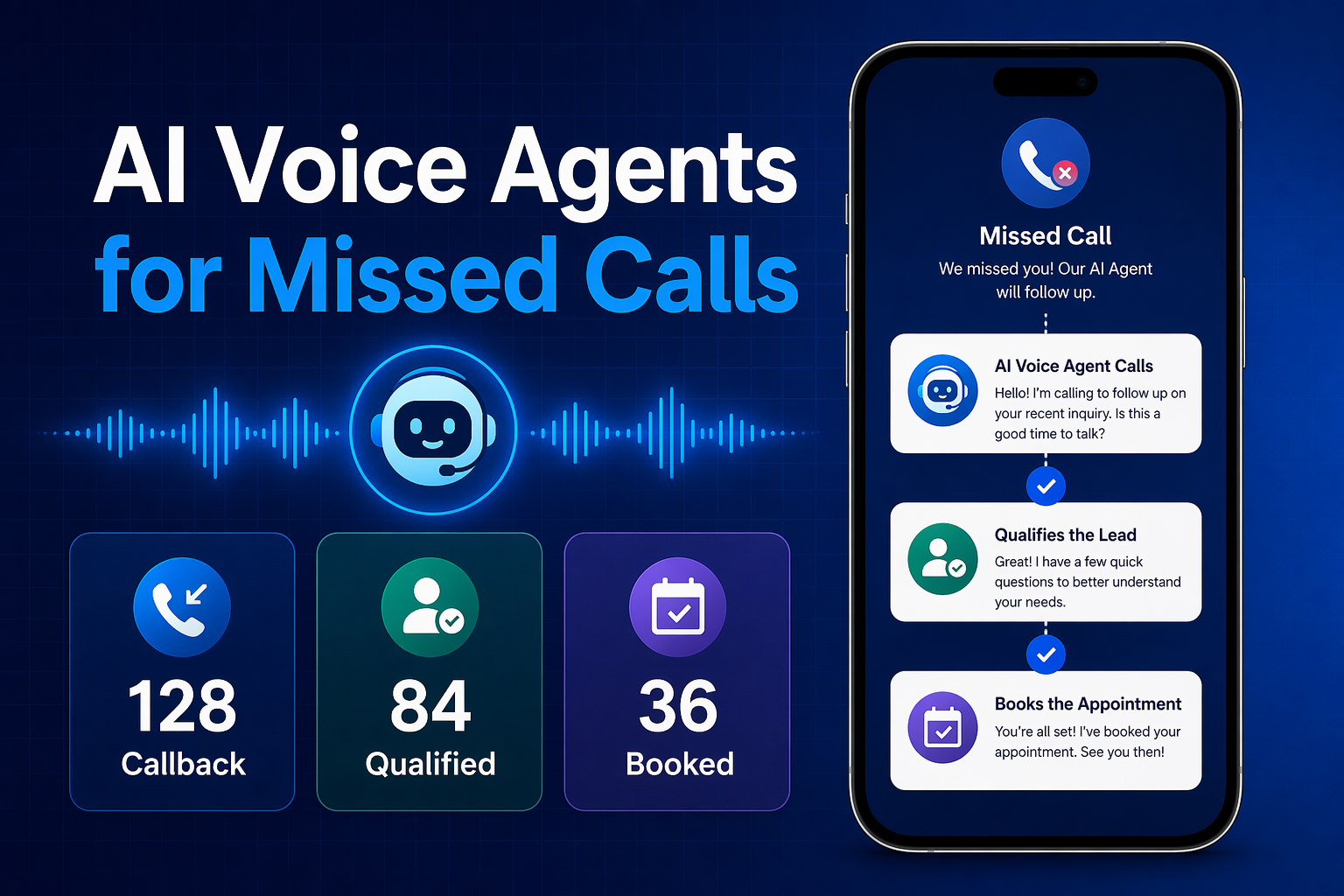


Ready to automate customer conversations?
Launch AI voice agents and WhatsApp bots with CallMissed — one API, 22+ Indian languages.