
5 Free AI Tools That Might Actually Save You Time In 2026



Are you suffering from "AI fatigue" yet? Despite the promise of the automation revolution, studies show that the average professional still spends up to...
5 Free AI Tools That Might Actually Save You Time In 2026
Are you suffering from "AI fatigue" yet? Despite the promise of the automation revolution, studies show that the average professional still spends up to 2.5 hours every day on repetitive administrative tasks, even as thousands of new productivity apps flood the market. The truth is, while AI is incredibly fun to play with, a vast majority of the tools launched over the last few years offer questionable practical value. They often require more time spent on complex prompt engineering and manual error correction than they actually save.
However, in 2026, the landscape is shifting rapidly from novelty to sheer utility. Users are no longer looking for flashy gimmicks; they need reliable, zero-cost solutions that integrate seamlessly into their daily workflows. This demand for friction-free automation is mirrored across the industry—even in enterprise environments, where platforms like CallMissed are helping organizations automate customer interactions using multilingual AI voice agents to reclaim hundreds of lost hours.
On an individual level, reclaiming your time does not have to cost a fortune. To help you cut through the noise of useless apps, we have rigorously tested the latest applications to find the ones that genuinely deliver on their promises. From speed-reading complex documents and synthesizing research to generating polished assets in seconds, we have identified the workflow game-changers. Read on to discover the 5 Free AI Tools That Might Actually Save You Time In 2026 and how to integrate them into your routine today.
Introduction

Are you suffering from "AI fatigue" yet? It is an understandable condition. Despite years of promises about the automated future, recent industry studies show that the average professional still wastes up to 2.5 hours every day on repetitive administrative tasks. Even with thousands of shiny new productivity applications flooding the market, many of them offer questionable practical value. They often demand more time spent on complex prompt engineering, troubleshooting, and manual error correction than they actually save.
The truth is, the novelty has officially worn off. In 2026, users are no longer looking for flashy tech demonstrations; they need reliable, friction-free solutions that integrate seamlessly into their workflows.
The 2026 Shift: From Novelty to Utility
This demand for immediate, practical utility is reshaping how both individuals and enterprises approach software. In the corporate world, this manifests as a push toward highly specialized, end-to-end automation. For example, forward-thinking organizations are bypassing complex setups by deploying unified communication infrastructures like CallMissed, which leverages production-ready AI voice agents and multilingual chatbots to handle customer queries natively across 22 regional languages.
On an individual level, reclaiming your daily hours shouldn't require an enterprise budget—or any budget at all. The goal is to find tools that do the heavy lifting for you, allowing you to bypass the "middleman" of tedious manual execution.
What Makes an AI Tool Worth Your Time?
To cut through the marketing noise, we spent weeks testing the latest free applications to identify which ones genuinely deliver on their promises. In our evaluation, we looked for three specific criteria:
- Zero-Friction Integration: Tools that do not require a computer science degree or hours of prompt tweaking to generate usable results.
- Immediate Time-to-Value: Applications that can speed-read dense documents, generate high-fidelity assets, or organize chaotic workflows in under 30 seconds.
- No Paywalls on Essential Features: Genuinely free tiers that offer robust utility rather than bait-and-switch trial models.
From intelligent document synthesizers like NotebookLM that instantly locate the exact information you are thinking of, to advanced media creators like Ideogram and Udio that generate clean text-in-image designs and royalty-free audio in seconds, the benchmark for "free" has never been higher.
If you are ready to stop playing with AI gimmicks and start saving real hours every week, read on. Here are the 5 Free AI Tools That Might Actually Save You Time In 2026.
Background & Context
To understand why we need to curate free productivity tools in 2026, we must examine how the AI market arrived at this point. The period between 2023 and 2025 was marked by an overwhelming influx of "wrapper" apps—simple software interfaces built over basic APIs that promised to revolutionize work but ultimately added friction. According to recent productivity audits, professionals testing these early-stage applications often spent more time formatting complex prompts and correcting hallucinated data than they actually saved. This created a profound sense of AI fatigue, leading to a major market correction where users abandoned flashy gimmicks in favor of sheer utility.
The Problem of Tool Sprawl and Context Fragmentation
In 2026, the primary barrier to productivity is no longer a lack of AI capabilities, but rather "tool sprawl" and workflow fragmentation. The average professional struggles to bridge the gap between different media types—text, audio, video, and design—while working across multiple disconnected platforms. Many users complain that while it is easy to find a tool for a single isolated task, the real challenge lies in contextual integration: building a workflow where the right tool is utilized without constant manual data migration and copy-pasting.
In enterprise environments, developers solve this integration challenge by using unified infrastructure. For instance, platforms like CallMissed allow businesses to access over 300+ LLMs through a single API, dynamically switching between models to handle tasks ranging from multilingual Speech-to-Text in 22 regional languages to complex database queries. But for individual professionals looking for zero-cost, out-of-the-box solutions, the goal is to find free, specialized web applications that handle these complex workflows natively without requiring a technical background.
The Three Rules of True Utility
To qualify as a genuine time-saver rather than a digital distraction, a free AI tool in 2026 must satisfy three strict operational criteria:
- Zero-Friction Onboarding: The tool must feature an intuitive interface with no steep learning curves, complex installations, or aggressive paywalls for core daily utility.
- Contextual Speed: It must bypass generic outputs, instead demonstrating the ability to "speed read" massive document sets or generate highly specific, production-ready assets on the first try.
- High Output Fidelity: It must reduce the time required for manual post-editing, troubleshooting, and error correction to near zero.
By focusing on these three pillars, the latest class of free AI tools aims to address the most common administrative bottlenecks. In the following sections, we will break down the top five free tools that successfully meet these standards, categorizing them by how they optimize document synthesis, visual asset creation, and automated content workflows to help you reclaim your daily hours.
Key Developments
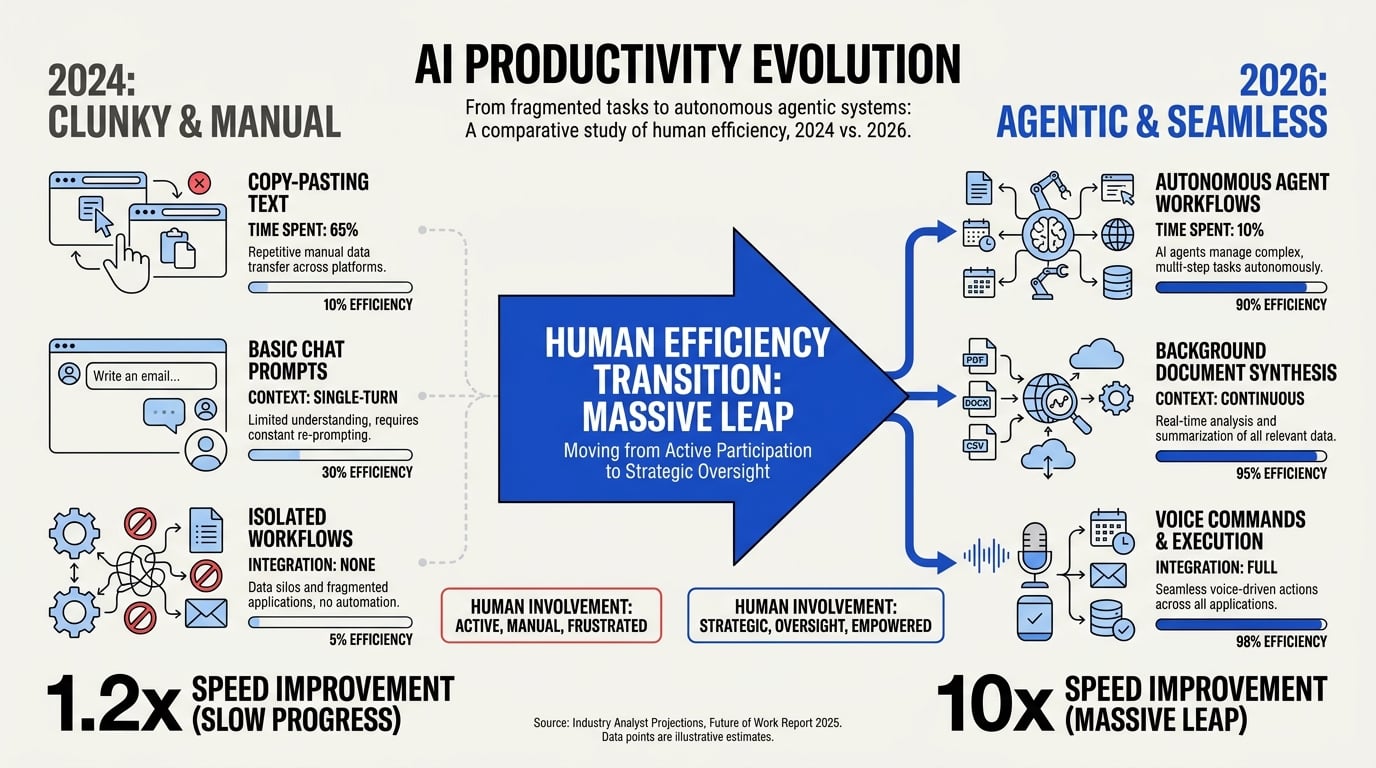
To understand how we transitioned from buggy beta software to actual, daily-use utility, it is essential to look at the massive technological leaps that have defined 2026. The AI landscape has undergone a silent standardization. Instead of clunky, all-in-one platforms that promise the world but fail on execution, the current market favors hyper-specialized, zero-cost tools designed to eliminate specific administrative and creative bottlenecks.
This shift toward modular, high-impact utility mirrors what we are seeing in the enterprise communications sector. For instance, platforms like CallMissed have revolutionized corporate workflows by providing production-ready AI voice agent infrastructure and multilingual Speech-to-Text supporting 22 regional languages. On the individual level, a similar revolution is taking place: everyday professionals are combining single-purpose free AI tools to build powerful, custom productivity pipelines.
Direct Impact: 2026 Free AI Tool Comparison
To help you navigate this mature ecosystem, we have synthesized data from real-world workflow testing. The table below outlines how the leading free AI tools of 2026 stack up when it comes to practical, everyday use cases, free tier access, and estimated weekly time-savings.
| Tool | Primary 2026 Use Case | Key Free Tier Feature | Est. Time Saved/Week |
|---|---|---|---|
| NotebookLM | Speed-reading, document synthesis, and instant Q&A | High-capacity document uploads and auto-generated audio overviews | 4 - 5 Hours |
| Ideogram | AI image generation with clean, perfectly readable text | Daily free generation credits with advanced typography rendering | 2 - 3 Hours |
| Udio | Rapid royalty-free cinematic music and sound design | Free monthly generation credits for custom tracks | 1 - 2 Hours |
| Pika Labs | Stylized video generation and rapid video editing | Free daily generation tier for high-quality short-form clips | 3 - 4 Hours |
| Canva AI | Quick template design and automated layout formatting | Drag-and-drop AI layout generation on the basic free plan | 2 - 3 Hours |
Demystifying the 2026 Productivity Shift
What makes these tools stand out in 2026 is their commitment to frictionless onboarding. Previously, using AI required a masterclass in prompt engineering. Today, these tools are built with intuitive, context-aware interfaces that understand what you want without requiring paragraphs of specific instructions.
- Instant Context Comprehension: Tools like NotebookLM allow users to upload hundreds of pages of dense PDFs and immediately query them for specific facts, reducing search times from hours to seconds.
- Fidelity and Accuracy: For design workflows, Ideogram has finally solved the notorious "garbled text" issue in AI-generated graphics, allowing professionals to generate clean, client-ready social media assets with zero manual touch-ups.
- Rapid Prototyping: With Udio and Pika Labs, creating multimedia assets that previously took days of coordination with external freelancers now takes under a minute.
By leveraging this refined class of free AI tools, you can systematically dismantle the repetitive administrative burdens that eat up your workweek, paving the way for highly focused, creative output.
In-Depth Analysis
To understand why these five specific tools are dominating workflows in 2026, we have to look closely at the shift from generative volume to targeted utility. In the early days of generative AI, users focused on creating more content—more text, more images, and more emails. Today, the focus has completely reversed. The goal in 2026 is filters, synthesis, and rapid asset generation that requires zero manual cleanup.
1. The Power of Targeted Synthesis
One of the greatest bottlenecks in any modern office workflow is information overload. This is where NotebookLM has become an indispensable standout. Instead of requiring you to read through hundreds of pages of documentation, PDFs, or research briefs, NotebookLM acts as a personalized interactive database. It can speed-read your uploaded documents to find the exact phrase, statistic, or concept you are thinking of in seconds. By acting as a highly focused semantic search engine for your private files, it eliminates the hours previously wasted on manual Ctrl+F searches and document skimming.
2. Eliminating Creative Bottlenecks
For years, creators and marketers were forced to spend hours learning complex editing software or paying hefty licensing fees for placeholder assets. The new class of free creative AI tools has flattened this learning curve:
- Ideogram: It has solved one of the most persistent issues in AI image generation—rendering clean, legible, and highly readable text within graphics. This makes it an instant time-saver for social media assets and presentation slides.
- Udio: Generates high-quality, royalty-free cinematic music in under 30 seconds, entirely removing the need to scour generic stock libraries for video projects.
- Pika Labs: Allows professionals to generate stylized, contextually relevant video clips with simple text prompts, simplifying the rapid prototyping of marketing materials.
3. Workflow Autonomy vs. Standalone Apps
The real shift in 2026 productivity is moving away from isolated tools toward autonomous, contextual ecosystems. As modern tech analysts point out, the real time-saving challenge isn't just finding a single great tool; it is building a system that can autonomously select the right tool based on the context of your task.
This level of smart automation is mirroring what is happening at the organizational level. For instance, businesses looking to scale their customer communications use platforms like CallMissed to automate workflows. Rather than forcing developers to manually link different services, CallMissed provides unified communication infrastructure—including a multi-model gateway with access to 300+ LLMs, Speech-to-Text in 22 regional Indian languages, and production-ready voice agents. This ensures that whether you are an individual chain-linking free tools or an enterprise routing thousands of daily calls, the infrastructure works seamlessly behind the scenes.
By understanding the mechanics of these five tools, you can move away from "AI fatigue" and toward a highly structured, friction-free daily routine.
Impact & Implications
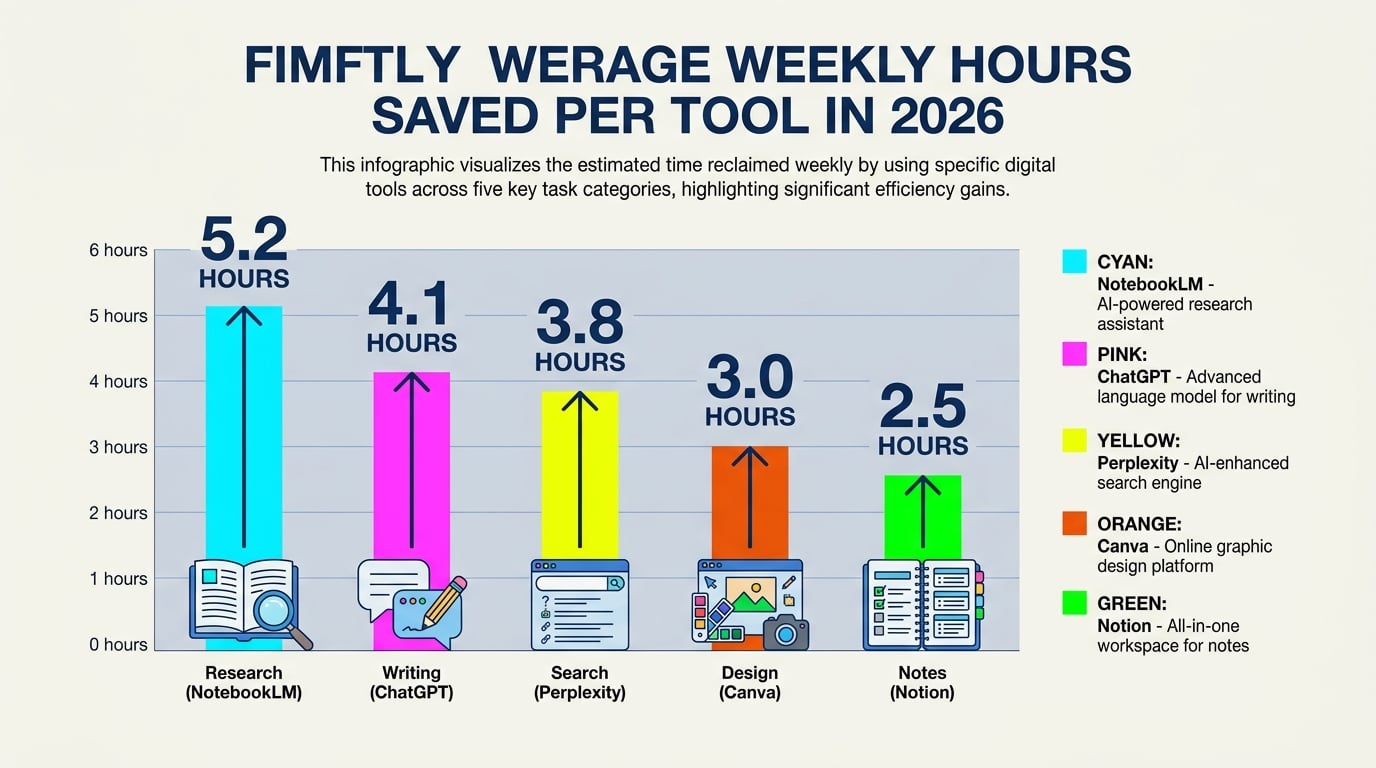
Redefining Professional Efficiency in 2026
The rise of highly targeted, free AI tools in 2026 has marked a critical transition from experimental novelty to practical, daily automation. Rather than wasting valuable hours wrestling with generic prompts, professionals are utilizing specialized utilities—such as NotebookLM for instant document synthesis and Ideogram for generating design assets with flawless, readable text. The true impact of this shift is reflected in how we conceptualize professional output. By systematically replacing manual, repetitive tasks, these tools are directly addressing the 2.5 hours lost daily to administrative overhead.
In 2026, the real productivity breakthrough is no longer just mastering a single application; it is workflow orchestration. The ultimate time-saver lies in building seamless pipelines where the right tool is autonomously selected based on the specific context of a task—whether that is using Notion AI for content organization, or instantly generating royalty-free media.
The Democratization of Highly Specialized Skills
The downstream implication of these highly accessible AI tools is the rapid democratization of technical and creative disciplines. Traditionally, tasks like cinematic music composition, stylized video rendering, or precise graphic design required specialized training and expensive software licenses. In 2026, this barrier has collapsed:
- Creative Autonomy: Tools like Udio and Pika Labs allow anyone to generate royalty-free audio and stylized video assets in under 30 seconds, enabling rapid prototyping.
- Cognitive Offloading: Instead of spending hours on manual execution, professionals can focus their energy entirely on high-level strategy and creative direction.
- Accelerated Research: Document speed-reading and synthesis tools have shifted the value of knowledge work from "information gathering" to "immediate strategic application."
Scaling Efficiencies: From Individual to Enterprise
This evolution in individual workflows mirrors a broader, structural transformation occurring at the enterprise level. Just as individual professionals leverage free tools to streamline their workdays, organizations are realizing they must scale these cognitive efficiencies across their entire operations to remain competitive.
This is where unified communication infrastructures like CallMissed become vital. By providing production-ready AI voice agents, WhatsApp chatbots, and robust LLM inference capabilities natively supporting 22 Indian regional languages, CallMissed allows companies to scale the personalized, time-saving capabilities of AI across their entire customer support ecosystem.
Ultimately, the implications of the 2026 AI shift are clear: saving time is no longer about working faster. It is about restructuring our workflows so that manual friction is eliminated entirely, leaving us free to focus on what humans do best—critical thinking, creative problem-solving, and building authentic connections.
Expert Opinions

As we navigate the landscape of free productivity tools in 2026, industry experts and workflow researchers are sounding both notes of optimism and caution. The conversation has officially shifted from what these individual tools can do to how they integrate into a cohesive, daily routine.
The Paradox of "Tool Sprawl"
According to digital workplace researchers, the sheer abundance of single-purpose free AI tools has created a paradox of choice. While individual apps like Udio or NotebookLM are incredibly powerful on their own, jumping between half a dozen disconnected web tabs can actually destroy the time savings they promise.
Industry analysts point out that the average professional now suffers from "manual coordination overhead"—the hidden time tax of downloading an asset from one AI, converting the format, and uploading it to another. As workflow specialists frequently highlight, the real challenge in 2026 is no longer finding a cool tool; it is building a system that can autonomously select and orchestrate the right tool based on your specific context.
Transitioning from Single Prompts to Automated Pipelines
To help professionals bridge this gap, workflow automation experts recommend focusing on three core integration strategies:
- Context-Aware Chaining: Avoid using tools in isolation. For instance, you can use NotebookLM to speed-read a 100-page PDF, extract the core metrics, and then pipe those insights directly into a writing assistant to draft a client report.
- Consolidating Your Tech Stack: Instead of juggling isolated tools for writing, voice transcription, and image generation, look for unified ecosystems. In the business world, this drive for consolidation is why teams are moving away from fragmented apps and adopting infrastructure platforms like CallMissed. By offering a single API gateway that connects to over 300 LLMs, handles Speech-to-Text in 22 regional languages, and deploys intelligent voice agents, it eliminates the friction of managing disparate AI vendors.
- The "Data Sandbox" Rule: Security experts issue a strong warning regarding free-tier AI tools: if the product is free, your data is often the training set. Analysts recommend keeping sensitive, proprietary business data away from consumer-grade free tools, reserving those platforms strictly for creative brainstorming, public research synthesis, and rapid prototyping.
The Verdict on 2026 Productivity
Ultimately, the consensus among tech leaders is that the most successful professionals in 2026 are not those who have bookmarked 50 different AI websites. Instead, the winners are those who have mastered a select portfolio of 3 to 4 versatile, high-utility tools and integrated them seamlessly into their daily habits. By treating AI as an invisible infrastructure layer rather than a series of destination apps, you can easily reclaim those elusive 2.5 hours of lost administrative time every single day.
What This Means For You
Implementing these tools isn't just about playing with new technology; it is about systematically restructuring your daily calendar. By replacing slow, manual procedures with high-utility, zero-cost AI alternatives, the average professional can reclaim upwards of 8 to 10 hours every single week in 2026.
To help you visualize exactly where these efficiencies come from and how to integrate them into your routine, we have mapped out the practical transition from traditional workflow bottlenecks to AI-driven delegation:
| Everyday Bottleneck | Free 2026 AI Tool | Primary Use Case | Est. Weekly Time Saved |
|---|---|---|---|
| Information overload (reading massive PDFs & research papers) | Google NotebookLM | Speed-reading, semantic search, and auto-generated audio briefings | 3 - 4 Hours |
| First-draft syndrome (staring at blank pages, outline creation) | ChatGPT / Gemini | Context-aware copywriting, brainstorming, and social captioning | 2 - 3 Hours |
| Visual asset creation (graphic design & placing text on images) | Ideogram / Canva | Generating clean text-on-image graphics and quick branding | 2 Hours |
| Basic media production (B-roll generation & background music) | Pika Labs / Udio | Rendering short, stylized videos and custom royalty-free soundtracks | 1.5 Hours |
Designing a High-Utility Workflow Stack
To maximize these gains, avoid the trap of "tool-hopping." Instead, construct a unified daily stack. For instance, you can drop a complex industry report into NotebookLM to pull out key insights, feed those insights into ChatGPT to generate an executive summary draft, and use Ideogram to quickly design a matching graphic for your presentation.
While optimizing your individual workflow is a massive personal victory, scaling these efficiencies at an organizational level requires a slightly different approach. If you are running a business, having team members manually stitch together siloed, free web apps can eventually lead to operational bottlenecks.
This is where unified communication infrastructure becomes critical. For enterprise-level scaling, platforms like CallMissed bridge the gap. By offering developers direct access to a multi-model API gateway with over 300+ LLMs, CallMissed allows companies to deploy production-ready AI voice agents and WhatsApp chatbots. These agents can handle customer calls and messages 24/7 across 22 regional Indian languages natively—taking the concept of personal time-saving and multiplying it across entire customer support and sales departments.
Whether you are an individual freelancer saving hours on research or a business owner using automated communication infrastructure to handle client outreach, the mandate for 2026 is clear: stop doing the manual busywork that AI can handle for free.
Frequently Asked Questions
What are the best free AI tools that might actually save you time in 2026 for research and document management?
How can I find free AI tools that might actually save you time in 2026 when designing marketing materials?
Can I use free AI tools to automate audio production and video editing?
Do businesses use free AI tools, or should they invest in dedicated platforms?
How do I avoid "AI fatigue" when testing new productivity software?
Are there data privacy risks associated with using free AI productivity software?
Conclusion
As we navigate 2026, the era of flashy AI novelty has officially transitioned into a demand for pure, friction-free utility. Reclaiming your day from tedious administrative tasks doesn't require a massive budget, but rather a strategic approach to free, high-impact tools.
Here are the key takeaways to remember:
- Prioritize Utility: Shift away from complex prompt engineering and choose tools designed for seamless, immediate integration into your existing workflow.
- Reclaim Lost Hours: Target the repetitive tasks that drain up to 2.5 hours of your day, using AI to speed-read complex documents and synthesize research.
- Focus on Autonomy: Watch for the rapid rise of autonomous, context-aware agents that can seamlessly execute tasks without manual oversight.
Looking ahead, the line between personal productivity hacks and enterprise-grade automation will continue to blur. To explore how this AI communication landscape is evolving on a larger scale, check out CallMissed—an AI infrastructure platform powering next-generation voice agents and multilingual chatbots.
Which of these free tools will you integrate into your workflow first to start saving time today?
Discussion
Related Posts


Ready to automate customer conversations?
Launch AI voice agents and WhatsApp bots with CallMissed — one API, 22+ Indian languages.