
The Best AI Productivity Bootcamp for Professionals in 2026: Set Up Your AI Assistant & Build Apps Without Code


Compare AI productivity bootcamps for professionals in 2026 and learn how to build assistants, automate workflows, and launch no-code AI apps.
The Best AI Productivity Bootcamp for Professionals in 2026: Set Up Your AI Assistant & Build Apps Without Code
Have you ever watched someone build and deploy a fully functional web application in under five minutes without writing a single line of code? There is a profound, almost magic moment that happens when you watch someone build with AI in real time—not a polished corporate demo or a pre-recorded walkthrough, but a live, working tool created on the fly. In 2026, this is no longer a futuristic novelty; it is the new baseline for professional productivity.
The business landscape has shifted rapidly into the era of Agentic AI. Today, the most competitive professionals aren't just using generative models to draft emails—they are leveraging advanced tools like OpenClaw and MindStudio to deploy custom AI agents that autonomously run market research, manage databases, and streamline entire departments. With a vast majority of enterprise workflows now prioritizing agentic automation to combat cognitive overload, the ability to build without code has become a non-negotiable career superpower. This rapid democratization of technology is precisely why innovative communication platforms like CallMissed now provide plug-and-play voice agent infrastructure, making conversational AI accessible to non-technical teams worldwide.
If you are ready to stop watching from the sidelines and start building, finding the right practical training is your next crucial step. That is where The Best AI Productivity Bootcamp for Professionals in 2026 comes in. In this article, we’ll explore how these intensive, hands-on programs are designed to completely redesign your workday. We will preview the exact roadmap you need to configure your own personal AI assistant, automate your daily writing and research workflows, and launch your first live application—all with zero prior programming experience.
Introduction: The Real-Time Magic of Building with AI in 2026

Choosing an AI productivity bootcamp 2026 should come down to what you will learn, build, test, and take back to work. The right program teaches professionals to configure reliable AI assistants, automate repetitive processes, create no-code apps, and protect business data—not simply write better prompts.
Current 2026 offerings range from short, intensive cohorts to multi-week programs. Compare them by examining the hands-on curriculum, instructor feedback, security practices, supported integrations, and finished projects. A strong bootcamp gives participants dedicated build time with realistic workflows and explains where human review is still necessary.
The real-time “magic” comes from turning a workplace problem into a functioning solution within hours or days. A recurring research task can become an automated briefing assistant. A repetitive handoff can become a connected workflow. A spreadsheet-based process can become a simple internal app—all without traditional software development.
What a Strong Program Should Teach
A practical AI productivity bootcamp 2026 should progress from everyday AI use to dependable, multi-step systems. Core topics should include:
- AI Assistant Setup: Configuring an assistant for research, summarization, drafting, planning, decision support, and recurring tasks.
- Prompt and Context Design: Providing clear instructions, relevant knowledge, examples, constraints, and structured output requirements.
- Agentic Workflows: Building systems that can plan steps, retrieve information, use approved tools, and request human authorization when necessary.
- No-Code Automation: Connecting email, documents, spreadsheets, databases, calendars, forms, and other business applications.
- No-Code App Building: Creating usable interfaces that allow colleagues or customers to access a workflow without working directly inside an AI platform.
- Testing and Evaluation: Checking outputs against defined criteria, testing edge cases, and measuring whether the system saves time or improves consistency.
- Security and Governance: Protecting sensitive information, managing permissions, monitoring costs, documenting data flows, and maintaining human oversight.
Tool demonstrations are useful, but they should support transferable methods rather than dominate the course. Platforms and model capabilities change quickly. Process mapping, model selection, context design, testing, safeguards, and performance evaluation remain valuable across tools.
Who the Bootcamp Is For
An AI productivity bootcamp 2026 is best suited to professionals who understand a business process but do not necessarily know how to code. This can include operations leaders, consultants, marketers, founders, project managers, analysts, customer-experience teams, recruiters, sales teams, and independent creators.
It is especially relevant for people who repeatedly transfer information between tools, prepare similar reports, research recurring topics, respond to routine requests, or manage workflows with multiple approval steps. Technical experience can help, but it should not be required for a genuinely no-code program.
Participants should arrive with one or two clearly defined problems rather than a general goal to “use more AI.” Specific use cases make it easier to choose appropriate tools, establish success criteria, identify risks, and build something useful during the program.
Practical Outputs You Should Expect
By the end of a strong bootcamp, participants should have working assets rather than only a folder of slides or prompt templates. Expected outputs include:
- A Personal AI Assistant: Configured around the participant’s role, preferred working style, source materials, and recurring responsibilities.
- One or More Automated Workflows: Connected to relevant workplace tools and designed to reduce a measurable administrative burden.
- A Functional No-Code App: A shareable internal or customer-facing tool that solves a defined operational problem.
- Test Cases and Safeguards: Accuracy checks, approval points, access controls, failure handling, and escalation rules.
- Clear Documentation: Instructions covering how the system works, which tools it uses, what data it accesses, and how it should be maintained.
- An Implementation Plan: A prioritized list of additional opportunities, including expected value, risks, dependencies, and responsible owners.
For customer-facing use cases, participants should also learn when a prototype needs production-grade infrastructure. Voice agents, WhatsApp chatbots, and multilingual support may require a dedicated communications platform such as CallMissed, together with monitoring, privacy controls, permission management, and clear escalation paths.
How to Evaluate AI Bootcamps
Before enrolling in an AI productivity bootcamp 2026, review the syllabus and ask what you will personally build. Favor programs with live workshops, realistic business scenarios, dedicated project time, small-group feedback, and opportunities to test workflows using appropriate data.
A credible program should clearly explain:
- Whether it is a short cohort, an intensive workshop, or a multi-week program—and how much live build time is included.
- Which AI, automation, and no-code tools are covered.
- Whether additional software subscriptions or usage fees are required.
- How much of the curriculum involves building versus watching demonstrations.
- Whether participants can work on their own business processes and approved datasets.
- How instructors address hallucinations, privacy, security, permissions, prompt injection, and human review.
- Whether projects include testing, error handling, monitoring, and cost controls.
- Whether completed assistants, automations, and apps can be exported, documented, shared, and maintained after the course.
- What support is available when an automation fails, a model changes, or an integration stops working.
Ask for sample project briefs, expected prerequisites, instructor experience, and a clear description of the final deliverables. If workplace data will be used, confirm the program’s rules for handling confidential information and whether participants can build with synthetic or anonymized data instead.
Avoid programs centered on hype, guaranteed income claims, unsupported adoption statistics, or a single fashionable platform. The best AI productivity bootcamp 2026 does not promise effortless automation. It teaches professionals how to identify worthwhile use cases, build practical systems, evaluate results, manage risk, and improve those systems responsibly.
Background & Context: Shifting from Simple Prompts to Autonomous Systems
In the early days of the generative AI boom, "using AI" meant typing a prompt into a chat box and waiting for a text response. While this was revolutionary at the time, busy professionals quickly ran into a productivity bottleneck. Copy-pasting text, manually chaining tools, and constantly babysitting prompts became a new form of cognitive overhead.
In 2026, we have moved past the era of simple prompting. The paradigm has shifted entirely to autonomous, agentic systems—AI agents that don't just answer questions, but proactively execute complex, multi-step workflows on your behalf.
The "Aha" Moment of Agentic AI
There is a distinct moment of realization that happens when you watch a modern AI builder construct a live application or automate a business process in real time. It is not a polished, pre-recorded demo; it is the raw capability of watching an AI coordinate search tasks, write code, and deploy a live website from scratch with zero coding required.
This shift is driving the massive popularity of structured training programs, such as the MIT Professional Education No Code and Agentic AI Certificate Program and the Founder Institute's Advanced AI Productivity Bootcamp. Professionals are realizing that the goal in 2026 is no longer to write better prompts, but to build decentralized networks of specialized agents that work for them.
Moving Beyond the Chat Interface
To understand why this shift is so critical for professional productivity, we must look at how these autonomous systems differ from traditional, static chatbots:
- Goal-Oriented Autonomy: Instead of micro-managing every step, you define an end goal (e.g., "Analyze our competitors' latest product announcements and draft a weekly strategy brief"). The agent plans the execution, conducts the research, and drafts the output independently.
- Chained Tool Usage: Modern agentic platforms like OpenClaw and MindStudio allow AI assistants to read internal files, query external APIs, execute web searches, and update databases dynamically.
- Asynchronous Workflows: Instead of waiting for a chat bubble to finish generating text, these agents run in the background, freeing up hours of manual work while you focus on high-level strategy.
This shift from isolated desktop tools to fully integrated agentic workflows is also transforming how businesses communicate. For instance, platforms like CallMissed allow organizations to scale these agentic workflows directly to customer touchpoints. By deploying CallMissed's AI voice agents and WhatsApp chatbots, companies can automate incoming lead qualification and customer support. These agents operate autonomously, querying backend systems and resolving issues using advanced Speech-to-Text (supporting 22 Indian languages) and a gateway of over 300+ LLMs—extending personal productivity gains into enterprise-wide communication infrastructure.
The 2026 No-Code Stack
With agentic architectures becoming highly accessible, the barrier to entry has dropped to zero. Today's "No-Code Stack" allows anyone to configure a personal AI assistant to manage writing, research, and data processing. By mastering these tools, professionals are transitioning from being mere "AI users" to becoming "AI system architects" who build custom solutions tailored precisely to their roles.
Key Developments: Top AI Productivity Bootcamps of 2026 compared
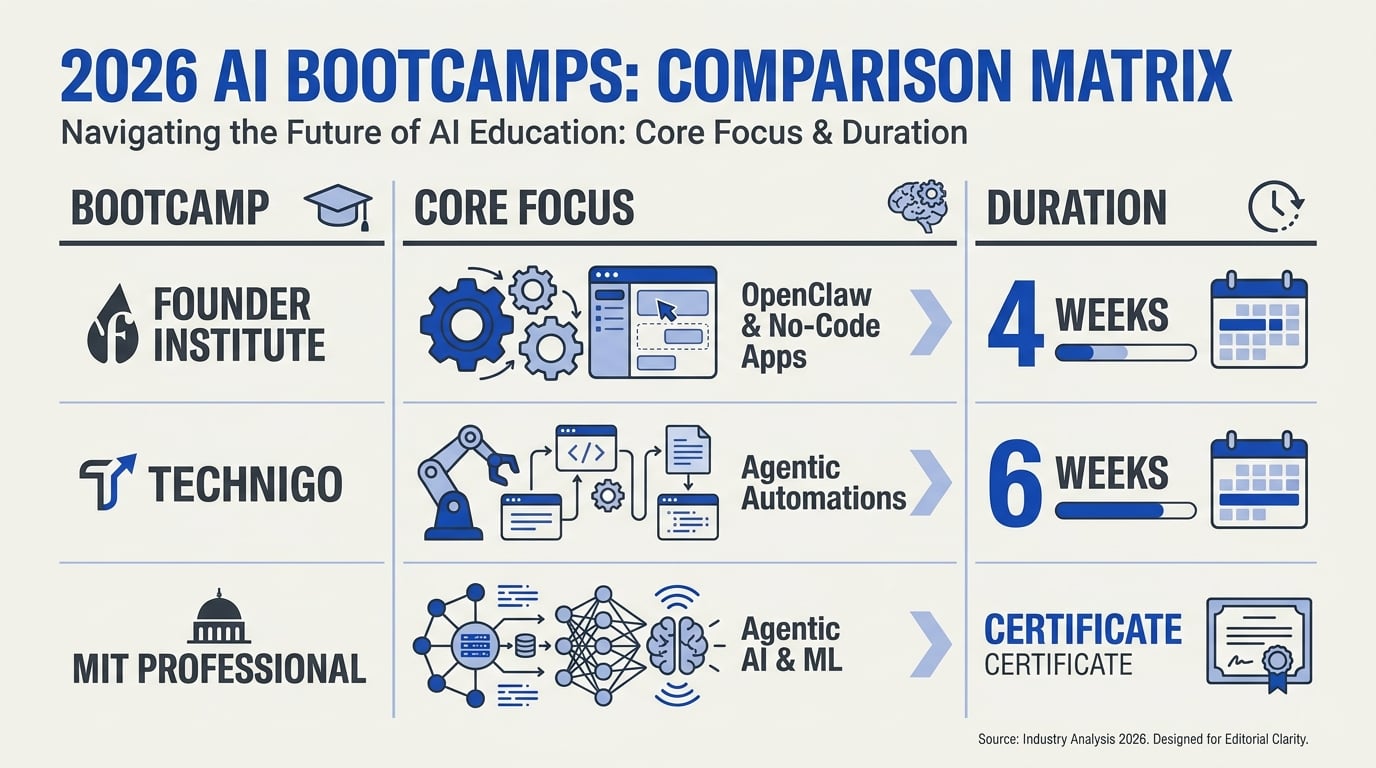
The professional landscape in 2026 demands more than just knowing how to write a basic ChatGPT prompt. Forward-thinking organizations are prioritizing "AI Builders"—professionals who can actively design, deploy, and scale autonomous agents. Because of this, educational programs have shifted away from theoretical video lectures toward active, build-in-real-time environments where students construct live applications during class.
To help you choose the right training path, we’ve analyzed and compared the top AI productivity bootcamps available in 2026. These programs focus on turning busy professionals into builders who can orchestrate workflows, integrate multi-agent systems, and launch custom apps without writing a single line of code.
| Program Name | Format & Duration | Core Focus | Featured Tools | Best For |
|---|---|---|---|---|
| Founder Institute Advanced AI Productivity | 4 Sessions (Intense Cohort) | Personal AI assistant setup, research & writing automation | OpenClaw, advanced agentic frameworks | Busy professionals & startup founders |
| Technigo AI Productivity Bootcamp | 6 Weeks (Online, Part-time) | Redesigning daily workflows, automations, & freeing up time | No-code automations, AI agents | Career changers & workflow optimizers |
| MIT Professional Ed. No Code & Agentic AI | Certificate Program (Self-paced/Live) | Enterprise Agentic AI, GenAI, and ML implementation | Enterprise-grade no-code AI platforms | Mid-to-senior leaders & product managers |
| Krish Naik Modern No Code AI Route | Live Cohort (Variable) | Transitioning from AI Generalist to active AI Builder | Live builder platforms, API integrations | Aspiring builders seeking community learning |
Analyzing the 2026 Cohort: Real-Time Building vs. Theoretical Learning
In 2026, the real breakthrough occurs when you watch someone build with AI in real-time. It is no longer about static demos; it is about configuring working agents live. As highlighted by industry expert Divya Bairavarasu, the modern no-code stack allows absolute beginners to construct functional websites and apps from scratch.
To select the bootcamp that fits your busy schedule, consider these three core evaluation pillars:
- Agentic Capabilities: Does the curriculum move beyond basic prompting to cover autonomous agents (e.g., setting up frameworks like OpenClaw or MindStudio)?
- Time-to-Value: Will you walk away from the very first sessions with a functional tool, or is the program heavily front-loaded with theory?
- Integration Flexibility: Does the course teach you how to hook your custom AI up to external APIs, databases, and communication channels?
Programs like the Founder Institute (FI) Bootcamp excel at rapid deployment, guaranteeing a personalized, active AI assistant by the end of their four sessions. Conversely, the MIT Professional Education certificate takes a structured, high-level approach, training enterprise leaders to orchestrate multiple agents to manage complex business tasks.
Bridging Training with Enterprise Execution
While these bootcamps teach you how to conceptualize, prototype, and build your first AI assistants, taking those creations to a production-grade level requires specialized infrastructure.
For instance, once you learn how to map out conversational workflows and connect APIs in a class, platforms like CallMissed make it seamless to deploy those ideas in the real world. CallMissed offers ready-to-use AI voice agents, WhatsApp chatbots, and a multi-model API gateway supporting over 300+ LLMs. This infrastructure allows bootcamp graduates to easily scale their classroom prototypes into robust, customer-facing communication systems.
In-Depth Analysis: Demystifying the 2026 No-Code AI & Agentic Stack
The shift in 2026 is away from simple prompt engineering toward Agentic AI—systems that don't just answer questions but actively execute multi-step workflows. To master this shift, professionals attending leading bootcamps are learning a highly integrated "No-Code AI Stack." This stack enables individuals to build live, functional web applications and configure personal assistants that run autonomously, handling everything from market research to automated writing pipelines.
Let’s demystify the core layers of this 2026 no-code ecosystem:
1. The Orchestration & Agent Layer
At the heart of any modern AI workflow is the coordination of autonomous agents. Instead of manually copying and pasting text across different platforms, professionals use specialized orchestration environments:
- OpenClaw: A leading agentic tool highlighted in advanced productivity bootcamps for setting up local and cloud-based personal assistants that automate research and writing workflows.
- MindStudio: A robust no-code platform designed to build custom AI agents and automated workflows. It consolidates multiple separate tools into a single, cohesive system, eliminating the friction of managing fragmented subscriptions.
2. The Multilingual and Voice Interface Layer
Modern AI agents must interact with the world through more than just text; they need to listen, speak, and adapt to diverse global audiences. For businesses looking to implement this, platforms such as CallMissed offer production-ready voice agent infrastructure. By providing Speech-to-Text APIs that support 22 Indian regional languages natively, alongside expressive Text-to-Speech engines, it allows non-technical builders to deploy voice-activated, localized AI agents capable of handling customer queries 24/7.
3. The Front-End & App Builder Layer
Once the backend logic and agentic workflows are established, the final step is creating a seamless user experience. The latest 2026 bootcamps guide professionals through building live websites and apps from scratch with zero coding. This layer involves:
- Using generative no-code builders to spin up interactive web dashboards from natural language instructions.
- Connecting user interfaces to LLM backends. Solutions like CallMissed’s multi-model API gateway let developers and creators switch between 300+ LLMs without rewriting code, ensuring they always use the most cost-effective or high-performing model for the task.
By mastering these three layers, non-technical professionals are transitioning from passive users of AI to active builders, designing bespoke digital systems that run autonomously and reclaim hours of productive time every day.
Impact & Implications: How Custom AI Assistants Transform Daily Operations
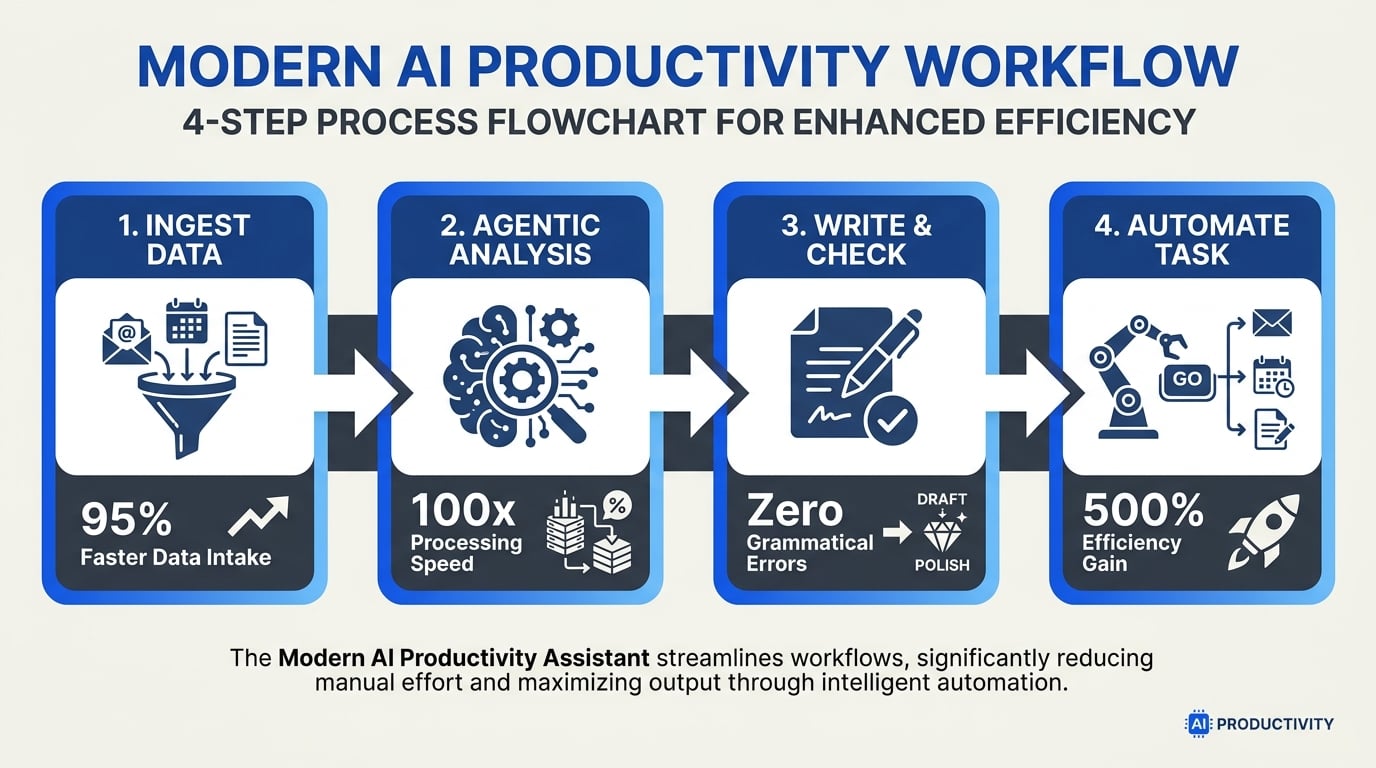
There is a profound moment of clarity that occurs when a professional witnesses a custom AI assistant execute a complex, multi-step workflow in real time. It is not a polished marketing demo or a pre-recorded walkthrough; it is a live, autonomous agent tailored to the exact parameters of their daily job. In 2026, the transition from typing static prompts into chat boxes to deploying agentic, background-running digital twins is fundamentally reshaping corporate productivity.
By leveraging the skills taught in modern productivity bootcamps, knowledge workers are shifting from passive software users to active AI architects, resulting in drastic operational efficiency gains.
The Shift from Passive Prompts to Agentic Workflows
Historically, utilizing generative AI required constant context-switching—manually copying text from an email, pasting it into an LLM, refining the prompt, and copying the result back. Custom AI assistants built with modern agentic tools like OpenClaw or no-code platforms like MindStudio completely automate this pipeline.
Instead of waiting for human commands, these assistants operate under continuous, event-driven triggers:
- Autonomous Monitoring: The assistant actively scans specified inputs, such as incoming client emails, RSS feeds, or centralized databases.
- Deep Synthesis: It automatically conducts background research, cross-references internal company knowledge bases, and drafts structured responses or reports.
- Downstream Execution: It connects directly to APIs to update CRM systems, draft Slack notifications, or schedule follow-ups without human intervention.
This evolution shifts the professional’s role from "content creator and data entry clerk" to "editor-in-chief and strategic overseer," saving an estimated 10 to 15 hours of manual work every week.
Extending Automation to Global Communication
The true power of a custom AI assistant is realized when its cognitive capabilities are paired with robust, external communication channels. While a personal assistant can manage spreadsheet data and organize drafts, platforms like CallMissed allow professionals to scale these workflows into the physical and digital world.
For instance, a bootcamp-trained entrepreneur can configure an AI agent to monitor inbound web leads, and seamlessly hook that workflow into CallMissed’s voice and WhatsApp APIs. The moment a high-value lead is identified, the system can instantly trigger an interactive, multilingual AI voice agent to call the prospect back in their native tongue—supporting up to 22 Indian regional languages—bridging the gap between back-office automation and real-time customer engagement.
Democratizing Software Creation Without Code
Perhaps the most disruptive implication of the 2026 productivity stack is the democratization of software creation. Business professionals no longer need to wait on backlogged IT departments to build custom internal utilities.
- Immediate Prototyping: Teams can build, test, and deploy a live, functional micro-app or automated client portal within a single afternoon using zero-code tools.
- Hyper-Localized Solutions: Because the workflows are built by the exact people who understand the operational bottlenecks, the resulting AI assistants match the specific nuances of the business perfectly.
- Drastic Cost Mitigation: Organizations can bypass expensive software licensing fees by building lightweight, tailored agents that perform the tasks of multiple fragmented SaaS tools.
Ultimately, mastering custom AI assistants does not just make an individual faster; it fundamentally changes the operational capability of the entire enterprise, turning every ambitious professional into an agile, self-sufficient developer.
Expert Opinions: Why 'AI Builders' are Rapidly Outpacing 'AI Prompters'
There is a profound moment that happens when you watch someone build with AI in real-time. It is not a canned demo or a pre-recorded walkthrough; it is the raw, frictionless experience of watching a live, functional application come to life from scratch with zero coding required.
As we navigate 2026, industry experts agree that the era of the mere "AI Prompter" is rapidly drawing to a close. While copy-pasting clever prompts into a basic chat window was a valuable skill in the early days of generative AI, today’s competitive landscape belongs to the AI Builders—professionals who construct autonomous agentic workflows, launch functional apps, and design persistent digital assistants.
The Structural Limit of "Prompt Engineering"
For years, professionals relied on prompt engineering to squeeze better outputs out of Large Language Models (LLMs). However, this approach remains inherently manual, linear, and transient. An AI propter is trapped in a loop: inputting a query, waiting for a response, and manually copying the output into another tool.
According to curriculum insights from leading programs, such as the MIT Professional Education program on No Code and Agentic AI, true productivity gains require moving beyond the chat box. Their frameworks emphasize that organizations deploying agentic, multi-agent systems achieve exponential efficiency gains compared to those relying on isolated prompt-and-response interactions. AI Builders do not just write prompts; they construct systems where agents hand off tasks to other agents, access live database APIs, and run continuously in the background.
Why AI Builders are Outpacing Prompters
The divergence between these two groups comes down to the creation of permanent digital leverage. Here is how they compare in daily operations:
- Systems over Chats: While a propter writes a prompt to draft a single email, an AI Builder uses tools like MindStudio to construct an automated lead-nurturing pipeline that monitors incoming signals, drafts personalized responses, and updates CRMs autonomously.
- Zero-Code App Deployment: Utilizing the 2026 no-code stack, AI Builders can spin up live, functional websites and internal micro-apps from scratch in minutes, bypassing traditional software development bottlenecks.
- Infrastructure-Level Control: Prompters are restricted to whatever interface a single consumer AI provider gives them. In contrast, Builders leverage advanced infrastructure platforms. For instance, forward-thinking professionals use communication platforms like CallMissed to access a multi-model API gateway, allowing them to switch between 300+ LLMs and deploy intelligent voice agents capable of communicating in 22 regional Indian languages without writing complex backend code.
The Bottom Line: Building Generates Assets, Prompting Consumes Time
Industry thought leaders argue that "prompting" is a consumption activity, whereas "building" is an asset-creation activity. When you complete a modern curriculum like the Advanced AI Productivity Bootcamp, you do not walk away with a mere cheat sheet of text prompts. You walk away with an active, custom-configured personal assistant running on agentic frameworks like OpenClaw—automating your research, writing, and daily operations while you sleep.
To remain indispensable, professionals must transition from asking AI to perform isolated tasks to building autonomous systems that manage entire operational workflows.
What This Means For You: Action Plan to Design Your AI Workflow
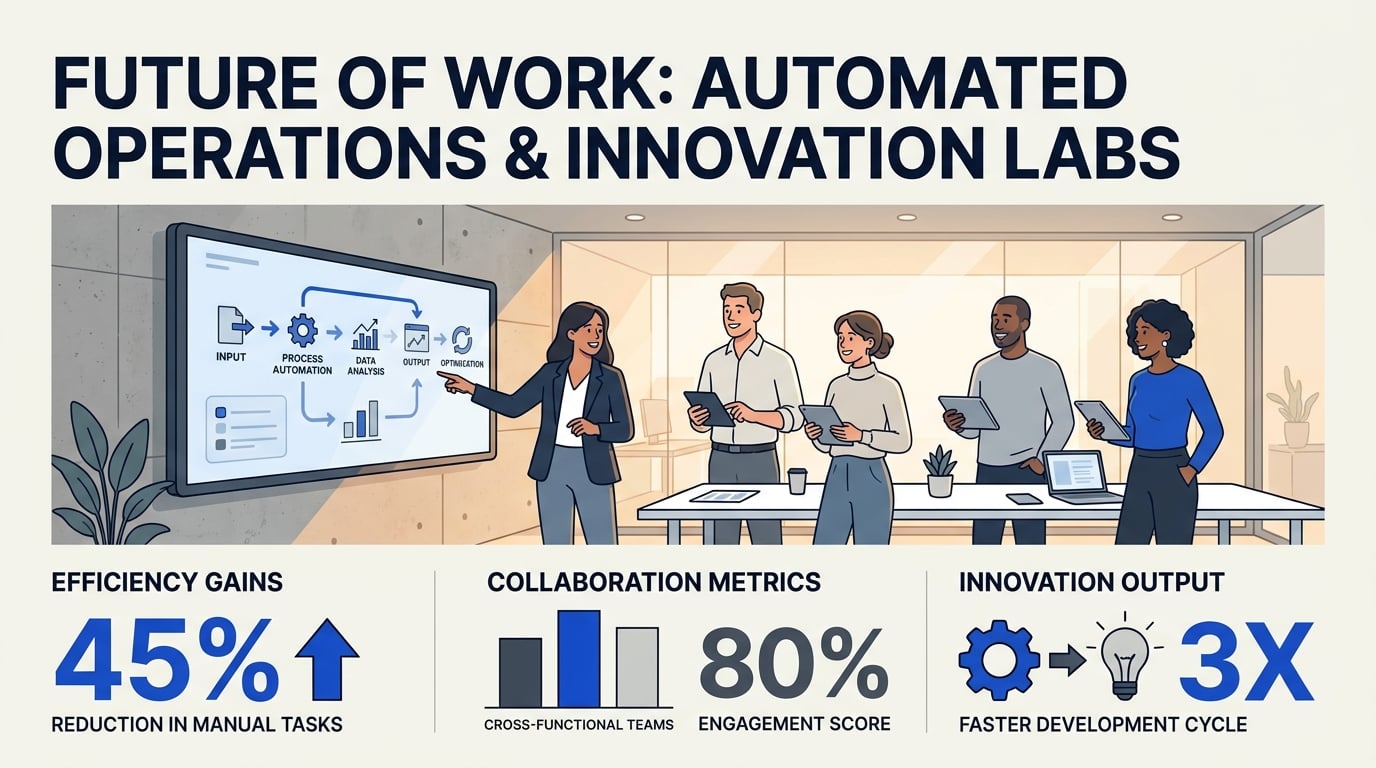
Transitioning from a passive user of AI to an active builder is the defining career pivot of 2026. As highlighted by leading programs from MIT Professional Education and the Founders Institute, the true power of modern AI lies in agentic workflows—systems that don't just answer prompts, but autonomously execute multi-step business operations.
To help you move from theory to execution, we have designed a blueprint to help you transition your daily routine into an automated, AI-driven engine. The following action plan outlines how to stack, build, and deploy your custom AI workflows without writing a single line of code.
| Phase | Core Objective | Recommended 2026 Stack | Key Deliverable | Est. Time |
|---|---|---|---|---|
| 1. Personal Assistant | Automate daily research, synthesis, and writing pipelines. | OpenClaw, Claude 3.5, Notion | Personalized executive daily briefing agent | 2–4 Hours |
| 2. Multi-Tool Integration | Connect fragmented apps into cohesive, automated workflows. | Zapier, MindStudio, Make | Auto-triage email & CRM pipeline | 1 Day |
| 3. No-Code App Launch | Build user-facing internal tools or client portals from scratch. | Softr, FlutterFlow, MindStudio | Interactive client dashboard or database | 3 Days |
| 4. Voice & Chat Scaling | Implement conversational AI agents for client-facing operations. | CallMissed, Retell AI | 24/7 automated multilingual voice & WhatsApp assistant | 2 Days |
Step 1: Establish Your Agentic Foundation
Begin by automating your personal informational bottleneck. Using open-source agentic tools like OpenClaw alongside advanced LLMs, you can configure an agent that runs in the background. Instead of manually scrolling through newsletters, feeds, and reports, this assistant gathers industry updates, synthesizes them against your specific project constraints, and drafts your morning briefings.
Step 2: Connect and Build Custom Applications
Once your internal pipeline is solid, transition to building outward-facing solutions. Using no-code platforms like MindStudio, you can easily turn complex spreadsheets and knowledge bases into custom web applications for your team or clients.
To supercharge these applications with production-grade communication, integrating specialized infrastructure is key. For example, platforms like CallMissed allow professionals to deploy highly responsive AI voice agents and WhatsApp chatbots that connect directly to their no-code databases. By utilizing CallMissed’s multi-model API gateway, you can seamlessly toggle between 300+ LLMs without touching any code, ensuring your custom apps always run on the most cost-effective, high-performing model available. Additionally, for global and regional operations, its native Speech-to-Text infrastructure supports 22 regional Indian languages, making localization effortless.
Step 3: Continuously Audit and Optimize
Your AI workflow is not a "set-and-forget" project. Dedicate 30 minutes every Friday to review execution logs, analyze where your automated agents hit roadblocks, and refine your prompts. In 2026, the professionals who command the highest market premiums are not those who work the longest hours, but those who successfully manage the most efficient digital workforce.
Frequently Asked Questions About AI Productivity Bootcamps
What is the best AI productivity bootcamp for professionals in 2026?
Do I need prior coding experience to enroll in an AI productivity bootcamp?
How long does a typical AI productivity bootcamp take to complete?
What tools and technologies are covered in an AI productivity bootcamp?
Will I build a real, functioning application during the program?
What career advantages does completing an agentic AI program offer?
Conclusion
Choosing an AI productivity bootcamp 2026 should come down to outcomes, not hype. Evaluate each program by its hands-on project time, instructor support, tool relevance, no-code deployment process, and guidance on privacy, security, and responsible AI use.
Expected Deliverables:
- A configured AI assistant tailored to research, writing, or administrative work.
- At least one automated workflow connected to real professional tasks.
- A deployed no-code app or website that can be tested and shared.
- A practical implementation plan for applying and maintaining these systems after the program.
A credible AI productivity bootcamp 2026 should require participants to build, test, and deploy—not simply watch demonstrations or discuss AI theory. Avoid theory-only programs that offer broad concepts without portfolio-ready deliverables or repeatable workflows.
Before enrolling in an AI productivity bootcamp 2026, confirm that its curriculum matches your goals and produces tools you can use immediately. To see how applied AI supports customer communication, explore CallMissed, an AI infrastructure platform for production-ready voice agents and multilingual chatbots.
Discussion
Related Posts


Ready to automate customer conversations?
Launch AI voice agents and WhatsApp bots with CallMissed — one API, 22+ Indian languages.