
OpenRouter vs Direct Provider APIs in 2026: Pricing, Latency, and Rate Limits


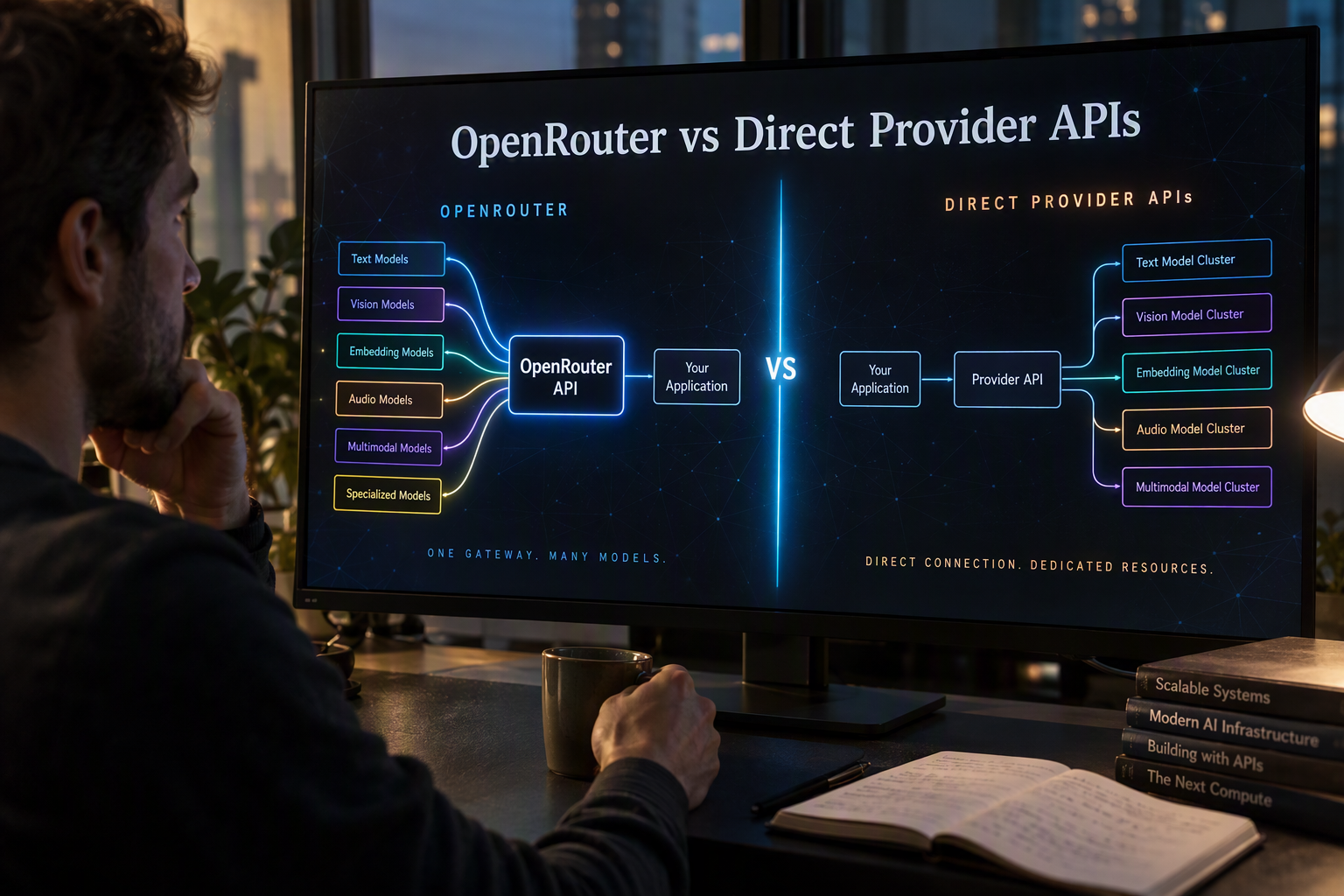
Compare OpenRouter vs direct provider APIs in 2026 across pricing, latency, rate limits, features, privacy, and production trade-offs.
OpenRouter vs Direct Provider APIs in 2026: Pricing, Latency, and Rate Limits
What if access to 300+ AI models costs more—but saves weeks of integration work? OpenRouter vs direct provider APIs is no longer a simple choice between convenience and control: in 2026, pricing, latency, failover, privacy, and rate limits can materially affect production costs and user experience. Costbench’s July 2026 pricing review lists OpenRouter’s free-model limit at 20 requests per minute, while Omid Saffari reports a 5.5% credit fee on top of underlying provider rates. Direct APIs may offer tighter control over quotas and network paths, but require separate keys, billing, monitoring, and fallback logic for each provider. This comparison breaks down real costs, request latency, rate-limit behavior, reliability, and switching trade-offs. We’ll also examine unified gateways such as CallMissed, which give developers one OpenAI-compatible endpoint for multiple models and modalities.
Which is better: OpenRouter or a direct provider API?
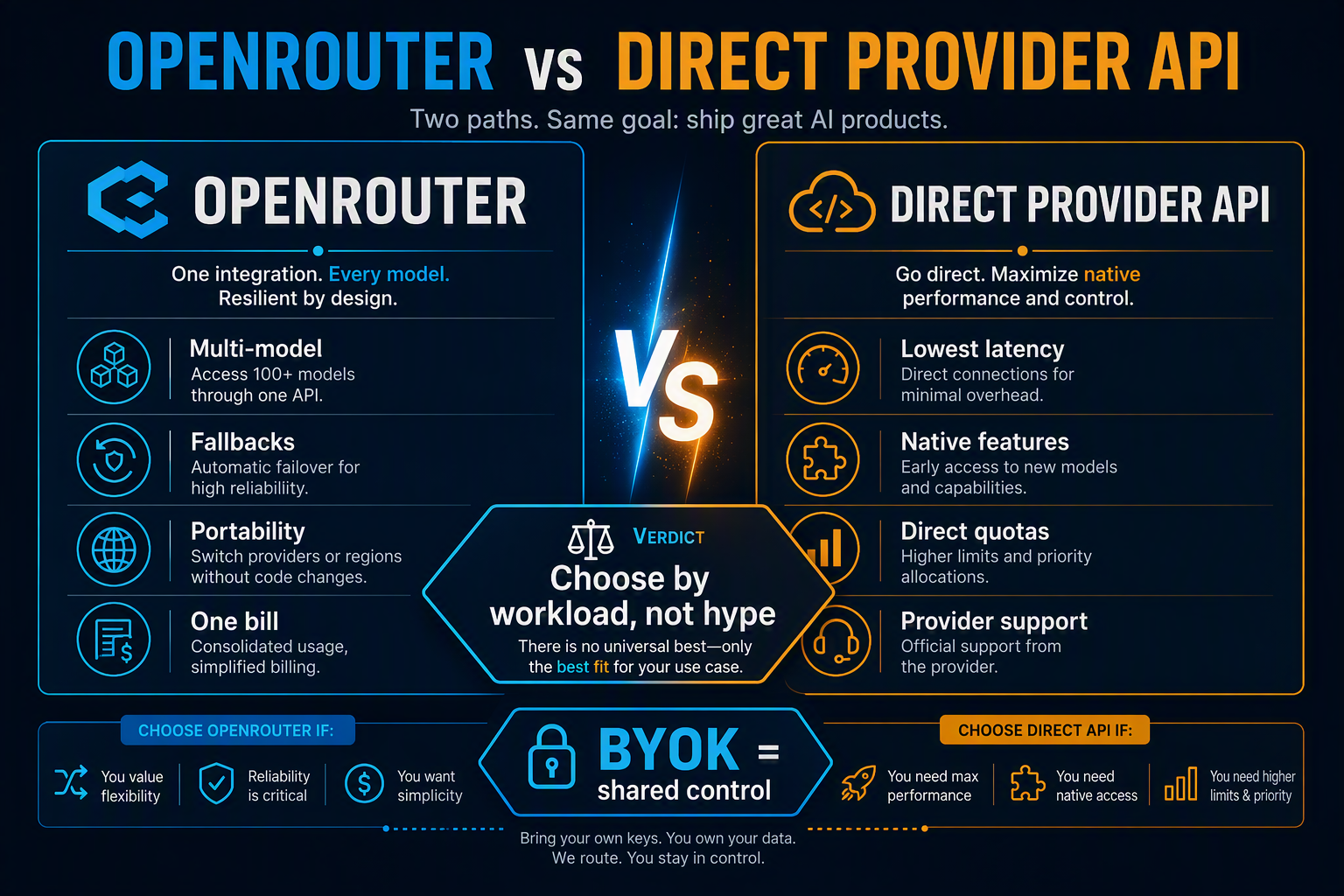
OpenRouter is generally better for multi-model portability, routing, and fallback, while a direct provider API is usually better when one provider’s native capabilities, governance terms, quotas, and support model are central to production. BYOK (Bring Your Own Key) offers a middle path: you retain provider credentials and provider-side commercial terms while using a unified routing layer.
When should you choose OpenRouter over a direct provider API?
Choose based on the operational problem—not simply the number of models available.
- Choose OpenRouter when portability matters. OpenRouter provides an OpenAI-compatible interface across models from providers such as OpenAI, Anthropic, Google, Meta, Mistral, and Cohere. AISO Tools described the catalogue as supporting 200+ models in 2026, while Costbench and AIToolPick reported 300+ models. Because model availability changes, treat any catalogue count as time-sensitive.
- Choose a direct API when native capability and control matter most. Direct integrations preserve provider-specific tools, response formats, fine-tuning options, regional settings, quotas, support channels, and billing relationships. The trade-off is more engineering: separate SDKs, authentication methods, request formats, dashboards, retry logic, and model-specific monitoring.
- Compare total cost, not only token prices. OpenRouter documentation states that the platform passes through underlying provider pricing without an inference markup. However, Omid Saffari reported a 5.5% credit-purchase fee in 2026, while Brainroad clarified that this fee applies when purchasing credits rather than to each inference. Direct APIs may avoid that intermediary funding fee and may provide committed-use discounts or negotiated enterprise rates. Engineering, observability, failover, and maintenance costs should also be included in the calculation.
- Use OpenRouter for routing and fallback. A gateway can simplify model switching, traffic balancing, and fallback when a provider is throttled or unavailable. A direct API may offer a shorter network path to the selected provider and potentially more predictable latency, but your team must build health checks, circuit breakers, retry policies, and alternate-provider logic.
How do rate limits and latency compare?
Direct APIs expose provider-specific quotas and tier upgrades, which can make capacity planning simpler for a single-provider architecture. OpenRouter centralizes access but does not remove upstream constraints: effective limits depend on the selected model, provider, and route.
Costbench’s pricing review, last checked in July 2026, listed 20 requests per minute for OpenRouter’s free models and described their availability as best effort. For either architecture, benchmark the exact production route using your own prompt lengths, concurrency, geographic regions, streaming settings, and fallback behavior; a gateway’s convenience does not guarantee lower latency.
Where does a unified API fit?
A unified gateway can be valuable when teams want portability without rebuilding integrations. For example, CallMissed’s developer AI API, as of September 2026, provides one API key and balance for 134 models, including 38 general-purpose LLMs, 25 realtime voice-agent models, 45 speech-to-text models, 9 text-to-speech models, 15 image models, and 2 embedding models. It supports OpenAI-compatible and Anthropic-compatible endpoints, allowing existing SDKs to work by changing the base URL.
Practical recommendation
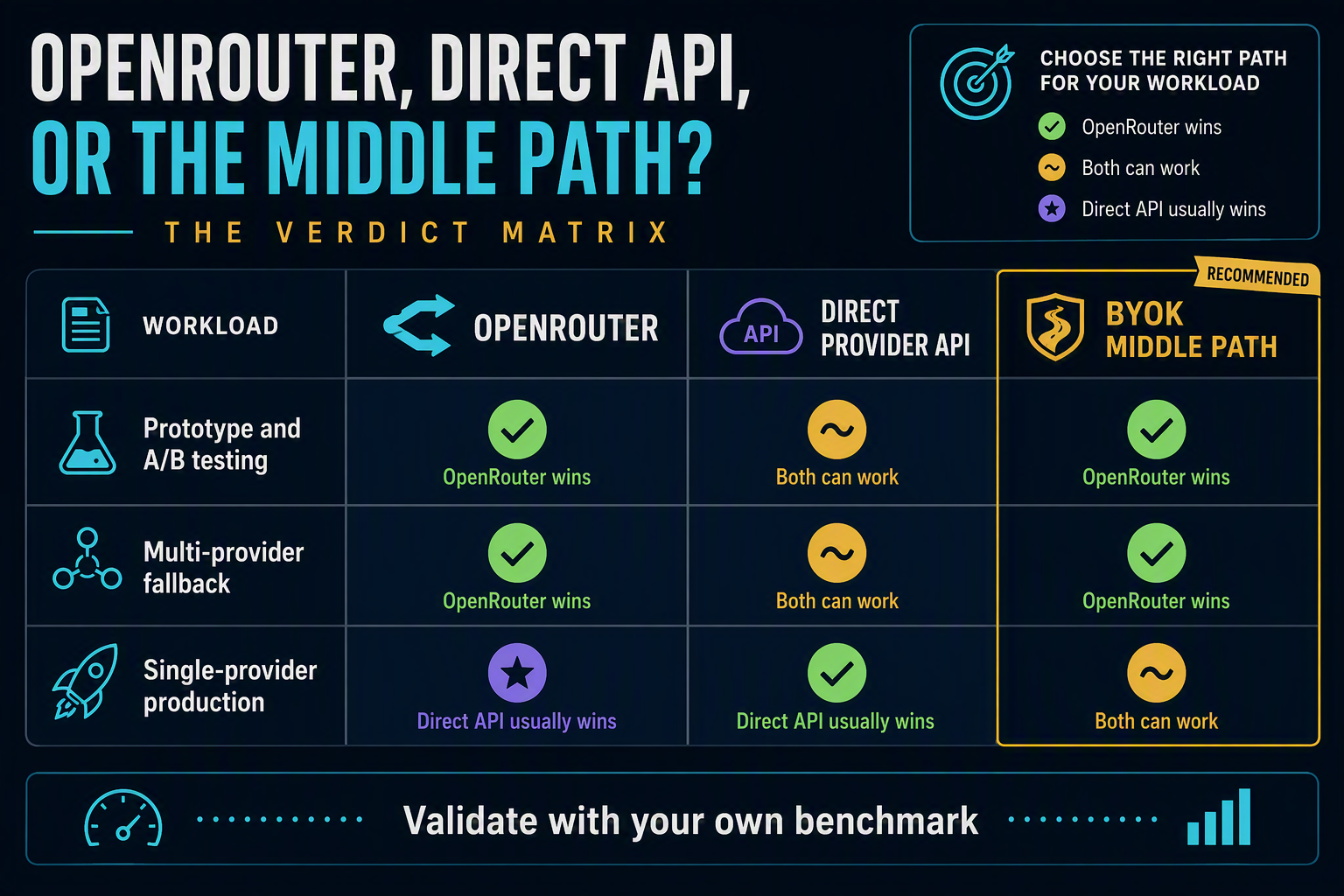
- Use OpenRouter for prototypes, evaluations, multi-model products, and applications that benefit from routing or fallback.
- Use a direct provider API for high-volume workloads with one dominant model, strict governance requirements, or a negotiated provider relationship.
- Use BYOK when you want a routing layer while preserving your own provider credentials, quotas, and commercial terms.
A hybrid architecture is often practical: use a direct API for the critical path and a gateway for experimentation, secondary models, or resilience. Evaluate privacy, retention, residency, logging, rate limits, and failure behavior separately for every deployment.
What is the short verdict at a glance?
Verdict
Choose OpenRouter when you value fast multi-model experimentation, one OpenAI-compatible integration, and built-in routing. Choose direct provider APIs when a stable model, predictable provider quotas, and minimum request-path overhead matter more. Neither option is universally cheaper or more reliable; the practical decision depends on traffic shape, latency targets, provider commitments, and how much integration and failover logic your team is prepared to maintain.
- OpenRouter is the practical default for multi-model applications. AISO Tools describes OpenRouter as providing access to 200+ models, while Costbench’s pricing review, last checked in July 2026, lists 300+ models. One interface can simplify testing across OpenAI, Anthropic, Google, Meta, Mistral, Cohere, and other providers without building a separate integration for every model.
- Direct APIs are the practical default for focused production workloads. A direct OpenAI, Anthropic, Google, or other provider integration preserves native features, provider-specific controls, support terms, enterprise pricing, and direct access to that provider’s quotas. It also avoids introducing a separate routing layer into the request path.
- OpenRouter pricing requires two calculations. OpenRouter documentation says the platform passes through underlying provider inference rates without an inference markup. However, Omid Saffari reports a 5.5% credit-purchase fee in 2026. Teams should therefore compare token costs, funding costs, and any operational savings from using one gateway rather than treating “no markup” as the complete all-in price.
- Free access is not a production-capacity guarantee. Costbench reports a 20-requests-per-minute limit for free models, with best-effort availability, in its July 2026 review. Paid model access and provider-specific limits can differ, so benchmark the exact model, route, region, and traffic pattern used by the application.
- Routing and fallback improve flexibility, not upstream capacity. OpenRouter can route requests across eligible providers or models and may reduce application-level disruption when one route is unavailable. It cannot eliminate upstream 429 responses, provider outages, queueing, model-specific limits, or regional capacity constraints. Production systems still need retries, exponential backoff, timeouts, circuit breakers, and observability.
Where BYOK Fits
BYOK, or Bring Your Own Key, is the middle path: OpenRouter supplies the unified interface and routing layer, while provider credentials and the provider-side commercial relationship remain part of the setup. BYOK can suit teams that want OpenRouter’s integration and fallback workflow without moving all inference billing to OpenRouter.
ContinuumCode reports a 5% BYOK fee above $25,000 of monthly list-price inference for its documented pay-as-you-go tier. Verify current OpenRouter terms before modelling costs because fees, allowances, and enterprise arrangements can change. BYOK also does not guarantee unlimited capacity: provider quotas, authentication, billing status, model availability, and upstream 429 responses still apply.
A comparable gateway approach is available from CallMissed, an OpenAI-compatible developer AI API. As of September 2026, CallMissed provides one API key and balance for 134 models, including general-purpose LLMs, realtime voice-agent models, speech-to-text, text-to-speech, image, and embedding models. That illustrates the broader gateway trade-off: one integration can broaden model access, but teams should still evaluate provider terms, limits, routing behaviour, and workload-specific latency.
Practical Choice
- Use OpenRouter for prototypes, multi-model products, provider diversification, and teams that prefer one integration.
- Use direct APIs for latency-sensitive workloads with a stable model, predictable traffic, or strong reasons to use native provider capabilities.
- Use OpenRouter with BYOK when you want a common gateway while retaining provider accounts, negotiated terms, or quota ownership.
How do OpenRouter and direct APIs compare feature by feature?
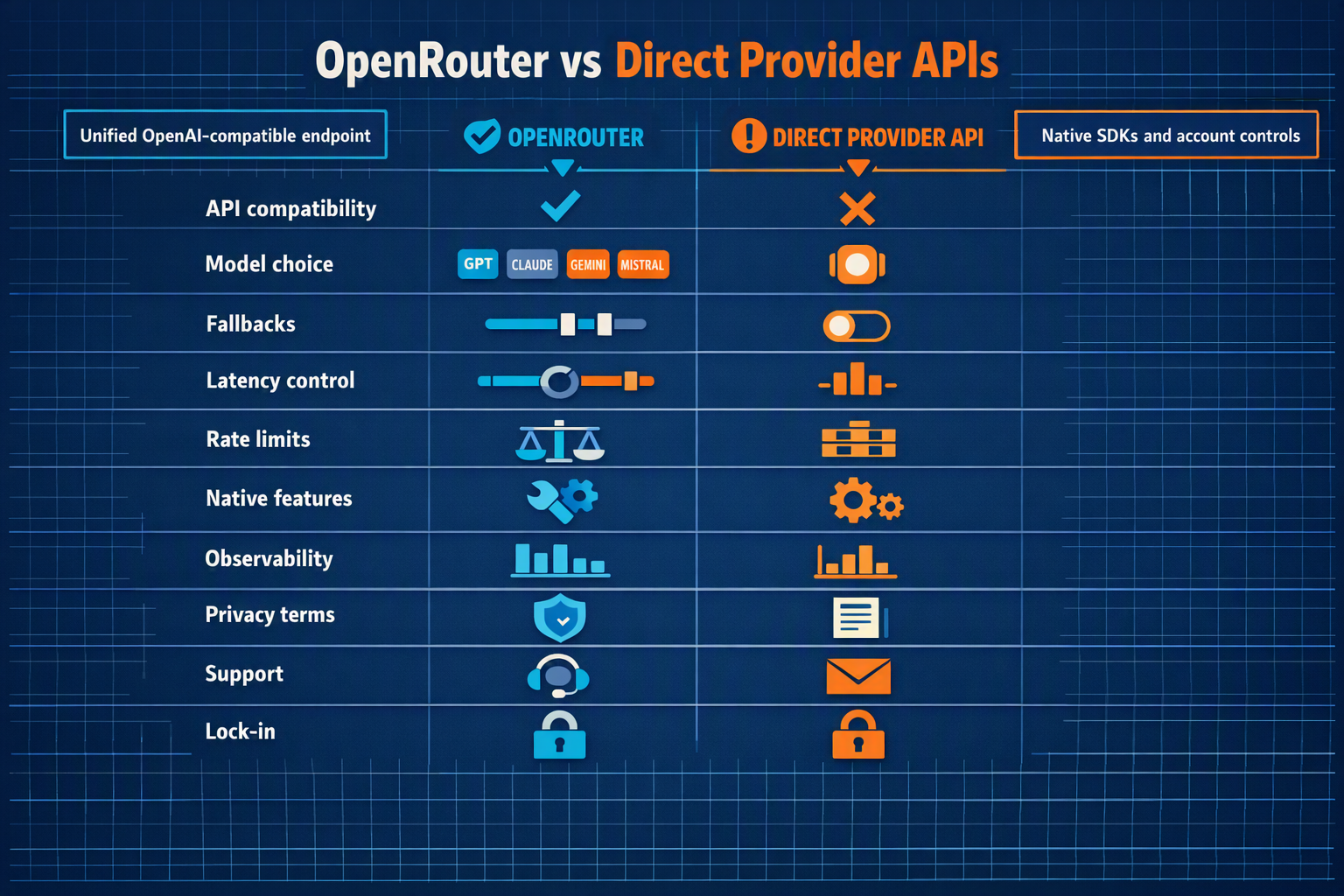
OpenRouter and direct provider APIs differ primarily in abstraction versus control. OpenRouter centralizes access, billing, and model routing, while direct APIs expose each provider’s native capabilities and account controls more directly. Capability parity is not guaranteed, so verify support by specific model, provider route, and API version before choosing an integration.
Feature comparison
| Feature | OpenRouter | Direct provider APIs | Practical implication |
|---|---|---|---|
| Unified endpoint and responses | Provides one OpenAI-compatible endpoint, API key, billing account, and generally normalized request and response formats. AISO Tools described access to 200+ models in 2026, while Costbench listed 300+ models, last checked in July 2026. | Each provider has its own endpoint, authentication, SDK conventions, error schema, and response features. | OpenRouter can reduce integration work for multi-provider applications. Direct APIs preserve each provider’s native contract with fewer translation layers. |
| Multi-provider access | Routes models from providers including OpenAI, Anthropic, Google, Meta, Mistral, Cohere, and independent inference providers, according to AISO Tools. | Requires separate integrations, credentials, billing relationships, and operational dashboards for each provider. | OpenRouter suits model evaluation and portability; direct APIs are simpler when production is concentrated on one provider family. |
| Routing and fallback controls | Can expose provider selection, model routing, and fallback options, although availability and behavior depend on the selected model and route. | The customer selects the provider directly and must implement cross-provider routing, retries, and failover. | OpenRouter may reduce resilience engineering, while direct APIs provide more explicit control over failover policy and provider selection. |
| Native features and parameters | Common features may be normalized, but provider-specific parameters, modalities, tools, fine-tuning, batch processing, priority capacity, and account controls can vary by model or route. | Native SDKs and APIs expose the provider’s supported parameters, modalities, tools, fine-tuning, batch, priority, and account controls most directly. | Direct access is generally preferable for advanced or provider-specific workflows. Confirm capability parity instead of assuming compatibility. |
| Pricing and fees | OpenRouter documentation states that underlying provider pricing is passed through without an inference markup. Omid Saffari reported a 5.5% credit-purchase fee in 2026, while other analyses describe separate BYOK fee rules. | Uses published provider rates, negotiated discounts, committed-use pricing, and provider-specific billing terms. | Compare token, image, tool, storage, and funding costs—not only the displayed per-token rate. |
| Quotas and rate limits | Limits depend on account status, model, provider route, and fallback path. Costbench reported 20 requests per minute for free models, based on its July 2026 review. | Quotas, burst limits, concurrency, regional capacity, and upgrade paths are controlled by the provider account and tier. | OpenRouter consolidates access but remains route-dependent; direct quotas may be easier to capacity-plan for one provider. |
| Latency and observability | Adds a gateway and possible routing hop, but can provide centralized request records, model selection, and cross-provider usage visibility. | Offers provider-native logs, traces, token accounting, request IDs, and performance metrics, with fewer intermediary variables. | Benchmark complete application latency, including queueing, routing, retries, and time to first token—not only model generation speed. |
| Privacy, retention, and support | Data handling, logging, retention, support, and incident processes may involve both OpenRouter and the selected provider; confirm current terms for the exact route. | Privacy, retention, support, and incident handling are governed primarily by the provider’s own terms and enterprise agreement. | Review data-processing terms, regional requirements, abuse policies, and support escalation before sending sensitive workloads. |
For teams comparing gateway architectures, CallMissed provides another example of the unified approach: its developer AI API offers one key and balance across 134 models, including OpenAI-compatible and Anthropic-compatible endpoints, as of September 2026. That pattern can simplify model switching, but the same trade-off remains: convenience must be weighed against provider-native control.
How does OpenRouter pricing compare with direct API pricing?
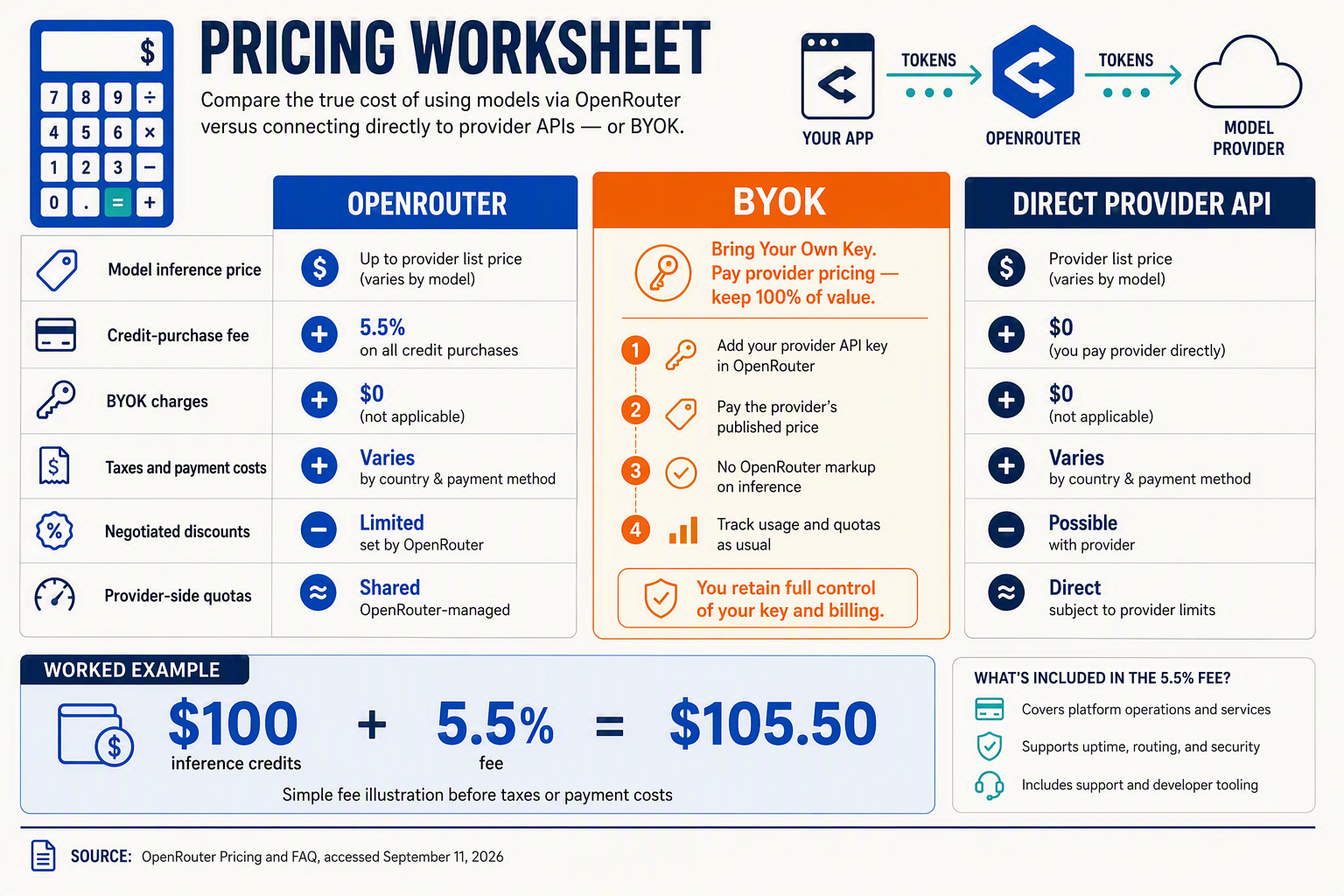
OpenRouter and direct provider APIs can have the same underlying inference price, but their total cost differs once funding fees, BYOK charges, free-tier limits, billing operations, and negotiated discounts are included. As of September 2026, compare the complete cost per production workload—not only the advertised token rate.
| Cost factor | OpenRouter | Direct provider API | Production implication |
|---|---|---|---|
| Inference price | OpenRouter documentation says underlying provider pricing is passed through without an inference markup | The provider’s published token, image, audio, or request rate applies directly | Compare the same model, provider route, region, context length, and output volume |
| Platform or funding fee | Omid Saffari reports a 5.5% credit-purchase fee in 2026; Brainroad also describes this as separate from inference pricing | Usually no intermediary gateway fee, subject to the provider’s billing terms | Direct access may reduce payment overhead, while OpenRouter consolidates access |
| Free-model access | Costbench’s July 2026 review lists a 20 requests-per-minute limit for free models with best-effort availability | Limits vary by provider, account, model, and region | Free routes are useful for experiments, but paid capacity may be necessary for reliable production |
| BYOK pricing | ContinuumCode reports no fee up to $25,000 of monthly list-price inference for pay-as-you-go BYOK, followed by a 5% fee | Provider contracts, negotiated discounts, and quotas apply directly | BYOK can preserve provider relationships while adding centralized routing |
| Billing model | Prepaid credits, one API key, one dashboard, and one consolidated bill across models | Separate invoices, credentials, quotas, and payment accounts | OpenRouter can reduce finance and operations work across providers |
| Enterprise discounts | Discounts depend on OpenRouter’s commercial terms and routing arrangement | Providers may offer committed-use pricing or negotiated rates | High-volume teams should calculate effective cost after discounts and gateway fees |
What is the practical pricing trade-off?
OpenRouter’s “no markup” generally refers to inference pricing, not every possible account charge. The Brainroad analysis says OpenRouter passes through underlying provider rates, while reports from Omid Saffari and ContinuumCode identify separate credit-purchase and BYOK fees. Teams should verify the current terms before creating a long-term forecast because fee structures can change.
Direct APIs can be cheaper at scale when a team has strong provider commitments or negotiated rates. However, the calculation should include more than input and output tokens:
- Engineering time for separate SDKs, authentication systems, and billing integrations
- Retry traffic and fallback implementation
- Monitoring, usage reporting, and quota management
- Minimum commitments or regional pricing
- The operational cost of maintaining multiple provider relationships
Conversely, OpenRouter’s consolidated billing and routing can be economically attractive when a team tests many models, changes providers frequently, or values a single integration more than the lowest possible unit price. Free-model access can lower experimentation costs, but the 20 requests-per-minute best-effort limit reported by Costbench in July 2026 should not be treated as a production capacity guarantee.
CallMissed follows a similar consolidation model through an OpenAI-compatible AI API and gateway for LLM, speech, image, and web-search workloads. CallMissed uses transparent credits where, as of September 2026, 1 credit equals ₹1, helping teams track usage in a single currency-based balance rather than infer costs from multiple provider invoices.
What are the pros and cons of each approach?
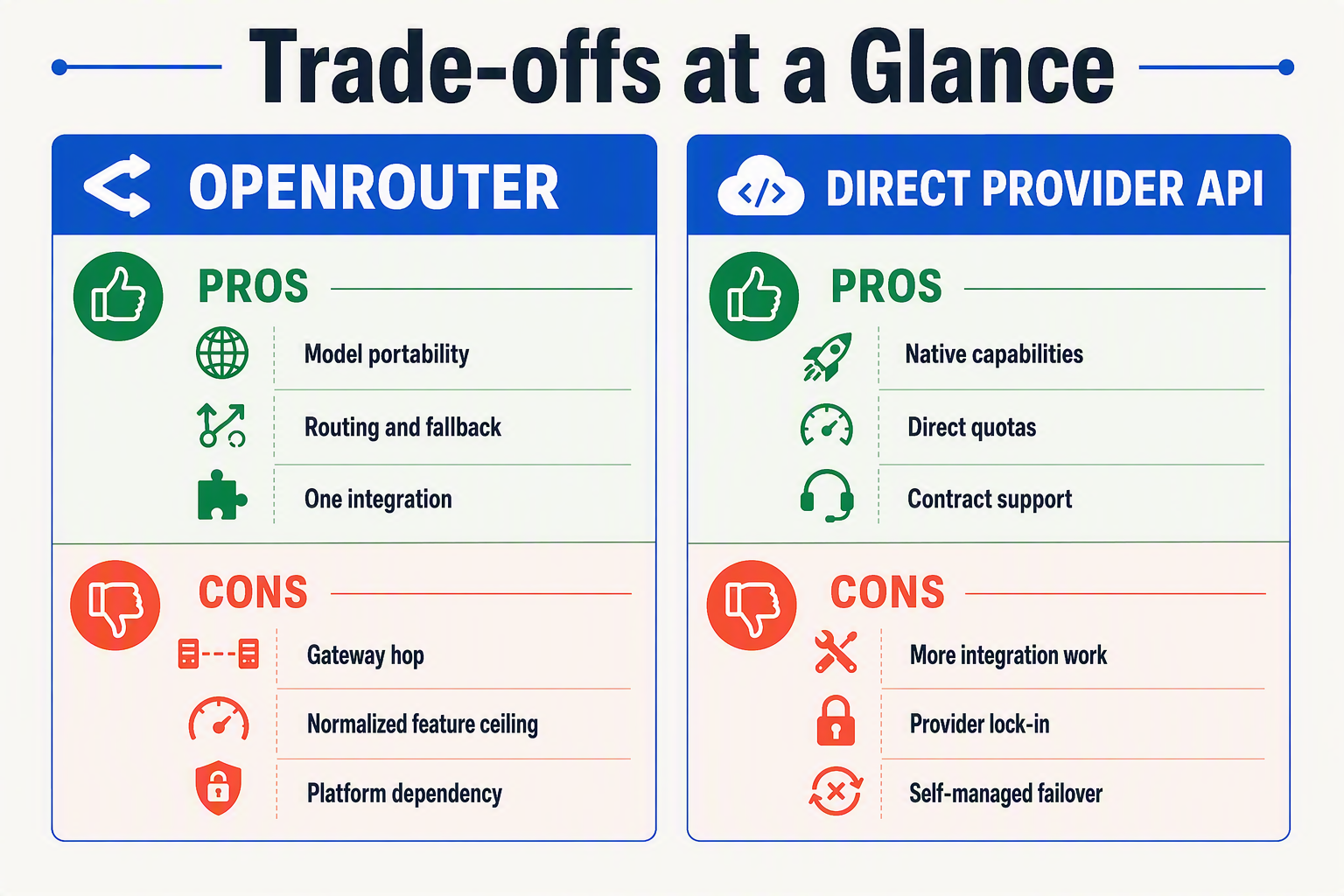
OpenRouter is strongest for multi-model access, unified integration, and faster experimentation; direct provider APIs are strongest for maximum control, native features, and predictable provider relationships. The right choice depends on whether your priority is reducing integration work or owning more of the production stack.
Pros and cons at a glance
| Dimension | OpenRouter | Direct provider APIs | Practical trade-off |
|---|---|---|---|
| Model access | AISO Tools reported 200+ models in 2026, while other 2026 reviews reported 300+, spanning providers such as OpenAI, Anthropic, Google, Meta, Mistral, and Cohere | Each integration exposes one provider’s catalogue and supported models | OpenRouter accelerates comparison; direct APIs simplify a focused production architecture |
| Pricing | OpenRouter passes through underlying inference rates; Omid Saffari reported a 5.5% credit-purchase fee in 2026 | Direct provider pricing, native billing, negotiated discounts, and provider-specific commitments | Direct access may reduce intermediary costs; OpenRouter can reduce engineering and billing overhead |
| Integration | One OpenAI-compatible API, key, and billing workflow | Separate keys, SDKs, dashboards, formats, and authentication flows may be required | OpenRouter lowers initial integration effort; direct APIs can expose deeper provider-specific controls |
| Latency | Routing can add a network hop; fallback may help avoid throttled or unavailable routes | A more direct path to the selected provider is easier to measure and tune | Direct APIs are often simpler to benchmark for fixed, latency-sensitive workloads |
| Rate limits | Costbench recorded 20 requests per minute on free models in July 2026; paid limits vary by route and provider | Quotas, request-per-minute limits, and upgrade tiers differ by provider | Direct limits may be easier to attribute; a gateway centralizes access but cannot remove upstream limits |
| Reliability and control | Routing and fallback can improve continuity across model providers | Teams control provider selection, model versions, retry logic, data handling, and regional configuration | OpenRouter favors operational flexibility; direct APIs favor governance and customization |
OpenRouter’s advantages are most visible during discovery and multi-provider development:
- Faster experimentation: teams can compare models without implementing every provider separately.
- Consolidated operations: one integration can simplify keys, usage tracking, and billing.
- Routing flexibility: fallback options can reduce dependence on a single provider or route.
- Broader testing surface: developers can evaluate general-purpose, reasoning, vision, and open-weight models through a common interface.
The trade-offs are equally important:
- Gateway dependency: an outage, policy change, or routing behavior at the intermediary becomes part of the application’s dependency chain.
- Variable latency: route selection and an additional network hop can make response times less predictable than a fixed provider path.
- Upstream constraints: a gateway does not eliminate the underlying provider’s quotas, availability limits, or model-specific behavior.
- Billing complexity: the 5.5% credit-purchase fee reported by Omid Saffari should be included in cost modeling, even when inference is passed through at provider rates.
Direct provider APIs are usually preferable when a workload depends on native capabilities, strict governance, fixed model versions, dedicated support, or carefully negotiated enterprise terms. Their downside is duplicated engineering: teams may need to build and maintain separate monitoring, retries, fallback, compliance controls, and billing workflows.
A hybrid approach is often practical. Use direct APIs for tightly governed, mission-critical paths and a gateway for experimentation or model breadth. CallMissed’s developer AI API, for example, provides one key and balance across 134 models—including LLM, realtime voice-agent, speech-to-text, text-to-speech, image, and embedding models—with OpenAI-compatible and Anthropic-compatible endpoints.
When should you use OpenRouter, direct APIs, or BYOK?
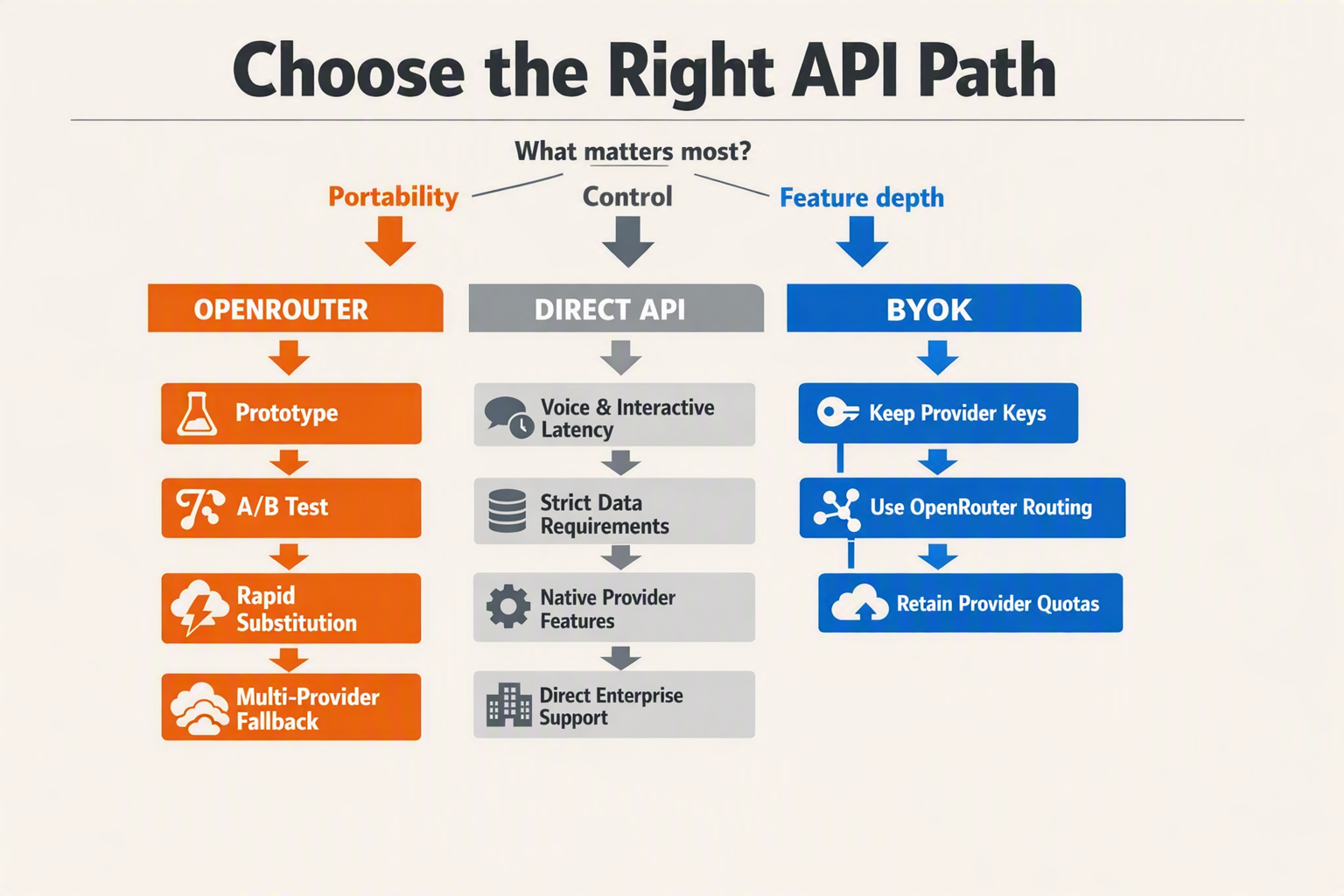
Choose OpenRouter for fast experimentation and multi-provider routing, direct provider APIs for maximum control over a critical production path, and BYOK when you want a unified gateway without abandoning your existing provider accounts. The right choice depends on model diversity, latency, pricing, quotas, compliance, and how much routing logic your team wants to operate.
When should you use OpenRouter?
Use OpenRouter when one integration needs access to models from multiple providers or when switching models quickly matters more than minimizing every network hop. OpenRouter is especially practical for:
- Prototyping and model evaluation across OpenAI, Anthropic, Google, Meta, Mistral, and other providers.
- Fallback routing when an application should try another provider after an outage, capacity error, or model-specific failure.
- Small engineering teams that prefer one API format, account, bill, and observability surface.
- Products with changing model requirements, where replacing a model should not require rewriting provider-specific integrations.
OpenRouter pricing analyses published in 2026 describe access to more than 200 or 300 models, depending on how models and provider variants are counted. CostBench’s July 2026 review lists 300+ models, while AISO Tools describes OpenRouter as providing access to 200+ large language models. Treat the catalogue size as dynamic rather than as a permanent guarantee.
Cost requires careful calculation. According to BrainRoad’s 2026 pricing analysis, OpenRouter passes through underlying provider inference rates without an inference markup, while Omid Saffari reports a 5.5% credit-purchase fee. Because the fee descriptions differ by transaction type and source, confirm the current billing terms before comparing OpenRouter with a direct account.
When are direct provider APIs better?
Choose a direct provider API when a particular model handles most production traffic and you need the shortest request path, provider-native features, or a negotiated commercial arrangement. Direct access is often preferable for:
- Latency-critical workflows, where an additional gateway hop may affect time to first token or overall response time.
- High-volume workloads with committed-use discounts or enterprise pricing.
- Provider-specific capabilities, controls, safety settings, regions, or quota arrangements.
- Regulated or tightly governed systems, where reducing intermediaries simplifies security and data-flow reviews.
The trade-off is operational concentration. Your team may need separate SDKs, authentication methods, usage dashboards, rate-limit policies, and fallback logic for each provider.
When does BYOK make sense?
Use BYOK—bring your own key when you want a routing layer’s common interface and fallback options while retaining provider-side billing, quotas, or negotiated rates. BYOK can be attractive for organizations that already have contracts with multiple model vendors, but verify whether the gateway applies a BYOK fee or usage threshold.
CallMissed’s developer AI API offers a related approach: one API key and balance across 134 models, including 38 general-purpose LLMs, 25 realtime voice-agent models, 45 speech-to-text models, 9 text-to-speech models, 15 image models, and 2 embedding models as of September 2026. CallMissed also supports bring-your-own provider keys, OpenAI-compatible and Anthropic-compatible endpoints, streaming, function calling, structured outputs, caller-selected fallbacks, and request logs.
What is the best hybrid architecture?
For many teams, the practical answer is hybrid:
- Keep direct APIs for latency-sensitive, regulated, or high-volume workloads.
- Use OpenRouter for experimentation, model comparisons, and cross-provider fallback.
- Use BYOK where existing provider relationships and quotas matter.
- Centralize authentication, spend limits, logging, and policy checks in your application gateway.
For Indian-language voice products, evaluate the full stack rather than only LLM routing. CallMissed offers speech recognition in 22 Indian languages plus English and natural text-to-speech in 10 Indian languages plus English; its platform also supports AI voice agents and WhatsApp Business calling, without implying automated outbound campaigns.
How can you migrate without losing provider-specific capabilities?
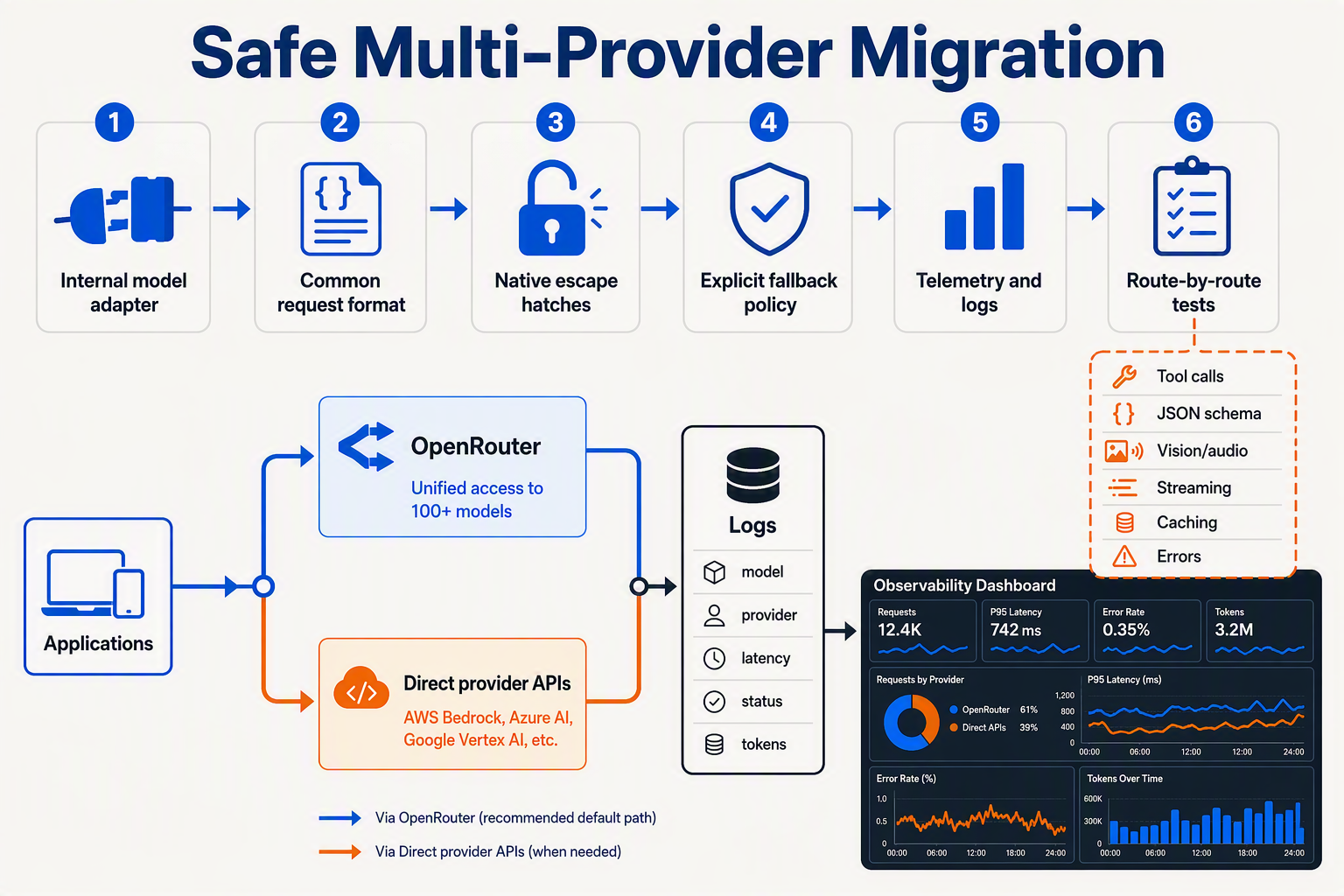
Migration is safest when you treat OpenRouter as a routing layer—not a complete replacement for every provider-native feature. Keep a stable internal interface, then preserve provider-specific controls through explicit adapters and fallbacks.
Migration checklist
- Define a capability matrix: Track supported context windows, tool calling, structured outputs, reasoning controls, streaming behavior, vision, and embedding support for every OpenRouter route and direct provider model.
- Use an internal adapter: Map application fields to a common schema, but retain an escape hatch for provider-native parameters; do not discard controls your production workloads depend on.
- Keep direct credentials available: Route standard traffic through OpenRouter while retaining direct OpenAI, Anthropic, Google, or other provider integrations for features unavailable through the gateway, regional requirements, or incident recovery.
- Validate model identifiers and limits: OpenRouter reviews list 200+ models, while Costbench lists 300+ models and a 20 requests-per-minute limit for free models, verified in July 2026; test the exact model-route combination rather than assuming identical quotas.
- Run a shadow migration: Send a small, non-user-visible sample to both paths and compare token usage, time to first token, complete latency, error codes, tool-call accuracy, and output quality before changing traffic weights.
- Make routing configurable: Use feature flags to send premium or capability-sensitive requests directly, while routing experiments and ordinary workloads through OpenRouter; this limits rollback to configuration changes.
- Reconcile billing correctly: OpenRouter documentation says inference follows underlying provider pricing without an inference markup, while Omid Saffari reports a 5.5% credit-purchase fee in 2026; compare total cost with direct API fees, engineering effort, and observability.
- Consider a broader gateway: CallMissed provides an OpenAI-compatible gateway spanning LLMs, speech, image generation, and web search, allowing teams to centralize integration while retaining model-level routing choices.
Frequently asked questions about OpenRouter vs direct provider APIs
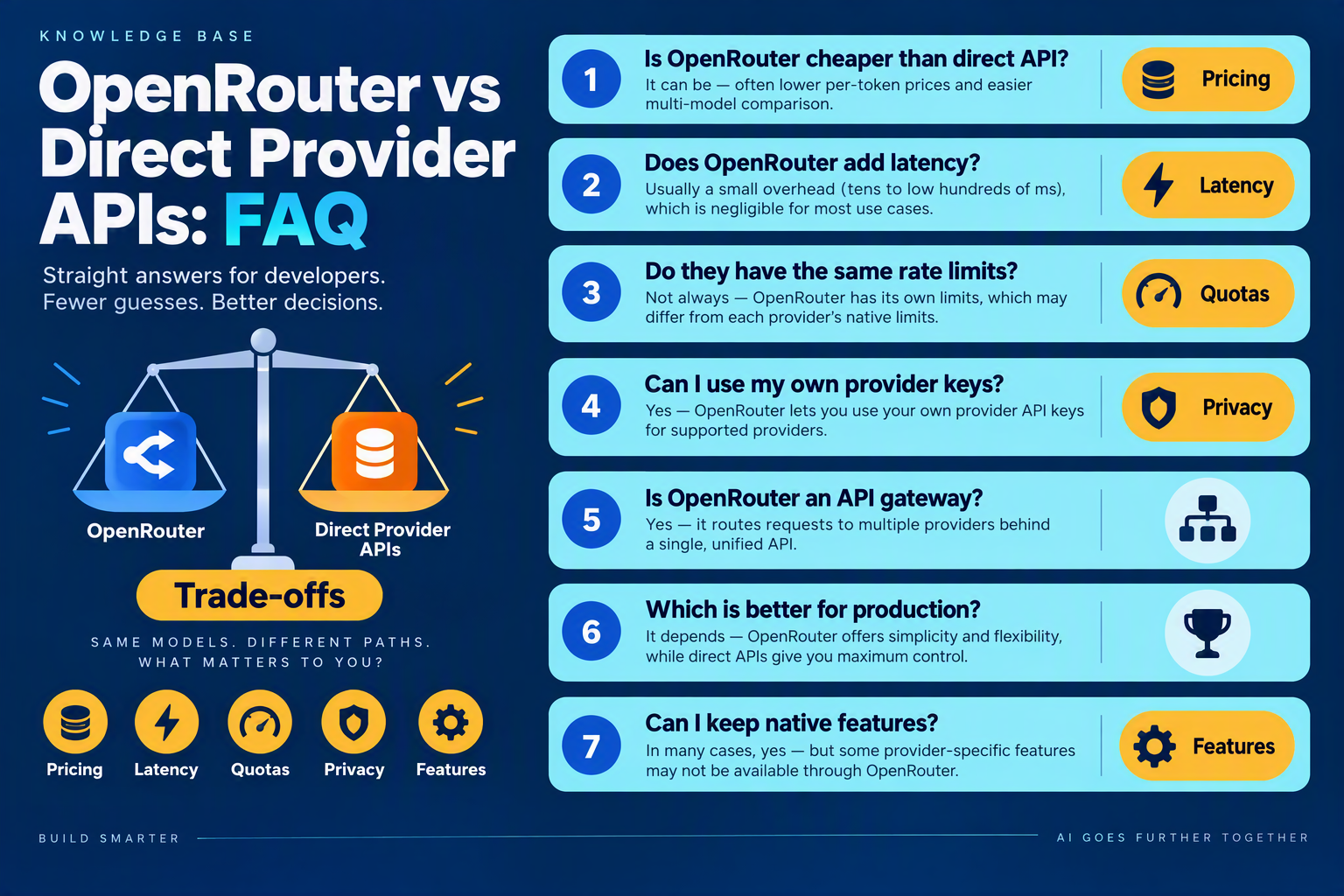
Is OpenRouter cheaper than direct provider APIs in 2026?
What is the latency difference between OpenRouter and direct provider APIs?
How do OpenRouter rate limits compare with direct provider API limits?
Can OpenRouter automatically switch models when a provider fails?
Is OpenRouter better for privacy and compliance than direct provider APIs?
What is an alternative to OpenRouter and direct provider APIs?
Conclusion
OpenRouter is generally the stronger fit for multi-model experimentation, routing, and simpler operations, while direct provider APIs remain preferable when predictable latency, native features, and provider-level quota control matter most. The practical decision is not only about token price; it is about the total cost of integration, monitoring, fallback engineering, and operational maintenance.
Key takeaways:
- OpenRouter offers breadth and convenience: A single OpenAI-compatible integration can reach models from OpenAI, Anthropic, Google, Meta, Mistral, Cohere, and independent providers. AISO Tools describes OpenRouter as supporting 200+ models, while other 2026 reviews list 300+ models.
- Pricing requires careful interpretation: OpenRouter documentation states that inference is passed through at underlying provider pricing without an inference markup, but Omid Saffari reports a 5.5% credit-purchase fee in 2026. Costbench’s July 2026 review lists a 20 requests-per-minute limit for free models. Direct APIs may avoid intermediary funding fees and support negotiated rates, but teams must account for engineering and infrastructure costs.
- Latency and rate limits involve trade-offs: Direct provider requests may use a shorter network path and expose clearer provider-specific quotas. OpenRouter can add gateway or routing overhead, yet its provider selection and fallback capabilities may reduce application-level delays during throttling or availability issues.
- Architecture should match production priorities: Use direct APIs when one provider, stable capacity, and maximum control dominate. Use OpenRouter when flexibility, rapid model evaluation, and a unified operational layer create more value than a direct network path.
Looking ahead, watch how providers evolve rate-limit tiers, enterprise discounts, routing transparency, and fallback behavior. As model catalogs expand, the cost of maintaining multiple native integrations may become more significant than small differences in per-token pricing. At the same time, latency-sensitive workloads will still need measured, production-specific benchmarks rather than assumptions based on API architecture alone.
Developers building communication products can also explore unified infrastructure beyond text generation. CallMissed provides an OpenAI-compatible gateway for multiple AI models and modalities, alongside AI voice agents, WhatsApp chatbots and Business calling, and speech support across 22 Indian languages—a practical example of how one integration can simplify broader AI communication workflows. Explore CallMissed to see how this infrastructure model is evolving.
The best choice in 2026 is the one that aligns model flexibility, pricing, latency, and rate-limit control with your actual workload. Will your next production system optimize for the shortest request path—or for the fewest integrations your team must maintain?
Related Reading
- Cheapest LLM API Provider in India (2026): Real Token Pricing, INR Cost Guide & Verdict
- Grok Bot Pricing 2026: Verified Access, Features, Risks and Limits
- Cheapest LLM API Provider India: 2026 Pricing Comparison
Sources
Discussion
Related Posts

Ready to automate customer conversations?
Launch AI voice agents and WhatsApp bots with CallMissed — one API, 22+ Indian languages.