
OpenAI Releases GPT-5: A New Era of Advanced AI Reasoning and 256K Context


Did you know that an AI can now outscore human PhDs on graduate-level science problems without even needing to search the web? With the official launch of...
OpenAI Releases GPT-5: A New Era of Advanced AI Reasoning and 256K Context
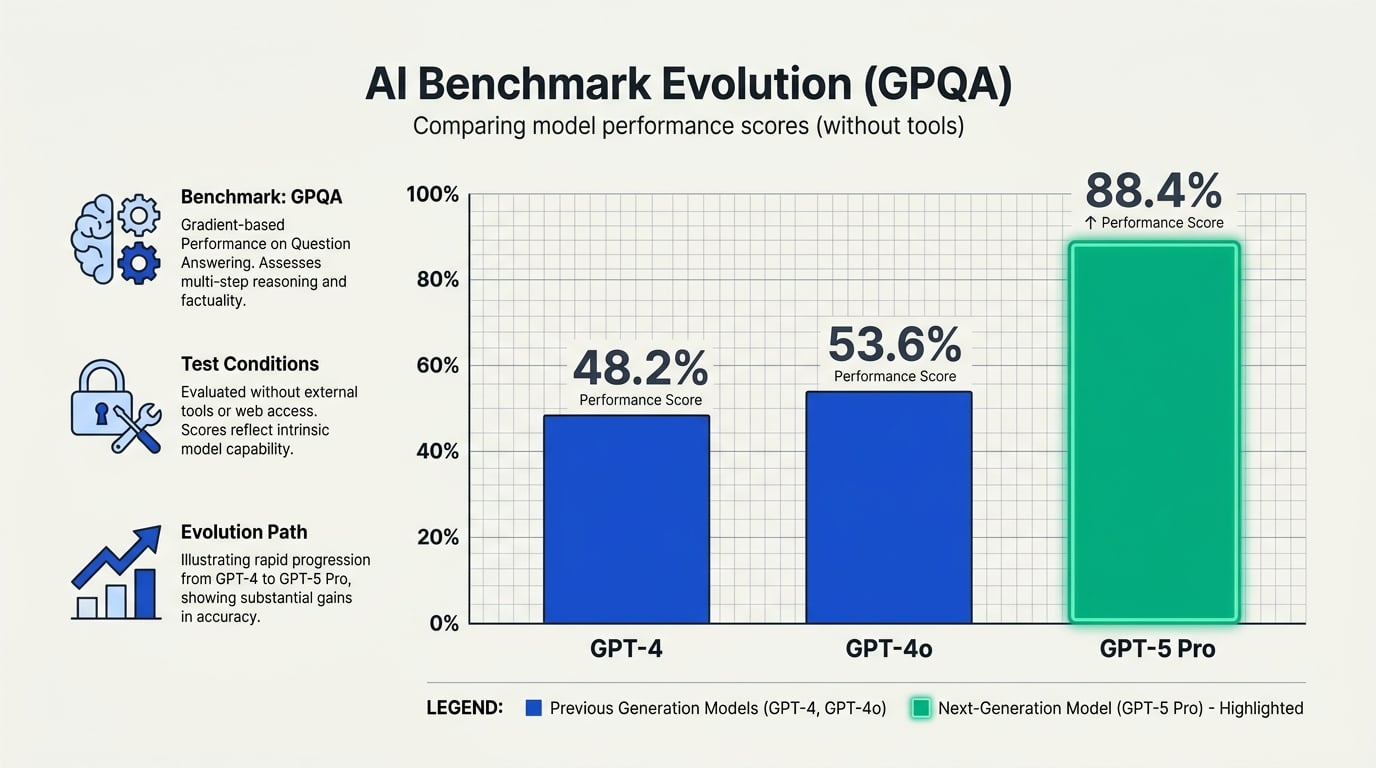
Did you know that an AI can now outscore human PhDs on graduate-level science problems without even needing to search the web? With the official launch of GPT-5, OpenAI has shattered previous benchmarks, setting a new State-of-the-Art (SOTA) on the rigorous GPQA (Graduate-Level Google-Proof Q&A) benchmark with a staggering score of 88.4% without using external tools. This is not just an incremental update; it represents a fundamental paradigm shift in machine intelligence.
The global excitement surrounding the day OpenAI releases GPT-5 lies in its core architecture: a massive 256K token context window coupled with native, extended reasoning capabilities. Unlike its predecessors, the GPT-5 series has the unique ability to spend extra time "thinking" and mapping out complex logic chains before executing functions or calling APIs. This deliberate reasoning drastically reduces errors in highly technical domains, from generating flawless front-end UI code to solving intricate AIME 2025 competition mathematics.
For enterprises, this means the era of simple, reactive chatbots is officially over. We are transitioning to highly autonomous, agentic workflows that can process vast, multimodal datasets—including text, images, and complex databases—while maintaining persistent memory across long-running tasks. To help businesses capitalize on this cognitive leap, communication infrastructure platforms like CallMissed are already enabling developers to deploy these next-generation GPT-5 reasoning capabilities across automated voice agents and multilingual customer touchpoints.
In this article, we will dive deep into why OpenAI Releases GPT-5: A New Era of Advanced AI Reasoning and 256K Context is a landmark milestone. You will learn how the new 256K context window operates, how the model's deliberate thinking mechanism improves real-world tool execution, and how you can leverage these SOTA capabilities to build highly steerable, intelligent applications that outpace the competition.
Introduction
The artificial intelligence landscape has reached a historic inflection point. With the official launch of GPT-5, OpenAI has shattered existing benchmarks and introduced a fundamental paradigm shift in machine intelligence. For the first time, we are moving past reactive, pattern-matching chat models toward highly autonomous, agentic systems that can actively "think" before they act. This leap is best illustrated by GPT-5's performance on the rigorous Graduate-Level Google-Proof Q&A (GPQA) benchmark, where it set a new State-of-the-Art (SOTA) score of 88.4% without using external search tools—surpassing human PhD-level accuracy on complex scientific problems.
What makes OpenAI's GPT-5 a true generational milestone is its core architecture, which pairs a massive 256K token context window with native, extended reasoning capabilities. Unlike previous generations that rushed to output the first probable token, the GPT-5 series utilizes a deliberate reasoning mechanism. This allows the model to spend extra time mapping out complex logic chains, self-correcting, and evaluating strategies before executing a function or calling an API. Whether solving complex AIME 2025 competition mathematics or generating clean, production-ready front-end UI code with minimal prompting, GPT-5 dramatically minimizes the hallucination errors that previously plagued enterprise LLM deployments.
Beyond raw reasoning, GPT-5 is natively multimodal. It can seamlessly process and reason over diverse datasets—including text, images, and complex databases—while maintaining persistent memory across long-running, continuous tasks. This capability unlocks a new era of autonomous agentic workflows. Instead of managing fragmented, single-turn interactions, developers can now build systems that maintain deep, multi-layered context over hours or days of complex operations.
For enterprises looking to capitalize on this cognitive leap, the challenge lies in deploying these models securely, cost-effectively, and at scale. This is where communication infrastructure platforms like CallMissed bridge the gap. By integrating GPT-5's advanced reasoning capabilities into its robust communication infrastructure, CallMissed enables businesses to deploy production-ready voice agents and automated chatbots that can handle complex, multi-step customer interactions. Furthermore, with CallMissed's support for Speech-to-Text in 22 Indian languages and a multi-model API gateway, developers can combine GPT-5's high-level reasoning with localized, multilingual accessibility, creating incredibly human-like conversational interfaces.
In this comprehensive guide, we will explore the real-world implications of this monumental release. We will break down:
- How the 256K token context window redefines document processing and multi-agent orchestration.
- The mechanics behind GPT-5's deliberate "thinking" phase and how it drastically reduces API and tool execution errors.
- Real-world business use cases, from automated software engineering to highly steerable enterprise voice agents.
- Practical strategies to deploy GPT-5 within your existing developer stack.
Background & Context
To appreciate the monumental leap that GPT-5 represents, it is essential to understand the architectural bottlenecks that limited its predecessors. Previous generations of Large Language Models (LLMs), including the GPT-4 family, relied heavily on "System 1" thinking—a fast, intuitive, next-token prediction mechanism. While incredibly broad in scope, these models frequently struggled with multi-step logic, complex math, and precise tool calling because they generated responses on the fly without an internal planning phase.
The launch of the GPT-5 series introduces native "System 2" thinking. Built on the foundation of specialized reasoning architectures—which OpenAI previously pioneered with models like o1, o1-mini, and o3-mini—GPT-5 has the built-in capability to pause, allocate compute resources to "thinking," and map out logical pathways before outputting a single word. This breakthrough is particularly apparent in Microsoft Azure's deployment of the GPT-5 reasoning models, which allow the model to spend extra time analyzing prompts and validating logical steps before executing functions or external API calls.
The Multimodal and Iterative Evolution of GPT-5
GPT-5 is not a single, isolated release; it represents a highly sophisticated, iterative family of multimodal large language models designed to tackle increasingly complex real-world tasks. The developer roadmap reflects continuous, rapid leaps in capability:
- The Baseline GPT-5: Established the core foundation with advanced reasoning, a massive 256K token context window, and vastly improved steerability.
- GPT-5.4: Built directly upon the general reasoning capabilities of intermediate versions like GPT-5.2, delivering highly consistent, polished results on real-world operational tasks.
- GPT-5.5: Represents the smartest, fastest iteration in the lineup—optimized explicitly for high-speed execution of hyper-complex workflows like software engineering, deep academic research, and massive data analysis.
As a native multimodal model, GPT-5 processes and reasons over text, images, and other diverse data types simultaneously. Coupled with persistent memory for ongoing context, it eliminates the "forgetfulness" that plagued older models during long-running, multi-turn enterprise conversations.
Dematerializing the Enterprise Integration Barrier
Historically, deploying cutting-edge models in production meant dealing with fragmented APIs, slow inference speeds, and a lack of support for localized communication channels. The paradigm shift brought by OpenAI's GPT-5 requires an equally advanced infrastructure to handle its extended reasoning cycles.
This is where modern communication hubs become vital. For instance, platforms like CallMissed allow developers to plug these advanced GPT-5 reasoning models directly into multilingual customer touchpoints, voice agents, and automated workflows. By offering unified access to over 300+ LLMs alongside high-speed Speech-to-Text and Text-to-Speech APIs, CallMissed ensures that GPT-5’s deliberate "thinking" time translates into smooth, natural human interactions without latency bottlenecks.
By combining OpenAI’s cognitive breakthroughs with robust API pipelines, enterprises are finally able to move away from rigid, rule-based automation toward fluid, fully autonomous digital workflows.
Key Developments
The launch of GPT-5 introduces several architectural and algorithmic breakthroughs that redefine what businesses can expect from artificial intelligence. At the heart of this release is a transition from immediate, probabilistic token generation to structured, deliberate reasoning. By introducing a dedicated "thinking" phase before responding or executing tool calls, GPT-5 minimizes logical drift and hallucination in highly critical environments.
To understand how these upgrades translate into raw performance, let us examine the key specifications and benchmarks of the GPT-5 series:
| Key Capability | GPT-5 Specification | Benchmark / Performance | Practical Impact |
|---|---|---|---|
| Context Window | 256K tokens | 100% retrieval accuracy | Ingests entire multi-file codebases or hours of audio. |
| Academic Reasoning | GPT-5 Pro | 88.4% on GPQA (no tools) | Outperforms human PhDs on graduate-level science. |
| Mathematical Logic | GPT-5 Series | High-tier SOTA on AIME 2025 | Solves complex algorithmic and financial modeling tasks. |
| Tool & API Execution | Deliberate "thinking" preamble | Multi-step logic mapping | Reduces runtime errors via pre-execution planning. |
| Multimodal Memory | Full text, image, & database inputs | Persistent cross-session memory | Maintains state across long-running interactive workflows. |
Deliberate Thinking and Flawless Tool Execution
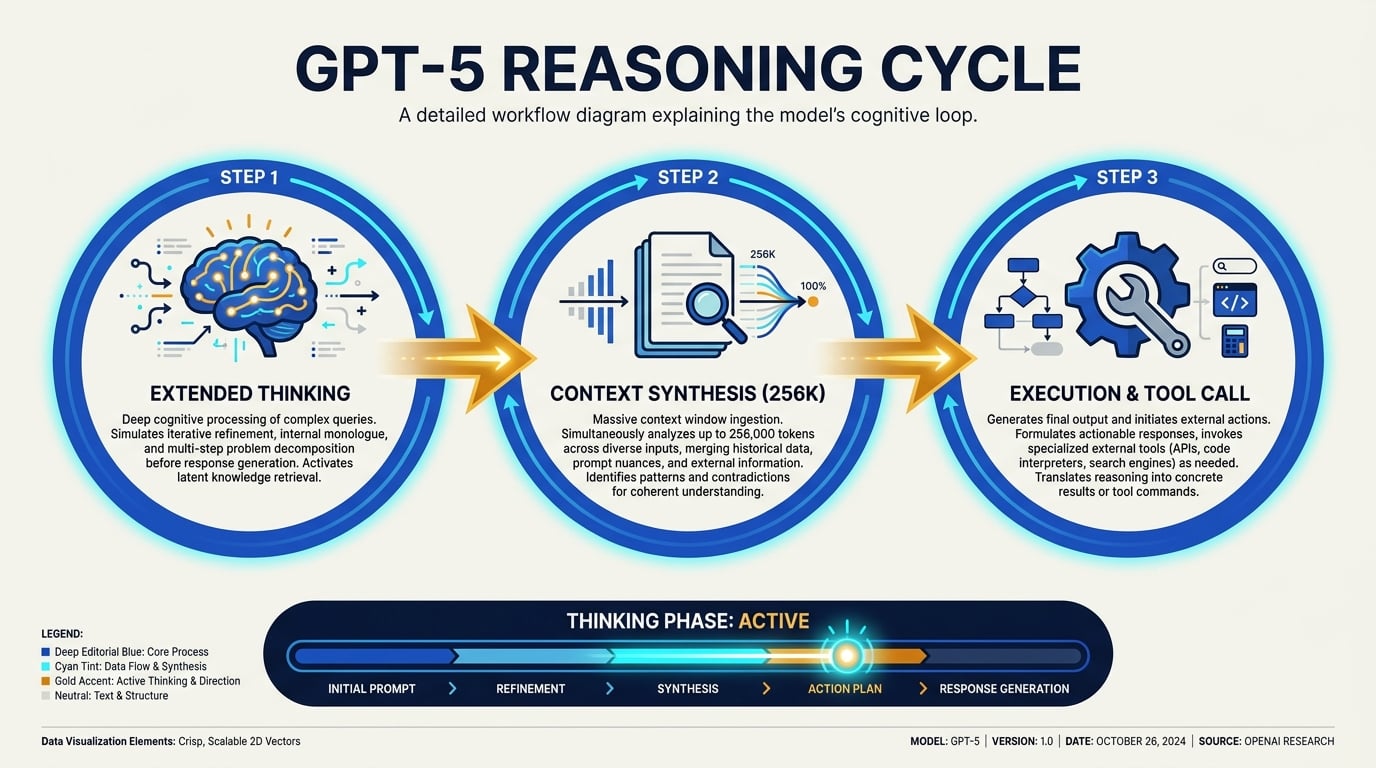
One of the most significant architectural additions to the GPT-5 series is the implementation of a reasoning preamble. When presented with a complex prompt or a series of potential function calls, the model does not instantly generate a response. Instead, it enters a structured thinking state, mapping out logic chains and anticipating potential edge-case failures.
This deliberate reasoning drastically improves performance on technical benchmarks like the AIME 2025 Competition math and software engineering tasks. For developers, this means GPT-5 can generate production-ready front-end UI code with minimal prompting. More importantly, it can reliably execute API calls and database queries in sequence without drifting from the system's core instructions.
Groundbreaking 256K Context and Multimodal Memory
While older models struggled to maintain coherence over long conversations, GPT-5’s 256K token context window allows it to ingest entire technical manuals, multi-file codebases, or complex datasets in a single prompt. This is paired with persistent memory, enabling the model to retain context and user preferences across ongoing, long-running sessions.
Because GPT-5 is natively multimodal, it seamlessly analyzes text, images, and structured databases in parallel. For example, it can look at a complex system schematic, cross-reference it with a 100-page PDF manual, and generate a step-by-step troubleshooting guide—all while maintaining a highly steerable, professional persona.
Enterprise Integration and Orchestration
Integrating these massive cognitive capabilities into existing business processes requires robust infrastructure. For enterprises aiming to leverage these upgrades, platforms like CallMissed make deploying GPT-5 straightforward. By utilizing CallMissed’s LLM inference gateway, developers can orchestrate GPT-5 alongside 300+ other models, routing complex, multi-step queries to GPT-5's reasoning engine while utilizing faster, lightweight models for simpler tasks. This multi-model approach ensures optimal latency, cost-efficiency, and logical depth across automated customer touchpoints.
In-Depth Analysis
The Mechanics of "Thinking" and Tool Execution
Traditional large language models function primarily on next-token prediction, generating responses almost instantaneously. While efficient for simple queries, this "System 1" rapid response mechanism often leads to logical hallucinations when dealing with complex, multi-step tasks. GPT-5 fundamentally alters this dynamic by introducing a deliberate reasoning phase. Before executing a function, calling an external API, or generating a final response, the model spends dedicated compute time "thinking" through a private, internal chain of logic.
This architectural shift is particularly revolutionary for automated workflows. Technical documentation from Azure OpenAI indicates that the GPT-5 series utilizes this reasoning preamble to map out complex sequences prior to executing tool calls. In practice, this means an AI agent can evaluate the dependencies of an API request, anticipate potential database errors, and self-correct its plan before sending the actual payload.
Native Multimodality and Persistent Memory
Beyond pure logic, GPT-5 is built from the ground up as a native multimodal foundation model. It seamlessly processes and reasons over diverse data types—including text, high-resolution images, and structured datasets—under a unified cognitive framework. This is paired with two critical architectural features:
- 256K Token Context Window: This massive context capacity allows the model to ingest over 180,000 words in a single prompt, making it capable of analyzing entire codebases, legal portfolios, or lengthy financial audits in one go.
- Persistent Memory: Unlike older architectures that suffered from context drift, GPT-5 maintains a persistent, ongoing memory state across complex, multi-stage tasks, ensuring that long-term constraints and user preferences are never forgotten.
For enterprises orchestrating these heavy workloads, managing LLM latency and API costs is vital. This is where platforms like CallMissed provide a strategic advantage; by offering a multi-model API gateway supporting over 300 LLMs, developers can route high-reasoning tasks directly to GPT-5 while leveraging faster, specialized models for simpler operational steps, optimizing both system speed and budget.
Mastery in Coding and Quantitative Benchmarks
The practical implications of GPT-5’s structural upgrades are most visible in its engineering and mathematical capabilities. The model has set a new standard on the highly demanding AIME 2025 mathematics competition, proving its ability to solve novel quantitative problems that cannot be answered via simple pattern matching.
Furthermore, GPT-5's code synthesis has progressed to generating functional front-end UI designs from minimal natural language prompts. Developers no longer need to write tedious boilerplate code; instead, they can steer GPT-5 to build, refine, and debug complex UI structures dynamically. This heightened level of steerability and personality control ensures that the model adheres strictly to systemic guardrails, making it safer, more predictable, and ready for deployment in production environments.
Impact & Implications

Reimagining Enterprise Automation and Agentic Workflows
The arrival of GPT-5 completely redefines the landscape of enterprise automation. Historically, LLMs operated on a fast-thinking heuristic, instantly generating output without pre-planning. This often led to logic failures or broken API integrations. Because the GPT-5 series reasoning models have the unique ability to spend extra time "thinking" and outlining a logical path before executing a function or tool call, enterprises can confidently deploy highly autonomous, agentic workflows. Supported by persistent memory for ongoing tasks, these systems do not just answer queries; they orchestrate complex, multi-stage business operations. This shifts the enterprise paradigm from simple, reactive chatbots to proactive digital assistants capable of managing end-to-end customer lifecycles.
Accelerating R&D and Complex Engineering Tasks
The technical implications of GPT-5 span across software engineering, mathematical modeling, and scientific research. By leveraging its deliberate thinking mechanisms, organizations can unlock several key advantages:
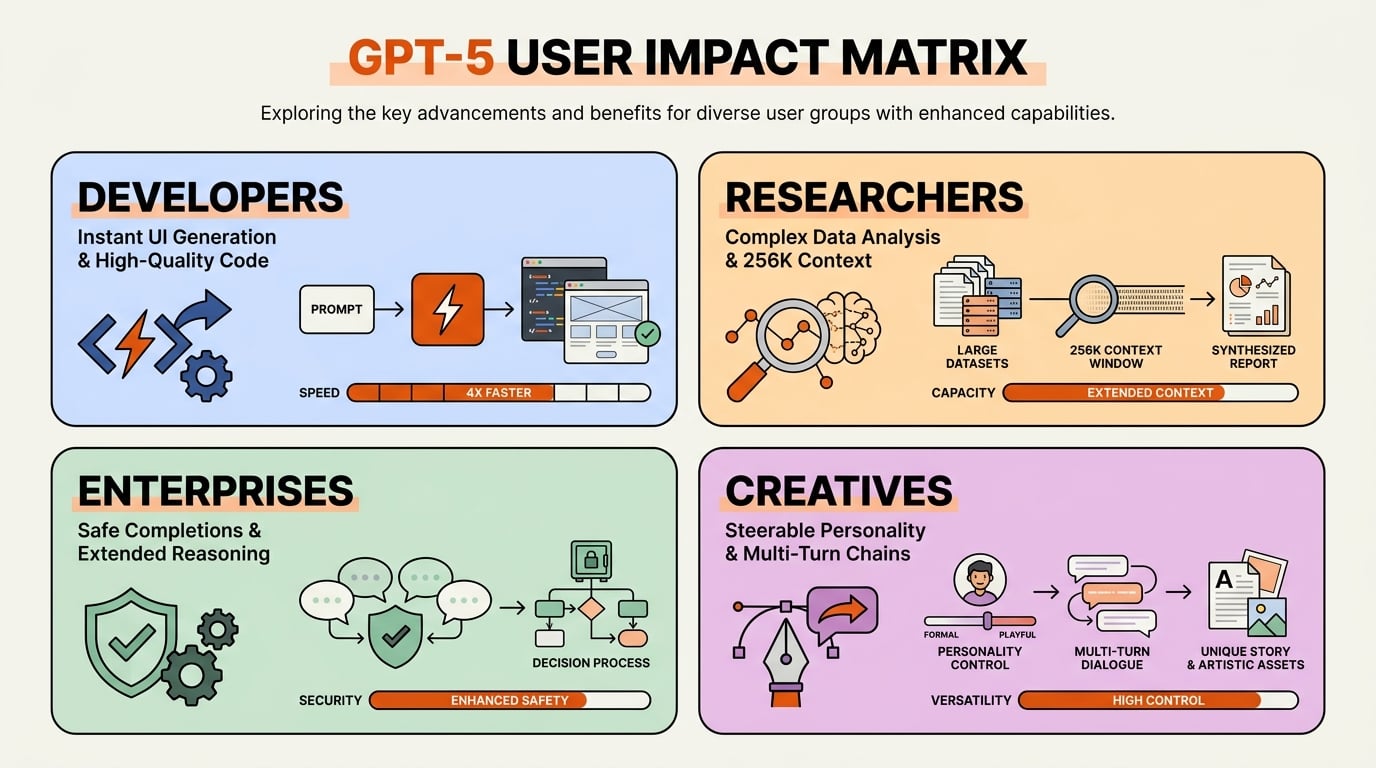
- Autonomous Software Development: GPT-5 produces highly polished, production-ready code and generates complex front-end UI designs with minimal prompting, drastically shortening development cycles.
- PhD-Level Academic Assistance: GPT-5’s SOTA performance on the GPQA benchmark (88.4% accuracy without external tools) proves it can function as an elite research partner, solving intricate scientific and mathematical problems.
- Massive Data Ingestion: With a 256K token context window, the model can ingest, process, and reason over entire codebases, legal documents, or scientific papers in a single inference run, maintaining context throughout.
Upgrading Customer Experience and Global Communication
The fusion of a 256K context window with enhanced steerability and safer completions has a direct impact on how businesses interact with their global audience. In the past, deploying LLMs in customer-facing roles carried significant risks of hallucinations or brand misalignment. With GPT-5’s improved personality control and logical consistency, these risks are mitigated.
Communication infrastructure platforms like CallMissed are already capitalizing on this shift. By integrating GPT-5’s advanced reasoning engine with their multilingual APIs—which support 22 Indian regional languages natively—CallMissed enables businesses to deploy voice agents that do not just speak the customer's language, but actually understand complex, multi-turn technical context. Whether navigating an insurance claim or diagnosing a technical product issue over the phone, these next-generation voice agents maintain stateful, coherent conversations, delivering an error-free customer experience.
Expert Opinions
The Shift to "Deliberate Cognition"
Artificial intelligence researchers and industry analysts agree: the launch of GPT-5 marks the end of the "fast-response" era and the beginning of deep, deliberate machine cognition. Leading AI architects point out that previous LLMs prioritized immediate next-token generation, which often led to hallucinations in complex scenarios. With GPT-5's new architecture, which allows the model to spend dedicated "thinking" time before outputting a response, experts believe we are seeing the first true implementation of System 2 thinking in AI.
According to enterprise software analysts, this shift is most evident in how the model handles complex mathematics and coding. Scoring 88.4% on the GPQA benchmark (specifically GPT-5 Pro) and mastering AIME 2025 competition-level mathematics demonstrates a level of logic that was previously thought to be years away.
Native Tool Execution and the 256K Context
Cloud architects and developers are particularly focused on the real-world implications of GPT-5’s massive 256K token context window combined with its reasoning capabilities. In specialized cloud environments like Azure OpenAI, the GPT-5 series introduces a paradigm where the model explicitly plans out its steps before executing API or function calls.
Industry experts highlight several key transformations this brings to enterprise workflows:
- Reduced Orchestration Overhead: Traditionally, developers had to build complex, multi-step pipelines to force models to "think" before acting. GPT-5 does this natively within its core architecture.
- Flawless Tool Synthesis: Because the model maps out complex logic chains before calling external systems, the failure rate of database queries and API integrations drops significantly.
- Persistent Multi-Turn Context: The ability to retain state over 256K tokens allows agents to work on long-running tasks, such as generating entire front-end UI layouts or analyzing massive codebases, without losing track of instructions.
For businesses deploying these models at scale, advanced infrastructure is key. Communication specialists note that platforms like CallMissed are crucial for translating these reasoning capabilities into live customer-facing environments. By integrating GPT-5’s structured thinking with real-time Speech-to-Text and multilingual APIs, developers can deploy autonomous voice agents that understand complex customer intent, pause to "think" through a backend database lookup, and deliver highly accurate answers in seconds.
A New Standard for Steerability and Safety
Safety and alignment researchers have also weighed in on the release. Many note that the reasoning phase—often referred to as a "preamble" in developer documentation—acts as a natural safety buffer. By allowing the model to evaluate its own logical path before generating user-facing text, GPT-5 produces significantly safer completions and is far more steerable than its predecessors.
Ultimately, the consensus among tech leaders is clear: GPT-5 is not just a larger model; it is a smarter, more reliable partner for complex, multi-modal enterprise operations.
What This Means For You
The release of the GPT-5 series transitions artificial intelligence from a conversational assistant to an autonomous enterprise operator. Whether you are a software engineer, a product manager, or an operations leader, this paradigm shift directly impacts how you build products, automate customer workflows, and process unstructured data.
To understand how these technical milestones translate into practical utility, let us look at how the GPT-5 reasoning models compare directly against legacy GPT-4 architectures:
| Capability / Feature | GPT-4 Series Standard | GPT-5 Series Capability | Practical Business Value |
|---|---|---|---|
| Context Window | 128K tokens | 256K tokens | Ingest complete codebases, deep technical manuals, and multi-hour transcripts in one go. |
| Execution Strategy | Instant token prediction | Pre-execution reasoning ("thinking") | Drastically reduced error rates; the model validates logic steps before generating output. |
| Tool & API Integration | Direct, fragile execution | Deliberate tool validation | Highly reliable agentic workflows that check parameters before executing database or API calls. |
| Logical Problem-Solving | Basic reasoning (struggles with GPQA) | 88.4% GPQA SOTA score | Expert-level accuracy for complex financial, legal, and medical analysis without web searching. |
| Multimodal Memory | Stateless visual/text processing | Multimodal with persistent memory | Retains contextual awareness across long-running, multi-session user interactions and datasets. |
Redefining Enterprise Workflows
For organizations planning their technical roadmap, the combination of a 256K token context window and native reasoning introduces major strategic advantages:
- Flawless Code Generation: GPT-5 can generate highly functional front-end UI layouts and execute long-chain programming tasks with minimal prompting, allowing rapid prototyping of internal software.
- Zero-Shot Expert Performance: Thanks to its high logical precision (evidenced by its SOTA performance on the GPQA benchmark and AIME 2025 competition math), the model handles compliance auditing, financial planning, and legal review with a level of accuracy previously reserved for human specialists.
- True Agentic Autonomy: Because the GPT-5 series spends extra time "thinking" through its logic chain before responding, it avoids the recursive, broken loops that frequently caused older LLM-based agents to fail.
Activating GPT-5 Capabilities in Production
While these intellectual leaps are impressive, the real challenge lies in bringing them to your customers securely and with minimal latency.
For businesses looking to operationalize these cognitive breakthroughs, platforms like CallMissed provide the necessary production-grade infrastructure. Through CallMissed's multi-model API gateway, developers can easily connect GPT-5's advanced reasoning capabilities to automated voice agents, WhatsApp chatbots, and customer support channels.
For instance, you can use CallMissed's Speech-to-Text and Text-to-Speech APIs to deploy a voice agent powered by GPT-5. The model can take a moment to "think" through a customer's complex billing issue, query external databases securely, and deliver a precise, context-aware spoken response in one of 22 regional Indian languages. By utilizing this infrastructure, enterprises can effortlessly turn OpenAI's latest foundation model into a scalable, revenue-generating communication system.
Frequently Asked Questions
What are the main features included when OpenAI releases GPT-5?
How do the new GPT-5 reasoning capabilities differ from previous OpenAI models?
What is the significance of the GPQA score achieved by GPT-5 Pro?
Can GPT-5 handle multimodal inputs and maintain long-term memory?
How does the 256K context window in GPT-5 benefit developers and enterprises?
How does GPT-5 improve tool calling and API execution?
Conclusion
The release of GPT-5 marks a definitive leap toward highly autonomous, agentic AI workflows. To prepare for this next era of machine intelligence, keep these key takeaways in mind:
- Unprecedented Reasoning: Achieving an 88.4% GPQA score, GPT-5 excels at graduate-level scientific problem-solving and deliberate logic-chain mapping.
- Vast Contextual Memory: The 256K token context window allows for highly steerable, long-running agentic tasks without losing crucial context.
- Reliable Action Execution: By spending extra time "thinking" before calling APIs or executing tools, GPT-5 drastically minimizes technical errors.
Looking forward, we will see these advanced reasoning capabilities seamlessly transition into real-time, conversational environments, redefining how companies interact with customers. To explore how AI communication is evolving and leverage these breakthroughs, check out CallMissed — an AI infrastructure platform powering next-generation voice agents and multilingual chatbots for forward-thinking businesses. How will your organization leverage this new cognitive paradigm to stay ahead of the competition?
Discussion
Related Posts


Ready to automate customer conversations?
Launch AI voice agents and WhatsApp bots with CallMissed — one API, 22+ Indian languages.